A Retired K9 Hadn’t Tracked in 4 Years—Then a Little Boy Vanished in a Snowstorm and the Old Dog Pawed at His Forgotten Harness
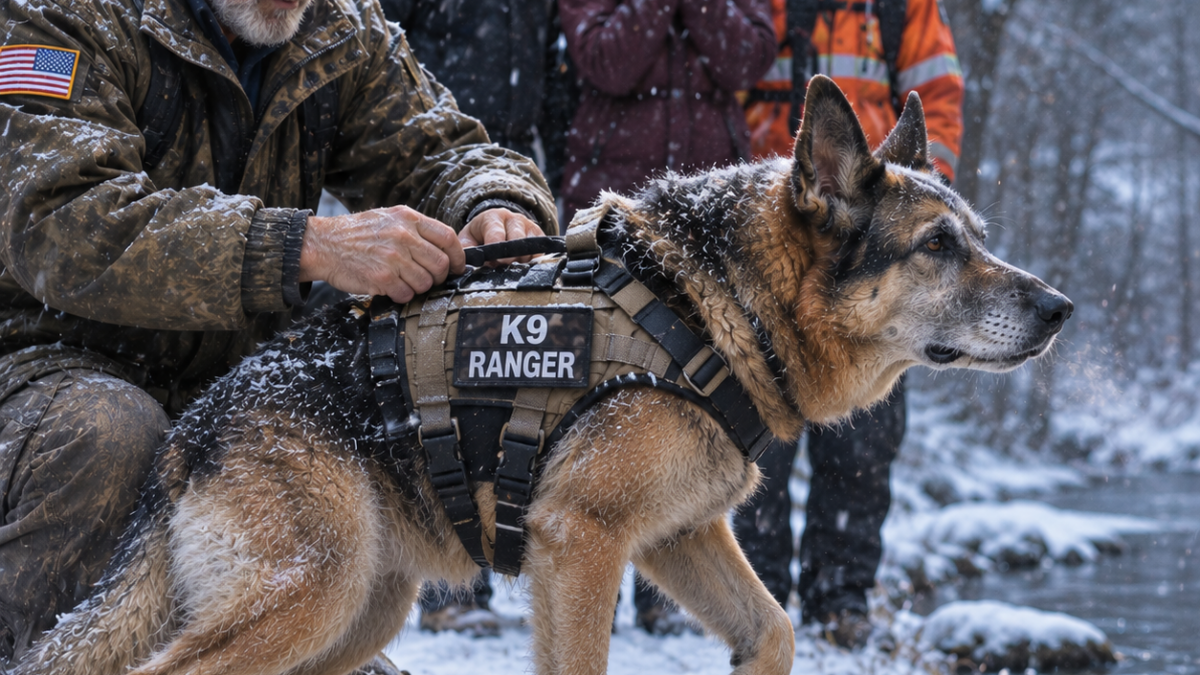
A Retired K9 Hadn’t Tracked in 4 Years—Then a Little Boy Vanished in a Snowstorm and the Old Dog Pawed at His Forgotten Harness
For four years, retired search K9 Ranger had done nothing more dangerous than limp from the fireplace to his food bowl, but when six-year-old Noah Whitmore disappeared during the worst snowstorm Virginia had seen in a decade, the old German Shepherd walked into the garage and pawed beneath the tracking harness nobody had touched since his retirement.
The volunteer search teams had already lost Noah’s trail beneath six inches of fresh snow when Ranger’s former handler, Grant Ives, clipped that faded harness onto his gray-haired partner one final time—and watched the dog change from a tired old pet into the K9 who had once brought thirty-one missing people home.
Then Ranger reached the frozen creek, ignored the footprints everyone else was following, and pulled Grant toward a section of ice where no child’s tracks existed at all, forcing the retired handler to decide whether he still trusted the dog enough to follow him when every human searcher was telling him to turn back.
At 6:14 on a Thursday evening, Grant Ives was standing in his kitchen arguing with a coffee maker.
The machine had been leaking for two weeks.
Grant had known this for thirteen days.
He had also known exactly how to fix it for twelve.
But repairing it meant walking into the garage, finding the right wrench, and admitting that he had become the kind of fifty-eight-year-old man who could spend more effort avoiding a ten-minute repair than simply doing it.
So he stood barefoot in the kitchen with a towel under the machine and said:
“You win.”
From the living room, Ranger lifted his head.
The old German Shepherd lay on a thick orthopedic bed beside the fireplace.
Eleven years old.
Almost twelve.
His once-dark muzzle had turned silver.
His right ear still stood sharply while the left leaned outward from an old injury.
His hindquarters had thinned.
Arthritis had begun stealing small things from him.
Stairs.
Cold mornings.
Jumping into Grant’s truck.
Long walks that once meant nothing.
Four years earlier, Ranger could track a frightened child across rocky ground, search collapsed buildings, clear acres of woodland, and run for hours beside Grant without losing focus.
Now he sometimes needed two attempts to stand.
Grant looked toward him.
“Don’t judge me.”
Ranger blinked.
“You’ve eaten your own vomit.”
No reaction.
“So morally, I’m ahead.”
The dog lowered his head.
Grant smiled.
Outside, snow pressed against the kitchen windows.
The storm had begun before noon.
By five, the local schools had closed early.
PART2:
By six, the road beyond Grant’s farmhouse had disappeared beneath white.
Weather forecasters predicted ten inches overnight.
Maybe fourteen farther west.
Grant had already stacked firewood on the porch.
Filled water jugs.
Charged flashlights.
Moved his truck beneath the barn overhang.
Retirement from the Hawthorne County Sheriff’s Office had not stopped him from preparing for emergencies nobody else expected.
Some habits survived careers.
Ranger had retired with him.
That part had never been negotiable.
The dog belonged to the county on paper until the paperwork caught up with what every deputy already knew.
Ranger had been Grant’s partner.
When the K9 retired, Grant signed one form, paid the ceremonial one-dollar adoption fee, and drove home with the dog sitting in the passenger seat like nothing had changed.
A lot changed.
No radio calls.
No midnight tracks.
No children missing in woods.
PART3:
No elderly dementia patients wandering away from homes.
No suspects running from cars.
No search harness hanging beside the kennel door.
Grant placed Ranger’s old equipment on hooks in the garage.
The tracking harness.
A twenty-foot lead.
Booties Ranger hated.
A red search vest.
A leather collar scarred from years of work.
For months Ranger would walk into the garage and look at the harness.
Then eventually he stopped.
Four years passed.
Grant became just Grant.
Ranger became just Ranger.
That had been the plan.
At 6:22, somebody pounded on the front door.
Ranger was standing before Grant reached the hallway.
Not barking.
Alert.
Grant glanced at him.
“You still have that?”
The knock came again.
He opened the door.
Wind threw snow into the entryway.
Mara Whitmore stood on the porch without a coat zipped properly.
Thirty-two.
Dark hair full of snow.
Face white with fear.
Grant knew her from three houses down.
Single mother.
Elementary school teacher.
Her son Noah sometimes rode his bicycle past Grant’s mailbox in summer.
“Grant.”
Something in her voice erased the quiet evening.
“What happened?”
“Noah’s gone.”
Grant stopped.
“What do you mean gone?”
“He was in the backyard.”
“In this?”
“Before it got this bad.”
Her words collided.
“He wanted to bring in his sled.”
“I was making dinner.”
“I looked away maybe five minutes.”
“The gate was open.”
“I thought he’d gone to Mrs. Collins’s.”
“He wasn’t there.”
“How long?”
Mara looked at her phone.
“I don’t know.”
Grant’s voice sharpened.
“How long since you saw him?”
“Forty-five minutes.”
He was already reaching for boots.
“You called 911?”
“Yes.”
“They’re coming.”
“Who’s searching?”
“Neighbors.”
“No.”
Grant looked at her.
“No one searches randomly. You destroy tracks.”
Mara began crying.
“I didn’t know.”
“I know.”
His tone softened immediately.
“Stay here.”
“Why?”
“Because your house is the point he comes back to.”
“I’m not staying.”
“Mara.”
“He’s six.”
“I know.”
“He doesn’t have his heavy coat.”
Grant stopped putting on his jacket.
“What is he wearing?”
“Blue puffer jacket. Gray sweatpants. Snow boots.”
“Hat?”
“Red knit hat.”
“Gloves?”
“One.”
“What?”
“He lost one yesterday.”
Grant nodded.
“Any reason he’d leave?”
“No.”
“Upset?”
“No.”
“Friends?”
“He wanted to see the creek.”
Grant’s head came up.
“What creek?”
“The trail behind Mr. Donnelly’s property.”
Grant looked through the front window.
Wind-driven snow crossed the yard sideways.
Hawthorne Creek ran less than a mile behind the neighborhood.
In summer, children caught minnows there.
In winter, shallow sections froze.
The deeper channel did not.
Grant pulled on his coat.
Mara saw his face.
“What?”
“Nothing.”
“That wasn’t nothing.”
“We’re checking the creek.”
Ranger stood beside him.
Grant looked down.
“No.”
The dog’s ears lifted.
“You stay.”
Ranger stepped toward the door.
“No.”
Grant pointed toward the living room.
“Bed.”
Ranger did not move.
Mara looked at the dog.
“Can he help?”
Grant shook his head.
“He’s retired.”
“He was search and rescue.”
“Four years ago.”
“But he can smell.”
“He also has arthritis.”
Mara looked at him with the desperation of a mother for whom every possible option had become reasonable.
“Please.”
Grant knew that look.
He had seen it for eighteen years.
Parents did not care about probabilities.
They cared about their child.
But dogs were not machines.
Working ability faded.
Endurance disappeared.
Cold hurt old joints.
Deep snow would exhaust Ranger quickly.
Grant looked down.
The shepherd looked back.
“No.”
Ranger walked away.
Grant exhaled.
“Good.”
He grabbed a flashlight.
Then noticed where Ranger was going.
Garage.
“Ranger.”
The dog pushed his nose against the interior garage door.
Grant stopped.
Ranger pawed it.
Once.
Again.
Mara whispered:
“What’s he doing?”
Grant opened the door.
Cold air entered.
Ranger walked inside.
Past the lawn mower.
Past shelves.
Past an old patrol equipment trunk.
Straight to the wall.
The tracking harness hung from a steel hook.
Dust covered the upper strap.
Ranger stood beneath it.
Looked up.
Then pawed the wall.
Grant did not move.
Ranger pawed again.
The old dog looked over his shoulder.
Something tightened in Grant’s chest.
“No.”
Ranger stared.
“You haven’t worn that in four years.”
The dog stepped beneath the harness.
Mara covered her mouth.
Grant entered slowly.
He reached up.
His fingers touched the strap.
The harness had once been black.
Sun and years had faded it almost charcoal gray.
Brass ID plate:
K9 RANGER
HAWTHORNE COUNTY SHERIFF
Grant took it down.
Ranger immediately stood straighter.
Grant felt a memory so strong it was almost physical.
Two in the morning.
Radio static.
Rain.
Ranger bouncing beside the patrol truck while Grant clipped the harness.
Search.
Find him.
Good boy.
Grant crouched.
“Buddy.”
Ranger pressed his nose against the harness.
“You’re old.”
Tail moved.
“So am I.”
Another tail movement.
Grant looked at Mara.
She said nothing.
Did not beg again.
She understood this choice was not hers.
Grant looked back at the dog.
“One track.”
Ranger stood.
“One.”
Grant slid the harness over him.
Adjusted the chest strap.
His hands remembered every buckle.
Ranger’s body changed.
Not younger.
That would have been sentimental nonsense.
His hips still hurt.
His muzzle remained gray.
His breathing remained older.
But his focus returned.
Eyes bright.
Mouth closed.
Weight forward.
Grant felt tears rise unexpectedly.
“Oh, hell.”
Ranger looked at him.
“Don’t make me regret this.”
He clipped the long line.
Then said the words neither of them had heard in four years.
“Want to work?”
Ranger barked once.
Mara began crying again.
The sheriff’s first patrol unit arrived four minutes later.
Deputy Claire Bennett stepped out.
Snow coated her uniform shoulders.
She recognized Grant immediately.
“Captain?”
“Retired.”
“Not tonight, apparently.”
She saw Ranger.
Her eyebrows rose.
“Is that who I think it is?”
“Yeah.”
“I thought he retired.”
“He did.”
“So did I.”
Claire looked at Mara.
“Give Ranger something Noah wore today.”
Mara ran home.
Returned with a blue sweatshirt from the laundry basket.
Grant stopped her before she brought it near the dog.
“Anyone else touch this?”
“Me.”
“Fine.”
He held the sweatshirt low.
Ranger sniffed.
Once.
Again.
Longer.
Grant waited.
No noise.
No encouragement.
Then Ranger lifted his head.
Grant whispered:
“Find Noah.”
The dog moved.
Straight toward Mara’s property.
The neighborhood had changed since Ranger worked.
New fences.
New decks.
New families.
But search behavior had not.
Ranger circled the backyard.
Sniffed near the sled.
Gate.
Stopped.
Nose down.
Moved through.
Grant followed on the line.
Claire radioed.
“K9 has possible trail east from residence.”
The search coordinator answered:
“Confirm active certified K9?”
Claire looked at Grant.
Grant shook his head.
Claire said:
“Retired K9 with former certified handler. Consider supplemental only.”
That was fair.
Grant wanted no authority Ranger no longer officially had.
Search decisions would not rest on an old dog.
Ranger did not care.
He tracked through two yards.
Across Willow Lane.
Toward the field behind the elementary school.
Snow fell hard enough that prints vanished within minutes.
A group of volunteers had already crossed part of the area.
Ranger worked through contamination.
Slow.
Methodical.
Grant watched every movement.
The dog was rusty.
No pretending otherwise.
He checked too many side scents.
Paused longer than he once would have.
Twice Grant wondered whether the track was gone.
Then Ranger corrected himself.
Kept moving.
Twenty minutes.
Half mile.
The dog began breathing harder.
Grant slowed him.
“Easy.”
Ranger ignored him.
“Easy.”
They reached the tree line.
Mara followed fifty yards behind with Claire.
Grant turned.
“You need to go back.”
“No.”
“You’re distracting him.”
That was only partly true.
Mara stopped immediately.
Whatever argument she had planned disappeared.
“Find him.”
Grant nodded.
“We’re trying.”
Ranger entered the woods.
Snow softened every sound.
Flashlights moved between trees.
Radio voices seemed distant.
Grant could hear Ranger breathing.
Could hear his own knee clicking.
Could hear snow falling from branches.
Then Ranger stopped.
Grant stopped too.
The dog raised his head.
Air-scented.
Turned left.
Then right.
Trail uncertain.
Grant’s heart tightened.
Four years ago he would have known instantly whether Ranger had lost scent or was working a complicated pool.
Now he second-guessed himself.
That scared him.
“Ranger.”
The dog looked back.
Grant crouched.
“Take your time.”
Ranger sniffed again.
Moved.
Thirty yards.
Then emerged onto an old logging track.
Three volunteer searchers stood there.
One pointed.
“We found footprints.”
Child-sized marks led north.
Grant looked.
Fresh enough to matter.
Ranger crossed them.
Did not follow.
The volunteer frowned.
“Hey.”
Grant let the dog continue.
“Tracks go that way.”
“I see them.”
“Kid’s boot size.”
“Maybe.”
Ranger pulled south.
Opposite direction.
The volunteer pointed north again.
“You’re going wrong.”
Grant looked at Ranger.
The dog’s head remained low.
Committed.
“Maybe.”
Then followed him.
The volunteers radioed the footprint discovery.
The main search shifted north.
Grant heard the instruction.
“All units concentrate north logging road toward Miller property.”
Claire called him.
“Grant, command wants everybody north.”
“Ranger has something south.”
“Footprints are north.”
“I know.”
“Could those be Noah’s?”
“Yes.”
“Then?”
Grant watched Ranger.
The dog was moving toward lower ground.
Toward the creek.
“He’s not on those tracks.”
Claire paused.
“Do you trust him?”
Grant almost answered immediately.
Then stopped.
Four years ago?
Absolutely.
Tonight?
Ranger had not worked for four years.
He had arthritis.
His last formal certification expired long ago.
Searchers had visual evidence north.
Grant had an old dog pulling south.
“I trust him enough to check.”
Claire said:
“I’ll send one deputy with you.”
“No.”
“Grant.”
“Keep resources on the footprints. We’re supplemental.”
“You’re heading toward the creek.”
“I know.”
“That area has ice.”
“I know.”
Her silence said everything.
Grant looked down.
Ranger pulled.
“Claire.”
“Yeah?”
“If I tell you we have something, move fast.”
“Copy.”
They continued alone.
Snow deepened near the creek valley.
Ranger slowed.
Grant’s flashlight caught gray hairs around his ears.
The harness looked too large now.
Or maybe the dog had lost more muscle than Grant had admitted.
“Easy.”
Ranger kept going.
Grant’s eyes burned.
“Don’t kill yourself proving something.”
The dog ignored him.
Classic Ranger.
They reached the creek at 7:41.
Water moved black between shelves of white ice.
Snow covered the bank.
Ranger stopped.
Sniffed.
Turned upstream.
Then downstream.
Grant shined his light.
No footprints.
No red hat.
No child.
“Ranger.”
The dog stepped onto the bank.
Pulled downstream.
Grant followed.
Twenty yards.
Thirty.
Then Ranger stopped beside a broad sheet of ice extending from shore toward the center.
He sniffed the edge.
Whined.
Grant’s stomach tightened.
“Show me.”
Ranger pawed at the snow.
Grant cleared it with his glove.
Nothing.
Ice.
Solid near shore.
Ranger stepped forward.
Grant pulled him back.
“No.”
The dog strained.
“There’s no trail.”
Ranger whined again.
Grant swept his flashlight.
Snow unbroken.
No human tracks.
No signs Noah had approached.
Then Ranger turned away from the ice.
Walked ten feet downstream.
Sniffed beneath an overhanging root system.
Returned to the ice.
Pulled.
Grant stared.
Air scent.
Not ground.
Ranger was not following where Noah walked.
He smelled where Noah was.
Grant’s pulse accelerated.
He radioed.
“Claire.”
“Go.”
“Ranger showing strong interest at creek, approximately four hundred yards south of logging road intersection.”
“Any visual?”
“No.”
“Tracks?”
“No.”
“Then what?”
“Dog says something’s here.”
A pause.
Then Claire:
“Units moving.”
The search commander interrupted.
“Negative. We have confirmed child prints northbound.”
Grant closed his eyes.
“Confirmed by what?”
“Size and tread pattern match photograph from mother.”
“Could be older.”
“Snow accumulation indicates recent.”
Ranger began barking.
Not normal tracking vocalization.
Repeated.
Urgent.
Grant turned.
The dog stared at the ice.
Then barked again.
Grant’s body remembered that sound.
Ranger had used it only twice in his career.
Human scent.
Strong.
Inaccessible.
“Command.”
Grant’s voice changed.
“Send rescue to my location now.”
“Basis?”
“Dog alert.”
“Retired dog.”
Grant snapped:
“I know how old my dog is.”
Silence.
He took a breath.
“Send one unit. You lose five minutes if I’m wrong.”
Claire’s voice:
“I’m coming.”
Ranger pulled again.
Grant moved closer to the ice.
He shined the flashlight across.
Nothing.
Then he noticed a dark gap beneath the opposite bank.
The creek bent sharply.
Floodwater had undercut a section of soil during autumn storms.
A cavity.
Maybe three feet high.
Mostly hidden by snow-covered brush.
Grant called:
“Noah!”
Nothing.
Again.
“Noah!”
Wind.
Water.
Then Ranger barked toward the cavity.
Grant crouched.
The ice between shore and the opening looked intact.
But the current underneath meant intact did not mean safe.
He shined the light.
Something red.
Deep under the bank.
Tiny.
Grant’s heart stopped.
Red knit hat.
“Noah!”
No response.
Grant stepped onto the first foot of ice.
It cracked.
He backed off.
“Damn it.”
Ranger tried forward.
“No!”
Grant shortened the line.
“You stay.”
Ranger fought him.
“Stay!”
The old command struck harder than intended.
Ranger stopped.
Grant radioed.
“Visual possible. Red object beneath south bank cavity. Need ice rescue immediately.”
Claire answered:
“Two minutes.”
Grant stared at the red shape.
Then it moved.
Barely.
“Noah!”
A small sound.
Maybe.
Grant could not tell.
Ranger could.
The dog barked.
The red moved again.
Grant’s eyes filled.
“He’s alive.”
He looked upstream.
Could Noah have fallen through and been swept under the shelf?
Maybe.
Or entered farther down where the ice opened and crawled into the bank.
No footprints because snow had covered the entry point—or because he had been in the water.
Hypothermia.
Time.
Grant’s instincts screamed to go.
His training screamed not to become a second victim.
Ranger began pacing.
“Stay.”
The dog whined.
Grant heard sirens.
Too far.
The cavity shifted.
Noah’s red hat disappeared.
Grant’s decision ended.
He clipped Ranger’s lead around a tree trunk.
“Stay.”
The dog barked.
Grant removed his coat.
Ranger barked harder.
“Don’t.”
He tested the ice with a fallen branch.
Broke through two feet from shore.
Water maybe waist deep there.
Deeper center.
Grant entered from the exposed water instead.
Cold hit his legs like electricity.
He gasped.
Moved.
One step.
Two.
Bottom dropped.
Water reached his chest.
Ranger barked wildly.
Grant gripped the ice edge.
Worked downstream toward the cavity.
Current pushed.
He nearly lost footing.
“Ranger, quiet!”
The dog stopped barking.
Whined instead.
Grant reached the undercut bank.
“NOAH!”
This time he heard it.
A tiny moan.
He shined the flashlight inside.
The child lay partly on a muddy ledge above water.
Blue jacket soaked.
One snow boot missing.
Red hat barely attached.
Eyes closed.
Grant reached.
Too far.
“Come on, kid.”
Noah did not move.
Grant tried to climb.
Bank collapsed under one hand.
Water pulled him backward.
He slammed against ice.
Pain shot through his shoulder.
Ranger barked.
Then Grant heard Claire.
“GRANT!”
“HERE!”
Rescue personnel arrived with ropes and dry suits.
The next minutes became organized chaos.
A rescuer clipped Grant.
Another crawled toward the cavity from downstream.
They reached Noah.
Pulled him free.
The boy was limp.
Grant saw his face.
Blue lips.
No response.
“Breathing?”
“Shallow.”
They moved.
Rope team hauled Noah toward shore.
Mara arrived just as rescuers lifted him from the water.
Her scream cut through the storm.
“My baby!”
Claire held her back long enough for paramedics to work.
“Let them.”
“Noah!”
“Let them work!”
Grant crawled onto shore.
Hands numb.
Clothes soaked.
He collapsed beside the tree.
Ranger fought the lead.
Grant released it.
The dog went straight to Noah.
A medic tried to block him.
Grant shouted:
“Let him through.”
The medic hesitated.
Ranger approached.
Sniffed Noah’s face.
Then lay down beside the stretcher.
Pressed his body against the boy’s left side.
Mara saw him.
Something about the dog’s calm slowed her enough to breathe.
Paramedics cut Noah’s wet clothing.
Wrapped him.
Oxygen.
Warm packs.
One said:
“Pulse improving.”
Mara sobbed.
Grant closed his eyes.
Alive.
For now.
An ambulance took Noah to Hawthorne Memorial.
Mara went with him.
Claire forced Grant into the second ambulance because his body temperature had dropped and he could not stop shivering.
He refused until she pointed at Ranger.
“Your dog’s going too.”
Grant stared.
“In ambulance?”
“Tonight, I’m apparently rewriting policy.”
Ranger climbed in with help.
For the first time in years, Grant had to lift his back end.
That hurt more than the freezing water.
At the hospital, doctors diagnosed moderate hypothermia and early cold injury.
Noah regained full consciousness forty-three minutes after arrival.
No major neurological injury.
No broken bones.
No drowning-related lung damage beyond mild aspiration.
Grant learned this while wrapped in heated blankets in another treatment room.
He looked at Claire.
“He’s okay?”
“Doctors think yes.”
Grant covered his face.
Ranger lay beside the bed.
Harness still on.
Wet.
Dirty.
Grant reached down.
“You found him.”
Tail moved.
“You crazy old bastard.”
Ranger closed his eyes.
Claire smiled.
“Command wants to know how he knew.”
Grant looked at her.
“He smelled him.”
“But no tracks.”
“Air scent.”
“From across moving water in a storm?”
Grant shrugged.
“He used to be annoyingly good.”
Claire looked at Ranger.
“Apparently still is.”
That should have been the story.
Old retired dog returns for one final search.
Finds missing child.
Everybody goes home.
It was not.
Because the next morning, searchers returned to reconstruct Noah’s route.
The footprints north had indeed belonged to him.
At first.
Noah left home.
Crossed the field.
Entered the logging road.
Walked north.
Then another set of prints appeared.
Adult boots.
They intersected Noah’s.
After that, the child’s prints changed direction.
Toward a side road.
Tire marks.
Then nothing.
Claire called Grant while he was drinking terrible hospital coffee.
“We have a problem.”
“What?”
“Noah didn’t walk to the creek.”
Grant stared.
“What do you mean?”
“His prints end near Miller Road.”
“So snow covered them.”
“Maybe.”
“Then?”
“There are vehicle tracks.”
Grant said nothing.
Claire continued.
“We found Noah’s missing boot half a mile from where Ranger located him.”
“Upstream?”
“No.”
“Where?”
“Roadside.”
Grant’s skin tightened.
“Someone took him.”
“We don’t know.”
“Claire.”
“We don’t know yet.”
Ranger opened his eyes.
Grant looked down.
The dog had not tracked Noah’s footsteps from the logging road.
He had crossed them.
Rejected them.
Gone south.
Toward the creek.
Maybe because the ground trail had ended.
Maybe because Noah had traveled by vehicle.
Ranger had picked up airborne scent later.
The search had suddenly become something else.
Doctors interviewed Noah carefully.
He had speech.
But severe fear shut it down.
Mara stayed beside him.
A child forensic specialist used drawings.
Pictures.
Simple choices.
Noah eventually pointed to a truck.
Red.
Then a man.
Hat.
Beard.
“Do you know him?” Mara asked.
Noah shook his head.
“How did you get to the creek?”
No answer.
The interviewer showed cards.
Walk.
Car.
Bike.
Noah touched car.
Mara’s face went white.
“Someone put you in a car?”
Noah began crying.
Interview ended immediately.
Claire returned to the neighborhood.
Doorbell cameras.
Traffic cameras.
Snow.
One video showed a red pickup entering Willow Lane at 5:41.
Leaving at 5:53.
Plate obscured by snow.
Grant sat in his kitchen watching the footage with Claire.
Ranger slept near the garage door.
“Random predator?”
Claire shook her head.
“Could be.”
“You don’t believe that.”
“No.”
“Why?”
“Truck drove directly toward Noah’s house.”
Grant’s jaw tightened.
“Someone knew him.”
“Mara says no one with a red pickup comes regularly.”
“Family?”
“None nearby.”
“Dad?”
Claire looked at him.
“Noah’s father, Jason Whitmore, died five years ago.”
Grant nodded slowly.
“Military?”
“How’d you know?”
“Mara has a folded flag in her living room.”
“Army.”
“What happened?”
“Vehicle rollover during training.”
Grant looked at Ranger.
The dog remained asleep.
“Any connection to me?”
“Not that I know.”
“Ranger?”
Claire paused.
“Jason Whitmore was K9 support.”
Grant looked up.
“What?”
“Not a handler. Logistics attached to county-state joint search exercises before he reenlisted.”
Grant frowned.
“I knew a Whitmore.”
Memory surfaced.
Young deputy volunteer.
National Guard.
Always brought terrible donuts.
“Jason.”
Claire nodded.
“You remember him?”
“Barely.”
“Ranger?”
Grant stood.
“Maybe.”
That afternoon Mara brought Noah home from the hospital.
Ranger was waiting.
The boy stepped out of the car.
Saw the dog.
Stopped.
Then walked straight to him.
Ranger sat.
Noah wrapped both arms around his neck.
Mara cried.
Grant looked away.
Noah whispered something.
Very quiet.
Grant did not hear.
Mara did.
“What?”
Noah looked at Ranger.
Then repeated:
“Dad’s dog.”
Mara froze.
Grant stared.
“What did he say?”
Mara whispered:
“He called Ranger Dad’s dog.”
Grant crouched.
“Noah, did your dad know Ranger?”
The boy nodded.
Mara looked confused.
“Jason never handled Ranger.”
Grant suddenly remembered.
Not handler.
Training helper.
Eight years earlier, before Ranger retired, Hawthorne County held weekend search drills with National Guard volunteers.
Jason Whitmore had volunteered as a hidden subject.
Again and again.
Ranger found him.
Jason sometimes wore the bite sleeve during cross-training.
Sometimes laid trails.
Sometimes hid in barns.
Noah would have been an infant.
“How would Noah know?”
Mara wiped her face.
“Videos.”
Of course.
Jason had recorded everything.
After his death, Noah watched old footage obsessively.
One clip showed Jason hiding in woods while Ranger tracked him.
Another showed Grant saying:
“Find Jason.”
Ranger locating him.
Jason cheering.
Mara whispered:
“He calls Ranger Dad’s dog because he sees him in Dad’s videos.”
Grant felt another piece move.
The kidnapping might have nothing to do with Ranger.
But Noah’s confidence in the dog did.
Ranger had not only smelled a missing child.
The child already knew him.
From a dead father’s memories.
Claire found the red truck two days later.
Abandoned in a hunting access lot.
Stolen.
Inside:
Noah’s other glove.
A strand of rope.
Mud.
No fingerprints usable.
But one item mattered.
A printed photograph.
Mara.
Noah.
Their house.
Taken from across the street.
Not random.
Someone had watched them.
The investigation shifted.
Mara told police about threatening emails she had dismissed.
Her late husband Jason had been involved in a military procurement complaint before his death.
Grant listened.
“What complaint?”
“Missing emergency equipment.”
“What kind?”
“Search-and-rescue supplies. Radios. Thermal optics.”
“Military?”
“National Guard inventory.”
“What happened?”
“Jason said contractors were billing replacements for equipment that never existed.”
Grant frowned.
“Fraud.”
“He reported it.”
“Then died.”
Mara’s face tightened.
“Training accident.”
Claire immediately raised a hand.
“We are not saying those are connected.”
Mara nodded.
“I know.”
But fear had entered the room.
Jason’s death had been ruled accidental.
Vehicle rollover during nighttime training.
No evidence of foul play.
Grant refused to turn tragedy into conspiracy without proof.
Still, police reviewed the old complaint.
The contractor Jason had named:
Calder Ridge Tactical Services.
Owner:
Franklin Voss.
Current address?
Six miles outside Hawthorne.
Red pickup registered to his adult son.
Not the stolen truck.
But interesting.
Detectives interviewed Voss.
Sixty-two.
Former military logistics officer.
He denied knowing Noah.
Then a detective showed the photograph found in the truck.
His face changed.
Not enough for arrest.
Enough for a warrant request when combined with digital evidence.
Police searched his property.
They found no child-abduction evidence inside the home.
But behind a workshop, in a burn barrel, investigators recovered partial remains of printed photographs.
Mara’s house.
Noah’s school.
And one image of Ranger.
Grant stared at the evidence photo.
“Why Ranger?”
Claire looked grim.
“Because whoever took Noah knew the dog might search.”
Grant felt cold.
“Then why dump Noah alive near the creek?”
“Maybe the plan wasn’t to kill him.”
“What was it?”
They found out from Voss’s son.
Evan Voss.
Thirty-four.
Debt.
Gambling.
Occasional work for his father’s company.
He confessed after phone-location data placed him near Willow Lane.
But the confession surprised everyone.
Franklin Voss had not ordered a kidnapping.
Evan acted alone.
Mostly.
He had found old correspondence among his father’s files showing Jason Whitmore had collected evidence against Calder Ridge.
Evan believed Mara still possessed copies.
He needed money.
He planned to frighten her into giving him whatever Jason had left.
He took Noah.
Intended to hold him for several hours.
Call Mara.
Demand Jason’s files.
But Noah panicked in the truck.
Kicked.
Tried to open the door.
Evan lost control of the vehicle near the creek access road.
He stopped.
Noah got out.
Ran.
Evan chased him.
The boy slid down the snowy bank into water.
Evan panicked.
Instead of helping, he fled.
“Did he know about Ranger?” Grant asked Claire.
“Yes.”
“How?”
“Jason’s old files had photos from search exercises.”
“So he knew if police brought Ranger—”
“He knew Ranger was retired.”
Grant stared.
Evan had assumed an old dog was irrelevant.
So had nearly everyone else.
“What files did he want?”
Mara did not know.
After Jason died, she boxed everything.
Never examined it.
Investigators searched legally with her consent.
In Jason’s old footlocker they found procurement records.
Nothing tied to murder.
No proof Franklin Voss caused Jason’s death.
But strong evidence of fraud.
False invoices.
Missing thermal optics.
Duplicate billing.
Equipment diverted and resold.
Jason had documented it.
The training rollover that killed him remained what investigators had always believed:
A tragic accident.
The corruption and the death existed beside each other without one causing the other.
Mara struggled with that.
“So Jason wasn’t killed because of this?”
Claire shook her head.
“No evidence of that.”
“Then why did Evan think the files were dangerous?”
“Because they were dangerous to his father financially and legally.”
“But not murder.”
“No.”
Mara closed her eyes.
“Good.”
Then immediately:
“That sounds terrible.”
Claire understood.
“No.”
Mara looked at her.
“It means Jason just died.”
Claire sat beside her.
“Sometimes ‘just died’ is the hardest answer.”
No villain to blame.
No hidden reason.
No alternate version where discovering the right secret brought someone back.
Jason died in an accident.
His work still mattered.
Both things could be true.
Franklin Voss was later charged with procurement fraud and theft-related offenses.
Evan faced kidnapping, child endangerment, unlawful restraint, and additional charges.
He pleaded guilty before trial.
Mara gave a victim-impact statement.
She did not scream.
Did not call him a monster.
She said:
“My son spent nineteen minutes in water cold enough to kill him because you were afraid of consequences for choices you had not even made yet.”
Evan looked down.
“You could have stopped at the house.”
“You could have stopped at the truck.”
“You could have stopped at the creek.”
“You had three chances to become the person who helped him.”
Her voice broke.
“You chose yourself every time.”
Grant remembered that sentence.
He thought about how often disaster was not one decision.
It was a series of exits people refused to take.
Ranger recovered more slowly.
The snow search had inflamed his hips badly.
For two days he struggled to rise.
Grant blamed himself.
Nora Callahan, Ranger’s veterinarian, did not allow it.
“You let him work.”
“He got hurt.”
“He has arthritis.”
“I knew.”
“He also made a choice.”
“He’s a dog.”
“Yes.”
Grant glared.
Nora continued.
“You’re allowed to protect him.”
“You’re not required to pretend his entire identity disappeared because he got old.”
Grant looked toward the treatment room.
Ranger slept.
Tracking harness beside him.
“I should’ve left him home.”
“Then Noah might be dead.”
“That doesn’t make it right.”
“No.”
Nora nodded.
“It makes it complicated.”
Grant hated complicated answers.
They were usually the true ones.
Noah visited Ranger every afternoon for a week.
He brought drawings.
Mostly terrible.
One showed a black dog on blue water.
Another showed Grant as an enormous stick figure with no hair.
Grant objected.
“I have hair.”
Noah looked at him.
Then drew two tiny lines.
Mara laughed for the first time since the kidnapping.
Ranger eventually stood without help.
Noah clapped.
The dog wagged.
Grant looked at the old harness.
Then at Ranger.
“Retiring again.”
Ranger ignored him.
“This time I mean it.”
Noah pointed toward the harness.
“Ranger work.”
His speech was normally clear, but stress had shortened sentences since the creek.
Grant nodded.
“He did.”
Noah touched Ranger’s head.
“Good dog.”
Ranger closed his eyes.
Noah began spending time at Grant’s farmhouse.
Not because anyone prescribed it.
Not as therapy.
Mara simply discovered her son felt safe there.
He helped fill Ranger’s water bowl.
Threw tennis balls approximately six inches because Ranger no longer chased far.
Watched Jason’s old search videos with Grant.
One afternoon Noah found footage of his father hiding behind an abandoned barn.
Young Ranger tracked him.
Grant’s younger voice shouted:
“Search!”
Ranger disappeared through tall grass.
Seconds later, barking.
Jason emerged laughing.
“He found me!”
Present-day Ranger heard the television.
Lifted his head.
Noah looked from screen to dog.
“Dad.”
Grant nodded.
“Yeah.”
“Ranger know Dad.”
“He did.”
“Dad like Ranger.”
“Very much.”
Noah thought.
Then:
“Ranger find me too.”
Grant swallowed.
“Yeah.”
The boy smiled.
“Same.”
That word almost broke him.
Same.
Father.
Son.
Years apart.
Same dog.
Same job.
Find him.
Grant began sleeping better after that.
He had not realized how much Ranger’s retirement affected him.
Four years earlier, Grant thought leaving the sheriff’s office would feel like relief.
Some days it did.
Other days felt like someone removed the middle of his identity.
No radio.
No partner beside him in the truck.
No one needing the skills he spent decades learning.
Ranger adapted better.
Eat.
Sleep.
Walk.
Sunlight.
Grant had envied him.
Then the snowstorm came.
For one night they were who they used to be.
Grant feared that was why he had allowed Ranger to search.
Not only for Noah.
For himself.
He told Mara that one evening.
They sat on the porch while Noah brushed Ranger.
“I think part of me wanted it.”
“What?”
“To work again.”
Mara looked at him.
“That makes you bad?”
“It made me take an old dog into a blizzard.”
“He walked to the harness.”
“I’m supposed to be the human.”
“Yes.”
She smiled faintly.
“Congratulations.”
Grant laughed.
Mara continued.
“You could have stopped him.”
“I almost did.”
“Would Noah have been found?”
“Search teams eventually would’ve checked the creek.”
“When?”
Grant did not answer.
Mara looked at Ranger.
“Then maybe two things were true.”
“You wanted to feel useful.”
“And Ranger was useful.”
Grant nodded.
She added:
“People act like motives have to be pure before good actions count.”
Grant looked at her.
“Teacher?”
“Third grade.”
“Explains the speech.”
“Shut up.”
He laughed.
By spring, Ranger no longer needed anti-inflammatory medication every day.
His gait never fully returned to where it had been before the storm.
Grant accepted that.
He placed the tracking harness back on the garage hook.
For three weeks Ranger ignored it.
Then one morning Grant found him sitting beneath it.
His heart dropped.
“No.”
Ranger looked at him.
“There is no missing child.”
Tail wag.
“You’re done.”
Ranger looked toward the garage door.
Grant finally understood.
He took down the harness.
Did not put it on Ranger.
He carried it to the house.
Placed it in a wooden display box with Ranger’s old badge.
The dog watched.
Grant said:
“You don’t have to wait for this anymore.”
Ranger yawned.
“Very emotional.”
Noah saw the display later.
“Why inside box?”
“Because he’s retired.”
“He was retired before.”
Grant frowned.
“That’s true.”
Noah looked at Ranger.
“Maybe Ranger decide.”
Grant laughed.
“Everyone in my life has become a philosopher.”
The county sheriff held a recognition ceremony.
Grant refused at first.
Mara insisted.
Noah insisted harder.
Ranger attended.
No giant crowd.
Local deputies.
Firefighters.
Search volunteers.
Families.
The sheriff read a commendation.
“Retired K9 Ranger and former handler Captain Grant Ives…”
Grant leaned toward Noah.
“Former captain.”
Noah whispered:
“Old captain.”
Grant glared.
Mara nearly laughed aloud.
The sheriff continued.
Ranger received a ceremonial medallion.
He immediately tried to chew the ribbon.
The crowd laughed.
Then Noah stepped forward.
This had not been planned.
He held something behind his back.
Grant looked at Mara.
She shrugged.
Noah stood in front of Ranger.
Pulled out one of his father Jason’s old National Guard patches.
He attached it clumsily to Ranger’s vest.
Grant’s throat tightened.
Noah said:
“Dad searched.”
Then touched Ranger.
“Ranger searched.”
Then pointed to himself.
“Found.”
Three words.
The room became silent.
Mara cried.
Grant looked away.
Ranger licked Noah’s hand.
After the ceremony, Claire showed Grant the finalized search reconstruction.
Noah left home at 5:27.
Evan intercepted him at 5:46.
Drove toward Miller Road.
Noah escaped near 6:03.
Fell into the creek around 6:07.
Likely moved downstream approximately seventy yards before climbing onto the undercut mud shelf.
Ranger reached the correct area at 7:41.
Ninety-four minutes in near-freezing conditions.
“How long did he have?”
Grant asked.
Claire shook her head.
“No one can say.”
“An hour?”
“Maybe less.”
Grant looked toward Ranger.
The old dog was asleep beneath a table.
“Those footprints north.”
“Noah’s.”
“So why didn’t Ranger follow them?”
“Because the scent trail ended where the truck picked him up.”
“And then?”
Claire smiled.
“You tell me.”
Grant thought.
Once Ranger lost the ground trail, he probably searched for airborne scent.
Wind from the creek valley carried Noah’s odor uphill through the woods.
Snow buried visual evidence.
Ranger followed scent humans could not perceive.
Nothing supernatural.
Just a dog doing what he had been trained to do thousands of times.
Except four years had passed.
Grant said:
“He remembered.”
Claire nodded.
“Apparently.”
That became the part news stations loved.
Retired K9 remembers his training.
But Grant knew memory was too simple.
Ranger had not merely remembered commands.
His body remembered how to sort odor.
How to reject false trails.
How to work contamination.
How to read wind.
How to continue when the ground scent disappeared.
Years of repetition lived somewhere deeper than conscious memory.
In muscle.
Habit.
Pattern.
Identity.
Grant understood because his hands had done the same thing.
When he clipped the harness, he remembered too.
How much line to give.
When to slow.
When to let the dog solve.
When not to contaminate.
When to trust.
That last one mattered most.
The footprints went north.
Ranger went south.
Grant followed.
Not because Ranger could not be wrong.
Working dogs were wrong all the time.
Because Grant knew how Ranger looked when he was guessing.
And how he looked when he knew.
Age had changed the dog.
Not that.
Two years passed.
Noah became eight.
Snow became complicated for him.
The first storm after the kidnapping, he refused to leave the house.
Mara did not push.
Ranger came over.
Lay beside the door.
Noah sat next to him.
Thirty minutes.
Then he put on boots.
Walked onto the porch.
No farther.
Next snow.
Mailbox.
Next.
Grant’s barn.
By the third winter, Noah sledded again.
Not near the creek.
Nobody needed that much symbolism.
Ranger watched from the porch.
Too old to participate.
Noah crashed into a snowbank.
Grant laughed.
Mara yelled:
“Are you okay?”
Noah emerged.
“YES!”
Ranger barked.
Grant looked at him.
“Don’t encourage stupidity.”
The dog barked again.
Ranger turned fourteen.
Then fifteen.
His world narrowed.
Porch.
Kitchen.
Yard.
Grant’s truck only for veterinary visits.
Noah’s visits.
Fireplace.
He stopped hearing well.
Then almost completely.
His eyesight clouded.
But his nose remained.
Noah could approach silently from behind the house.
Ranger would lift his head before the door opened.
Every time.
One afternoon Noah asked:
“How does he know?”
Grant said:
“Smell.”
“From outside?”
“Your scent gets carried by air.”
Noah considered.
“Like creek.”
Grant looked at him.
“Yeah.”
“Like creek.”
Noah no longer remembered everything about that night.
Trauma and childhood blurred details.
He remembered cold.
Red hat.
A man shouting.
Water.
Then Ranger.
That was enough.
At sixteen, Ranger began losing use of his hind legs.
Nora called it degenerative myelopathy layered on arthritis.
No cure.
Grant built a ramp.
Noah painted it.
Terribly.
RANGER ROAD.
Grant complained about the lettering.
Mara reminded him Noah was now nine and could hear criticism.
Noah said:
“He old. Cannot read.”
Grant stared.
“Fair.”
Ranger Road stayed.
The final autumn was warm.
Ranger spent afternoons beneath an oak tree.
Grant placed a bed there.
The dog preferred dirt.
“Of course.”
Noah sat beside him doing homework.
One day he asked:
“Grant?”
“Yeah?”
“Did Ranger save other kids?”
“Some.”
“How many?”
Grant thought.
“Children specifically? Nine before you.”
Noah looked impressed.
“Then I ten.”
“Yes.”
“Best?”
Grant smiled.
“You’re asking me to rank missing children?”
“Yes.”
“You’re terrible.”
Noah laughed.
Then became serious.
“Dad ever help find someone?”
Grant looked at him.
“Your dad hid for Ranger in training.”
“That not same.”
“No.”
Grant thought.
“Jason helped during a real search once.”
Noah’s head came up.
“You never tell me.”
Grant remembered.
An elderly woman with dementia.
Winter.
Ranger found her near a drainage ditch.
Jason had helped carry blankets.
“He wasn’t the one who found her.”
“But help.”
“Yes.”
Noah nodded.
“Good.”
The boy had spent years trying to understand his father through fragments.
Grant knew that instinct.
He had done the same with people he lost.
They often became cleaner after death.
Braver.
Kinder.
Simpler.
Grant tried not to do that to Jason.
He told Noah stories where Jason was funny.
Clumsy.
Late.
Terrible at hiding from Ranger.
Human.
Noah deserved a father, not a monument.
Ranger’s final day came after the first snowfall of December.
Not a storm.
Just three quiet inches.
Grant woke at 5:20.
Ranger was not beside the fireplace.
He found him in the garage.
That was impossible enough that Grant stopped in the doorway.
The dog had not walked that far alone in weeks.
Ranger lay beneath the wooden display box.
The tracking harness inside.
Grant’s throat tightened.
“No.”
Ranger looked up.
Tail moved weakly.
Grant sat on the concrete.
“You trying to work?”
Ranger breathed slowly.
Grant opened the display box.
Took out the harness.
Placed it beside him.
Ranger sniffed.
Closed his eyes.
Grant understood.
Not work.
Memory.
Maybe comfort.
Maybe nothing more than familiar leather and years of scent.
He called Mara.
Then Nora.
Noah came wearing pajama pants under snow boots.
He knelt.
“Ranger.”
The dog’s eyes opened.
Noah touched his head.
“Hey.”
Ranger’s tail moved.
Noah saw the harness.
“Search?”
Grant shook his head.
“No.”
Noah looked at him.
Grant could barely speak.
“He’s tired.”
The boy had lived with enough loss to understand that word.
He sat beside Ranger.
For a while nobody talked.
Nora arrived.
Examined him.
Heart weak.
Breathing altered.
Pain manageable.
But the body was shutting down.
Grant asked:
“Could we move him inside?”
Nora looked at Ranger.
“I wouldn’t.”
The garage was cold.
Grant turned on two heaters.
Brought blankets.
Mara brought coffee.
Noah refused hot chocolate.
The four of them sat on the floor beneath the old harness display.
At 7:10, Ranger tried to lift his head.
Noah reached for the harness.
Grant stopped him.
Then changed his mind.
“Go ahead.”
Noah lifted it.
Placed it over Ranger’s shoulders without fastening.
The old dog relaxed.
Grant looked at the faded straps.
So many searches.
Rain.
Mud.
Forests.
Roadsides.
Fields.
Missing children.
Missing adults.
People alive.
Some not.
Grant had always thought the harness represented work.
Now it represented something else.
The years when he and Ranger moved through the world believing every trail led somewhere.
Noah touched the brass nameplate.
“K9 Ranger.”
Grant nodded.
“Yeah.”
“Last search me.”
Grant swallowed.
“Yes.”
Noah shook his head.
“No.”
Grant looked at him.
The boy touched Ranger’s chest.
“Last search home.”
Grant’s eyes filled.
“What?”
“He find me.”
Noah pointed toward the farmhouse.
“Then home.”
Mara began crying.
Grant laughed softly through tears.
“You’re getting annoyingly philosophical again.”
Noah smiled.
Ranger breathed.
Grant placed one hand beneath his jaw.
“You did enough.”
The dog’s eyes moved toward him.
“For eighteen years I told people not to humanize working dogs.”
Mara almost smiled.
Grant continued.
“Then I spent four years talking to you like you understood taxes.”
Ranger exhaled.
Noah whispered:
“He understand.”
“Probably better than me.”
Grant bent closer.
“No more searches.”
The old shepherd’s ear moved.
“No more harness.”
Another breath.
“No more frozen creeks.”
Grant’s voice broke.
“You’re retired.”
Ranger’s tail touched the blanket once.
Grant laughed.
“Finally.”
Nora administered the medication only after Grant nodded.
Noah kept one hand on Ranger’s shoulder.
Mara held Noah’s other hand.
Grant held Ranger’s face.
The dog relaxed.
Breathing slowed.
Grant whispered the command that had started hundreds of searches.
“Find him.”
Then shook his head.
“No.”
He smiled through tears.
“Found.”
Ranger exhaled.
And stopped.
Nobody moved.
Snow drifted past the open garage door.
No sirens.
No radio.
No emergency waiting somewhere else.
Just an old dog beneath the harness he had asked for one last time.
They buried Ranger on Grant’s property near the oak tree.
Noah chose the stone.
Grant expected something sentimental.
Instead:
RANGER
K9 SEARCH & RESCUE
31 CAREER FINDS
1 RETIREMENT FIND
Below it:
HE STILL KNEW THE WAY.
Grant laughed when he saw the draft.
“Thirty-two total.”
Noah shook his head.
“Retirement different.”
Grant thought.
“Okay.”
One retirement find.
Noah.
Years later, people in Hawthorne County still told the story whenever snow began falling.
Some versions said Ranger broke out of retirement because he heard Mara crying.
He did not.
Some said the old dog tracked Noah through a blizzard for ten miles.
It was less than two.
Some said Ranger jumped through ice and dragged the boy out himself.
He did not.
Human rescuers did that.
And Grant always corrected people.
Because truth mattered even when exaggeration made the dog look better.
Ranger’s real accomplishment needed no help.
He had not worked in four years.
His hips hurt.
His lungs tired faster.
Fresh snow buried tracks.
Hundreds of human footprints contaminated the search area.
A clear visual trail pointed north.
Ranger went south.
Toward the creek.
Grant followed.
That was the story.
But the part Grant remembered most was not the rescue.
It was the garage.
The quiet before anyone knew whether Ranger still had anything left.
An old harness hanging beneath dust.
A gray dog standing below it.
One paw scratching the wall.
Grant had spent four years believing retirement meant the useful part of Ranger’s life was over.
He had believed something similar about himself.
The storm taught him otherwise.
Being old did not mean unchanged.
It did not mean unlimited.
Ranger could not run the way he once had.
Could not work all night.
Could not be deployed like a young K9.
One search cost him more than it would have years before.
Those facts mattered.
So did another one.
When a child disappeared and everybody else lost the trail, Ranger still knew what the harness meant.
Still knew Noah’s scent mattered.
Still knew how to work the wind.
Still knew when the footprints were lying.
And when the dog turned toward the frozen creek, Grant still knew how to trust him.
Four years of retirement had changed both of them.
It had not erased who they had been.
Sometimes the final thing age takes from you is not ability.
It is permission.
Permission to believe you can still matter.
Ranger never waited for permission.
He simply walked into the garage.
Stood beneath his old harness.
And asked for one more job.
Grant gave it to him.
A little boy came home because he did.








