A Retired K9 Had Been Uncontrollable for 18 Months and Ignored Every SEAL Handler—Then an Old Farmer Stepped Onto the Training Field and Said One Name: “Ranger.”
PART2:
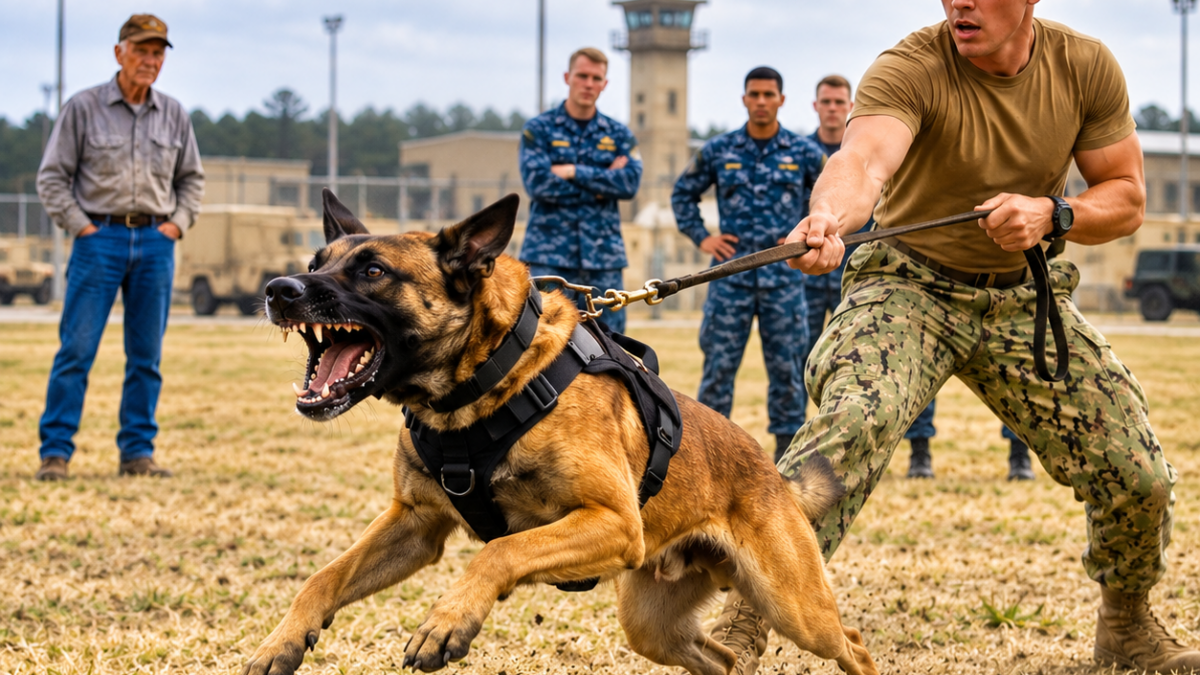
Mason’s voice cut across the Virginia training yard, sharp enough to stop most young SEALs mid-thought.
“On the line!”
The command broke uselessly against the dog.
Havoc lunged sideways, not toward the padded attacker downrange, not toward the bite sleeve, not toward the target he had been trained to read.
He lunged against the world.
His teeth were bared in a silent snarl.
His eyes were wide.
His ears pinned back.
His paws scraped through the dirt as though the ground beneath him had become enemy territory.
The young handler holding the lead had arms like coiled rope and a face carved with frustration. Sweat ran down his temples. His knuckles were white. He had tried every correction, every command, every reset, every technique the instructors gave him.
Nothing worked.
Havoc dragged him in a slow, humiliating circle through the dust.
“Damn it,” Mason snapped, not at the handler exactly, but at the situation, the file, the program, and whatever invisible damage lived inside the dog. “Get him under control.”
The handler dug his heels into the dirt.
“Trying, sir.”
“Try harder.”
The words were unfair the moment they left Mason’s mouth.
He knew it.
The handler knew it.
Every man watching knew it.
Trying harder did not stop a hurricane.
From the edge of the sprawling training complex, near a newly repaired section of chain-link fence, an old man watched.
He had been there since sunrise, replacing a loose post along the perimeter. The base kept him on a standing contract for small jobs nobody else wanted to schedule properly. Fencing. Irrigation pipe repairs. Small engines. Broken hinges. Gate latches. Drainage trenches after heavy rain.
Samuel, people called him.
Just Samuel.
No one on base seemed to know much more.
He was in his late sixties, maybe older, with a face mapped by sun, wind, and years spent outdoors. He wore faded denim jeans, a sweat-stained work shirt, a dusty cap from a local feed supply store, and boots that had seen more mud than polish.
His tools were laid neatly on canvas beside him.
He had finished the fence repair twenty minutes earlier.
He had not left.
Instead, he stood still beneath the hard morning light, watching the SEALs struggle with the dog.
He stood the way certain old men stand when the land has taught them not to waste motion. Nothing about him asked for attention. Nothing about him looked important. He seemed almost part of the perimeter itself, as unremarkable and necessary as the water tower shimmering in the distance.
But his eyes were not unremarkable.
Pale blue.
Calm.
Deeply sad.
He watched Havoc’s paws first.
Not the teeth.
Not the lead.
Not the handler’s muscles.
The paws.
The way they scrambled for purchase.
The way the dog’s weight shifted backward, then forward, then backward again.
The tremor running up his legs.
The frantic scanning of his eyes.
Mason saw an animal refusing control.
Samuel saw something else.
The dog was not attacking.
He was trying to escape.
Not from the handler.
Not from the team.
From something no one else could see.
The young handler lost his footing for half a second and dropped to one knee before dragging himself upright.
Havoc whined.
High.
Thin.
A sound like a tortured nerve.
The entire training yard seemed to tighten around it.
Mason kicked a loose stone.
“What is wrong with this animal?”
Samuel heard him.
His jaw moved once.
Not in judgment.
In recognition.
He had seen the same question asked too many times in different forms.
What is wrong with this soldier?
What is wrong with this man?
What is wrong with him that he cannot simply obey the thing everyone else survives?
Samuel looked at Havoc again.
The Navy saw a malfunctioning piece of equipment.
Samuel saw a soldier whose world had come apart and never been put back together.
He sighed softly.
Then he placed his hammer carefully back into the loop of his tool belt.
The movement was slow.
Deliberate.
Final.
The quiet promise he had made to himself, to a ghost in a forgotten land, had come due.
He started walking.
The SEALs noticed immediately.
They noticed everything.
Six heads turned toward him.
A wall of muscle, weapons discipline, professional suspicion, and contained aggression shifted between the old man and the dog.
One operator raised his hand.
“Sir, that’s far enough.”
Samuel kept walking.
“This is a live training area. You need to go back.”
Samuel did not answer.
His eyes remained on the dog.
He saw the ears pinned back.
The frantic panting that did not come from effort.
The subtle shift in Havoc’s posture as Samuel approached.
A flicker.
Small.
Impossible.
Something other than fear.
Lieutenant Commander Mason stepped forward.
“Sir, I’m not going to tell you again.”
Samuel stopped about thirty feet from the dog.
Dust moved around his boots.
Mason’s voice hardened.
“Step back now. This animal is not stable.”
It was the voice of command.
A voice trained to make hesitation disappear.
Samuel lifted his gaze from the dog and met Mason’s eyes.
For one strange second, Mason felt as if he were the one being assessed.
Weighed.
Measured.
There was no fear in the old man’s face.
No defiance either.
That somehow made it worse.
Only a profound, weary calm.
Samuel gave a small nod.
Not obedience.
Acknowledgment.
He had heard the warning.
He simply did not accept the conclusion.
Then he looked back at the dog.
Havoc had stopped lunging.
The lead still pulled tight, but the frantic motion had changed into quivering stillness. His head angled slightly. His nostrils worked. His eyes locked on Samuel with a focus so sudden that even the handler noticed.
“Sir?” the handler whispered.
Mason raised one hand to keep everyone still.
Samuel took one slow step forward.
The handler braced.
The dog did not explode.
Another step.
Then another.
The air became thick with tension, sweat, dust, and canine fear.
No one spoke.
Somewhere in the distance, a generator hummed.
Samuel’s posture did not change. He stood relaxed but perfectly balanced, hands loose at his sides. He did not offer a hand for the dog to sniff. Did not make kissing sounds. Did not crouch or plead or dominate.
He simply stood there, a fixed point inside the chaos.
He let the dog see him.
Let the scent of him carry on the breeze.
Earth.
Motor oil.
Leather.
Old cotton.
And something else.
Something buried beneath trauma, training, transfers, new commands, new handlers, new files, new names.
Something the dog’s body remembered before his mind could.
Samuel’s voice was quiet when he finally spoke.
Not a command.
Not a request.
A key turning in a lock no one else knew existed.
“Ranger.”
The effect was instantaneous.
Absolute.
Havoc froze.
The snarling stopped.
The whining stopped.
The lunging stopped.
His body went rigid, his head snapping up toward Samuel’s face. A low, guttural sound escaped him, not aggression, not warning, but something far more devastating.
Recognition.
Confusion.
Grief.
Hope.
Every man in the yard felt it.
The dog’s tail, tucked tight beneath him all morning, gave one tentative thump against his leg.
Then another.
The lead slackened for the first time all day.
The dog sat.
He simply sat in the dust and stared at the old farmer with eyes that no longer looked wild.
They looked like they were asking a question no human on that field had expected an animal to ask.
Where have you been?
The young handler stood frozen, the lead rope limp in his hand.
Mason did not move.
Neither did the team.
Samuel took another step.
Then another.
He closed the distance until he stood just a few feet away.
Then he knelt.
Not like an old man lowering himself with effort.
Like someone whose body still remembered harder ground.
Fluid.
Controlled.
Balanced.
He did not reach out.
He waited.
Ranger broke first.
The dog surged forward with a sound that tore through the training yard. Not a bark. Not a snarl. A cry so full of relief that every man there understood, without needing translation, that whatever they had been watching for weeks had never been disobedience.
It had been loss.
Ranger crashed into Samuel’s chest.
Seventy pounds of muscle and memory nearly knocked the old man backward, but Samuel wrapped both arms around him. The dog licked his face, his neck, his hands. His tail blurred. His whole body shook with the ecstasy of a reunion he had stopped believing would come.
Samuel buried his face in the thick fur of Ranger’s neck.
His shoulders shook once.
Only once.
He murmured words too low for anyone else to hear.
Old praise.
Old commands.
Names.
Promises.
The fearsome, uncontrollable K9 called Havoc was gone.
In his place was Ranger.
A soldier reunited with his commander.
A lost soul who had finally found the one point of reference that made the world make sense again.
The training yard had been chaos moments earlier.
Now it felt like a cathedral.
Mason was the first to move.
He approached slowly, every certainty in his head rearranging itself.
The irritation was gone.
So was the embarrassment.
What remained was an unsettling curiosity and the beginning of shame.
He stopped a respectful distance from Samuel and the dog.
Ranger lifted his head and looked at Mason.
A low, possessive growl rolled from his chest. His body shifted subtly, placing himself between Mason and Samuel.
Samuel laid one hand on the dog’s head.
“Easy, boy. He’s a friend.”
The growl ceased instantly.
Not reduced.
Not corrected reluctantly.
Ceased.
Ranger trusted the man’s judgment without question.
Mason swallowed.
“Sir,” he began, his voice softer now, stripped of command authority, “I don’t understand. How did you do that?”
Samuel looked up.
His pale eyes seemed to look through Mason rather than at him.
“He just needed to hear his name,” Samuel said. “His real name.”
He ran one hand across the dog’s back, his fingers searching beneath the fur, finding old scars as if reading braille.
“He’s been lost a long time.”
A pause.
Then softer.
“We both have.”
The young handler approached cautiously, still holding the useless lead.
“His file says his name is Havoc. K9-7. That’s all it’s ever said.”
Samuel shook his head.
“Files get changed. People get changed. Dogs remember.”
He looked at the young handler, and his expression softened.
“It’s not your fault, son. You were trying to command a stranger.”
He lowered his hand to Ranger’s neck.
“This here is Ranger. He only answers to his name. And he only works for his partner.”
The implication hung in the air.
The SEALs exchanged uneasy glances.
This quiet old man in mud-scuffed boots was claiming to be the partner of a Tier One military working dog.
Impossible.
Men like that did not become anonymous farmers fixing fences near training ranges.
Handlers at that level were elite operators themselves. Forged in the same fire as the men they served beside. Their names did not disappear into local maintenance contracts.
And yet, the proof leaned against Samuel’s leg, whining softly and licking his weathered hand.
Mason dealt in facts.
Clear chains of command.
Verifiable intelligence.
This was something else.
“What’s your name?” Mason asked. “Your full name.”
Samuel hesitated.
Only a fraction of a second.
But Mason saw it.
The old man’s gaze flickered across the faces around him, not with fear, but with exhaustion. The look of someone who had carried a secret so long it had become part of his skeleton.
“Folks around here just call me Samuel.”
Mason’s jaw tightened.
“That’s not what I asked.”
“No,” Samuel said.
He rose, this time with a slight groan. The fluid grace of his kneel disappeared as if he were putting the costume of an old farmer back on.
Ranger stood with him, glued to his leg.
“I think this fellow’s had enough for one day,” Samuel said. “Maybe you all have.”
He started to turn away with the dog.
As if the matter were settled.
“Hold on,” Mason said.
His voice regained a sliver of authority.
“You can’t just leave with him. That is a United States Navy asset.”
The words sounded wrong the moment he said them.
Samuel stopped.
Slowly, he looked back.
His expression did not change, but the air around him did.
“He’s not an asset, Commander.”
Mason said nothing.
“He’s a soldier,” Samuel continued. “And his tour is over. He’s earned his peace.”
He gave Ranger’s head a soft pat.
“I’ll take him home with me. Get him settled.”
The audacity of it left Mason speechless.
A civilian contractor was proposing to walk off a secure Naval Special Warfare base with a million-dollar military working dog.
Every regulation in the building behind Mason said no.
Every piece of evidence in front of him said separating them now would be an act of cruelty.
More than that, it might be impossible.
Mason had led men through places that existed in nightmares.
He had ordered movement under fire.
Called extractions.
Made decisions that still visited him at night.
But standing there in the dust with a farmer and a dog, he knew he was out of his depth.
“Stay here,” he said tightly. “Just don’t go anywhere.”
Samuel looked at him.
Did not answer.
Mason turned to his senior chief.
“Get me everything on K9-7. Not the summary. Everything. Vet records, transfer orders, handler reports, origin documents—right back to the day he was whelped. And find out who the hell Samuel is.”
The senior chief ran toward the command post.
Mason looked back.
Samuel and Ranger sat together in the dust.
Two forgotten soldiers waiting for the world that discarded them to catch up.
The file on K9-7 was disappointing.
Thin.
Too clean.
It detailed pedigree, early training, physical scores, advanced selection, assignment to Naval Special Warfare, failed handler pairings, behavior issues, and final-stage integration concerns.
The official narrative was simple.
Genetically superior canine.
Psychologically unstable.
Unfit for operational service.
A washout.
Mason slammed the folder onto his desk.
“This is useless.”
Senior Chief Carter leaned over his shoulder. Carter was older, grizzled, and harder to impress than most men in the building.
“There’s a redacted section here, sir.”
He pointed to a block of black ink.
“Transfer order from the Army. That’s where he came from before he was Havoc.”
Mason stared at the blacked-out lines.
“Who did he belong to?”
“Can’t tell. Unit is classified. Handler’s name is redacted. Transfer happened eighteen months ago out of a medical facility in Landstuhl, Germany.”
Landstuhl.
Mason went still.
The military hospital that received some of the most grievously wounded service members from European, African, and Middle Eastern theaters.
This was not a standard transfer.
This was connected to a medical evacuation.
The dog had been through something.
Something bad enough that his previous life had been erased from a Navy file.
“I need to know what’s under that black ink,” Mason said.
Carter shook his head.
“That’s above our pay grade, sir. We’d need a flag officer to request it and a damn good reason.”
Mason looked toward the window.
Beyond it, the training yard sat empty now.
But he could still see Ranger sitting at Samuel’s feet.
“We have a reason.”
Carter waited.
“A civilian walked onto our range and took control of a Tier One K9 with one word. A word that isn’t in this file.”
Mason tapped the folder.
“That man is the key. Find him. Not the fence guy. Not the contractor. Him.”
Carter nodded.
“Yes, sir.”
“And Chief?”
“Yes?”
“I’d bet my career he served.”
Carter’s mouth twitched.
“I’d bet he did more than serve.”
While Carter began making quiet inquiries that would set off alarms in corners of the military most people never saw, Mason went to the base veterinarian.
Captain Ava Rostova did not waste time.
Sharp.
Precise.
No-nonsense.
She had examined K9-7 more times than she wanted to count.
“Physically?” she said, pulling up the file. “Superb specimen. Nothing current explains the behavior.”
“And psychologically?”
She looked at him over her glasses.
“He’s a wreck.”
Mason sat back.
“Say that again.”
“Severe trauma presentation. Hypervigilance. Exaggerated startle response. Dissociation under controlled stress. Panic displacement. He is not aggressive in the way your trainers keep describing him. He is terrified.”
Mason thought of the training yard.
Of Havoc lunging against the lead.
Of the whine.
The paws.
The eyes.
“Old injuries?” he asked.
“Several.”
Rostova tapped keys.
“Significant scar tissue along the left flank and shoulder. Deep under the fur. Radiographic evidence of healed rib fractures on the same side. Possible shrapnel. Old wounds. Severe but well healed. They happened before he came to us.”
“Before he was Havoc.”
“Yes.”
The pieces clicked.
Not fully.
Enough.
The dog was a combat veteran.
Wounded.
Separated.
Renamed.
Transferred.
Rebuilt on paper and broken in practice.
Meanwhile, Samuel had taken Ranger home.
His farmhouse sat on a few acres bordering the base, tucked behind a line of oaks and weathered fencing. The place was simple. White paint peeling near the porch rail. Barn roof patched. Tools hung in exact order. A windmill turned lazily near a water tank.
The moment Ranger crossed the threshold, he seemed to know the house.
He moved through each room with cautious urgency, nose working, body low, searching. Then he returned to the living room and settled at Samuel’s feet beside a worn armchair.
He released a long sigh.
Not sleep yet.
Not peace exactly.
But the first edge of it.
Samuel stood over him for a long time.
Then he went to the bedroom and opened a dusty footlocker at the foot of the bed.
Inside, beneath a neatly folded flag, lay a worn leather harness and a faded photograph.
The photograph showed a younger Samuel.
Harder face.
Leaner body.
Eyes already old.
He wore sterile camouflage in a sun-bleached mountain country, seated beside an unscarred Belgian Malinois.
Ranger.
Younger.
Alert.
Proud.
Samuel touched the image with his thumb.
“I thought I lost you, boy,” he whispered. “I really thought I had.”
Ranger lifted his head.
The military had told Samuel the dog died.
A kind lie, perhaps.
That must have been the logic.
Kinder than telling a wounded man his partner survived but was classified, renamed, transferred, and placed into a program where no one understood why he would not bond.
For eighteen months, Samuel had grieved the last member of his team.
For eighteen months, Ranger had been lost in a world of strangers calling him Havoc.
Late that night, Mason’s phone rang.
Washington, D.C. area code.
He answered on the second ring.
“Commander Mason.”
The voice on the other end was gravelly, tired, and carried authority that had nothing to do with volume.
“You need to stop digging into K9-7 and a man named Samuel Keen.”
The name hit Mason like a physical blow.
Samuel Keen.
Now he had a last name.
“My inquiries are a matter of base security,” Mason said, keeping his voice steady. “I have an unknown civilian with a classified connection to one of my K9s.”
A dry chuckle came through the line.
“Son, that man is not a civilian, and that dog is not your asset.”
Mason said nothing.
“You’ve stumbled into something you are not cleared for. You are to stand down. Direct instruction.”
“From who?”
“Someone who appreciates what that man has done for this country and believes he has earned the right to be left in peace.”
“The dog?”
“The dog is where he belongs. Consider the case closed.”
The line went dead.
Mason stood in his office, phone still against his ear.
Samuel Keen.
Not just Samuel.
Not a handyman.
Not a random farmer.
Someone, somewhere high enough to end questions with a phone call, was protecting him.
The next morning, Mason drove off base.
Not toward town.
Toward Samuel Keen’s farmhouse.
He was not going as a commander.
Not really.
Not as an investigator either.
He was going as a man who had seen something true and could not accept being told to forget it.
He found Samuel in the barn mending a piece of tack. Ranger lay at his side with no lead, no collar, just devotion.
The dog saw Mason’s truck and stood. A low rumble began in his chest.
Samuel placed one hand on his back.
Ranger quieted, though his eyes stayed fixed on Mason.
Mason got out slowly and approached the barn entrance.
“Mr. Keen.”
The old man did not look surprised.
He finished the stitch, pulled it tight, and set the leather aside.
“Commander.”
“I was told to stand down.”
“Sounds like good advice.”
“I can’t.”
Samuel looked at him.
“I saw what that dog was yesterday,” Mason said. “And I saw him with you. I need to know why.”
Samuel sighed.
Long.
Slow.
He looked down at Ranger, who nudged his hand.
“That dog’s name is Ranger,” Samuel said. “He was my partner for three years.”
“What unit?”
Samuel’s eyes lifted.
Mason corrected himself.
“You don’t have to answer that.”
“No,” Samuel said. “I don’t.”
A silence passed.
Then Samuel looked toward the barn doors, beyond which the Virginia fields rolled beneath pale light.
“We were part of a specialized unit. We did hard things in hard places.”
That was all he said.
It was enough.
“What happened?” Mason asked.
Samuel’s gaze went distant.
“Last tour. Bad call. Ambush on a ridgeline. We were outnumbered and outgunned before we understood how badly we had been read.”
His hand moved unconsciously to his left side, where an old scar disappeared beneath his shirt.
“My whole team gone. Just me and him.”
Ranger pressed closer.
“We were both hit bad. I was pinned down. Couldn’t move. Ranger kept them off me. Drew fire. Took more rounds than any living thing should take.”
Samuel’s voice tightened.
“QRF got to us because of him. He saved my life.”
He stopped.
The barn seemed to hold its breath.
“And I was too messed up to save him.”
The words broke at the end.
Mason did not speak.
“When I woke up in Landstuhl, they told me Ranger didn’t make it. They gave me a new name, a new life, and told me to disappear for my own protection. The people we had been fighting did not forget faces.”
Ranger lowered his head against Samuel’s leg.
“I believed them,” Samuel whispered. “Because I could barely breathe, barely walk, and because the alternative was imagining him alone.”
Mason understood then.
“They didn’t just change your name.”
Samuel looked at him.
“They changed his too,” Mason said. “They tried to erase you both. They thought they could retrain him, make him someone else’s partner.”
His jaw tightened.
“But he wasn’t disobeying. He was grieving. He was lost.”
Samuel nodded.
Eyes shining, but not spilling.
“He wasn’t looking for a handler,” he said. “He was looking for me.”
Mason looked at Ranger.
The same dog that had nearly pulled a trained handler to the ground now sat peacefully beside an old farmer in a barn, as if every war in his head had gone quiet.
Shame settled into Mason’s chest.
Not theatrical shame.
Useful shame.
The kind that teaches.
“He’s not a Navy asset,” Mason said.
Samuel watched him carefully.
“He’s your partner,” Mason continued. “He’s home.”
A few days later, a small informal ceremony took place on the same dusty training field where Ranger had once been called Havoc.
No press.
No medals.
No speeches from officers trying to make themselves part of something sacred.
Just Lieutenant Commander Mason, Senior Chief Carter, the handler, the team, Captain Rostova, Samuel Keen, and Ranger.
Ranger wore his old scarred harness.
Samuel stood beside him in faded jeans, work shirt, and boots. He looked uncomfortable with attention but did not leave.
The young handler stepped forward first.
His face was serious.
No embarrassment now.
Only respect.
“Sir,” he said to Samuel, “it’s an honor.”
Then he knelt and offered his hand to Ranger, not as a handler, but as a fellow soldier.
Ranger sniffed.
Paused.
Then gave the hand one respectful lick.
The handler’s throat moved.
He stood and stepped back.
Mason faced Samuel.
“The Navy has officially retired K9-7,” he said. “His papers are signed.”
Samuel’s expression did not change.
Mason handed him a folder.
“He’s yours.”
Samuel looked at the folder.
Then at Ranger.
“He was always his own,” he said.
Mason nodded once.
“Fair.”
He held out an envelope.
“There’s also compensation owed. Back pay related to his service status and retirement classification. It’s not enough. But it’s what the system can recognize.”
Samuel accepted it slowly.
Ranger leaned against his leg.
Mason continued.
“There is one more request.”
Samuel’s eyebrows lifted.
“We were wondering if you would be willing to help us.”
“With what?”
“Training.”
Samuel looked at the team.
Mason corrected himself.
“Not just the dogs. Us.”
A few operators shifted, but no one looked away.
“Help us understand what we missed. The bond. Trauma signs. Handler continuity. When a dog is refusing and when a dog is breaking. What a name means. What memory means.”
Samuel looked down at Ranger.
For years, he had lived quietly, fixing fences, repairing engines, letting the world pass without asking who he used to be.
Now the past stood beside him, alive, scarred, breathing.
A small smile touched his lips.
“I think,” he said, voice clear and strong, “we can do that.”
Mason exhaled.
He had not realized he had been holding his breath.
The first training session Samuel led looked nothing like the Navy’s standard canine integration program.
No shouting.
No timed drills.
No dominance demonstrations.
No corrections designed to prove who commanded the field.
Samuel placed a chair in the dust and sat.
Ranger lay beside him.
The team gathered in a half-circle.
Samuel waited until the quiet became uncomfortable.
Then he said, “Most of you think obedience is the foundation.”
No one answered.
“It isn’t.”
He scratched Ranger behind one ear.
“Trust is the foundation. Obedience is what grows out of it when fear does not have to make every decision first.”
Mason stood near the back, arms folded.
Samuel pointed toward the training lane.
“You can force compliance under pressure. That works until it doesn’t. With men. With dogs. With anyone who has seen the world come apart. If all they know is pressure, they may perform for a while. But pressure does not tell a wounded mind where home is.”
The young handler listened harder than anyone.
Samuel noticed.
“You did nothing wrong with Ranger,” he said.
The handler swallowed.
“I couldn’t control him.”
“No,” Samuel said. “You couldn’t reach him. Different problem.”
That sentence stayed with every man there.
Over the next months, Samuel became something the base had not known it needed.
Not an instructor in the official sense.
Not a consultant who filled binders with jargon.
He became a translator between soldiers and animals who had been trained to endure the impossible and then expected to return unchanged.
He taught handlers to watch paws, breathing, tail carriage, eye focus, startle direction, recovery time.
He taught them that panic often looked like defiance to men trained to demand response.
He taught them that a working dog was not a weapon with fur.
A dog could be disciplined, elite, fearless in the field, and still carry invisible wounds home.
So could a man.
That was the lesson no one wrote on the board.
Everyone heard it anyway.
Ranger changed too.
Not overnight.
Real healing rarely does.
At first, he would not leave Samuel’s side for more than a few seconds. If a door slammed, his body went rigid. If a helicopter passed low overhead, he pressed into Samuel’s leg and scanned the sky. If a handler shouted too sharply across the yard, Ranger’s ears flattened before Samuel’s hand found his neck.
But slowly, the world became less hostile.
He began greeting the young handler each morning.
Then Captain Rostova.
Then Mason.
He never returned to operational training.
No one asked him to.
His tour was over.
But he came to the field with Samuel and showed the younger dogs what steadiness looked like. He sat beside nervous handlers. Demonstrated calm greetings. Walked through stress exercises as an example of trust rather than force.
The men started calling him Sergeant Ranger.
No one officially approved that.
No one stopped it either.
Samuel returned to his farmhouse each evening with Ranger in the passenger seat of his old truck. The dog slept in the farmhouse living room beside the worn armchair. Sometimes Samuel woke in the night and found Ranger standing near the door, listening to something only memory could hear.
Samuel would say, “You’re home, boy.”
Ranger would return to his bed.
Sometimes Samuel said it for himself too.
“You’re home.”
He was still learning to believe it.
Mason visited more often than regulation required.
At first, he told himself he was checking on a retired military working dog and a sensitive personnel matter.
Eventually, Samuel handed him coffee and said, “You can stop inventing reasons.”
Mason took the cup.
“I don’t invent reasons.”
“You’re an officer. That’s most of the job.”
Mason almost smiled.
They sat on the porch while Ranger slept at Samuel’s boots.
For a long time, neither man spoke.
Then Mason said, “I called him an asset.”
Samuel did not answer.
“I keep thinking about that.”
“You didn’t know.”
“That doesn’t make it right.”
“No,” Samuel said. “It makes it a starting point.”
Mason looked across the field.
“You ever miss who you were?”
Samuel’s eyes stayed on the horizon.
“Every day.”
“How do you stop?”
“You don’t.”
The answer was quiet.
Honest.
“You build something around what’s left.”
Mason nodded.
He did not say it helped.
It did.
One year later, the training program at the base had changed.
Not publicly.
No big announcement.
No polished video.
No press release.
But handlers were trained differently.
Behavioral review began earlier.
Transfer histories were scrutinized.
Names were preserved whenever possible.
Retired dogs were treated less like equipment reaching the end of usefulness and more like partners who had finished service.
A small line was added to internal doctrine:
A working dog’s operational identity must include handler history, trauma exposure, and bonded response markers.
Samuel called it fancy language for common sense.
Mason called it progress.
Ranger called it nothing because Ranger cared only about breakfast, Samuel’s left boot, porch naps, and the occasional opportunity to steal half a biscuit from the kitchen table when Samuel pretended not to see.
The old farmer never became comfortable with praise.
When visitors from higher command came through, Samuel disappeared to repair something on the far fence line.
When a colonel tried to thank him formally, Samuel said, “The hinge on your south gate is failing,” and walked away.
But every morning he returned to the training yard.
And every time a young dog panicked, Samuel made the handlers slow down.
“Look first,” he would say.
“What is he actually doing?”
Not what do you assume.
Not what do you want.
What is he actually doing?
That question saved dogs.
It also saved men.
The young handler who once fought Havoc in the dirt became one of Samuel’s best students. His name was Petty Officer Caleb Ross. He had carried quiet shame about failing K9-7 until Samuel finally cornered him beside the kennel building.
“You still blaming yourself?”
Ross looked embarrassed.
“No, sir.”
“Bad answer.”
Ross sighed.
“Yes, sir.”
Samuel nodded.
“Better.”
“I should have known.”
“No. You should have been told.”
Ross looked at him.
“He wasn’t in the file,” Samuel said. “You can’t read what someone erased.”
“But I pushed him.”
“You followed the training you had.”
“That doesn’t make me feel better.”
“It’s not supposed to. It’s supposed to make you better.”
Ross became better.
Patient.
Observant.
Less impressed with force.
Months later, he successfully bonded with a young shepherd named Echo, not because he commanded harder, but because he learned to wait long enough for trust to show itself.
When Echo passed his integration evaluation, Ross looked toward Samuel before anyone else.
Samuel gave one small nod.
It meant more than applause.
Ranger lived five more years.
Good years.
Quiet years.
He grew gray around the muzzle. His stride shortened. Old wounds stiffened in cold weather. He still followed Samuel from house to barn to field to porch, slower but no less certain.
The base built a shaded rest area near the training yard.
No plaque at first.
Samuel did not want one.
After Ranger died, Mason had one installed anyway.
Small.
Plain.
Near the fence Samuel had been repairing the day everything changed.
RANGER
Military Working Dog
Partner. Soldier. Friend.
No One Is Just An Asset.
Samuel stood in front of it for a long time.
Mason waited beside him.
Finally Samuel said, “He would’ve liked fewer words.”
Mason nodded.
“Probably.”
“He also would’ve tried to dig under it.”
“Definitely.”
Samuel’s mouth curved.
Not quite a smile.
Close enough.
After Ranger, Samuel still came to the base.
Not every day.
But often.
He taught because the work mattered, not because it filled the absence. Nothing filled that fully. Some losses become part of the structure. You build around them.
Years later, Lieutenant Commander Mason, promoted by then, spoke to a new class of handlers on that same Virginia field.
He did not begin with bite work.
Or control.
Or obedience.
He began with a story.
“There was a dog here once,” he said, “that we thought was broken.”
The young handlers listened.
“We called him Havoc because we didn’t know his name. We called him unstable because we didn’t know his history. We called him an asset because that made it easier not to notice his grief.”
Mason looked toward the old fence line.
“Then a farmer stepped forward and said one word.”
A few of the older instructors lowered their eyes.
“Ranger.”
Mason let the name settle over the field.
“That dog taught us something we should have already known. Power without understanding is just noise. Control without trust is temporary. And no file, no rank, no designation should ever erase the truth of what a soldier has survived.”
At the edge of the field, Samuel Keen stood with his dusty cap pulled low, listening.
He had never asked to become a legend.
Legends were often just people who did the necessary thing while everyone else was looking in the wrong direction.
That morning, the wind moved through the training yard, stirring dust around boots, paws, and the small plaque near the fence.
Samuel looked at the place where Ranger had once sat in the dirt after hearing his true name.
He remembered the frozen stillness.
The first tail thump.
The cry.
The weight of the dog crashing into his chest.
For eighteen months, Samuel had believed his partner was gone.
For eighteen months, Ranger had lived under another name, surrounded by men who wanted to use him well but could not understand why he would not become what their file said he should be.
One word changed that.
Not because it was magic.
Because it was truth.
Ranger.
A name.
A history.
A promise.
A way home.
People often asked Samuel how he controlled the K9 no one else could.
He always hated the question.
He had not controlled Ranger.
He had recognized him.
That was different.
Control says, Be what I need.
Recognition says, I know who you are.
On that day in the Virginia dust, the SEALs had brought strength, training, rank, discipline, and every approved method they had.
Samuel brought memory.
And for a lost soldier wearing the wrong name, memory was the only command that mattered.
So when the story passed through the base, it changed with each telling.
Some said the old farmer whispered.
Some said the dog cried before Samuel spoke.
Some said every SEAL on the field stepped back like they had seen a ghost.
Some said Mason nearly lost his command over the incident.
Some said Washington called before sunset.
Samuel never corrected the details.
Only one part mattered.
They could not control the K9.
Then the old farmer stepped forward.
He said, “Ranger.”
And the soldier came home.








