A Retired K9 Guarded the Same Empty Wheelchair Every Day—Then a Doctor Found the Name Scratched Underneath
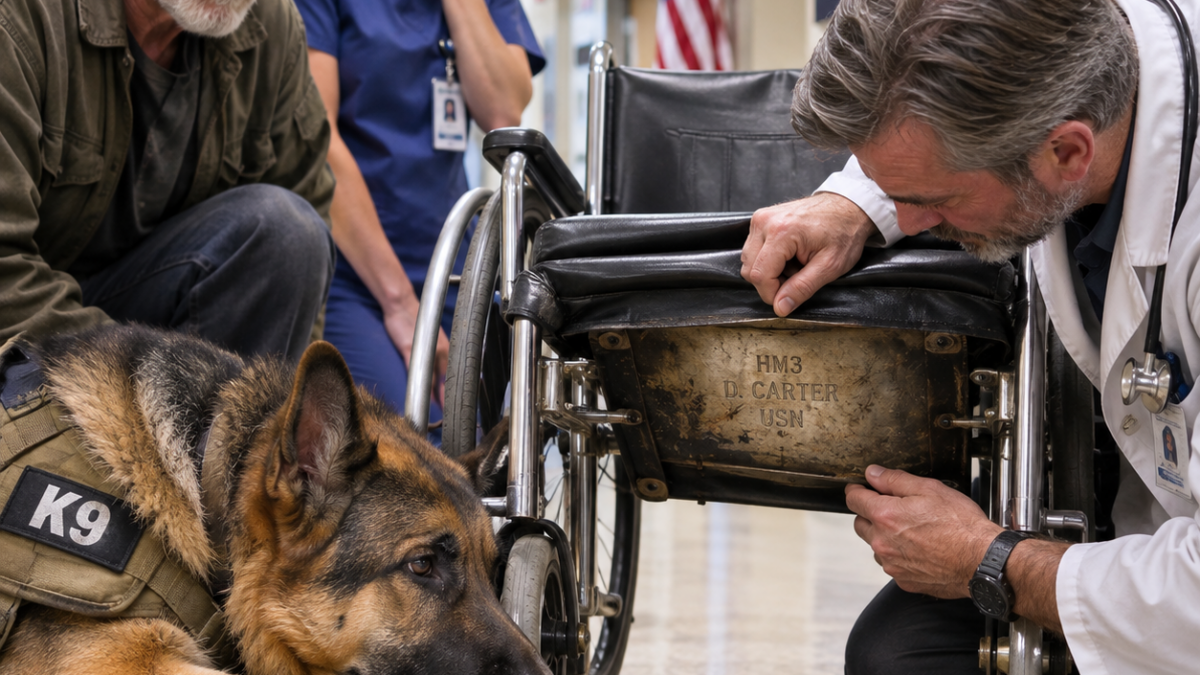
A Retired K9 Guarded the Same Empty Wheelchair Every Day—Then a Doctor Found the Name Scratched Underneath.
Every morning at exactly 9:18, retired military K9 Atlas slipped away from his therapy group, crossed the VA hospital lobby, and sat beside the same empty wheelchair as though someone invisible had ordered him to stand guard.
Staff moved the chair to different floors twice, but Atlas found it both times—and when anyone tried to wheel it away, the old German Shepherd quietly blocked the handles with his body.
Then a doctor finally turned the chair over and found a scratched name beneath the seat, connecting it to the combat medic who had saved Atlas and his handler thirteen years earlier—and to a man everyone at the hospital believed had died overseas.
Atlas had been trained to find bombs.
He had been trained to clear rooms.
He had been trained to ignore gunfire, engines, shouting, helicopters, and the smell of blood.
No one had ever trained him to guard a wheelchair.
That was what bothered Dr. Mara Ellison.
Not that the dog liked the chair.
Dogs became attached to strange things all the time.
Blankets.
Doors.
Corners.
People.
What bothered her was the precision.
Atlas did not wander toward the wheelchair when bored.
He did not sniff it occasionally.
He did not sleep beside it because it happened to be cool near the elevator.
Every morning, almost to the minute, he left his assigned therapy area and went straight to that chair.
Then he sat.
Facing outward.
Alert.
Waiting.
The first time Mara noticed, she assumed somebody had forgotten him there.
Atlas was an eleven-year-old sable German Shepherd with a gray muzzle, a scar beneath his right eye, and the stiff rear-leg movement that came from age, old injuries, and too many years jumping in and out of military vehicles.
He had served three deployments.
His paperwork said Afghanistan.
Explosives detection.
Route clearance.
Retired seven months earlier.
His final handler, Staff Sergeant Owen Mercer, had brought him home.
Owen was now a patient at the North Ridge Veterans Medical Center outside St. Louis.
He attended physical therapy three mornings a week.
Atlas had originally come as Owen’s service dog.
Then hospital behavioral staff noticed how unusually calm he was around other veterans.
Soon, with Owen’s permission, Atlas became part of several supervised therapy sessions.
Men who barely spoke to nurses would talk to Atlas.
Veterans with prosthetics practiced walking beside him.
One former Marine who refused to leave his room had followed Atlas down the hall because the dog had stolen his slipper.
Nobody believed the slipper incident was accidental.
Atlas had that kind of intelligence.
But the wheelchair was different.
It belonged to no current patient.
At least that was what staff believed.
Old black vinyl seat.
Steel frame.
Right footrest slightly bent.
One wheel squeaked.
A faded inventory sticker suggested it had been in the hospital system for years.
It usually sat beside the service elevator because nobody wanted it.
Too old for regular patient transport.
Too functional to throw away.
Mara first saw Atlas beside it on a Monday.
PART2:
She had just finished rounds in rehabilitation when she noticed him sitting rigidly near the elevator.
No leash.
No Owen.
“Atlas?”
The dog looked at her.
Then back toward the hallway.
Mara approached.
“Where’s your person?”
Atlas remained sitting.
She checked his vest.
RETIRED MWD.
DO NOT DISTRACT WHILE WORKING.
The irony made her smile.
“You’re definitely distracted.”
His ears moved.
Nothing else.
A nurse named Claire Benton appeared.
“There you are.”
Atlas looked at Claire.
Still did not move.
“Owen’s looking for you.”
Claire reached for his harness.
Atlas stood reluctantly.
Before leaving, he leaned his nose toward the wheelchair seat.
One slow breath.
Then walked away.
PART3:
Mara forgot about it.
Until Wednesday.
9:18 a.m.
Atlas was there again.
Friday too.
The following week, Claire mentioned it during lunch.
“That dog is obsessed with that chair.”
Mara looked up.
“How often?”
“Every session.”
“Since when?”
“Owen says maybe a month.”
“A month?”
“He thought Atlas was just resting.”
Mara frowned.
“At the same chair?”
“Yes.”
“Has anyone checked it?”
“For what?”
Mara did not know.
That was the problem.
Nothing made sense.
The following Monday, Mara deliberately watched.
Owen and Atlas arrived at 8:47.
Owen was forty-two, lean, broad across the shoulders, with the tired posture of someone whose body had been repaired more times than he liked discussing.
He walked with a cane.
Left leg permanently damaged by shrapnel.
Right shoulder reconstructed.
He had served seventeen years before medical retirement.
Atlas remained close beside him.
At nine, Owen joined a small rehabilitation group.
Atlas lay near the wall.
9:16.
The dog lifted his head.
9:17.
He stood.
9:18.
He walked out.
No hesitation.
Mara followed from a distance.
Atlas turned left.
Passed radiology.
Crossed the main lobby.
Went directly to the elevator.
Wheelchair.
He sat beside it.
Exactly as before.
Mara checked her watch.
9:19.
She crouched several feet away.
“Atlas.”
No response.
“Come.”
His right ear flicked.
He stayed.
She stood.
Walked behind the wheelchair.
Atlas immediately turned his head.
Not aggressive.
Watchful.
Mara placed a hand on one handle.
Atlas rose.
Moved between her and the chair.
She froze.
“Okay.”
His tail remained low.
No growl.
No teeth.
Just refusal.
Mara removed her hand.
Atlas sat again.
She found Owen afterward.
“Your dog is guarding a wheelchair.”
Owen gave her a tired smile.
“He’s retired.”
“He disagrees.”
“What happened?”
“He blocked me when I tried to move it.”
That erased Owen’s smile.
“Atlas blocked you?”
“Yes.”
“Physically?”
“Yes.”
“Any warning?”
“No aggression.”
“Just positioned himself.”
Owen looked toward the hallway.
“That’s not random.”
“That’s why I’m asking.”
He was silent.
Then:
“Can I see it?”
They walked together.
Atlas was still there.
The second he saw Owen, his body softened slightly.
Owen approached.
“Atlas.”
The dog looked at him.
Owen pointed toward his own left side.
“Heel.”
Atlas hesitated.
That caught Owen’s attention.
He repeated:
“Heel.”
Atlas stood.
Took one step toward him.
Then looked at the wheelchair.
Owen’s face changed.
“Buddy.”
Atlas returned to the chair.
Pressed his nose under the seat.
Owen stared.
“What?”
Mara asked.
He did not answer immediately.
Then:
“I don’t know.”
But something in his expression suggested he had felt something.
Not recognition.
Something close.
The next morning, hospital logistics moved the chair.
Mara had not ordered it.
An orderly simply noticed it blocking part of the elevator area and took it to a storage alcove on the third floor.
Atlas arrived at 9:18.
Stopped.
The chair was gone.
For the first time, staff saw him become visibly distressed.
He paced the elevator area.
Sniffed the floor.
Turned twice.
Then went to the elevator doors.
Claire said:
“He never does this.”
Owen watched.
Atlas stared upward.
Elevator opened.
He entered.
Claire laughed nervously.
“Where does he think he’s going?”
Nobody knew.
Mara pressed third floor because that was where she had seen the orderly take equipment earlier.
Doors opened.
Atlas exited.
Turned right.
Passed two rooms.
Storage alcove.
Wheelchair.
He stopped beside it.
Sat.
Mara felt goosebumps rise along both arms.
Owen whispered:
“How?”
No one answered.
The chair was moved again the next day.
Different building wing.
Atlas found it.
That ended the theory of routine.
The dog was not going to a location.
He was finding the chair.
Mara asked facilities to pull its inventory history.
The response arrived that afternoon.
Incomplete.
Chair model manufactured fourteen years earlier.
Entered VA system roughly thirteen years ago.
Original inventory location:
Fort Belden Transitional Medical Unit.
Later transferred to North Ridge VA after Fort Belden’s medical wing closed.
No assigned patient listed.
No useful history.
Owen read the email.
“Fort Belden?”
“Yes.”
His eyes narrowed.
“You know it?”
“I passed through there.”
“When?”
“After Afghanistan.”
Mara waited.
Owen stared at the screen.
“2013.”
Thirteen years earlier.
Atlas had been young then.
Barely eighteen months.
His first deployment.
Owen had been his handler.
Mara looked toward the therapy room where Atlas slept beneath a table.
“Was Atlas with you?”
Owen nodded slowly.
“For part of it.”
That night, Mara could not leave the question alone.
She asked Owen what happened in 2013.
He did not answer easily.
Veterans often did not.
Mara had learned not to push.
But eventually, Owen spoke.
“Route clearance outside Kandahar.”
Atlas alerted on a culvert.”
“We stopped the convoy.”
“Found a pressure plate.”
“Then secondary device went off.”
Mara listened.
Owen continued.
“Not the one Atlas found.”
“Another one.”
He looked down at his leg.
“I got hit.”
“How bad?”
“Bad enough.”
“What happened to Atlas?”
“Blast knocked him unconscious.”
“He woke up before I did.”
“How do you know?”
“People told me.”
Owen rubbed his thumb against the cane handle.
“Our medic kept both of us alive.”
“Name?”
Silence.
Then:
“Eli.”
Mara waited.
“Eli what?”
Owen frowned.
“Elias.”
“Elias Rourke.”
The name meant nothing to her.
Owen looked away.
“He was attached to our team temporarily.”
“Combat medic.”
“Best one I ever saw.”
“What happened to him?”
Owen’s voice changed.
“He died.”
Mara said nothing.
Owen continued before she could ask.
“Officially.”
“Officially?”
“He got us onto the bird.”
“Atlas was bleeding.”
“I was bleeding.”
“Eli climbed in after us.”
“Then we took fire during extraction.”
“He was hit.”
“I blacked out.”
“When I woke up, they told me he didn’t make it.”
“Body?”
Owen looked at her.
“No.”
That single word stayed between them.
“No recovery?”
“Not that I ever saw.”
“Were you certain?”
“I was told.”
Mara looked toward Atlas.
“Did Atlas know Eli?”
Owen laughed once, without humor.
“Atlas loved him.”
That was unexpected.
“Military working dogs don’t usually transfer attention easily.”
“No.”
“But Eli had a way with him.”
“What way?”
Owen smiled faintly.
“He carried beef jerky.”
Mara laughed.
Owen did too.
Then his face softened.
“Eli treated Atlas like another soldier.”
“Not equipment.”
“If Atlas got overwhelmed after a blast, Eli would sit near him.”
“Never touched him right away.”
“Just talked.”
“What did he say?”
Owen closed his eyes.
“Same thing every time.”
Mara waited.
“Easy, Atlas.”
“You’re still here.”
The next morning, Atlas went to the wheelchair again.
This time Mara came prepared.
Facilities supervisor.
Owen.
Claire.
A maintenance technician.
Mara said:
“Turn it over.”
Owen frowned.
“Why?”
“We’ve checked everything except underneath.”
The technician locked the wheels.
Tilted the chair.
Atlas stood immediately.
Alert.
Owen placed a hand on his harness.
“It’s okay.”
The bottom of the chair was scratched.
Old metal.
Dust.
Tape residue.
Then Claire noticed letters near the rear crossbar.
“Wait.”
They cleaned the surface gently.
Scratched by hand.
Not factory engraving.
Not inventory marking.
Seven letters.
R O U R K E.
Below:
E. R.
And beneath that:
13B-07.
Owen stopped breathing.
Mara looked at him.
“Rourke.”
Owen stepped forward.
Touching the scratched name with one finger.
“No.”
His voice was barely audible.
“Eli.”
Atlas whined.
First sound he had made around the chair.
Owen dropped to one knee despite the pain.
Atlas pressed against him.
Owen stared at the name.
Mara asked:
“Could it be someone else?”
“No.”
“Rourke wasn’t common in our unit.”
“E.R.”
“Elias Rourke.”
“Thirteen B…”
His face tightened.
“What?”
Mara asked.
“Thirteen Bravo was our ward section at Fort Belden.”
“After evacuation.”
Owen looked up.
“This chair was his.”
Facilities records suddenly mattered.
Mara requested archived transfer manifests from Fort Belden.
Most had been scanned poorly.
Some barely readable.
Two days passed.
Atlas continued guarding the chair.
Then a clerk found a handwritten equipment transfer sheet.
Wheelchair serial number matched.
Assigned:
ROURKE, ELIAS M.
Patient status:
NEURO/ORTHO RECOVERY.
Mara read it twice.
“He was a patient.”
Owen sat across from her.
“He died overseas.”
“That’s what you were told.”
“He was on the helicopter.”
“Maybe he survived.”
“No.”
The word came automatically.
Then less firmly:
“No.”
Mara turned the screen.
“Fort Belden had him registered as a patient six weeks after your injury.”
Owen stared.
Nothing moved in his face.
Then his hands began shaking.
“Why didn’t anyone tell me?”
Mara did not know.
They pulled more.
Privacy rules slowed everything.
Old military records complicated things further.
But enough surfaced to reconstruct part of the truth.
Elias Rourke had survived evacuation.
Barely.
Gunshot wound.
Pelvic fractures.
Spinal damage.
Severe blood loss.
Traumatic brain injury.
He arrived stateside under a temporary unidentified casualty designation because paperwork from the forward hospital was incomplete.
By the time his identity was properly reconciled, Owen had already been transferred elsewhere.
Somebody had marked Rourke as deceased in an earlier casualty report.
Correction existed.
But it had not reached everyone who needed it.
Especially Owen.
Especially not Atlas’s later records.
Owen sat in Mara’s office.
Read every page.
Then said:
“He lived.”
“Yes.”
“How long?”
“We don’t know yet.”
“Did he recover?”
“Somewhat.”
“Where did he go?”
“We’re still tracing.”
He looked toward the door.
Atlas waited outside.
Then Owen said something Mara never forgot.
“I grieved a man who was alive.”
Three days later, the hospital social worker found another record.
Rourke had spent eleven months at Fort Belden.
Then transferred into long-term rehabilitation.
Wheelchair user for most of that period.
Partial return of leg function.
Persistent nerve damage.
Then:
Discharged.
Address:
Montana.
No later VA activity under that exact patient identifier for nearly ten years.
Then one record from a rural clinic.
Elias M. Rourke.
Age fifty-nine now.
Mara called.
No information could be released without authorization.
But the clinic agreed to contact him.
Owen sat beside her while she waited.
Atlas at his feet.
Twenty minutes.
Thirty.
Then Mara’s office phone rang.
She answered.
“This is Dr. Ellison.”
An older man’s voice.
“Someone said you found a wheelchair.”
Mara looked at Owen.
He went pale.
“Yes.”
Silence.
Then:
“Is the dog still alive?”
Owen covered his mouth.
Mara could barely speak.
“Yes.”
The man inhaled sharply.
“Atlas?”
The dog’s head came up.
Not because he understood the phone.
Because Mara said the name.
Mara put the call on speaker.
“Mr. Rourke?”
“Yes.”
“I have someone here.”
Owen could not speak.
Mara looked at him.
He shook his head once.
Then forced air into his lungs.
“Eli?”
Silence.
Long enough that Mara thought the call had dropped.
Then:
“Mercer?”
Owen made a sound between a laugh and a sob.
Atlas stood.
The voice came again.
“Owen Mercer?”
Owen leaned toward the phone.
“You’re alive.”
Eli answered:
“Apparently.”
Owen closed his eyes.
Thirteen years disappeared from his face.
Mara left the office.
Claire followed.
They gave the men privacy.
Atlas stayed.
Inside, Owen asked every question at once.
Why did no one tell him?
Why did Eli never contact him?
Did he know Owen survived?
Did he know Atlas survived?
The answers were not simple.
Eli had spent months barely aware of his surroundings.
Memory fragmented.
Names gone.
Faces returning in pieces.
By the time he understood who he was, Owen had moved.
Military contacts had changed.
Eli believed Owen and Atlas had both been killed after the evacuation helicopter was forced down at a later landing site.
Another bad report.
Another administrative error.
Two survivors grieving each other.
For thirteen years.
Eli had eventually rebuilt some kind of life in Montana.
Small house.
Part-time work repairing fishing equipment.
Chronic pain.
Walked short distances with braces and a cane.
Wheelchair on bad days.
No family nearby.
Owen asked:
“Why was your name under that chair?”
Eli laughed weakly.
“Because everybody kept stealing mine.”
“What?”
“Wheelchairs.”
“They all looked the same.”
“So I scratched my name underneath.”
Owen started laughing.
Then crying again.
“That stupid chair.”
“I hated that thing.”
Atlas paced in circles.
Eli heard his tags through the phone.
“Is that him?”
Owen lowered the phone.
“Atlas.”
The dog looked.
Owen pressed speaker volume higher.
Eli said:
“Easy, Atlas.”
The dog froze.
Mara, standing outside the partially open door, heard it.
Then Eli said the rest.
“You’re still here.”
Atlas made a sound no one at the hospital had ever heard from him.
A low broken cry.
Not barking.
Not whining exactly.
Something between recognition and grief.
He pressed his nose against the phone.
Owen bent over him.
Thirteen years.
One sentence.
Still there.
That explained the wheelchair.
At least part of it.
Scent seemed impossible after so long.
But perhaps not everything had disappeared.
Old upholstery.
Metal.
Hospital storage.
Cleaning.
Transfers.
More likely Atlas recognized some combination nobody could isolate.
A faint preserved odor.
The pattern of the chair.
The scratched metal.
The location associated with old memory.
Or simply the object that had once been beside a man whose voice had meant safety after the worst day of Atlas’s young life.
No one needed to turn it into magic.
What happened was already extraordinary enough.
Eli agreed to come to North Ridge.
Not immediately.
Travel was hard.
Owen offered to go to Montana.
Eli refused.
“You’ve got the dog.”
“So?”
“He found me.”
“I’ll meet him where he found me.”
The hospital helped arrange accessible travel.
Three weeks later, on a cold Tuesday morning, Mara stood in the lobby beside the elevator.
The wheelchair was there.
Cleaned.
Not restored.
Nobody wanted to erase the scratches.
Atlas sat beside it.
9:18.
Exactly.
Owen stood behind him.
Hands shaking.
Claire pretended hers were not.
The elevator opened.
A man appeared in a modern wheelchair.
Gray hair.
Beard.
Thin face.
Left leg supported with a brace.
One hand resting on the wheel rim.
For a moment, Atlas did nothing.
Eli Rourke rolled forward.
Ten feet away.
“Atlas.”
The dog stood.
Ears forward.
Owen whispered:
“Go.”
Atlas took one step.
Then another.
Slow.
Age visible.
Uncertainty visible.
Eli stopped.
Did not reach.
Just as Owen remembered.
He waited.
Then said:
“Easy, Atlas.”
Atlas’s tail moved once.
Eli’s voice broke.
“You’re still here.”
The old German Shepherd crossed the remaining distance.
Pressed his head against Eli’s knee.
Eli folded over him.
No dramatic music.
No cheering.
Nobody spoke.
Atlas leaned harder.
Eli buried one hand in the fur behind his ears.
Owen stood several feet away.
Crying openly.
After a while, Eli looked up.
“You got old.”
Owen laughed.
“So did you.”
Eli looked at Atlas.
“I was talking to him.”
That broke the tension.
Claire laughed through tears.
Mara turned away to wipe her face.
The reunion did not fix thirteen years.
Nothing could.
Eli and Owen had missed birthdays.
Funerals.
Recovery.
Relapses.
Relationships.
Whole stretches of life.
They could not get those back.
But they could stop being dead to each other.
That mattered.
They spent three hours together.
Mostly talking.
Sometimes not.
Eli told Owen about Fort Belden.
Owen told Eli about returning to active duty for a short time before injuries forced retirement.
Then about Atlas’s later deployments.
Eli looked horrified.
“They sent him back?”
“He was cleared.”
“He was a lunatic at eighteen months.”
“He improved.”
“He ate half my medical bag.”
“One strap.”
“Two.”
Atlas slept between them.
At one point Eli reached under the old wheelchair.
Touched his scratched name.
“I remember doing that.”
Owen said:
“You realize this dog spent a month guarding it.”
Eli looked down at Atlas.
“Guarding me?”
“No.”
Owen thought.
“Maybe making sure we finally paid attention.”
Eli smiled.
“That sounds like him.”
The hospital decided not to discard the chair.
Facilities wanted to.
Old equipment.
No clinical value.
Mara objected.
Eventually it was placed in the rehabilitation history room.
Not as a heroic military artifact.
As a reminder.
A scratched name beneath a seat.
A clerical error.
A dog refusing to ignore something everyone else walked past.
Eli stayed in Missouri for six weeks.
Owen arranged temporary housing through a veterans support organization.
They saw each other almost every day.
Some conversations went badly.
That surprised Mara.
People assume reunion means instant healing.
It does not.
Owen carried anger.
“You could’ve looked for me.”
Eli answered:
“I did.”
“Not enough.”
“I could barely remember my own address.”
“That doesn’t make me less angry.”
“I know.”
Eli had anger too.
“You believed I was dead.”
“They told me.”
“You never checked?”
“I was twenty-nine and learning how to walk again.”
Silence.
Then both men apologized.
Not because either had failed morally.
Because grief makes people blame whoever survived close enough to hear it.
Atlas became the bridge.
If voices rose, he lifted his head.
If one man stopped talking, Atlas moved toward him.
Once, during a particularly bitter argument, Atlas picked up Eli’s glove and dropped it in Owen’s lap.
Both men stared.
Then laughed.
Argument over.
Eli eventually returned to Montana.
But not alone in the way he arrived.
Calls every Sunday.
Video chats.
Owen visited twice that year.
The following spring, Eli moved closer to Missouri.
Not because anybody asked.
Because, as he put it:
“I’ve spent enough years living where nobody knows what my silence means.”
He rented a small accessible house thirty minutes from Owen.
Atlas began splitting his time.
Mostly with Owen.
Afternoons with Eli.
One afternoon Mara visited.
Atlas lay asleep with his head across Eli’s foot.
Eli looked down.
“He still guards me.”
Mara smiled.
“You sure he isn’t guarding the refrigerator?”
“Possible.”
Then Eli became serious.
“Do you know what bothers me?”
“What?”
“If Atlas hadn’t noticed that chair…”
Mara knew.
They might never have found each other.
The thought bothered her too.
The hospital had moved that wheelchair countless times.
People had cleaned around it.
Transported it.
Stored it.
Ignored it.
Nobody turned it over.
Nobody read the scratched name.
Until a dog behaved strangely enough that someone became curious.
That changed Mara’s practice in a small way.
When veterans became attached to objects, places, sounds, routines, she stopped dismissing them as meaningless behavior.
Not every pattern hid a dramatic story.
Most did not.
But patterns came from somewhere.
People did too.
Atlas turned twelve.
Then thirteen.
His hips worsened.
Stairs became difficult.
Owen installed ramps.
Eli bought him an orthopedic bed.
Atlas ignored it and slept on the rug.
Eli complained:
“That bed cost two hundred dollars.”
Owen said:
“He served the government.”
“Wasteful spending is familiar.”
Atlas stared at them.
One year after the reunion, they returned to North Ridge.
Same elevator.
Same wheelchair.
Atlas walked slower.
He sniffed the old chair.
Then, for the first time, did not sit beside it.
He turned.
Walked toward Eli.
Lay beside his wheelchair instead.
Mara watched.
Owen whispered:
“Guess his job moved.”
Eli reached down.
“Yeah.”
“Found the right chair.”
Atlas died the following winter.
Fourteen years old.
Cancer.
Fast.
No long decline.
Owen noticed he stopped eating breakfast.
Vet found abdominal mass.
Hemangiosarcoma.
Days, maybe weeks.
They chose home.
No heroic surgery.
No final hospital stay.
Atlas spent his last afternoon near the fireplace at Owen’s house.
Snow outside.
Eli came early.
Sat on one side.
Owen on the other.
The veterinarian arrived near sunset.
Atlas was tired.
Still alert enough to lift his head when Eli moved.
Eli placed his hand gently behind the dog’s ear.
Did not say goodbye immediately.
Instead:
“Easy, Atlas.”
The old dog looked at him.
Eli swallowed.
“You’re still here.”
Owen put his hand over Atlas’s shoulder.
“Yes.”
“He is.”
Atlas died with both men touching him.
For a while, nobody moved.
Then Owen laughed quietly through tears.
“What?”
Eli asked.
“That stupid wheelchair.”
Eli smiled.
“Best piece of junk the VA ever kept.”
Months later, Owen donated Atlas’s harness to the hospital history room.
It hung near the wheelchair.
Not on it.
Beside it.
A small plaque told only the necessary facts.
Retired Military Working Dog Atlas.
Staff Sergeant Owen Mercer.
Combat Medic Elias Rourke.
Reunited after thirteen years.
No claim that Atlas remembered a scent perfectly for more than a decade.
No miracle language.
No mythology.
Mara insisted on that.
The truth was stronger without embellishment.
The dog had found the chair repeatedly.
The scratched name led to records.
The records led to Eli.
The voice led to recognition.
Whatever happened inside Atlas’s memory belonged to him.
Years later, new residents and medical students still asked Mara about the old chair.
She would tell them:
“The important part isn’t that a dog solved a mystery.”
“What is it?”
“That everybody else kept walking past something because we thought we already knew what it was.”
An unused chair.
An old dog.
A dead medic.
Three assumptions.
All wrong.
Owen eventually began volunteering at North Ridge.
Not as a therapist.
He was careful about that.
Peer support.
Veterans adjusting to disability.
Men angry at bodies that would not return to what they had been.
He rarely told the Atlas story unless someone asked.
Eli volunteered too.
Mostly with medics.
He talked about survivor guilt.
Memory gaps.
Administrative errors.
How a wrong line in a record could become the truth in somebody else’s life for thirteen years.
One young medic asked:
“Are you angry?”
Eli thought.
“Yes.”
“At who?”
“That’s harder.”
He did not blame one clerk.
One officer.
One hospital.
War created messy records.
Evacuations created confusion.
People moved.
Systems failed.
He said:
“I’m angry that something could be wrong for so long and still look official.”
Then he added:
“That’s why names matter.”
The scratched name beneath the chair became more important to him over time.
Not because it was mysterious.
Because it was stubborn.
Elias Rourke had carved his name into metal when he was injured, confused, and tired of losing track of hospital equipment.
Thirteen years later, that act said:
I was here.
That was enough.
Owen kept one photograph on his desk.
Not military.
Not Afghanistan.
Not Atlas in tactical gear.
It showed the hospital lobby on reunion day.
Eli in his wheelchair.
Atlas pressed against his knee.
Owen standing beside them.
Three survivors.
For years, Owen had thought there were only two.
That photograph corrected the count.
One afternoon, Mara visited him.
She noticed another photograph beside it.
Young Atlas.
Afghanistan.
Owen.
Eli.
Dust everywhere.
Eli kneeling beside the dog.
One hand near Atlas’s chest.
“What day was that?”
Mara asked.
Owen turned it over.
Writing on the back.
Two days before the blast.
Eli had written:
MERCER + ATLAS.
BOTH TOO STUBBORN TO DIE.
Mara laughed softly.
“You kept that?”
“I found it in an old deployment box after Eli came back.”
“Did he remember writing it?”
“No.”
“Convenient.”
Owen smiled.
Then:
“He was right.”
All three had been too stubborn.
But stubbornness alone had not reunited them.
Atlas had done what working dogs often do best.
Notice what humans miss.
Not because they are magical.
Because their world is built from different information.
Scent.
Pattern.
Association.
Sound.
Routine.
A dog does not care that a hospital inventory system labels something UNUSED EQUIPMENT.
If the object means someone, it means someone.
That was the story Mara told when people asked.
Not:
Atlas knew Eli was alive.
Nobody could prove that.
Not:
Atlas smelled a thirteen-year-old scent and tracked it perfectly.
Nobody knew.
She said:
“Atlas recognized something we didn’t.”
And because he refused to stop returning to it, eventually we looked closer.
That was enough.
North Ridge renovated the elevator wing several years later.
Facilities proposed moving the wheelchair into storage permanently.
Mara objected again.
By then she was department chair.
She won.
The chair moved only twenty feet.
A small alcove.
Protected.
One afternoon Eli rolled up beside it.
Owen walked next to him.
They had both aged.
Eli touched the scratched letters underneath.
R O U R K E.
“They really should’ve thrown this thing away.”
Owen laughed.
“Probably.”
“You’d still think I was dead.”
“Probably.”
“That’s depressing.”
“Yes.”
Eli smiled.
“Good thing Atlas had terrible boundaries.”
Owen looked toward the empty space where the dog used to sit.
“He had excellent priorities.”
They stayed there for several minutes.
No sadness exactly.
Not only sadness.
Gratitude and grief are often the same shape from far away.
Before leaving, Eli tapped the chair once.
Then said:
“I hated you.”
Owen frowned.
“The chair?”
“Yes.”
“Why?”
“Because I needed it.”
“Now?”
Eli looked at the scratched name.
“Now I think it waited longer than either of us did.”
Owen shook his head.
“You’re getting sentimental.”
“I’m old.”
“That’s not an excuse.”
They laughed.
Then left.
The wheelchair remained.
Empty again.
But not meaningless.
That is how I think about Atlas now.
Not as a dog who guarded an empty chair.
There was never anything empty about it to him.
We just did not know what it carried.
A name.
A memory.
A medic.
A promise.
Thirteen years of grief built on the wrong information.
And somewhere inside an old German Shepherd’s mind, enough remained that he refused to let everyone keep walking past.
Every morning at 9:18, Atlas sat beside that chair.
Staff moved it.
He found it.
They moved it again.
He found it again.
He never barked.
Never dragged anyone toward it.
Never created a scene.
He simply sat.
Waiting.
Watching.
Doing what he had been trained to do his entire life.
Hold position until the humans finally understood what was dangerous.
This time, the danger was not an explosive.
It was forgetting.
And Atlas refused to let that happen.








