A Retired K9 Escaped Every Sunday and Walked 4 Miles to the Same Church—Then the Pastor Opened a Basement That Had Been Locked for 15 Years
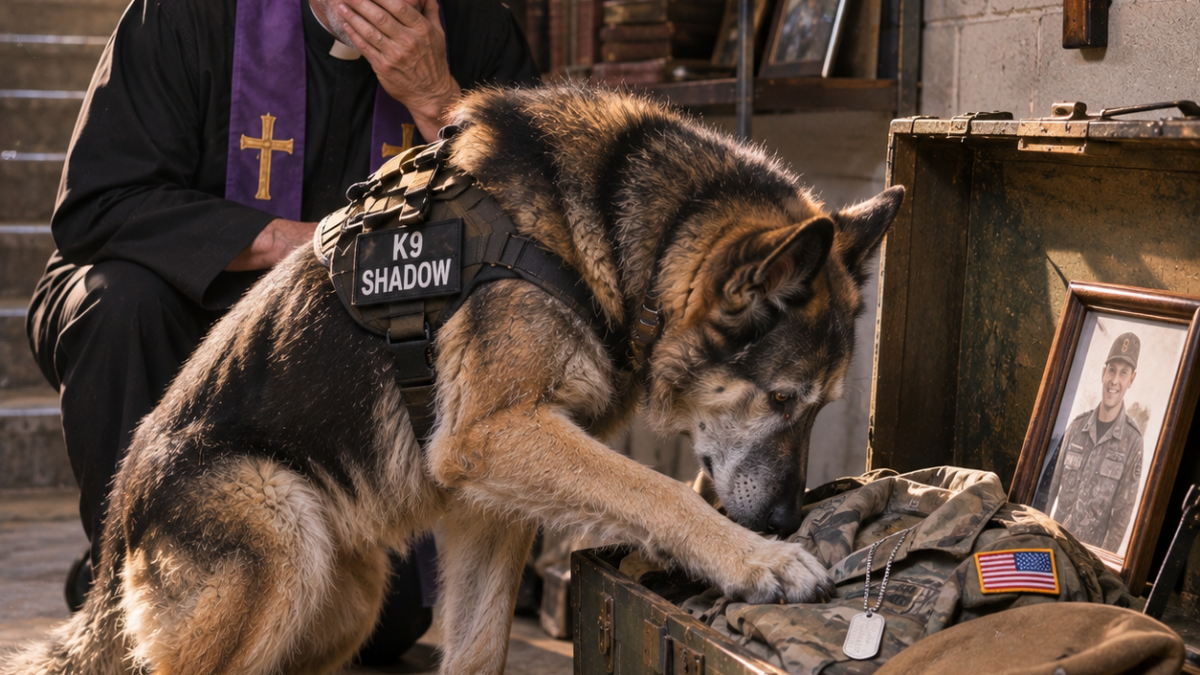
A Retired K9 Escaped Every Sunday and Walked 4 Miles to the Same Church—Then the Pastor Opened a Basement That Had Been Locked for 15 Years
For six straight Sundays, retired military K9 Shadow escaped a secured veterans’ sanctuary before sunrise, crossed four miles of freezing Virginia back roads, and sat outside the same locked church basement door as if someone beneath it were still waiting for him.
The pastor blamed instinct until he finally opened the basement and watched Shadow ignore boxes of donated clothing, old hymnals, and dusty furniture before stopping beside a sealed footlocker containing the uniform of a soldier the congregation had been told died overseas fifteen years earlier.
But when the pastor saw the name stitched above that uniform pocket—and remembered who had ordered the basement sealed after the soldier’s funeral—he realized Shadow’s Sunday journey was connected to something the little church had spent fifteen years unknowingly protecting.
At 4:52 on Sunday morning, Shadow disappeared.
Again.
Caleb Ross knew the exact time because the motion alarm on his phone woke him before the dog’s empty bed did.
He sat upright in the dark guest room at Haven Ridge Veterans Sanctuary, stared at the glowing screen, and said a word he had promised the sanctuary director he was trying to use less often.
Then he swung his legs out of bed.
His left knee protested immediately.
“Yeah, yeah.”
Caleb reached for the brace hanging over the chair.
At forty-three, he moved like a man twenty years older on cold mornings.
A roadside bomb outside Kandahar had left him with a titanium plate in his leg, three screws in his knee, and the kind of nerve pain that made weather forecasts unnecessary.
But at that moment, his knee was not the problem.
Shadow was.
The retired Belgian Malinois had escaped five Sundays in a row.
This made six.
Haven Ridge was not a careless place.
The sanctuary sat on thirty-seven acres outside the small town of Bellweather, Virginia, surrounded by pasture fence, reinforced kennel runs, motion lights, and two locked vehicle gates.
Most of the dogs living there were retired military or police K9s whose former handlers had died, become medically unable to care for them, or faced circumstances that made adoption complicated.
Some dogs needed quiet.
Some needed rehabilitation.
Some simply needed a place to grow old where nobody asked them to work.
Shadow needed, apparently, a weekly church appointment.
Caleb pulled on jeans and boots.
PART2:
By the time he reached the hallway, sanctuary director Mara Collins was already there.
She wore sweatpants, a winter coat over a T-shirt, and the expression of a woman who had run out of patience three Sundays earlier.
“Tell me he’s in the laundry room.”
“He’s not.”
“Tell me he’s under the porch.”
“He’s not.”
Mara closed her eyes.
“Gate?”
“Still locked.”
“Fence?”
“I’m checking.”
They went outside.
February cold cut across the property.
Frost silvered the grass.
The eastern sky remained completely black.
Mara swept a flashlight along the kennel fence.
“No break.”
Caleb looked toward Shadow’s private run.
The latch was still closed.
PART3:
The dog had apparently pushed the lower corner of the chain-link panel just far enough away from the concrete footing to squeeze beneath it.
Again.
Mara crouched.
“We reinforced this.”
“He’s a Malinois.”
“That is not an engineering degree.”
“Tell him.”
She stood.
“GPS collar?”
Caleb checked the tracking app.
A small blue dot was already moving southeast.
Mara stared at it.
“You have got to be kidding me.”
“Nope.”
“Same route?”
“Looks like.”
She looked at Caleb.
“You’re driving.”
“Your truck’s faster.”
“My truck has heated seats.”
“So does mine.”
“Yours smells like coffee and wet dog.”
“That’s called character.”
Mara grabbed the keys from his hand.
“I’m driving.”
They found Shadow twenty-seven minutes later.
Exactly where Caleb expected.
Cedar Grove Community Church.
A small white wooden building at the intersection of County Route 9 and a narrow gravel road lined with bare oak trees.
It had one steeple.
One bell.
A cemetery behind it.
A fellowship hall built in the seventies.
And a basement entrance on the eastern side with two concrete steps descending to a heavy green door.
Shadow sat on the bottom step.
Facing the door.
Waiting.
His black-and-tan coat was damp from frozen grass.
Mud darkened his paws.
His breath clouded white in the cold.
He looked neither lost nor distressed.
He looked annoyed that everyone else had taken so long.
Mara parked.
Caleb opened the passenger door.
Shadow glanced over.
Then looked back at the basement.
Caleb walked down the slope.
“Morning.”
No response.
“Good trip?”
Shadow’s right ear moved.
“You know, most retired dogs sleep in.”
The Malinois stared at the door.
Caleb crouched.
“What is it?”
Shadow placed one paw against the lowest step.
Not scratching.
Not frantic.
Just touching it.
Mara came up behind them.
“Six Sundays.”
Caleb nodded.
“Four miles.”
“Four point three.”
“You tracked the decimal?”
“I’m irritated.”
Mara looked at the church.
Lights off.
Service would not begin for another three hours.
“Why here?”
Caleb rubbed Shadow’s neck.
The dog wore an old black collar from his military days.
His identification tag read:
SHADOW
MWD
RETIRED
No original handler information appeared anywhere on it.
That had always bothered Caleb.
Most military working dog records included handler chains, units, deployments, training history.
Shadow’s file had gaps.
Large ones.
The sanctuary received him after his final handler, Staff Sergeant Daniel Mercer, entered long-term neurological rehabilitation following a stroke.
Daniel had handled Shadow only during his last eighteen months of service.
Before that, the paperwork listed “prior tactical assignment — records restricted.”
No handler.
No unit.
No location.
Mara had requested additional records.
Twice.
Both requests returned incomplete documents.
At first, nobody cared.
Shadow was retired.
Twelve years old.
Arthritic.
Healthy enough.
He ate.
Slept.
Allowed Caleb to brush him.
Hated thunderstorms.
Loved scrambled eggs.
That should have been enough.
Then six weeks earlier, Shadow escaped on Sunday morning.
A farmer found him sitting outside Cedar Grove’s basement door.
The second Sunday, Caleb followed the GPS signal.
Same location.
Third Sunday.
Same.
Fourth.
Same.
Fifth.
Same.
And now six.
Mara sighed.
“We need to call the pastor.”
“At five-thirty in the morning?”
“We’ve already retrieved a military dog from his property six times.”
“Technically five. First time the farmer did.”
“Caleb.”
“Fine.”
The pastor arrived fifteen minutes later.
Reverend Thomas Bell was sixty-one, broad-shouldered, gray-haired, with wire-rimmed glasses and a wool coat buttoned crookedly over pajamas.
He parked beside the church.
Got out.
Saw Shadow.
Then stopped.
“Again?”
Mara raised both hands.
“I am so sorry.”
Pastor Bell walked closer.
Shadow glanced at him.
No aggression.
No interest.
“Good morning, soldier.”
Shadow looked back at the door.
Bell smiled.
“Still not impressed by clergy.”
Caleb said, “He’s selective.”
Bell stepped down.
Shadow moved aside enough to let him pass, then repositioned himself.
Bell tried the basement handle.
Locked.
Shadow stood.
His whole body changed.
Caleb noticed immediately.
Ears forward.
Mouth closed.
Weight shifted toward the door.
Bell looked at him.
“He really wants in.”
“Yes.”
“What’s down there?”
Bell thought.
“Storage.”
“Anything military?”
The pastor’s expression changed slightly.
“Probably.”
Caleb caught it.
“What kind?”
“Old donations. Church records. Clothes.”
“Uniforms?”
Bell looked toward the cemetery.
“Possibly.”
Mara asked, “Could we look?”
The pastor hesitated.
That hesitation bothered Caleb more than a refusal would have.
“Is there a reason we can’t?”
Bell rubbed his hands together against the cold.
“The basement hasn’t been opened in years.”
“How many?”
“I don’t know. Ten? More.”
Mara stared.
“You have a locked basement under your church that nobody’s opened in ten years?”
“It’s not sinister.”
“I didn’t say sinister.”
“You sounded like you were about to.”
Bell almost smiled.
“It was damaged by flooding. We moved most active storage upstairs.”
Caleb looked at the green door.
“Do you have the key?”
Bell’s smile disappeared.
“I think so.”
“Then open it.”
The pastor did not move.
Mara glanced at Caleb.
Bell said quietly, “Not this morning.”
“Why?”
“I need to speak with someone first.”
“Who?”
Bell looked at Shadow.
Then at Caleb.
“Our senior deacon.”
Caleb felt the first real tug of suspicion.
“Why does your senior deacon care about a storage room?”
Bell’s jaw tightened.
“Because some of what’s inside belonged to his brother.”
Shadow whined.
The sound cut through the cold.
Bell looked down at him.
Caleb asked, “His brother military?”
“Yes.”
“Dog handler?”
The pastor went still.
Mara looked at Caleb.
Caleb looked at Shadow.
Bell said, “I don’t know.”
That was a lie.
Not necessarily malicious.
But a lie.
Caleb had spent fourteen years in the Army.
He had learned that people had different ways of avoiding truth.
Some talked too much.
Some got angry.
Some gave technically correct answers to questions nobody had asked.
Pastor Bell belonged to the third group.
Caleb stood.
“What was his name?”
Bell looked toward the church.
“Elias Ward.”
Shadow barked.
One sharp sound.
Everyone froze.
Caleb’s pulse jumped.
Bell stared at the dog.
“What did you say?”
“Nothing.”
“No. The name.”
Bell swallowed.
“Elias Ward.”
Shadow stepped toward him.
Then sat.
Perfectly.
Military straight.
Eyes up.
Caleb felt cold move through him that had nothing to do with February.
“Say it again.”
“Elias.”
Shadow’s tail struck the concrete once.
Mara whispered, “Oh my God.”
Bell looked from the dog to Caleb.
“You think—”
“I think he knows that name.”
“But Elias died fifteen years ago.”
Shadow whimpered.
Caleb crouched beside him.
“Was Elias a handler?”
Bell looked suddenly older.
“I need to call his brother.”
Caleb stood.
“No.”
The pastor stared.
“You’ve got a retired military dog walking four miles every Sunday to your church. He reacts to the name of a dead soldier whose belongings are behind the door he’s been waiting outside.”
Bell’s jaw tightened.
“That does not give you the right—”
“You’re right.”
Caleb’s voice softened.
“It doesn’t.”
He looked at Shadow.
“But I’m asking you not to shut the door on this because it makes somebody uncomfortable.”
Bell did not answer.
Mara said, “Pastor, we can do this properly. You open it. We don’t touch anything without permission. If there’s personal property, we stop.”
Bell looked at Shadow.
Then at the basement.
Finally he sighed.
“I’ll call Jonathan.”
Jonathan Ward arrived at 7:02.
He was seventy.
Tall.
Thin.
White hair beneath a dark felt hat.
He drove an old Ford F-150 with a dented front bumper and parked far enough away that he could watch everyone before getting out.
Caleb knew that habit too.
Jonathan approached slowly.
His eyes found Shadow immediately.
He stopped.
The dog stood.
Jonathan’s face lost color.
“Where did you get him?”
Caleb glanced at Mara.
“Haven Ridge Veterans Sanctuary.”
“No.”
Jonathan stepped closer.
“Where did he come from before that?”
“Military working dog program.”
“What’s his name?”
“Shadow.”
Jonathan removed his hat.
His hands began trembling.
“That’s not possible.”
Caleb’s heartbeat accelerated.
“You know him.”
Jonathan stared.
“He should be dead.”
Nobody spoke.
Jonathan walked toward Shadow.
Caleb kept one hand near the collar, not because the dog looked aggressive, but because old emotions and old working dogs were unpredictable combinations.
Jonathan stopped three feet away.
“Shadow?”
The Malinois stared.
Jonathan lifted his right hand.
Flat palm.
Then folded the middle two fingers inward.
Shadow instantly lowered into a down position.
Caleb swore under his breath.
Mara whispered, “You knew the command.”
Jonathan looked at his own hand as though surprised by it.
“My brother taught me.”
Caleb asked, “Elias?”
Jonathan nodded.
Shadow crawled forward.
Not walked.
Crawled.
His belly low to the concrete.
Then placed his head against Jonathan’s boot.
Jonathan began crying.
No sound at first.
Just tears.
He crouched with difficulty.
Touched the dog’s face.
“Oh, buddy.”
Shadow closed his eyes.
Jonathan rubbed behind his ear.
“You got old.”
The dog licked his wrist.
Jonathan laughed through tears.
“Yeah.”
His voice cracked.
“So did I.”
Pastor Bell looked shaken.
Caleb asked, “Elias was his handler.”
Jonathan nodded.
“First one.”
Mara said, “Shadow’s records don’t show him.”
“They wouldn’t.”
“Why?”
Jonathan’s face hardened.
“Because according to the Army, my brother became a disgrace before he became a casualty.”
Caleb felt anger rise before he knew any details.
“What happened?”
Jonathan stood.
He looked toward the basement.
“Open it.”
Pastor Bell hesitated.
Jonathan turned.
“Thomas.”
Bell nodded.
He went inside the church.
Returned with an old brass key.
The basement lock resisted.
He sprayed lubricant.
Tried again.
Metal clicked.
Shadow stood instantly.
The door opened three inches.
A smell came out.
Cold concrete.
Dust.
Old paper.
Damp wood.
And something else.
Shadow pushed forward.
Caleb held him.
“Easy.”
Bell opened the door completely.
A narrow staircase descended into darkness.
He flipped a switch.
Nothing.
“Power’s off.”
Mara turned on her phone flashlight.
Caleb did the same.
They descended.
Shadow moved carefully.
His old hips stiff on the steps.
At the bottom, the basement widened into one large storage room.
Shelves.
Boxes.
Old choir robes.
Christmas decorations.
Broken folding tables.
Church records.
Stacked hymnals.
A wooden nativity scene.
And against the far wall, three military footlockers.
Shadow pulled.
Caleb released a little leash.
The dog went straight past everything.
Past cardboard boxes.
Past old furniture.
Past a metal cabinet.
He stopped beside the middle footlocker.
Green.
Scratched.
Faded stencil.
WARD, ELIAS M.
U.S. ARMY
Jonathan covered his mouth.
Pastor Bell looked down.
Caleb’s heart hammered.
Shadow sat beside it.
Then placed his paw on the lid.
Mara whispered, “He knew.”
Jonathan crouched.
His fingers hovered over the latch.
“I haven’t opened this in fifteen years.”
Caleb looked at him.
“Why?”
Jonathan’s eyes remained on the box.
“Because I was angry.”
“At Elias?”
“Yes.”
Shadow whined.
Jonathan shut his eyes.
“I believed them.”
Caleb waited.
Jonathan continued.
“They told us he got soldiers killed.”
No one moved.
Pastor Bell looked at him.
“You never told me that.”
Jonathan laughed bitterly.
“What was I supposed to say? That the brother we prayed for every Sunday came home in a flag-covered coffin after the Army accused him of cowardice?”
Caleb looked at Shadow.
“What exactly did they accuse him of?”
Jonathan opened the latch.
The metal snapped loudly.
Shadow’s body stiffened.
Jonathan lifted the lid.
Inside lay folded uniforms.
Boots.
A Bible.
Letters tied with string.
Photographs.
A green beret.
And on top of everything, a desert camouflage combat uniform.
The name tape read:
WARD.
The other side:
U.S. ARMY.
A military working dog handler patch was attached to the sleeve.
Shadow stepped forward.
He sniffed the uniform.
One sleeve.
The chest.
The collar.
Then he lowered his body until his nose rested against the fabric.
A sound came from him.
Not a bark.
Not a whine.
Something deep.
Almost like a sigh.
Jonathan sat on the floor.
“He remembers.”
Caleb swallowed.
“Dogs remember scent for a long time.”
“Fifteen years?”
“Sometimes longer.”
Shadow pushed his nose beneath the folded jacket.
Something shifted.
A small leather object fell onto the concrete.
Caleb picked it up.
A leash handle.
Cut.
Only ten inches remained.
Dark leather.
Brass snap missing.
Along one side, carved letters.
E.W.
Shadow sniffed it frantically.
Jonathan took the piece.
His face broke.
“He cut it before he left.”
“What?”
“Elias.”
Jonathan looked at Caleb.
“He had this superstition.”
“What kind?”
“Every handler he trusted got half a leash before a bad deployment.”
Caleb frowned.
“That sounds impractical.”
“It was stupid.”
Jonathan smiled through tears.
“He said if he didn’t come back, the dog should know somebody else still had the other end.”
Shadow pushed his muzzle into Jonathan’s hand.
Jonathan closed his fingers around the leather.
Pastor Bell quietly asked, “What happened to Elias?”
Jonathan stared into the footlocker.
“Official story?”
“No.”
Bell’s voice softened.
“The truth as you understand it.”
Jonathan did not answer immediately.
Then he began.
Fifteen years earlier, Staff Sergeant Elias Ward had served with a specialized military working dog team in Afghanistan.
Shadow was young then.
Twenty-one months old.
Fast.
Fearless.
Explosive detection.
Patrol.
Tracking.
Elias had trained him from adolescence.
They deployed together with a joint task force under Lieutenant Colonel Marcus Vane.
Caleb recognized the name.
“Marcus Vane?”
Jonathan looked up.
“You know it?”
“Retired brigadier general.”
“Yes.”
Caleb frowned.
“Silver Star. Wrote that leadership book.”
Jonathan’s mouth tightened.
“That’s him.”
“Elias served under him?”
“Yes.”
“What happened?”
Jonathan pulled a yellowed newspaper clipping from the footlocker.
The headline:
LOCAL SOLDIER KILLED DURING AFGHANISTAN SECURITY OPERATION.
The article described Elias as dying during a complex attack after “leaving his assigned position contrary to tactical instruction.”
Caleb read it again.
“Leaving his assigned position.”
Jonathan nodded.
“That phrase followed him into the investigation.”
“Why did he leave?”
“To follow Shadow.”
Caleb looked at the dog.
Jonathan continued.
“The team was clearing a village compound. Shadow alerted near the western wall. Elias was ordered to hold because command believed the dog was reacting to fertilizer.”
“Did Elias agree?”
“No.”
“Then?”
“Shadow broke focus and tracked along an irrigation ditch.”
“Handlers don’t let detection dogs self-deploy.”
“Elias didn’t.”
Jonathan’s voice hardened.
“He followed because Shadow kept looking back at him.”
Caleb understood.
Handlers learned their dogs’ anomalies.
The little changes.
The signals outside formal signals.
“He thought Shadow had something.”
“Yes.”
“So he left position.”
“For maybe ninety seconds.”
“What did he find?”
Jonathan looked at Pastor Bell.
The pastor seemed to know part of this.
“A child.”
Mara whispered, “What?”
“Afghan boy. Maybe eight years old.”
Jonathan’s voice slowed.
“Tied inside the irrigation culvert.”
Caleb went still.
“Human shield?”
“Worse.”
Jonathan’s eyes hardened.
“The boy had a pressure-trigger device strapped under his clothing.”
Mara covered her mouth.
“Jesus.”
“Shadow detected it.”
Caleb looked at the old dog.
Shadow remained pressed against the uniform.
Jonathan continued.
“Elias called EOD.”
“What happened?”
“Command denied his request.”
Caleb stared.
“Why?”
“Because the objective was already behind schedule and the intelligence target was believed to be leaving.”
“That doesn’t make sense.”
“I know.”
“An explosive device on a child is exactly why you stop.”
“I know.”
“Did Vane know?”
Jonathan’s jaw tightened.
“According to Elias, yes.”
“According to Elias?”
“He called me.”
“When?”
“Two days later.”
“What did he say?”
Jonathan looked at the footlocker.
“He said Vane ordered them to continue the assault and leave the boy for a follow-on team.”
Caleb’s stomach turned.
“What did Elias do?”
“He disobeyed.”
Of course.
“He stayed with the child.”
“Yes.”
“Shadow too?”
“Yes.”
“And the rest of the team?”
“Moved.”
“What happened?”
“The target compound exploded.”
Caleb exhaled.
“Casualties?”
“Four American wounded. One Afghan interpreter killed.”
“And the boy?”
“Elias and EOD got the device off him.”
Caleb looked at Shadow.
“So he saved the kid.”
“Yes.”
“Then why disgrace him?”
Jonathan gave a bitter laugh.
“Because the official report needed someone to explain why the assault team had fragmented.”
Caleb shook his head.
“No.”
“That’s what Elias told us.”
“Did he have proof?”
“He thought he did.”
“What?”
“Helmet camera footage.”
Caleb sat forward.
“His?”
“Body-mounted camera. Plus radio recordings.”
“Where?”
Jonathan looked into the footlocker.
“Missing.”
Mara said, “Convenient.”
Pastor Bell frowned.
“What did the Army say?”
“That Elias had abandoned his assigned sector without authorization, caused tactical confusion, and made false claims afterward to justify it.”
Caleb looked at Shadow.
“And then he died.”
Jonathan nodded.
“Six weeks later.”
“How?”
“Vehicle explosion.”
“Combat?”
“Officially.”
Caleb heard the qualifier.
“Unofficially?”
Jonathan stared at the floor.
“My brother called me the night before.”
“What did he say?”
“That he was scared.”
“Of insurgents?”
“No.”
Jonathan looked directly at Caleb.
“Of his own command.”
The basement became very quiet.
Pastor Bell sank onto an old wooden chair.
Mara asked, “Did you report that?”
“My father did.”
“To who?”
“Army Criminal Investigation Command.”
“And?”
“They told him combat stress could create paranoia.”
Caleb felt anger sharpen.
“So Elias becomes unreliable.”
“Yes.”
“What about the boy?”
Jonathan looked up.
“The Army said no child matching Elias’s account could be located.”
Caleb shook his head.
“And Shadow?”
“Reassigned.”
“To who?”
“I don’t know.”
“Why did you think Shadow died?”
“We asked.”
Jonathan’s voice broke.
“They told us the dog had been killed in another operation six months later.”
Mara stared at Shadow.
“But he wasn’t.”
“No.”
“Who told you?”
Jonathan looked at Pastor Bell.
“Colonel Vane.”
Caleb slowly stood.
“Vane personally contacted your family?”
“Yes.”
“Why?”
“He said he wanted us to know Elias had still served with honor despite the investigation.”
Caleb laughed once.
No humor.
“That’s generous.”
Jonathan looked ashamed.
“I believed him.”
“You were grieving.”
“I believed him for fifteen years.”
“That’s different.”
Jonathan shook his head.
“No.”
His voice cracked.
“I stood beside my brother’s coffin and thought he had endangered his men because he couldn’t follow orders.”
Shadow lifted his head.
Jonathan began crying.
“I was angry at him during the funeral.”
The dog stood.
Walked to Jonathan.
Pressed his forehead against the man’s chest.
Jonathan wrapped both arms around him.
“I’m sorry.”
Caleb looked away.
Jonathan whispered into Shadow’s fur.
“I’m sorry I believed them.”
Pastor Bell wiped his eyes.
Then he said quietly, “There’s something else.”
Jonathan looked up.
Bell stared at the basement wall.
“What?”
“I knew there was more in that footlocker.”
Jonathan froze.
“What do you mean?”
Bell stood.
“When your father brought Elias’s things here, he asked Reverend Paulson to store them.”
“My father brought them?”
“Yes.”
Jonathan stared.
“I thought the Army shipped everything directly to the church after the funeral.”
“No.”
Bell shook his head.
“Your father came here himself.”
“When?”
“A week after.”
Jonathan looked stunned.
Bell continued.
“He and Reverend Paulson spent almost two hours downstairs.”
“Doing what?”
“I don’t know.”
“You were here?”
“I was associate pastor.”
“Why didn’t you tell me?”
“Because your father asked Paulson to keep the basement locked until…”
Bell stopped.
“Until what?”
The pastor looked at Shadow.
“Until the dog came back.”
Nobody spoke.
Caleb felt gooseflesh rise along his arms.
Jonathan stared.
“What did you say?”
Bell swallowed.
“Your father said, ‘If Shadow ever comes back to this church, open Elias’s box.’”
Mara whispered, “Your father knew Shadow was alive.”
Jonathan stood.
“No.”
“He must have believed—”
“No.”
Jonathan’s voice sharpened.
“My father died twelve years ago. If he knew Shadow was alive, he would’ve told me.”
Bell said, “Maybe he couldn’t.”
“Why?”
“I don’t know.”
Caleb looked around the basement.
“Where’s Reverend Paulson?”
Bell’s face fell.
“Dead. Nine years.”
“Any records?”
“Church office.”
“What exactly did your father leave?”
Bell shook his head.
“I was never told.”
Caleb crouched by the footlocker again.
Shadow watched him.
“Maybe the box.”
They removed everything carefully.
Uniform.
Boots.
Letters.
Bible.
At the bottom lay a wool blanket.
Under it, nothing.
Caleb ran his hand along the inside walls.
Solid.
Mara checked beneath the lid.
Nothing.
Jonathan looked disappointed.
Then Shadow pawed the floor beside the footlocker.
Once.
Twice.
He sniffed underneath.
Caleb frowned.
“Help me move it.”
He and Jonathan lifted the trunk.
Heavy.
They slid it sideways.
Beneath it, one concrete floor tile looked newer than the others.
Mara crouched.
“Somebody patched this.”
Caleb tapped it.
Hollow.
Pastor Bell stared.
“I never knew.”
Jonathan grabbed an old pry bar from a shelf.
The tile lifted.
Underneath was a narrow cavity.
Inside lay a metal ammunition can wrapped in two layers of plastic.
Jonathan whispered, “Dad.”
Caleb pulled it out.
The can was padlocked.
Taped to the top was a note.
Jonathan recognized the handwriting instantly.
His father’s.
He sat down.
Read aloud.
“Jonathan,
If you are opening this because Shadow came back, then Elias was right about one thing: the dog remembers what men are paid to forget.”
Caleb felt a chill.
Jonathan continued.
“I did not tell you because you had a family, children, and a life your brother wanted you to keep.”
His voice shook.
“I was afraid.”
Jonathan stopped.
Mara said softly, “Keep going.”
He did.
“The material in this box came from a man who said Elias trusted him. I could not verify all of it. I could verify enough to know our son deserved another hearing.”
Jonathan started crying.
“The man told me not to go to the Army again.”
Caleb’s jaw tightened.
“Of course.”
Jonathan continued.
“If I was wrong to hide this, forgive me. If I was right, forgive me for making you carry it later.”
The final line:
“Shadow will know what belongs to Elias.”
No key.
Caleb looked at Pastor Bell.
“Bolt cutters?”
Ten minutes later, the lock broke.
Inside were three sealed envelopes.
A small cassette recorder.
Two MiniDV tapes.
A memory card.
A stack of photocopied military documents.
And a plastic evidence bag containing a torn strip of desert camouflage fabric stained dark brown.
Shadow sniffed the bag.
Then sat.
Caleb did not touch anything else.
“We stop.”
Jonathan looked at him.
“What?”
“This is evidence.”
“Of what?”
“We don’t know.”
Mara nodded.
“Caleb’s right.”
Jonathan stared at the box.
After fifteen years, the instinct to open everything was nearly overwhelming.
But Caleb had learned something from his own war.
Truth mattered.
So did chain of custody.
They called federal investigators.
Not local police.
Not base command.
The nearest Army Criminal Investigation Division office.
Special Agent Dana Brooks arrived that afternoon.
She was forty-six, calm, direct, and did not react visibly to the story until she saw the note from Jonathan’s father.
Then she read it twice.
“Who has touched the ammunition can?”
Caleb raised his hand.
“Me. Jonathan. Pastor Bell.”
“Contents?”
“No one beyond what you see.”
Brooks looked at him.
“You’re former military?”
“Army.”
“Rank?”
“Staff sergeant.”
“Combat?”
“Yes.”
She nodded.
“You knew enough to stop.”
“Barely.”
Brooks photographed everything in place.
Bagged the documents.
Took the tapes.
The memory card.
The cassette recorder.
Then she reached the stained fabric.
Shadow stood.
A low whine.
Brooks stopped.
Caleb noticed.
“So did she.
“Does he react to everything?”
“No.”
She held the sealed evidence bag closer without letting him touch it.
Shadow sniffed.
His body stiffened.
Then he lay down.
Head between paws.
Jonathan whispered, “That was Elias’s.”
Brooks looked at him.
“We’ll test it.”
“What happens now?”
“I find out whether a fifteen-year-old allegation was ever investigated correctly.”
“Can you tell us?”
“No.”
“Will you?”
“If I can.”
Jonathan laughed bitterly.
“I’ve heard that before.”
Brooks did not get defensive.
“You should be skeptical.”
That answer earned the first bit of trust.
The first result came five days later.
The blood on the fabric belonged to Elias Ward.
Jonathan had supplied a comparison sample from a preserved family item with hair attached.
The second result came two days after that.
The memory card contained photographs.
Not battlefield images.
Administrative documents.
An intelligence summary.
A casualty report draft.
And several screenshots of email traffic.
One email was sent by Lieutenant Colonel Marcus Vane ten hours before the mission Elias had disputed.
Subject:
CIVILIAN PRESENCE — OBJECTIVE AREA.
Body:
Local source reports noncombatants remain near western irrigation structures. Probability moderate. Do not delay HVT action unless positive confirmation.
Caleb read the released copy in Brooks’s office.
“Western irrigation structures.”
Brooks nodded.
“Where Elias found the boy.”
“Yes.”
“So Vane knew civilians might be there.”
“He knew there was reporting.”
“Different words.”
“Yes.”
“Was that in the official investigation?”
“No.”
Jonathan stared.
“Why not?”
Brooks turned another page.
“Because this email was not included in the command packet reviewed after Elias’s death.”
“Who excluded it?”
“We don’t know yet.”
Caleb asked, “What about the videos?”
“Damaged.”
“Recoverable?”
“Maybe.”
“The cassette?”
Brooks looked at Jonathan.
“That one you should hear.”
She placed a digital copy on the table.
Press play.
Static.
Then a man’s voice.
Young.
Tired.
Elias.
Jonathan covered his mouth.
Fifteen years collapsed into one sound.
“Dad, if you get this, I need you to believe me before you believe the paperwork.”
Jonathan shut his eyes.
Elias continued.
“Shadow found the kid.”
A breath.
“I know what they’re saying.”
Another pause.
“I left the west security position because Shadow alerted twice and pulled toward the culvert.”
Caleb looked at Shadow lying beneath the table.
Elias’s voice came through again.
“I saw the wires.”
Then:
“Vane knew there were civilians.”
Jonathan’s hand shook.
“I asked for EOD.”
Static.
“He told us the objective mattered more.”
Caleb’s jaw clenched.
Elias coughed.
“I stayed.”
A longer pause.
“We got the boy out.”
Then his voice changed.
Fear.
“I think somebody removed my camera card.”
Jonathan whispered, “Oh God.”
Elias continued.
“Sergeant Miller said he made a copy before turning equipment in.”
Caleb looked at Brooks.
She wrote the name.
Elias:
“If anything happens to me, find Miller.”
The recording ended.
Brooks stopped the playback.
Jonathan stared at the device.
“Who’s Miller?”
Brooks answered.
“We’re looking.”
Sergeant Aaron Miller had disappeared from ordinary public records eleven years earlier.
Not dead.
Just difficult to find.
He had left the Army eight months after Elias died.
Then divorced.
Moved twice.
Worked private security.
Then nothing.
CID found him in Idaho.
Living under his own name in a small town near Coeur d’Alene.
He answered Brooks’s call.
The moment she said Elias Ward, he hung up.
Agents visited in person.
He refused to speak.
Then Brooks showed him a photograph of Shadow.
Miller broke.
Not dramatically.
He simply sat down on his front porch and began crying.
“He’s alive?”
Brooks nodded.
Miller looked away.
“Then Elias got one thing.”
“What?”
“The dog out.”
Caleb later listened as Brooks recounted the interview.
Miller had been a communications sergeant attached to Elias’s team.
After the mission, he copied helmet-camera data from multiple soldiers because storage devices had begun disappearing during review.
He did not know whom to trust.
Elias gave him one instruction.
“If I get hit, make sure Shadow doesn’t disappear too.”
Miller promised.
Three weeks later, Elias was killed.
Miller tried to deliver copied footage to an investigating officer.
Before he could, his room was searched.
His laptop disappeared.
He was questioned about unauthorized retention of operational data.
Then threatened with prosecution.
He panicked.
Burned one copy.
Kept another.
“How did Shadow survive?” Caleb asked Brooks.
“Miller arranged his transfer.”
“Under whose authority?”
“Forged veterinary hold paperwork.”
Caleb almost laughed.
“Miller forged orders to save a dog?”
“Apparently.”
“Then why did everyone think Shadow died?”
“Because Miller inserted a false death entry into an internal logistics file.”
Jonathan stared.
“He made us believe Shadow was dead.”
Brooks nodded.
“To keep anyone from looking for him.”
“Where did the dog go?”
“To a different working-dog program under a new tracking number.”
Caleb looked at Shadow.
“That’s why his file starts halfway through his life.”
“Yes.”
“Did Vane know?”
“We don’t know.”
Jonathan asked, “Where’s Miller’s copy?”
Brooks’s expression changed.
“He buried it.”
“Literally?”
“Yes.”
Outside a hunting cabin.
The recovered drive took a week to restore.
Then the case changed completely.
The footage began with a shaking helmet camera.
Dust.
Mud wall.
Soldiers moving.
Shadow visible ahead.
Young.
Lean.
Harnessed.
Elias holding the leash.
A voice on radio:
“Ward, hold western sector.”
Shadow stopped.
His head lifted.
He pulled toward the irrigation ditch.
Elias whispered, “Easy.”
The dog sniffed.
Alerted.
Sat.
Then stood again.
Pulled.
Elias radioed.
“Possible explosive indication west irrigation.”
A voice responded.
“Maintain position.”
Elias:
“Dog is strong.”
Another voice.
Vane.
“Ward, hold your sector.”
Elias looked toward the ditch.
Shadow pulled harder.
Then a child cried.
Faint.
Caleb stopped breathing.
Elias said, “I’ve got a voice.”
Vane:
“Negative movement. Assault element is thirty seconds.”
Elias:
“Possible civilian with device.”
Vane:
“Ward, stay in position.”
Shadow lunged.
Elias followed.
Not recklessly.
Carefully.
Camera shook as he descended.
Then the boy appeared.
Small.
Bound at the wrists.
Terror on his face.
Wires visible beneath a dirty shirt.
Elias whispered, “Jesus Christ.”
He radioed:
“Child with confirmed device. Need EOD now.”
Vane answered:
“Assault continues.”
Elias:
“Sir, I need EOD.”
“Continue mission.”
“I am not leaving him.”
Silence.
Then Vane:
“That is a direct order.”
Elias’s breathing was audible.
He looked down at Shadow.
The dog stared at him.
Elias whispered:
“No.”
Caleb felt his throat tighten.
The footage continued.
Elias stayed.
Another soldier joined him.
Miller.
They stabilized the boy.
An EOD tech arrived despite the command dispute.
Then in the distance—
Explosion.
Gunfire.
Chaos.
Elias turned toward it.
Radio screaming.
Casualties.
Requests for medic.
The assault team had entered the main compound.
An explosive trap detonated inside.
The footage ended minutes later.
Mason had been right about one thing Caleb learned long ago.
Dogs did not care about rank.
Shadow had told Elias something was wrong.
Elias listened.
Men with more authority had not.
That should have been the end of the question.
It was not.
Because the footage also revealed something worse.
At the end of one restored clip, after the mission, Elias confronted Vane.
Not privately.
Outside a command tent.
“You knew civilians were here.”
Vane replied, “We had unconfirmed reporting.”
“You knew.”
“Watch yourself.”
“You told me to leave that kid.”
“I told you to maintain mission integrity.”
“He had a bomb on him.”
“And the HVT escaped while the assault element fragmented.”
Elias stared.
“You’re blaming me.”
Vane’s expression hardened.
“I am telling you your decision had consequences.”
Elias laughed.
“Yeah.”
He pointed back toward the village.
“That kid is alive.”
Vane stepped closer.
“Three Americans are in surgery.”
“And you sent them into a bad objective.”
“Enough.”
“No.”
Miller’s camera caught Elias moving closer.
“You want my dog’s alert buried because then you have to explain why you pushed anyway.”
Vane looked toward Miller.
“Turn that off.”
The video ended.
Jonathan watched it twice.
Then stood.
Walked outside Brooks’s office.
Caleb followed.
Jonathan leaned against the wall.
“My brother was right.”
“Yes.”
“He knew.”
“Yes.”
“And I thought he was ashamed to come home.”
Caleb frowned.
“What?”
Jonathan wiped his face.
“After the mission, he stopped calling as much.”
“He was under investigation.”
“I thought…”
Jonathan swallowed.
“I thought he didn’t want to face us.”
Caleb understood.
“Shame does that to families even when it belongs to somebody else.”
Jonathan looked at him.
“You sound like you’ve done this before.”
Caleb touched his knee brace.
“Different war. Same paperwork.”
The investigation went public after a reporter obtained confirmation that the Army had reopened Elias Ward’s case.
Marcus Vane appeared on cable television within forty-eight hours.
He was seventy-three now.
Retired brigadier general.
Author.
Consultant.
Chairman of a defense leadership institute.
He sat beneath studio lights in a dark suit and expressed “deep sympathy for the Ward family.”
Then he said:
“Combat decisions must be judged in context, not reconstructed from isolated recordings fifteen years later.”
Caleb watched from Haven Ridge.
Mara sat beside him.
Jonathan stood behind the couch.
Shadow slept near the television.
Vane continued.
“Staff Sergeant Ward was a courageous soldier dealing with enormous stress.”
Jonathan’s face hardened.
There it was.
The soft discrediting.
Courageous but stressed.
Brave but confused.
Honorable but unreliable.
Vane continued.
“The mission involved incomplete intelligence, rapidly changing conditions, and difficult command choices.”
Mara muttered, “He’s good.”
Caleb nodded.
“He’s had fifteen years to practice.”
A reporter asked:
“General, did you order Ward to leave a child wearing an explosive device?”
Vane paused.
“No commander would knowingly order a soldier to abandon a child wearing a confirmed explosive device.”
Jonathan leaned toward the television.
“You did.”
The reporter continued:
“Recovered video appears to record you ordering Ward to maintain his position after he reported the child.”
Vane’s face remained composed.
“The authenticity and completeness of that recording have not been established publicly.”
Caleb looked at Jonathan.
“Now it’s the video.”
Vane went on.
“I welcome a fair review.”
Mara laughed bitterly.
“Of course he does.”
Caleb looked down.
Shadow had opened his eyes at Vane’s voice.
The dog stared at the television.
His body stiffened.
Then he stood.
Walked closer.
Vane continued speaking.
Shadow growled.
Low.
Jonathan stared.
“He remembers him.”
Caleb was not certain.
Dogs responded to voices, tones, screens unpredictably.
He did not say yes.
He said, “He remembers something.”
That night, Shadow escaped again.
Not Sunday.
Wednesday.
Caleb woke at 2:14 a.m.
GPS moving.
Same direction.
But this time the dot stopped halfway to Cedar Grove.
At an abandoned gas station.
Caleb and Mara found him scratching beneath a collapsed wooden bench beside the old service building.
“What now?”
Mara held the flashlight.
Shadow dug.
Caleb crouched.
Under the bench was a rusted metal ring set into concrete.
He pulled.
A small utility hatch opened.
Inside lay trash.
Dead leaves.
An old coffee can.
And a plastic tube.
Shadow sniffed it.
Then sat.
Caleb stared.
“No way.”
Inside the tube was a folded piece of paper.
Old.
Water-stained.
A map.
Hand-drawn.
Cedar Grove Church.
A road.
The gas station.
An X marked behind the cemetery.
Initials:
E.W.
Mara looked at Caleb.
“You’re kidding.”
Shadow had not been simply escaping to the church.
He had been following a route.
An old route.
Caleb called Brooks before touching anything else.
Federal agents searched the cemetery the next day.
Behind the oldest row of graves, near a stone wall, they found a buried waterproof container.
Inside was another memory card.
And letters.
Elias had built a dead-drop system.
Church.
Gas station.
Cemetery.
Places from his childhood.
Places he could describe to his father without naming military locations.
The memory card contained no battlefield footage.
It contained an audio statement.
Elias recorded it six days before his death.
His face appeared on screen.
Tired.
Bruised around one eye.
Still in uniform.
“My name is Staff Sergeant Elias Matthew Ward.”
Jonathan sat before the monitor with both hands clasped.
Shadow lay beneath him.
Elias continued.
“If this is being watched because I’m dead, I need something understood.”
He took a breath.
“I did not abandon my team.”
Jonathan began crying.
Elias:
“I left my assigned position to respond to a confirmed explosive indication by MWD Shadow and located a civilian child wearing an explosive device.”
Caleb looked down at the dog.
“I requested EOD support.”
Pause.
“I was ordered to continue the operation.”
Longer pause.
“I refused.”
His jaw tightened.
“I would refuse again.”
Jonathan whispered, “Elias.”
The recording continued.
“The official narrative is being changed.”
He held up documents.
“The intelligence warning about civilians existed before mission launch.”
Another sheet.
“Shadow’s detection alert was entered in the canine log and later removed from the summary.”
Caleb sat forward.
Another sheet.
“The assault plan was not delayed because command wanted the target before a visiting oversight delegation arrived.”
Mara looked at Brooks.
“What delegation?”
Brooks already knew.
A congressional defense oversight team had been scheduled to visit the next day.
Vane wanted an operational success before briefing them.
Elias continued.
“I don’t think anyone planned for soldiers to get hurt.”
That mattered.
He was not exaggerating.
Not claiming conspiracy where negligence and ambition were enough.
“But after it happened, people started protecting careers.”
He looked directly into the camera.
“If they say I was unstable, remember I was stable enough to handle an explosive detection dog until I disagreed with them.”
Caleb closed his eyes.
Elias continued.
“If they say Shadow was wrong…”
For the first time, he smiled.
“Trust the dog.”
Shadow lifted his head at Elias’s recorded voice.
Jonathan broke completely.
He bent forward.
One hand on Shadow’s neck.
Elias went on.
“Dad, I’m sorry.”
Jonathan sobbed harder.
“I know you’ll try to fix this.”
A faint smile.
“Don’t destroy yourself.”
Then:
“Jonathan, take care of him.”
Jonathan covered his face.
“I mean Shadow.”
Elias laughed softly.
“I know he likes you better anyway.”
Jonathan laughed through tears.
The dog moved closer.
The final lines:
“If he ever comes home, he’ll remember the church.”
Elias looked down.
Then back at the camera.
“Sunday mornings were the only time Dad could get me out of bed as a kid.”
A pause.
“So if Shadow starts showing up there…”
He smiled.
“Open the basement.”
The video ended.
Nobody spoke for a long time.
Fifteen years.
A dog had carried one instruction longer than the people around him knew it existed.
Sunday.
Church.
Basement.
Home.
Caleb finally understood.
Shadow had not discovered Cedar Grove by accident.
Elias had trained it into him.
Maybe as a game.
Maybe as a contingency.
Maybe because soldiers living in dangerous places sometimes created plans that sounded paranoid until the day they mattered.
“Why now?” Mara asked.
Jonathan looked at the dog.
“That’s what I don’t understand.”
Caleb did.
Or thought he did.
“What happened six weeks ago?”
Mara frowned.
“At Haven Ridge?”
“Yes.”
She thought.
“Nothing major.”
“Shadow’s routine.”
“Same.”
“Visitors?”
Then she stopped.
“One.”
“Who?”
“The veterans’ leadership tour.”
Caleb’s stomach tightened.
A group of retired officers and donors had visited Haven Ridge six weeks earlier.
One of them—
Marcus Vane.
He had come as part of a foundation board.
Caleb remembered him crouching near Shadow.
Saying:
“Good-looking Malinois.”
Shadow had backed away.
That Sunday, he escaped for the first time.
Jonathan whispered, “He saw Vane.”
Caleb nodded.
“Or smelled him. Heard him.”
“And that woke up the route.”
“Maybe.”
Shadow had spent fifteen years carrying a memory without reason to act on it.
Then the voice from Elias’s past appeared.
The next morning, Haven Ridge security footage confirmed Vane had stood within five feet of Shadow.
He had reached toward the dog’s collar.
Shadow had growled.
Vane immediately withdrew.
At the time, nobody considered it significant.
Now it looked different.
The Army review accelerated.
The original mission investigation was found to contain serious irregularities.
The canine detection log had indeed been altered.
The first version stated:
“MWD Shadow demonstrated positive explosive odor behavior at western irrigation structure.”
The final version stated:
“MWD displayed ambiguous environmental distraction.”
Caleb stared at the two documents.
“Who changed it?”
Brooks answered.
“Operations officer under Vane’s command.”
“On whose instruction?”
“We’re working on that.”
The intelligence warning about civilians had been excluded from the final command packet.
Elias’s complaint about the child was summarized as “handler disagreement over tactical priorities.”
His mental-health records had been requested during disciplinary review even though no clinician had found him unfit for duty.
Then, six weeks later, Elias died when his vehicle struck an explosive device on a route that was supposed to have been cleared.
That part of the case remained difficult.
No evidence proved his death had been arranged.
Caleb refused to say it was.
Jonathan wanted answers.
Brooks kept him grounded.
“Suspicion is not proof.”
“My brother said he was afraid of command.”
“Yes.”
“Then he dies.”
“Yes.”
“And you think that’s coincidence?”
“I think I need evidence.”
Jonathan slammed his palm against the table.
“Fifteen years and you still need more?”
Brooks did not raise her voice.
“Yes.”
Jonathan stared.
She continued.
“Because your brother spent his last weeks trying to prove what happened rather than just accuse people.”
That stopped him.
Brooks leaned forward.
“If we turn his story into something we cannot prove, we give everyone who dismissed him another excuse.”
Jonathan sat.
Caleb watched him.
Anger wanted certainty.
Justice required discipline.
The vehicle explosion that killed Elias was reinvestigated.
The original photographs survived.
So did route-clearance logs.
A disturbing discrepancy emerged.
The road where Elias died had been scheduled for engineering sweep at 0600.
His convoy entered at 0542.
Eighteen minutes early.
Why?
An operations message instructed the convoy to move ahead of schedule because of “urgent tasking.”
Sender authorization:
Task Force Sentinel command.
But the digital signature could not be tied personally to Vane.
The officer who transmitted it had died years earlier.
No proof of deliberate targeting.
Only another unanswered question.
Jonathan struggled with that.
“I need to know whether they killed him.”
Caleb sat with him on the Cedar Grove steps.
Shadow lay between them.
“You may never know.”
Jonathan looked angry.
“That’s not acceptable.”
“No.”
“Then why say it?”
“Because not knowing and lying to yourself are different things.”
Jonathan stared toward the cemetery.
Caleb continued.
“You know what they did after Red Valley.”
“Yes.”
“You know they changed the record.”
“Yes.”
“You know Elias saved that kid.”
“Yes.”
“You know Shadow was right.”
“Yes.”
“You know your brother didn’t abandon his team.”
Jonathan’s eyes filled.
“Yes.”
Caleb touched the old dog’s shoulder.
“Don’t let the one question you can’t answer erase the ones he fought to leave you.”
Jonathan looked down.
Shadow’s head rested across his boots.
The Army Board for Correction of Military Records reopened Elias’s disciplinary findings.
The process lasted nine months.
Vane’s attorneys submitted hundreds of pages.
They argued tactical hindsight.
Fragmented footage.
Incomplete context.
They emphasized that commanders sometimes had to make decisions with uncertainty.
That was true.
Caleb hated that it was true because truth rarely belonged entirely to one side.
Commanders did make terrible choices under impossible conditions.
Dogs did give false alerts.
Intelligence did change.
Soldiers did disobey.
But the review was not really about whether Vane’s tactical decision had been perfect.
It was about what happened afterward.
Records changed.
Warnings removed.
A handler’s accurate alert rewritten.
A civilian child erased from the narrative.
A soldier’s dissent converted into instability.
Those were choices too.
And those choices happened after the gunfire stopped.
The board issued its decision on a rainy October morning.
Jonathan refused to open the envelope alone.
They gathered at Cedar Grove.
Pastor Bell.
Caleb.
Mara.
Brooks was not there; investigators did not celebrate outcomes.
Shadow lay on a blanket near the basement door.
He was nearly thirteen now.
His hips had worsened.
Jonathan held the envelope.
“You read it.”
Caleb shook his head.
“Your brother.”
Jonathan opened it.
The first page shook in his hands.
He read silently.
Stopped.
Started again.
Pastor Bell whispered, “Jonathan?”
He looked up.
“They cleared him.”
His voice barely worked.
Mara covered her mouth.
Jonathan continued.
“Finding of dereliction vacated.”
He read.
“Record corrected to reflect that Staff Sergeant Ward’s deviation from assigned tactical position occurred in response to a credible explosive detection alert and resulted in the recovery of a civilian child from an explosive hazard.”
Tears ran down his face.
Caleb looked at Shadow.
The dog slept.
Jonathan read another paragraph.
“The board finds prior characterization of MWD Shadow’s behavior as ambiguous inconsistent with contemporaneous veterinary and video evidence.”
Jonathan laughed through tears.
“They cleared the dog too.”
Caleb smiled.
“About time.”
Another line.
“Staff Sergeant Ward acted within the ethical obligations expected of a noncommissioned officer confronted with an immediate threat to civilian life.”
Jonathan stopped.
His knees weakened.
Pastor Bell caught his arm.
Jonathan sat on the church step.
For fifteen years, his brother had been a source of shame he hated himself for feeling.
Now an official document said what Shadow had known all along.
Elias had not failed because he disobeyed.
He had disobeyed because obedience would have meant leaving a child strapped to a bomb.
The board recommended restoration of awards previously withheld and a posthumous commendation for lifesaving action.
It did not accuse Vane of murder.
It did not determine Elias’s later death had been intentional.
It did state that command reporting after Red Valley had been “materially incomplete and misleading.”
That sentence damaged Vane more than any television argument.
His leadership institute placed him on leave.
A military professional association removed him from its ethics board.
His publisher postponed a new book titled Decisions Under Fire.
Veterans who had served under him began speaking.
Some defended him.
Others described a pattern of punishing dissent.
The story became complicated in public.
As real stories do.
One former officer said Vane had also saved lives during other deployments.
Another said he had been an excellent commander until ambition overtook judgment.
A third said he had no knowledge of falsified records.
Caleb refused invitations to go on television and call Vane evil.
Jonathan did too.
One reporter asked him outside Cedar Grove:
“Do you believe General Vane is a bad man?”
Jonathan looked uncomfortable.
“My brother didn’t spend his last weeks leaving evidence so I could replace facts with adjectives.”
The reporter paused.
“What do you believe?”
“I believe he knew civilians might be there.”
“I believe he ordered the mission forward.”
“I believe my brother found a child with a bomb strapped to him.”
“I believe Shadow alerted.”
“I believe the records were changed.”
Jonathan looked toward the church.
“And I believe my brother deserved to have those facts written correctly while he was alive.”
That became the quote newspapers used.
Marcus Vane eventually agreed to testify before an Army administrative panel.
His testimony was closed.
Parts of the findings later became public.
He acknowledged receiving intelligence about possible civilians.
He denied knowingly directing anyone to leave a confirmed explosive threat unattended.
He admitted he was aware Elias had complained about the reporting.
He denied personally ordering alterations.
Then, under questioning, he was shown an email recovered from Miller’s archive.
Sent three days after Red Valley.
From Vane.
To the operations officer.
Subject:
AFTER ACTION LANGUAGE.
“Remove canine ‘positive alert’ wording unless EOD confirms device composition tied to reported indication. Avoid implication command disregarded confirmed threat.”
Caleb read the sentence several times.
There it was.
Not dramatic.
Not “destroy the evidence.”
Not “frame Ward.”
Administrative language.
Clean.
Professional.
Enough to change history.
The device had been confirmed.
The child had been real.
But the wording was softened before anyone outside the unit saw it.
Vane later released a statement.
“I accept responsibility for approving language that, with hindsight, did not adequately reflect Staff Sergeant Ward’s actions or the canine indication.”
Jonathan threw the newspaper across his kitchen.
“With hindsight.”
Shadow lifted his head.
Jonathan laughed.
“Sorry.”
He picked up the paper.
“Don’t eat it.”
The dog lowered his head again.
Jonathan’s anger cooled over time.
Not disappeared.
Changed.
The church held a memorial service for Elias.
Not a funeral.
They had already done that fifteen years earlier.
This time, Jonathan insisted it be called a record-restoration service.
“No pretending we just lost him.”
Pastor Bell smiled.
“You’re very specific.”
“I’ve had fifteen years to edit.”
The sanctuary brought Shadow.
The church filled beyond capacity.
Veterans stood along the walls.
People who had never met Elias came because the story had reached them.
Caleb worried the crowd would overwhelm Shadow.
It did not.
The dog walked down the aisle beside Jonathan.
Slow.
Arthritic.
Head level.
They stopped near the front.
On a small table sat Elias’s uniform.
The same one from the footlocker.
Cleaned but not altered.
Beside it rested half of the old leather leash.
Jonathan carried the other half.
Pastor Bell spoke briefly.
No exaggerated hero language.
No sermon about everything happening for a reason.
Caleb appreciated that.
Some things happened because people made bad decisions.
Faith did not require pretending otherwise.
Then Jonathan spoke.
He stood behind the lectern.
Looked at the crowd.
“For fifteen years, I thought my brother’s last important act was disobedience.”
He paused.
“I was right.”
People shifted.
Jonathan continued.
“He disobeyed an order.”
He looked toward Shadow.
“He stayed with a child when leaving would have been easier for his career.”
Jonathan’s voice tightened.
“So I’m not here to tell you Elias was falsely accused of disobeying.”
“He did disobey.”
“He just chose the right thing to disobey.”
Silence.
Jonathan held up the leash.
“My father hid evidence because he was afraid.”
“Sergeant Miller hid a dog because he was afraid.”
“Witnesses stayed quiet because they were afraid.”
“I believed an official report because I was afraid the alternative meant the people I trusted had lied to us.”
He looked at Shadow.
“This dog wasn’t brave because he never felt fear.”
“We don’t know what dogs feel in the way people do.”
“But he kept following what he had been taught.”
Jonathan looked toward the basement door.
“Every Sunday.”
The congregation became completely silent.
“Four miles.”
“Same church.”
“Same door.”
“Until somebody opened it.”
He looked at Caleb.
“That’s the part I’ll remember.”
“Sometimes truth doesn’t disappear.”
“Sometimes it sits outside the door waiting for people to become brave enough to unlock it.”
After the service, people lined up to meet Shadow.
The dog hated lines.
Caleb ended that quickly.
“No receiving line.”
An elderly woman approached Jonathan instead.
Afghan.
Late seventies.
Beside her stood a man in his twenties.
She spoke limited English.
The young man translated.
“My grandmother wants to know if this is Shadow.”
Jonathan stared.
“Yes.”
The woman began crying.
She knelt slowly.
Shadow sniffed her hand.
Then the young man said:
“My grandmother is from Kandahar.”
Caleb felt something shift.
The woman spoke.
Her grandson translated.
“She says her sister had a son named Farid.”
Jonathan went pale.
The boy.
The young man continued.
“Farid was taken by insurgents and used with an explosive vest.”
Nobody moved.
“They said American soldiers found him.”
Jonathan’s lips parted.
“Is he alive?”
The grandmother smiled through tears.
The grandson nodded.
“He lives in Germany.”
Jonathan covered his mouth.
“He’s alive?”
“Yes.”
“He has a family.”
The young man took out his phone.
Photograph.
A man in his early twenties.
Dark hair.
A woman beside him.
Two small children.
Jonathan stared.
His brother had not saved a moment.
He had saved a life that continued.
A marriage.
Children.
Years.
The young man handed Jonathan a letter.
“Farid wrote this after seeing the news.”
Jonathan’s hands shook.
He opened it.
The English was careful.
“My name is Farid Rahimi.
I was the child your brother refused to leave.”
Jonathan could not continue.
Caleb read for him.
“I do not remember everything from that day.”
“I remember the dog.”
Shadow’s ears moved.
“I remember his black face beside the ditch.”
“I remember a soldier telling me not to move.”
“I remember another man cutting the wires.”
Caleb’s voice began to shake.
“I was told later the soldier died.”
“For many years I did not know his name.”
“Now I know.”
Jonathan sobbed.
Caleb continued.
“I have two daughters.”
“The older one is eight.”
“The age I was.”
“I do not know what to say to the family of a man who gave me years he did not get.”
“So I will only say this.”
“Every birthday I have had since that day exists partly because Staff Sergeant Elias Ward stayed.”
Caleb stopped.
Nobody needed the rest immediately.
Jonathan folded the letter against his chest.
Shadow stepped toward the Afghan grandmother.
She touched his head.
Whispered something in Dari.
The grandson translated.
“She said, ‘You found him.’”
Jonathan corrected gently.
“No.”
He looked at Shadow.
“He found both of them.”
Shadow’s health declined quickly after that winter.
Kidney disease.
Degenerative hips.
Hearing loss.
He stopped escaping.
Not because the fence finally defeated him.
Because he no longer tried.
Every Sunday morning at Haven Ridge, however, he woke before sunrise.
He walked to the main gate.
Sat.
And looked southeast.
The first Sunday Caleb noticed, he opened the gate.
Mara stared.
“You’re encouraging him?”
“I’m driving.”
They loaded Shadow into the truck.
Four miles.
Cedar Grove.
Jonathan was waiting.
It became routine.
Every Sunday.
7:00 a.m.
Shadow arrived by truck instead of foot.
He walked down to the basement.
The door remained open now.
The footlocker had been moved upstairs, but the room stayed mostly the same.
Shadow would enter.
Circle once.
Lie where Elias’s uniform had rested.
Then sleep.
Pastor Bell stopped calling it strange.
One morning he told Caleb, “I think animals understand sacred places differently.”
Caleb smiled.
“Or he likes cold concrete.”
“Your theology is inspiring.”
“I’m a veteran.”
“I noticed.”
Jonathan eventually moved Elias’s uniform to a military museum for preservation.
He kept the half leash.
The other half remained at Cedar Grove in a small glass case.
No giant plaque.
Just a card.
STAFF SERGEANT ELIAS WARD
MWD SHADOW
RED VALLEY, AFGHANISTAN
And below:
THEY STAYED.
Caleb liked that.
Not hero.
Not legend.
Stayed.
Because that was what Elias did.
That was what Shadow did.
Fifteen years apart.
Same decision.
On Shadow’s final Sunday, Caleb knew before they left Haven Ridge.
The dog could barely stand.
Mara said, “We don’t have to take him.”
Caleb looked down.
Shadow was already facing the gate.
“Yes, we do.”
They laid blankets in the back of the SUV.
Jonathan met them at Cedar Grove.
He took one look at Shadow and understood.
“Oh.”
No one said more.
They carried him downstairs.
Pastor Bell turned on the newer lights.
The basement had been cleaned now.
Dry.
Warm enough.
Shadow lay beside the place where the footlocker had stood.
Jonathan sat beside him.
Caleb on the other side.
Mara near the stairs.
Pastor Bell quietly left them alone.
Jonathan held the old half-leash.
He placed it beside Shadow’s paw.
“You remember this?”
The dog sniffed weakly.
Tail moved once.
Jonathan smiled through tears.
“Yeah.”
He touched the scarred leather.
“My father said somebody should still have the other end.”
Shadow breathed slowly.
Jonathan looked at Caleb.
“Do you think Elias knew this would happen?”
“No.”
Jonathan nodded.
“Good.”
Caleb almost laughed.
“Why good?”
“Because if he planned fifteen years ahead better than I plan next Tuesday, I’d be annoyed.”
Caleb smiled.
They sat.
The church above them filled for Sunday service.
Footsteps crossed the floor.
Muted voices.
A piano began.
Shadow’s ears moved.
Jonathan looked upward.
“He used to come here as a kid.”
“Elias?”
“Hated dress clothes.”
“Reasonable.”
“Dad made us sit in the second pew.”
“Why second?”
“First looked too eager.”
Caleb laughed.
Jonathan rubbed Shadow’s chest.
“Elias always fell asleep during the sermon.”
The dog exhaled.
Jonathan’s voice softened.
“You walked all this way because of him.”
Caleb looked at him.
“Maybe because of the routine.”
“Let me have the romantic version.”
“Fair.”
The hymn above them grew louder.
Shadow’s breathing slowed.
Jonathan took the leash handle.
Placed it in his own hand.
The other end no longer existed.
But he held it anyway.
“I’ve got it.”
Shadow’s eyes opened.
Jonathan leaned closer.
“I’ve got the other end.”
The dog looked at him.
“Elias doesn’t have to wait.”
Jonathan’s voice broke.
“You don’t either.”
Caleb put one hand on Shadow’s shoulder.
“Good boy.”
The church bell rang above them.
One deep note.
Shadow breathed out.
His body softened.
And sometime during the second hymn, in the basement he had spent six Sundays trying to reach and fifteen years remembering, Shadow died.
Jonathan stayed beside him until the service upstairs ended.
Nobody rushed him.
Nobody offered a speech.
Eventually Pastor Bell came down.
Saw Shadow.
Removed his glasses.
Sat on the bottom stair.
The four of them remained there together.
A pastor.
A veteran.
A grieving brother.
A sanctuary director.
And an old military dog whose final mission had begun long after anyone knew he was still working.
They buried Shadow on Haven Ridge land beneath an oak tree facing southeast.
Jonathan asked for one thing.
“Point the stone toward Cedar Grove.”
Caleb did.
The inscription read:
SHADOW
MILITARY WORKING DOG
HE FOUND THE DOOR.
WE FINALLY OPENED IT.
A year later, Jonathan traveled to Germany.
Farid Rahimi met him at the airport.
They recognized each other immediately despite never having met.
Farid hugged him.
Jonathan cried.
Farid’s daughters held handmade pictures of a black-and-tan dog.
The older girl had drawn Shadow beside a soldier.
She handed it to Jonathan.
“This is your brother?”
Jonathan looked at the stick-figure soldier.
Then at the dog.
“Yes.”
“What was his name?”
“Elias.”
She repeated it carefully.
Jonathan smiled.
Farid took him to dinner.
They spoke for hours.
About Red Valley.
About Elias.
About Shadow.
About the strange moral arithmetic of war, where one soldier’s “failure to follow orders” could become the reason a child lived long enough to raise children of his own.
Before Jonathan left Germany, Farid gave him a photograph.
Farid at eight years old.
Taken months after the explosion.
Thin.
Serious.
Alive.
On the back he had written:
FOR ELIAS.
Jonathan placed it inside his brother’s Bible.
The Bible returned to Cedar Grove.
Not the basement.
The sanctuary display upstairs.
On Sundays, people sometimes stopped to read the small exhibit.
A uniform photograph.
A copy of the corrected Army finding.
The half leash.
Farid’s letter.
No photograph of Marcus Vane.
Jonathan insisted on that.
“This isn’t about him anymore.”
Caleb agreed.
Years later, new volunteers at Haven Ridge still heard Shadow’s story.
The details sometimes changed in retelling.
People said he broke through steel gates.
He did not.
People said he walked through snowstorms.
Mostly frost and cold rain.
People said he somehow knew evidence was hidden under the basement floor.
Nobody could know that.
Dogs remembered places.
Routes.
Scents.
Commands.
Associations.
Maybe Shadow simply remembered Elias.
Maybe seeing Vane awakened an old sequence.
Maybe the church smelled like Jonathan’s father, leather, dust, and the uniform of the first human who had taught him what work meant.
The mystery mattered less with time.
The facts mattered more.
Fifteen years earlier, Shadow had alerted.
Elias listened.
A child lived.
Then people with more authority changed the story.
They called courage disobedience.
They called evidence ambiguity.
They called a soldier unstable when his memory became inconvenient.
They told a grieving family their dog was dead.
They let a brother carry anger that never belonged to him.
And yet the story did not stay buried.
A frightened sergeant hid a dog.
A father hid evidence.
A church kept a basement locked.
A military K9 grew old under another name.
Then one winter morning, the past walked four miles on arthritic legs and sat outside a green door.
Again the next Sunday.
And the next.
And the next.
Shadow could not explain what was beneath the church.
He could not say Elias Ward’s name.
He could not read the reports that had erased his own alert.
He could not tell Jonathan that his brother had died telling the truth.
All he could do was return.
Sit.
Wait.
And trust that eventually somebody would understand that waiting was not the same thing as being lost.
On the sixth Sunday, they opened the basement.
Fifteen years after Elias Ward refused to walk away from a child, the truth finally stopped waiting behind a locked door.








