A Retired K9 Escaped Every Sunday and Walked 3 Miles to an Empty Church—Then the Pastor Unlocked the Room He’d Been Waiting For
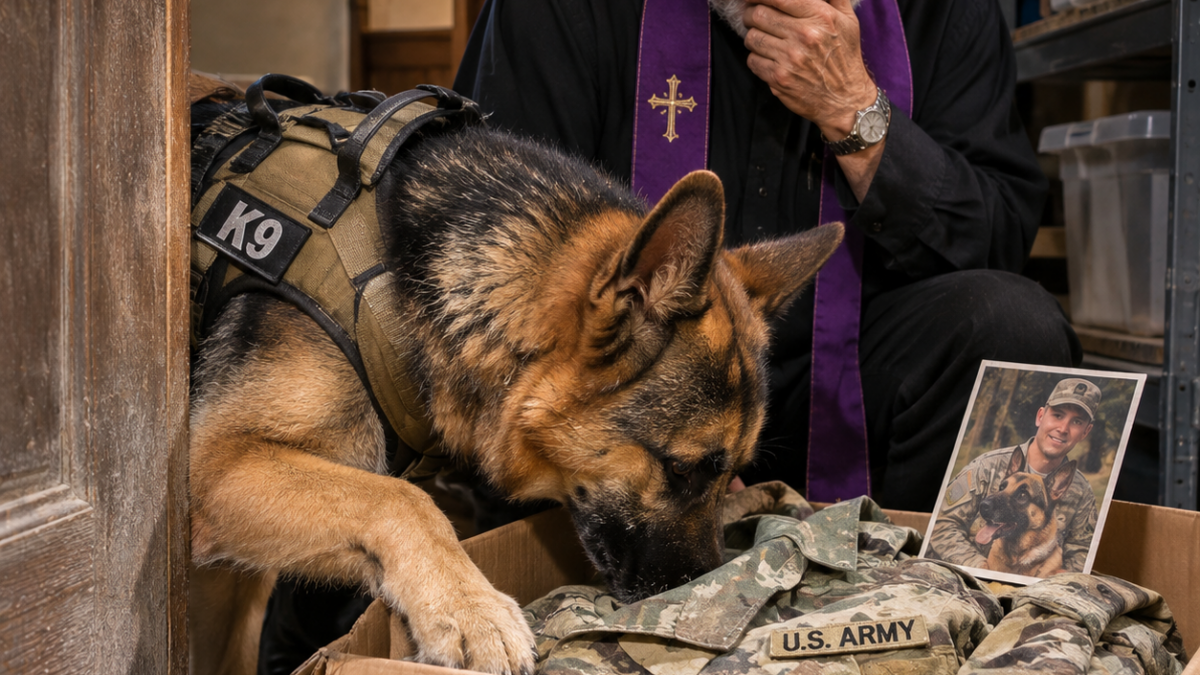
A Retired K9 Escaped Every Sunday and Walked 3 Miles to an Empty Church—Then the Pastor Unlocked the Room He’d Been Waiting For
For six Sundays in a row, retired military K9 Max escaped from a secure retirement facility, crossed three miles of Kentucky back roads, and sat beside the same locked basement door of a small country church without entering the sanctuary or approaching a single person.
Staff reinforced his kennel, changed his exercise schedule, and even moved him to another building, but every Sunday morning Max found a new way out and returned to that door as if he were reporting for an appointment nobody else remembered.
Then Pastor Samuel Reeves finally unlocked the forgotten storage room, and Max went straight to a cardboard box of military uniforms donated fifteen years earlier—where a faded name patch and a sealed envelope revealed why the old dog had been trying to get back there before it was too late.
The first time Max disappeared, nobody panicked.
Not immediately.
Bluegrass Working Dog Retirement Center sat outside Harrodsburg, Kentucky, on twelve fenced acres of rolling pasture and hardwood trees.
The facility cared for retired police dogs, military working dogs, search-and-rescue dogs, and several service animals whose handlers had died or could no longer keep them.
Most were older.
Some had arthritis.
Some were partially deaf.
A few had the kind of habits only years of serious work could create.
One German Shepherd refused to eat until somebody inspected the room first.
A retired explosives dog named Boone still sat automatically whenever he smelled diesel exhaust.
A Belgian Malinois called Major slept with his back against the kennel door every night, as though even retirement needed perimeter security.
Max was different.
He was thirteen years old.
German Shepherd.
Large even after age had taken muscle from his back legs.
Black saddle fading into gray.
Left ear permanently bent near the tip.
Small white scar running from the corner of his right eye toward his cheek.
His military records listed him as MWD M-417.
Explosives detection.
Patrol support.
Afghanistan.
Two deployments.
Then stateside security work.
His last handler was Staff Sergeant Daniel Mercer.
Daniel had been with Max longer than anyone else.
Seven years.
According to the transfer paperwork, Daniel died eighteen months earlier from complications connected to injuries he had carried home from his final deployment.
Max had remained with a military kennel program for several months after Daniel’s death.
Then his hips worsened.
He stopped meeting working standards.
By the time he arrived at Bluegrass, he was officially retired.
His file contained only one personal note.
HANDLER DECEASED.
NO VERIFIED FAMILY PLACEMENT AVAILABLE.
That sentence bothered facility director Nora Callahan.
Not because it was unusual.
Working dogs passed through systems.
Handlers moved.
Families moved.
Records became incomplete.
PART2:
Sometimes the dog retired years after the person who knew him best disappeared from the paperwork.
Still, Max did not behave like a dog who had nowhere to go.
He behaved like a dog waiting for someone to remember the destination.
On most days, Max was easy.
He ate slowly.
Walked twice each morning.
Ignored tennis balls.
Loved cheese.
Disliked thunderstorms.
Tolerated younger dogs as long as they did not jump on him.
If a volunteer sat quietly beside his run, he would eventually lean his shoulder against the fence.
He rarely barked.
Never paced.
Never tried to climb.
That was why Nora was not worried when kennel technician Luis Ortega walked into her office on the first Sunday and said:
“Max is out.”
Nora looked up.
“Out where?”
“Out.”
“Exercise yard?”
Luis shook his head.
“Facility.”
She stood.
“How?”
“Don’t know.”
“Gate?”
“Closed.”
“Fence?”
“Looks fine.”
“Camera?”
“Checking.”
PART3:
The retirement center’s perimeter was not a prison.
But it was secure.
Six-foot fencing.
Double-gate entry.
Cameras.
Night locks.
Most residents were old enough that the greatest security threat was somebody forgetting to latch a food bin.
Max was not supposed to be able to disappear.
They searched the property first.
Barn.
Training field.
Wood line.
Drainage ditch.
Nothing.
Then Nora drove the nearby roads while Luis checked camera footage.
Ten minutes later her phone rang.
“I found it.”
“What happened?”
“North exercise gate.”
“What about it?”
“He opened it.”
Nora almost laughed.
“Opened what?”
“The latch.”
“It has a spring clip.”
“He used his nose.”
“Luis.”
“I’m serious.”
“He watched Melissa open it at 7:02.”
“At 7:14 he came back.”
“Pushed the bottom.”
“Worked the latch with his muzzle.”
“Got through before it swung shut.”
Nora stared through her windshield.
“That dog is thirteen.”
“Tell him.”
A second call came before she could respond.
Unknown number.
“Bluegrass Working Dog Retirement?”
“Yes.”
“This is Reverend Samuel Reeves at Grace Fellowship Church.”
Nora slowed the van.
“Yes?”
“Do you have an old German Shepherd missing?”
Her foot moved to the brake.
“Where are you?”
“Grace Fellowship.”
“Old Mill Road.”
Nora knew it.
Three miles from the center.
“How did he get there?”
“I was hoping you could tell me.”
Grace Fellowship Church was small.
White clapboard.
Dark green shutters.
A simple steeple.
Cemetery behind it.
Built on a rise above a two-lane road where horse farms and soybean fields stretched toward the horizon.
Sunday service had already started when Nora pulled into the gravel lot.
She expected chaos.
People surrounding Max.
Children trying to pet him.
Somebody feeding him donuts.
Instead, the front lawn was empty.
Samuel Reeves stood near the side of the church.
Sixty-eight.
Tall.
Thin.
White hair.
He pointed.
“There.”
Max sat beside a basement-level door beneath a narrow concrete stairwell.
Not lying down.
Sitting.
Back straight despite his hips.
Facing outward.
Nora walked toward him.
“Max.”
His ears moved.
He looked at her.
Then immediately looked back at the door.
Samuel said:
“He hasn’t moved for twenty minutes.”
“Did he try to get inside?”
“No.”
“Scratch?”
“No.”
“Bark?”
“No.”
“Just sat down.”
Nora clipped a leash to his collar.
“Come on.”
Max resisted.
Not violently.
He shifted his weight backward.
Nora looked at the door.
“What’s in there?”
“Storage.”
“What kind?”
“Old Sunday school supplies.”
“Christmas decorations.”
“Tables.”
“Things churches refuse to throw away because somebody donated them in 1984.”
Nora smiled.
“Anything military?”
Samuel thought.
“Maybe.”
“Why?”
“His handler was military.”
The pastor looked at Max differently.
“What was his handler’s name?”
“Daniel Mercer.”
Samuel’s expression changed.
Very slightly.
Nora noticed.
“You know that name?”
He hesitated.
“Mercer is common.”
Not an answer.
Before she could push, the church bell rang from inside.
Service ending.
Max’s ears came forward.
Then he stood.
Looked toward the sanctuary wall.
For one second his whole body changed.
Age seemed to leave him.
Alert.
Waiting.
Then nothing.
People began exiting the front doors.
Max sat again beside the basement door.
Samuel watched him.
“He knows this place.”
Nora looked down.
“Maybe.”
She coaxed him away with cheese.
He looked back three times before reaching the van.
That afternoon, Nora reviewed Max’s file.
No Grace Fellowship.
No Harrodsburg church.
Daniel Mercer’s military address history listed Kentucky during several stateside assignments.
But nothing specific.
She made a note.
Then forgot about it.
Until the next Sunday.
7:31 a.m.
Max disappeared again.
This time the spring clip was reinforced.
He could not manipulate it.
Luis watched the footage.
Max never tried.
Instead, he waited for volunteer Hannah Price to enter the yard with breakfast.
When she opened the inner gate, Max moved behind her.
Not rushing.
Not bolting.
He slipped through while she turned to greet another dog.
Then crossed the service yard.
At the outer vehicle gate, he waited beside a landscaping trailer.
The truck left at 7:42.
Max walked through before the gate closed.
Luis called Nora.
“He planned it.”
Nora was pulling on boots.
“He’s a dog.”
“Watch the video.”
“He planned it.”
Nora drove directly to Grace Fellowship.
Max was there.
Same basement door.
Same position.
Samuel stood beside him with two coffees.
He handed Nora one.
“I figured you’d come.”
“How long?”
“Fifteen minutes.”
“Anybody feed him?”
“No.”
“Talk to him?”
“Yes.”
“He ignored us.”
Nora crouched.
“Max.”
The dog looked at her.
Then at the door.
Samuel said:
“I checked.”
“What?”
“Mercer.”
Nora stood.
The pastor looked toward the cemetery.
“There was a Mercer family here.”
“Years ago.”
“How many years?”
“Fifteen.”
That number stayed in the air.
Samuel continued.
“Thomas and Evelyn Mercer.”
“Their son Daniel grew up here.”
Nora stared.
“Staff Sergeant Daniel Mercer?”
“I don’t know about the rank.”
“But yes.”
“Daniel.”
The pastor shook his head.
“I should’ve remembered immediately.”
“He left town a long time ago.”
Nora looked down at Max.
“Did Daniel bring him here?”
Samuel rubbed his chin.
“I don’t remember the dog.”
“I remember Daniel visiting in uniform.”
“Maybe ten years ago.”
“Maybe more.”
“I’ve done too many funerals.”
“Too many homecomings.”
“Faces blur.”
He sounded ashamed.
Nora said:
“That’s normal.”
Samuel glanced toward the basement door.
“Maybe.”
They did not open it.
Not yet.
Samuel had service.
Nora needed to return Max.
She asked him to check church records.
He agreed.
Monday afternoon he called.
Daniel Mercer had indeed grown up at Grace Fellowship.
Baptized there.
His father Thomas had served twenty-two years in the Army.
His older uncle had served in Vietnam.
The Mercer family had attended almost every Sunday until Thomas died.
Fifteen years earlier, Evelyn Mercer donated several boxes to the church.
Military uniforms.
Books.
Flags.
Photographs.
Things she could not bear to keep but did not want thrown away.
Most were intended for Veterans Day displays.
Samuel said:
“I think some boxes went downstairs.”
Nora looked through her office window at Max sleeping in the sun.
“Behind that door?”
“Probably.”
“Can we check?”
“This week.”
But the week became complicated.
A plumbing leak flooded part of the fellowship hall.
Samuel spent two days dealing with insurance.
Nora had a veterinary emergency with a retired police dog.
By Saturday nobody had opened the storage room.
Sunday morning, Max escaped again.
This time Nora had changed his schedule.
No yard access before ten.
At 7:15, Max was still inside the main retirement building.
Doors closed.
Staff nearby.
At 7:36, a food delivery arrived.
The loading door opened for less than twenty seconds.
Max was nowhere near it.
At least that was what everyone believed.
Camera footage later showed him lying beneath a bench in the hallway.
He stood when the delivery worker passed.
Waited.
Followed silently.
Slipped behind a stack of food bags.
Out the door.
Luis watched the footage three times.
Then looked at Nora.
“He knows it’s Sunday.”
Nora did not answer.
“How?”
Luis asked.
Routine.
Church bells in the distance.
Volunteer schedule.
Human behavior.
Maybe some combination.
Dogs understood patterns better than people often gave them credit for.
Still, it unsettled her.
Max reached the church at 8:04.
Same door.
Samuel met Nora in the parking lot.
“I’m opening it after service.”
“Why after?”
“Because I want time.”
“For what?”
“I don’t know.”
He looked at Max.
“But I think he does.”
That Sunday Nora stayed.
She sat in the back pew.
Max remained outside.
He could hear music.
The old dog never entered.
That detail became more important later.
If Max simply remembered attending church with Daniel, why not go toward the sanctuary?
Why the basement?
At exactly 10:56, service ended.
People left.
Several recognized Max from the previous weeks.
Nobody approached him.
Samuel had asked them not to.
When the final car pulled away, he took a ring of keys from his pocket.
Nora stood beside him.
Luis had come too.
Max rose before Samuel reached the basement steps.
The pastor tried the first key.
Wrong.
Second.
Wrong.
Third.
The lock clicked.
Max’s whole body stiffened.
Samuel looked at Nora.
She nodded.
He opened the door.
Cold basement air came out.
Dust.
Wood.
Old cardboard.
The smell of concrete.
Max stepped forward.
Nora held his leash loosely.
“Slow.”
The room was larger than expected.
Shelving.
Christmas wreaths.
Plastic tubs.
Old hymnals.
Folding signs.
A broken artificial tree.
Cardboard boxes stacked along the back wall.
Max did not sniff randomly.
He walked directly down the center aisle.
Turned left.
Stopped in front of a stack of boxes beneath an old church banner.
He pushed his nose against the bottom one.
Samuel read the faded handwriting.
MERCER FAMILY.
VETERANS DISPLAY.
The final digit had smeared.
Samuel crouched.
“This is it.”
They moved the boxes above it.
Max paced.
One slow circle.
Then stood over the Mercer box.
Nora opened the flaps.
Fabric.
Olive green.
Dress blues.
A folded field jacket.
Old service caps.
Thomas Mercer’s name appeared on several.
MERCER.
Samuel lifted one jacket.
Max sniffed it.
No dramatic reaction.
Then returned to the box.
Pushed deeper.
Nora removed another uniform.
Army combat shirt.
Different era.
Different pattern.
Name tape:
MERCER.
Inside collar, handwritten initials.
D.M.
Daniel Mercer.
Nora stopped.
“How old was Daniel when these were donated?”
Samuel stared.
“Twenty-six.”
“He was already Army.”
“Yes.”
“Why would his uniform be here?”
“I don’t know.”
He picked it up.
Memory came slowly.
“Wait.”
“After Thomas died, Evelyn wanted the church to keep some of his things.”
“Daniel added one of his own uniforms for a Veterans Day display.”
“He said…”
Samuel frowned.
“What?”
“He said people should see the family kept serving.”
Max pressed his nose into Daniel’s old shirt.
Then sat.
Not excited.
Not frantic.
He simply leaned his muzzle against the fabric.
Nora felt her throat tighten.
Fifteen years.
Could a dog recognize a human’s scent on clothing stored that long?
No one in that basement could answer.
The box had remained closed.
Dry.
Undisturbed.
But dust, cardboard, fabric degradation, church storage, other hands—all of it complicated any claim.
Nora refused to turn Max into a miracle.
She did not need to.
The dog had known the route.
The church.
The door.
And now he had selected a box carrying his dead handler’s name.
That was enough to demand attention.
Samuel lifted Daniel’s shirt.
Something fell from beneath it.
A photograph.
Young Daniel Mercer.
Late twenties.
Army fatigues.
Standing beside a German Shepherd.
Nora picked it up.
The dog was younger.
Black muzzle.
Both ears straight.
No gray.
But the scar beneath the right eye was visible.
Max.
On the back:
HOME FOR CHRISTMAS.
MAX HATED THE ORGAN MUSIC.
Daniel + Max.
Samuel sat down on a folding chair.
“Oh, Lord.”
Nora looked at him.
“You saw them here.”
“Yes.”
“I forgot.”
His voice broke slightly.
“They came.”
“Daniel brought him.”
“When?”
Samuel took the photograph.
“Christmas leave.”
“Maybe eleven years ago.”
“Daniel sat in the back because Max wouldn’t settle during hymns.”
“That explains why he stays outside.”
Samuel nodded.
“After service, Daniel helped me carry display boxes downstairs.”
“Max came with us.”
Nora looked at the door.
“He’s been here.”
“Yes.”
“He knew the room.”
“Yes.”
Max pushed his nose back into the box.
Under the uniforms.
Scratched once at the cardboard bottom.
Nora removed a folded American flag.
A pair of old boots.
Then a thick envelope slid into view.
Cream-colored.
Church stationery.
Written across the front:
REV. SAMUEL REEVES
IF SOMETHING HAPPENS TO ME, PLEASE READ THIS.
Samuel stopped moving.
The handwriting was Daniel’s.
He knew immediately.
Nora said:
“Did you know about this?”
“No.”
“Have you ever seen it?”
“No.”
“How did it get here?”
Samuel stared.
“I don’t know.”
The envelope was unsealed.
Not secret legal correspondence.
Just folded paper tucked into a family box.
Samuel opened it.
The letter was dated eight years earlier.
Years after the box had originally been donated.
Daniel must have added it during a later visit.
Samuel read silently.
His hands began shaking.
Nora said:
“What?”
He looked at Max.
Then read aloud.
Pastor Sam,
Mom says I’m being dramatic writing this, so don’t tell her I did.
I’m headed back overseas.
Max is coming with me.
He has already saved my life twice, once officially and once when nobody was keeping score.
If I don’t come home and he does, I need you to help make sure he gets to family.
The Army has rules and I understand that.
But when he retires, if nobody knows where he belongs, call Rachel.
She promised me years ago that if I couldn’t take him, she would.
Max knows Grace Fellowship.
He knows the basement because he slept down there during the Christmas veterans event when the organ scared him half to death.
If he ever comes back without me, maybe he’ll remember.
Probably not.
But I’d like to think he will.
Samuel stopped.
Nobody spoke.
Max’s head remained against Daniel’s old uniform.
Samuel continued.
Rachel’s contact information was beneath.
Rachel Mercer Hale.
Daniel’s younger sister.
Address in Tennessee.
Phone number.
Old.
Probably useless after eight years.
Then one final paragraph.
Please don’t let him spend his last years behind a kennel fence just because people forget he belonged to someone before he belonged to the government.
He’s stubborn.
He steals socks.
He hates thunder.
He likes cheddar cheese better than any dog should.
Tell Rachel he still sleeps on the left side of the bed if nobody stops him.
And if Max somehow gets himself back to church one Sunday, open the basement door.
He’ll probably know what he came for.
Daniel
Samuel lowered the letter.
Luis turned away.
Nora sat on an overturned storage crate.
For six Sundays, Max had walked three miles to exactly the place Daniel had written about.
Not because he understood a letter.
Not because anybody had taught him the address.
Because years earlier, Daniel had brought him there.
Maybe repeatedly.
And the dog remembered.
Samuel whispered:
“I never read it.”
Nora looked at him.
“You didn’t know it existed.”
“He wrote my name.”
“And put it in a closed box.”
“What kind of pastor doesn’t find a letter for eight years?”
“One who doesn’t inventory military uniforms in a basement.”
Samuel looked miserable.
Nora continued:
“Daniel didn’t mail it.”
“He didn’t give it to you.”
“He hid it in a box.”
“That isn’t your failure.”
Samuel looked at Max.
“But he came six times.”
“Yes.”
“And I left the door locked.”
“You opened it today.”
That was what mattered now.
Rachel’s old number was disconnected.
The Tennessee address belonged to another family.
Nora expected the trail to end.
It did not.
Military families leave traces in ordinary places.
Church newsletters.
Obituaries.
School announcements.
Veterans organizations.
Samuel found Thomas Mercer’s old obituary.
Rachel listed as daughter.
Married name Hale.
Then a later newspaper article.
Rachel Hale.
Registered nurse.
Lexington.
Back in Kentucky.
Forty-one.
Worked in a rehabilitation clinic less than an hour away.
Nora called.
Receptionist answered.
“Rachel Hale, please.”
“May I ask who’s calling?”
“My name is Nora Callahan.”
“I run a retired working-dog facility.”
Pause.
“What is this regarding?”
“Her brother Daniel.”
Longer pause.
“I’ll see if she’s available.”
Two minutes later, a woman answered.
“This is Rachel.”
Nora looked through the office window.
Max was asleep beside Luis’s desk.
“Ms. Hale, did your brother Daniel Mercer handle a military working dog named Max?”
Silence.
Then a breath.
“Yes.”
Nora closed her eyes.
“I have him.”
Nothing.
Then:
“What?”
“I have Max.”
“No.”
Rachel’s voice changed.
“No, Max died.”
“He didn’t.”
“They told us—”
“He’s thirteen.”
“Retired.”
“He’s here in Kentucky.”
The other end went quiet.
Then Rachel started crying.
Not loudly.
The kind of crying people do when the body reacts before the mind has decided what emotion it is.
Nora waited.
Finally:
“Where?”
Nora told her.
Rachel said:
“I’m coming.”
Then:
“Is he okay?”
“Yes.”
“Does he…”
Her voice broke.
“Does he remember Daniel?”
Nora looked toward the old dog.
“I think he has spent six Sundays trying to prove that.”
Rachel arrived ninety minutes later.
Still wearing blue scrubs.
No makeup.
Hair pulled into a rough ponytail.
She parked badly.
Left the driver’s door open.
Nora met her outside.
Rachel held up one hand.
“I need a second.”
She leaned against the car.
Breathing.
“Daniel died seven years ago.”
“I know.”
“They told us Max had been killed during the same deployment.”
Nora frowned.
“His records say he survived and continued working.”
Rachel wiped her face.
“We were told Daniel’s dog didn’t make it home.”
“Maybe there was confusion.”
“Maybe.”
Nora had seen enough military paperwork to know that one incorrect family notification could survive forever if nobody had reason to challenge it.
Rachel stared toward the building.
“Where is he?”
“Inside.”
“Will he know me?”
“I don’t know.”
That was important.
Nora would not promise a movie.
Seven years.
Different smells.
Age.
No guarantee.
Rachel nodded.
“Okay.”
They entered.
Max was lying beside the office doorway.
He lifted his head.
Rachel stopped twenty feet away.
Her hands shook.
“Oh my God.”
Max watched.
No movement.
Rachel crouched.
Not approaching.
“Hey, old man.”
Max’s ears came forward.
She laughed through tears.
“That’s what Daniel called you.”
Max stood.
Slowly.
His hips stiff.
He took three steps.
Stopped.
Nora held her breath.
Rachel did not reach for him.
“Max.”
The dog moved closer.
Sniffed her hands.
Her pants.
Shoes.
Then stared at her face.
Nothing dramatic.
No leap.
No bark.
No instant collapse into her arms.
Then Rachel whispered:
“Left side of the bed.”
Max’s tail moved.
Once.
Rachel covered her mouth.
“Cheddar cheese.”
Another tail movement.
She laughed.
Max pressed his forehead against her chest.
Rachel folded around him.
That was enough.
Later she said Max probably recognized Daniel’s scent in her.
Maybe.
Maybe not.
Rachel had spent years around Daniel.
Same family home.
Similar genetic scent cues.
Same detergent her mother used.
Maybe Max recognized her voice.
Maybe he remembered Rachel directly from years earlier.
Maybe he simply accepted a crying woman who smelled familiar.
The mechanism did not matter to her.
She knew one thing.
Daniel’s dog was alive.
And Daniel had wanted him with her.
Rachel came to Grace Fellowship that afternoon.
Samuel handed her the letter.
She read the first paragraph.
Stopped.
Read again.
By the time she reached the part about Max’s last years behind a kennel fence, tears were falling onto the paper.
“I told him.”
“What?”
Samuel asked.
“I promised.”
“When?”
“The night before his last deployment.”
“He said if anything happened, Max came to me.”
“I thought Max was dead too.”
She looked at Nora.
“How did he end up at Bluegrass?”
“Retirement transfer.”
“No verified family placement.”
Rachel closed her eyes.
“Because nobody knew we existed.”
“Apparently.”
She looked at Max.
He sat beside the cardboard box.
Then at the basement door.
“He knew.”
Samuel shook his head slowly.
“He knew enough.”
That was more honest.
Daniel’s letter did not automatically transfer ownership of a former military working dog.
There were adoption procedures.
Veterinary checks.
Facility policies.
Rachel knew.
She did not demand Max that afternoon.
That made Nora trust her more.
Instead she visited.
Every day the first week.
Then every other day while paperwork moved.
Rachel brought Daniel’s photographs.
Old videos.
One clip showed Max younger, sprinting through a backyard while Daniel laughed behind the camera.
Another showed Rachel throwing a tennis ball.
Max catching it.
Rachel paused the video.
“There.”
Nora looked.
Young Max sat beside Rachel.
“You met him.”
“I told you I did.”
“I just didn’t know whether he’d remember.”
Rachel smiled.
“I barely remember being that thin.”
The adoption process included a home inspection.
Rachel lived on six acres outside Lexington.
One-story house.
Fenced yard.
No stairs Max needed to climb.
She had an older Labrador named Scout.
Introduction went well.
Scout sniffed Max.
Max ignored him.
Perfect senior-dog diplomacy.
The only concern was Max’s medical care.
Arthritis.
Kidney values beginning to change.
Old spinal injury.
Potential costs.
Rachel listened.
Then:
“I’m a nurse.”
Nora smiled.
“For humans.”
“I can learn.”
“Can you lift eighty pounds?”
“No.”
“Good.”
“Because he’ll bite your dignity before letting you.”
Rachel laughed.
Six weeks after Max first escaped, Bluegrass approved placement.
Nora expected him to be excited when Rachel arrived with his new collar.
He was asleep.
He looked up.
Saw her.
Went back to sleep.
Rachel said:
“I feel honored.”
Luis laughed.
Max’s few possessions fit in one bag.
Medication.
Blanket.
Food.
Daniel’s old photograph, which Samuel had given to Rachel.
The uniform remained at the church.
The letter went with Rachel.
Before leaving, Rachel took Max to Grace Fellowship one more time.
Sunday.
Samuel opened the basement door before Max reached it.
No locked barrier.
Max walked downstairs.
Went to the Mercer box.
Sniffed Daniel’s shirt.
Then turned away.
He climbed the stairs slowly.
Outside, people entered for service.
Max did not go toward the basement again.
He followed Rachel toward her car.
Samuel watched.
“He got what he came for.”
Rachel shook her head.
“No.”
“What?”
“He came to get us to open it.”
That interpretation stayed with Nora.
Max had not wanted the box.
Not exactly.
If he had, he might have remained beside it after it was opened.
Instead, once the humans understood where to look, his obsession stopped.
Daniel’s letter had done the rest.
Max adjusted to Rachel’s house quickly.
Too quickly, according to Scout.
He stole Scout’s bed.
Then ignored the orthopedic bed Rachel bought specifically for him.
Daniel had warned them.
Left side of the bed.
First night, Rachel woke at 2:13 a.m. with eighty pounds of retired German Shepherd pressed against her legs.
She laughed so hard she cried.
“Daniel, you jerk.”
Max lifted his head.
She moved over.
“Fine.”
“Left side.”
He settled.
Sunday mornings changed.
For the first month, Rachel expected Max to become restless.
He did not escape.
He did not pace.
But around eight, he would walk to the front door.
Rachel understood.
She began taking him to Grace Fellowship.
Not every week.
Enough.
The first Sunday, Samuel left the side basement door unlocked.
Max walked past it.
Straight toward the rear sanctuary entrance.
Then stopped.
Organ music.
He backed up.
Rachel laughed.
“He really did hate it.”
Samuel came outside.
“I thought Daniel was exaggerating.”
Max sat on the church steps until the music stopped.
Then entered.
They sat in the back row.
Exactly where Daniel had sat with him years earlier.
Older members began remembering.
Mrs. Evelyn Price said:
“That’s Daniel’s dog.”
Her husband disagreed.
“That dog would be ancient.”
“He is ancient.”
Then memories returned.
Daniel home on Christmas leave.
Uniform.
Tall.
Laughing.
A young German Shepherd lying under the pew.
Daniel taking him downstairs after he became restless.
Bits of Max’s past had been scattered across other people’s memories all along.
Nobody had known they mattered.
Rachel began bringing the box contents upstairs for Veterans Day.
They built a small display.
Thomas Mercer’s dress uniform.
Daniel’s old combat shirt.
Photographs.
A copy of Daniel’s letter with private contact details removed.
And one photograph of Max sitting beside the basement door.
No dramatic caption.
Only:
MAX.
MWD M-417.
HE REMEMBERED THE WAY BACK.
Rachel disliked that line at first.
Too sentimental.
Then she decided it was accurate enough.
He had remembered something.
A route.
A place.
A routine.
A door.
Whatever combination existed inside his old working-dog brain had brought him three miles every Sunday until someone opened it.
The retirement center changed too.
Nora began asking more questions when new dogs arrived.
Not only medical history.
Personal history.
Where did the dog live?
What routines did the handler have?
Church?
Favorite park?
Family?
Commands?
Nicknames?
What did Sundays mean?
What did a particular truck mean?
What song played in the handler’s home?
Most answers led nowhere dramatic.
That was fine.
The point was not to create mysteries.
The point was to remember working dogs had lives before forms reduced them to serial numbers.
Luis added a line to every intake sheet.
KNOWN PLACES OF PERSONAL SIGNIFICANCE.
Nora teased him.
“That sounds very official.”
“It is.”
“You wrote it in Comic Sans.”
“The printer is hostile.”
But the question stayed.
Max lived another two years.
Good years.
Not perfect.
Age continued.
His back legs weakened.
Rachel installed rubber mats.
Then ramps.
Then a harness.
Thunderstorms terrified him more as hearing changed.
Rachel sat on the floor during storms.
Cheese helped.
Daniel had been right about that too.
One afternoon, she found an old recording on a phone recovered from a storage box.
Daniel’s voice.
Not important.
Just a message he had sent years earlier.
“Rachel, Mom says stop buying Max those disgusting cheese sticks because he stole an entire package and threw up in my truck. Also, he says he’s innocent.”
Rachel played it.
Max lifted his head.
For several seconds, he stared at the phone.
Then got up.
Walked over.
Pressed his nose against the speaker.
Rachel stopped breathing.
Daniel’s voice continued.
“Max, get away from that.”
The old dog’s tail moved.
Rachel sat on the kitchen floor.
Played it again.
Max lay beside the phone.
Not frantic.
Not confused.
Just listening.
She never played it excessively after that.
Memories could comfort.
They could also agitate.
She asked Nora.
“Do you think he knows?”
Nora answered:
“I think something in that voice matters to him.”
That was enough.
Rachel began making her own recordings.
Not because she expected to die.
Because Daniel’s letter changed how she thought about continuity.
“Max, food’s in the blue cabinet.”
“Scout pretends he doesn’t like you.”
“Thunder means basement.”
“Sundays mean church.”
She laughed at herself.
Then kept doing it.
Max’s final Sunday came in October.
Kentucky leaves turning gold.
He was fifteen.
Walking slowly.
Eating less.
Veterinarian had found a large abdominal mass months earlier.
Probably cancer.
Rachel chose comfort.
No surgery.
No hospitalization that would buy weeks at the cost of fear.
That Sunday, Max stood at the door at 7:55.
Rachel had planned to skip church because he seemed tired.
He looked at her.
Then the door.
“You want to go?”
Tail.
One movement.
They drove.
Samuel was seventy now.
He opened the basement side door when he saw them.
Max did not go down.
He walked to the front lawn.
Stopped near the steps.
People arrived.
Some bent to greet him.
Rachel warned them:
“Gentle.”
Max accepted hands on his shoulders.
Children sat near him.
When the organ started, he looked toward the sanctuary.
For the first time, he did not back away.
Rachel whispered:
“You finally getting over it?”
He walked inside.
Slowly.
Back row.
Lay beside Rachel’s feet.
Samuel saw them from the pulpit.
Stopped for half a second.
Then continued.
After service, Max did not want to stand.
Rachel and Luis, who happened to be visiting from Bluegrass, used the support harness.
They carried some of his weight.
Outside, Samuel knelt beside him.
“You gave me six chances.”
Rachel smiled sadly.
“Six?”
“Six Sundays.”
“Seven if you count the day we opened it.”
Samuel touched Max’s shoulder.
“Stubborn old man.”
Max looked at him.
Then toward the basement door.
It was open.
Nothing waiting.
No unfinished job.
Rachel took him home.
Two days later, he stopped eating.
The veterinarian came to the house.
Scout lay nearby.
Rachel placed Daniel’s old photograph on the table.
Not because Max needed it.
Because she did.
She gave him a piece of cheddar.
He ate half.
His final victory.
Rachel sat on the floor beside him.
One hand behind his bent ear.
“I kept the promise.”
Her voice broke.
“I was late.”
“But I kept it.”
Max breathed slowly.
She leaned closer.
“Daniel would’ve been so proud of you.”
The veterinarian gave the medication.
Max relaxed.
Rachel whispered:
“You found us.”
Then:
“You can stop looking now.”
Max died with his head in her lap.
For weeks afterward, Rachel woke automatically on Sundays before eight.
Expected paws near the door.
Nothing.
Scout eventually started sleeping on Max’s stolen bed.
Rachel considered that justice.
Grace Fellowship placed Max’s collar inside the Veterans Day display.
Samuel refused to turn the basement storage room into a shrine.
Daniel would have hated that.
Instead, the room stayed what it had always been.
Christmas decorations.
Old tables.
Choir robes.
Boxes.
The Mercer box was moved to a dry shelf.
Properly labeled.
Samuel placed Daniel’s letter in the church archive with Rachel’s permission.
Not because it was famous.
Because churches are full of small histories people assume somebody will remember.
Then people die.
Pastors retire.
Families move.
Memory needs help.
One Sunday, several years later, a child asked Samuel about the photograph of the old German Shepherd.
“Did he really walk here by himself?”
“Yes.”
“Six times?”
“Yes.”
“How did he know where the church was?”
“He’d been here before.”
“How did he know the box was downstairs?”
Samuel smiled.
“He’d been downstairs before.”
“Did he smell the uniform from three miles away?”
“No.”
The child looked disappointed.
“No?”
“No.”
Samuel pointed toward the photograph.
“He remembered the place.”
“And once he got here, he remembered where something important had happened.”
“That’s better.”
The child thought.
“What was important?”
“A man he loved.”
The child accepted that.
Adults usually wanted something more mysterious.
A supernatural scent.
A miracle.
A dog solving a coded message.
Samuel always resisted.
The real story was more moving.
Max had spent years working beside Daniel Mercer.
Daniel brought him home.
Brought him to Grace Fellowship.
Took him into that basement.
At some point, Daniel placed a letter inside a box and wrote a ridiculous line:
If Max somehow gets himself back to church one Sunday, open the basement door.
Years later, Daniel was gone.
Max was old.
Paperwork had separated the dog from the family who had promised to take him.
Nobody remembered the letter.
Nobody remembered the box.
But Max remembered enough.
Not words.
Not promises.
A route.
A building.
A door.
And apparently Sunday.
That memory did not need magic.
It needed someone to pay attention.
Nora Callahan eventually retired from Bluegrass.
Before leaving, Luis gave her a framed photograph.
Max beside the locked basement door.
Underneath, a small brass plate.
WHEN BEHAVIOR DOESN’T MAKE SENSE, ASK WHAT HISTORY YOU’RE MISSING.
Nora stared.
“That is annoyingly sentimental.”
“You’re crying.”
“Retirement allergies.”
“Sure.”
She hung it in the intake office.
Years later, new employees still asked.
“Who’s Max?”
Luis would tell them.
Not every detail.
Only enough.
Retired military dog.
Escaped Sundays.
Three miles.
Church.
Locked basement.
Old uniforms.
Handler’s letter.
Family found.
Then he always ended the same way.
“Don’t assume the dog is confused just because you are.”
That became part of Bluegrass culture.
Rachel visited once a year.
Usually October.
She brought photographs.
One year she brought Daniel’s old combat shirt.
Not to leave.
Just to show Nora.
The fabric had faded.
Name tape worn.
MERCER.
Rachel held it carefully.
“I used to think this was what Max went there for.”
Nora looked at her.
“You don’t anymore?”
“No.”
“What do you think?”
Rachel smiled.
“He went there because Daniel told him where home was.”
Nora shook her head gently.
“Daniel told Samuel.”
“Not Max.”
Rachel looked toward the old photograph on the wall.
“Maybe.”
“But Max was there when Daniel carried that box downstairs.”
“He was there when Daniel sat in church.”
“He was there when Daniel visited home.”
“Maybe that was enough.”
Nora could accept that.
The last piece of the story surfaced unexpectedly.
Samuel died at seventy-six.
While sorting his office, the new pastor found an old church newsletter.
Christmas issue.
Eleven years before Max’s escape.
One photograph showed Daniel Mercer standing outside Grace Fellowship.
Young Max beside him.
Underneath:
STAFF SGT. DANIEL MERCER VISITS HOME WITH MILITARY WORKING DOG MAX.
A handwritten caption in Samuel’s pen:
Daniel says Max can locate explosives, track threats, and clear buildings, but apparently cannot survive thirty minutes of organ music.
Below that, another note.
After service, Daniel helped move the Mercer military display back to basement storage.
Max supervised.
Rachel laughed when she read it.
There.
Not theory.
Not imagination.
Max had walked that route with Daniel.
Sat on those steps.
Entered that basement.
Watched Daniel handle the uniforms.
It had been part of his life.
Forgotten by everyone except perhaps the dog.
Rachel made a copy.
The original stayed in the archive.
She framed hers beside Max’s collar at home.
Sometimes visitors asked about it.
She would tell them the whole story.
Then they would say:
“That dog walked three miles every Sunday just to find Daniel’s uniform?”
Rachel usually shook her head.
“No.”
“That’s not quite it.”
“What then?”
She would look at the photograph.
Daniel smiling.
Young Max alert beside him.
“He walked three miles because everybody else had forgotten where he belonged.”
That was the truth as she understood it.
The uniform was evidence.
The letter was instruction.
The church was memory.
But Max’s real destination had never been a cardboard box.
It was a family.
Daniel had tried to leave a path.
The system lost it.
Samuel never knew the letter was there.
Rachel believed Max was dead.
Bluegrass had no verified family contact.
Every human record ended in the wrong place.
So Max did what he had done his entire working life.
He followed the route he knew.
Again.
And again.
And again.
Sunday after Sunday.
Until somebody finally opened the door.
People sometimes call that loyalty.
Rachel thinks the word is too small.
Loyalty sounds passive.
Waiting.
Max did not wait.
At thirteen years old, with stiff hips and a gray muzzle, he escaped a secure retirement facility six Sundays in a row.
He crossed three miles of Kentucky road.
He ignored an entire congregation.
He sat beside one locked basement door.
He did not stop when staff moved him.
He did not stop when gates were reinforced.
He did not stop because everyone around him assumed the behavior made no sense.
He kept returning to the last place where Daniel Mercer had once shown him something that felt like home.
And when that door finally opened, Max walked past the Christmas decorations, the folding tables, and fifteen years of dust.
Straight to the box marked MERCER FAMILY.
Inside was Daniel’s uniform.
Inside was Daniel’s photograph.
And beneath them was a letter written by a dead soldier who had somehow understood his dog well enough to leave one strange sentence behind:
If Max somehow gets himself back to church one Sunday, open the basement door.
Daniel was right about Max.
He was stubborn.
He loved cheese.
He hated thunder.
He slept on the left side of the bed.
And when everyone else lost the trail, the old dog found it.
Six Sundays.
Three miles.
One locked door.
That was all it took to bring him home.








