A Retired K9 Carried His Leash to an Empty VA Room Every Night—Then a Nurse Found His Dead Handler’s Name in a Twelve-Year-Old File
A Retired K9 Carried His Leash to an Empty VA Room Every Night—Then a Nurse Found His Dead Handler’s Name in a Twelve-Year-Old File
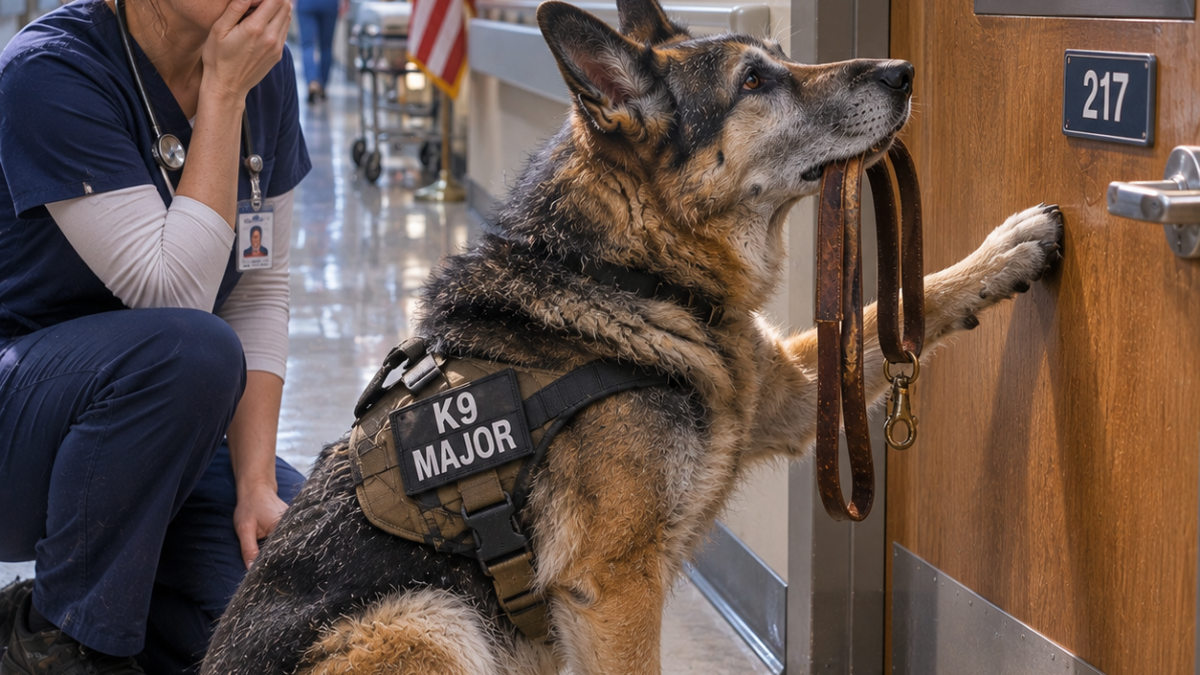
For forty-one nights, retired military K9 Major picked up the same worn leather leash at exactly 7:10 p.m., carried it through the VA hospital, and laid it outside an empty room nobody had used in months.
The staff called it an old dog’s grief until Nurse Claire Bennett opened a twelve-year-old patient file and discovered that Major’s first handler had died inside Room 217 after repeatedly claiming someone at the hospital was changing his medical records.
But when Claire found one final entry made less than an hour before the handler’s death, she realized Major had not been returning to that room simply because he missed the man who once held the other end of his leash—and whatever the old dog was waiting for had been buried inside the hospital far longer than anyone wanted uncovered.
The first time Nurse Claire Bennett saw Major carrying the leash, she thought someone had forgotten to attach themselves to it.
It was 7:10 on a Thursday evening at the Jefferson Ridge Veterans Medical Center outside Richmond, Virginia, and Claire had just finished helping an eighty-two-year-old Korean War veteran back into bed after he had tried to walk to the bathroom without calling for assistance.
The corridor on the second floor was quiet.
Visiting hours were almost over.
The television in the family lounge played a baseball game with the volume turned low.
A meal cart squeaked toward the elevators.
Then Major appeared around the corner.
Large German Shepherd.
Black-and-tan coat fading silver along his muzzle.
Right ear permanently folded at the tip.
Heavy shoulders.
Slow hips.
And a worn brown leather leash held gently between his teeth.
No person followed.
Claire stopped.
“Major?”
The dog kept walking.
He technically belonged to the hospital’s veteran companion program now.
Before that, he had served nearly eight years as a military working dog.
Patrol.
Explosive detection.
Search operations.
Two deployments to Afghanistan.
One to Iraq.
After retirement, he had gone home with his final handler, Army Sergeant Grant Ellis.
When Grant died from pancreatic cancer two years later, his family had donated Major to Jefferson Ridge because the dog had spent so much time visiting Grant during treatment that he seemed comfortable around the facility.
Major became part mascot, part therapy animal, part unofficial hospital employee.
He knew which veterans liked their hands licked.
Which ones preferred no contact.
Which nurses carried treats.
Which elevator made a high-pitched squeal he disliked.
PART2:
He often slept near the physical therapy wing and wandered under staff supervision through the long-term rehabilitation floor.
But Claire had never seen him carry his own leash.
“Where are you going?”
Major did not look back.
Claire followed.
The dog passed Room 213.
Then 215.
Then slowed.
Room 217 sat at the end of the hall.
Empty.
The hospital had stopped using it four months earlier after a pipe burst inside the wall and damaged part of the ceiling.
Repairs had been completed, but administration kept postponing reopening it while maintenance reviewed ventilation complaints.
Major stopped outside the door.
He placed the leash on the floor.
Then sat.
Claire waited.
Nothing happened.
“Major?”
The shepherd stared at the closed door.
Claire looked at the clock mounted above the nurses’ station.
7:12.
She crouched beside him.
“There’s nobody in there, sweetheart.”
Major’s ears moved.
PART3:
His gaze did not.
Claire picked up the leash.
“Come on.”
Major stood immediately.
For one hopeful second, she thought he had listened.
Then he took the leash gently from her hand.
Placed it back in front of Room 217.
Sat again.
Claire frowned.
“Okay.”
Major stared at the door.
“You’re weird.”
His tail moved once.
She smiled.
“Very handsome.”
Another tail movement.
“Still weird.”
The next evening at 7:10, Major did it again.
And the evening after that.
By the seventh night, the entire second-floor nursing staff knew.
Licensed practical nurse Sheila Barnes took a video.
“He thinks somebody’s supposed to take him for a walk.”
Claire shook her head.
“Then why this room?”
“Maybe that’s where somebody used to keep treats.”
“Room’s been empty since April.”
“Dog memory.”
“That doesn’t explain it.”
Sheila shrugged.
“He’s twelve, Claire.”
“Eleven and a half.”
“You correct everybody about that.”
“Because twelve sounds ancient.”
“He is ancient.”
Major looked up from the floor.
Sheila pointed at him.
“See? He knows.”
Claire laughed.
But she continued watching.
Every night, same ritual.
At roughly seven, Major would wake from wherever he had been resting.
He would walk to the small storage alcove near physical therapy where staff kept his bed, water bowl, grooming kit, and old belongings.
He would nose open a fabric basket.
Pull out the same leather leash.
Not the newer blue nylon one.
The old leather leash.
Then he would carry it down the corridor.
Room 217.
Place leash down.
Sit.
Wait.
He usually remained between twenty and thirty minutes.
Then he picked up the leash and returned to his bed.
No whining.
No scratching.
No agitation.
Just waiting.
By night fourteen, hospital staff had started joking.
“Major’s got a ghost appointment.”
“Room 217’s haunted.”
“He’s waiting for Elvis.”
Claire laughed with them.
But something about it bothered her.
Dogs repeated behaviors for reasons.
Especially working dogs.
Major had spent most of his life learning that precise actions produced specific outcomes.
Sit meant something.
Alert meant something.
Stay meant something.
Returning to one doorway at the same hour with the same object meant something too.
On night nineteen, Claire unlocked Room 217.
“Want to prove me wrong?”
Major stood.
She opened the door.
Lights off.
Bed stripped.
Chair pushed against the wall.
Nothing else.
Major remained outside.
Claire stepped in.
“Come on.”
He would not cross the threshold.
That changed everything.
Claire walked back out.
Major sat again.
Not afraid.
Not anxious.
Waiting.
She crouched.
“What happened in here?”
Major looked at the door.
The next afternoon, Claire asked maintenance supervisor Frank Mallory who had used Room 217 before the pipe problem.
“Lots of people.”
“I mean historically.”
Frank laughed.
“You want the genealogy of a hospital room?”
“I’m serious.”
“Claire, that building opened in the seventies.”
“Is there a room archive?”
“Medical records.”
“Patient names?”
“Protected.”
“I know HIPAA.”
“Then you know why I’m not giving you a list.”
“I don’t need a list.”
“What do you need?”
She looked through the glass doors toward the courtyard.
Major slept beneath a bench.
“I need to know whether that dog has been in Room 217 before.”
Frank followed her gaze.
“Major?”
“Yes.”
“He’s been here forever.”
“How forever?”
“Before me.”
“You’ve worked here nine years.”
Frank shrugged.
“Then longer than nine.”
Claire frowned.
“I thought he came with Grant Ellis.”
“No. Grant visited with him years before his cancer.”
“Years?”
“Major used to come in with military patients. Training outreach, therapy introductions, that kind of thing.”
Frank rubbed his chin.
“Actually…”
“What?”
“I think he came here before Grant owned him.”
Claire turned.
“With who?”
“No idea.”
That evening she went downstairs to Health Information Management.
She did not ask for patient files.
That would have crossed a line.
Instead she asked for archived facility utilization logs tied to military working dog visits.
Nothing.
Then volunteer program records.
Nothing.
Then old security visitor logs.
Most were gone.
On the third search, she found a scanned document from twelve years earlier.
A therapy-dog access request.
It listed:
MILITARY WORKING DOG MAJOR — TEMPORARY VISIT AUTHORIZATION.
Handler:
STAFF SERGEANT MICHAEL HALE.
Claire stared.
Michael Hale.
She had never heard the name.
The form was dated October 14, twelve years earlier.
Floor:
2 WEST.
Authorized patient contact:
Room 217.
Claire sat back.
She read it again.
Major had been there.
Not once.
Repeatedly.
She searched Michael Hale’s name in the internal patient index.
A record appeared.
Restricted archive.
Deceased.
Claire stared at the status.
Then the death date.
October 22.
Twelve years earlier.
Eight days after the first recorded visit.
Location of death:
Jefferson Ridge Veterans Medical Center.
Room 217.
Claire did not open the medical record.
Not yet.
She knew better.
Curiosity did not authorize access.
Instead she called the privacy office and asked a hypothetical question about historical records tied to an animal behavior concern.
The answer was essentially no.
Not unless Major’s behavior had clinical implications for a current patient.
He did not.
He was a dog.
So she stopped.
For six hours.
Then at 7:10, Major picked up the leash.
Claire followed.
Room 217.
Leash down.
Sit.
Wait.
She looked at the old leather.
The brass clip had been polished smooth from years of use.
Along one side, faint initials had been burned into the leather.
She had never noticed them.
M.H.
Claire’s stomach tightened.
She crouched.
“This was his.”
Major looked at her.
“Michael Hale.”
The reaction was small.
But real.
His mouth closed.
His ears rose.
Claire whispered the name again.
“Michael.”
Major stood.
His tail did not wag.
He picked up the leash.
Then pushed the handle into Claire’s hand.
She froze.
Major sat in front of her.
His eyes fixed on hers.
Claire felt suddenly foolish for being emotional over a dog and a piece of leather.
Then Major lifted his right paw.
Placed it against her knee.
Claire swallowed.
“Were you his?”
Major leaned into her hand.
That night, she went home and searched public records.
No confidential files.
Just news archives.
Staff Sergeant Michael Andrew Hale.
Army military police.
K9 handler.
Thirty-two years old.
Two Bronze Stars.
Purple Heart.
Multiple deployments.
Returned from Afghanistan after surviving a convoy attack that killed two soldiers.
Admitted months later to Jefferson Ridge for complications related to blast injuries, chronic pain, headaches, and episodes of disorientation.
Died unexpectedly during inpatient treatment.
The newspaper described it as “medical complications.”
A photograph showed Michael in uniform.
Beside him stood a much younger Major.
Same folded right ear.
Same dark mask.
Same eyes.
Claire stared at the image for a long time.
The article mentioned one surviving family member.
Younger sister: Rebecca Hale.
A follow-up article three months later quoted Rebecca.
“My brother went into that hospital walking and talking. Eight days later they called me to say he was dead.”
Claire read it twice.
Another line:
Hale family attorney has requested an independent review.
Then nothing.
No later coverage.
No lawsuit result.
No investigation.
Nothing.
The next morning, Claire asked longtime nurse Patrice Donovan whether she remembered Michael.
Patrice had worked at Jefferson Ridge for twenty-seven years.
Her face changed immediately.
“Where did you hear that name?”
“Major.”
Patrice stared at her.
“The dog?”
“He keeps waiting outside 217.”
Patrice sat down.
“You need to leave that alone.”
Claire frowned.
“Why?”
“Because it was ugly.”
“What was?”
Patrice looked toward the hallway.
“Michael Hale’s death.”
“Did you care for him?”
“No. I was on nights across the hall.”
“What happened?”
Patrice shook her head.
“Officially? He deteriorated.”
“Unofficially?”
“Claire.”
“You knew him.”
“I knew of him.”
“And Major?”
Patrice smiled sadly.
“That dog slept outside his door.”
Claire went still.
“Every night?”
“Every night.”
“With the leash?”
Patrice looked at her.
“What leash?”
Claire described it.
Patrice’s eyes filled.
“Oh my God.”
“What?”
Patrice looked away.
“Michael used to put it outside the room.”
“Why?”
“He couldn’t keep Major overnight. Hospital policy.”
“So?”
“He’d put the leash outside when he wanted the staff to know Major was coming the next evening.”
Claire stared.
“He left the leash?”
“Usually with the front desk. One of the military guys would bring Major after dinner.”
“At seven?”
Patrice nodded slowly.
“Seven-ten.”
Claire felt cold.
Exactly.
Not approximately.
Major had been repeating an appointment.
For twelve years.
Patrice rubbed her arms.
“Michael would spend the whole day asking when Major was coming. Pain medication made him confused sometimes, but the second that dog walked in, Michael was himself again.”
“Why did the visits stop?”
Patrice’s face tightened.
“The night Michael died.”
“What happened?”
“I told you.”
“No. You said it was ugly.”
Patrice stood.
“I have patients.”
“Patrice.”
“Claire, stop.”
“Why?”
Patrice turned.
“Because people lost jobs asking that question.”
Then she walked away.
Claire did not sleep much that night.
The next morning, she found Major’s current veterinary file.
That was accessible because she coordinated his companion-animal care.
His original military paperwork had been scanned into it.
Handler history:
SSG Michael Hale.
Then after Michael’s death:
SSG Grant Ellis.
Grant had not simply been Major’s final military handler.
He had taken Major after Michael died.
Claire felt another piece click into place.
She knew Grant’s widow, Laura.
Laura still attended the hospital’s cancer caregiver group.
Claire called.
“Did Grant ever talk about Michael Hale?”
Silence.
Then Laura said, “Why?”
“Major’s doing something.”
“What?”
Claire explained.
Laura began crying before Claire finished.
“Laura?”
“He started again?”
“Again?”
“He used to do it at our house.”
Claire gripped the phone.
“When?”
“After Grant first brought him home.”
“Carry the leash?”
“Every evening.”
“To where?”
“The front door.”
“How long?”
“Months.”
Laura took a shaky breath.
“Grant finally locked the leash in a trunk because he couldn’t stand watching it.”
“Why didn’t he tell anybody?”
“He did.”
“Who?”
“The Army.”
“And?”
“They told him it was separation behavior.”
Claire looked at Major sleeping near the nurses’ station.
“What did Grant think?”
“He thought Major was waiting for Michael.”
“Did Grant know how Michael died?”
Another silence.
“Yes.”
Claire sat straighter.
“What did he know?”
“Not enough.”
“Laura.”
“Grant made me promise.”
“He’s gone.”
“I know.”
“So is Michael.”
“I know.”
“Major isn’t.”
That silenced her.
Laura eventually said, “Come over.”
Her house stood thirty minutes west of Richmond.
She brought Claire into the garage.
At the back sat a green military storage trunk.
Laura opened it.
Inside were Grant’s uniforms.
Awards.
Photographs.
And a manila envelope marked:
HALE.
Claire looked up.
“Grant kept this?”
“He kept everything.”
Inside were copies of emails.
Handwritten notes.
A photograph of Michael and Major.
And a typed statement Grant had apparently prepared but never submitted.
Claire read.
Michael had called Grant from Room 217 two days before his death.
He believed someone was altering his medication schedule.
He had complained of losing time after evening doses.
He claimed doses listed in his chart did not match what nurses told him they administered.
He had also discovered that his designation in the electronic record had changed from full resuscitation to DNR.
Claire looked up.
“DNR?”
Laura nodded.
“Michael never signed one.”
“Did Grant verify that?”
“He tried.”
“What happened?”
“Michael died.”
Claire went back to the statement.
Grant wrote that he had arrived at Jefferson Ridge the night Michael died with Major.
Hospital security would not let him upstairs.
They said Michael had requested no visitors.
Grant called Michael’s phone.
No answer.
At 8:02 p.m., Michael was pronounced dead.
Cause initially listed as cardiac arrest secondary to complications of traumatic brain injury and medication interaction.
Claire frowned.
“Medication interaction.”
Laura nodded.
“Grant never believed it.”
“Why?”
“He talked to Michael that afternoon. Michael sounded fine.”
“That doesn’t mean—”
“I know.”
Laura held up a hand.
“I know what it means and what it doesn’t.”
Claire softened.
“What happened to the independent review?”
Laura laughed bitterly.
“What independent review?”
“Michael’s sister requested one.”
“She did.”
“And?”
“The hospital reviewed itself.”
Claire looked back at the papers.
“Grant did nothing?”
“Grant was twenty-seven.”
Laura’s voice sharpened.
“He had a new wife, a baby, security clearance, and a commander telling him that Michael’s death was medically complicated and none of his business.”
Claire remained silent.
Laura’s eyes filled.
“He hated himself for that.”
“What changed?”
“Years later, when he got cancer, he started talking about Michael again.”
Laura looked toward the trunk.
“He said dying makes cowardice feel louder.”
Claire sat beside her.
“Did Grant ever contact Rebecca?”
“Yes.”
“When?”
“Six years ago.”
“What happened?”
“She never answered.”
“Did he send this?”
“No.”
“Why?”
“He changed his mind.”
Laura looked ashamed.
“He said reopening it would only hurt her.”
Claire shook her head.
“Or expose something.”
“Maybe.”
“Why keep it then?”
Laura looked at the old envelope.
“Because part of him wanted someone else to be braver.”
Claire returned to Jefferson Ridge with copies Laura legally gave her.
She did not confront administration.
She contacted the hospital’s current patient safety officer, Dr. Julian Reeves.
Julian listened carefully.
He was younger than Claire expected for the role.
Forty-three.
Former emergency physician.
Known for irritating administrators by documenting everything.
When she finished, he asked, “What exactly are you alleging?”
“Nothing yet.”
“Good.”
“I’m saying we have a deceased patient, historical concerns about record alterations, and new information suggesting a possibly unauthorized DNR.”
“That is an allegation.”
“It’s a question.”
“Questions are more dangerous.”
Claire almost smiled.
“Will you look?”
Julian read Grant’s statement.
Then looked at the date.
“Twelve years.”
“I know.”
“Electronic systems changed twice since then.”
“I know.”
“Paper records may be archived off-site.”
“I know.”
“People retire.”
“I know.”
Julian sighed.
“You’re annoying.”
“So I’ve been told.”
He picked up the phone.
“I’ll request the audit log.”
Claire blinked.
“You can do that?”
“I can request anything.”
“Will they give it to you?”
“That’s the fun part.”
Three days later, Julian called her into his office.
He closed the door.
“Sit.”
Claire sat.
He slid a printed audit report across the desk.
“Michael Hale’s electronic record still exists in cold storage.”
Claire looked at the page.
“You found changes?”
“Yes.”
“How many?”
“Several hundred normal chart events.”
“And abnormal?”
Julian pointed.
“DNR status changed at 6:14 p.m. the night he died.”
Claire felt her pulse accelerate.
“Who changed it?”
“Dr. Stephen Caldwell.”
She knew the name.
Everyone did.
Caldwell had been chief medical officer at Jefferson Ridge twelve years earlier.
Now he served on the regional VA medical advisory board.
Retired clinically.
Still influential.
“Was he Michael’s doctor?”
“No.”
Claire looked up.
“Then why did he access the chart?”
“Excellent question.”
“Documentation?”
“None.”
“Signed DNR?”
“Not in the file.”
Claire’s mouth went dry.
Julian continued.
“At 6:26, a medication order was added.”
“What medication?”
“A sedative.”
“Dose?”
“High.”
“Appropriate?”
“Possibly in certain circumstances.”
“For Michael?”
“I can’t answer without full context.”
“Who ordered it?”
“Caldwell.”
“Again?”
“Yes.”
“Administered?”
Julian pointed to another line.
“Chart says 6:41.”
“By who?”
“Registered nurse Evelyn Marrow.”
Claire knew that name too.
Evelyn had retired years ago.
She had been nursing supervisor.
“Then?”
“At 7:03, Michael’s vital signs were documented as stable.”
Claire glanced at the clock.
Major had expected to arrive at 7:10.
Julian continued.
“7:18, unresponsive.”
“Code?”
“No.”
“Because of the DNR.”
“Yes.”
Claire sat very still.
“Time of death?”
“8:02.”
The same time Grant remembered.
Julian leaned back.
“There’s more.”
Claire looked at him.
“At 8:41, after Michael was dead, someone reopened the chart.”
“Who?”
“Caldwell.”
“And?”
“Deleted a nursing note.”
Claire stared.
“You can see that?”
“The note content is gone. Audit trail shows deletion.”
“Can it be recovered?”
“Maybe.”
“What about the DNR?”
“Changed again at 9:06.”
“To what?”
“Full code.”
Claire felt sick.
“They changed it back after he died.”
Julian said nothing.
Claire whispered, “So anyone looking later might think—”
“That his default status had always been full code.”
“Except the audit trail.”
“Yes.”
“Why wasn’t this caught?”
“Twelve years ago audit logs were not routinely reviewed unless somebody requested technical analysis.”
“Rebecca requested an investigation.”
“Apparently not one that included this.”
Claire stood.
“We need to report it.”
“I already did.”
“To who?”
“VA Office of Inspector General.”
Claire looked at him.
Julian added, “And before you ask, I did not notify Caldwell.”
“Good.”
“Claire.”
She paused.
“Do not discuss this with staff.”
“Why?”
“Because right now, it is evidence.”
“What about Patrice?”
“Who?”
Claire told him.
Julian’s expression changed.
“I need her name.”
Patrice initially refused to speak.
Then Major changed her mind.
She was standing at the nurses’ station when 7:10 arrived.
Major came down the corridor carrying the leash.
Patrice froze.
The old dog stopped outside 217.
Placed the leash down.
Sat.
Patrice covered her mouth.
“I can’t do this.”
Claire approached.
“Do what?”
Patrice began crying.
“I watched him wait that night.”
Claire felt cold.
“Major?”
Patrice nodded.
“Grant brought him.”
“What happened?”
“Security wouldn’t allow them up.”
“You said Major slept outside Michael’s room.”
“Before that night.”
Patrice wiped her face.
“Michael asked all day when Major was coming.”
“Then?”
“Dr. Caldwell came up around six.”
“Why?”
“I didn’t know.”
“Did you see him?”
“Yes.”
“What did he do?”
“He went into Michael’s room.”
“For how long?”
“Maybe twenty minutes.”
“And?”
“When he left, he told Evelyn that Michael was agitated and needed to rest.”
“Was he?”
“No.”
Patrice’s voice broke.
“He had been joking with me an hour earlier.”
Claire waited.
Patrice continued.
“Evelyn brought medication.”
“Did you see her give it?”
“Yes.”
“What happened after?”
“Michael asked what it was.”
“And?”
“She told him it was for pain.”
“Was it?”
“I don’t know.”
“You were a nurse.”
“I was a new nurse.”
Patrice looked angry at herself.
“I knew enough to wonder. Not enough to challenge Evelyn.”
“What happened at seven?”
“Michael kept asking for Major.”
“Exact words?”
Patrice closed her eyes.
“He said, ‘Seven-ten. Don’t let them forget him.’”
Claire looked at the old dog.
Patrice sobbed.
“At 7:08, I went downstairs.”
“Why?”
“To get Grant and Major.”
“And?”
“Security stopped me.”
“Who told security?”
“Caldwell.”
Claire’s hands curled.
“What happened upstairs?”
“When I came back, Michael was barely breathing.”
“You called a code?”
“I reached for the button.”
“And?”
“Evelyn stopped me.”
Claire stared.
“She said he was DNR.”
“Did you know that?”
“No.”
“Had he ever said that?”
“No.”
“Did you question it?”
“Yes.”
“What did Evelyn say?”
“That the paperwork had been completed that afternoon.”
“Did you see it?”
“No.”
“Then what?”
“Michael opened his eyes once.”
Patrice looked toward Room 217.
“He couldn’t really talk.”
“What did he say?”
“I thought it was nonsense.”
“Patrice.”
“He said, ‘Leash.’”
Claire felt tears burn her eyes.
Patrice continued.
“Then ‘Major.’”
The dog’s ears lifted at his name.
Patrice looked at him.
“I told him Major was downstairs.”
“What happened?”
“He squeezed my hand.”
She began crying harder.
“And I told him I’d bring the dog up as soon as he rested.”
Claire whispered, “He died waiting.”
“Yes.”
Major lowered his head onto the leather leash.
Patrice sank into a chair.
“I should have pushed the button.”
“You were told he had a DNR.”
“I should have checked.”
“You were a new nurse under a supervisor.”
“I should have checked.”
Claire did not argue.
Because guilt rarely cared whether it was fair.
The Inspector General investigation began quietly.
Claire was interviewed.
Julian was interviewed.
Patrice was interviewed.
Laura Ellis handed over Grant’s documents.
Rebecca Hale had to be found.
She lived in North Carolina now.
Fifty-one years old.
Middle school principal.
Never married.
When investigators called, she initially hung up.
Then called back.
She came to Jefferson Ridge two weeks later.
Claire met her in the lobby.
Rebecca looked like Michael in the photographs.
Same dark eyes.
Same sharp cheekbones.
She carried no bag.
No coat despite the cold.
Just a folder.
Claire approached.
“Ms. Hale?”
“Yes.”
“I’m Claire Bennett.”
“The nurse with the dog.”
“Major.”
Rebecca’s expression changed.
“He’s alive?”
Claire blinked.
“You didn’t know?”
Rebecca shook her head.
“I was told he died years ago.”
“Who told you?”
“Dr. Caldwell.”
Claire felt anger move through her.
“When?”
“About six years after Michael.”
“That was when Grant tried contacting you.”
Rebecca stared.
“Who?”
“Grant Ellis. Major’s second handler.”
“I never heard from him.”
Claire explained.
Rebecca slowly sat in a lobby chair.
“So Grant was alive.”
“He died several years ago.”
Rebecca laughed bitterly.
“Everybody’s dead by the time the truth arrives.”
Claire sat beside her.
“Major isn’t.”
Rebecca looked at her.
“Can I see him?”
They went upstairs.
Major slept near physical therapy.
Rebecca stopped twenty feet away.
The dog woke.
Lifted his head.
Stared.
Rebecca did not move.
“Major.”
The shepherd stood.
His old hips wobbled.
Then he walked toward her.
Slowly at first.
Then faster.
Rebecca knelt.
Major sniffed her hands.
Her clothes.
Her face.
Then he whined.
Rebecca began crying.
“You remember me?”
Major pressed his forehead against her chest.
She wrapped both arms around him.
“I used to bring you hamburger when Michael wasn’t looking.”
Major licked her chin.
Rebecca laughed through tears.
“Still shameless.”
Claire stepped away.
After several minutes, Major walked toward his basket.
Pulled out the leather leash.
Rebecca saw it.
Her face collapsed.
“Oh.”
Claire asked softly, “You recognize it?”
Rebecca touched the handle.
“My father made this.”
Claire stared.
“What?”
“Michael’s first military leash broke during training.”
Rebecca traced the burned initials.
“Dad made him this one from an old saddle strap.”
She laughed quietly.
“Michael said it was too thick and ugly.”
Major held the middle of the leash between his teeth.
Rebecca took the handle.
The dog immediately began walking.
Toward Room 217.
Claire followed.
Rebecca stopped when she saw the number.
Major placed the leash outside.
Sat.
Rebecca went pale.
“No.”
Claire stood beside her.
“Rebecca?”
“No.”
“What?”
“He did this at the funeral home.”
Claire stared.
“What do you mean?”
“After Michael died.”
Rebecca’s voice shook.
“Major kept bringing his leash to the closed casket.”
She looked down.
“Grant finally had to take it away.”
Claire felt gooseflesh.
Rebecca entered Room 217.
Major remained outside.
She stood in the middle.
“My brother hated hospitals.”
Claire said nothing.
Rebecca looked around.
“He called me the day he died.”
“What time?”
“A little after five.”
“Did he sound confused?”
“No.”
“Scared?”
Rebecca considered.
“Angry.”
“About what?”
“He said someone had changed his chart.”
Claire and Rebecca looked at each other.
“What else?”
“He said a doctor was trying to make him look unstable.”
“Caldwell?”
“He didn’t say.”
“Why didn’t you report this?”
“I did.”
“To?”
“Hospital administration.”
“What happened?”
“They told me blast injuries could cause paranoia.”
Rebecca laughed bitterly.
“Every time Michael said something inconvenient, somebody called it trauma.”
“What did he tell you before hanging up?”
Rebecca’s eyes filled.
“He said, ‘If anything happens tonight, ask about the seven-ten visit.’”
Claire looked at Major.
The dog had lain down beside the leash.
Rebecca whispered, “I thought he meant Major.”
“Maybe he did.”
“No.”
She shook her head.
“He said visit.”
Claire frowned.
“What else was supposed to happen at seven-ten?”
Rebecca opened her folder.
“I brought everything.”
Inside were twelve years of letters.
Complaints.
FOIA requests.
Responses.
Medical summaries.
One handwritten page from Michael.
Claire read.
7:10 — G.E. + Major.
Below it:
7:10 — D.C. coming with copy.
Claire pointed.
“D.C.?”
Rebecca shook her head.
“I never knew.”
Claire copied the initials for investigators.
The name took three days to identify.
David Carver.
Former Jefferson Ridge pharmacist.
Terminated twelve years earlier.
Official reason: medication inventory discrepancies.
Termination date:
October 23.
One day after Michael died.
Investigators found him in Ohio.
He was sixty-eight.
Retired.
Living alone.
When an Inspector General agent mentioned Michael Hale, Carver went silent.
Then he said, “I knew somebody would eventually find that dog.”
Claire heard about the statement later.
Carver agreed to return voluntarily.
He met investigators in a federal conference room.
Claire was not initially allowed inside.
Rebecca was.
After four hours, Rebecca came out trembling.
Claire stood.
“What?”
Rebecca looked at her.
“He was coming to see Michael that night.”
“At 7:10.”
“Yes.”
“Why?”
“He had proof.”
“Of what?”
Rebecca lowered her voice.
“A medication trial.”
Claire felt her stomach drop.
“What kind?”
“Pain management.”
Michael had been one of several veterans receiving an off-label combination of medications through a quality-improvement program overseen by Caldwell.
Carver had noticed discrepancies.
Doses were being changed without documented consent.
Adverse reactions were being recorded inconsistently.
One veteran had suffered respiratory arrest.
Another had fallen and fractured his skull after sedation.
Carver raised concerns.
Caldwell told him the data remained within acceptable parameters.
Carver disagreed.
Then he discovered some patients had been marked with treatment limitations they claimed never to have chosen.
DNR.
Do not intubate.
Comfort measures.
Not every case.
Only the ones with severe adverse events.
Claire felt sick.
Rebecca continued.
“Michael figured it out because another veteran told him.”
“Who?”
“Harold James.”
“Alive?”
“No.”
Harold had died three days before Michael.
Respiratory arrest.
DNR documented shortly beforehand.
No scanned consent.
Michael had started asking questions.
Carver printed pharmacy logs.
He arranged to meet Michael at 7:10.
Grant and Major were also coming.
Carver never arrived.
“Why?”
Rebecca’s face hardened.
“He was stopped in the parking garage.”
“By who?”
“Security.”
“On whose order?”
“Caldwell.”
They confiscated Carver’s badge.
Told him he had been placed on administrative leave.
Escorted him off hospital property.
The pharmacy logs were in his briefcase.
He kept them.
“Then why didn’t he come forward?”
“He did.”
“To who?”
“Regional administration.”
“And?”
“He was accused of stealing protected records.”
Claire closed her eyes.
“Of course.”
Rebecca nodded.
“He got an attorney. Then his wife was diagnosed with breast cancer. He signed a settlement and stayed quiet.”
Claire leaned against the wall.
“Another person who got scared.”
“Yes.”
“Did he keep the records?”
Rebecca looked at her.
“Yes.”
The logs proved medication irregularities.
Not murder.
Not yet.
But enough to reopen the clinical review of five deaths.
Michael Hale.
Harold James.
Two other veterans.
One patient whose death certificate listed pneumonia but whose pharmacy record showed a sedative dose more than triple normal range.
The Inspector General suspended Caldwell from all advisory roles pending investigation.
His attorney issued a statement calling the allegations “revisionist interpretations of complex clinical decisions made more than a decade ago.”
Caldwell himself appeared on television leaving his attorney’s office.
Silver-haired.
Seventy-two.
Expensive coat.
Calm expression.
A reporter shouted, “Dr. Caldwell, did you change Michael Hale’s DNR status without consent?”
He stopped.
Looked directly at the cameras.
“These were severely injured veterans with complicated neuropsychiatric conditions. Many had impaired judgment.”
Rebecca watched from Claire’s apartment.
Her face turned white.
Claire muted the television.
Rebecca stared at the screen.
“He’s doing it again.”
“What?”
“Calling Michael crazy.”
The next morning, Claire entered work to find Caldwell in the lobby.
She stopped.
He wore a visitor badge.
A hospital attorney walked beside him.
Julian Reeves approached quickly.
“What are you doing here?”
Caldwell smiled.
“Dr. Reeves.”
“You have no clinical privileges.”
“I’m not practicing.”
“Then why are you here?”
“Meeting counsel.”
Caldwell’s eyes moved to Claire.
“You must be Nurse Bennett.”
Claire said nothing.
“I’ve heard a great deal about you.”
“That makes one of us.”
Caldwell smiled faintly.
“You’ve built quite a story around an old dog.”
“No.”
Claire looked him directly in the eyes.
“You built it.”
His smile vanished.
The attorney intervened.
“Dr. Caldwell is not here to discuss ongoing matters.”
Claire stepped aside.
“Good.”
As Caldwell passed, Major appeared from the physical therapy corridor.
The dog stopped.
Caldwell stopped too.
Major’s body changed.
Not aggressive.
Rigid.
Eyes fixed.
Caldwell stared at him.
For a second, real fear crossed his face.
Then he recovered.
“That animal is still here?”
Claire heard it.
Not What dog is that?
Not Is that Major?
That animal is still here?
She looked at Julian.
He had heard it too.
Major growled.
Low.
Deep.
Claire had never heard him growl inside the hospital.
Caldwell stepped backward.
“He should be restrained.”
Claire moved beside Major.
“He is.”
Major never took his eyes off Caldwell.
Caldwell walked away.
At 7:10 that evening, Major carried the leash to Room 217.
But this time he did something new.
He scratched at the baseboard.
Claire watched.
“Major?”
Scratch.
Scratch.
He sniffed the lower wall near the bed.
Frank Mallory from maintenance came up.
“Pipe issue?”
“I don’t think so.”
They removed a loose section of trim that had been replaced after the water damage.
Behind it was nothing unusual.
Concrete.
Old wiring conduit.
Dust.
Major kept scratching.
Frank frowned.
“There’s an old service cavity.”
He removed another panel.
A narrow gap opened between the wall and a vertical utility chase.
Major shoved his nose toward it.
Claire used her phone flashlight.
Something was wedged deep inside.
A plastic bag.
Frank reached with a grabber tool.
Pulled it free.
Inside was a small handheld digital voice recorder.
Old.
Corroded.
Battery long dead.
A strip of medical tape had been wrapped around it.
Written on the tape:
M.H.
Claire stopped breathing.
The Inspector General took possession.
Data recovery took four days.
The device contained seventeen audio files.
Most ordinary.
Michael speaking notes to himself.
Medication times.
Symptoms.
Names.
Questions.
Then file sixteen.
Recorded October 22.
6:02 p.m.
Michael’s voice.
Clear.
Tired.
But coherent.
“Carver’s coming at seven-ten with pharmacy copies. Grant’s bringing Major. If Caldwell comes back before then, I’m calling Rebecca.”
The recording paused.
Then continued.
“I did not sign a DNR.”
Claire closed her eyes.
Michael’s voice became harder.
“I want that on record.”
Another pause.
“I did not consent to additional sedation tonight.”
File seventeen began at 6:19.
Muffled sound.
Door opening.
Caldwell’s voice.
“You’re upsetting yourself.”
Michael:
“I asked you to leave.”
“You need rest.”
“I need my chart fixed.”
“Your chart is accurate.”
“No, it isn’t.”
“Michael.”
“Don’t call me that.”
“You’re experiencing fixation. It’s common after blast trauma.”
“Get out.”
A woman’s voice.
Evelyn Marrow.
“Dr. Caldwell?”
Caldwell:
“Administer the medication.”
Michael:
“No.”
Evelyn:
“He’s refusing.”
Caldwell:
“He lacks capacity right now.”
Michael:
“I know exactly what I’m saying.”
Caldwell:
“Your behavior proves otherwise.”
Michael:
“Touch that IV and I’ll pull it out.”
Then movement.
A struggle.
Michael shouting.
“Get Grant!”
Sound distorted.
Then Caldwell, closer to the recorder:
“Hold his arm.”
Michael screamed.
The recording continued for three minutes.
Then silence.
At 6:31, Michael whispered.
Barely audible.
“Major.”
The file ended.
Claire cried when she heard it.
Rebecca did not.
She sat perfectly still.
That frightened Claire more.
The recording changed everything.
Federal prosecutors became involved.
Evelyn Marrow was located in Florida.
Seventy-four.
Retired.
She initially denied wrongdoing.
Then investigators played the audio.
She requested an attorney.
Two days later, she offered cooperation.
Her statement filled in the rest.
Caldwell had pressured staff to continue the experimental medication protocol despite adverse events because he was preparing research data for a prestigious federal grant and outside consulting arrangement.
Technically, it had not been a formal clinical trial.
That was part of the problem.
He classified it as a quality-improvement initiative, which subjected it to less oversight.
When patients developed severe reactions, records were modified to make events appear consistent with their existing injuries or illnesses.
Michael discovered the pattern.
Caldwell did not intend, Evelyn insisted, to kill him.
He intended to sedate him until Carver’s expected visit passed.
But Michael had already received other medications.
The combination suppressed his breathing.
At 7:18, Evelyn found him barely responsive.
She wanted to call a code.
Caldwell pointed to the DNR he had entered electronically.
There was no signed form.
Evelyn knew it.
She obeyed anyway.
“Why?” the investigator asked.
Her answer later appeared in court documents.
“Because he was Dr. Caldwell.”
Three words.
That was all.
Because he was Dr. Caldwell.
Authority.
Reputation.
Fear.
Hierarchy.
Enough to make trained professionals doubt themselves while a thirty-two-year-old veteran stopped breathing.
The final betrayal came next.
Michael had not died at 8:02.
Not clinically.
A respiratory therapist documented a weak pulse at 8:06.
That note was the one Caldwell later deleted.
Michael might have been salvageable for several minutes if full resuscitation had begun.
Instead, Caldwell ordered comfort measures.
By the time another physician arrived and questioned the situation, Michael had no pulse.
Rebecca heard that finding in a federal office.
She stood.
Walked to the restroom.
Did not come out for twenty minutes.
When she finally did, Claire was waiting.
Rebecca leaned against the wall.
“He waited for the dog.”
Claire nodded.
“He thought Major was coming.”
“Yes.”
“And they kept him downstairs.”
“Yes.”
Rebecca pressed both hands over her face.
“My brother died thinking we forgot him.”
“No.”
Rebecca looked up.
Claire’s voice broke.
“He knew Grant was coming.”
“He didn’t get there.”
“He tried.”
“He didn’t get there.”
“Rebecca.”
Claire stepped closer.
“Michael hid the recorder.”
Rebecca shook her head.
“So?”
“He was fighting.”
Tears finally came.
“He was leaving something behind because he believed somebody would keep looking.”
Rebecca cried.
Claire held her.
“He wasn’t abandoned.”
Rebecca whispered, “It took twelve years.”
“I know.”
“He deserved better.”
“I know.”
“He was thirty-two.”
“I know.”
They stood in the hallway crying over a man Claire had never met and Rebecca had spent twelve years refusing to let become a footnote.
Caldwell was indicted seven months later.
Charges included falsification of medical records, obstruction, conspiracy, tampering with evidence, health-care fraud connected to research billing, and criminal charges related to Michael’s death.
Evelyn Marrow pleaded guilty to falsification and obstruction in exchange for testimony.
The criminal case drew national attention.
Jefferson Ridge became a symbol of something larger than one doctor.
Veterans came forward.
Former nurses came forward.
Families requested records.
Several found altered code statuses.
Not all involved Caldwell.
Not all represented wrongdoing.
But enough did to trigger a national audit of historical consent practices in similar facilities.
Claire hated reporters calling Major “the dog who solved a murder.”
It was cleaner than the truth.
Major had not solved anything.
He had remembered.
People had finally paid attention.
During Caldwell’s trial, prosecutors played Michael’s final recordings.
Caldwell sat expressionless.
Rebecca sat directly behind the prosecution.
Claire beside her.
Julian behind them.
Patrice attended one day.
David Carver testified.
So did Evelyn.
When the defense attorney suggested Michael’s traumatic brain injury made his perceptions unreliable, Rebecca’s hands tightened.
The prosecutor responded by playing Michael’s 6:02 recording again.
“I did not sign a DNR.”
Clear.
Calm.
Coherent.
The jury heard it.
Caldwell did too.
The defense argued Michael might still have died even with resuscitation.
Medical experts agreed that was possible.
The prosecution did not need to prove certainty of survival for every count.
They needed to prove what Caldwell did.
What he changed.
What he ordered.
What he deleted.
And why.
The verdict came after four days.
Guilty on most counts.
Not every one.
Enough.
When Caldwell was led away, he looked toward Rebecca.
For the first time in twelve years, she did not look away.
Outside the courthouse, reporters surrounded her.
One asked, “Do you feel closure?”
Rebecca almost laughed.
“No.”
The microphones moved closer.
She continued.
“Closure is a word people use when they want grief to behave.”
The crowd went quiet.
“My brother is still dead.”
She looked toward the courthouse doors.
“A conviction doesn’t reverse that.”
“Then what does today mean?”
Rebecca thought.
“It means the record finally tells the truth.”
She paused.
“And that matters because people treated Michael like his injury made his own words less trustworthy.”
She looked directly into the cameras.
“He said something was wrong.”
“Nobody listened.”
“An old dog did.”
She walked away.
Jefferson Ridge changed after the investigation.
Not magically.
Hospitals did not become moral because one administrator issued an apology.
But policies changed.
Code-status changes required stronger documentation.
Patient consent audits became automatic in certain units.
Anonymous staff escalation channels were expanded.
Historical complaint records were reopened.
Room 217 remained closed.
Administration considered converting it back into a patient room.
Rebecca asked them not to.
Instead, it became a family consultation room.
No plaque with Caldwell’s name.
No dramatic memorial.
Just comfortable chairs.
A window.
A lamp.
A place where patients and families could ask questions away from the noise of a ward.
Rebecca approved.
Major continued visiting.
But after the trial, something changed.
At 7:10, he still woke.
Still walked toward the basket.
The first night, Claire watched.
Major put his nose inside.
Touched the leather leash.
Then walked away without taking it.
Claire stood still.
The second night, same thing.
Third night.
Same.
On the fourth, he picked it up.
Claire’s throat tightened.
He carried it toward Room 217.
But he did not stop outside.
He walked inside.
For the first time.
Claire followed.
Major crossed the threshold.
Walked to the window.
Placed the leash on the floor.
Then lay beside it.
Claire covered her mouth.
Rebecca was visiting that night.
She entered behind Claire.
Saw Major.
“He went in.”
Claire nodded.
Rebecca sat on the floor beside him.
Major placed his head on her lap.
She touched the leather leash.
“You were waiting for somebody to finish it, weren’t you?”
Major closed his eyes.
Rebecca smiled sadly.
“You stubborn old man.”
Claire sat in the chair near the window.
For nearly an hour, none of them spoke.
The ritual ended that night.
Major never again carried the leash down the hallway at 7:10.
He still visited Room 217 sometimes.
But without the leash.
He would walk in.
Circle once.
Sleep near the window.
Then leave.
Rebecca began visiting every month.
Not because she loved hospitals.
She still hated them.
But because she wanted to see Major.
She brought hamburger.
Exactly as she had when he was young.
Claire pretended not to notice.
“He’s on a controlled diet.”
Rebecca slipped him another piece.
“He’s nearly twelve.”
“Eleven and three quarters.”
Rebecca laughed.
“You’re as bad as Michael.”
“What?”
“He used to correct people about Major’s age too.”
Claire smiled.
“Then he was right.”
Major looked between them, clearly hoping disagreement would produce more hamburger.
It usually did.
Patrice retired the following spring.
At her small farewell gathering, she gave Claire an envelope.
Inside was a handwritten note.
I should have pushed the button.
Claire found Patrice near the elevators.
“You don’t have to carry this forever.”
Patrice looked toward Major.
“Yes, I do.”
“No.”
Claire held up the note.
“You have to remember it.”
“That’s different.”
Patrice’s eyes filled.
Claire continued.
“Guilt says you should suffer forever.”
“Responsibility says you should do better next time.”
Patrice nodded.
“I wish somebody had told me that when I was twenty-four.”
“Tell somebody who’s twenty-four now.”
Patrice smiled through tears.
“I will.”
Julian Reeves eventually became medical director.
At his first department meeting, he showed staff a photograph.
Not of Caldwell.
Not of Michael.
Major.
Sleeping beside Room 217.
Julian said, “This hospital spent twelve years believing its paperwork over the people who questioned it.”
He looked around the room.
“Remember that records are evidence.”
“Credentials are evidence.”
“Experience is evidence.”
“But none of them are the same thing as truth.”
He clicked to the next slide.
A blank screen.
“If a patient tells you something is wrong, your first job is not to explain why they might be mistaken.”
“It is to listen long enough to find out whether they are.”
Claire looked down.
Major slept beneath her chair.
His health declined that winter.
Slowly.
First the stairs.
Then long corridors.
Then standing from tile floors.
The veterinarian diagnosed degenerative myelopathy on top of arthritis.
There was no cure.
Claire moved his bed closer to the nursing station.
Rebecca drove up more often.
Laura Ellis came once with Grant’s adult daughter, Emma.
Emma had been a baby when Grant first brought Major home.
She was nineteen now.
When she saw the dog, she knelt.
“My dad talked about you.”
Major sniffed her.
Tail moved.
Emma cried.
“He said you were the best partner he never earned.”
Claire smiled.
“That sounds like Grant.”
“You knew him?”
“Only near the end.”
Emma touched Major’s gray face.
“He talked about Michael too.”
Rebecca looked up.
Emma hesitated.
“What did he say?”
“That he was sorry.”
Rebecca swallowed.
“For what?”
“For being afraid.”
Emma’s voice shook.
“He said Michael was braver in Room 217 than Dad was afterward.”
Rebecca moved closer.
“Your father carried guilt that didn’t belong entirely to him.”
Emma nodded.
“He knew.”
“No.”
Rebecca touched her hand.
“I mean I want you to know.”
Emma began crying.
Rebecca hugged her.
Major rested his head across both their knees.
Three generations of people connected by two dead handlers and one old dog sat together in the hospital corridor.
Claire watched and thought about how strange justice was.
It rarely arrived looking like justice.
Sometimes it arrived as a federal indictment.
Sometimes a corrected medical record.
Sometimes an apology.
Sometimes two women who should have met twelve years earlier holding each other beside a dog who had been waiting longer than either understood.
Major turned twelve in February.
Claire finally stopped correcting everyone.
They held a party in the courtyard.
No ridiculous hat.
Major hated hats.
Hamburger.
Chicken.
A dog-safe cake.
Rebecca brought the leather leash.
Not because Major still carried it.
Because she had decided to give it to the hospital archive.
Claire asked, “Are you sure?”
Rebecca nodded.
“It shouldn’t sit in my closet.”
“What do you want the label to say?”
Rebecca thought.
“Nothing dramatic.”
“Major’s original service leash?”
“No.”
“Michael Hale memorial leash?”
“No.”
She looked at Major sleeping in the sun.
Then smiled.
“Write: ‘The leash Major carried to Room 217.’”
“That’s it?”
“That’s enough.”
The hospital displayed it in a small case near the second-floor family room.
Beside it sat Michael’s photograph with Major.
And one line from his recovered recording:
I want that on record.
Nothing else.
No accusation.
No summary.
The court records existed.
The investigative reports existed.
People could read them.
Rebecca wanted Michael’s own words.
Because so much of the case had been about other people telling everyone what Michael meant.
What he understood.
What he wanted.
What his injury supposedly made him incapable of deciding.
His own sentence deserved the final space.
Major lived another nine months.
His last day came on an unusually warm November morning.
Claire found him awake at 6:30.
He had not eaten.
His back legs could no longer support him.
The veterinarian examined him.
Claire already knew.
She called Rebecca.
Rebecca drove up from North Carolina.
Laura came.
Emma came.
Julian stood in the doorway.
Patrice returned.
Nobody planned a gathering.
People simply arrived.
Around 6:50 that evening, Major became restless.
Claire sat beside him.
“What is it?”
He tried to lift his head.
Rebecca looked at the clock.
7:03.
She knew.
Claire knew too.
Rebecca reached for the display-case key.
She removed the old leather leash.
Brought it to Major.
The shepherd smelled it.
His eyes opened wider.
Rebecca placed the handle near his paw.
“Seven-ten.”
Major breathed.
Slowly.
Claire checked the clock.
7:08.
Rebecca stroked his head.
“You don’t have to wait tonight.”
Major’s ear moved.
“Michael knows.”
Claire began crying.
“Grant knows too.”
Emma placed her hand on Major’s shoulder.
Rebecca whispered, “Everybody knows.”
7:09.
Major tried to take the leash in his mouth.
He could not lift his head enough.
Claire helped.
He held the leather weakly between his teeth.
Then released it.
7:10.
No one spoke.
Major exhaled.
His body relaxed.
Rebecca bent down.
“Good boy.”
Major’s eyes remained on her.
Claire whispered, “All done.”
The old shepherd’s tail moved once against the blanket.
Then, quietly, with the leash resting beneath his chin, Major died.
They buried his ashes in two places.
Half went home with Rebecca to the Hale family property in North Carolina.
She buried them beside Michael’s military memorial stone.
The other half went beneath a maple tree in the Jefferson Ridge courtyard.
The hospital placed no giant statue.
Rebecca refused.
Instead, they installed a simple bench.
On its back were eight words.
WHEN SOMETHING FEELS WRONG, STAY LONG ENOUGH TO LISTEN.
Years later, new nurses at Jefferson Ridge sometimes heard the story.
An old German Shepherd.
A leather leash.
Room 217.
Some versions grew exaggerated.
People said Major scratched open the wall himself.
He did not.
People said he attacked Caldwell.
He never touched him.
People said the dog knew his handler had been murdered.
Nobody could know what Major understood.
Dogs did not read audit logs.
They did not understand DNR orders.
They did not know federal regulations or medical ethics or criminal statutes.
Major knew something simpler.
Michael had taught him a routine.
At seven-ten, come to Room 217.
A man he trusted would be waiting.
Then one night Major came.
And Michael did not.
For twelve years, humans filled the absence with explanations.
Complications.
Trauma.
Policy.
Memory.
Fear.
Administrative decisions.
An old dog carried none of those excuses.
He carried a leash.
Night after night.
Down the same hallway.
To the same door.
At the same time.
And he waited.
Not because dogs understood justice better than people.
Because Major understood something people had forgotten.
When someone you trust is supposed to be there and suddenly is not, sometimes the right response is not to accept the first explanation.
Sometimes you return.
Sometimes you keep asking.
Sometimes you sit beside the closed door until somebody finally opens it.
And twelve years after Staff Sergeant Michael Hale died believing his dog was waiting downstairs, Major led them back to Room 217.
This time, they listened.








