A Retired K9 Carried His Dead Handler’s Combat Boot for 7 Years—Then a Veterinarian Lifted the Insole and Found Something Hidden Inside
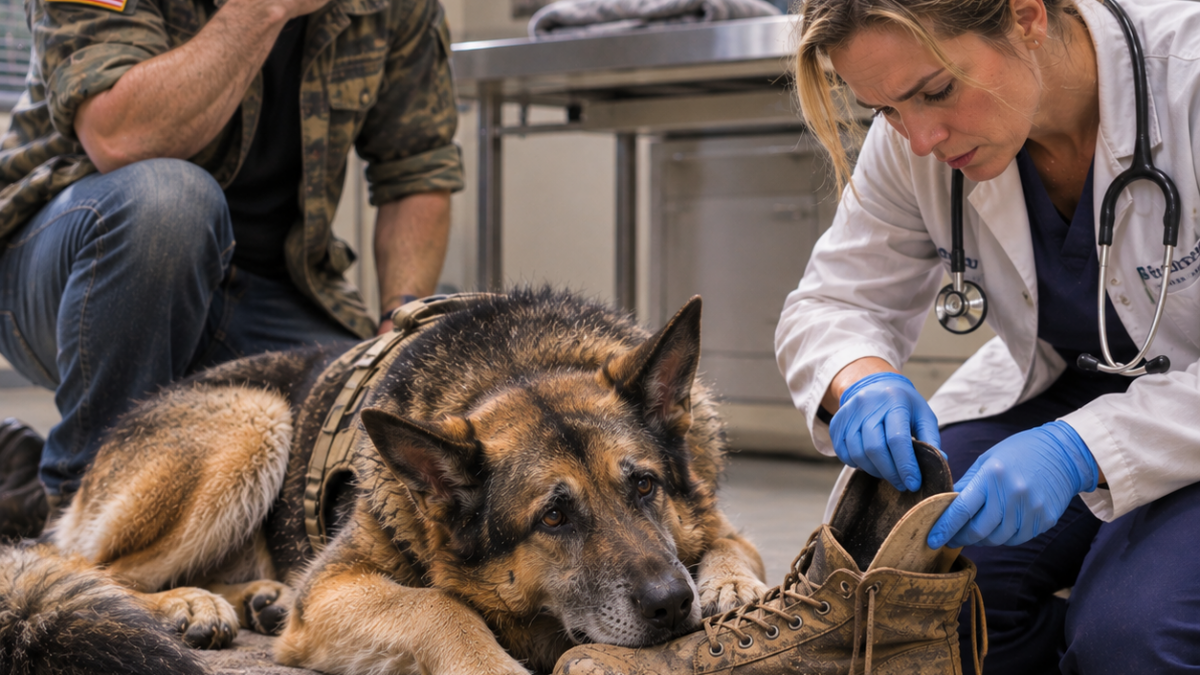
A Retired K9 Carried His Dead Handler’s Combat Boot for 7 Years—Then a Veterinarian Lifted the Insole and Found Something Hidden Inside.
For seven years, retired military K9 Ranger slept beside the same torn combat boot, carried it to every meal, and panicked whenever anyone tried to move the last object he had left from Staff Sergeant Daniel Mercer, the handler the Army said had died during an ambush overseas.
Everyone at the veterans’ sanctuary believed the boot was nothing more than grief made physical—until a veterinarian repairing its loose insole felt a hard rectangular shape beneath the leather and discovered something that had never been manufactured as part of any military footwear.
But when the hidden object was finally removed and the serial number on it was traced, the sanctuary director realized Ranger had spent seven years guarding far more than a dead soldier’s memory—and someone who thought the secret had disappeared with Daniel Mercer was about to learn the dog had never let it go.
Ranger bit the volunteer on a Tuesday afternoon.
Not hard.
Not enough to break skin.
But enough to make everybody in the treatment room go silent.
The retired German Shepherd had been at Haven Ridge Veterans Sanctuary for almost four years, and in all that time he had never put his teeth on a person outside play.
He was thirteen now.
Heavy through the chest.
Gray around the muzzle.
His hips had begun to sink when he stood too long, and the tips of his ears had small ragged scars from a life nobody at the sanctuary fully understood.
But Ranger remained gentle.
Children read books beside him during weekend therapy events.
He tolerated nail trims.
Accepted injections without restraint.
Let sanctuary director Mara Collins clean his ears while telling him he was the most dramatic patient in Virginia.
He even allowed the young volunteers to put ridiculous holiday bandanas around his neck.
There was only one thing nobody touched.
The boot.
Old desert-tan Army combat boot.
Left foot.
Size twelve.
Toe leather split along one side.
Black burn mark near the heel.
Laces replaced twice over the years.
The boot belonged to Staff Sergeant Daniel Mercer.
Ranger’s first handler.
Or at least the earliest handler anyone could confirm.
Daniel had died seven years earlier during an overseas deployment.
Ranger returned stateside without him.
The boot came back with the dog.
Nobody seemed to know exactly how.
The transfer paperwork simply listed:
PERSONAL CONDITIONING OBJECT — RETAIN WITH K9.
Ranger treated it like another living creature.
He slept with his nose touching it.
Carried it from room to room.
When he ate, the boot lay beside the bowl.
PART2:
When sanctuary staff moved him to the veterinary wing after dental surgery, Ranger woke from anesthesia, realized the boot was missing, and howled until somebody retrieved it from his kennel.
During thunderstorms, he took it beneath his cot and wrapped his front paws around it.
When other dogs approached, he stepped between them and the boot.
Not aggressive.
Protective.
Everyone knew the rule.
Do not take Ranger’s boot.
That Tuesday, nineteen-year-old volunteer Tyler Grant forgot.
Or rather, he did not know.
He had been working at Haven Ridge for eleven days.
He was sweeping Ranger’s room when he found the boot partly beneath the dog’s blanket.
The sole was muddy.
Tyler picked it up.
“Man, this thing is nasty.”
Ranger had been lying near the doorway.
His head snapped up.
Tyler carried the boot toward the utility sink.
“Let’s get you cleaned—”
Ranger crossed the room faster than a thirteen-year-old shepherd with arthritis should have been able to move.
He grabbed Tyler’s sleeve.
One warning bite.
PART3:
Controlled pressure.
Release.
Tyler froze.
Mara came running.
“Ranger!”
The dog stood between Tyler and the boot.
Ears forward.
No growling.
Mara looked at Tyler’s sleeve.
“You okay?”
“I think so.”
“Skin?”
“No.”
“What happened?”
“I picked up the boot.”
Mara closed her eyes.
“Oh, Tyler.”
“I didn’t know.”
“Drop it.”
Tyler did.
Ranger immediately lowered his head.
Picked up the boot.
Carried it to his bed.
Then lay over it.
Tyler stared.
“That dog just mugged me for a shoe.”
Mara tried not to laugh.
“You were warned about his boot.”
“I thought people were exaggerating.”
“People exaggerate about almost everything here.”
She pointed at Ranger.
“Not that.”
Dr. Nora Bennett entered from the clinic hallway.
“What happened?”
“Tyler violated international law.”
Tyler looked offended.
“I touched a shoe.”
Nora crouched near Ranger.
“Let me see your sleeve.”
“No skin.”
“Still documenting.”
She examined Tyler.
No injury.
Then she looked at the boot.
Ranger had placed his chin across it.
Nora frowned.
“That insole is coming out.”
Mara looked over.
“What?”
“The heel.”
The old boot’s interior lining had separated near the back.
A small section of the insole curled upward.
“Probably needs repair.”
Mara shook her head.
“You can explain that to him.”
Nora looked at Ranger.
“Ranger.”
One ear moved.
“I need your disgusting shoe.”
Nothing.
“I’m a doctor.”
Ranger closed his eyes.
Nora sighed.
“Veterinarians get no respect.”
Mara smiled.
“Try bribery.”
Twenty minutes later, Ranger was eating strips of boiled chicken from Mara’s hand while Nora examined the boot no more than three feet away.
He watched every movement.
Nora did not wash it.
She reinforced the torn leather with flexible adhesive.
Replaced one broken lace.
Then pressed down the loose insole.
Something clicked.
Very softly.
Nora stopped.
She pressed again.
Click.
Mara noticed.
“What?”
“There’s something under here.”
Ranger stopped chewing.
Nora looked toward him.
Then back at the boot.
“Could be a broken support piece.”
“Military boots have support pieces?”
“Not shaped like that.”
“How can you tell?”
“Because it moved.”
Ranger stood.
Mara put her hand on his collar.
“Easy.”
Nora slipped a blunt instrument beneath the loose insole.
The adhesive was ancient.
The leather lifted.
Beneath it was a thin layer of foam.
And beneath the foam—
Black plastic.
Rectangular.
About two inches long.
Nora stared.
“That’s not part of the boot.”
Mara’s hand tightened on Ranger’s collar.
“What is it?”
Nora did not touch it.
She leaned closer.
“One of those old memory-card housings, maybe.”
Ranger whined.
Mara looked at him.
His breathing had changed.
Fast.
Focused.
The same expression he showed when visitors entered carrying military gear.
Nora stood.
“Don’t touch it.”
“I wasn’t going to.”
“You were absolutely going to.”
Mara smiled faintly.
Then became serious.
“What if it’s just a tracker?”
“Seven years old?”
“Could be.”
“Or storage.”
Mara looked down at the boot.
Nobody in that room spoke for several seconds.
Ranger’s dog tags clicked softly as he shifted.
Nora asked, “Do we know the full story of the handler?”
“Daniel?”
“Yeah.”
“Army K9 handler. Killed overseas. Ranger came home.”
“That’s the short version.”
“It’s the only version we have.”
Nora looked at the hidden object.
“Maybe not anymore.”
They did not remove it.
Mara had worked around former military dogs long enough to understand that strange objects tied to deceased service members were not automatically hers to investigate.
She photographed the boot exactly as they found it.
Then called Haven Ridge’s board attorney.
Then Army Criminal Investigation Division.
It felt ridiculous at first.
Hello, we found something hidden inside a dead soldier’s boot because his dog bit a teenager.
But when the CID duty agent heard Staff Sergeant Daniel Mercer’s name, his tone changed.
“Do not alter the object.”
“We haven’t.”
“Do not connect it to any device.”
“We won’t.”
“Secure the boot.”
Mara looked at Ranger.
“That might be difficult.”
“Why?”
“The dog has been carrying it for seven years.”
Silence.
Then the agent said, “Secure the dog with it.”
That was easier.
Ranger spent the night in the sanctuary clinic with the boot beneath his head.
Mara slept on a folding cot beside him because she did not trust his anxiety if strangers came for it.
At 2:17 a.m., Ranger woke.
Picked up the boot.
Walked to the clinic door.
Mara sat up.
“Where are you going?”
Ranger stood there.
Boot in his mouth.
Waiting.
She opened the door.
He walked down the dark corridor.
Past the kitchen.
Past the kennel wing.
To the sanctuary’s front entrance.
He sat.
Mara frowned.
“Want outside?”
Nothing.
She opened the front door.
Cold October air entered.
Ranger stepped onto the porch.
He looked toward the road.
Then placed the boot on the boards.
Sat beside it.
Mara pulled on her coat.
For fifteen minutes, they stayed there.
Ranger staring down the driveway.
Mara staring at him.
“You waiting for somebody?”
The dog’s ears moved.
She looked at the boot.
“Daniel?”
Ranger lowered his head.
Mara felt foolish immediately.
Then sad.
Seven years.
Dogs did not understand legal death certificates.
They understood absence.
Routine.
Scent.
Return.
Maybe Ranger had been waiting for the same truck, the same boots, the same voice for seven years.
Or maybe he knew exactly what he had been carrying.
Mara did not believe dogs understood evidence.
But working dogs understood tasks.
That distinction would matter later.
Special Agent Dana Brooks arrived the next morning with a digital-forensics specialist named Eric Vaughn.
Brooks had the tired eyes of somebody who had spent twenty years listening to people lie badly.
She examined Ranger first.
Not the boot.
“How long has he had it?”
“Seven years.”
“Continuous?”
“As far as anyone knows.”
“Who gave it to him?”
“Unknown.”
Brooks frowned.
“Transfer paperwork?”
Mara handed it over.
Brooks read.
PERSONAL CONDITIONING OBJECT — RETAIN WITH K9.
“No originating signature.”
“No.”
“No handler designation.”
“No.”
“Who delivered Ranger stateside?”
“Military transport unit.”
“Which one?”
“File’s incomplete.”
Brooks looked at Mara.
“Do you know anything about Mercer’s death beyond the public report?”
“Vehicle ambush. Afghanistan. Four dead.”
“Three.”
Mara frowned.
“What?”
“Official casualty report lists three Americans killed.”
“Daniel and two others?”
“Yes.”
“Ranger wasn’t there?”
“No.”
“That’s all I know.”
Brooks looked toward the clinic.
Ranger lay behind the glass with the boot between his paws.
“Then we start there.”
The object came out cleanly.
Thin encrypted micro-storage device in a custom polymer shell.
Old.
Military-grade.
No markings except one engraved string:
RR-19-042.
Vaughn photographed it.
Brooks stared.
“You recognize that?” Mara asked.
“No.”
“But you reacted.”
“I recognize that somebody bothered engraving an evidence-style identifier into something they hid inside a boot.”
“What does RR mean?”
“We’ll find out.”
Ranger watched the whole procedure.
The moment the boot was returned, he took it.
Sniffed inside.
Paused.
Looked at Nora.
Then carried it back to his bed.
The object no longer inside bothered him for exactly forty-three seconds.
Then he settled.
Mara noticed.
“He knew you took it.”
Nora shook her head.
“He knew the smell changed.”
“Same difference to him.”
The device was encrypted.
Vaughn took it to the lab.
Brooks remained.
She asked for everything Haven Ridge had on Ranger.
The file began at age six.
Mara watched her.
“That’s weird, isn’t it?”
Brooks nodded.
“Military working dogs have records from procurement onward.”
“So where are the first six years?”
“Good question.”
“Daniel was his first handler?”
“Publicly, his name appears associated with Ranger during one deployment.”
“That’s not what I asked.”
“No.”
Brooks looked at her.
“I don’t know who Ranger’s first handler was.”
“What do you know?”
“That Daniel Mercer died seven years ago.”
“Anything unusual?”
Brooks hesitated.
“That depends on your definition.”
Mara waited.
“His body was recovered.”
“Okay.”
“Identification confirmed.”
“Okay.”
“His after-action report was sealed for five years.”
Mara frowned.
“Why?”
“Operational classification.”
“That normal?”
“Not unusual.”
“Then what’s unusual?”
Brooks looked toward Ranger.
“Daniel’s mother filed three Freedom of Information Act requests asking why her son had been moved to a mission outside his assigned K9 team.”
Mara sat straighter.
“He wasn’t supposed to be there?”
“According to her, no.”
“Ranger stayed behind.”
“Yes.”
“Why?”
“Official report says minor medical issue.”
“What issue?”
“Heat stress.”
Mara looked at the dog.
“Ranger?”
“Yes.”
“He handles summer better than half my staff.”
“Seven years ago is seven years ago.”
“Still.”
Brooks nodded.
“I thought so too.”
“Did anyone verify?”
“Veterinary logs from that week are missing.”
Mara stared.
“All of them?”
“For Ranger.”
That bothered her more than she expected.
Brooks continued.
“Daniel was originally assigned to an explosive detection movement with Ranger.”
“Then?”
“Forty-eight hours before departure, Ranger was removed.”
“Who ordered it?”
“Captain Owen Pike.”
Mara knew the name.
Current colonel.
Veterans’ security adviser.
Occasional donor to military charities.
“Why?”
“Medical.”
“Without a veterinary record.”
“Yes.”
“And Daniel went anyway.”
“Yes.”
“Died.”
“Yes.”
The hidden device opened six days later.
Brooks called Mara to a federal office in Richmond.
Nora came too because she had discovered it.
Vaughn connected an isolated forensic system.
“Three partitions.”
He clicked.
“One contains images.”
Second.
“Documents.”
Third.
“Audio and video.”
Brooks said, “Start with index.”
The first file was created eight years earlier.
One year before Daniel died.
Photograph.
A shipping container.
Military base.
Night.
The next image showed the container open.
Inside—
Wooden crates.
Serial labels.
Mara could not tell what they were.
Brooks could.
“Explosive demolition material.”
Nora looked at her.
“Legal?”
“Could be.”
Next image.
Inventory sheet.
Several entries highlighted.
Then another.
Same serial numbers marked EXPENDED during training exercises.
Mara understood.
“They were supposed to be destroyed.”
“Used or destroyed.”
“Yet they’re in a container.”
“Yes.”
Next.
A man standing beside the truck.
Civilian clothes.
Brooks zoomed.
Mara recognized him.
“Who’s that?”
Nora asked.
Mara stared.
“General Marcus Vane.”
Brooks looked at her.
“You know him?”
“He spoke at our veterans’ fundraiser last year.”
Vane had retired as a major general.
High-profile.
Leadership consultant.
Frequent cable-news guest on military matters.
He had chaired a defense logistics review commission.
The photograph showed him younger.
Then a colonel.
Standing beside the container.
Talking to a civilian.
Vaughn opened the next file.
A handwritten note scanned into the device.
D.M. — 0412
RANGER POSITIVE ON CRATE C-17.
MANIFEST = SPENT MATERIAL.
CRATE CONTAINS LIVE STOCK.
VANE INFORMED.
ORDER: DO NOT LOG CANINE ALERT.
Mara stared.
“Daniel wrote that?”
Brooks examined the handwriting.
“Looks consistent.”
Nora whispered, “They ordered him not to record Ranger’s alert.”
Vaughn opened more.
Daniel had documented months of irregularities.
Training explosives marked expended but transferred elsewhere.
Detonators removed from demolition inventories.
Restricted components appearing in contractor shipments.
Vehicle movements with no matching logistics entries.
Names repeated.
Colonel Marcus Vane.
Major Curtis Shaw.
Civilian contractor Paul Denning.
Warrant Officer Thomas Vale.
Mara leaned back.
“This is a theft ring.”
Brooks did not answer immediately.
“Potentially.”
“Why potentially?”
“Because photographs of inventory discrepancies prove discrepancies.”
“Not theft.”
“Correct.”
“God, you investigators hate nouns.”
Brooks almost smiled.
“Only unsupported ones.”
Then they opened the audio.
Daniel’s voice.
“You recording?”
Another man answered.
“Yes.”
Daniel:
“Date, May fourteen.”
“Time, twenty-one forty.”
“Ranger alerted on Atlas Logistics crate C-17 at 1630.”
A second voice:
“Confirmed?”
Daniel:
“Dog gave full trained response.”
“Crate listed as?”
“Destroyed detonators and expended training blocks.”
“What did you observe?”
“I observed sealed live components with matching lot numbers from material listed destroyed three months ago.”
Another voice:
“Did you notify Vane?”
“Yes.”
“What did he say?”
“Keep the dog out of the report.”
Silence.
Then:
“He said contractor movement was authorized above my clearance.”
Second voice:
“Do you believe him?”
“No.”
“Why?”
“Because EOD says the lot should not exist.”
Mara looked at Brooks.
“Who’s the other man?”
Brooks paused.
“Thomas Vale.”
The name from the notes.
Next audio.
Vale alone.
“If Daniel is hearing this, I confirmed what you asked.”
“Atlas is billing disposal.”
“Material isn’t being destroyed.”
“Some is being rerouted through private demolition contracts.”
“I traced two batches to domestic seizures.”
Mara’s skin went cold.
“Domestic?”
Brooks leaned closer.
Vale continued.
“Explosive components recovered in criminal cases.”
“One biker extortion case in Kentucky.”
“One illegal quarry operation.”
“One militia seizure in Idaho.”
“Serials match military stock.”
Nora whispered, “Jesus.”
Vale’s voice became quieter.
“I reported it.”
Pause.
“Wrong person.”
The file ended.
Brooks asked Vaughn to open the final video chronologically before Daniel’s death.
Daniel appeared.
Uniform.
Tired.
Ranger behind him.
The date was four days before Daniel’s final mission.
He looked into the camera.
“My name is Staff Sergeant Daniel Mercer.”
“I’m recording because the official complaint process is compromised.”
Mara watched Ranger in the background.
Young.
Alert.
Daniel continued.
“Ranger detected live explosive material inside cargo marked as destroyed training stock.”
“I reported through Captain Pike.”
“Pike took it to Colonel Vane.”
“Within forty-eight hours, Ranger was declared medically non-deployable.”
“I did not request that.”
The dog behind him stood.
Walked into frame.
Daniel scratched his chest.
“He’s fine.”
Ranger licked his wrist.
Daniel smiled for one second.
Then serious again.
“I have been reassigned to tomorrow’s route patrol without him.”
Mara stopped breathing.
Brooks stared at the screen.
Daniel held up a paper.
“Original mission tasking had Ranger and me assigned to explosive route clearance.”
“New tasking sends me as security support.”
“Why?”
“I asked.”
“No answer.”
He looked off-camera.
Then back.
“If I die tomorrow, do not let anyone say Ranger was sick.”
Nora whispered, “Oh God.”
Daniel’s voice became slower.
“I’m putting a copy of everything where he can carry it.”
Mara looked at the boot.
Not present.
But she understood.
“He hid it before he left.”
Brooks nodded.
Daniel continued.
“Ranger knows the boot.”
“I trained him to retrieve it from my locker whenever I say ‘bring Daniel.’”
Mara swallowed.
“After training today, I’m leaving it with Sergeant Grant.”
“Grant knows only that the boot stays with the dog if I don’t return.”
Mara closed her eyes.
So the boot had not been sentimental accident.
It had been intentional.
Daniel had turned grief into a transport system.
The final video had no Ranger.
Recorded in a vehicle.
Daniel whispering.
“I found Vale.”
Mara leaned forward.
“He’s alive.”
Brooks frowned.
Daniel continued.
“They told me he resigned.”
“He didn’t.”
“He’s being held at a contractor medical site outside Bagram.”
“Vale says Vane knows.”
“He says the missing material is part theft, part covert off-book acquisition.”
Brooks paused the file.
“Off-book acquisition?”
Mara looked at her.
“What does that mean?”
“Could mean unrecorded material used for clandestine programs.”
“Legal?”
“Depends.”
“So the theft might have been hidden inside something classified.”
“Possibly.”
Brooks resumed.
Daniel:
“If that is true, it explains why every complaint disappears.”
“He told me some of the material was sold by contractors after being diverted.”
“He has names.”
“I’m supposed to meet him after patrol.”
A pause.
“If I don’t…”
Daniel looked out the windshield.
Then smiled bitterly.
“Ranger hates this boot.”
Nora laughed unexpectedly.
Daniel continued.
“He chewed the heel during our first deployment.”
Mara looked toward the evidence photograph of the burned, torn boot.
“So I figure he owes me.”
Daniel’s expression softened.
“Mom, if anyone gets this to you, I’m sorry.”
Mara’s throat tightened.
“I should have walked away.”
“But if people are selling military explosives and hiding behind classification…”
He stopped.
“I couldn’t.”
Then the line that changed everything.
“If Ranger still has the boot, the evidence still exists.”
The video ended.
No one spoke.
Mara looked at Brooks.
“So Daniel knew exactly what he was doing.”
“Yes.”
“He expected Ranger to keep it.”
“Yes.”
“For how long?”
Brooks looked toward the forensic image of the old boot.
“Probably not seven years.”
The question became obvious.
How had nobody found it?
Daniel died.
Ranger returned.
The boot traveled with him through military kennels.
Retirement processing.
Daniel’s mother had declined adoption because she was already caring for a husband with advanced Parkinson’s.
Ranger went to Daniel’s second handler for two years.
Then that handler deployed again.
Eventually the dog transferred to Haven Ridge.
Through all of it, the boot remained.
Nobody cleaned beneath the insole.
Nobody X-rayed it.
Nobody searched it.
Because everyone believed the story they had been given.
Grieving dog.
Dead handler’s boot.
Do not touch.
The emotional explanation protected the physical evidence better than any lock.
Brooks said it first.
“Mercer knew people.”
Mara looked over.
“What?”
“He knew if he hid something in a safe, somebody would search it.”
“Locker?”
“Search.”
“House?”
“Search.”
“Computer?”
“Search.”
“But nobody takes a grieving dog’s dead handler’s boot.”
“Exactly.”
Nora stared.
“That’s either brilliant or insane.”
Brooks shrugged.
“Those categories overlap.”
The investigation reopened quietly.
The Army did not announce anything.
Marcus Vane was not contacted immediately.
Neither was Owen Pike.
Brooks started with the living witnesses.
Thomas Vale.
The man Daniel said was alive despite having supposedly resigned.
Public records showed Thomas Vale died six years ago in a boating accident.
Mara stared at the report.
“That convenient?”
Brooks gave her a look.
“Don’t.”
“Fine.”
Body recovered?
Yes.
Identification?
Dental.
No suspicious circumstances.
Maybe a real accident.
Not every death tied to a suspicious story was murder.
That mattered.
Then Sergeant Grant.
The man Daniel said would preserve the boot.
Staff Sergeant Benjamin Grant had retired four years earlier.
He lived in Pennsylvania.
When Brooks showed him Ranger’s photograph, he cried.
“He kept it?”
“Yes.”
“All this time?”
“Yes.”
Grant covered his face.
“I thought maybe somebody took it.”
“Who?”
“After Daniel died, Vane’s people searched everything.”
“Did they ask about the boot?”
“No.”
“Why?”
“Because I had already given it to Ranger.”
Brooks asked what Daniel told him.
“Nothing about evidence.”
“Exact instructions?”
Grant remembered.
“If I don’t come back, give Ranger the left boot.”
“That’s it?”
“And don’t let anybody clean it.”
Brooks raised an eyebrow.
Grant laughed.
“I thought it was scent.”
“Why the left boot?”
“He always trained Ranger with the right.”
That surprised everyone.
Daniel had used the right boot for scent retrieval training.
The left appeared identical.
By hiding evidence in the left, he created an object Ranger knew by Daniel’s scent but nobody associated with formal training records.
Grant continued.
“After Daniel died, Colonel Vane came to the kennel.”
“Personally?”
“Yes.”
“What did he want?”
“Daniel’s gear.”
“Did you give it?”
“Most.”
“Boot?”
“I said Ranger had chewed it up and the veterinarians let him keep it.”
“What did Vane say?”
“He looked at the dog.”
Grant swallowed.
“Then he said, ‘Let the animal have something.’”
Mara felt a chill.
Vane had stood feet away from the evidence.
And dismissed it.
Because Ranger was grieving.
Brooks asked, “Did that seem unusual?”
“At the time? No.”
“Later?”
Grant looked ashamed.
“Everything seemed unusual later.”
“What changed?”
“Ranger started refusing to give the boot up.”
“He did that immediately?”
“Yes.”
“Before Daniel died?”
“No.”
Mara leaned forward.
“What?”
Grant looked at her.
“Before the mission, Ranger didn’t care about it.”
“So Daniel trained him after hiding the device.”
Grant nodded slowly.
“The night before he left.”
“What did he do?”
“He spent almost an hour with Ranger and the boot.”
“Commands?”
“I didn’t hear most.”
“Anything?”
“One phrase.”
“What?”
Grant looked toward Ranger’s photograph.
“Guard Daniel.”
Mara closed her eyes.
That was the task.
Not sentimental attachment.
At least not initially.
Daniel had taught Ranger:
Guard Daniel.
The boot was Daniel.
The command remained.
Then Daniel died.
Training became grief.
Grief became ritual.
Seven years.
Brooks asked Grant why he never came forward.
He laughed bitterly.
“With what?”
“A dog guarding a shoe?”
“Daniel told me nothing.”
“Then later?”
“Later, people started disappearing.”
“Who?”
“Vale.”
“Anyone else?”
“Warrant Officer Thomas Reed.”
Name not on Daniel’s device.
Brooks wrote it.
“Who was Reed?”
“Logistics.”
“What happened?”
“Car crash six months after Daniel.”
“Anything suspicious?”
“I don’t know.”
“Then why mention him?”
“He told me once not to ask about Atlas shipments.”
Grant looked at Brooks.
“Two weeks later, he was dead.”
Again, maybe coincidence.
Maybe not.
Brooks refused to turn proximity into proof.
But patterns earned attention.
Investigators recovered Daniel’s original mission paperwork.
Ranger had indeed been removed 48 hours before departure.
Medical reason:
Paw inflammation.
Veterinary signature:
Dr. Lisa Monroe.
Brooks found Dr. Monroe in North Carolina.
She looked at the document.
“This isn’t my signature.”
That changed the temperature in the room.
“You’re sure?”
“I’ve signed ten thousand medical forms.”
“Could you have forgotten?”
“No.”
She pointed at the notation.
“And I would never use ‘paw inflammation.’”
“What would you write?”
“Interdigital dermatitis, pad lesion, lameness, something clinical.”
“Was Ranger treated that week?”
“No.”
“You remember?”
“I remember Daniel arguing in my hallway because someone told him his dog had been medically pulled.”
“Who?”
“Captain Pike.”
“Did you confront Pike?”
“Yes.”
“What did he say?”
“That another veterinarian had made the determination.”
“Name?”
“He wouldn’t give me one.”
“Did you document the argument?”
“Yes.”
“Where?”
“My old daily log.”
She still had it.
Handwritten.
Date.
SGT MERCER + MWD RANGER — NO MEDICAL BASIS FOR REMOVAL FROM DUTY FOUND. CAPT PIKE ADVISED.
Mara stared at the photocopy.
“They forged a medical reason.”
Brooks nodded.
Someone did.
Pike became unavoidable.
He was now Colonel Owen Pike.
Commander of a stateside training brigade.
CID interviewed him under caution.
Initially he denied knowledge beyond administrative decisions.
Then they showed Monroe’s log.
His story changed.
He had been ordered by Vane to remove Ranger.
Reason given:
Sensitive operation unsuitable for canine support.
“Why use fake medical paperwork?” Brooks asked.
Pike looked down.
“Because Daniel would challenge any operational reassignment.”
“He challenged the medical one.”
“Yes.”
“Why forge a veterinarian’s signature?”
“I didn’t.”
“Who did?”
“I don’t know.”
“Who handed you the paperwork?”
“Vane’s operations chief.”
“Name?”
“Major Curtis Shaw.”
The second recurring name on Daniel’s device.
Shaw had retired five years earlier.
Now worked as vice president of compliance for Atlas Strategic Logistics.
Mara laughed when she heard.
“Compliance.”
Brooks did not.
“It’s often the compliance people who know where things are buried.”
Shaw hired attorneys.
Vane issued a public statement through counsel after word of the reopened investigation leaked.
He denied any involvement in theft.
He said Daniel Mercer had been killed by enemy action during a legitimate mission.
He called the allegations “a tragic misunderstanding of classified logistics procedures.”
Mara read the statement aloud in her office.
Nora sat across from her.
Ranger slept beneath the desk with the boot touching his paw.
“Classified logistics procedures.”
Nora rolled her eyes.
“Universal language for don’t ask.”
Mara looked at Ranger.
“Seven years.”
“What?”
“He carried the answer around for seven years.”
Nora shook her head.
“Part of an answer.”
Mara smiled.
“You’ve been talking to Brooks.”
“Unfortunately.”
The hidden device gave investigators records.
It did not prove who killed Daniel.
Officially, Daniel’s convoy hit an enemy explosive device.
The device was never fully recovered.
No evidence initially linked it to diverted stock.
But the original forensic report had one partial detonator photograph.
Brooks compared the serial fragment against Daniel’s inventory images.
Match.
Same batch marked destroyed.
Mara stared.
“So the missing material killed him.”
Brooks corrected.
“A component from the missing batch was used in the device.”
“Which means—”
“It means exactly that.”
“Doesn’t that prove murder?”
“Enemy groups sometimes captured military material.”
“But Daniel was investigating the same batch.”
“Yes.”
“And Ranger was removed.”
“Yes.”
“And he was sent on a route without his explosives dog.”
“Yes.”
Mara stared.
Brooks held her gaze.
“Now you understand why I don’t use the next noun yet.”
Who placed the device?
Enemy cell?
Corrupt contractor?
Someone connected to the theft ring?
Nobody knew.
Then a retired Afghan interpreter named Farid Hakimi contacted investigators after seeing Daniel’s name in an online article about the reopened case.
He had been on a different vehicle in the convoy.
He remembered something not in the official report.
The route had changed the morning of movement.
Original route: Highway 7.
Changed route: agricultural road east of Qalat.
Why?
Daniel had argued about it.
Farid remembered because Daniel said:
“That route hasn’t been cleared with a dog.”
Who ordered the change?
Major Curtis Shaw.
Brooks pulled route logs.
The digital record had been overwritten.
Paper copy survived in an archived motor-pool binder.
There.
Route change.
Authorized:
C. SHAW.
Time:
Device detonated:
Mara looked at Brooks.
“Now?”
“Now we know Shaw changed the route.”
“And knew Ranger wasn’t there.”
“Yes.”
“Now can we say murder?”
“No.”
Mara swore.
Brooks almost smiled.
They found Shaw’s phone records from seven years earlier through preserved corporate litigation archives.
One call stood out.
At 0412, twenty-six minutes before the route change, Shaw called a contractor satellite phone registered to Atlas security supervisor Paul Denning.
The same name from Daniel’s files.
Call duration:
four minutes, eleven seconds.
At 0438, route changed.
At 0614, explosion.
Denning had disappeared from Atlas six months later.
Current location unknown.
The search took three weeks.
He was in Costa Rica.
Not hiding legally.
Retired.
Owned a small charter-fishing business.
Federal authorities arranged interview through cooperation.
Denning denied wrongdoing.
Then Brooks showed him Daniel’s photograph.
His face changed.
Then Ranger.
Worse.
Then the boot.
Denning whispered, “That damn dog.”
Brooks sat still.
“What about him?”
Denning realized too late.
Asked for counsel.
That one sentence became critical.
He knew the dog mattered.
Before investigators had told him why.
His attorney negotiated.
Denning wanted immunity.
He did not get full immunity.
He got reduced exposure in exchange for truthful cooperation.
The story he told was less cinematic than Mara expected.
That made it worse.
Atlas was stealing military explosive material.
Not huge quantities.
Small amounts.
Marked destroyed.
Resold through illicit channels.
Some buyers were mining operators avoiding regulation.
Some criminal groups.
At least one extremist network.
Vane discovered it during an internal audit.
At first, he intended to expose Atlas.
Then learned senior military personnel had signed years of faulty destruction certificates.
The scandal would damage multiple commands.
He chose containment.
Atlas agreed to stop.
They did not.
Instead, certain people began paying officers and contractors to keep records clean.
Vane did not take direct bribes, Denning claimed.
He protected his reputation and command.
Shaw did take money.
Daniel discovered the theft.
Vane ordered him silenced administratively.
Remove Ranger.
Transfer Daniel.
Confiscate records.
But Daniel kept digging.
Then he found Thomas Vale.
Vale had been part of Atlas logistics and wanted out.
He gave Daniel information.
Shaw panicked.
Denning testified:
“Vane wanted Mercer transferred stateside.”
Brooks asked, “Alive?”
“Yes.”
“Did he order him killed?”
“No.”
“Who did?”
Denning looked at the table.
“Shaw.”
There.
The noun.
Murder.
According to Denning, Shaw knew Daniel’s convoy schedule.
He arranged the route change.
He provided the diverted detonator and explosive components to a local criminal intermediary who had contacts with insurgents.
The intermediary planted the device.
The attackers believed they were targeting an ordinary military convoy.
They did not know one specific soldier had been selected.
Mara felt physically sick when Brooks explained it later.
“He outsourced an ambush.”
“Yes.”
“To people who didn’t even know why.”
“Yes.”
“What about the other soldiers?”
Brooks’s face hardened.
“Collateral to Shaw.”
Two other Americans died.
Specialist Aaron Bell.
Sergeant Michael Hayes.
An Afghan interpreter named Abdul Rahim.
Daniel was not the only family destroyed.
Shaw had not simply killed one whistleblower.
He had accepted whoever else happened to be in the vehicle.
Brooks said quietly, “That’s why cases matter more than stories.”
Mara looked at her.
“I’m starting to hate that sentence.”
“Good.”
Shaw was arrested at his Virginia home.
Vane was not.
Not for murder.
Evidence showed he participated in obstruction and concealment.
No proof he knew Shaw planned to kill Daniel.
He had created the pressure.
Approved record alterations.
Allowed forged medical paperwork.
Protected Atlas.
But the murder decision belonged to Shaw and Denning.
That distinction mattered.
Mara found it emotionally unsatisfying.
Legally, it mattered enormously.
Daniel’s mother, Ruth Mercer, learned about the hidden device from Brooks.
She was seventy-one.
Still lived in El Paso.
Her husband had died three years after Daniel.
She had never visited Ranger at Haven Ridge.
Not because she did not care.
Because she could not bear to see him.
Mara called anyway.
“Mrs. Mercer?”
“Yes?”
“My name is Mara Collins. I run Haven Ridge Veterans Sanctuary.”
Silence.
“You have Ranger.”
“Yes.”
Another silence.
“Is he alive?”
Mara smiled despite herself.
“He’s thirteen.”
Ruth began crying immediately.
“I thought he’d be gone by now.”
“He’s stubborn.”
“He learned that from Daniel.”
Mara looked down at the boot.
“We found something.”
Ruth came to Virginia.
She arrived wearing a blue coat and carrying a small brown paper bag.
Ranger was in the sanctuary courtyard.
He saw her.
Stopped.
Ruth stopped too.
Mara had wondered whether Ranger would remember a woman he had probably met only a handful of times.
Then Ruth said:
“Ranger, baby.”
The dog’s body changed.
He walked toward her.
Not ran.
Too old.
But fast enough.
Ruth dropped to her knees.
Ranger pressed his head into her chest.
She cried into his fur.
“You old fool.”
The dog licked her face.
Ruth laughed.
“Still terrible breath.”
Mara walked away to give them space.
After several minutes, Ranger left Ruth.
Went inside.
Returned carrying the boot.
Ruth saw it.
Her face collapsed.
“Oh God.”
Ranger placed it in her lap.
For the first time anyone at Haven Ridge had ever seen, he released the boot voluntarily into another person’s hands.
Ruth held it.
Touched the cracked toe.
The burned heel.
“Daniel wore this on his first deployment with Ranger.”
Mara sat beside her.
“You recognize it?”
“He hated these boots.”
Ruth laughed softly.
“Said they pinched his left foot.”
She looked inside.
“The insole?”
“We removed the device underneath.”
Ruth looked at Mara.
“So that’s where he put it.”
“You knew?”
“No.”
She shook her head.
“But Daniel called me the night before he died.”
Mara went still.
“What did he say?”
“That he had something he needed to get home.”
“Did he mention Ranger?”
“Yes.”
“Exact words?”
Ruth closed her eyes.
“He said, ‘If Ranger comes home carrying something stupid, don’t throw it away.’”
Mara laughed despite the tears in her eyes.
“He called the boot stupid?”
“Daniel hated sentiment.”
Ruth stroked Ranger’s head.
“Which is why this whole thing is very him.”
“Did you ever see the boot after?”
“Once.”
“When?”
“Funeral.”
Mara frowned.
“Ranger was at the funeral?”
“No.”
Ruth’s face changed.
“The boot was.”
“What?”
“The Army put Daniel’s gear on a memorial table.”
“Was this one there?”
“I think so.”
Mara felt cold.
If the boot had been displayed at the funeral, then the hidden evidence had passed within reach of everyone connected to Daniel’s death.
“Who brought it?”
“I don’t know.”
“Who took it afterward?”
“An Army dog handler said Ranger had been refusing food and wanted Daniel’s scent.”
Ruth looked at the dog.
“I said give him anything he wanted.”
The boot returned to Ranger.
He never let it go again.
Ruth visited Daniel’s trial evidence review with Brooks.
She heard his recordings.
She did not cry until one line.
“If Ranger still has the boot, the evidence still exists.”
Then she broke.
“He knew that dog better than people.”
Mara sat beside her.
Ruth shook her head.
“No.”
“He trusted Ranger more than people.”
That was different.
The federal case lasted fourteen months.
Shaw’s defense attacked Denning as a liar seeking leniency.
Correct.
They attacked military forensic reconstruction.
Expected.
They argued enemy actors independently chose the route.
Possible.
Then prosecutors produced the strongest evidence.
A text message recovered from an old Atlas litigation backup.
From Shaw to Denning.
Time: 0444.
“Mercer moved east route. No dog. Window open.”
Six words.
No ambiguity.
No dog.
Window open.
Mara read them three times.
Daniel’s death reduced to logistics.
Ranger’s absence reduced to opportunity.
Another message from Denning six minutes later:
“Understood.”
At 0614, the vehicle exploded.
The prosecution showed the jury the boot.
Not Ranger.
Mara had worried they would turn the dog into spectacle.
They did not.
The boot sat sealed in an evidence display.
Scuffed.
Old.
Ugly.
The micro-storage housing beside it.
Daniel’s voice played.
“If Ranger still has the boot, the evidence still exists.”
The courtroom went completely silent.
Shaw stared at the table.
Denning testified.
Pike testified about removing Ranger.
Dr. Monroe testified her signature was forged.
Grant testified that Daniel had trained Ranger to guard the boot.
Farid testified about the route change.
Ruth testified about her son’s phone call.
Vane testified under immunity for limited obstruction-related exposure.
That became national news.
A retired major general admitting that he had suppressed the original canine alert and approved misleading logistics language to avoid scandal.
The prosecutor asked:
“Did you know Daniel Mercer was investigating criminal diversion?”
“Yes.”
“Did you order Staff Sergeant Mercer killed?”
“No.”
“Did you order his dog removed?”
“I ordered the dog withheld from the mission.”
“Why?”
“I was told the dog had become part of Mercer’s unauthorized inquiry.”
The prosecutor paused.
“Meaning?”
“Mercer was using Ranger’s alerts as evidence.”
“So removing Ranger weakened Mercer’s ability to document further irregularities.”
Vane looked toward the jury.
“Yes.”
“Did you know Shaw changed Mercer’s route?”
“No.”
“Did you know Shaw had financial ties to Atlas?”
“Not then.”
“Did your concealment make it easier for Shaw to act without scrutiny?”
Defense objected.
Sustained.
The prosecutor rephrased.
“General, do you regret hiding the original diversion allegations?”
Vane hesitated.
“Yes.”
“Why?”
For the first time, the decorated general looked smaller than his biography.
“Because I thought I was protecting the Army from a scandal.”
He swallowed.
“I protected the scandal from the Army.”
That line appeared everywhere.
Ruth did not care.
When a reporter later asked whether she appreciated Vane’s admission, she answered:
“I appreciate my son more.”
Shaw was convicted of conspiracy to murder, murder-related offenses under federal jurisdiction tied to the criminal scheme, trafficking and theft of explosive material, obstruction, and multiple fraud counts.
Denning received a reduced but substantial sentence.
Vane pleaded guilty separately to obstruction, falsification, and conspiracy related to concealment of the diversion scheme.
He was not charged with Daniel’s murder.
Some people online hated that.
They wanted one clean villain.
Ruth did not.
“He did what they proved.”
She said it outside court.
“That’s enough for me.”
The reporter asked, “You don’t think he deserves more?”
Ruth looked tired.
“I spent seven years wanting a story where everyone who hurt Daniel was one kind of monster.”
She looked toward Mara.
“Turns out some were greedy.”
“Some were afraid.”
“Some protected careers.”
“One ordered murder.”
“And a lot of others looked away.”
She shook her head.
“Reality doesn’t organize itself for our satisfaction.”
Ranger’s role became public after the trial.
News headlines called him:
THE K9 WHO GUARDED EVIDENCE FOR SEVEN YEARS.
Mara hated most of them.
One television producer wanted Ranger to appear on stage while dramatic music played.
Mara hung up.
A magazine asked to photograph the boot beside Ranger.
Ruth said no.
“He’s not a prop.”
The sanctuary did allow one official photograph.
Ranger lying on the porch.
The boot between his paws.
No flags.
No medals.
No dramatic lighting.
Just an old dog and an old piece of leather.
The caption:
Ranger carried Staff Sergeant Daniel Mercer’s combat boot for seven years. Evidence concealed inside the boot helped reopen the investigation into Mercer’s death.
That was enough.
Ranger stayed with Haven Ridge.
Ruth considered adopting him.
She wanted to.
But her health had worsened.
Two knee replacements.
Heart condition.
She lived alone.
She told Mara:
“I love him enough not to pretend I can lift seventy pounds when he falls.”
Mara understood.
So Ruth visited every month.
Always bringing boiled chicken.
Ranger adored her.
The boot remained with him.
CID no longer needed it after trial.
The hidden device was retained as evidence.
The boot itself returned.
Mara asked Ruth whether it belonged with Daniel’s personal effects.
Ruth looked at Ranger.
“No.”
“He earned it.”
The dog carried it back to his bed.
Case closed.
Except grief did not close when courts did.
Ranger continued his routines.
Breakfast.
Boot.
Morning walk.
Boot.
Nap.
Boot.
At first, Mara thought something might change now that the hidden device was gone.
It did.
Subtly.
He stopped guarding it aggressively.
Tyler could move the boot now.
Nora could repair it.
Mara could pick it up without Ranger standing.
The task had been completed.
Whatever Daniel trained into him had loosened.
But affection remained.
One evening Mara found Ranger sleeping without the boot touching him.
It sat three feet away.
She smiled.
“Progress?”
Ranger opened one eye.
Then closed it.
Months later, he began carrying something else occasionally.
A tennis ball.
The first time Nora saw it, she called Mara like there had been a medical miracle.
“He has a toy.”
Mara laughed.
“He’s had toys.”
“No. He has chosen a toy.”
Ranger walked through the clinic carrying a red rubber ball.
The boot remained in his bed.
“He’s cheating on Daniel.”
“Do not say that.”
“I’m serious. Look.”
Ranger dropped the ball at Tyler’s feet.
Tyler froze.
“Is this a trap?”
Mara laughed.
“Throw it.”
Tyler did.
Ranger chased it halfway.
Then remembered he was thirteen.
Stopped.
Looked offended by the distance.
Tyler retrieved it for him.
That became their game.
Human fetch.
Ruth visited for Ranger’s fourteenth birthday.
There was cake.
Dog-safe.
No hat.
Ranger refused hats.
Mara gave a speech anyway.
“He’s fourteen.”
Ruth raised a finger.
“Daniel would correct you.”
“What?”
“He always counted months.”
Mara looked at Ranger.
“Fine. Fourteen years and three months.”
Ruth smiled.
“Better.”
After cake, Ruth pulled something from her purse.
Daniel’s original dog tags.
She had kept them since his funeral.
She knelt beside Ranger.
“These should’ve gone to you years ago.”
Mara watched.
Ruth attached one tag to Ranger’s collar.
The other she kept.
Ranger sniffed it.
Then leaned against her.
Ruth whispered:
“You got him home.”
Mara’s eyes filled.
Ruth looked at her.
“Not his body.”
She touched the boot.
“The truth.”
Ranger’s health declined the following winter.
Kidneys first.
Then hips.
Then a small tumor near his liver.
Nothing dramatic enough to treat aggressively.
Everything cumulative enough to slow him.
He stopped carrying the boot downstairs.
Mara moved his food upstairs.
He stopped sleeping in his bed and chose the sunny patch near the window.
Mara moved the boot there too.
One morning, Ranger picked it up and tried to walk.
His back legs gave out.
Nora helped him.
“Easy.”
He growled in frustration.
“Yeah, I know.”
She stroked his shoulder.
“Getting old is terrible.”
Ranger looked at her as if this was somehow her fault.
Ruth began visiting more often.
She read Daniel’s old letters aloud.
Not because Ranger understood the words.
Because she did.
One letter from Daniel’s first deployment:
Mom,
Ranger stole my boot again.
If I come home missing footwear, blame the dog.
Ruth laughed.
Ranger slept.
Another:
He’s getting better.
Still thinks every helicopter belongs to him.
I think he likes flying more than I do.
Another:
Sometimes I think he knows I’m scared before I do.
Ruth stopped.
Her voice broke.
Mara sat beside her.
Ruth touched Ranger’s head.
“He was twenty-nine when he wrote this.”
Mara said nothing.
“Twenty-nine.”
Ruth looked out the window.
“I’m older now than he ever got to see me.”
Grief did strange arithmetic.
Ruth asked:
“Do you think Ranger missed him every day?”
Mara thought before answering.
“No.”
Ruth looked at her.
“You don’t?”
“I think dogs are better at the present than we are.”
Mara touched the boot.
“I think Daniel stayed inside his routines.”
“His scent.”
“His training.”
“His expectations.”
“But I don’t think Ranger spent every second suffering.”
Ruth looked relieved.
“Good.”
“He ate stolen bacon yesterday.”
Ruth laughed.
“Definitely Daniel’s dog.”
The final decline came in March.
Ranger stopped eating.
Nora ran bloodwork.
Kidneys failing.
They could hospitalize.
Fluids.
Medication.
Maybe days.
Maybe weeks.
Ruth came immediately.
She sat on the floor beside him.
“No more hospitals.”
Mara looked at Nora.
Nora nodded.
“Comfort is reasonable.”
Ruth cried.
“So that’s how we say it.”
Nora sat beside her.
“Yes.”
Ranger slept.
The boot beneath his chin.
Tyler came.
Now twenty-two.
No longer a volunteer kid.
Working full time at Haven Ridge.
He brought the red ball.
Placed it beside Ranger.
“You still owe me a sleeve.”
Ranger’s tail moved once.
Tyler cried immediately.
“You jerk.”
Mara left them alone.
That evening, rain fell.
Soft.
Ranger hated storms but liked rain when there was no thunder.
The sanctuary grew quiet.
Ruth lay on a mattress beside him.
Mara sat in the doorway.
Nora checked his breathing.
Slow.
Comfortable.
At 9:13, Ranger woke.
Lifted his head.
Looked toward the boot.
Ruth picked it up.
“Want this?”
He sniffed it.
Then turned his head away.
Everyone noticed.
Ruth looked at Mara.
“He doesn’t want it.”
Mara felt her throat tighten.
Ranger looked toward the front door.
Mara understood.
“Outside?”
The dog’s ears moved.
They carried him onto the covered porch in a blanket.
Rain beyond the roof.
Cool air.
Ruth sat beside him.
Mara on the other side.
Tyler stood near the door.
The boot remained inside.
For the first time in seven years, Ranger had chosen to go somewhere without it.
Ruth noticed.
She cried harder.
Mara whispered:
“Maybe he’s done.”
Ruth nodded.
“I think so.”
Ranger watched the rain.
His collar carried Daniel’s tag.
Metal clicked when he breathed.
Ruth touched it.
“You waited long enough.”
Ranger closed his eyes.
“You guarded it.”
His tail moved faintly.
“You did your job.”
Mara placed her hand on his shoulder.
“No more guard Daniel.”
Ranger’s ear moved.
Ruth looked at Mara.
“That was the command?”
“Yes.”
Ruth bent close.
“Daniel’s safe.”
Her voice broke.
“Not the way I wanted.”
She stroked Ranger’s face.
“But he’s safe with us now.”
Ranger breathed.
Ruth whispered:
“You can let go.”
The dog opened his eyes once more.
Looked at her.
Then toward the open doorway.
The boot sat visible inside.
Old.
Empty now.
Nothing beneath the insole.
No secret.
No task.
Just leather.
Ranger looked away from it.
Back toward the rain.
Mara felt his body relax beneath her hand.
Ruth pressed her forehead against his.
“Good boy.”
One breath.
Another.
Then none.
Ranger died on the Haven Ridge porch with Daniel Mercer’s identification tag resting against his chest and the boot he had guarded for seven years sitting ten feet away.
Ruth stayed until midnight.
Nobody rushed her.
The next morning, she asked Mara for the boot.
Mara gave it to her.
Ruth took it back to El Paso.
Not to put on a shelf.
Not immediately.
She placed it beside Daniel’s folded flag.
For almost a year.
Then one spring, she returned to Haven Ridge carrying it.
Mara met her in the lobby.
“You sure?”
“Yes.”
“What do you want us to do with it?”
Ruth looked toward the wall where photographs of retired dogs hung.
“Teach with it.”
The sanctuary built a small display.
Not dramatic.
Ruth insisted.
The boot sat behind glass.
The loose insole visible.
Beside it, a replica of the storage housing.
The real device remained in federal evidence archives.
A photograph of Daniel and young Ranger stood to the side.
The text read:
STAFF SERGEANT DANIEL MERCER
MILITARY WORKING DOG RANGER
Before his final deployment, Daniel concealed evidence inside this combat boot and trained Ranger to protect it if he failed to return.
Ranger carried the boot for seven years.
The evidence contributed to the exposure of a military explosives diversion scheme and the prosecution of those responsible for Daniel’s death.
Below that, Mara added one sentence.
Ruth approved it.
SOMETIMES LOYALTY LOOKS LIKE REFUSING TO PUT SOMETHING DOWN.
Years passed.
New volunteers came to Haven Ridge.
They heard the story.
Some exaggerated it.
They said Ranger knew the boot contained evidence.
Nobody could prove that.
They said he intentionally prevented criminals from finding it.
Probably not.
They said Daniel had trained him for seven years of guarding.
Impossible.
Daniel expected days.
Maybe weeks.
Maybe months.
Not seven years.
The truth was simpler and stranger.
Daniel gave Ranger a command.
Guard Daniel.
The dog learned the boot represented his handler.
Then Daniel died.
Nobody released Ranger from the task.
So he continued.
Through transfers.
Through retirement.
Through strangers calling the boot sentimental.
Through medical procedures.
Through thunderstorms.
Through sanctuary moves.
Through years when everybody who understood the original command was either dead, frightened, silent, or gone.
Ranger carried it.
People thought grief made him obsessive.
Perhaps grief did.
But training gave the grief direction.
Then one afternoon, a young volunteer picked up the boot.
Ranger stopped him.
A veterinarian repaired the insole.
Felt something underneath.
And seven years of silence cracked open.
Daniel Mercer had hidden evidence because he no longer trusted the people above him.
But he trusted his dog.
Not because Ranger understood conspiracies.
Not because dogs were morally superior to humans.
Because Ranger understood one thing with absolute clarity.
This belongs to my person.
Do not lose it.
Daniel had been right.
The courts found the murderers.
Investigators reconstructed the theft.
Families received corrected records.
The Army changed procedures.
Marcus Vane lost the reputation he had protected at the cost of everyone else’s truth.
Curtis Shaw lost his freedom.
Paul Denning lost the deal he thought would erase his responsibility.
Ruth Mercer got the answer she had spent seven years being told did not exist.
None of it gave her son back.
None of it gave Ranger his handler.
Justice did not reverse time.
It only stopped the lie from owning what remained.
And in the end, the most important evidence in the case had not been locked inside a vault, hidden behind a classified password, or buried in some secret archive.
It had traveled openly for seven years.
Across bases.
Across kennels.
Across retirement paperwork.
Across hundreds of hands that wisely decided not to take it away.
An old combat boot.
Torn at the toe.
Burned near the heel.
Carried gently in the mouth of a retired German Shepherd who had been told one last time to guard Daniel.
And until somebody finally looked beneath the insole, Ranger never stopped.








