A Rehab Director Sent the “Rookie Nurse” Alone Into a Room With Three Retired Military K9s—Then All Three Surrounded Her in a Formation No One Expected.
PART3:
Never that.
She asked about injury patterns.
Sleep rhythm after blast exposure.
Medication timing after nerve pain.
Whether the patient woke before the nightmare or because of it.
Whether a knee locked under load or during transition.
Whether a sound startled them because it was loud or because it arrived without warning.
Some patients answered her with the guarded respect reserved for people who had asked the real question.
The staff noticed.
Then forgot.
People are very good at forgetting what does not fit their first impression.
Kesler’s first impression of Olivia Marsh was simple.
Quiet meant compliant.
Compliant meant useful.
Useful meant controllable.
He ran the rehabilitation wing the way some men run every room they enter—by testing how much pressure people will accept before they push back.
Olivia never pushed back.
When he asked her to cover two extra shifts, she said yes.
When he sent her to clean a discharge room while two orderlies stood in the hallway laughing over coffee, she went.
When he corrected her documentation format in front of three nurses even though she had followed the hospital template exactly, she only said, “Thank you for the feedback.”
When the K9 program needed a nursing liaison for animal welfare documentation, Kesler volunteered her before asking.
“You’ll handle the records,” he told her. “Simple paperwork.”
“Okay,” Olivia said.
He waited for hesitation.
There was none.
That was when pushing her stopped being administrative and became entertaining.
Not cruel, Kesler would have said.
He did not think of himself as cruel.
That mattered later.
People like Kesler rarely do.
They think of themselves as efficient. As demanding. As realistic. As able to read weakness where others avoid naming it.
By her second week, he had decided Olivia Marsh needed to be tested.
The K9 suite gave him the opportunity.
When he discovered she had spent three days reviewing files without entering the room with Gunner, Atlas, and Dusk, he called her into his office and framed it as a performance issue.
“The program needs active nursing participation,” he said.
“I’ve been reviewing their documentation,” Olivia replied.
“That’s not enough.”
“The protocol says the first week can be documentation-based.”
Kesler smiled.
The smile never reached his eyes.
“The committee expects integration, Nurse Marsh. Can you handle that?”
Olivia looked at him.
“When would you like me to start?”
“Tomorrow,” he said. “First thing.”
What he did not tell her was that tomorrow was also the first group assessment for all three dogs in the same room.
He did not tell her because the cruelty of the arrangement required surprise.
The next morning, Olivia arrived at 6:47.
Thirteen minutes before her shift began.
She changed into clean navy scrubs, clipped on her badge, pulled her hair back more tightly than usual, and went to the assessment suite corridor without stopping for coffee.
Donna Reyes, arriving for handoff, saw her pass.
“That’s new,” Donna said to Priya Anand.
“What?”
“Marsh skipped coffee.”
Priya glanced down the corridor.
“Maybe she heard about the dogs.”
Donna smirked.
“Hope she likes paperwork better than teeth.”
They both laughed.
Not loudly.
Not cruelly enough to call it cruelty.
Just casually.
That was how most institutional harm traveled.
Casually.
In the corridor outside the suite, Wale Okafor stood near the door with Tess Bremer and Dr. Halloway.
Okafor had spent eleven years working with military working dogs before retiring from the Army. He was broad, thoughtful, and slow to trust anyone who treated dogs as program assets before they treated them as living veterans of war.
He looked at Olivia when she arrived.
“You know what we’re doing today?”
“Moving all three into the suite together for the first time,” she said. “Dr. Kesler briefed me.”
Okafor’s eyes narrowed slightly.
Not at her.
At the sentence.
“He did?”
Olivia filed the reaction away.
She had learned long ago not to speak every conclusion the moment it arrived.
Tess Bremer stepped closer.
“There’s an observation window. You can watch from there at first.”
“Or I can go in,” Olivia said.
Nobody answered immediately.
That was its own answer.
“These aren’t therapy dogs yet,” Okafor said carefully. “They’re in transition. Gunner especially.”
“I know Gunner’s history,” Olivia said.
“You read the files.”
“I read the files.”
She said it without emphasis.
Somehow that made it more unnerving.
At 7:02, Kesler arrived with coffee in hand.
By 7:15, several staff members were gathered at the observation window.
At 7:19, Gunner was led in first.
He moved with controlled, assessing energy, body contained, head working through the room. Not anxious. Not comfortable. Present.
Atlas entered next, black coat absorbing the gray October light, eyes sweeping every corner.
Dusk came last, careful on her hip but no less sharp for it.
Okafor and Bremer unclipped the leashes and stepped back.
The dogs moved around the suite, reading the new arrangement, the new smells, the windows, the furniture, the humans beyond glass, the air itself.
Then Kesler turned to Olivia.
“Okay, Nurse Marsh. Protocol requires your initial assessment.”
Okafor looked at him.
Bremer took one step forward.
“We can bring her in gradually,” she said. “Let the dogs—”
“Protocol is clear,” Kesler interrupted.
“It doesn’t require—”
“She volunteered for this role,” Kesler said smoothly.
He looked at Olivia.
“Capable, right, Nurse Marsh?”
Every face at the observation window turned toward her.
Someone raised a phone.
Olivia saw it.
She also saw Kesler see it.
She looked at the suite door.
Then at Kesler.
“I’ll go in,” she said.
The door opened.
The room did not explode.
That seemed to disappoint some of the people watching.
Olivia stepped inside, and the door closed behind her.
The lock clicked.
On the far side of the glass, Kesler folded his arms.
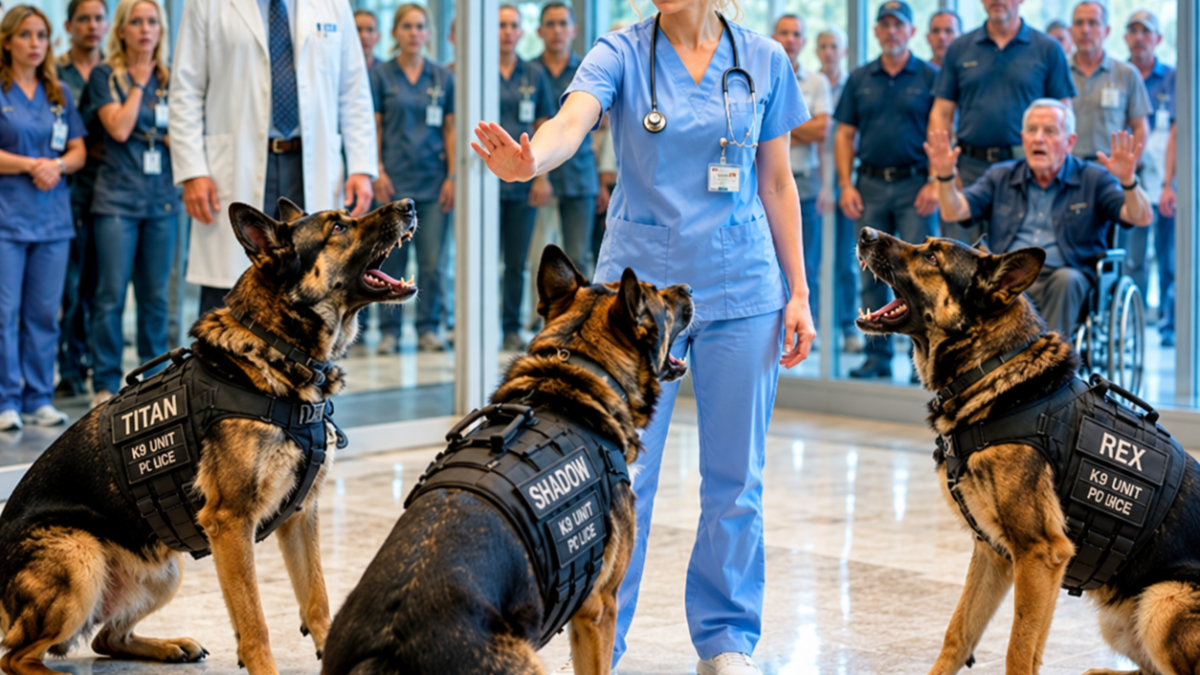
Inside the suite, Olivia did not move toward the dogs.
She stood near the entry area with her arms at her sides, her weight balanced, her breathing steady.
Not stiff.
Not performatively calm.
Just present.
Her eyes moved from Gunner to Atlas to Dusk in a slow arc.
Gunner stopped moving first.
He turned and looked at her directly.
Ears forward.
Head tilted by the smallest degree.
Atlas shifted his weight.
Dusk lifted her head from near the window.
Outside the glass, Priya whispered, “Why aren’t they moving?”
Nobody answered.
Olivia took two steps forward.
Stopped.
Then she made a sound.
Barely audible through the glass.
Low.
Short.
Not a whistle.
Not a word.
Something shaped between both.
A sound with memory in it.
Gunner changed.
Not stiffening.
Not bracing.
Not threat.
He changed the way a man changes when a voice from another life crosses a crowded room and says his name before he has had time to remember he was still waiting to hear it.
His head lowered.
His tail dropped from high alert.
Then it began to move.
Slowly.
Atlas made a sound deep in his chest.
Dusk walked toward Olivia.
Eleven years old, hip damaged, cautious for everyone else.
But she crossed that floor like she had been waiting for permission for six years.
“What is happening?” Bremer whispered.
It was not really a question.
Okafor said nothing.
He was recalculating everything.
Inside the suite, all three dogs moved to Olivia Marsh.
They did not jump.
They did not paw.
They did not crowd in childish excitement.
Gunner went to her left.
Atlas settled slightly behind her right side.
Dusk lowered herself across Olivia’s feet.
The formation was not random.
Okafor knew that.
Dale Ferris would have known it.
Any handler who had worked operational dogs long enough would have known it.
It was not therapy positioning.
It was not civilian affection.
It was what a canine unit did when it returned to its medic.
The person safe enough to bleed beside.
The person who had smelled like antiseptic, dust, sweat, fear, gauze, and survival.
The person who had stayed.
Olivia crouched slowly.
Without hesitation.
She placed one hand on Gunner’s scarred flank and said something to him no one outside the room could hear.
Gunner pressed his heavy head against her knee.
Atlas leaned toward her.
Dusk exhaled and stayed across her feet, the way an old dog anchors a person she has already decided belongs.
Kesler’s coffee cup lowered by an inch.
Donna Reyes whispered, “She knows those dogs.”
“That’s not possible,” Dr. Halloway said.
But his voice lacked the certainty required to carry the sentence.
The phone at the observation window kept recording.
No one stopped it.
For four hours, Olivia sat on the floor with the three animals Dr. Kesler had sent her in to fear.
They did not leave her.
Bremer eventually entered and sat near the wall, careful not to interfere. Okafor came in once, saw Gunner check Olivia before allowing him near, and walked back out with a face that had become unreadable to everyone except those who knew what awe looks like when it is wearing discipline.
The video spread through the hospital before lunch.
It moved the way all forbidden things move inside large institutions.
First one nurse.
Then one therapist.
Then an administrative assistant.
Then a staff lounge.
Then a private message with the caption:
Who is Nurse Marsh and why do those dogs know her?
Priya Anand saw the video three times before noon.
On her break, driven by guilt, curiosity, and the uncomfortable need to know whether she had laughed at someone she should have respected, she opened Olivia’s personnel file.
It was thin.
Too thin.
Not because Olivia had done little.
Because what she had done lived somewhere else.
There was a six-year gap between her nursing certification at twenty-two and her first listed civilian hospital position at twenty-eight.
Six years.
A clean absence.
The kind that meant weight.
Priya closed the file and sat still in the staff lounge.
Some doors, once opened, do not open in the direction expected.
At 11:40, Olivia came out of the suite with her clipboard.
Her scrubs were clean.
Her face was calm.
Behind her, Gunner stood at the door like he wanted to follow.
Okafor waited in the corridor.
“Can we talk?”
“Yes,” Olivia said.
They went into a small conference room.
He closed the door.
For a moment, neither sat.
Then Okafor said, “Where did you serve?”
It was not an accusation.
Not even entirely a question.
It was one person from a specific world acknowledging that the bridge existed, that the language existed, that he already knew enough to ask the real thing.
Olivia set her clipboard on the table.
“That’s a specific question.”
“I have specific reasons.”
She looked toward the door.
Not nervously.
Calculating.
Then she looked back at him.
“Navy,” she said. “Attached to a special operations support element. I was a combat medic before I cross-trained into nursing.”
Okafor let the room sit with that.
“Which unit?”
Olivia shook her head.
“That’s not a question I can answer.”
He nodded.
He understood answers like that.
“Gunner’s service record shows he deployed with a special operations element in the second and third years of his active service,” Okafor said. “So did Atlas. Dusk was attached to a different unit, but same operational theater. Same years you would have been there.”
Olivia did not move.
“They recognized you,” Okafor said. “All three of them. Not like a scent they processed once. Like someone they trusted when trust was not small.”
“Dogs have long memories.”
“Longer than people give them credit for,” he said. “Especially for the things that mattered to them.”
The room went quiet.
Then Olivia said, “I treated them. Field conditions. There were injuries.”
Okafor waited.
“Gunner’s fragment wound. Atlas’s concussive event. Dusk’s hip injury.”
Her voice stayed even, but underneath it lived something requiring force to contain.
“Their handlers rotated out for different reasons that year. I was the consistent medical presence for a while.”
“For a while,” Okafor repeated softly.
She did not elaborate.
He did not ask.
“Does Kesler know any of this?”
“No.”
“Did you plan to tell anyone?”
Olivia picked up her clipboard.
“I came here to be a nurse,” she said. “That’s what I am.”
She meant it.
Entirely.
And it was true.
It was also only part of the truth.
By the next morning, the video had left the hospital’s internal network.
Someone had posted a screenshot to a private military working dog veterans forum.
The post asked one question.
Anyone recognize this situation? The dog formation is MWD protocol. Who is this woman?
By afternoon, the thread had forty-seven replies.
Most analyzed the dogs’ behavior.
A few said what others were afraid to write.
That’s not a civilian with good energy.
Those dogs have worked with her before.
One comment, posted by an account with no profile picture, said:
She’s real. Give her space.
The moderator pinned that comment and locked the thread.
Nobody named Olivia.
But the shape of her appeared.
Enough for those who knew to know.
Enough for those who did not to understand that something larger than gossip had entered the room.
On the second morning after the video, two people arrived at Hargrove in a plain dark sedan.
Commander Elise Pharaoh from a Navy personnel office.
Lieutenant Commander Paul Gettis with a document folio.
They asked for Gordon Price, the hospital’s executive director.
Price met them in the lobby at 7:22.
Commander Pharaoh handed him a document.
Price read the first paragraph.
Then read it again.
“I wasn’t aware of this,” he said.
“Most people in her current professional environment aren’t,” Pharaoh replied. “That was intentional.”
Within twenty minutes, Price, Barbara Stroud, Dr. Kesler, Okafor, Commander Pharaoh, Lieutenant Commander Gettis, and Olivia Marsh were in the executive conference room.
Kesler sat with a legal pad in front of him.
The page remained blank.
Commander Pharaoh did not waste time on pleasantries.
“Nurse Marsh,” she said, “I want to be straightforward about why we’re here.”
Olivia sat still.
“The video of your interaction with the K9 unit reached a veteran community forum. Three individuals connected to operational teams during your service period contacted our office within eighteen hours of the video posting.”
Price looked up.
Straud’s expression shifted.
Kesler looked down at his hands.
“They were not filing complaints,” Pharaoh continued. “They were asking us to make sure you were okay.”
The room changed.
Not loudly.
But something inside it rearranged.
“They were concerned that your professional cover, in terms of keeping your service history private, had been compromised. We are not here to discipline you. We are not here to compel disclosure. We are here to make sure you have the support of your branch and to give you the option to control your own narrative going forward.”
Olivia looked at the gray folder on the table.
“That is your commendation file,” Pharaoh said. “I brought it because some of the people in this room may need context. With your permission, I can share what is permitted.”
Olivia’s jaw tightened slightly.
A small movement.
Private and public colliding.
“Yes,” she said. “Go ahead.”
Pharaoh opened the folder.
The first page summarized what could be said without classified operational detail.
Five years and eight months of active service in the Navy medical corps.
Attached to special operations support in three operational theaters.
Two commendations for valor under fire.
A Navy Achievement Medal with combat distinguishing device.
One partially redacted citation for medical actions during a critical incident in which she sustained an injury and continued providing care.
“You were wounded?” Barbara Stroud asked.
“Shrapnel,” Olivia said. “Shoulder. It wasn’t significant.”
“It was significant enough to be cited,” Commander Pharaoh said.
“Kept working,” Olivia replied. “That’s the job.”
Kesler made a sound that was not quite a word.
Everyone looked at him.
He closed his mouth.
Pharaoh moved to the second page.
“The K9 section,” she said.
This time, she placed the page so Okafor could see it too.
“During a fourteen-month period in your third and fourth years of service, you were primary medical support for a military working dog unit attached to your element. Three animals designated G7, A4, and D2 in operational records.”
She looked up.
“Gunner, Atlas, and Dusk in their current designations.”
Okafor covered his mouth with one hand and looked at the ceiling for a moment.
Pharaoh continued.
“During this period, you provided emergency veterinary first aid, sustained recovery care, behavioral monitoring, and according to the written account of the unit’s supervising handler, maintained those animals through a period when their assigned handlers were medically unavailable, keeping them operationally functional and psychologically stable.”
She set the page down.
“The handler’s account specifically states that without your intervention, at least one of the three animals would have been lost.”
The room went silent.
“Which one?” Okafor asked.
His voice had gone rough.
Pharaoh looked at Olivia.
Olivia looked at her hands, flat on the table.
“Gunner,” she said.
Nobody moved.
“He took the worst of the fragment event. His handler was already down. The secondary handler was managing another situation.”
She stopped.
Breathed.
“He was going into shock. I had limited supplies and an active perimeter. I sat on the floor of a position that was not secure and kept him alive for six hours until extraction.”
No one in the room interrupted the silence after that.
Kesler stared at the legal pad in front of him.
The man had assigned supply closets, discharge cleaning, and a staged humiliation to someone who had kept a military working dog alive for six hours in an unsecured position while wounded.
For the first time since Olivia arrived at Hargrove, he looked at her.
Not over her.
Not around her.
At her.
Like a man beginning to understand how long he had been wrong.
Pharaoh gathered the papers.
“Nurse Marsh, the Navy’s position is this. Your choice to maintain a private professional profile after your service is entirely within your rights. Nothing that has happened here obligates you to disclose anything more than you choose.”
Olivia nodded once.
“Given the outside inquiries, we wanted to give you the option to make a formal statement through proper channels. That would allow you to control what is said and what is not.”
“I’ll think about it,” Olivia said.
“That is all we ask.”
Pharaoh stood.
Before leaving, she looked around the table.
“I ask that the contents of this meeting remain in this room until Nurse Marsh decides how she would like to proceed.”
Her gaze landed last on Kesler.
It was brief.
Level.
It said nothing improper.
It did not need to.
After Pharaoh left, Price cleared his throat.
“Olivia—”
“I need to get back to my patients,” she said.
No one stopped her.
She made it as far as the stairwell before her body demanded what her mind refused.
A pause.
Not tears.
Not collapse.
Three seconds with one hand against the cold wall.
Her left shoulder ached the way it always did in cold weather, the body’s private notation of a bill paid years earlier.
For six years, Olivia had rebuilt herself methodically.
Nursing school.
Clinical hours.
Two hospital positions.
Hargrove.
Each step deliberate.
Each step adding distance from a world where the stakes had been absolute and the margin for error had been zero.
She had not been running from that person.
Not exactly.
She had been carrying her carefully into a new life, the way you carry something fragile into a place that does not know its value.
She had thought she would have more time before someone looked directly at it.
She was wrong.
At 11:40 that same morning, a patient fell in the rehabilitation gym.
Ruth Pullman, sixty-seven, recovering from hip replacement, caught her foot on the edge of a floor mat. She hit the parallel bars shoulder first, then the back of her head, and landed hard on her left side.
The call button was pressed.
Two junior nurses froze in the doorway.
Olivia arrived in twenty-two seconds.
She did not run because running in hospitals creates panic in patients who see it.
But she moved at the exact edge of a run, controlled and purposeful.
One look gave her the room.
Patient conscious.
Head contact.
Left shoulder presenting wrong.
Possible anterior dislocation.
Brief orientation gap reported by the PT.
Possible concussion.
Do not reduce shoulder until neurological assessment.
C-collar.
Backboard.
Call neurology first, not just floor attending.
Keep head movement minimal.
Speak calmly.
Keep patient present.
Ruth clutched Olivia’s hand and said, “Don’t touch the shoulder.”
“I’m not touching it,” Olivia told her. “Promise.”
Four minutes later, Dr. Ashby arrived.
Ninety seconds after that, orthopedics.
The decision was clean.
CT first.
Shoulder reduction after clearance.
Correct call.
When Ruth was stabilized and transported, Olivia stayed behind to finish the incident report.
Kesler appeared in the gym doorway while she was writing.
He looked smaller.
Not physically.
Something else.
The posture he had worn for years suddenly seemed too expensive to maintain.
“I heard what happened,” he said.
“It was a manageable incident,” Olivia replied. “The patient is in imaging.”
“You prevented a complication.”
“Dr. Ashby prevented a complication. I provided information.”
Kesler stepped inside.
Stopped.
Looked at his hands.
“Olivia,” he said, “I owe you an apology.”
She kept writing.
“What I did, sending you into that suite without proper preparation, without telling you what the morning protocol was, was wrong. I want to say that directly.”
Olivia finished the line, capped her pen, and turned.
“Yes,” she said. “It was.”
The simple agreement seemed to knock him off balance.
“Dr. Kesler,” Olivia continued, voice even, “you assigned me tasks below my clinical level because I didn’t push back. You put me in a situation you intended to be embarrassing because I didn’t give you a reason to think I could handle it.”
She paused.
“That is a pattern. Not a single incident.”
Kesler stood still.
“I accept that you’re sorry,” she said. “But I think you should also look at that pattern.”
Her voice did not rise.
“I’m not the only person you manage.”
Then she picked up the report and walked out.
Some things need to be said plainly and left to do their work.
That afternoon, the day broke open again.
Gunner collapsed in the assessment suite.
He was breathing, but wrong.
Labored.
Fast.
Exhale slightly prolonged.
Not seizure.
Not full cardiac arrest.
But distress.
Bremer called the program veterinarian, Dr. Voss, who was twenty minutes out.
Olivia reached the suite first.
Gunner lay on his side near the south wall. Atlas pressed into the corner, contained but watching. Dusk lay against Gunner’s flank, her old body providing the oldest kind of comfort in the world.
“What happened?” Olivia asked, already on the floor.
“He went down fast,” Bremer said. “He was pacing, then his back legs went.”
Olivia found Gunner’s pulse.
Elevated.
Irregular.
Not catastrophically, but wrong enough.
“Has he eaten today?”
“Half his morning meal.”
“Medication changes?”
“No changes. Joint supplement and low-dose anti-inflammatory.”
Bremer checked the file.
“Wait. Anti-inflammatory was switched two days ago. Different compound, same class. Dr. Voss approved it.”
Olivia looked at Gunner’s face.
He was looking at her with the same absolute focus he had given her in rooms far less safe than this one.
“Get his full medication file,” Olivia said. “Everything from the last two weeks. Not just current list.”
Bremer moved.
“Look for GI symptoms in the last two days,” Olivia said. “Vomiting, loose stool, anything.”
Bremer flipped pages.
“Two notations. Yesterday and the day before. Logged as possible dietary sensitivity. Nobody flagged it to the vet.”
A silence followed.
Bremer’s face changed.
“Okay,” Olivia said. “Not your fault. But when Dr. Voss gets here, that’s the first thing she needs.”
“You think it’s the medication?”
“I think it is worth ruling out.”
She did not practice outside scope.
She did not diagnose.
She gathered the story.
Medication switch.
Reduced appetite.
GI symptoms.
Pacing.
Acute presentation.
Elevated heart rate.
Irregular rhythm.
Labored breathing.
Specific injury history.
Old systemic stress.
Operational dogs carry their past in their bodies too.
“Keep Atlas and Dusk close,” Olivia said.
Bremer looked up.
“That’s not standard protocol.”
“No,” Olivia said. “But it will help him stay calm. Calm is what we need right now.”
She glanced at Dusk, still pressed to Gunner’s flank.
“She knows what she’s doing.”
Dr. Voss arrived at 4:17.
Eleven minutes later, she came out holding the file.
“You called the medication change,” she said to Olivia.
“I flagged it as a possibility.”
“It’s the cause. The new compound has a rare documented interaction profile with his inflammatory pattern around the fragment site. It wouldn’t show on a standard screen. We discontinue, support the cardiac symptoms, monitor for forty-eight hours. Heart structure is fine. Metabolic cascade, not primary cardiac event.”
Okafor exhaled like he had been holding his breath for half an hour.
“He’ll recover?” he asked.
“He’ll recover,” Dr. Voss said.
Then she looked toward Barbara Stroud.
“Your documentation pathway needs revision. Handlers logged early warning signs, but they did not move through a clinical review channel.”
“I’ll fix it Monday,” Stroud said.
“No,” Olivia said.
Everyone looked at her.
She checked the clock.
Her shift had ended nine minutes earlier.
“Tomorrow morning,” she said. “Monday is too late.”
Barbara Stroud looked at her for one second.
Then nodded.
“Tomorrow morning.”
By Friday, the hospital’s HR review had uncovered seven documented instances over four months where nursing staff in Kesler’s wing had been assigned duties outside or below role scope.
Three involved Olivia.
Others involved Priya Anand and a nurse named Torres who had transferred out because of workload.
The full review later documented eleven instances over five months.
It used institutional language, but the language was precise enough to cut.
Systematic exploitation of professional deference.
Kesler was moved from rehabilitation wing director to a non-supervisory clinical advisory position.
Quietly.
No theater.
No public humiliation.
Real accountability rarely looks the way people imagine.
He was not an evil man.
That made the story harder.
He was a man who had treated certain people as less substantial than they were, and had done it long enough that the habit became invisible to him.
The review made it visible.
What he did with that visibility afterward became his responsibility.
Priya apologized to Olivia on Friday afternoon.
Not in a dramatic speech.
In the corridor, by the med cart.
“I’m sorry,” she said. “Not just for the video. For the things I said and laughed at in the first week.”
Olivia looked at her.
“I know.”
Priya waited.
“Is that it?”
“What else do you want me to say?”
“I don’t know. Something more.”
“Okay,” Olivia said. “You’re a good nurse. You saw things you should have said something about, and you didn’t. Carry that productively.”
Priya swallowed.
Olivia added, “Also, your potassium monitoring on the patient in room eight is excellent. I’ve been watching you work this week.”
Priya blinked.
“I meant that as a compliment,” Olivia said.
“I know. It just wasn’t what I expected.”
“Most true things aren’t.”
The following Monday, Barbara Stroud called a program meeting.
The K9 integration program would expand.
Hargrove would become a model site for veteran rehabilitation integration.
Atlas and Dusk would move into active therapy status.
Gunner would follow once cleared by Dr. Voss.
The documentation protocols would be rebuilt under Olivia’s clinical oversight.
And Olivia Marsh would become the program’s medical integration specialist.
Civilian nursing track.
Formal authority.
Salary adjustment.
Clear scope.
Protected role.
Her military background would not be used to turn her into a symbol without consent, but the truth of her experience would no longer be treated as a secret she had to hide in order to do ordinary work.
Three weeks later, Olivia sat in the newly renamed integration therapy suite with Atlas and a thirty-one-year-old veteran named Patrick Seio.
Patrick had sustained a traumatic brain injury in a training accident. He was in the difficult middle stage of recovery, where the crisis has passed, everyone expects progress, and the patient begins to understand how slow rebuilding a brain can be.
For fifteen minutes, he said nothing.
Atlas sat beside him.
Not leaning.
Not performing comfort.
Present.
Patrick finally put one hand on Atlas’s back.
“Does he know I’m messed up?” he asked.
“Yes,” Olivia said.
“Does it bother him?”
“No.”
“How do you know?”
“Because he’s still here.”
Patrick looked at Atlas.
Atlas looked back.
Been through stuff,” Patrick said.
“Yes.”
“Bad stuff?”
“The kind you come back from,” Olivia said. “But you come back different for a long time.”
Patrick’s hand stayed on Atlas’s back.
In her observation log, Olivia wrote three clinical lines.
Those lines were factual.
Standardized.
Professional.
They did not say what the room had actually held.
A young man who had been inside his own damage for six weeks had been outside it for fifteen minutes because an animal with his own damage sat beside him without judgment and waited.
That was the mechanism.
That was the program.
Not sentiment.
Not a photo opportunity.
Not dogs as props.
The presence of something that did not need you fixed in order to stay.
Six weeks after Gunner’s episode, he entered his first active therapy session.
His patient was Carol Wittmann, sixty-five, Army veteran, grief defended so well it had become part of her posture.
She had refused to engage with the therapy dogs for two weeks.
Gunner entered the suite, checked Olivia once with a look she knew very well, then walked without instruction to the corner where Carol sat.
He lay down in front of her feet.
He did not look at her.
He did not ask.
He waited.
Carol stared at him for forty seconds.
Then she placed one hand on his head.
She did not cry.
She was not the kind of person who cried where others could see it.
But something changed in her face.
The release of something held too long at too great a cost.
Across the room, Tess Bremer said nothing.
She was learning that sometimes nothing is the correct response.
After the session, she walked beside Olivia down the corridor.
“How did he know to go to her?”
“He read the room,” Olivia said.
“But how?”
“The same way you learn to read anything. Pay attention long enough and you start seeing what is actually there instead of what you expect to be there.”
Bremer thought about that.
“Did someone teach you that?”
Olivia was quiet.
“The hard way,” she said.
Which is mostly how it works.
On a late November Tuesday, the first snow fell over Dunore, Pennsylvania.
Light and directionless.
The flakes moved sideways in the wind off the hills, dusting the parking structure, the courtyard, the stripped trees along the hospital perimeter.
Olivia was at the nursing station before her shift officially began, reviewing the day’s session schedule, when she heard the sound in the corridor.
Gunner, Atlas, and Dusk.
Morning station transfer.
Bremer first.
Then Okafor.
Then the dogs.
Gunner measured and deliberate.
Atlas half a step ahead.
Dusk at the rear, hip listing slightly, eyes reading the floor.
They passed the nursing station.
Then Gunner stopped.
He turned and looked at Olivia across the counter.
His tail moved.
Not frantic.
Not begging.
A slow, considered movement from an animal making a clear statement.
“Good morning,” Olivia said.
His tail moved again.
Atlas turned his head.
Dusk lifted hers.
Okafor watched from the corridor and said nothing.
There was nothing to say that the moment was not already saying.
Olivia came around the nursing station and crouched.
Her left shoulder ached with the cold, the body’s private notation of an old bill paid in full.
She placed her hand on Gunner’s head.
He stood still under it the way he had stood still in the worst hours of both their lives, when the only available fact had been that she was there and she was not leaving.
“We’ve got work to do,” she told him.
Gunner looked at her.
Then stood.
Together, they went to work.
The hospital moved around them the way hospitals always move—necessary, continuous, full of competence and failure, recovery and loss, ordinary labor and hidden courage.
Some people in that building were recognized for what they carried.
Some were not.
The distance between those two groups was sometimes circumstance, sometimes injustice, and usually a combination of both.
Olivia Marsh had learned something across six years of rebuilding, four days of exposure, and weeks of reconstruction.
The quiet you build around yourself to stay safe will eventually become a room too small to live in.
Not because quiet is wrong.
Because the things you carry do not diminish in the dark.
They wait.
Patiently.
Like Dusk.
Like Atlas.
Like Gunner standing at a door until the footsteps he remembered returned.
You can carry your history as a burden, and it will get heavier.
Or you can carry it as a tool, which has weight too, but weight with purpose.
Weight that does something when placed in the right hands.
The day Dr. Kesler sent Olivia Marsh into that locked room, he thought he was about to expose her limits.
He did expose something.
Just not what he intended.
He exposed the foolishness of judging competence by volume.
He exposed the danger of mistaking patience for weakness.
He exposed an institution that had grown comfortable using quiet people as extra space.
And he exposed the truth that three retired military dogs had known before anyone with a badge or title bothered to learn it.
Olivia Marsh was not a rookie.
She was not manageable.
She was not empty because her file was thin.
She was a combat medic who had carried two lives inside one body and finally found a place where both could work.
At the end of the rehabilitation corridor, in a suite built for healing people who had forgotten how far they might still go, Olivia sat on the floor with Gunner, Atlas, and Dusk while a young veteran reached out for the first time that morning.
No one rushed him.
No one ordered him to recover.
No one performed hope at him.
They simply stayed.
Olivia watched the veteran’s hand settle on Atlas’s back.
Gunner rested near the door.
Dusk breathed slowly by the window.
Snow crossed the glass.
The world outside went briefly, impartially white.
Inside, a woman and three dogs waited with a man who had not yet learned that the distance between where he was and where he might still get to was crossable.
They crossed it with him one Tuesday morning at a time.
For as long as it took.
That was the work.
And the work was enough.








