A Quiet Nurse Found 12 Retired Military K9s Being Auctioned Off—Then She Recognized Her Fallen Soldier’s Dog in Kennel 7
PART3:
Military language did not use words like that.
Assigned.
Paired.
Handler and K9.
But anyone who had ever watched Marcus and Ghost together knew the paperwork was inadequate.
Marcus had been twenty-six.
Georgia accent.
Paperback western novels folded into cargo pockets.
Terrible coffee.
A habit of talking to Ghost as if the German Shepherd were an argumentative coworker.
“You know you’re not getting half this beef stick.”
Ghost would stare.
Marcus would sigh.
“Fine.”
Half the beef stick disappeared.
Emily had treated Marcus twice before the mission that killed him.
Once for dehydration.
Once for a laceration he tried to tape shut himself because he did not want to miss a patrol.
She had called him an idiot.
He had called her terrifying.
They got along.
Ghost had been with him for almost four years.
Explosive detection.
Tracking.
Patrol.
A large German Shepherd with a black saddle, intelligent amber eyes, and a diagonal scar along his left shoulder from an earlier deployment.
The scar had healed badly.
Not because the medic had been careless.
Because the medic had been Emily.
And she’d had seven minutes, two injured men, one dog bleeding through a temporary dressing, and incoming fire close enough to shake dust from the ceiling.
She had closed Ghost’s shoulder as fast as she could.
Years later she could still picture the stitches.
Ugly.
Functional.
Alive.
Then came the valley.
The mission Emily spent four years trying not to revisit.
Bad intelligence.
That was what everyone said afterward.
Bad things happen.
Fog of war.
Incomplete information.
Unpredictable enemy movement.
The phrases arrived in debriefs with bureaucratic cleanliness.
Marcus arrived at the forward operating base in shock.
Ghost arrived beside him.
The dog had blood across his muzzle that wasn’t his own.
Emily worked Marcus for eleven minutes.
Airway.
Chest.
Pressure.
Medication.
Compression.
Reassessment.
Again.
Again.
Again.
The medevac remained twenty minutes out.
Marcus’s blood pressure disappeared.
They kept working.
Someone eventually touched Emily’s shoulder.
She kept working.
“Carter.”
She ignored him.
“Emily.”
Nothing.
“That’s enough.”
“No.”
“Emily.”
“No.”
There is a point when medicine stops being medicine and becomes refusal.
Emily crossed it knowingly.
Marcus Webb died on that table.
Ghost lay beneath it.
No one could move him.
He didn’t growl.
Didn’t bite.
Didn’t panic.
He just stayed.
When they carried Marcus away, Ghost stood.
Followed.
And Emily never saw the dog again.
Until three weeks before the blocked message.
A veteran named Dale Petroan had come into her clinic with a badly infected hand from a farm accident.
During triage he mentioned he’d once worked around military dogs.
They talked.
Briefly.
Emily did not tell him much.
Then Dale said:
“Funny thing. One of Webb’s old dogs is still alive.”
Emily stopped wrapping his hand.
“What?”
“Ghost.”
She looked at him.
“Marcus Webb?”
“Yeah.”
“Where?”
“Transition program somewhere in Oregon.”
Dale shrugged.
“Heard he’s being processed out.”
Emily finished the bandage.
Then went home and spent four hours looking.
She found almost nothing.
Asset transition.
Regional processing.
No adoption listing.
No public placement notice.
She filed it away.
Emily was extremely good at filing things away.
She had survived years by becoming good at it.
The facility appeared at 6:47 in the morning.
Chain link.
Floodlights.
Low government buildings.
A faded sign:
REGIONAL MILITARY ASSET TRANSITION CENTER.
The phrase was deliberately boring.
Emily parked.
Sat.
Watched.
A guard moved around the perimeter.
One delivery truck near the maintenance building.
Three kennel ventilation stacks beyond the main structure.
She got out.
The guard’s name was Terrence.
Forties.
Sleepy eyes.
Professional enough.
“Morning, ma’am.”
“Morning.”
“Can I help you?”
“I’d like to speak with whoever is overseeing today’s K9 disposition.”
His face changed.
Just slightly.
“You have an appointment?”
“No.”
“Are you registered for the auction?”
“I will be.”
“You need to come back when public intake opens.”
“What time?”
“Nine.”
“I know.”
Terrence glanced toward the building.
Emily said:
“I drove ninety minutes. I’d like to see the animals before I bid.”
“That’s not normally—”
“I’m not asking to handle them.”
He studied her.
She let him.
Emily had learned a long time ago that silence made people reveal which part of their objection was real.
Terrence eventually picked up the phone.
Ten minutes later, Lieutenant Paul Pruitt appeared.
Clipboard.
Duty uniform.
Polite suspicion.
“Ms. Carter?”
“Yes.”
“I understand you’re interested in today’s auction.”
“Yes.”
“Public access isn’t open.”
“So I’ve been told.”
“You may return at nine.”
“I’d like to see the dogs first.”
Pruitt sighed.
“That’s not standard.”
“Neither is buying a working dog without evaluating its condition.”
That made him pause.
“You have K9 experience?”
“Yes.”
“What kind?”
“Military medical support.”
Pruitt looked at the canvas bag.
Then at her.
“You military?”
“Former.”
He clearly wanted a longer explanation.
Emily did not provide one.
Eventually he said:
“I can give you observation access.”
“Fine.”
“No contact.”
“Fine.”
“Ten minutes.”
Emily followed.
The kennel smell hit her before the door opened fully.
Dog.
Bleach.
Urine.
Disinfectant.
Metal.
Poor ventilation.
Stress had a smell too.
People argued about that.
Emily had stopped arguing years earlier.
Animals under prolonged stress carried themselves differently.
Held heat differently.
Breathed differently.
The corridor ran behind chain link.
Twelve kennels.
Belgian Malinois.
German Shepherds.
Most between six and nine years old.
All military retirees.
Too old for the next operational cycle.
Too expensive for organizations that had begun calculating them as maintenance burdens.
Emily walked slowly.
Kennel One.
Malinois.
Rear-leg stiffness.
Kennel Two.
German Shepherd.
Worn teeth.
Kennel Three.
Malinois with a bandaged tail.
Four.
Five.
Six.
Then seven.
Emily stopped.
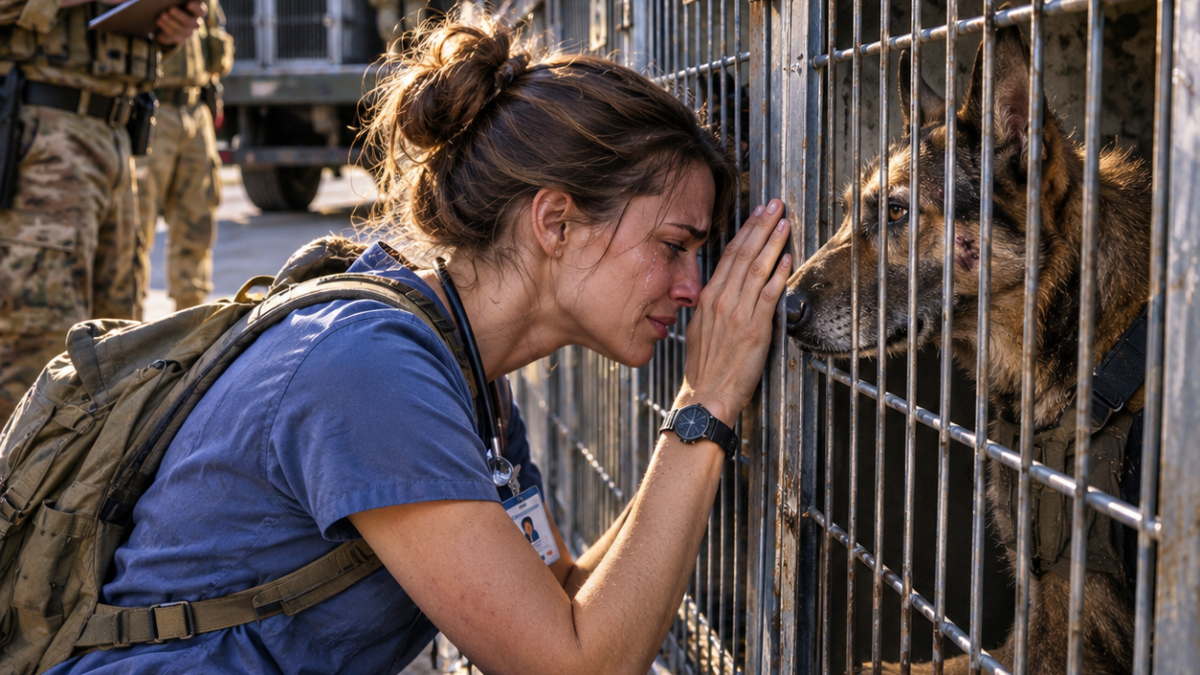
The dog in the back corner did not move.
Large German Shepherd.
Thinner than she remembered.
Gray around the muzzle.
Left shoulder.
Diagonal scar.
Ugly suturing pattern.
Her suturing pattern.
Emily forgot to breathe.
The tag read:
GHOST — K9-7
FORMER HANDLER: CPL MARCUS WEBB
DEPLOYMENT HISTORY: KANDAHAR / KHOST / HELMAND
The rest blurred.
“Ghost.”
The dog’s ear moved.
Emily took one step closer.
Pruitt said:
“Ma’am, please remain behind the barrier.”
She stopped.
Ghost raised his head.
Slowly.
Their eyes met.
Emily did not know whether dogs remembered faces across four years.
She knew scent lasted.
Voices could last.
Associations lasted.
But she would not romanticize what she could not prove.
Ghost looked at her.
That was enough.
His bowl was untouched.
“How long hasn’t he eaten?”
Pruitt looked at his clipboard.
“I don’t have medical data.”
“Water intake?”
“Veterinarian handles that.”
“Weight loss?”
“I said I don’t—”
“Who signed his disposition?”
Pruitt’s expression changed.
“Commander Callahan oversees the process.”
“I want to speak with him.”
“The auction begins at nine.”
“I know.”
“Then you can—”
“Now.”
Pruitt stared.
Emily looked at Ghost.
The dog had lowered his head again.
“Please.”
Something in the final word worked.
Commander Derek Callahan arrived at 8:15.
He looked exactly like a man who had been told a civilian inconvenience was waiting.
Early fifties.
Tall.
Trim.
Military bearing sharpened by years of being obeyed.
He did not offer his hand.
“Miss Carter.”
“Commander.”
“I understand you have concerns.”
“I have questions.”
“About?”
“Why twelve retired military working dogs are being sold through asset disposal instead of transferred through established K9 adoption and law-enforcement placement programs.”
Callahan’s eyes cooled.
“Because placement capacity is finite.”
“That’s not a reason.”
“It is when this facility has transition deadlines.”
“So the deadline is more important than the dogs.”
“The timeline is part of resource reality.”
Emily looked through the window toward the kennels.
“One of those dogs belongs to the service record of a soldier killed in action.”
“None of the animals belong to individuals.”
She looked back at him.
“You know what I meant.”
Callahan’s jaw moved.
“Ms. Carter, these animals have been evaluated and cleared for disposition in accordance with applicable standards.”
“Who evaluated them?”
“Our veterinary staff.”
“I’d like copies.”
“No.”
“Why?”
“They are internal records.”
“Then I’d like the public disposition summary.”
“You’ll receive whatever documentation is appropriate if you become the successful bidder.”
Emily nodded once.
“All right.”
Callahan looked slightly relieved.
Then she said:
“I’ll take all twelve.”
Silence.
Pruitt stopped writing.
Callahan actually blinked.
“What?”
“All twelve dogs.”
“You cannot simply—”
“What’s the minimum total?”
“That’s not how—”
“Individual minimum bids. Add them.”
Callahan looked at her clothes.
Her old truck visible through the window.
The faded canvas bag.
His face said what his mouth did not.
You cannot afford them.
Emily had seen that look before.
Usually from men who thought nursing meant taking orders rather than making decisions while somebody bled.
“Whatever the number is,” she said, “I’ll meet the minimum.”
“Do you have an approved facility?”
“Not yet.”
“Then you’re not qualified.”
“I can have one before nine.”
Callahan almost smiled.
“Military K9 transition facilities require specialized care capacity.”
“I know.”
“Prior experience.”
“I know.”
“Liability coverage.”
“I know.”
“Secure transport.”
“I know.”
He stared.
Emily continued:
“Give me the written requirements.”
Callahan did not.
Instead:
“Return at nine and follow the auction process.”
“Why won’t you give me the requirements now?”
“They’ll be provided.”
“When?”
“Nine.”
“After interested parties have already arrived?”
“Miss Carter—”
“Is there already a buyer?”
The room changed.
Pruitt looked down.
Callahan’s eyes sharpened.
Emily noticed.
There it was.
Not proof.
Reaction.
“Who else is bidding?”
“Confidential.”
“Is there a pre-qualified buyer?”
“Confidential.”
“Are these dogs being bundled?”
“Miss Carter.”
“Equipment too?”
Callahan’s voice hardened.
“You’re crossing into matters that don’t concern you.”
Emily met his gaze.
“Twelve military dogs being disposed of concerns me.”
“In what capacity?”
The tone carried the insult.
Emily heard it.
So did Pruitt.
Callahan continued.
“You said you’re a nurse.”
“I am.”
“Private clinic?”
“Rural cooperative.”
“Then you have no professional relationship with this facility.”
“No.”
“No military authority.”
“Not currently.”
“No K9 organization.”
“Not currently.”
Callahan spread his hands slightly.
“Then what exactly gives you standing here?”
Emily thought of Marcus.
Ghost beneath the table.
Blood on her gloves.
The helicopter arriving too late.
“Personal interest.”
Callahan gave a small smile.
“There are procedures for people with personal interest.”
“Good.”
Emily smiled back.
“I’ll use them.”
She returned to the parking lot.
Made three calls.
The first went to Vera Solano.
Sixty-one.
Twenty-two years running an animal sanctuary outside Bend.
Emily had helped Vera during a winter medical emergency two years earlier after a volunteer broke a hip during a snowstorm.
Neither had discussed the debt.
Emily explained.
Vera interrupted:
“Twelve?”
“Yes.”
“Military?”
“Yes.”
“Age?”
“Six to nine.”
“Behavior histories?”
“Unknown.”
“Medical?”
“Unknown.”
“You’re asking me to certify placement without records.”
“Temporarily.”
Silence.
Then:
“Send me the facility requirements.”
“I don’t have them.”
“Of course you don’t.”
“Can you do it?”
Vera sighed.
“Yes.”
The second call went to Sloan Atterly.
Former K9 handler.
Six years.
Now security consulting in Idaho.
When Emily said Ghost’s name, Sloan went silent.
“Webb’s Ghost?”
“Yes.”
“You sure?”
“I’m looking at him.”
Another silence.
“How bad?”
“Thin.”
“Responsive?”
“Barely.”
“I’m coming.”
“It’s four hours.”
“I know.”
The third call took longer to dial.
Sergeant First Class Ethan Walker, retired.
Emily had not spoken to him in two years.
He answered on the fourth ring.
“Carter.”
“You kept my number.”
“Apparently.”
“I need something.”
“Figured.”
She explained.
Ghost.
Auction.
Callahan.
Walker’s voice changed when she mentioned Marcus.
“That dog was supposed to go to Webb’s family.”
Emily stopped.
“What?”
“His sister filed.”
“When?”
“Eight months ago.”
“Rejected?”
“Never completed.”
“Why?”
“I don’t know.”
“Could the dog have failed evaluation?”
“Ghost?”
Walker almost laughed.
“He was cleared for transition years ago.”
“Can you check?”
“Yes.”
“How long?”
“Give me an hour.”
“I don’t have one.”
“Then give me thirty minutes.”
At 8:42, three vehicles arrived.
White cargo van.
Black SUV with government plates.
Pickup with livestock trailer.
Emily watched.
A manifest appeared at reception.
She moved past it casually.
The top line caught her eye.
CHYROS DEFENSE SOLUTIONS.
She photographed the page before the receptionist turned it over.
At 8:58, a man entered wearing a jacket that cost more than Emily’s monthly rent.
No sign-in.
No questions.
He walked directly to Callahan.
They shook hands like men who had done it before.
Comfortable.
Familiar.
Emily searched the company.
Chyros Defense Solutions.
Private defense contractor.
Nine years old.
K9 division.
Federal contract awarded fourteen months earlier.
Trained working dogs for law enforcement and private security.
Then another phrase caught her attention.
RETIRED MILITARY K9 REPURPOSING.
Emily stared.
Repurposing.
She went looking for the veterinarian.
Dr. Nadia Oay was in a cramped exam room reviewing records.
Thirty-four.
Exhausted.
The look of someone who knew something she wished she did not.
Emily introduced herself.
Oay closed the door.
“You’re the civilian causing trouble.”
“Apparently.”
“You have five minutes.”
“Did you evaluate the twelve dogs?”
Oay’s expression changed.
“Yes.”
“Did you clear them for disposal?”
Pause.
“Disposition orders came from command.”
“That’s not what I asked.”
Oay looked at the door.
Then:
“No.”
Emily stayed still.
“Explain.”
“I recommended several for transfer.”
“To?”
“Law enforcement. Reduced-intensity service. Some for adoption assessment.”
“Ghost?”
Oay’s face tightened.
“Law enforcement transfer.”
“When?”
“Eight weeks ago.”
“Signed?”
“Yes.”
“Filed?”
“Yes.”
“Where is it?”
“I don’t know.”
Emily felt the cold settle into her chest.
“Current paperwork?”
“Standard disposal.”
“So your evaluation changed.”
“I did not change it.”
“Who could?”
“Command-level records access.”
“Callahan?”
Oay did not answer.
She did not need to.
The auction bell sounded.
Nine o’clock.
Emily turned toward the door.
Oay spoke behind her.
“Ghost hasn’t eaten in three days.”
Emily stopped.
“He stopped after the last familiar handler visited.”
“How long ago?”
“Six weeks.”
“Why didn’t you intervene?”
“I did.”
Oay’s voice sharpened.
“Recommendations were submitted.”
“And?”
“You see where he is.”
Emily went into the hall.
Callahan was already coming toward her.
The expensive-jacket man walked behind him.
“Miss Carter.”
“Commander.”
“You were told to remain in the public area.”
“I was talking to your veterinarian.”
“You’re leaving.”
“I haven’t bid.”
“Your bid will not be accepted.”
“Why?”
“You lack certified placement.”
“Solano Animal Sanctuary.”
Callahan stopped.
“Licensed state facility.”
He recovered.
“You lack military K9 experience.”
Emily looked at him.
“Actually, I don’t.”
The expensive-jacket man became more attentive.
Emily continued.
“I served as a combat medic with the 75th Ranger Regiment.”
Callahan’s face changed.
“Four years.”
Silence.
“Advanced K9 medical support training at Fort Benning.”
Pruitt stared.
Emily reached into her bag.
“I have a copy of my DD214 in the truck if you’d like it.”
Nobody spoke.
She stepped closer.
“I’ll take all twelve.”
Callahan’s jaw tightened.
“I have certified placement.”
No answer.
“I have relevant experience.”
Nothing.
“I can meet the minimum bid.”
The expensive-jacket man looked at Callahan.
Emily saw it.
Fast.
Concern.
“I also know Dr. Oay’s original evaluation for Ghost cleared him for law-enforcement transfer.”
Callahan went very still.
“And I know Marcus Webb’s family filed a placement request eight months ago.”
Callahan’s eyes hardened.
“Where did you get that information?”
“Does it matter?”
“Yes.”
“Then you should probably assume I’ll tell whoever reviews the auction.”
The hallway became silent.
Callahan finally said:
“You are being asked to leave.”
“On what grounds?”
“Restricted facility.”
“I’m registered to bid.”
“Your bid is rejected.”
“Document it.”
“What?”
“Written reason.”
“You don’t dictate—”
“Then accept the bid.”
The expensive-jacket man spoke for the first time.
“Commander.”
Just one word.
Callahan looked at him.
A warning.
Emily filed that away.
Callahan turned back.
“This auction has already been awarded to a pre-qualified bidder.”
Emily stared.
There it was.
“You just said the auction was opening.”
“Pre-qualification is permitted.”
“Before bidding?”
“Under this process.”
“Which regulation?”
“Talk to legal.”
“That means Chyros.”
The expensive-jacket man did not move.
Callahan said:
“Escort her out.”
Two security officers appeared.
Emily did not resist.
She had what she needed.
Statement.
Witnesses.
Timing.
She let them walk her outside.
The door closed.
She checked the clock.
9:10.
Forty-seven minutes until formal close.
Sloan arrived at 9:16.
Beat-up Chevy.
Idaho plate.
Faded K9 sticker.
He got out.
Emily said:
“Pre-qualified.”
Sloan’s expression changed.
“Chyros?”
“Yes.”
He stared at the building.
“Ghost is really there?”
“Seven.”
Sloan swallowed.
“What do you need?”
“JAG contact.”
He nodded.
“Inspector General too.”
“Good.”
She told him everything.
Oay.
Changed evaluations.
Webb family.
Callahan.
Chyros.
Sloan said:
“Official military record alteration isn’t a paperwork problem.”
“I know.”
“It’s criminal.”
“I know.”
“Can Oay testify?”
“Not yet.”
Sloan looked toward the facility.
“Not yet is enough to start.”
Walker called.
Emily put him on speaker.
He had found the Chyros contract.
Eighty-three million dollars.
Multi-year military working-dog replacement and repurposing.
The business model depended on obtaining retired military K9s cheaply, retraining them, then placing them in law enforcement or private security contracts at enormous markup.
Sloan understood first.
“If normal adoption transfers work properly…”
“Chyros doesn’t get enough inventory,” Emily said.
Walker went quiet.
Then:
“Exactly.”
The word inventory made Emily feel sick.
Not dogs.
Inventory.
Marcus had slept beside Ghost on deployment.
Talked to him.
Trusted him with his life.
Somewhere in a contract spreadsheet, Ghost had become inventory.
“How do we stop it?”
Emily asked.
“You file a formal bid objection.”
“Will it stop today?”
“Probably not.”
“Then why?”
“Because it creates a federal timestamp.”
Walker started dictating.
Competitive bidding.
Potential predetermined award.
Discrepancy in disposition evaluations.
Military credentials.
Certified facility availability.
Copy to contracting office.
Copy to DoD Inspector General.
Emily submitted at 9:31.
Six minutes before official close.
The Chyros convoy left at 9:44.
Emily watched twelve dogs disappear behind white vehicle doors.
For one moment, anger nearly took control.
She wanted to drive after them.
Block the road.
Force the doors open.
Do something physical because physical action felt more honest than paperwork.
Sloan saw her expression.
“Don’t.”
“I didn’t say anything.”
“You don’t need to.”
She exhaled.
At 10:07, Dr. Oay came through a side exit.
Civilian clothes.
She walked toward her car.
Stopped.
Turned.
Came to Emily’s truck.
“Chyros intake facility outside Redmond.”
Emily opened her phone.
“Address?”
“County commercial registry.”
“Why are you telling me?”
Oay’s eyes were tired.
“Ghost hasn’t eaten.”
“I know.”
“No.”
Oay looked toward the departed convoy.
“He has stopped trying.”
That landed differently.
“Chyros intake assessment begins today.”
“What happens if he fails?”
Oay did not answer.
Then:
“Find out.”
She left.
Sloan already had someone who knew.
Garrett Tilman.
Former Chyros K9 intake employee.
Four months.
Quit.
When Sloan finished the call, he looked sick.
“They hold forty-eight hours.”
“And?”
“Assess.”
“And?”
“Dogs they can retrain stay.”
Emily waited.
“The ones they can’t…”
“Say it.”
“Euthanized.”
The word entered the truck and sat between them.
“They call it quality control.”
Emily started the engine.
“Ghost fails.”
Sloan nodded.
“With his current condition?”
“Yes.”
“How fast?”
“Tilman says twelve to eighteen hours after priority designation.”
Emily pulled onto the highway.
Redmond.
An hour and twenty minutes.
Walker called halfway there.
He had reached an Oregon National Guard legal contact.
There was a possible route.
Federal property hold.
Until transfer paperwork fully cleared, the dogs remained federal assets.
Because Emily had challenged the auction before close, the transfer could be legally flagged.
Lieutenant Colonel Patricia Han, regional contracting officer, could freeze movement.
“How long?”
“Maybe an hour.”
“Too long.”
“I know.”
Then Walker’s voice changed.
“There is something else.”
Emily’s hand tightened on the wheel.
“What?”
“I pulled what I could from Marcus’s mission file.”
Silence.
“Why?”
“Because Chyros’s name bothered me.”
Emily looked at the road.
“The intelligence source for Webb’s final mission came through a contractor chain.”
She already knew what he would say.
Still, she asked:
“Which?”
“Chyros family.”
The desert outside blurred.
“What?”
“The information used to authorize the operation was flagged low confidence.”
Emily felt heat rise through her chest.
“By who?”
“Two analysts.”
“Then why did we go?”
“Override.”
“Authorized by?”
“Public record redacts the signature.”
Pause.
“Contracting officer associated with the intelligence chain was Derek Callahan.”
Emily stopped breathing.
For four years, she had carried Marcus Webb’s death as medicine’s failure.
As war.
As bad luck.
As the thing you accepted if you worked long enough around violence.
Now a different possibility appeared.
Not bad intelligence.
Ignored intelligence.
“Emily?”
“I’m here.”
“Don’t do anything stupid.”
“No promises.”
“Carter.”
She ended the call.
When the Chyros facility appeared, she pulled onto the shoulder.
New fencing.
Converted agricultural buildings.
Professional logo.
PROTECTING THOSE WHO PROTECT US.
Emily stared.
Sloan pulled beside her.
She got out.
Started walking.
He intercepted.
“Stop.”
“No.”
“You go through that gate without authority, they call county police.”
“Let them.”
“Then Ghost dies while you’re explaining yourself from a holding room.”
That stopped her.
Sloan continued.
“You taught people not to move just because they’re angry.”
“I taught medics.”
“Same principle.”
Emily looked at the facility.
Callahan.
Marcus.
Ghost.
She wanted a target.
A door.
Something to break.
Instead she breathed.
“You’re right.”
Sloan nodded.
“What now?”
“We find standing.”
Walker called.
Han had reviewed the challenge.
She could issue a hold.
Emily checked the time.
Ghost might already be undergoing assessment.
She needed faster proof.
Oay’s original evaluation.
Official record.
Military K9 database.
Someone could alter status.
But databases logged changes.
Emily knew one person who understood those systems.
Deborah Maize.
Retired Sergeant First Class.
Military records administration.
Emily hadn’t spoken to her in three years.
Maize answered.
“Who’s this?”
“Emily Carter.”
Long pause.
“Carter.”
“I need a favor.”
“Of course you do.”
Emily explained.
Ghost.
Evaluation eight weeks earlier.
Oay.
Replacement disposal assessment.
“Can the original be recovered?”
“Yes.”
“Can you access it?”
“No.”
Emily closed her eyes.
Maize continued:
“But I know someone who can.”
“How long?”
“Forty-five.”
“I have thirty.”
“You always were irritating.”
“Thirty.”
Maize sighed.
“Fine.”
Twenty-eight minutes later, Maize called.
Her voice had changed.
“Original exists.”
Emily stood.
“What does it say?”
“Law-enforcement transfer approved.”
“Modification?”
“Yes.”
“Who?”
Maize inhaled.
“User credential belongs to Commander Derek Callahan.”
Emily closed her eyes.
“He changed it himself?”
“Looks that way.”
“When?”
“Eleven weeks ago.”
“Can you preserve the audit?”
“Already did.”
“How?”
“Don’t ask questions you don’t want answered.”
Emily almost smiled.
“Send reference number.”
“I’ll do more.”
“What?”
“Anonymous tip to DoD IG.”
“Maize—”
“Don’t thank me.”
Click.
Emily told Sloan.
“He altered Ghost’s record personally.”
Sloan stared.
“That ties him directly.”
“To Ghost.”
“To Chyros.”
“Partially.”
Her phone rang.
Walker.
“The hold is active.”
Emily exhaled.
“When?”
“Eleven minutes ago.”
“What does it prohibit?”
“Transfer, processing, alteration, euthanasia.”
“And Chyros received it?”
“Registered contracting contact.”
“Read?”
“No guarantee.”
Emily looked at the gate.
She made a decision.
“I’m going in.”
This time Sloan did not argue.
They walked to the intercom.
“Name and purpose.”
“Emily Carter.”
Pause.
“Regarding twelve military working dogs received today under a federal property hold issued through Lieutenant Colonel Patricia Han’s contracting office.”
Silence.
Longer.
“Hold.”
Four minutes.
Then another voice.
Professional.
“Ms. Carter, our legal team is reviewing the notification.”
“The hold is active.”
“We cannot grant access until—”
“I am documenting condition of federal property under a contested transfer.”
She read the reference number.
“If you deny access, I’ll include that in the contracting-office record.”
Another silence.
“Ten minutes.”
At minute seven, her phone rang.
Unknown number.
“Ms. Carter.”
She recognized the voice.
Expensive jacket.
“This is Victor Kaine.”
CEO.
Emily looked at Sloan.
He saw her expression.
Kaine continued:
“I understand you’ve developed some concerns.”
“Several.”
“I think there may be misunderstandings about our acquisition process.”
“No.”
Pause.
“You’re a clinic nurse with an old service record.”
There it was.
He had looked her up.
“You do not have resources to pursue allegations of this scale.”
Emily’s voice remained quiet.
“Your lawyers are reading a federal property hold.”
Silence.
“Army CID is being contacted regarding a modification audit showing Commander Callahan’s credentials altered an official military working-dog evaluation.”
Another silence.
“You should call different lawyers, Mr. Kaine.”
“What?”
“The ones who handle federal criminal cases.”
Three seconds.
“I’ll be in touch.”
He hung up.
Sloan said:
“He called you directly?”
“Yes.”
“Good.”
“Why good?”
“Because powerful people call personally when they’re scared.”
The gate opened.
Gary Purcell met them.
Facility manager.
Forties.
Sweating despite the temperature.
He checked the hold reference.
Identification.
DD214.
He looked at Emily differently after that.
“Animals are Intake Building B.”
They walked.
The Chyros facility was cleaner than the military transition center.
That almost made it worse.
Proper drainage.
Modern ventilation.
Clean stalls.
Everything organized.
Fraud rarely looks dirty from the outside.
Eleven dogs were standing or sitting.
Disoriented.
Stressed.
Alive.
Stall twelve.
Ghost.
On his side.
Eyes open.
Breathing shallow and fast.
Emily crouched.
The intake sheet read:
BEHAVIOR: DEPRESSED / NONRESPONSIVE
WEIGHT DEFICIT: 12–15%
DISPOSITION: PRIORITY REVIEW
Priority.
Emily knew what that meant now.
“How long ago?”
“Assessment?”
Purcell checked.
“About forty minutes.”
“Who evaluated?”
“Dr. Fontaine.”
“Get her.”
Emily stayed at the stall.
“Ghost.”
One ear moved.
Her voice lowered.
“Hey.”
His eyes shifted.
“It’s me.”
She didn’t know whether that was true in the way humans meant.
She stayed anyway.
Dr. Fontaine arrived.
Early forties.
Professional.
Guarded.
Emily pointed at the sheet.
“What does priority review mean?”
“Reassessment.”
“Before what?”
Fontaine looked at Purcell.
Emily waited.
Fontaine finally said:
“Disposition determination.”
“Euthanasia?”
Silence.
That was answer enough.
“The hold prohibits that.”
“Our legal team is reviewing the validity.”
“The federal government issued it.”
“I’m aware.”
“When was Ghost scheduled?”
“Afternoon assessment.”
“And after?”
Fontaine’s expression tightened.
“I can’t predict.”
Emily stood.
“Put all twelve under hold-status care.”
“I’m not authorized.”
“Then document that I’m requesting it.”
Fontaine looked at Purcell.
Purcell’s phone buzzed.
He read.
His face changed.
Emily saw.
“What does it say?”
“Nothing.”
“Mr. Purcell.”
His hand tightened.
“What does it say?”
He looked around.
Then turned the screen.
Message from VK.
MOVE THE PRIORITY DOGS NOW. DON’T WAIT FOR CID. USE EAST EXIT. I’LL HANDLE THE REST.
Sloan whispered:
“Jesus.”
Emily read it again.
Then looked at Purcell.
“You voluntarily showed me that.”
He looked stunned by his own action.
Emily continued:
“You can explain this as the moment you refused to participate.”
He swallowed.
“Or investigators can explain it as something else.”
Purcell looked toward the stalls.
“I didn’t know.”
“I believe you.”
“I was told transfer was standard.”
“Then document it.”
He stared at the phone.
“I’m not moving them.”
“Good.”
His shoulders dropped.
“Now write everything down.”
Emily pointed at Sloan.
“He’ll witness.”
Purcell left.
Fontaine remained.
Emily looked toward Ghost.
“He needs treatment.”
Fontaine’s professional distance broke slightly.
“Yes.”
“Then treat him.”
“I was told not to intervene before final assessment.”
“By who?”
She didn’t answer.
Emily looked at the IV supplies.
“What do you need?”
“Fluids.”
“Then start.”
“Warming.”
“Do it.”
“Blood work.”
“Do it.”
Fontaine hesitated.
Emily’s voice softened.
“He’s not an asset right now.”
The veterinarian looked at her.
“He’s a dog.”
That decided it.
Fontaine moved.
IV line.
Warming blanket.
Blood drawn.
Gum color.
Capillary refill.
Temperature.
Ghost barely resisted.
When the warm fluid began running, his breathing changed.
Not good.
Better.
Fontaine sat back.
“He should’ve been treated before transport.”
Emily said nothing.
“Someone should’ve noticed this two weeks ago.”
Emily looked at her.
“Someone did.”
Fontaine understood.
Oay.
Recommendations.
Records.
Ignored.
She looked ashamed.
“I didn’t know what the intake program was doing with failed dogs.”
“What were you told?”
“Partner shelter transfer.”
“Did you ever verify one?”
“No.”
The word came out quietly.
Emily nodded.
“Then start writing.”
Fontaine did.
Walker’s call came at 1:37.
“CID referral accepted.”
“How long?”
“Forty minutes.”
“Lead?”
“Special Agent Renata Bird.”
Emily repeated the name.
“Callahan?”
“Separate team going to transition facility.”
“Does he know?”
“Not about the audit.”
“What about Marcus’s mission?”
“In briefing.”
“Make sure.”
“It is.”
“Make sure.”
Walker exhaled.
“I know.”
At 2:17, three vehicles entered the Chyros compound.
Special Agent Renata Bird stepped out first.
Mid-forties.
Compact.
Calm.
No wasted movement.
She approached Emily.
“Carter?”
“Bird.”
“Walk me through it.”
Emily did.
Beginning to end.
Blocked message.
Auction.
Chyros manifest.
Oay.
Altered evaluation.
Webb family.
Callahan credentials.
Bid objection.
Hold.
Kaine phone call.
Kaine text.
Purcell statement.
Ghost intake.
Fontaine.
Bird interrupted only to clarify times.
When Emily finished, the agent said:
“You’ve built a cleaner chain of evidence in six hours than some teams build in weeks.”
Emily didn’t react.
“Dogs first.”
Bird nodded.
“Agreed.”
CID secured the facility.
Purcell cooperated.
Fontaine surrendered records.
Phones preserved.
Computers isolated.
Nobody moved any animals.
At 4:44, Walker called.
“Callahan’s office is secured.”
Emily stepped outside.
“And?”
“He lawyered up.”
“Good.”
“Good?”
“Means someone explained the situation correctly.”
Walker almost laughed.
“His computer was unlocked when agents arrived.”
Emily waited.
“They have correspondence with Chyros.”
“How far?”
“Twenty-two months.”
Her stomach tightened.
“Anything on Ghost?”
“Yes.”
“Marcus?”
Pause.
“Yes.”
Emily closed her eyes.
Walker continued.
“Email eleven days before Webb’s mission.”
No.
She knew.
Still:
“Read it.”
“Emily—”
“Read it.”
Walker did.
“Delay is not an option. Contract milestone requires transition completion before quarter close. Move forward with current intelligence regardless of confidence assessment.”
Emily sat on the hood of her truck.
The world became very quiet.
“Callahan wrote that?”
“Yes.”
“To?”
“Chyros intelligence division.”
“He knew.”
“Yes.”
“Low confidence.”
“Yes.”
“He sent them anyway.”
“Yes.”
Emily remembered Marcus’s blood.
The folding table.
Her hands.
Ghost refusing to leave.
For four years, she had told herself:
You did everything right.
Sometimes everything right is not enough.
Now there was another truth.
Somebody had knowingly made the conditions wrong before Marcus ever reached her table.
“Three soldiers died.”
Walker said nothing.
“Because of a contract milestone.”
“We don’t know legal causation yet.”
Emily laughed once.
Cold.
“You sound like JAG.”
“I sound like someone trying to keep you from letting anger decide what the evidence means.”
That irritated her because he was right.
She looked toward the intake building.
“Property hold?”
“Solid.”
“Chyros challenge?”
“Collapsed.”
“Why?”
“Kaine’s text.”
Good.
“What happens now?”
“CID and federal prosecutors take it.”
“Ghost?”
“Your sanctuary transfer should clear tomorrow.”
Emily breathed.
“Good.”
That night, Special Agent Bird found her beside Ghost.
The dog’s breathing had slowed.
IV still running.
Warming blanket over him.
“He’s better.”
Bird nodded.
“Callahan investigation is expanding.”
“I figured.”
“Kaine is being detained.”
Emily looked up.
“On what?”
“Obstruction tied to directing movement of federal assets under active hold.”
“When?”
“Six-oh-eight.”
Emily absorbed that.
Bird continued:
“There may be more facilities.”
“How many?”
“We don’t know.”
“Dogs?”
“We don’t know.”
The phrase landed heavier each time.
Bird looked at Ghost.
“There’s another thing.”
“What?”
“Financial records suggest this scheme predates the current K9 contract.”
Emily stared.
“Other dogs.”
“Yes.”
“How many?”
“Potentially significant.”
The word was careful.
Professionally careful.
Emily hated it.
At 9:30, her phone buzzed.
Blocked number.
Same sender.
No text.
Screenshot.
Internal Chyros email.
Sixteen months earlier.
Compliance officer warning.
Evaluation modifications fraudulent.
Potentially criminal.
Recommendation:
Stop program.
Victor Kaine’s reply:
Reassign him. Make sure he signs the NDA first.
Below it:
His name is Daniel Reyes. Find him.
Emily forwarded it to Bird.
At 11:47, Bird texted.
REYES LOCATED. PORTLAND. COMING VOLUNTARILY.
Four minutes later:
HE KEPT COPIES OF EVERYTHING.
Emily put the phone down.
Ghost shifted.
For the first time since she had seen him, he pushed himself upright onto his sternum.
Head raised.
Front legs tucked.
Eyes focused.
Emily leaned toward the mesh.
“Hey.”
Ghost looked at her.
“Yeah.”
His ears moved.
“Me too.”
Morning brought transport authorization.
Vera arrived at 10:05 with a sanctuary van and two trained staff.
She took one look at Emily.
“You look terrible.”
“Good morning to you too.”
“Have you slept?”
“No.”
“Of course.”
Vera went straight to Ghost.
“This one first.”
Moving him took four people.
Ghost tried to stand.
His rear legs trembled.
He panicked when the transport crate shifted.
Sloan crouched.
“Hey.”
Ghost froze.
Sloan held still.
“I’ve got you.”
The old phrase.
Handler phrase.
Promise phrase.
Ghost allowed them to continue.
One by one, twelve military dogs were loaded.
When the final doors closed, Emily sat on the ground against the van bumper.
Her legs had decided for her.
Sloan sat beside her.
For several minutes neither spoke.
Then:
“Marcus talked about Ghost constantly.”
Emily looked at him.
“I know.”
“Every debrief.”
Sloan smiled faintly.
“Ghost did this. Ghost did that. Ghost found this.”
He swallowed.
“He loved that dog.”
Emily stared at the van.
“I know.”
Sloan looked at her.
“You saved him.”
“Fontaine stabilized him.”
“You got her to.”
“She chose to.”
“Emily.”
She closed her eyes.
Sloan continued.
“You can let something count.”
That irritated her.
Because it was probably true.
She looked at the van.
“Okay.”
That was all.
Federal cases did not resolve like stories.
No dramatic courtroom one week later.
No neat confession.
No single investigator walking out with a folder and announcing justice.
Months.
Subpoenas.
Audits.
Interviews.
Forensic accounting.
Contract records.
Email recovery.
Witness preparation.
Lawyers.
More lawyers.
Victor Kaine was charged with federal fraud, conspiracy, obstruction, and eventually money laundering tied to Chyros K9 division accounts.
Daniel Reyes’s records broke the case open.
Eighteen months of internal emails.
Original evaluations.
Altered versions.
Payment records.
Supply projections.
Communication about “pipeline volume.”
The term made Emily sick every time she read it.
Pipeline.
Dogs who had slept beside soldiers.
Dogs who had found bombs.
Dogs who had tracked injured men through darkness.
Pipeline.
Two Chyros executives entered plea agreements.
A third cooperated.
Kaine went to trial.
Nine convictions out of eleven counts.
Fourteen years.
Emily did not attend sentencing.
That morning she was at Vera’s sanctuary.
Ghost ran.
Not fast.
His left shoulder remained damaged.
His gait would always show it.
But he ran across an open paddock.
Once.
Twice.
Nose low.
Checking ground.
At the fence he stopped.
Looked back.
Emily stood at the gate.
She raised one hand.
Ghost watched.
Then turned toward a patch of grass and began investigating it with complete concentration.
Emily laughed.
Quietly.
Something moved inside her.
Not healing.
She had stopped believing healing meant returning to who you were before.
Adjustment.
That was the word.
Something heavy shifted into a position she could carry differently.
Callahan’s case went deeper.
The Army reopened the mission intelligence review.
Two analysts came forward.
Both had flagged the source as low confidence.
Both had been overridden.
Another officer gave a sworn statement.
Emails showed Callahan pushing the mission timetable while coordinating with the same contractor family tied to Chyros.
The operation’s timing was connected to contract milestones.
No email said:
Kill Marcus Webb.
Reality was uglier because it was more ordinary.
Move forward.
Meet deadline.
Accept risk.
Override concern.
Close quarter.
Three people died because someone in authority decided a warning was inconvenient.
Callahan faced court-martial.
Dereliction of duty.
Falsification.
Conduct unbecoming.
Related charges tied to the K9 records.
Eleven years.
Reduction to private.
Walker attended.
Emily didn’t.
Afterward he called.
“He stared at the table.”
Emily sat on her porch.
Ghost asleep beside her.
“Okay.”
“Didn’t look at Webb’s family.”
“Okay.”
“Feels like it should feel better.”
“It doesn’t.”
“No.”
Silence.
Walker said:
“It’s not enough.”
“I know.”
“What would be enough?”
Emily looked at Ghost.
“Nothing.”
That was the truth.
Justice could punish.
It could document.
Correct records.
Remove authority.
Return money.
Name failure.
It could not restore a body.
Daniel Reyes met Emily six weeks after the Chyros verdict.
Coffee shop in Portland.
Twenty-nine.
Nervous.
Thinner than she expected.
Hands around a paper cup.
“You could’ve gone to the press.”
“I know.”
“Why me?”
Reyes looked embarrassed.
“I’d seen your name.”
“Where?”
“K9 veterans forum.”
Emily frowned.
“I posted one comment.”
“Three.”
“You researched me.”
“Six weeks.”
“That is mildly disturbing.”
He almost smiled.
“I needed someone with standing.”
“Why not a lawyer?”
“I had one.”
“Why not federal investigators?”
“I didn’t know who inside the system was connected.”
Emily understood.
Reyes continued.
“I signed an NDA.”
“Criminal conduct isn’t protected by an NDA.”
“I know now.”
“You didn’t then.”
“No.”
He looked at his coffee.
“I was scared.”
Emily waited.
“I kept thinking I’d waited too long.”
“You kept copies.”
“Yes.”
“You found counsel.”
“Yes.”
“You identified the dogs.”
“Yes.”
“You found me.”
He nodded.
“You were scared and did it anyway.”
Reyes looked up.
“That matters.”
He swallowed.
“Are they okay?”
“Most.”
“Ghost?”
“Home with me.”
Reyes’s face relaxed.
Emily noticed.
“He’s okay.”
The broader investigation identified forty-one additional military dogs processed through similar schemes.
Twenty-two had already been euthanized before investigators reached them.
Emily read that number sitting in her truck outside the clinic.
Twenty-two.
She read it again.
No amount of legal language made it smaller.
She sat for twenty minutes.
Then went inside and worked.
That night, Ghost followed her into the kitchen.
He had lived with her two months.
Vera had originally described the placement as temporary.
Emily filled out permanent adoption paperwork before Vera finished the sentence.
Ghost slept at the foot of her bed.
Except he had moved the bed twice.
Emily stopped moving it back.
She sat at the kitchen table.
Legal pad.
Pen.
Ghost lying nearby.
She wrote:
MILITARY K9 RECOVERY / PLACEMENT
Then:
Early transition monitoring.
Evaluation verification.
Veterinary review.
Handler-family notification.
Law-enforcement transfer.
Sanctuary partnership.
Adoption advocacy.
Fraud challenge documentation.
Legal support.
Medical support.
She stared at the page.
Then called Sloan.
“I’m starting something.”
“What kind?”
“Organization.”
“That’s concerning.”
“I need you on the board.”
“Worse.”
She ignored him.
“Military K9 transition oversight.”
Silence.
“Independent?”
“Yes.”
“What exactly?”
“Find dogs before disposal.”
“Verify evaluations.”
“Yes.”
“Challenge manipulation.”
“Yes.”
“Placement?”
“Yes.”
“Sanctuary?”
“Vera.”
“Veterans?”
“Walker.”
“Records?”
“Maize.”
“Contracting?”
“Reyes eventually.”
“And you?”
Emily looked at Ghost.
“Director.”
Sloan laughed.
“What?”
“Nothing.”
“What?”
“You finally picked a title.”
She hung up.
The organization became the Webb K9 Recovery Project.
Not Carter.
Never Carter.
Marcus Webb’s name.
Walker called when the incorporation papers became public.
“Marcus would’ve hated that.”
“I know.”
“He’d turn red.”
“I know.”
“He’d say the dog deserved the name more.”
Emily smiled.
“I know.”
Walker laughed.
A real laugh.
Short.
Unexpected.
For a second Emily saw twenty-six-year-old Marcus again.
Paperback western folded in his pocket.
Ghost stealing half his beef stick.
The following spring, the Army issued a formal acknowledgment.
The mission intelligence had not met required confidence threshold.
The override constituted dereliction of duty.
The decision contributed to loss of life.
Formal recognition extended to affected families.
Emily read the statement three times.
Ghost lay across her feet.
The language was bureaucratic.
Flat.
Institutional.
Some people criticized it as inadequate.
It was.
It also mattered.
For four years Emily carried Marcus’s death without a name for the thing underneath grief.
Now it had one.
Failure.
Not hers.
She put the phone down.
Ghost lifted his head.
“I’m fine.”
He stared.
Then returned his head to her feet.
Emily smiled.
“That’s rude.”
Marcus’s sister was named Laurel.
Thirty-two.
Teacher.
Georgia.
She and Emily met in Atlanta.
Laurel had her brother’s stillness.
The way he gave someone room to finish a sentence.
“He wrote about you.”
Emily looked up.
“What?”
“Emails.”
“What did he say?”
Laurel smiled faintly.
“That there was a medic he’d want on his side if everything went wrong.”
Emily looked at her coffee.
“I didn’t know.”
“He trusted you.”
Emily swallowed.
“I couldn’t save him.”
“I know.”
No accusation.
That somehow hurt more.
Laurel reached into her bag.
A faded blue bandana.
“He wore this.”
Emily stared.
“Under his helmet sometimes.”
Laurel ran her thumb across the fabric.
“I kept it with his things.”
She looked toward Emily.
“I want Ghost to have it.”
Emily accepted it carefully.
“Okay.”
“Will he know?”
Emily thought.
About scent.
Memory.
Association.
How dogs remembered without needing language.
“I think so.”
Back home, Emily placed the bandana near Ghost.
He sniffed.
Once.
Then again.
Longer.
His body became still.
Emily did not move.
Ghost pressed his nose into the fabric.
Then lay down with one paw over it.
Emily sat on the floor.
No photographs.
No video.
No need.
She stayed until he fell asleep.
The Webb Project grew.
Slowly.
Correctly.
First active case:
A retired Malinois whose evaluation labeled him aggressive after a bite caused by untreated dental pain.
Second:
A Shepherd whose former handler had been told the dog died when in fact he had been transferred between facilities.
Third:
Two K9s scheduled for disposal after a contractor classified their arthritis as “operationally nonviable” without offering adoption placement.
Emily learned nonprofit accounting.
Hated it.
Learned grant applications.
Hated them more.
Vera built sanctuary partnerships.
Maize developed a records-verification checklist.
Sloan designed handler-transition protocols.
Walker became the person families called when military language stopped making sense.
Reyes helped interpret contracts.
Ghost attended none of the meetings because Ghost considered meetings beneath him.
He preferred Emily’s porch.
One year after the auction, the Army held a recognition event for the twelve dogs.
Several had permanent families.
Others came with sanctuary handlers.
One still required specialized behavioral support.
All twelve were alive.
That mattered.
Emily stood beside Sloan.
Walker.
Vera.
Ghost sat at her left leg.
Marcus’s faded blue bandana around his neck.
Laurel stood in the audience.
An officer spoke.
Military service.
Systemic failure.
Corrective action.
Commitment to reform.
Emily listened.
She had spent enough years around institutions to know promises were not proof.
Still.
The words were on record.
That mattered too.
A young soldier approached afterward.
Maybe twenty-one.
He crouched in front of Ghost.
“Can I?”
Emily nodded.
Ghost allowed one hand beneath his chin.
The soldier smiled.
“He’s incredible.”
“He is.”
“What did he do overseas?”
Emily looked down at the old shepherd.
Gray muzzle.
Scar.
The shoulder she had stitched years earlier.
The dog who had lain beneath a table while Marcus died.
The dog somebody later reduced to a three-hundred-dollar line in an auction manifest.
“Everything,” she said.
The soldier looked up.
“What?”
“He did everything they asked him to do.”
The soldier nodded slowly.
Then stood.
“Good boy.”
Ghost watched him leave.
Emily touched the bandana.
For years, people had underestimated her for reasons she understood perfectly.
Quiet.
Woman.
Nurse.
Civilian.
Rural clinic.
No visible rank.
No title worth fearing.
She had once been angry about it.
Now she saw the advantage.
Callahan had looked at her and seen inconvenience.
Kaine had looked at her and seen somebody without resources.
Chyros had seen personal interest.
None of them had understood that Emily’s real skill was never marksmanship, intimidation, or being the most dangerous person in a room.
It was remaining functional while everyone else misread the situation.
Combat medicine taught that.
Look at what is actually happening.
Not what somebody says is happening.
Find the bleeding.
Find the airway.
Find the threat.
Find what will kill the patient first.
Then act.
That morning at 4:32, the patient had looked like one dog.
Ghost.
By nine, it was twelve.
By noon, a corrupted transition process.
By afternoon, a federal contract.
By evening, a procurement scheme.
By the following months, forty-one more dogs.
And beneath all of it, buried where nobody had expected anyone to look, the decision that sent Marcus Webb into a valley on intelligence people already knew was unreliable.
Emily never believed the universe sent signs.
She believed people sent messages.
Sometimes blocked numbers.
Sometimes altered records.
Sometimes a dog refusing to eat.
Sometimes a veterinarian quietly telling a stranger that a file had vanished.
Sometimes a frightened facility manager turning a phone around so somebody else could see the instruction he had just received.
Systems failed in pieces.
They were corrected in pieces too.
One person deciding to keep a copy.
One person filing an objection.
One veterinarian speaking.
One administrator refusing an order.
One investigator asking the next question.
One nurse refusing to leave.
Years afterward, the story people told became simpler.
The corrupt commander sold military dogs.
A heroic nurse exposed him.
The dogs were saved.
Justice won.
Emily disliked that version.
It made Callahan seem like a cartoon villain.
Made her seem braver than she felt.
Made recovery look cleaner than it was.
Twenty-two dogs still died.
Marcus still died.
Three soldiers did not return from the mission Callahan approved.
Ghost still woke some nights with his legs moving in sleep.
Emily still occasionally woke before dawn with the sensation of blood drying on her hands.
Daniel Reyes still checked behind himself when leaving government buildings.
Laurel still had a brother-shaped absence in every family photograph.
Nothing about the ending erased the beginning.
That was why Emily preferred the truth.
She had been frightened.
Reyes had been frightened.
Oay had been frightened.
Purcell had been frightened.
Fontaine had been frightened.
Courage did not enter the story because fearless people appeared.
It entered because frightened people eventually decided fear was no longer a good enough reason to stay quiet.
Callahan’s mistake was not simply greed.
It was believing everybody else would continue obeying the pressure that protected him.
Kaine believed the same thing.
An NDA would silence Reyes.
Rank would silence Oay.
Procedure would silence Emily.
Employment would silence Purcell.
Contracts would silence investigators.
Time would silence Marcus’s family.
And if enough people stayed quiet long enough, a dog like Ghost could disappear into a private intake facility and be dead before anybody with the authority to ask questions understood he had ever been there.
They were almost right.
That was the part Emily remembered.
Not how dramatically they failed.
How close they came to succeeding.
Eleven words prevented it.
They’re selling your K9s today. Don’t let Ghost disappear.
Eleven words sent at 4:32 by a man who had spent sixteen months carrying evidence.
Emily kept a screenshot of that message.
Not framed.
Not displayed.
Saved in a folder.
Some things did not need ceremony.
One autumn morning, two years after the auction, Emily woke before sunrise.
Ghost was beside the bed.
Older now.
Slower.
His shoulder required medication.
Kidneys watched carefully.
Gray spreading across his face.
Emily made coffee.
Opened the back door.
Ghost walked onto the porch.
The sky over eastern Oregon began turning pale.
He stopped at the top step.
Looked back.
Emily raised an eyebrow.
“What?”
Ghost waited.
She understood.
“Fine.”
She followed.
He walked into the yard.
Not far.
Twenty feet.
Sniffed grass.
Checked fence.
Returned.
Routine.
Safety.
Home.
Emily sat on the porch step.
Ghost lowered himself beside her.
His weight pressed gently against her leg.
She thought about Marcus.
Not the table.
That surprised her.
For years, every memory of Marcus ended there.
Blood.
Compression.
Numbers falling.
Failure.
Now another memory came first.
Marcus sitting against a vehicle tire with a paperback western.
Ghost beside him.
Marcus tearing a beef stick.
“You’re not getting half.”
Ghost staring.
“Fine.”
Emily laughed.
Ghost lifted his head.
“Nothing.”
He settled again.
That was adjustment.
The past did not disappear.
It changed position.
Marcus’s death was still there.
So was the truth about Callahan.
So were the twenty-two dogs.
But there was also Ghost breathing beside her.
The Webb Project operating in three states.
Evaluation reviews happening before dogs disappeared into asset disposal.
Handlers reunited with retired partners.
Families receiving records.
A federal regulation change requiring dual verification before disposition assessments could override prior adoption or law-enforcement transfer recommendations.
Not perfect.
Nothing was.
But real.
Emily put one hand on Ghost’s head.
He leaned into it.
Small pressure.
No dramatic gesture.
Exactly enough.
The morning she first saw him again, he had sat in the back of Kennel Seven like an animal who had stopped expecting anything good to happen.
Everyone else had seen an aging dog.
A maintenance cost.
A failed placement.
Three hundred dollars of recoverable asset value.
Emily had seen the scar across his shoulder.
And remembered exactly where it came from.
That was the entire difference.
She knew his history.
She knew his name.
She knew the person he had lost.
Once an animal becomes a number, terrible decisions become easier.
Asset.
Unit.
Inventory.
Disposition.
Priority.
Nonviable.
Quality control.
Emily’s work after Chyros became, in many ways, a fight against those words.
Not because bureaucratic terms were inherently evil.
Because language could create distance.
And distance made abandonment feel administrative.
Ghost had never been a three-hundred-dollar asset.
He had been the dog Marcus Webb trusted enough to walk ahead of him toward places that might explode.
He had stayed beside Marcus when the explosion finally came.
Then he had survived the man who sent them there.
Survived the facility that tried to sell him.
Survived the contractor that would have labeled him unusable.
Survived long enough to sleep on Emily Carter’s floor.
Sometimes survival was the closest thing to justice available.
Emily eventually accepted that.
Not because it was enough.
Because it was real.
The Webb Project’s first office was terrible.
Two rooms above a veterinary supply warehouse.
One window.
Heating inconsistent.
Sloan complained constantly.
Emily reminded him he’d volunteered.
Vera mailed a coffee maker.
Walker donated a filing cabinet.
Reyes built the contract-review database.
Laurel sent a framed photograph.
Marcus.
Ghost.
Both younger.
Both looking toward the camera.
On the back she wrote:
He would’ve liked what you did with the name.
Emily hung it beside the main desk.
Below it, she placed a small metal plaque.
Not inspirational.
Just three words.
VERIFY BEFORE DISPOSITION.
Sloan saw it.
“That’s your slogan?”
“No.”
“It’s terrible.”
“It’s accurate.”
“Nonprofits need heart.”
“They need documentation.”
“You’re impossible.”
“Still here.”
He smiled.
That became the real ending, if the story had one.
Not Callahan in prison.
Not Kaine sentenced.
Not a military ceremony.
Not even Ghost running across Vera’s field.
A small office.
Bad heating.
A database.
Phones ringing.
Files stacked.
A retired combat medic reading an evaluation for a dog in another state and noticing one date did not match.
“Reyes.”
“What?”
“Pull the original.”
Keyboard.
“Got it.”
“Change log?”
Pause.
“Yes.”
“Who?”
Reyes looked up.
Emily reached for the phone.
Another dog.
Another record.
Another door.
She no longer needed a blocked message to tell her what to do.
The first message had been enough.
At 4:32 one morning, someone told Emily Carter not to let Ghost disappear.
She didn’t.
And once she understood how easily a dog like Ghost could be erased by a signature, an altered evaluation, and a quiet auction nobody thought the public would notice, she made a decision that lasted much longer than that morning.
She would keep looking.
Not because she believed she could save every dog.
The twenty-two proved she couldn’t.
Not because she thought every corrupt person would be caught.
Experience had cured her of that fantasy too.
She kept looking because the system depended on people eventually looking away.
And Emily Carter had learned, years earlier on a folding table three thousand miles from home, exactly what it cost when the wrong person decided a warning was inconvenient.
So she stopped looking away.
And somewhere beneath her desk, an old German Shepherd named Ghost slept with Marcus Webb’s faded blue bandana tucked beneath one paw, while the woman who once could not save his handler spent the rest of her life making sure the dog he left behind—and as many others as she could reach—would never again be reduced to a number on somebody else’s balance sheet.








