A Puppy Slept Outside a Retired K9’s Door for 3 Freezing Nights—Until the Truth Was Revealed
PART3:
“That lesson lasted a long time.”
Nyla gave him a look over her shoulder that seemed to say she did not find the situation amusing.
Near the maple tree, Nyla found her old rubber ball half-hidden beneath leaves. It had once been bright orange. Years of weather and teeth had faded it into something closer to rust. Nyla picked it up, more out of habit than play.
The puppy saw the ball and hurried over, trying to take it from her mouth.
Nyla lifted her head out of reach and calmly walked to the other side of the yard.
The puppy trotted after her.
Corbin watched them for nearly an hour while he cleared leaves from the porch steps and replaced a loose screw in the railing. He told himself the puppy had probably wandered from a nearby home and would leave once she became hungry, bored, or tired. Puppies followed movement. Puppies liked other dogs. Puppies made poor decisions with absolute confidence.
As evening came, the temperature dropped.
Corbin called Nyla inside.
Nyla climbed the porch steps and crossed through the kitchen door.
The puppy followed as far as the threshold.
Then she stopped.
Corbin held the door open.
Cold air moved around his ankles.
“Come on,” he said softly.
The puppy leaned forward and looked inside.
Nyla stood a few feet away on the kitchen mat.
Still, the puppy would not cross.
Corbin stepped back to give her room.
Nothing changed.
She placed one paw near the threshold, then pulled it back.
The screen door shifted in the wind, creaking against the frame.
The puppy jumped backward so sharply she nearly fell off the porch.
“All right,” Corbin said. “No pressure.”
He set a shallow bowl of water under the covered corner of the porch and brought out a small amount of food. The puppy waited until he moved away, then ate like hunger had been following her longer than she had been following Nyla.
When Corbin checked an hour later, she was curled near the wall.
The porch roof protected her from the sky. The corner blocked most of the wind. It was not warm, but it was shelter.
“You need to go home, little one,” he said through the glass.
The puppy lifted her head.
Nyla stood behind Corbin, silent.
“She probably lives nearby,” he told the old dog.
Nyla did not look convinced.
By morning, the puppy was still there.
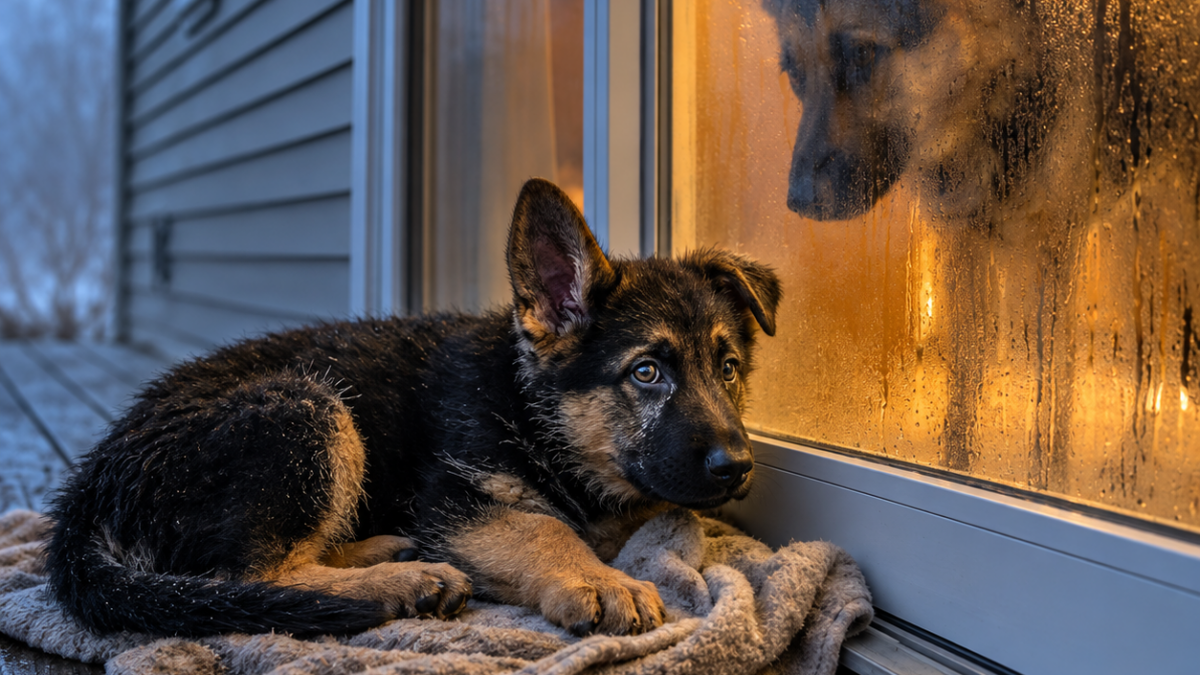
Corbin opened the back door just after six. The world was blue and frozen. Frost silvered the grass. His breath fogged in front of him.
The puppy sat near the porch steps.
The moment Nyla appeared behind him, her tail began moving.
Corbin frowned.
“Well,” he said, “that’s one way to start a day.”
He assumed she had gone home during the night and returned early. That was easier to believe than the alternative. A puppy that young sleeping outside in late October was not something he wanted to imagine.
The second day followed much the same pattern.
The puppy stayed close to Nyla whenever they were outside. She tried again to take the rubber ball and failed. She attempted Nyla’s tail once, saw Nyla turn her head, and thought better of it. Corbin walked the nearby road twice, asking anyone outside if they recognized her.
A man raking leaves shrugged. A woman getting mail shook her head. A teenager waiting for a school bus said, “Cute dog,” and put his earbuds back in.
No one came looking.
That evening, when Nyla went inside, the puppy again stopped at the doorway.
Corbin left it open longer this time.
The kitchen light spread warm across the porch boards.
The puppy stared in.
Nyla stood inside, watching.
“Come on,” Corbin said softly. “It’s warmer in here.”
The puppy shifted forward.
One paw touched the mat.
Then the furnace clicked on, sending a dull vibration through the floor.
The puppy bolted backward.
Corbin did not chase her. Fear chased enough living things without his help.
He brought out food, water, and an old thick towel from the utility closet. He folded it in the porch corner.
The puppy sniffed it, circled twice, and lay down.
Corbin stood inside the kitchen looking through the glass.
“You’re going to have to figure this out,” he said.
But when he turned off the light, unease followed him down the hallway.
At 4:52 the next morning, Corbin woke because Nyla was standing beside his bed.
She did not bark.
She did not paw at him.
She simply stood there, fully alert, looking at him with the expression she used to wear on duty when she already knew something was wrong and was waiting for him to catch up.
Corbin sat up.
“Nyla?”
The old K9 turned and walked toward the hallway.
Corbin followed barefoot, his body waking faster than his mind. He knew that walk. He had followed it into alleys, fields, abandoned houses, dark tree lines, and once toward a riverbank where a missing man had fallen and broken his leg.
Nyla stopped at the back door.
The kitchen was dark except for the green numbers on the stove clock.
Corbin looked through the glass.
The puppy was still there.
Curled tightly on the damp towel.
Only this time, she did not rise when Nyla appeared.
Corbin opened the door.
Cold air rushed into the kitchen.
He stepped onto the porch and crouched beside her.
The puppy lifted her head only slightly.
Corbin placed one hand against her side.
Her body was cold.
Not cool.
Cold.
Her belly fur was damp from the night air. Her ears felt icy beneath his fingers. A faint tremor moved through her small frame, so delicate at first he almost thought it was the vibration of his own hand.
Then her eyes opened fully.
Corbin’s throat tightened.
“Hey,” he whispered. “Hey, little girl.”
He slid one arm beneath her chest and lifted her carefully.
The puppy stirred.
For one second, Corbin expected her to curl into his jacket, to seek human warmth, to cling to the person lifting her from the cold.
She did not.
She turned her head past him.
Searching.
Nyla had stepped onto the porch.
The puppy stretched toward her.
Corbin lowered her slightly.
As soon as Nyla came close enough, the puppy pushed her face beneath the older dog’s chest and pressed herself there with all the strength she had left.
Nyla remained still.
No growl.
No correction.
No step away.
Corbin looked down at the towel.
It was damp where the puppy had been sleeping. Small paw marks crossed the porch boards to the water bowl and back. They circled the steps. They moved along the wall. They did not lead clearly toward the road.
The truth arrived quietly.
She had not been leaving at night and coming back before sunrise.
She had never left.
For three freezing nights, this eight-week-old puppy had stayed on the other side of Corbin’s door because Nyla was inside.
For three nights, she had chosen the cold over walking away.
Corbin stood on the porch in the dark, holding that tiny shivering body, and felt shame hit him so hard he could barely breathe.
He had fed her.
He had given her water.
He had given her a towel.
And then he had turned off the light.
He had assumed she knew how to go home.
He had assumed she had a home close enough, warm enough, safe enough.
Old police habits had taught him not to assume.
Retirement had made him rusty.
“I’m sorry,” he whispered.
The puppy did not look at him.
She pressed closer to Nyla.
Corbin carried her inside.
This time, he did not ask her to cross the threshold herself. He carried her through it.
Nyla walked beside him.
Inside the kitchen, Corbin placed the puppy on a folded blanket near the heater. The puppy immediately turned toward Nyla. Nyla lowered herself a few feet away, stiff joints bending carefully.
The puppy crawled closer until her nose touched one of Nyla’s front paws.
Then, finally, she stopped trembling.
Corbin stood near the door and watched them.
Three days earlier, he had thought a stray puppy had followed Nyla home because she wanted another dog to play with.
Now that explanation felt embarrassingly small.
Whatever had brought that puppy to Nyla was not simple curiosity.
It was need.
Deep, wordless, desperate need.
And Corbin did not yet know what she was so afraid of losing again.
By 8:00 a.m., Corbin had called Dr. Laurel Ames.
Laurel ran the small veterinary clinic near Main Street, a converted brick building that smelled like antiseptic, coffee, and nervous animals. She was forty-four, practical, sharp-eyed, and one of the few people who had treated Nyla without talking to her like an old hero or a fragile antique.
When Corbin carried the puppy in wrapped in a blanket, Laurel took one look and said, “Exam room two.”
The puppy weighed less than she should have. She was mildly dehydrated, slightly underweight, and had shallow scratches on her paws. No collar. No microchip. No major injury.
“She’s lucky,” Laurel said after checking her temperature again. “Cold, hungry, tired, but lucky.”
Corbin looked at the puppy curled on the exam towel. “She slept outside three nights.”
Laurel’s expression changed.
“She what?”
“I thought she was leaving and coming back.”
Laurel did not scold him. That was not her style. But her silence carried enough weight.
“I know,” Corbin said.
The puppy lifted her head when two sparrows landed on the window ledge outside the exam room. One hopped along the glass. The puppy’s head tilted left. When the second fluttered upward, her head tipped right.
Corbin watched her for the first time without thinking of her as “the puppy.”
Something about her curious little face, one ear up and one sideways, mud still clinging to her legs despite the towel bath he had given her, made a name arrive before he could stop it.
“Pippa,” he said.
Laurel glanced at him.
“Temporary?” she asked.
Corbin looked down at the puppy.
Pippa pressed her nose into the blanket and sighed.
“For now,” he said.
Laurel smiled like she did not believe him.
Back home, Pippa adjusted quickly to Corbin in all the ways that should have comforted him.
She accepted food from his hand. She allowed him to clean her paws. By the second day, she discovered one of his slippers could be dragged under the dining table and guarded like treasure. She slept hard, the way puppies do when warmth and food finally convince their bodies danger can wait.
But whenever Nyla moved, Corbin ceased to exist.
If Nyla crossed the kitchen, Pippa followed.
If Nyla went outside, Pippa hurried to the door.
If Nyla lay down, Pippa tried to curl against her.
If Nyla left the room, Pippa woke from sleep and searched.
At first, Nyla seemed mildly offended by the whole arrangement.
She had spent years working beside humans, not raising puppies. Retirement had not included childcare in the contract. She corrected Pippa with calm authority when the puppy tried to climb over her, steal food from her bowl, or chew her left ear. Pippa accepted every lesson with dramatic disappointment, then forgot half of them within twelve hours.
One evening, Corbin sat in his chair pretending to read while actually watching them.
Nyla lay on the living room rug.
Pippa climbed against her side and placed both front paws against Nyla’s belly. Then she began pressing gently, kneading through the fur. Her nose pushed underneath, searching.
Nyla stood at once.
Pippa rolled onto her side and stared after her.
Corbin’s chest tightened.
That was not play.
He had seen motherless puppies before. In shelters, on calls, in backyards where people treated animals like accidents. He had seen the way young animals searched for warmth that should have still belonged to them.
Pippa got up and followed Nyla into the kitchen.
Nyla gave Corbin a weary glance as if to say, Are you seeing this?
“I’m seeing it,” he murmured.
He called the local shelter, sent Laurel a description to circulate, checked missing pet pages, neighborhood groups, and community boards. He drove slowly along the road where Pippa had first appeared, looking for flyers on telephone poles. Nothing.
No one called.
No one came.
Meanwhile, something began changing in Nyla.
It happened in increments so small Corbin might have missed them if he had not spent his life reading dogs.
Nyla stopped walking at her normal pace when Pippa followed. She slowed just enough for the puppy’s short legs to keep up.
One afternoon beneath the maple tree, Nyla carried her old rubber ball to Pippa and dropped it beside her.
Pippa lifted her head.
The ball was too big for her mouth. She tried anyway, jaw stretching, paws fumbling. It rolled away twice before she trapped it between both front paws.
Corbin expected Nyla to take it back.
She did not.
She lay down several feet away and watched Pippa fall asleep with one paw resting over the ball.
That night, Corbin woke sometime after midnight and realized Nyla was not in her usual place near the bedroom doorway.
He found her in the living room.
Pippa slept inside her small basket.
Nyla lay on the floor beside it.
One of Pippa’s front paws had slipped over the edge and rested against Nyla’s shoulder.
Nyla was awake.
She looked at Corbin.
Corbin looked at the puppy.
Neither of them moved.
A week earlier, Nyla would have stood the moment Pippa came that close.
Now she stayed.
Corbin returned to bed without disturbing them.
The next afternoon, while Pippa slept near Nyla, Corbin opened a pet supply website on his laptop.
He needed food.
That was what he told himself.
Five minutes later, he was looking at collars.
Ten minutes later, he had selected a small purple one.
Then the website offered an identification tag.
Corbin stared at the empty name field.
Pippa.
He typed it slowly.
Behind him, the puppy shifted in her sleep. Nyla lifted her head, checked on her, then lowered it again.
Corbin stared at the order button.
He had not clicked it when his phone rang.
Laurel.
“I may have something,” she said.
Corbin straightened.
“What?”
“A rescue contact recognized the description. German Shepherd female, about eight weeks, one ear half-up, no chip. Corbin…” Laurel hesitated. “They know where she came from.”
The clinic had received records from a foster network two counties over. Pippa had been part of a litter of six German Shepherd puppies. Their mother had died when they were about five weeks old from complications after an untreated infection. The puppies had been bottle-fed, rotated between foster homes, and kept together as long as possible.
One note in the file stood out.
Small female, temporarily named Juniper, searches for adult dog at night. Settles best against older female shepherd mix in foster home.
Corbin read the line twice.
Juniper.
That had been her old name.
He looked at Pippa sleeping with her back against Nyla’s leg.
The name did not fit her anymore.
But the ache did.
Then Laurel showed him the part he had not expected.
Pippa had already been adopted.
Three days before she appeared behind Nyla on that residential road, she had gone home with Graham and Celeste Bellows.
Graham was forty-seven, a maintenance supervisor at a local paper facility. Celeste was forty-five and worked as an administrative assistant at a medical office. They had no children, had completed a home check, bought supplies, and reported Pippa missing the morning after she disappeared from their fenced backyard.
“They’ve been looking for her,” Laurel said.
Corbin felt something sink inside him.
Of course they had.
In all his quiet hope, in every small moment where Pippa’s name had settled deeper into the house, he had allowed himself to imagine no one was coming.
But someone was.
By late afternoon, a dark SUV pulled into Corbin’s driveway.
Graham stepped out first, broad-shouldered, tense, wearing a work jacket and the face of a man who had been expecting bad news for days. Celeste came around the passenger side before the vehicle had fully stopped. Her eyes searched the yard, the porch, the windows.
Corbin opened the front door.
Pippa was in the living room beside Nyla.
Celeste stepped inside and called softly, “Juniper?”
Pippa’s head came up.
For one second, she froze.
Then she ran.
She crossed the room so fast her paws slipped on the floor. Celeste dropped to both knees, and Pippa crashed into her, tail whipping, body wiggling, nose pushing under Celeste’s chin.
Celeste laughed, but the sound broke halfway into a sob.
“There you are,” she whispered. “There you are, baby.”
Graham crouched beside them. Pippa turned toward him too, licking his fingers, pressing against his leg, remembering.
Corbin stood near the doorway.
There was no fear in Pippa.
No hesitation.
No sign of mistreatment.
She remembered them.
And she was happy.
That should have made everything simple.
It did not.
Graham explained what happened. They had brought Pippa home after preparing for weeks. They had placed a bed near the kitchen, blocked the stairs, moved cords and shoes and cleaning supplies, bought toys, scheduled her first vet follow-up. Celeste had ordered a name tag but had not attached it yet because they wanted to adjust the collar first.
Pippa had been with them three days when she vanished.
Graham found a gap beneath one section of fencing where the soil had been loose. The puppy must have widened it enough to squeeze through. He repaired it immediately. They searched nearby streets, called shelters, posted photos, contacted clinics, and drove around every evening after work.
“We thought someone picked her up,” Celeste said, one hand still on Pippa. “Or a car—”
She could not finish.
Corbin nodded.
“I’m glad she had you,” Graham said. “Really. Thank you.”
Nyla rose from the rug and walked toward the kitchen.
Pippa saw her.
Her tail stopped.
She turned from Celeste and followed Nyla without hesitation.
Graham watched her disappear around the doorway.
“That’s the dog she followed home?”
“Yes,” Corbin said.
“She’s only been here a little over a week,” Graham said. “Maybe she just attached quickly.”
“Maybe.”
Corbin did not sound convinced.
Celeste looked between them.
“Can we see what happens if Nyla leaves the room?”
Corbin hesitated, then called Nyla into the small room off the hallway.
Nyla followed him.
Corbin closed the door but stepped back into the living room with everyone else.
Pippa stood where Nyla had disappeared.
At first, she stared.
Then she moved closer.
Her nose touched the bottom of the door.
She stepped away.
Turned once.
Came back.
Within half a minute, she began pacing between the door and the living room.
Celeste called her softly. “Juniper. Come here, sweetheart.”
Pippa looked at her.
She did not come.
A small sound rose in her throat.
She placed one paw against the door.
Then another.
Corbin opened it.
Nyla walked out.
Pippa rushed forward and pressed beneath her chest so tightly Nyla had to shift her feet to keep balance.
No one spoke.
Graham’s face had changed.
He had seen enough to understand why Corbin was concerned, but understanding did not erase the basic fact standing between them.
“We adopted her,” he said quietly.
Corbin nodded. “I know.”
“We’ve been looking everywhere.”
“I know.”
“We love her.”
Corbin looked at Celeste still kneeling on his living room floor, one hand covering her mouth, tears in her eyes.
“I can see that.”
“And we want to take her home,” Graham said.
There was nothing unreasonable in the request.
Pippa had recognized them. She had been cared for. They had searched for her from the moment she disappeared. Corbin had no legal or moral right to keep her simply because his house had begun making room for her.
“All right,” he said.
Celeste had brought the same travel crate they had used during the adoption. A folded blanket rested inside. Pippa sniffed it and stepped in without resisting.
Graham secured the crate in the back of the SUV while Celeste thanked Corbin again and again for feeding her, taking her to the clinic, keeping her safe.
Corbin told her there was nothing to repay.
At the vehicle, Pippa turned inside the crate.
Nyla stood behind the glass of Corbin’s front door.
The engine started.
Pippa placed both front paws against the crate door and stared toward the house.
Corbin remained beside the driveway until the SUV turned at the end of the street.
Only then did he go inside.
The house felt different immediately.
Not empty exactly.
But missing a sound it had only recently learned.
Nyla walked to the back door and lay down with her rubber ball between her front paws.
Corbin stood in the kitchen, looking at the porch corner where the folded towel was gone.
On his laptop, the pet supply page still waited.
Pippa remained typed above the unclicked tag order.
Corbin closed the page without deleting the name.
Pippa had a home.
She remembered Graham and Celeste.
She had run to them willingly.
Yet three days after they first brought her home, she had slipped beneath a fence, crossed streets, followed whatever invisible thread led her to Nyla, and slept outside in freezing weather rather than walk away.
For the first time, the mystery was no longer where Pippa belonged.
It was why a wanted puppy had left a good home to reach an old dog she had only just met.
The first days after Pippa returned to Graham and Celeste were quiet enough for everyone to hope the worst was over.
Celeste sent Corbin a photo the next afternoon.
Pippa slept on her side with one of Graham’s socks tucked beneath her paw.
Looks settled, Celeste wrote.
Corbin showed the picture to Nyla.
“She looks settled.”
Nyla sniffed the phone once and turned away.
Corbin took that as skepticism.
The second night, the indoor camera near the Bellows kitchen recorded what Graham and Celeste did not see until morning.
At 1:54 a.m., Pippa woke from her bed, walked directly to the back door, and sat facing it.
She did not scratch.
She did not whine.
She simply waited.
After ten minutes, she returned to bed.
The next day, Celeste noticed Pippa walking the fence line more often. Nose low. Body focused. She moved from one corner to the other, returned to the gate, then started again. When a large dog passed somewhere beyond the houses and its collar tags jingled faintly, Pippa rushed toward the sound before stopping at the fence.
By the following afternoon, Graham called Corbin.
“She’s eating. She’s sleeping. She plays. Nothing looks wrong.”
“But?”
“She keeps checking the gate.”
Corbin looked across his yard.
Nyla lay beneath the maple tree with the old rubber ball near her paws.
“Maybe let them see each other once,” Corbin said. “Then we’ll know more.”
Graham agreed.
The next afternoon, Corbin drove Nyla to the Bellows house.
He had barely opened the car door when barking came from inside.
Celeste appeared with Pippa on a leash. The moment the puppy saw Nyla, she nearly tangled herself around Celeste’s legs trying to reach her.
Pippa rushed forward, circled Nyla twice, then pushed beneath her neck.
Nyla stood still through the first burst.
When Pippa bounced away and returned carrying a small rope toy, Nyla lowered her head to inspect it. Pippa dropped the rope, picked it up again, then dropped it directly in front of Nyla.
Celeste laughed through tears. “She hasn’t touched that since she came back.”
For almost an hour, Pippa transformed.
She crossed the yard with Nyla. She carried toys from one place to another. She attempted to crawl beneath the older dog before Nyla calmly stepped sideways and ended that plan. Even Graham smiled.
The visit might have felt like a solution if it had ended five minutes earlier.
Then Corbin clipped Nyla’s leash on and walked toward the car.
Pippa followed.
Celeste gently stopped her.
Nyla climbed into the back seat.
Pippa pulled once toward the vehicle.
“Easy,” Celeste said.
The puppy stopped struggling, but when Corbin closed the car door, Pippa rose onto her back legs and placed both front paws against the fence.
Inside the car, Nyla turned.
For several seconds, the two dogs watched each other.
Then Corbin drove away.
In the mirror, he saw Pippa remain at the fence until the street curved and she disappeared from view.
The next afternoon, a delivery driver left the Bellows side gate unsecured for less than thirty seconds.
It was enough.
Pippa saw the opening and ran.
Celeste was near the kitchen door.
“Pippa!”
The puppy stopped in the driveway.
She turned.
For one suspended moment, she looked directly at Celeste.
Celeste would later say that was the moment that hurt most.
Because Pippa knew she was being called.
She knew she was loved.
Then she ran again.
By the time Graham reached the street, she had vanished between two houses.
Cold rain began tapping against Corbin’s windows when Celeste called.
“She got out.”
Corbin was already reaching for his coat.
“When?”
“Minutes ago.”
“Which direction?”
“Toward your side of town.”
Corbin looked at Nyla.
The old K9 was already standing.
He reached for her leash, but before he opened the front door, Nyla walked past him toward the back of the house. She stopped at the kitchen door.
Corbin froze.
Nyla went outside, crossed several yards, returned to the porch, paced once near the steps, and looked toward the fence.
She was not tracking in the way she once had.
She was waiting.
Pippa did not take the road a car would take.
Later, neighbors remembered seeing a small muddy dog cutting across backyards, ducking beneath hedges, disappearing through the strip of trees between the Bellows neighborhood and Corbin’s side of town. The route was shorter than the streets, but still too far for a small puppy in cold rain.
Graham drove.
Celeste searched on foot.
Corbin checked the front road, then the backyard, then the side street.
Nyla would not settle.
By late afternoon, the sky had dimmed to a bruised gray. Corbin stood in the kitchen with his phone beside him when Nyla suddenly lifted her head.
Scratch.
Corbin froze.
A pause.
Scratch. Scratch.
He reached the door in three steps.
Pippa stood outside.
Mud covered her legs and belly. Water darkened her coat. Her chest moved rapidly with each breath. One front paw lifted slightly from the boards.
Corbin opened the door.
Pippa did not stop for him.
She ran straight past his legs.
Nyla waited near the kitchen.
Pippa reached her and pushed her face beneath Nyla’s neck.
This time, Nyla did not step away.
She lowered her head and slowly licked the top of Pippa’s head.
Corbin crouched beside them and saw the blood on the puppy’s lifted paw.
One pad was scraped, not deeply, but enough to hurt.
He carried Pippa into the small utility room where he kept first aid supplies. Nyla usually disliked that narrow room and avoided entering it.
This time, before Corbin could close the door, Nyla stepped inside.
She walked to Pippa and lay down beside the towel.
Pippa rested her chin against Nyla’s front leg while Corbin cleaned the mud and checked the scrape.
No command had brought Nyla there.
She had chosen to stay.
Graham and Celeste arrived soon afterward, both soaked from searching.
Celeste went straight to the floor beside Pippa. The puppy lifted her head, wagged, and pushed her nose into Celeste’s hand.
Graham remained standing.
His eyes moved from Pippa’s scraped paw to Nyla lying beside her.
He took off his wet jacket and placed it over a chair.
“If we take her home tonight,” he said quietly, “how far does she run next time?”
Corbin had no answer.
Celeste looked down at Pippa.
The puppy still leaned into her hand, but her body remained pressed against Nyla.
No one reached for a leash.
Outside, rain continued against the windows.
Inside the small room, Nyla stayed where she was.
For the first time, the question was no longer whether Pippa could find her way back to Nyla.
She already had.
The harder question was what love was supposed to do when holding on might hurt the very thing it wanted to keep.
For the next several days, Pippa stayed with Corbin while Graham and Celeste considered what to do.
They still visited.
Pippa greeted them with joy every time. She leaned against Celeste’s legs, followed Graham across the room, and once stole the same kind of sock she had carried around their house.
Graham found it beneath Corbin’s coffee table and held it up.
“So this wasn’t personal.”
Pippa wagged and tried to take it back.
Nothing about those visits suggested she had forgotten them.
Yet when they left, Pippa no longer rushed to the door. She watched for a moment, then returned to wherever Nyla was resting.
That made everything more painful, not less.
Because Graham and Celeste were not villains.
That would have been easier.
If they had been cruel, Corbin could have drawn a line and stood behind it. If Pippa had cowered from them, if she had refused their touch, if their home had been unsafe, then the decision would have had a shape.
But love stood on both sides.
Celeste had waited years to get a dog. Graham had built a small ramp off the back porch before they even brought Pippa home because he read German Shepherd puppies should not jump too much while growing. They had framed her adoption photo. They had called shelters every day after she vanished. Celeste had slept with Pippa’s unused collar beside the bed because she could not stop imagining the puppy alone in the dark.
And still, Pippa kept choosing Nyla.
Not instead of them.
That was the truth that broke them.
Pippa loved them.
But Nyla was where her fear stopped.
Laurel helped them understand.
“She lost her mother very young,” the vet said during one difficult conversation in Corbin’s kitchen. “That kind of early loss can create powerful attachment behaviors. It doesn’t mean she doesn’t love you. It means her nervous system found safety in Nyla.”
Celeste wiped her eyes. “So what are we supposed to do? Just give her up because she’s scared?”
“No,” Laurel said gently. “You’re supposed to ask what gives her the best chance to become less scared.”
Graham looked down at his hands.
“And that’s here?”
Laurel did not answer quickly.
“I think she can learn independence,” she said. “But right now, removing her from Nyla has made her risk herself twice. Once in freezing weather. Once in cold rain. That matters.”
Corbin looked at Pippa.
She lay near Nyla, not touching this time, but close enough to see her.
That was new too.
A week earlier, she had needed to crawl under Nyla to rest.
Now a few feet was enough.
Small healing was still healing.
Then Nyla began favoring one back leg.
At first, it appeared only when she stood after sleeping. Several steps later, the stiffness eased. Two days after that, she hesitated before climbing the porch steps.
Corbin called Laurel.
The exam confirmed an old joint problem had worsened. It was manageable, but Laurel recommended a minor procedure and overnight observation.
“She should do well,” Laurel said. “But when she comes home, she’ll need quiet. No jumping, no rough play, no puppy climbing all over her.”
Corbin looked at Pippa sitting beside Nyla’s front paws.
Quiet had become a relative term.
The morning of the procedure, Corbin loaded Nyla into the car.
Pippa followed them to the door. When Nyla climbed into the back seat, Pippa tried to follow.
Corbin blocked her gently.
“Not today.”
Pippa stood behind the glass as the car pulled away.
Several hours later, Corbin returned alone.
Pippa met him at the door.
She looked behind him.
Around him.
Then ran to the driveway, stopped beside the car, and raised her nose toward the open door.
Nyla was not there.
Pippa hurried back inside.
She checked Nyla’s bed, the kitchen, the back door, the hallway.
Corbin let her search.
After several minutes, Pippa returned to the kitchen door and lay down facing it.
That evening, Corbin placed one of Nyla’s old towels near Pippa’s basket.
Pippa picked it up and carried it to the back door.
She curled on top of it.
At 10:00, she was still there.
Near midnight, Corbin sat in his chair with a book he never began reading. Pippa remained by the door.
At 12:47, he heard fabric scrape across the floor.
Pippa was dragging Nyla’s towel through the hallway.
She stopped beside his chair, dropped it, turned twice, and lay down across part of it with her back against his foot.
Corbin lowered one hand but did not touch her.
A few minutes later, Pippa’s breathing slowed.
She slept there for the rest of the night.
Corbin did not.
He sat in the dark, looking at the puppy pressed against his foot, and understood something that made his throat ache.
Pippa was still afraid.
But she was learning that comfort could have more than one source.
Laurel called the next morning.
Nyla had done well and could come home that afternoon.
Then came the hard part.
For several weeks, Nyla had to avoid sudden movement and rough play. No running across the yard. No tug. No jumping. Most importantly, Pippa could not throw herself against Nyla, crawl beneath her, or climb across her body.
Corbin brought home a low pet gate and divided the living room before carrying Nyla inside.
Pippa heard the car first.
She was waiting at the door.
The moment she saw Nyla, she rushed forward.
Corbin caught her gently around the chest before she could reach the older dog.
Pippa struggled once, confused rather than angry.
Nyla stood on the opposite side of the gate.
Pippa pushed her nose between the bars.
A soft whine escaped her.
Nyla took one step forward.
Corbin watched her injured leg and called her back quietly.
For several minutes, Pippa paced along the gate. She pressed one paw against it, moved away, returned, whined, and stared.
Nyla lowered herself carefully onto the blanket Corbin had placed nearby.
Pippa stopped pacing.
She stood for a long time, looking through the bars.
Then she lay down on the other side.
Only a few feet separated them.
Pippa could see Nyla.
She could smell her.
But she could not crawl underneath her.
The first evening was difficult.
The second was worse.
By the third, something shifted.
Pippa brought Nyla’s rubber ball and dropped it near the gate. Nyla looked at it but did not rise. Pippa waited. When nothing happened, she carried it away.
On the fifth day, Pippa found the braided tug rope. She carried it straight toward Nyla, then stopped at the gate. Nyla lifted her head but remained on her blanket.
Pippa stood in the middle of the room, uncertain.
Then she turned toward Corbin.
She walked over and placed the rope against his shoe.
Corbin looked down.
“All right,” he said.
He took the other end.
Pippa pulled.
Not hard at first.
Then harder.
Her paws slid across the floor, and she shook the rope with sudden determination.
Behind the gate, Nyla watched.
It was not betrayal.
It was expansion.
Pippa was learning that needing Nyla did not mean there was no room for anyone else.
A little over two weeks later, Laurel cleared Nyla for more movement.
Corbin removed the gate.
Pippa was already waiting.
Nyla stood from her blanket.
Pippa rushed forward three steps.
Then stopped.
The distance between them was barely an arm’s length.
Nyla walked the rest of the way.
Their noses touched.
Pippa’s tail began moving.
She did not push beneath Nyla’s body.
She did not leap against her chest.
When Nyla turned toward the kitchen, Pippa walked beside her instead of under her.
Corbin left the gate folded against the wall.
For the first time since Pippa had arrived, nothing stood between the two dogs.
Yet Pippa no longer seemed afraid of the space.
That evening, Graham called.
He and Celeste were ready to talk again.
They came on a quiet Saturday afternoon when winter had finally begun loosening its grip on Monomin. Snow remained only in shaded patches. Gutters dripped. Birds returned to the backyard with cautious optimism.
Pippa heard their SUV before Corbin reached the door.
She ran into the hallway, tail already moving.
Celeste stepped inside first.
Pippa went straight to her, pressing against her legs, lifting her paws briefly before Corbin reminded her to stay down.
Celeste laughed and crouched to rub both sides of Pippa’s neck.
Graham entered carrying a small paper bag.
Pippa noticed him and rushed over. Then she disappeared into the living room and returned with the braided rope in her mouth, dropping it near his boots.
Graham looked down.
“You still remember me when there’s work involved.”
He picked up one end and gave it a short pull.
Pippa braced her paws.
The game lasted less than a minute before she released the rope and moved away on her own.
Nyla rested near the kitchen.
Pippa crossed the room, circled once beside her, and lay down a few feet away.
Celeste watched without speaking.
A month earlier, Pippa would have pressed against Nyla immediately.
Now she simply settled where she could see her.
Corbin brought coffee to the table.
For several minutes, they talked about ordinary things because the extraordinary thing waited too heavy in the room. Nyla’s recovery. The weather. A damaged road after winter. The rising cost of dog food. Anything except the question that had brought them there.
Finally, Celeste looked toward the two dogs.
“If we take her home again,” she said, “do you think she’ll try to come back?”
Corbin did not answer right away.
“I don’t know.”
It was the only honest answer he had.
Graham leaned back in his chair. His eyes moved toward Pippa’s front paw, now healed. The last time he had stood in this house, that paw had been scraped from running through rain and yards and whatever fear drove her.
“We fixed the fence,” he said. “We could make it harder for her to get out.”
Corbin nodded.
“But if she spends every day trying to leave,” Graham continued, “that doesn’t solve much.”
Celeste lowered her eyes to the coffee cup in her hands.
Pippa got up, walked to her, and rested her chin on Celeste’s knee.
Celeste smiled through tears.
“That doesn’t make this easier.”
Pippa’s tail tapped once.
Celeste stroked the top of her head.
No one tested which person she would choose.
They had already learned enough from testing.
Graham opened the paper bag.
Inside was the small identification tag they had purchased before adopting her. Her old foster name was engraved across the front. Their phone number was on the back.
He set it on the table.
“We thought we’d attach it when she settled.”
Corbin picked it up.
The tag was small enough to disappear in his palm.
Celeste stayed beside Pippa for several more minutes before standing.
“We’ll transfer the adoption,” she said. “If you still want her.”
Corbin looked toward Nyla.
Then at Pippa.
“Yes.”
There was no celebration.
It did not feel like winning.
It felt like three adults choosing heartbreak carefully because the puppy on the floor deserved peace more than anyone deserved possession.
Graham completed the paperwork with the rescue group the following week. Corbin registered Pippa with Laurel and ordered a new identification tag with his address and phone number.
He kept the Bellows tag in a drawer beside the leash.
Not hidden.
Not discarded.
Kept.
Because love that lets go is still love.
Graham and Celeste did not disappear from Pippa’s life.
The first time their SUV returned to Corbin’s driveway, Pippa ran to the front window, then to the door. When Celeste entered, Pippa greeted her with the same excitement as before. She brought Graham a toy, stole one of his gloves while he was not looking, and spent most of the visit moving between them and Nyla.
When they left, Pippa followed them to the gate.
She watched the SUV pull away.
Corbin stood behind her.
For a moment, he held his breath.
Then he called softly, “Pippa.”
She turned.
A moment later, she ran back to the house.
Celeste cried in the car all the way home.
Graham drove with one hand on the wheel and the other wrapped around hers.
“I hate this,” she whispered.
“I know.”
“Did we do the right thing?”
Graham looked in the rearview mirror at the empty back seat where a crate had once been.
“I think doing the right thing is why it hurts.”
Later, they became volunteers at the rescue that had placed Pippa. Celeste began fostering older dogs who needed quiet homes instead of puppies who needed more than she could give at that moment. Graham repaired fences, gates, kennel latches, and porch steps for foster families who could not afford help.
Their love did not vanish.
It changed shape.
Corbin watched that and respected them more than he could easily say.
Spring arrived fully.
Pippa grew fast.
Her legs lengthened. Her ears finally both stood, though one still tilted when she was tired. Her body filled out, but some puppy softness remained in her face. She developed habits Corbin pretended to dislike and secretly encouraged. She stole socks. She carried Nyla’s rubber ball but rarely returned it. She slept in her own bed some nights, near Corbin’s chair on others, and near Nyla whenever the old dog allowed it.
Nyla regained movement slowly.
Her limp eased. Her walks remained shorter than before, but she returned to the maple tree and began carrying the old ball again. Sometimes she dropped it near Pippa. Sometimes she kept it because retirement had not made her generous all the time.
Pippa no longer followed Nyla every time she moved.
Sometimes Nyla went outside alone, and Pippa watched from the living room rug, ears lifted, then lowered her head back onto the braided rope.
The first time that happened, Corbin stopped in the kitchen with a towel basket in his arms.
The back door stood open.
Nyla crossed the yard at an easy pace.
Pippa watched.
Then stayed.
Minutes later, Nyla returned.
Pippa stood, walked over, and touched her nose lightly to Nyla’s muzzle.
Then she went back to the rope.
Corbin looked away because his eyes had filled without warning.
Healing did not always look dramatic.
Sometimes it looked like a puppy staying on a rug while the dog she loved walked through a door.
Sometimes it looked like trust.
That summer, a local animal welfare page posted Pippa and Nyla’s story after Laurel asked permission. Corbin almost refused. He did not like attention. He had spent years stepping into public view only because the job required it. But Laurel explained that the story might help people understand orphaned puppies, attachment trauma, and why “good home” did not always mean “simple adjustment.”
The post spread farther than any of them expected.
Most responses were kind.
People wrote about dogs who bonded with older dogs. Cats who adopted kittens. Children who attached to teachers, grandparents, neighbors, anyone safe enough to become shelter. Foster parents wrote about separation anxiety. Veterans wrote about service dogs who gave them back the ability to sleep.
But cruelty always finds a comment box.
Some people accused Corbin of stealing Pippa.
Others accused Graham and Celeste of giving up too easily.
A few said Nyla should have been kept away from the puppy so Pippa could “learn to get over it.”
One man from town, a former officer named Dennis Harrow who had never liked Corbin, wrote a long post claiming retired cops loved “playing hero” and that Corbin had manipulated a grieving couple out of their dog.
The post went local before Corbin saw it.
By noon, people were arguing in community groups.
By evening, someone had left a note in Corbin’s mailbox.
DOG THIEF.
Corbin stood in the driveway holding the note, his old police instincts going cold and clear.
Inside the house, Pippa and Nyla slept near the kitchen.
He could have ignored it.
He wanted to.
But he thought of Graham and Celeste reading strangers call them weak. Thought of Laurel being accused of helping with some imaginary scheme. Thought of Pippa’s story being turned into a fight about ownership instead of a lesson about love.
So he did something he had learned in police work.
He documented everything.
The foster records showing Pippa’s mother had died.
The veterinary report from Laurel.
The Bellows missing puppy posts.
The second escape.
The scraped paw.
The adoption transfer signed freely by Graham and Celeste.
Then he asked Graham and Celeste before saying anything publicly.
Graham’s answer was immediate.
“We’ll stand with you.”
Celeste said, “No. We’ll stand with Pippa.”
The rescue hosted a small community meeting after the online argument became too loud to ignore. Leah Benton from the rescue attended. Laurel came. Graham and Celeste came. Corbin came with Nyla and Pippa, though he kept them away from the crowd at first.
Dennis Harrow sat in the second row with his arms folded.
Corbin did not speak first.
Celeste did.
She stood holding Pippa’s original tag in one hand.
“We loved her,” she said. “We still do. That is why we signed the transfer.”
Her voice shook, but she did not sit down.
“Love is not proven by keeping something at any cost. We brought her home. We searched for her. We fixed the fence. We tried. And when she risked herself again to get back to Nyla, we had to ask whether keeping her with us was about her needs or our grief.”
The room went silent.
Graham stood beside her.
“She was not taken from us,” he said. “We chose what gave her peace.”
Laurel explained early maternal loss and attachment behavior in plain language.
Leah explained adoption ethics and why sometimes the best placement is not the one first planned.
Then Corbin brought Pippa and Nyla in.
Pippa entered with confidence. She greeted Celeste first, tail wagging, body bright with recognition. Then she greeted Graham. Then she returned to Nyla and sat beside her.
Not under her.
Beside her.
Corbin looked at the room.
“This dog is not evidence in a custody dispute,” he said. “She is a living creature who told us what she needed before any of us understood the language. The Bellows listened. Laurel listened. The rescue listened. Nyla listened first.”
Dennis Harrow did not speak.
The next morning, his post was gone.
The note in Corbin’s mailbox remained in a drawer for exactly two days before he threw it away.
He did not need to keep every ugly thing people gave him.
By fall, Pippa was nearly full grown.
Not as large as Nyla had been in her prime, but strong, graceful, and quick. She still had moments of puppy chaos, usually involving socks. She also had a steadiness Corbin recognized as partly Nyla’s influence and partly her own survival turning into confidence.
Nyla aged more visibly that year.
Her muzzle whitened. Her naps lengthened. Cold mornings made her stiff. But Pippa brought something back into her that Corbin had not realized was missing.
Purpose.
Not duty.
Duty had taken enough from Nyla.
This was different.
When Pippa hesitated near a new object, Nyla would walk past it first. When Pippa became too excited, Nyla corrected her once and expected results. When Corbin laughed too loudly at Pippa’s foolishness, Nyla looked at him as if joy was acceptable but dignity still mattered.
One night, the first snow of the season began falling.
Corbin stood at the back door with a mug of coffee gone cold in his hand. Nyla lay on the rug. Pippa sat beside her, watching the snow through the glass.
The porch corner was empty now.
No damp towel.
No shivering puppy.
No three nights of cold misunderstood.
Corbin opened the door.
Snowflakes swirled in.
Nyla rose slowly.
Pippa looked at her.
Months earlier, that movement would have made the puppy leap up, desperate not to be left.
Now she waited.
Nyla stepped onto the porch.
Pippa remained inside for three seconds.
Then Nyla turned back and picked up her rubber ball from near the door.
She carried it to Pippa and dropped it at her feet.
Pippa stared.
Her tail began moving.
Nyla stepped outside again, a little quicker this time.
Pippa grabbed the ball and followed.
Corbin watched both dogs move into the yard.
The door remained open behind them.
Once, a closed door had meant panic.
Once, Pippa had slept in the cold because Nyla was on the other side of one.
Now the doorway meant something else.
Nyla could leave.
Pippa could stay.
Pippa could follow.
Nyla could return.
Love was no longer a thing that vanished when a door closed.
It was a thing that came back.
A year after the day Pippa followed Nyla home, Corbin visited the rescue with both dogs for an adoption event.
Not as a speaker. He refused that part. But Leah asked if they could be present for families considering puppies, especially those who already had older dogs at home or were adopting from litters with strong attachments.
Pippa behaved beautifully for almost twenty minutes, then stole a volunteer’s glove and tried to hide it beneath a folding chair.
Nyla watched from a mat beside Corbin, unimpressed.
A little girl approached with her mother and pointed at Pippa.
“Is that the puppy who slept outside?”
Corbin crouched.
“She used to be.”
“Why did she do that?”
Corbin looked at Pippa, now greeting Graham and Celeste near the entrance with wild joy because they had arrived for their monthly visit.
“She was scared of losing the dog who made her feel safe.”
The little girl looked at Nyla.
“Is that her mom?”
Corbin thought of Pippa’s real mother, gone too early. Thought of the foster dogs who had warmed her. Thought of Celeste holding her and letting her go. Thought of Nyla standing on the porch while a half-frozen puppy reached for her.
“Not exactly,” he said. “But sometimes love finds someone who needs it and decides to stay.”
The girl nodded as if this made perfect sense.
Maybe children understood these things better than adults.
That evening, after the event, Corbin drove home with Nyla and Pippa in the back. In the rearview mirror, he saw Pippa asleep with her head near Nyla’s shoulder, not pressed desperately beneath her, not clinging, simply near.
Nyla’s eyes were half-closed.
The sun dropped behind the trees.
The house waited at the edge of town.
For years after retirement, Corbin had thought his story was mostly behind him. The calls, the searches, the fear, the purpose, the partnership, the sharpness of being needed. He had believed he and Nyla were living in the quiet after everything important had already happened.
Then an eight-week-old puppy followed them home and slept outside their door for three freezing nights because her heart recognized safety before her mind knew what to call it.
Pippa had not been stubborn.
She had not been disobedient.
She had not been ungrateful to the people who loved her.
She was a baby who had lost her mother too young, been moved from place to place, and found in Nyla something her body remembered needing: warmth, steadiness, an older heartbeat that did not vanish when the room went dark.
And Nyla, retired from service, tired in her joints, done with commands and danger and long nights of work, had found something too.
A reason to soften.
A reason to wait.
A reason to pick up an old rubber ball and offer it to a puppy who had once trembled on the other side of the door.
Graham and Celeste found a different kind of healing. They became the people who could visit and leave without breaking Pippa’s world. They became proof that letting go did not always mean abandonment. Sometimes it meant trusting love to continue in a new shape.
Corbin found that his house no longer needed the television to feel alive.
It had paws in the hallway.
A rubber ball under the table.
A purple collar hanging by the door.
An old K9 who still noticed everything.
And a young German Shepherd who no longer panicked when someone crossed a threshold.
On winter nights, when the wind came hard off the water and frost silvered the porch boards, Corbin sometimes stood at the kitchen door longer than necessary.
He remembered opening it before dawn.
Remembered the cold puppy on the damp towel.
Remembered how she had not reached for him.
She had reached past him, toward Nyla.
At first, that had hurt a little. He could admit that now. He had been the man lifting her from the cold, and still he was not the comfort she wanted most.
But love, he learned, was not always about being chosen first.
Sometimes love meant carrying someone across the threshold to the one they needed.
Sometimes it meant opening the door.
Sometimes it meant knowing when to hold on.
And sometimes, the deepest kind of love meant becoming safe enough that the one who once clung to survive could finally let go without fear.
Pippa never stopped loving Nyla.
She never stopped watching for her, not completely.
But she learned that Nyla could walk outside and come back. That Corbin could leave for groceries and return. That Celeste and Graham could visit, hug her, cry a little, and still smile when they drove away. That doors were not always endings. That absence was not always abandonment. That a closed door could open again.
And Nyla, who had once spent her life searching for missing people, spent her old age being found every day by a puppy who had needed her more than anyone understood.
Three freezing nights could have ended Pippa’s story.
Instead, they revealed it.
A retired officer finally listened.
A wounded old K9 finally softened.
A loving couple finally chose the puppy’s peace over their own wishes.
And a small German Shepherd who had once slept outside in the cold because she could not bear to leave love behind grew into a dog who understood the lesson every broken heart longs to learn:
The ones who love you can walk through a door.
They can disappear from sight.
The room can go quiet.
The night can get cold.
But if love is real, it does not always leave forever.
Sometimes it comes back with muddy paws, an old rubber ball, a familiar step on the porch, and enough patience to wait until fear finally learns the sound of home.








