A Prisoner Was Allowed One Last Kiss With the Dog He Loved Through a Glass Wall—Then the Door Suddenly Opened Again, and Neither of Them Was Ready
PART3:
Long enough to lose your job, your house, your place in the world.
Long enough for a dog to wait without understanding why waiting had become his whole life.
Maggie had met Buddy at the county shelter three days after Caleb’s arrest.
The dog had refused food.
He sat facing the kennel door, ears raised every time footsteps approached, then lowering when they belonged to someone else. Shelter staff said he had been found inside Caleb’s empty house, curled on a sweatshirt near the front door, still waiting.
Maggie ran a small rescue program that placed pets of incarcerated people, hospitalized veterans, and families in crisis with temporary fosters. It was supposed to be practical work.
Food.
Leashes.
Vet appointments.
Paperwork.
But Buddy had nearly ruined her.
He slept by her front door for the first two months.
Every truck that passed made him lift his head.
Every man with work boots made him stand.
When Caleb’s first letter arrived, Maggie read it aloud because she did not know what else to do.
Buddy came from the hallway before she reached the second sentence.
By the third, he was sitting in front of her, head tilted, listening to Caleb’s words spoken in someone else’s voice.
After that, Maggie read every letter aloud.
She read about Caleb’s days, which were never described dramatically.
He asked more questions than he answered.
Does he still hate thunderstorms?
Does he limp after long walks?
Does he still hide socks under the couch?
Does he sleep better with the lamp on?
Please tell him I didn’t leave because I wanted to.
Maggie always did.
She told Buddy everything.
But dogs do not understand prison.
They understand presence.
Absence.
Routine.
Scent.
The sound of a truck that never turns into the driveway.
So when the prison finally approved a special contact-free visit through the glass, Maggie drove three hours with Buddy in the back seat, not telling the dog where they were going because hope felt dangerous when spoken too early.
Now Buddy had found Caleb.
And the glass was breaking his heart.
Caleb sat on the metal stool opposite him.
Buddy sat too, because Caleb had once taught him that sitting made people understand you were trying.
“Good boy,” Caleb whispered. “You remember.”
Buddy thumped his tail.
Officer Roscoe stood behind Caleb with his arms folded.
He had worked corrections for fifteen years, long enough to develop a face that did not change easily. He had seen men cry when wives left them, when mothers died, when children refused calls, when parole was denied, when parole was granted, when freedom suddenly looked more frightening than walls.
But he had never seen a dog try to understand glass.
Buddy kept moving his nose along the barrier, searching for an opening. He sniffed the metal frame, the seam, the bolted ledge, the small speaker grille. He pawed once, gently at first, then harder.
Caleb shook his head.
“No, buddy. You can’t come through.”
The dog looked at him.
Caleb swallowed.
“I know. I know, it’s stupid.”
Maggie tried to smile and failed.
Caleb looked at her for the first time.
“You’re Maggie?”
She nodded.
“Thank you.”
“You say that in every letter.”
“It isn’t enough in letters.”
She looked at Buddy.
“He’s been waiting.”
Caleb’s face folded.
“I know.”
“No,” Maggie said softly. “I don’t think you do.”
Caleb closed his eyes.
Buddy whined.
Immediately, Caleb opened them again.
“I’m here,” he said. “I’m here.”
Buddy pressed his forehead against the glass.
Caleb did the same.
For a few seconds, man and dog stayed like that, separated by two inches of reinforced prison glass that might as well have been the whole world.
Caleb’s breath fogged the surface.
Buddy licked the other side.
Caleb laughed and cried at the same time.
“Gross,” he whispered. “Still gross.”
Buddy’s tail swept faster.
Officer Roscoe looked toward the clock.
The visit was approved for ten minutes.
The warden had resisted even that.
Prisons had rules for reasons, he said. Emotional exceptions created complications. Animals created liability. Inmates manipulated sympathy. Staff time was already stretched.
Roscoe had expected that answer.
Then he watched the video Maggie sent with her request.
Buddy lying beside Caleb’s old work boots.
Buddy carrying one of Caleb’s socks to bed.
Buddy sitting at the window when a truck slowed outside.
Buddy hearing Caleb’s name on a recorded prison call and running to the front door with a toy in his mouth.
Roscoe had watched it once.
Then again.
Then he walked into the warden’s office and said, “Sir, if this place is supposed to correct men, maybe we ought to let one remember he’s loved.”
The warden gave him ten minutes through glass.
No touching.
No contact.
No exceptions.
Now eight minutes had passed.
Caleb knew because men inside prisons become experts in the cruelty of clocks.
He tried to say everything quickly.
“You look good. Maggie says you’re being good. Don’t steal socks from her laundry. That’s rude. And don’t bark at the mailman unless he deserves it.”
Buddy stared, eyes shining.
Caleb’s voice cracked.
“I’ve got six months left if the board approves the release plan. Maybe less with the work credit. I’m trying, buddy. I’m trying so hard.”
Buddy placed one paw against the glass.
Caleb matched it with his hand.
“I’m sorry I wasn’t there when they took the house. I’m sorry you waited by the door. I’m sorry I couldn’t explain. I didn’t forget you. Not one day. Not one.”
The guard shifted behind him.
“Mercer.”
Caleb inhaled sharply.
Buddy’s ears moved.
He recognized the change.
Dogs understand goodbye before people say it.
Caleb shook his head once.
“Please,” he said quietly, not to the officer exactly, not to Maggie, not even to God.
Roscoe looked at the clock.
“Time.”
Buddy stood.
Caleb stood too.
The dog’s tail stopped again.
“No,” Caleb whispered. “Buddy, listen to me. You go with Maggie. Okay? You go with Maggie, and you be good.”
Buddy whined.
Maggie gripped the leash with both hands, tears running freely now.
Caleb turned his face away for one second, trying to gather himself before the dog saw him break.
But Buddy did see.
He always saw.
Caleb turned back and bent toward the glass.
“One kiss,” he whispered. “Come on. One kiss, buddy.”
Buddy rose on his back legs, front paws braced carefully on the ledge. He pressed his nose and mouth to the glass.
Caleb kissed the other side.
It was ridiculous.
Painful.
Beautiful.
A kiss with no warmth, no fur, no wet nose, no weight of a beloved animal leaning into him.
Only cold glass.
But Caleb closed his eyes as if it were enough because it had to be.
“I love you,” he said.
Roscoe touched his shoulder.
Caleb stepped back.
Buddy barked once.
Sharp.
Panicked.
Caleb flinched but kept moving because if he stopped, he would not be able to start again.
The gray door opened behind him.
Buddy barked again.
Not aggressive.
Begging.
Caleb’s hands curled at his sides.
“Good boy,” he forced out. “Stay.”
Buddy knew that word.
He hated it now.
The guard led Caleb through the door.
It closed.
Buddy stared at it.
His tail lowered.
For several seconds, he did not move.
Then he looked back at Maggie.
Then at the glass.
Then at the door.
He sat.
“Maggie,” Officer Roscoe said gently from the other side of the room, now outside the inmate area. “I’m sorry. We have to clear the room.”
Maggie tugged the leash softly.
“Come on, Bud.”
Buddy did not move.
“Buddy.”
He leaned toward the door Caleb had disappeared through.
A sound came out of him that made Maggie cover her mouth.
A low, trembling cry.
Not loud.
That made it worse.
The kind of sound an animal makes when he knows something is wrong but has no language for why everyone else is allowing it.
Roscoe looked away.
Another officer standing near the hallway cleared his throat and stared at the floor.
Maggie knelt beside Buddy.
“I know,” she whispered. “I know, sweetheart. I’m sorry.”
Buddy placed his paw against the glass again.
But Caleb was gone.
In the holding corridor beyond the visitation room, Caleb stopped walking.
Roscoe had brought him through the interior door and into a narrow gray hallway.
“Keep moving,” another officer said.
Caleb did not.
Roscoe raised one hand to silence the younger guard.
“Mercer.”
Caleb’s chest heaved.
“I can’t do it.”
“You have to.”
“I can’t leave him like that again.”
Roscoe’s expression tightened.
“You don’t have a choice.”
Caleb looked at him then.
There was no anger in his face.
Only a grief so naked Roscoe almost wished for anger instead.
“He thinks I left him,” Caleb said. “Again.”
Roscoe said nothing.
“I taught him stay,” Caleb whispered. “I taught him that if I said stay, I’d come back.”
The younger guard looked uncomfortable.
Caleb pressed both hands against the wall and bowed his head.
“I didn’t come back.”
In fifteen years, Roscoe had heard inmates excuse themselves, blame everyone else, swear innocence, perform remorse, weaponize tears, charm volunteers, curse judges, and promise change they did not mean.
This was different.
This was a man finally understanding that punishment was not only bars.
Sometimes punishment was a dog obeying the last good command he ever trusted from you.
Roscoe looked through the narrow wire-glass window in the door.
Buddy was still sitting at the glass.
Waiting.
Not pulling.
Not barking.
Waiting because Caleb had told him to stay.
Roscoe exhaled.
“Damn it.”
The younger officer looked at him.
“Sir?”
Roscoe pulled out his radio.
“Control, this is Roscoe. Hold movement from Visitation Two.”
Static.
Then, “Reason?”
Roscoe looked at Caleb.
Then at Buddy.
“Unfinished rehabilitation.”
The younger guard stared.
Roscoe ignored him and keyed the radio again.
“Requesting warden authorization for controlled contact in Visitation Two. One inmate. One civilian foster. One dog. Two officers present. Restraints removed only inside secured room.”
The answer came back almost immediately.
“Negative. Policy prohibits animal contact.”
Roscoe’s jaw tightened.
“Then get the warden on channel.”
“Stand by.”
Caleb lifted his head.
“What are you doing?”
Roscoe did not look at him.
“Possibly ending my career with something stupid.”
A minute passed.
Then the warden’s voice came through, irritated.
“Roscoe, explain.”
Roscoe kept his eyes on Buddy through the window.
“Sir, the dog is refusing to leave because the inmate gave a stay command. The animal is under control. The foster handler is present. Mercer has six months remaining, clean conduct record, work program lead, approved counseling participation, no violent infractions inside. I’m requesting five minutes of controlled contact.”
“No.”
“Sir—”
“No.”
Roscoe lowered his voice.
“Then come down here and watch the dog yourself.”
Silence.
The younger officer’s eyes widened.
Caleb stared at Roscoe as if he had lost his mind.
Finally, the warden said, “You have two minutes. Inmate remains supervised. Any sudden movement and it ends.”
Roscoe closed his eyes briefly.
“Copy.”
He turned to Caleb.
“Listen carefully. You do exactly what I say. You kneel when you enter. You let the dog come to you. You do not stand until I tell you. You do not approach the civilian. You do not make me regret this.”
Caleb’s mouth opened, but no sound came.
Roscoe pointed at him.
“Do you understand?”
Caleb nodded.
“Yes, sir.”
Roscoe unlocked the door.
Inside Visitation Two, Maggie was still kneeling beside Buddy when the gray door opened again.
Buddy’s head snapped up.
Caleb stepped through.
For half a second, the dog did not move.
Maybe his heart needed proof.
Maybe he was afraid the door would close again.
Caleb dropped to his knees exactly as Roscoe instructed.
“Buddy,” he whispered.
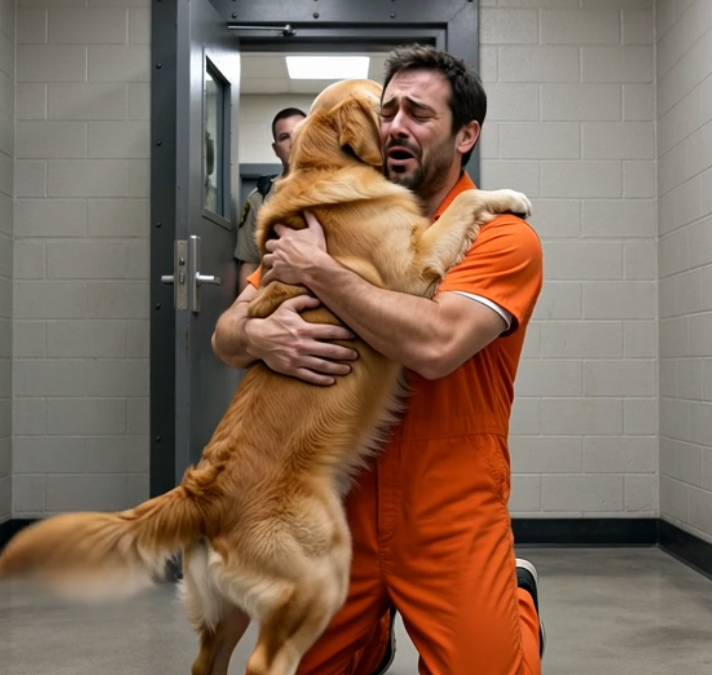
The leash slipped from Maggie’s fingers because no human hand could have held what happened next without cruelty.
Buddy ran.
He crossed the room in a golden blur, paws sliding on the polished floor, and hit Caleb’s chest with enough force to knock him backward onto the concrete.
Caleb wrapped both arms around him.
Buddy climbed half into his lap, half onto his shoulders, whining, barking, licking his face, pressing his whole body into Caleb as if trying to make sure there was no glass this time, no trick, no barrier, no disappearance.
Caleb sobbed.
Not quietly.
Not with control.
He buried his face in Buddy’s fur and broke open.
“I came back,” he kept saying. “I came back, buddy. I came back.”
Buddy licked his cheek, his forehead, his chin, then pressed his head under Caleb’s jaw the way he had done every night after Joanna died, when Caleb used to sit on the kitchen floor in the dark because the bed felt too large.
Caleb held him tighter.
“I missed you. God, I missed you. I’m sorry. I’m sorry.”
Maggie stood with one hand over her mouth.
The younger officer turned toward the wall.
Roscoe watched for three seconds, then five, then ten.
Rules existed for reasons.
He knew that.
But sometimes the reason for a rule stood beside the reason for mercy, and a man had to decide which one looked more like justice.
Buddy rolled onto his back, paws curling, tail beating the floor.
Caleb laughed through tears.
“You still do that? You still do that, you ridiculous dog?”
Buddy sneezed in his face.
Caleb laughed harder.
For one brief minute, there was no prison.
No orange jumpsuit.
No manslaughter charge.
No dead man in a parking lot.
No brother who ran.
No lost house.
No two years of letters read aloud by a woman who had become family by accident.
There was only a man and a dog remembering the shape of each other.
Roscoe glanced at the clock.
Two minutes had already become four.
He did not speak.
Maggie noticed.
She looked at him.
He gave the smallest shake of his head.
Not yet.
Caleb sat up slowly, Buddy pressed against his chest.
“I’m coming home,” Caleb whispered into the dog’s ear. “Not today. I know. I know it’s not today. But I’m coming home. You hear me? I’m going to come back for real.”
Buddy panted, eyes bright, body trembling.
Caleb pulled back enough to look at him.
“You go with Maggie. You listen to her. You keep stealing socks if you have to, but only ugly ones.”
Maggie laughed and cried at the same time.
Caleb looked at her.
“I don’t know how to thank you.”
“You can come home and take him for a walk,” she said.
His face crumpled again.
“Yes, ma’am.”
Roscoe finally stepped forward.
“Mercer.”
Caleb nodded.
He had been given more than he asked for.
He knew better than to steal from mercy.
He held Buddy’s face between both hands.
“Stay with Maggie,” he said softly. “I will come back.”
Buddy stared at him.
“Not like before,” Caleb whispered. “I promise. I will come back.”
He kissed Buddy’s forehead.
Then, slowly, he handed the leash to Maggie.
Buddy resisted for one second, leaning after him.
Caleb stood.
The dog whined.
Caleb lifted one hand, palm out.
“Stay.”
Buddy shook.
But this time, Caleb added the words he had not been able to add before.
“I’ll see you again.”
The difference mattered.
To Buddy.
To Caleb.
To everyone watching.
Roscoe opened the door.
Caleb stepped backward through it, keeping his eyes on the dog until the last possible second.
The door closed.
Buddy whined once.
But he did not panic.
He stood there trembling, watching the door.
Then he turned and pressed himself against Maggie’s legs.
She knelt and hugged him.
“Good boy,” she whispered. “He came back. He came back.”
Six months later, Buddy stood outside the same prison before sunrise.
The sky was pale gray. Fog sat low over the fields beyond the razor wire. Maggie wore the same blue jacket she had worn on the first visit because Buddy had grown attached to it after Caleb hugged him with it nearby.
Officer Roscoe stood near the release gate holding a clipboard.
“You didn’t have to come in on your day off,” Maggie said.
Roscoe did not look at her.
“Had paperwork.”
“At six in the morning?”
“Lots of paperwork.”
Buddy sat facing the gate.
He had been restless since four.
Maggie had said Caleb’s name once while putting on his collar, and after that Buddy had followed her through the house with absolute seriousness, as if finally understanding that this was not a letter day, not a phone call day, not a glass day.
This was a door day.
The inner gate buzzed.
Buddy stood.
A guard appeared.
Then Caleb.
No orange jumpsuit.
Jeans.
Plain gray sweatshirt.
Work boots issued from a donation closet because his old ones were gone.
A paper bag of belongings in one hand.
He looked thinner, nervous, almost afraid of the open morning.
Then he saw Buddy.
The bag fell from his hand.
Maggie released the leash.
Buddy ran.
This time there was no glass.
No guard telling him where to stand.
No clock.
No two minutes.
He launched himself into Caleb’s arms, and Caleb went down onto one knee in the gravel, laughing, crying, holding on while Buddy tried to climb completely inside his chest.
Roscoe looked down at his clipboard.
Maggie wiped her eyes.
Caleb whispered something into Buddy’s fur that no one else heard.
Maybe another apology.
Maybe a promise.
Maybe just the dog’s name, over and over, because sometimes love does not need new language.
After a while, Buddy settled enough for Caleb to look up.
Maggie stepped forward.
“Welcome back.”
Caleb stood awkwardly, one hand still buried in Buddy’s fur.
“I don’t know where to start.”
Maggie smiled.
“That’s easy.”
She nodded toward Buddy.
“You start with the walk you owe him.”
Caleb looked down.
Buddy’s tail swept the gravel.
For the first time in three years, Caleb Mercer smiled without breaking.
“Yeah,” he said. “I can do that.”
Rebuilding a life was not simple.
People like clean endings, but real mercy often begins after the emotional reunion, when the camera would rather stop.
Caleb had no house. No tools except what a prison work supervisor helped him apply to receive through a reentry program. No truck. No job yet. No guarantee that everyone in town would forgive or understand. A man was still dead because of a night Caleb wished he could cut out of time.
He knew that.
He did not pretend love erased consequence.
But Buddy made the first days possible.
When Caleb slept on Maggie’s foldout couch until his transitional housing opened, Buddy slept on the floor beside him, one paw on Caleb’s blanket.
When Caleb woke from nightmares of parking lot lights, blood on rainwater, and Buddy barking behind a closed shelter door, the dog pushed his nose under Caleb’s hand until Caleb came back to the room.
When Caleb walked into his first job interview with a construction company willing to consider formerly incarcerated workers, Buddy waited in Maggie’s car and greeted him afterward as if he had returned from war.
When Caleb got the job, he sat on a curb outside the office and cried into Buddy’s neck.
When he received his first paycheck, he bought dog food, work gloves, and one ugly pair of socks for Buddy to steal legally.
Maggie stayed part of their life because love does not always transfer cleanly from one home to another. Buddy had waited for Caleb, yes. But Maggie had been the bridge that kept waiting from becoming despair.
On the day Caleb moved into a small apartment above a mechanic’s garage, Maggie brought over Buddy’s bed, three toys, a bag of food, a folder of vet records, and the blue jacket Buddy liked.
She tried to leave quickly.
Caleb stopped her.
“He loves you too,” he said.
Maggie laughed, but her eyes filled.
“I know.”
“I mean it. You’re not losing him.”
She looked at Buddy, who stood between them with a sock in his mouth, worried because humans were emotional again.
Maggie crouched.
“You take care of him, okay?”
Buddy wagged.
Caleb said, “We both will.”
Months later, Caleb began volunteering with the same rescue program that had saved Buddy from the shelter system. At first, he only repaired fences, built dog runs, fixed broken gates, and carried heavy food bags because that felt safer than speaking to people.
Then Maggie asked if he would talk to a man whose wife had entered long-term treatment and whose two dogs needed temporary placement.
Caleb said no.
Then he remembered Buddy behind the prison glass.
He said yes.
The man cried in the parking lot while surrendering leashes he swore he would come back for.
Caleb did not tell him everything would be fine.
He knew better than to make promises pain might overhear.
He only said, “Write to them. Send something that smells like you. And when you say you’re coming back, mean it.”
Years passed.
Buddy’s golden face grew white.
Caleb’s life became smaller than some people might have imagined but larger than he once believed he deserved.
A steady job.
A rented house with a fenced yard.
Weekly support meetings.
Volunteer work.
Dinner with Maggie every Sunday.
Letters to the family of the man who died, though he sent only the first after a victim advocate said they were willing to receive it. In that letter, Caleb did not ask forgiveness. He did not explain himself into innocence. He wrote about responsibility, sorrow, and the life he was trying to build because wasting it would dishonor everyone harmed that night.
No reply came for a long time.
Then, one Christmas, a card arrived.
It contained only one sentence.
Keep doing good with the life you still have.
Caleb kept it in his wallet.
Beside the first photo Maggie had ever sent him of Buddy asleep with Caleb’s old sweatshirt.
Every year, on the anniversary of the glass visit, Caleb took Buddy to a quiet park at sunrise. He brought coffee for himself and a biscuit for the dog. They sat beneath an oak tree and watched the light move over the grass.
On the fifth year, Buddy needed help getting out of the truck.
Caleb lifted him carefully.
“Easy, old man.”
Buddy gave him a look that said age had not improved Caleb’s authority.
They walked slowly.
Very slowly.
At the oak tree, Buddy lowered himself with a sigh and leaned against Caleb’s leg.
Caleb rested one hand on his head.
“I asked for one kiss,” he said softly. “Remember?”
Buddy’s ears moved.
“And you gave me my life back.”
A breeze moved through the branches.
Caleb looked across the empty park.
He thought of the glass.
The cold surface beneath his lips.
The door closing.
Buddy staying because he had been told to stay.
The door opening again.
The impossible weight of a golden retriever crashing into his chest, forgiving him before he knew how to forgive himself.
People sometimes called dogs loyal as if loyalty were simple.
It isn’t.
Loyalty is not forgetting the person who failed to come home.
Loyalty is waiting without understanding the sentence.
It is pressing your nose to glass because love is on the other side.
It is running when the door opens again.
It is trusting the same voice that once disappeared when it says, “I’ll come back.”
And maybe redemption is not one grand moment either.
Maybe it is a thousand returns after the first one.
Coming back to the dog.
Coming back to work.
Coming back to truth.
Coming back to the people who helped carry what you could not.
Coming back to yourself, even when shame tells you there is nothing worth returning to.
Caleb did not become perfect.
No one does.
But he became present.
And for Buddy, who had never needed perfection, that was everything.
The dog rested his white muzzle on Caleb’s boot.
Caleb smiled down at him.
“I came back,” he whispered.
Buddy closed his eyes.
This time, there was no glass between them.








