A Pregnant Widow Sought Warmth in a Feared Cowboy’s Bed During a Deadly Blizzard—But Before Dawn, One Terrifying Moment Changed Both of Their Lives Forever
PART3:
Mara felt the old humiliation rise hot beneath her skin.
Gerald leaned back against the counter as though they were discussing pantry storage instead of her life.
“You need somewhere quiet until the child comes. North Ridge is quiet.”
“It has one room.”
“It has a roof.”
“Does it have enough wood?”
“You’ve always been resourceful.”
That nearly made her laugh.
Everyone in Iron Hollow who had ever called Mara lazy because she was large would have been surprised by the things she had done beside Daniel.
Split fence posts.
Driven cattle.
Carried feed sacks.
Canned peaches until midnight.
Delivered a neighbor’s lamb when the ewe became trapped in labor and no man nearby could bring himself to put his hands where they needed to go.
But people rarely adjusted their judgments after making them.
They simply looked for evidence that kept them comfortable.
Mara touched the place where her baby shifted beneath her ribs.
“What happens when Daniel’s child is born?”
For the first time, Gerald’s smile vanished.
“Then we discuss the future.”
Something cold passed through her.
Not fear exactly.
Instinct.
Daniel used to tell her animals sensed storms long before humans saw clouds.
Her body was telling her something now.
She simply did not know what.
North Ridge cabin had once been used during elk season.
Nobody had hunted there in years.
The chimney smoked when the wind turned west. One shutter had broken loose. Mice had discovered the pantry before Mara did. The stove door hung crooked unless wedged shut with a flat stone. The floor near the back wall dipped in a way that made her uneasy every time she crossed it.
But the roof held.
At least at first.
Mara made the place hers because there was nothing else to do.
She scrubbed soot from the stove.
Stuffed rags between wall boards.
Hung Daniel’s old blue shirt beside the bed because she could not sleep unless something that smelled faintly of cedar and tobacco remained close.
At night, she spoke to the baby while the wind moved through the pines.
“Your father would hate this stove.”
Kick.
“He claimed every stove had a personality.”
Another kick.
“This one’s personality is criminal.”
She smiled.
Then cried so suddenly she had to sit on the floor.
Grief behaved like that.
It waited.
It let her complete chores.
It let her eat breakfast.
It let her almost believe the world remained survivable.
Then some tiny thing — a bent spoon, a phrase, Daniel’s handwriting on a flour order — would cut her open from throat to stomach.
The first snow arrived in November.
The real storm came three weeks later.
By afternoon, Iron Hollow disappeared beneath white.
Wind struck the cabin hard enough to shake powder through seams in the roof. Mara fed the fire. Then fed it again. By midnight, she had burned twice the amount of wood she normally used.
At dawn, the temperature inside had fallen anyway.
She could see her breath.
The baby moved sluggishly.
Mara pressed both hands against her belly.
“Come on, sweetheart.”
Nothing.
Her pulse jumped.
She stood.
Walked.
Drank the last of the warm milk.
Pressed her palm low against the right side where the child often kicked.
Finally, there came a faint shift beneath her hand.
Mara closed her eyes.
“Thank God.”
But gratitude did nothing to warm the room.
Outside, the woodpile was nearly buried.
She spent twenty minutes reaching it. Snow hit above her knees. The wind stole her breath. She dragged four pieces of wood inside and collapsed against the door, gasping.
That was when she looked up.
A thin crack had appeared across the largest roof beam.
Mara went still.
There had been no crack yesterday.
She climbed onto a chair, one hand braced against the wall, the other pressed to her belly as if she could physically hold the child away from danger.
She touched the timber.
A sprinkling of snow dust fell across her face.
The beam groaned.
For the first time, Mara understood that the cabin was not shelter anymore.
It was a trap waiting for enough snow to become a coffin.
She knew of only one occupied property higher on the ridge.
Rowan Hale’s cabin.
Everyone in Iron Hollow knew Rowan.
Or rather, everyone knew the story they preferred about him.
Five winters earlier, a wealthy cattle buyer named Silas Mercer had died in the middle of Main Street with Rowan’s bullet through his chest. Rowan claimed Mercer drew first. Two witnesses supported him. A circuit judge ruled self-defense.
Iron Hollow ignored the judge.
Mercer had money.
Rowan had a violent father, a quiet temper, and no family anyone respected.
The town created its own verdict.
Murderer.
After that, Rowan stopped defending himself.
Eventually, he stopped coming down the mountain at all.
Mara had seen him twice.
Once outside the feed store.
Once across the churchyard.
Both times he seemed larger than rumor had prepared her for — tall, broad through the shoulders, black beard touched with early gray, heavy coat hanging from him like armor. His eyes were gray, not soft gray like rain, but mountain-stone gray, the kind that made people lower their voices before speaking.
Daniel had watched him the second time.
Strangely.
Mara remembered asking, “Do you know him?”
Daniel had been quiet too long.
“Not well enough.”
She had forgotten the moment.
Until now.
Another groan came from the roof.
Mara moved.
She wrapped wool around her legs, pulled two coats across her body, tied a scarf around her face, and packed matches, dried meat, a tin cup, and Daniel’s pocketknife.
Before stepping outside, she looked at the blue shirt beside the bed.
“I’m trying,” she whispered.
Then she walked into the storm.
The mountain erased distance.
Trees appeared only when she nearly struck them.
Snow pulled at her boots.
Her belly changed her balance, forcing her to lean backward on slopes where every instinct told her to lean forward.
After half a mile, her thighs trembled.
After three-quarters, she stopped feeling her fingertips.
She fell once.
Then again.
The second time, she rolled onto her side and screamed Daniel’s name.
No one answered.
Of course no one answered.
She pushed herself upright.
“You are not dying here.”
The wind stole the words.
Mara staggered onward.
The third time she fell, she remained down.
Snow collected across her coat.
Her eyelids felt heavy.
Strangely, the cold no longer hurt as much.
That frightened her more than pain had.
She imagined Daniel kneeling beside her.
Not the dead Daniel.
Her Daniel.
Laughing.
Warm.
The man who rubbed her feet while pretending he wasn’t.
The man who spoke to her stomach every night.
You don’t get to quit because you’re frightened, sweetheart.
Mara opened her eyes.
Through the white chaos, she saw gray smoke.
She crawled.
Ten yards.
Twenty.
A dark shape formed.
Cabin.
Fence.
Woodpile.
She reached the porch on her knees.
Raised one numb fist.
Knocked once.
Nothing.
Again.
The door opened.
Rowan Hale filled the frame.
His expression moved from suspicion to shock in less than a second.
Mara attempted to stand.
Her body refused.
“Please.”
Rowan looked at her belly.
Then her blue lips.
Something almost savage crossed his face.
“What the hell are you doing out here?”
“Trying…”
Her teeth struck together.
“…not to die.”
His expression changed.
He bent, lifted her as if she weighed nothing, and carried her inside.
Warmth hurt.
That was the first surprise.
As blood returned to Mara’s fingers, fire stabbed through them. She cried out before she could stop herself.
Rowan crouched in front of her.
“Don’t rub them.”
“I know.”
“Then stop.”
“I’m not.”
“You are.”
He caught her wrists gently.
His hands were enormous.
Callused.
Warm.
“Slow,” he said.
Mara looked at him through wet lashes.
“You always this pleasant?”
“No.”
“Good.”
He almost smiled.
Almost.
Rowan stripped the frozen outer layers from her shoulders, wrapped her in a buffalo blanket, and shoved a bowl into her hands.
Soup.
Potatoes.
Rabbit.
Onion.
She smelled salt and rosemary.
“Eat.”
“I might throw up.”
“Then throw up and eat again.”
Mara blinked.
Daniel used to say exactly that.
Not the words.
The tone.
Practical tenderness disguised as irritation.
Her chest suddenly hurt.
Rowan turned toward the stove.
She watched him.
“Why did you open the door?”
He stopped.
Only briefly.
Then added wood to the fire.
“Because you knocked.”
That was all.
No speech.
No judgment.
No question about why a pregnant widow had been left alone in a failing cabin during the worst storm of the season.
Because you knocked.
That night, Mara slept seventeen hours.
When she woke, Rowan had placed another blanket over her feet.
He never mentioned doing it.
The storm did not leave.
It settled over the mountain like something alive.
For four days, snow moved sideways past Rowan’s windows. The sky vanished. The world beyond the cabin became a white wall. Trees groaned under weight. Wind screamed through the chimney, and every so often the cabin shuddered as if struck by an invisible hand.
Mara expected Rowan to resent her.
He didn’t.
He also didn’t make conversation unless conversation had a purpose.
“There’s coffee.”
“The bucket freezes if you leave it near the door.”
“Don’t stack green wood there.”
“You’re limping.”
“I’m pregnant.”
“That doesn’t answer me.”
“My hip hurts.”
“That does.”
Then Rowan produced a rolled blanket and placed it behind her lower back.
No pity.
No fuss.
Just solution after solution.
It irritated Mara.
Then, against her will, it comforted her.
On the fifth day, she discovered his pantry was nearly empty.
“You gave me your last potatoes.”
“I have beans.”
“You hate beans.”
His eyes narrowed.
“How do you know that?”
“You’ve been glaring at that pot for an hour.”
Rowan looked offended.
Mara laughed for the first time since Daniel died.
The sound shocked both of them.
Rowan turned away.
But she saw the corner of his mouth move.
When the sky finally cleared enough to travel, they went to North Ridge.
They found half the roof inside the cabin.
Mara stopped twenty feet away.
Snow covered her bed.
One wall leaned outward.
A massive beam had fallen exactly where she had slept.
She stared at it.
Rowan said nothing.
Mara imagined herself beneath that timber.
Imagined Gerald coming in spring and finding whatever winter left.
Her knees weakened.
Rowan caught her elbow.
“If I’d stayed…”
“Yes.”
She looked at him.
He did not soften the truth.
“You’d be dead.”
Her hand moved to her stomach.
“So would the baby.”
“Yes.”
Mara began crying without sound.
Rowan stood beside her until she finished.
He did not tell her not to cry.
That mattered.
When they returned to his cabin, she tried to discuss leaving.
“There’s nowhere to go,” Rowan said.
“I can reach town once the lower road clears.”
“That could take weeks.”
“I can’t stay here indefinitely.”
“Why?”
Mara stared.
“Because this is your home.”
“So?”
“So I’m in the way.”
Rowan looked genuinely confused.
“You sleep. You eat. Sometimes you argue about beans. I’ve survived worse.”
She folded her arms.
“You don’t owe me anything.”
“No.”
The word stung more than she expected.
Then he added, “People shouldn’t need to owe you before you’re allowed to survive.”
Mara looked away.
“You make everything sound simple.”
“It usually is. People complicate it afterward.”
Days became weeks.
Rowan showed her how to listen to snow before walking beneath overloaded pine branches.
How to bank coals beneath ash so a fire could be revived at dawn.
How to place wet socks beneath her shirt so body heat dried them without wasting fuel.
How to melt snow safely, never from the top where soot and needles collected, but from the clean layers beneath.
Mara learned quickly.
One afternoon she split kindling until Rowan took the axe from her.
“I’m not helpless.”
“I know.”
“Then stop taking things away from me.”
“You’ve been swinging that for twenty minutes.”
“So?”
“You’re tired.”
“I am pregnant, Rowan. I am always tired.”
“Then being tired isn’t a moral failure.”
Mara went still.
He leaned the axe against the wall.
She looked down at herself.
“You say that because you don’t know.”
“Know what?”
“What it’s like to have people assume every difficult thing is difficult because you’re too big to do it.”
Rowan’s jaw tightened.
Mara had opened something now and could not stop.
“When I breathe hard walking uphill, people smirk. When another woman breathes hard, they ask if she needs water. When I sit down, I’m lazy. When I eat, someone notices how much. When I don’t eat, someone thinks I’m pretending.”
Rowan watched her.
“And Daniel?”
“He never did.”
“Good.”
“He was the exception.”
“No.”
She frowned.
“What?”
Rowan stepped closer.
“Daniel wasn’t the exception.”
“How would you know?”
His face shuttered.
For one strange second, Mara thought he looked caught.
Then he said quietly, “Anyone who decides another person’s worth by looking at their body is too stupid to deserve an opinion.”
Mara swallowed.
“You really believe that?”
“I don’t waste words saying things I don’t believe.”
She smiled faintly.
“That explains why you hardly speak.”
This time he actually smiled.
It transformed him.
Not into a handsome man exactly, though he was.
Into a younger one.
A lonelier one.
Mara had the sudden irrational feeling that she had seen that smile somewhere before.
Then it vanished.
The worst cold arrived in January.
Even Rowan feared it.
She knew because he counted the wood three times.
Mara watched from the table.
“How bad?”
He did not answer.
“How bad, Rowan?”
“If we burn enough to keep the room comfortable, we run short before thaw.”
“And if we don’t?”
“We get uncomfortable.”
“That isn’t what your face says.”
He exhaled.
“We keep the fire low at night.”
The first night was miserable.
The second was worse.
On the third, Mara woke shaking so hard her teeth hurt.
The cabin had become silver with moonlight. Frost clung to the window glass in white patterns. The fire was almost dead, little more than red bones beneath ash.
Across the room, Rowan sat in a chair beneath two blankets.
His shoulders trembled.
“Rowan.”
“I’m awake.”
“You’re freezing.”
“I noticed.”
“Come here.”
Silence.
Mara’s face heated despite the cold.
She glanced at the narrow bed.
Then at him.
“The bed.”
Rowan became absolutely still.
“Mara.”
“This isn’t about anything except body heat.”
“I know.”
“Then why do you sound like I proposed a bank robbery?”
“Because you’re Daniel’s…”
He stopped.
Mara stared.
“I’m Daniel’s what?”
Rowan looked toward the dying fire.
“Widow.”
Something about the pause disturbed her.
But the cold was stronger.
“You taught me survival comes before pride.”
His head snapped toward her.
Mara frowned.
“What?”
“Nothing.”
“Daniel used to say that too.”
Rowan’s eyes lowered.
“He was right.”
“Come here.”
“Mara—”
“If you die in that chair, I will be furious.”
That earned a quiet breath of laughter.
He crossed the room.
Before climbing beneath the blankets, he asked, “You’re sure?”
“I’m sure I prefer embarrassment to freezing to death.”
At first, they lay several inches apart.
Then the mountain solved modesty for them.
Mara’s back touched Rowan’s.
His shoulder pressed against hers.
Heat gathered slowly between them.
Twenty minutes later, she stopped shivering.
An hour later, she was asleep.
Sometime during the night, she turned.
When Mara woke briefly, her cheek rested against Rowan’s chest.
His arm lay across her waist.
Not possessive.
Protective.
Her belly pressed against his side.
The baby kicked.
Rowan woke.
His hand lifted instantly.
Mara expected him to pull away.
Instead, his palm hovered above her stomach.
“May I?”
She nodded.
He touched her belly.
The child kicked again.
Rowan’s face changed.
Something raw opened behind his eyes.
“Strong little thing.”
“Daniel said the same.”
Rowan swallowed.
Mara noticed.
“Did you know my husband?”
His hand withdrew.
“No.”
Too fast.
She knew it immediately.
“Rowan.”
He rolled onto his back.
“Sleep.”
“You lied.”
“Mara.”
“You knew Daniel.”
“I said sleep.”
Before she could answer, pain ripped across her abdomen.
Mara gasped.
Rowan sat upright.
“What?”
She clutched the blanket.
Another tightening came.
Harder.
“No.”
“Mara?”
She looked down.
Warm liquid spread beneath her.
Her blood went cold.
“My water broke.”
Rowan stared at the bed.
Then at her.
The feared mountain cowboy went completely white.
“It’s too early.”
“I know.”
“How early?”
“Seven weeks.”
“Seven?”
Another contraction struck.
Mara folded around it.
Rowan moved instantly.
“What do I do?”
“I don’t know.”
“You’ve done this before.”
“With sheep!”
“That counts.”
“It absolutely does not count!”
He took her face between his hands.
“Mara.”
She looked at him.
His fear was visible now.
Not hidden.
Not controlled.
“I don’t know how to do this.”
Her breath broke.
“Neither do I.”
Rowan pressed his forehead briefly to hers.
“Then we’ll be terrified later. Right now, you tell me what you need.”
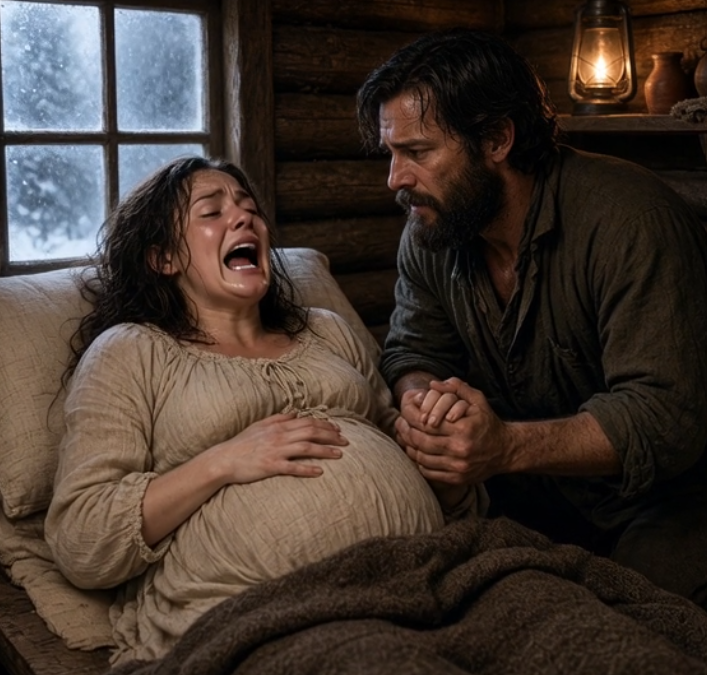
Labor lasted six hours.
Six brutal, endless hours.
Rowan boiled water.
Tore clean linen into strips.
Fed the fire until every calculation about future wood became meaningless.
“More,” Mara gasped.
“We need to conserve—”
“Burn the damn cabin if you have to!”
He burned more.
Mara screamed through another contraction.
She had never known pain could erase language.
At some point, she began begging for Daniel.
Not consciously.
His name simply came.
“Daniel.”
Rowan flinched every time.
“Daniel, please.”
“I’m here.”
“You’re not Daniel!”
“I know.”
“I want him!”
Rowan’s face twisted.
“I know.”
He gave her his hand.
She nearly broke two fingers.
By dawn, Mara was exhausted beyond fear.
“I can’t.”
“Yes, you can.”
“I can’t.”
“You can hate me afterward.”
“I already hate you.”
“Good. Use it.”
She laughed.
Then screamed.
Rowan looked down.
His expression changed.
“Mara.”
“What?”
“I see…”
His voice cracked.
“What?”
“Hair.”
She began crying.
“Is that good?”
“I think.”
“You think?”
“I deliver calves!”
“You keep telling me that like it’s comforting!”
“It’s the only qualification I have!”
Another contraction arrived.
Rowan’s face became serious.
“Push.”
Mara pushed.
Again.
Again.
Pain tore her apart.
Then suddenly pressure released.
A tiny body slipped into Rowan’s shaking hands.
Silence.
Terrible silence.
Mara lifted her head.
“Why isn’t he crying?”
Rowan stared at the baby.
Blue.
Still.
“Rowan.”
He rubbed the child.
Nothing.
“ROWAN.”
“I’m trying.”
“Do something!”
Rowan cleared the baby’s mouth.
Rubbed harder.
“Come on.”
Nothing.
His voice broke.
“Come on, little man. Your mother crossed a mountain for you. You don’t get to quit now.”
Mara stopped breathing.
Rowan bent and gave the smallest breath into the infant’s mouth.
Once.
Twice.
Then—
A sound.
Thin.
Weak.
Perfect.
The baby cried.
Mara collapsed backward.
Rowan laughed.
It came out halfway between a sob and a gasp.
He wrapped the child and placed him against Mara’s chest.
She looked at the tiny face.
Purple eyelids.
Dark wet hair.
Furious little mouth.
“Hello.”
The baby cried louder.
“Yes,” Mara whispered, tears sliding into her hair. “I know. It was awful.”
Rowan sat on the floor.
His hands were covered in blood.
His eyes shone.
Mara looked at him.
“You’re crying.”
“No.”
“You are.”
“Smoke.”
“There isn’t any smoke.”
“Then mind your business.”
Mara laughed until it hurt.
Then the baby’s hand emerged from the blanket.
Rowan offered one finger.
The newborn grasped it.
Rowan stopped breathing.
And Mara watched the most feared man in Iron Hollow bow his head over a child who trusted him before the world had taught him not to.
They named him Samuel Daniel Dalton.
Samuel because Daniel had once said he liked it.
Daniel because Mara could not bear the thought of her husband’s name ending in a graveyard.
For three days, the world shrank to feeding, sleeping, keeping Samuel warm, and watching his breathing.
Rowan became unbearable.
“Is he breathing?”
“Yes.”
“He sounds strange.”
“He’s a newborn.”
“He coughed.”
“Babies cough.”
“Should they?”
“Rowan.”
“What?”
“You delivered him in a blizzard.”
“That doesn’t make me a doctor.”
“It apparently makes you his nervous grandmother.”
Rowan glared.
Mara smiled.
The baby sneezed.
Rowan turned immediately.
Mara laughed so hard she woke Samuel.
For one impossible week, happiness entered the cabin.
Not the clean happiness Mara remembered from before Daniel died.
This one hurt around the edges.
It carried guilt.
Sometimes she watched Rowan hold Samuel and felt warmth bloom inside her, followed instantly by grief.
Daniel should have been doing that.
Daniel should have complained about diapers.
Daniel should have been the one standing barefoot at three in the morning whispering nonsense into his son’s hair.
One night, Mara found Rowan sitting beside the stove with Samuel asleep against his chest.
The firelight made him look exhausted.
She sat beside him.
“You’re good with him.”
“I’m terrified of him.”
“That might be why.”
Samuel made a tiny sound.
Rowan smiled down.
Again that smile.
Mara’s stomach tightened.
She had seen it.
She knew she had.
“Rowan.”
He looked up.
“Tell me the truth.”
His expression closed instantly.
“You knew Daniel.”
Silence.
“I asked you before.”
“I remember.”
“You lied.”
“Yes.”
No excuse.
That angered her more.
Mara stood.
“Who was he to you?”
Rowan looked at Samuel.
“Not while you’re holding him.”
She took the baby.
“Talk.”
Rowan walked to a floorboard near the bed.
Kneeled.
Pried it loose.
Underneath lay a small iron box.
Mara stopped breathing.
She recognized it.
Not the box itself.
The carving on the lid.
A crooked D.
Daniel carved that D into everything he made as a boy. He had shown Mara once on an old fence post, laughing because the letter looked more like a crippled horseshoe than an initial.
Rowan carried the box to the table.
“You need to sit.”
“No.”
“Mara.”
“Open it.”
He did.
Inside was Daniel’s pocket watch.
Mara made a sound she did not recognize.
She had searched for that watch after his death.
Gerald claimed it must have fallen into the ravine.
Her hands shook.
“How do you have that?”
Rowan looked at her.
“Daniel gave it to me.”
“When?”
“Two nights before he died.”
The room shifted.
Mara grabbed the table.
“Why would my husband come here?”
“Because he’d been coming here for years.”
“No.”
“Mara—”
“No. Daniel hated this mountain.”
“He hated climbing it.”
“He never mentioned you.”
“I asked him not to.”
“Why?”
Rowan closed his eyes.
When he opened them, all hardness was gone.
“My mother’s name was Abigail Hale.”
Mara waited.
“Before she married my father, she worked at the Dalton ranch.”
Mara’s breathing slowed.
She suddenly did not want the next sentence.
Rowan said it anyway.
“She became pregnant.”
Mara stared.
“The Daltons paid her to leave Iron Hollow.”
“No.”
“She married my father two years later. He gave me his name.”
“No.”
“Thirty-two years after that, Daniel found the baptism record.”
Mara covered her mouth.
Rowan’s voice dropped.
“Daniel was my younger brother.”
The cabin became silent except for the fire.
Mara looked at Rowan.
Really looked.
The eyes.
Not the color.
The shape when he smiled.
The slight unevenness in one eyebrow.
Daniel had the same.
“Oh my God.”
“He came here the first time six years ago.”
“One year after we married.”
“Yes.”
“You knew me?”
“Through him.”
“All this time?”
“He talked about you constantly.”
Mara started crying.
Rowan looked away.
“He said you snored when you were exhausted.”
“I do not.”
“He said you absolutely do.”
A laugh escaped through her tears.
It destroyed her.
She sank into the chair.
“Why didn’t he tell me?”
“I asked him not to.”
“Why?”
Rowan touched the scar beneath his beard.
“Because wherever my name went, trouble followed. Daniel had you. He had a decent life. I didn’t want Iron Hollow turning his family into mine.”
Mara stared at the watch.
“Then why did he come two nights before he died?”
Rowan’s face darkened.
He reached into the box and pulled out an envelope.
Mara recognized Daniel’s handwriting before Rowan placed it down.
Her name.
MARA.
The paper trembled in her hands.
“What is this?”
“The reason I lied.”
She opened it.
Daniel’s words leaned slightly right.
Exactly as they always had.
Mara,
If you are reading this, something has happened before I managed to fix what I should have fixed years ago.
Her vision blurred.
She kept reading.
Gerald knows about the revised deed.
Mara looked up.
“What deed?”
Rowan nodded toward the letter.
She continued.
Father’s original agreement did not give Gerald the house after my death. I discovered he altered a copy in the county file. The farm, North Ridge, and half the cattle belong to you, then to our child.
Mara’s heart pounded.
I confronted him yesterday.
He laughed.
Then he asked what would happen to the land if neither you nor the baby survived.
Mara stopped.
The cabin seemed colder.
Rowan said, “Keep reading.”
She did.
My saddle cinch was cut last month. I replaced it and told no one except Rowan.
Her hands began shaking violently.
If anything happens to me while riding, do not believe the first explanation you are given.
Mara whispered, “No.”
Rowan stared at the floor.
“There’s more.”
She forced herself onward.
Rowan has the original deed, a signed statement from me, and the cut cinch. I asked him to keep them because Gerald knows I discovered the forgery.
I was going to take everything to the territorial marshal after the winter supply run.
If I fail, Rowan will know what to do.
Mara could no longer see the words.
She turned the page.
One final paragraph.
There is one thing I have been too cowardly to tell you.
Rowan is my brother.
Not by law. Not by the name our town recognizes. By blood.
I kept his secret because he asked me to, but Samuel — if you still want that name for our baby — deserves to know there was another good man in his family.
Mara’s breath shattered.
Daniel had known.
The baby’s name.
Their private name.
He had written it before dying.
At the bottom:
And Mara, if I am gone, do not let grief convince you that surviving me is betrayal.
Survive.
Please.
She lowered the letter.
For a long time, nobody spoke.
Samuel slept against her chest.
The fire popped softly.
Outside, snow slid from a branch and thudded against the ground.
Then Mara looked at Rowan.
“You knew Gerald might have killed him.”
“Yes.”
“And you let me live at North Ridge.”
Pain crossed his face.
“I didn’t know Gerald sent you there until you appeared at my door.”
“You could have come down.”
“I tried after Daniel died.”
“What?”
“Gerald met me on the road.”
Mara froze.
“He told me you blamed me.”
“I didn’t even know you.”
“He said Daniel had told you everything about my past. Said you wanted me nowhere near you or the child.”
Mara whispered, “He was keeping us apart.”
Rowan nodded.
“Then the snow came.”
“And Gerald sent me to a cabin he knew was failing.”
Rowan’s expression became murderous.
Mara suddenly understood.
The roof.
The isolation.
Gerald’s strange smile when she asked about her baby’s future.
Then we discuss the future.
She covered her mouth.
Daniel’s death had not made Mara homeless by accident.
Gerald had moved her to North Ridge because winter could finish what the ravine had started.
The road opened nine days later.
Rowan rode into Iron Hollow carrying Daniel’s letter, the original property deed, and a saddle cinch that had been cut nearly through with a knife.
He told Mara to stay.
She refused.
“I spent my whole life letting people decide what I could handle.”
“This could get ugly.”
“So can childbirth.”
“Mara.”
“I’m going.”
They entered town with Samuel bundled against her chest.
People stared.
A widow.
A newborn.
Rowan Hale beside them.
Rumor moved faster than horses.
By the time they reached the sheriff’s office, Gerald was already there.
His face changed when he saw Mara.
Just for one second.
But she caught it.
Not relief.
Not surprise.
Fear.
“Mara.”
Gerald approached.
“I thought—”
He stopped.
Mara stared at him.
“You thought what?”
Gerald recovered.
“We were afraid you’d died in the storm.”
“Were you?”
“Mara, of course.”
Samuel shifted beneath the blankets.
Gerald’s eyes dropped to the child.
That same calculating look returned.
Rowan stepped between them.
“Don’t.”
Gerald looked at him.
“You.”
Rowan placed the iron box on the sheriff’s desk.
“Yes.”
The sheriff opened the documents.
Gerald laughed.
“This is absurd. Rowan Hale? A murderer bringing accusations?”
The room changed.
Mara saw how easily Gerald did it.
He knew the town’s favorite story.
He simply reached for it.
Rowan did not respond.
Mara did.
“He was acquitted.”
Gerald looked at her.
“You don’t know what he is.”
“I know exactly what he is.”
“Do you?”
“Yes.”
Her voice trembled.
But it did not break.
“He’s Daniel’s brother.”
Silence.
Someone outside the sheriff’s office gasped.
Gerald’s face emptied.
That was enough.
The sheriff noticed.
So did Rowan.
Gerald turned.
“That’s impossible.”
Rowan’s voice came quietly.
“Funny choice of word.”
“What?”
“I expected ridiculous. Maybe false. You chose impossible.”
Gerald said nothing.
The sheriff unfolded Daniel’s statement.
Then examined the cinch.
“Gerald.”
“This proves nothing.”
A new voice came from the doorway.
“It proves more with me.”
Everyone turned.
Elias Fitch stood there.
Seventeen.
Thin.
Stable hand at the Dalton property.
Mara remembered him crying at Daniel’s funeral.
Gerald went pale.
“Get out, boy.”
Elias shook.
But stayed.
The sheriff frowned.
“What do you know?”
The boy looked at Mara.
“I’m sorry, ma’am.”
Her blood went cold.
“I should’ve told someone.”
Gerald moved.
Rowan moved faster.
One hand struck Gerald’s chest and pinned him against the wall.
The sheriff shouted, “Nobody moves.”
Elias began crying.
“I saw Mr. Gerald in the stable the night before Mr. Daniel died.”
Gerald shouted, “Liar!”
“He had a knife.”
“LIAR!”
“He told me Daniel’s saddle strap was cracked and he was fixing it.”
Mara stopped breathing.
Elias wiped his face.
“But he wasn’t fixing it.”
The sheriff’s face hardened.
“What was he doing?”
Elias looked at Gerald.
“He was cutting it.”
Mara closed her eyes.
For six weeks, she had imagined Daniel’s last moments as accident.
Horse slipping.
Loose stone.
Wrong turn.
Now another picture came.
Daniel climbing into the saddle before sunrise.
Trusting leather that had carried him hundreds of miles.
Gerald standing somewhere nearby.
Waiting.
Mara nearly collapsed.
Rowan caught her.
Gerald began shouting.
About inheritance.
About lies.
About how Daniel had always been favored.
About how Rowan had poisoned him against his own family.
No one needed him to confess completely.
Rage did it for him.
The sheriff placed him in irons.
Mara watched.
She expected satisfaction.
Instead, she felt only tired.
So terribly tired.
Gerald was dragged toward the cells.
He looked back once.
“You think that bastard will replace Daniel?”
Mara stiffened.
Rowan’s hand fell away from her shoulder.
Gerald smiled cruelly.
Mara walked toward him.
Slowly.
Samuel against her heart.
“No.”
Gerald waited.
“Daniel cannot be replaced.”
Her voice steadied.
“That’s why you failed.”
His smile disappeared.
“You killed a man.”
She looked at Rowan.
“You didn’t erase what he loved.”
Then she walked away.
Spring came late to Iron Hollow.
Snow withdrew in dirty ribbons.
Creeks broke free.
Grass returned beneath dead yellow stems.
The court restored Daniel’s property to Mara.
Gerald stood trial for murder, forgery, and attempted fraud.
Elias testified.
The altered county document was traced to a clerk Gerald had bribed.
People apologized to Mara.
Some apologized to Rowan too.
He accepted none of it gracefully.
One shopkeeper said, “We judged you unfairly.”
Rowan replied, “You had five years to figure that out.”
Mara kicked his boot.
“What?” he asked.
“You are impossible.”
“So I’ve heard.”
She rebuilt North Ridge.
Not the old cabin.
She had that torn down.
Instead, she used timber from Daniel’s land and stone from Rowan’s ridge to build something larger between both properties.
Two bedrooms.
A wide kitchen.
A porch facing west.
Rowan helped.
Of course he did.
He claimed he was only helping because Mara’s hammering was painful to listen to.
She claimed he was only breathing because she permitted it.
Samuel grew.
Too quickly.
His hair lightened.
His eyes became gray.
That unsettled Mara at first.
Daniel’s eyes had been brown.
Then one afternoon Rowan held Samuel beneath the porch sunlight.
The baby laughed.
Mara stared.
Same eyes.
Not Daniel’s.
Rowan’s.
Blood had crossed another generation.
Not in scandal.
Not in shame.
Simply in the quiet mathematics of family.
Rowan looked at her.
“What?”
“Nothing.”
“You’re staring.”
“He has your eyes.”
Rowan went still.
Samuel grabbed his beard.
Hard.
Rowan winced.
Mara laughed.
“Also your manners.”
Months passed.
People began asking questions neither Mara nor Rowan answered.
Was he staying?
Were they courting?
Would they marry?
Iron Hollow loved arranging other people’s lives.
Mara had learned not to help them.
Some evenings, she and Rowan sat on the porch after Samuel slept.
They spoke about Daniel.
Not constantly.
Enough.
Rowan told her stories she had never known.
Daniel at twelve stealing peaches.
Daniel falling through river ice.
Daniel finding Rowan for the first time and standing outside his cabin for twenty minutes because he could not decide how to introduce himself.
“What did he finally say?” Mara asked.
Rowan smiled.
“He said, ‘I think my mother owes both of us an explanation.’”
Mara laughed until she cried.
Rowan’s smile faded.
“You miss him.”
“Every day.”
“Does it get easier?”
She thought about it.
“No.”
He looked surprised.
Mara continued.
“But it gets larger.”
“What does?”
“Life around the missing part.”
Rowan watched the horizon.
After a moment, he nodded.
“I understand that.”
She knew he did.
One September evening, Rowan handed her something wrapped in cloth.
Daniel’s pocket watch.
“I think this belongs with Samuel.”
Mara opened it.
Inside the lid was an inscription she had never noticed.
Three words.
SURVIVAL BEFORE PRIDE.
She looked at Rowan.
“You said it first.”
He smiled faintly.
“To Daniel. Long time ago.”
“So all those years…”
“He stole my best advice.”
“He improved it.”
“Probably.”
Mara closed the watch.
Her eyes burned.
“I’m glad he found you.”
Rowan looked toward the mountains.
“So am I.”
“And I’m glad I did.”
He looked at her then.
Neither moved.
No dramatic confession came.
No promise.
No kiss beneath a sunset that suddenly understood music.
Only Rowan reaching across the space between their chairs.
Palm open.
Mara placed her hand in his.
His thumb passed once across her knuckles.
Warm.
Certain.
Nothing like survival.
And nothing they needed to name yet.
From inside the house, Samuel began crying.
Rowan stood.
“I’ll get him.”
“You got him last time.”
“He likes me better.”
“He has terrible judgment.”
Rowan disappeared through the door.
A moment later, Mara heard his voice.
Low.
Patient.
The voice Iron Hollow had once been frightened to hear.
“Easy, little man. I’m here.”
Mara remained on the porch.
The mountains had taken Daniel from her.
That truth would never become beautiful.
But they had also kept a brother Daniel had loved in secret.
A man who opened his door because she knocked.
A man who burned his winter wood without counting when her child came early.
A man who had held Daniel’s evidence, Daniel’s history, Daniel’s grief — and then held Daniel’s son alive in his hands before dawn.
Mara looked toward the first snow beginning far above the tree line.
For years, she had believed strength meant proving she needed nobody.
Daniel had known better.
Rowan did too.
Strength was sometimes walking.
Sometimes crawling.
Sometimes knocking.
Sometimes climbing into a narrow bed beside another freezing human being because pride could not warm either of you.
And sometimes strength was surviving long enough to discover that the worst night of your life had not been the end of your family.
It had been the night your family found its way back to you.








