A Police K9 Waited at the Precinct Doors for 7 Days After His Partner Collapsed—Then the Hospital Called With Four Words: “Daniel Is Asking for Rex”
PART3:
At Rex.
I turned.
Rex was standing perfectly still, trembling so hard the leash shook.
Daniel tried again.
This time I heard it.
“Rex.”
Then he went limp.
The ambulance arrived in six minutes.
Those six minutes stretched until they felt like a separate lifetime.
Paramedics rushed in. Someone cut Daniel’s shirt open. Someone else told us to move back. I remember the bright red bag hitting the pavement. I remember Martinez whispering, “Come on, man,” over and over under his breath. I remember Rex making one low sound, not a bark, not a whine, something deeper and worse.
When they loaded Daniel onto the stretcher, Rex stood at perfect attention.
I don’t know why that detail breaks me even now.
He stood like Daniel had given him a command.
Like the correct thing to do when your world was being carried away from you was to behave.
The ambulance doors closed.
The siren started.
The vehicle pulled out of the lot and turned onto Madison Street.
Rex watched until it disappeared.
Then he did something none of us expected.
He turned, walked around the side of the building, and went to the front entrance of the precinct.
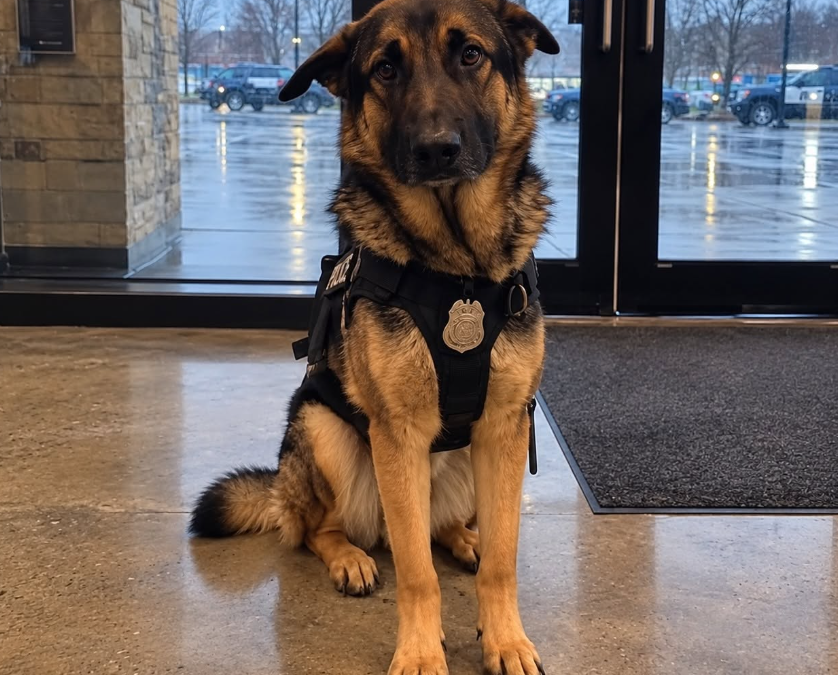
By the time I followed, he was sitting inside the glass doors, facing the street.
The same street where the ambulance had gone.
I clipped the leash to his collar.
“Come on, buddy.”
He did not move.
“Rex.”
His ears twitched.
“Let’s go.”
He stayed.
I thought maybe he was confused. Maybe he thought Daniel would return through the front, the way officers came and went all day.
I crouched beside him.
“Daniel’s at the hospital.”
Rex stared outside.
I touched his shoulder.
“He’s not coming through there right now.”
His eyes remained fixed on the street.
At first, people tried to make light of it because cops will joke at the edge of a cliff if joking keeps them from looking down.
“He’ll move when he gets hungry,” Officer Blake said.
He didn’t.
At lunch, someone brought Rex’s food.
He sniffed it and turned back toward the doors.
At three, I brought water.
He drank a little, then returned to watching.
At five, Captain Marshall came out of his office.
Captain Evelyn Marshall had been in law enforcement longer than I had been alive. She was short, sharp-eyed, and terrifying in the way only people who never raised their voices can be terrifying. She had promoted Daniel into K-9. She had approved Rex’s purchase. She cared more than she ever let anyone see.
She stood behind Rex for a long time.
Then she said, “Has he moved?”
“No.”
“Eaten?”
“No.”
Her mouth tightened.
“What’s the latest on Reynolds?”
I looked toward the hallway.
“Hospital says he’s in surgery.”
Marshall closed her eyes for half a second.
Then she opened them, captain again.
“Keep me updated.”
“Yes, ma’am.”
That night, I tried to take Rex to the kennel area.
He stood when I clipped the leash.
For one hopeful second, I thought grief had exhausted him enough to follow.
Then he walked three feet, turned around, and returned to the doors.
“Rex.”
He sat.
I crouched beside him.
“Buddy, come on.”
He would not look at me.
I hated myself for what I said next.
“He isn’t coming through there tonight.”
Rex’s ears lowered.
I know people say dogs don’t understand sentences.
Maybe they don’t.
But they understand absence.
They understand tone.
They understand when the pack has lost its center.
I sat beside him until midnight.
The night-shift officers stepped around us quietly. Nobody complained. Nobody told me to move him. Nobody wanted to admit that every person in that building felt safer when Rex was at the doors, even broken.
At 1:17 a.m., the hospital called.
Daniel had survived emergency surgery.
Barely.
He was unconscious.
The doctors were cautious.
That was the word they used.
Cautious.
In hospitals, cautious means nobody wants to give hope a shape yet.
I told Rex.
I felt stupid doing it.
Still, I leaned down and whispered, “He made it through surgery.”
Rex blinked.
“He’s fighting.”
Rex placed his chin on his paws.
But his eyes never left the street.
The second day was worse because hope had settled into waiting.
The precinct changed around Rex.
Officers lowered their voices near the doors.
People who normally strode in laughing slowed when they saw him.
A patrolman from another shift brought a blanket and laid it beside him. Rex ignored it for two hours, then finally shifted enough that one paw rested on the edge.
Someone printed a picture of Daniel and Rex from last year’s charity event and taped it to the wall near the entrance.
In the photo, Daniel was kneeling, one arm around Rex, laughing because Rex had just stolen a hot dog from a councilman’s plate.
Every time I passed that photo, my chest tightened.
By the third day, the story had spread.
First through dispatch.
Then through neighboring departments.
Then online.
A civilian entering the precinct to file a report saw Rex at the doors and asked why the police dog looked so sad. Someone told her. She posted a photo. By evening, people were leaving flowers and dog treats outside the building.
The caption read: K-9 Rex waiting for his injured partner to come home.
I hated how beautiful and terrible that was.
Rex did not care about the flowers.
He did not care about the treats.
He cared about every vehicle that slowed near the curb.
Every time tires crunched outside, his ears rose.
Every time a uniform approached, he stood.
Every time it wasn’t Daniel, he sat again.
On the fourth day, it rained.
Not hard at first. Just a steady tapping against the glass.
Rex remained where he was.
His reflection stared back at him from the doors, tall ears, gray-black saddle, tired eyes.
I sat in a chair near him with a cup of coffee going cold in my hands.
Officer Blake came over and stood beside me.
“He still won’t eat?”
“Not enough.”
“What does the vet say?”
“Stress. Grief. Keep trying.”
Blake rubbed a hand over his face.
“I used to think he was scary.”
“He is scary.”
“No.” Blake looked at Rex. “I mean before. When Daniel would bring him through booking, I’d think, that dog could take down a grown man in half a second.”
“He could.”
“Yeah. But look at him.”
Rex’s nose was almost touching the glass.
Blake’s voice changed.
“He’s just waiting for his person.”
That was when the jokes stopped completely.
On the fifth day, Captain Marshall summoned me to her office.
I knew before I went in that I wasn’t going to like the conversation.
Her blinds were half-closed. A file sat open on her desk. She had removed her glasses and was pinching the bridge of her nose.
“Close the door, Carter.”
I closed it.
She looked older than usual.
“This can’t continue.”
I said nothing.
“He’s exhausting himself.”
“He’s grieving.”
“He’s refusing necessary care.”
“He’s waiting.”
“Sam.”
She almost never used my first name at work.
I looked away.
“Daniel is still unconscious,” she said.
“I know.”
“We have to consider Rex’s welfare.”
That word.
Welfare.
People use gentle words when they are about to do something hard.
“What does that mean?”
“Temporary foster placement has been approved.”
My head snapped toward her.
“No.”
“That wasn’t a request.”
“You move him now, and he’ll think Daniel disappeared and we disappeared too.”
“He’s a police dog.”
“He’s Daniel’s partner.”
Marshall stared at me.
Her face tightened, but not with anger.
With pain.
“You think I don’t know that?”
I swallowed.
“He needs to hear Daniel’s voice.”
“Daniel can’t speak.”
“Not yet.”
“Not yet may become never.”
I felt those words like a slap.
Marshall regretted them as soon as she said them, but she didn’t take them back because captains cannot afford to build policy around denial.
She slid the file across the desk.
A form sat on top.
Temporary transfer authorization.
Destination: North Valley K-9 Rehabilitation Facility.
I knew the name.
Private contractor. Expensive. Clean website. Smiling trainers. Too many rumors.
“North Valley?” I said.
Marshall’s mouth flattened.
“It’s what the deputy chief approved.”
“Deputy Chief Whitlock doesn’t know Rex.”
“He knows liability.”
“Rex hasn’t done anything wrong.”
“He hasn’t eaten properly in five days.”
“So we help him here.”
“We are not equipped for long-term behavioral decline in a working dog.”
“He’s not declining. He’s waiting.”
Marshall leaned back.
For a moment, the captain disappeared and the woman remained.
“Sam, I am trying to keep him alive.”
That stopped me.
She continued more quietly.
“If he keeps refusing food, if his stress worsens, if he becomes unpredictable because we pushed him past his limit, the city will not ask what love required. They will ask why I didn’t act sooner.”
I wanted to argue.
I wanted to say she was wrong.
But she wasn’t wrong about the city.
I had seen enough council meetings to know paperwork had a way of becoming colder than death.
“When?” I asked.
“Tomorrow morning.”
“No.”
“Sam.”
“Give me twenty-four hours.”
“You have less than that.”
“Then give me until the morning.”
She studied me.
“For what?”
“I don’t know yet.”
“That’s not an answer.”
“It’s the only one I have.”
Marshall looked toward the glass wall of her office. Through the blinds, we could see Rex sitting at the entrance.
Still waiting.
She closed the file.
“By 0900 tomorrow, either you give me a viable plan approved by a vet and command, or Rex is transported.”
I stood.
“Thank you.”
“Don’t thank me. Find me something I can defend.”
I left her office and found Rex exactly where I had left him.
I sat beside him.
“All right, buddy,” I whispered. “We have until morning.”
Rex did not move.
That evening, something happened that made everything worse.
Deputy Chief Alan Whitlock came to the precinct.
I had never liked Whitlock.
He was one of those men who smiled for cameras but never at janitors. Tall, polished, silver-haired, with a voice trained for press conferences and a handshake that felt rehearsed. He had risen fast through administration, not street work, and he treated officers like budget categories that occasionally bled.
He entered with two aides and a woman from city communications.
Rex stood when the doors opened.
For half a second, hope lit his whole body.
Then he realized it wasn’t Daniel.
He sat.
Whitlock looked down at him.
“So this is the situation.”
The word made me step forward.
“Sir.”
Whitlock looked at me like he was trying to remember whether I mattered.
“Carter, correct?”
“Yes, sir.”
“I understand you’re emotionally invested.”
I kept my face still.
“I’m professionally responsible for Rex until Officer Reynolds returns.”
“If Officer Reynolds returns.”
The air near me seemed to drop ten degrees.
Several officers nearby went silent.
Whitlock did not miss it. He enjoyed it.
“I’m sorry,” he said, not sounding sorry. “But leadership requires clear eyes. This department cannot have a service animal deteriorating in a public lobby while citizens come in to report crimes.”
“He isn’t hurting anyone.”
“He is creating a spectacle.”
I looked at Rex.
A spectacle.
A dog waiting for his injured partner had become a problem of optics.
Whitlock turned to the communications woman.
“We’ll release a statement tomorrow explaining that Rex is being moved for specialized care.”
Moved.
Not removed.
Again, gentle words.
Captain Marshall came out of her office.
“Deputy Chief.”
“Captain. I thought it best to handle this before the story becomes sentimental.”
“It already is sentimental,” Marshall said. “That doesn’t make it false.”
Whitlock’s smile tightened.
“I’m not interested in arguing philosophy in the lobby.”
He looked at Rex again.
“Frankly, the animal should have been transferred two days ago.”
Rex’s ears flicked at the hard edge in his voice.
I stepped slightly between them without thinking.
Whitlock noticed.
“Careful, Carter. Confusing attachment with judgment is how officers make mistakes.”
It was meant to humiliate me.
It worked.
Not because I felt ashamed of loving Rex.
Because everyone heard him reduce Daniel, Rex, and all seven days of pain into a lesson about professionalism.
Then Officer Aaron Mills spoke from behind the front desk.
“With respect, sir, Rex hasn’t been a problem.”
Whitlock turned slowly.
Aaron was twenty-six, new enough to still polish his boots too much, but he had a backbone I admired.
Whitlock’s eyes narrowed.
“Officer Mills, do you have something useful to add?”
Aaron’s confidence faltered, but he nodded.
“I was there when Officer Reynolds collapsed. Rex obeyed every command. He didn’t interfere.”
Whitlock looked at him too long.
“Interesting.”
That was all.
But Aaron went pale.
I noticed.
I would remember that later.
Whitlock left after instructing Marshall to have Rex ready by morning.
The lobby remained silent after he walked out.
Then Blake muttered, “Spectacle.”
Nobody laughed.
At 10:42 that night, I called Daniel’s doctor.
I had her number because Daniel’s sister had authorized me to receive updates. Daniel’s parents were gone, and his sister lived three states away. I had been at the hospital every night I wasn’t at the precinct.
Dr. Frances Moran answered on the fourth ring.
“This is Dr. Moran.”
“Doctor, it’s Officer Carter. Sam Carter.”
“Officer Carter, has something changed?”
“No. I was calling to ask something strange.”
There was a pause.
“With this week, strange is relative.”
I rubbed my eyes.
“If Daniel wakes up, if he can speak at all, could Rex hear his voice?”
Silence.
I regretted asking immediately.
Then she said, “You mean over the phone?”
“Yes. Or video. Anything.”
“Officer Reynolds is still unconscious.”
“I know.”
“And if he wakes, he may be disoriented. Weak. Unable to communicate.”
“I know.”
“What are you trying to accomplish?”
I looked at Rex through the lobby glass.
His head was up again. Another car had passed.
“He’s waiting for Daniel. They want to move him tomorrow. I think hearing Daniel might help him eat, rest, something. I don’t know.”
Dr. Moran was quiet long enough that I thought she would refuse gently.
Then she said, “If Daniel wakes and can speak, I’ll try.”
“Thank you.”
“Officer Carter?”
“Yes?”
“I can’t promise you he will.”
I closed my eyes.
“I know.”
But I slept on the lobby bench anyway, because leaving Rex felt like failing Daniel twice.
The seventh morning arrived cold and bright.
Rex looked terrible.
Not injured. Not sick in an obvious way.
Worn down.
His posture was still straight, because discipline was carved into him, but his eyes were duller. His sides looked too lean. He had eaten only a few bites in two days, and even those had required me hand-feeding him like a stubborn child.
At 7:30 a.m., Captain Marshall came into the lobby holding the transfer file.
Her face told me she hated herself.
“Sam.”
I stood.
“Give me until nine.”
“It is almost nine.”
“It’s seven-thirty.”
“The transport team is coming early.”
I stared at her.
“What?”
“Whitlock changed the schedule.”
Of course he had.
The private transport van was due at eight.
I looked at Rex.
He watched the street, unaware that people had decided his grief was inconvenient.
“Captain, please.”
Marshall’s voice lowered.
“I fought for the extra night. That’s all I could get.”
“Then fight harder.”
Her eyes flashed.
“Do you think I haven’t?”
The lobby went quiet.
She stepped closer.
“I have spent thirty-one years in this job. I know exactly what men like Whitlock do when they decide something is about control. If I refuse a direct order without grounds, they remove me from the decision and send Rex anyway.”
“So we just hand him over?”
“No,” she said. “We document everything. We make sure he is cared for. We visit. We keep pressure on.”
“He’ll think we abandoned him.”
Marshall’s face broke for half a second.
Then the front phone rang.
Everyone looked toward it.
Aaron Mills picked it up.
“Precinct.”
He listened.
Then his eyes lifted to mine.
“Officer Carter.”
My body moved before my mind did.
I took the receiver.
“This is Carter.”
A woman’s voice said, “Officer Carter? It’s Dr. Moran.”
I gripped the phone so hard my knuckles hurt.
“Yes.”
Behind me, Rex stood.
Maybe he heard the change in my breathing.
Maybe he had spent seven days learning the shape of hope.
Dr. Moran’s voice softened.
“Daniel is asking for Rex.”
Four words.
That was all.
Daniel is asking for Rex.
The entire precinct went silent.
I forgot how to breathe.
Captain Marshall closed her eyes.
Blake whispered something I could not hear.
Rex stared at me.
I put the receiver on speaker with shaking fingers.
“Doctor,” I said, my voice breaking, “can he talk?”
“He’s weak, but yes. Not much. I have him here.”
There was rustling.
A faint beep in the background.
Then a voice came through.
Thin.
Rough.
Alive.
“Rex.”
The dog froze.
Every person in the lobby froze with him.
Daniel breathed unevenly on the line.
“Rex, buddy.”
Rex made a sound I will never forget.
It started low in his chest and rose into a whine so human it hurt.
He stepped toward the desk, ears forward, eyes suddenly awake.
Daniel’s voice came again.
“Good boy.”
Rex’s front paws lifted onto the counter.
Aaron backed away, crying openly and not caring.
I held the phone lower.
“Easy, Rex. Easy.”
Daniel whispered, “Wait for me.”
Rex trembled.
“Stay with Sam.”
The dog turned his head toward me.
I broke then.
Not loudly.
Just enough that I had to cover my mouth.
Daniel said one more thing.
“Home soon.”
Then the line shifted, and Dr. Moran returned.
“That’s all he can do right now.”
“Thank you,” I managed.
“Officer Carter?”
“Yes?”
“You should bring Rex.”
I looked at Marshall.
Her eyes were wet.
“To the hospital?” I asked.
“I’m clearing it with administration now. It may take an hour, but medically…” She paused. “I think it would help both of them.”
Marshall reached for the transfer file.
For one terrifying second, I thought she was going to say we still had orders.
Instead, she tore the top page in half.
“Get the transport crate out of my lobby,” she said.
Nobody moved.
Then Blake laughed once through tears.
The private van pulled up ten minutes later.
Two men in uniforms from North Valley K-9 Rehabilitation stepped out.
Behind them came Deputy Chief Whitlock in his black department SUV.
Of course.
He wanted to witness obedience.
He walked in, saw the torn paper in Marshall’s hand, and stopped.
“What is this?”
Marshall stood straighter.
“Medical update.”
“The transfer is authorized.”
“It is postponed.”
“By whom?”
“By me.”
His face hardened.
“Captain.”
She did not look away.
“Officer Reynolds is conscious. His physician has requested Rex be brought to the hospital.”
Whitlock’s eyes flicked toward the lobby, toward the officers, toward Rex.
He realized instantly how bad it would look to drag the dog away ten minutes after Daniel’s first words.
So he smiled.
It was ugly.
“That is wonderful news.”
Nobody believed him.
“I’ll come along,” he said.
“No,” Marshall answered.
The silence after that was dangerous.
Whitlock’s smile vanished.
“Excuse me?”
“This is not a press event.”
“I am deputy chief.”
“And I am the commanding officer responsible for this precinct and this K-9 until Daniel Reynolds resumes command or formal reassignment occurs. Rex will be transported by Officer Carter.”
Whitlock leaned closer.
“You’re making a mistake.”
Marshall’s voice dropped.
“No, Deputy Chief. I made one yesterday when I almost let you turn a grieving partner into a public relations problem.”
For a second, I thought Whitlock would explode.
Instead, he looked around and saw too many witnesses.
He turned and left without another word.
That should have been the end of him.
It wasn’t.
I loaded Rex into my cruiser.
He moved differently now.
Still tired, still thin-eyed from seven days of waiting, but alive again. He watched through the windshield like he knew exactly where we were going.
At the hospital entrance, security tried to stop us until Dr. Moran arrived.
She was in her fifties, calm, with silver hair pulled tight and the kind of eyes that had seen too many families begging for impossible answers.
“You must be Rex,” she said.
Rex looked at her, then past her.
She nodded.
“I know. Come on.”
We walked through the hospital like a small parade of controlled heartbreak.
Nurses stepped aside. Patients looked up. Someone whispered, “That’s the dog.”
Rex’s nails clicked on the polished floor.
The closer we got to Daniel’s room, the faster he walked.
“Easy,” I said.
He obeyed.
Barely.
Outside the ICU room, Dr. Moran stopped me.
“He is weak. He has tubes. He may not look like himself.”
“I understand.”
She looked down at Rex.
“I’m saying that for him too.”
Rex stared at the closed door.
Dr. Moran opened it.
Daniel lay in the bed beneath white blankets, pale and smaller than I had ever seen him. There were monitors beside him, wires at his chest, an IV in his arm. His lips were dry. His eyes were half-open.
For one awful second, Rex did not move.
Then Daniel turned his head.
A smile touched his mouth.
“Hey, partner.”
Rex crossed the room with a sound that was almost a sob.
He did not jump.
He did not pull.
He approached the bed, placed his front paws carefully on the edge only after I gave him permission, and pressed his head against Daniel’s side with a gentleness that made every nurse in the room cry.
Daniel’s hand moved slowly.
It found Rex’s fur.
“Good boy,” he whispered.
Rex closed his eyes.
Daniel looked at me.
“You look terrible.”
I laughed and wiped my face.
“You died for seven minutes and still found time to insult me?”
“Didn’t die.”
“Close enough.”
His fingers moved weakly through Rex’s fur.
“Rex okay?”
I looked at the dog pressed against him.
“He is now.”
Daniel’s eyes closed.
For a second, panic flared.
Dr. Moran stepped forward, checked the monitor, then nodded.
“He’s resting.”
But Daniel’s hand remained in Rex’s fur.
Rex did not move for forty-three minutes.
I know because I watched the clock.
When we finally had to leave, Daniel opened his eyes just enough to whisper, “Stay with Sam.”
Rex whined.
“Rex.”
That one word, weak as it was, still carried command.
Rex lowered his paws.
I clipped the leash.
Daniel whispered, “Good.”
Rex obeyed.
But he looked back all the way to the door.
For two days, hospital visits became our routine.
Rex ate again.
Not much, but enough.
He slept in front of Daniel’s room when hospital staff allowed it and in my cruiser when they didn’t. The story went wider online. People sent messages from across the state. A local station requested an interview. Marshall denied all media access.
“This is not a circus,” she said.
Whitlock disagreed.
On the third day after Daniel woke, he held a press briefing without telling us.
I saw it on the lobby television.
Deputy Chief Whitlock stood behind a podium with the department seal, voice smooth, expression solemn.
“We are grateful Officer Reynolds is recovering,” he said. “However, there has been public misunderstanding regarding K-9 Rex. While we all appreciate the emotional bond between handler and animal, our responsibility is to ensure safety, discipline, and operational readiness.”
My stomach tightened.
Blake, standing beside me, muttered, “What is he doing?”
Whitlock continued.
“There are questions about whether Rex’s recent behavioral instability may make him unsuitable for future service.”
The lobby went dead quiet.
On screen, a reporter asked, “Are you saying the dog may be removed from Officer Reynolds?”
Whitlock folded his hands.
“I’m saying no decision will be based on emotion.”
Emotion.
That word again.
As if loyalty was a weakness.
As if grief erased discipline.
As if Rex had not obeyed every command given to him except the one that asked him to stop loving Daniel.
The next morning, an official review was scheduled.
Captain Marshall called me into her office.
Her face was stone.
“Whitlock is moving to retire Rex as unstable.”
I stared at her.
“Daniel isn’t even out of ICU.”
“I know.”
“Can he do that?”
“He can recommend it. If the review board agrees, yes.”
“This is punishment.”
“It’s politics.”
“Same thing.”
Marshall did not argue.
Then she slid another document across the desk.
“This was filed late yesterday.”
I looked down.
Incident report.
Author: Officer Aaron Mills.
My stomach dropped.
The report claimed that on the morning Daniel collapsed, Rex “resisted restraint,” “exhibited uncontrolled distress,” and “created risk of interference with emergency medical personnel.”
I read it twice.
Then a third time.
“This is a lie.”
Marshall said nothing.
“Aaron was there. He defended Rex.”
“He changed his statement.”
“Why?”
“I think you know why.”
I stood so fast the chair scraped the floor.
“Where is he?”
“Sam.”
“Where?”
“Locker room.”
I found Aaron sitting on a bench, elbows on knees, staring at the floor like he had aged ten years overnight.
He looked up when I entered.
“Carter—”
“Tell me you didn’t write it.”
His eyes filled.
That was answer enough.
“Tell me Whitlock made you.”
Aaron rubbed both hands over his face.
“He said if I didn’t clarify the record, I’d be accused of falsifying my original verbal statement.”
“Clarify?”
“I know.”
“You lied.”
“I know.”
“You stood in that lobby and said Rex did nothing wrong.”
“He said there were cameras. He said if any angle made it look like Rex pulled toward Daniel, I’d be the one accused of covering for a dangerous dog because everyone was emotional.”
I wanted to be angry at him.
I was angry.
But he looked terrified.
Young.
Cornered.
“What did he offer you?”
Aaron’s face twisted.
“Nothing.”
“What did he threaten?”
“My probationary review.”
There it was.
Not money.
Not corruption in the dramatic sense.
Just power leaning on someone too new to know how to stand upright beneath it.
“You understand what this does?” I said. “If they remove Rex, Daniel wakes up to find out his partner was taken because you signed a lie.”
Aaron flinched.
“I’m sorry.”
“Sorry doesn’t fix paper.”
He looked up.
“What does?”
“The truth. Written. Now.”
He swallowed.
“If I do that, Whitlock will end my career.”
I stepped closer.
“If you don’t, you’ll spend the rest of it knowing exactly what kind of officer you became.”
Aaron stared at me.
Then he lowered his head.
When he spoke, his voice was barely audible.
“I’ll write it.”
The review happened that afternoon in the municipal building.
Daniel was still too weak to attend, but Dr. Moran allowed a video statement if it remained brief. Captain Marshall came in uniform. I came with Rex. Aaron came pale and shaking, carrying a new signed statement.
Deputy Chief Whitlock sat at the long table with three board members, two department administrators, and a man named Cole Varrick from North Valley K-9 Rehabilitation.
Varrick was broad-shouldered, clean-shaven, and smiling in a way that made me trust him less with every passing second.
Rex sat beside me, calm.
Exhausted, but calm.
Whitlock opened with concern.
Men like him always did.
“We are here because we all care about the animal,” he said.
Marshall’s jaw tightened at the word animal.
He continued, “K-9 Rex has served this department admirably. But after Officer Reynolds’ medical crisis, Rex demonstrated severe attachment dysregulation, refusal of food, command resistance, and potential operational instability.”
Potential.
A useful word when evidence is thin.
Then he showed the first report.
Aaron’s false report.
I looked at Aaron.
He looked sick.
Whitlock called Cole Varrick to speak.
Varrick leaned forward.
“Working dogs are not pets,” he said. “Once a K-9 shows inability to function without one handler, the safest course is removal to a neutral rehabilitation environment.”
“Neutral,” I repeated under my breath.
Marshall glanced at me.
Be quiet.
Varrick continued.
“At North Valley, Rex would undergo a decompression period, then evaluation for reassignment, retirement, or contract placement.”
Contract placement.
I looked up.
So did Marshall.
“What does that mean?” she asked.
Varrick smiled.
“In some cases, dogs unsuitable for police duty can work in private-sector detection or security roles.”
My hand tightened on Rex’s leash.
There it was.
Rex was not being moved for his welfare.
He was being harvested.
Whitlock looked irritated that Varrick had said the quiet part too plainly.
One board member, a retired judge named Helen Cross, leaned forward.
“Are you saying a dog whose handler is recovering in ICU may be transferred to private-sector work?”
Varrick’s smile faltered.
“Only if deemed appropriate.”
Judge Cross looked at Rex.
“He looks rather attached to his current sector.”
Nobody laughed.
Then Marshall presented Daniel’s medical update and Dr. Moran’s recommendation that Rex’s continued contact appeared beneficial to both handler and dog.
Whitlock countered with liability.
Varrick countered with policy.
The room became cold with language.
Asset.
Risk.
Outcome.
Disposition.
I wanted to stand up and scream that Rex had a name.
Instead, I waited.
When they called me, I told the truth.
I described the training exercise.
Daniel’s collapse.
Rex obeying stay.
Rex waiting.
Daniel’s voice on the phone.
The hospital reunion.
Whitlock interrupted twice.
“Officer Carter is emotionally involved.”
Judge Cross looked at him over her glasses.
“Deputy Chief, I assume everyone in this room is emotionally involved. Please let the officer finish.”
So I did.
Then Aaron stood.
His hands shook as he unfolded his statement.
Whitlock’s face changed.
Just slightly.
But I saw it.
Aaron read slowly.
“My prior written report was inaccurate. K-9 Rex did not interfere with paramedics. He did not act aggressively. He did not pose a risk to emergency personnel. He attempted to move toward his handler and obeyed when commanded to stay.”
Whitlock’s expression hardened.
Aaron’s voice shook but did not stop.
“I wrote the prior report after Deputy Chief Whitlock told me my probationary status could be affected if I failed to clarify events in a way consistent with command concerns.”
The room went silent.
Whitlock stood.
“That is categorically false.”
Aaron looked at him.
For the first time, he did not look away.
“No, sir. It isn’t.”
Then Marshall did something I did not expect.
She opened a folder.
“I also have lobby security footage from the morning of the collapse, synchronized with body camera audio from Officer Carter and Officer Martinez.”
Whitlock’s face lost color.
He had forgotten something every street officer learns early.
There is always a camera somewhere.
The footage played on the screen.
Daniel collapsing.
Rex moving toward him.
Me shouting, “Rex, stay!”
Rex stopping.
Standing.
Trembling.
Obeying.
The paramedics loading Daniel.
Rex watching.
No aggression.
No interference.
No instability.
Just loyalty under command.
When the lights came back on, nobody spoke.
Judge Cross turned to Whitlock.
“Deputy Chief, it appears the dog showed more discipline under stress than several humans involved in this matter.”
I will remember that sentence forever.
Whitlock started to answer, but the door opened.
A hospital staff member wheeled in a monitor cart.
Daniel appeared on the screen.
Pale.
Tired.
Alive.
His voice was rough.
“I can’t talk long.”
Rex stood at once.
His ears lifted.
Daniel smiled faintly.
“Hey, partner.”
Rex whined softly.
Daniel looked toward the board.
“Rex followed command. He always follows command.”
He swallowed.
“Except when Sam tells him not to steal fries.”
Even in that room, a few people laughed through tears.
Daniel’s eyes moved toward Whitlock.
“I filed a handler contingency form two years ago.”
Marshall looked sharply at him.
Daniel continued.
“If I’m incapacitated, Rex stays with temporary department care under Sam Carter or Captain Marshall until I can resume duty or formally retire him.”
Whitlock said, “There is no such form in the active file.”
Daniel’s face hardened.
“Then someone removed it.”
The room went still again.
Marshall opened her folder more slowly this time.
“Actually,” she said, “Daniel emailed me a copy after his surgery, before this meeting. He asked me not to mention it until necessary.”
On screen, Daniel gave the weakest smug smile I had ever seen.
“Paperwork saves lives, Carter.”
I almost laughed.
Marshall placed the form on the table.
Signed.
Dated.
Approved by previous command.
Rex was not to be transferred to any private contractor without Daniel’s consent or, if he was unable, review by the captain and city attorney.
Whitlock’s plan cracked completely.
But the final blow came from Judge Cross.
She had been flipping through North Valley’s proposed transfer agreement.
“Deputy Chief,” she said, “why does this agreement include an option for permanent acquisition of Rex by North Valley after thirty days?”
Whitlock looked at Varrick.
Varrick looked at the table.
Marshall’s voice went cold.
“Permanent acquisition?”
Judge Cross continued reading.
“And why is there a consulting signature block with your initials on the attached procurement memorandum?”
Whitlock said nothing.
He didn’t have to.
The investigation that followed took months.
It revealed that Whitlock had pushed several K-9 contracts toward North Valley in exchange for paid consulting work after retirement. Not always illegal on paper, at least not at first glance. Men like Whitlock are careful. But careful is not the same as innocent.
Aaron kept his job after a formal reprimand, because he told the truth before the lie became permanent.
Varrick lost the city contract.
Whitlock resigned before termination proceedings finished.
The public version was clean.
Administrative misconduct.
Procurement irregularities.
Failure to disclose conflict of interest.
But inside our precinct, everyone knew the simpler truth.
He tried to take Daniel’s dog while Daniel was too weak to stop him.
And Rex waited long enough for Daniel to wake up.
Daniel’s recovery was slow.
Painfully slow.
He had suffered a major cardiac event tied to an undiagnosed condition. Surgery saved him, but the doctors were careful with their promises.
No patrol for a long time.
No K-9 field work.
Maybe never again.
Daniel hated every word of that.
The first time he came back to the precinct, he used a cane.
Rex saw him from the lobby.
For once, nobody gave a command.
Nobody needed to.
Rex crossed the room at a careful trot, fast enough to show joy, slow enough not to knock Daniel down.
Daniel lowered himself awkwardly onto one knee.
Rex pressed into him.
The entire precinct pretended not to cry and failed.
Daniel buried his face in Rex’s neck.
“Good boy,” he whispered.
Rex leaned harder.
“You waited?”
I stood nearby, throat tight.
“He waited.”
Daniel looked at me over Rex’s shoulder.
“You stayed with him?”
“Yeah.”
“Thank you.”
I shrugged because if I tried to answer like a mature adult, I was going to embarrass myself.
“He snores.”
Daniel smiled.
“So do you.”
Rex retired six months later.
Officially, he was medically retired due to handler-related service continuity concerns and age.
Unofficially, Daniel signed the paperwork at his kitchen table while Rex lay with his head on Daniel’s foot, and both of them looked happier than any active-duty unit I had ever seen.
The department held a small ceremony.
No cameras, except ours.
Captain Marshall presented Rex with a framed certificate and a ridiculous medal that he immediately tried to chew.
Daniel wore a suit jacket over a shirt he clearly hated. He still looked thinner than before, but color had returned to his face.
When Marshall finished speaking, Daniel stood.
He gripped the podium.
“I had a speech,” he said.
Rex yawned loudly.
Everyone laughed.
Daniel looked down at him.
“Apparently my partner has reviewed it and found it too long.”
He folded the paper.
“So I’ll just say this. I spent years thinking Rex was trained to protect me. And he was. But the week I was gone, he protected something else.”
He looked around the room.
“He protected the part of this job that paperwork can’t measure. Loyalty. Trust. The promise that we don’t abandon our own because caring for them becomes inconvenient.”
His voice thickened.
“I don’t remember collapsing. I don’t remember the ambulance. I barely remember waking up. But I remember hearing that Rex was waiting for me.”
He looked at the dog.
“And I remember thinking I had to come back because he still believed I would.”
Rex looked up at him.
Daniel smiled.
“Good boy.”
After the ceremony, Daniel signed the adoption paperwork.
Retired K-9 Rex Reynolds officially went home with his partner.
Not as city property.
Not as an asset.
As family.
Daniel’s house changed after that.
Before, it had been a bachelor officer’s house. Clean enough. Sparse. Too many takeout containers. One couch Rex had technically not been allowed on but absolutely owned.
After retirement, it became a recovery zone.
Medication bottles on the counter.
Physical therapy bands on chairs.
Dog beds in every room because Daniel claimed Rex needed options.
Rex followed Daniel everywhere.
Bathroom.
Kitchen.
Porch.
Bedroom.
Daniel complained.
“Personal space, Rex.”
Rex ignored him.
“Sam, tell him.”
I looked at Rex sprawled across Daniel’s feet.
“He’s retired. Union rules.”
Daniel made slow progress.
At first, a walk to the mailbox left him pale and sweating. Rex walked beside him without pulling once, matching his pace like he had been trained for this exact mission.
Then they made it to the end of the block.
Then around the block.
Then to the park.
One afternoon, nearly a year after the collapse, I found Daniel standing at the edge of the old training yard behind the precinct.
Rex sat beside him, gray showing around his muzzle now.
“You okay?” I asked.
Daniel looked at the asphalt.
“That’s where it happened.”
“I know.”
“Funny thing is, I don’t remember hitting the ground.”
“That’s probably good.”
“I remember waking up and asking for Rex.”
“Yeah.”
He smiled faintly.
“Doctor told me I asked for him before I asked what happened.”
“That sounds right.”
Daniel looked down at Rex.
“I didn’t ask if I still had a job.”
“No.”
“I didn’t ask if I was going to be okay.”
“No.”
“I asked for my dog.”
Rex leaned against his leg.
Daniel put a hand on his head.
“Best question I ever asked.”
Years passed.
Daniel never returned to full patrol.
At first, that nearly broke him.
Police work had been his identity for so long that losing it felt like losing language. He tried administrative duty and hated it. He tried community outreach and pretended to hate it until a group of third graders wrote Rex letters and Daniel kept every single one.
Eventually, he became the department’s K-9 training coordinator.
Not the kind who shouted commands and measured dogs like equipment.
The kind who taught young handlers that the leash went both ways.
“Your dog is reading you,” he would say. “Always. So be worth reading.”
Rex came to training days as an old retired legend.
New handlers whispered around him like he was a celebrity.
Rex mostly slept.
Once, a young officer asked Daniel if Rex missed working.
Daniel looked at the dog snoring beside his chair.
“He’s working right now.”
The officer looked confused.
“Doing what?”
“Teaching you what retirement looks like when you’ve earned it.”
Rex opened one eye as if approving the lesson.
As for me, I stayed in patrol for a while.
Then I moved into training too.
People assumed it was because of Daniel.
They were partly right.
But mostly, it was because of what happened in that review room.
I had watched a dog tell the truth simply by being himself.
I had watched people twist words, hide forms, pressure a young officer, and call loyalty instability because loyalty interfered with their plans.
I had watched a captain risk her position to protect what mattered.
I had watched Daniel, barely able to keep his eyes open, still fight for Rex.
After that, I stopped believing integrity was made in big heroic moments.
Most of the time, it was made in smaller ones.
Writing the second statement.
Refusing the polished lie.
Tearing the transfer paper.
Picking up the phone.
Sitting beside a dog who refused to stop waiting.
Rex lived five more years after retirement.
Good years.
Slow years.
Years of porch sunlight, short walks, stolen fries, and Daniel pretending not to notice when Rex climbed onto the couch after being told no.
He grew old the way brave dogs do, without complaint but not without opinion.
He hated his joint supplements.
He loved scrambled eggs.
He barked at the mailman until he was too tired, then gave one symbolic bark from his bed as a matter of principle.
Daniel aged with him.
The cane disappeared eventually, then returned on cold mornings. The scar on his chest faded. His laugh came back fully. He dated once or twice, badly. Rex disapproved of everyone.
“Maybe he’s protective,” I said.
Daniel shook his head.
“He’s judgmental.”
“He learned from you.”
“Probably.”
The end came on a bright October morning.
Rex had been slowing for months.
Daniel knew.
We all did.
Knowing never helps as much as people think it will.
The vet came to Daniel’s house because Rex hated clinics after years of duty exams. Captain Marshall came too, retired by then, wearing jeans and carrying a bag of treats Rex was no longer allowed to have but received anyway because rules become softer near goodbye.
I stood near the doorway, remembering another waiting room, another collapse, another phone call.
Rex lay on his favorite blanket in the living room.
Daniel sat on the floor beside him.
The same man who had once been carried away in an ambulance now held his old partner’s head in his lap.
Rex’s eyes were cloudy but calm.
Daniel stroked the fur between his ears.
“You waited for me once,” he whispered.
Rex breathed slowly.
“My turn now.”
Captain Marshall turned away.
I stared at the wall.
Daniel bent close.
“You can rest, partner.”
Rex’s tail moved once.
Just once.
A small, tired thump against the blanket.
Then he closed his eyes.
Daniel held him long after he was gone.
Nobody hurried him.
Some goodbyes take all the time they need.
At Rex’s memorial, the precinct doors were left open.
That was Daniel’s idea.
A framed photo stood near the entrance: Rex sitting at the glass doors during those seven days, eyes fixed on the street.
Below it, someone had placed his medal.
Officers came from three counties.
Children from school programs came with handmade cards.
Aaron Mills came in uniform, older now, steadier. He stood in front of the photo for a long time, then hugged Daniel without saying anything.
Captain Marshall spoke briefly.
“Rex served this department with courage,” she said. “But his greatest service may have been reminding us that loyalty is not a weakness to manage. It is a promise to honor.”
Daniel could not speak that day.
So I did.
I stood where Rex had waited.
I looked at the glass doors.
For a second, I could see him there again.
Tired.
Hungry.
Unmoving.
Watching for the man he loved.
“I used to think Rex waited seven days because he didn’t understand Daniel might not come back,” I said.
My voice shook.
“I don’t think that anymore.”
The room stayed silent.
“I think Rex waited because love does not accept disappearance as an ending until it has no choice. He waited because Daniel was his partner. He waited because he had been told all his life that partners come back for each other. And when Daniel finally woke up, the first thing he did was prove Rex right.”
Daniel lowered his head.
I continued.
“Some people saw a dog at the door and called it emotional instability. Rex showed more stability in grief than most people show in power. He did not lash out. He did not quit. He did not forget who he loved. He stayed exactly where hope told him to stay.”
I looked at Whitlock’s empty place, though he had been gone for years.
“Rex taught us that the heart of service is not control. It is trust. And trust is not built by command alone. It is built every day, in every small act that says, I will not leave you when you become inconvenient.”
That was all I could manage.
Afterward, Daniel and I sat outside on the precinct steps.
The same steps Rex had stared past for seven days.
For a long time, neither of us spoke.
Then Daniel said, “You know what’s funny?”
“What?”
“He hated waiting.”
I laughed through tears.
“Yeah. He was terrible at patience.”
“No. He was terrible at pointless patience.” Daniel looked toward the street. “But if he knew why he was waiting, he’d wait forever.”
I nodded.
The street was busy.
Cars passed.
People walked by without knowing they were crossing the place where a dog had once changed an entire department.
Daniel wiped his face.
“I don’t know how to go home without him.”
I looked at my friend.
Then I told him the truth Rex had taught all of us.
“You don’t do it all at once.”
He nodded.
“You just go home today.”
“And tomorrow?”
“You do it again.”
Daniel breathed out slowly.
Then he smiled faintly.
“Sounds like training.”
“Everything with Rex was training.”
A week later, Daniel called me.
His voice sounded strange.
Too casual.
That meant trouble.
“What did you do?” I asked.
“Why do you assume I did something?”
“Because you called and said hello like a man preparing a defense.”
Silence.
Then he said, “There’s a dog.”
I closed my eyes.
“Daniel.”
“At the shelter.”
“No.”
“He’s older.”
“Absolutely not.”
“Retired military dog.”
I sat up.
“That is emotional manipulation.”
“He doesn’t like most people.”
“Neither do you.”
“He’s been returned twice.”
I rubbed my forehead.
“Daniel.”
“He sat by the kennel door when I walked past.”
I said nothing.
“He looked at me like…”
His voice faded.
I knew.
Not like Rex.
No dog would ever look at Daniel exactly like Rex had.
But grief has a strange way of recognizing doors.
“You’re not replacing him,” I said.
Daniel’s voice became quiet.
“I know.”
“Good.”
“I just keep thinking…”
“What?”
“If Rex taught me anything, it’s that nobody should wait alone.”
I looked toward my own front window.
Outside, the afternoon light was fading.
I thought about Rex at the glass doors.
Daniel in the hospital bed.
Captain Marshall tearing the transfer paper.
Aaron choosing the truth.
A whole department learning, painfully, that love was not unprofessional just because it made decisions harder.
“What’s his name?” I asked.
Daniel paused.
“Atlas.”
“Of course it is.”
“He’s big.”
“Of course he is.”
“He may only have a few years.”
I smiled.
“Then he needs somebody for a few years.”
Daniel was quiet.
Then he said, “You sound like Rex.”
“No,” I said. “I sound like someone he trained.”
Atlas came home with Daniel the next day.
He never sat where Rex used to sleep.
Not at first.
He chose the hallway.
Then the kitchen.
Then, months later, the living room rug near Daniel’s chair.
One evening, I stopped by and found Daniel asleep in that chair, one hand hanging down, fingers resting on Atlas’s back.
The television played softly.
Atlas opened one eye when I entered, decided I was acceptable, and closed it again.
On the wall above them was a framed photograph.
Rex at the precinct doors.
Waiting.
Daniel once told me he could not look at that photograph without feeling guilty.
I told him guilt was the wrong word.
Rex had not waited seven days to accuse him.
He had waited seven days because he believed in him.
And Daniel had come back.
Not the same as before.
Not whole in the easy way people imagine healing.
But back.
Sometimes that is the miracle.
Not that nothing changes.
But that love survives the change.
Years have passed now.
The precinct has new doors.
The old glass cracked during a storm and was replaced with heavier panels. Younger officers walk through them every day with no memory of the German shepherd who once sat there refusing to move.
But those of us who were there still pause sometimes.
Especially when an ambulance passes.
Especially when rain hits the glass.
Especially when a K-9 unit pulls into the lot and a dog’s ears rise toward the sound of his handler’s voice.
There is a small plaque near the entrance now.
Captain Marshall fought the city for it after she retired, which means the city never stood a chance.
It reads:
K-9 Rex Reynolds
Partner. Protector. Friend.
He waited because love does not abandon its post.
People stop to read it.
Some smile.
Some cry.
Some ask what it means.
And when they do, we tell them.
We tell them about the Thursday morning Daniel collapsed.
We tell them about the ambulance.
We tell them about the dog at the doors.
We tell them about seven days of untouched food, sleepless nights, rain against glass, and officers pretending not to cry.
We tell them about the transfer order.
The phone call.
Daniel’s voice.
Rex’s first whine when he heard his partner say his name.
We tell them about the review room, the lie, the footage, and the truth.
We tell them that loyalty can be inconvenient to people who only understand control.
We tell them that a dog waited longer than some people were willing to care.
And we tell them Daniel came back.
Because he did.
Because Rex believed he would.
Because sometimes love is not dramatic.
Sometimes love is a dog sitting in front of a door.
Sometimes love is a captain tearing up an order.
Sometimes love is a young officer finding the courage to rewrite a lie.
Sometimes love is a man waking from darkness and asking for the one soul who had never stopped looking for him.
Daniel still visits the precinct sometimes.
He walks slower now.
Atlas walks beside him, gray around the muzzle, because time repeats itself whether we are ready or not.
Every time Daniel reaches the doors, he pauses.
His hand lowers to the dog beside him.
For a moment, I know he is not seeing the new glass.
He is seeing Rex.
Tall ears.
Tired eyes.
Waiting.
One afternoon, I asked him what he thinks about when he stops there.
He looked embarrassed, which meant the answer mattered.
“I think about the phone call,” he said.
“When you asked for Rex?”
He nodded.
“I barely remember it. Dr. Moran told me later I kept trying to say his name before I could form the words.”
“Sounds right.”
Daniel looked at the street.
“I don’t remember deciding to come back.”
The honesty in that sentence made me quiet.
He continued.
“But I remember hearing him in the room. Feeling him against me. And I remember thinking, okay. Not done yet.”
Atlas leaned into his leg.
Daniel scratched behind his ear.
“Rex waited seven days,” he said. “After that, I figured the least I could do was stay.”
That is the part of the story most people don’t understand.
They think it is about a dog waiting for a man.
It is.
But it is also about a man learning to live because the dog waited.
It is about a precinct learning that compassion does not weaken duty.
It is about truth surviving paperwork.
It is about how quickly people in power will call love a liability when love stands between them and what they want.
And it is about what happens when ordinary people refuse to let them.
I still have the phone log from that morning.
8:17 a.m.
Incoming call.
St. Catherine’s Hospital.
Dr. Frances Moran.
I keep a copy in my desk drawer beneath old training schedules and case notes.
Sometimes new officers ask why.
I tell them it reminds me to answer the phone.
They think I’m joking.
I’m not.
Because sometimes the call you almost miss is the one that saves a life.
Sometimes four words can stop a van from taking a grieving dog away.
Sometimes the future changes because someone on the other end of the line says:
Daniel is asking for Rex.
And sometimes, years later, when the rain is tapping against the precinct glass and an ambulance siren fades somewhere down Madison Street, I look at that plaque and remember the seventh morning.
Rex standing.
The lobby silent.
Daniel’s voice, weak but alive.
Good boy.
I remember Rex trembling, not with fear anymore, but with recognition.
I remember realizing that he had known something the rest of us were too afraid to believe.
His partner was still out there.
His post was not finished.
His waiting had not been wasted.
That is what Rex left behind.
Not just stories.
Not just a plaque.
Not just a framed photograph of a police dog at a door.
He left a standard.
If someone is missing, look for them.
If someone is grieving, sit beside them.
If someone tells you loyalty is inconvenient, question what they are trying to take.
And if someone you love disappears into a storm, an ambulance, a hospital room, or any darkness you cannot enter, hold your post as long as hope asks you to.
Rex did.
For seven days.
And when Daniel finally came back, every person in that precinct understood something we should have known all along.
Rex had not been refusing commands.
He had been obeying the oldest one.
Stay.








