A Police K9 Refused to Leave His Handler’s Funeral—Then an Old Mechanic Whispered a Command Nobody Had Used in 12 Years
PART3:
“He’s not coming, buddy.”
The dog sat.
Price swallowed.
“He’s not coming.”
Kaiser lowered his nose to the jacket.
Did not move for nearly an hour.
At the funeral, the department debated whether Kaiser should attend.
Mara decided.
“He worked with him.”
Nobody argued.
The service began at ten.
Hundreds came.
Officers.
Firefighters.
Sheriff’s deputies.
State troopers.
Veterans.
Neighbors.
People Daniel had arrested.
People Daniel had helped.
A woman whose son he once talked down from an overpass stood near the back and cried harder than most of the uniformed officers.
Daniel was forty-four.
Former Army military police.
Sixteen years with Tulsa PD.
Twelve years K9.
Two previous dogs before Kaiser.
A daughter, Sophie, thirteen.
A wife he had met in high school and married after coming home from his first deployment.
He was not perfect.
The eulogies did not pretend he was.
He hated paperwork.
Forgot birthdays unless Mara programmed them into his phone.
Burned eggs.
Once backed a department vehicle into his own mailbox.
Had a temper he spent years learning to control.
Loved bad country music.
And carried dog treats in every jacket he owned.
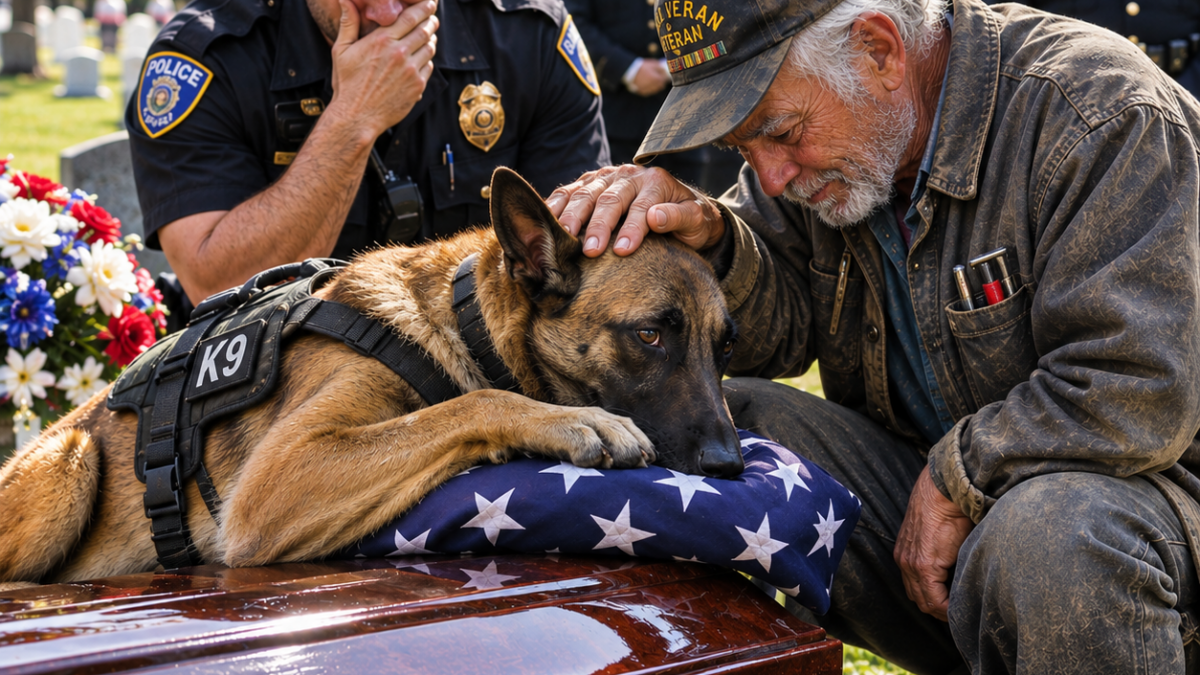
Kaiser wore a black mourning band around his collar.
Officer Luis Ortega held the leash.
Luis was thirty-six.
Daniel’s closest friend on the unit.
He had been named temporary handler because somebody needed legal responsibility for Kaiser until the department decided what came next.
Kaiser walked beside him.
But the dog’s focus stayed on the casket.
During the service, Kaiser did not lie down.
Did not sit unless directed.
He stood.
Watching.
When honor guard officers folded the American flag and presented it to Mara, Kaiser’s ears shifted forward.
Three volleys sounded.
Kaiser flinched once.
Then recovered.
Bagpipes began.
That was when he pulled toward the graveside.
Luis tightened the leash.
“Easy.”
Kaiser pulled harder.
“Easy, Professor.”
The nickname stopped him.
For two seconds.
Then he pulled again.
Mara saw.
She nodded toward Luis.
Let him.
Luis walked Kaiser closer.
The dog reached the edge of the green burial carpet.
Sniffed.
Then lay down.
His body pressed flat against the ground.
Head facing the folded flag now resting in Mara’s lap.
The cemetery emptied slowly.
Police families hugged.
Uniforms disappeared.
Patrol cars left.
News vans packed equipment.
Flowers remained.
The grave crew waited at a respectful distance.
Kaiser did not move.
Luis tried:
“Kaiser. Fuss.”
Heel command.
Nothing.
“Kaiser. Hier.”
Come.
One ear moved.
No response.
Luis crouched.
“Come on, buddy.”
Nothing.
Mara approached.
Kaiser looked at her.
She touched his neck.
“Daniel isn’t there.”
The dog breathed.
“He’s gone.”
Kaiser’s eyes returned to the grave.
Sophie came next.
She knelt.
Put both hands around his face.
“Kai.”
Kaiser licked her wrist.
Then lowered his head again.
Lunch passed.
Cold settled deeper.
Someone brought water.
Kaiser refused.
Food.
Refused.
A tennis ball.
Normally enough to turn him into an idiot.
Nothing.
The K9 commander arrived.
Tried formal commands.
German.
English.
Hand signals.
No reaction beyond occasional ear movement.
At two in the afternoon, Lieutenant Price said:
“We may have to lift him.”
Luis looked horrified.
“He’ll fight.”
“He’s not aggressive.”
“Not what I mean.”
Nobody wanted Kaiser’s last experience beside Daniel’s grave to be four officers physically carrying him away.
So they waited.
Across the two-lane road from Green Hill Cemetery sat an old automotive shop.
WALTER’S GARAGE.
The sign leaned slightly.
Paint faded.
Two service bays.
One vending machine from an era when vending machines apparently survived nuclear war.
A rusted Chevrolet pickup sat near the side fence.
Primer gray.
Orange rust along the wheel wells.
Flat right-rear tire.
Nobody had paid attention to it all morning.
Police vehicles had parked within fifty feet.
Honor guard members had walked past.
Media vans had used the shop driveway to turn around.
Inside the garage, seventy-four-year-old Samuel “Sam” Harlan had watched the funeral from a wooden stool.
Sam had repaired transmissions in Tulsa for forty-six years.
His hands permanently carried black grease in the creases no matter how hard he scrubbed.
White hair.
Thin frame.
Old Army jacket.
Hearing aid in one ear.
He knew Daniel.
Not well.
That was what he told people.
“Not well.”
Daniel brought cruisers to him occasionally when city fleet maintenance was backed up.
More importantly, Daniel had brought police dogs.
Not officially.
The shop had a fenced rear lot.
Sam kept water bowls.
When Daniel needed somewhere quiet to let a K9 decompress after difficult training, he sometimes stopped.
Sam never charged.
Never made a fuss.
Dogs liked him.
Maybe because he smelled like grease, coffee, and old leather.
Kaiser had been there twice.
But twelve years earlier, before Kaiser was born, another dog had spent nearly every afternoon in Sam’s yard.
A black-and-tan German Shepherd named Major.
Daniel’s first K9.
Nobody at the cemetery knew that yet.
At 2:16, Sam crossed the road.
Luis saw him.
“Sir, cemetery’s still closed around this section.”
Sam stopped.
“I know.”
“You family?”
“No.”
“Department?”
“No.”
He looked toward Kaiser.
“Can I try something?”
Luis almost refused.
Then Kaiser raised his head.
The dog had noticed Sam.
Not excited.
Alert.
Sam did not approach directly.
He walked in an arc.
Stopped about eight feet away.
No eye contact.
No hand extended.
Luis asked:
“You know him?”
“Seen him around.”
“That doesn’t mean—”
Sam lifted one hand.
Not at Kaiser.
At Luis.
“Give me a second.”
Then he said one word.
Quiet.
Barely louder than the wind.
“Anchor.”
Kaiser stood.
Every officer near the grave froze.
The dog moved to Sam’s left side.
Perfect heel position.
Shoulder aligned with his knee.
Head up.
Waiting.
Luis stared.
“What did you say?”
Sam did not answer immediately.
He looked down at Kaiser.
Then toward the garage.
“Anchor.”
Kaiser started walking.
Sam moved with him.
Luis followed.
Then Price.
Then two K9 officers.
Mara stood.
“What’s happening?”
Sam looked toward her.
“I think your husband left something unfinished.”
That sentence changed the entire afternoon.
Kaiser led.
Not Sam.
The dog crossed the cemetery lane.
Stopped at the curb.
Waited for traffic.
Then moved toward Walter’s Garage.
His nose stayed high.
Not tracking ground scent.
Navigating.
He passed the first service bay.
Second.
Went around the side.
Straight toward the rusted Chevrolet pickup.
Luis looked at Sam.
“Whose truck?”
“Mine.”
“Last time driven?”
Sam hesitated.
“Three days.”
“You brought it here?”
“Always here.”
Kaiser reached the driver’s door.
Sat.
Looked at Sam.
Then at Luis.
Luis said:
“Kaiser, search.”
Nothing.
Sam whispered:
“Anchor.”
Kaiser stood.
Moved around the truck.
Stopped at the tailgate.
Scratched once.
Then sat again.
Price’s expression changed.
“Open it.”
Sam shook his head.
“Tailgate sticks.”
Luis grabbed the handle.
Nothing.
Sam reached under the bumper.
Pulled a hidden wire release.
Metal groaned.
Tailgate dropped.
Inside:
Old tires.
A tarp.
Two toolboxes.
Lengths of hose.
Nothing obvious.
Kaiser jumped his front paws onto the bumper.
Sniffed.
Whined.
Then stared at a red metal toolbox bolted against the cab.
Sam went pale.
Price noticed.
“What’s in there?”
“Tools.”
“Open it.”
Sam did.
Wrenches.
Socket set.
Grease gun.
Old photographs.
A leather collar.
Luis reached toward the collar.
Sam stopped him.
“Wait.”
At the bottom sat a sealed evidence-style plastic bag.
Not police issue.
Clear freezer bag.
Inside:
A small digital recorder.
A folded envelope.
And a battered brass dog tag.
The tag read:
MAJOR — K9 27.
Daniel Mercer’s first police dog.
Luis looked at Sam.
“What the hell is this?”
Sam sat on the truck bumper.
Suddenly older.
“Something Daniel asked me to keep.”
Mara had crossed the road by then.
Sophie beside her.
Price looked at Sam.
“When?”
“Twelve years ago.”
“Why?”
Sam looked at the brass tag.
“Because that dog saved his life.”
That began another story.
Daniel had joined the K9 unit twelve years earlier.
His first dog, Major, was already six.
Experienced.
Difficult.
Smart enough to manipulate new handlers.
Major’s previous handler retired after a back injury.
Daniel was twenty-nine.
Too confident.
According to Sam:
“He thought the uniform meant the dog should automatically respect him.”
Major disagreed.
The first month was ugly.
Missed commands.
Bad timing.
Arguments between human and dog.
Daniel blamed Major.
Major blamed Daniel.
The training supervisor blamed both.
Then Sam entered the picture.
Major’s original puppy raiser had been Sam’s younger brother, Thomas Harlan.
Thomas worked as a civilian mechanic for a federal training facility and volunteered with working-dog programs.
Major lived with Thomas from eight weeks to fourteen months before entering police training.
During those months Thomas taught him one unusual command.
Anchor.
It meant:
Stop searching.
Return to me.
Stay at my left side until I move.
Not a tactical command.
A grounding command.
Thomas had developed it after Major became overstimulated during early scent work.
Eventually official trainers replaced it with standardized commands.
Anchor disappeared from the dog’s police vocabulary.
Except Major never forgot it.
Thomas died in a workplace accident before Daniel became Major’s handler.
Sam inherited his notebooks.
Photos.
Dog equipment.
And the word.
Daniel discovered the connection accidentally when he brought his cruiser to Sam’s shop.
Major saw Sam.
Froze.
Sam said:
“Anchor.”
The dog immediately moved to heel.
Daniel nearly lost his mind.
“What did you do?”
“Used an old word.”
“What word?”
Sam explained.
Daniel started using it only in private.
Not for police work.
For moments when Major became overwhelmed.
After explosions.
After children screaming.
After one apartment fire where Major searched rubble for forty minutes.
Anchor meant:
Come back.
You are not working now.
You are safe beside me.
Daniel loved it.
Years passed.
Major became Daniel’s best partner.
Then came the Brookside case.
A twelve-year-old girl disappeared.
Major tracked her through drainage channels behind an industrial park.
Found her alive inside an abandoned rail warehouse.
But during the search, a suspect ambushed Daniel.
One shot.
Daniel’s vest stopped it.
Second round struck Major.
The Shepherd still engaged.
Bought Daniel enough time to survive.
Major died at the emergency veterinary hospital.
Daniel never recovered completely.
He returned to work.
Eventually handled another K9.
Then Kaiser.
But after Major died, he stopped using Anchor.
Sam asked once why.
Daniel said:
“That word belongs to him.”
Sam never said it again.
Until the funeral.
Luis looked down at Kaiser.
“That doesn’t make sense.”
Sam nodded.
“I know.”
“Kaiser wasn’t alive.”
“I know.”
“How did he respond to a command from Major?”
Sam looked toward Mara.
“That’s why Daniel came here three days before he died.”
Silence.
Mara stepped closer.
“What?”
Sam pointed toward the recorder.
Daniel had visited the garage on Monday.
Crash happened Wednesday night.
“He was worried about something.”
“What?”
“Wouldn’t tell me all of it.”
“Why didn’t you call us?”
“I didn’t know he was going to die.”
Mara flinched.
Sam immediately regretted the sentence.
“I’m sorry.”
She shook her head.
“Keep going.”
Daniel brought Kaiser.
They spent almost two hours behind the garage.
Daniel asked Sam to say Anchor.
Kaiser did nothing at first.
Daniel rewarded him when he moved toward Sam.
Again.
Again.
By the end:
Anchor meant heel Sam.
Price stared.
“He trained his active police dog to respond to a civilian?”
“Three days before dying?”
Sam nodded.
“Yes.”
“Why?”
Sam looked at the red toolbox.
“Because he thought somebody might need Kaiser to find this if he couldn’t.”
Every police instinct in the yard woke up.
Price told everyone:
“Stop touching anything.”
Scene secured.
Garage closed.
Detectives called.
Internal affairs notified.
Not because Sam was a suspect.
Because Daniel Mercer had apparently prepared a posthumous trail.
Kaiser sat beside the truck.
Calm.
The first time all day he looked calm.
Mara whispered:
“He knew.”
Luis asked:
“What?”
“Daniel knew something could happen.”
Price immediately said:
“We don’t know that.”
Mara looked at him.
“He trained Kaiser to come here.”
Price had no answer.
Detectives photographed the toolbox.
Bag.
Recorder.
Envelope.
Tag.
The envelope had Mara’s name.
They allowed her to open it after processing.
Inside:
One handwritten page.
Mara,
If you’re reading this because Sam had to use Anchor, then I didn’t get the chance to tell you myself.
First: I am sorry.
Second: don’t let Sophie turn me into somebody braver than I was.
Third: trust Kaiser.
He knows the route.
Mara stopped.
Her hands shook.
The final line:
Major taught me that a dog can bring you home before you know you’re lost. Kaiser might have to do it again.
No explanation.
The recorder contained one file.
Daniel’s voice.
Recorded Monday.
“If this gets played, something went wrong.”
He sounded tired.
Not frightened.
“I’ve been reviewing old vehicle-theft reports connected to our K9 training burglaries.”
Price looked at the detectives.
Nobody interrupted.
Over the previous six months, police equipment had disappeared from training facilities.
Nothing major enough to trigger headlines.
Old radios.
Uniform parts.
Retired badges.
Vehicle keys.
K9 bite sleeves.
Blank evidence labels.
License plates awaiting destruction.
Items that seemed unrelated.
Daniel noticed a pattern.
Several stolen objects later appeared in crimes designed to resemble police activity.
A home invasion where suspects wore outdated department jackets.
A vehicle stop involving a fake unmarked cruiser.
A narcotics robbery where witnesses believed officers were involved.
Daniel suspected somebody was collecting discarded law-enforcement equipment to create convincing impersonations.
Then came something worse.
A retired police Tahoe scheduled for auction disappeared from an impound contractor.
Two days later, Daniel found internal paperwork indicating the vehicle had never officially left inventory.
Someone with access was altering records.
Daniel did not know who.
He had told Price he was reviewing paperwork.
He did not tell him why.
Because one name kept appearing near vehicle disposal records.
A civilian fleet contractor named Nolan Greaves.
Greaves had worked around police vehicles for eleven years.
Access.
Keys.
Schedules.
Auction records.
Daniel began following paperwork.
Then license plate camera data.
He discovered Greaves’s personal pickup repeatedly traveling near reported impersonation incidents.
Not proof.
Enough for concern.
Monday, Daniel visited Sam.
Why?
Because Sam’s garage sat opposite the cemetery?
No.
Because Daniel had stored an old retired department GPS unit in the red toolbox months earlier while helping Sam test electrical problems.
He remembered the unit automatically retained route history.
Greaves had borrowed that GPS temporarily during an auction transport.
Daniel believed it might contain data showing the missing police Tahoe’s actual route.
He retrieved the GPS.
Downloaded the route.
Found the Tahoe had traveled not to auction, but to an abandoned farm outside Sand Springs.
He placed the recorder, screenshots, and notes with Sam.
Then trained Kaiser on Anchor.
The rusty pickup was not random.
Kaiser had been taught:
If Daniel was absent and Sam said Anchor, follow Sam to the truck.
The simplest dead-man trail Daniel could devise without electronic messages someone might find.
Then Daniel died.
Vehicle collision.
Another vehicle crossed center line.
Never found.
Suddenly the crash looked different.
Price stopped the recording.
Nobody spoke.
Mara’s face went blank.
“You told me it was an accident.”
Price answered carefully.
“That is still what the evidence showed.”
“Showed.”
“Yes.”
“Past tense.”
“I’m not going to lie to you.”
“We need to reopen parts of it.”
Mara sat down.
Sophie held her arm.
Kaiser moved.
Not toward Luis.
Toward Mara.
He lay beside her boots.
The investigation changed immediately.
Daniel’s crash scene photographs were reviewed.
A paint transfer on the cruiser had originally been attributed to roadway debris.
Lab retesting identified automotive paint.
Dark green.
Older formulation.
Traffic camera footage twelve miles away showed a dark green pickup traveling without headlights twenty minutes after the crash.
Partial plate.
Not enough.
Daniel’s recorder gave detectives reason to examine Greaves.
His registered vehicle:
Dark green 2008 Ford F-250.
Greaves claimed it had been broken for weeks.
It was not at his house.
He said he sold it.
No bill of sale.
Investigators searched the abandoned farm tied to the GPS route.
They found the missing retired police Tahoe inside a metal barn.
Along with:
Uniforms.
Magnetic police lights.
Stolen plates.
Radios.
Fake warrant paperwork.
Body armor.
Evidence bags.
And parts from a dark green F-250.
Greaves had dismantled his own truck.
The front bumper was missing.
One headlight assembly replaced.
Forensic comparison matched paint from Daniel’s cruiser.
But the story was not as simple as:
Greaves murdered Daniel because Daniel discovered him.
Investigators found two accomplices.
One was a former towing company employee.
The other:
A reserve deputy from a neighboring county.
They had been using retired police equipment to stop drug couriers they believed would never report being robbed.
Greaves handled vehicles.
The former tow employee found targets.
The reserve deputy supplied procedural knowledge.
Daniel had unknowingly driven close to their farm the night he died while responding to a domestic disturbance nearby.
Greaves saw Daniel’s cruiser.
Panicked.
Believed Daniel was coming for him.
He followed.
On the rural road, he attempted to force Daniel to stop.
Pulled alongside.
Crossed the center line.
Daniel swerved.
Crash.
Greaves fled.
He had not planned a murder.
It did not matter to Mara.
Daniel was still dead.
Charges came.
Vehicular homicide.
Conspiracy.
Police impersonation.
Robbery.
Evidence tampering.
Multiple other offenses.
The reserve deputy was arrested at his home.
The tow employee surrendered.
Greaves ran.
For two days.
Then Kaiser found him.
The department hesitated to deploy the dog.
Luis had become temporary handler, but Kaiser was grieving.
His performance had been inconsistent.
Price asked:
“You ready?”
Luis looked at Kaiser.
“I don’t know.”
Sam was there.
He had become unexpectedly central to everything.
He stood beside the K9 vehicle.
“Kaiser.”
The dog looked at him.
Sam whispered:
“Anchor.”
Kaiser moved into heel.
Luis watched.
Sam then looked at the dog.
“This isn’t your job with me.”
He stepped back.
Luis gave the working command.
Kaiser turned toward him.
Perfect focus.
Two different relationships.
Anchor meant safe.
Luis’s command meant work.
The dog tracked Greaves from an abandoned stolen car into wooded land near Keystone Lake.
Three miles.
Cold rain.
Mud.
Kaiser found Greaves hiding beneath an overturned aluminum boat near an old fishing shack.
No dramatic attack.
Greaves surrendered when officers surrounded him.
Kaiser barked.
Luis recalled.
The dog returned instantly.
For the first time since Daniel died, Luis smiled.
“Good boy.”
Kaiser sneezed in his face.
Sam laughed.
“Professor has opinions.”
Luis stared at him.
“Daniel called him that.”
Sam looked toward Kaiser.
“Major too.”
That stopped Luis.
“What?”
Sam smiled.
“Daniel stole the nickname.”
Some grief hurts less when you discover the dead borrowed things from people they loved.
Kaiser’s future became another question.
Police departments have policies.
Dogs are equipment legally.
Living equipment, but contracts and liability still exist.
Kaiser was seven.
Healthy enough to work.
Luis could be certified with him.
Mara could petition for retirement placement.
Sophie wanted him home.
Everyone had opinions.
Mara surprised them.
“Let him choose work for now.”
Price asked:
“You sure?”
“No.”
She looked at Kaiser.
“But Daniel loved the job.”
“And Kaiser loves the job.”
“What about Sophie?”
“She loves him enough not to make him become a couch because we miss Daniel.”
Luis completed transition training.
The first months were difficult.
Kaiser searched the parking lot for Daniel’s cruiser.
Stopped when voices resembled Daniel’s over radio.
Refused to enter one training field because Daniel’s scent still lingered in equipment storage.
Luis never tried to replace him.
That was important.
He did not use Daniel’s nicknames at first.
Did not sit in Daniel’s old chair at the K9 office.
Did not expect Kaiser to transfer loyalty like a badge number.
They built something different.
Luis was quieter.
More patient.
Daniel had worked dogs through intensity.
Luis worked through repetition.
Kaiser adjusted.
Slowly.
Mara and Sophie remained part of his life.
Every Sunday, Luis brought Kaiser to their house.
No uniform work.
No training.
Just yard.
Tennis ball.
Kitchen floor.
Sophie sometimes lay beside him doing homework.
Kaiser slept against her back.
Mara kept Daniel’s patrol jacket on a hook in the garage.
For months Kaiser smelled it every visit.
Then one Sunday he walked past without stopping.
Mara cried after.
Not because he forgot.
Because he had learned memory did not require checking.
Sam visited too.
Usually with greasy paper bags containing hamburgers he was explicitly told not to feed Kaiser.
“You trying to kill him?”
Luis asked.
Sam removed the onions.
“Health food.”
“You’re seventy-four.”
“Exactly. Clearly working.”
The brass Major tag returned to Sam after the investigation.
He tried giving it to Mara.
She refused.
“Daniel left it with you.”
Sam stared at the old tag.
“He belonged to Daniel.”
“And before that, part of him belonged to your brother.”
Sam nodded.
He hung Major’s tag on the garage wall beside an old photograph of Thomas.
Daniel.
Major.
Three people and a dog tied together by years nobody had planned.
One year after Daniel’s funeral, the department held a memorial run.
Mara hated public ceremonies by then.
Too many speeches about sacrifice.
Too many people telling Sophie her father was a hero when she mostly missed him forgetting to buy milk.
They attended anyway.
Kaiser walked with Luis.
At the end, the route passed Green Hill Cemetery.
Luis looked toward Mara.
She nodded.
They stopped.
Kaiser walked to Daniel’s grave.
No leash tension.
No collapse.
No refusal.
He sniffed the grass.
Sat.
Sophie knelt.
“Hey, Kai.”
He licked her chin.
She laughed.
Then cried.
Kaiser stood.
Walked once around the stone.
Returned to Luis.
Heel.
No command.
Mara watched.
“You ready?”
Luis asked.
Kaiser looked forward.
They walked away.
Sam stood across the road at the garage.
Same place where he had watched the funeral.
Mara crossed to him.
“You knew he’d get up that day.”
Sam shook his head.
“No.”
“You used Anchor.”
“I hoped.”
“What did Daniel tell you?”
Sam leaned against the rusted pickup.
It had new tires now.
Still ugly.
“He told me if something happened and Kaiser shut down, the word might give him a direction.”
Mara looked toward the cemetery.
“He thought of everything.”
Sam shook his head.
“No.”
“He thought of one thing.”
“What?”
“That grief needs somewhere to go.”
Mara looked at him.
Sam tapped the pickup.
“Major taught him that.”
“Kaiser brought us here.”
“Then the evidence gave everybody something to do.”
“Find the truth.”
“Catch the men.”
“Train with Luis.”
“Visit you.”
“Walk away from that grave eventually.”
He shrugged.
“Direction.”
Mara was quiet.
Then asked:
“Why Anchor?”
Sam smiled faintly.
“My brother used to sail.”
“Thomas?”
“Yep.”
“He said an anchor wasn’t only something that stopped you.”
“It told you where you were.”
Mara looked at Kaiser across the road.
That became the phrase Sophie remembered.
An anchor tells you where you are.
Kaiser served eighteen more months.
Then arthritis in his shoulders worsened.
Nothing dramatic.
No final heroic capture.
No gunfight.
Just age.
The department retired him.
Luis wanted him.
Mara wanted him.
Sophie solved the argument.
“He gets two houses.”
That became the arrangement.
Weekdays mostly with Luis because Kaiser had grown attached to his new handler.
Weekends with Mara and Sophie.
Sam’s garage whenever he wanted.
Official paperwork listed Luis as owner.
Kaiser disagreed with the concept.
He belonged to his route.
At Mara’s house he slept beside Daniel’s old recliner.
At Luis’s, he slept near the front door.
At Sam’s garage, he lay beneath the rusted pickup.
Never beside the expensive restored cars.
Always the ugly truck.
Sam said:
“He appreciates history.”
Two years after retirement, Sam’s health declined.
Heart failure.
He closed the garage.
Sold most equipment.
Kept the building.
Kept the truck.
One afternoon Luis brought Kaiser.
Sam sat in a lawn chair inside the first bay.
Oxygen line beneath his nose.
Kaiser walked in.
Paused.
Sam looked at him.
“Professor.”
The dog’s ears lifted.
Sam smiled.
“Anchor.”
Kaiser moved to his left side.
Perfect heel.
Sam rested one hand on the dog’s head.
“Still works.”
Luis stood near the door.
Kaiser sat.
Sam said:
“You know why Daniel taught you that?”
The dog looked up.
“Neither do I.”
He laughed.
Then coughed.
Kaiser remained.
Sam died three weeks later.
His garage went to a nephew.
The rusted pickup went to Sophie.
She was sixteen by then.
Could not drive stick.
Did not care.
Her mother was horrified.
“That thing is a tetanus infection with headlights.”
“It was Grandpa Sam’s.”
“He was not your grandfather.”
Sophie looked at Mara.
Mara sighed.
“Fine.”
They restored it slowly.
Not completely.
Sophie insisted the rust stay visible.
“She earned it.”
The truck got new brakes.
Engine rebuild.
Seat covers.
Tires.
The red toolbox remained bolted behind the cab.
Empty now except for one thing.
A replica of Major’s brass tag.
The original stayed at the garage wall.
Kaiser grew old.
His muzzle whitened.
Hearing faded.
One rear leg stiffened.
He slept more.
But sometimes, when Sophie visited Luis’s house, she would drive the restored pickup.
Kaiser could hear the old engine before anybody else.
He would rise.
Walk to the window.
Tail moving.
The last year of Kaiser’s life, he developed cancer.
Hemangiosarcoma.
Aggressive.
Unfair.
Veterinarian gave them options.
Surgery might add time.
Maybe months.
Kaiser was eleven.
Luis asked Mara:
“What would Daniel do?”
She shook her head.
“We’re not asking dead people to make this one.”
They chose comfort.
Good days.
Short walks.
Food he was never allowed during active service.
Sam would have approved.
Sophie brought cheeseburgers.
On Kaiser’s final afternoon, they went to the cemetery.
Not because they wanted some cinematic ending.
Because Kaiser kept refusing to settle in the car and repeatedly oriented toward the old route.
Luis finally said:
“Let’s see.”
They drove.
Green Hill Cemetery.
Cold spring wind.
Mara.
Sophie.
Luis.
Kaiser.
Nobody else.
The dog walked slowly.
They did not lead him toward Daniel.
He found the grave.
Of course he did.
Stopped beside it.
Sniffed the stone.
Then lay down.
Mara’s chest tightened.
The old fear returned.
The funeral.
Refusing to leave.
Luis whispered:
“Not again.”
Kaiser rested his head on his paws.
Sophie sat beside him.
“It’s okay.”
He breathed.
Heavy.
Tired.
Luis tried the recall.
Nothing.
Mara looked across the road.
Walter’s Garage had a new sign now.
HARLAN AUTO.
Same bays.
Same fence.
The old pickup was parked near the cemetery because Sophie had driven it.
She suddenly understood.
“Mom.”
“What?”
“The word.”
Mara looked at her.
Sophie knelt beside Kaiser.
Not commanding.
Just close.
She whispered:
“Anchor.”
Kaiser’s ears moved.
He lifted his head.
For one second, everybody stopped breathing.
Then the old Malinois stood.
Slowly.
Painfully.
He moved to Sophie’s left side.
Not perfect anymore.
Hip too stiff.
Shoulders weak.
But close.
Heel.
Sophie cried.
“Okay.”
Kaiser looked toward the pickup.
She opened the passenger door.
Luis helped him climb in.
Kaiser settled on the seat.
His head near the open window.
They drove home.
Not away from Daniel.
Home.
Kaiser died that night on a blanket in Luis’s living room.
Mara and Sophie were there.
No uniform.
No cemetery.
No commands.
Just people.
Luis held Kaiser’s paw.
Sophie rested against his shoulder.
Mara stroked the gray fur between his ears.
Before his breathing stopped, Sophie whispered:
“You found the truck.”
“You found Dad.”
“You found all of us.”
Kaiser’s eyes remained half open.
She corrected herself.
“No.”
“You brought us back.”
His final breath came quietly.
The department offered a formal K9 memorial.
They held one.
Smaller than Daniel’s.
Mara requested no rifles.
No sirens.
No speeches longer than five minutes.
Kaiser’s ashes were divided.
Part with Luis.
Part with Mara and Sophie.
A small portion placed beside Daniel’s grave.
And beneath Daniel’s memorial plaque, Sophie asked permission to add one line.
Not about arrests.
Not about service years.
Not about heroism.
One word.
ANCHOR.
People asked what it meant.
Sophie usually said:
“It was an old dog command.”
That was technically true.
But those closest to the story understood more.
Twelve years before Kaiser ever heard it, Anchor had belonged to Major.
A frightened working dog.
Then Daniel.
A young handler trying to become better.
Then Sam.
An old mechanic keeping his brother’s memory alive.
Then Kaiser.
A grieving Malinois lying beside a dead handler’s grave.
Then Luis.
Mara.
Sophie.
A police department that needed evidence.
A family that needed truth.
The word never meant:
Forget.
It never meant:
Move on.
It meant:
Come back to where you are.
Know who is beside you.
Stop searching for the person you cannot bring back long enough to see the people still standing there.
The day of Daniel Mercer’s funeral, everyone believed Kaiser refused to leave because he could not understand death.
We were wrong.
The dog understood something the rest of us had missed.
Daniel had given him one final job.
Not to guard the grave.
Not to mourn forever.
To find the route.
The old mechanic supplied the word.
Kaiser supplied the memory.
And behind a rusted pickup everyone had ignored sat the truth Daniel died trying to protect.
Years later, whenever Sophie drove that restored truck past Green Hill Cemetery, she slowed.
Never stopped for long.
On the passenger-side dashboard she kept two brass tags.
MAJOR — K9 27.
KAISER — K9 411.
And beneath them, scratched into a small strip of aluminum, one sentence Sam had once told her mother:
AN ANCHOR DOESN’T ONLY STOP YOU.
IT TELLS YOU WHERE YOU ARE.
Sophie always touched that strip before continuing down the road.
Then she drove home.








