A Police K9 Found an 81-Year-Old Woman Alive in a Ravine—Then He Wouldn’t Leave Her Cane Until Deputies Looked Beneath the Handle
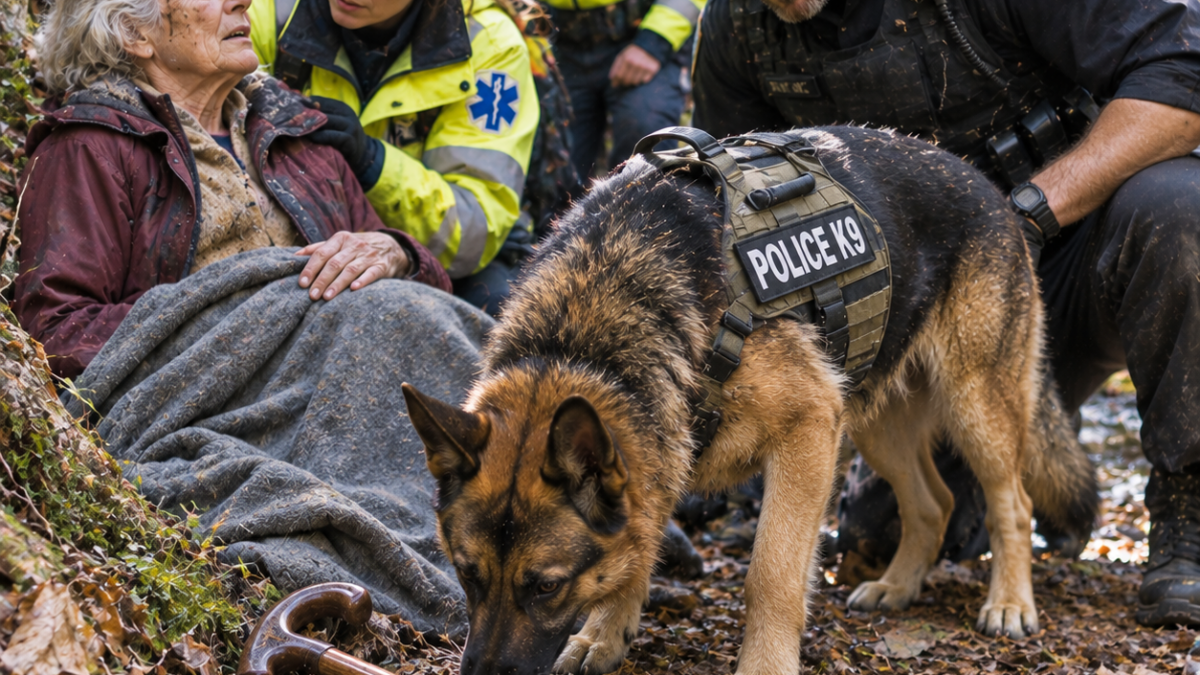
A Police K9 Found an 81-Year-Old Woman Alive in a Ravine—Then He Wouldn’t Leave Her Cane Until Deputies Looked Beneath the Handle.
After an entire freezing night alone in the North Carolina woods, eighty-one-year-old Eleanor Whitmore was found alive at the bottom of a ravine only because police K9 Loki refused to abandon a scent trail everyone else believed had disappeared at the creek.
But while paramedics prepared to carry Eleanor uphill, Loki ignored the rescuers and returned to her battered wooden walking cane, repeatedly sniffing the rubber grip until his handler realized something had been deliberately hidden inside the hollow shaft.
What Deputy Luke Serrano pulled out was a tiny brass key wrapped in a thirty-year-old military photograph—and when Eleanor saw it, she began crying because her family had been searching for both since the night her husband died.
At 5:47 on Thursday morning, the search commander said the word nobody wanted to hear.
“Temperature?”
“Twenty-eight.”
Deputy Luke Serrano looked toward the tree line.
Dark.
Wet.
Silent.
A hard frost covered the weeds beside the gravel road.
His police K9, Loki, stood near the rear bumper of the patrol SUV, nose lifted into the wind.
The seven-year-old German Shepherd had worked almost continuously since midnight.
Luke could see fatigue beginning to settle into him.
Not enough to stop.
Enough to matter.
Loki’s black-and-tan coat was wet from crossing two creeks.
Mud covered his legs.
A thorn had caught the fur beneath one eye.
His tongue hung slightly farther than normal.
Luke knelt.
“You still with me?”
Loki looked at him.
Luke scratched the dog’s neck.
“Stupid question.”
The search had begun eleven hours earlier.
Eleanor Whitmore disappeared Wednesday afternoon from her daughter’s farmhouse outside Asheville.
Eighty-one.
Early arthritis.
Mild hearing loss.
No dementia diagnosis.
No history of wandering.
She had walked alone almost every evening for seventeen years.
Same route.
Mailbox.
Gravel lane.
Old cemetery.
Back through the eastern pasture.
Half a mile total.
Her daughter, Claire Whitmore, had never worried about it.
Not until 7:10 Wednesday night when she looked outside and realized her mother’s porch light was on but Eleanor was not home.
At first Claire searched herself.
Barn.
Pasture.
Cemetery.
Road.
Neighbors.
At 8:02 she called 911.
By 9:00, sheriff’s deputies were searching.
By 10:00, volunteer fire crews.
PART2:
By midnight, Luke and Loki had arrived.
Eleanor’s age made every hour dangerous.
The cold made it worse.
She wore a wool sweater beneath a light brown coat.
No hat.
No gloves.
Walking shoes.
And carried the same dark hickory cane she had used since hip surgery three years earlier.
Claire provided a pillowcase from Eleanor’s bed.
Loki took scent.
Immediately led them east.
Not toward Eleanor’s normal walking route.
That bothered Luke.
“She always goes west?”
Claire had nodded.
“Always.”
“Never this way?”
“There’s nothing east except woods.”
Luke looked at Loki.
The dog had already chosen.
“Tonight she went east.”
They followed.
For four hours.
Across pasture.
Over a fence.
PART3:
Along an abandoned logging trail.
Down toward Blackstone Creek.
Then the scent became difficult.
Cold air pooled near water.
Volunteer traffic contaminated the ground.
Two deer crossed.
Another search dog worked from the opposite direction.
Loki lost the trail three times.
Recovered it three times.
At 4:38, they found one glove.
Gray wool.
Claire identified it.
“My mother’s.”
Twenty minutes later, a torn piece of brown fabric caught on blackberry brambles.
Same color as Eleanor’s coat.
The trail entered steeper terrain.
Luke’s concern became fear.
An eighty-one-year-old woman had no business walking there even in daylight.
At 5:16, Loki stopped beside Blackstone Creek.
Sniffed.
Crossed.
Returned.
Crossed again.
Sergeant Mara Collins stood behind Luke.
“Water loss?”
“Maybe.”
She shined her flashlight upstream.
“Could she have fallen in?”
“Don’t know.”
Loki moved twenty yards downstream.
Climbed the bank.
Then turned sharply.
Luke followed.
The dog began pulling.
Hard.
“Got something?”
Loki accelerated.
Branches snapped beneath Luke’s boots.
Mara followed.
Another deputy, Caleb Ross, stayed on radio behind them.
The terrain dropped.
Luke nearly fell.
“Slow.”
Loki did not.
Then the German Shepherd barked.
One.
Sharp.
Again.
Luke recognized the tone.
Person.
He slid down the slope.
“Eleanor!”
Nothing.
Loki barked again.
They reached the edge of a ravine.
Maybe twenty feet deep.
Rock.
Leaves.
Fallen branches.
Luke’s flashlight swept downward.
Brown coat.
He stopped breathing.
“Got her!”
Mara immediately transmitted coordinates.
Luke descended.
Loki moved faster.
At the bottom, Eleanor Whitmore lay curled beside a fallen maple trunk.
One leg trapped awkwardly beneath her.
Her face pale.
Eyes closed.
Walking cane several feet away.
Luke reached her.
“Mrs. Whitmore?”
Nothing.
He touched her neck.
Pulse.
Weak.
Present.
“Alive!”
Mara exhaled audibly from above.
Luke removed one glove.
Touched Eleanor’s cheek.
Cold.
Too cold.
“Eleanor.”
Her eyelids moved.
Luke leaned closer.
“My name is Luke.”
Her lips parted.
No sound.
“Help’s coming.”
Loki moved beside her.
Sniffed her face.
Then her hands.
Eleanor’s eyes opened slightly.
She saw the dog.
For a second confusion.
Then she whispered:
“Wolf?”
Luke laughed despite himself.
“No, ma’am.”
Loki licked her knuckles.
“Police dog.”
Eleanor’s mouth moved.
“Handsome.”
Luke smiled.
“He’s going to be unbearable when I tell him.”
Loki did not care.
He sniffed along her body.
No major blood.
No obvious severe injury.
Eleanor’s left ankle looked swollen.
Possible fracture.
Main concern remained hypothermia.
Luke wrapped her in an emergency blanket.
Mara reached them with additional gear.
“Medical’s eight minutes.”
Eleanor tried lifting her head.
“My cane.”
Luke glanced.
“Right there.”
“Don’t lose it.”
“We won’t.”
She gripped his sleeve weakly.
“Promise.”
Luke looked at her.
Something in her expression made him take the request more seriously than an old woman worrying about property.
“I promise.”
Her hand relaxed.
By 6:09, paramedics had reached the ravine.
Core temperature dangerously low but survivable.
Ankle fracture.
Dehydration.
Cuts.
No obvious head injury.
They placed Eleanor onto a rescue litter.
Claire had been informed.
Luke heard her crying over radio.
The medics prepared the rope system for extraction.
Luke collected Eleanor’s belongings.
One glove.
Small purse.
Walking cane.
He picked up the cane.
Heavy.
Dark hickory.
Polished nearly smooth from years of use.
Brass collar near the handle.
Black rubber grip at bottom.
Nothing unusual.
He leaned it against a tree.
Loki immediately walked toward it.
Sniffed.
Luke ignored him.
The dog sniffed again.
Then began working upward from the rubber tip.
“Leave it.”
Loki looked at Luke.
Returned to the cane.
Sniffed the grip.
Mara noticed.
“What’s he doing?”
“No idea.”
“Human scent.”
“Obviously.”
Loki pawed the cane.
Luke frowned.
“Hey.”
The dog sniffed the rubber grip again.
Hard.
Then pawed.
Eleanor heard the scratching.
From the litter she turned her head.
“Loki.”
Luke looked at her.
She had remembered his name.
“Ma’am?”
Her eyes went toward the cane.
Then away.
Luke caught it.
Not concern about an ordinary mobility aid.
Something else.
He picked up the cane.
Loki immediately pushed his nose against the bottom.
“What?”
Mara crouched.
“Food inside?”
Luke laughed.
“Emergency cane bacon?”
“Old people carry stranger things.”
Eleanor whispered:
“No.”
Luke looked over.
“No what?”
Her face tightened.
“Leave it.”
Luke froze.
Mara looked at him.
Loki sniffed again.
Luke noticed scratches around the rubber grip.
Not random.
Fine circular marks.
As though it had been removed repeatedly.
He turned the cane.
The grip rotated slightly.
Luke stopped.
“This comes off.”
Eleanor closed her eyes.
“Please.”
Luke looked toward her.
“Mrs. Whitmore, is there medication inside?”
No answer.
“If there’s anything medical, paramedics need to know.”
“It isn’t medicine.”
Luke’s curiosity sharpened.
“Is it dangerous?”
“No.”
“Weapon?”
Eleanor almost laughed.
“At eighty-one?”
“I’ve met eighty-one-year-olds.”
That earned the faintest smile.
Then her expression turned serious.
“It belongs to my husband.”
Luke looked at the cane.
“Your husband?”
“He’s dead.”
Luke waited.
Eleanor whispered:
“Nine months.”
Mara exchanged a glance with him.
Luke looked at the paramedic.
The medic shrugged.
Extraction could wait another minute while the rope team finalized rigging.
Luke twisted the rubber grip.
It resisted.
Then released.
Inside the hollow cane shaft was a tightly rolled piece of plastic.
Loki immediately sniffed.
Luke carefully pulled it out.
Not plastic.
A small waterproof sleeve.
Inside was a folded photograph wrapped around something metallic.
Luke opened it.
A brass key.
Tiny.
Old.
Number stamped:
And the photograph.
Four young American soldiers standing beside a helicopter.
Vietnam-era uniforms.
Faded colors.
One man holding a black dog.
On the back:
DA NANG — 1968
WALTER, HENRY, FRANK, SAM
WE ALL COME HOME OR NONE OF US DO.
Luke stared.
Eleanor began crying.
Not quietly.
Her whole face crumpled.
“Oh, Walter.”
Luke walked toward her.
“You knew this was inside?”
She nodded.
“Since when?”
“Yesterday.”
Luke looked at the key.
“What does it open?”
Eleanor closed her eyes.
“My family has been asking that for thirty years.”
The rope team arrived.
Questions had to wait.
Eleanor was carried out.
Loki climbed beside the litter whenever terrain allowed.
Luke carried the cane.
Carefully now.
Like evidence.
Not criminal evidence.
Something heavier.
At the top of the ravine, Claire Whitmore ran toward her mother.
Fifty-three.
Red hair beneath a knit cap.
Eyes swollen from crying.
“Mom!”
Eleanor lifted one hand.
Claire took it.
“You scared ten years off my life.”
Eleanor whispered:
“Then we’re even.”
Claire laughed and sobbed at the same time.
Paramedics moved toward the ambulance.
Luke followed.
“Ms. Whitmore?”
Claire turned.
“Thank you.”
“Loki did the finding.”
She immediately knelt.
Loki accepted both hands against his face like this was appropriate tribute.
Claire cried into his fur.
“You beautiful boy.”
Luke gave him a look.
“Told you.”
Then Claire noticed the cane.
Her expression changed.
“You found it.”
Luke frowned.
“What?”
“The cane.”
She stood.
“Mom’s been obsessed with that thing since Dad died.”
Eleanor looked sharply from the stretcher.
“Claire.”
“What?”
“Not here.”
Luke looked between them.
“What’s going on?”
Claire wiped her face.
“My father’s name was Walter Whitmore.”
Luke glanced at the photograph in his pocket.
“Vietnam?”
Claire stopped.
“How do you know that?”
Luke slowly removed the sleeve.
Eleanor covered her eyes.
Claire stared.
“No.”
Luke handed her the photograph.
Claire’s hands began trembling.
“Where did you get this?”
“Inside the cane.”
Her eyes moved to the brass key.
She stopped breathing.
“Mom.”
Eleanor looked away.
Claire whispered:
“You had it?”
“Not until yesterday.”
Claire stared at her mother.
“We searched everything.”
“I know.”
“Dad’s desk.”
“I know.”
“The attic.”
“I know.”
“The bank.”
“I know.”
“His truck.”
“I know, Claire.”
“You told us you didn’t know where it was.”
“I didn’t.”
Claire looked furious now.
Not with Luke.
With nine months of unanswered questions.
“Then how did it get inside your cane?”
Eleanor’s eyes filled.
“Your father put it there.”
“When?”
“I found the note yesterday morning.”
“What note?”
Eleanor looked at Luke.
Then at all the deputies.
“This is family business.”
Luke nodded.
“Understood.”
He handed the items to Claire.
Eleanor immediately said:
“No.”
Claire stopped.
“Mom?”
“Give them to the deputy.”
Luke frowned.
“Why?”
Eleanor looked at him.
“Because Walter said if the key was ever found, somebody outside the family should be there when we opened what it belongs to.”
Claire went completely still.
“What did Dad get us into?”
Eleanor whispered:
“Nothing bad.”
Then looked toward the photograph.
“I think he was trying to give something back.”
The ambulance doors closed.
Eleanor went to Mission Hospital.
Loki went home and ate two breakfasts.
Luke got three hours of sleep.
At noon, Sheriff Grant Ives called.
“Whitmore family wants you at their house.”
Luke stared at the ceiling.
“Why?”
“Something about a key.”
“I’m K9 patrol.”
“They specifically asked for you.”
“Can I bring the dog?”
“Apparently the old lady insisted.”
Luke looked toward Loki, who was upside down on the living-room floor.
“Of course she did.”
The Whitmore farmhouse sat on thirty acres outside Asheville.
White siding.
Green roof.
Old apple trees.
A barn leaning slightly east.
Walter and Eleanor had bought the property in 1974.
Raised three children there.
Claire lived in a smaller house across the field.
Luke arrived at 2:10.
Eleanor was already home.
Against medical advice, apparently.
Left ankle in a boot.
Wrapped in blankets on the living-room sofa.
Luke stared.
“You escaped the hospital.”
Eleanor smiled.
“They said I could leave.”
Claire from the kitchen:
“They said she should stay.”
“Difference.”
Luke shook his head.
Loki immediately walked to Eleanor.
She touched his ears.
“My handsome wolf.”
“Please don’t encourage him.”
Three other family members were present.
Claire.
Her older brother Michael Whitmore, fifty-seven.
Younger sister Ruth Callahan, forty-nine.
And Claire’s twenty-four-year-old son, Ben.
All looked exhausted.
All kept glancing at the brass key on the coffee table.
Luke sat.
“Someone tell me why I’m here.”
Michael answered.
“Because our father left instructions.”
“What instructions?”
Eleanor handed Luke an envelope.
Old.
Cream-colored.
Walter’s handwriting:
ELLIE — IF YOU FIND THE SMALL ENVELOPE IN MY VETERANS PAPERS, TAKE THE CANE APART. CALL THE KIDS. DO NOT OPEN BOX 317 WITHOUT A WITNESS WHO ISN’T FAMILY.
Luke looked up.
“Box 317.”
Claire nodded toward the key.
“Exactly.”
“Where is the box?”
Nobody answered.
Luke sighed.
“You don’t know.”
Michael rubbed his face.
“We’ve been looking for thirty years.”
“For a box?”
“For something connected to 317.”
Ruth explained.
Walter Whitmore served in Vietnam from 1967 to 1969.
Army helicopter crew chief.
He returned home with few possessions and almost no willingness to discuss the war.
But when the children were young, Walter occasionally mentioned three men.
Henry Caldwell.
Frank Mallory.
Samuel Bishop.
The men in the photograph.
All part of his aviation unit.
Henry died in 1971.
Frank in 1986.
Sam disappeared after the war.
“Disappeared how?”
Luke asked.
Michael shrugged.
“No one knew.”
Then in 1994, Walter received a package.
No return address.
Inside:
A brass key.
A photograph.
And a note.
Eleanor had seen only the note once.
“What did it say?”
She closed her eyes.
“Walter read it.”
“Then burned it.”
Claire leaned forward.
“You never told us that.”
“You were children.”
“I was twenty-one.”
“Still a child when I wanted you to be.”
Claire rolled her eyes.
Luke almost smiled.
Eleanor continued.
“The note said Henry had kept his promise.”
“Which promise?”
“We all come home or none of us do.”
Luke looked at the photograph.
The phrase written on the back.
Eleanor nodded.
“Walter became obsessed.”
“With what?”
“Finding Sam.”
Luke frowned.
“Samuel Bishop?”
“Yes.”
“What happened to him?”
“Walter believed he survived Vietnam.”
“But?”
“He never came home.”
Officially Samuel Bishop had been listed missing in action in 1968.
Then presumed dead.
But Walter never accepted it.
“Why?”
Eleanor looked at the photograph.
“Because Walter watched him leave.”
Luke stared.
“Leave Vietnam?”
“No.”
“Leave the crash.”
Silence.
The story came slowly.
September 1968.
Walter’s helicopter went down during a night extraction near the Cambodian border.
Pilot killed.
Two crew wounded.
Walter survived.
Frank survived.
Henry survived.
Sam survived initially.
The helicopter burned.
Enemy patrols nearby.
The men split while trying to reach friendly forces.
Sam was carrying sensitive maps and radio codes.
He told Walter he would draw enemy troops away.
Then disappeared into the jungle.
Walter’s group was rescued the following day.
Sam was not.
Searches found nothing.
No body.
No equipment.
No dog tags.
He became MIA.
“But Dad thought he lived?”
Claire asked.
“Always.”
“How?”
Eleanor’s voice softened.
“Because three months after Walter returned to his unit, someone left Sam’s unit patch beneath his pillow.”
Luke felt a chill.
“On base?”
“In Vietnam.”
“Could’ve been someone else.”
“Walter knew.”
“How?”
“Inside the patch was a stitch pattern.”
She looked embarrassed.
“Sam’s mother taught him to sew.”
“Walter said he repaired everything with the same ugly cross stitch.”
Luke smiled.
“Reasonable.”
“After that?”
“Nothing for twenty-six years.”
Then came the 1994 package.
The key.
Photograph.
Note saying Henry kept his promise.
Except Henry Caldwell had died twenty-three years earlier.
“That doesn’t make sense.”
Luke said.
Eleanor nodded.
“Exactly.”
Walter spent years trying to decode 317.
Bank lockers.
Military storage.
Veterans organizations.
Old addresses.
Nothing.
Eventually he stopped talking about it.
The key disappeared.
The photograph too.
Eleanor assumed Walter had thrown them away.
Until after he died nine months earlier.
While sorting his veterans papers, the family found repeated references:
H.C.
S.B.
One line:
ELI HAS IT.
Nobody knew Eli.
Another:
DON’T LET THE KIDS OPEN IT UNTIL THEY KNOW ABOUT SAM.
Then another:
CANE.
But the cane had no obvious compartment.
They checked the handle.
Nothing.
Walter’s note found yesterday explained the rubber grip.
Eleanor discovered the key inside.
Then decided to walk.
Claire stared.
“You went into the woods because of the key?”
Eleanor looked guilty.
“Partly.”
Luke sat straighter.
“Why?”
Eleanor looked toward the window.
“Because I knew what 317 was.”
Everyone froze.
Michael stood.
“Mom.”
She nodded.
“I remembered yesterday.”
Claire almost shouted:
“You remembered?”
“Not the box.”
“The number.”
“Where?”
Eleanor looked at Luke.
“Train station.”
“What train station?”
“Old Asheville depot.”
Luke frowned.
“There’s no passenger station operating there.”
“Not anymore.”
Walter used to bring Eleanor there in the 1970s.
Locker banks lined one wall.
Numbers.
Luke stared at the brass key.
“Railway locker.”
“Maybe.”
Claire looked at her mother.
“Why walk east into the woods?”
“I wasn’t going to the depot.”
“Then where?”
Eleanor sighed.
“Walter hid things in the old cemetery.”
Everyone stared.
Luke almost laughed.
“You people have unusual family traditions.”
Eleanor smiled.
“Walter didn’t trust banks.”
She remembered he had once told her:
“If I die before I settle Sam’s business, look beneath Henry.”
Henry Caldwell had a memorial marker in the old cemetery near their farm.
Not a grave.
Henry was buried in Ohio.
Walter paid for a small memorial stone anyway.
Yesterday Eleanor walked there.
Found nothing.
Then remembered another Henry.
A dog.
Luke frowned.
“What?”
Eleanor smiled faintly.
“Walter had a black Labrador named Henry after the war.”
The dog was buried east of the pasture.
Near the woods.
Eleanor went looking for the old marker.
Got turned around.
Followed the wrong logging trail.
Fell into the ravine after dark.
Luke exhaled.
“So this entire search happened because your husband made a scavenger hunt spanning fifty years.”
Eleanor looked offended.
“He would’ve called it contingency planning.”
Claire laughed despite herself.
“Dad absolutely would.”
Luke stood.
“Where is the dog buried?”
Eleanor pointed through the eastern window.
“Past the barn.”
They went.
Loki led because Loki believed every outdoor trip belonged to him.
Behind the barn, beneath an enormous oak, lay a weathered flat stone.
HENRY
1970–1983
GOOD DOG. BAD JUDGE OF SKUNKS.
Luke laughed.
“I like Walter.”
Eleanor smiled.
“So did Henry.”
Michael brought shovels.
They searched carefully around the marker.
Luke felt ridiculous.
Then Loki began sniffing.
Of course.
He moved behind the stone.
Pawed once.
Luke looked at him.
“Seriously?”
Loki pawed again.
They dug.
Six inches.
Nothing.
Ten.
Metal.
Claire dropped to her knees.
A small ammunition box emerged.
Rusty.
Sealed inside a plastic bag.
Eleanor covered her mouth.
“Oh, Walter.”
Luke carried it inside.
On the lid:
The brass key fit.
No one touched it at first.
Luke looked at Eleanor.
“You sure?”
She nodded.
“Witness.”
“That’s apparently me.”
“And Loki.”
Luke looked at the dog.
“He’s terrible under oath.”
Eleanor smiled.
“Open it.”
Click.
Inside were three objects.
A bundle of letters.
A military dog-tag chain.
And a sealed cassette tape.
Claire whispered:
“That’s it?”
Luke looked deeper.
A smaller envelope.
Written:
FOR SAMUEL BISHOP’S FAMILY.
Eleanor began crying.
Michael reached for it.
She stopped him.
“No.”
“Mom.”
“Read Walter’s letter first.”
The top letter was addressed to the children.
Claire unfolded it.
Her father’s handwriting.
Kids—
If you’re reading this, your mother finally found the key or one of you got impatient enough to destroy my cane.
Claire laughed through tears.
Walter continued.
Before you decide your father spent thirty years hiding treasure, understand this: there is no money in this box.
Michael groaned.
Ruth hit his arm.
Walter’s letter continued.
There is something more important.
A promise I failed to keep quickly, but did not stop keeping.
Samuel Bishop did not die in 1968.
The room went silent.
Luke leaned forward.
Claire read.
Sam survived the crash.
He survived the jungle.
He survived the war.
But by the time he got somewhere safe, he had become useful to people who preferred him missing.
Luke frowned.
Intelligence?
Walter wrote carefully.
Sam had been captured briefly, escaped, then helped an American intelligence-linked unit identify enemy logistics routes along the border.
Because he was already officially missing, somebody decided the cleanest arrangement was to keep him off normal personnel records.
After the war, Sam worked under different identities in Southeast Asia.
Then Europe.
Then disappeared from government contact.
Walter learned part of this from Henry Caldwell.
Henry had served briefly as liaison to a recovery group after leaving Vietnam.
Before Henry died in 1971, he sent Walter a message:
Sam is alive. Do not look through official channels. I’ll bring him home if I can.
Eleanor covered her mouth.
“Henry kept his promise.”
Claire continued reading.
In 1994, the package arrived because Henry’s widow discovered papers after her own death? Wait can’t. Better: a former colleague executing Henry’s sealed instructions after declassification trigger. Let’s craft: package mailed by Henry’s son once instructed date reached. Walter learned Sam returned to U.S. in 1992 under alias Elijah Bishop? Aha “ELI HAS IT.” Let’s continue.
The package had been mailed by Henry Caldwell’s son, following instructions his father left two decades earlier.
Inside was the key.
The photograph.
And a note explaining Sam had returned to the United States in 1992.
Under the name:
Elijah Brooks.
“Eli,” Luke whispered.
Eleanor nodded.
Walter’s notes.
ELI HAS IT.
But what did Eli have?
Claire continued.
Sam did not want his old identity restored.
Not because he hated his family.
Because he believed everyone who loved him had built lives around his death.
He had a wife before Vietnam?
No.
A mother.
A younger sister.
He feared returning would destroy what remained.
Walter disagreed.
He found Sam anyway.
In 1995.
Living in West Virginia.
Teaching mechanics at a community college.
Claire stopped.
“You met him?”
Eleanor shook her head.
“Walter never told me.”
Luke understood why the family had searched after Walter’s death.
There was a whole second life hidden inside mundane papers.
Walter visited Sam four times.
Their letters were in the box.
Sam repeatedly refused public recognition.
But he asked Walter for one favor.
His dog tags.
They had been recovered from the jungle years after the crash and eventually reached Henry.
Henry kept them.
Then passed them through instructions to Walter.
The tags now lay in the box.
SAMUEL J. BISHOP.
Service number.
Blood type.
Religion.
Identity.
Claire touched them.
“Why didn’t Dad return them?”
Eleanor whispered:
“Maybe he tried.”
The final letter explained.
Sam died in 1999.
Not in war.
Cancer.
Quietly.
Under the name Elijah Brooks.
No children.
Never married.
But before he died, he gave Walter a small list.
Names and addresses of six families.
Luke frowned.
“Who?”
Claire continued reading.
Families of soldiers who disappeared during the same period.
Men officially listed dead or missing.
Sam had spent years helping recover information about them.
Not dramatic secret missions by the time he was older.
Letters.
Contacts.
Foreign records.
Hospital lists.
He found answers.
Some good.
Mostly painful.
He entrusted the remaining records to Walter.
Where?
Locker 317.
The train-station locker.
The brass key.
Luke felt a chill.
“This key opens more than the ammo box?”
Eleanor looked at it.
“Apparently.”
Walter’s letter said the station lockers were removed in 2001.
Before demolition, he transferred 317’s contents.
To where?
A safe-deposit-style archive locker at the Mountain Veterans Historical Society.
Number 317.
Same key modified for a replacement lock.
Luke laughed.
“Your husband really committed to the number.”
Eleanor smiled through tears.
“He hated remembering new ones.”
Inside Locker 317 were documents belonging to the six families.
Walter had spent years tracking descendants.
He successfully returned four.
Two remained.
He kept trying until illness worsened.
The family had thought Walter’s final months were occupied by medical appointments and sorting farm accounts.
Instead he had been searching for people connected to dead soldiers.
Claire lowered the letter.
“Why didn’t he tell us?”
Eleanor answered quietly:
“Because he thought promises belonged to the people who made them.”
Luke looked at her.
“That sounds lonely.”
“It was.”
She stared at Walter’s handwriting.
“He always thought carrying something alone made it lighter for everybody else.”
Claire’s eyes filled.
“Did he?”
Eleanor smiled sadly.
“No.”
Luke knew men like Walter.
Too many.
The cassette tape remained.
No player in the house.
Ben, Claire’s son, found one in the barn office because apparently Walter kept everything manufactured after 1940.
They inserted the cassette.
Static.
Then Walter’s voice.
Older.
Probably recorded near the end of his life.
“Ellie, if you’re listening, I’m dead, which means I finally won our argument about who leaves the lights on.”
Eleanor laughed and cried simultaneously.
Walter continued.
“I’m sorry.”
The room quieted.
“I should have told you about Sam.”
“I should have told the kids.”
“I kept saying I would when I knew enough.”
“Problem is, there is no enough.”
Luke looked at Eleanor.
She closed her eyes.
Walter’s voice:
“War teaches young men that unfinished business is failure.”
“Age teaches you most business stays unfinished.”
“I spent too long trying to make Sam’s story neat.”
“It wasn’t.”
“He survived something nobody expected.”
“Then lived a life nobody recorded.”
“That life still counted.”
Static.
Then:
“The key isn’t valuable.”
“The names are.”
“Please finish the last two if you can.”
“And if you can’t, give everything to somebody who will.”
Pause.
“Also, Ellie, stop using that awful aluminum cane and use the hickory one I made you.”
Everyone looked at Eleanor’s cane.
She began laughing.
“That idiot.”
Claire hugged her.
Luke looked at Loki.
The dog was asleep.
Completely uninterested in multigenerational secrets he had helped uncover.
The family contacted the Mountain Veterans Historical Society that afternoon.
Locker 317 existed.
Walter had paid storage fees twenty years in advance.
The director nearly cried when Luke explained.
They went the next day.
Eleanor insisted.
Wheelchair this time.
Luke drove separately.
Loki came because Eleanor refused to proceed without “the detective.”
Locker 317 was not large.
Steel cabinet.
Old-fashioned lock.
The brass key turned.
Inside:
Six folders.
Four stamped RETURNED.
Two marked SEARCHING.
First unrecovered:
PRIVATE FIRST CLASS THOMAS REEVES.
Missing 1969.
Family believed body never recovered.
Walter’s folder contained documentation suggesting Reeves died in a field hospital in Laos under an incorrectly transcribed surname.
Personal effects cataloged under REEVESON.
Among them:
Wedding ring.
Letters.
One photograph.
The hospital archive had eventually moved materials to Hawaii.
Nobody connected them.
Walter had.
He found Reeves’s daughter in Oregon.
But she moved before he contacted her.
The second:
SPECIALIST DANIEL MERCER.
Missing 1968.
Possible survival after capture.
Walter and Sam traced him to a prisoner release list under a misspelled first name.
He returned to the United States in 1973 under complicated circumstances, then disappeared from family contact.
Not because government hid him.
Because Daniel chose not to go home.
Luke frowned.
“Why?”
The file contained a letter.
Daniel had written to Sam.
I came back wrong.
Mom remembers a boy who isn’t here anymore.
I can’t watch her wait for him while looking at me.
So I’m going west.
Tell her I’m sorry if you ever find her.
Luke swallowed.
No conspiratorial explanation.
Just trauma.
Daniel Mercer died in California in 2007.
His mother had died long before.
But a younger brother might still be alive.
Walter had found a possible address in Arizona.
Eleanor looked at her children.
“There’s the last promise.”
Michael sighed.
“Mom.”
“What?”
“You’re eighty-one with a broken ankle.”
“I have a phone.”
Luke smiled.
Claire glared at him.
“Do not encourage her.”
“I didn’t say anything.”
Loki yawned.
Eleanor pointed.
“He agrees with me.”
They found Thomas Reeves’s daughter first.
Her name was Susan Palmer.
Seventy-two.
Living outside Eugene, Oregon.
Claire called.
Explained carefully.
Long silence.
Then Susan asked:
“Who was Walter Whitmore?”
Claire looked at her mother.
“A friend of someone who served with your father.”
Susan began crying.
“My mother waited until she died.”
Nobody knew what to say.
The historical society arranged transfer of the documents.
Two months later, Susan flew to North Carolina.
She brought her father’s last known photograph.
When she met Eleanor, she hugged her.
“You didn’t even know him.”
Eleanor replied:
“My husband thought that didn’t matter.”
The wedding ring was eventually recovered from the military archive in Hawaii after documentation was verified.
Susan received it.
She wore it on a chain.
The second family took longer.
Daniel Mercer’s younger brother, Michael, was alive.
Eighty-four.
Arizona.
When contacted, he refused.
“I don’t want anything.”
Claire tried.
Eleanor tried.
Historical society tried.
Nothing.
Then Luke asked permission to call.
Why him?
No good reason.
Maybe because he understood old men who preferred silence.
Michael answered.
“Who is this?”
“Deputy Luke Serrano.”
“If this is about Daniel, I already told them no.”
“I know.”
“Then why are you calling?”
“To tell you I’m not going to ask you to forgive him.”
Silence.
Luke continued:
“I’m not even going to ask you to read the file.”
“Good.”
“I just wanted you to know your brother spent years believing going home would hurt your mother more than staying gone.”
Michael’s voice hardened.
“He was wrong.”
“Yes.”
That startled him.
Luke continued.
“He was completely wrong.”
“He hurt her.”
“He hurt you.”
“He made a decision for everybody else.”
“But it looks like he made it because he thought he was protecting you.”
Silence.
“Doesn’t make it right.”
“No.”
“Then what do you want?”
“Nothing.”
Luke looked at Loki sleeping beside the desk.
“Just thought you deserved the reason.”
Michael hung up.
Three weeks later he called Claire.
He wanted the letter.
Not the entire file.
Just Daniel’s letter.
That was enough.
Months passed.
Eleanor healed.
Mostly.
Her ankle took longer than she admitted.
She obeyed physical therapy inconsistently.
Claire became authoritarian.
Eleanor described her as a prison warden.
Luke refused involvement.
Loki visited anyway.
Each time, the dog inspected the cane.
The first visit after the key was removed, Loki sniffed the grip.
Then looked at Luke.
Empty.
Luke laughed.
“Sorry, detective.”
Eleanor scratched his ears.
“He thinks you stole his treasure.”
“There was no treasure.”
“There were names.”
Luke looked at her.
“That sounds like something Walter would say.”
Eleanor smiled.
It became obvious why Loki had obsessed over the cane.
Not magic.
The hollow compartment carried concentrated scent from old paper, metal, plastic, and Walter’s hands.
The rubber grip trapped it.
Loki had been trained to distinguish and investigate human-associated odor during searches.
After spending hours following Eleanor, the cane smelled strongly of her—but also held older, enclosed scent that did not match the exposed surface.
Interesting.
Different.
Worth checking.
Luke explained this to reporters after the story became public.
They preferred:
HERO K9 DISCOVERS HIDDEN FAMILY SECRET.
Luke corrected one journalist.
“He discovered an odor.”
“That sounds less exciting.”
“It usually does.”
“But without him—”
“We might have put the cane in the ambulance and found the key eventually.”
“Eventually.”
Luke nodded.
“That word matters.”
The story spread anyway.
Not because of crime.
Because people liked Walter.
A dead old veteran who hid a brass key inside his wife’s cane and spent decades returning lost pieces of other families’ histories.
The historical society created the Walter Whitmore Recovery Archive.
Eleanor hated the name.
“Sounds like he was an alcoholic.”
Claire laughed for five straight minutes.
They changed it to the Whitmore-Bishop Veterans Records Project.
Better.
The project helped families investigate unresolved personnel records.
Most cases were not conspiracies.
Misspelled names.
Transferred archives.
Destroyed records.
Unclaimed personal effects.
Wrong dates.
Administrative errors.
Occasionally something more complicated.
Luke liked that.
Reality needed fewer dramatic explanations than people thought.
Sometimes a mystery lasted fifty years because a clerk typed one letter wrong.
Eleanor volunteered.
Of course.
Broken ankle or not.
She sat at the historical society twice a week.
Read letters.
Organized names.
Called families.
Loki visited sometimes.
Staff kept biscuits for him.
Luke complained.
Nobody listened.
One afternoon Eleanor showed Luke the original photograph again.
Walter.
Henry.
Frank.
Sam.
Young.
Smiling beside a helicopter.
“You know what bothers me?”
Luke asked.
“What?”
“They look like kids.”
“They were.”
“How old was Walter?”
“Twenty-two.”
Luke stared.
“I have socks older than twenty-two.”
Eleanor smiled.
“That’s what age does.”
“What?”
“Turns the people you remember as giants back into children.”
She touched Walter’s face in the photograph.
“I spent fifty-eight years married to him.”
“But sometimes when I look at this, I remember the scared boy who woke up shouting at three in the morning.”
Luke looked at her.
“Did he ever get over it?”
“No.”
She smiled sadly.
“He got around it.”
Luke liked that phrase.
Not over.
Around.
Walter built a farm.
Raised children.
Loved a woman.
Fixed tractors.
Complained about taxes.
Forgot anniversaries twice.
Remembered them magnificently afterward.
Helped families.
Carried Sam’s secret.
War remained part of him.
Not all of him.
Two years after the ravine rescue, Loki developed a shoulder problem.
Old training injury.
Nothing catastrophic.
But police work demands more than ordinary life.
Luke retired him at nine.
The ceremony was held behind the sheriff’s office.
Eleanor attended with her cane.
Same cane.
Luke noticed.
“You still using that thing?”
“Walter told me to.”
“He also hid classified emotional baggage inside it.”
“Marriage.”
Luke laughed.
Loki saw Eleanor.
Walked directly to her.
Sniffed the cane.
Then sat.
Everyone laughed.
Eleanor leaned down.
“Nothing in there, nosy.”
Loki pawed it once.
Luke shook his head.
“He’s never letting this go.”
Eleanor handed Luke a small box.
Inside was a new brass tag for Loki’s retirement collar.
Engraved:
LOKI
GOOD DOG
BAD AT RESPECTING FAMILY SECRETS
Luke stared.
“This is perfect.”
“I know.”
Retirement suited Loki.
He slept.
Ate.
Patrolled Luke’s backyard against squirrels.
Occasionally visited Eleanor.
The bond between them grew strange and gentle.
Eleanor said Loki had saved her life.
Luke corrected her.
“Search team too.”
“Yes.”
“Medics.”
“Yes.”
“Volunteers.”
“Yes.”
“Okay.”
Then she would point at Loki.
“But him first.”
Luke stopped arguing.
At eighty-four, Eleanor began using a wheelchair for longer trips.
The cane remained beside her.
At eighty-five, she moved into Claire’s home permanently.
At eighty-six, doctors diagnosed heart failure.
Slow.
Manageable.
Until it was not.
Luke visited with Loki.
The dog was twelve.
Old now.
Gray muzzle.
Arthritis.
He entered Eleanor’s bedroom and went directly to the cane.
Sniffed.
Then to her bed.
Eleanor laughed weakly.
“Still checking?”
Loki rested his head beside her hand.
Luke sat.
“You look terrible.”
Eleanor smiled.
“You flirt exactly like Walter.”
“High praise.”
She touched Loki’s ear.
“I have something for you.”
Luke frowned.
“No more keys.”
“No.”
“Photographs?”
“No.”
“Instructions requiring interstate travel?”
“Possibly.”
Luke groaned.
Eleanor laughed.
Then handed him an envelope.
“For after.”
Luke did not want it.
She saw.
“Take it.”
He did.
“What is it?”
“Something Walter taught me.”
“What?”
“Don’t wait until you’re dead to make everyone solve everything.”
Luke smiled.
“Growth.”
“Exactly.”
Eleanor died three weeks later.
At home.
Claire holding one hand.
Michael and Ruth nearby.
Loki had visited the day before.
At the funeral, Luke brought him.
No uniform.
No working vest.
Only the retirement collar with Eleanor’s brass tag.
After the service, Claire approached.
“Did Mom give you an envelope?”
“Yes.”
“She gave all of us one.”
Luke looked suspicious.
“Is this another operation?”
Claire smiled.
“Open it.”
Inside was one page.
Luke—
You always insisted Loki did not know there was a secret inside my cane.
You are probably correct.
This annoys me.
But Walter spent fifty-eight years teaching me that what something means afterward can matter as much as what anyone intended at the beginning.
Loki smelled paper and metal.
I saw Walter.
Both things are true.
Luke stopped reading.
Looked at the old dog.
Then continued.
You found me alive because you trusted him when the trail stopped making sense.
You found the key because you trusted him again when he would not leave the cane alone.
Keep doing that.
Not just with dogs.
People tell you things without knowing how to say them too.
And please stop feeding him those terrible processed treats.
He likes roast chicken.
—Eleanor
Luke laughed through tears.
Claire said:
“She wrote the chicken part specifically to irritate you.”
“Worked.”
Loki received roast chicken that evening.
Too much.
He had no complaints.
The Whitmore-Bishop project continued.
Claire took Eleanor’s place on the board.
Ben became a military archivist.
Michael handled finances.
Ruth ran family outreach.
Luke occasionally assisted when law-enforcement records overlapped.
He still hated meetings.
Loki attended fewer as age caught him.
At fourteen, the dog’s kidneys began failing.
Luke knew the signs.
More water.
Less appetite.
Weight loss.
The veterinarian gave him months.
Maybe less.
Luke took retirement seriously after that.
No unnecessary trips.
No crowded events.
Sunlight.
Slow walks.
Chicken.
The old brass tag remained on Loki’s collar.
GOOD DOG. BAD AT RESPECTING FAMILY SECRETS.
One morning Claire arrived carrying Eleanor’s cane.
Luke stared.
“Why?”
“Mom left instructions.”
“Of course she did.”
“She wanted Loki to have it.”
“He doesn’t have hands.”
Claire rolled her eyes.
“Sentimental purpose.”
Luke accepted it.
Set the cane beside Loki’s bed.
The dog immediately sniffed the rubber grip.
Then looked up.
Luke laughed.
“You’re unbelievable.”
Claire crouched.
“Maybe he’s checking if she put something back.”
Luke twisted the grip jokingly.
It moved.
Both stopped.
“No.”
Claire covered her mouth.
“No way.”
Luke removed the grip.
Inside was a rolled piece of paper.
He stared.
“Your family needs help.”
Claire began laughing.
Luke opened it.
Eleanor’s handwriting:
I knew he’d check.
Luke laughed so hard he had to sit down.
Below that:
There is nothing else hidden.
Probably.
Claire cried laughing.
Loki sneezed.
That note went into the historical society display.
Beside the key.
Beside Walter’s photograph.
Beside a photograph of Loki sitting next to Eleanor’s cane.
The display did not call him a hero.
Luke insisted.
Instead:
LOKI — POLICE K9
FOLLOWED ELEANOR WHITMORE’S TRAIL THROUGH BLACKSTONE WOODS, FEBRUARY 2026.
HIS PERSISTENT INTEREST IN HER WALKING CANE LED THE FAMILY TO DISCOVER WALTER WHITMORE’S FINAL RECORDS PROJECT.
Accurate.
Boring enough for Luke.
Visitors loved it anyway.
Loki’s final day came in autumn.
He could no longer stand without help.
Luke carried him onto the porch.
Claire came.
Ben.
Mara.
Caleb.
People from the sheriff’s office.
Not too many.
Luke hated crowds around dying dogs.
The cane stood beside Loki’s blanket.
Claire had brought it.
The veterinarian sat quietly.
Luke rested one hand on Loki’s ribs.
“You know, this whole thing started because you couldn’t mind your business.”
Loki breathed slowly.
Claire smiled through tears.
“Best quality.”
“Debatable.”
Luke looked at the cane.
Then at the dog.
“You found her.”
Breath.
“You found that stupid key.”
Another.
“You made me spend two years attending historical society meetings.”
Claire laughed.
Loki’s ear moved.
Luke’s voice broke.
“And you were right to stop.”
That mattered.
The search night returned to him.
Creek.
Cold.
Ravine.
Everyone exhausted.
A scent trail that should have ended.
Loki insisting it did not.
Then later.
Ambulance ready.
Rescue complete.
Everyone believing the important part was finished.
Loki returning to the cane.
Again.
Again.
There was a pattern.
The dog did not understand stories.
He understood unfinished scent.
Humans supplied the rest.
Luke rubbed the gray fur beneath Loki’s chin.
“Good search.”
Loki exhaled.
The veterinarian administered the sedative.
The dog relaxed.
Luke removed the retirement collar.
Held the brass tag.
Claire placed Eleanor’s cane beside the blanket.
For one absurd second, Loki’s nose moved toward it.
Claire gasped.
Luke laughed through tears.
“You’ve got to be kidding.”
Loki breathed once more.
Then became still.
Luke stayed beside him.
No rush.
No radio.
No next call.
Claire eventually whispered:
“He checked one last time.”
Luke nodded.
“Yeah.”
This time he allowed the sentimental version.
Loki’s ashes stayed with Luke.
The brass tag went into the Whitmore-Bishop archive beside Eleanor’s note.
The cane remained with Claire.
She never used it.
Too tall.
Instead she kept it beside Walter and Eleanor’s wedding photograph.
Years later, visitors to the archive often asked about the strange collection.
A military photograph.
Old brass key.
Dog tags belonging to Samuel Bishop.
A battered hickory cane.
Police K9 collar.
A handwritten note reading:
I KNEW HE’D CHECK.
Ben Whitmore, now the project’s director, told the story.
Usually the short version.
His grandmother got lost.
A police dog found her.
Then became interested in her walking cane.
Inside it was a key.
The key opened a box.
The box revealed records.
The records returned lost pieces of history to several families.
Visitors always wanted to know:
“Did Loki smell the key?”
Ben would smile.
“Probably the combination of old paper, metal, plastic, and trapped human scent.”
They looked disappointed.
“So he didn’t somehow know it was important?”
Ben laughed.
“He was a dog.”
Then he would point toward the brass tag.
“But he knew it was different.”
That was enough.
Because the Whitmore family eventually learned the same lesson Walter had spent his life learning.
Finding someone was not always the same as bringing them home.
Samuel Bishop survived Vietnam but remained lost to his family.
Thomas Reeves died under the wrong name and spent decades separated from his wedding ring.
Daniel Mercer came home physically and still could not make himself cross his mother’s doorway.
Walter came home, built a family, and spent fifty years quietly carrying pieces of men who did not.
Eleanor spent one frozen night at the bottom of a ravine because she was trying to finish the promise he left behind.
And Loki?
Loki was simpler.
He followed what remained.
A glove.
A trail.
A woman.
A cane.
An odor trapped beneath rubber.
He never knew about Vietnam.
Or Walter.
Or Sam.
Or Henry.
Or Locker 317.
He did not understand why Eleanor cried when Luke removed the brass key.
He did not know six families had spent decades waiting for answers.
He only knew the cane smelled like something worth checking.
So he checked.
And when Luke tried moving on, Loki stayed.
That was what everyone remembered afterward.
Not the moment the key came out.
Not the old photograph.
Not even Eleanor being lifted from the ravine alive.
They remembered the dog standing beside a battered walking cane while paramedics, deputies, and rescuers were already preparing to leave.
The important job appeared finished.
The missing woman had been found.
But Loki lowered his nose to that rubber grip one more time and refused to walk away.
Because sometimes the thing everyone has been searching for is not another person lost in the woods.
Sometimes it has been carried beside them for years.
Waiting for someone stubborn enough to notice.








