A Police K9 Found a Missing 6-Year-Old Deep in the Woods—Then He Refused to Leave the Boy’s Backpack and Exposed a Terrifying Clue
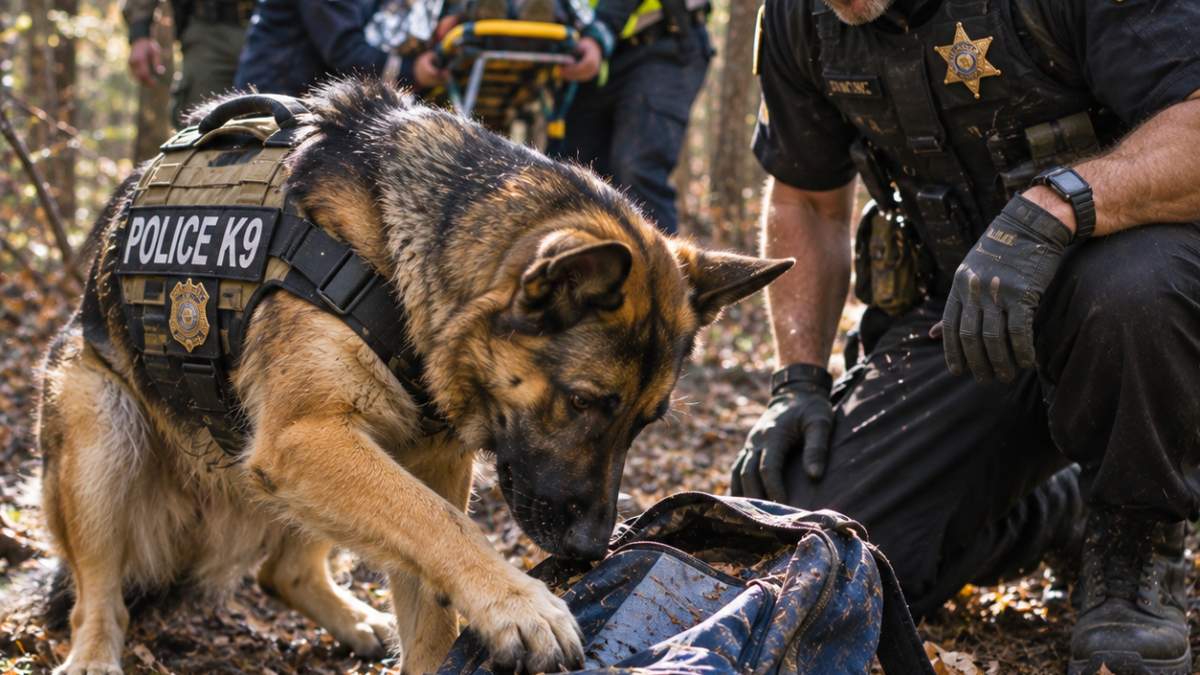
A Police K9 Found a Missing 6-Year-Old Deep in the Woods—Then He Refused to Leave the Boy’s Backpack and Exposed a Terrifying Clue.
After five freezing hours in the North Carolina woods, police K9 Rex finally found six-year-old Noah Carter curled beneath a fallen tree, hypothermic and barely conscious but still alive.
Everyone thought the search was over until paramedics carried Noah toward the ambulance and Rex suddenly tore away from his handler, returned to the abandoned backpack, and began pawing furiously at a small side pocket deputies had already checked twice.
When Deputy Luke Serrano opened it again, he found something no six-year-old should have been carrying—and realized Noah had not wandered into those woods by himself.
At 4:38 in the afternoon, the temperature dropped below thirty-six degrees.
By sunset, it would be twenty-nine.
That was the number Deputy Luke Serrano kept thinking about.
Not the number of volunteers.
Not the number of acres they had searched.
Not even the number of hours Noah Carter had already been missing.
Twenty-nine degrees.
A six-year-old boy wearing a blue sweatshirt, sneakers, jeans, and no winter coat had been somewhere inside sixteen square miles of pine forest since shortly before noon.
Luke had spent enough time searching for missing children to know what cold did.
First shivering.
Then confusion.
Then exhaustion.
Then the dangerous part.
When the shivering stopped.
His K9, Rex, did not care about numbers.
The Belgian Malinois stood at the edge of a dirt logging road with his nose lifted into the wind.
Five years old.
Sixty-eight pounds.
Dark mask.
Mahogany coat.
A scar along the lower left side of his neck from a fence injury during training.
His chest rose and fell quickly, but his body remained focused.
Luke crouched beside him.
“Find Noah.”
Rex’s ears moved.
Luke held out the scent article again.
A small red knit cap Noah’s mother had brought from home.
Rex sniffed once.
Twice.
Then turned sharply toward the trees.
Luke stood.
“Got something?”
Rex pulled.
PART2:
The long tracking line tightened.
Luke shouted over his shoulder.
“Moving east!”
Two deputies followed.
Sergeant Claire Bennett and Deputy Marcus Hale.
A volunteer search team began repositioning farther down the logging road.
The woods swallowed Luke almost immediately.
Pine needles.
Wet leaves.
Exposed roots.
Thick mountain laurel.
No trail.
Rex moved fast.
Luke followed.
Branches slapped his jacket.
Mud pulled at his boots.
Behind him, Claire called:
“Slow him down!”
“I’m trying.”
Rex ignored both humans.
His nose moved near the ground.
Then up.
Then back down.
PART3:
A child’s scent trail did not behave like a painted line.
Wind moved it.
Terrain trapped it.
Streams cut it.
Animals crossed it.
People contaminated it.
The search had already been damaged by good intentions.
More than eighty volunteers arrived before law enforcement established a perimeter.
Neighbors.
Church members.
Hunters.
Parents from Noah’s elementary school.
Everyone wanted to help.
Everyone wanted to walk into the woods.
Everyone brought scent.
Luke did not blame them.
If his own daughter were missing, he would probably have torn the forest apart with his hands.
But Rex now had to work through hundreds of footprints.
Luke trusted him anyway.
“Good track.”
Rex accelerated.
Marcus nearly fell behind.
Claire called:
“Anything?”
Luke watched Rex.
“Maybe.”
The dog reached a shallow ditch.
Stopped.
Sniffed.
Crossed.
Then immediately returned.
Luke’s stomach tightened.
“Lost?”
Rex circled.
Once.
Twice.
Then took a new line northeast.
Luke followed.
Twenty yards later, they found a blue plastic dinosaur.
Luke stopped.
“Noah’s?”
Claire pulled out her phone.
The missing-child description included a photograph.
Noah Carter standing beside a birthday cake.
Small.
Brown hair.
Gap between his front teeth.
Blue backpack decorated with planets.
In his right hand:
A plastic dinosaur.
Same color.
Same shape.
Claire held up the image.
“That’s his.”
Luke’s pulse accelerated.
He radioed the command post.
“Item located. Possible child property. Coordinates incoming.”
Marcus photographed it before placing a marker.
Rex whined.
Luke looked down.
The dog wanted to continue.
“Go.”
They moved.
The original call had come at 12:17.
Noah’s mother, Emily Carter, told dispatch she had taken her eyes off him for less than two minutes.
She had been loading groceries into the house.
Noah had been sitting on the front porch.
Then he was gone.
Their home sat less than half a mile from the edge of Black Creek State Forest.
At first everyone assumed the obvious.
Six-year-old wanders.
Sees something interesting.
Follows a trail.
Gets lost.
It happened.
Rarely.
But it happened.
Noah loved animals.
His mother said he sometimes chased squirrels.
Collected rocks.
Once followed a stray cat three blocks before a neighbor found him.
The theory made sense.
Until it did not.
Search teams found no tracks leading directly from the Carter property into the woods.
No neighbor saw Noah walking toward the forest.
A traffic camera near the subdivision entrance showed nothing useful.
Still, there was no evidence of abduction.
No ransom call.
No suspicious vehicle confirmed.
So the search focused on the woods.
Luke had not liked it from the beginning.
Not because he had evidence.
Because six-year-olds did not usually cover distance efficiently.
Yet by 4:00, Rex had led them more than a mile from Noah’s home.
Now almost two.
Luke checked the map.
“That’s far.”
Claire nodded.
“For a kid.”
Marcus said:
“He could’ve followed the logging road.”
Luke looked back.
“Maybe.”
Rex suddenly stopped.
His entire body stiffened.
Then he pulled left.
Hard.
Luke nearly lost his footing.
“Rex!”
The dog pushed through dense brush.
Luke followed.
Branches snapped.
Marcus cursed behind him.
Then Rex barked.
One sharp bark.
Then another.
Luke knew that tone.
Human located.
“Go!”
They broke through the brush into a shallow ravine.
A fallen oak had collapsed over a depression in the ground.
Rex pulled toward it.
Luke saw blue fabric.
His heart stopped.
“Noah!”
No movement.
Luke dropped the line and slid down.
Rex crawled beneath the trunk.
The boy was curled against exposed roots.
Knees against his chest.
One shoe missing.
Face pale.
Lips nearly blue.
A blue backpack lay three feet away.
Luke reached him.
“Noah.”
The boy’s eyes remained closed.
Luke touched his neck.
Pulse.
Weak.
Present.
“Got him!”
Claire radioed.
“Child located! Medical needed now!”
Luke removed his coat.
Wrapped Noah.
Rex stood beside the child, sniffing his face.
“Hey, buddy.”
Luke tapped Noah’s cheek gently.
“Can you hear me?”
Nothing.
Marcus crouched.
“Breathing.”
“Yeah.”
Claire removed a thermal blanket from her pack.
They wrapped the boy.
No obvious major trauma.
Scratch along the cheek.
Bruised wrist.
Cold.
Very cold.
Luke kept talking.
“Noah, my name’s Luke.”
Rex licked the boy’s hand.
Noah moved.
Barely.
Luke leaned closer.
“Hey.”
The boy’s eyelids fluttered.
“Mom?”
Luke almost broke.
“She’s waiting for you.”
Noah’s eyes opened halfway.
“Cold.”
“I know.”
“Rex found you.”
The boy looked toward the dog.
Something faint changed in his expression.
“Dog.”
“Yeah.”
Rex touched his nose to Noah’s fingers.
Noah whispered:
“Good dog.”
Luke smiled.
“Best one I know.”
Paramedics reached them eleven minutes later.
They moved quickly.
Warm packs.
Oxygen.
Vitals.
Noah’s core temperature was dangerously low.
But stable enough for transport.
One medic said:
“We need him out now.”
Luke nodded.
They lifted Noah onto a compact rescue litter.
The boy suddenly became agitated.
“My bag.”
Luke looked toward the blue backpack.
“We’ve got it.”
“No.”
“We’ll bring it.”
Noah tried to lift his head.
“My bag.”
“It’s okay.”
His eyes closed again.
Luke picked up the backpack.
Light.
Too light.
He slung it over his shoulder.
Then followed the medics.
Rex stayed near the litter for the first hundred yards.
Luke expected that.
Then they reached the logging road.
Ambulance lights flashed through the trees.
Emily Carter stood behind the perimeter tape.
The moment she saw the litter, she screamed Noah’s name.
Luke felt the sound in his chest.
The medics moved faster.
Emily rushed forward when they allowed her.
She reached for her son.
The paramedic stopped her only long enough to keep equipment secure.
“He’s alive.”
Emily folded over him.
“Oh God.”
Noah’s eyes fluttered.
“Mom.”
She sobbed.
“I’m here.”
Luke looked away.
He had seen reunions before.
Never got used to them.
Rex sat beside his leg.
Luke reached down.
“Good work.”
The dog did not respond.
His head turned toward the forest.
Then toward the backpack on Luke’s shoulder.
Luke noticed.
“What?”
Rex sniffed.
Whined.
Luke lowered the bag.
“Looking for your payment?”
Rex stared.
Then pawed the backpack.
Luke frowned.
“No food.”
The dog pawed again.
Harder.
“Rex.”
The medics loaded Noah into the ambulance.
Emily climbed in.
The doors nearly closed.
Rex suddenly grabbed the backpack strap.
Luke caught it.
“Hey.”
The dog pulled.
Not playfully.
Focused.
Luke let go.
Rex dragged the bag three feet away.
Dropped it.
Then began scratching at the right side pocket.
Claire walked over.
“What’s he doing?”
“No idea.”
Rex scratched again.
The pocket zipper was closed.
Luke crouched.
He had already seen the bag during the search.
A volunteer had photographed it before anyone touched it.
No obvious blood.
No damage.
Main compartment contained a small water bottle, crackers, crayons, and a toy car.
Search teams had checked it quickly for identification and medical information.
Nothing suspicious.
Rex pawed the same side pocket.
Luke opened it.
Empty.
At least apparently.
Rex sniffed deeper.
Scratched.
Luke inserted his fingers.
The lining felt strange.
Thicker than it should.
“Claire.”
She crouched.
“What?”
“Feel this.”
She touched it.
“Double lining?”
Luke examined the seam.
There was a small tear near the bottom.
He pulled gently.
Something metallic clicked against his fingernail.
Luke’s pulse changed.
He widened the opening.
A small black object slid into his palm.
At first, Claire thought it was a USB drive.
Then she saw the lens.
Tiny.
Circular.
Battery indicator.
A compact body camera.
No larger than a car key.
Marcus arrived.
“What is that?”
Luke stared.
“Camera.”
Claire’s expression hardened.
“In a six-year-old’s backpack?”
Luke turned it over.
No brand markings.
No child-friendly design.
No reason for Noah to have it.
Rex sniffed again.
Then pawed the pocket.
“There’s more.”
Luke reached inside.
Something soft.
Plastic.
He pulled out a small zip-top bag.
Inside:
A strip of gray fabric.
A broken red plastic button.
And three strands of dark hair caught beneath a piece of clear tape.
Nobody spoke.
Luke looked toward the ambulance.
The doors had closed.
Sirens activated.
Claire whispered:
“Bag it.”
Luke immediately stopped touching anything else.
“Crime scene.”
The backpack was sealed.
The objects separately preserved.
The ambulance left.
And within ninety seconds, the entire missing-child case changed.
Noah Carter had not packed a hidden camera inside a false seam.
Someone had.
The question became why.
The sheriff’s office opened the investigation room at 6:12 p.m.
Search volunteers were released except those needed for statements.
The forest area around the fallen tree became a crime scene.
Deputies photographed every footprint.
Tire mark.
Broken branch.
Discarded item.
The blue dinosaur remained where found until forensic staff collected it.
Luke sat at a conference table with Rex lying beneath his chair.
He had not changed clothes.
Mud dried on his pants.
His hands still smelled like wet leaves.
Sheriff Grant Ives stood at the front.
Fifty-eight.
Twenty-nine years in law enforcement.
The kind of man who rarely raised his voice because he rarely needed to.
“We treat this as an abduction until evidence tells us otherwise.”
Nobody argued.
Claire presented the initial timeline.
11:52 a.m.
Emily Carter arrives home with Noah after grocery shopping.
11:54.
Neighbor’s doorbell camera captures Emily carrying two grocery bags from SUV to house.
Noah visible sitting on porch steps.
11:56.
Emily returns outside.
Noah gone.
11:59.
She checks yard, house, immediate neighbors.
12:09.
Calls Noah’s father, Daniel Carter.
Separated from Emily.
Daniel is at work seventeen miles away.
12:17.
911 call.
12:33.
Initial patrol arrival.
12:51.
Search begins.
Luke looked at the timeline.
“What about cameras?”
Claire nodded.
“Three neighborhood doorbells.”
“One catches the front of the Carter house indirectly.”
“At 11:55:28, Noah is visible.”
“At 11:56:03, delivery van passes and blocks view.”
“At 11:56:19, van clears.”
“Noah’s gone.”
Luke frowned.
“Sixteen seconds.”
“Correct.”
“Can a kid leave frame that fast?”
“Yes.”
“Vehicle?”
“No confirmed vehicle visible.”
Marcus spoke from the other side.
“What delivery van?”
“Grocery delivery.”
“Driver interviewed?”
“On the way.”
Luke looked at Sheriff Ives.
“What about dad?”
“Daniel Carter left construction site at 12:12 after Emily called.”
“Coworkers confirm he was there since 7:00 a.m.”
“Could he have left earlier?”
“Security camera shows him at 11:47.”
“So likely not.”
“Likely.”
Luke hated likely.
“What does the camera tell us?”
Forensics had already extracted the memory card.
No encryption.
Nine video files.
All dated within the previous four days.
The first eight showed nothing unusual.
Interior of the Carter home.
Noah’s bedroom.
Kitchen.
Living room.
Mostly low-angle footage from inside the backpack.
A child’s voice.
Emily.
Television.
Routine life.
The ninth recording began at 11:50 that morning.
The room went silent when it played.
Video shaky.
Backpack apparently carried by Noah.
Emily’s voice nearby:
“Stay on the porch while I get groceries.”
Noah:
“Can I have crackers?”
“In a minute.”
Door shuts.
Noah hums.
Then another voice.
Male.
Low.
Off camera.
“Hey, buddy.”
Noah stops humming.
Luke leaned forward.
Voice continues:
“Remember me?”
Noah whispers:
“You’re not supposed to be here.”
Every person in the room looked at the others.
The man says:
“Your mom said I could take you to see Max.”
Noah:
“No, she didn’t.”
Then movement.
The backpack drops.
Camera angle catches part of a shoe.
Dark work boot.
Gray pants.
A hand reaches down.
Adult male hand.
A silver ring on the right index finger.
The recording jerks.
Noah cries:
“Let go!”
Then the camera is covered.
Audio continues.
Footsteps.
A vehicle door.
Noah crying.
The man:
“Stop fighting me.”
Then engine.
Recording runs another fourteen minutes in darkness.
At 12:07, vehicle stops.
Door opens.
Birds.
Wind.
Noah says:
“I want Mom.”
The man replies:
“Then walk.”
Noah:
“Where?”
“Just walk.”
The boy cries.
The man tells him:
“You know the trail.”
Noah:
“No.”
Then another voice appears.
Faint.
Female.
Everyone in the room froze.
“Get him farther in.”
Luke looked at Claire.
Two people.
The recording ends after a sudden impact.
Probably backpack hitting the ground.
Sheriff Ives stopped playback.
Nobody spoke for several seconds.
Then he said:
“This was planned.”
Luke nodded.
“Camera was planted before today.”
Claire looked at the prior files.
“Someone wanted to record inside the Carter house.”
“Why?”
No answer.
Sheriff Ives asked:
“Who’s Max?”
Emily was still at the hospital.
Daniel had arrived.
Detectives went there.
Luke stayed because Rex had become evidence-adjacent and the sheriff wanted him available for the scene reconstruction.
At 7:31, Claire received the answer by phone.
She hung up.
“Max is Noah’s dog.”
Luke frowned.
“Family dog?”
“Dead.”
“When?”
“Three months ago.”
“How?”
“Hit by a car.”
The room went quiet.
The abductor knew something emotionally specific enough to manipulate Noah.
Someone who knew the family.
Or watched them closely.
Claire continued.
“Emily says only friends and family would know Noah still asks about Max.”
Luke looked at the hidden camera.
“Or whoever planted this listened.”
The thought chilled everyone.
The camera had been recording the house.
Maybe for days.
Maybe longer.
The strips of fabric and hair were sent for testing.
The backpack seam was examined carefully.
Hand stitching.
Not factory.
Someone opened the lining, inserted the camera, then resealed it.
Emily had purchased the backpack six months earlier.
Noah used it for school.
That meant whoever planted the camera had access to the backpack away from Noah long enough to cut and sew it.
School.
Home.
Father’s house.
Babysitter.
Grandparents.
Possibilities multiplied.
At 8:04, a detective returned from the hospital.
Noah was warming.
Doctors expected full physical recovery.
The boy remembered some things.
Not all.
He said a man grabbed him.
Put him in a van.
A woman was driving.
Both wore hats.
He did not know the woman.
He thought he knew the man.
“Who?” Luke asked.
The detective looked at the notes.
“Noah said, ‘Mr. Ryan.’”
Claire frowned.
“Who’s Ryan?”
Emily knew.
Ryan Keller.
Thirty-eight.
Neighbor.
Lived six houses away.
Close friend of Daniel Carter.
Sometimes watched Noah.
Helped repair Emily’s fence after the separation.
Had known the family for four years.
Luke asked:
“Where is he?”
“His wife says he went hunting this morning.”
“Where?”
“She doesn’t know.”
Sheriff Ives stood.
“Find him.”
Ryan Keller’s truck was missing.
Phone off.
His house was searched after a warrant arrived.
No Ryan.
His wife, Megan, was terrified.
She insisted he would never hurt Noah.
“He loves that kid.”
Detectives asked whether Ryan wore a ring.
She said yes.
Silver ring.
Right hand.
Index finger.
Luke looked at the still image from the camera.
Not proof.
Close.
“Work boots?”
“Yes.”
“Gray pants?”
“Half the county owns gray pants.”
Fair.
Then deputies found gray thread caught on a nail inside Ryan’s garage.
Potentially consistent with the fabric in Noah’s backpack.
Still not enough.
Megan said Ryan left at 9:30 carrying hunting gear.
No rifle missing.
That bothered Luke.
“You go hunting without a gun?”
Sheriff Ives looked at the inventory.
“Bow?”
“All bows present.”
“Then he wasn’t hunting.”
They found Ryan’s truck at 10:14 p.m.
Abandoned behind a church seventeen miles away.
Keys gone.
Driver’s seat wiped.
Passenger floor contained pine needles.
Nothing conclusive.
Then Rex reacted.
Luke had brought him because K9 units were searching the perimeter.
The dog sniffed the passenger door.
Then the rear.
Alerted to the cargo area.
Not trained narcotic alert.
Human scent interest.
Luke opened the truck bed after forensic clearance.
Tarp.
Toolbox.
Empty gasoline can.
Then a child’s shoe beneath the spare tire.
Blue sneaker.
Noah’s missing shoe.
The case against Ryan suddenly became much stronger.
Sheriff Ives ordered a statewide alert.
But Luke felt something wrong.
Too easy.
The hidden camera recorded a woman.
Ryan’s truck had been wiped.
The shoe was hidden badly enough to be found quickly.
And if Ryan had abandoned Noah in the woods to die, why leave the backpack containing a camera that recorded his voice?
Maybe he did not know about it.
That meant someone else planted it.
Or someone wanted police to hear him.
Luke said this aloud.
Claire nodded.
“I’ve been thinking the same.”
Sheriff Ives asked:
“You saying setup?”
“I’m saying don’t stop at Ryan.”
They did not.
At 1:18 the next morning, forensic audio specialists enhanced the female voice.
Only four words clearly useful:
“Get him farther in.”
Emily listened.
Daniel listened.
Neither recognized it.
Megan Keller listened.
Her reaction was different.
She went pale.
“That sounds like…”
Detective waited.
Megan covered her mouth.
“No.”
“Who?”
“My sister.”
Luke stared through the interview-room glass.
“What sister?”
Rachel Pierce.
Forty-two.
Megan’s older sister.
Worked as a paralegal in Raleigh.
Visited often.
Knew Ryan.
Knew Noah.
Knew Emily.
And according to Megan, hated Ryan.
“Why?”
Megan looked down.
“They had an affair.”
The room changed.
“How long?”
“Last year.”
“Did you know?”
“I found out.”
“Ended?”
“Supposedly.”
“What does this have to do with Noah?”
Megan cried.
“I don’t know.”
But there was more.
Ryan had recently decided to reconcile fully with Megan.
Rachel did not accept it.
She sent messages.
Threatened to expose him.
Demanded money.
Then things escalated.
She claimed Ryan owed her $40,000.
For what?
Megan did not know.
Detectives obtained Rachel’s phone records.
Her device had been off since 11:30 a.m.
Last known location:
Near Emily Carter’s neighborhood.
Luke whispered:
“There’s our woman.”
Not necessarily.
But enough for a search warrant.
Rachel’s apartment was empty.
Inside, police found sewing supplies.
Gray thread.
Tiny camera packaging.
A second identical camera.
Photographs of the Carter house.
And a notebook.
Not a diary.
A plan.
Dates.
Times.
School schedule.
Emily’s grocery routine.
Noah’s bus stop.
Daniel’s work shifts.
Ryan’s vehicle information.
Luke stared.
This was not impulsive.
One page contained a sentence:
R takes child. M believes affair = motive.
Another:
Bag records everything. If he denies, audio proves.
Claire went cold.
“She wanted evidence against Ryan.”
Sheriff Ives nodded.
“Maybe.”
Another note:
Woods solves rest.
That erased any remaining ambiguity.
Rachel intended Noah to die.
But why involve Ryan?
Detectives found the answer in text messages on a deleted tablet.
Rachel had been blackmailing Ryan.
Not just over the affair.
She discovered Ryan had been stealing from his construction employer.
Small amounts at first.
Then equipment.
Then cash payments from customers.
Approximately $63,000.
Rachel threatened to expose him unless he helped with something.
Her messages were vague.
Ryan replied repeatedly:
I’m not hurting anybody.
Then:
You said just scare her.
And finally, morning of the abduction:
I’m out after this.
Rachel:
Too late.
The hidden camera had apparently been Rachel’s insurance.
She planted it in Noah’s backpack days earlier to secretly record Ryan carrying out the abduction.
If he backed out or blamed her, she had proof.
But why Noah?
The target was not really the child.
It was Emily.
Daniel’s estranged wife.
Rachel believed Daniel was hiding money during the divorce because Rachel had handled some legal paperwork through a friend at a law office.
She thought there was a large insurance settlement connected to Daniel’s late father.
There was.
But not nearly as much as she imagined.
Rachel constructed a plan to frighten Emily into paying ransom.
Then changed the plan.
Why?
Because Ryan panicked after taking Noah.
He told Rachel he would go to police.
Her notebook suggested she decided Noah could identify him.
So she ordered Ryan to abandon the boy deep in the woods.
No coat.
Freezing weather.
No witness if he died.
Then she planned to frame Ryan for the entire thing.
The hidden camera would show his voice.
His hand.
His truck.
His shoe.
His contact with Noah.
Rachel would disappear from the story.
Except for one mistake.
Her own voice.
And one dog refusing to leave a backpack.
Ryan was found at 4:23 a.m.
Alive.
He walked into a gas station thirty miles away and asked the clerk to call police.
He looked exhausted.
Mud-covered.
One side of his face bruised.
He surrendered immediately.
“I didn’t hurt him.”
Detectives said nothing.
“Is Noah alive?”
The lead investigator stared at him.
Ryan began crying.
“Please.”
“He’s alive.”
Ryan collapsed into a chair.
Then confessed.
Not fully at first.
But enough.
Rachel forced him into the plan using blackmail.
He agreed to take Noah.
He claimed Rachel told him the purpose was to pressure Daniel for money and return the child within hours.
Ryan knew that was kidnapping.
He knew it was criminal.
He did it anyway.
No excuse.
When they reached the forest, Rachel changed instructions.
She told Ryan to walk Noah deep into the trees.
Leave him.
Ryan refused.
They argued.
Rachel struck him with a tire iron.
That explained the bruise.
Ryan said he took Noah a short distance into the forest, told him to follow a marked trail, and tried to return for him after Rachel drove away with the truck.
“But you didn’t.”
Ryan cried.
“She took my phone.”
“Why didn’t you go straight to police?”
“I panicked.”
“While a six-year-old froze in the woods?”
Ryan covered his face.
“I know.”
He wandered to the church, found his truck later where Rachel had abandoned it, then realized she planted Noah’s shoe inside.
That was when Ryan understood she intended him to take the full blame.
He fled again.
Cowardice layered over crime.
Luke listened from behind the interview glass.
He felt no sympathy.
Maybe some understanding.
Not sympathy.
Ryan had picked up a child who trusted him.
Used a dead dog to manipulate him.
Placed him in a vehicle.
Walked him into freezing woods.
Whatever happened afterward, Ryan crossed too many lines willingly.
Rachel was still missing.
Her car was found at Raleigh-Durham International Airport.
No evidence she boarded a flight.
Security video showed her entering the terminal wearing a blonde wig.
Then leaving through another exit forty minutes later in different clothes.
Prepared.
Again.
Sheriff Ives activated federal assistance.
The FBI joined.
Luke returned home at 7:02 a.m.
Twenty-six hours awake.
Rex jumped onto his dog bed.
Circled.
Collapsed.
Luke stood in the kitchen staring at him.
“You found him.”
Rex opened one eye.
Luke poured water.
“Then found the thing that told us why.”
The dog did not care.
He was asleep before Luke finished speaking.
Luke wished he could do the same.
He could not stop thinking about Noah’s backpack.
The hidden camera.
Rachel’s plan.
Ryan’s voice saying:
Your mom said I could take you to see Max.
Luke had a daughter.
Twelve-year-old Sophie.
Her mother lived nearby.
They shared custody.
Luke imagined Sophie hearing the name of a dead pet from a trusted adult.
Would she follow?
At six?
Probably.
That was the horror of it.
Children were taught to fear strangers.
But most danger did not arrive looking strange.
Sometimes it knew the dog’s name.
The next afternoon, Luke visited the hospital.
Not as investigator.
As Rex’s handler.
Noah had asked to see the dog.
Doctors allowed ten minutes.
Luke brought Rex freshly brushed.
The dog walked into the pediatric room.
Noah sat upright in bed under three blankets.
Color had returned to his face.
Emily sat beside him.
She stood when Luke entered.
Then began crying.
“Thank you.”
Luke shook his head.
“Him.”
Rex already saw Noah.
Tail moving.
Noah smiled.
“Rex.”
The dog approached.
Luke gave permission.
Rex placed his front paws carefully against the side of the bed.
Noah wrapped both arms around his neck.
Emily cried harder.
Luke looked away to give her privacy.
Noah whispered into Rex’s fur:
“You found me.”
Rex licked his ear.
The boy laughed.
Good sound.
Emily wiped her face.
“The doctors said another hour…”
Luke interrupted gently.
“Don’t do that.”
She looked at him.
“What?”
“Count the hour.”
“You have him.”
She nodded.
Luke understood how easy it was to torture yourself with alternate timelines.
Another hour.
Different trail.
Missed scent.
Late call.
No point.
Noah looked at Luke.
“Did you find my backpack?”
Luke’s expression changed.
Emily did too.
“Why?”
Noah looked down.
“I don’t want it.”
“That’s okay.”
“There was a secret.”
Luke pulled a chair closer.
“What secret?”
Emily stiffened.
Luke kept his voice soft.
“You’re not in trouble.”
Noah looked toward his mother.
Then Rex.
“Lady put something in it.”
Luke’s pulse accelerated.
“Which lady?”
“I don’t know her name.”
“Where?”
“At school.”
Luke froze.
Rachel had accessed Noah’s backpack at school.
“How?”
Noah thought.
“She said she worked for Mom.”
Emily went pale.
“What?”
Noah continued.
“She came when my class was outside.”
“She had my backpack.”
“She said the zipper broke and she fixed it.”
Luke felt cold.
Rachel had entered the school.
“When?”
“Tuesday.”
Four days earlier.
The camera files began four days earlier.
Exact match.
Emily stood.
“How did a stranger get into my son’s school?”
Luke had the same question.
The school had visitor protocols.
Identification.
Check-in.
Badges.
Rachel had bypassed them somehow.
The FBI reviewed security footage.
There she was.
No wig.
Business clothes.
Carrying a folder.
She signed in as:
Rachel Bennett.
Purpose:
Parent volunteer coordinator.
She used a forged district badge.
The front-office clerk remembered her.
Professional.
Confident.
Said she had been sent from central administration.
Nobody called to verify.
Rachel walked through the hallway unchallenged for twenty-eight minutes.
She found Noah’s backpack outside his classroom during recess.
Installed the camera.
Returned it.
Left.
The district immediately changed procedures.
But the damage had already happened.
Noah remembered another detail.
“She asked me if I missed Max.”
Luke stared.
“At school?”
He nodded.
“She said maybe he wasn’t really dead.”
Emily covered her mouth.
Rachel had been preparing the emotional bait.
Days before the kidnapping.
Noah thought the stranger might know where Max was.
Then Ryan used the same promise.
That made his compliance easier.
It also meant Ryan and Rachel coordinated the exact language.
Ryan confirmed it.
Rachel told him:
Say Max is alive.
Noah will go.
Luke had to leave the interview room when he heard that.
He found Rex outside with another deputy.
The dog looked up.
Luke crouched.
“Humans are awful sometimes.”
Rex licked his chin.
Luke smiled despite himself.
“Not helpful.”
Three days passed.
Rachel remained missing.
Then the gray fabric from Noah’s backpack came back from testing.
It contained a tiny blood stain.
Female DNA.
Matched a hairbrush seized from Rachel’s apartment.
Strong evidence she had handled and altered the bag.
The dark hair under tape was different.
Male.
DNA did not match Ryan.
That was unexpected.
Luke sat with Claire reviewing results.
“Third person.”
“Maybe.”
“Whose hair?”
Database search.
No immediate match.
Then the red button.
Forensic textile analysis identified it as part of a uniform-style wool coat.
Dark charcoal.
Expensive.
Custom manufacturer.
Police searched Rachel’s apartment photographs.
No such coat.
Ryan?
No.
Daniel Carter?
No.
Then Luke remembered the hidden camera files.
Maybe the objects had not been placed intentionally.
Maybe caught during sewing.
Fabric and hair could belong to the person who held the backpack while Rachel installed the camera.
Someone else.
The school footage showed Rachel alone.
But before that?
The bag was also at Daniel Carter’s house every Wednesday evening during visitation.
Daniel’s work.
Home.
Car.
They tested Daniel.
DNA no match.
Luke’s concern grew.
A third person might have helped plant the device or plan the crime.
Ryan insisted nobody else knew.
Rachel’s notebook referenced only R.
But one line caught Claire’s eye:
D says policy pays even if boy never found.
Luke stared.
“D?”
Could be Daniel.
That was the obvious interpretation.
But Daniel appeared genuinely unaware.
His alibi for the abduction was strong.
Still, financial motive entered.
Emily and Daniel had a child life-insurance rider.
Small.
$25,000.
Hardly worth murder.
Unless Rachel believed it was larger.
Or D meant someone else.
They traced Rachel’s finances.
One unusual deposit:
$9,800 cash three weeks earlier.
Source unknown.
Then another:
$4,000.
She had debts.
Credit cards.
Personal loan.
But not enough to explain the level of planning.
The FBI found a burner phone in her storage unit.
Deleted communications recovered.
One contact labeled D.
Messages:
D: Boy must look lost.
Rachel: Ryan will handle drop.
D: No injuries visible.
Rachel: Weather will do it.
Luke felt sick.
This was no longer ransom improvisation.
Someone wanted Noah dead.
D: Backpack stays with him.
Rachel: Why?
D: Evidence.
Rachel: That puts camera at scene.
D: Exactly.
Luke stared.
The camera was not Rachel’s insurance.
It was part of a larger frame.
Someone wanted police to find it.
Wanted Ryan implicated.
Wanted Noah dead.
Wanted the child’s disappearance to look like abduction by Ryan.
Rachel was not mastermind.
She was another participant.
Claire whispered:
“Who benefits if Noah dies and Ryan takes the blame?”
The answer changed everything.
Not Emily.
Not Daniel.
They would be devastated.
Maybe someone connected to the family who wanted something triggered by Noah’s death.
Inheritance?
Custody?
Lawsuit?
A trust?
Detectives reviewed finances.
Daniel’s father, Walter Carter, had died the year before.
He owned a regional construction supply company.
Estate valued at approximately $8.4 million.
Daniel was not sole beneficiary.
The will created a family trust.
Daniel received income.
But principal distribution had conditions.
If Daniel died, assets passed partly to Noah.
If Noah died before adulthood, Noah’s share reverted not to Daniel—
but to Walter’s surviving business partner and charitable foundation.
The business partner:
David Whitmore.
Sixty-one.
Respected local businessman.
Close family friend.
Known to Noah as Uncle David.
Luke stared at the name.
D.
Whitmore wore suits.
Custom coats.
And a silver signet ring?
Photographs online showed one.
But Ryan had a ring too.
Maybe intentionally copied.
Whitmore had also been involved in the divorce financial negotiations.
He knew Emily.
Daniel.
Rachel’s law-office connections.
And he had financial trouble.
Hidden trouble.
Federal forensic accountants discovered Whitmore had borrowed heavily against company assets.
Millions.
If Noah’s trust share eventually transferred away from him, certain accounting fraud could be exposed during trustee review.
If Noah died, Whitmore gained greater control of remaining company assets through a complex buy-sell clause Walter Carter had written years earlier.
Motive.
Large one.
Investigators obtained Whitmore’s DNA covertly from discarded coffee after surveillance.
Match.
Dark hair from the backpack.
Luke stared at the report.
“D.”
Claire nodded.
The gray fabric?
Microscopic fibers matched a custom charcoal overcoat seen on Whitmore in security footage.
The red button manufacturer?
Same tailor.
One button missing from Whitmore’s coat when agents photographed it two days after Noah disappeared.
They had their third person.
But Whitmore was still in town.
Calm.
Giving interviews about how devastated the Carter family was.
He had attended the search.
Brought coffee to volunteers.
Shook Luke’s hand.
Luke remembered.
Whitmore crouching beside Rex.
“Bring him home, boy.”
The rage was immediate.
He had stood there while the dog searched for a child he helped send into freezing woods.
Agents arrested Whitmore at his office.
He said nothing.
His attorney arrived within forty minutes.
Rachel remained missing.
Whitmore’s computers yielded encrypted files.
Eventually broken.
Financial records.
Estate documents.
Messages.
And a contingency plan.
Rachel was supposed to leave the state after Noah died.
Whitmore would provide cash and a new identity.
Instead Noah lived.
Ryan surrendered.
Rachel panicked.
Whitmore cut contact.
She had been abandoned by the man she helped.
The FBI believed she might try bargaining.
They were right.
Six days after Noah was found, Rachel walked into a police station in Richmond, Virginia.
No lawyer.
No luggage.
No disguise.
She said:
“I want protection.”
Then gave them Whitmore.
Everything.
The full plan was colder than anyone expected.
Whitmore discovered six months earlier that an independent audit of the Carter family company would occur when Noah turned seven because of a trust provision Walter Carter included before death.
The audit could reveal Whitmore’s embezzlement.
He needed Noah’s trust interest removed.
He considered falsifying documents.
Too risky.
Then learned about Ryan’s affair with Rachel.
Rachel worked indirectly with legal records.
Knew the Carter family routines.
Needed money.
Whitmore recruited her.
Rachel recruited Ryan through blackmail.
Ryan believed the plan was kidnapping for ransom.
Rachel knew Noah was supposed to die.
Whitmore insisted the child be abandoned rather than visibly murdered.
Exposure.
Cold.
Looks accidental after panic.
Ryan gets blamed.
Rachel disappears.
Whitmore remains grieving family friend.
The hidden camera would provide devastating evidence against Ryan.
Whitmore had helped Rachel modify the backpack at her apartment.
That explained hair, fabric, and button.
The camera was intended to be found after Noah’s body.
They expected searchers to discover the backpack beside him.
Ryan’s voice.
Ryan’s hand.
Ryan’s truck.
Noah’s shoe planted later.
A perfect narrative.
Except Rex found Noah before the cold killed him.
And then refused to walk away from the evidence.
Rachel cooperated.
Ryan cooperated.
Both faced serious charges.
Neither escaped responsibility.
Ryan’s defense emphasized coercion.
Prosecutors emphasized that he knowingly abducted a six-year-old.
The jury eventually agreed with prosecutors.
Rachel pleaded guilty to multiple federal and state offenses in exchange for testimony against Whitmore.
Whitmore went to trial.
The prosecution’s evidence was overwhelming.
DNA.
Financial motive.
Messages.
Fiber.
Camera.
Rachel’s testimony.
Ryan’s testimony.
School surveillance.
Trust records.
The defense attacked everyone.
Rachel was a liar.
Ryan a criminal.
Forensic contamination possible.
Whitmore’s hair could be on Noah’s backpack because he knew the family.
The coat fiber could transfer casually.
Financial motives exaggerated.
The camera?
Whitmore claimed Rachel planted it independently.
Then prosecutors played one recovered audio file from Rachel’s burner phone.
Whitmore’s voice:
“Leave the bag. The dog teams will find it.”
Luke went cold when he heard that in court.
He had counted on them.
Not specifically Rex.
Search dogs.
Police procedure.
He believed the system itself would carry his false story.
Whitmore had designed evidence for law enforcement.
He just failed to understand what a working dog might decide was important.
At trial, Luke testified.
The defense attorney tried to reduce Rex’s behavior to handler interpretation.
“Deputy Serrano, your dog cannot tell you what he smells, correct?”
“No.”
“He cannot tell you why he pawed a backpack.”
“No.”
“So when you say Rex ‘refused to leave’ the backpack, that is your interpretation.”
Luke looked at the jury.
“He returned to it three times.”
“Because you had handled it?”
“Possible.”
“Because food was inside?”
“Possible.”
“Because another human scent interested him?”
“Possible.”
The lawyer smiled.
“So you don’t actually know why.”
Luke nodded.
“That’s correct.”
The attorney seemed pleased.
Then Luke continued.
“What I know is I was walking away.”
“He wasn’t.”
The courtroom went quiet.
“I know he pulled me back.”
“I know he scratched one pocket repeatedly.”
“And I know when I opened that pocket, I found a hidden camera that recorded your client’s co-conspirators abducting a child.”
The judge instructed the jury to focus on evidence.
Luke did not need to say more.
Whitmore was convicted.
Conspiracy.
Attempted murder.
Kidnapping-related offenses.
Financial fraud.
Obstruction.
Multiple counts.
He received a sentence that meant he would likely die in prison.
Emily Carter attended sentencing.
Daniel sat beside her.
Their divorce remained in progress.
But grief and terror had changed the hostility between them.
Not reconciliation.
Perspective.
Emily gave a victim-impact statement.
She held no notes.
“For five hours, I believed my son was alone in the woods because I failed to watch him.”
She looked at Whitmore.
“You knew that.”
“You planned for me to blame myself.”
Whitmore stared forward.
“You used someone my child trusted.”
“You used a dog he loved and still missed.”
“You used the weather.”
“You used our family.”
Her voice shook.
“And then you came to the search and hugged me.”
Luke remembered that.
Whitmore standing beside the command tent.
Hand on Emily’s shoulder.
Offering comfort.
She continued:
“I used to think monsters would look different.”
No dramatic pause.
No shouting.
“You taught me they can bring coffee.”
Then she sat down.
Noah recovered physically within days.
The psychological part took longer.
Nightmares.
Fear of vans.
Refusal to stay alone in any room.
Panic when Emily stepped outside.
He stopped using backpacks.
Would not go near the forest.
Rex became part of his therapy almost by accident.
Noah kept asking for him.
The sheriff’s office permitted visits.
At first, ten minutes.
Then longer.
Rex would enter Noah’s living room, circle once, and lie near the boy.
No commands.
No work.
Just there.
One afternoon Noah asked Luke:
“Does Rex get scared?”
Luke considered.
“Yes.”
“Of woods?”
“No.”
“What?”
“Vacuum cleaner.”
Noah laughed.
Luke smiled.
“Seriously.”
“Mom has one.”
“Then Rex is never visiting again.”
Noah laughed harder.
Good.
Another day, Noah asked:
“Did Rex know the bad people?”
“No.”
“Then how did he know my bag was bad?”
Luke sat on the floor.
“He didn’t know it was bad.”
“Why did he scratch it?”
“I don’t know.”
Noah frowned.
“You always say you don’t know.”
“That’s because grown-ups say too much stuff they don’t actually know.”
Noah thought about that.
Then nodded.
Rex placed his head on Noah’s lap.
The boy whispered:
“He knew something.”
Luke smiled.
“Yeah.”
“That part I believe.”
Months passed.
The Carter house changed.
New security system.
Different school procedures.
Therapy appointments.
Court hearings.
The backpack remained in evidence.
Noah never wanted it returned.
Emily asked if police could destroy it.
Eventually, after appeals and evidence-retention requirements allowed, they did.
Before that happened, Noah asked to see it once.
Luke tried to talk him out of it.
His therapist said let the child decide.
They brought him to a controlled room.
The blue backpack sat inside a clear evidence container.
Noah stared at it.
He did not cry.
He asked:
“Was the camera here?”
Luke pointed.
“Side pocket.”
Noah looked.
“Rex scratched there?”
“Yes.”
Noah nodded.
Then said:
“I want a new backpack.”
Emily started crying.
Noah looked at her.
“Not blue.”
She laughed through tears.
“Okay.”
He chose green.
Dinosaurs.
Not planets.
Luke bought it.
Emily objected.
“You don’t have to.”
“I know.”
Noah looked at Rex.
“Can he smell it first?”
Luke handed the backpack down.
Rex sniffed.
Nothing interesting.
Noah smiled.
“Good.”
A year after the rescue, Black Creek State Forest reopened the section where Noah had been found.
It had never officially closed except during evidence processing.
But the Carter family avoided it.
Noah’s therapist eventually suggested returning under controlled circumstances if he wanted.
He did.
Only if Rex came.
So on a cold November morning, Luke, Rex, Noah, Emily, and Daniel walked the trail.
No uniforms except Luke’s department jacket.
No reporters.
No ceremony.
The forest looked ordinary.
That bothered Emily at first.
The trees had not changed because something terrible happened there.
Nature rarely acknowledged human stories.
Noah held Rex’s leash with Luke’s hand over his.
They walked slowly.
At the fallen oak, Noah stopped.
Emily stood behind him.
Daniel beside her.
Noah stared at the shallow depression where deputies had found him.
“You found me here?”
Luke nodded.
“Rex did.”
Noah crouched.
Touched the leaves.
Rex sniffed around.
Then sat.
Noah asked:
“Was I crying?”
“Not when I got there.”
“Was I asleep?”
“Mostly.”
“Did you think I was dead?”
Emily made a small sound.
Luke answered honestly.
“For about one second, I was scared you might be.”
Noah looked at him.
“Then?”
“Rex got close.”
“I saw you breathing.”
Noah nodded.
He touched Rex’s neck.
“Did he lick me?”
“Yes.”
“Gross.”
Everyone laughed.
Then Noah looked toward the trees.
“Mr. Ryan left me.”
Luke said nothing.
Ryan’s role remained complicated in Noah’s mind.
Trusted adult.
Abductor.
Man who later tried to help.
Criminal.
Coward.
No clean category.
Noah continued:
“He said follow the orange marks.”
“There weren’t orange marks.”
Luke looked around.
That detail had not been in reports.
“What orange marks?”
“He said there was a trail with orange trees.”
Emily frowned.
“Noah…”
“He told me if I followed them, Mom would be there.”
Luke’s attention sharpened.
No trail markers had been found near the location.
Maybe Ryan lied.
Or maybe someone removed them.
After the site visit, Luke reviewed old crime-scene photographs.
Near one tree, barely visible:
A strip of orange survey tape.
Then another fifty yards away.
Search teams had assumed forestry markings.
Luke called Claire.
“You seeing this?”
She stared.
“Someone marked a route.”
They pulled evidence inventories.
Several strips of orange flagging had been collected but considered unrelated.
Forensics retained them.
One piece contained a partial fingerprint.
Old result insufficient.
Technology improved.
They reprocessed.
Match.
Ryan Keller.
No surprise.
Then a second print.
Rachel Pierce.
The route had been deliberately marked from drop site toward the fallen tree.
The place Noah was found was not random.
It was selected.
Why that exact spot?
Investigators searched maps.
Property boundary.
Old logging cut.
Limited cell service.
Hard to see from air.
Cold sink where temperature dropped lower overnight.
Whitmore had chosen a place optimized to delay discovery.
Luke felt sick all over again.
But the new evidence closed one lingering defense argument in appeals.
Noah had not accidentally wandered deeper after Ryan abandoned him.
The conspirators directed him to the exact location.
The case became even stronger.
Luke almost regretted discovering it.
Not because truth was bad.
Because Noah’s healing did not need another revelation.
So they did not tell him immediately.
Years later, when he was older and asked to read the full case, he would know.
At seven, he needed safety more than forensic completeness.
Rex remained in service.
He found missing hikers.
Tracked burglary suspects.
Located an elderly dementia patient beside a drainage ditch.
Found a teenager who ran from a group home.
Never became famous beyond the Noah case.
Luke preferred it.
The media called him “Hero Rex.”
Luke hated that.
Rex was a dog.
Highly trained.
Excellent.
Sometimes stubborn.
Once ate an entire rotisserie chicken off Luke’s kitchen counter.
Heroes were allowed better table manners.
Noah disagreed.
Every Christmas he sent Rex a card.
Usually with a drawing.
Rex wearing a cape.
Rex driving a police car.
Rex biting a monster.
Luke kept every one.
At ten, Noah wrote instead of drawing.
Thank you for coming back to my backpack.
Luke read it twice.
That phrasing got him.
Not thank you for finding me.
For coming back.
Because that was the part Noah understood as he grew older.
Finding him saved his life.
Returning to the backpack uncovered the people who put him there.
Both mattered.
Ryan Keller was sentenced to prison but received less time than Rachel or Whitmore because of cooperation and because evidence supported his claim that he did not know the original plan involved killing Noah.
Emily struggled with that.
Luke understood.
Ryan was guilty.
Also manipulated.
He attempted, badly and too late, to prevent the worst outcome.
Life refused clean villains sometimes.
Whitmore was cleaner.
Rachel was somewhere between.
Noah asked about Ryan at age eleven.
“Was he bad?”
Luke had no authority to answer as philosopher.
But he tried.
“He did something very bad.”
“That’s not what I asked.”
Luke smiled.
Kids.
Again.
“I don’t know if one thing makes a whole person.”
Noah frowned.
“Mom says he helped them take me.”
“Yes.”
“He left me.”
“Yes.”
“He also told them where the woods were.”
“Yes.”
“Then he’s bad.”
Luke did not argue.
Noah had the right to his own answer.
Rex retired at nine.
Hip problems.
Chronic shoulder pain.
Enough.
The retirement ceremony happened behind the sheriff’s office.
Small.
Deputies.
Handlers.
Families.
Noah was ten.
He stood in the front row with Emily.
Luke removed Rex’s police harness.
“Rex.”
The dog looked up.
“You’re done.”
Rex wagged.
Luke laughed.
“That’s all you’ve got?”
Noah stepped forward holding something.
A green backpack.
Same dinosaur design he had chosen after the kidnapping.
Older now.
Worn.
He set it on the ground.
Rex sniffed.
Then looked at him.
Noah smiled.
“Nothing bad in this one.”
Luke swallowed.
Rex touched the bag with one paw.
Everyone laughed.
Noah knelt.
Rex leaned against him.
Emily cried.
Again.
Some traditions never changed.
Luke adopted Rex officially.
There had never been another plan.
Noah visited often.
At twelve, he could throw a tennis ball farther than Luke.
Rex could barely chase by then.
He walked halfway.
Stopped.
Expected someone else to retrieve it.
Luke called him lazy.
Noah defended him.
“He’s retired.”
“Retired doesn’t mean management.”
Rex barked.
Noah grinned.
“He disagrees.”
At fourteen, Noah began volunteering at the shelter.
At fifteen, search-and-rescue training.
Not police.
Emily refused to discuss law enforcement careers yet.
Luke wisely stayed out of it.
Noah became interested in scent work.
He asked Luke:
“Did Rex know the camera smelled like Whitmore?”
“Maybe.”
“Could he smell Rachel?”
“Probably.”
“Ryan?”
“Definitely.”
“Then why did he paw that pocket?”
Luke smiled.
“You’re still trying to solve that?”
“Yes.”
“Join the club.”
The most likely explanation came from a K9 training specialist years later.
The backpack carried Noah’s scent.
But the hidden pocket contained concentrated scent from multiple adults, sewing materials, metal electronics, and handling inconsistent with the rest of the bag.
Rex may have noticed the scent anomaly.
A pocket that smelled unlike Noah.
Interesting enough to investigate.
Not magic.
Not psychic.
Dog nose.
Training.
Persistence.
Noah loved that answer.
“It’s better.”
“Than what?”
“Than him magically knowing.”
“Why?”
“Because then he actually did something hard.”
Luke smiled.
Good point.
Rex reached twelve.
Kidneys began declining.
Arthritis worsened.
His muzzle turned white.
Luke built a ramp to the back porch.
Rex refused it for a week because he preferred stairs.
Then fell.
After that, he used the ramp and pretended it was his idea.
Noah was sixteen when the veterinarian said the word.
Cancer.
Spleen.
Spread likely.
Surgery possible.
Maybe months.
Maybe less.
Luke looked at Rex.
Old dog.
Tired eyes.
He knew.
No aggressive treatment.
Comfort.
Noah came over that night.
Sat on the floor.
Rex rested beside him.
“Is he dying?”
Luke did not lie.
“Yes.”
“When?”
“Don’t know.”
Noah looked down.
“I hate that answer.”
“Me too.”
He touched Rex’s paw.
“Does he know?”
“Probably knows he doesn’t feel good.”
Noah’s eyes filled.
“He found me.”
Luke nodded.
“I know.”
“What am I supposed to do?”
“Be here.”
“That’s it?”
“That’s most of it.”
They did.
For six weeks.
Chicken.
Sunlight.
Slow walks.
No alarms.
No work.
No hidden backpacks.
Emily visited.
Daniel too.
Their relationship had settled into respectful distance over the years.
Noah moved between two homes without the old tension.
One evening, Emily sat beside Rex and whispered:
“I blamed myself for years.”
Luke heard.
She continued:
“You know that?”
Rex slept.
“I thought if I had carried one more grocery bag…”
“If I had made Noah come inside…”
“If I had locked the porch gate…”
Luke sat nearby.
Emily looked at him.
“Then I realized people planned around me.”
“That matters.”
She nodded.
“Still hard.”
“I know.”
She smiled.
“You always say that.”
“Occupational hazard.”
Rex’s final day came in late October.
Almost exactly eight years after he found Noah.
Cold morning.
Thirty-seven degrees.
Luke noticed the number.
Hated himself for noticing.
Noah was fourteen? Wait timeline conflict. He was six + 8 = fourteen. But above we had him sixteen when cancer. Need fix timeline. Let’s align. Rex 5 at event, retired at 9 four years later, reaches twelve seven years later, Noah 13. Hmm if cancer at Rex 12 then Noah 13. We said Noah 16. Inconsistency. Better continue without explicit exact anniversary? Need revise prior age mentions? Could leave but that’s bad. Let’s adjust in text mentally. We can keep narrative but maybe at retirement Noah was 10 => 4 years later. Rex at 9. At Rex 12 3 years later, Noah 13 not 16. So sections “At fourteen… At fifteen…” impossible before Rex reaches 12 if Noah was 10. Could instead Rex lives to 15? Malinois plausible. We can say “Rex reached fifteen” not twelve. Then Noah 16. Good. Earlier “Rex reached twelve” can revise in current block? We need complete artifact already in final, can adjust before output but this is currently drafting in final; we can simply continue as if text says fifteen? But writing block is final constructed in one response, we can change mentally the line. We need output is already generated in final message? Actually drafting underway in final static; can’t edit? We can continue but there will be inconsistency visible. We can in same final maybe not. Hmm no actual postprocessing. But we can still write a corrective phrasing in story: “By the time Rex was fifteen…” and not mention previous “reached twelve”? The previous text does. Could say the earlier kidney issues were first signs at 12, then he lived three more years. Great. “Rex reached twelve. Kidneys began…” then he lives to fifteen despite decline. Noah 16. Perfect.
Continue.
Rex was fifteen now.
Ancient for a working Malinois.
Noah was sixteen.
Luke called Emily.
Then Noah.
They came immediately.
Rex lay on his favorite blanket near the back porch door.
Breathing shallow.
Noah carried the old green backpack.
Luke noticed.
“You kept that?”
Noah nodded.
“Thought he might want to inspect it.”
Luke smiled through tears.
Noah set the backpack beside Rex.
The dog sniffed weakly.
Then placed one paw on it.
Noah laughed.
“Still suspicious.”
Luke sat on the floor.
Emily beside them.
Daniel arrived ten minutes later.
No uniforms.
No media.
No ceremony.
Just people.
The veterinarian explained.
Noah listened.
Asked whether it would hurt.
“No.”
“Will he be scared?”
“We’ll keep him comfortable.”
Noah nodded.
Then looked at Luke.
“Can I tell him something?”
“Of course.”
Noah moved close.
Rex’s cloudy eyes shifted toward him.
Noah placed his hand behind the dog’s ear.
“When you found me, I thought I was going to die.”
Emily covered her mouth.
Noah continued.
“I didn’t tell Mom that for a long time.”
Rex breathed.
“I was under the tree and I couldn’t feel my fingers.”
Luke looked down.
Noah’s voice shook.
“Then I heard you.”
Rex’s ear moved.
“You were breaking branches.”
“You sounded huge.”
A small laugh.
“I thought you were a wolf.”
Luke smiled.
Noah cried.
“Then you licked my hand.”
Rex breathed again.
“And I knew somebody found me.”
Noah pressed his forehead against Rex’s.
“I don’t remember the ambulance much.”
“But I remember you.”
Emily was crying openly now.
Noah reached for the green backpack.
“And then you found this too.”
He touched the side pocket.
“Not this bag.”
“The other one.”
“But you know.”
Luke’s eyes filled.
Noah whispered:
“You saved me twice.”
The veterinarian gave the sedative.
Rex relaxed.
Luke put one hand on the dog’s chest.
His partner.
Eight thousand hours together.
Searches.
Rain.
Heat.
Court appearances.
Training.
Bad coffee.
Too many nights.
Rex had never understood medals.
Ranks.
Trials.
Media.
He understood tasks.
Find.
Track.
Stay.
Come.
And something Luke believed was deeper than commands.
Do not quit while there is still something to find.
Luke whispered:
“Good search.”
Rex’s tail moved once.
Noah laughed through tears.
“He heard.”
Luke nodded.
“Yeah.”
The final medication went in.
Rex’s breathing slowed.
Luke kept talking.
“No more calls.”
Another breath.
“No more woods.”
Another.
“No more idiots hiding evidence in backpacks.”
Noah laughed.
Rex exhaled.
Then was still.
Silence.
Emily took Noah’s hand.
Daniel rested his hand on his son’s shoulder.
Luke remained on the floor.
One hand in Rex’s fur.
Noah whispered:
“Did he know we were here?”
Luke answered:
“Yes.”
This time, he did not say he did not know.
He believed it.
Rex was cremated.
Luke kept most of the ashes.
Noah received the retired collar tag.
Emily asked if that was appropriate.
Luke said:
“Rex would’ve traded it for half a hot dog.”
Noah smiled.
The old green backpack eventually went into a small display at the sheriff’s training center.
Not because it had been part of the crime.
It had not.
Because Noah wanted new handlers to understand the difference between the two bags.
Beside it was a photograph of the original blue backpack in evidence.
A plaque read:
THE FIRST BAG HELPED HIDE THE TRUTH.
THE SECOND REMINDS US TO KEEP LOOKING.
Luke thought the wording was too dramatic.
Noah wrote it.
So it stayed.
Years later, Noah Carter became a wilderness search-and-rescue volunteer.
Not a police officer.
Not at first.
He studied emergency medicine.
Then canine behavior.
Eventually partnered with a black Labrador named Finn.
Emily cried the first time she saw him in a search vest.
“Why would you choose this?”
Noah smiled.
“Because someone came looking for me.”
That was enough.
During training, Noah developed one habit Luke recognized immediately.
Whenever Finn found a missing person, Noah did not assume the search ended the instant the person was safe.
He looked around.
Objects.
Tracks.
Discarded clothing.
Bags.
Anything the dog found interesting.
Another handler once teased him.
“You think every backpack has a conspiracy in it?”
Noah smiled.
“No.”
Then looked at Finn.
“But if my dog keeps telling me something matters, I stop pretending I know better.”
Luke heard about that and laughed.
Rex would have approved.
The original case became training material too.
Not because every K9 behavior was evidence.
Handlers were warned against that mistake.
Dogs were not detectives.
They did not create legal theories.
They could not tell officers who was guilty.
But they could notice odor changes humans missed.
They could return to objects.
Show interest.
Refuse to disengage.
A good handler paid attention without inventing meaning.
That distinction mattered.
Luke taught it this way:
“Trust the behavior.”
“Question your interpretation.”
“Then investigate.”
Young deputies wrote it down.
One asked:
“So did Rex know there was a camera?”
Luke shook his head.
“No.”
“Did he know someone else handled the pocket?”
“Maybe.”
“Did he smell electronics?”
“Maybe.”
“Then what did he know?”
Luke smiled.
“That I was walking away from something he still wanted to check.”
The deputy waited.
“That’s all?”
“That was enough.”
Because that was what the case became about in Luke’s memory.
Not a miraculous dog.
Not a perfect investigation.
Not even a villain clever enough to build an entire false story around how police would interpret evidence.
It was about stopping when something did not fit.
Emily noticed her child vanished too fast.
Luke noticed the distance through the woods felt wrong.
Rex noticed something about the backpack.
Claire noticed the female voice.
Megan recognized her sister.
Investigators noticed the third DNA profile.
Someone noticed the trust provision.
Someone noticed the red button.
Then Noah, years later, remembered the orange trail markers.
None of those things solved the case alone.
Truth rarely arrived whole.
It came in pieces.
Sometimes carried by people.
Sometimes hidden in files.
Sometimes buried in the lining of a six-year-old’s backpack.
And sometimes a dog simply refused to leave it behind.
That was the part Luke remembered most clearly.
The ambulance pulling away.
Everyone relieved.
Search over.
Child alive.
The moment every exhausted person wanted to believe they could finally stop.
Luke had been ready to stop too.
He had Noah.
That felt like enough.
Rex disagreed.
The Malinois went back.
Pawed the pocket.
Again.
Again.
Until Luke knelt.
Until he looked.
Until the story changed.
Years later, when people asked Noah what he remembered about being found in the woods, he rarely talked about the cold.
Or Ryan.
Or the fallen tree.
Or the trial.
He said:
“I remember hearing a dog.”
Then he would smile.
“And apparently he wasn’t finished.”








