A Paralyzed Kitten Dragged Himself Beside a Busy Road Using Only His Front Paws—Then, Months Later, One Tiny Back Paw Finally Twitched.
PART3:
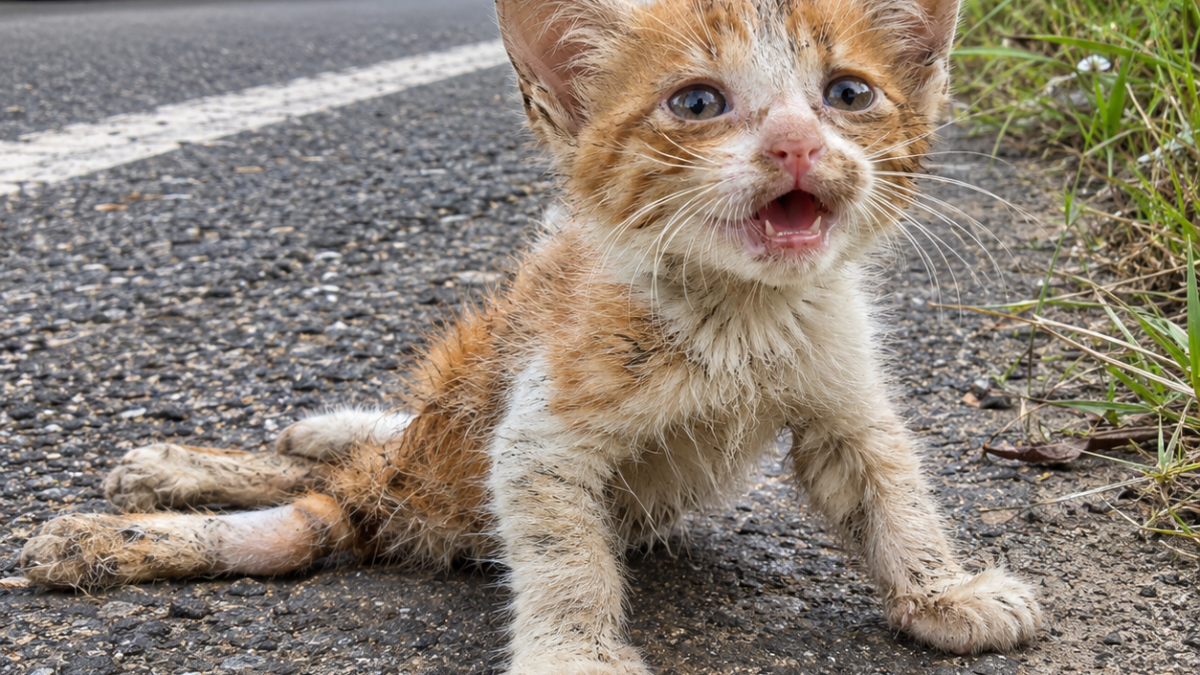
He saw me.
His eyes widened.
He tried to move faster.
His front paws scrambled desperately.
But his body betrayed him.
He moved maybe eight inches.
Then stopped.
His sides heaved.
I crouched several feet away.
“Hey.”
The kitten flattened himself.
Not because he could run.
Because freezing was the only defense he had left.
“Easy.”
His ears pressed sideways.
I lowered one hand to the ground.
He watched it.
No hiss.
No growl.
No attempt to scratch.
That worried me.
Very frightened kittens often fight.
This one simply became still.
As if he had learned that struggling against bigger things did not help.
I looked around.
No mother.
No littermates.
No person searching.
There were a few scraps of food near a dumpster farther down the road, but no water.
I wondered how long he had been there.
An hour?
A day?
Longer?
A motorcycle passed so close that wind lifted dust over us.
That decided everything.
I reached forward.
The kitten’s body became rigid.
“I know.”
My hand touched his chest.
He was warm.
Too warm.
Thin beneath the fur.
I slid my other hand under his belly carefully.
When I lifted him, his hind legs hung loose.
Completely loose.
He did not cry.
He just stared at me.
I wrapped him in the scarf I had been wearing.
His heart hammered against my palm.
“You’re okay.”
It was the first lie I told him.
At that moment, I had no idea whether he was okay.
I carried him to the car.
Once inside, I placed him in a cardboard carrier I kept in the trunk for emergencies.
He tried to pull himself toward the corner.
The box slid slightly.
His hindquarters followed uselessly behind him.
I put a folded towel beneath him.
The kitten stared through the holes in the carrier.
I called Dr. Samir.
He answered with, “You left twenty minutes ago.”
“I found something.”
Silence.
Then a sigh.
“What kind of something?”
“Kitten.”
“Mariam.”
“He can’t use his back legs.”
The irritation left his voice instantly.
“Bring him.”
“I’m coming.”
“Trauma?”
“I don’t know.”
“Bleeding?”
“No.”
“Responsive?”
“Yes.”
“Bladder?”
“I haven’t checked.”
“Come straight back.”
I turned the car around.
The kitten did not make a sound during the entire drive.
That frightened me more than crying would have.
At the clinic, Dr. Samir met me near the back entrance.
He was forty-six, with permanently tired eyes and the calm hands of a man who had spent twenty years touching frightened animals.
He opened the carrier.
The kitten pressed himself backward with his front legs.
Samir stopped.
“Hello, little man.”
I said, “Male?”
“Looks like.”
We moved him onto the examination table.
He weighed barely more than a kilogram.
Maybe eight weeks old.
Possibly younger.
His body condition was poor but not catastrophic.
No obvious fractures.
No external injuries explaining the paralysis.
Samir pinched gently between the toes of one rear paw.
Nothing.
The other.
Nothing.
He tested reflexes.
Then moved up the leg.
A small response near the hip.
He frowned.
I knew that frown.
“What?”
“Let me finish.”
He palpated the spine.
The kitten did not cry.
He checked the pelvis.
Then the abdomen.
When he reached the lower belly, his expression changed.
“What?”
“His bladder is huge.”
I looked down.
“What does that mean?”
“It means he may not be urinating on his own.”
I knew enough to understand the danger.
A paralyzed animal can sometimes lose bladder control completely.
Not just accidents.
The opposite.
Inability to empty.
Urine stays inside.
Bladder stretches.
Infection.
Kidney damage.
Pain.
Potentially death.
Samir looked at me.
“When did you find him?”
“Twenty minutes ago.”
“No way to know how long he’s been like this.”
“No.”
He called our technician, Youssef.
Together they helped empty the kitten’s bladder manually.
I stood nearby.
The kitten’s eyes stayed on me.
His front paws gripped the towel.
It was uncomfortable.
Maybe painful.
He did not fight.
That made me ache.
“Why isn’t he trying to bite?” I asked.
Samir kept working.
“He may be exhausted.”
“Or?”
“Or he learned freezing works better.”
I looked away.
We took X-rays.
No broken spine.
No obvious pelvic fracture.
That was good.
And not good.
Because something was wrong neurologically.
Possibly spinal trauma that had already stabilized.
Possibly congenital.
Possibly infection.
Possibly nerve damage from an old injury.
Without advanced imaging we could not know everything immediately.
Samir sat beside the X-ray screen.
“There is no guarantee.”
I hated that sentence.
“Of what?”
“Any recovery.”
“He’s eight weeks old.”
“I know.”
“So he can heal.”
“Maybe.”
“That sounds like yes.”
“It isn’t.”
He pointed to the image.
“His legs are not responding normally. Deep pain response is questionable. Bladder dysfunction is serious.”
I crossed my arms.
“What are you saying?”
“I’m saying this may be permanent.”
I looked at the kitten.
He had pulled himself toward the far edge of the towel.
His hind legs lay behind him.
“What happens if it is?”
“He can still live.”
I looked at Samir.
“With no back legs?”
“Yes.”
“And no bladder control?”
“Also yes. But it requires care.”
“How much?”
“Several times a day.”
“For how long?”
Samir met my eyes.
“Potentially forever.”
The word settled between us.
Forever.
It is easy to say you would save an animal.
People imagine the dramatic part.
Scooping a kitten from a road.
Driving fast.
Paying the emergency bill.
They do not imagine forever.
They do not imagine waking before work every morning to manually empty a bladder.
Diapers.
Laundry.
Medication.
Skin care.
Monitoring infections.
Cleaning urine.
Supporting the body while an animal eats.
Repeating physical therapy that may never produce visible improvement.
They imagine rescue as an event.
Often it is a schedule.
I looked at the kitten.
“What happens tonight?”
“We admit him.”
I nodded.
Samir said, “Mariam.”
“What?”
“Do not decide his entire life tonight.”
“I’m not.”
“You’re doing the face.”
“What face?”
“The one where you decide something unreasonable and make everybody else help.”
Youssef laughed from the other side of the room.
I glared at him.
“I have no face.”
“You absolutely have a face,” he said.
Samir smiled.
“Tonight, he gets fluids, food, warmth, bladder care, observation.”
“And tomorrow?”
“Tomorrow can handle itself.”
That should have been enough.
It wasn’t.
“What do we call him?”
Samir shrugged.
“You found him.”
Outside, the sunset call to prayer began drifting over the neighborhood.
Ramadan had not started yet, but the sound quieted something inside me.
The kitten lifted his head.
His ears moved toward the sound.
I looked at him.
“Wasim.”
Youssef repeated it.
“Wasim?”
I nodded.
“It suits him.”
Samir looked at the tiny, dust-covered animal with a scrape on his foot and both back legs dragging.
“Handsome?”
“Yes.”
Samir smiled faintly.
“Then Wasim.”
That first night, Wasim slept wrapped in a yellow fleece blanket.
I know because I did not go home.
My sister, Layla, called at eight.
“Where are you?”
“Clinic.”
“Again?”
“Yes.”
“Mama already asked whether you married the veterinarian.”
“Tell Mama no.”
“I did.”
“What did she say?”
“That this is worse.”
I laughed despite myself.
Layla said, “What happened?”
“I found a kitten.”
Silence.
Then, “Of course you did.”
“He’s paralyzed.”
Her tone changed.
“Oh.”
“He can’t urinate by himself.”
“Oh.”
“I might be late.”
“You are already late.”
“I know.”
“Do you need food?”
That was my sister.
No matter the problem, eventually food entered the strategy.
“Yes.”
She arrived forty minutes later carrying containers.
She found me sitting beside Wasim’s cage.
The kitten was awake.
Watching.
Layla crouched.
“He’s tiny.”
“I know.”
“Can he move at all?”
“Front legs.”
She looked at me.
“Are you going to keep him?”
“No.”
My answer came too quickly.
Layla smiled.
“Why are you smiling?”
“Nothing.”
“I’m not keeping him.”
“Okay.”
“I work too much.”
“Obviously.”
“He needs specialized care.”
“Of course.”
“We’ll find someone.”
“Definitely.”
I hated when she agreed with me.
Wasim ate that night.
Not much.
But enough.
Wet kitten food watered into a soft paste.
He pulled himself toward the plate.
His front paws slipped.
His body twisted.
I placed a rolled towel beneath his hips.
That helped.
He ate.
Then tried to groom his chest.
The simple normality of that nearly made me cry.
An animal can be catastrophically injured and still care that its fur is messy.
The next morning began our routine.
Medication.
Bladder expression.
Gentle range-of-motion exercises.
Food.
Cleaning.
Rest.
Then repeat.
At first, Wasim hated being handled.
He did not attack.
He froze.
Every single time.
When I picked up his rear half to clean him, his front legs locked.
When Samir touched his spine, he became flat and silent.
When Youssef approached with a towel, Wasim’s eyes widened until almost no color showed around the pupils.
“Something happened to him,” I said one afternoon.
Samir was writing notes.
“Yes.”
“You think somebody hurt him?”
“I think a kitten ended up paralyzed beside a road.”
“That’s not what I asked.”
“No.”
He put the pen down.
“We don’t know.”
“Could have been hit.”
“Yes.”
“Could have been kicked.”
“Yes.”
“Dropped?”
“Yes.”
“Born like this?”
“Possible, but his front half is strong and he appears to have some inconsistent reflexes. Trauma is high on the list.”
I looked at Wasim.
He was staring at the clinic door.
Every loud sound made him flinch.
“What if the car that hurt him didn’t stop?”
Samir said nothing.
I realized I did not actually want an answer.
During the first week, we posted his photograph online.
FOUND KITTEN.
Approx. 2 months old.
Male.
Hind-limb paralysis.
Found roadside.
No microchip.
No collar.
Nobody claimed him.
Several people commented.
Poor baby.
Prayers.
God bless the rescuer.
So sad.
One person asked whether he would be euthanized.
Another said keeping a paralyzed animal alive was selfish.
I stopped reading.
Human beings become very brave around suffering when it belongs to somebody else.
By the second week, we began a more structured rehabilitation plan.
Vitamin B12 injections.
Joint and nerve support supplements.
Careful massage.
Passive flexion and extension.
Warm compresses.
Skin protection.
Bladder monitoring.
No miracle promises.
Samir repeated that constantly.
“No miracle promises.”
“I haven’t made any.”
“You keep telling him he’s going to walk.”
“That’s encouragement.”
“That is literally a promise.”
Wasim looked between us from his blanket.
I scratched beneath his chin.
“You’re going to walk.”
Samir sighed.
“See?”
Wasim did not walk.
Not that week.
Not the next.
March became April.
The weather warmed.
Ramadan began and ended.
Wasim learned the rhythm of the clinic.
He knew which refrigerator held food.
He knew Youssef’s footsteps.
He learned that Samir was the one who did uncomfortable examinations and therefore should be regarded with mild suspicion.
He learned my voice.
At first, he responded by freezing less.
Then by lifting his head.
Then by pulling himself toward the front of the kennel.
The first time he came toward me voluntarily, I almost missed it.
I opened the kennel.
Normally, I would reach inside.
That day, I was distracted, speaking to Layla on the phone.
Wasim dragged himself forward.
Front paws.
Pull.
Pause.
Pull.
His rear legs followed uselessly.
But he came until his nose touched my wrist.
I stopped speaking mid-sentence.
Layla said, “Hello?”
I whispered, “He came to me.”
“What?”
“Wasim.”
She laughed.
“You sound like you won the lottery.”
I looked at the kitten.
“Maybe.”
That was the first time he purred.
Very faint.
I thought at first something was wrong with his breathing.
Then I felt the vibration beneath my fingers.
Purring.
Wasim.
The kitten who had frozen every time we touched him.
Purring beneath my hand.
I sat on the floor and cried.
Not dramatically.
Just quiet tears.
Wasim kept purring.
The clinic’s receptionist, Noor, walked past.
She saw me.
Saw the kitten.
Then backed away without saying anything.
I appreciated that.
Some moments become smaller if people explain them too quickly.
Progress did not become easy after that.
That is important.
Stories love turning points.
One good moment and then everything rises.
Real recovery is crueler.
Two steps forward.
One back.
Sometimes five back.
In May, Wasim developed a urinary infection.
He became lethargic.
Stopped eating.
His temperature rose.
I knew before the test.
I had become obsessed with urine.
Color.
Amount.
Odor.
Frequency.
There are sentences I never imagined saying before Wasim.
Did he pee?
How much?
Was his bladder firm?
When was the last expression?
I had entire conversations about cat urine while eating lunch.
The infection frightened all of us.
For three days he needed fluids and antibiotics.
One night, his fever reached a point where Samir stayed at the clinic until two in the morning.
I stayed too.
“You can go home,” he told me.
“No.”
“Mariam.”
“No.”
“You have work tomorrow.”
“I work here.”
“You know what I mean.”
Wasim lay under a warming blanket.
His eyes looked dull.
I sat beside him.
“I found him alone once.”
Samir stopped.
I continued.
“He’s not doing sick alone.”
Samir pulled another chair over.
“Then neither are you.”
We sat.
No big speech.
No dramatic rescue.
Just two tired adults drinking terrible vending-machine coffee while a tiny paralyzed cat fought an infection.
He recovered.
Slowly.
A week later, he was insulting Samir again with his eyes.
We celebrated.
Then nothing improved neurologically for almost a month.
No leg movement.
No voluntary urination.
No new reflex.
That was harder than the infection in a different way.
A crisis gives you a job.
Plateau gives you doubt.
Every morning, I massaged Wasim’s legs.
Warm towel.
Gentle circles over the muscles.
Flex.
Extend.
Support the joints.
Watch the toes.
Nothing.
“Come on.”
Nothing.
“Give me something.”
Nothing.
Wasim sometimes purred through the entire process.
That should have been enough.
It wasn’t.
I wanted proof.
Proof that all the hours meant something beyond maintenance.
One afternoon, I lost patience.
Not with him.
With hope.
I had been manually expressing his bladder before lunch.
He was restless.
I repositioned him.
The bladder did not empty easily.
He became uncomfortable.
I tried again.
He twisted.
Urine spilled onto the towel.
My scrub pants.
The floor.
Wasim panicked.
He dragged himself backward.
Knocked over the water bowl.
The kennel bedding became soaked.
I froze.
Then I said, too sharply, “Stop!”
Wasim froze too.
Instantly.
His body flattened.
Eyes wide.
That old fear.
The clinic went silent.
I felt sick.
“Wasim.”
He did not move.
I put both hands down.
“I’m sorry.”
Nothing.
“I’m sorry.”
I backed away.
Samir had heard.
He came over.
I expected criticism.
Instead, he handed me another towel.
“Go outside.”
“I’m fine.”
“No.”
“I scared him.”
“Yes.”
“I didn’t mean—”
“I know.”
“I should fix it.”
“Not while you’re upset.”
I looked at Wasim.
He was still frozen.
Samir lowered his voice.
“He needs you calm more than he needs you guilty.”
That sentence stayed with me.
I went outside.
Sat on the curb behind the clinic.
Cried for five minutes.
Then Layla called.
I answered.
“You sound terrible.”
“I yelled at Wasim.”
“You yelled at a cat?”
“Yes.”
“Did he deserve it?”
“No.”
“Then apologize.”
“I did.”
“Good.”
“That’s all?”
“What do you want, prison?”
I laughed despite myself.
Layla continued.
“You’re tired.”
“So?”
“So tired people make mistakes.”
“He already has enough fear.”
“Mariam.”
“What?”
“You cannot love something by never making a mistake.”
I was quiet.
She said, “You love it by staying after you do.”
I went back inside.
Wasim was curled in a fresh blanket.
I sat outside the kennel.
Did not reach.
For almost twenty minutes, he ignored me.
Fair.
Then he stretched one front paw through the bars.
Touched my finger.
That was forgiveness.
Or curiosity.
Cats do not label things for our comfort.
Either way, I accepted it.
Summer came.
Wasim grew.
That created new problems.
A two-pound paralyzed kitten is easier to carry than a seven-pound adolescent cat.
His front half became powerful.
Shoulders broad.
Forelegs muscular from doing the work of four limbs.
He could move astonishingly fast on smooth surfaces.
The first time he escaped his exercise pen, we found him under Samir’s desk eating a tissue.
Youssef stared.
“How?”
I looked at Wasim.
He looked pleased.
“He climbed.”
“With what back legs?”
“Apparently spite.”
We began using a small support harness.
The harness wrapped around his hips and allowed us to lift part of his weight while he moved.
At meals, it kept him aligned.
During therapy, it let his paws touch the floor in proper position.
We hoped repetition might encourage neurological pathways.
Again, no promises.
At first, his legs simply hung.
Then one day, his right paw landed flat instead of folding under.
I saw it.
I stopped.
“Samir.”
He was examining a dog.
“Busy.”
“Samir.”
“Mariam.”
“Come here.”
He heard something in my voice.
He came.
We repositioned Wasim.
Supported him.
Moved forward.
Left rear paw folded.
Right rear paw landed.
Flat.
Then collapsed.
Samir crouched.
“Again.”
We tried.
Nothing.
Again.
Nothing.
I looked at him.
“You saw it.”
“Yes.”
“That was placement.”
“Maybe.”
“Samir.”
“Yes, I saw it.”
Hope is dangerous.
It can make you invent things.
So we documented everything.
Video.
Dates.
Reflex scores.
Bladder function.
We became scientists about a cat we loved because love without evidence can lie to itself.
July brought the first major change.
Not walking.
Urination.
One morning, I picked Wasim up to express his bladder.
It felt smaller than expected.
I frowned.
Checked again.
“Youssef.”
“What?”
“Did you do him already?”
“No.”
“Samir?”
“No.”
I looked at the litter area.
There was a wet patch on the absorbent pad.
Not huge.
But there.
I stared.
Maybe leakage.
Paralyzed animals can leak urine without true control.
We tested.
Observed.
Waited.
Two days later, it happened again.
Then again.
Wasim was releasing some urine by himself.
Not enough.
Not consistently.
But something had changed.
I called Layla at seven in the morning.
“He peed.”
Silence.
Then, “Congratulations?”
“By himself.”
“Oh!”
She understood immediately.
“He peed?”
“Yes.”
“You’re crying about urine.”
“Yes.”
“I’m proud of both of you.”
We still expressed his bladder.
But less.
That mattered.
Every small piece of independence mattered.
We celebrated strange things.
A wet pad.
A toe reaction.
A proper paw placement.
The first time he repositioned his own hip.
People celebrate birthdays.
Promotions.
Engagements.
We celebrated a cat flexing a toe.
August was when the twitch happened.
Nearly six months after I found him.
It was late afternoon.
Hot.
The clinic’s air conditioner was struggling.
Wasim lay on a towel while I massaged his left rear leg.
He was half asleep.
Purring.
I moved my thumb along the paw pad.
The toes twitched.
I stopped.
My heart slammed.
“Wasim.”
He opened one eye.
I touched the pad again.
Nothing.
I waited.
Pressed lightly.
The paw moved.
Not a reflexive jerk from the whole leg.
A small flex.
I screamed.
Actually screamed.
Samir came running from the treatment room.
“What happened?”
“His paw.”
“What?”
“His paw moved.”
Youssef appeared behind him.
Noor came from reception.
Everybody crowded around.
Samir said, “Move back.”
Nobody moved.
He tested.
Touch.
No response.
Again.
Small twitch.
Samir froze.
I grabbed his arm.
“You saw it.”
“Yes.”
“You saw it.”
“I saw it.”
I began crying.
Youssef raised both hands.
“Is this good?”
“Yes!”
Wasim looked deeply annoyed by the noise.
Samir tested the other paw.
A weaker response.
He sat back.
“This is neurological response.”
“What does that mean?”
“It means something is conducting.”
“He’ll walk.”
“I did not say that.”
“He’ll walk.”
“Mariam.”
“He will.”
Samir looked at Wasim.
Then at me.
For once, he did not argue.
The video of the twitch became the most watched clip in our private staff group.
My mother watched it eleven times.
She had originally told me I should not become too attached to “that poor little animal.”
By August she was sending him boiled chicken.
People change.
Wasim changed too.
Not just physically.
His personality emerged as fear faded.
He was not quiet.
That had been survival.
The real Wasim was demanding.
Nosy.
Affectionate when he wanted something.
Offended by closed doors.
He loved towels fresh from the dryer.
Hated bananas for reasons nobody understood.
He adored a small stuffed duck that Noor bought him.
He would drag it across the floor using his teeth.
At night, if I stayed late, he would pull himself toward my chair and sleep on my shoe.
Eventually, I began taking him home on weekends.
That was temporary.
Everything important begins with people lying to themselves about the word temporary.
My apartment had one bedroom.
Layla helped me adapt it.
Low litter trays.
Washable rugs.
Foam mats for traction.
A ramp to the couch that Wasim ignored because he preferred climbing the side like a criminal.
Diaper supplies in a basket.
Medication in the kitchen.
The first weekend, I slept on the floor beside him because I was afraid he would get stuck somewhere.
At 3:00 a.m., I woke to scratching.
Wasim had pulled himself halfway into my open wardrobe.
“What are you doing?”
He looked at me.
A sock hung from his mouth.
“You have no respect.”
He dragged the sock away.
That was the night I realized he was happy.
Not grateful.
I dislike when people say rescued animals are grateful.
Animals do not owe us gratitude for treating them decently.
Wasim was simply happy.
Safe enough to steal socks.
Safe enough to complain.
Safe enough to sleep deeply.
Safe enough to become inconvenient.
That felt like success.
In September, roughly seven months after his rescue, we tried a mobility cart.
Two tiny wheels supported his hips.
I hated it on sight.
It looked mechanical.
Cold.
Like admitting defeat.
Samir saw my face.
“This is not giving up.”
“I didn’t say anything.”
“You’re doing the face.”
“I hate that everyone says that.”
Wasim was fitted carefully.
At first, he froze.
Then pulled forward.
The wheels rolled.
He stopped.
Looked behind himself.
Pulled again.
Rolled.
His ears lifted.
Then he took off.
Straight down the clinic corridor.
Noor screamed.
A client grabbed her purse.
Wasim hit a cardboard display of cat food samples and scattered packets everywhere.
Youssef chased him.
I laughed so hard I had to lean against the wall.
For the first time since I met him, Wasim moved faster than I could comfortably follow.
That cart did not mean his legs had failed.
It meant his life did not have to wait for them.
That lesson was harder for me than for him.
Human beings are obsessed with normal.
Walking normally.
Living normally.
Recovering normally.
But Wasim did not care how movement looked.
He cared that the hallway existed and he could get down it.
He cared that there was a sunbeam near reception.
He cared that someone had left chicken unattended.
The cart gave him freedom.
So we used it.
Then removed it for therapy.
Then used it again.
Rehabilitation and adaptation existed together.
One did not cancel the other.
Autumn brought setbacks.
His bladder function improved, then worsened during another infection.
He developed skin irritation from diapers.
We had to change materials, increase cleaning, use barrier cream, give more diaper-free time.
His left leg became stiff.
More stretching.
More massage.
More uncertainty.
Some days I went home convinced he had plateaued forever.
Other days he surprised us.
During one therapy session, he pulled himself forward in the harness and his right hind leg pushed against the floor.
Not a step.
A push.
Then another week later, the left leg responded.
Tiny.
Uneven.
But there.
By November, Wasim could sometimes hold himself upright for two or three seconds if we positioned his feet.
The first time it happened, nobody breathed.
I supported his hips lightly.
Samir placed both rear paws flat.
“Ready?”
“As I’ll ever be.”
I reduced support.
Wasim remained upright.
One second.
Two.
His legs trembled violently.
Three.
Then he collapsed sideways into a towel.
I screamed again.
Wasim immediately bit the towel.
Youssef clapped.
Noor cried.
Samir smiled.
That was rare enough to be documented separately.
“Three seconds,” I said.
“About.”
“Three.”
“Yes.”
I kissed the top of Wasim’s head.
He tried to bite my chin.
“Ungrateful.”
Samir said, “You just said animals don’t owe gratitude.”
“Not now.”
December was the hardest month emotionally.
A year was approaching.
That created an invisible deadline in my mind.
I had never said it aloud.
But somewhere inside me, I had decided that by one year Wasim needed to walk.
Why?
No medical reason.
No rehabilitation rule.
Just human obsession with anniversaries.
One year feels like a verdict.
If he walked before then, the story had an ending.
If he did not, maybe I had failed.
I began increasing therapy.
Longer sessions.
More repetitions.
Samir noticed.
“Enough.”
“He’s not tired.”
“You are.”
“I’m fine.”
“You are becoming impatient with his body.”
That offended me.
“I have spent ten months being patient.”
“Exactly.”
“So?”
“So now you think patience has earned you a result.”
I stared at him.
“That’s unfair.”
“Yes.”
“Then why say it?”
“Because it’s true.”
I looked at Wasim.
He was sleeping inside a folded towel.
Samir sat beside me.
“His recovery is not payment for your work.”
“I know.”
“Do you?”
I said nothing.
“He may never walk normally.”
The sentence still hurt.
Even after all that time.
Samir continued.
“And if he doesn’t, this year was not wasted.”
“I know.”
“You kept him alive.”
“More than that.”
“Yes.”
“He’s happy.”
“Yes.”
“He can pee some on his own.”
“Yes.”
“He has sensation.”
“Yes.”
“He can stand sometimes.”
“Yes.”
Samir looked at me.
“So why are you measuring success by the one thing he hasn’t done?”
I didn’t answer.
Because humans do that.
We ignore ninety-nine victories and stare at the unopened door.
That evening, I went home early.
No therapy.
No extra exercises.
I put Wasim on the rug without his harness.
He dragged himself toward the couch.
Climbed the ramp halfway.
Slid backward.
Tried again.
I sat nearby.
Did not help.
The third time, he made it.
He pulled himself onto the cushion.
Then crawled into my lap.
I stroked his back.
“You don’t owe me walking.”
Wasim purred.
“I mean it.”
Purr.
“You can be exactly this.”
He pressed his face into my arm.
Something inside me finally relaxed.
January came.
Cold rain.
Short days.
Wasim began spending more time standing during supported therapy.
Four seconds.
Five.
Sometimes seven.
His right hind leg became more active than the left.
He could push.
Occasionally reposition.
We changed the exercises.
Water therapy was suggested.
Wasim hated water.
The first session lasted forty seconds before he climbed halfway up my shirt.
“No.”
He dug claws into my shoulder.
“It helps.”
He climbed higher.
“Wasim.”
Samir laughed from outside the therapy tub.
“I think he has expressed an opinion.”
“He has neurological damage, not voting rights.”
Wasim reached my neck.
We tried again days later.
Gradually.
Less water.
More support.
He tolerated it.
Then adapted.
Then, unbelievably, began moving both rear legs in the water.
Not weight-bearing.
But movement.
Alternating movement.
I saw it.
I did not scream this time.
I whispered.
“Oh my God.”
Samir crouched.
Wasim paddled.
Front legs.
Right rear.
Left rear.
Weak.
But there.
That night, I called Layla.
“He moved both.”
“What?”
“Back legs.”
Silence.
Then she began crying before I did.
“Both?”
“Yes.”
“Did you record it?”
“Of course.”
“Send it.”
I did.
My entire family watched that video.
My mother forwarded it to people I did not know.
By February, nearly one year after I found him, Wasim had become a clinic celebrity.
People asked about him.
Children brought toys.
A local rescue group donated therapy supplies.
One elderly man came every Tuesday just to sit with him.
His name was Ibrahim.
He had lost his wife the previous year.
He never said much.
He would sit in the corner.
Wasim would drag himself over.
Eventually climb into Ibrahim’s lap.
One afternoon I heard Ibrahim whisper, “We are both learning, you and me.”
I pretended not to hear.
Wasim had become more than a patient.
That happens sometimes.
An animal survives publicly enough that everybody begins placing pieces of themselves into the survival.
Dangerous.
Beautiful.
Heavy.
Near the anniversary of his rescue, we repeated neurological tests.
Samir worked slowly.
Right paw response.
Strong.
Left.
Moderate.
Hip movement.
Improved.
Tail movement.
Intermittent.
Bladder control.
Partial.
I stood beside the table.
“Well?”
Samir removed his gloves.
“Well what?”
“You know.”
“He improved.”
“How much?”
“Significantly.”
“Will he walk?”
Samir smiled faintly.
“I knew you’d ask.”
“Answer.”
“Maybe.”
I stared at him.
After a year, maybe had become a beautiful word.
The anniversary arrived on a Tuesday.
Exactly like the day I found him.
I drove the same road that morning.
Alone.
I had not planned to stop.
Then I did.
Traffic still moved fast.
Repair shops still lined the street.
The shoulder looked ordinary.
That upset me.
Places do not preserve the importance of what happened there.
There was no marker.
No sign.
No evidence that a tiny kitten once dragged himself through dust beside speeding cars.
I parked.
Got out.
Stood near the place where I first saw him.
I tried to imagine driving past again.
I could.
That was the frightening part.
A different day.
Looking at my phone.
Thinking about work.
A larger truck behind me blocking the view.
I might never have seen him.
People love stories about fate.
I am less comfortable with them.
Fate lets us feel everything important was guaranteed.
Wasim was not guaranteed.
He was small enough to miss.
That truth made his life feel more precious, not less.
I returned to the clinic.
Noor had decorated Wasim’s exercise area.
I objected immediately.
“What is this?”
A little paper sign said:
ONE YEAR STRONG.
“No party.”
“There’s cake.”
“For humans?”
“Mostly.”
Samir came from treatment.
“You lost this argument hours ago.”
I looked at Wasim.
He wore a small blue bandana.
“You allowed this?”
Wasim licked his paw.
Traitor.
We did his normal therapy.
Not a performance.
That was important to me.
No forcing a milestone because people were watching.
Warm massage.
Stretch.
Harness.
Paw placement.
Wasim was relaxed.
Purring.
I supported his hips.
He moved forward.
Front paws stepped.
Right hind paw pushed.
Left dragged.
Again.
Right push.
Then something happened.
Wasim lifted the left hind paw.
Not a twitch.
Not water movement.
Lifted.
Placed.
Weight transferred.
I froze.
Samir’s eyes widened.
“Don’t stop.”
I barely breathed.
Wasim moved a front paw.
Right rear pushed.
Front.
Left rear lifted again.
Placed badly.
Collapsed.
I caught him.
Nobody made a sound for maybe two seconds.
Then Noor screamed.
Youssef shouted.
I sank to my knees.
Wasim tried to crawl out of the harness, offended by the celebration.
I held his face.
“You stepped.”
My voice broke.
“You stepped.”
Samir crouched beside us.
“One assisted sequence.”
I glared through tears.
“Don’t you dare.”
He smiled.
“It was a step.”
I kissed Wasim’s head.
He purred.
That was not the end.
He did not suddenly walk across the room.
The next day he could not repeat it.
Two days later, one rear leg barely cooperated.
A week later, he managed another assisted step.
Then three.
Then none.
Recovery remained recovery.
Messy.
Incomplete.
Honest.
But the door had opened.
By spring, Wasim could manage short supported sequences.
His left leg remained much weaker.
He still used his cart.
Still wore diapers at times.
Still needed bladder checks.
Still required skin care.
Still had limitations.
And none of those facts diminished what he had become.
The helpless kitten beside the road no longer existed.
Not because Wasim became “normal.”
Because helpless had never actually described him correctly.
Even that first day, he had moved.
Two front paws.
One inch.
Then another.
He had always been participating in his own rescue.
I simply noticed.
Eventually, the clinic began asking me the question I had avoided from the beginning.
“Where is Wasim going to live?”
I answered the same way.
“We’ll find the right home.”
Layla laughed when I told her.
“What?”
“You are the right home.”
“I work.”
“You take him to work.”
“I have one bedroom.”
“He weighs eight pounds.”
“Nine.”
“Thank you for proving my point.”
“He needs specialized care.”
“You perform the specialized care.”
“That doesn’t mean—”
“Mariam.”
I stopped.
She softened.
“Why are you afraid to say he’s yours?”
I knew the answer.
Because animals die.
Because loving fragile things gives the future a weapon.
Because caring for Wasim had consumed nearly a year of my life, and somewhere along the way I had started imagining what would happen if he developed kidney failure.
A bad infection.
A spinal complication.
Because when you spend months trying to keep something alive, sometimes you protect yourself by pretending you are only temporary.
“I don’t know.”
Layla said, “Yes, you do.”
I looked across my apartment.
Wasim was asleep on a folded towel near the window.
His cart sat beside the couch.
Diapers in the basket.
Stuffed duck beneath the table.
There was cat hair on my prayer rug despite my constant effort.
His food in my kitchen.
His medications labeled in my handwriting.
His life already woven through mine.
“What if I can’t do this forever?”
“You don’t have to do forever today.”
Samir had said something similar on the first night.
Tomorrow can handle itself.
Apparently everybody had been conspiring against me.
The next morning, I filled out the adoption papers through the rescue organization that had helped cover some of his rehabilitation supplies.
Under adopter name:
Mariam Hassan.
Noor cried.
Youssef clapped.
Samir said, “Finally.”
I said, “You’re all irritating.”
Wasim ate a treat.
He had no idea anything legal had changed.
That was appropriate.
The paper did not make him family.
It documented something that had happened months earlier.
Wasim continued improving.
Not dramatically.
That is the ending people sometimes expect.
They want me to say he eventually ran.
That his paralysis disappeared.
That one day he rose and became indistinguishable from any other cat.
That did not happen.
His story is better because I do not need to lie about it.
He remained neurologically disabled.
His right leg became functional enough to assist movement.
The left gained sensation and limited motion.
He could sometimes support himself briefly.
He could take assisted steps.
He gained meaningful bladder function but still required monitoring and occasional help.
He used his cart when he wanted speed.
He dragged himself when he didn’t.
He learned to climb furniture using techniques no veterinarian approved.
He became excellent at removing diapers.
He became even better at looking innocent afterward.
He lived.
That is the miracle.
Not perfect recovery.
Life.
One evening, nearly eighteen months after I found him, I took Wasim onto the small enclosed balcony of my apartment.
The sun was setting.
Warm breeze.
Traffic sounded far below.
He sat in his cart.
Then I removed it.
Placed him on the rug.
He pulled himself toward the railing.
Stopped.
Looked through the bars.
Cars moved below.
I wondered whether the sound frightened him.
He did not freeze.
He watched.
Then turned toward me.
His front paws moved.
His right hind leg pushed.
The left shifted.
He came across the rug.
Not gracefully.
Not normally.
But toward me.
I sat down.
Wasim reached my knee.
Climbed into my lap.
Purrrrr.
I touched the top of his head.
“You know, I drove past you.”
His eyes closed.
“I did.”
Purr.
“I almost didn’t stop.”
That confession had lived inside me for a long time.
People told the story differently.
Mariam saw a kitten and rescued him.
Mariam saved Wasim.
Mariam refused to give up.
Those versions made me uncomfortable.
The truth was less flattering.
I was tired.
I wanted to go home.
I saw him late.
I had already passed.
The difference between his life and death may have been one glance into a rearview mirror.
That knowledge changed me.
Not into a saint.
Into someone who looked more carefully.
After Wasim, I began noticing things.
The limping dog near a bakery.
The dehydrated kitten hiding beneath a car.
The old man struggling with grocery bags.
The exhausted mother carrying a sleeping child on a bus.
You cannot rescue everyone.
That is another truth.
Trying will destroy you.
But you can notice.
And sometimes noticing is the first piece of mercy.
Wasim became six years old.
Then seven.
Older than anyone had guaranteed.
He developed preferences.
Routines.
Enemies.
Vacuum cleaner: enemy.
Hair dryer: enemy.
Closed bathroom door: personal insult.
Chicken: sacred.
Fresh laundry: immediately occupied.
He never became comfortable with strangers reaching too quickly.
That first fear stayed somewhere inside him.
But he learned choice.
If someone sat quietly, he would sometimes approach.
If they reached, he might leave.
Nobody forced him.
The boy who once had no control over his own body deserved control wherever we could give it.
I learned to ask permission in ways animals understand.
Hand near.
Wait.
Touch.
Stop if he stiffens.
Continue if he leans in.
People could learn from that too.
When Wasim turned eight, Samir found early kidney changes.
Nothing catastrophic.
Manageable.
Still, I went home and cried.
Layla came over.
“You knew he would get old.”
“I know.”
“You knew this part would come.”
“I know.”
She sat beside me.
Wasim lay in his bed.
I said, “I thought after everything he already went through, maybe he should get some exemption.”
“From aging?”
“Yes.”
“Reasonable.”
I laughed.
Then cried again.
Wasim lived three more years.
Eleven years old.
Not bad for a kitten who might have died before his first Ramadan.
His last year was quiet.
Kidney food.
More checkups.
His mobility decreased.
The little right leg that had fought so hard became weaker.
Eventually, he stopped using the cart much because it tired him.
I carried him more.
He liked that.
The frightened kitten who once froze under human hands eventually became an old cat who demanded to be held against my chest.
Sometimes I thought about that transformation more than the neurological recovery.
Trust had been his longest journey.
Longer than walking.
Longer than bladder control.
Longer than nerve healing.
The road taught his body that the world was dangerous.
Years of ordinary kindness taught him something else.
Not that nothing bad would happen.
That safety could exist too.
On his final morning, Wasim did not eat.
I knew.
We always know before we admit it.
I called Samir.
He had more gray hair by then.
So did I.
He came to my apartment instead of making Wasim travel.
Layla arrived.
Noor came later with the old stuffed duck.
She had kept a duplicate all those years.
Wasim lay in his favorite yellow blanket.
The same color as the one we wrapped him in his first night at the clinic.
I had not planned that.
Maybe some circles close themselves.
Samir examined him.
Kidneys.
Age.
Weakness.
Pain that medication no longer controlled well enough.
He looked at me.
I nodded before he spoke.
That was the final thing I could do for Wasim.
Not another treatment.
Not another exercise.
Not asking his exhausted body for one more victory because I was afraid of losing him.
I put him in my lap.
He was light again.
Like the kitten from the road.
Not as light.
But close enough to hurt.
His hind legs lay relaxed.
I rubbed them.
The same massage.
Small circles.
Gentle pressure.
After eleven years, my hands knew every bone.
Every muscle.
Every place that had once been unresponsive.
Wasim purred.
Faintly.
Layla began crying.
Samir turned away for a moment.
I whispered, “Remember this?”
Purr.
“You used to hate it.”
His paw twitched.
The right one.
Tiny.
Maybe reflex.
Maybe nothing.
I laughed through tears.
“Show-off.”
I thought of that first twitch nearly a year after his rescue.
How we screamed.
How ridiculous we must have looked.
Adults celebrating a toe.
But love gives value to small things.
A twitch.
A wet pad.
Three seconds standing.
One assisted step.
One purr.
One animal choosing to come toward you instead of freeze.
Small things had built Wasim’s entire life.
Samir prepared the medication.
I held Wasim closer.
“You were supposed to be temporary.”
His purr continued.
“You were supposed to go to someone with more time.”
I kissed his forehead.
“Better apartment.”
Purr.
“More money.”
His eyes half closed.
“Probably fewer diapers.”
Layla laughed through tears.
I looked down at him.
“But you got me.”
Wasim rested his chin against my arm.
“And I got you.”
That was the truth.
He had not spent eleven years as my burden.
He gave me something too.
Patience without guarantees.
Hope without entitlement.
The ability to celebrate progress without demanding perfection.
A reason to stop believing that a life had to look ordinary to be complete.
Samir asked, “Ready?”
No.
“Yeah.”
The first medication relaxed him.
His body softened.
The tension left his shoulders.
I kept massaging the little back paws.
He could feel some of it.
We knew that.
That still amazed me.
“Good boy.”
I had said those words thousands of times.
“Good boy.”
Wasim exhaled.
I touched his forehead with mine.
“You can rest.”
The second medication went in.
His breathing slowed.
One.
Pause.
Another.
Then stillness.
I did not move.
Nobody asked me to.
After a while, Samir placed one hand on my shoulder.
“He had eleven years.”
I looked at him.
“He should’ve had more.”
“Yes.”
That was why I trusted him.
No speeches about being grateful.
No insistence that eleven was enough.
Love always asks for one more day.
Wasim was buried in my mother’s garden beneath a jasmine tree.
Layla chose the place.
I brought the stuffed duck.
Then changed my mind.
I kept it.
Some things belong with the living.
His small mobility cart went to the rescue clinic.
A young paralyzed kitten used it six months later.
That nearly destroyed me.
Then healed something too.
The new kitten’s name was Sami.
He hated the cart for three days.
Then discovered speed.
Noor sent me a video.
Sami racing down the same clinic hallway.
Packets flying from the same cardboard display.
I laughed until I cried.
The clinic eventually started a small rehabilitation fund.
Nothing large.
Money for diapers.
Harnesses.
Wheelchairs.
Physical therapy.
Bladder-care supplies.
They named it after Wasim.
I objected.
Naturally nobody listened.
On the wall near the treatment room, they hung one photograph.
Not Wasim standing.
Not Wasim in his cart.
Not the dramatic twitch.
It was a photograph from his first week.
Tiny kitten.
Wrapped in yellow fleece.
Front paws tucked beneath his chest.
Eyes wide.
Still afraid.
Below it, Noor placed a sentence:
RECOVERY DOES NOT BEGIN WHEN THE BODY BECOMES PERFECT.
IT BEGINS WHEN SOMEONE DECIDES THE LIFE IS WORTH THE WORK.
I still think that is too dramatic.
She refuses to remove it.
Every year near Ramadan, I drive the road where I found Wasim.
The city changed.
One repair shop became a pharmacy.
Another became a café.
Traffic became worse.
The shoulder was paved.
There is nothing there now that looks like the place where a tiny kitten pulled himself through dust.
I stop anyway.
Not for long.
A minute.
Maybe two.
I think about two front paws.
Pull.
Pause.
Pull.
The back legs dragging.
The eyes searching.
People often tell me Wasim never gave up.
I understand why.
It sounds beautiful.
But I think the truth is slightly different.
Animals do not make inspirational speeches to themselves.
Wasim was not thinking about courage.
He was trying to reach somewhere safer.
Trying because that was what his body could still do.
Two front paws.
So he used two front paws.
When bladder function returned a little, his body used that.
When one toe twitched, we built around the twitch.
When one leg pushed, we built around the push.
When walking remained difficult, wheels gave him speed.
When wheels became tiring, arms carried him.
Recovery was never about turning Wasim into the kitten he might have been if nothing bad had happened.
That kitten did not exist anymore.
Recovery was helping the cat in front of us build a life with what remained.
That changed the way I understood courage.
Courage is not always standing.
Sometimes you cannot stand.
Courage can look like dragging yourself one more inch.
Trust can look like not freezing when a hand reaches toward you.
Hope can look like urine on an absorbent pad.
A miracle can be one toe moving for one second.
And love can look remarkably unglamorous.
Laundry.
Medication.
Diapers.
Alarms.
Cleaning.
Appointments.
Massaging legs that may never walk.
Showing up again tomorrow even when today gave you nothing new.
That is what nearly a year taught us before Wasim took his first assisted step.
And the eleven years afterward taught me something even bigger.
The step was never the point.
We thought it was.
I desperately wanted it to be.
The point was that long before Wasim moved that paw, his life already mattered.
He mattered when he was dragging himself beside the road.
He mattered when his bladder had to be emptied by somebody else.
He mattered when his legs did nothing.
He mattered when he froze in fear.
He mattered when he purred.
He mattered in the cart.
He mattered in my arms.
He mattered old and tired beneath a yellow blanket.
Recovery did not create his worth.
It only gave him more time to show us what had been there from the beginning.
A tiny body.
A stubborn heartbeat.
Two trembling front paws.
And a life worth stopping for.








