A One-Eyed Stray Cat Vanished for Three Days During a Snowstorm—Then He Came Scratching at My Door With a Little Girl’s Pink Glove in His Mouth.
PART3:
After that, I noticed them together more often.
The girl’s name was Lily.
I knew because I heard her mother call it one evening from the doorway in that tired voice parents use when they have already called twice and do not have enough strength left for a third.
“Lily, come inside.”
Lily would appear around sunset and sit on the steps in that too-small pink coat, knees tucked together, hands hidden in her sleeves.
Soldier would come from nowhere.
I never saw where he slept.
Never saw where he spent mornings.
He just arrived like fog.
Silent.
Scarred.
Certain.
He took his place near the bottom step and watched the street.
He did not act sweet.
He did not beg.
He did not press against her legs.
He only sat close enough that a child could feel less alone without having to admit she was lonely.
There are some kinds of kindness that do not announce themselves.
In neighborhoods like ours, you learn not to push people for more than they want to give.
You notice things.
You pretend not to.
You see the same green coat on Lily’s mother every evening.
You see grocery bags carried in both hands.
You see a child sitting outside too long because the inside of a house may not be dangerous, exactly, but it might be heavy.
You see a stray cat sitting guard.
And if you are cowardly, or tired, or just human, you tell yourself it is not your business.
That is what I did.
Then Soldier disappeared.
One day passed.
Then two.
Then three.
Lily still came outside and sat on the steps.
The wind got meaner. Snow started falling in dry little needles that stung your face. From my living room window, I watched her sit there in that same pink coat, twisting her fingers together, staring at the street like she could force Soldier to come back by wanting it badly enough.
I almost went over twice.
I did not.
I told myself it was not my business.
That sentence has excused more cruelty than most of us want to admit.
That night, the temperature dropped hard.
The kind of cold that makes old houses pop and groan like they are complaining in their sleep.
I was in the kitchen heating canned soup when I heard scratching at my back door.
Not knocking.
Scratching.
I turned off the burner and stood there listening.
Again.
Scratch.
Scratch.
Scratch.
I opened the door.
There he was.
Soldier.
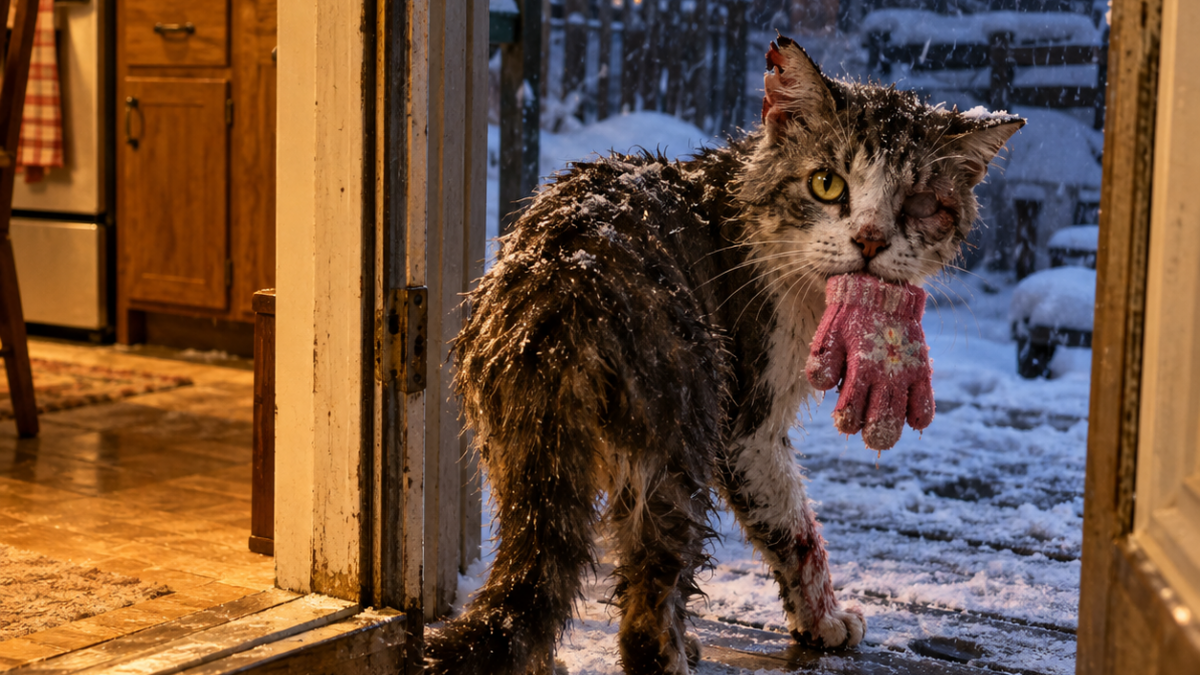
He was soaked through, shivering so hard his whole body jerked. Snow clung to his whiskers. One paw was bleeding, leaving tiny red marks on the back step.
And hanging from his mouth was a little pink glove.
A child’s glove.
For one second, I just stared.
He stared back with that one yellow eye.
Then he turned, stumbled off the porch, and looked over his shoulder.
Not like a cat looking for food.
Not like an animal asking to come inside.
Like he needed me to follow.
My heart dropped through my ribs.
I grabbed my coat, flashlight, and boots without thinking. I did not even lock the door behind me.
Soldier limped across the narrow yard behind the houses, through snowdrifts that came halfway up my boots, toward the broken stretch of fence near the back lot.
My light shook so badly I could barely keep it straight.
“Slow down,” I whispered, though he was barely moving.
He did not slow.
He led me through the gap in the fence.
That was when I heard it.
A tiny sound.
Not even a cry anymore.
More like breathing wrapped in fear.
I swung the flashlight.
There, on the other side of the fence, half-curled into herself in the snow, was Lily.
One hand bare.
Cheeks white with cold.
Eyes too wide.
Her pink coat was dusted in ice.
She must have gone looking for Soldier when he did not come back. Maybe she slipped. Maybe she got turned around. Maybe the snow swallowed familiar shapes until home disappeared behind her.
However it happened, she was too scared and too cold to find her way back.
“It’s okay,” I said, dropping to my knees. “I got you. I got you.”
Her lips trembled.
“Soldier,” she whispered.
He was beside her.
Still standing.
Still guarding.
As if his half-starved frame was enough to fight winter itself.
I wrapped my coat around Lily, lifted her up, and held her against me as tightly as I dared. She was icy through her clothes. Her bare fingers curled against my shirt like little frozen twigs.
Soldier stayed beside us until I stood.
Then he staggered once.
Nearly fell.
“Come on,” I told him. “You too.”
I carried Lily home first because there are moments when priority is not a moral puzzle.
Her house was dark except for one kitchen light.
No one answered when I knocked.
So I brought her to mine.
I got her under blankets.
Put socks on her feet.
Made hot chocolate too sweet because I could not think clearly.
Her fingers were icy.
Her lips trembled when she tried to speak.
I kept saying stupid things like, “You’re okay,” and “Just breathe,” because sometimes the mouth keeps working long after the brain has lost the map.
When I looked toward the door, Soldier was still there on the mat.
Waiting.
Snow melting under him.
Blood from his paw spreading into the towel I had thrown down.
Lily saw him and started crying before I did.
“You came back,” she whispered.
For the first time since I had known him, Soldier let me pick him up.
He did not hiss.
Did not slap.
Did not twist away.
He was too tired.
Too done trying to be tough.
I wrapped him in an old towel and set him near the heater.
Lily reached down and touched the top of his scarred head with two fingers.
He closed his one good eye like that was all he needed to hear.
Soldier stayed with me after that.
Not officially at first.
People like to imagine rescue as a clean moment.
Door opens.
Animal enters.
Heart heals.
Credits roll.
That is not how it works with creatures who have survived by trusting nothing.
For the first week, Soldier tolerated the house like a prisoner evaluating the guards.
I bought a litter box.
He insulted it.
I bought the cheapest cat bed at the hardware store.
He slept beside it on the floor.
I put down soft canned food.
He sniffed it like I had served poison, then ate all of it when he thought I was not looking.
At the clinic, they told me his bleeding paw was infected.
They told me he had an old healed rib fracture.
They told me the scars around his empty eye socket were old too.
Maybe from another animal.
Maybe from a car.
Maybe from a person.
The world gives out damage in more ways than one.
They said he was maybe six.
Maybe eight.
Hard to tell with strays.
Hard lives age you funny.
That much made sense to me.
I paid for the antibiotics with grocery money I should not have touched.
Then told myself I would figure it out later.
That was how most of us on that block were living anyway.
One late fee at a time.
One repaired boot instead of new shoes.
One prayer to the furnace.
One card declined in private.
The morning after Lily was found, her mother came to my house.
Her name was Dana.
I had seen her coming and going for months, always in a rush, always wearing that tired green coat, always carrying too much in both hands.
Laundry.
Groceries.
Shoes in a plastic bag.
A lunch container.
The kind of woman who moved like rest was a rumor other people could afford.
She worked nights at Pine Hollow Care Center.
The badge on her coat said so.
Not a place you would know.
Just one of those facilities that smelled like bleach, old coffee, and low staffing.
She had picked up an extra shift.
Then another.
Then another.
By the time she got home that night, Lily was supposed to be asleep at a neighbor’s place for an hour or two.
Except the arrangement fell through.
Except nobody told Dana in time.
Except children do what children do when grief and loneliness and hope get mixed together.
They go looking.
And Lily had gone looking for Soldier.
Dana stood in my kitchen and apologized so hard it frightened me.
“I don’t leave her,” she said.
Then, more fiercely: “I don’t just leave my kid.”
“I know,” I said.
But the truth was, I did not know much yet.
Not really.
I only knew the look on her face.
That sick, hollow, self-punishing look people get when life hands them one bad break too many and then dares them to blink.
Lily sat at my table under a blanket, sipping hot chocolate too fast and burning her tongue a little.
Soldier lay near the heater.
Still wrapped in my old towel.
Still breathing like each breath had to be negotiated.
Every so often, Lily leaned down and touched the back of his neck like she needed proof he was real.
That should have been the end of it.
A quiet miracle.
A scared child found.
A battered cat saved.
One family grateful.
One neighbor changed.
That should have been enough.
But nothing stays small anymore.
Not kindness.
Not pain.
Not judgment.
Before noon, somebody had posted about it in the neighborhood group.
Not me.
Not Dana.
Not Lily.
Probably the woman across from the corner house, the one who always knew a story before the people living it did.
The post had a blurry photo of Soldier sitting on my porch like an old boxer after twelve rounds.
The caption said:
ONE-EYED STRAY SAVES LITTLE GIRL IN LAST NIGHT’S STORM.
By two o’clock, people were losing their minds over it.
“Angel cat.”
“God sends help in strange forms.”
“This made me cry.”
“That baby needs a medal.”
“Someone get that brave kitty to a real home.”
“This is why animals are better than people.”
That one showed up a lot.
Funny thing is, most people only say animals are better than people when they are looking for an excuse not to do better themselves.
By dinner, one of those cheerful little local online news pages had picked it up too.
Not a major outlet.
Just a community page that posted school bake sales, traffic warnings, lost dogs, and miracles between ads for roofers.
They wanted to “feature the inspiring story.”
Dana said no.
I said no.
Lily hid behind the couch when anyone mentioned a photo.
But Soldier?
People wanted Soldier.
They wanted his face.
His story.
His scars.
His journey.
They wanted the cleaned-up version where courage shows up furry and broken and uncomplicated.
Nobody wanted the other version.
The one where a child had been cold and scared enough to wander into a back lot after dark because the world around her had already asked too much of her.
That version did not fit in a cute headline.
For two days, my phone kept buzzing.
I did not even know that many people had my number.
A woman from a rescue group asked if I was “the current point of contact for the hero cat.”
That was how she said it.
Like Soldier was a little celebrity with a management team.
A retired man from four streets over offered to build an insulated outdoor shelter “if the animal is too feral for indoor life.”
A teacher from the elementary school dropped off canned food and gloves for Lily.
That part was kind.
A man I had never met messaged me to say strays are unpredictable and I should not trust a half-wild animal around children.
That part felt more familiar.
Praise with one hand.
Fear with the other.
That is how people treat the visibly damaged more often than they like to admit.
Soldier, meanwhile, did not care.
He slept.
He ate.
He limped to the water bowl.
He glared at me when I cleaned the dried blood from his paw, then gave up fighting halfway through and let me do it anyway.
He was heavier than he looked when I picked him up.
All bone.
Old hurt.
Stubbornness.
That first week, Lily came over every day after school.
At first, Dana apologized for that too.
“She’s not trying to be underfoot,” she said. “She just…”
“I know,” I said.
And I did.
Lily did not come for me.
Not really.
She came for Soldier.
But I think she also came for what my house felt like after that night.
Warm.
Quiet.
Predictable.
There is no luxury more powerful to a scared child than knowing what the next ten minutes are going to feel like.
She sat cross-legged on the rug and read to him from library books.
Not cat books either.
History books.
Weather books.
One about sharks.
Soldier lay there like a king receiving reports from the front.
Sometimes he opened his good eye halfway when she used a silly voice.
That was his version of joy.
He did not purr much.
He leaned.
Just leaned.
Against her leg.
Against the radiator.
Against the old blanket.
As if after years of surviving alone, he was finally learning the difference between shelter and home.
Then the comments got uglier.
That always comes next too.
A week into the story going around, somebody posted that Lily’s mother should be “investigated.”
Somebody else wrote that if a child was outside alone in weather like that, “there are probably bigger issues in that household.”
Another person said, “Everybody’s romanticizing this, but where was the mom?”
There it was.
The question people love most.
Not, How can we help?
Not, What happened?
Not, What do they need?
Just:
Who can we blame cleanly enough to make ourselves feel safe?
Dana saw some of it.
I know because she came to my porch that Thursday night with eyes so red they looked sanded down.
She had just gotten off work.
Still in scrubs under that old green coat.
Still smelling faintly of disinfectant and cold air.
“I should keep Lily off the internet, right?” she asked.
“She’s eight,” I said. “She shouldn’t be on it in the first place.”
That got a tiny laugh out of her.
Then she sat down hard on the porch swing like her bones had run out of bargaining power.
“They act like I wanted this,” she said.
“I know.”
“I was working.”
“I know.”
“I was working because the rent went up.”
She said it flat.
Not dramatic.
Not fishing for pity.
Just the kind of fact that lands heavy because there is no room left to dress it up.
“I know,” I said again.
Then she looked at me with something between anger and shame.
“And you know what the worst part is?”
I did not answer.
People do not ask that unless they already need to say it out loud.
“The worst part,” she said, “is if that cat hadn’t found her, half these people wouldn’t know my kid existed.”
That sat between us for a while.
The porch light buzzed.
A truck rumbled by slow on the wet street.
Inside, Soldier was at the window.
Watching.
Guarding.
Dana wiped her face with the heel of her hand.
“I hate that he’s the reason they care.”
I looked through the glass at him.
That scarred head.
That busted ear.
That body built out of old fights and pure nerve.
Then I said the thing I probably should not have.
“Maybe he’s not the reason they care.”
She turned to me.
“Maybe he’s the reason they can.”
That made her cry harder.
Because we both knew it was true.
People can love courage when it has fur.
When it does not ask anything hard from them.
When it does not come with overdue rent and second shifts and a child who has gotten too used to being brave.
The real storm hit three nights later.
Not snow this time.
Ice.
The kind that turns power lines into glass and tree limbs into loaded weapons.
By seven, the whole neighborhood was creaking under it.
By eight, half the block had lost power.
Mine flickered three times and held.
Dana’s did not.
Lily showed up in my doorway carrying a backpack and Soldier’s old towel from the rescue night. Dana stood behind her with two grocery bags and the same face people get when pride and necessity are wrestling in public.
“Just until morning,” Dana said.
“Of course,” I told her.
No speech.
No performance.
Just move over and make room.
That is all help really is most days.
They stayed on the couch and air mattress.
Lily thought it was fun for the first hour.
Then the wind kept hitting the house like thrown gravel and she stopped pretending.
Soldier made three full patrols of the living room before settling in the hallway where he could see both the front door and the back.
Around midnight, we heard the crack.
A tree branch somewhere.
Big.
Close.
Then someone shouting outside.
A man’s voice.
Then another.
I pulled on my boots and looked through the window.
Across the street, old Mr. Kessler stood in his yard wearing pajama pants and a winter coat, yelling toward the front of his house.
The big limb from the maple had come down across his porch roof.
Not through it.
Thank God.
But heavy enough to trap his front door half-shut.
His wife had died the year before.
He lived alone now.
One bad fall away from becoming one of those tragedies people talk about for three days and then scroll past.
I grabbed my flashlight and went out with the neighbor from the blue duplex.
We got him back inside through the kitchen door after fighting the drifted gate for ten minutes.
Crisis handled.
A small one.
But when I came home, Soldier was gone.
The towel was empty.
The hallway was empty.
The front window was cracked open.
I stood there dripping melted ice onto the floorboards.
Lily saw my face first.
“Where is he?”
I did not lie.
“I don’t know.”
She was already pulling on her boots.
Dana said no.
Lily said she had to help.
Dana said absolutely not.
Then Lily yelled something that sliced the room clean open.
“He always comes for everybody else!”
Silence after that.
The kind that exposes more than noise ever could.
Dana sat down slowly, like that sentence had struck somewhere old.
I put my hand on Lily’s shoulder.
“We’ll find him,” I said.
And I meant it.
Though part of me already feared the obvious.
Storm.
Injury.
Cold.
A body under some porch come morning.
It happens.
It happens to creatures like him all the time.
Beloved for one week.
Gone the next.
But I took the flashlight and headed out anyway.
I checked under porches.
Behind my shed.
The alley.
The fence line where we had found Lily.
No sign.
The snow had crusted over strange and slick.
My breath hurt in my chest.
A couple houses down, I heard something metallic banging in the wind.
Then a sound I almost missed.
A single sharp meow.
Not loud.
But furious.
I followed it to the Wilcox place.
Small rental.
Peeling trim.
Three boys who were always biking in the street come summer.
The youngest one, Mateo, maybe six years old, was sitting in the family van parked at the curb.
Alone.
Crying.
Engine off.
Doors locked.
I do not know how long he had been there.
Long enough for the windows to fog.
Long enough for panic to turn his face blotchy.
His mother came running from the side gate before I reached the curb.
She had been hauling bottled water from a cousin’s place because their pipes had gone bad earlier that evening. The van door had auto-locked while Mateo climbed inside “just for a minute.” Her phone was dead. Her spare key was inside. Every neighbor she had banged on either had not heard her or did not have the right tools.
Soldier was under the van.
Yowling like judgment day.
That was how I found them.
Because he was making enough noise to shame the whole block.
The woman from the duplex came out with a window wedge.
Mr. Kessler came huffing down in boots too big for him.
The teenage boy from the corner house brought a long metal rod.
Three minutes later, the door popped.
Mateo came out screaming and sobbing into his mother’s coat.
She dropped to the curb and held him so hard it made my throat ache.
Soldier crawled out from under the van, snow stuck to his whiskers again.
He looked at me like I was late.
That cat had the nerve of a foreman.
I scooped him up before he could protest.
He dug one claw into my sleeve, then stopped resisting.
From the curb, Mateo’s mother looked up at him and cried all over again.
That was when something shifted.
Not online.
Not in headlines.
On the street.
In real life.
People began stepping out of their houses.
Not to watch.
To do.
One neighbor brought extension cords.
Another brought soup.
Somebody found batteries.
Somebody else had a propane heater and enough sense to lend it.
By one in the morning, half the block was in motion.
Not polished.
Not organized.
Not led by any perfect saint.
Just ordinary, tired people finally acting like they lived next to one another.
And there, in the middle of it, was Soldier.
A one-eyed alley cat with a limp and a scarred face.
Walking from porch to porch like he had personally decided we were all worth the trouble.
The next day, the internet went from sentimental to insane.
Now there were two stories.
Hero cat saves girl.
Hero cat alerts neighbors to trapped child.
People were calling him a guardian angel, a miracle, a warrior, a blessing, a national treasure, all the usual things we say when we want to make wonder sound official.
The rescue woman called again.
This time with an offer.
A donor had heard about Soldier.
They wanted to cover his vet bills.
That part was good.
Then came the rest.
They wanted to feature him in a fundraising campaign.
Pictures.
Updates.
Maybe a “journey to trust” story.
Possibly merchandise down the line if interest stayed high.
I thought I misheard her.
“Merchandise?”
“Well, maybe just shirts or mugs for supporters,” she said brightly. “It could help a lot of animals.”
I looked over at Soldier, who was chewing the corner of a cardboard box like he still owed the world bad manners.
“No,” I said.
There was a pause.
“I’m sorry?”
“I said no.”
Her tone shifted.
Still polite.
Now cooler.
“With respect, this kind of visibility could do tremendous good.”
“I’m sure it could.”
“And the cat could become a symbol.”
There it was.
Not a living creature.
Not a scarred old fighter who had already survived more pain than most people could stomach.
A symbol.
Useful.
Portable.
Simple.
I kept my voice even.
“He already did good,” I said. “He doesn’t owe anyone a brand.”
That probably sounded harsher than I meant.
I did not care.
The more people praised Soldier, the more I noticed what they still were not seeing.
Lily’s boots had duct tape on one seam.
Dana was skipping meals.
Mr. Kessler needed help getting his prescription before the next freeze.
Mateo’s mother had been one broken van lock away from disaster because she could not afford roadside service.
But people were emailing me about cat calendars.
That was the week I finally got mad enough to write something.
I did not plan to.
I am not a speech guy.
Never have been.
I am a keep-your-head-down, shovel-your-walk, mind-your-own-business kind of man.
But anger is funny.
Sometimes it does not come out as yelling.
Sometimes it comes out clean.
I wrote one post.
Just one.
No fancy language.
No swearing.
No preaching.
Just the truth as I had seen it.
I wrote:
Yes, the cat is brave.
Yes, he saved a child.
Twice, if you count the van.
But some of you are proving the point without realizing it.
You will donate for a one-eyed stray because his courage makes you feel good.
Will you help the children and parents on your own street who are carrying more than they should?
Will you notice them before an animal has to make them visible?
Do not just love the story.
Love the people living inside it.
I almost deleted it.
Then I hit post.
All hell broke loose.
Not the bad kind at first.
The loud kind.
The post got shared.
Then shared again.
People argued in the comments exactly the way I knew they would.
Some said I was right.
Some said I was “making it political,” which is what people say now when they want human responsibility to sound rude.
Some said a cat story should “just be a cat story.”
Some said struggling families do not need judgment disguised as sympathy.
Some said if people want to donate to an animal, that is their choice.
That last one was true.
It is their choice.
That was my whole point.
What we choose tells on us.
For every ten people praising Soldier, maybe three asked what Lily needed.
Maybe two asked if Dana had support.
One woman messaged privately and said, “Thank you for saying what I wasn’t brave enough to.”
A man wrote, “This is exactly why folks stop asking for help.”
Another wrote, “Animals are innocent. People make bad choices.”
I read that one three times.
Bad choices.
That easy.
That lazy.
That clean little phrase people throw over someone else’s suffering like a tarp.
As if low wages are a choice.
As if a rent hike is a choice.
As if a second shift, a dead phone, and a child missing one hour of supervision in a life already stretched too thin can be tied into a neat moral lesson for strangers.
The comments got meaner after dark.
That is when the cowards clock in.
Somebody said Dana should not have custody.
Somebody suggested Lily be placed “somewhere stable.”
Someone else called me a bleeding heart with too much time on my hands.
That one almost made me laugh.
Too much time.
I was eating peanut butter on crackers for dinner because the cat’s antibiotics had cleared out the food budget.
But sure.
Too much time.
Dana wanted to disappear for a few days.
That was her phrase.
Disappear.
Not forever.
Just until people found somebody else to inspect.
I told her to stay off the neighborhood page.
She said she could not help checking.
I told her that was like licking a frozen fence.
She laughed despite herself.
Then she cried again.
Lily heard more than we thought.
Children always do.
One afternoon, she came into my house quieter than usual.
No backpack thump.
No book report for Soldier.
Just that small, folded-in way children carry pain when they do not yet have adult words for it.
I asked what was wrong.
She said, “A boy at school asked if my mom is a bad mom because I got lost.”
That hit me so hard I had to turn away for a second.
“What did you say?”
She looked down at Soldier, who was batting lazily at her shoelace like nothing in the world could possibly concern him.
“I said no.”
Then after a pause:
“I said bad moms don’t work all night and still braid your hair in the morning.”
That one nearly finished me.
Children see things cleaner than adults until adults teach them not to.
I sat down across from her.
“Your mom is tired,” I said. “That’s different.”
Lily nodded.
Like she wanted to believe it.
Like she was trying.
Then she said the other thing.
The thing that should have embarrassed all of us.
“People only like stories where somebody saves you fast.”
She said it while scratching Soldier under the chin.
Still looking at him.
Still calm.
Not dramatic at all.
That was exactly why it landed so hard.
Because she was right.
People love rescue.
They are less excited by support.
A rescue is a moment.
Support is a commitment.
A rescue makes you cry.
Support makes you rearrange your budget, your schedule, your assumptions, your ego.
One is a story.
The other is love.
Not long after that, the school called.
Nothing bad.
A counselor just wanted to check in.
Lily had been drawing pictures of Soldier in class.
In every picture, he stood between a child and something dark.
Snow.
Wolves.
A giant shadow with teeth.
A house on fire.
A faceless crowd.
That last one bothered me most.
The counselor asked if Lily might benefit from extra support.
Dana stiffened when she heard the phrase.
Not because she did not want help.
Because people without money have learned that “support” sometimes shows up carrying forms, suspicion, and a permanent file.
I told her it was okay to ask questions.
I told her she did not have to nod yes out of fear.
I told her help is not help if it arrives with a trapdoor under it.
That evening, Dana admitted something else.
She had gotten a notice from the landlord.
Not eviction.
Not yet.
A warning.
Too many complaints about “animal activity” around the property.
I stared at her.
“You’re kidding.”
“I wish I was.”
Apparently, Soldier being seen near her steps had become a problem.
Not the little girl in danger.
Not the broken side fence.
Not the porch light that had been out for months because nobody fixed it.
The cat.
The one-eyed neighborhood hero.
Now suddenly he was a nuisance.
That made me so mad I laughed.
Real anger sometimes comes out that way.
Like your body cannot decide whether to punch a wall or sit down.
“He doesn’t even live there,” I said.
Dana gave me a look.
We both knew that was not entirely true.
Soldier spent most nights at my place now.
But every afternoon, he still walked Lily home.
He waited until she got to her steps.
Then he sat with her awhile.
Guarding.
Watching.
Like the job had chosen him and he was too stubborn to quit.
“The landlord told me,” Dana said quietly, “that stories online don’t change lease rules.”
There it was again.
The great split.
People will clap for your survival and still fine you for the evidence of it.
Lily did not understand all of it, but she understood enough.
The next day she asked me, “If everybody says he’s a hero, why do some people still want him gone?”
I thought about making it simple.
I thought about lying a little.
Then I looked at Soldier, asleep in a patch of window light, the ruined side of his face turned up like an old scar the sun had finally kissed.
I told her the truth.
“Because some people like heroes better when they’re far away.”
She was quiet for a second.
Then she nodded like she already knew.
That weekend, a woman from three blocks over started a fundraiser.
Not for Soldier this time.
For Lily and Dana.
Boots.
Groceries.
Utility help.
A winter coat that actually fit.
Gift cards for the clinic.
It was not huge.
But it was real.
Because people are strange, the same argument started all over again.
Why help one family?
What about everybody else?
How do we know the money is being used right?
Why are people rewarding irresponsibility?
That word.
Rewarding.
As if basic survival were a trophy.
As if warmth were some prize you had to deserve publicly first.
I watched Dana read those comments with her jaw clenched so tight I worried for her teeth.
Then something unexpected happened.
Mr. Kessler marched over in his church coat with an envelope full of cash and said, “I’ve lived long enough to know a person can be proud and drowning at the same time.”
He handed it to Dana like he was passing the salt.
No speech.
No ceremony.
Just old-school decency.
Then Mateo’s mother brought over a bag of gloves, socks, and hand-me-down sweaters.
The teacher sent books.
The woman from the duplex organized meal drop-offs without ever calling them charity.
Just extra food.
That matters.
The way help is named matters.
People receive dignity through language more often than we realize.
Little by little, the block began to change.
Not magically.
Not enough to make a movie out of.
But enough.
The porch light at Dana’s place got fixed.
The broken fence behind the lot got repaired after three neighbors did it themselves in one Saturday afternoon.
Mr. Kessler stopped pretending he did not need rides.
Mateo’s mother finally got a spare key made and hung it under a fake rock so ugly nobody would ever steal it.
And Soldier?
Soldier became something harder to explain.
Not a mascot.
Not a pet, exactly.
A standard.
That is the closest word I can find.
Everywhere he went, he exposed people.
Who crossed the street because his face scared them.
Who crouched down gently.
Who called him poor thing.
Who called him gross.
Who saw damage and assumed danger.
Who saw damage and recognized endurance.
It is a brutal thing to realize how quickly people sort worth by appearance.
A cat can teach you that if you are paying attention.
So can a little girl in a too-small coat.
So can a tired mother with old shoes and a smile that only reaches one side because the other side is busy holding the line.
A month after the storm, the local page asked again if they could do a story.
This time with a “community angle.”
I almost said no out of habit.
Then Dana surprised me.
She said yes.
But only if Lily’s face was not shown.
Only if no one named the school.
Only if the story was about neighbors helping neighbors, not pity.
And only if they used one sentence exactly as she said it.
When the young woman came to interview us, she was polite.
Trying hard.
Notebook in hand.
Windburn on her cheeks.
The kind of person who still believed words could help if arranged carefully enough.
She asked Dana what she wanted people to learn from what happened.
Dana did not answer right away.
She looked at Lily on the rug.
At Soldier beside her.
At me in my chair pretending not to feel awkward.
Then she said:
“Don’t wait for a miracle to notice somebody is struggling.”
The reporter wrote that down.
Then underlined it.
Good.
Because that was the whole story.
Not that a brave cat did something beautiful.
Though he did.
Not that the internet can still be kind sometimes.
Though sometimes it can.
Not even that children and animals find each other in the loneliest corners of the world.
Though God knows that seems true.
The story was this:
Pain does not become real only when it turns dramatic.
Need does not become worthy only when it becomes photogenic.
Courage does not belong only to the ones who make the papers.
Sometimes courage is a mother working all night and still showing up with tangled hair and apology in her throat.
Sometimes it is a little girl admitting she was scared.
Sometimes it is an old man coming down icy steps with an envelope.
Sometimes it is a whole block of ordinary people deciding they are done being strangers.
And sometimes, yes, it is a one-eyed cat dragging a pink glove through the snow because nobody told him saving somebody was above his pay grade.
A few days after the article ran, I found a package on my porch.
No return address.
Inside was a custom-made little name tag for Soldier’s collar.
Plain metal.
Nothing fancy.
Just one word stamped in crooked letters:
COURAGE.
I laughed when I saw it.
Then I did not use it.
Because the word was true, but it was too small.
Courage is what people call the visible part after the invisible part has already survived.
Soldier was more than courage.
He was proof.
Proof that being scarred does not cancel your capacity to save.
Proof that what looks broken to one person may be the very thing that makes another feel safe.
Proof that the ones the world overlooks are sometimes the first to show up when everything goes cold.
Lily asked if we could keep the tag anyway.
I said yes.
She hung it on the hook by the front door.
That seemed right.
A reminder.
Of who we wanted to be when the night got ugly.
Winter loosened after that.
Not all at once.
Just in little ways.
Snowbanks shrinking.
Gutters dripping.
The first wet patch of thawed grass by the curb.
The whole neighborhood looking half-relieved and half-suspicious, like we had all been fooled by March before.
Soldier got stronger.
His limp eased.
His coat came in thicker.
He still hated being picked up.
Still despised the carrier.
Still acted personally insulted by the existence of the litter box.
But he began sleeping on the couch sometimes.
Just for an hour.
Just when he thought nobody was looking.
Then one evening, something happened so small nobody else would have marked it.
Lily fell asleep reading.
Head tipped sideways.
Book open on her chest.
Feet tucked under the blanket.
Soldier climbed up beside her.
Not near her.
Beside her.
He pressed his back against her arm.
Closed his eye.
And slept.
I stood in the hallway staring like I had witnessed some rare celestial event.
Maybe I had.
Trust is a miracle too.
Just a quieter one.
There are people who will read this and still say, “It’s just a cat.”
And yes.
He is.
Just a cat.
Just a stray.
Just an animal with one eye, too many scars, and no respect for furniture.
But if that is all you see, maybe that is the problem.
Maybe just is the word that keeps this country colder than winter does.
Just a single mom.
Just a quiet kid.
Just an old man.
Just a neighbor.
Just a family behind on bills.
Just a battered cat.
We use that word to shrink our obligations.
To make indifference sound practical.
To explain why we looked once and kept walking.
I almost did that the first day I saw him.
I almost looked at that scarred face behind the dumpsters and decided I had enough of my own trouble.
I almost left courage out in the snow because it did not arrive looking pleasant.
That thought still humbles me.
Because the truth is, Soldier did not just save Lily.
He dragged something else through that storm too.
Attention.
Decency.
The nerve to belong to each other.
That is what real courage looks like, I think.
Not perfection.
Not polish.
Not some clean heroic speech at the right moment.
It looks like showing up wounded.
It looks like doing the job anyway.
It looks like refusing to become hard just because the world has been.
Maybe that is why people argue so hard in the comments.
Stories like this accuse us.
Gently, maybe.
But clearly.
They ask who we notice.
Who we believe.
Who we help.
Who we call irresponsible when what we really mean is inconvenient.
Who we celebrate from a distance while avoiding the cost of loving them up close.
Those questions make people defensive.
Good.
Maybe they should.
Maybe comfort has had the microphone long enough.
Spring came slow.
The day the first real warm breeze moved through the open window, Soldier took one look at the sunshine on the porch and remembered he had once belonged partly to the outside.
Lily panicked.
“He’s leaving?”
Dana smiled for the first time in weeks without forcing it.
“No, baby,” she said. “He’s just checking.”
That was exactly what he was doing.
Checking.
The yard.
The steps.
The sidewalk.
The street where winter had almost swallowed too much.
Then he came back in.
Straight to the front window.
Straight to his post.
Watching.
Guarding.
Same as ever.
Only now, when people passed, more of them waved.
Some tapped the glass and smiled.
Some left little bags of treats on the porch, though he rejected the expensive ones on principle.
Mr. Kessler saluted him every morning with his coffee mug.
Mateo called him Captain.
The duplex woman called him “that judgmental little war veteran.”
Soldier accepted all titles equally and respected none of us.
As it should be.
A while later, Lily asked me why he had chosen her.
I told her I did not know.
She said, “I think maybe he knew I was lonely.”
I asked if she thought he was lonely too.
She smiled a little.
“Maybe that’s how they find each other.”
Maybe it is.
Maybe the scarred know the scarred before the rest of us catch on.
Maybe that is why some souls walk straight past polished doors and choose the houses where the lights flicker but the hearts still answer.
I know this much.
If you had seen him that first day, half-hidden in slush and cardboard, you might have called him ugly.
You might have called him sad.
You might have called him a problem.
A lot of people did.
And you would have missed him entirely.
That happens every day.
With animals.
With children.
With old people.
With the poor.
With anyone carrying visible damage in a culture that worships smooth surfaces.
We say we value resilience.
What we often mean is we prefer pain after it has become inspirational and no longer interrupts dinner.
But real courage is messy.
It limps.
It hisses.
It comes with a torn ear and a history nobody wrote down.
It does not always look easy to love.
Love it anyway.
That is the whole lesson.
Not because it makes you noble.
Not because it will go viral.
Not because somebody might someday call you a hero online.
Love it because the world is already cold enough.
And because every now and then, the thing everyone else looked away from turns out to be the very thing holding the line between somebody making it home and somebody disappearing into the dark.
So yes.
The one-eyed cat dragged a child’s glove through the snow.
But that was not the bravest thing he did.
The bravest thing he did was refuse to become cruel.
After whatever took his eye.
After whatever broke his rib.
After all those hungry nights and freezing mornings and human hands that may not have been kind.
He still came back for somebody smaller than himself.
He still guarded.
He still cared.
He still answered need with movement.
That is courage.
And if we are honest, that is also the kind of courage this country is starving for.
Not louder opinions.
Not prettier slogans.
Not another polished campaign about compassion with no hands attached to it.
Just this.
Notice.
Show up.
Stay soft where it matters.
And when something wounded drags evidence of somebody else’s pain to your door, do not stand there admiring the story.
Put your boots on.
Follow it.








