A Nurse Walked Into a Retired K9 Auction Alone—Then 30 Military Dogs Froze When She Called One Name
PART2:
Owen opened his eyes.
“That bark.”
“I know.”
“It sounded like her.”
Delaney knew exactly who he meant.
Juno.
Belgian Malinois.
Military working dog.
Owen’s partner for six years.
Officially killed during an overseas kennel fire three years earlier.
Owen still carried guilt about not being there.
“I miss her every day.”
Delaney did not answer with anything about closure.
People used that word too easily.
Instead she stayed until his breathing slowed.
Two minutes.
Maybe three.
Then an administrative assistant appeared at the end of the hallway.
“Nurse Brooks?”
“Yes?”
“This was left for you.”
PART3:
Plain brown envelope.
No stamp.
No return address.
Only one word written across the front.
DELANEY.
She frowned.
“Who brought it?”
“No idea.”
“It was here when I came in.”
Delaney put the envelope into her scrub pocket.
She finished medication reconciliation.
Checked two patients.
Helped transfer another.
Only after the end of her shift did she sit in the staff locker room and open it.
Inside:
one folded page.
One printed transport manifest.
She unfolded it.
Livestock transport.
Retired working-dog placement inventory.
Thirty animals.
Transfer points.
Medical codes.
Identification numbers.
At first, none of it made sense.
Then one line stopped her.
Partially blacked out.
K9 R417.
Transfer name:
REX.
Delaney stopped breathing.
R417.
She knew that number.
Not because she worked with dogs.
Because eighteen months earlier, she had helped her younger brother complete emergency contact paperwork before an overseas assignment.
Micah Brooks.
Navy K9 rehabilitation technician.
Twenty-seven.
Too sarcastic for his own good.
Always called her D.
He had sent her photographs of dogs more often than photographs of himself.
His favorite was Rex.
Large German Shepherd.
Dark saddle.
Bent cartilage in the left ear.
Old scar along the muzzle.
Micah had joked that Rex had a face built for intimidating strangers and a personality built for stealing sandwiches.
Then Micah died.
Official report:
transport accident overseas.
Rex listed among the canine fatalities.
Delaney had read the paperwork.
More than once.
R417.
Deceased.
She crossed the locker room.
Opened the bottom compartment of her bag.
Pulled out an old notebook.
Inside was a photocopy of Micah’s emergency sheet.
K9 R417.
Same number.
Her hands started shaking.
She read the manifest again.
There was an address near Lexington, Kentucky.
Red Cedar Auction Barn.
Retired working-dog placement event.
That evening.
Someone had wanted her to see this.
She should have called someone.
Hospital administration.
Military liaison.
Police.
Anybody.
Instead, Delaney changed out of her hospital shoes.
Kept the blue scrubs.
Grabbed her keys.
And drove.
The Red Cedar Auction Barn sat along a stretch of Kentucky farmland that looked almost painfully peaceful.
Golden evening sun.
White fencing.
Pickup trucks.
American flags lining the drive.
A huge banner:
HONORING OUR RETIRED WORKING DOGS.
Families carried brochures.
Veterans greeted one another.
Handlers stood beside dogs wearing clean black harnesses.
Everything looked legitimate.
Respectable.
Patriotic.
Delaney parked.
For a moment, she sat with both hands on the steering wheel.
Then she folded the manifest.
Placed it in her bag.
Went inside.
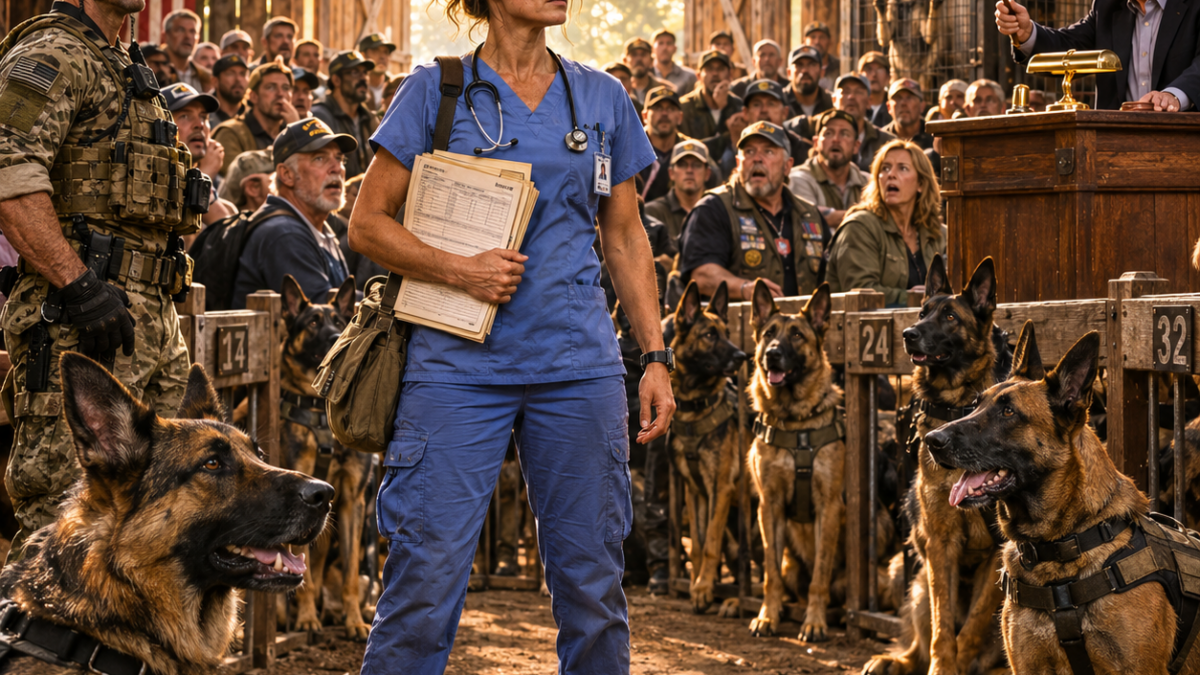
Thirty dogs.
Exactly.
German Shepherds.
Belgian Malinois.
Dutch Shepherds.
Two Labrador detection dogs.
Each assigned a numbered pen.
An auctioneer tested a microphone.
“Ladies and gentlemen, welcome.”
Applause.
“Today’s placement event gives these heroes the retirement they deserve.”
More applause.
Delaney did not clap.
She watched.
One Malinois flinched when someone touched behind the shoulders.
A German Shepherd wearing a harness marked BRUNO did not react when the handler repeated the name.
A Labrador listed as twelve moved with the loose, athletic stride of a much younger dog.
One medical card said:
EXCELLENT BODY CONDITION.
The dog behind it had visible ribs.
None of those details proved anything.
Delaney knew that.
She was a nurse, not a veterinarian.
She did not diagnose dogs from ten feet away.
But inconsistencies mattered.
A man beside her said:
“Beautiful animals.”
She turned.
Tall.
Civilian clothes.
Close-cropped gray hair.
Weathered face.
Military posture that civilian clothing could not hide.
“Thinking of adopting?”
“No.”
He raised an eyebrow.
“I’m looking for one dog.”
“They’re all good dogs.”
“Rex.”
Something changed in his expression.
“There’s no Rex on the roster.”
“There should be.”
He studied her.
“Senior Chief Everett Sloan.”
“Security.”
“Delaney Brooks.”
His eyes went to the scrubs.
“You came straight from work.”
“I didn’t know I’d be coming until this afternoon.”
“What makes you think Rex is here?”
She handed him the manifest.
Everett unfolded it.
Read.
His forehead tightened.
“I’ve never seen this version.”
“It’s real.”
“How do you know?”
“The identification number.”
He looked at her.
“Whose dog?”
“My brother worked with him.”
“Worked?”
“Micah Brooks.”
Everett’s face changed.
He knew the name.
“You’re Micah’s sister.”
Delaney felt something cold move through her.
“You knew him?”
“Not well.”
“Enough to recognize the name.”
“Yes.”
Before Everett could say more, applause broke out.
A sharply dressed man stepped onto the auction platform.
Mid-fifties.
Silver at the temples.
Tailored jacket.
Expensive smile.
“Ladies and gentlemen, Gideon Rusk.”
More applause.
“It has been my privilege to oversee the retirement placement of some of this nation’s finest working dogs.”
People trusted him immediately.
Delaney did not know whether that distrust was evidence or grief.
She reminded herself:
Do not decide before you know.
Gideon continued speaking.
Placement.
Care.
Service.
Honor.
Delaney looked past him.
Thirty dogs.
Too many small things wrong.
She raised a hand.
“Excuse me.”
The room quieted gradually.
Gideon looked toward her.
“Can I help you?”
“I’m looking for military working dog R417.”
His face did not move.
“I’m afraid we have no animal with that designation.”
“You should.”
“No.”
Delaney unfolded the manifest.
“This says otherwise.”
Gideon’s smile disappeared.
“Ma’am, I have no idea where you got that document.”
“Neither do I.”
“That paperwork is not part of today’s event.”
Everett stepped forward.
“I haven’t seen it either.”
Gideon barely looked at him.
“You didn’t need to.”
That sentence changed Everett’s posture.
Delaney noticed.
Gideon gestured toward two security workers.
“Please escort this woman outside.”
Whispers started.
“Who is she?”
“Nurse?”
“What’s going on?”
Delaney did not move.
“My brother died believing Rex was dead.”
Gideon’s expression remained controlled.
“I’m sorry for your loss.”
“I’m asking to see one kennel.”
“You are disrupting a private adoption event.”
“No.”
She folded the paper.
“I’m asking one question.”
“Remove her.”
The security men approached.
Everett stepped between them.
“Hold on.”
Gideon stared.
“Senior Chief.”
“We can verify a chip number.”
“There is nothing to verify.”
That certainty bothered Delaney more than denial.
She looked at the dogs.
Years earlier, Micah’s video messages usually ended the same way.
Camera turning.
Large German Shepherd somewhere behind him.
Micah laughing.
“Come on, Rex.”
The dog would run toward the camera.
Sometimes bark.
Sometimes knock Micah sideways.
Delaney closed her eyes for one second.
Then opened them.
She called:
“Rex!”
The effect was immediate.
Thirty dogs froze.
Every one.
Heads up.
Ears forward.
Bodies suddenly still.
No barking.
No leash pulling.
No pacing.
The entire barn seemed to inhale and stop.
The auctioneer lowered his microphone.
Buyers lowered bidding paddles.
Handlers looked at one another.
Everett turned slowly.
“What just happened?”
Then a sound came from the back.
Under the platform.
One bark.
Then another.
Two sharp barks.
Pause.
A softer third.
Delaney’s eyes filled.
“No.”
She knew that sequence.
She had heard it in video after video.
“Rex.”
Scratching echoed from beneath the rear storage area.
Metal.
Claws.
Something contained.
Everett looked at Gideon.
“You told me every dog was accounted for.”
“They are.”
“That sound is under the building.”
“Farm dog.”
Delaney shook her head.
“That’s Rex.”
Gideon laughed.
“You cannot identify a dog by a bark from underneath a floor.”
“I’ve heard him hundreds of times.”
The scratching came again.
Several auction dogs turned toward the back platform.
Then someone stood from the third row.
Owen Tate.
Delaney stared.
“Owen?”
He did not look at her.
He was staring at one Belgian Malinois.
Catalog name:
SIERRA.
His face had lost all color.
“No.”
Everett looked over.
“What?”
Owen pointed.
“That dog.”
The handler beside the pen frowned.
“What about her?”
Owen’s hand trembled.
“That’s Juno.”
Silence.
Someone whispered:
“What?”
The handler said:
“Sir, this dog is Sierra.”
“No.”
Owen walked closer.
His breathing began to change.
Delaney almost moved toward him.
Stopped.
This was not the hospital.
Owen pointed toward the Malinois’s right shoulder.
“She has a crescent scar beneath the coat.”
The handler looked uncertain.
Owen’s voice cracked.
“Barbed wire.”
“Training accident.”
“Six years ago.”
Everett said:
“Check.”
The handler brushed the fur aside.
A pale crescent scar.
Owen covered his mouth.
For several seconds, nobody moved.
Then Juno looked at him.
Her head tilted.
Owen whispered:
“June.”
The dog surged forward.
Not violently.
Recognition.
Whole body.
Tail striking the kennel wall.
A sound came from Owen that Delaney had never heard from another human being.
Half sob.
Half laugh.
He dropped to his knees.
“Juno.”
The Malinois pressed against the gate.
Owen put both hands through.
Forehead against hers.
“They told me you died.”
Around them, veterans began pulling phones from pockets.
Old photographs.
Dog records.
Handlers comparing ears.
Scars.
Markings.
The auction changed shape in seconds.
What had looked like a placement event began looking like a room full of people realizing they might not know which animals they had been brought to buy.
Delaney approached a German Shepherd marked TITAN.
Inside one ear, faint tattoo.
Not listed anywhere on the card.
She looked at Everett.
“These records don’t match the animals.”
Gideon stepped down.
“Enough.”
Nobody moved.
“This event is over.”
Everett answered:
“No.”
Gideon stared.
“Nobody leaves.”
“You do not have authority over my business.”
Everett pulled out his phone.
“I have authority to report suspected irregularities involving retired military working dogs.”
He called state veterinary investigators.
For the first time, Gideon Rusk looked nervous.
Dr. Nessa Ward arrived less than an hour later.
Veterinary forensic specialist.
No dramatic entrance.
No weapon.
Scanner.
Laptop.
Evidence bags.
She started with the first visible kennel.
Microchip scan.
Number appeared.
Federal registry.
Belgian Malinois.
Ten years old.
Status:
DECEASED.
Nessa rescanned.
Same chip.
She looked at the living dog.
Then at the screen.
“This dog is registered dead.”
The crowd went silent.
Second dog:
German Shepherd.
Chip registered to a Labrador.
Third:
no registered chip.
Fourth:
scar consistent with surgical chip removal.
Nessa stopped.
“I have examined hundreds of retired working dogs.”
She looked at Everett.
“I have never seen a group with this many identification discrepancies.”
Delaney opened her bag.
“There’s something else.”
She pulled out a small flash drive.
Then an old digital recorder.
Everett stared.
“What is that?”
“Micah mailed these to me before he died.”
“And you never listened?”
“I listened to some.”
She swallowed.
“I didn’t understand what I was hearing.”
She pressed play.
Static.
Then her brother’s voice.
“Hey, D.”
Delaney shut her eyes.
Eighteen months collapsed.
Micah again.
Alive inside a cheap recorder.
“If you’re listening to this, something probably happened.”
The barn disappeared for her.
Then Micah continued.
“They’re not stealing dogs.”
Pause.
“They’re stealing identities.”
No one moved.
“An injured dog disappears.”
“A healthier one gets its record.”
“Government keeps paying rehabilitation invoices.”
“Contractors keep billing.”
“Everybody trusts the paperwork.”
Another pause.
“Nobody checks the scars.”
Everett looked toward the kennels.
Micah’s voice continued.
“If I can’t finish this, find Rex.”
Then:
“He carries the names.”
Recording ended.
Silence.
Nessa looked at Delaney.
“What does that mean?”
“I don’t know.”
Gideon said:
“This is absurd.”
Delaney looked at him.
“My brother died three days after he recorded that.”
“That does not make it evidence.”
“No.”
She stepped closer.
“It makes it something investigators should hear.”
Everett stared at Gideon.
“You told me Heritage K9 Transition Services passed every inspection.”
“We did.”
“Then why is every identification check failing?”
No answer.
Nessa completed a preliminary review of the visible kennels.
Nineteen identities questionable.
Six dogs listed as deceased.
Four apparently associated with different agencies.
At least three medical histories inconsistent with the animals in front of her.
The barn erupted.
Veterans demanded answers.
Potential buyers dropped catalogs.
Some handlers removed bidder numbers.
Owen remained beside Juno.
Delaney barely heard any of it.
Scratching had started again beneath the platform.
Everett walked toward the back.
Feed bags had been stacked in front of a heavy steel door.
He moved them.
Padlock.
“Gideon.”
No answer.
“What’s behind this?”
“Storage.”
“For what?”
“Equipment.”
Delaney stepped beside Everett.
“No.”
She listened.
Scratch.
Pause.
Two barks.
“That is Rex.”
Everett held out one hand.
“Key.”
“I don’t have one.”
A young employee standing near the wall looked terrified.
Then slowly reached into his pocket.
“I do.”
Everyone turned.
“I’ve worked here three weeks.”
His voice shook.
“They told me never to open it.”
He handed Everett the key.
The padlock clicked.
Steel door opened.
Cold air.
Concrete stairs.
Darkness.
And the unmistakable smell of kennels.
Everett switched on a flashlight.
Rows of enclosures stretched beneath the barn.
Occupied.
Old dogs.
Thin dogs.
Injured dogs.
Animals whose paperwork apparently said they did not exist.
Delaney covered her mouth.
“Oh my God.”
At the far end, one German Shepherd slowly stood.
Large.
Thinner than the dog in Micah’s videos.
Gray beginning around the muzzle.
Old scar across the face.
Left ear bent where cartilage had healed badly.
Brown eyes fixed on her.
Delaney stopped.
The dog did too.
No bark.
She whispered:
“Home is still waiting.”
Micah used to say that at the end of some videos.
A joke.
A promise.
Rex took one step.
Then another.
Reached the gate.
Pressed his nose through the bars.
Delaney extended her fingers.
His nose touched them.
She started crying.
Silently.
Everett looked at the faded identification plate fixed to the kennel.
Most of the number had been scraped.
But not all.
R417.
Everett closed his eyes.
“They lied to us.”
Delaney pressed her forehead to the bars.
“My brother kept looking for you.”
Rex stared past her for a moment.
Searching.
That hurt more than anything.
Because Rex did not know Micah was gone.
Then Everett noticed something hanging from the dog’s worn collar.
Small metal capsule.
Weatherproof.
Nessa crouched.
“What is that?”
Delaney unscrewed it carefully.
Inside:
tiny waterproof storage card.
Nessa immediately held out an evidence sleeve.
“Nobody reads this directly.”
Delaney nodded.
“Chain of custody.”
“Yes.”
The card went into the sleeve.
State investigators arrived.
Then federal investigators.
Tables that had displayed auction catalogs became temporary evidence stations.
Nessa walked kennel to kennel.
One Labrador struggled standing.
A Dutch Shepherd had an untreated limp.
An older Malinois with cloudy eyes still wagged when approached.
The false identities continued.
One dog labeled Titan carried a chip belonging to a dog named Apollo.
Problem:
Apollo had been a chocolate Labrador.
Another chip had been implanted only eight months earlier even though the file claimed the dog retired six years before.
Nessa stared at the data.
“They’ve been recycling identities.”
Around the hidden kennel room, former handlers started calling names.
Not the catalog names.
Real ones.
“Shadow?”
A shepherd lifted his head.
“Scout?”
A Malinois stood.
“Brisk?”
One gray-haired veteran froze.
The elderly dog in front of him slowly rose.
The man’s face collapsed.
“No.”
He stepped closer.
“Brisk.”
The Malinois limped forward.
Tail wagged once.
The veteran dropped to his knees.
“They told me you had cancer.”
The dog leaned into him.
Around the barn, reunion became almost impossible to watch.
Joy did not erase what had happened.
Some handlers had mourned these dogs.
Buried memories because they believed there had been nothing left to recover.
Now the animals were standing in front of them.
Older.
Injured.
Sometimes neglected.
Alive.
Delaney looked at Everett.
“They weren’t selling dogs.”
He followed her gaze.
“They were selling histories.”
The forensic team copied Micah’s storage card.
Folder after folder.
Photographs.
Transport logs.
Microchip scans.
Veterinary invoices.
Death certificates.
Insurance claims.
Audio.
Cross-reference sheets.
Micah had organized everything.
One folder was labeled:
IF YOU FIND REX.
Delaney stopped breathing.
Everett stood beside her.
“You want a minute?”
“No.”
She opened it.
Video.
Micah appeared on screen.
Sitting beside Rex inside a rehabilitation kennel.
He looked tired.
Beard longer.
But smiling.
“Hey, D.”
Delaney covered her mouth.
“If you’re watching this, Rex found you.”
Micah scratched the dog behind the ears.
“I knew he’d outsmart everybody.”
He laughed.
Delaney started crying.
Micah’s expression became serious.
“If anything happens to me, don’t waste your life chasing revenge.”
Pause.
“Chase the truth.”
He held up a notebook.
“They’re changing names.”
“Not just dogs.”
“Medical invoices.”
“Microchips.”
“Death certificates.”
“They erase one animal and give the identity to another.”
He tapped the notebook.
“I cross-referenced everything I could.”
“Rex carries the final list.”
Micah looked down.
The dog rested against him.
“If you’re watching this, it means they never expected him to survive.”
He smiled faintly.
“I did.”
Then to Rex:
“You always come home, buddy.”
Video ended.
Nobody spoke.
Everett eventually said:
“I should have listened.”
Delaney looked at him.
“You never heard this.”
“I heard concerns.”
“From Micah?”
“Not enough.”
Everett rubbed his face.
“I trusted reports.”
“So did I.”
That mattered.
It was easier to build a story where everyone who missed the truth was corrupt.
Reality was more uncomfortable.
Some people had simply trusted systems designed to be trusted.
The problem was that someone had learned how to exploit that trust.
Investigators spent the night cataloging everything.
By sunset, the Red Cedar barn no longer looked like an auction.
Evidence markers.
Veterinary stations.
Photographs.
Computers.
Handlers sitting beside dogs they had believed dead.
The huge banner still hung above the entrance.
HONORING OUR RETIRED WORKING DOGS.
Everett looked at it.
Then pulled it down.
Gideon Rusk tried leaving through the rear lot carrying a leather briefcase.
Everett saw him.
“Going somewhere?”
Gideon stopped.
“I’m giving investigators room.”
“You forgot something.”
Everett held a stack of transport contracts recovered from Gideon’s office.
Altered identification numbers.
False euthanasia reports.
Insurance claims.
Private sales.
Gideon looked toward his truck.
Then ran.
Three steps.
Maybe.
Investigators intercepted him.
The briefcase hit gravel.
Documents scattered.
Delaney stood near the doorway holding Rex’s old collar.
Gideon looked at her.
“You have no idea how complicated federal contracts are.”
Delaney answered:
“No.”
Then:
“But false names are still false names.”
He was taken into custody.
The investigation did not end that evening.
Delaney learned that quickly.
Arrest is not conviction.
Suspicion is not proof.
One dramatic day inside a barn does not answer every question.
Federal investigators spent months reconstructing billing.
Veterinary experts reviewed records.
Military agencies compared service histories.
Handlers gave statements.
Microchips were verified.
DNA was sometimes used when available.
Scars documented.
Old photographs compared.
Transport routes rebuilt.
Some dogs turned out to have been renamed legitimately during earlier transfers.
Others did not.
Some record errors were administrative.
Others appeared deliberate.
Not every discrepancy meant fraud.
Enough did.
The scheme, prosecutors later alleged, worked partly because retired military working dogs existed inside complicated transitions.
One agency.
Another contractor.
Medical evaluation.
Retirement placement.
Transportation.
Private adoption.
Each step created paperwork.
Each step trusted the previous one.
If one identity became wrong early enough, the error could travel.
Or be made to travel.
Micah had noticed.
Not because he was a detective.
Because he worked around rehabilitation dogs every day.
A scar did not match.
Then a gait.
Then a microchip.
Then a dog officially listed as dead appeared on another transport roster.
He started taking notes.
Photographs.
Copies.
He became afraid.
He sent pieces to Delaney without fully explaining.
She had assumed her younger brother was becoming obsessive.
That knowledge hurt.
One evening, months into the investigation, Delaney sat alone inside her apartment and replayed an old voicemail.
Micah:
“D, call me when you can.”
That was it.
She had been on shift.
She texted:
Tomorrow?
He replied:
Yeah.
No urgency.
No warning.
Tomorrow never happened.
Delaney had spent eighteen months telling herself there was nothing she could have done.
Now she had new information and therefore new ways to blame herself.
She should have called.
Should have asked what was wrong.
Should have noticed.
Should have—
Rex walked into the room.
He had been temporarily placed with Delaney while investigators and military authorities determined final disposition.
The German Shepherd was lying near the doorway.
He stood.
Walked toward her.
Stopped.
Delaney held out one hand.
Rex lowered his head beneath it.
She scratched behind the ear.
“You miss him too?”
Rex leaned.
Delaney whispered:
“I’m sorry.”
The dog did not absolve her.
Dogs cannot do that.
He simply stayed.
That was better.
Owen and Juno became one of the earliest confirmed reunions.
Juno’s chip had been altered in the system.
Her physical identifiers, original medical images, dental records, handler photographs, and service documentation made the match overwhelming.
When investigators finally authorized permanent transfer, Owen sat beside her in the hospital courtyard.
Delaney found them there.
Juno asleep with her head on his shoe.
Owen looked up.
“She still snores.”
Delaney smiled.
“You missed that?”
“No.”
He scratched Juno’s neck.
Then:
“Yes.”
His expression changed.
“For three years, I thought she died because I wasn’t there.”
Delaney sat beside him.
“And now?”
“I’m angry.”
“Good.”
He looked surprised.
“Good?”
“It means you don’t have to turn everything inward anymore.”
Owen stared at Juno.
“I don’t know what to do with that.”
“You don’t have to know today.”
He laughed weakly.
“You always say that.”
“Because you keep asking questions that don’t have same-day answers.”
Rex’s medical evaluation revealed chronic problems.
Old orthopedic injury.
Poor dental care.
Weight loss.
Skin issues.
Nothing miraculous.
No dramatic operation that made him young again.
He needed treatment.
Food.
Physical therapy.
Rest.
Routine.
Delaney continued working at Blue River.
At first, colleagues expected her to stop.
Become full-time advocate.
Go on television.
Write a book.
Something grand.
She did none of those things.
She worked shifts.
Checked veterans.
Administered medication.
Visited Rex after work.
Met investigators when requested.
She declined most media.
One reporter asked:
“Do you see yourself as the nurse who exposed the K9 auction scandal?”
Delaney answered:
“No.”
“What would you call yourself?”
“My brother’s sister.”
“And the person who found Rex.”
“I called a name.”
“The dogs reacted.”
“Yes.”
“Thirty of them.”
“Yes.”
“Why?”
“I don’t know.”
That answer disappointed people.
They wanted symbolism.
A secret command.
A hidden training cue.
The truth was simpler and less provable.
Perhaps several dogs had known Rex.
Perhaps they recognized tension in the room.
Perhaps the name had been used repeatedly by staff.
Perhaps handlers reacted and dogs followed.
The moment was real.
Its exact meaning was not something Delaney could responsibly claim to know.
What mattered came afterward.
A bark below the floor.
A hidden kennel.
Mismatched identities.
Evidence.
Micah’s records.
Truth did not depend on turning every strange moment into magic.
Eight months later, Red Cedar Auction Barn looked completely different.
The state seized the property during the case.
A nonprofit consortium of veterans, veterinary specialists, and working-dog organizations eventually took over the site.
The holding pens were removed.
Windows added.
Outdoor runs built.
Shaded trails.
Rehabilitation spaces.
Quiet rooms for dogs whose nervous systems could not tolerate busy kennels.
The entrance sign read:
THE MICAH BROOKS WORKING DOG RECOVERY SANCTUARY.
Delaney cried the first time she saw it.
Then immediately said:
“He would hate this.”
Everett looked at her.
“The sanctuary?”
“His name that big.”
Everett smiled.
“What would he want?”
“Something smaller.”
“How much smaller?”
“Probably a handwritten sign taped to a cooler.”
They laughed.
Everett became operations director.
Not because one dramatic day transformed him.
Because he had spent months helping investigators reconstruct what had gone wrong.
He knew retired working-dog systems.
He knew handlers.
He knew where oversight had failed.
Delaney directed the sanctuary’s medical coordination program while continuing part-time at Blue River.
She refused the title of veterinarian.
“I’m a nurse.”
“You run medical coordination.”
“Yes.”
“That sounds important.”
“It is.”
Rex followed her everywhere he was allowed.
Gray muzzle.
Persistent limp.
Bent ear.
Bright eyes.
At first, he slept near doors.
Always with a view of the room.
Later, he chose the rug beneath Delaney’s desk.
Eventually, he began sleeping with his back turned toward the hallway.
Tiny change.
Delaney noticed.
Of course she did.
On opening day, former handlers arrived.
Some with recovered dogs.
Some alone.
Not every story ended in reunion.
Several dogs had died before investigators found them.
Some were medically too fragile to travel.
A few handlers could not take dogs home because of housing, family, or health.
The sanctuary treated those realities respectfully.
Love did not automatically solve logistics.
But every recovered animal received one thing the fraud had tried to erase:
an accurate identity.
Real service record.
Correct medical history.
Correct age when possible.
Correct handler association.
Correct name.
A young boy approached Delaney during the ceremony.
“Miss Brooks?”
“Yes?”
“My grandpa said all the dogs froze when you yelled Rex.”
Delaney smiled.
“They did.”
“Why?”
She looked across the field.
Juno sleeping beside Owen.
Brisk lying beneath a tree.
Two Labradors walking slowly beside volunteers.
Rex near Everett.
“I don’t know exactly.”
The boy looked disappointed.
Then she added:
“But names matter.”
“How?”
“They tell us who someone is.”
“Dogs know names?”
“Sometimes.”
“Can they forget?”
Delaney thought.
“They can learn new ones.”
“They can move to new places.”
“They can lose people.”
She looked toward Rex.
“But that doesn’t mean everything that came before disappears.”
Everett stepped beside her.
The boy asked:
“So Rex remembered?”
Delaney smiled.
“Yes.”
“That part I know.”
During the dedication, Micah’s identification capsule sat inside a display case beside one photograph.
Micah sitting on a kennel floor.
Rex leaning against him.
No medals.
No dramatic quote.
Only one line beneath it:
CHASE THE TRUTH.
After the crowd left, Delaney remained.
Rex walked beside her.
The sanctuary became quiet.
She opened the display case.
Not to remove evidence.
The case was over enough that the original capsule had been released back to the family.
She held it.
Small metal cylinder.
Micah had trusted that something so insignificant might survive when paperwork did not.
Delaney put it beneath the framed photograph.
“You were right.”
Rex rested his head against her hand.
“You were incredibly annoying.”
Tail moved.
“That too.”
She laughed.
Then cried.
Both felt appropriate.
Years later, people still told the story incorrectly.
A nurse walks alone into a secret military-dog auction.
Calls one name.
Thirty dogs reveal a conspiracy.
Rex leads her to hidden evidence.
Villain arrested.
Dogs reunited.
Perfect ending.
Delaney never liked that version.
It made truth sound easy.
Truth had not been easy.
Thirty dogs freezing did not prove fraud.
One handler recognizing a scar did not prove fraud.
One mismatched chip did not prove the entire scheme.
Micah’s recording did not, by itself, prove every accusation.
Truth required accumulation.
Scans.
Records.
Veterinary review.
Witnesses.
Contracts.
Financial evidence.
Transport logs.
Old photographs.
Physical identifiers.
Independent confirmation.
The dramatic moment opened a door.
Evidence had to walk through it.
That distinction became part of training at the sanctuary.
Every new employee heard Everett say:
“Never let the story become stronger than the documentation.”
Delaney usually added:
“And never let the documentation convince you not to look at the animal.”
Both mattered.
Paperwork.
Observation.
One without the other had helped create the problem.
Rex grew old at the sanctuary.
Delaney eventually adopted him officially once all legal claims were resolved.
Her apartment became his retirement home.
He hated vacuum cleaners.
Loved scrambled eggs.
Learned exactly which hospital shoes meant Delaney was leaving for a long shift.
On those mornings he waited beside the door.
“Don’t.”
Rex stared.
“I’m going to work.”
Still staring.
“I am not quitting because you’re emotionally manipulative.”
Tail wag.
Delaney sighed.
“Micah taught you this.”
Some evenings she came home exhausted.
Rex met her slowly.
No running anymore.
Arthritis.
Gray face.
But still there.
She would sit on the floor.
Rex leaned.
Delaney talked.
Not because she believed he understood the details.
Because there are some things easier to say to a dog.
She told him about Owen.
About hospital patients.
About Everett irritating her.
About Micah.
Especially Micah.
One night she said:
“I used to think finding you would make his death make sense.”
Rex breathed against her shoulder.
“It doesn’t.”
She rubbed his ear.
“It shouldn’t.”
Micah had not needed to die for the investigation to matter.
The recovered dogs did not transform his death into a good thing.
There are tragedies that remain tragedies even after people do something meaningful with what follows.
Delaney eventually understood that.
Legacy is not justification.
It is continuation.
Micah left evidence.
Others followed it.
Dogs got names back.
Contracts changed.
Veterinary verification improved.
Handlers learned what had happened.
Some families reunited.
That mattered.
It did not make losing him fair.
Rex outlived Micah by many years.
When the dog’s health finally began declining, Delaney recognized it before anybody said the word.
Less interest in food.
More difficulty rising.
Longer sleep.
The veterinarian discussed pain control.
Mobility.
Quality of life.
Delaney listened.
Asked questions.
Did not demand miracles.
She had spent her career watching families struggle with the difference between extending time and extending comfort.
Now the decision belonged to her.
One evening Rex struggled to stand.
Delaney helped with the support harness.
He took several steps.
Stopped.
Looked at her.
She knew.
Not magically.
Not because of one look.
Because of weeks of change.
She called the veterinarian.
Everett came.
Owen came with Juno, now very old herself.
They sat in Delaney’s living room.
Rex lay on his blanket.
Delaney held the old identification capsule in one hand.
With the other, she scratched behind his bent ear.
“Home is still waiting.”
Rex’s eyes closed.
The veterinarian helped him die peacefully.
No ceremony.
No music.
No final bark.
Just breathing that gradually stopped.
Delaney remained beside him.
Afterward, Owen whispered:
“I’m sorry.”
Delaney nodded.
She could not speak.
Everett took the capsule from her hand before she crushed it.
For several weeks, Delaney could not enter the sanctuary office without looking toward the rug beneath her desk.
Empty.
That was grief.
It did not care how many dogs had been saved.
It did not care whether the story had a meaningful ending.
Missing is missing.
Eventually, Delaney placed Rex’s old collar beside Micah’s photograph.
Two names.
Micah Brooks.
Rex R417.
Neither hidden anymore.
Years later, when a new nurse at Blue River asked why the working-dog sanctuary had Micah’s name, Delaney told the short version.
“My brother found irregularities.”
“He documented them.”
“He died before he could finish.”
“And you finished?”
Delaney shook her head.
“No.”
“Who did?”
“A lot of people.”
Investigators.
Veterinarians.
Handlers.
Auditors.
Military officials.
Shelter staff.
Volunteers.
Everett.
Owen.
Micah.
Even Gideon’s frightened young employee who eventually handed over the key.
No single hero.
That mattered to her.
The nurse looked toward a photograph of Rex.
“But you were the one who called his name.”
Delaney smiled.
“Yes.”
“That started everything.”
“No.”
She touched the frame.
“Micah started it.”
Then thought.
“Maybe even he didn’t.”
“Then who?”
Delaney looked toward the rehabilitation wing, where another retired dog was walking slowly beside an injured veteran.
“Probably the first person who noticed something did not match and decided not to ignore it.”
That was the lesson she kept.
Not that one forgotten name could magically expose thirty stolen identities.
That made a good headline.
The real lesson was more difficult.
Sometimes systems become dangerous not because nobody cares, but because everyone trusts the previous form.
The previous signature.
The previous database entry.
The previous inspection.
Micah questioned the paperwork.
Delaney questioned the manifest.
Owen questioned a name.
Nessa questioned a chip.
Everett questioned a locked door.
Each question was small.
Together they became impossible to dismiss.
And that was why, years after Red Cedar closed and the sanctuary became a place of recovery instead of sale, Delaney still paused whenever someone described a dog only by what the file said.
She read the file.
Then looked at the animal.
Both.
Always both.
Because Micah had once written in the margin of one of his notebooks:
Names can be changed on paper faster than truth changes in a body.
Delaney kept that page framed inside the sanctuary office.
Underneath it sat Rex’s old collar.
The identification plate still read:
R417.
No scratches could erase it now.
The nurse had walked into the auction looking for one dog.
She found him.
But more importantly, investigators eventually restored the names and histories of dozens of animals whose identities had been altered, misplaced, or deliberately buried.
And whenever somebody asked Delaney what she remembered most about that day, they expected her to say the hidden kennel.
Or Gideon’s arrest.
Or Rex touching her fingers through the bars.
She never did.
She remembered the moment before all of it.
Thirty working dogs standing beneath auction lights.
Thirty heads lifting.
Thirty bodies going still after one name crossed the room.
For a few seconds, nobody knew what it meant.
That was important.
Because truth rarely arrives already explained.
Sometimes it begins as a detail that does not fit.
A scar.
A number.
A bark.
A dog who should be dead.
A name that makes an entire room stop moving.
Then somebody has to be willing to ask one more question.








