A Nurse Lost Everything in a Single Afternoon—Then She Gave Her Last Comfortable Seat to a Biker Stranger, Never Imagining How One Quiet Act of Kindness Would Return to Her
PART3:
She was sharply dressed in a charcoal suit, with pale hair cut just below her jaw and a face arranged into professional sympathy. Beside her sat a man from security named Grant, broad and uncomfortable, staring at the wall as if he wished he were drywall.
There was no nursing supervisor.
No union representative.
No witness from pediatrics.
Diane’s first real warning came from the empty chair across from Celine.
“Ms. Caldwell,” Celine said calmly, gesturing to the chair. “Please sit.”
Diane remained standing.
“What’s this about?”
Celine’s expression did not change.
“Please sit.”
Diane sat.
Celine folded her hands over the folder.
“Due to internal restructuring and concerns brought to administration regarding patient-family interactions, Westbridge Medical Center has made the decision to terminate your employment effective immediately.”
For a second, Diane did not understand the sentence.
It entered the room as language, but not meaning.
Then meaning arrived all at once.
“I’m sorry,” Diane said. “What?”
Celine’s voice remained smooth.
“Your position has been terminated. Effective immediately.”
Diane stared at her.
“I’ve worked here twenty-three years.”
“Yes.”
“I’m scheduled through Friday.”
“Your remaining shifts will be covered.”
“By who? We’re already short.”
Celine glanced down at the folder as if Diane’s concern for staffing were an inconvenient symptom.
“That will be handled.”
Diane’s pulse began to pound in her ears.
“What concerns?”
“A complaint was received from a patient’s family.”
Diane leaned forward.
“What complaint?”
“I’m not permitted to disclose identifying details.”
“Then how am I supposed to respond?”
“You may file an appeal through the proper channels.”
“Celine, I don’t even know what I’m being accused of.”
Celine looked at her then, and for a moment the sympathy mask thinned.
“The allegation involves inappropriate conduct, failure to follow family communication protocols, and insubordination toward administrative directives.”
Diane felt cold spread through her chest.
“Inappropriate conduct? With a child?”
“No one said that.”
“You just said it carefully enough not to.”
Celine’s lips tightened.
“This is not a debate.”
“It should be.”
“You will receive documentation by mail. During the appeal period, you are not permitted on hospital grounds except with written authorization. You are not to contact patients or patient families regarding this matter. References for future employment will be limited to dates of service and position title.”
The message was clear.
Stay quiet.
Or lose everything left.
Diane gripped the edge of the table.
“I want my supervisor here.”
“That will not be necessary.”
“I want to see the complaint.”
“That won’t be possible.”
“I want to know who said this.”
Celine closed the folder.
“That is confidential.”
Diane looked at the closed folder.
Something about it felt staged. Too neat. Too final. Too prepared.
“This is because of the Mitchell case,” Diane said softly.
For the first time, Celine’s eyes changed.
Barely.
But enough.
“Ms. Caldwell, I advise you not to speculate.”
Diane’s heart pounded harder.
The Mitchell case.
Six weeks earlier, eight-year-old Sophie Mitchell had been admitted for complications after surgery. Her father, Gregory Mitchell, was not merely a patient’s father. He was also a major hospital donor, real estate developer, and friend of at least two board members. His name was on the children’s rehabilitation wing. His money had purchased equipment. His temper had purchased fear.
Diane had seen him berate a resident for not arriving quickly enough.
She had seen him snap at housekeeping.
She had seen Sophie flinch when his voice rose.
The night everything changed, Sophie’s mother had stepped into the hallway with tears in her eyes and whispered to Diane, “Please don’t leave her alone with him when he’s angry.”
That was all.
One sentence.
Please don’t leave her alone with him when he’s angry.
Diane had documented it exactly.
She had also filed an internal safety concern after seeing bruising on Sophie’s arm that did not match the chart explanation. The pediatrician reviewed it. Social work was notified. Then, somehow, the concern vanished into administrative fog. Sophie was discharged early. Gregory Mitchell complained that Diane had “created a hostile environment” and “overstepped her role.”
Diane had been told to “use discretion” with high-profile families.
She had replied, “Children are not less vulnerable because their fathers donate buildings.”
Two days later, her schedule changed.
Then her supervisor stopped meeting her eyes.
Now she sat across from Celine Harrow with a closed folder and a career erased in five minutes.
“This is retaliation,” Diane said.
Celine’s voice cooled.
“This is a personnel matter.”
“It is retaliation.”
“I would be careful with accusations.”
Diane stood.
“I was careful with a child. That’s what this is about.”
Celine gestured toward the security guard.
“Grant will escort you to collect your personal belongings.”
Grant looked miserable.
Diane turned toward him.
“You know me.”
He swallowed.
“Ma’am, I’m just here to—”
“You know me,” she repeated.
He looked down.
That hurt more than she expected.
Within minutes, Diane was escorted through the hallway she had walked for more than two decades. Staff saw. Of course they saw. Hospitals have eyes even when people pretend not to look.
A respiratory therapist she had trained suddenly became fascinated by a supply cart. A young nurse who used to ask Diane for advice turned quickly into a patient room. A doctor looked at her, opened his mouth, then closed it again.
Fear moves faster than truth in workplaces.
By the time Diane reached her locker, her badge had already been deactivated.
That was when she nearly broke.
Not when Celine said terminated.
Not when Grant avoided her eyes.
Not even when she realized she had no income, no severance beyond what the policy required, and no reference after twenty-three years of service.
It was the badge.
The little plastic rectangle that had opened every locked door in the pediatric wing. The badge she had tapped against sensors thousands of times while carrying blankets, medication, juice cups, charts, worry, hope. The badge with her photo from eleven years earlier, before grief had carved lines beside her mouth.
Grant waited outside the locker room.
Diane packed a small cardboard box.
Her stethoscope.
A faded photo of Tom standing beside her at a hospital fundraiser, smiling with one hand in his pocket because he hated formal pictures.
A mug that said NURSES CALL THE SHOTS.
A pair of white sneakers covered in tiny cartoon bears, a gift from a patient who said children should not have to look at boring feet.
A stack of thank-you cards tied with an old ribbon.
She reached for the cards, then stopped.
There were too many.
If she took them, she would fall apart.
She took three.
One from Mason.
One from Sophie Mitchell’s mother, written before the complaint, thanking Diane for “seeing my daughter as a person, not a case.”
One from a little girl named Ava who had drawn Diane with a cape and written, “You are brave even when you whisper.”
Diane closed the locker.
Grant walked her to the employee exit.
He did not speak until they reached the door.
“I’m sorry,” he said.
Diane looked at him.
“Are you?”
His face reddened.
“Ms. Caldwell—”
“You stood there.”
“I have a job.”
“So did I.”
She walked out into the rain with her box in her arms.
Her car sat near the back of the employee lot. She placed the box on the passenger seat, got in, closed the door, and sat there.
For a long time, she did nothing.
Rain ran down the windshield, blurring the hospital into streaks of light and concrete. The pediatric wing windows glowed on the third floor. Behind one of them, children were scared. Parents were exhausted. Nurses were short-staffed. Diane’s name would disappear from the schedule. Her locker would be assigned to someone else. Her patients would ask where she was, and someone would say, “She doesn’t work here anymore,” as if that were an explanation.
Then Diane cried.
Not elegantly.
Not quietly.
She folded forward over the steering wheel and sobbed from somewhere low and old.
She cried for the job.
For Tom.
For every child she could not protect.
For the humiliation of being escorted out like a thief.
For the way people looked away when power entered a room.
For Sophie Mitchell, wherever she was.
For the terrible fact that doing the right thing had not saved her.
When she finally lifted her head, her face was swollen and her throat hurt.
She wiped her eyes with the sleeve of her scrubs.
Then she checked her bank account.
$512.67.
Rent due in nine days.
Car insurance in twelve.
Groceries almost gone.
No job.
No reference.
No plan.
She started the car and drove home through the rain, but halfway there, traffic backed up near the interstate because of an accident. Diane sat in the line of brake lights, hands numb on the steering wheel, and realized she could not bear to go home.
Home was too quiet.
Home was Tom’s old jacket still hanging in the hall because she had never been able to donate it.
Home was bills on the kitchen table, a leaky faucet, and no one to tell that her life had just collapsed.
So she turned off at the next exit.
She did not know exactly where she was going until she saw the Greyhound station.
It was an old brick building near downtown, wedged between a pawn shop and a diner with a flickering sign. Diane had not taken a bus in years. She parked across the street and sat for a moment watching people move in and out with duffel bags, backpacks, paper coffee cups, tired children.
She thought of leaving.
Not forever.
Just for a night.
Her sister lived three hours away in Harrisburg, but they were not close enough for Diane to show up crying with a box of work shoes. There was a lakeside town two hours north where Tom had taken her once in October. She could go there. Sit in a motel. Breathe air that did not smell like hospital disinfectant and betrayal.
She entered the station carrying the box because she did not want to leave it in the car.
The air inside smelled like fuel, old coffee, wet coats, and floor cleaner. A television mounted in the corner played a news segment no one watched. A baby cried near the vending machines. A man slept with his chin on his chest beneath a faded poster advertising routes to cities Diane had never visited.
She stood in line at the ticket counter.
When it was her turn, the clerk looked at her box, her scrubs, her red eyes, and wisely asked no personal questions.
“Where to?”
Diane glanced at the route board.
“Lake Marion,” she said.
“One way or round trip?”
She almost laughed.
One way sounded too dramatic.
“Round trip. Tomorrow evening.”
The clerk typed.
“Standard seat is forty-eight dollars.”
Diane nodded.
Then she saw the sign beside the counter.
PREMIUM RESERVED SEATING — EXTRA LEGROOM — QUIET FRONT SECTION — LIMITED AVAILABILITY
The price made her wince.
It was foolish.
Reckless, even.
She had just lost her job. She had rent due. She had no idea how long unemployment would take or whether Westbridge would fight it. She should preserve every dollar.
But something inside her was tired of being practical while the world took everything anyway.
For twenty-three years, she had eaten lunch standing up, worked holidays, skipped vacations, picked cheaper shoes, fixed her own sink, and told herself comfort could wait because someone else always needed more.
Today, she wanted one thing that felt like dignity.
A seat with space.
A seat where her knees would not press against hard plastic.
A seat where she could lean back, close her eyes, and not feel like life had stuffed her into whatever corner was left.
“I’ll take premium,” she said.
The clerk raised an eyebrow.
“You sure?”
Diane heard the judgment and almost changed her mind.
Then she lifted her chin.
“Yes,” she said. “Just this once.”
It was a small act of defiance.
A quiet way of telling herself she still mattered, even if Westbridge had decided she could be removed from a room and forgotten.
The bus was scheduled to leave in forty minutes.
Diane bought a coffee she did not want and sat near the gate with her box at her feet. She looked down at her scrubs and realized she was still wearing her hospital shoes. The cartoon bears stared up at her cheerfully, unaware they no longer belonged to a nurse with a unit.
When boarding began, the driver scanned tickets with the bored impatience of a man who had been asked too many questions by too many passengers. His name tag read RON.
Diane climbed aboard and found her seat in the front premium section.
It was wider than standard.
Not luxurious.
But it was clean, with extra legroom and a small curtain half-separating the front from the crowded rows behind. She placed her box carefully above her, sat down, and leaned back.
For the first time all afternoon, she closed her eyes.
She had just begun to breathe when the voices started.
Not loud at first.
A murmur near the front door.
Then tension.
The particular shift in air that happens when strangers sense conflict and decide whether to watch or pretend not to.
Diane opened her eyes.
A man stood in the aisle near the driver.
He was tall, broad-shouldered, and clearly in pain. He wore a black leather vest over a dark thermal shirt, worn jeans, heavy boots, and a beard streaked with gray. His left cheek bore shiny burn scarring that disappeared beneath his collar. His right hand trembled against the seatback. His movements were stiff and uneven, as if each step required negotiation with old injuries.
Behind him, passengers waited to move down the aisle.
The driver sighed.
“Sir, if you can’t sit properly, I can’t let you ride.”
The man’s voice was rough.
“I paid for my ticket. I’ll manage.”
“You’re blocking boarding.”
“I said I’ll manage.”
He tried to turn into a standard seat, but the space was too narrow. His knee would not bend enough. His damaged hand slipped on the seatback. A young man nearby snickered under his breath. An older woman looked away. Someone whispered, “Biker dude’s holding up the bus.”
The man heard.
Of course he heard.
His jaw tightened.
Diane stood before she had decided to move.
Old training.
See pain. Go.
“I’m a nurse,” she said.
The driver looked relieved and annoyed at the same time.
The man turned his head toward her sharply.
“I don’t need a nurse.”
“I didn’t say you did.”
“You said you’re a nurse.”
“Yes. It’s a hard habit to break.”
His eyes were dark, guarded, and tired.
Up close, Diane saw the full extent of his injuries. Burn scars along his neck. Tightness in one shoulder. Fingers that looked as if they had been reconstructed and did not always obey him. A small tremor from effort, pain, or both.
She kept her voice low.
“These seats are too tight for you.”
“I can see that.”
“I have a better one.”
“No.”
“I’m not asking because I think you’re helpless.”
“Good.”
“I’m asking because I know what pain looks like when someone is trying not to show it.”
That landed.
His expression shifted.
Not softened exactly.
But changed.
Behind him, Ron the driver said, “Ma’am, if you could sit down, we’re already behind.”
Diane ignored him.
She looked at the biker.
“You can take my seat.”
“No.”
“Please.”
“I said no.”
Her throat tightened unexpectedly.
Then she said the truth before pride could stop her.
“I need to do something good today.”
The man stared at her.
The bus went quiet.
Diane felt every face watching.
She hated that.
But she did not look away.
After a long moment, the man’s shoulders lowered slightly.
“What’s your name?” he asked.
“Diane.”
“Diane, I’m not taking your seat.”
“Yes,” she said. “You are.”
For the first time, a faint almost-smile touched his mouth.
“You always this bossy?”
“I spent twenty-three years in pediatrics. This is me being gentle.”
Something flickered in his eyes then.
Pain, maybe.
Memory.
Finally, he nodded once.
“All right.”
She helped him into the premium seat without making a performance of it. She moved her box to the overhead rack above the standard rows, ignored Ron’s irritated expression, and took the cramped aisle seat the man had been assigned.
The space was tight. Her knees pressed against the seat in front. Her back ached within minutes.
But the man in the front seat exhaled slowly, carefully, as if the extra room had given his body permission to stop bracing.
Before the bus pulled away, he turned slightly.
“Thank you.”
“You’re welcome.”
“Name’s Marcus.”
“Diane.”
“You said that.”
“I’m tired.”
“Me too.”
The bus rolled out into the wet evening.
For a while, they did not speak.
Diane stared out the window at gas stations, traffic lights, dark storefronts, and rain-slick streets sliding past. Her body hurt from the shift, the shock, the uncomfortable seat, the weight of everything waiting for her when the bus returned tomorrow.
After twenty minutes, Marcus turned again.
“Pediatrics?”
“Yes.”
“My daughter spent time in a children’s hospital.”
Diane’s heart tightened.
“How old was she?”
He was quiet long enough that she knew before he answered.
“Six.”
“I’m sorry.”
He nodded once.
“She liked nurses better than doctors.”
“That’s because nurses bring blankets.”
“She liked stickers.”
“We were trained in sticker deployment.”
This time, he did smile.
Barely.
Then the smile disappeared.
“She died in a house fire. My wife too.”
Diane inhaled softly.
Marcus looked out the windshield, not at her.
“Fourteen years ago. Electrical fire. Old rental house. I got out. Went back in. Got burned. Didn’t reach them.”
The bus engine hummed.
Rain streaked the glass.
Diane knew many kinds of pain, but this one had its own gravity. No words could make it smaller. She had learned long ago that people in grief did not need phrases polished by discomfort.
So she said only, “Tell me her name.”
Marcus turned.
For a moment, he looked startled.
Then he looked down at his damaged hands.
“Lily.”
Diane smiled sadly.
“That’s a beautiful name.”
“She hated it. Said it sounded too small. Wanted to be called Rocket.”
“Rocket is excellent.”
“She wore rain boots everywhere. Even to bed once. My wife let her.”
“What was your wife’s name?”
“Caroline.”
Diane let the names settle.
Lily.
Caroline.
Not “my wife and daughter,” not tragedy reduced to roles, but people.
Marcus understood.
She saw it in the way his eyes glistened before he turned away again.
For the next hour, they spoke in fragments.
Not the polished exchange of strangers making conversation, but the careful offering of wounded things.
He told her he belonged to a motorcycle club called the Iron Saints, though he clarified immediately that they were not criminals, despite what television liked to suggest.
“Veterans, mechanics, warehouse guys, a retired accountant who looks scarier than all of us and has never even gotten a speeding ticket,” he said. “We do toy drives. Food runs. Ride escorts for funerals. That kind of thing.”
Diane told him about Westbridge.
Not everything.
Not at first.
But enough.
“I lost my job today.”
Marcus turned fully despite the pain it cost him.
“Today?”
She nodded.
“After twenty-three years.”
“For what?”
“For doing my job, I think.”
“That sounds like a story with names in it.”
Diane gave a tired laugh.
“You sound like my husband.”
“Smart man?”
“Very.”
“Still around?”
“No.”
Marcus looked down.
“Sorry.”
“Me too.”
She told him more then. About Sophie Mitchell. About the safety concern. About the complaint she was not allowed to see. About Celine Harrow’s smooth voice and Grant the security guard’s refusal to meet her eyes. About the badge that stopped working.
Marcus listened without interrupting.
When she finished, he said, “That’s not right.”
Diane looked out the window.
“No. But right doesn’t seem to matter much when money is in the room.”
Marcus reached carefully into the inner pocket of his vest and pulled out a worn leather card holder. His fingers shook slightly as he removed a card and handed it back to her.
The card read:
MARCUS REED
IRON SAINTS CHARITABLE RIDERS
COMMUNITY OUTREACH COORDINATOR
A phone number was printed beneath.
Diane tried to hand it back.
“I can’t take this.”
“You can.”
“I don’t need charity.”
“I didn’t offer charity.”
“Then what is this?”
“A door.”
She looked at him.
Marcus’s voice was low.
“You gave me something today I don’t get much of anymore.”
“A seat?”
“Respect.”
Diane’s throat tightened.
He continued.
“People see the burns, the vest, the limp, the hands. They decide what I am before I open my mouth. You didn’t.”
“I’m a nurse.”
“No,” he said. “You’re Diane.”
The simple distinction broke something open inside her.
For a moment, she had to look away.
When the bus reached Lake Marion, the rain had stopped. Diane helped Marcus stand despite his protests. At the station, three bikers waited near the curb beside a black pickup truck with a motorcycle trailer. Their vests matched his. One was huge, bald, and tattooed up both arms. One was older, with a white beard and wire-rimmed glasses. One was a woman with cropped hair, a leather jacket, and the calm stare of someone who missed nothing.
They moved toward Marcus quickly.
Not dramatically.
Carefully.
Family carefully.
“You good, brother?” the bald one asked.
Marcus nodded toward Diane.
“Because of her.”
Three sets of eyes turned to Diane.
She suddenly became very aware of her damp scrubs, her cardboard box, her swollen eyes, and the fact that she had given away a bus seat because her life had fallen apart and she needed not to feel useless.
The woman stepped forward.
“Name’s Jo.”
“Diane.”
Jo looked at Marcus, then back at Diane.
“Thank you.”
“It was just a seat.”
Marcus shook his head.
“No, it wasn’t.”
Diane did not know what to do with that.
The older man with glasses lifted her box from the bus luggage area.
“Where you headed, ma’am?”
“I don’t know, actually.”
They waited.
The truth was humiliating.
“I bought a round trip because I didn’t want to go home.”
Jo’s face softened.
“We know a diner two blocks over. Warm food. No questions unless you want them.”
Diane almost refused.
Pride rose automatically.
Then her stomach growled loud enough that the bald biker grinned.
“No questions,” he said. “But that was a statement.”
She laughed.
A small laugh.
But real.
They took her to a diner called Mae’s, open late, with red vinyl booths and pie under glass domes. Marcus sat carefully beside the window. Diane slid into the booth across from him. Jo ordered coffee for everyone before asking. The bald man’s name was Tank, which seemed too perfect until he explained his mother had called him Teddy and the club had overcorrected. The older man was Walter, a retired accountant and the most intimidating person Diane had ever seen order herbal tea.
They did not ask for her story right away.
They let her eat.
That kindness undid her more than interrogation would have.
Only after she had finished half a grilled cheese and tomato soup did Jo say, “Marcus says you got pushed out of a hospital.”
Diane looked at Marcus.
He lifted his hands slightly.
“Didn’t give details.”
She looked around the booth.
These people owed her nothing.
Still, something about them felt safer than the glass-walled conference room where her life had been dismantled.
So she told them.
This time, she told the whole story.
When she finished, Tank’s jaw was tight.
Walter had taken out a small notebook.
Jo leaned back.
“Name of the donor father?”
Diane shook her head.
“I can’t drag a child into this.”
“We don’t need the child,” Jo said. “We need the pattern.”
Diane frowned.
“What pattern?”
Walter spoke for the first time.
“Hospitals do not usually terminate a twenty-three-year employee with no documentation unless they are hiding something, rushing something, or both.”
Tank nodded.
“Or somebody powerful wanted you gone.”
“I filed an appeal.”
Jo’s mouth tilted.
“Appeals inside the same system that threw you out?”
Diane had no answer.
Marcus looked at her.
“What do you need right now?”
She almost said nothing.
That was her reflex.
Nothing. I’m fine. I’ll manage.
Then she thought of the bus seat.
I need to do something good today.
Maybe sometimes honesty was the good thing.
“I need a job,” she said quietly. “I need to pay rent. I need my name back.”
The booth was silent.
Then Jo nodded once.
“We can help with the first two. The third will take longer.”
Diane’s eyes stung.
“I can’t accept money.”
Tank held up a hand.
“Who said money?”
“Our club runs a free pediatric clinic twice a month out of a community center in East Varrow,” Jo said. “Mostly uninsured families, foster kids, kids whose parents work cash jobs and don’t qualify for half the help they need. We partner with a doctor and a legal aid group. Our nurse coordinator moved to Florida last month.”
Diane stared at her.
“You run a clinic?”
Tank grinned.
“Don’t look so surprised. We also bake.”
Walter added, “Poorly.”
Jo ignored him.
“It’s part-time stipend, not hospital money. But it’s immediate. And if you’re as good as Marcus says, we’d be lucky.”
Diane looked at Marcus.
“You told them I was good?”
“I told them you looked like someone who had held families together while the walls fell down.”
She covered her mouth.
Jo leaned forward.
“One more thing. Our legal aid partner owes us a favor. If you want to fight, we know someone.”
Diane whispered, “Why would you do this for me?”
Marcus’s scarred face softened.
“Because you stopped.”
The next morning, Diane returned home before dawn.
She did not sleep on the bus.
She held Marcus’s card in one hand and watched darkness thin into gray beyond the window.
When she unlocked her front door, the house was still quiet. Tom’s jacket hung in the hall. The kitchen faucet dripped. Bills waited on the table. Nothing had changed.
Everything had.
At 9:08 a.m., her phone rang.
Unknown number.
She stared at it.
It stopped.
Then rang again.
And again.
Finally, she answered.
“Hello?”
A calm voice said, “Ms. Caldwell? My name is Angela Brooks. I’m an attorney with Brooks and Patel Legal Aid. Marcus Reed gave me your number. He said you may be the nurse Westbridge terminated yesterday.”
Diane sat down.
“Yes.”
“I’d like to meet today if you’re willing.”
“I don’t have money for a lawyer.”
“I didn’t ask for money.”
“Why would you take this?”
Angela paused.
“Because my son was treated at Westbridge five years ago, and a nurse named Diane sat with me when I received the worst news of my life. You probably don’t remember us. His name was Isaac.”
Diane closed her eyes.
She did remember.
A little boy with sickle cell complications. A mother who wore blue scarves. A father deployed overseas. A night when Isaac’s oxygen levels had frightened everyone, and Diane had brought Angela coffee she did not drink.
“He liked space,” Diane whispered.
Angela’s voice changed.
“Yes. He did.”
“Did he—”
“He’s alive. He’s sixteen now. Tall. Annoying. Applying to engineering programs.”
Diane laughed and cried at the same time.
Angela cleared her throat.
“So if you’re asking why I’d take your case, Ms. Caldwell, it’s because some debts are not legal. They’re human.”
They met that afternoon in Angela’s small office above a pharmacy. Diane brought everything she had: termination letter, old performance reviews, printed emails, schedule changes, notes from the Mitchell case she was legally allowed to keep, copies of her appeal form, and the three thank-you cards.
Angela read quietly.
“This is retaliation,” she said after twenty minutes.
Diane almost laughed.
“I said that.”
“They hate when people use the correct word.”
“Can we prove it?”
Angela looked at the Mitchell note.
“Maybe. We need timelines, witnesses, records, and your personnel file. They will resist. We resist harder.”
Diane thought of Celine’s closed folder.
“They said references may not be provided.”
“Of course they did. Fear is cheaper than severance.”
Angela leaned forward.
“Here’s what we do first. File unemployment immediately. File a formal appeal. Request your personnel records. Send a preservation letter so they cannot conveniently lose relevant documents. Then we identify anyone willing to say what happened.”
Diane thought of the staff looking away.
“They’re scared.”
“Yes.”
“So was I.”
Angela’s expression softened.
“And yet here you are.”
That evening, Diane attended the Iron Saints clinic for the first time.
It operated out of the basement of a brick community center beside an elementary school. Diane expected chaos. Instead, she found organized compassion.
A waiting area with folding chairs and donated toys. A check-in table staffed by Walter with color-coded folders. Tank carrying boxes of diapers as if they weighed nothing. Jo directing volunteers with calm authority. A pediatrician named Dr. Elena Ruiz examining a toddler with an ear infection. Marcus sitting near a table of children’s books, reading softly to a little girl in a pink coat who leaned against his good arm without fear.
The sight stopped Diane in the doorway.
Marcus looked up.
His face changed when he saw her.
Not surprise.
Welcome.
Jo approached.
“You came.”
“I said I needed a job.”
“And a chance.”
Diane looked around the room.
Children coughed. Babies fussed. A mother argued quietly with an insurance form. A boy hid behind a chair, refusing a temperature check.
Diane set down her bag.
“Where do you need me?”
Jo smiled.
“Everywhere.”
Within thirty minutes, Diane was Diane again.
Not Westbridge’s discarded employee.
Not a woman with five hundred dollars and no plan.
A nurse.
She knelt beside the boy hiding behind the chair.
“What’s your name?”
He glared.
“None of your business.”
“That is an unusual name.”
His mother sighed.
“Mateo.”
“Mateo None-of-Your-Business,” Diane said, “I’m Diane. I need to borrow your ear for three seconds.”
“No.”
“Good negotiation. How about two?”
He narrowed his eyes.
“One.”
“Deal.”
His mother stared as Mateo allowed Diane to check his temperature.
Jo watched from across the room.
Marcus watched too.
Diane pretended not to notice because if she did, she might cry again, and she was tired of crying.
The clinic stipend was modest, but immediate. Jo also connected Diane with a temporary home-care agency that needed pediatric experience. Within a week, Diane had enough work to keep rent paid, barely.
Barely was enough.
For now.
Then the engines came.
It was eight days after her firing, a cold Wednesday morning. Diane stood in her kitchen wearing her old robe, calculating which bill could be delayed without disaster, when a low rumble began outside.
At first, she thought it was thunder.
Then it grew.
Engines.
Many engines.
She stepped onto the porch.
A line of motorcycles turned onto her street, not speeding, not roaring aggressively, but moving with solemn purpose. Behind them came a pickup truck, then two cars. Neighbors opened doors. Curtains moved. Dogs barked.
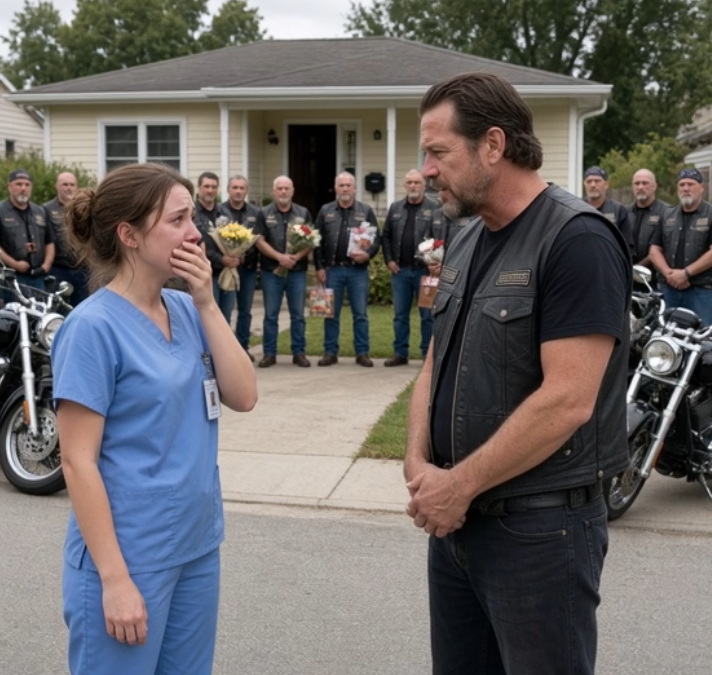
The Iron Saints parked along the curb.
Marcus climbed carefully from the truck. Jo removed her helmet. Tank carried a cardboard tray of coffee. Walter held a folder. Behind them stood people Diane did not know: a woman in scrubs, an older man with a cane, a young couple holding a toddler, a teenager wearing a hoodie with rockets on it.
Angela Brooks stepped out of one of the cars.
Diane clutched her robe closed.
“What is happening?”
Jo walked up the steps and handed her coffee.
“Breakfast.”
“That is not an answer.”
“It’s the first part of one.”
Marcus stood at the bottom of the stairs.
“We talked to people.”
“What people?”
“The kind who remember you,” Walter said.
The woman in scrubs stepped forward.
“I’m Heather Lane. You trained me in pediatrics fourteen years ago. I still fold blankets the way you taught me.”
The older man with the cane lifted a hand.
“My granddaughter Ava said you were the nurse with the cape.”
The teenager with the rocket hoodie gave an awkward wave.
“My mom’s Angela. You gave her coffee when I was little. I don’t remember, but she does.”
A young mother holding the toddler said, “You caught my son’s infection when everyone said he was just fussy.”
More people gathered.
Some had driven. Some had ridden. Some had come because Marcus posted privately to the Iron Saints network asking whether anyone knew a nurse named Diane Caldwell.
They knew her.
Or they knew someone she had helped.
Diane stood on the porch as one by one, people offered memories.
Not dramatic speeches.
Specific things.
“You stayed after your shift.”
“You called to check on us.”
“You believed my daughter’s pain.”
“You told me to sleep while you watched him.”
“You noticed the rash.”
“You brought my son a red popsicle because he was scared.”
“You said brave doesn’t mean it doesn’t hurt.”
Diane covered her mouth.
Angela stepped up beside her.
“This is not just breakfast. It’s witness gathering. With your permission, we’re collecting statements.”
Diane could not speak.
Marcus looked at her gently.
“They tried to make you feel erased.”
Jo said, “We thought we’d remind you you’re not.”
The first article appeared three days later.
It did not name the Mitchell family because Diane insisted Sophie’s privacy mattered more than public outrage. It did not accuse without evidence. Angela was too careful for that.
The headline read:
Veteran Pediatric Nurse Questions Sudden Termination After Raising Child Safety Concern
Dana Caldwell — no relation, a local reporter with a talent for asking polite questions that cornered powerful people — wrote the piece. It described Diane’s twenty-three-year career, public statements from former patients, the timeline of her complaint and termination, and Westbridge’s refusal to provide specifics.
Westbridge responded with a statement.
“Westbridge Medical Center does not comment on personnel matters. We remain committed to the highest standards of patient care, safety, and professional conduct.”
Professional conduct.
Diane nearly threw the paper across the room.
Angela told her not to.
“Let them speak in fog,” she said. “We speak in facts.”
The facts began to gather.
A nurse named Paige came forward anonymously at first, then openly. She had seen Gregory Mitchell shout at Sophie. A resident confirmed Diane had raised concerns before the family complaint. Social work records showed a referral was entered, then marked “administratively resolved” without explanation. Diane’s schedule had been altered the next day. Another staff member disclosed that Celine Harrow had instructed supervisors to “minimize unnecessary escalation involving donor families.”
Then Grant, the security guard, called Diane.
She almost did not answer.
When she did, his voice shook.
“I’m sorry,” he said.
She closed her eyes.
“You said that before.”
“I know.”
“What do you want?”
“I want to tell the truth.”
They met at Mae’s Diner.
Grant looked smaller out of uniform.
“I was in the hall before your meeting,” he said. “Celine was on the phone. She said, ‘We need her out before the board packet goes final.’ I didn’t know what it meant.”
Angela, sitting beside Diane, wrote it down.
“Anything else?” she asked.
Grant swallowed.
“She told me not to leave you alone near the nurses’ station. Said you might try to access records.”
Diane stared at him.
“I wasn’t stealing records.”
“I know.”
“Did you?”
He looked confused.
“Did you know?”
He lowered his head.
“Yes.”
That honesty hurt.
But less than the looking away had.
“Why now?” Diane asked.
Grant rubbed his hands together.
“My wife asked what I would do if our daughter had a nurse who spoke up and got fired for it.” His voice broke. “I didn’t have an answer I could live with.”
Angela took his statement.
Westbridge’s fog began to thin.
Then Sophie Mitchell’s mother called.
Her name was Rebecca.
Diane had wondered about her every day, but she had obeyed the order not to contact patient families. Rebecca found her through Angela.
They met in Angela’s office.
Rebecca looked thinner than Diane remembered, her hair pulled back tightly, eyes shadowed from sleeplessness. She held a folder against her chest like armor.
Before Diane could speak, Rebecca began crying.
“I’m sorry,” she said. “I am so sorry.”
Diane stood.
Rebecca crossed the room and hugged her so fiercely Diane could barely breathe.
“He made the complaint,” Rebecca whispered. “Gregory. Not me. He said you humiliated him. He said you were trying to destroy our family. I didn’t know they fired you until I saw the article.”
Diane held her shoulders.
“How is Sophie?”
Rebecca’s face crumpled.
“With my sister. Safe.”
The word safe loosened something in Diane’s chest.
Rebecca handed Angela the folder.
“I’m filing for divorce. There’s an emergency custody hearing next week. I can’t say everything publicly yet, but I can give a statement that Diane was right to be concerned.”
Angela opened the folder.
Inside were photos, texts, discharge documents, and a copy of Sophie’s medical records obtained legally by her mother.
Rebecca looked at Diane.
“You saw what everyone else was afraid to see.”
Diane shook her head.
“I wish seeing had been enough.”
“It helped me stop pretending.”
Sometimes justice arrives slowly.
Sometimes it arrives through paperwork, witness statements, hearings, emails, and people finding courage only after someone else has already paid the price.
Three months after Diane lost her job, Westbridge Medical Center called.
Not Celine.
She had been placed on administrative leave after the board opened an internal investigation into retaliation and donor influence.
The call came from Dr. Samuel Ortiz, the new interim chief medical officer.
“Ms. Caldwell,” he said, “Westbridge would like to discuss reinstatement.”
Diane was in the community clinic supply room counting donated inhalers.
She looked through the open door.
Marcus sat at the children’s table helping Mateo build a tower of blocks. Tank was arguing with a coffee machine. Jo was checking a list. A mother laughed for the first time since arriving. A child with a fever slept under a donated blanket Diane had warmed in the dryer.
“Reinstatement,” Diane repeated.
“Yes. With back pay, restoration of benefits, and correction of your employment record.”
Six months ago, she would have thought those words could restore the world.
Now they sounded like a door opening to a room she no longer trusted.
“Am I receiving an apology?” she asked.
A pause.
“Yes.”
“From the hospital or from the people who harmed me?”
Another pause.
“That would need to be discussed.”
“Then discuss it before you call again.”
She hung up.
Jo, who had heard only Diane’s side, raised her eyebrows.
“Did you just hang up on a hospital?”
Diane looked at the inhalers in her hands.
“Yes.”
Tank yelled from the coffee machine, “That’s our girl!”
But the decision was not simple.
Reinstatement meant security. Benefits. Retirement contributions. The reputation she had earned. It also meant walking back into hallways where people had watched her leave and stayed silent.
Angela advised negotiation.
Marcus advised listening to her gut.
Her gut was tired and confusing.
So Diane went to Westbridge one final time before deciding.
Not as an employee.
As a visitor.
Dr. Ortiz arranged for her to enter through the main lobby. No security escort. No humiliation. He met her personally, a tall man with kind eyes and the exhausted look of someone cleaning up a mess made by people who had already left the room.
“I’m sorry,” he said.
They stood near the donor wall, where Gregory Mitchell’s name gleamed in polished metal.
Diane looked at it.
“For the optics or for what happened?”
“For what happened.”
“Good.”
He did not flinch.
“The board has voted to remove donor influence from child safety reviews. Social work referrals will no longer be administratively closed without clinical documentation. HR termination procedures are under review. Ms. Harrow has resigned.”
“And Gregory Mitchell?”
“His donor privileges and advisory role have been suspended pending review.”
That was careful language.
But it was something.
Dr. Ortiz handed her a letter.
Formal apology.
Back pay.
Corrected record.
Settlement terms Angela would review.
Then he said, “I hope you’ll come back.”
Diane looked down the hallway toward pediatrics.
Her heart ached.
She walked there slowly.
The unit smelled the same.
Sanitizer. Apple juice. fear. Hope.
Heather Lane saw her first.
Then Paige.
Then one of the doctors.
Silence fell, then broke.
Heather began crying.
Paige whispered, “I’m sorry.”
Others said it too.
Some meant it.
Some were ashamed.
Some were still afraid.
Diane accepted only what she could.
Near Room 214, a little boy in superhero pajamas rolled past in a wheelchair pushed by his father. The boy looked at Diane’s shoes, the ones with the cartoon bears.
“Cool shoes,” he said.
Diane smiled.
“Thank you.”
“You work here?”
For a moment, the whole unit seemed to hold its breath.
Diane looked at the nurses’ station.
At the rooms.
At the place that had shaped her and failed her.
Then she looked back at the boy.
“I used to,” she said. “Now I work somewhere else.”
Dr. Ortiz walked her back to the lobby.
“I take it that’s your answer.”
Diane held the apology letter.
“I’ll accept the correction. I’ll accept the back pay. I’ll accept that the record shows I did nothing wrong.”
“And the position?”
“No.”
He nodded slowly.
“May I ask why?”
Diane glanced again at the donor wall.
“Because I spent twenty-three years thinking this building was my purpose. But purpose isn’t a place. It’s what you do when someone needs you and everyone else is looking away.”
Dr. Ortiz absorbed that.
Then he said, “If we asked you to consult on pediatric patient advocacy policy?”
Diane smiled faintly.
“Paid?”
“Yes.”
“With authority to speak honestly?”
“Yes.”
“And no donor names on the meeting room walls?”
He almost smiled.
“I can arrange that.”
“Then call Angela.”
The settlement allowed Diane to breathe financially for the first time in months.
She paid overdue bills. Fixed the kitchen faucet. Replaced the tires on her car. Donated to the Iron Saints clinic. Set aside money for the future.
But she did not return to her old life.
She became clinical coordinator for the Iron Saints’ community pediatric clinic, which expanded from twice a month to weekly within a year. She helped design a patient advocacy program for families afraid of hospitals. She trained volunteers on trauma-informed care. She consulted with Westbridge twice a month, sitting across from executives who now listened when she spoke because the settlement agreement required it and because she no longer cared whether powerful people found her convenient.
Sophie Mitchell remained safe with Rebecca.
Diane received one letter from her months later, written in careful eight-year-old handwriting.
Dear Nurse Diane,
Mom says you helped us be brave. I am doing better. I have a new room at Aunt Kelly’s. It has purple curtains. Thank you for believing me even when I did not know how to say things.
Love,
Sophie
Diane framed it beside Ava’s cape drawing and Mason’s medal.
Marcus became part of her life slowly.
Not romantically at first.
Not in any way either of them expected.
He was a friend. A witness. Someone who understood grief did not end just because life continued. He fixed her porch railing because it had been broken since Tom died. She changed the dressing on his shoulder after a minor surgery because he complained about everyone else’s technique. He taught her the difference between motorcycle engines even though she retained almost none of it. She taught him how to make vegetable soup without turning it into punishment.
On the anniversary of the bus ride, the Iron Saints took Diane to Mae’s Diner.
Her premium seat had become legend.
Tank insisted on giving a toast.
“To Diane,” he said, raising a coffee mug. “Who gave away the most expensive bus seat she could not afford and accidentally acquired a biker club.”
Walter added, “And legal counsel.”
Jo said, “And a clinic.”
Marcus looked at Diane across the booth.
“And gave a man back his name before asking for his.”
Diane’s eyes filled.
“You all give me too much credit.”
Marcus shook his head.
“No. We give you what you tried to give everyone else. Witness.”
Later that night, Marcus drove her home in the black pickup because rain made his leg ache too much to ride. They sat in her driveway for a moment, windshield dotted with water, porch light glowing.
“Do you ever miss it?” he asked.
“Westbridge?”
“Yeah.”
Diane thought before answering.
“I miss the children. I miss some of the nurses. I miss who I thought I was there.”
“Who were you?”
“Necessary.”
Marcus nodded.
“And now?”
She looked toward her porch, where the railing no longer wobbled.
“Now I think I’m free.”
He smiled.
“That’s better.”
“It’s scarier.”
“Most better things are.”
She looked at him then, at the scars on his face, the hands that trembled sometimes, the grief he carried without letting it turn him hard.
“Marcus.”
“Yeah?”
“Thank you for taking my seat.”
He laughed softly.
“You’re thanking me?”
“If you hadn’t, I might have gone to Lake Marion, cried in a motel, and come home still thinking I was alone.”
His smile faded into something tender.
“You weren’t.”
“I know that now.”
The rain fell gently.
Diane reached across the space between them and took his damaged hand.
He went still.
She held it carefully, not because it was fragile, but because it had survived.
After a moment, his fingers closed around hers.
They sat that way until the porch light flickered off.
Years later, Diane would tell the story to new volunteers at the clinic.
Not all of it.
Not at first.
She would stand in the community center basement, now renovated into a proper free pediatric health space with exam rooms, a waiting area full of books, and a wall of photos from toy drives and health fairs, and she would say, “You will meet people here on the worst day of their month, maybe their year. Do not decide who they are from how they look when pain has cornered them.”
Then she would point to the framed bus ticket hanging near the front desk.
Premium Reserved Seat. Lake Marion. Diane Caldwell.
Beside it was Marcus’s old outreach card, the edges worn.
A reminder.
A joke.
A history.
Sometimes visitors asked about it.
Diane would smile and say, “That seat cost me too much and gave me everything.”
On the fifth anniversary of the clinic expansion, Westbridge Medical Center sent representatives to honor Diane with a community service award. Diane accepted only after Angela negotiated the speech terms, because Angela remained terrifying and loyal.
The ceremony was held not at the hospital but at the community center.
That mattered to Diane.
Dr. Ortiz spoke first. He admitted publicly that institutions fail when they protect reputation over people. He did not use vague language. Diane appreciated that.
Rebecca and Sophie attended. Sophie was thirteen now, tall and serious, with purple streaks in her hair. She hugged Diane without hesitation.
“You still wear the bear shoes,” Sophie said.
“For formal occasions.”
Marcus sat in the front row beside Jo, Tank, Walter, Angela, and half the Iron Saints. He looked uncomfortable in a button-down shirt but proud enough to glow.
When Diane stepped up to the microphone, she looked out at the room.
Former patients.
Parents.
Nurses.
Bikers.
Lawyers.
Volunteers.
Children coloring at the back tables because ceremonies were boring and everyone knew it.
She unfolded her paper, then decided not to read it.
“I lost my job in one afternoon,” she said. “At the time, I thought I had lost the place where my life mattered. I was wrong.”
The room quieted.
“I had mistaken a building for a calling. A title for a purpose. A badge for proof that I belonged.”
Her voice trembled, but she continued.
“That day, I bought one comfortable bus seat with money I should have saved because I needed to feel human. Then I gave it away to a stranger in pain because he needed it more. I thought I was giving up the last small thing I had.”
She looked at Marcus.
“But kindness does not subtract the way fear tells us it will. Sometimes what we give away becomes the road back to ourselves.”
Marcus lowered his head.
Diane looked at the room.
“If there is a lesson in my story, it is not that every good deed is rewarded. Many are not. Many brave people speak up and pay a price. Many quiet acts of compassion go unseen. But unseen does not mean wasted.”
She paused.
“I have learned that justice often begins with one person refusing to look away. From a child. From a stranger. From a coworker being escorted out. From a family without insurance. From someone whose pain makes them inconvenient.”
Her eyes found Grant near the back of the room.
He had come too.
He nodded once, tears in his eyes.
Diane nodded back.
“We do not always get to choose the afternoon that breaks our life open. But we do get to choose what we do afterward. We can become bitter. We can become silent. Or we can become a door for someone else.”
She touched the edge of the podium.
“I am here because people became doors for me.”
The applause came slowly at first.
Then fully.
Diane stepped down into hugs, tears, laughter, children tugging at her sleeve, Tank loudly pretending not to cry, Angela correcting a reporter’s legal phrasing, Jo organizing cleanup before the event was even over.
Marcus waited until the crowd thinned.
Then he approached.
“You did good, Nurse Caldwell.”
She smiled.
“You too, biker stranger.”
He held out his hand.
She took it.
This time, nobody in the room looked away.
That night, after everyone left, Diane stayed behind to straighten the waiting room. Marcus helped, though he mostly moved slowly and claimed supervisory authority. The clinic was quiet now. The colorful chairs were stacked. The exam rooms were clean. A forgotten stuffed rabbit sat on the front desk.
Diane picked it up and placed it in the lost-and-found basket.
Marcus leaned against the doorway.
“You tired?”
“Yes.”
“Happy?”
She looked around.
At the books.
The blankets.
The framed bus ticket.
The sign Jo had made that read BRAVE DOESN’T MEAN IT DOESN’T HURT.
“Yes,” she said. “I think I am.”
He nodded.
“Ready to go home?”
Home.
For years, that word had meant a quiet house filled with absence.
Now it meant a repaired porch, soup on the stove, Marcus’s motorcycle boots sometimes by the door, Tom’s photo still on the mantel because love did not need to be removed for new love to enter, and a life Diane had not planned but had earned by surviving.
She turned off the clinic lights.
Outside, the parking lot was dark except for the glow of streetlamps. Marcus’s truck waited near the curb. Diane paused at the door and looked back once.
She thought of Westbridge’s glass conference room.
Celine’s closed folder.
Grant’s lowered eyes.
The rain.
The bus station.
Marcus struggling in the aisle while people stared.
Her own voice saying, I need to do something good today.
She had not known then that doing something good would not save her old life.
It would build a new one.
Marcus held the door open.
Diane stepped into the night.
Months later, a young nurse named Paige came to the clinic after leaving Westbridge.
She arrived pale, nervous, clutching a folder much like Diane once had. She had reported unsafe staffing ratios and found herself suddenly reassigned, written up, and warned about “tone.”
Diane listened.
Then she made tea.
Then she called Angela.
Paige began crying.
“I don’t know why I came here.”
Diane placed a cup in front of her.
“Yes, you do.”
Paige looked at her.
“Because someone told me you’d understand.”
Diane sat across from her.
“I do.”
“Will it ruin my career?”
“Maybe the version other people controlled.”
Paige’s face crumpled.
“What if I’m not brave enough?”
Diane thought of Sophie’s letter. Marcus’s scars. Rebecca’s shaking hands. Grant’s apology. Her own walk through Westbridge with a cardboard box.
Then she said, “Brave doesn’t mean it doesn’t hurt.”
Paige laughed through tears.
“Someone told me you say that.”
“Frequently. I’m very quotable.”
Paige smiled.
And Diane understood, in that moment, that the chain had not ended with her.
Kindness never does when people keep passing it forward.
A seat becomes a conversation.
A conversation becomes a phone call.
A phone call becomes a room full of witnesses.
A room full of witnesses becomes policy.
Policy becomes protection.
Protection becomes courage for someone else.
Years after the afternoon she was fired, Diane no longer remembered the exact wording of Celine Harrow’s termination speech unless she tried. The humiliation faded at the edges. The fear lost its sharpest teeth. Westbridge remained part of her story, but not the center of it.
The center became a bus seat.
A stranger named Marcus.
A diner booth.
A motorcycle club that baked badly, organized fiercely, and loved without embarrassment.
A child named Sophie safe beneath purple curtains.
A clinic full of families who no longer had to choose between rent and care.
A nurse who learned that losing a title did not mean losing her calling.
On quiet evenings, Diane sometimes sat on her porch beside Marcus, watching motorcycles gleam in the driveway while the neighborhood settled into dusk. Her bear shoes rested by the door, worn but still cheerful. Tom’s old jacket still hung inside, not as a wound now, but as a witness to a life that had loved her first.
Marcus would drink coffee.
Diane would drink tea.
Sometimes they spoke.
Sometimes they did not.
One night, after a long silence, Marcus said, “Do you ever think about what would’ve happened if you hadn’t stood up on that bus?”
Diane looked at him.
“All the time.”
“Me too.”
“What do you think?”
He flexed his damaged hand slowly.
“I think I would’ve gotten off. Told myself I didn’t need to go. Gone home. Spent another night believing the world only saw what the fire left behind.”
Diane’s throat tightened.
“And you?”
She looked out at the quiet street.
“I think I would’ve gone to Lake Marion and cried in a motel. Then come home and maybe believed Westbridge’s version of me a little more than my own.”
Marcus reached for her hand.
She gave it.
“Good thing you’re bossy,” he said.
She smiled.
“Good thing you’re stubborn.”
He laughed.
Above them, the porch light glowed warm against the dark.
And Diane thought, not for the first time, that lives do not always change in grand heroic moments. Sometimes they change because a tired woman stands up on a bus. Because a scarred man accepts help. Because strangers in leather vests understand dignity better than people in suits. Because someone who has lost everything still says, Please, I need to do something good today.
That was the moment her life began again.
Not when Westbridge apologized.
Not when the settlement cleared.
Not when the clinic expanded.
It began in the narrow aisle of a bus, in front of impatient strangers, when she chose kindness while holding the broken pieces of herself.
The world had tried to make her small that day.
A closed folder.
A deactivated badge.
A security escort.
A warning to stay quiet.
But Diane Caldwell did not stay small.
She gave away her seat.
And somehow, through the strange mercy of one human being seeing another, everything she thought she had lost found its way back to her.
Not in the same shape.
Not in the same building.
Not under the same nameplate.
But in children who still needed blankets.
In frightened parents who needed advocates.
In nurses who needed courage.
In a biker who needed respect.
In a community that needed someone steady.
In a life that, after one devastating afternoon, became wider, braver, and more full of love than the one she had been trying so hard not to lose.








