A Nine-Year-Old Girl Called 911 Because Her Neighbor’s Cat Was Screaming—What I Found Under His Couch Changed Three Lives
PART3:
Maya looked toward the neighboring house.
“That’s Pumpkin’s house.”
The house next door was darker than hers.
One lamp glowed through the living-room curtains.
An older Buick sat in the driveway.
“You know Pumpkin?”
“He sits in the window.”
“How long have you known him?”
“Since we moved here.”
“How long is that?”
“Three years.”
“What did you hear tonight?”
Maya swallowed.
“Something fell.”
“What kind of thing?”
“I don’t know.”
“Then what?”
“Mr. Miller yelled.”
“What did he say?”
She looked down.
“You can tell me.”
“He said, ‘Get away from me.’”
“Anything else?”
“Then Pumpkin screamed.”
The word came out smaller.
“Did you see anything?”
“No.”
“Have you ever seen Mr. Miller hurt Pumpkin?”
Maya hesitated.
That hesitation mattered.
“I saw him push him once.”
“How?”
“With his foot.”
“Kick him?”
“No.”
She shook her head quickly.
“Not like a big kick.”
I appreciated the distinction.
Children who are inventing stories usually make them larger.
Maya was making hers more precise.
“He pushed Pumpkin away because he was trying to go inside.”
“When was that?”
“Maybe last week.”
“Anything else?”
“He gets mad at him a lot.”
“How do you know?”
“I can hear.”
“From your house?”
She nodded.
Their homes were close.
Ten feet between driveways.
A person shouting inside one could easily be heard from the other if windows were open.
“What makes you worried about Pumpkin now?”
Maya’s eyes filled.
“He got skinny.”
“How skinny?”
“His sides go in.”
She placed both hands against her waist.
“And he doesn’t sit in the window as much.”
“Anything else?”
“He hides.”
“Cats hide.”
“I know.”
She sounded almost offended.
“My friend Sophie has three cats.”
“Okay.”
“Pumpkin didn’t used to hide.”
That was an important answer.
“What happens when Mr. Miller comes outside?”
“He goes low.”
“What do you mean?”
Maya crouched slightly, shoulders tight.
“Like this.”
Fear posture.
“Has Pumpkin ever come into your yard?”
“All the time before.”
“Recently?”
“No.”
“Does Mr. Miller know you like him?”
“He used to let me pet him.”
“What changed?”
Maya glanced toward the house.
“I don’t know.”
I stood.
“Stay here.”
“Are you going over there?”
“Yes.”
“Will he know I called?”
There it was.
The real fear.
“I’m going to tell him we received a complaint.”
“But will he know it was me?”
“I won’t give him your name.”
She looked skeptical.
“He’ll guess.”
Probably.
I didn’t lie.
“He might.”
Her face tightened.
“Am I in trouble?”
“No.”
“For calling?”
“No.”
“What if Pumpkin’s okay?”
“Then we find out he’s okay.”
She thought about that.
“And if he’s not?”
“Then we help him.”
Maya nodded.
That seemed to be all she needed.
I walked next door.
The front porch had not been swept in a long time.
Dead leaves were packed against one side.
Three newspapers lay near a flowerpot.
I knocked.
No answer.
Knocked again.
“Police department.”
Movement inside.
A lock turned.
Then another.
The door opened about a foot.
Ray Miller looked older than sixty-two.
Gray hair stuck up on one side.
Unshaven.
Old Ohio State T-shirt.
Sweatpants.
Socks but no shoes.
His eyes were tired.
Not drunk, from what I could tell.
Just exhausted.
“Can I help you?”
“Ray Miller?”
“Yeah.”
“I’m Officer Daniel Cole.”
“What happened?”
“We got a complaint about an animal inside the residence.”
He closed his eyes briefly.
“That kid.”
I said nothing.
Ray opened the door wider.
“She called cops over a cat?”
“I didn’t say who called.”
He glanced toward Maya’s house.
“Come on.”
That confirmed he already suspected.
“I understand you have a cat.”
“Pumpkin.”
“Is he inside?”
“Yes.”
“Can I see him?”
Ray laughed once.
Not pleasantly.
“For what?”
“We had a report of an animal screaming.”
“He knocked over a lamp.”
“You yelled?”
“Yeah.”
“What happened after that?”
“He ran.”
“Did you touch him?”
“No.”
“Throw anything?”
“No.”
“Kick him?”
“No.”
Ray rubbed his face.
“He knocked over my wife’s lamp.”
There was something in the way he said wife.
Not ex-wife.
Not late wife.
Wife.
“What happened to the lamp?”
“Broke.”
“Can I see?”
He hesitated.
Then stepped aside.
Normally I would not enter a residence casually without clear consent or legal justification.
I asked.
“Are you inviting me in?”
Ray sighed.
“Yes.”
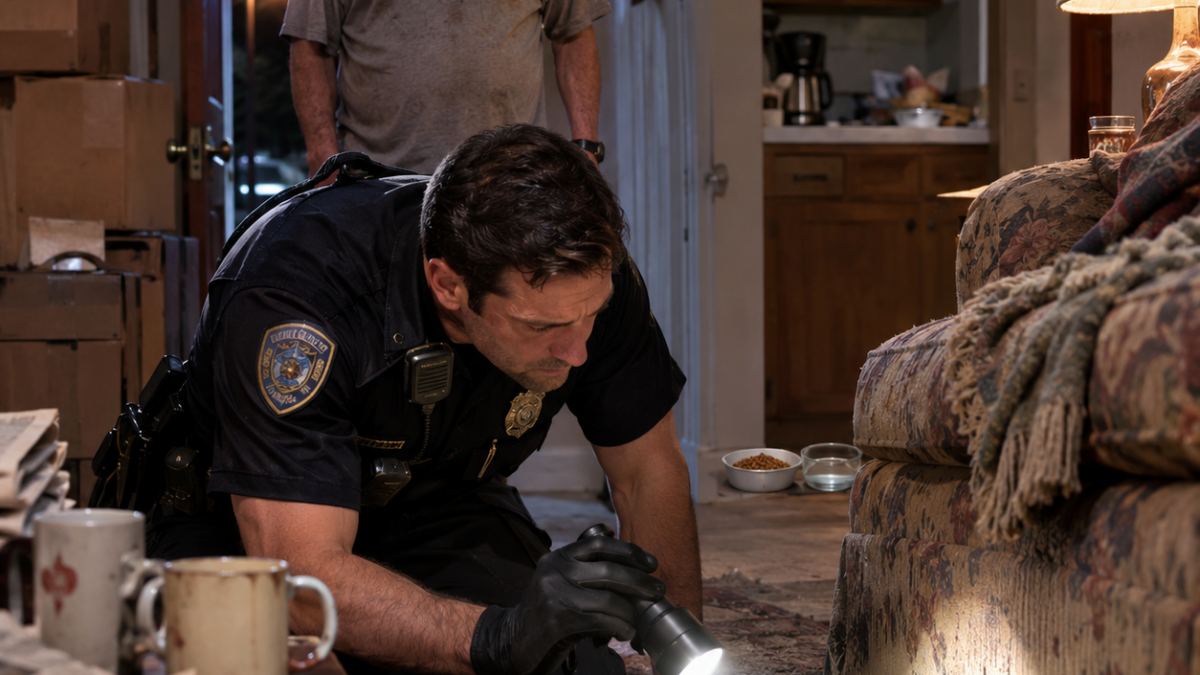
The living room looked like a place that had slowly stopped being cared for.
Not filthy enough for immediate condemnation.
But neglected.
Stacks of newspapers.
Boxes against one wall.
Half-empty coffee mugs.
Dust on the television stand.
Prescription bottles near the recliner.
A crocheted blanket folded carefully across one chair despite everything else being disordered.
That detail stood out.
The lamp lay broken beside an end table.
Ceramic base shattered.
Shade bent.
Ray pointed.
“There.”
I looked around.
“Where’s Pumpkin?”
“Probably under the couch.”
“Can I look?”
“If you want.”
I crouched.
Two yellow eyes stared from the darkness.
Orange face.
Large tabby.
He had shoved himself so far underneath that his whiskers pressed against the carpet.
“Hey, buddy.”
Pumpkin did not move.
Ray stood behind me.
“Come out of there.”
Pumpkin flattened.
Not slightly.
Completely.
His chin dropped.
His ears moved sideways.
Body compressed as if trying to disappear into the floor.
That reaction changed my assessment.
I looked over my shoulder.
“Does he always do that when you call him?”
Ray’s expression hardened.
“Cats hide.”
“I know.”
“He’s skittish.”
“How long?”
“What?”
“How long has he been skittish?”
Ray crossed his arms.
“He’s always been weird.”
Behind me, Pumpkin did not move.
I stood.
“Mind if I look at his food and water?”
Ray’s jaw tightened.
“What does food have to do with a broken lamp?”
“I’m checking welfare.”
He stared at me.
Then pointed toward the kitchen.
“Over there.”
The bowls sat beside a cabinet.
Water bowl maybe one-quarter full.
A film of dust and cat hair floated on top.
Food bowl empty.
Completely clean except for a few crumbs.
I crouched again.
“When did he last eat?”
“This afternoon.”
“How much?”
Ray did not answer.
I stood.
“When did you feed him?”
“I don’t keep a log.”
“Today?”
“I said this afternoon.”
“What time?”
“Jesus.”
His voice rose.
Pumpkin moved under the couch.
I noticed.
Ray noticed me noticing.
He lowered his voice.
“I don’t know. Two. Three.”
“What did you feed him?”
“Cat food.”
“Dry?”
“Yeah.”
“Where is it?”
He pointed toward a lower cupboard.
I opened it after asking permission.
The bag inside was empty.
Folded over.
No replacement bag.
I looked at Ray.
“I was going tomorrow.”
“To buy food?”
“Yes.”
“What was he going to eat tonight?”
Ray stared.
“I have tuna.”
I remained quiet.
Silence makes people uncomfortable.
They often fill it with truth.
Ray finally said, “I forgot.”
“How often do you forget?”
His face changed.
Not anger.
Shame.
He looked away.
“That kid puts food out for him sometimes.”
“Maya?”
He immediately realized he had used the name.
I didn’t respond.
“She gives him scraps over the fence.”
“Why would she need to?”
“She likes the cat.”
I heard Maya from outside.
“Officer Cole?”
I turned toward the open door.
She had not left her property.
Good.
“What?”
“Look at the bowl.”
“I did.”
“The blue one.”
I glanced back.
There was another dish partly hidden near the refrigerator.
Blue ceramic.
Empty.
Ray closed his eyes.
“Maya, stay over there.”
She obeyed.
I picked up the bowl.
On the front was painted:
PUMPKIN.
The bowl was old.
Hand-painted.
A small flower beside the name.
“Your wife make this?”
Ray stared.
“Yes.”
There it was again.
Wife.
I set it down.
“Ray.”
“What?”
“Do you still want this cat?”
His head snapped toward me.
“What kind of question is that?”
“A direct one.”
“He’s mine.”
“That’s not what I asked.”
“He lives here.”
“Still not the question.”
Ray stared.
His breathing changed.
I kept my voice level.
“Do you want Pumpkin here?”
For the first time since opening the door, Ray looked less angry than lost.
He turned toward an old recliner in the corner.
The one with the crocheted blanket.
He walked to it.
Sat.
For several seconds, nothing happened.
Then he said, “My wife sat there.”
I waited.
“Her name was Linda.”
He touched the armrest.
“Thirty-eight years.”
“How long ago?”
“Two years in March.”
“I’m sorry.”
Ray laughed bitterly.
“Everybody says that.”
No response seemed useful, so I gave none.
“Cancer?”
I asked eventually.
He nodded.
“Ovarian.”
He stared at the chair.
“She was sick eighteen months.”
Pumpkin remained under the couch.
“She wanted that stupid cat.”
Ray smiled despite himself.
“I told her no.”
“Why?”
“I hated cats.”
“Still do?”
He looked toward the couch.
“I don’t know.”
“What happened?”
“We went to some adoption event.”
His voice softened.
“Pumpkin was this orange thing with feet too big for his body.”
“He climbed into Linda’s purse.”
I smiled.
“That sealed it?”
“She said any cat smart enough to choose a purse was smart enough to choose a house.”
Ray swallowed.
“She always said things like that.”
The house seemed quieter.
“After she died…”
He stopped.
I waited.
“Pumpkin kept waiting outside the bedroom.”
“He slept in her chair.”
“Wouldn’t leave it.”
Ray rubbed both hands over his face.
“First few months, I liked it.”
“Felt like something of hers was still here.”
He looked at me.
“Does that make sense?”
“Yes.”
“Then I started hating it.”
The honesty surprised both of us.
He looked down.
“Every morning he scratches the bedroom door.”
“Every morning.”
“Like she might still be in there.”
His voice broke.
“I open it.”
“He walks in.”
“He jumps on her side of the bed.”
Ray’s eyes filled.
“And looks at me.”
He shook his head.
“You ever have an animal look at you like you owe them an explanation?”
“Yes.”
I had.
“He doesn’t understand.”
“No.”
“He waits.”
Ray stared toward the hallway.
“And every time he waits, I have to lose her again.”
His hands trembled.
“I started shutting the door.”
“He’d cry.”
“So I shut him out of the hallway.”
“He’d scratch.”
“I yelled.”
“Then one day I pushed him away with my foot.”
“Hard?”
Ray closed his eyes.
“Harder than I should have.”
That was probably the incident Maya saw.
“Tonight?”
“He knocked over the lamp.”
“Linda made that lamp in some pottery class.”
His jaw tightened.
“I saw it break.”
“And?”
“I threw a newspaper at him.”
“Did it hit him?”
“I don’t know.”
“Ray.”
“Yes.”
“Where?”
“Side.”
“Hard?”
“No.”
He paused.
“Maybe.”
Then he began crying.
Not dramatically.
Just tears running down an old man’s face while he stared at his dead wife’s chair.
“I yelled at him.”
“He ran.”
“I went after him.”
“Why?”
“I don’t know.”
Pumpkin remained invisible except for his eyes.
“I kicked the couch.”
“Not the cat?”
“No.”
“The couch.”
“Then he screamed.”
Ray looked sick.
“I scared him.”
I stood quietly.
None of this excused neglect.
Grief did not refill a food bowl.
Depression did not make fear harmless.
Love for someone dead did not permit cruelty toward something living.
But patrol work teaches you another uncomfortable truth.
Sometimes the person causing harm is not a monster.
Sometimes they are a person whose suffering has curdled into behavior they once would have condemned in somebody else.
That does not eliminate responsibility.
It makes responsibility more complicated.
I contacted county animal welfare.
Officer Elena Ruiz arrived twenty-six minutes later.
She was one of the best I had worked with.
Calm.
Blunt.
Impossible to manipulate.
She listened while I summarized.
Then she crouched near the couch.
“Pumpkin?”
Nothing.
Ray sat in the recliner.
Elena examined the bowls.
Empty food bag.
Living conditions.
Then she asked Ray for permission to examine Pumpkin.
“If you can get him.”
“We’ll try without forcing.”
She placed wet food near the couch.
Pumpkin did not move.
Elena sat on the floor.
Five minutes.
Ten.
Ray became restless.
“He won’t come.”
Elena ignored him.
Eventually Pumpkin’s nose appeared.
Then his face.
He smelled food.
Hunger won.
He crawled out.
That was when we saw how thin he really was.
Maya had been right.
His waist narrowed sharply.
Hip bones visible beneath orange fur.
Not skeletal.
But underweight.
Significantly.
Elena’s expression hardened.
Ray looked shocked.
“He didn’t look like that.”
Elena looked at him.
“He lives in your house.”
“I know.”
“You haven’t noticed?”
Ray stared at Pumpkin.
“No.”
That was perhaps the most damning answer of the night.
Not that he had not cared.
That he had stopped seeing.
Elena let Pumpkin eat slowly.
Then ran her hands gently over him.
He flinched when she touched his left side.
“Possible bruising.”
Ray looked horrified.
“From the newspaper?”
“Could be.”
“I didn’t—”
Elena held up one hand.
“We’ll let a veterinarian determine injury.”
She checked his gums.
Hydration.
Eyes.
Coat.
“He needs an exam, but I don’t see an obvious emergency.”
Ray nodded.
“I’ll take him tomorrow.”
Elena looked at him.
“No.”
Ray stared.
“What?”
“He’s coming with me tonight.”
“No.”
His reaction was immediate.
“He’s mine.”
Elena stood.
“Ray.”
“No.”
His voice rose.
Pumpkin bolted back under the couch.
That ended the argument before it really started.
Everyone saw it.
Ray too.
He looked toward the couch.
His shoulders collapsed.
Elena lowered her voice.
“I need you to decide whether you can safely and consistently care for him.”
“I can.”
“Can you?”
Silence.
“Food every day?”
Ray stared down.
“Fresh water?”
Nothing.
“Veterinary care?”
Ray’s eyes filled.
“Safe handling when you’re angry?”
He covered his face.
“No.”
The word came through his hands.
Elena waited.
Ray lowered them.
“No.”
It sounded like confession.
Not defeat.
“I can’t.”
Maya was still outside.
I could see her silhouette near the porch.
Elena said, “We can place Pumpkin in protective foster while we determine next steps.”
Ray shook his head.
“Don’t put him in a cage.”
“He’ll be safe.”
“He hates cages.”
“You know that?”
“Linda brought him home in one.”
A faint smile.
“He screamed forty minutes.”
Elena softened slightly.
“We’ll use the least stressful option we have.”
Ray nodded.
Then looked at me.
“You asked if I wanted him here.”
“Yes.”
“I do.”
He swallowed.
“That’s the problem.”
I waited.
“I want him because he was hers.”
He looked at Pumpkin.
“But I don’t think I want him for himself.”
That sentence was one of the most honest things I have ever heard somebody say.
“And that isn’t fair.”
“No,” I said.
“It isn’t.”
He nodded.
Pumpkin would not enter the carrier.
Elena tried food.
A towel.
Patience.
Nothing.
Then Ray stood.
Walked toward the couch.
Elena looked at me.
I watched carefully.
Ray got down on his knees.
His movements were slow.
Pumpkin stared from the darkness.
Ray did not reach.
“Hey, buddy.”
Pumpkin flattened.
Ray’s face crumpled.
He stayed there.
“I’m not going to touch you.”
Pumpkin watched.
Ray wiped his nose with the back of his hand.
“I’m sorry.”
No movement.
“I’m sorry, buddy.”
His voice shook.
“That’s not enough.”
Pumpkin blinked.
“I know.”
Ray looked toward Linda’s chair.
“She’d hate me right now.”
I did not know whether that was true.
Neither did he.
“But you didn’t do anything.”
His voice cracked.
“You were just waiting.”
Pumpkin’s ears shifted.
“That’s all you did.”
Ray put one hand on the carpet.
Palm up.
Far enough away not to corner him.
“I’m sorry I got angry because you missed her.”
Nothing dramatic happened.
Pumpkin did not crawl into his arms.
He did not forgive him in the way humans like stories to make animals forgive.
He simply stared.
Then after nearly a minute, he moved his nose forward and smelled Ray’s fingers.
Ray sobbed once.
Quietly.
Elena looked away.
So did I.
Pumpkin backed up again.
That was all.
But Ray seemed to understand.
“You don’t have to.”
He sat back.
“Okay.”
Elena eventually used a towel and careful handling to place Pumpkin in the carrier.
He cried once.
Ray flinched.
“I know.”
Elena lifted the carrier.
Ray stood near the door.
“Where’s he going?”
“Veterinary evaluation first.”
“Can I call?”
“Yes.”
“Will they tell me?”
“With the proper release.”
He nodded.
Then asked the question I had been expecting.
“Am I getting arrested?”
I looked at Elena.
She handled the welfare investigation.
“Not tonight.”
Ray looked almost disappointed.
Not because he wanted jail.
Because punishment would have been simpler than what was actually happening.
Elena continued.
“There will be a report.”
“You may be cited.”
“Depending on the veterinary findings and prosecutor review, there could be charges.”
Ray nodded.
“I understand.”
Then he looked at Maya’s house.
“She called?”
I did not answer.
He gave a broken smile.
“Smart kid.”
I surprised myself.
“Yes.”
“She is.”
I walked back across the lawn.
Maya opened the storm door before I reached the porch.
“Is Pumpkin okay?”
“He’s going to see a veterinarian.”
Her eyes went to the carrier.
“Is he leaving?”
“For now.”
“What happens to him?”
“We’ll make sure he’s safe.”
She looked toward Ray’s house.
“Is Mr. Miller going to jail?”
“Not tonight.”
“Is he mad?”
“Probably at a lot of things.”
“At me?”
I crouched again.
“He did not say that.”
Maya looked unconvinced.
“Did I do the right thing?”
“Yes.”
Immediate.
No hesitation.
“Even if he didn’t really hurt Pumpkin?”
“He did hurt Pumpkin.”
Her eyes widened.
“Bad?”
“Pumpkin is thin. He’s frightened. That matters.”
She looked at the carrier.
“I didn’t want Mr. Miller to get in trouble.”
“I know.”
“I just wanted Pumpkin to stop being scared.”
“I know.”
Maya nodded.
Then she asked something I did not expect.
“Is Mr. Miller scared too?”
I looked at her.
“What makes you ask?”
“He looked like my grandpa did after Grandma died.”
Children see things adults spend years ignoring.
“Yes.”
I said finally.
“I think he is.”
“Can somebody help him too?”
There are moments in police work when a child makes you feel smaller than your badge.
That was one.
“We can try.”
Maya nodded.
Then she walked to the carrier.
Elena lowered it carefully.
Pumpkin was pressed against the back.
Maya knelt.
“Hi, Pumpkin.”
His eyes moved toward her.
“It’s me.”
She put one finger against the carrier door.
Pumpkin sniffed.
Then touched his nose to the metal near her fingertip.
Maya smiled.
“You’re going to be okay.”
We did not know that yet.
She said it anyway.
Pumpkin’s veterinary examination showed he was roughly three pounds underweight.
He had mild dehydration.
A small bruise along his ribs.
No fractures.
No internal injuries.
His coat was greasy from stress and poor grooming.
His bloodwork was otherwise surprisingly decent.
Elena called me the next morning.
“Could have been much worse.”
“That doesn’t make me feel better.”
“It should make you feel a little better.”
“What happens now?”
“Temporary foster.”
“Ray surrendering?”
“Not yet.”
“You think he’ll fight it?”
“I think he doesn’t know what he wants.”
She paused.
“He called twice overnight.”
“To ask about Pumpkin?”
“Yes.”
“That good?”
“Maybe.”
“What did he say?”
“First call, asked if he’d eaten.”
“Second, asked if he was hiding.”
I leaned against my desk.
“And?”
“He apologized to the receptionist for calling twice.”
That sounded like Ray.
Elena continued.
“I’m recommending counseling resources in the welfare plan.”
“For him?”
“Yes.”
“Since when does animal control do social work?”
“Since people keep pretending animal problems happen separately from human problems.”
Fair enough.
Ray received a citation for failure to provide adequate care.
The bruise and reported behavior were documented.
The prosecutor did not pursue a felony cruelty charge because the evidence did not support intentional serious injury.
Some people later thought that was too lenient.
Others thought any punishment was cruel to a grieving widower.
Both groups wanted the case to be simple.
It was not.
Ray had neglected Pumpkin.
He had frightened him.
He had thrown something that struck him.
He had failed him.
Those facts remained true.
So did this:
Ray was deeply depressed.
He had stopped taking care of himself too.
His refrigerator contained mustard, old milk, coffee creamer, and half a loaf of bread.
His electricity had nearly been shut off twice.
He had missed his own medical appointments.
He had lost twenty pounds.
He slept in the recliner because he had not entered the bedroom for six months.
When county social services became involved, a caseworker named Dana Whitaker called me.
“You know this guy?”
“Briefly.”
“You worried he’ll hurt himself?”
That question sharpened everything.
“Did he say something?”
“No.”
“Then why?”
“His depression screening is bad.”
I closed my office door.
“How bad?”
“Bad enough that I’m asking.”
I called Ray.
He answered after six rings.
“Cole?”
“You saved my number?”
“You’re the only cop who’s been in my house lately.”
“How are you?”
“Terrific.”
“That convincing, huh?”
He sighed.
“What do you want?”
“I heard someone came to see you.”
“Social worker.”
“Dana.”
“Yeah.”
“She annoying?”
“Very.”
“Good at her job.”
“Probably.”
Silence.
“Ray.”
“What?”
“You sleeping?”
“Some.”
“Eating?”
“Apparently everybody is obsessed with whether everyone eats now.”
“Answer.”
“Yes.”
“What?”
“What what?”
“What did you eat?”
Silence.
“Ray.”
“Soup.”
“When?”
“Lunch.”
“What about dinner?”
“I’ll eat.”
“That means no.”
He became irritated.
“Are you my mother?”
“No.”
“Then stop.”
I almost did.
Then I thought of Maya asking whether somebody could help him too.
“Ray, Pumpkin is in a foster home eating twice a day.”
Silence.
“He’s gaining weight.”
“Good.”
“Your turn.”
“What?”
“Eat dinner.”
“That’s stupid.”
“Probably.”
I hung up.
Twenty minutes later, he texted me a photograph of a turkey sandwich.
No words.
I replied:
Acceptable.
He sent back:
Go to hell.
I smiled.
Over the next two weeks, Pumpkin’s foster placement became complicated.
He was safe.
Fed.
Medically stable.
But miserable.
He hid under furniture.
Would not approach the foster volunteer.
Cried at night.
Sat beside windows.
The volunteer, a retired teacher named Melissa Grant, called Elena.
“He wants something.”
“What?”
“I don’t know.”
Then one afternoon Maya’s mother contacted animal welfare.
Her name was Rachel Bennett.
She had been working the night Maya called.
She had come home horrified that her daughter had been handling something so heavy while she was away.
Rachel wanted to know if Maya could visit Pumpkin.
Elena initially said no.
Then reconsidered.
They arranged a supervised visit at the foster home.
I was not there.
But Elena told me later.
Pumpkin had spent twenty minutes under a bed.
Maya sat on the floor.
Did not reach.
Did not call repeatedly.
She opened a book and started reading aloud.
Charlotte’s Web.
Within six minutes, Pumpkin’s face appeared.
At ten, he came out.
At twelve, he walked into her lap.
Melissa cried.
Elena pretended she had allergies.
Maya just kept reading.
That visit changed the placement conversation.
Rachel had never planned to own a cat.
She was a single mother.
Two kids.
Full-time job.
Budget carefully managed.
But Maya had already been putting money aside.
Fourteen dollars and thirty-seven cents.
“To buy his food,” she told her mother.
Rachel stared at her.
“With what income?”
“Birthday money.”
“You’re nine.”
“I know.”
“You cannot financially support a cat.”
“I can help.”
Rachel later told me she knew she was losing the argument when Maya said:
“He already knows our house.”
Pumpkin had spent years watching the Bennett family from his window.
He knew Maya.
He had visited their yard.
Rachel agreed to foster.
Not adopt.
Everybody said that.
Temporary placement.
The first afternoon Pumpkin entered Maya’s house, he walked directly to the storm door and looked across the lawn at Ray’s home.
He sat there for nearly an hour.
Maya sat beside him.
Neither moved.
Rachel took a photograph but did not post it.
She sent it to Elena.
Elena sent it to Ray.
He replied only:
Thank you.
Ray did not ask to visit.
Not at first.
He knew Pumpkin was close.
Twenty yards away.
That was apparently enough.
Every morning, he opened his curtains.
Pumpkin sometimes sat in Maya’s front window.
Ray could see him.
Pumpkin could see Ray.
Neither crossed the space between houses.
Ray began counseling.
I learned because he called one afternoon.
“You ever been to therapy?”
“Why?”
“Answer.”
“Yes.”
He sounded surprised.
“Really?”
“Cops are not legally prohibited from emotions.”
“Funny.”
“What happened?”
“She wants me to talk about Linda.”
“Seems predictable.”
“I don’t want to.”
“Then why go?”
“Dana said if I want anybody to believe I’m serious about changing, I need help.”
“That’s not a good reason.”
“What?”
“If you’re only doing it to prove something.”
Ray was quiet.
“So what’s the good reason?”
“Maybe because you threw a newspaper at a cat because your wife died.”
That was harsh.
I knew it immediately.
Ray did too.
Silence.
“Ray—”
“No.”
His voice was steady.
“You’re right.”
He hung up.
I felt like a jerk for the rest of the afternoon.
The next day he texted:
Went back.
I replied:
Good.
Three weeks after Pumpkin moved in with Maya’s family, I happened to drive down their street.
I say happened because that is technically true.
It was also not the fastest route to where I was going.
Maya sat on her front steps.
Pumpkin was beside her.
He looked different.
Not dramatically.
Still thin.
Still cautious.
But his coat had improved.
His shoulders no longer seemed permanently hunched.
Maya was doing homework.
Pumpkin watched a squirrel.
I pulled over.
Maya waved.
“Officer Cole!”
Pumpkin immediately moved behind her.
“Nice greeting.”
“He doesn’t like uniforms.”
“Understandable.”
I approached slowly.
“How’s he doing?”
“He gained one pound.”
“That’s good.”
“The vet said he should gain maybe another one and a half.”
“You memorized that?”
“Yes.”
“Of course you did.”
Rachel stepped outside.
“Sorry, she gives everyone medical updates now.”
Maya frowned.
“People should know.”
“I agree.”
Then Ray’s front door opened.
Everybody noticed.
He stepped outside carrying something.
An old folded blanket.
Pumpkin’s body tightened.
Not full panic.
But alert.
Ray stopped at the edge of his driveway.
He did not cross.
Rachel looked at Maya.
Maya looked at me.
I looked at Ray.
He held up the blanket.
“This was his favorite.”
Nobody moved.
Ray swallowed.
“I washed it.”
He looked embarrassed.
“Probably shouldn’t have.”
Pumpkin stared.
Ray continued.
“Smells wrong now.”
Maya stood.
She crossed halfway.
Ray held out the blanket.
“This was Linda’s.”
His voice caught.
“She put it on the recliner.”
Maya accepted it carefully.
“Thank you.”
Ray nodded.
Then started to turn away.
Maya said, “Mr. Miller?”
He stopped.
“You can visit him.”
Rachel’s eyebrows went up.
So did mine.
Ray looked toward Pumpkin.
“I don’t think he wants that.”
Maya glanced down.
“You don’t know.”
“I scared him.”
“Yes.”
Nine-year-olds are not famous for diplomatic dishonesty.
Ray almost smiled.
“Yes, I did.”
“But you can sit over there.”
She pointed to the edge of the yard.
“You don’t have to touch him.”
Rachel started to intervene.
“Maya—”
Ray shook his head.
“It’s okay.”
He looked at Pumpkin.
“Maybe another day.”
Pumpkin surprised all of us.
He stood.
Walked down the steps.
Slowly.
Ray froze.
Pumpkin crossed the grass.
Not all the way.
He stopped about six feet from Ray.
Ray’s hands hung at his sides.
Pumpkin sniffed the air.
Ray crouched.
Very slowly.
“Hey.”
Pumpkin’s tail flicked.
“Hey, buddy.”
Ray extended no hand.
For a minute, nothing happened.
Then Pumpkin walked two steps closer.
Sniffed Ray’s shoe.
Moved toward his fingers.
Ray turned his hand palm-down and held it still.
Pumpkin smelled him.
Then backed away.
Sat.
Four feet between them.
Ray started crying.
Maya said nothing.
Neither did I.
That was the right response.
The moment did not need interpretation.
It was not forgiveness.
It was not reunion.
It was Pumpkin gathering information.
Are you dangerous now?
Are you calm?
Do you still smell like home?
Can I be near you without disappearing underneath furniture?
Animals are often better at boundaries than people.
Pumpkin did not forget because Ray cried.
He simply chose, for that moment, to remain nearby.
Ray understood more than I expected.
He wiped his face.
“Thank you.”
Not to Maya.
Not to me.
To Pumpkin.
Then he stood.
Went home.
Pumpkin returned to Maya.
That became the beginning of something none of us planned.
Every Saturday morning, Ray sat outside.
Same folding chair.
Same spot near the property line.
He brought nothing.
No treats.
No toys.
Maya insisted.
“You can’t bribe him.”
Ray agreed.
Pumpkin watched from the Bennett porch.
First week, he did not approach.
Second week, same.
Third week, he crossed halfway.
Fourth, sat three feet away.
Fifth, walked beside Ray’s chair.
Ray did not touch him.
Sixth week, Pumpkin rubbed once against Ray’s pant leg.
Ray closed his eyes.
Maya saw.
“Don’t cry or you’ll scare him.”
Ray laughed through tears.
“Yes, ma’am.”
His recovery was not as simple as the cat’s.
Some weeks Ray looked better.
Shaved.
Clean shirt.
Groceries in the kitchen.
Other weeks the curtains stayed closed.
Maya noticed.
One afternoon she knocked on my cruiser window while I was parked nearby.
“Mr. Miller didn’t come out Saturday.”
“Okay.”
“He always comes out Saturday.”
“Maybe he was busy.”
“He wasn’t.”
“How do you know?”
“His car didn’t move.”
I sighed.
“You keeping surveillance?”
“I look.”
“Different thing?”
“Yes.”
I checked on Ray.
He opened the door wearing pajamas at four in the afternoon.
“Kid sent you?”
“She expressed concern.”
“She needs hobbies.”
“She has Pumpkin.”
“Good point.”
“Bad week?”
Ray looked behind him.
Linda’s birthday had been Thursday.
I understood.
“Therapist know?”
“Appointment tomorrow.”
“Eat?”
Ray rolled his eyes.
“Yes.”
“What?”
“Lasagna.”
“Frozen?”
“Yes.”
“Vegetable?”
“Tomato is a fruit.”
“You’re impossible.”
“So I’ve heard.”
I left.
The next Saturday he sat outside again.
Maya brought him lemonade.
Ray protested.
She left it anyway.
Pumpkin eventually climbed onto the lower edge of his folding chair.
Not his lap.
Just the chair.
Ray sat completely still for twenty-three minutes.
I know because Maya timed it.
She told me later.
The legal case resolved in municipal court.
Ray pleaded to a misdemeanor neglect charge.
Fine.
Probation.
Mandatory compliance with mental-health treatment and prohibition on owning another animal during the probation period unless approved.
He did not contest any of it.
At sentencing, the judge asked if he wanted to speak.
Ray stood.
“I don’t have an excuse.”
That got my attention.
Defendants usually had several.
“I loved my wife.”
He looked at the judge.
“And after she died, I started using that grief to excuse everything I stopped doing.”
He swallowed.
“My house.”
“My health.”
“People.”
“Pumpkin.”
He paused.
“I thought because I was suffering, I wasn’t responsible for what I did while suffering.”
His voice shook.
“I was wrong.”
The judge watched him.
Ray continued.
“The cat didn’t understand why I was angry.”
“He didn’t do anything except remind me of someone I lost.”
Ray looked down.
“I became the thing he was afraid of.”
No one moved.
“I’m ashamed of that.”
The judge imposed the negotiated sentence.
No dramatic lecture.
No applause.
No humiliation.
That mattered to me.
Justice is not always a spectacle.
Sometimes accountability works better when nobody gets to perform.
Pumpkin’s adoption by the Bennett family became final two months later.
Maya insisted Ray be told before the paperwork was signed.
Elena asked why.
“He should know.”
“Why?”
“Because Pumpkin was his.”
Elena corrected gently.
“Pumpkin is his own.”
Maya considered.
“Then because Mr. Miller loved him.”
That was harder to argue with.
Ray signed the surrender documents voluntarily.
His hand shook.
At the bottom, beneath the signature, there was a blank line labeled:
Reason for surrender.
He stared at it.
Elena said, “You can write unable to provide care.”
Ray shook his head.
He wrote:
HE DESERVES TO FEEL SAFE.
Elena kept a copy.
So did Maya.
Pumpkin’s name stayed Pumpkin.
Rachel had briefly suggested changing it.
Maya refused.
“That’s his name.”
“What if it reminds him of Mr. Miller?”
“Mr. Miller isn’t all bad.”
Rachel looked at her daughter.
“No.”
“He did bad things.”
“Yes.”
“But that’s different.”
Rachel nodded.
“It can be.”
Pumpkin gained the rest of the weight slowly.
His first medical recheck showed improvement.
Second showed normal hydration.
Third showed his coat had returned to a healthy shine.
He began sleeping on Maya’s bed.
Always near her feet.
He sat in the window again.
That detail nearly destroyed Ray.
The first time he saw Pumpkin back in a window—across the lawn now instead of inside his own house—he stood in his driveway staring.
Pumpkin lifted one paw.
Pressed it against the glass.
The same gesture he used to make when Maya came home from school.
Ray lowered his head.
Maya appeared behind Pumpkin.
She waved.
Ray waved back.
Then Pumpkin did something Maya swore was deliberate.
He tapped the glass twice.
Ray laughed.
Real laughter.
Maybe the first in two years.
Spring came.
Then summer.
I stopped by less often because life moved.
Other calls.
Other houses.
Other people in trouble.
But I heard updates.
Maya sent the department a Christmas card with Pumpkin wearing a ridiculous red bow tie.
Ray joined a grief support group.
He started volunteering twice a week at a community woodworking shop.
He cleaned the house.
Not all at once.
One room at a time.
Linda’s chair stayed.
So did the lamp table, though the broken pottery lamp was gone.
One afternoon he showed Maya a box.
Inside were pieces of the broken ceramic base.
“I was going to throw them away.”
“Don’t.”
“What am I supposed to do with broken lamp pieces?”
Maya shrugged.
“Fix them.”
Ray smiled sadly.
“Doesn’t work like that.”
“Why?”
“Some things don’t go back together.”
Maya examined a piece.
“Then make something else.”
Ray stared at her.
That became a project.
He took the ceramic fragments to the community workshop.
Mounted them inside a shallow wooden frame.
Not pretending they formed the original lamp.
They did not.
The pieces remained broken.
But arranged around a small photograph of Linda holding Pumpkin as a kitten.
Ray hung it beside the recliner.
When Maya saw it, she said:
“That’s better than a lamp.”
Ray laughed.
“Linda would disagree.”
Another year passed.
Maya turned ten.
Then eleven.
Pumpkin became completely attached to her.
He waited at the front window every afternoon around the time the school bus came.
When Maya stepped off, his paw hit the glass.
Every day.
Sometimes Ray happened to be outside.
Sometimes not.
Pumpkin continued visiting him too.
Not inside the house.
Never.
Maya respected that.
So did Ray.
Visits happened outdoors.
Pumpkin would cross the grass.
Sit with him.
Sometimes accept petting.
Sometimes not.
Ray never picked him up.
Never tried to reclaim anything.
That restraint became its own form of apology.
One afternoon I stopped because I saw Ray and Pumpkin under a maple tree.
Pumpkin was asleep about a foot from his chair.
Ray smiled when I approached.
“Look at this.”
“I see.”
“He’s been there forty minutes.”
“Maybe he’s using you for shade.”
“That’s likely.”
I sat on the porch rail.
“You doing okay?”
“Mostly.”
“Mostly is good.”
“My therapist says I use humor to avoid discomfort.”
“Your therapist is perceptive.”
“She also says I deflect.”
“Definitely.”
Ray looked at Pumpkin.
“I still miss Linda every day.”
“I’d be worried if you didn’t.”
“Some days I miss being miserable too.”
That surprised me.
“What?”
He shrugged.
“When I started feeling better, I felt guilty.”
“Why?”
“Like I was moving away from her.”
I understood.
“Grief was the last thing you still shared?”
He looked at me.
“Something like that.”
Pumpkin opened one eye.
Ray smiled.
“This idiot helped.”
“Pumpkin?”
“Yeah.”
“How?”
Ray thought.
“I kept looking at him and thinking I wanted him to stop being scared of me.”
“And?”
“I realized I wanted to stop being scared of me too.”
That stayed with me.
Not because it was poetic.
Because it was accurate.
People sometimes reach a point where they no longer trust themselves.
Anger.
Addiction.
Grief.
Whatever it is.
They start arranging their lives around avoiding what they might become.
Ray had done that.
Pumpkin forced him to see it.
Then Maya forced him to do something about it.
When Maya was twelve, she had to give a school presentation about someone she considered courageous.
Her teacher assumed she would choose a historical figure.
Maya chose Pumpkin.
Technically.
The presentation title was:
THE COURAGE TO NOTICE.
I only heard about it because Rachel sent me a video.
Maya stood in front of her class with a photograph of Pumpkin projected behind her.
She had grown taller.
Still serious.
Still direct.
“When people talk about courage,” she said, “they usually mean doing something big.”
She clicked to the next slide.
A picture of a phone.
“But sometimes you don’t have to do something big.”
“You just have to not ignore something small.”
Another slide.
Pumpkin under a blanket.
“I was scared when I called 911 because Mr. Miller was an adult and I was a kid.”
She paused.
“I thought maybe adults would say I was being dramatic.”
The room was quiet.
“But Pumpkin couldn’t call.”
That sentence nearly got me.
“He couldn’t explain that he was hungry.”
“He couldn’t tell anyone he was afraid.”
“He could only hide.”
Maya looked at her classmates.
“So I think courage is sometimes noticing when somebody else doesn’t have a voice people understand.”
Then she added:
“And I think helping doesn’t always mean deciding somebody is bad forever.”
A photograph of Ray appeared.
He was sitting outside with Pumpkin nearby.
Maya continued.
“Mr. Miller hurt Pumpkin.”
“He neglected him.”
“That was wrong.”
“He also got help.”
“He apologized.”
“He changed.”
She paused.
“Pumpkin does not live with him anymore.”
“And I think that’s right too.”
There it was.
A twelve-year-old explaining something adults spend lifetimes avoiding.
Compassion without surrendering boundaries.
Accountability without dehumanization.
Forgiveness without pretending harm did not happen.
Maya ended with:
“You can care about the person who caused harm and still protect the one who was harmed.”
I watched that line twice.
Then a third time.
Ray attended the presentation.
I noticed him in the back of the video.
He cried through most of it.
Afterward, he asked Maya:
“You think I’m courageous?”
She said, “No.”
He laughed so hard he had to sit down.
Then she added:
“But I think you’re trying.”
Ray nodded.
“I’ll take it.”
Years later, Maya would tell me that was the thing she remembered most.
Not calling police.
Not Pumpkin leaving in the carrier.
Not even Ray crying.
The trying.
Because change did not happen when Ray said sorry.
It happened when he kept doing the things that made sorry believable.
Therapy.
Food in his own refrigerator.
Showing up.
Accepting that Pumpkin did not owe him closeness.
Respecting a boundary every Saturday.
Letting the cat belong somewhere else.
Learning to live in a house where Linda was gone without punishing the creature who remembered her.
Pumpkin lived another eight years.
By then Maya was seventeen.
College brochures covered the kitchen table.
Rachel had started pretending she was fine with her daughter moving away.
Nobody believed her.
Pumpkin was older.
Thicker around the middle.
Gray around his muzzle.
Slower.
Still devoted to the front window.
Ray had changed too.
Healthier.
Beard trimmed.
House painted.
He had even started seeing a woman named Diane from grief group.
Maya found this scandalous.
“Does Pumpkin like her?”
Ray laughed.
“Why does that matter?”
“It matters.”
“She’s met him once.”
“And?”
“He ignored her.”
Maya considered.
“That’s acceptable.”
Ray and Diane eventually married in a tiny courthouse ceremony.
Maya attended.
So did Rachel.
I was invited too.
Pumpkin was not.
Maya said he objected.
Ray said he would survive.
A photograph of Linda remained in Ray’s house.
Diane never asked him to remove it.
That mattered.
Ray did not replace Linda.
He did not need to.
He built something after her.
Different.
Not betrayal.
Life.
Pumpkin’s decline began quietly.
Kidney disease.
Then arthritis.
Maya administered medication with the confidence of somebody who had spent years reading veterinary instructions.
One winter afternoon, Rachel called me.
“Pumpkin’s not doing well.”
I had not heard from them in months.
“How bad?”
“The vet thinks days.”
I sat down.
“Does Ray know?”
“Maya told him.”
“What happened?”
“He hasn’t come over.”
That surprised me.
“Why?”
“Ask him.”
I did.
Ray answered.
“I don’t think I should.”
“Why?”
“He’s Maya’s cat.”
“He can be Maya’s cat and still matter to you.”
Silence.
“What if I scare him?”
“After eight years?”
“Maybe.”
“Ray.”
“I don’t want his last day to include him being afraid of me.”
That was guilt still speaking.
Not responsibility anymore.
I told him so.
“He forgave you?”
“No.”
“I didn’t say that.”
Pumpkin had never needed to forgive in a human sense.
He had simply rebuilt enough trust to choose proximity.
“That’s different.”
Ray remained quiet.
“What does Maya want?”
“She wants you there.”
Another silence.
“I’ll go.”
Pumpkin was lying in Maya’s bedroom when Ray arrived.
Maya sat beside him.
Seventeen years old.
Same serious eyes.
Ray stopped in the doorway.
“Hey, buddy.”
Pumpkin’s ears moved.
Ray came closer.
Not too close.
Old habits.
Respect learned over years.
Maya said, “You can sit.”
Ray sat on the floor.
His knees protested.
“I’m too old for this.”
Maya smiled.
Pumpkin lifted his head.
Looked at Ray.
Then stood.
Slowly.
Walked across the blanket.
And lowered himself against Ray’s thigh.
Ray stopped breathing.
Maya covered her mouth.
Pumpkin had never done that before.
Not once in all those years.
Ray placed one hand beside him.
Not on him.
Pumpkin moved his head.
Rested it on Ray’s fingers.
Ray began to cry.
“I’m sorry.”
Maya shook her head.
“Don’t.”
Ray looked at her.
“What?”
“Don’t make him spend this time comforting you.”
That was pure Maya.
Direct.
Painful.
Correct.
Ray laughed through tears.
“Right.”
He stroked Pumpkin’s head.
“Thank you.”
Better.
Pumpkin purred.
Faintly.
The veterinarian came to the Bennett house the next afternoon.
Ray was there.
So was I.
I did not have to be.
I wanted to.
Pumpkin lay on Maya’s lap.
Rachel sat beside her daughter.
Ray sat on the floor near the bed.
When the veterinarian gave the first medication, Pumpkin relaxed.
Maya cried silently.
Ray kept one hand near his back.
The cat’s breathing slowed.
Maya whispered, “You’re okay.”
Pumpkin’s eyes closed.
“You did everything right.”
That sentence broke Ray.
He looked at Maya.
She did not mean the cat had lived perfectly.
She meant Pumpkin had survived without becoming responsible for what people had done to him.
He had hidden when he needed to.
Trusted when he was ready.
Left when he had to.
Returned when he chose.
Nothing about that was failure.
His final breath came quietly.
Maya kept holding him.
Ray lowered his head.
Nobody spoke for a long time.
Then Ray said:
“Linda loved that cat.”
Maya looked at him.
“So did you.”
Ray shook his head.
“I did it badly for a while.”
“Yes.”
He smiled sadly.
“Still direct.”
“Always.”
Ray looked at Pumpkin.
“I think I loved him because she did.”
Then his voice changed.
“And somewhere along the way I started loving him because he was him.”
Maya nodded.
“That’s better.”
“Yes.”
“Much.”
After Pumpkin died, Maya kept the blue bowl.
PUMPKIN.
The one Linda had painted.
Ray had given it to her years earlier along with the blanket.
Maya took it to college.
Not for food.
She kept pens in it on her desk.
When people asked, she told the story.
Not the dramatic version.
Not “I saved a cat.”
She hated that.
She said:
“I noticed him.”
That was all.
Years later, after I retired, I received an envelope with no return address I recognized.
Inside was a photograph.
Maya.
Older now.
Maybe twenty-six.
Standing in front of a building with a sign:
BENNETT ANIMAL ADVOCACY & COMMUNITY SUPPORT.
Beside her stood Ray.
Very old.
White-haired.
Holding a cane.
On the back she had written:
Officer Cole,
You told me when I was nine that if Pumpkin wasn’t okay, we would help him.
I never forgot the “we.”
We now help families who are struggling to care for animals during grief, illness, eviction, hospitalization, or financial crisis.
Sometimes protecting an animal means removing them.
Sometimes it means helping a person before things get that bad.
Thank you for believing me.
—Maya
There was another note beneath it.
Different handwriting.
Shaky.
Cole,
Kid still bossy.
Still right most of the time.
You asked me one question that night:
Do you still want Pumpkin here?
Took me years to realize you were asking whether I wanted him as a living creature or only as a piece of my wife.
That question saved more than the cat.
—Ray
I sat at my kitchen table holding those two notes for a long time.
Sixteen years in patrol had taught me not to expect clean endings.
People relapsed.
Families fractured.
Victims returned to dangerous homes.
Addiction came back.
Apologies failed.
Court orders expired.
Some people changed.
Some did not.
You learned to do the work without demanding proof that it mattered.
But every once in a while, years later, the answer arrived.
Not because one officer fixed anything.
I did not.
Maya made the first call.
Elena protected Pumpkin.
Veterinarians treated him.
Rachel opened her home.
Ray took responsibility.
A therapist helped him carry grief without turning it into harm.
Pumpkin decided for himself how close Ray was allowed to come.
Everyone did one part.
That was the lesson I carried into retirement.
People like stories where one heroic person saves everybody.
Real life is usually less convenient.
Most rescues happen because somebody notices.
Then somebody believes them.
Then somebody else shows up.
Then another person stays.
Maya could not arrest anyone.
She could not examine Pumpkin.
Could not diagnose Ray’s depression.
Could not make adults behave.
She was nine.
All she had was a phone.
And the uncomfortable certainty that something next door was wrong.
A lot of people spend their lives trying to silence that certainty.
Not my business.
Someone else will handle it.
Maybe I’m overreacting.
Maybe I didn’t really hear what I heard.
Maybe the animal is fine.
Maybe the kid is fine.
Maybe the old man is fine.
Maybe somebody more qualified will notice.
Maya did something harder.
She accepted the possibility that she might be wrong and called anyway.
That is an underrated kind of courage.
Not certainty.
Responsibility.
The willingness to say:
I don’t know exactly what is happening.
But I know enough not to ignore it.
Years after Pumpkin died, Ray reportedly still kept the framed pieces of Linda’s broken lamp beside her recliner.
The photograph remained in the center.
Linda holding Pumpkin as a kitten.
Ceramic fragments around it.
Nothing restored to its original shape.
Nothing pretending not to have broken.
Just pieces arranged into something new.
I thought that suited all of them.
Ray never got his old life back.
Maya grew up.
Pumpkin never became the same fearless window cat he had been before those bad months.
Some things remained changed.
But changed is not always ruined.
Ray learned that grief explained his behavior without excusing it.
Maya learned that protecting someone did not require hating whoever hurt them.
Pumpkin learned that doors could open and lead somewhere safe.
And I learned that one of the bravest calls I ever answered came from a child whispering into a phone because she was afraid the adult next door would hear her.
“Please don’t hang up.”
I can still hear her.
“He hurt Pumpkin again.”
Her voice trembling.
“I know he isn’t my cat…”
Then the sentence that mattered.
“…but I think he needs someone.”
She was right.
Pumpkin needed someone.
So did Ray.
And on that Tuesday night, because one nine-year-old girl refused to decide that another living thing’s pain was none of her business, both of them finally got help.








