A Newly Adopted Maine Coon Escaped His New Home Three Times to Return to the Shelter—Then His Family Followed Him and Found the Senior Cat He Refused to Leave Behind
PART3:
There was no immediate family willing to take him.
A neighbor fed him for several weeks before eventually contacting the rescue.
Winston came with a faded blue blanket, two bottles of thyroid medication, and a handwritten note from the neighbor.
HE LIKES TUNA.
HE’S AFRAID OF VACUUM CLEANERS.
PLEASE DON’T LET HIM THINK NOBODY WANTED HIM.
The volunteers taped that note inside his file.
Winston was placed two kennels away from Oliver.
For almost a week, nothing happened.
Then one morning a volunteer named Carly opened Oliver’s enclosure to clean.
Oliver walked out.
Not unusual.
The cat room had a secured internal door.
Cats sometimes wandered while their enclosures were changed.
Oliver ignored the toys.
Ignored the windows.
Ignored the empty cardboard boxes placed around the room.
He walked directly toward Winston.
Winston was asleep.
Oliver sat outside his enclosure.
Waited.
Eventually Winston opened his eyes.
The two cats stared at each other.
Carly expected hissing.
Maybe territorial behavior.
Instead, Winston walked slowly toward the gate.
Oliver made a small chirping sound.
Winston answered.
That was the beginning.
At first the volunteers allowed short supervised visits.
Then longer ones.
Neither cat showed aggression.
Within days, Oliver began grooming Winston.
Winston slept against Oliver’s side.
Soon, the rescue moved them into a larger shared cat room whenever space allowed.
After that, separating them became almost impossible.
Every morning, volunteers found them in the same cat tree.
Oliver usually curled around Winston.
Sometimes only their tails touched.
Every afternoon, they claimed the window overlooking the bird feeder.
Oliver sat upright.
Winston leaned against him.
At night, they slept on the same blanket.
The volunteers joked about them constantly.
“The old married couple.”
“The brothers.”
“Grandpa and his bodyguard.”
One volunteer called them “the orange sun and the gray moon.”
Nobody knew exactly what they were to each other.
Cats don’t explain relationships.
They simply repeat them.
Oliver waited for Winston before eating.
Winston followed Oliver to the litter boxes.
If Oliver went into another room during cleaning, Winston sat near the doorway until he came back.
If Winston had a veterinary appointment, Oliver became restless.
Once, Winston had to stay at the clinic for six hours because his thyroid medication needed adjusting.
Oliver spent most of that day beside the cat-room door.
When Winston returned, Oliver sniffed him for almost a full minute.
Then hit him gently on the head with one paw.
The volunteer laughed.
“You’re in trouble, Winston.”
Winston walked past him.
Oliver followed.
That night, they slept closer than usual.
Everyone at Willow Creek knew they were bonded.
At least emotionally.
But they weren’t officially listed as a bonded pair.
That distinction would matter later.
Bonded-pair designation made adoption more difficult.
Two cats.
Double food.
Double veterinary costs.
Winston was elderly and needed medication.
Oliver was younger and highly adoptable.
The rescue was overcrowded.
There were always more animals coming in than homes available.
The staff told themselves something many shelters have to tell themselves.
If Oliver finds a good home, that’s still a good thing.
Winston can find his own.
Nobody wanted to separate them.
Nobody believed separation would destroy either cat.
Then the Harris family came in.
Daniel and Claire Harris had been thinking about adopting a cat for months.
They lived about seven miles from Willow Creek in a quiet neighborhood outside town.
Two children.
Emma, eleven.
Noah, eight.
No dogs.
No other cats.
Their previous cat, Maple, had died nearly a year earlier at sixteen.
The family had waited.
Claire wanted everyone to be ready.
The children wanted a kitten.
Daniel wanted an adult.
“We already know what kittens do to curtains.”
Noah argued:
“That’s why kittens are funny.”
Daniel replied:
“That’s why curtains are expensive.”
They walked through Willow Creek on a Saturday afternoon.
Emma saw Oliver first.
“Mom.”
Claire turned.
Oliver sat on a shelf near the window.
Sunlight made his orange coat glow.
“Oh.”
Noah whispered:
“He’s huge.”
Oliver looked at them.
Then looked away.
They spent almost forty minutes with him.
Oliver was reserved at first.
Then Emma sat on the floor and stopped trying.
That changed him.
He approached.
Sniffed her fingers.
Rubbed his cheek against her knee.
Claire smiled.
Daniel asked:
“What’s his story?”
Carly explained the apartment abandonment.
His age.
Temperament.
Health.
Then Oliver looked toward the hallway.
Winston was in another room receiving medication.
Claire noticed.
“What is he looking at?”
Carly hesitated.
“His friend.”
“Another cat?”
“Winston.”
She explained that the two spent time together.
The Harris family met Winston briefly.
The gray cat was asleep under a blanket.
He lifted his head when Oliver approached.
They touched noses.
Emma smiled.
“Can we get both?”
Daniel laughed.
“Let’s survive one first.”
Carly almost said something.
She almost explained how close they were.
Instead, she said:
“Winston is available too.”
Claire looked at Winston’s medical card.
Thirteen.
Thyroid medication.
Arthritis management.
Possible kidney monitoring in the future.
Two cats hadn’t been the plan.
And adopting an elderly special-needs cat was very different from adopting one healthy adult.
Claire crouched.
Petted Winston gently.
“He’s sweet.”
Then they returned to Oliver.
The adoption application was approved.
The following Wednesday, Oliver went home.
Everyone at the rescue celebrated.
Carly cried.
She always cried.
Oliver rode in a large carrier.
Emma sat beside him in the back seat.
“It’s okay.”
Oliver stared through the carrier door.
When they reached the Harris home, he explored every room.
Kitchen.
Living room.
Hall.
Bedrooms.
Closets.
He sniffed the windows.
Inspected the staircase.
Walked beneath the dining table.
Then returned to the front door.
He sat there.
Claire thought he was overwhelmed.
“Give him time.”
That evening Oliver ate.
Used the litter box.
Accepted brushing.
Then slept at the foot of Emma’s bed.
Everything seemed fine.
The next morning he sat near the back window.
The afternoon after that, he discovered the sunny patch in the living room.
He accepted a cardboard box Noah decorated with markers and labeled:
OLIVER’S FORT.
The family thought he was settling beautifully.
Then, on Saturday morning, Willow Creek opened at eight.
At 8:17, Carly parked her car.
She walked toward the entrance.
Stopped.
Oliver was sitting beside the door.
Perfectly calm.
Tail wrapped around his paws.
Carly stared.
“Oliver?”
He chirped.
She looked around.
No carrier.
No person.
No vehicle.
“How are you here?”
Oliver stood.
Walked toward the door.
Carly opened it automatically.
He went inside.
Straight down the hallway.
By the time Carly realized what was happening, Oliver had reached the cat room.
Winston was sitting in his enclosure.
The moment he saw Oliver, the old cat stood.
Oliver chirped.
Winston answered.
Carly’s stomach tightened.
She called Claire.
“Hi.”
“Everything okay?”
“I have a strange question.”
Claire laughed.
“Okay.”
“Is Oliver home?”
Pause.
“What?”
“Oliver.”
Claire called his name.
Nothing.
Daniel checked downstairs.
Emma checked her bedroom.
Back door.
Windows.
Then Claire’s voice changed.
“Oh my God.”
She rushed to Willow Creek.
Emma cried when she saw Oliver.
“You scared us.”
Oliver head-butted her hand.
The staff assumed he’d slipped out.
Maybe through the garage.
Maybe someone opened the door.
Daniel inspected the entire house.
They took him home.
That night, they became obsessive.
Doors checked.
Windows locked.
Garage access closed.
Everyone accounted for every entry and exit.
Oliver ate dinner.
Sat beside Emma.
Slept on the couch.
At 6:40 the next morning, Noah came downstairs.
Oliver was gone.
Impossible.
They searched.
Closets.
Basement.
Under beds.
Laundry room.
Garage.
No cat.
Claire called Willow Creek before anyone suggested it.
Carly answered.
“He’s here.”
Claire sat down.
“You’re joking.”
“I wish I were.”
Oliver had appeared at 6:26.
This time a volunteer had seen him coming along the sidewalk from the east.
Wet paws.
Burrs in his tail.
Very pleased with himself.
Again he walked directly to Winston.
Claire brought him home.
Nobody understood.
“We didn’t open anything.”
Daniel installed a camera near the back door.
Another near the garage.
A third covered the sunroom windows.
That night they confined Oliver to the main floor.
At 3:14 a.m., the camera captured it.
Oliver climbed onto a shelf beside the laundry room.
Pushed at the upper section of an old casement window.
The latch looked closed.
It wasn’t completely engaged.
Oliver worked one paw beneath the edge.
Pushed.
Again.
Again.
Window opened two inches.
He squeezed through.
By 3:21, Oliver was outside.
Daniel stared at the footage.
“He broke out.”
Noah looked proud.
“He’s a genius.”
Claire did not.
“He’s going to get hit by a car.”
They fixed the window.
Two nights later, Oliver disappeared again.
This time nobody could identify how.
At 7:03 the following morning, Willow Creek called.
Oliver was back.
Third return.
The rescue staff stopped calling it coincidence.
Claire stood in the shelter lobby with her hands around a coffee she had forgotten to drink.
“I don’t understand.”
Carly said:
“Maybe he’s having trouble adjusting.”
“But he seems happy.”
“He may be.”
“He sleeps with Emma.”
“I know.”
“He plays.”
“I know.”
“He eats.”
“I know.”
Claire looked toward the cat room.
“So why does he keep leaving us?”
The question hurt more than she intended.
Carly heard it.
“This may not be about leaving you.”
“What else could it be?”
Carly didn’t answer.
Because she was starting to suspect.
They agreed on a plan.
Oliver would stay at the rescue for one evening.
They would observe what he did.
No interference.
No immediately returning him to his old room.
They wanted to know where he chose to go.
At 6:42 p.m., Oliver was released into the secured hallway.
He didn’t visit his former enclosure.
Didn’t check the food station.
Didn’t investigate the playroom.
He walked.
Purposefully.
Past three rooms.
Turned left.
Stopped.
Kennel twelve.
Winston.
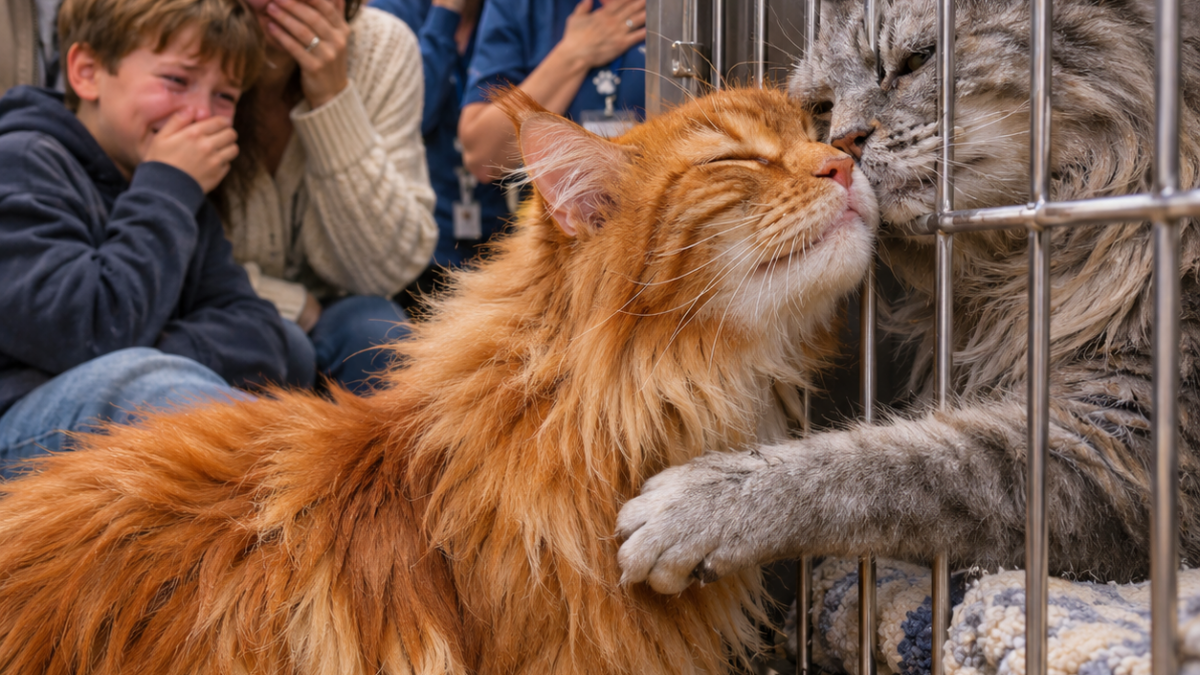
The old gray Maine Coon was sleeping.
Oliver made one soft chirp.
Winston’s head rose.
His whole expression changed.
That was the part Claire remembered later.
Not simply recognition.
Life.
Winston stood.
Slowly.
Arthritis stiff in his back legs.
Walked toward the door.
Oliver pressed his face against the bars.
Winston pressed back.
Purring began.
Oliver first.
Then Winston.
Loud enough that Claire could hear it several feet away.
Nobody spoke.
Carly opened the kennel.
Oliver walked inside.
Winston rubbed his entire body against him.
Once.
Twice.
Then Oliver began cleaning the top of Winston’s head.
Winston closed his eyes.
Claire covered her mouth.
“How long have they been like this?”
Carly swallowed.
“Almost a year.”
Claire turned.
“A year?”
“Yes.”
“You didn’t tell us.”
“We told you they were friends.”
“No.”
Claire wasn’t angry exactly.
Hurt.
“You said he had a friend.”
Carly looked down.
“We didn’t understand how dependent they were.”
Another volunteer spoke.
“Neither did we.”
Claire looked at Winston.
His coat had lost shine.
He was thinner than when they’d first visited.
“What happened to him after Oliver left?”
Nobody answered immediately.
Then Carly said:
“He stopped greeting people.”
Oliver continued grooming Winston.
“He barely plays anymore.”
“Does he eat?”
“Yes.”
Pause.
“Less.”
Claire’s eyes filled.
“And Oliver keeps coming back.”
Carly nodded.
Not because his new family wasn’t enough.
Because somebody was missing.
Daniel arrived twenty minutes later.
Emma and Noah with him.
Emma sat outside Winston’s kennel.
Oliver looked at her.
He didn’t run.
He approached.
Rubbed her hand.
Then returned to Winston.
Emma started crying.
“He likes us.”
Claire put an arm around her.
“I know.”
“Then why does he keep leaving?”
Daniel looked at the cats.
“Maybe because he likes him too.”
Noah asked:
“Does Winston have a family?”
Carly shook her head.
“No.”
“Why not?”
“He’s older.”
“So?”
“He needs medicine.”
Noah frowned.
“So?”
Adults make many complicated explanations.
Children sometimes remove them with one word.
Daniel sat beside his son.
“Winston might need more veterinary care than Oliver.”
Noah looked at the old cat.
“Does he have to stay here because he’s old?”
“No.”
“Then why don’t we take him?”
Daniel looked at Claire.
Claire looked back.
Neither answered.
That night they returned home with Oliver.
Again.
But everything felt different.
Oliver sat on the windowsill.
He didn’t try to escape.
Maybe because he’d seen Winston that evening.
Maybe because the patched windows finally held.
Maybe coincidence.
Claire watched him.
At midnight, she found him sitting near the front door.
Not crying.
Waiting.
She sat beside him.
“Is that what you’ve been doing?”
Oliver looked at her.
“You think he’s waiting too?”
No answer.
Claire scratched behind his ear.
“You couldn’t just tell us?”
Oliver purred.
“I suppose you tried.”
The next morning, Claire called the rescue.
Not to adopt.
Not yet.
Questions first.
Winston’s health.
Medication.
Costs.
Expected lifespan.
Behavior.
Whether he liked children.
Whether he and Oliver could safely live together permanently.
Dr. Patel, the rescue veterinarian, spoke with them that afternoon.
“Winston’s thyroid disease is manageable.”
“What about his kidneys?”
“Currently stable.”
“Arthritis?”
“Medication helps.”
“How long does he have?”
Dr. Patel smiled sadly.
“Nobody can promise that.”
“Years?”
“Possibly.”
“Months?”
“Also possible.”
Claire looked at Daniel.
That was the frightening part.
Adopting Winston meant possibly teaching their children to love a cat who might die relatively soon.
Daniel asked the question aloud.
“Is that unfair to them?”
Dr. Patel said:
“Loving an elderly animal always comes with that possibility.”
Pause.
“But Winston is already experiencing time.”
Daniel looked at him.
“He doesn’t become less mortal because nobody adopts him.”
That sentence followed them home.
They talked after the children went to bed.
Two cats.
Medication twice daily.
Veterinary bills.
Special food possibly later.
Oliver already had significant grooming needs.
Vacations become more difficult.
Winston might have accidents.
He might need more care.
Claire said:
“I don’t want to do this because we feel guilty.”
Daniel nodded.
“Neither do I.”
“I don’t want to adopt a cat we’re not prepared for.”
“Agreed.”
Silence.
Then Daniel said:
“But every argument we’re making is about inconvenience.”
Claire looked at him.
“Some are about money.”
“We can afford it.”
“Probably.”
“We can.”
She sighed.
“You’re sure?”
“No.”
That made her smile.
“Excellent.”
Daniel looked toward the hallway.
Oliver was asleep near Emma’s bedroom door.
“What bothers me is this.”
“What?”
“We keep saying we adopted Oliver.”
Claire waited.
“But maybe we only adopted half his life.”
Three days later, the Harris family returned to Willow Creek.
Winston was asleep.
Oliver wasn’t with them.
They wanted to make the decision without using his reaction as emotional pressure.
Emma carried a blanket.
Noah carried a toy mouse he’d selected even though Winston had shown almost no interest in toys.
Claire carried paperwork.
Daniel carried a large cat carrier.
Carly looked at it.
Then them.
“Are you sure?”
Claire nodded.
“We’re sure enough.”
Noah corrected:
“We came for Winston.”
Winston woke when the kennel opened.
Carly lifted him carefully.
He was lighter than Claire expected.
That hurt.
Winston sniffed the carrier.
Then stepped inside.
No fight.
No fear.
As though he had somewhere to go.
At the front desk, Emma asked:
“Will Oliver know?”
Carly smiled.
“I think he’ll know.”
The ride home took sixteen minutes.
Winston cried twice.
Then remained quiet.
Claire’s stomach knotted as Daniel turned into their street.
“What if Oliver attacks him here?”
“He won’t.”
“You don’t know that.”
“No.”
“What if shelter friendship doesn’t translate?”
Daniel looked at her.
“We’ll handle it.”
They brought Winston inside inside the carrier.
The children were instructed to stay back.
Oliver appeared at the top of the stairs.
He stopped.
Everything stopped.
Winston made one chirp from inside the carrier.
Oliver ran.
Claire had never seen him move that fast.
Down the stairs.
Across the hallway.
Straight to the carrier.
He sniffed frantically.
Winston pressed against the door.
Oliver began making sounds Claire had never heard.
Chirps.
Trills.
Small breathy cries.
Daniel opened the carrier.
Winston stepped out.
Oliver shoved his head against Winston’s chest.
Winston nearly lost balance.
Oliver corrected himself immediately.
Then groomed his face.
Emma started crying.
Noah laughed.
Claire cried too.
Daniel pretended he had dust in his eye.
There was no dust.
The two cats walked into the living room together.
Oliver showed Winston the house.
That was what it looked like.
Food bowls.
Water.
Sunroom.
Cat tree.
Upstairs.
Couch.
Winston followed slowly.
When he struggled with the stairs, Oliver stopped three steps above him.
Waited.
Winston continued.
Oliver waited again.
At the top, both walked into Emma’s room.
Then out.
By evening, Winston had found the sunniest patch in the living room.
Oliver lay beside him.
Not touching at first.
Then Winston moved his tail.
Across Oliver’s paw.
Oliver closed his eyes.
Nobody in the family wanted to move.
Dinner happened late because everyone kept watching the cats.
Winston’s transition wasn’t perfect.
That matters.
Stories sometimes end at the emotional reunion because reality after it is less cinematic.
Winston had trouble finding the litter box twice.
He vomited medication once.
He disliked Noah’s remote-control car with a hatred usually reserved for natural predators.
His arthritis made the stairs increasingly difficult.
Daniel built a small ramp to the couch.
Winston refused it for a week.
Then used it only when nobody appeared to be watching.
Oliver occasionally became jealous when Winston received special food.
He solved this by trying to steal it.
Winston slapped him.
Their bond survived.
The family learned the routine.
Thyroid tablet morning.
Thyroid tablet evening.
Arthritis medication.
Weekly weight checks.
Regular bloodwork.
More brushing than any normal household should reasonably perform.
Emma became excellent at giving medication hidden in soft food.
Noah became responsible for refilling water.
Daniel handled litter.
Claire handled appointments.
Oliver handled Winston.
Every morning, Winston woke first.
Oliver followed.
Every afternoon they occupied the same window.
The family placed a wide bench there so both fit comfortably.
Bird feeder outside.
Entertainment provided.
Winston watched.
Oliver watched Winston watching.
At night, they slept together.
Even though the house offered beds in nearly every room.
Several months later, Willow Creek asked permission to use Oliver and Winston’s story in a fundraiser about bonded senior animals.
Claire agreed.
During the event, Carly told the story.
Oliver’s escapes.
The seven-mile journeys.
Winston waiting.
The Harris family returning.
Someone in the audience asked:
“How did Oliver find the shelter from seven miles away?”
Nobody actually knew.
Cats possess remarkable orientation abilities.
Scent.
Landmarks.
Sound.
Memory.
Luck.
Probably several things.
But Daniel gave the answer everyone remembered.
“He knew where Winston was.”
That was enough.
The rescue changed its adoption policy afterward.
Not radically.
They couldn’t require every friendly pair to remain together.
That would strand too many animals.
But strongly bonded cats received longer observation before separation.
Volunteers documented eating changes.
Sleep behavior.
Distress when apart.
They stopped treating “friends” and “bonded” as interchangeable words.
Winston and Oliver became the reason.
A photograph hung near the adoption desk.
Two Maine Coons.
Orange and gray.
Pressed together in a window.
Caption:
SOME ADOPTIONS COME IN PAIRS.
One year after Winston’s adoption, his kidney values worsened.
Not catastrophic.
Yet.
Dr. Patel adjusted food.
Added fluids twice weekly.
Claire learned how to administer them.
The first time, her hands shook.
Winston objected.
Oliver stood beside the table, watching suspiciously.
Claire said:
“You are not helping.”
Oliver chirped.
Winston tolerated the procedure.
Afterward, Oliver groomed the spot where the needle had been.
Emma whispered:
“He takes care of him.”
Claire said:
“Yes.”
The children had matured around Winston’s care.
Not dramatically.
But in quiet ways.
Noah learned an old animal sometimes needed time to get up.
Emma stopped complaining about medication schedules.
They learned that loving something could be inconvenient.
Expensive.
Messy.
And still worth doing.
Winston slowed.
His world became smaller.
Living room.
Kitchen.
Sunroom.
Bed.
Oliver adjusted with him.
Stopped racing upstairs as often.
Spent more time on the floor.
If Winston couldn’t reach the cat tree, Oliver often slept beside him instead.
Claire noticed one evening.
Oliver had always loved the highest platform.
Now it sat empty.
Winston lay on a blanket near the heater.
Oliver beside him.
Claire touched Daniel’s arm.
“Look.”
Daniel watched.
“He came back for him.”
Claire nodded.
“And he’s still doing it.”
Winston lived almost two years in the Harris home.
Longer than anyone expected.
His final decline began in February.
Food became less interesting.
Weight dropped.
Kidney disease progressed.
There were good days.
Then fewer.
Oliver knew before the family admitted it.
He stopped leaving Winston alone.
During the final week, Oliver slept with one paw across Winston’s side.
Always.
Dr. Patel made a house call on a Sunday afternoon.
The children were given a choice.
Emma stayed.
Noah stayed too.
Winston lay on his favorite gray blanket.
Oliver beside him.
Claire asked:
“Should Oliver leave the room?”
Dr. Patel shook his head.
“If he’s calm, let him stay.”
Daniel sat on the floor.
Emma stroked Winston’s head.
Noah held his tail gently.
Claire cried before anything began.
Winston was seventeen, maybe eighteen.
Nobody knew exactly.
He had survived abandonment.
Shelter life.
Separation.
Then two years of sunlight and family and the same orange cat who had once crossed seven miles repeatedly just to see him.
Dr. Patel gave the first medication.
Winston relaxed.
Oliver lifted his head.
Sniffed him.
Then lay back down.
Claire whispered:
“Good boy.”
Winston’s eyes closed.
The final medication followed.
His breathing slowed.
Then stopped.
Oliver stayed.
For almost ten minutes, he did nothing.
Then he stood.
Sniffed Winston’s face.
Touched noses.
Waited.
Nothing.
Oliver groomed one ear.
Once.
Then sat beside him.
Emma sobbed.
Daniel put an arm around her.
Noah asked:
“Does he know?”
Dr. Patel answered carefully.
“He knows something changed.”
Oliver remained until the family was ready.
That night, he searched the house.
Window.
Hallway.
Kitchen.
Sunroom.
He stood by the front door.
Claire sat beside him.
She remembered their first nights.
Oliver waiting there.
Then escaping.
Running back.
Searching for Winston.
She whispered:
“He’s not there anymore.”
Oliver looked at her.
“I know.”
He walked into the living room.
Jumped onto the couch.
For the first time since arriving in the Harris home, Oliver slept alone.
The next few weeks were difficult.
He ate less.
Not dangerously.
Enough to worry them.
He stopped watching birds.
He slept on Winston’s blanket.
Claire spoke with Dr. Patel.
Grief, likely.
Routine.
Patience.
Attention.
No forcing.
Emma started reading beside Oliver every evening.
Noah sat on the floor and did homework.
Daniel opened the window slightly so fresh air came through.
Claire brushed him.
Slowly, Oliver returned.
Not to the cat he had been before.
That wasn’t the goal.
He began sitting in the sun again.
Started eating normally.
One afternoon, three months after Winston died, Oliver climbed onto the high platform of the cat tree.
The one he’d abandoned when Winston could no longer climb.
Claire saw him.
She cried.
Not because he’d forgotten Winston.
Because he hadn’t.
And still, he had climbed.
There is a difference between moving forward and leaving someone behind.
Oliver seemed to understand it better than most people.
Years later, he still slept occasionally on Winston’s blanket.
The family never washed it after the final week.
Probably sentimental.
Probably unhygienic by some standards.
Nobody cared.
A small photograph sat beside the window.
Winston and Oliver together.
Tails touching.
Oliver grew older.
His muzzle lightened.
He stopped attempting impossible escapes.
Not once after Winston came home did he try to leave the house.
That became the part Daniel found most convincing.
Before Winston:
Escape.
Return to shelter.
Escape.
Return.
Again.
Again.
Again.
After Winston crossed the threshold:
Nothing.
Oliver hadn’t been searching for a building.
He hadn’t missed the shelter.
He hadn’t rejected his family.
He had simply refused to accept that home could be complete while Winston remained behind.
The Harris family had believed they were adopting one cat.
What they eventually understood was that they were entering a relationship already in progress.
Oliver came with history.
With loyalty.
With another living creature written into his definition of safety.
People sometimes talk about adoption as rescue.
The human saves the animal.
Sometimes that’s true.
But Oliver made the arrangement more complicated.
The Harris family gave Oliver a home.
Oliver made them go back and widen it.
He led them toward a cat who was older, less adoptable, more expensive, and easier to overlook.
A cat who might otherwise have spent his final years waiting near a shelter door.
Winston received two years of family because Oliver refused to move on without him.
And the Harris family received something too.
Their children learned that love isn’t always about choosing what is easiest to bring home.
Sometimes love is noticing who your happiness left behind.
Sometimes it is returning.
Sometimes it is saying:
There is room for one more.
A few months after Winston died, Willow Creek invited Oliver back for a quiet visit.
Not overnight.
Just an afternoon.
Claire hesitated.
Then agreed.
Oliver entered the rescue center.
Volunteers gathered.
Some of the same people who remembered him sitting outside the entrance years earlier.
Carly crouched.
“Hey, runaway.”
Oliver rubbed her hand.
Then walked down the hallway.
Everyone followed.
He stopped outside the old kennel.
Winston’s kennel.
It was occupied now by a young black cat asleep in a hammock.
Oliver looked through the door.
Waited.
Then turned away.
No cry.
No scratching.
No attempt to enter.
He walked back toward Claire.
She knelt.
Oliver pressed his forehead into her chest.
Carly wiped her eyes.
“He knows.”
Claire didn’t answer.
Maybe he did.
Maybe he simply knew Winston wasn’t there.
Either way, when the front doors opened, Oliver did not turn back toward the hallway.
He walked outside beside his family.
He got into the car.
Went home.
That evening, he slept in the living room.
Winston’s blanket beneath one paw.
Emma found him there before bed.
She sat beside him.
“You found him.”
Oliver opened one eye.
Emma stroked his orange fur.
“And then we found him too.”
He purred.
For years, people at Willow Creek told the story of the Maine Coon who kept escaping his adopted home.
They told it because it was unusual.
Funny at first.
Then heartbreaking.
Then beautiful.
But Carly always corrected one part.
“Oliver didn’t keep running away.”
She would say.
“He kept going back.”
There was a difference.
Running away meant rejecting the place he’d been given.
Going back meant remembering someone who hadn’t been given one yet.
Oliver was happy in the Harris home.
That was true.
He liked Emma’s bed.
Noah’s cardboard forts.
The sunny window.
Claire’s brushing.
Daniel pretending he didn’t allow cats on his office chair.
He had found safety.
But apparently safety wasn’t enough while Winston remained behind.
So Oliver crossed those miles.
Again.
Again.
Again.
Until the humans finally understood what he had been trying to tell them.
Home wasn’t a house.
Not completely.
It wasn’t a sunny window.
A full bowl.
A soft blanket.
Or even a loving family.
For Oliver, home was also one elderly gray cat waiting behind a kennel door.
And once Winston was there beside him—
on the same couch,
in the same sunlight,
sleeping with one tail touching the other—
Oliver never tried to leave again.
Because some bonds don’t weaken when circumstances change.
Some friendships survive abandonment, shelter walls, age, illness, and distance.
And sometimes an animal who cannot explain any of that simply does the only thing he knows how to do.
He goes back for the one he loves.
Again and again—
until someone finally follows him.








