A Navy SEAL Stopped at a Small-Town Café for Coffee—Then a Familiar Voice Behind the Counter Brought Back the Woman and the Questions He Had Carried for 14 Years
PART3:
She had always known how to help without making a person feel watched.
At nineteen, she could hand a hungry man day-old bread and somehow make it seem like he was doing her a favor by taking it before she had to throw it out. She could correct Alec’s terrible attempt at fixing a cabinet hinge without making him feel stupid, though Diane Hartley, her mother, had no such restraint and once told him he owed the cabinet a written apology.
Diane.
The name moved through him with unexpected force.
Hartley Bread and Pie.
Late nights behind the bakery after closing. Rachel smelling like cinnamon, flour, coffee, and soap. Alec wearing the same mechanic’s jacket because it was the only one he owned that didn’t have tire grease ground permanently into the cuffs. Cheap coffee that tasted burned. Shared cinnamon rolls. Rain on the alley pavement. Rachel folding an old order slip into a paper boat and giving it to him after he said he wanted to go farther than Eastern Oregon someday.
“There,” she had said. “Transportation.”
He had kept it.
God help him, he had kept it through fourteen years, several wallets, three deployments, two storage units, and more countries than he cared to count.
A chair scraped near the rear hallway.
A boy came into the café carrying a school backpack that looked too big for him. He was around eleven, thin and dark-haired, with rain-darkened sneakers and the restless energy of someone who had been promised food after school and intended to collect.
He dropped his backpack on a chair near the back table as if it had a permanent claim there, then went straight to Rachel.
He wrapped both arms around her from behind while she was arranging cups.
“You promised me one.”
Rachel stumbled half a step and caught herself against the counter.
“I promised nothing.”
“The apple turnover.”
“I said I’d think about saving one.”
“That means yes.”
“It means I thought about it and decided homework first.”
The boy looked offended. “That was not part of the agreement.”
“There was no agreement.”
Alec almost smiled.
Then the boy looked up at Rachel.
The smile never arrived.
Something in the child’s face hit Alec in the center of the chest.
The eyes were not identical.
But close enough.
Same dark shape. Same slight lift at the outer corners. Same seriousness beneath the humor.
Alec went still.
Her son.
The conclusion came too easily.
He looked at Rachel’s left hand when she reached for a plate. No ring. That meant nothing. People removed rings for work. People divorced. People had children without marriage, built families, lost families, rebuilt them again in ways strangers could not understand from across a room.
Still, the thought settled like a stone.
Rachel had moved on.
Of course she had.
Fourteen years was a lifetime when you were nineteen and twenty-one. It was college, jobs, marriages, funerals, children, moves, illnesses, bills, all the ordinary forces that dragged people forward whether they wanted to go or not.
Alec had changed.
Why had some foolish, hidden part of him expected Rachel to remain untouched by time simply because he had never stopped remembering her?
He drank the rest of his coffee too quickly.
Hot bitterness burned his tongue.
Good.
He deserved that.
There was no reason to speak to her. No reason to walk into her afternoon carrying unfinished history when her life was clearly full. He could leave quietly. Drive to the lake. Tell himself coincidence did not require action.
Mako shifted again.
Alec looked down.
“Don’t start.”
The dog blinked.
Across the room, Rachel picked up a stainless steel coffee pot.
She checked two tables near the counter.
Then turned toward his side of the room.
Alec set his cup down.
Rachel came closer.
Twenty feet away, he had been able to observe her as if this were information gathering. At ten feet, every detail became personal. At three feet, there was no cover.
She reached his table, tilted the coffee pot toward his cup, and stopped.
Her eyes went first to his hand resting beside the saucer.
Then to his face.
Alec watched recognition move through her like a light turning on in a closed room.
She looked at the thin scar above his right eyebrow, then at the line of his jaw, as if checking one remembered detail against another before trusting the answer.
“Alec?”
For fourteen years, he had imagined that if he ever saw Rachel Hartley again, he would have something useful to say.
What came out was smaller.
“Hey, Rae.”
The coffee pot lowered.
She did not smile right away. She just stared at him while the café continued around them, unaware that an entire buried life had surfaced between table three and the bookshelf.
“You’re really here,” she said.
Alec glanced around as if confirming. “Looks that way.”
That brought a small smile.
It was older than the one he remembered and exactly the same where it mattered.
Rachel looked down. “And you brought company.”
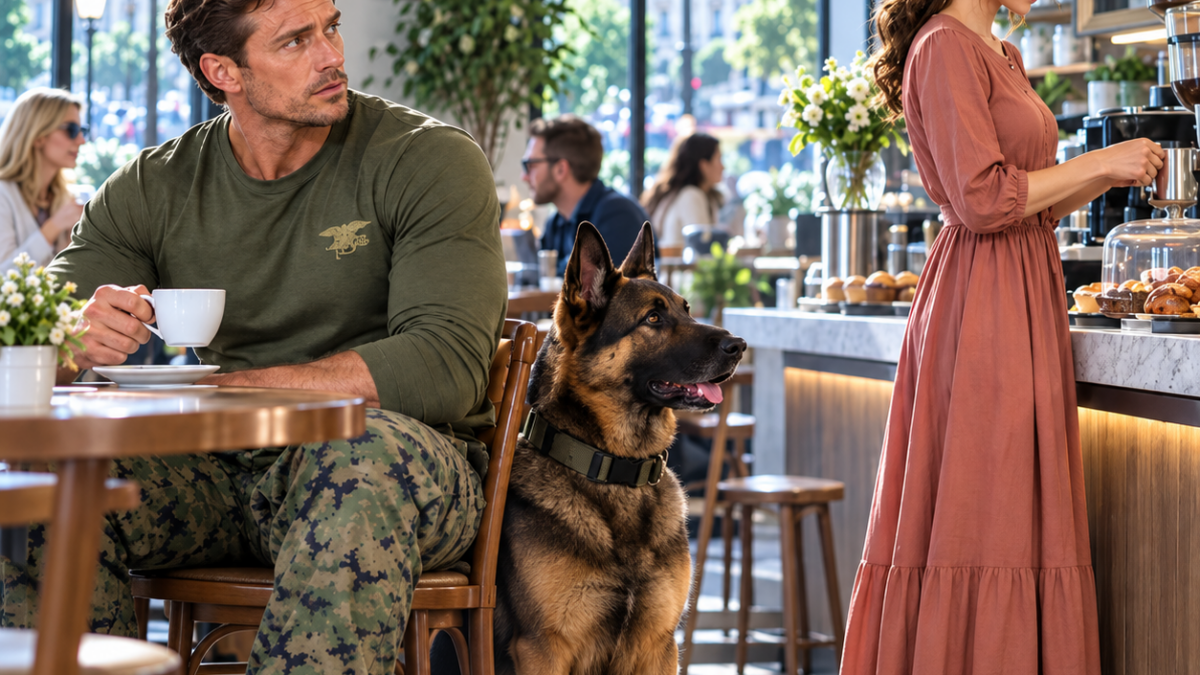
“Mako.”
The German Shepherd lifted his head at the sound of his name but remained down.
Rachel did not reach for him.
“Working?”
“More or less.”
She nodded, accepting the boundary without making a performance of respecting it. Rachel had always been good at that too.
Behind the counter, the copper-haired barista called, “Rachel?”
Rachel looked back, then at Alec.
“I have to…”
“Yeah.”
She took two steps away, then stopped.
“Don’t leave.”
The words seemed to surprise her as much as him.
Alec looked at her.
Rachel adjusted the coffee pot in her hand. “I mean, I get a break in ten minutes.”
Alec could have made a joke.
He didn’t.
“I’ll be here.”
Rachel returned to the counter.
Alec looked down at the coffee she had refilled, though he had no memory of her pouring it.
Mako rested his chin back on his paws.
“You’re not helping,” Alec murmured.
The dog closed his eyes.
Rachel’s ten minutes became sixteen.
Alec noticed everything while pretending not to.
She finished a line of orders. Wiped the counter. Carried soup to an elderly couple by the window. Answered a question from the boy with the backpack without pausing long enough for him to win the argument. Then she untied her apron and brought her own mug to Alec’s table.
For a second, she stood there as though sitting would make the reunion more real.
Then she pulled out the chair opposite him.
“I don’t know where to start,” she said.
“Neither do I.”
That seemed to reassure her more than any polished answer.
She wrapped both hands around her mug.
“You’re still in the Navy?”
He nodded.
“Still in.”
She studied him. Jeans. Dark green shirt. Weathered jacket. Nothing that announced what he did unless someone knew what to look for.
“I wondered.”
Alec did not ask when.
“What about you?”
Rachel looked toward the counter. “This is me right now.”
He waited.
She recognized the silence as an invitation, not a demand. She had always known that about him.
“I’ve been in Joseph a while.”
“How long?”
“Long enough to complain about tourists like I was born here.”
“That an official town ordinance?”
“Practically.”
He smiled.
She took a sip of coffee, watching him over the rim.
“You look different.”
“So do you.”
“Good different?”
“I’m still working on the report.”
That earned him the old look—the one that said he had one more bad joke before consequences.
For one strange moment, Alec was twenty-one again, standing behind Hartley Bread and Pie with a wrench in his hand while Rachel explained that no reasonable person needed three attempts to tighten the same hinge.
The memory hit hard enough that he looked away.
Rachel saw it.
“What?”
“Nothing.”
“That used to mean something.”
“Still does.”
She studied him another second, then let it go.
The conversation found a rhythm. Not easy exactly. Easy would have been disrespectful to fourteen years of silence. But possible.
She asked what brought him to Joseph.
He told her about leave, the long drive, the teammate who once recommended Wallowa County in early fall, the idea of a few quiet days where nobody asked where he needed to be next. He left out the exhaustion that had been following him for months. The way his life had begun to feel like a collection of departure dates. The way stillness had become both something he wanted and something he did not know how to trust.
Rachel looked out at the rain.
“You picked a very Oregon way to find quiet.”
“This wasn’t in the brochure.”
“Wait twenty minutes.”
“For better weather?”
“For different weather.”
He laughed softly.
Rachel’s eyes stayed on him a beat too long.
Then she looked down at Mako.
“How old?”
“Five.”
“And he’s always this serious?”
“No. He’s pretending because you’re new.”
“Good. I’d hate to damage his reputation.”
The boy from the back room appeared beside the table.
He approached quietly enough that Alec noticed him only because Mako lifted his head.
The boy stopped several feet away.
His eyes went straight to the dog.
Rachel turned.
“What happened to homework?”
“I finished math.”
“You had reading.”
“I’m between subjects.”
“That’s not a thing.”
“It should be.”
The boy shifted but did not move closer to Mako.
“Aunt Ra, can I ask him?”
One word rearranged the room.
Aunt.
Alec looked at Rachel.
Rachel glanced at him, and something quiet passed between them.
Not amusement. Not accusation.
Awareness.
She nodded toward Alec.
“You can ask.”
The boy looked at him.
“Can I pet your dog?”
Alec did not answer immediately.
“What’s your name?”
“Eli.”
“Eli what?”
“Bennett.”
Alec looked at Rachel again.
“My sister Megan’s boy,” she said softly. “He’s been with me four years.”
Alec felt something release inside him so quietly it embarrassed him.
He turned back to Eli.
“You ever been around a working dog?”
“My friend’s uncle has a Labrador.”
“That’s not an answer to the question I asked.”
Eli considered that.
“No.”
“Okay. First rule is you ask the handler, which you did. Second, you don’t go over his head. Hold your hand low and let him decide whether he wants to check you out.”
Eli crouched slightly, staying where Alec indicated.
Mako looked at Alec.
Alec gave a small release cue.
The shepherd rose, took two measured steps forward, and sniffed Eli’s hand. Eli held remarkably still. Mako smelled his sleeve next, then his shoes, apparently finding the school cafeteria more interesting than the boy.
Eli whispered, “Does he understand English?”
“Depends what you ask.”
“What does he know?”
“Sit, usually. Stay, definitely.”
“Homework?”
“I’ve never met a German Shepherd with that kind of training.”
Rachel laughed.
Alec did too.
It came easier this time.
Mako accepted a brief touch to his shoulder, then stepped back toward Alec.
“That means we’re done,” Alec said.
Eli withdrew his hand immediately.
“Did I do something wrong?”
“No. He just decided he had enough.”
Eli looked impressed rather than disappointed.
“So he can say no in his way.”
Rachel’s expression softened.
“That’s probably a useful rule for people too.”
Eli looked between them. “Was that about me?”
“Yes,” Rachel said.
“Probably,” Alec said at the same time.
Eli narrowed his eyes. “Adults are weird.”
“Go finish reading,” Rachel said.
“I’m checking math.”
“You said you finished math.”
“I might have lied for dog reasons.”
Rachel pointed toward the back.
Eli left with the dignity of a boy unjustly persecuted.
When he was gone, the space between Rachel and Alec changed again.
Alec did not ask what happened to Megan.
Rachel did not explain.
Not yet.
But the word had been said.
Had been with me.
Alec filed it carefully, not as a secret to pry open, but as fragile ground not to step on without permission.
Rachel’s break had ended.
The copper-haired barista called her again.
Rachel stood.
“I really do have to go.”
Alec rose halfway out of habit before catching himself.
Rachel noticed.
“You still do that.”
“What?”
“Stand when a woman leaves the table.”
“My mother had rules.”
“She had a lot of them.”
“She was thorough.”
Rachel retied her apron. “Are you staying around town?”
“For a little while.”
“How long?”
He checked his phone though he already knew.
“Ten days total. Nine now.”
Rachel nodded.
Nine days was only a number.
It did not feel like one.
Nine days became eight, then seven, without Alec ever deciding that Juniper and Pine had become part of his routine.
He simply found himself there most mornings.
Sometimes he walked Mako first along the quiet streets near the edge of town, where dry grass bent in the wind and the mountains stood close enough to make a man feel measured by something older than his own decisions. Sometimes he drove out toward Wallowa Lake and let the dog work off energy along the shore before coming back after the breakfast rush.
Rachel rarely had more than a few minutes at a time.
That helped.
No long talks about fate. No dramatic unpacking of the past beside the espresso machine. No attempt to pretend fourteen years could be cleaned up because two people still knew how to make each other laugh.
But the pieces came.
One morning, Rachel noticed a scrape across Alec’s knuckles and asked whether the Navy still paid him to damage his hands.
“Never specifically,” he said. “But I’ve developed considerable experience.”
“You used to come into the bakery with cuts all over your hands and pretend you didn’t notice.”
“I noticed.”
“You put electrical tape on one once.”
“It held.”
“That wasn’t medical care.”
“It stopped the bleeding.”
Rachel stared at him.
Alec took another drink. “Very judgmental café.”
Her smile stayed after she turned away.
The memory followed him long after the conversation ended.
At twenty-one, Alec had worked full-time at Larkin Tire and Service on the edge of La Grande. The shop smelled permanently of rubber, brake dust, stale coffee, and whatever had spilled near the alignment rack ten years before. He did tires, oil changes, brakes, small repairs—anything that made him useful enough to pick up extra hours.
His apartment was above a laundromat. The pipes knocked when anyone downstairs started a washing machine. He owned one decent jacket, an unreliable pickup, two pairs of running shoes, and a notebook where he tracked swim times and distances because paper was cheaper than equipment.
The Navy had begun as an idea he kept mostly to himself.
Not because he was ashamed.
Because he disliked announcing plans before they became real.
A recruiter had told him there was a path worth trying if he could meet the standards. Alec had no illusions about how hard that path would be. He trained anyway. Ran after closing. Swam when he could find pool time. Worked until his hands cracked. Saved gas money. Counted progress in seconds, miles, repetitions, discipline.
Rachel knew he was considering the Navy.
She did not know how far the process had gone.
At nineteen, Rachel was trying to build something of her own. She took classes toward becoming a physical therapist assistant and worked the rest of the time at Hartley Bread and Pie with Diane. Rachel liked physical therapy because progress could be measured in ordinary miracles—a hand gripping a fork again, a patient standing without help, a man buttoning his own shirt after a stroke.
Diane approved for a different reason.
“People will always need help walking,” she had once said while shaping bread dough before sunrise. “Bread may be less reliable.”
Rachel accused her of insulting the family business.
Diane told her to finish weighing the flour.
Alec remembered those mornings.
The way Diane ruled the bakery kitchen like a benevolent dictator. The way Rachel looked half-asleep and beautiful with flour on her sleeve. The way poverty had been inconvenient but not yet humiliating because they were young enough to believe hard work always led somewhere fair.
They shared cheap food, borrowed tools, delayed purchases, and laughed at appliances that required negotiation before working.
They had been poor.
They had been happy anyway.
Then Diane got sick.
Rachel mentioned it several days into Alec’s stay while refilling his coffee.
They had been talking about whether Diane had ever once followed measurements in her own recipes.
Rachel said, almost casually, “She got sick right around then.”
Alec looked up.
Rachel kept her attention on the coffee pot.
“She’d been tired for a while. We thought she was working too much.”
A customer asked for cream.
Rachel left to get it.
The conversation ended there.
Alec did not bring it back.
The next piece came two days later.
Rachel finished an afternoon shift early, and the weather turned clear enough that she agreed to walk part of the lake shore with Alec and Mako before picking Eli up from his after-school program.
Cottonwoods near the road had begun turning yellow. Wind off the water carried enough cold to make Rachel pull her sleeves down over her hands. Mako moved ahead on leash, interested in wet grass and the tracks left by birds near the shoreline.
They walked without speaking for several minutes.
Then Rachel said, “Mom went to Portland.”
Alec knew immediately.
“The night before I left.”
Rachel kept walking.
“She got worse fast. Megan came over. We drove her down because they wanted tests done there.”
Alec remembered that night differently.
He had gone to Hartley Bread and Pie after his shift at Larkin because he finally had the date he had been waiting for. The Navy was no longer an idea. He had to report. Everything was suddenly real, and the first person he wanted to tell was Rachel.
The bakery had been dark.
Rachel’s apartment had been empty.
He had called once.
Then again.
Then from the bus station.
His own departure date did not move because Rachel’s life had exploded somewhere he could not see.
“I didn’t know,” he said.
Rachel nodded.
“I know that now.”
No accusation.
That made it harder.
“I tried your apartment.”
“We weren’t there.”
“I tried the bakery.”
“I know.”
That surprised him.
Rachel tucked loose hair behind one ear. “Mrs. Keller next door told me later.”
Alec remembered Mrs. Keller. She had owned a terrier that hated his truck.
“You never got my messages?”
“Some. Not enough. My phone spent days dying in waiting rooms and Megan’s car. I heard things late. Half messages. Numbers without context.”
She looked across the water.
“By the time I got back to La Grande for clothes and paperwork, you were gone.”
Alec said nothing.
“Someone at Larkin told me you left for the Navy.”
She gave a small laugh without humor.
“I was nineteen. Exhausted. Terrified Mom was dying. Standing in a parking lot with a medical folder under my arm. There weren’t many ways to interpret that.”
He looked at the lake.
His own version came back with equal clarity.
Rachel did not answer.
Then she still did not answer.
At first, he assumed Portland. Hospital. Diane. Crisis.
Later, after enough time had passed, another explanation filled the silence: Rachel had realized what his life would become and wanted no part of it.
The letter he sent to her apartment came back.
The one he sent later to Hartley Bread and Pie produced nothing.
By then he had entered a world where every day was measured by the next required thing, and weeks stopped behaving like weeks.
He told himself Rachel needed someone who could stay.
It had sounded generous at twenty-one.
Standing beside her now, he could hear the arrogance hidden inside it.
He had decided what was best for her without ever asking.
“Did you ever come back?” Rachel asked.
The question was so quiet he almost thought she had changed her mind before finishing it.
He looked at her.
“Yes.”
Her face changed.
“The bakery was locked. Your apartment had somebody else’s name on the mailbox.”
Rachel looked down.
“Mom was gone by then.”
Alec did not speak.
“I moved closer to Megan after the funeral. New number. New place. Pretty much new everything.”
Mako stopped to investigate a clump of grass, pulling lightly on the leash.
Alec let him.
For years, Alec had imagined arriving too late because Rachel had chosen another life.
Rachel had imagined him never returning because he had chosen one too.
Neither version had ever been complete.
A few days later, another piece fell into place almost by accident.
Rachel had closed Juniper and Pine and was wiping the last table while Alec waited for a takeout coffee. Eli was in the back gathering his books.
Rachel said, “I looked you up once.”
Alec turned.
“When?”
“A few years ago.”
She folded the cloth over once.
“I found a picture. You were at some memorial event. There was a woman next to you. Blonde. A little girl.”
Alec searched his memory.
Then he knew.
“Laura and Sophie.”
Rachel looked up.
The fact that he knew the photograph immediately seemed to make her uncomfortable.
“Ben’s wife and daughter,” Alec said.
Rachel stopped wiping.
“Ben was one of my teammates. He was killed. A few of us showed up for a charity event afterward.”
Rachel looked down at the table.
“I thought…”
“I know.”
Her eyes lifted.
“You do?”
“Apparently I’ve been doing the same thing.”
She frowned.
Alec glanced toward the back room, where Eli had first appeared days earlier.
Understanding reached her.
Rachel stared at him for a second.
Then she covered her mouth.
“You thought Eli was my son?”
“I had limited information.”
She started laughing.
It came suddenly enough that she leaned against the table.
“That is the most Navy answer you could possibly give.”
“I’m not sure what you want from me.”
“You sat there thinking I had an eleven-year-old child?”
“The math worked.”
“It did not.”
“It was close enough that I wasn’t asking questions in public.”
Rachel laughed harder.
Eli came out with his backpack and looked between them.
“What happened?”
“Nothing,” Alec said.
“Fourteen years of bad assumptions,” Rachel said.
Eli considered that, decided adults were exhausting, and went to find his jacket.
There was no grand relief.
No sudden repair.
Diane was still gone.
Megan was still gone.
Fourteen years had still passed.
But something shifted.
For the first time, Alec could see how much of the past had been built from silence and then treated as fact.
Rachel looked at him.
Neither of them needed to say it.
They had been remarkably good at believing things they had never asked.
The next morning, Alec learned about Hartley Bread and Pie from Eli.
Rachel had traded shifts and was packing a folder, two bottles of water, and lunch into a canvas tote when Alec came in for coffee. She mentioned only that she needed to drive toward La Grande to collect paperwork from an old property.
Eli, sitting at his usual table with a spelling worksheet in front of him, supplied the rest.
“We’re going to Grandma Diane’s bakery.”
Rachel stopped putting the lid on her coffee.
Eli looked up.
“What?”
Alec did not immediately respond.
The name reached him before Rachel could decide whether she wanted it to.
“Hartley Bread and Pie?”
Eli nodded.
Rachel gave her nephew a look of resignation.
“You are very bad at classified information.”
“I didn’t know it was classified.”
“It wasn’t.”
“Then I’m good.”
Alec looked at Rachel.
“I need old tax records and lease papers,” she said.
That was all she offered.
He could have left it there.
Perhaps because he had spent the previous evening thinking about locked doors, returned letters, and empty mailboxes, he didn’t.
“Is the place still standing?”
Rachel gave a faint smile.
“Mostly.”
Eli glanced toward Mako, who lay beside Alec’s chair.
“Can they come?”
Rachel’s eyes moved from Eli to Alec.
“You don’t have to.”
“I know.”
That answer seemed to make the decision harder, not easier.
“We’ll be there a couple hours.”
“Mako’s terrible with tax records,” Alec said, “but I can probably manage.”
An hour later, they were heading west.
The road out of Joseph rolled through open country before following the valley toward La Grande. The morning was cool and bright, patches of cloud moving over the mountains and changing the fields by the minute. Eli sat in the back seat under strict instructions not to distract Mako, which he interpreted as permission to ask Alec questions steadily as long as none were directed at the dog.
Rachel lasted twenty minutes before turning the radio up slightly.
Alec noticed.
He did not tell Eli to stop.
By the time they reached La Grande, Eli had learned that Alec disliked olives, had once slept through a hotel fire alarm because the alarm was defective and not because Navy SEALs possessed special sleeping abilities, and would not answer whether Mako had ever caught a bad guy.
“Why not?” Eli asked.
“Because that’s not a useful way to think about what he does.”
“So he does more boring stuff.”
“A lot of good work looks boring.”
Rachel glanced at Alec from the passenger seat.
Hartley Bread and Pie stood on a side street a few blocks from the center of town.
Alec recognized the building before the sign.
The lettering had faded. One corner of the awning sagged. Brown paper covered part of the front window from inside. The neighboring storefront had become an insurance office. Across the street, the laundromat where Alec once lived above rattling pipes had disappeared entirely.
The bakery had not.
Rachel did not move when Alec parked.
Eli unbuckled.
“Aunt Ra.”
“I know.”
She opened the door.
Alec stayed where he was long enough to give her space.
Rachel unlocked the front entrance on the second try. The bell above the door gave a dry, uneven sound.
For Alec, the smell was the first surprise.
Not bread.
Dust. Old wood. Stale air. A building closed too long.
Rachel stepped inside and remained near the door.
Eli passed her, familiar enough with the place to head toward the old tables. Mako entered beside Alec, paused to take in the room, then waited.
The counter was still there.
So was the long glass display case, empty except for a faded paper sign someone had forgotten to remove. Behind it sat the old mixer, larger than Alec remembered and painted dull cream. A row of wooden shelves covered one wall. One leaned slightly downward on the right.
Alec stopped.
Rachel noticed.
“No.”
He pointed. “That’s the one.”
“I know.”
“It was already crooked.”
“It was not.”
“The wall was uneven.”
“My mother measured the wall after you said that.”
Alec considered the shelf.
“She was thorough.”
Rachel’s mouth twitched.
It was the first time he had seen her smile since she unlocked the door.
He walked behind the counter. Below the register shelf was a shallow scratch in the wood. Alec ran his thumb over it.
Rachel followed his gaze.
“You blamed the screwdriver.”
“It had poor balance.”
“You dropped it.”
“That’s an interpretation.”
“You were standing three feet away.”
Eli looked between them.
“You broke Grandma’s bakery?”
“One very small part,” Rachel said. “He was banned from tools for two days.”
“I came back the next morning.”
“Mom ignored you.”
“She gave me a biscuit.”
“That was to keep you out of the kitchen.”
Alec smiled.
Rachel did too.
For a few seconds, Hartley Bread and Pie was not a closed building.
Then Rachel looked toward the kitchen.
The smile left.
Alec saw it happen and said nothing.
Eli found a stack of folded tablecloths beneath one table.
“Can I take these off?”
Rachel seemed grateful for the practical question.
“Carefully.”
The first cloth released a visible cloud of dust.
Mako sneezed.
Eli froze.
The dog sneezed again, shook his head, and looked toward Alec with what Eli apparently interpreted as personal offense.
The boy started laughing.
“Sorry, Mako.”
“He’s filing a complaint,” Alec said.
“With who?”
“Management.”
Eli looked at Rachel. “She’s management today.”
“She is.”
That small exchange changed the room more effectively than any conversation about grief could have.
Rachel set her folder on the counter and began opening drawers.
The paperwork she needed was in an old metal filing cabinet near the office, buried under appliance receipts, supplier invoices, lease agreements, and handwritten notes Diane had kept long after most businesses would have thrown them away.
Alec did not help with the records.
He found the cabinet hinge instead.
The lower door beneath the prep counter had sagged enough to scrape the floor every time it opened.
He tested it once, looked around for tools, then remembered the compact kit in his truck.
Rachel saw him heading for the door.
“Where are you going?”
“Truck. For that hinge.”
“Alec.”
“It’s annoying.”
“It’s been like that for months.”
“Exactly.”
He left before she could argue.
When he came back, Rachel was wiping dust from the counter with an old towel. Neither acknowledged that she had started cleaning.
The hinge took less than ten minutes.
The stripped screw hole needed a larger screw and a washer. Eli held both with solemn intensity after Alec warned him that losing hardware counted as sabotage.
Once the cabinet closed properly, Alec opened it again just to confirm.
Rachel caught him.
“Feel better?”
“Yes.”
“That’s concerning.”
“Your faucet leaks.”
She looked toward the sink.
“How do you know?”
“It always dripped.”
“That sentence is why things stay broken.”
This time she laughed without trying not to.
Tasks appeared wherever the last one ended.
Rachel found the lease papers, but instead of leaving, she opened the blinds. Then one window. Cool air moved through the room, carrying away some of the stale smell. Eli removed tablecloths. Alec tightened chair backs and fixed a rocking table properly instead of letting Rachel shove sugar packets beneath the leg.
“Mom used sugar packets,” Rachel said.
“She was wrong.”
“You would have told her that?”
“No.”
“Good answer.”
The kitchen remained untouched for most of the afternoon.
Rachel moved around it rather than through it.
Alec noticed.
He noticed the stainless prep tables, the cooling racks, the commercial oven, the shelves of metal pans still stacked by size. An old radio sat on a narrow shelf near the back wall.
Rachel eventually crossed the threshold only because Eli asked where the trash bags were.
She stopped near the pantry cabinet.
For several seconds, she seemed to forget what she had gone in to find.
Then she opened the correct drawer.
The trash bags were exactly where they had always been.
That seemed to hurt worse than if someone had moved them.
Alec looked away.
Later, he would learn why.
Years earlier, after Diane died, Rachel had tried once to return to the bakery as if routine might solve what grief had broken.
She came before sunrise because that was when Diane always started. She turned on the lights, tied an apron around her waist, and heated the oven. Then she measured flour, yeast, butter, cinnamon. The kitchen warmed. The old radio remained silent because she could not make herself turn it on.
When the butter hit the warm pan and the first familiar smell filled the room, Rachel reached automatically for the second mixing bowl.
Diane always kept it to her left.
Her hand found empty counter.
Rachel turned off the oven.
She left the dough unfinished.
She never tried again.
For more than a decade, the bakery had been leased to Martha Keane, who had worked beside Diane for years and never asked Rachel to explain why she could not keep it herself. Martha kept Hartley Bread and Pie alive until age and a bad hip made the early mornings impossible. Then the bakery closed.
Rachel kept paying what the building required and told herself she would decide later.
Months passed.
Dust began deciding for her.
By late afternoon, sunlight reached the old display case.
Rachel looked around.
“What time is it?”
Alec checked.
“Almost four.”
“No.”
He showed her his phone.
They had been inside more than two hours.
Her folder sat on the counter exactly where she had left it.
Eli was labeling a box of old menus with categories that seemed based more on whether he liked the logos than whether the menus were usable. Mako slept near the door. The cabinet no longer dragged. Three tables were uncovered. One window stood open.
Rachel rubbed dust from her wrist.
“We were supposed to get papers.”
“We got papers.”
“We also cleaned half the front room.”
“Quarter.”
She looked at him.
“Don’t make it worse.”
The next morning, Alec returned to Juniper and Pine shortly after eight.
Rachel was behind the counter.
His coffee was already waiting.
He set a hand around the cup.
Rachel wiped the espresso wand, put the cloth down, and looked at him.
“Do you think that old commercial oven can be repaired?”
Alec did not answer immediately.
Not because he didn’t know.
Because it was the first question she had asked about the bakery that belonged to the future.
“The oven?”
“The big one.”
“I know which oven.”
“Can it be repaired?”
“I can tell you whether it turns on. After that, we find someone who actually knows commercial ovens.”
She seemed almost disappointed.
“I thought Navy SEALs knew everything.”
“Mostly people assume we do.”
“That must be convenient.”
“It saves time until something catches fire.”
Rachel smiled and handed him a paper bag with a breakfast sandwich inside.
“Then we’re calling a professional.”
That became the rule for the bakery.
Alec could tighten hinges, replace worn hardware, recognize mechanical problems, fix simple plumbing, and make lists so detailed Rachel accused him of retiring furniture with full honors.
He did not pretend to be an electrician, roofer, refrigeration technician, or commercial appliance repairman.
Rachel appreciated the distinction.
Within days, Hartley Bread and Pie looked less abandoned.
The electrician inspected the panel and found updates needed before the kitchen could safely operate. A roofing contractor discovered failed flashing around a rear vent. The old refrigerator needed replacement. The commercial oven was not dead, but the control system and door seal needed work.
Alec wrote everything down.
Rachel crossed out half his categories.
“You do not need three columns for chairs.”
“They’re different conditions.”
“They’re chairs.”
“One is stable. Four need work. Two need to leave the building.”
Rachel looked at the sheet.
“You labeled them operational, repairable, and retired.”
“That seemed clear.”
“You retired furniture.”
“It served honorably.”
Eli, sitting at the end of the counter with a pencil, raised his hand.
“Can I have the retired ones?”
“No,” Rachel said.
“Depends what you’re planning,” Alec said.
Rachel looked at him.
“Do not encourage procurement.”
Alec glanced at her.
“That sounded suspiciously like a briefing.”
She tried not to smile and failed.
Rachel changed slowly.
The first afternoon, she had followed whatever task appeared in front of her. Now she arrived carrying a notebook. She remembered the regional flour supplier Diane once used near Pendleton. She found an old number, learned the business had changed ownership but still delivered, and asked about minimum orders before Alec could suggest anything.
She began pricing butter, yeast, fruit, packaging.
She built a menu small enough to manage without pretending to resurrect Diane’s entire operation overnight.
Alec saw six items written down.
“What happened to the old menu?”
Rachel glanced toward the faded board above the display case.
“Too big.”
“Your mother had twenty-three things on there.”
“My mother started work at three-thirty in the morning and considered sleep a moral weakness.”
“Fair.”
Rachel tapped the page.
“Country bread. Buttermilk biscuits. One breakfast pastry. Soup at lunch. One sandwich. Maybe pie on weekends.”
She paused.
“No cinnamon apple braid.”
Alec heard what she did not say.
He nodded and left it alone.
Eli fell in love with the bakery project because it offered tools, dust, food, Mako, and endless opportunities to avoid homework. Alec showed him how to use a compass one morning during a short trail walk before they started work. He taught him to compare a map to landmarks and check weather before pretending toughness could solve poor planning.
“So if I get lost, I use the compass?” Eli asked.
“First, you try not to get lost.”
“But if I do?”
“You stop.”
Eli frowned. “Stop?”
“Running around scared usually makes the problem larger. Stop. Think about what you know. Look for the last thing you recognize. If you’re really lost, stay where people can find you.”
Eli considered this while Mako watched a squirrel disappear behind a fallen branch.
“What if somebody else is in trouble?”
“Same rule. Stop. Pay attention before deciding what the problem is.”
Eli looked at Mako.
“Is that how you protect people?”
Alec took a moment.
“Most of the time, protecting someone has very little to do with fighting.”
Eli seemed unconvinced.
“What does it have to do with?”
“Paying attention.”
Rachel, walking a few steps behind them, heard the answer.
She did not comment.
That afternoon, the bakery had its first minor crisis.
Rachel spread inspection notes, equipment estimates, supplier prices, and old lease papers across three tables. The more she organized, the larger the project became.
Eli entered carrying a box of cleaned baking pans.
“That looks bad.”
“Thank you,” Rachel said.
“What’s the next useful thing?”
Rachel stopped.
Her eyes moved immediately to Alec, who was kneeling beside a table leg near the front window.
Alec kept working.
Rachel looked back at Eli.
“Who taught you that?”
Eli pointed. “Alec.”
Alec tightened a bolt.
“You asked me what to do when there are too many things.”
Rachel folded her arms.
“And that was his answer?”
“He said looking at the whole mess doesn’t make anything smaller.”
Alec glanced up.
“That is not exactly what I said.”
“It’s what I heard.”
Rachel looked at the paperwork.
Then separated one repair estimate from the pile.
“Fine. The next useful thing is figuring out whether we can afford the refrigerator.”
Eli nodded as if a serious command decision had been made.
“I’ll be with Mako.”
“You will not be bothering Mako.”
“That’s different.”
It took Eli several attempts to learn that distinction.
Mako treated the bakery like familiar territory now. He settled near the front counter where he could see Alec and the entrance without blocking anyone. Rachel could pass close to him without drawing more than a glance. Eli, however, wanted participation.
“Mako, down.”
Mako remained standing.
Eli tried again.
“Mako, down.”
The shepherd looked at Alec.
Alec continued sorting hardware.
Eli lowered his voice. “He’s ignoring me.”
“Yes.”
“Why?”
“Because I didn’t tell him you were giving commands.”
“But he knows the word.”
“He’s not a remote control.”
“That seems rude.”
“It’s extremely fair to Mako.”
Later, with Alec’s permission, Eli held a regular leash during a short walk behind the bakery while Alec stayed beside him. Mako behaved exactly as trained, which Eli found less exciting than expected.
Rachel found it reassuring.
There were boundaries here.
Alec enforced them without making Eli feel foolish for not knowing them.
By the fourth afternoon, the bakery smelled different.
Not like bread yet.
Cleaner. Old wood. Paint samples. Tools. Dust disturbed enough to leave.
Rachel stood in the kitchen sorting pans when Alec noticed she had been there nearly an hour without finding a reason to leave.
She picked up a loaf pan, examined it, then set it down.
“I remember every recipe.”
Alec stopped replacing a drawer slide.
Rachel leaned one hand against the prep table.
“That’s why I couldn’t do it. If I make dinner rolls, I remember Mom complaining that Megan always made them too large. If I make pie crust, I know exactly how she pressed the edge with her thumb. Apple bread means the first cold weekend in October. Even the bad recipes have somewhere attached to them.”
Her voice stayed level.
Then she looked irritated by her own explanation.
“I know that sounds ridiculous.”
“No.”
She waited for more.
He had none.
No was enough.
That evening, she asked the question she had been avoiding.
Even if she decided to reopen, how would she pay for it?
They sat at one of the clean tables after Eli went to wash his hands. Mako lay beneath the window outside. Late afternoon light reached halfway across the street.
Rachel had enough to maintain the building for a while, but not enough to replace equipment, complete repairs, buy inventory, and reopen without risking more than she could carry.
Alec had known that for two days.
He also knew offering money outright would end the conversation.
“What if it isn’t a gift?” he asked.
Rachel’s expression changed.
“What does that mean?”
“An investment.”
“No.”
“You asked.”
“I asked how I pay for it.”
“That’s one answer.”
“I’m not taking your savings because we ran into each other in a coffee shop.”
“Neither am I.”
She looked at him.
Alec pulled her notebook closer, turned to an empty page, and wrote three lines.
Building stays yours.
Recipes stay yours.
Decisions stay yours.
Rachel watched.
“I put money into reopening. We write down the amount. The bakery pays it back from a percentage of profit when there is profit.”
“And you own what?”
“Nothing permanently.”
“That makes no sense for an investor.”
“It makes sense if the return is agreed in advance.”
“You’ve thought about this.”
“I think about most things before saying them.”
“I remember.”
He continued.
“The agreement is written. You have someone look at it who isn’t me. No handshake deal. No quiet strings.”
Rachel leaned back.
“And if the bakery fails?”
“Then I made a bad investment.”
“That’s it?”
“That is traditionally one of the risks.”
She stared at him.
Alec understood what she was checking.
Not whether he could afford it.
Whether help from him would quietly become ownership over her choices.
It would not.
Rachel closed the notebook.
“I’ll think about it.”
“Good.”
“You’re not going to argue?”
“You said you’d think.”
“That usually frustrates people.”
“I’ve survived worse.”
The next morning, Rachel arrived at the bakery carrying flour.
Not much.
One small bag, yeast, salt, water, nothing else.
Alec found her standing at the prep table with an old mixing bowl in front of her.
“You starting without inspection clearance?”
“Cold oven. I’m making dough. Not selling anything.”
He nodded.
Rachel measured carefully.
Her hands remembered faster than she expected.
The first minutes were awkward. Then something older than thought began taking over: the angle of her wrist, the feel of dough beneath her palms, the pause before adding more flour.
Eli watched.
Alec kept his distance.
Rachel shaped one plain loaf.
No cinnamon.
No apples.
No Diane Hartley signature recipe.
Just bread.
Later, using a small countertop oven already cleared for use, she baked it.
The loaf rose unevenly.
Eli studied it with troubling seriousness.
“Is it supposed to do that?”
Rachel looked at him.
Alec examined the loaf.
“I was trying not to be judgmental.”
Rachel pressed both hands against the counter and started laughing.
Not politely. Not carefully.
She laughed until she wiped her eyes with her wrist.
Eli still looked uncertain.
“Can we eat it?”
Rachel finally breathed.
“Yes.”
The bread was slightly dense.
They ate it anyway.
The second loaf came out straighter.
By then, Hartley Bread and Pie began to look less like a room they were visiting and more like a place preparing for people to return.
Then Alec remembered his leave ended in two days.
He realized it while loading new door hardware into the truck.
The number was not surprising. He always knew when he was due back. Dates mattered too much in his profession to become vague.
What surprised him was the weight the date had acquired.
Ten days earlier, returning to duty had simply been the end of a quiet trip.
Now it meant leaving Rachel with a bakery half-cleared, contractors scheduled, invoices arriving, an investment agreement not yet finalized, and a nephew who already referred to Mako’s spot near the counter as “his station.”
None of those things required Alec to stay.
That was exactly the problem.
He knew Rachel could finish without him.
The sensible response was to make sure she did not begin expecting otherwise.
So he started doing what he had spent years becoming good at.
He reduced loose ends.
He organized repair notes. Marked which contractor handled which job. Wrote model numbers for parts. Confirmed supplier contacts were saved in Rachel’s phone. Stopped talking about work that would happen the following week.
Rachel noticed before dinner.
They stood beside the front counter while Eli cleaned paint brushes in the back sink. Alec was explaining which screws he used on the rebuilt shelf when Rachel interrupted.
“You already told me that.”
He looked at the shelf.
“Just making sure.”
“You’ve been making sure all day.”
He closed the plastic organizer.
Rachel waited.
Alec did not fill the silence.
Outside, a dry leaf scraped along the sidewalk each time the wind caught it. Mako slept beneath the window, one ear moving when a car passed.
Rachel put down the rag in her hand.
“You’re leaving Thursday.”
“Yeah.”
The answer was too clean.
She nodded once, then went back to wiping the counter.
Alec told himself that was better.
The next morning, he arrived later than usual. Rachel had already unlocked the bakery. Eli was at school. Mako settled near the front while Alec carried in hardware.
They worked nearly an hour with little conversation.
The distance was not hostile.
That made it more familiar.
Alec knew how easily two people could build a wall out of reasonable behavior.
He still did nothing.
Around noon, Rachel stepped outside to take a supplier call. Alec went to the truck for a tape measure. When Rachel returned, the passenger door was open. His duffel bag sat behind the front seat.
Packed.
Rachel stopped on the sidewalk.
Alec followed her eyes.
He had packed the night before because that was what he did before traveling. Clothes folded. Documents checked. Gear accounted for. There had been no meaning attached when he zipped the bag.
Now he saw what she saw.
Rachel entered the bakery without commenting.
Alec retrieved the tape measure and followed.
She stood at the prep table reading an invoice she had already read twice.
“You could just say it,” she said.
Alec set the tape measure down.
“Say what?”
“That you’re leaving.”
“You know I’m leaving.”
“I know the date. That’s not the same thing.”
He leaned one hand against the counter.
“I’m not trying to make it something it isn’t.”
“That’s exactly what you’re doing.”
He looked at her.
Rachel’s voice stayed quiet.
“You’ve spent two days turning yourself into instructions.”
“I’m making sure you have what you need.”
“I have what I need.”
“I know.”
“Then why do you keep acting like you have to erase yourself from the room before Thursday gets here?”
That stopped him.
Rachel folded her arms, not defensively, just keeping her hands occupied.
“Fourteen years ago, you thought I didn’t answer because I wanted you gone. I thought you left because you had already chosen the rest of your life. We were both wrong.”
The room stayed quiet except for the refrigeration technician working behind the wall.
Rachel looked back at him.
“If you have to go back, go back. I knew you were active duty the day I saw you again.”
Alec’s jaw shifted.
She continued before he spoke.
“What I’m not doing again is letting you decide what your leaving means for me.”
Alec looked down at the tape measure between them.
Most of his adult life had rewarded fast decisions.
Assess what was known. Reduce uncertainty. Choose action before circumstances chose one for you.
It worked well in places where hesitation had consequences.
Human beings were less cooperative.
“I thought making this easier would help.”
“For who?”
He almost answered automatically.
Then reconsidered.
“Probably me.”
Rachel’s expression softened slightly.
Alec rubbed one thumb along the counter edge.
“I know how to leave cleanly.”
“That sounds miserable.”
“Sometimes it’s useful.”
“And sometimes?”
He looked at her.
“Sometimes it’s just leaving.”
Neither apologized.
They did not need another apology for being twenty-one and nineteen.
They needed to stop behaving like those two people now.
Alec took a breath.
“I can’t promise I’ll always be here.”
“I didn’t ask you to.”
“I can’t always tell you where I am.”
“I know.”
“My schedule changes.”
“Alec.”
He stopped.
Rachel rested both palms on the prep table.
“I’m not asking you to explain the Navy to me.”
That almost made him smile.
“What are you asking?”
“Don’t guess what I can handle.”
He looked at her for a long moment.
“Okay.”
She nodded.
“Okay.”
It was not a dramatic reconciliation.
Fifteen minutes later, they were arguing about paint.
That evening, Alec sat in the truck outside the small place he had rented near Wallowa Lake. The engine was off. Mako occupied the back seat.
Alec opened his phone.
He checked his leave balance.
Then his schedule.
There was room.
He did not ask for favors often. Military life contained enough variables without creating new ones for other people to solve. But there was room, and he had unused leave.
He submitted a request for seven additional days.
Required reason: personal matters.
He sent it.
Mako sighed behind him.
“I know,” Alec said.
The dog had no opinion.
The request remained pending the next morning. Alec did not mention it.
He and Rachel drove to La Grande separately because she had to take Eli home that evening. They spent most of the day meeting the electrician and reviewing estimates. Rachel ordered the refrigerator. She called the flour supplier herself, negotiated a smaller first delivery, and arranged the larger schedule only after an opening date.
Alec listened from across the room.
Years earlier, he might have stepped in when the supplier pushed for a larger order.
Rachel handled it.
By mid-afternoon, his phone vibrated.
Approved.
Seven days.
Alec slipped the phone back into his pocket.
Rachel was writing measurements on the wall.
“Something wrong?”
“No.”
That evening, as they locked the bakery, she asked, “What time are you heading out Thursday?”
Alec put the keys in her hand.
“Next Thursday.”
Rachel stopped.
“You said this Thursday.”
“I did.”
“What changed?”
“Schedule worked out.”
She looked at him carefully.
“You asked for more leave.”
“I had leave available.”
Rachel waited for him to add something sentimental.
He didn’t.
Finally, she smiled.
“Seven days?”
“Seven.”
“Then you’re painting.”
“I was afraid you’d say that.”
The additional week did not transform the bakery.
It gave the project something better than a miracle.
Time.
The electrical updates were completed. The oven passed its service check. The replacement refrigerator arrived and fit the space Rachel measured, which she mentioned to Alec more than once after reminding him his preferred model would have been nearly two inches too wide.
They chose paint.
Or rather, Rachel chose paint while Alec learned that describing three nearly identical shades as “off-white” was considered unhelpful.
The business agreement moved from Alec’s notebook into a proper document reviewed by someone who understood contracts. The building remained Rachel’s. The recipes remained Rachel’s. Alec’s money would fund part of the reopening and be repaid under written terms tied to future business performance.
Rachel signed only after reading every page twice.
Alec expected nothing less.
On his final afternoon, he paid for hardware at a local store. Back at the bakery, he pulled the receipt from his wallet so Rachel could add it to expenses.
Something small came out with it.
It landed beside the receipt.
Rachel reached for it before he did.
A flattened piece of old yellowed paper, softened by years inside a wallet.
She unfolded it carefully.
A tiny paper boat.
The faded printing on one side was barely visible.
Hartley Bread and Pie order slip.
Rachel looked at the boat.
Then at Alec.
Fourteen years earlier, he had sat on the back step of the bakery after closing and said someday he wanted to go farther than Eastern Oregon, though at twenty-one he had no idea where that would be.
Rachel had torn an unused order slip from the pad, folded it into a boat, and handed it to him.
“There. Transportation.”
She had forgotten.
Alec had not.
“You kept this?” she whispered.
Alec glanced at the receipt.
“Apparently, that’s your answer.”
“It survived all that?”
“Several wallets.”
“And deployments?”
“Yes.”
“And you never threw it away?”
“No.”
“Why?”
Alec looked at the little paper boat in her hand.
Because in a life built around leaving, it had been proof that once, someone had imagined him going somewhere without imagining him gone.
But he did not say it like that.
He said, “It mattered.”
Rachel’s eyes filled.
She refolded one softened corner and placed the boat beside the register instead of handing it back.
Alec noticed.
He did not ask for it.
The following morning was his last in La Grande.
No one treated it like an ending.
Rachel had a supplier appointment. Eli had school. Alec needed to return a rented tool before driving north. Ordinary things kept the day from becoming ceremonial.
That suited all of them.
By noon, there was almost nothing left for him to do that could not wait for someone else.
Two weeks earlier, Hartley Bread and Pie had been a locked room full of decisions Rachel did not want to make.
Now delivery dates were written on a board. Paint had dried on the front wall. The refrigerator hummed. A short menu sat clipped to Rachel’s notebook. There was work everywhere, but it was her work now.
Eli came after school.
He walked in, dropped his backpack on the same chair he had claimed days earlier, and looked around for Mako.
The German Shepherd lay near the front window.
“Can I?”
He looked at Alec rather than approaching.
Alec nodded.
Mako rose on cue and crossed the distance. Eli scratched his shoulder carefully.
“You’re leaving too?” Eli asked.
“He generally insists on coming with me.”
Eli looked at Mako. “You could stay here.”
Mako returned to Alec.
“Traitor,” Eli said.
Rachel, checking an invoice behind the counter, said, “He has a job.”
“So do I.”
“You have sixth grade.”
“Exactly.”
That evening, there was no long goodbye.
Alec loaded his duffel into the truck.
Rachel stood near the bakery entrance while Eli waited beside her. Streetlights had just come on, though enough daylight remained to make them unnecessary.
Alec looked at Rachel.
“I’ll call when I can.”
She nodded.
Not every night.
Not at seven.
Not a promise built around a schedule neither controlled.
“When you can.”
Alec held her gaze.
That was the agreement.
Eli pointed toward Mako.
“And pictures of the dog.”
“Obviously.”
Alec opened the truck door. “Good to know where I rank.”
Rachel folded her arms.
“You’re competing with a German Shepherd. Unfair contest.”
Mako climbed in.
Alec left.
Rachel watched the truck disappear at the corner. Then she turned back toward the bakery.
The door behind her was still unlocked.
That mattered.
Distance did not become easy simply because they understood one another.
Some days Alec answered within minutes. Other days Rachel sent a photo in the morning and his reply came late that night or the next day with no explanation beyond what he could say.
Rachel learned not to fill those spaces with stories.
Alec learned not to assume silence meant she wanted more distance.
It was less romantic than certainty.
It was more useful.
Rachel sent pictures of practical things.
The refrigerator installed beneath the prep counter.
The first painted wall.
A repaired shelf holding flour bins.
A badly handwritten sign Eli made for the staff sink that read: DO NOT PUT MAKO’S WATER BOWL HERE.
Alec responded: Management approves.
Eli answered from Rachel’s phone: You are not management.
Alec replied: Noted.
The bakery continued without him.
Rachel hired June Keller, a local baker who had worked mornings at a grocery bakery for years and wanted fewer hours without giving up the work entirely. June knew production, did not argue with Rachel’s smaller menu, and had the useful habit of saying when an idea would take twice as long as Rachel expected.
Rachel kept a few shifts at Juniper and Pine during the transition, then reduced them.
The first week back in the Hartley kitchen was difficult in quiet ways.
She opened drawers and remembered Diane.
She reached for bowls that had not been in their old places for years.
She heard the mixer start and once had to step outside for two minutes before returning.
She always returned.
That became more important than never needing to leave.
Customers began asking when the bakery would reopen before Rachel announced anything.
She chose a Saturday in early November.
No ribbon cutting.
No newspaper photograph.
No speeches.
Rachel unlocked the door at six that morning.
By seven, four people waited outside.
By eight, the first batch of biscuits was gone.
The menu was smaller than Diane’s had been.
Country bread. Buttermilk biscuits. One breakfast pastry. Soup and a sandwich later in the day. Pie on weekends.
Rachel left the old menu board hanging on one wall but did not copy it.
Hartley Bread and Pie was not being preserved under glass.
It was working again.
Alec received one photograph that afternoon.
Rachel stood behind the counter with flour on one sleeve while Eli leaned into the frame making a face. Behind them, the display case was half empty.
Rachel had written: We survived opening day.
Several hours later, Alec replied.
Define survived.
She answered: No fires. No lawsuits. Eli ate inventory.
Alec wrote: Successful operation.
Rachel read the message twice before putting her phone away.
One old practice returned almost immediately.
Diane had never liked throwing away good bread. On Fridays, the final loaves were boxed separately and taken to a local pantry or families she knew were having a hard month. She never advertised it. Rarely called it charity.
When Rachel asked why once, Diane had shrugged.
“Bread doesn’t improve by being lonely.”
Rachel remembered that sentence while closing after the second week.
So Hartley Bread and Pie began setting aside an evening basket. Customers who wanted to could add the cost of a loaf or breakfast box to their purchase. Rachel matched part of what was given, and the bakery prepared the rest from fresh food unlikely to sell the next morning. The boxes went to a family resource center.
No photographs.
No donor wall.
Just food leaving the bakery at closing time.
One recipe remained absent.
Diane’s cinnamon apple braid.
Rachel had written the name once while planning the menu and crossed it out.
June never asked why.
Weeks passed.
Then, early one morning before sunrise, Rachel took the old recipe card from a tin at the back of the pantry. It was written in Diane’s handwriting, incomplete in the way Diane’s recipes always were because “until it feels right” had apparently been a legitimate measurement.
Rachel laid the card beside the mixing bowl.
Flour.
Yeast.
Butter.
Apples.
Brown sugar.
Cinnamon.
Orange zest.
She stopped when the cinnamon opened.
The smell reached her before she prepared for it.
For several seconds, she stood with one hand on the counter.
The kitchen around her was not the same kitchen anymore.
Different refrigerator. Fresh paint. New lighting. June’s coffee mug near the sink. Eli’s crooked homework folder on a chair. The old radio still on the shelf.
Diane was gone.
Megan was gone.
Fourteen years were gone.
But Rachel was there.
And this time, that was enough.
She measured the cinnamon.
Alec returned to Joseph several weeks later during another short leave.
Rachel knew he was coming.
There was no need for another surprise.
He drove to La Grande early the next morning with Mako and arrived at Hartley Bread and Pie before opening. The lights were already on.
He stepped inside and stopped before removing his jacket.
The smell reached him immediately.
Apple. Butter. Cinnamon. Citrus beneath it.
Eli stood at the prep table trying to braid three strands of dough. The result looked less like bread and more like a rope that had lost an argument.
Alec came closer.
“What’s that supposed to be?”
Eli did not look up.
“Family tradition.”
Rachel, standing at the other end of the table, said, “Do not encourage him.”
A cooling rack beside her held six finished loaves. Braided golden dough curved around apple filling, sugar browned lightly across the top.
Alec knew what they were before Rachel said anything.
“Your mom’s?”
Rachel nodded.
“First batch.”
He looked at her.
She did not look away.
There was no triumph in her expression. No great declaration that grief had finally ended.
Diane was still absent from the room.
Rachel had simply learned absence did not require the room to remain empty.
Eli pointed at the cooling rack.
“Can we eat one?”
“No.”
“You made six.”
“They’re spoken for.”
Alec looked toward the display case.
“Opening order?”
Rachel began sliding the cooled braids into bakery boxes.
“Family center.”
Alec understood.
“Your mom used to do that every Friday.”
Rachel folded one box closed.
“I stopped.”
Alec waited.
Rachel ran her thumb along the cardboard seam.
“I didn’t forget. I just couldn’t do it for a while.”
Alec pulled the next empty box toward himself.
Rachel handed him labels.
That was the entire conversation.
Mako lay beneath the prep table, safely outside the work area. Eli stuck the first label on crooked.
Rachel peeled it off.
“You had one job.”
“I’m adding personality.”
“You’re adding labor.”
Alec took another label.
“I’ve seen worse.”
Rachel glanced at him.
“Of course you have.”
By seven, the boxes were ready.
The front door opened soon afterward.
Customers arrived.
Life moved into the room.
Alec stayed only a few days. His return to duty remained exactly what it had always been: part of the life he had chosen and still intended to keep.
On his final morning, Rachel walked him outside.
The air was cold enough that Mako’s breath showed beside the truck. Eli stood in the bakery doorway because Rachel refused to let him come outside without a jacket.
Rachel handed Alec a small bakery box.
He looked at it.
“For the road?”
“No.”
Alec glanced at her. “Then what?”
“You bring the box back.”
He looked down at the plain cardboard box, then at Rachel.
She had given him no date.
No promise.
Only an assumption that there would be another return.
Alec tucked the box carefully behind the passenger seat.
From the bakery doorway, Eli called, “And bring Mako!”
Alec turned.
“Apparently, I’m optional.”
Rachel’s mouth lifted at one corner.
“You’ve been demoted.”
Alec looked at Mako.
“You hearing this?”
The German Shepherd climbed into the truck without hesitation.
Rachel laughed.
Alec closed the door.
When he drove away, Rachel stayed outside until the truck turned the corner.
Then she went back inside.
The morning batch of cinnamon apple braid was almost ready to come out of the oven.
I keep thinking about that little paper boat Alec carried for all those years.
It was nothing valuable.
Just an old bakery order slip folded by a young woman who had no idea how far apart their lives were about to drift. Still, somehow it survived every new wallet, every move, every season when neither of them knew what had become of the other.
Maybe that is what matters most.
Sometimes we do not stop caring about people.
We simply become too certain about what their silence means.
Pride can do that.
So can grief.
So can the belief that stepping away is kinder than asking one more question.
Alec and Rachel did not get the fourteen years back.
Nobody gets years back.
Diane never stood in the bakery kitchen again, correcting measurements that did not exist. Megan never walked through the door to tease Rachel about working too hard. The young people Alec and Rachel had been did not magically return with clean hands and simple dreams.
But one rainy afternoon, a man stopped for coffee and heard a voice he thought belonged to a life he had lost forever.
And instead of leaving quietly, he stayed.
Not forever.
Not perfectly.
Not in the easy way stories sometimes promise.
He stayed long enough to ask.
Rachel stayed brave enough to answer.
Together, they discovered that love does not always die in silence. Sometimes it waits beneath it, folded small and carried through the years like a paper boat in a wallet, worn soft but still holding its shape.
Sometimes healing is not a miracle.
Sometimes it is an old door unlocked.
A crooked shelf fixed.
A recipe tried again.
A boy learning that working dogs can say no.
A woman measuring cinnamon with shaking hands.
A man who finally understands that leaving cleanly is not the same as loving well.
And sometimes the future begins in the simplest way imaginable.
A coffee cup.
A familiar voice.
A name spoken after fourteen years.
And two people, older now and no longer certain of everything, deciding that this time they will not let silence tell the story for them.








