A Navy SEAL Rescued a 13-Week-Old Belgian Malinois From a Freezing Rest Stop—Weeks Later, the Puppy Locked Onto a Missing Girl’s Scent and Led Him Off the Trail
PART3:
For speed.
For pursuit.
For obedience so sharp it can look like instinct.
For decisions made faster than fear can interfere.
I had worked with Malinois for six years in the Navy.
My dog had been named Dutch.
Seventy pounds of controlled velocity, the best tracker in the unit, faster than any man on the team, and braver in a way that had nothing to do with courage because Dutch had simply never learned to be afraid.
He died on a road outside Kandahar eight years before, when the IED that took out the front vehicle also ended him.
I carried Dutch’s body wrapped in my own field jacket for four miles back to the FOB because I was not going to leave him on that road.
I had never fully explained to anyone why that mattered so much.
No one who had not done it could understand.
No one who had done it would need me to explain.
The puppy sneezed.
I looked over.
He lifted his narrow head and looked at me again.
“Don’t,” I said.
The puppy put his head back down.
It was not a command.
Not really.
It was a request.
Don’t look like him.
Don’t make me remember.
Don’t make me open a room I have kept locked for eight years.
Sylva sat folded into the valley where the Tuckasegee River bent south, a small western North Carolina town ringed by the first dark ridges of the Smokies. In winter, the mountains closed around it like cupped hands. The sky came down low and gray. On evenings like that one, streets emptied early, and the whole place felt sealed off from the rest of the country by something older than weather.
I rented a narrow two-story house at the edge of town, backing up against a creek and a stand of hemlock trees.
I had moved there fourteen months earlier after Alma died.
Alma had been quiet and good, and she understood my silences without needing to fill them. That was the rarest thing I had ever found in a person. She didn’t ask me to speak when speech would have only made the dark larger. She didn’t flinch when I woke from dreams and sat on the edge of the bed, counting breaths like they were rounds. She didn’t treat grief like an enemy to defeat. She treated it like weather. Something that came. Something that passed. Something that might return tomorrow.
Pancreatic cancer took her in nine months.
From diagnosis to the end.
Nine months.
I had spent seventeen years as a Navy SEAL and thought I understood time. The length of a deployment. The seconds before breach. The endless stretch of waiting in the dark. The speed of disaster. The slow hour after.
But cancer taught a different time.
The cruel kind.
The kind measured in weight loss, medication schedules, bad mornings, better afternoons, new pain, smaller meals, thinner wrists, fewer trips downstairs, more pillows, quieter laughter.
Alma was fifty-one years old, and she did not complain in front of me once.
Not once.
Though I knew she cried at night because sometimes I heard her through the wall of the guest room where she slept those last months so the hospital bed could fit.
I stood in her doorway one night and almost went in.
Almost.
But some grief is too private to witness and too large to touch.
So I walked away.
That is a sentence I still live with.
After she died, I moved the furniture into the Sylva house, hung nothing, unpacked only what was necessary, and existed in the rooms like a man renting space from his own life.
One couch.
A kitchen table.
A shelf of books Alma had given me over the years.
A photograph of Dutch on the middle shelf, facing the wall.
Dutch in the back of a Humvee, ears up, looking at something off camera with absolute focus, every inch of him certain that his place in the world had already been decided and he belonged exactly there.
I carried the puppy inside and set him on a folded blanket near the baseboard heater.
The house was clean and spare.
Too clean.
Alma used to say a house without clutter was either brand-new or grieving.
Mine was both, in a way.
“You stay there,” I told the puppy. “I’ll figure out the rest.”
He watched me.
I set water in a shallow bowl near the blanket, found half a bag of dry food I had never managed to throw away, and crouched at the edge of the room to let him decide.
The food had been Dutch’s brand.
I had kept it through two moves and one funeral.
I had told myself I forgot it was there.
That was a lie.
The puppy didn’t eat.
He watched the bowl for a long time.
Then he watched me.
Then he tucked his nose under his own paw and closed his eyes.
I sat on the floor against the wall and watched his small chest rise and fall until I was certain it would keep doing that.
Then I got up, made coffee, and did not sleep.
Leah Corbett ran the Sylva Animal Clinic with two technicians and the kind of steady competence that made frightened animals stop trembling and frightened owners stop apologizing.
She was forty-two, tall, brown-haired, with reading glasses perpetually pushed up on her forehead and a habit of speaking directly to animals as if they had arrived for a proper consultation and she intended to take them seriously.
She had grown up on a cattle ranch in Montana, which accounted for both her practicality and the faint impression she gave of having seen worse and managed it.
I brought the puppy in at seven-thirty the next morning.
Leah looked at him once and said, “Well, somebody owes you an apology, don’t they?”
The puppy stared at her.
She did not stare back too hard.
Smart.
She examined him carefully, running her hands along his ribs, checking his gums, lifting each paw, pressing gently at the raw band of skin where the zip tie had been.
I stood back with my arms crossed and my jaw set in the way of a man trying not to let anything show.
That had become my default setting.
Arms crossed.
Face still.
Voice low.
The whole body turned into a locked door.
“About thirteen weeks,” Leah said. “Dehydrated. Underweight. Early skin breakdown around the neck. No broken bones.”
She paused.
“Whoever had him was careless, not violent, which sometimes makes it harder.”
I looked at her.
She kept her hands on the puppy, slow and gentle.
“Dogs that are hit know the pattern. Dogs that are just neglected don’t know what the rule is.”
The puppy’s eyes flicked to me.
“Will he be all right?” I asked.
“Physically, yes. He’s a Malinois. They’re built stubborn.”
She scratched behind one of his half-standing ears.
He went still.
Not leaning in.
Not pulling away.
“Emotionally,” she said, “that depends on what comes next.”
I looked at the dog on the exam table.
The dark muzzle.
The amber eyes.
The particular alertness even in exhaustion that was unmistakably the breed.
“He’s been bred for working,” Leah said.
“I know.”
She looked at me for a moment.
“You’ve worked with Malinois before.”
It was not a question.
“Once,” I said. “For a while.”
She did not push.
That was one of the first things I liked about Leah Corbett.
She placed a soft temporary collar around the puppy’s neck, loose enough not to touch the raw place, practical, not ceremonial. Then she pulled a brown leather collar from a drawer.
Simple.
Well-made.
Steel ring.
Enough room to grow into.
She set it on the counter.
“When he’s ready for that,” she said. “Not before. A collar should mean belonging, not just containment.”
The words landed somewhere I did not want them to.
“He’ll need a name,” she added.
I looked at the dog.
The puppy looked back.
For one long second, I considered naming him nothing.
Not out of cruelty.
Out of protection.
Mine.
His.
A name was a door.
A name made things harder to return.
A name meant you had started seeing the future and penciling someone into it.
“Trooper,” I said.
It came out before I considered it.
I didn’t take it back.
Leah wrote it on the intake form without comment.
Some names don’t need explaining.
The first week was a lesson in patience, which is not a virtue I ever claimed naturally.
I learned patience in cold water. In darkness. In position. In the long wait before a command. In the discipline of stillness when every nerve wants action. In grief, too, which teaches a different kind of stillness than training does.
But patience with a frightened animal is its own education.
Trooper would not eat when I was in the room.
He would approach the bowl, scent it, and retreat.
On the second day, I began eating my own meals at the kitchen table while his food was down, keeping the table between us, not watching him directly.
That mattered.
Looking too hard can feel like pressure.
I knew that too.
By the fourth day, Trooper ate four bites.
By the sixth, he cleaned the bowl.
I began keeping notes on a yellow legal pad the way I had once kept field notes. Not because anyone would read them. Because putting things into words gave them edges, and edges made them easier to hold.
Day three: ate with me in the room. Did not look at me once. That’s fine.
Day five: followed me to the kitchen. Stood in the doorway. Left when I turned.
Day seven: sat near the couch while I read. Did not sleep, but did not leave.
Day eight: I stayed on the floor for two hours. He came three feet closer.
I did not write what I was really thinking.
That he reminded me of Dutch.
That I hated that.
That I wanted him gone before I could love him.
That I had already stopped imagining the house without him.
Harold Finch appeared on the eighth morning.
Seventy years old, built like a man who had once been broad and was now simply sturdy, with a white mustache and the deliberate movements of someone whose knees gave him strong opinions. He had been a high school history teacher for thirty-two years and had retired into the role of landlord with the same methodical attention he had once given lesson plans.
He showed up with a pipe wrench and a complaint about the outdoor spigot.
“You let that thing freeze again, you’re going to owe me more than rent,” he said before I had the door fully open.
“I didn’t let it do anything.”
“Water never freezes without permission from a negligent man.”
He stepped inside like he owned the place, which, technically, he did.
Then he saw Trooper in the hallway and stopped.
“Malinois,” Harold said.
“That’s right.”
“My son-in-law had one. Smartest dog he ever owned. Also the most opinionated.”
Trooper stood six feet away, head low, eyes on Harold’s hands.
Harold saw that and did something that made me respect him immediately.
He crouched slowly, one hand braced on his knee, and held his palm flat near the floor without reaching forward.
“Take your time,” he told the dog, as though they had a scheduled meeting and he was simply the one who had arrived early.
Trooper stretched his neck from six feet away.
Then retreated.
Harold didn’t move.
Three minutes passed.
A pipe clicked somewhere under the sink.
The house settled.
Trooper came forward and touched his nose to Harold’s knuckle.
One contact.
Then he withdrew.
“Good enough,” Harold said, and stood.
He fixed the spigot and left without making anything of it.
That mattered too.
Two days later, Judith Tully knocked with a foil-covered pan.
She was seventy-three, silver-haired, with the cheerful persistence of a woman who had raised four children and did not accept the premise that anything was hopeless. She lived two doors down and had been watching my house with the careful attention of someone who understood what a dark window meant.
“Pecan rolls,” she said when I opened the door. “I made too many.”
“You live alone.”
“I didn’t say I made them accidentally.”
She stepped inside with the ease of someone who had already decided she was welcome and was simply waiting for me to catch up.
When she saw Trooper, she sat down on the nearest chair, placed the pan on her knees, and waited.
Trooper sniffed the air.
Pecan.
Butter.
Something warm.
He came to her in stages.
Three steps.
A pause.
Two more.
A longer pause.
Until he stood close enough to accept the small piece she broke off and offered on her flat palm.
“Told you,” she said to no one in particular.
“You didn’t tell me anything,” I said.
“I thought it.”
She scratched behind Trooper’s ear.
This time, the puppy leaned into it.
Just slightly.
Just enough.
That evening, I wrote:
He leaned into Judith’s hand. I stayed in the room the whole time and did not want to leave.
I stared at that line for a while.
Then closed the notebook.
The thunderstorm came on a Tuesday in late February, the kind of storm the Smokies build over three days and then release all at once.
It arrived after dark, rolling in from the southwest with the sound of something being dragged across the sky, and it hit the valley hard.
Trooper felt it before the first crack of thunder.
He stood up from his blanket, stiff-legged, ears flat, scanning the room for the source of a threat that had no location.
When the thunder broke—sudden, enormous, shaking the windows—he bolted for the space beneath my bed and pressed himself against the wall.
I set down my coffee and stood still.
The second strike rolled through, and I felt it in my chest.
And then somewhere below my chest, in the place where thunder sounds like something else entirely, I was back on the road outside Kandahar.
Heat.
Dust.
A ringing silence.
Dutch’s weight in my arms.
The smell of burned metal and earth.
The specific hollow after an explosion, when the world takes one second to remember how to be loud again.
I had not asked for the memory.
I never did.
It arrived the way weather arrived, without considering whether the timing was convenient.
I lowered myself to the floor.
Not toward the bed.
Not chasing Trooper.
Just down.
Cross-legged.
Back against the wall.
The way I used to sit in confined spaces when waiting was the mission.
I breathed in through my nose.
Breathed out slowly.
Another crack of thunder.
The lights flickered.
“Just weather,” I said to the room, to the dog, to myself, to whoever else needed to hear it. “Loud and large and finished eventually.”
The storm pounded the roof for thirty minutes.
I sat on the floor.
I did not call for Trooper.
I did not look under the bed.
I sat with my palms open on my knees and breathed and let the memories come and go the way the thunder did.
Arriving.
Rolling.
Passing.
At some point—I couldn’t have said when—I felt something warm press against my left side.
Trooper had come out from under the bed.
His whole body was vibrating with the effort of being present despite every instinct telling him to hide.
He pressed himself against my ribs, not quite touching at first, and then nosed forward.
His nose found the old shrapnel scar on my forearm.
A pale crooked line of raised skin running four inches from my wrist to my inner elbow, the permanent address of one piece of metal from a road in Kandahar.
Trooper put his nose to it and held still.
I stopped breathing for a moment.
The dog had no way to know what that scar meant.
But he had found it in the dark through some instinct that lived below knowledge, and he had not looked away from it.
“Yeah,” I said.
My voice was rough and small.
“I know.”
Outside, the thunder moved north.
The rain stayed, steady and clean, and the world went quiet beneath it.
Trooper curled against my side, still trembling lightly, and I sat with one hand resting near him.
Not gripping.
Just present.
Until the trembling slowed.
Then stopped.
Somewhere in the middle of the rain-heavy dark, Trooper fell asleep against me.
I did not write anything in the legal pad that night.
Some things you just let land.
The morning after the storm arrived white and washed and startlingly cold.
I put Trooper in the soft harness Leah had sent home from the clinic and walked him down to the creek behind the property, where the hemlock trees had shed their ice overnight and stood bare and dark and patient.
Trooper moved cautiously on the frozen bank, nose low, testing each step.
He found the edge where ice met moving water and stopped.
He reached one paw out and touched the surface.
It gave slightly.
He pulled back.
Then he stuck both front paws in.
The cold shocked him.
He scrambled backward, spraying ice water, and stood on the bank with the expression of a creature who had been personally insulted by the natural world.
He looked at me.
Looked back at the creek.
Then, from somewhere in his thin chest, he produced a bark.
Just one.
Short.
Clear.
Slightly surprised at itself.
I laughed.
It came out of me fast, the way things come out when they have been stored too long. Not controlled. Not polished. Entirely real.
Trooper looked at me.
Then barked again, louder, as if he had found something he had misplaced and wanted to confirm it was still there.
“There you are,” I said.
My voice was unsteady in a way I decided not to apologize for.
After that, word spread through the neighborhood the way word always spreads in small places.
Harold told Judith.
Judith told the family two houses down.
And the family’s two children arrived at my door on a Saturday morning like a small and determined expedition.
The older one was Cason, eleven, dirt on his jacket, earnest focus in his eyes, the kind of boy who had decided something was interesting and would pursue it until the world gave up trying to distract him.
His sister Piper was nine, quieter, with a serious face and the habit of watching before she moved.
I opened the door and looked at them.
“We heard you have a Malinois,” Cason said.
“I do.”
“Can we see him?”
I looked down at Trooper, who had come to stand at my knee.
Trooper regarded the children the way he regarded most things now—not retreating, not quite trusting, but present.
“He gets to decide,” I said.
Piper understood that immediately.
She sat down on the porch step without being asked, tucked her hands in her lap, and said quietly, “Hi, Trooper. I’m Piper. You don’t have to come if you don’t want to.”
Cason stood very still.
It was clearly an effort.
Trooper descended the step.
Sniffed Cason’s jacket.
Circled Piper once.
Then sat directly in front of her.
She reached out slowly and touched the top of his head.
He didn’t move.
His tail shifted once.
Barely.
Just enough to count.
“He likes you,” Cason said.
“I think he’s just deciding,” Piper said.
She was right.
By the end of that visit, Trooper had allowed both children to sit beside him on the porch for forty minutes. Cason talked about school, creek rocks, salamanders, and whether Malinois could beat German Shepherds in a race. Piper mostly listened. Every now and then, she looked at Trooper like she understood something about him she had no intention of explaining.
When the children left, Trooper watched them from the doorway with his ears up and his tail still moving.
“You’re getting popular,” I told him.
He ignored me and sniffed the place where Piper had been sitting.
March came in with thawing mud, cold mornings, and light that lasted a little longer each evening.
Trooper grew fast.
His legs lengthened.
His chest started to fill.
His ears, after weeks of indecision, finally committed to standing. The raw band around his neck healed slowly, first scabbing, then shrinking, then vanishing under a change in the direction of his fur.
A reminder.
Not a wound.
Leah checked him twice during those weeks, and each time she pretended to be professional for the first ten minutes before sitting on the floor and letting him climb halfway into her lap.
“He’s gaining weight,” she said on the second visit.
“He eats like he’s afraid the bowl will disappear.”
“It might take a while for that to fade.”
“I know.”
She looked up at me.
“How are you?”
“I’m not underweight.”
“That wasn’t the question.”
I looked away.
Leah had a way of throwing questions like knives and making them sound like casual conversation.
“I’m here,” I said.
She watched Trooper gnaw gently on the end of her sleeve.
“That’s more than nothing.”
“Depends on the day.”
“Most things do.”
I liked Leah.
That was inconvenient.
Not romantic, exactly. Not then.
It was more that she entered rooms without trying to own them. She spoke plainly. She didn’t mistake silence for stupidity or pain for weakness. Around her, I felt less like I had to protect everyone from what I carried.
That was rare.
It was a Tuesday in March when Piper didn’t come home.
Cason came pounding on my door at 5:15 in the afternoon, out of breath, his face stripped of everything except fear.
“Mr. Rowan!”
I opened the door before the second knock landed.
“What happened?”
“It’s Piper.”
Trooper was already at my side.
Cason gulped air.
“She went up the creek trail after school. She said she’d be back by four-thirty, and she’s not back, and Mom’s at the trail entrance calling her, and her phone isn’t answering, and—”
“Slow down.”
“I can’t.”
I was already reaching for my boots.
“Where was she going?”
“The flat rock place. Maybe farther. I don’t know. She likes the place where the little water cuts through the moss.”
“Was she alone?”
“Yes.”
“Jacket?”
“Purple.”
“Shoes?”
“Blue sneakers.”
“Phone?”
“With her, but dead maybe. Or broken. She always forgets to charge it.”
I pulled on my jacket.
“Get something that smells like her.”
Cason blinked.
“What?”
“Fleece. Hat. Pillowcase. Something from today if you can.”
He turned and ran.
I clipped Trooper into the harness.
The moment he saw my body change, he changed too.
Not fear.
Focus.
Not the puppy from the rest stop.
Not the cautious dog on the porch.
Something older.
Something bred into bone.
Donna Price arrived within ten minutes with a fleece jacket from Piper’s room. Donna ran animal rescue out of a converted barn off Route 107, and she had been the one who sent me the photo of Trooper at the rest stop. She had guilt in her eyes every time she saw him, which irritated me because the dog was alive and guilt rarely helps the living.
This time, she only handed me the jacket.
“Her mother’s losing her mind.”
“Anybody call county?”
“Already. They’re sending someone, but you know the trail.”
“I know part of it.”
“Trooper?”
I looked down.
Trooper stood very still, eyes fixed on the jacket.
I held it low.
He pressed his nose into it once.
Then again.
Working it.
And his whole body changed.
The puppy uncertainty left him the way weather leaves a cleared sky.
His head lowered.
His tail leveled.
His shoulders shifted forward.
He pulled toward the creek trail with a focus so sudden and complete that I had to shorten the lead to keep pace.
We moved into the hemlocks as the light went flat and gray.
I followed Trooper the way I had once followed Dutch.
Not directing.
Not second-guessing.
Trusting the dog’s knowledge of a world my own senses could not reach.
Trooper moved with his nose sweeping low, rising, dropping again, working in arcs, patient and fast at once. He checked the trail. Left. Right. Back. Forward. The lead tightened, loosened, tightened again. His paws hit mud, rock, old leaves, ice-crusted moss.
Behind us, Piper’s mother called her name.
“Piper!”
The sound cracked through the trees.
Trooper did not turn.
That told me something.
A dog uncertain of the scent will check every loud sound.
A dog locked in does not.
“Good,” I said under my breath. “Stay with it.”
We passed the flat rock place.
Then the trail narrowed.
The creek grew louder.
Dusk thickened under the hemlocks.
A branch cracked somewhere upslope.
Trooper stopped and lifted his head.
His ears went forward.
Then he pulled left, off trail, down a slope I almost missed in the fading light.
“Here?” Donna called behind me.
I held up one hand.
Trooper didn’t hesitate.
We slid down through wet leaves, boots skidding. Twice I had to brace against tree trunks. Trooper moved low and sure, every line of him aimed toward something I could not see.
Then I heard it.
Not a scream.
Not even a call.
A small sound.
“Trooper?”
The dog surged.
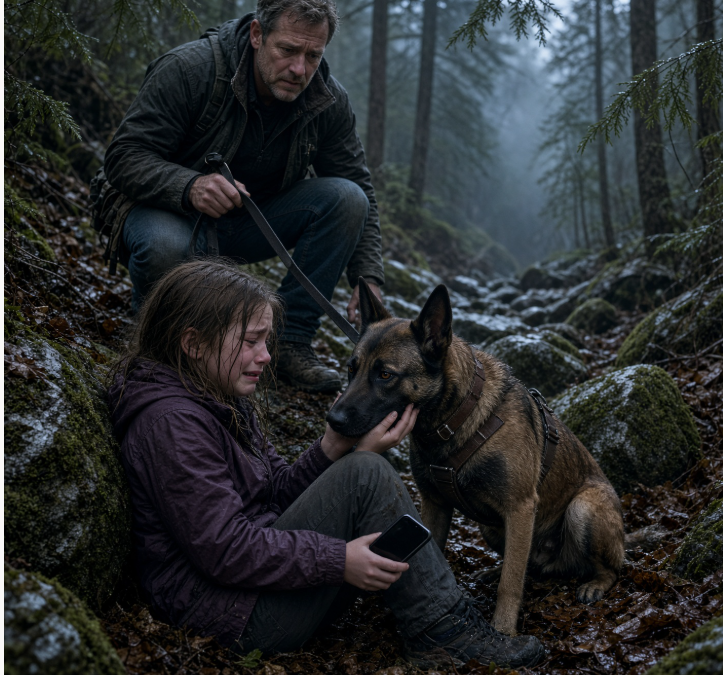
We found Piper at the bottom of a shallow gully, seated with her back against a mossy rock, her left ankle bent wrong beneath her, her purple jacket pulled tight around her body.
Her face was pale, but composed in the way of a child who had decided to be brave and was mostly succeeding.
Her phone was dead in her hand.
She had been there for an hour.
Maybe more.
When she saw Trooper, her face broke before her voice did.
“Trooper.”
The relief in that one word nearly took me down.
Trooper walked to her directly.
No hesitation.
No caution.
He pressed his forehead to her knee.
She held his face in both hands.
“Thank you,” she whispered.
That was about all that needed saying.
I checked her ankle.
“Does it hurt here?”
“Yes.”
“Can you move your toes?”
“A little.”
“Any head pain? Did you hit your head?”
“No. I just slipped. I tried to climb back up, but my ankle—”
“You did right staying put.”
“I was going to yell more, but I got tired.”
“You did right,” I said again.
She looked at Trooper.
“He found me.”
“Yes.”
I took off my jacket and wrapped it around her shoulders.
Donna came sliding down behind us, breathing hard.
“Oh, honey.”
“I’m okay,” Piper said.
She wasn’t fully, but she needed to say it.
I understood that.
I lifted her carefully.
She weighed almost nothing.
Trooper walked close at my side the entire way up the slope, ears up, watching the tree line.
Old habits in a new country.
Back at the trailhead, Piper’s mother’s embrace swallowed her whole.
Harold was there with a blanket.
Judith had appeared from somewhere with coffee in a thermos.
Cason stood very straight and didn’t say anything, which was the most composed I had ever seen him.
Then he dropped to his knees and put both arms around Trooper’s neck.
Trooper allowed it for three seconds.
Then sat down hard, as if the emotion had knocked the structure out of him.
Donna crouched beside him and looked at him for a long moment.
“He locked onto that scent,” she said. “Didn’t waver once.”
“No,” I said. “He didn’t.”
Piper, wrapped in a blanket with her mother’s arm around her, looked at me.
Then at Trooper.
“He knew where I was,” she said.
I looked down at the dog.
His amber eyes lifted to mine.
“Yes,” I said. “He knew.”
The deputy arrived twenty minutes too late, which was not his fault and did not stop everyone from looking at Trooper like he had done something holy.
Leah came too, because Donna had called her. She checked Piper’s ankle on the tailgate of Donna’s truck before the ambulance took the girl for X-rays.
“Sprain, I think,” Leah said. “Painful, but she’ll live to scare everybody again.”
Piper gave a tired smile.
Trooper sat beside her foot, nose pointed toward the woods.
Leah looked at him.
Then at me.
“Working dog,” she said softly.
“Yeah.”
“How do you feel about that?”
I watched Trooper watching the trees.
The truth was complicated.
Pride, fear, grief, memory, dread, awe.
All of it braided together.
“I don’t know yet.”
Leah nodded.
“Fair.”
That night, after the porch lights came on and the neighbors returned to their houses and the creek ran dark and loud with snowmelt, I took the brown leather collar from the shelf.
The one Leah had given me.
I turned it over in my hands.
Week two, I had driven to the hardware store and asked for an engraved tag.
Brass.
Simple.
It read:
Trooper.
Nothing else.
I had not been able to write more than the name.
I had decided the name was enough.
Now I wasn’t sure if it had been enough then, but it was enough now.
I knelt on the kitchen floor.
Trooper walked to me, calm and unhurried, as if he had known this was coming and had simply been waiting for me to be ready.
I slipped off the temporary collar.
He stood still.
I buckled the brown leather gently around his neck.
The brass tag shifted and settled against the healed skin where the zip tie had once been.
That nearly broke me.
The place where something had once meant containment now carried his name.
I kept my hands there for a moment, feeling the heartbeat beneath the fur.
Strong and even.
Nothing like the fragile flutter against my coat that first night in the truck.
“You belong here,” I said.
The words were almost too large for the room.
Trooper looked at me.
“We’ll figure out the rest together.”
He pressed his nose to my jaw, warm and deliberate, and held it there.
I closed my eyes.
For a second, I was not in Kandahar.
I was not in Alma’s doorway.
I was not beside Dutch’s body.
I was in my kitchen in Sylva, North Carolina, with a rescued dog wearing his first real collar, and the house no longer felt like a place where life had stopped.
Spring arrived in Sylva the way it always does in the mountains, not all at once, but in arguments.
Cold mornings that lost ground to warm afternoons.
Creek ice gone by midday and refrozen by dark.
Hemlocks holding their deep green against a sky that could not decide between gray and blue.
Then one morning it decided.
The whole valley went gold and soft.
The Smokies rose over the ridge in that particular blue haze that had given them their name, and Trooper stood on the back porch with his ears steady, his chest broader, his tag catching light when he turned his head.
He had grown.
So had I, though mine was harder to see.
Harold came by more often than the spigot required.
Judith kept pretending to make too many baked goods.
Cason asked if Trooper could track his lost baseball, which Trooper did in twenty seconds, humiliating the entire family.
Piper came over on crutches once, then without them, sitting on the porch steps with Trooper’s head in her lap while she told him about school and how boring it was to be careful.
“You saved me,” she whispered once when she thought I could not hear.
Trooper closed his eyes.
Maybe he understood.
Maybe not.
It mattered either way.
Leah came by one afternoon with her old camera, the one she kept for recovery photographs.
“Not for records,” she said. “For proof that healing happened.”
She found us on the back porch steps.
Trooper leaning against my shin in the way he had started doing when evening came on, as if confirming that everything was still exactly where it should be.
“Don’t pose,” she said.
“I wasn’t planning to.”
“That’s exactly what someone says before becoming awkward.”
“I’m always awkward in photographs.”
“I’ve noticed.”
She took the picture.
Nobody told me to smile.
Nobody needed to.
Later, after Leah left, I went to the shelf in the living room.
I stood there a long time before I touched the photograph.
Dutch still faced the wall.
I turned the frame around.
Slowly.
As if sudden movement might reopen something.
Then I wiped the glass with my sleeve.
Dutch looked back at me from that Humvee seat, ears up, eyes certain, exactly as I remembered him.
For eight years, I had treated that photograph like a live wire.
Something too charged to face directly.
I had told myself I turned it away because grief needed privacy.
Maybe.
But maybe I had also been punishing myself.
For living.
For coming back.
For carrying him four miles and still not being able to bring him home.
Trooper came into the room without sound.
He sat beside me.
Not leaning.
Just there.
I looked from Dutch’s photograph to Trooper.
Then back again.
“You would’ve hated him,” I said to Dutch.
Trooper tilted his head.
“He’s rude. Nosy. Dramatic with water.”
His tail moved once.
I swallowed.
“You would’ve liked him.”
The room stayed quiet.
For the first time in years, the silence did not feel like judgment.
I set Dutch’s photograph upright on the shelf, facing the room.
Not replacing anything.
I understood that now.
I had probably understood it since the night on the floor in the storm, when Trooper found the scar.
Love is not a finite substance stored in a jar that empties.
You can grieve a dog for eight years and still have the full capacity for the next one.
You can love a woman through death and still answer the door when life knocks in another shape.
The war had taught me that grief was durable.
What I had needed to learn was that everything else could be durable too.
Care.
Trust.
Laughter.
Usefulness.
The particular courage of going toward what needs you.
I sat down on the couch.
Trooper climbed up beside me without asking permission, which was new and entirely welcome.
He set his head on my knee.
Outside, the mountains held the last of the light, and the creek ran clear over the stones below the hemlocks.
I thought about that rest stop on I-26.
The concrete post.
The zip tie.
The sleet.
The puppy’s eyes.
I had driven almost three hundred miles in a storm because Donna asked and the roads were glass and one animal needed one person to show up.
I told myself the whole way there that it was only an errand.
I understood now that there are no errands.
Not really.
There are only small moments when the world places something wounded in your path and waits to see whether you still have enough left in you to stop.
In the dark.
In the cold.
Through everything you have lost.
With your hands open, your boots on, and no promise that saving anything will not cost you.
Trooper sighed against my knee.
Outside, the Smokies went blue and then dark, and the first stars appeared above the ridge, patient and indifferent and everywhere at once.
The same stars that had watched over roads in Kandahar.
Hospital rooms in Charlotte.
A shuttered rest stop on I-26.
A creek trail where a little girl waited in the fading light.
A kitchen where a dog learned his name meant belonging.
I looked at them through the window.
For a long time, I had believed survival meant learning not to need.
Not to reach.
Not to let anything get close enough to become another loss.
Trooper had not argued with that belief.
He had simply laid himself beside it.
Day after day.
Storm after storm.
Until fear loosened.
Until the door opened.
Until the thing I thought I was rescuing began tracking its way back through everything in me that had gone missing.
I scratched behind his ear.
“You found her,” I said.
His ear flicked.
“You found me too.”
Trooper closed his eyes.
And in the quiet house, with Dutch facing the room and Alma’s books on the shelf and a brown leather collar resting against healed skin, I finally believed that being found does not always feel like rescue at first.
Sometimes it feels like cold rain.
A long drive.
A burden you did not ask for.
A puppy watching your hands like he already knows they have carried too much.
But if you go anyway—
if you keep going toward what needs you—
sometimes the ending will break you.
And sometimes, after it breaks you, it gives back the part of you that can still heal.








