A Navy K9 Rejected Every Handler for 97 Days—Then an Old Farmer Whistled Once and the Entire Kennel Went Silent
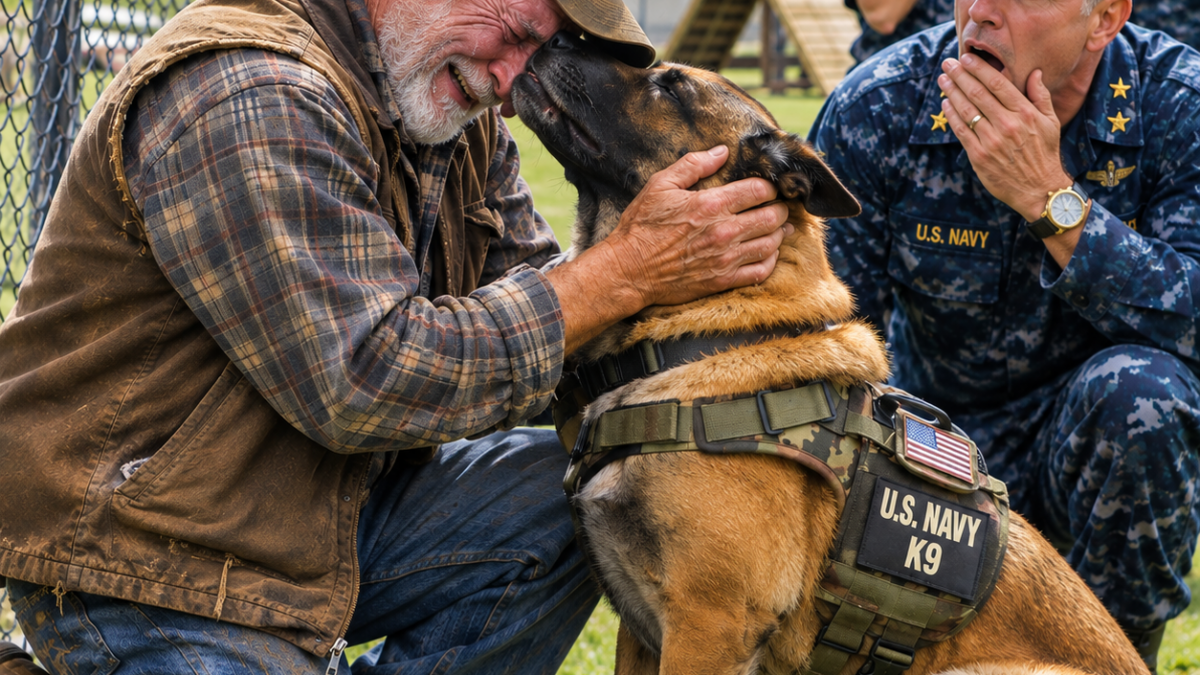
A Navy K9 Rejected Every Handler for 97 Days—Then an Old Farmer Whistled Once and the Entire Kennel Went Silent
For ninety-seven days, Deacon had rejected every experienced Navy handler sent into his run, but when a weathered farmer stopped outside the fence and gave one soft whistle, the Belgian Malinois froze as if a ghost had just called his name.
Seconds later, the dog who had ignored commands, shattered training routines, and humiliated some of the best handlers on the base crossed fifty yards of wet grass and locked himself into a perfect heel beside a stranger in muddy work boots.
No one watching understood why Deacon suddenly obeyed a man who claimed he had never seen the dog before—and when the kennel master noticed what was hanging from the farmer’s neck, he realized the strangest part of the story had not even begun.
The whistle came at 6:43 on a cold October morning.
Chief Petty Officer Mason Hale remembered the exact time because he had been staring at the red digits on his wristwatch while wondering how many more days the Navy would let him keep making excuses for a dog who refused to cooperate.
Ninety-seven days.
That was how long Military Working Dog Deacon had been back at Naval Station Everett after an overseas deployment that nobody in the kennel seemed willing to talk about in detail.
Ninety-seven days of rejected handlers.
Ninety-seven days of untouched bite sleeves.
Ninety-seven days of commands answered with silence, hard staring, pacing, or a low warning rumble that made even experienced men reconsider how badly they wanted to prove themselves.
Deacon was not wild.
That was what made him difficult.
Wild dogs were predictable in their unpredictability.
Fearful dogs tried to escape.
Aggressive dogs moved forward.
Confused dogs scattered their energy everywhere.
Deacon did none of those things.
He watched.
He waited.
And if a handler gave him an order he did not respect, the seventy-two-pound Malinois simply looked through the person as though they did not exist.
That morning, Petty Officer First Class Ryan Kepler was attempting the obstacle course with him.
Kepler had handled dogs for almost eleven years. He had trained in Virginia, deployed twice to the Middle East, worked explosive detection, patrol, building clearance, and protection.
He was not easily embarrassed.
But Deacon had a gift for making talented people look incompetent.
“Deacon, heel.”
The dog remained standing twenty feet away.
Kepler raised his voice.
“HEEL.”
Nothing.
A few sailors watching near the kennel office shifted awkwardly.
Kepler walked toward him, leash in hand.
Deacon stepped backward.
“Come on, man.”
Another step.
Deacon turned.
Not frightened.
Not fleeing.
PART2:
He simply trotted to the opposite side of the course and sat beside a wooden barrier.
Kepler exhaled sharply.
“Chief.”
Mason crossed his arms.
“Try again.”
“I’ve tried again for three weeks.”
“Then today makes three weeks and one day.”
Kepler stared at him.
Mason knew the frustration was justified.
He also knew the report waiting on his desk.
Behavioral reassessment.
Temporary non-deployable status.
Possible transfer out of active working service.
There were polite military terms for what happened to dogs who became operational liabilities.
Mason had learned not to trust polite terms.
Kepler approached again.
“Deacon.”
The dog turned his head.
“Come.”
Nothing.
Kepler dropped into a crouch and softened his voice.
“Buddy, come here.”
Deacon’s ears moved forward.
For half a second, Mason thought they had him.
Then the whistle came.
One low note.
PART3:
Barely louder than the wind pushing through the chain-link fence.
Deacon’s entire body changed.
His ears snapped upright.
His head whipped toward the perimeter road.
His mouth closed.
Every muscle became rigid.
Kepler straightened.
“What the hell?”
The whistle came again.
Two notes this time.
Low.
Pause.
High.
Mason turned toward the fence.
An old man stood outside it.
He wore faded denim overalls beneath a brown canvas jacket polished smooth at the elbows by years of use. His boots were covered with pale mud. A gray beard shadowed his narrow jaw, and a battered green cap sat low over his forehead.
He looked like someone who belonged beside a cattle gate in eastern Washington, not beside a restricted military training field.
The man had stopped along the public access road that ran beyond the outer fence.
One hand rested on a weathered wooden walking stick.
The other held a thermos.
His expression had changed from casual curiosity to absolute disbelief.
Inside the course, Deacon stood so still that Mason could see the dog trembling from thirty yards away.
“Deacon,” Kepler said.
The Malinois did not look at him.
“Stay.”
Deacon moved.
He did not run recklessly.
He crossed the field with purpose.
Straight toward the old farmer.
“Deacon!”
Kepler grabbed for the trailing line.
Missed.
The Malinois cleared a low training barrier without breaking stride, cut across the grass, and stopped at the inside edge of the chain-link fence.
The old man slowly set his thermos on the ground.
For several seconds, neither moved.
Mason was already walking toward them.
“Sir,” he called. “Step away from the fence.”
The farmer did not appear to hear him.
He was staring at Deacon.
The dog pressed his nose to the wire.
The old man lifted a shaking hand but stopped before touching the fence.
His lips parted.
Then, very quietly, he said, “Easy, boy.”
Deacon whimpered.
Mason stopped walking.
Everyone stopped.
In ninety-seven days, Mason had heard Deacon bark, growl, pant, snap, and once release a deep throaty howl during a thunderstorm.
He had never heard him whimper.
The farmer swallowed.
“Easy.”
Deacon lowered his head.
The old man gave the two-note whistle again.
Low.
Pause.
High.
Deacon turned away from the fence.
Walked three steps.
Then pivoted until his left shoulder aligned beside where the old man stood on the opposite side.
Perfect heel position.
There was only a chain-link fence between them.
Kepler stared.
“You have got to be kidding me.”
Mason approached slowly.
“Sir.”
The farmer looked at him now.
His eyes were pale blue.
Old eyes.
Tired eyes.
But not confused ones.
“Yes?”
“This is restricted military property.”
“I can see that.”
“Do you know this dog?”
The farmer looked back at Deacon.
“No.”
Mason waited.
The man rubbed his jaw.
“Least I don’t believe I do.”
“You whistled.”
“I whistle at every dog that looks like it needs somebody to talk to.”
“That wasn’t a random whistle.”
The old man’s expression tightened.
“What do you mean?”
Mason gestured toward Deacon.
“That dog hasn’t properly heeled for anyone in over three months.”
The farmer glanced down.
Deacon remained beside him on the other side of the fence.
Straight.
Focused.
Waiting.
The old man’s hand moved toward his chest.
That was when Mason saw the chain.
Thin silver.
Mostly hidden beneath the man’s flannel shirt.
Something metal hung from it.
A military identification tag.
Mason’s posture changed.
“Were you Navy?”
The farmer looked down as if he had forgotten he was wearing it.
“No.”
“Marine Corps?”
“No.”
“Army?”
The old man hesitated.
Then pulled the tag free.
It was old.
Scratched.
Not his.
Mason stepped closer.
“What name is on that?”
The farmer closed his fist around it.
“My son’s.”
A cold wind moved across the training field.
Deacon’s nose lifted.
The dog stared at the farmer’s hand.
Mason watched carefully.
“What was your son’s name?”
The farmer’s eyes stayed on Deacon.
“Eli.”
Something in the dog changed again.
Not dramatically.
One small movement.
A tremor through his shoulders.
Mason noticed it.
So did Kepler.
The farmer did not.
Mason asked, “Eli what?”
“Eli Mercer.”
Kepler sucked in a breath behind him.
Mason turned.
“What?”
Kepler’s face had gone pale.
He looked from the farmer to Deacon.
Then back to Mason.
“Chief.”
“What?”
Kepler lowered his voice.
“We need to go inside.”
Mason did not move.
“Why?”
“Because I know that name.”
The farmer heard him.
His hand tightened around the dog tag.
“From where?”
Kepler said nothing.
The old man stepped toward the fence.
“From where do you know my son’s name?”
Mason lifted a hand.
“Sir, give us a minute.”
“No.”
His voice was still quiet, but its softness was gone.
“My son has been dead six years. If that sailor knows his name, I want to know why.”
Deacon stood.
The farmer looked down immediately.
“It’s all right, boy.”
The dog sat again.
Kepler stared harder.
Mason saw fear now.
Not fear of the dog.
Fear of what the dog represented.
“Chief,” Kepler said, “please.”
Mason turned toward the kennel building.
“Walk with me.”
The farmer called after him.
“My name is Walter Mercer.”
Mason looked back.
Walter’s face was lined by age, weather, and something deeper than either.
“If somebody on this base knows something about my son,” he said, “I’ll be standing right here until they tell me.”
Mason went inside with Kepler.
The kennel office smelled of coffee, disinfectant, and damp canvas.
Kepler shut the door.
“What do you know?”
Kepler sat at Mason’s computer.
“Deacon’s deployment records are partially compartmented. You know that.”
“I know.”
“I saw a transfer note when he came back.”
“So did I.”
“Did you read the previous handler field?”
“It was redacted.”
“Not on the logistics copy.”
Mason felt something unpleasant settle in his stomach.
Kepler typed.
The network loaded slowly.
“You kept this from me?”
“I didn’t keep anything. I saw it once. I figured it was a clerical issue.”
“What name?”
Kepler looked at him.
“Mercer.”
Mason stared.
“Eli Mercer?”
“No. Caleb Mercer.”
Walter’s son had been Eli.
Deacon’s previous handler had been Caleb.
Mason leaned over the desk.
“Relation?”
“I don’t know.”
“Find out.”
Kepler opened personnel records.
Access denied.
Tried another portal.
Denied again.
Mason called base personnel.
Three transfers later, he had a lieutenant commander telling him the file required authorization.
“Then authorize it.”
“I can’t.”
“I have an active military working dog displaying behavioral responses to a civilian whose family name appears in the dog’s deployment history.”
Silence.
Then, “Chief Hale, keep the civilian outside the secure area.”
“I understand perimeter procedure.”
“And do not permit physical interaction with the animal.”
Mason looked through the office window.
Walter remained by the fence.
Deacon remained beside him.
“Why?”
“Because I said so.”
“That isn’t an answer.”
“It’s the answer you have.”
The call ended.
Mason stared at the phone.
Kepler said, “That sounded healthy.”
“Call command.”
“I already did.”
“And?”
“They want a full incident report.”
“Of course they do.”
Mason walked back outside.
Walter had lowered himself onto an overturned roadside bucket someone had left near the ditch.
He sat facing the fence.
Deacon lay on the other side.
They watched each other.
Mason stopped ten feet away.
“Mr. Mercer.”
Walter looked up.
“What did you find?”
“A previous handler shared your last name.”
Walter’s brows drew together.
“What was his first name?”
“Caleb.”
The effect was immediate.
Walter stood so quickly the bucket tipped over.
“What did you say?”
“Caleb Mercer.”
Walter looked at Deacon.
Then at Mason.
“That’s my grandson.”
Mason said nothing for a moment.
Walter’s jaw trembled.
“My grandson’s name is Caleb Mercer.”
“Is he Navy?”
“He was.”
“Dog handler?”
Walter looked insulted by the question.
“No.”
Then he stopped.
His face changed.
“I don’t know.”
Mason studied him.
“How do you not know?”
Walter stared beyond him toward the barracks.
“Because Caleb disappeared from our lives four years ago.”
The wind rattled the fence.
Walter’s voice became distant.
“He enlisted at nineteen. His father—my son Eli—was already gone. Caleb said he needed somewhere that made sense. Somewhere with rules. Somewhere a man could earn what he was given.”
“What happened to Eli?”
Walter looked at the dog tag in his hand.
“Afghanistan. Army combat engineer. Killed by an IED outside Kandahar.”
“I’m sorry.”
“People say that because there’s nothing else to say.”
Mason understood the sentence better than Walter knew.
Walter continued.
“Caleb took it hard. Worse than anybody realized. He worshiped Eli. Started sleeping in his father’s old field jacket. Learned every cadence he could find. Practiced that whistle because Eli used it to call our sheepdog.”
Mason looked sharply at him.
“The whistle you used?”
Walter nodded.
“My son taught it to Caleb when he was little.”
Mason’s eyes moved toward Deacon.
The Malinois was watching Walter’s mouth.
A memory.
Not of Walter.
Of a sound.
Walter saw Mason understand.
“You think Caleb taught it to him.”
“I think it’s possible.”
Walter grabbed the fence.
“Where is my grandson?”
Mason did not have an answer.
Walter’s knuckles turned white around the wire.
“Four years ago, Caleb called his mother from somewhere overseas. Said he was okay. Said he couldn’t tell us where he was. Two months later, he stopped answering altogether.”
“Was he reported missing?”
“We called everybody.”
“What did the Navy say?”
“That his command was aware of his status and his communications were restricted.”
“For four years?”
Walter laughed once.
There was no humor in it.
“You tell me.”
Mason felt the unease deepen.
A military member did not simply vanish from his family for four years without a reason.
Not legally.
Not administratively.
Not entirely.
Unless someone had been told not to look too closely.
Walter looked at Deacon.
“Was Caleb his handler?”
Mason chose his words carefully.
“Records indicate he was assigned to him.”
“For how long?”
“I don’t know yet.”
“Where?”
“I don’t know.”
“What happened?”
“I don’t know.”
Walter’s anger finally surfaced.
“You people keep dogs better than you keep families informed.”
Kepler looked down.
Mason let the remark land.
Walter breathed hard.
Then shame flickered across his face.
“I shouldn’t have said that.”
“You had a right.”
“No. You didn’t kill my boy.”
Mason looked toward Deacon.
“No.”
Walter released the fence.
“My wife died waiting for that phone to ring.”
Mason turned back.
Walter’s eyes were wet.
“She slept with Caleb’s last voicemail saved on an old answering machine because she was afraid a phone update would erase it. Every Sunday she put his coffee cup on the kitchen table.”
He wiped his face with the heel of his hand.
“She died believing he hated us.”
Deacon stood.
Walter whispered, “No, boy.”
The dog pushed his nose through the fence.
Walter crouched.
He did not touch him.
Neither did Deacon.
They stayed inches apart.
Mason watched them.
Then he made a decision that would later become the most criticized decision of his twenty-one-year career.
“Mr. Mercer.”
Walter looked up.
“I need you to come with me.”
Kepler turned sharply.
“Chief.”
Mason ignored him.
“There’s a visitor processing office by the main gate. We can verify your ID, clear you for an escorted visit, and move this conversation somewhere warmer.”
“What about him?”
Walter nodded toward Deacon.
“He stays here.”
The old man hesitated.
Mason added, “I’m not promising you anything. But I am promising I’ll look.”
Walter studied him.
“Why?”
Mason glanced at Deacon.
“Because that dog has spent ninety-seven days trying to tell us something, and this morning is the first time I think any of us listened.”
Three hours later, Mason had the first piece of a story nobody seemed eager to explain.
Caleb Mercer had enlisted at nineteen.
He completed basic training, then specialized schools that Walter had never known about.
At twenty-two, he entered the military working dog program.
At twenty-three, he was paired with Deacon.
They trained together for eleven months.
Their evaluation scores were exceptional.
Obedience.
Detection.
Tracking.
Patrol.
Off-leash control.
Environmental stability.
Caleb’s supervisor had written one sentence in a quarterly assessment.
HANDLER-DOG BOND UNUSUALLY STRONG; USE AS MODEL TEAM.
Then the paperwork changed.
Entire months were missing.
Deployment locations were blacked out.
Mission identifiers were restricted.
And then, almost exactly four years earlier, Caleb’s active personnel file ended.
No discharge entry.
No transfer.
No retirement.
No death certificate.
Nothing.
Mason called the personnel office again.
This time, he asked a different question.
“Is Caleb Mercer alive?”
The woman on the phone went silent.
“I’m unable to answer that.”
“That isn’t classified location information.”
“I’m unable to answer that.”
“Is he in the Navy?”
“I’m unable to answer that.”
“Can you confirm whether the man exists?”
“Chief Hale, I suggest you direct further inquiries through your command.”
The call ended.
Walter sat across from Mason’s desk.
He had heard everything.
“Four years,” he said.
Mason rubbed his forehead.
“I know.”
“No, you don’t.”
Walter reached into his coat.
Kepler’s hand moved instinctively.
Walter slowly pulled out a folded envelope.
Old.
Creased.
He placed it on the desk.
“This came two years ago.”
Mason looked at it.
No return address.
Postmark from Virginia.
Walter opened it.
Inside was a photograph.
Deacon.
Younger.
Standing beside a man in fatigues.
The man’s face had been cut away.
Not torn.
Cut cleanly with scissors.
On the back, in handwriting faded by handling, were seven words.
He kept his promise when I couldn’t.
Mason read it twice.
“Who wrote this?”
“I don’t know.”
“Caleb’s handwriting?”
“No.”
“Did you report it?”
“Of course.”
“To whom?”
“Naval Criminal Investigative Service.”
Now Mason sat straighter.
“What did they say?”
“That they’d review it.”
“And?”
“That was it.”
“Did they keep a copy?”
“They took the original envelope for three weeks, then mailed it back.”
Kepler stared at the photograph.
“What promise?”
Walter’s face tightened.
“That’s what I’ve been asking myself for two years.”
That afternoon, Deacon refused food.
Mason watched from the corridor as the dog lay facing the door.
Not the bowl.
Not the yard.
The door Walter had walked through when he left.
“He’s waiting,” Kepler said.
“For what?”
“You know.”
Mason did.
He just did not want to say it.
Walter returned the next morning.
Then the next.
And the next.
Officially, he was an approved civilian observer assisting with behavioral evaluation.
Unofficially, nobody could get Deacon to do anything meaningful unless Walter stood near the training field.
Walter never issued military commands.
He simply whistled.
Deacon would sit.
Walter stepped left.
Deacon tracked him.
Walter walked outside the fence.
Deacon mirrored him from inside.
On the fourth day, Mason had Walter brought into the training enclosure under strict supervision.
Kepler held the leash.
Mason stood ten feet away.
A veterinarian waited behind the gate.
Walter entered slowly.
Deacon did not charge.
He did not bark.
He walked forward.
One step.
Two.
Three.
Then stopped.
Walter’s eyes filled.
“Hey, boy.”
Deacon lowered his head.
Walter lifted his hand.
Mason said, “Let him choose.”
Walter froze.
Deacon moved closer.
He sniffed Walter’s boots.
His trousers.
His hands.
Then he pressed his muzzle against Walter’s chest.
Right where Eli Mercer’s dog tag hung.
Walter made a sound that was almost a sob.
Deacon sniffed harder.
His nose traveled up the silver chain.
Then he sat.
And looked directly into Walter’s face.
Walter whispered, “You remember him, don’t you?”
Mason stepped closer.
“Caleb?”
Walter nodded.
“My grandson wore his father’s tags sometimes.”
Deacon raised one paw.
Placed it against Walter’s knee.
Walter sank slowly onto the grass.
The dog leaned into him.
Not excited.
Not frantic.
Heavy.
As though exhausted by holding something in for too long.
Walter buried both hands in the fur behind Deacon’s neck.
The Malinois closed his eyes.
Every sailor around the enclosure became silent.
Kepler turned away.
Mason looked at the dog.
The behavioral reports had described defiance.
Withdrawal.
Operational unreliability.
Handler rejection.
But watching Deacon now, another word came to him.
Grief.
The dog had not forgotten how to work.
He had been waiting for the person who taught the work meaning.
That afternoon, Mason found another irregularity.
Deacon had returned from his last deployment with a healed bullet graze across his right shoulder.
The veterinary report called it a field injury.
No corresponding incident existed in the operational file.
A second scar crossed the underside of his rib cage.
Again, no detailed report.
And when Mason pulled the equipment intake paperwork from the dog’s transport crate, he found something taped beneath the original shipping label.
A strip of gray fabric.
Someone had missed it.
The cloth had been folded three times.
Inside it, written in permanent marker, were the letters C.M.
Kepler stared.
“That could mean anything.”
“No.”
Mason unfolded the cloth.
One corner contained dried brown discoloration.
Blood.
The next morning, command ordered Mason to stop reviewing historical deployment records.
Captain Douglas Vane delivered the instruction personally.
Vane ran base security operations.
Tall, immaculate, fifty-two, silver at the temples.
The kind of officer who made regulations sound like moral principles.
He entered Mason’s office at 7:10.
Closed the door.
“You’ve developed an unhealthy curiosity, Chief.”
Mason remained standing.
“I have a dog with unexplained behavioral issues tied to a missing handler.”
“You have an animal experiencing separation-related regression.”
“From a handler nobody can tell me is alive or dead.”
Vane’s face remained smooth.
“That matter does not concern you.”
“It concerns the dog.”
“Then treat the dog.”
“We are.”
“Without civilians.”
Mason understood.
“Walter.”
“Mr. Mercer’s access is revoked.”
“Why?”
“He has no operational necessity.”
“He’s the only person Deacon responds to.”
“Then Deacon is no longer fit for service.”
The room went very still.
Mason asked, “What exactly are you ordering?”
“End Mr. Mercer’s participation. Complete the behavioral assessment. If Deacon cannot meet standards without him, recommend disposition.”
Disposition.
There was the polite word.
Mason’s jaw tightened.
“You knew Caleb Mercer.”
Vane looked at him.
It was a subtle reaction.
Tiny.
But Mason saw it.
“Who?”
“Caleb Mercer.”
“No.”
“You didn’t even ask who that was.”
Vane stepped closer.
“Chief Hale, twenty-one years of good judgment have given you a respectable career. Do not confuse longevity with authority.”
Mason met his eyes.
“Respectfully, sir, that sounded like a warning.”
“It was intended as guidance.”
Vane opened the door.
“Follow it.”
Walter was waiting by the public fence when Mason walked outside.
He was holding a paper bag.
“I brought biscuits.”
Mason stopped.
Walter smiled faintly.
“For the humans. I figured the dog probably has rules.”
Mason hated what he had to say.
“Your access was revoked.”
Walter’s smile disappeared.
“Why?”
“I wasn’t given a reason.”
“Who?”
“I can’t discuss internal command decisions.”
“You mean you won’t.”
Mason looked at him.
Walter read the answer in his face.
“Someone’s scared.”
Mason said nothing.
Walter looked toward the kennel.
“Can I see him from here?”
“Yes.”
Deacon appeared behind the run door as if he had heard them.
Walter raised two fingers.
Whistled.
The dog sat.
Walter swallowed.
“I came here because my truck overheated.”
Mason glanced at him.
“That first morning. I wasn’t planning to stop. Temperature needle jumped. I pulled off the road, opened the hood, heard dogs barking.”
He laughed softly.
“My whole life changed because of a cracked radiator hose.”
Mason leaned against the fence post.
“Sometimes that’s how it happens.”
Walter looked at him.
“How’d yours happen?”
“What?”
“The thing that makes you care more than your rank says you should.”
Mason stared across the yard.
“My brother.”
Walter waited.
“Army medic. Iraq. Came home alive.”
“That sounds good.”
“He came home different.”
Walter nodded.
“He needed help. Everybody kept telling him where to file paperwork. Which office. Which appointment. Which form.”
Mason rubbed his hands together against the cold.
“He stopped asking.”
Walter understood the rest before it was spoken.
“I’m sorry.”
Mason nodded once.
“My mother spent ten years blaming herself. I spent ten years blaming everybody.”
“And now?”
“Now I blame systems when they deserve it and people when they deserve it.”
Walter looked toward the administration building.
“Which one is this?”
“I haven’t decided.”
That night, someone entered the kennel records archive.
The access log showed Captain Vane’s credentials at 11:38 p.m.
By 11:46, three historical files related to Deacon had been permanently removed from the local server.
Whoever did it made one mistake.
Kepler had already copied them.
Mason found him sitting in his truck the next morning with a portable drive in his hand.
“I know I’m probably destroying my career.”
Mason opened the passenger door.
“Move over.”
They reviewed the deleted files.
One was an after-action veterinary report.
One was a canine transport order.
The third was a casualty support memo.
The memo contained a name.
Petty Officer First Class Caleb J. Mercer.
Status: injured during classified joint operation.
Transfer authorized.
Destination redacted.
Mason read the date.
Four years earlier.
“He was injured,” Kepler said.
“Not killed.”
“At least not then.”
The veterinary report described Deacon’s wounds.
Gunshot graze.
Shrapnel.
Severe dehydration.
And one line Mason read aloud.
“Animal refused evacuation until unconscious handler was loaded onto aircraft.”
Kepler leaned back.
“Caleb.”
The transport record confirmed it.
Deacon and Caleb had been evacuated together.
Then separated.
Deacon had been returned stateside six months later.
Caleb’s trail vanished.
Mason stared through the windshield.
“If he survived the evacuation, why tell his family nothing?”
Kepler’s expression hardened.
“Maybe they didn’t.”
Mason turned.
“What?”
“Maybe someone thought they did.”
They spent the day tracing paperwork.
At 4:20 p.m., Kepler found the first real crack.
A family notification form.
It listed Caleb Mercer as medically evacuated to a secure long-term recovery program.
Next of kin contacted.
Walter Mercer.
Signature acknowledging notification.
Mason stared at the signature.
He had seen Walter write his name on the visitor log.
This was not his handwriting.
“Forgery,” Mason said.
Kepler nodded.
“And look at the date.”
The form had been signed three days after Walter’s wife suffered a stroke.
Hospital records Walter later provided showed both grandparents had been at St. Joseph Medical Center for nearly forty-eight consecutive hours.
The notification officer listed on the form had retired.
Mason located him in Arizona.
Master Chief Samuel Ortega answered on the fourth ring.
Mason identified himself.
Mentioned Caleb.
The line became silent.
“Master Chief?”
“I told them this would come back.”
Mason gripped the phone.
“Told who?”
“Who are you with?”
“Naval Station Everett.”
Another pause.
“Is Vane still there?”
Mason looked at Kepler.
“Yes.”
Ortega exhaled.
“I’m hanging up.”
“Wait.”
“I have a family.”
“So does Caleb Mercer.”
Silence.
Then Ortega spoke quietly.
“He was never supposed to disappear.”
Mason closed the office door.
“What happened?”
“I can’t discuss the operation.”
“I’m not asking.”
“Caleb was badly injured. Brain trauma. Multiple fractures. Nerve damage. He couldn’t speak for months.”
“Where was he sent?”
“A specialized federal rehabilitation facility.”
“Why wasn’t his family told?”
“They were supposed to be.”
“Records show Walter Mercer was notified.”
“He wasn’t.”
“You know that?”
“I was assigned to notification support.”
Mason sat down.
“Then whose signature is on the form?”
“I don’t know.”
“Why didn’t you report it?”
“I did.”
“To Vane?”
A long pause.
“Yes.”
Mason closed his eyes.
“What did he say?”
“That Mercer’s family had been briefed through another channel.”
“And you believed him?”
“I wanted to.”
“What happened to Caleb?”
“He recovered enough to communicate.”
“When?”
“About eight months later.”
“And?”
“Then things got complicated.”
“How?”
“He started asking questions about the mission.”
“What questions?”
“I don’t know.”
“Where is he now?”
“I truly don’t know.”
Mason looked through the window.
Deacon stood in his run.
Watching the road.
Ortega said one final thing.
“Chief.”
“Yes?”
“If that dog is still alive, don’t let them treat his behavior like a failure.”
Mason’s voice hardened.
“Why?”
“Because the last thing Caleb said before they sedated him on the evacuation flight was, ‘Get Deacon home.’”
The call ended.
Mason remained motionless.
Kepler whispered, “That was the promise.”
He kept his promise when I couldn’t.
The photograph.
The anonymous message.
Deacon had been sent home.
Caleb had not.
The following morning, Walter found Mason waiting beside the fence.
“I need to show you something.”
They sat inside Walter’s truck.
Mason handed him copies of the records.
Walter read slowly.
His breathing changed.
When he reached the forged notification form, he stopped.
“That’s not my signature.”
“I know.”
Walter looked up.
“You know?”
“We verified where you were that day.”
Walter read the injury memo.
Again.
Then again.
“He was alive.”
“At that time.”
“Four years ago.”
“Yes.”
Walter pressed his thumb to Caleb’s printed name.
“My wife died thinking he abandoned her.”
Mason had no answer.
Walter stared out the windshield.
For a long time, the old man did not cry.
That made it worse.
“She used to make excuses for him,” he whispered.
“Every birthday. Every Thanksgiving. She’d say maybe he was someplace he couldn’t call from. Maybe he was saving lives. Maybe he was doing important things.”
His mouth trembled.
“And when she got sick, she made me promise not to be angry at him.”
Walter finally covered his face.
“She thought her grandson had forgotten her, and somebody signed my name saying I knew where he was.”
Mason looked away to give him whatever privacy a truck cab could offer.
After a minute, Walter lowered his hands.
“Who did this?”
“We don’t know yet.”
“You suspect someone.”
“Yes.”
“Who?”
Mason hesitated.
“Captain Vane.”
Walter’s grief became anger with astonishing speed.
“Then take me to him.”
“No.”
“Why?”
“Because anger is what people like him understand how to use against you.”
Walter stared.
Mason continued.
“If we’re wrong, we need evidence.”
“And if you’re right?”
“Then we need more evidence.”
Walter laughed bitterly.
“You military people love evidence after you lose the truth.”
Mason accepted that too.
Later that day, Vane ordered Deacon transferred.
Not reassigned.
Transferred to a military veterinary behavioral center across the country for final evaluation.
Departure: forty-eight hours.
Mason read the order twice.
Kepler kicked a chair.
“He knows.”
“Yes.”
“What do we do?”
Mason looked toward the kennel.
“We do our jobs.”
“That sounds like surrender.”
“No.”
Mason folded the transfer order.
“It sounds like paperwork.”
Then he called NCIS.
Not the base liaison.
A regional special agent.
Special Agent Dana Brooks arrived six hours later.
She was forty-one, precise, direct, and unimpressed by rank.
Mason gave her everything.
The deleted files.
The forged notification.
The archive access logs.
The photograph.
Ortega’s information.
Brooks asked the obvious question.
“Why would Vane conceal the status of one injured handler?”
Mason answered, “I don’t know.”
“That’s the missing piece.”
“I know.”
“Could be operational security.”
“For four years?”
“Could be negligence.”
“Then why delete files?”
Brooks nodded.
“Exactly.”
She interviewed Walter.
Then Kepler.
Then Mason.
Finally she requested to see Deacon.
Walter stood beyond the run.
Brooks watched him whistle.
Deacon immediately obeyed.
“What’s the significance?”
Mason told her about Eli.
About Caleb learning the whistle.
About the dog tag.
Brooks looked at Walter.
“You have something that belonged to Caleb?”
Walter touched the tag.
“His father’s.”
“Anything Caleb himself wore?”
Walter thought.
Then reached into his wallet.
A folded scrap of leather sat behind an old photograph.
“His bracelet.”
It was a narrow braided leather band.
“Why do you carry it?”
“Caleb gave it to his grandmother before boot camp. She gave it to me before she died.”
Brooks looked at Mason.
“Let the dog smell it.”
Mason hesitated.
Then opened the run.
Walter held out the bracelet.
Deacon sniffed.
The reaction was immediate.
He whined.
Licked the leather.
Then turned and ran to the back corner of his kennel.
He began scratching beneath his sleeping platform.
Mason frowned.
“Deacon.”
The dog scratched harder.
Kepler entered.
Together they lifted the platform.
Underneath was a small cavity in the packed dirt where the dog had been digging.
Inside lay an object wrapped in torn bedding.
A metal identification tag.
Not Eli’s.
A different one.
Mason picked it up.
The engraved name was clear.
MERCER, CALEB J.
Walter stopped breathing.
“How did he get that?”
No one knew.
Brooks photographed it.
Mason turned it over.
There were scratches on the back.
Not random.
Letters.
Someone had etched three characters by hand.
W.R.H.
Brooks stared.
“What does that mean?”
Walter went pale.
“I know.”
They all turned.
Walter’s voice shook.
“Willow Ridge Home.”
“What is that?”
“A rehabilitation hospital outside Tacoma.”
Mason frowned.
“You know it?”
“My wife spent two weeks there after her stroke.”
Brooks was already reaching for her phone.
The facility had changed names three years earlier.
Before that, part of its campus had been leased to a federal medical contractor.
Patient records were protected.
But Brooks had a badge and enough probable cause to start asking uncomfortable questions.
By midnight, she had a patient alias.
Charles Miller.
Male.
Military referral.
Severe traumatic brain injury.
Admitted four years earlier.
No family visitors.
Transferred eighteen months later.
Destination sealed.
Walter stared at the computer screen.
“Charles Miller?”
Brooks said, “Possibly Caleb.”
“Why an alias?”
“Security.”
“Whose?”
No one answered.
Walter’s voice rose.
“My grandson was thirty miles from my house?”
Mason felt sick.
Walter stood.
“Thirty miles?”
“Walter—”
“My wife was dying thirty miles away from him.”
Brooks rose too.
“We do not know it was Caleb.”
Walter pointed at the dog tag.
“His dog knew.”
Nobody had an answer to that either.
The next morning, Vane had Mason removed from kennel command.
Two armed security officers entered the building at 7:15.
Captain Vane followed.
“Mason Hale, you are temporarily relieved of duties pending investigation into unauthorized access and distribution of controlled records.”
Every sailor in the kennel stopped working.
Mason removed his access badge.
Placed it on the desk.
Vane turned to Kepler.
“You’re acting kennel supervisor.”
Kepler stared at him.
“No, sir.”
Vane’s eyebrows lifted.
“That was not a request.”
“I understand.”
“Then assume the position.”
Kepler removed his own badge.
Set it beside Mason’s.
Vane’s face hardened.
“You want to make a career decision over a dog?”
Kepler looked at Deacon’s run.
“No, sir.”
Then he looked directly at Vane.
“Over a forged family notification.”
Nobody moved.
Vane’s eyes narrowed.
“Be very careful.”
Kepler replied, “I think that advice goes both ways.”
Vane turned toward the personnel assembled in the corridor.
“Anyone else?”
No one moved.
But no one looked away either.
Vane left.
Mason expected suspension.
He did not expect Walter to be waiting outside the gate with six pickup trucks.
Farmers.
Veterans.
Two former dog handlers.
And one local television van.
Mason walked toward him.
“What did you do?”
Walter looked almost embarrassed.
“I told some people.”
“You told the media?”
“I told my neighbor.”
“Who told the media?”
“My neighbor’s daughter.”
Mason stared at the camera crew.
“You understand this could hurt the investigation.”
Walter nodded.
“Agent Brooks said the same thing.”
“So why are you here?”
Walter looked toward the base.
“Because silence already hurt us.”
The story broke locally that evening.
It did not include classified operations.
It did not accuse Vane by name.
It asked a simpler question.
Why had the family of an injured sailor apparently been told nothing for four years?
The next morning, national outlets called.
By afternoon, congressional staffers called.
By evening, Captain Vane had retained an attorney.
And Deacon’s transfer was postponed.
Three days later, Brooks found the second hospital.
Colorado.
A neurological rehabilitation center contracted through the Department of Defense.
Patient transferred under another alias.
Again.
Then a third location.
Virginia.
Then silence.
At every stage, paperwork claimed family notification had occurred.
Every signature was Walter’s.
None matched.
Brooks placed four forms in front of him.
“All forged?”
Walter examined them.
“Yes.”
Mason stood behind her.
“Same handwriting?”
“Possibly.”
Brooks tapped the final document.
“This one matters.”
It authorized voluntary restricted contact.
Signed by Caleb Mercer.
Walter stared.
“That’s his signature.”
Mason felt hope collapse into confusion.
“He asked for no contact?”
Brooks shook her head.
“Read the date.”
The form was dated six days after Caleb’s evacuation.
The medical record from that week stated he was intubated and unconscious.
Walter looked up.
“So that’s forged too.”
Brooks nodded.
“Which means somebody wanted a legal-looking reason to keep the family away.”
“Why?”
Brooks closed the folder.
“We’re close.”
The answer arrived from the last person Mason expected.
Captain Vane’s former executive assistant.
Lieutenant Sarah Kim had left the Navy two years earlier.
She contacted Brooks after seeing Walter on television.
They met in a federal office in Seattle.
Kim looked frightened.
“I handled logistics after the operation.”
“What operation?” Brooks asked.
Kim shook her head.
“I won’t discuss details.”
“We don’t need details. We need Mercer.”
Kim looked at Walter.
“I’m sorry.”
Walter’s expression hardened.
“People keep saying that.”
Kim lowered her eyes.
“Caleb was injured during a mission that went wrong.”
“How wrong?” Mason asked.
“Bad enough that careers were going to end.”
“Vane’s?”
Kim hesitated.
“Yes.”
Brooks leaned forward.
“What did Caleb know?”
“He knew the mission had been approved using intelligence that had already been flagged as unreliable.”
Mason said, “By Vane?”
Kim nodded.
“He was a commander then. Not the only decision-maker, but one of them.”
“And Caleb?”
“He survived long enough to contradict the official report.”
Walter went still.
Kim continued.
“His first written communication during rehabilitation said civilians had been present where command claimed there were none.”
Brooks asked, “Did Vane order his isolation?”
“I never saw an order.”
“But?”
“I saw emails.”
“Do you have them?”
Kim removed a small encrypted drive from her purse.
“I kept copies.”
Mason stared.
“Why?”
“Because I was a coward.”
Her eyes filled.
“I told myself I was keeping evidence in case things got worse. Then things got worse and I still did nothing.”
Walter looked at her.
“Where is my grandson?”
“I don’t know.”
His hand hit the table.
“Everybody knows pieces and nobody knows where he is!”
Kim flinched.
Walter stood.
“My wife died calling his name.”
His voice broke.
“She made me promise to forgive him for not coming home.”
Mason touched his shoulder.
Walter pulled away.
“No.”
He looked at Kim.
“You don’t get to cry before I know whether he’s alive.”
Kim wiped her face.
“You’re right.”
She opened her laptop.
“There may be one person who knows.”
The name was Dr. Evelyn Hart.
Neurologist.
Former Navy medical officer.
She had supervised Caleb’s recovery in Virginia.
Brooks found her in Maine.
Retired.
At first, Hart refused to speak.
Then Walter got on the phone.
“My name is Walter Mercer.”
Silence.
“I’m Caleb’s grandfather.”
Another silence.
Walter closed his eyes.
“Please.”
The woman began crying.
Walter gripped the phone.
“Is he alive?”
Hart did not answer immediately.
Mason watched the old man’s face.
Finally she said, “The last time I saw him, yes.”
Walter sat down.
The sound that came out of him was neither relief nor grief.
It was both.
“When?”
“Eleven months ago.”
Walter covered his mouth.
Brooks asked, “Where?”
Hart hesitated.
“I can’t give you the current location.”
Walter leaned toward the phone.
“Why?”
“Because Caleb asked me not to.”
Everything stopped.
Walter stared.
“What?”
“He asked me not to tell you where he was.”
Walter recoiled as though struck.
Mason felt the room change.
All the anger.
All the certainty.
Suddenly there was another possibility.
The most painful one.
Walter whispered, “He knew?”
Hart said, “Eventually.”
“He knew we were alive?”
“Yes.”
Walter’s face emptied.
“And he stayed away.”
“Mr. Mercer—”
“He stayed away.”
“It was not that simple.”
Walter stood.
“No. I think it is.”
He walked out.
Mason followed him into the hallway.
“Walter.”
The old man did not stop.
“Walter.”
He finally turned.
His eyes were red.
“I spent four years blaming strangers.”
“You were right to.”
“And maybe all along he didn’t want us.”
“You don’t know that.”
“He told her not to tell me.”
“You don’t know why.”
Walter laughed bitterly.
“There’s always a why with you people.”
He left.
For the first time since the whistle, he did not visit Deacon.
The dog noticed.
By evening, Deacon was pacing.
By the second day, he stopped eating.
By the third, Mason found Walter sitting in his barn forty miles east of the base.
Rows of old tools hung from the walls.
A rusted tractor sat beneath a canvas tarp.
Walter occupied a wooden chair beside an empty dog bed.
Mason stood in the doorway.
“You missed a spot.”
Walter looked up.
“What?”
“Deacon’s waiting for you.”
Walter stared at the floor.
“He’ll get over it.”
“No.”
“Dogs do.”
“Some do.”
Walter said nothing.
Mason stepped inside.
“Dr. Hart wants to talk again.”
“I don’t.”
“She says you misunderstood.”
“I understood English.”
“She says Caleb suffered severe neurological damage.”
Walter’s jaw tightened.
“So?”
“So memory loss.”
Walter looked up.
Mason continued.
“Speech impairment. Panic episodes. Partial facial paralysis. Periods where he couldn’t recognize people.”
Walter’s anger flickered.
“She said he recovered.”
“Some.”
“Enough to tell her not to contact me.”
“Yes.”
“Then there you go.”
Mason sat on an overturned feed bucket.
“Do you know why?”
Walter did not answer.
“He was ashamed.”
Walter’s face changed.
Mason continued quietly.
“He saw photographs of himself after the injury. Learned what your wife had gone through. Learned how long he’d been gone.”
Walter’s eyes filled.
“Dr. Hart says Caleb became convinced coming back would destroy whatever memory you had of him.”
“That’s stupid.”
“Yes.”
Walter glared.
“That’s not what I meant.”
“I know.”
Mason leaned forward.
“Grief makes intelligent people believe stupid things.”
Walter looked toward the empty dog bed.
“He should’ve called.”
“Yes.”
“He should’ve let her hear his voice.”
“Yes.”
“He should’ve trusted us.”
“Yes.”
Walter finally looked at him.
“Why aren’t you defending him?”
“Because pain doesn’t become harmless just because there’s a reason for it.”
Silence.
Mason added, “But reasons still matter.”
Walter began to cry.
“I’m angry at him.”
“You’re allowed.”
“I love him.”
“You’re allowed that too.”
Walter wiped his face.
“He’s alive.”
“Yes.”
The words seemed to reach him for the first time.
“He’s alive.”
Mason nodded.
Walter laughed through tears.
“My grandson is alive.”
The next morning, Walter returned to the fence.
Deacon was already outside.
The old farmer whistled.
The dog sprinted toward him.
Walter placed both hands against the wire.
“I’m sorry, boy.”
Deacon whined.
Walter smiled.
“Yeah. Me too.”
Brooks called that afternoon.
“We found Caleb.”
Walter almost dropped the phone.
“Where?”
“Before I tell you, there’s something you need to understand.”
“What?”
“He still doesn’t want contact.”
Walter’s shoulders sagged.
“Why?”
“He gave a statement.”
Brooks paused.
“He believes Deacon died.”
Walter looked toward the kennel.
“What?”
“He was told Deacon died from his injuries after evacuation.”
Walter stared at the living dog ten yards away.
The lie had gone both directions.
Caleb’s family had been told nothing.
Caleb had been told his dog was dead.
The one relationship strong enough to pull him toward his old life had been severed with a sentence.
Walter whispered, “Who told him?”
Brooks answered.
“Vane.”
The investigation accelerated.
Emails from Kim’s drive showed Vane coordinating information restrictions after the failed operation.
One message discussed “containing conflicting witness accounts.”
Another referred to Caleb as “neurologically unreliable.”
A third requested that family communication be “deferred until narrative stabilization.”
Narrative stabilization.
Walter read the phrase and slammed the page down.
“They stole four years for a narrative?”
Mason said nothing.
Vane’s attorney claimed the decisions were made for national security and Caleb’s medical welfare.
Brooks disagreed.
So did federal prosecutors.
But before any charges became public, there was one matter Walter cared about more.
Caleb.
He was living under medical supervision on a small rehabilitation farm in Virginia.
Thirty-one years old.
Walked with a cane.
Spoke slowly when tired.
Experienced memory gaps.
Worked with horses because animals did not care whether his sentences came quickly.
He had refused every invitation to return home.
Walter asked if he could send one thing.
Not a letter.
Not a photograph.
A recording.
Brooks arranged it.
Mason filmed inside Deacon’s training yard.
No speeches.
No explanation.
Walter stood beside the fence.
Whistled.
Deacon ran to him.
Walter entered.
The dog heeled.
Walter removed Eli’s tag from his neck and held it in front of Deacon.
The Malinois touched it with his nose.
Then Walter looked directly into the camera.
“Caleb.”
He swallowed.
“You were wrong about one thing.”
Deacon looked toward the lens.
Walter gave the old two-note whistle.
The dog’s ears rose.
Walter whispered, “He kept waiting.”
The recording ended.
Caleb watched it in Virginia.
Dr. Hart later described what happened.
He watched once without moving.
Then a second time.
Then a third.
On the fourth viewing, his hands began shaking.
When Walter whistled, Caleb covered his face.
When Deacon appeared, he slid from his chair to the floor.
The staff tried to help him.
He pushed them away.
And for almost ten minutes, the man who had survived blast trauma, surgeries, isolation, shame, and four stolen years wept with his forehead against the screen.
Two days later, Walter received a phone call.
Unknown number.
He answered on the third ring.
“Hello?”
Breathing.
Nothing else.
Walter sat at his kitchen table.
“Hello?”
A man’s voice spoke.
Rough.
Slow.
“Grandpa?”
Walter closed his eyes.
His hand began trembling.
He did not answer immediately because the voice was older than the one he remembered.
Damaged.
Careful.
But it was Caleb.
Walter finally whispered, “Yeah.”
Silence.
Then Caleb said, “I’m sorry.”
Walter’s face crumpled.
He gripped the table.
“No.”
“I should’ve—”
“No.”
“Grandpa—”
“You listen to me.”
Walter was crying openly now.
“You don’t apologize first.”
Caleb went silent.
Walter took a shaking breath.
“You let me hear you breathe.”
Neither spoke.
They stayed on the phone.
One minute.
Two.
Three.
Just breathing.
Then Walter said, “Your grandmother waited for you.”
Caleb made a broken sound.
“I know.”
“She loved you.”
“I know.”
“She was never angry.”
Caleb began sobbing.
Walter let him.
Eventually Caleb whispered, “Is he really alive?”
Walter smiled through his tears.
“He’s meaner than ever.”
A laugh came through the phone.
Small.
Fragile.
But unmistakable.
Walter had not heard his grandson laugh in six years.
“Does he remember me?”
Walter looked through the kitchen window toward the fields.
“Oh, son.”
His voice softened.
“I think that dog spent four years remembering enough for all of us.”
Caleb agreed to return to Washington.
Not permanently.
One visit.
No ceremony.
No press.
No uniforms beyond the personnel required.
Mason was reinstated before the visit.
Kepler too.
Captain Vane had been placed on administrative leave.
The kennel staff spent two days pretending they were not nervous.
Deacon sensed everything.
On the morning Caleb arrived, rain hung over the base in a fine silver mist.
Walter stood inside the training field.
Mason beside him.
Deacon sat twenty yards away.
“He doesn’t know,” Walter said.
“No.”
“Will he?”
Mason looked at the dog.
“We’re about to find out.”
A government sedan stopped outside the gate.
Dr. Hart exited first.
Then Caleb.
Walter stopped breathing.
His grandson was thinner than he remembered.
A scar traveled from his right temple into his hairline.
His left hand curled slightly against his coat.
He leaned on a black cane.
He paused outside the gate.
Walter wanted to run to him.
He did not.
Caleb looked across the field.
Saw his grandfather.
His mouth trembled.
Walter lifted one hand.
Caleb lifted his.
Then Deacon noticed him.
At first, nothing happened.
The dog stared.
Mason watched his ears move.
His nose lifted.
Deacon took one step.
Stopped.
Caleb’s face collapsed.
“Hey.”
The word barely carried across the field.
Deacon’s body went rigid.
Caleb’s hand left the cane.
He put two fingers to his lips.
Mason looked at Walter.
Walter was already crying.
Caleb whistled.
Low.
Pause.
High.
Deacon exploded forward.
Not aggressive.
Not controlled.
Not military.
He ran with every piece of himself.
Caleb dropped the cane.
Walter shouted his name as his grandson fell to both knees.
Deacon hit him in the chest hard enough to nearly knock him backward.
Caleb wrapped both arms around the dog.
Deacon whined.
Barked.
Whined again.
He climbed halfway into Caleb’s lap, licking his face, pressing his head under Caleb’s chin, pawing frantically at his shoulders.
Caleb was laughing and sobbing.
“No, no, no—easy—Deac—easy, buddy—”
The dog ignored every command.
For once, nobody cared.
Every sailor around the field looked away or wiped their face.
Kepler openly cried.
Mason made no attempt to hide his own tears.
Walter stood ten feet away, watching his grandson bury his face in the dog’s neck.
Caleb whispered something.
Only Deacon heard it.
Then the dog suddenly settled.
Perfectly still.
Caleb moved his trembling hand down Deacon’s back.
Found an old scar.
Then another.
“I thought you died.”
Deacon licked his chin.
Caleb shut his eyes.
“I thought I left you there.”
Walter stepped closer.
“You didn’t.”
Caleb looked up.
Walter’s voice broke.
“You got him home.”
Caleb stared at him.
Then Walter held out Eli’s dog tag.
Caleb saw it.
His shoulders shook.
“My dad’s.”
Walter nodded.
“You taught Deacon the whistle.”
Caleb touched the tag.
“Dad taught me.”
“I know.”
Caleb looked between his grandfather and the dog.
For the first time, the entire chain became visible.
Eli had taught the whistle to a little boy.
The boy had grown into a sailor.
The sailor had taught it to his dog.
The dog had carried it through war, injury, separation, and years of waiting.
Then one cold morning, an old farmer had whistled outside a fence.
A sound passed from father to son, from son to grandson, from grandson to dog.
And the dog had answered.
Caleb rose slowly with Walter’s help.
Then he hugged his grandfather.
There was no cinematic speech.
No perfect apology.
Caleb simply said, “I missed Grandma.”
Walter held the back of his head.
“I know.”
“I should’ve called.”
“I know.”
“I was scared.”
“I know.”
Caleb pulled back.
“You’re angry.”
“Very.”
Caleb almost smiled.
Walter touched his cheek.
“But I came all this way to be angry at you in person.”
Caleb laughed.
Walter laughed too.
Deacon barked between them.
For the first time in years, their grief had somewhere to go besides inward.
The investigation lasted eleven months.
It revealed no single dramatic conspiracy controlling every decision.
Reality was uglier because it was more ordinary.
A failed operation.
Officers protecting careers.
Medical uncertainty.
Classification rules abused beyond necessity.
Paperwork forged to conceal delays.
Subordinates afraid to challenge superiors.
People convincing themselves that temporary dishonesty could be corrected later.
Later became months.
Months became years.
Captain Douglas Vane was ultimately charged with multiple offenses related to falsification of official records, obstruction, unlawful concealment of material information, and retaliation connected to the investigation.
He was not accused of causing Caleb’s battlefield injuries.
He had not personally engineered every transfer.
But prosecutors established that he had repeatedly interfered with lawful family notification because Caleb’s testimony threatened to expose decisions Vane wanted buried.
In court, Vane’s defense described his choices as attempts to protect operational security.
Walter sat behind the prosecution table.
Caleb did not attend every day.
Neither did Mason.
The case no longer owned their lives.
When Vane finally spoke at sentencing, he claimed he had faced impossible circumstances.
Walter listened without expression.
Later, a reporter asked him whether the punishment was enough.
Walter answered carefully.
“No punishment gives my wife those years back.”
The reporter waited.
Walter continued.
“And no sentence gives Caleb his twenties back either. Justice isn’t magic. It doesn’t reverse anything.”
“What does it do?”
Walter looked toward Caleb, who stood beside a truck with Deacon.
“It tells the truth where the lie used to be.”
Deacon never returned to active deployment.
The official reason was age, accumulated injuries, and behavioral history.
Mason suspected everyone involved understood something else.
The dog had already completed his final mission.
The Navy approved his retirement.
Caleb was offered first adoption rights.
He hesitated.
Not because he did not want Deacon.
Because he still lived under medical supervision in Virginia.
Walter solved the problem.
“Come home.”
Caleb looked at him across the kitchen table.
“For how long?”
Walter shrugged.
“Long enough to irritate me.”
“Grandpa.”
“The east pasture fence is falling down.”
“I walk with a cane.”
“You still have one good hand.”
Caleb laughed.
Walter leaned back.
“You think I need you to fix a fence?”
Caleb’s smile faded.
Walter looked toward the empty chair where his wife used to sit.
“I need somebody to drink the coffee I keep making too much of.”
Caleb lowered his eyes.
Walter continued.
“You don’t have to come home as the man who left.”
Caleb looked up.
“You can come home as whoever survived.”
Three weeks later, Caleb moved into the farmhouse.
Deacon came with him.
The first months were not easy.
Caleb had nightmares.
Sometimes he woke believing he was overseas.
Sometimes a tractor backfiring sent him to the floor before he knew what happened.
Sometimes he forgot names.
Sometimes words vanished in the middle of sentences.
Walter learned not to finish them for him unless Caleb asked.
Deacon slept beside Caleb’s bed.
When panic came, the dog pressed his body against Caleb until his breathing slowed.
Walter watched from doorways and understood that Deacon was still working.
Just not for the Navy.
Caleb began helping with chores.
Slowly.
He fed chickens.
Repaired gates.
Drove the small utility tractor.
Later he started visiting a veterans’ rehabilitation center with Deacon.
At first, he sat in the back.
Then another injured sailor asked about the dog.
Caleb told him.
Not the classified parts.
Not Vane.
Just the part about believing your old life was gone.
The next week, the sailor returned.
So did Caleb.
By spring, he volunteered twice a week.
Walter never mentioned how proud he was.
He simply complained that Caleb kept stealing his thermos.
Mason visited the farm one Saturday in April.
Deacon was lying beneath an apple tree.
Older.
Gray beginning around his muzzle.
Caleb stood beside a fence post.
Walter waved from the porch.
Mason walked up.
“You look terrible.”
Walter grinned.
“Retirement suits me.”
“You were already retired.”
“Then I’m getting better at it.”
Caleb joined them.
He still used the cane on uneven ground.
But his movement had improved.
“So,” Mason said, “how’s civilian life?”
Caleb looked at Deacon.
“He doesn’t follow orders.”
Walter snorted.
“That makes two of you.”
Deacon lifted his head.
Mason smiled.
“Some things never change.”
Later, they sat on the porch.
Walter poured coffee.
The sunset stretched orange across the fields.
Mason noticed Eli’s dog tag no longer hung around Walter’s neck.
He looked at Caleb.
The tag rested against the younger man’s shirt.
Walter saw Mason notice.
“Figured it belonged there.”
Caleb touched it.
“My grandmother used to hate this thing.”
“Why?”
“Said Dad wore it in the shower and scratched her with it when he hugged her.”
Walter smiled.
“She complained every day.”
Caleb’s eyes softened.
“I barely remember her voice now.”
Walter went inside.
Returned with an old answering machine.
Caleb stared.
“You kept that?”
Walter set it on the table.
“Your grandmother kept everything.”
He pressed play.
Static.
A click.
Then a woman’s voice filled the porch.
Warm.
Older.
A little irritated.
“Caleb, sweetheart, your grandfather says not to worry about calling tonight, which means I am absolutely telling you to call tonight because he’s pretending he doesn’t miss you.”
Caleb covered his mouth.
Walter looked away.
The recording continued.
“There’s pie in the freezer for when you get home. And don’t let anybody feed you that nonsense about us being proud only if you do something important.”
A pause.
“We were proud before you left.”
The message ended.
Caleb sat motionless.
Deacon stood.
Walked over.
Rested his head on Caleb’s knee.
Caleb’s fingers moved into his fur.
Walter said quietly, “She never stopped waiting.”
Caleb nodded.
“I know.”
“No.”
Walter looked at him.
“I don’t think you did.”
Caleb met his eyes.
Walter’s voice softened.
“But you know now.”
The following October marked one year since Walter’s truck had overheated beside the Navy fence.
Mason drove out to the farm.
Kepler came too.
No uniforms.
No ceremony.
Walter had invited several veterans from Caleb’s rehabilitation group for lunch.
Children ran through the yard.
Deacon lay under the porch steps while a six-year-old girl decorated his collar with yellow leaves.
Caleb let her.
Walter pretended not to notice when the girl fed Deacon a piece of sausage.
At dusk, everyone gathered near the pasture.
A young veteran named Daniel asked Caleb how he had gotten Deacon back.
Caleb looked toward his grandfather.
Walter was closing the gate.
“He found him.”
Daniel smiled.
“Your grandfather found your military dog?”
“Kind of.”
“How?”
Caleb considered the question.
Then smiled.
“He whistled.”
Daniel laughed.
“That’s it?”
Caleb looked at Deacon.
The dog was watching Walter.
“No.”
He shook his head.
“That wasn’t it.”
Walter walked across the pasture.
His steps were slower than they had been a year earlier.
He stopped halfway.
Put two fingers to his lips.
And whistled.
Low.
Pause.
High.
Deacon’s ears rose.
The old dog stood.
For a moment, Caleb expected him to run to Walter.
Instead, Deacon looked at Caleb.
Waiting.
Caleb understood.
He nodded.
“Go.”
Deacon ran.
Not as fast as before.
Age had shortened his stride.
Old injuries stiffened his shoulder.
But he crossed the field anyway.
Walter laughed as the dog reached him.
Deacon settled into heel.
Perfect position.
Exactly as he had that first morning outside the Navy fence.
Caleb watched them from the porch.
Mason stood beside him.
“Ninety-seven days,” Mason said.
Caleb glanced over.
“What?”
“That’s how long he rejected every handler we gave him.”
Caleb looked at Deacon.
“He wasn’t rejecting them.”
Mason smiled slightly.
“No?”
Caleb shook his head.
“He was waiting.”
“For you?”
Caleb watched his grandfather scratch behind Deacon’s ears.
Then he looked at the farmhouse, the fields, his father’s tag around his neck, and the people laughing beneath the October sky.
“No.”
His voice softened.
“For something that felt like home.”
Across the pasture, Walter whistled once more.
Deacon looked back toward Caleb.
And for the first time in years, no one was missing.








