A Navy K9 Refused to Board His Final Transport Home—Then He Saw an Old Farmer Standing Beyond the Flight Line Fence.
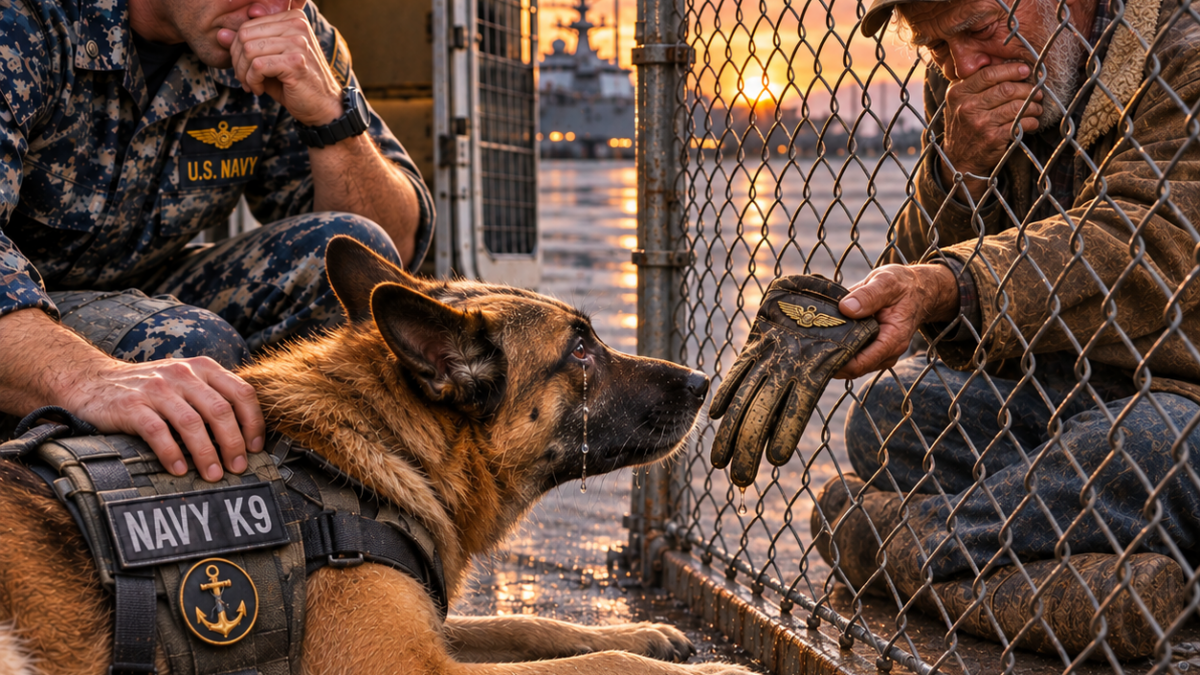
A Navy K9 Refused to Board His Final Transport Home—Then He Saw an Old Farmer Standing Beyond the Flight Line Fence.
Chief had completed his final assignment and was supposed to leave the naval air station before sunset, but the retired Belgian Malinois planted himself beside the runway and refused every command to board.
For nearly twenty minutes he stared through the chain-link fence at an elderly farmer holding a battered canvas flight bag nobody recognized.
Then the old man removed a fifteen-year-old pilot’s glove from inside the bag, and Chief made a sound his handler had never heard in eight years of working beside him.
Chief was ten years old.
Seventy-three pounds.
Belgian Malinois.
Dark mahogany coat.
Black mask.
Gray beginning beneath the muzzle.
A thin white scar crossing his right shoulder.
His official designation was Chief MWD N519.
Military Working Dog.
United States Navy.
Explosives detection.
Aircraft security.
Search.
Patrol.
Three deployments.
Two overseas naval installations.
One carrier qualification.
Hundreds of flight-line sweeps.
And enough hours around jet engines that he had learned to sleep through sounds capable of rattling windows half a mile away.
Chief was not sentimental.
That was how Petty Officer First Class Daniel “Danny” Cole described him.
Danny had been Chief’s handler for eight years.
He was thirty-six.
Lean.
Short brown hair.
A scar beneath his chin from a motorcycle accident he refused to discuss because, according to Chief Petty Officer Alvarez, the story made him look stupid.
Chief knew approximately thirty spoken commands.
Hand signals.
Search patterns.
Emergency recalls.
Aircraft loading procedures.
And one extraordinary skill:
He could detect when Danny was about to lie.
Not officially.
PART2:
But everyone in the kennel unit believed it.
Danny would say:
“I’m fine.”
Chief would stare.
Danny:
“I slept.”
Chief would stare harder.
Danny:
“I definitely didn’t eat the last breakfast burrito.”
Chief would turn toward the trash can.
There was no beating the dog.
Their final day together began at Naval Air Station Meridian just before dawn.
Chief was retiring.
Not because he had failed.
Because age had begun taking small pieces.
His right shoulder stiffened after long work.
His hearing remained sharp, but recovery after difficult searches took longer.
During his last veterinary exam, the base veterinarian had said what everyone already knew.
“He can still work.”
Then:
“He shouldn’t have to.”
That distinction mattered.
PART3:
Chief had completed ten years of service.
Danny had filed to adopt him.
Approved.
No complications.
No waiting family.
No competing claim.
Chief would leave military service and spend the rest of his life at Danny’s small house outside Pensacola.
Fenced yard.
Old oak tree.
Porch.
No aircraft.
No explosives.
No kennels.
Danny had purchased a ridiculously expensive orthopedic dog bed.
Chief ignored it when they tested one at the pet store.
Preferred the concrete floor.
Danny bought it anyway.
The retirement paperwork was complete.
The final medical evaluation signed.
Microchip transferred.
Kennel property logged.
The plan was simple.
At 4:30 p.m., Chief would board a Navy transport aircraft headed toward Florida.
Danny would fly with him.
At sunset, Chief would no longer belong to the Department of Defense.
He would belong, legally and practically, to Danny Cole.
Everyone joked about the word belong.
Chief had ignored ownership for most of his career.
He tolerated people.
He worked with Danny.
That was different.
At three that afternoon, the kennel unit held a small ceremony.
No reporters.
No speeches from admirals.
Chief hated crowds.
The commanding officer kept it short.
Certificate.
Shadow box.
Old working collar.
A new retirement collar with CHIEF stitched across it in white.
Danny stood beside him.
Chief sat.
Looked bored.
Chief Petty Officer Alvarez read the summary of his service.
“Three deployments.”
“Two hundred and nineteen aircraft-security sweeps.”
“Forty-one explosive finds in training environments.”
“Seventeen operational alerts requiring secondary investigation.”
“Zero handler bites.”
Somebody whispered:
“Miracle.”
Danny looked at the junior handler.
Chief looked too.
The junior handler stopped smiling.
The ceremony ended at 3:42.
By four, Danny had Chief’s equipment loaded.
Water.
Medication.
Veterinary paperwork.
Retirement documents.
Old tennis ball Chief had carried since his first deployment.
The flight crew opened the transport ramp.
Danny clipped the lead.
“Ready?”
Chief stood.
They walked toward the aircraft.
Thirty feet from the ramp, Chief stopped.
Not slowed.
Stopped.
Danny felt the leash tighten.
“Chief.”
The dog’s ears pointed toward the western perimeter.
Danny followed his gaze.
Chain-link fence.
Security road.
Beyond that:
Open land.
A drainage ditch.
County road.
A stand of oak and pine.
Nothing unusual.
“Come on.”
Chief did not move.
Danny gave the heel command.
Nothing.
That got attention.
Chief did not ignore working commands.
He might hesitate.
Question.
Look toward a competing stimulus.
But he did not simply refuse.
Danny stepped closer.
“Chief. Heel.”
The Malinois shifted.
But not toward the plane.
Toward the fence.
Lieutenant Rivera, the transport officer, checked his watch.
“Problem?”
Danny shook his head.
“Give me a minute.”
Chief stared.
Then Danny saw the man.
Across the security road.
Beyond the fence.
An elderly man stood beside an old green Ford pickup.
Late seventies.
Maybe eighty.
Sun-faded denim shirt.
Brown work jacket.
Work boots.
White hair beneath a battered cap.
He held a canvas bag.
Military style.
Olive drab.
Old.
One strap repaired with black electrical tape.
The man was not inside the restricted area.
He stood beyond the outer fence on public land.
Watching Chief.
Danny’s first reaction was security.
“Who is that?”
Rivera lifted binoculars.
“No idea.”
Chief stepped forward.
Danny stopped him.
“Stay.”
Chief stayed.
But his entire body had changed.
Weight forward.
Tail low.
Nose lifting.
Trying to catch scent through jet fuel, asphalt, hot metal, and several hundred feet of air.
The old man moved closer to the fence.
Base security began walking toward him from the perimeter road.
He raised one hand.
Not threatening.
Just acknowledging.
Then he opened the canvas bag.
Chief’s breathing changed.
Fast.
Shallow.
Danny had seen Chief alert on explosives.
Track suspects.
Locate hidden training aids.
Search collapsed structures.
React to gunfire.
React to injured handlers.
React to thunder.
He had never heard the sound that came next.
It began low in the dog’s chest.
Not a bark.
Not a whine.
Almost a broken howl.
One long note.
Then another.
Chief pulled so hard Danny nearly lost the leash.
“Chief!”
The Malinois strained toward the fence.
The old farmer reached into the bag.
Removed a brown leather flight glove.
Old Navy issue.
Cracked across the palm.
Faded name written in black marker above the wrist.
Chief screamed.
That was the only word Danny could later use.
A sharp, desperate sound.
The kind of noise animals make when recognition overwhelms training.
Every person on the flight line turned.
The old man pressed the glove against the fence.
Chief began dragging Danny.
Lieutenant Rivera said:
“What the hell?”
Danny looked at the glove through the fence.
Could not read the name from that distance.
Security reached the farmer.
One officer spoke with him.
The man pointed toward Chief.
Then toward the glove.
Chief paced.
Back and forth.
Pulling.
Danny crouched beside him.
“You know that?”
Chief tried to move past him.
Danny’s stomach tightened.
Ten years old.
Three deployments.
Transferred between handlers before Danny.
There were years of Chief’s life Danny knew only through files.
Puppy program.
Initial training.
Early naval aviation familiarization.
A classified assignment summary so heavily redacted it was almost useless.
Danny had always assumed those early years were ordinary.
Nothing about Chief was feeling ordinary now.
Chief Petty Officer Alvarez came running.
“What happened?”
Danny pointed.
“Old guy showed him that glove.”
Alvarez looked.
Chief howled again.
“What’s the dog doing?”
“I don’t know.”
Security radioed Rivera.
The elderly man was asking to speak with Chief’s handler.
Name:
Elias Mercer.
Retired farmer.
Former Navy aviation structural mechanic.
Age seventy-eight.
No warrants.
No restricted property.
He claimed the glove belonged to his son.
That changed everything.
Danny asked:
“His son who?”
Security answered over radio.
“Lieutenant Noah Mercer.”
Danny froze.
He knew the name.
Everyone in naval working-dog aviation eventually did.
Lieutenant Noah Mercer.
Naval aviator.
Killed fifteen years earlier during a training mission in the Gulf of Mexico.
Aircraft lost after catastrophic hydraulic failure.
Co-pilot ejected.
Noah did not.
Body recovered three days later.
Official investigation closed.
Danny looked at Chief.
Chief was ten.
Noah Mercer died fifteen years ago.
Impossible.
Chief could not have known him.
Alvarez said it first.
“That timeline doesn’t work.”
Danny nodded.
“No.”
The old farmer still held the glove.
Chief could barely contain himself.
Danny asked security to escort Elias to the designated visitor checkpoint.
The flight was delayed.
Lieutenant Rivera hated delays.
But even he stopped arguing after Chief refused the ramp a third time.
Twenty minutes later, Elias Mercer stood inside a secure visitor area near the kennel compound.
Not on the flight line.
Not yet.
Danny approached with Chief.
The dog saw him at fifty feet.
Pulled.
Elias crouched.
His hands shook.
“Easy.”
Chief slowed.
Not because Danny commanded it.
Because the old man spoke.
One word.
“Blue.”
Chief stopped.
Danny’s blood went cold.
That was not one of Chief’s commands.
Elias’s eyes filled.
“Oh, God.”
Chief moved forward.
Slowly now.
He reached the old man.
Sniffed his boots.
Jeans.
Hands.
Then the canvas bag.
Elias opened it.
Chief shoved his nose inside.
Found the glove.
Took it gently.
Backed away.
Lay down.
Placed the glove between his paws.
Then rested his muzzle on it.
Nobody spoke.
Danny finally asked:
“Mr. Mercer, what does ‘Blue’ mean?”
Elias sat on the concrete curb.
“It was my son’s word.”
“For what?”
Elias looked at Chief.
“For that.”
“That dog wasn’t alive when your son died.”
“I know.”
“So how does he know the word?”
Elias wiped his eyes.
“I don’t think he does.”
Danny frowned.
“You just said—”
“I think he knows what came before him.”
That answer made no sense.
Elias seemed to understand.
“Do you know where Chief came from?”
“Navy breeding program.”
“What line?”
Danny hesitated.
Working-dog pedigrees existed.
He had never cared much.
“Belgian line.”
Elias shook his head.
“No.”
“His mother?”
“Imported.”
“Father?”
Danny looked at Alvarez.
Alvarez pulled up records.
Chief’s sire:
Mako.
Military Working Dog.
Retired.
Born twelve years earlier.
Elias closed his eyes.
“There.”
Danny looked at him.
“Mako?”
Elias nodded.
“My son trained him.”
Silence.
That was the beginning.
Fifteen years earlier, Noah Mercer was twenty-nine.
Naval aviator.
F/A-18 pilot.
Stationed at NAS Meridian during an advanced training rotation.
His father Elias had already retired from Navy maintenance and returned to the family farm outside Tupelo.
Noah loved aircraft.
Always had.
But animals came a close second.
At one point, during a temporary assignment attached to a security-development unit, Noah volunteered to assist with aviation familiarization for young military working dogs.
Jets terrified some dogs.
Not simply the noise.
Vibration.
Fuel.
Exhaust.
Movement.
Ramp equipment.
Noah had patience.
He understood machines.
He also understood fear.
One young Belgian Malinois stood out.
Mako.
Dark coat.
Too much energy.
Too intelligent.
Terrible impulse control.
The dog would work flawlessly near vehicles.
Then shut down when fighter engines spooled up.
Handlers tried gradual exposure.
Food.
Distance.
Play.
Progress was slow.
Noah started spending his lunch breaks near the kennels.
Not training officially.
Just sitting.
Flight gloves tucked into his belt.
Eventually Mako approached.
Noah let the dog smell everything.
Gloves.
Helmet bag.
Flight suit.
Boots.
Then Noah developed a routine.
Before engine exposure, he held up his right glove.
Said:
“Blue.”
Then rewarded Mako when he settled.
Nobody knew why Blue.
Elias did.
Noah’s mother, who died when he was seventeen, had owned an Australian shepherd named Blue.
Whenever Noah became anxious as a child, he sat beside that dog.
The name became shorthand for:
You’re safe.
Stay here.
Breathe.
Noah never told most people.
He told his father.
Mako improved.
Eventually aircraft noise stopped frightening him.
The dog entered active service.
Noah returned to flying.
Their paths separated.
Then came the accident.
October 2009.
Training sortie.
Mechanical failure.
Hydraulic loss.
Flight controls deteriorated.
Noah remained with the aircraft while his younger co-pilot ejected.
Noah attempted to guide the jet away from a populated coastal area.
He transmitted until the final seconds.
The aircraft went down over water.
Noah died.
At the funeral, Elias received his son’s effects.
Wallet.
Watch.
Dog tags.
Flight bag.
Gloves.
One glove missing.
The right one.
Months later, a Navy handler contacted him.
Mako had apparently been given the glove during Noah’s final week at Meridian.
Nobody had realized it belonged personally to the pilot.
The handler asked whether Elias wanted it returned.
Elias said yes.
The glove came in the mail.
Chewed along one finger.
Elias laughed for the first time in weeks.
Then cried for an hour.
Mako served another eight years.
Detection work.
Aviation security.
Overseas duty.
Retired at age ten.
Elias followed his service through occasional updates from a former handler.
Then communication stopped.
Mako died at twelve.
But before that, he had sired a limited working-dog litter.
Chief came from that line.
Danny stared.
“So Chief is Mako’s son?”
“Biologically.”
“Yes.”
“That doesn’t explain this.”
“No,” Elias said.
“It doesn’t.”
Chief still lay over the glove.
Danny looked at him.
Genetic memory did not work like that.
Dogs did not inherit specific words.
Specific people.
Specific gloves.
But scent could.
The glove had been exposed to Mako.
Years of canine scent.
Saliva.
Skin oils.
Kennel environment.
Chief could be responding to his father’s scent.
Possible.
But Blue?
That remained harder.
Elias reached inside the canvas bag again.
Removed a small cassette recorder.
Old.
Then a plastic envelope containing photographs.
One showed Noah kneeling beside Mako.
The dog younger.
Ears oversized.
Noah smiling.
Flight suit.
Glove raised in one hand.
On the back:
BLUE DAY 14 — MAKO STOOD THROUGH TWO ENGINE STARTS.
Another photograph showed Mako lying beside Noah’s helmet bag.
Elias said:
“There’s more.”
Danny looked at the old farmer.
He seemed tired now.
Not physically.
Emotionally.
Like a man who had spent fifteen years deciding whether memory was something you carried or something carrying you.
He placed the recorder on the curb.
“I didn’t come because I knew Chief would recognize this.”
“Then why?”
Elias took a breath.
“Because Noah left something unfinished.”
Danny almost laughed.
Too many mysteries in one afternoon.
“What?”
“The day before he died, he called me.”
Elias pressed play.
Static.
Then a younger man’s voice.
Noah.
“Dad.”
The recording was not from an official system.
Voicemail transferred to cassette years earlier.
“I’m flying tomorrow.”
“Nothing unusual.”
“Mako moved out today.”
“Finally passed the engine test.”
“Thought you’d like that.”
Elias looked at Chief.
Noah’s voice continued.
“I gave him one glove.”
“I know you’ll say that’s stupid.”
“It probably is.”
“But I think dogs should keep something from the people who helped them stop being scared.”
Pause.
Then:
“If I ever get a place after flying, maybe I’ll take an old dog.”
“Not Mako.”
“He’ll have a job.”
“Maybe one of his pups someday.”
Noah laughed.
“Imagine that.”
The message ended.
Danny felt something shift.
Elias said:
“Noah never got that place.”
“He never got old.”
“He never got the dog.”
“Fifteen years I kept thinking that promise died with him.”
Danny looked at Chief.
“And now?”
Elias shook his head.
“I don’t know.”
“I saw the retirement announcement.”
“What announcement?”
“The base posted Chief’s retirement notice.”
Danny remembered.
One photograph.
Official social page.
Chief beside Danny.
Service summary.
No exact travel schedule.
Elias continued.
“I recognized the pedigree.”
“Mako’s line.”
“I called the kennel office.”
“They wouldn’t give me personal information.”
“Good.”
“I came anyway.”
“How did you know today?”
“I didn’t.”
Elias almost smiled.
“I’ve been coming for three days.”
Danny looked toward the fence.
“You stood out there three days?”
“Few hours each afternoon.”
“Why?”
“Didn’t know if I wanted to do this.”
“Show him the glove?”
“No.”
“See if I could let it go.”
That silenced Danny.
Elias looked at Chief.
“I’m seventy-eight.”
“My wife’s gone.”
“Farm’s too much.”
“I’m selling most of it.”
“I kept Noah’s room untouched for fifteen years.”
“That’s not memory anymore.”
“That’s storage.”
Danny knew grief enough to understand the difference.
Chief lifted his head.
The glove remained beneath one paw.
Danny asked:
“What do you want from him?”
Elias looked surprised.
“Nothing.”
“Then why stop his transport?”
“I didn’t.”
“The dog did.”
Fair.
Elias continued:
“I came to give you the bag.”
“Me?”
“You’re adopting him.”
“Yes.”
“Then the glove should go with him.”
Danny shook his head.
“That belonged to your son.”
“So did fifteen years of me keeping it in a drawer.”
“Mr. Mercer—”
Elias looked directly at him.
“I don’t need the glove to keep my boy.”
The sentence settled between them.
Chief stood.
Walked toward Elias.
Placed the glove in the old farmer’s lap.
Elias laughed softly.
“That complicates my speech.”
Chief sat.
Danny smiled despite himself.
“Maybe he disagrees.”
Elias rubbed one thumb over the cracked leather.
Then something happened.
Chief leaned forward.
Pressed his nose against Elias’s chest.
The old man froze.
Chief remained there.
Not excited.
Not searching.
Just contact.
Elias placed one hand on his neck.
“Blue.”
Chief’s eyes closed.
Danny looked at Alvarez.
Neither man spoke.
There was no scientific explanation that satisfied the moment.
Maybe Chief responded to tone.
Maybe the scent of Mako still clung to the glove.
Maybe Elias unconsciously used the same cadence as his son.
Maybe the dog sensed grief and did what trained dogs often do—move toward it.
None of those explanations made the moment smaller.
Eventually Chief stood.
Picked up the glove.
Walked toward Danny.
Dropped it at his boots.
Then turned toward the flight line.
Danny stared.
Chief walked five steps.
Looked back.
Lieutenant Rivera, who had been waiting far longer than he considered reasonable, folded his arms.
“Is that dog finally boarding?”
Danny smiled.
“Looks like.”
Chief walked toward the aircraft.
No resistance.
At the ramp, he stopped.
Turned.
Looked toward Elias.
The old farmer raised the glove-less hand.
Chief gave one bark.
Sharp.
Single.
Then boarded.
Danny followed.
The transport departed twenty-six minutes before sunset.
Elias remained at the fence until the aircraft disappeared.
That should have been the ending.
It wasn’t.
Because Chief’s retirement changed Danny’s life in ways he had not expected.
Military handlers imagine retirement as relief.
No alerts.
No deployments.
No midnight kennel calls.
No paperwork.
No wondering whether the next search hides an explosive device.
Instead, Danny discovered that Chief had no idea how to be retired.
At 5:10 every morning, the Malinois stood beside the front door.
Ready.
Danny tried:
“Go back to sleep.”
Chief stared.
“Civilian life.”
Stare.
“You don’t work anymore.”
Chief brought his old leash.
For three weeks, Danny took him on dawn walks because apparently retirement still required formation.
Chief inspected parked cars.
Sniffed trash cans.
Watched aircraft overhead.
At home he ignored the expensive orthopedic bed.
Slept beside Danny’s boots.
The flight glove came too.
Elias had insisted.
Chief carried it from room to room the first several days.
Then placed it beneath the dining-room table.
Never chewed it.
Never played with it.
Just kept it.
Danny called Elias a week later.
“Thought you should know.”
“What?”
“He sleeps next to the glove.”
Long pause.
Then Elias said:
“Mako used to.”
Danny sat down.
“You knew Mako after service?”
“No.”
“But the handler sent me pictures.”
“In almost every one, that glove was beside his bed.”
Danny looked across the room.
Chief slept with one paw touching the old leather.
Coincidence.
Scent association.
Learned behavior through shared environment impossible across generations.
It bothered Danny because he could not explain it.
Eventually he stopped trying.
Three months later, Elias called.
Not about Chief.
About the farm.
“You know anything about tractors?”
Danny laughed.
“Absolutely not.”
“Good.”
“Why good?”
“You’ll ask before touching things.”
Elias was preparing to sell most of his acreage.
One hundred and twenty-three acres outside Tupelo.
Soybeans.
Hay.
Small cattle field.
Old barn.
House built by his father.
He wanted help going through Noah’s belongings.
Not because Danny knew Noah.
Because Danny knew working dogs.
And apparently that was close enough.
Danny drove up with Chief.
The farm sat three miles off the main highway.
Long gravel drive.
Oak trees.
White farmhouse.
Red barn faded toward brown.
Elias waited on the porch.
Chief jumped from Danny’s truck.
Stopped.
His nose lifted.
The dog began walking.
Not toward Elias.
Toward the barn.
Danny called:
“Chief.”
No response.
Then:
“Chief, heel.”
The dog slowed.
Looked back.
Elias said:
“Let him.”
Danny hesitated.
Then unclipped the leash.
Chief moved toward the barn.
Not running.
Purposeful.
He passed the tractor.
Hay shed.
Old water trough.
Then entered through the open side door.
Danny and Elias followed.
Chief sniffed one wall.
Crossed.
Stopped beside an old wooden cabinet.
Elias went pale.
“No.”
Danny looked at him.
“What?”
“That was Noah’s.”
The cabinet had once been an aircraft parts locker.
Noah brought it home from a surplus auction during college.
Elias had not opened it since before the funeral.
Chief pawed once at the bottom.
Danny crouched.
“Something in there?”
Elias found the key hanging behind a nail.
Opened it.
Tools.
Flight manuals.
Old baseball glove.
Photographs.
A cracked motorcycle helmet.
Then a metal ammunition box.
Elias lifted it.
Heavy.
Inside:
Dog equipment.
An old nylon leash.
Training ball.
Canvas bite tug.
A collar.
Name patch.
MAKO.
Danny stared.
Elias sat down hard on a hay bale.
“I forgot this was here.”
Chief sniffed the collar.
Then sneezed.
His tail moved.
Not wildly.
Slow.
Danny asked:
“How did Noah get Mako’s gear?”
Elias shook his head.
“Maybe before the dog transferred.”
There was also a notebook.
Noah’s handwriting.
Training notes.
Engine exposure.
Flight line stress.
Scent conditioning.
Blue command.
Danny read carefully.
One entry:
MAKO DIDN’T NEED ME TO MAKE THE NOISE SMALLER TODAY. HE JUST NEEDED TO KNOW I’D STAY WHILE IT WAS LOUD.
Danny stopped.
Chief sat beside him.
Another entry:
THE DOG IS NOT AFRAID OF THE ENGINE. HE IS AFRAID HE WILL BE LEFT ALONE WITH IT.
Elias covered his face.
Danny closed the notebook.
“Want me to stop?”
Elias shook his head.
“No.”
They spent the afternoon sorting.
Keep.
Donate.
Archive.
Trash.
Elias struggled most with ordinary objects.
Noah’s service medals were easy.
Keep.
Old uniforms:
Some donate.
Photographs:
Keep.
Receipts.
Broken pens.
A coffee mug with a cracked handle.
Harder.
Grief is strange.
Ceremonial objects tell you what to do with them.
Ordinary objects force decisions.
Chief moved quietly around the barn.
At sunset, Elias found a folded map.
Marked with pencil.
A small circle on the northern edge of the farm.
He laughed.
“Noah wanted to build here.”
Danny looked.
“House?”
“Yep.”
“Always said he’d come back after flying.”
“Small place.”
“Workshop.”
“Dog yard.”
“Too many dogs, according to his mother.”
Elias looked toward Chief.
“He never did.”
Danny said nothing.
Then Elias asked:
“You ever think about leaving the Navy?”
“All the time.”
“Serious?”
“Sometimes.”
“What would you do?”
Danny looked toward the map.
“I don’t know.”
“Good.”
“What’s with you and liking people who don’t know things?”
Elias smiled.
“People who know everything are expensive to repair.”
Chief lay between them.
The idea began there.
Not dramatically.
No promise.
No sudden decision.
Months later, Danny transferred from active-duty handling into a training and administrative billet.
Chief’s aging accelerated.
The shoulder became worse.
Then arthritis in both hips.
Danny started bringing him to the farm every few weeks.
Elias never sold all of it.
He reduced operations.
Leased fields.
Kept thirty acres around the house and barn.
Chief loved the place.
Not because of Noah.
Maybe.
But probably because there were fields.
Squirrels.
Mud.
Things military retirement brochures omit.
He slept on Elias’s porch.
Walked the fence line.
Carried Noah’s glove sometimes.
At night Elias told stories.
Not heroic ones.
Noah backing a truck into a gate.
Noah ruining Thanksgiving gravy.
Noah pretending to understand cattle.
Noah’s first solo flight.
Noah’s mother refusing to watch takeoffs because she said mothers should not encourage sons to leave the ground.
Danny listened.
Chief slept.
A year after retirement, Elias said:
“I think I’m keeping the northern field.”
“Why?”
“Because selling it feels wrong.”
Danny looked at him.
“You just told me not to turn memory into storage.”
“Did I?”
“Yes.”
“Old men are allowed contradictions.”
Chief opened one eye.
Danny pointed.
“Even he knows.”
Elias laughed.
Then became serious.
“Noah wanted something there.”
“A house.”
“Not exactly.”
He handed Danny a later notebook.
One page contained a sketch.
Barn-style building.
Fenced exercise areas.
Kennel runs.
Open field.
Notes:
RETIRED WORKING DOGS?
TEMP BOARDING FOR HANDLERS DEPLOYING?
QUIET PLACE FOR DOGS THAT CAN’T SWITCH OFF?
Danny read it twice.
“Noah planned this?”
“Apparently.”
“Before he died?”
“Maybe a year.”
“Why didn’t you know?”
“Children tell parents less than parents imagine.”
Danny looked at Chief.
The dog was twelve now.
He had trouble standing after long naps.
Still alert.
Still opinionated.
Still occasionally woke at dawn expecting work.
Danny understood the sketch immediately.
Military working dogs often retired well.
Many transitioned into homes with handlers.
Some struggled.
Hypervigilance.
Noise sensitivity.
Routine loss.
A body designed for purpose suddenly given a sofa.
Humans romanticized retirement.
Dogs sometimes found it confusing.
Danny said:
“This could work.”
Elias nodded.
“I thought you might say that.”
“You already knew.”
“I suspected.”
“What do you want?”
Elias looked toward the field.
“Finish something.”
It took two years.
Not because a montage skipped the difficult parts.
Money.
Permits.
Veterinary partnerships.
Insurance.
Construction.
Nonprofit registration.
Training standards.
Volunteers.
More money.
Less money.
A contractor who disappeared halfway through fencing.
A donated HVAC system that failed inspection.
Elias insulting three separate bankers.
Danny reconsidering his life approximately twelve times.
Chief supervising everything.
They called it Blue Field.
Not Noah’s name.
Elias insisted.
“No monuments.”
Danny asked:
“Why Blue?”
Elias looked at Chief.
“Because it means stay here until the loud part passes.”
Blue Field opened with six kennels.
But kennel was the wrong word.
Each dog had indoor and outdoor access.
Quiet walls.
Soft flooring.
Open exercise areas.
No unnecessary metal banging.
No crowds.
No forced social interaction.
Handlers could visit.
Veterans volunteered.
Retired working dogs came for transition periods before permanent placement.
Police K9s.
Military dogs.
Detection dogs.
Some stayed three days.
Some months.
Chief became unofficial management.
He hated puppies.
Loved elderly Shepherds.
Ignored Labradors.
Once stole a blanket from a retired explosives dog named Tango and refused to return it.
Danny said:
“Great leadership.”
Chief stared.
Elias replied:
“Management always steals resources.”
Chief lived to thirteen.
Longer than Danny expected.
Not long enough.
His final winter was mild.
He stopped walking the full fence line.
Preferred the barn porch.
Noah’s glove rested beside his bed.
One February morning, Chief refused breakfast.
Danny knew.
Veterinarian came to Blue Field.
Elias sat beside him.
Eighty-one now.
Thinner.
Chief lay in sunlight.
Danny held his head.
“You were supposed to be retired.”
Chief breathed slowly.
“You made more work.”
Elias rubbed the dog’s shoulder.
“Sounds like Navy.”
Danny laughed.
Then cried.
The veterinarian waited.
No rush.
Danny took Noah’s glove.
Placed it near Chief’s nose.
The old dog smelled it.
His eyes opened slightly.
Elias whispered:
“Blue.”
Chief exhaled.
Relaxed.
The final injection came.
His breathing stopped quietly.
No flight line.
No kennel.
No jet engines.
No commands.
Just two men.
An old glove.
And a dog who had spent his whole life moving toward whatever somebody needed him to find.
They buried Chief beneath an oak at the northern edge of Blue Field.
Elias wanted Noah’s glove buried with him.
Danny said no.
“Why?”
“Because you gave it away once.”
Elias looked at him.
“To Chief.”
“Right.”
“Now what?”
Danny folded the glove carefully.
“Now it stays where the next dog can smell it.”
Elias smiled.
“That makes no scientific sense.”
“Learned from you.”
They placed the glove inside a shadow box in the main building.
Not sealed airtight.
Chief’s old collar beside it.
Mako’s name patch.
A photograph of Noah kneeling beside Mako.
Another of Chief sitting beside Elias’s rusted pickup.
And Noah’s line from the notebook:
THE DOG IS NOT AFRAID OF THE ENGINE.
HE IS AFRAID HE WILL BE LEFT ALONE WITH IT.
Blue Field expanded.
Six kennels became twelve.
Then eighteen.
They added a veteran counseling partnership.
Not therapy by dog magic.
Danny hated that language.
Dogs were not treatments simply because people felt better near them.
But routines helped.
Walking helped.
Responsibility helped.
Silence helped.
Being around animals that did not require explanation sometimes helped.
Elias spent mornings on the porch.
Veterans called him Mr. Mercer.
He corrected them.
“Elias.”
Most still called him Mr. Mercer.
One young former Navy handler named Jake came with a retired Labrador who refused to enter buildings.
The dog slept outside for two nights.
Jake apologized constantly.
Danny said:
“To who?”
“The staff.”
“For what?”
“He won’t go inside.”
“So?”
“What if he never does?”
Elias overheard.
“Then buy a porch.”
Jake laughed.
He needed that.
The dog eventually entered.
Took six weeks.
Nobody celebrated publicly.
They simply left the door open.
Elias died at eighty-four.
Peacefully.
At home.
Danny found him in his recliner after he failed to appear for breakfast.
An old Blue Field sweatshirt across his chest.
Noah’s photograph on the side table.
The farm passed partly to a family trust and partly into the nonprofit arrangement Elias had built with attorneys.
Danny remained director.
He never called himself that unless forms required it.
Chief’s grave stayed beneath the oak.
Every retired dog that arrived walked past eventually.
Some ignored it.
Some sniffed.
One Malinois named Rex lay there for twenty minutes on his first day.
Danny watched from the porch.
Did not turn it into a sign.
Dogs choose shade for many reasons.
Years after Chief died, a young Navy handler visited.
He had heard the story.
Everyone had by then.
The dog who refused transport.
The old farmer.
The glove.
People had exaggerated it online.
Some versions claimed Chief had been Noah’s dog.
Impossible.
Others said Chief recognized Noah’s ghost.
Danny hated that one.
Another claimed Noah’s remains had been hidden on the farm.
Absurd.
The real story needed no supernatural improvement.
The young handler stood before the shadow box.
“Did Chief really recognize the glove?”
Danny answered:
“Yes.”
“How?”
“I don’t know.”
“His father’s scent?”
“Maybe.”
“And the word?”
“Tone.”
“Coincidence.”
“Maybe.”
“You don’t think it was something else?”
Danny looked toward the field.
“I think people get too interested in proving why an animal did something and forget to notice what happened afterward.”
“What happened?”
Danny pointed.
Through the window stood Blue Field.
A retired German Shepherd asleep in grass.
An old Labrador walking beside a veteran.
A volunteer fixing a fence.
An empty porch chair that had belonged to Elias.
“That.”
The handler was quiet.
Danny continued:
“Chief stopped at a fence.”
“An old man opened a bag.”
“Then a lot of people changed direction.”
“That’s enough for me.”
The young handler looked at Noah’s glove.
“Would you ever give it away?”
Danny smiled.
“It’s already been given away twice.”
“To Mako and Chief.”
“Yeah.”
“So no?”
Danny looked toward an elderly black Malinois sleeping near the door.
“Ask me when the next dog needs it.”
That became Blue Field’s unofficial rule.
Nothing meaningful was kept simply because it was old.
Objects could move.
Stories could move.
Promises could move.
Noah’s glove eventually did too.
A retired Navy detection dog named Atlas arrived after his handler died from cancer.
Atlas refused the kennel area.
Would not settle.
Would not eat unless someone sat beside him.
The first night, Danny brought Noah’s glove from the shadow box.
Placed it near Atlas’s bed.
Not because he believed in inherited memory.
Because old leather smelled like dogs.
Handlers.
Work.
Something familiar.
Atlas sniffed it.
Lay down.
Danny whispered:
“Blue.”
No response.
Of course not.
He smiled.
Then sat beside the dog until morning.
That was the point.
The word had never been magic.
Noah had used it while staying beside Mako.
Elias had used it while staying beside Chief.
Danny finally understood that the command was not telling the dog:
Calm down.
It was a promise from the human.
I am staying here while you do.
Fifteen years after his son died, Elias Mercer had stood beyond a flight-line fence carrying a battered canvas bag because he believed he was finally ready to let go of one old glove.
Instead, a retiring Malinois saw him.
Stopped an aircraft departure.
Dragged his handler toward a story none of them knew.
Chief did eventually board that final transport.
He did go home with Danny.
He did retire.
But he also led Danny back to a farm where a dead pilot’s unfinished idea had been sitting inside notebooks and forgotten cabinets for fifteen years.
One dog.
One glove.
One word.
Blue.
Years later, visitors sometimes asked why a small wooden sign at the entrance to Blue Field carried only four words.
No logo.
No military insignia.
No names.
Just:
STAY THROUGH THE LOUD PART.
Danny never explained unless someone asked.
When they did, he usually looked toward the oak where Chief was buried.
Then toward the barn where Noah’s drawings still hung.
And told them:
“Because sometimes getting home isn’t the same as leaving the job.”
Sometimes a working dog needs someone to show him what comes next.
Sometimes a father needs fifteen years before he can open a bag.
Sometimes an unfinished promise does not need to be completed exactly as it was imagined.
It only needs someone willing to carry it forward.
Chief had refused his final transport because an old farmer stood beyond a fence holding a piece of a story that began before the dog was born.
Nobody could prove exactly what he smelled.
What he remembered.
Or why Noah’s old word made his body still.
Danny stopped needing the answer.
Because the part that mattered came afterward.
Chief boarded.
Elias let go.
Danny changed direction.
And on a quiet farm outside Tupelo, dogs who had spent their lives working eventually learned that they did not need to keep searching forever.
Someone would stay beside them while the loud part passed.








