A Mother Cat Woke From Surgery to Find Her 3 Kittens Gone—After Searching Every Cage for 6 Hours, She Curled Up in Their Empty Box for 4 Days and Her Photo Changed 11,000 Shelters
PART3:
MOM FRIENDLY.
KITTENS ACTIVE.
EATING/NURSING.
ELIGIBLE FOR WEANING SOON.
That final phrase mattered more than anyone knew.
At five weeks, kittens begin transitioning toward solid food.
They are not newborns.
They can eat wet food.
They can explore.
Their teeth are coming in.
In an overcrowded shelter, that often meant staff began planning the next step.
Vaccinations.
Adoption floor.
Foster placement.
Spay/neuter scheduling.
The mother was placed on the surgery list for the following morning.
Nothing about that decision seemed unusual.
Shelter cats were routinely sterilized before adoption.
Faster surgery meant faster placement.
Faster placement meant an open kennel for the next animal waiting in an intake van.
The mother still did not have a name.
One technician had started calling her Mama Gray.
Another called her Willow because of the pale stripe down her nose.
Neither name made it onto the official paperwork.
At 7:12 the next morning, a veterinary assistant checked her.
She was awake.
Kittens nursing.
At 7:37, she received pre-anesthetic medication.
The kittens were still climbing over her.
At 7:51, staff lifted the kittens into a small carrier.
Their mother raised her head.
The medication had already made her movements slow.
One kitten called.
The mother tried to stand.
Her hind legs did not cooperate.
The assistant spoke gently.
“It’s okay, Mama.”
Then the carrier left.
The mother watched it go.
That moment lasted less than ten seconds.
Nobody working that morning thought it was a goodbye.
The kittens were moved to the adoption preparation area.
Because they were considered old enough to begin weaning, the shelter’s procedure allowed them to be separated while the mother underwent surgery.
One would later go to a local family.
Another to a couple two towns away.
The third would eventually leave Florida with an adopter who was visiting relatives.
At the time, they were simply three kittens occupying an adoption enclosure.
At 8:14 a.m., their mother was anesthetized.
At 8:42, the spay procedure began.
At 9:07, it ended.
Uneventful.
No excessive bleeding.
No anesthesia complication.
Normal recovery expected.
The surgeon did everything correctly.
Technically.
The mother was carried into the recovery room.
Kennel four.
Her abdomen had been shaved.
A small incision closed.
Pain medication given.
Inside kennel four was the same cardboard nesting box she had used the night before.
Staff had moved it with her because it smelled familiar.
The towel was still inside.
It smelled like milk.
Her body.
Three kittens.
She slept.
Elsewhere in the building, the kittens were processed.
Photographed.
Examined.
Listed.
The shelter was busy.
By noon, prospective adopters were already looking through the kitten area.
At 12:43, the mother opened her eyes.
At first, nothing happened.
The security camera showed her lying on her side.
Eyes unfocused.
Head lifting slightly.
Dropping.
Lifting again.
Anesthesia leaves the body in stages.
Awareness returns before coordination.
Smell before balance.
Instinct before understanding.
At 1:06, she managed to sit.
She swayed.
Looked around.
Then turned toward the nesting box.
That was the first thing she searched.
She pushed her head inside.
Stopped.
Pulled back.
Looked around the kennel.
Then entered the box fully.
She sniffed the towel.
One corner.
Another.
She pawed at it.
Pulled it toward herself.
Sniffed underneath.
Nothing.
She stepped out.
Then back in.
The recording had no sound from inside individual kennels, but the microphone mounted in the room captured a faint noise several times.
A chirp.
Short.
Rising.
The sound mother cats make to call kittens.
At 1:19, she called again.
No answer.
She checked behind the box.
There was nowhere for a kitten to hide.
She checked anyway.
At 1:24, a veterinary technician entered for a routine recovery check.
The cat pressed toward the door.
The technician gently guided her backward.
Checked the incision.
Gums.
Respiration.
Everything looked medically normal.
The kennel was closed.
Or appeared closed.
The latch did not fully engage.
At 1:31, the mother pushed her nose against the gate.
It shifted.
She pushed again.
The door opened.
She stepped into the recovery room.
No staff member saw her immediately.
The camera did.
She did not run toward an exit.
She turned left.
Kennel five.
A male orange cat was recovering from neuter surgery.
She approached.
Pressed her face to the bars.
Called.
Waited.
Nothing.
Kennel six.
A black adult female.
Call.
Wait.
Move.
Seven.
Eight.
Nine.
The pattern was almost identical.
Approach.
Sniff.
Reach one paw beneath the cage.
Chirp.
Pause.
Listen.
Move on.
At kennel ten, something inside moved.
The mother became frantic.
She rose onto her hind legs despite the fresh abdominal incision.
Pressed both front paws against the gate.
Called repeatedly.
The occupant was a young tabby.
Not one of hers.
The tabby hissed.
The mother dropped down.
Moved on.
Kennel eleven.
Twelve.
Then she returned to one.
She had completed the room once.
She started again.
By then a technician entered.
Saw her loose.
Guided her carefully.
But when staff attempted to return her to kennel four, she struggled.
Not aggressively.
She twisted.
Reached toward the other cages.
Called.
A staff member later described the behavior as:
“Post-anesthesia disorientation.”
That phrase went into the medical record.
It was not entirely wrong.
It simply wasn’t complete.
She was returned to kennel four.
Ten minutes later she pushed the poorly latched door open again.
This time staff allowed her several minutes under observation because she was not disturbing the surgical sites of other cats.
She went directly to the cages.
Same sequence.
Search.
Call.
Listen.
Nothing.
At 2:17, she discovered the supply cabinet.
She pushed behind it as far as her body could fit.
The incision pulled against her belly.
She kept going.
At 2:29, she crawled beneath the sink.
At 2:41, she tried to climb onto a lower shelf.
Her legs slipped.
She tried again.
At 3:03, she found a plastic bag filled with clean towels.
She smelled it intensely.
Then hooked one claw into the bag.
Pulled.
The bag dropped.
Towels spilled across the floor.
The mother searched every one.
She buried her face between them.
Pushed them aside.
Chirped.
Waited.
Nothing.
A technician cleaned the towels.
She followed.
The technician thought the cat wanted attention.
Reached down.
The mother walked past her and checked beneath the cart.
At 3:46, a volunteer named Rebecca Hayes entered the recovery area carrying laundry.
Rebecca was fifty-eight.
Retired elementary-school secretary.
Three years volunteering at the shelter.
She knew the gray-and-white mother had been spayed that morning.
She did not know the kittens had already left the building.
She watched the cat searching beneath a folded blanket.
“What is she doing?”
The technician answered:
“Still loopy.”
Rebecca crouched.
The mother chirped.
Rebecca froze.
She had fostered nursing cats.
She knew that sound.
“Where are her kittens?”
The technician pointed vaguely toward the adoption wing.
“Separated.”
“Can you bring them in?”
“I think they were cleared.”
“Cleared for what?”
“Adoption.”
Rebecca stood.
“When?”
The technician checked.
Two had already left.
The third had an adopter completing paperwork.
Rebecca stared.
“She woke up without them?”
The technician looked uncomfortable.
“They’re five weeks.”
Rebecca understood the policy.
Knew kittens were weaned around that age.
Knew shelter capacity.
Knew nobody had deliberately tried to hurt the cat.
But she watched the mother walk to kennel six and call again.
Then wait.
It did not feel like a policy discussion anymore.
“Does she know they’re gone?”
Nobody answered.
How could anyone know what a cat understood?
But the mother knew they were not where she had left them.
That much was visible.
At 4:12, the final kitten left the shelter.
Its mother was searching beneath a storage cart in the recovery room.
At 4:38, she returned to kennel four.
Went inside.
Sniffed the nesting box.
Walked back out.
The search resumed.
At 5:03.
Kennel one.
Two.
Three.
Call.
Wait.
At 5:28, she stood beside the recovery-room door.
Chirped toward the hallway.
At 5:41, someone opened it briefly.
The mother tried to follow.
Staff blocked her.
Not roughly.
She sat.
Looked through the doorway until it closed.
Then returned to the cages.
By 6:00, the search had slowed.
Her surgery was only hours old.
Her body hurt.
The anesthetic was still leaving her system.
She was hungry.
Milk remained in her mammary glands.
Her kittens no longer existed within reach of any of it.
At 6:27, she called from beside kennel twelve.
Waited.
Nothing.
At 6:31, she walked back toward kennel four.
For the first time, she did not stop at another cage.
She entered her own enclosure.
Climbed into the cardboard box.
Turned once.
Then lowered herself onto the towel.
Not randomly.
She lay on her side.
Belly exposed.
Front legs curved inward.
Hind legs positioned exactly as they had been while the kittens nursed.
A space remained along her abdomen.
Enough for three small bodies.
She stared at the wall.
At 6:43, the security camera showed her still in the same position.
At 7:30.
Same.
At 9:00.
Same.
The overnight worker placed food beside her.
She did not move.
The next morning, the bowl was almost untouched.
The cat had no name on the overnight chart.
The worker wrote:
QUIET.
DEPRESSED?
POOR APPETITE.
DAY TWO.
Rebecca returned.
The mother was still in the box.
Same towel.
Same curve.
Rebecca entered the kennel quietly.
The cat’s eyes followed her.
No movement.
Rebecca offered wet food.
Nothing.
Chicken.
Nothing.
Water from a spoon.
Two licks.
Then the cat lowered her head.
Rebecca sat on the floor outside.
“I’m sorry.”
It felt ridiculous to apologize to a cat for an institutional decision she had not made.
She said it anyway.
The mother closed her eyes.
Her mammary glands were still swollen.
That was another problem.
Her body had prepared to feed kittens that were no longer there.
Veterinary staff monitored her for mastitis.
Warm compresses.
Pain relief.
Hydration.
Everything medically appropriate.
None of it answered the chirps that no longer came.
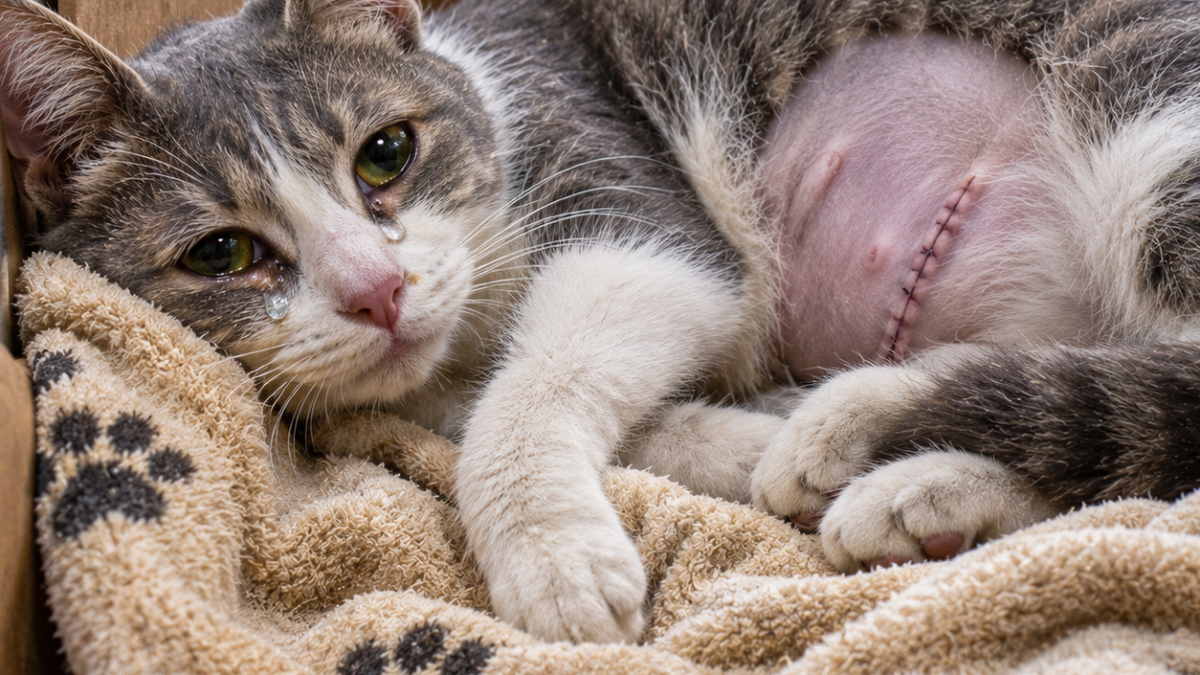
That afternoon Rebecca took the photograph.
She did not plan to.
She had her phone out because the veterinarian had asked her to record the cat’s resting posture.
One image.
Gray-and-white mother inside a cardboard box.
Wrinkled towel.
Shaved abdomen.
Fresh surgical incision visible.
Body curved protectively.
Empty space along her belly.
Eyes open.
Looking at nothing anyone else could see.
Rebecca stared at the photograph after taking it.
Something about stillness made the absence visible in a way the six-hour search had not.
During the search, there was action.
Hope.
Maybe behind this cage.
Maybe beneath this towel.
Maybe through this door.
The photograph was after hope had run out of places to look.
Rebecca posted it that night to her personal social media page.
No shelter logo.
No accusation.
No names.
Just the photograph and two sentences:
She was spayed while her kittens were being adopted.
She woke up, and they were gone.
She has been lying like this for two days.
Rebecca expected friends to react.
Maybe twenty shares.
By morning, there were thousands.
By afternoon, tens of thousands.
By the end of the week, the photograph had crossed states.
Then countries.
People saw the empty curve of the cat’s body.
They did not need a long explanation.
Comments came faster than anyone could read.
How could you do this?
Bring her kittens back.
Who thought this was okay?
She’s grieving.
Look at her body.
She’s still waiting for them.
Some comments became abusive.
Threats appeared.
The shelter’s phone lines flooded.
Employees who had not been involved in the decision were called monsters.
The shelter director, Dr. Helen Pierce, asked Rebecca to come into her office.
Rebecca expected to be banned from volunteering.
Instead, Helen placed a printed copy of the photograph on the desk.
“I hate this picture.”
Rebecca swallowed.
“I understand.”
“No.”
Helen shook her head.
“I hate that it’s accurate.”
That surprised her.
Helen had worked municipal animal welfare for twenty-one years.
She was not sentimental about difficult decisions.
She had euthanized suffering animals.
Managed disease outbreaks.
Closed hoarding properties.
Sent animals to emergency surgery knowing the shelter would have to beg for donations afterward.
She understood triage.
But she also understood when a system had produced harm while following its own rules.
She pulled the procedure manual from a drawer.
NURSING FEMALES / KITTENS.
The policy did not say:
Separate mothers while unconscious.
It allowed kittens over a certain developmental threshold to be moved into adoption pathways once medically appropriate.
That flexibility had slowly hardened into routine.
Five weeks?
Begin weaning.
Mother scheduled for spay?
Move kittens.
Adopters available?
Place.
Every individual step could be defended.
Nobody had paused to examine the sequence from the mother’s perspective.
Helen asked:
“Where are the kittens?”
“All adopted.”
“Can we contact them?”
“Yes.”
They did.
Not to demand returns.
The adoptions were lawful and final.
The kittens were safe.
One was asleep beside a teenage boy when the adopter answered.
Another had been named Poppy.
The third was traveling with a family back to Georgia.
Could the shelter reunite them temporarily?
Possible in theory.
But veterinary staff worried about stress, transportation, disease exposure, and then repeating separation again days later.
The behavioral consultant warned:
“If you bring them back only to remove them again, we don’t know that you’re reducing distress.”
There was no clean solution.
The kittens were gone.
Helen sat in the recovery room that evening.
She watched the mother in the box.
“You don’t know me.”
The cat looked at her.
Helen had spent decades telling people not to anthropomorphize animals.
Cats were not human mothers.
Dogs were not children.
Behavior should be interpreted carefully.
Still.
The milk was real.
The calling was real.
The searching was real.
The change in appetite was real.
The six hours of checking empty cages were real.
You didn’t need to call it human grief to recognize distress.
On day three, the mother drank more.
Ate a few bites.
She left the box long enough to use the litter tray.
Then returned.
Same position.
Rebecca came twice.
Spoke softly.
No touching unless the cat initiated.
That evening the mother put her head against Rebecca’s fingers.
Small movement.
Rebecca cried.
Day four.
Food increased.
She sat upright for several minutes.
Then lay down again.
Day five.
She left the nesting box.
Walked to the kennel door.
Looked down the hallway.
One chirp.
Then returned.
That sound almost broke Rebecca.
By the end of the week, Helen announced the policy revision.
No nursing mother would be surgically separated from dependent kittens without a documented medical or welfare reason.
When surgery was necessary, kittens would remain housed nearby whenever safe.
The mother’s recovery would occur with scent and visual continuity when possible.
No kittens would leave for adoption while the mother remained anesthetized.
Weaning had to be behaviorally and nutritionally complete—not merely assumed because a kitten had reached a minimum age.
Staff would document maternal behavior before permanent separation.
The shelter also changed language.
“Old enough to eat independently” would no longer automatically mean “ready for immediate separation.”
Some staff thought the change went too far.
They had practical objections.
Space.
Disease control.
Scheduling.
Adoption pressure.
Helen listened.
Then she played the security recording.
Not all six hours.
Twenty minutes.
Mother at kennel one.
Call.
Wait.
Two.
Call.
Wait.
Three.
Pause.
Four.
Five.
Then the towel bag.
Then the door.
Nobody argued afterward.
Not because video answered every scientific question.
Because it forced everyone to see the cost of convenience.
Rebecca’s photograph continued spreading.
Animal welfare organizations contacted the shelter.
Veterinary behaviorists commented carefully.
Some supported the new procedure.
Others warned against claiming cats experience loss exactly like humans.
Helen agreed.
“We don’t need to prove she conceptualized motherhood the way we do.”
She told one conference call.
“We need to recognize that abrupt separation produced observable distress we failed to anticipate.”
That sentence traveled.
Training documents began referencing the case.
Not always with the photograph.
Sometimes just:
POST-ANESTHESIA MATERNAL SEPARATION CASE — FLORIDA.
Shelters asked:
How do you schedule spays for nursing mothers?
What age do you separate litters?
Should kittens remain in visual contact?
What about foster programs?
What about emergency surgeries?
What if adoption demand means kittens can leave earlier?
There was no universal answer.
Policies differed.
Resources differed.
But thousands of shelters began asking questions that had rarely made it into procedure manuals before.
Rebecca hated the number people eventually attached to the story.
Eleven thousand.
Reports, reposts, shelter newsletters, network partners, rescue coalitions, training groups.
Nobody could prove every single facility rewrote a formal rule.
Some changed written policies.
Some changed practice.
Some distributed guidance.
Some simply told staff:
Do not remove kittens while Mom is unconscious.
The exact figure mattered less than the spread.
The photograph had gone farther than Rebecca could comprehend.
But the cat herself remained in kennel four.
That bothered Rebecca.
Everybody wanted the image.
Few people asked what happened to the animal inside it.
So she gave her a name.
Lena.
Not for any profound reason.
Rebecca said the cat needed something besides “the mother from the picture.”
Lena.
Two syllables.
Soft.
The cat began responding after several days.
By week two, Lena came to the kennel gate when Rebecca arrived.
No chirping.
Just watching.
Rebecca sat.
Lena approached.
Sniffed her hand.
Then returned to the box.
The shelter replaced the cardboard one with a clean new nesting bed.
Lena refused it.
She wanted the original.
It smelled like the kittens.
Staff left it.
By week three, the smell must have faded.
At least to humans.
Lena still slept there.
She began eating normally.
Gained weight.
Surgical incision healed.
Milk production stopped.
Physically, she recovered.
Behaviorally, she changed more slowly.
Young kittens crying elsewhere in the shelter made her stand.
Every time.
A foster brought in a nursing litter for vaccination.
From three rooms away, Lena heard them.
She rose.
Called once.
Then again.
Rebecca sat beside her.
The kittens’ mother answered.
Lena became agitated.
Paced.
For twenty minutes.
Then returned to her box.
Helen wrote a new note:
HOUSE AWAY FROM NURSING LITTERS WHEN POSSIBLE.
Six weeks after the surgery, Rebecca adopted her.
People assumed the famous cat would receive hundreds of applications.
She did.
But Helen did not want fame deciding placement.
Lena needed quiet.
No kittens.
No constant visitors.
No household using her story for attention.
Rebecca lived alone in a modest house outside Orlando.
Two bedrooms.
Screened porch.
One older orange cat named Simon who slept approximately twenty-one hours per day and considered conflict beneath him.
It was a good fit.
Rebecca signed the paperwork after her Friday volunteer shift.
Helen handed her the original cardboard box.
Rebecca stared.
“You’re kidding.”
“She sleeps in it.”
“It’s falling apart.”
“Your problem now.”
Rebecca laughed.
Then cried.
She carried Lena home in a hard-sided carrier.
The cardboard box rode in the back seat.
At Rebecca’s house, Lena remained inside the carrier for twenty-three minutes.
Door open.
No pressure.
Simon watched from across the room.
Eventually Lena emerged.
Low to the ground.
She inspected the hallway.
Kitchen.
Living room.
Bedroom.
Then found the cardboard box Rebecca had placed in a quiet corner.
She entered.
Turned.
Lay down.
Rebecca sat on the floor several feet away.
“You can stay there as long as you want.”
Lena did.
For three days.
Then, slowly, the house became hers.
First the bedroom.
Then hallway.
Then windowsill.
Then screened porch.
Simon offered no meaningful resistance.
Within a month, they sometimes slept on opposite ends of the couch.
Lena began playing.
A feather toy first.
Then a small felt mouse.
Rebecca saw her chase it across the kitchen and cried so unexpectedly she had to sit down.
Grief and joy make strange neighbors.
A creature can lose something and still play.
That doesn’t erase what happened.
It means life continued.
Months passed.
The cardboard box finally collapsed.
One side tore.
Rebecca threw it away.
She expected Lena to protest.
She didn’t.
But that evening something new happened.
Rebecca was folding towels in her bedroom closet.
One small hand towel fell onto the floor.
Lena appeared.
Sniffed it.
Then caught the edge in her teeth.
Dragged it toward the corner.
Rebecca watched.
Lena pawed the towel flat.
Turned once.
Lay on her side.
Belly exposed.
Legs curved inward.
The old nursing posture.
Rebecca stopped folding.
Lena remained like that for about twenty minutes.
Then stood.
Walked away.
The next night, she did it again.
Pulled down a towel.
Arranged it.
Lay down.
Twenty minutes.
Gone.
Third night.
Same.
Rebecca began leaving a towel on a low shelf.
Lena retrieved it herself.
Not every night at exactly the same time.
But often.
Quiet house.
Evening.
Bedroom closet.
Towel.
Nursing position.
Empty curve.
Rebecca never filmed it.
Never posted it.
The photograph had already taken enough from something private.
She mentioned the behavior to a veterinarian.
The vet gave several possible explanations.
Habit.
Comfort-seeking.
Residual nesting behavior.
A learned sleeping posture.
Scent association.
No one could prove Lena was consciously imagining her kittens.
Rebecca appreciated the uncertainty.
She did not need a supernatural interpretation.
The behavior mattered because Lena did it.
That was enough.
A year after the photograph, Helen invited Rebecca to speak at a regional shelter conference.
Rebecca refused.
“I’m a volunteer.”
“You took the picture.”
“That’s not expertise.”
Helen smiled.
“Correct.”
Instead, Helen spoke.
She put Lena’s photograph on the screen.
No dramatic music.
No accusation.
Then displayed the old policy.
Then the revised one.
She said:
“This case is often described as a shelter cruelty story.”
Pause.
“I don’t think that’s accurate.”
Some people shifted.
Helen continued.
“The staff involved cared about animals. They followed procedures. That’s exactly why the case matters.”
The room became quiet.
“Systems can create suffering without anyone inside them waking up intending to cause it.”
She showed the timeline.
Admission.
Nursing.
Anesthesia.
Kitten transfer.
Adoptions.
Mother wakes.
Search.
Six hours.
“What failed here wasn’t compassion.”
Helen said.
“It was perspective.”
That sentence became the one Rebecca remembered.
Perspective.
The shelter had asked:
Are five-week-old kittens capable of eating without their mother?
Yes.
Are they adoptable?
Yes.
Can the mother be spayed?
Yes.
Are homes available?
Yes.
Each answer independently made sense.
Nobody had asked:
What happens if she goes to sleep with three kittens against her body and wakes to none?
After the case, more shelters began asking that kind of question.
Not just about cats.
Bonded animals.
Senior dogs.
Animals separated during medical procedures.
Objects carrying familiar scent.
Shelter design.
Transitions.
Adoption timing.
Not because every separation could be prevented.
Sometimes it couldn’t.
But preventable distress deserved to be considered before efficiency made the decision automatically.
Lena never became a mascot.
Rebecca refused.
No public appearances.
No shelter events.
No posing beside policy posters.
Lena was a cat.
She had already given people an image.
That was enough.
Her kittens grew.
Rebecca occasionally received updates because the shelter maintained contact with adopters.
The gray male became Jasper.
Healthy.
Enormous.
Loved sleeping in sinks.
The gray-and-white female became Daisy.
She lived with a retired couple and had a habit of stealing bread.
The smallest kitten, the one with two gray patches above the eyes, became Pepper.
He moved to Georgia.
Slept beside a teenage girl every night.
All three were loved.
That knowledge comforted Rebecca.
And hurt.
Both could be true.
Once, Helen asked whether Rebecca wanted the adopters’ contact information.
Maybe they could arrange photographs.
Rebecca asked:
“For me?”
“For Lena.”
Rebecca looked at her.
Helen laughed softly.
“Right.”
Photos would mean nothing to a cat.
Human beings wanted reunion artifacts.
Lena wanted scents and bodies.
Those were gone.
Rebecca declined.
The kittens were safe.
Their mother was safe.
The past could not be reconstructed into a cleaner story.
That became another lesson.
Policy change does not undo harm.
It only gives harm somewhere to go besides repetition.
Lena lived peacefully.
Years passed.
Her evening towel ritual became less frequent.
At first nightly.
Then four or five nights a week.
Then occasionally.
Sometimes months went by.
Then a kitten would cry on television.
Or a high-pitched sound came from outside.
And Rebecca would find Lena in the closet.
Curled around nothing.
She never interrupted.
Never placed toys against her belly.
Never tried to “replace” the kittens.
She simply let Lena finish.
Usually twenty minutes.
Then Lena stood.
Often went directly to Rebecca’s bed.
Curled against her legs.
Life after loss is not a straight line.
Animals probably know that better than people.
Five years after adoption, Lena became ill.
Kidney disease.
Manageable at first.
Special food.
Fluids.
Medication.
She remained affectionate.
Still loved the screened porch.
Still tolerated Simon until he died at eighteen.
After Simon’s death, Lena searched the house for two days.
Not six hours.
No frantic chirping.
But she checked his bed.
His window.
Behind the couch.
Then slept where he usually slept.
Rebecca saw the pattern.
Recognition made it harder.
And gentler.
She understood now not to rush the behavior away.
By then, the original photograph had become almost detached from them.
People reposted it without knowing Lena’s name.
Sometimes captions changed.
Some said she had been abandoned by her kittens.
Some claimed all three died.
Some said shelter staff intentionally removed them to punish her.
Those versions were false.
Rebecca occasionally corrected them.
Then stopped trying to chase every distortion.
The truth mattered.
The truth was painful enough.
Three healthy kittens left for adoptive homes while their anesthetized mother remained behind.
Nobody intended to hurt her.
She woke.
Searched.
Stopped.
A photograph showed the consequence.
Policy changed.
That was enough.
On Lena’s final morning, Rebecca found her in the closet.
Not because she had pulled down the towel.
She was too weak.
Rebecca had left one there the night before.
Lena lay on it.
Not in the old nursing curl.
Simply resting.
Rebecca sat beside her.
The veterinarian was scheduled to arrive that afternoon.
Kidney failure had advanced.
Lena had stopped eating.
Walking had become difficult.
Rebecca stroked the gray patch between her ears.
“You’ve held enough spaces.”
Lena purred.
Weakly.
Rebecca had never thought of what she would say at the end.
People imagine they will produce beautiful sentences.
Most of the time, they don’t.
She said:
“I’m here.”
That was all.
The veterinarian arrived.
Lena remained on the towel.
Rebecca held her.
The first medication made her sleepy.
Her body softened.
For one brief moment, her hind legs curled inward.
The old posture.
Rebecca felt tears come.
She whispered:
“You don’t have to wait.”
Lena’s breathing slowed.
Then stopped.
Rebecca stayed in the closet a long time afterward.
The towel beneath them.
One body gone.
Another holding the shape it had left.
Weeks later, Rebecca brought Lena’s ashes to Cedar Ridge.
Helen had retired, but she came back for the afternoon.
They did not build a statue.
Rebecca would have hated that.
So would Helen.
Instead, near the recovery room, the shelter placed a small framed card for staff.
No photograph.
Just a sentence:
BEFORE SEPARATION, ASK WHO WILL WAKE UP MISSING WHOM.
New employees learned the story during orientation.
Not as shame.
As history.
The security footage was never used to punish the people who had worked that day.
Several still worked in animal welfare.
One became a veterinary technician.
Another managed foster placement.
All remembered Lena.
One of them later said:
“I wish we had known to think about it.”
That was the point.
Now they did.
The photograph continued moving through rescue networks.
Years after the original post.
Sometimes attached to updated maternal-care recommendations.
Sometimes to discussions about early weaning.
Sometimes simply shared because the image hurt to look at.
Rebecca never called Lena a hero.
A cat had not chosen advocacy.
She had not decided to reform shelters.
She had lost her kittens.
People saw it.
Then people decided to change.
The distinction mattered.
Calling suffering heroic can make humans feel better about allowing it.
Lena deserved better than that.
She was a mother cat who woke up.
Looked for three babies.
Could not find them.
And showed people, without words, what their procedure had failed to consider.
That was enough to change one shelter.
Then another.
Then thousands more began examining the same question.
Her kittens lived happy lives.
Lena eventually lived one too.
Neither fact canceled the six hours.
Neither erased the empty box.
Rebecca kept the original photograph private after Lena’s death.
She had a printed copy in a drawer.
Not displayed.
Occasionally she looked at it.
Gray-and-white body.
Freshly shaved belly.
Legs curved.
Open eyes.
Empty towel.
For years, people focused on the empty space.
Rebecca eventually noticed something else.
Lena’s front paw rested at the edge of the box.
Not curled inward.
Extended.
As if leaving one final place open.
Rebecca would never know what the cat remembered.
Nobody would.
But she knew what changed because people saw her.
Before Lena, the shelter’s procedure had treated weaning primarily as a developmental milestone.
After Lena, it became a transition.
A process.
Something with two sides.
Kittens leaving.
Mother being left.
That difference traveled farther than Lena ever did.
She never left central Florida except through a photograph.
Her three kittens went in three directions.
Her own life became quiet again.
Screened porch.
Sunlight.
Closet towel.
Rebecca.
No crowds.
No policy meetings.
No understanding that strangers in distant shelters were discussing her.
She never knew that people had printed the photograph for training rooms.
Never knew staff members in other states paused before moving a nursing litter.
Never knew a foster coordinator in Canada changed a checklist.
Never knew a rescue in Australia delayed an adoption by two days so a mother could finish weaning naturally.
Never knew any number attached to her story.
Eleven thousand.
A hundred thousand.
A million animals potentially affected over years.
Numbers belong to humans.
Lena knew only three.
Three smells.
Three small bodies.
Three voices.
Three kittens pressed against her abdomen when she went to sleep.
Then none when she woke.
For six hours she believed there was still somewhere left to search.
For four days she held their space.
For years her body occasionally recreated it.
And because one volunteer looked at that empty curve and understood that absence itself could be evidence, thousands of people began looking differently too.
Lena never got her babies back.
Nothing in the story changes that.
No policy makes it fair afterward.
No viral photograph returns a kitten.
No number of shares gives a mother back the morning she lost.
But what happened to her stopped being invisible.
And sometimes that is where change begins.
Not with a speech.
Not with an organization.
Not with a perfect campaign.
Sometimes it begins with a gray-and-white cat lying inside an empty cardboard box, her body still curved around three babies who are no longer there.
Waiting.
Holding the shape.
Leaving room.
Just in case.








