A Mother Cat Was Scheduled to Be Euthanized at 2:00 P.M.—At 1:47, She Pushed Her Only Surviving Kitten Through the Bars and Turned to Face the Wall
PART3:
“She’s a good mom,” one technician said.
“She’s the best mom,” another corrected.
Unfortunately, being a good mother did not create space in an overcrowded shelter.
By early August, the building had reached capacity.
Then it passed capacity.
Portable crates filled the hallways.
Temporary cages appeared in offices.
Staff took animals home overnight just to create room for emergencies.
The shelter posted photographs online.
They called rescue groups.
They begged for foster homes.
They reduced adoption fees.
Still, animals kept coming.
An elderly man died, leaving six cats behind.
A landlord emptied an apartment containing three abandoned dogs.
Animal control brought in a litter found beneath a highway overpass.
A woman arrived crying with two cats because she had been evicted.
There were always stories.
There were always emergencies.
And eventually there were more animals than places to keep them.
The shelter director hated the list.
Everyone hated the list.
But when kennels were full and no rescue placements were available, animals considered least likely to be adopted were reviewed.
Older animals.
Animals with medical needs.
Animals who had shown severe behavioral problems.
Animals who had been waiting with no interest.
And sometimes perfectly gentle animals who had simply been unlucky.
The little black mother had several things working against her.
She was an adult.
She was thin.
She had no name.
She had no known owner.
She had received no adoption applications.
And black cats historically took longer to place at that particular shelter.
Her kitten, on the other hand, would almost certainly be adopted.
Healthy kittens usually were.
By the morning of August 8, the decision had been made.
The mother was scheduled for euthanasia at 2:00 p.m.
The kitten would remain available for adoption.
At 11:20 that morning, one of the technicians attached a small colored card to C-14.
The volunteers knew what the card meant.
Most tried not to look at it.
One volunteer could not stop looking.
Her name was Emily.
She had been helping at the shelter three afternoons a week for almost two years.
She cleaned cages.
Washed blankets.
Filled water bowls.
Photographed animals for adoption posts.
Sat with frightened dogs.
Held senior cats when they needed to be examined.
She had learned to love animals without pretending she could save every one of them.
That had been the hardest lesson.
In the beginning, she had gone home crying constantly.
She would lie awake thinking about the dog who trembled in the corner or the cat who reached through the bars.
Eventually she learned the sentence every longtime rescue worker learns.
You cannot save them all.
Emily hated that sentence.
But she understood why people said it.
That afternoon, she carried a plastic bucket of clean water bowls down the cat aisle.
The room was unusually warm despite the air conditioning.
Sunlight came through a narrow window near the ceiling, falling in pale rectangles across the floor.
Emily replaced bowls one kennel at a time.
She spoke softly to each animal.
“Hey, handsome.”
“There you go, sweetheart.”
“I know. I know. Dinner’s coming.”
When she reached C-14, she stopped.
The black mother cat was lying on her side.
The little black-and-white kitten was nursing.
Emily glanced at the colored card.
2:00 PM.
She checked her watch.
1:31.
Her stomach tightened.
“No,” she whispered.
She looked through the kennel bars.
The mother opened her eyes.
Emily had interacted with her almost every shift since intake.
The cat did not have a shelter name because staff had been too busy and no foster had stepped forward.
Emily had privately called her Mama.
“Hey, Mama.”
The cat blinked slowly.
The kitten continued nursing.
Emily crouched down.
“You don’t deserve this.”
She knew that was not useful.
She knew the shelter staff were not cruel.
She knew the veterinarian hated euthanasia days.
She knew the director had spent the entire morning calling rescues.
She knew three staff members had already taken extra cats home.
She knew the issue was not that anyone wanted the mother dead.
The issue was that another animal was already waiting in the intake hallway for her kennel.
Knowing all of that did not make it easier.
Emily rested two fingers against the bars.
The mother raised her head.
For a few seconds, they simply looked at each other.
“You were a good girl,” Emily whispered.
Her voice cracked.
“A really good girl.”
The cat stood.
The kitten rolled onto its side.
Emily expected the mother to walk toward her.
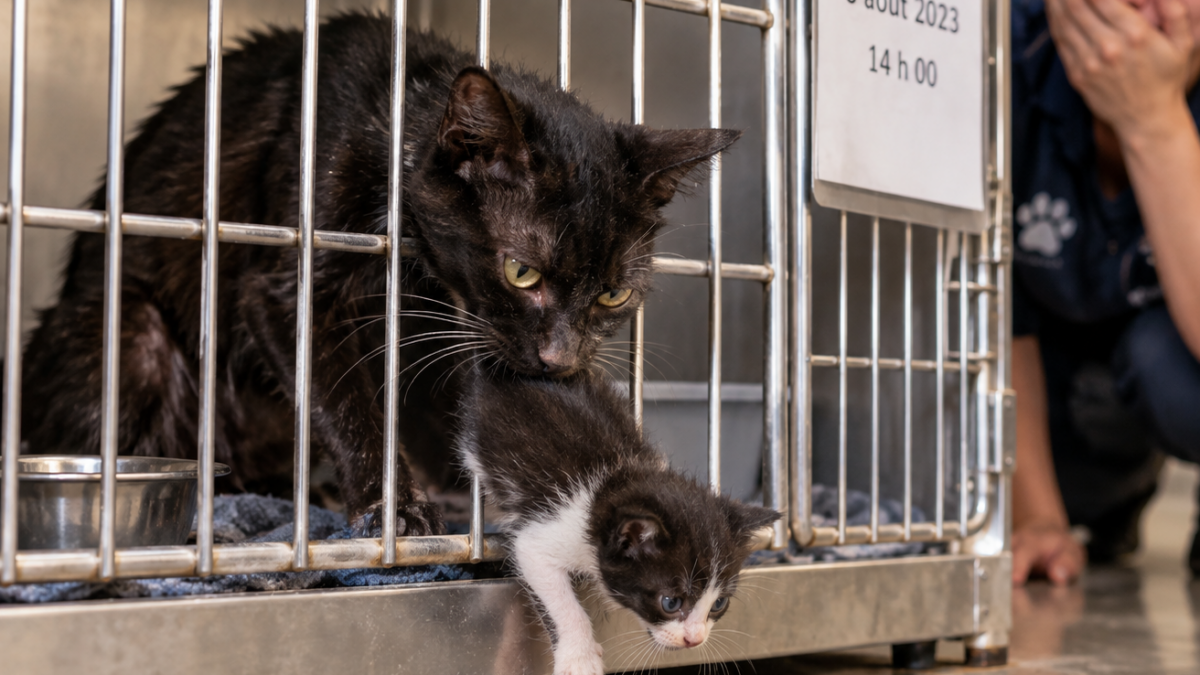
Instead, she lowered her head and gently took the kitten by the loose skin behind the neck.
Emily smiled sadly.
“There you go. Keep that baby close.”
The mother turned toward the kennel door.
Then she did something strange.
She pushed the kitten toward the bars.
Emily frowned.
The space between the vertical metal bars was narrow.
Too narrow for the mother.
But possibly wide enough for a very small kitten.
The kitten’s front paw slipped through.
Then its face.
Emily shifted closer.
“What are you doing?”
The mother adjusted her grip.
The kitten squeaked.
The mother stopped immediately.
She repositioned her mouth more gently around the kitten’s scruff.
Then she tried again.
One front leg through.
Then the other.
The kitten’s shoulders caught.
The mother pulled her back.
She waited.
Tried a different angle.
Emily’s heartbeat began to quicken.
At first she assumed the cat was simply confused.
Maybe trying to move her kitten away from the front of the kennel.
But then the mother pushed again.
Carefully.
Deliberately.
The kitten’s head went through.
Her front paws reached the outside.
Her body caught at the shoulders again.
The mother changed the angle.
Emily set the water bucket down.
She did not touch them.
She simply watched.
“Come on, little one,” she whispered.
The mother gave one final gentle push.
The kitten slipped through.
For one second, the baby dangled awkwardly between the bars.
Then she landed softly on the narrow ledge outside the kennel door.
Emily caught her before she could fall to the floor.
The kitten let out a tiny cry.
The mother immediately released her.
Emily looked down at the baby in her hands.
Then back at the mother.
“Okay,” Emily said softly. “I’ll put her back.”
She reached toward the kennel latch.
But before she opened it, she stopped.
The mother was backing away.
One step.
Then another.
Then another.
Until she reached the farthest corner of the kennel.
She sat down.
She turned toward the wall.
Emily froze.
“Mama?”
The cat did not look back.
The kitten cried again.
Still the mother remained facing the rear wall.
Emily felt something cold move through her chest.
She checked the clock mounted above the door.
1:47 p.m.
Thirteen minutes.
She looked at the mother.
Then at the kitten.
“No.”
Her voice was barely audible.
The mother did not move.
Emily’s eyes filled.
“No, no, no.”
She knew she was projecting human thoughts onto an animal.
She knew cats did not understand clocks.
They did not understand euthanasia schedules.
They did not understand shelter policy.
But this mother had spent nineteen days watching.
People opened kennels.
Animals left.
Sometimes they returned.
Sometimes they did not.
She had watched three of her own babies disappear after they died.
She had watched staff movements change that afternoon.
She had sensed stress.
Perhaps that was all.
Perhaps there was a perfectly ordinary behavioral explanation.
Emily did not care.
Because whatever the mother understood, she had done one undeniable thing.
She had moved her baby outside the cage.
Then she had gone back alone.
As if putting the kitten beyond the bars was the only thing that mattered.
Emily lifted the kitten against her chest.
The baby pressed its face into her scrub top.
The mother remained facing the wall.
Emily stood.
She walked directly toward the shelter director’s office.
She did not stop at the volunteer desk.
She did not return the water bucket.
She did not ask permission.
She opened the office door.
The director, Karen Mitchell, was on the phone.
“Yes, I understand you’re full too,” Karen was saying. “If anything changes, please call me.”
Emily stood in the doorway holding the kitten.
Karen looked up.
She saw Emily’s face.
“I have to go,” she told the rescue coordinator on the phone.
She hung up.
“What happened?”
Emily placed the kitten gently on a folded towel on the desk.
“You’re not euthanizing her.”
Karen closed her eyes.
“Emily.”
“No.”
“You know what today looks like.”
“I know.”
“We called every rescue within three counties.”
“I know.”
“We have eleven cats waiting.”
“I know.”
“And we’ve already postponed two animals.”
“I know.”
Karen studied her.
Emily wiped tears from her cheek with the heel of her hand.
“She pushed her baby out.”
Karen frowned.
“What?”
“She pushed the kitten through the bars.”
“That’s not possible.”
“I watched her do it.”
Karen looked at the tiny kitten.
Emily continued.
“She kept changing the angle until the baby fit. Then she let go, walked to the back of the kennel, sat down, and turned toward the wall.”
Karen said nothing.
Emily’s voice broke.
“She got her baby out.”
The office was silent except for the kitten’s faint mew.
Karen looked toward the clock.
1:51.
“Emily…”
“I’ll take her.”
Karen blinked.
“What?”
“I’ll foster her.”
“You already have two cats.”
“I have a spare bedroom.”
“You said your landlord—”
“He allows three.”
“She may need medical care.”
“I’ll cover it.”
“Emily.”
“I’ll pay for everything.”
Karen leaned back in her chair.
“You understand fostering a nursing mother means the kitten has to go with her.”
“Then I’ll take both.”
“You’ll need a separate room.”
“I have one.”
“She needs a veterinary recheck.”
“Fine.”
“She may have parasites.”
“I’ll handle it.”
“She may not adjust easily.”
“I don’t care.”
Karen looked at her for a long time.
Emily placed both hands on the desk.
“Please.”
The kitten cried.
Emily lowered her voice.
“I know we can’t save every animal.”
Karen looked away.
“I know.”
“But not this one.”
Karen swallowed.
Emily continued.
“Not after that.”
At 1:54 p.m., Karen picked up the phone.
She called the medical room.
“Remove C-14 from the schedule.”
A pause.
“Yes.”
Another pause.
“I said remove her.”
Emily covered her mouth.
Karen hung up.
“There.”
Emily stared at her.
“What time is it?”
Karen looked at the clock.
“1:54.”
Six minutes.
Emily began crying so hard she laughed at the same time.
“Six minutes.”
Karen nodded.
“Six minutes.”
Emily picked up the kitten.
“I think I know what we should call her mother.”
When they returned to C-14, the black cat was still sitting in the corner.
The kennel door opened.
The mother looked over her shoulder.
Emily lowered the kitten onto the blanket.
The baby immediately stumbled toward her.
The mother stood.
For the first time that afternoon, her expression seemed to change.
She rushed forward.
Not fast.
Not wildly.
But urgently.
She sniffed the kitten from head to tail.
Then she began licking the top of her head.
The baby pressed beneath her chest.
Emily crouched outside the open kennel.
“You’re coming with me,” she whispered.
The mother looked at her.
“Both of you.”
The mother was given the name Six.
Because six minutes had stood between her and the end of her life.
The kitten became One.
Because out of four newborn kittens, she was the one who survived.
That evening, Emily carried them into her apartment in a hard plastic carrier.
She prepared the spare bedroom with everything the shelter had recommended.
Litter box.
Food.
Water.
Soft bedding.
A heating pad beneath one side of the kitten’s nest.
A cardboard box turned on its side.
A low lamp.
Emily opened the carrier door.
One stepped out almost immediately.
Six did not.
For nearly fifteen minutes, the mother remained at the back of the carrier.
Her eyes moved around the unfamiliar room.
There were no barking dogs.
No metal cage doors.
No carts rolling down the hallway.
No strangers constantly passing.
Just silence.
Emily sat on the floor.
“You can stay there.”
Six watched her.
“I’m not going to pull you out.”
Emily leaned against the wall and waited.
Eventually, Six stepped onto the carpet.
She smelled the air.
Walked around the perimeter of the room.
Checked beneath the bed.
Checked behind the dresser.
Then she discovered the closet.
The door had been left slightly open.
Six went inside.
She sat facing the doorway.
One followed.
For the first night, Six refused to leave the closet except to eat.
On the second day, she allowed Emily to sit several feet away.
On the third, she ate while Emily remained in the room.
On the fourth evening, Emily awoke around 2:00 a.m. and found Six sitting in the hallway outside her bedroom.
The moment Emily moved, the cat disappeared.
On the fifth day, something changed.
Emily had been sitting cross-legged in the hallway checking emails on her phone when One toddled out of the spare bedroom.
The kitten had become adventurous.
She explored everything.
Shoes.
Chair legs.
Laundry baskets.
The bottom shelf of a bookcase.
That afternoon, she wandered into the hallway alone.
Six remained inside the closet.
One stopped.
Turned around.
Then returned.
She walked directly into the closet.
Emily could see only part of what happened.
One approached her mother.
Six lowered her head.
The kitten rubbed against her face.
For several seconds, the black cat remained completely still.
Then she curled one front leg around One.
Pulled her close.
And began nursing her.
Emily lowered her phone.
Her vision blurred.
Five days earlier, she had watched this mother apparently send her baby away.
Now Six held the kitten against her chest as though she would never release her again.
Emily wiped her cheeks.
“You thought you were saying goodbye, didn’t you?”
Six looked toward her.
Emily smiled through tears.
“You don’t have to anymore.”
Over the next two weeks, Six slowly changed.
She began sleeping outside the closet.
She discovered sunlight.
Every morning around ten, a rectangle of warm light appeared on the bedroom rug.
Six would lie in it while One climbed over her stomach.
She learned the sound of the refrigerator opening.
She learned Emily kept treats in a glass jar.
She learned that a washing machine was loud but harmless.
She learned that footsteps in the hallway did not mean her cage was about to open.
She learned that doors could open without something terrible happening.
Most importantly, she began to relax.
One afternoon, Emily reached toward her.
Six did not pull away.
Emily touched two fingers to the top of her head.
The cat closed her eyes.
Emily barely breathed.
She stroked her again.
Six leaned forward.
Only slightly.
But enough.
When Six returned to the shelter for her veterinary check, several staff members came to see her.
They could hardly believe it was the same animal.
She had gained weight.
Her coat looked healthier.
Her eyes were brighter.
One had become a fearless little kitten who attacked shoelaces, climbed pant legs, and treated every cardboard box as private property.
The veterinarian examined the hairless patch on Six’s nose.
“It looks like friction,” she said.
Emily frowned.
“From what?”
“Could’ve been rubbing against fencing. Wire. Kennel bars. Something repetitive.”
Emily looked at Six.
The cat stared through the open exam-room door.
Searching for exits.
Emily’s chest tightened.
No one knew where Six had lived before she arrived at the shelter.
No one knew how long she had been outside.
No one knew whether she had once belonged to someone.
Maybe she had been trapped somewhere.
Maybe she had spent days pushing her nose through fencing.
Maybe she had been trying to protect her kittens.
There was no way to know.
But the bald patch became one more piece of a life no one could fully reconstruct.
A month after the rescue, photographs of Six were posted online.
The shelter used simple language.
Quiet adult female.
Gentle.
Needs a patient home.
Would do best with someone who understands shy cats.
Emily worried no one would respond.
One received multiple applications within days.
Six received none.
That was the pattern they had expected.
Everyone wanted the playful kitten.
Few people asked about the thin black mother who hid when strangers entered the room.
Then a woman named Helen came to the shelter.
She was sixty-two.
She had been widowed two years earlier.
She lived alone in a small house with a screened porch.
Her previous cat had died at eighteen.
She did not want a kitten.
“I’m too old for curtains being climbed,” she told Karen.
Karen laughed.
“What are you looking for?”
Helen thought about it.
“Someone quiet.”
Karen nodded.
“Independent?”
“Maybe.”
“Lap cat?”
“Doesn’t have to be.”
“Playful?”
“Not important.”
Karen studied her.
Helen glanced toward the cat room.
“I guess I want an animal that understands silence.”
Karen stopped smiling.
“I think I know one.”
When Helen met Six, the cat did not walk toward her.
She did not rub against the bars.
She did not purr.
She sat in the back of the adoption room beneath a chair.
Helen sat on the floor several feet away.
For twenty minutes, she did nothing.
No baby talk.
No reaching.
No treats.
She simply sat.
Eventually, Six walked out.
She stopped halfway between the chair and Helen.
Helen extended one hand.
Six sniffed her fingers.
Then walked away.
Karen expected Helen to be disappointed.
Instead, she smiled.
“That’s her.”
“You’re sure?”
“She came halfway.”
Karen laughed softly.
Helen shook her head.
“You don’t understand.”
Her eyes filled.
“My husband was sick for almost three years before he died. After that, people kept telling me I needed to move on.”
Karen listened.
Helen looked at Six.
“I hated that phrase.”
Six sat near the wall.
Helen continued.
“Sometimes halfway is enough.”
The adoption was approved.
Emily cried when Six left.
She had known from the beginning that fostering meant goodbye.
Still, she carried Six’s carrier to Helen’s car herself.
Before closing the door, she whispered, “You made it.”
Six looked back at her through the carrier grate.
The same kind of barrier she had once pushed her baby through.
But this time she was on the side that was leaving.
Alive.
One was adopted soon afterward by a young couple with a nine-year-old daughter.
The girl had fallen in love with her photograph.
She renamed none of the animals.
“She survived as One,” the girl said. “That should stay her name.”
The staff agreed.
Months passed.
Emily stayed in contact with both families.
Helen sent photographs of Six sleeping beside windows.
Six sitting on the screened porch.
Six curled beside Helen on the couch.
Six watching birds.
Six stealing chicken from a plate when Helen looked away.
In almost every photograph, the little bald patch remained visible on her nose.
It became less noticeable as the surrounding fur filled in.
But it never disappeared completely.
One grew into a sleek black-and-white cat with enormous green eyes and far too much confidence.
She slept in the little girl’s bed.
Chased toy mice through the hallway.
Sat on homework.
Attacked Christmas wrapping paper.
Once, she climbed halfway up the family’s artificial Christmas tree and had to be removed while everyone laughed.
Eventually, Emily asked both families whether they would be comfortable letting Six and One see each other again.
Everyone agreed.
The reunion happened at Helen’s home.
Emily came too.
She was nervous.
Part of her imagined an emotional recognition.
The mother running toward the kitten.
The kitten crying.
Some dramatic moment that would make everyone in the room burst into tears.
That was not what happened.
One entered the room in her carrier.
Six sat on the windowsill.
The carrier door opened.
One walked out.
Six looked at her.
One looked at Six.
For several seconds, neither moved.
Then One explored the room.
Six jumped down.
She approached.
They sniffed each other.
One flicked her tail.
Six walked around her once.
Then she sat several feet away.
Emily waited.
Nothing dramatic happened.
No crying.
No desperate reunion.
No frantic grooming.
Six simply watched.
Quietly.
Peacefully.
Helen looked disappointed.
“Do you think she remembers?”
Emily studied the black cat.
Six’s posture was relaxed.
Her eyes followed One as the younger cat investigated a basket near the fireplace.
“I don’t know,” Emily said.
That was the truth.
She would never pretend to know exactly what an animal thought.
Then One climbed onto the couch.
Six jumped up beside her.
For perhaps thirty seconds they sat close together.
Their shoulders almost touching.
Then One jumped down.
Six remained.
Emily smiled.
“I think that might be enough.”
The visits continued occasionally.
Every few months, One’s family brought her over.
The two cats never behaved like a human mother and daughter reunited after a long separation.
They did not need to.
Six watched.
One explored.
Sometimes they shared a patch of sunlight.
Sometimes they slept several feet apart.
Sometimes they ignored each other completely.
And every time One left, Six remained calm.
No pacing.
No searching.
No crying at the door.
It was almost as if the mother who had once spent every second protecting her final kitten had accepted something important.
The baby was safe.
She had food.
She had warmth.
She had people.
She had a life.
The job was finished.
Years later, Emily would still remember August 8.
Not because of the paperwork.
Not because of the overcrowding.
Not even because of the six-minute rescue.
She remembered the moment before all of that.
1:47 p.m.
The metal kennel.
The tiny kitten squeezing between the bars.
The black mother stepping backward.
One step.
Two steps.
Three.
Then turning toward the wall.
Emily never claimed to know what Six understood.
Maybe she understood nothing about the euthanasia schedule.
Maybe she had simply heard unusual sounds.
Maybe instinct told her to move her kitten.
Maybe it was coincidence.
Maybe people had placed meaning on an ordinary feline behavior because they needed meaning in a terrible moment.
All of that was possible.
But Emily also knew what she had seen.
A starving mother who had lost three babies had spent nineteen days protecting the only one she had left.
And in the final minutes before humans had decided her life would end, that mother used every bit of patience she had to maneuver her kitten through an opening she herself could never fit through.
She did not follow.
She did not try to escape.
She put the kitten outside.
Then she went back alone.
For Emily, that was enough.
Years later, whenever someone asked why the black cat was named Six, Emily told them.
“She had six minutes.”
But that was only half the story.
Six had once spent days rubbing her nose against barriers hard enough to leave a permanent patch where the fur never completely returned.
Perhaps she had been searching for a way out.
Perhaps she had always been searching.
In the shelter, she finally found an opening.
It was too small for her.
So she gave it to her baby.
And somehow, in doing that, she saved them both.








