A Mother Cat Survived a House Fire With Half Her Face Burned Away—Then the Vet Realized She Had Used Her Body to Shield Two Newborn Kittens
PART3:
Daniel raised one hand.
“Something moved.”
The investigator turned his light toward the tub.
For several seconds, none of them spoke.
There was an animal inside.
A cat.
She was crouched low against the far end of the bathtub, motionless except for the shallow movement of her chest.
At first Daniel could not understand what he was seeing.
One side of her body looked almost normal.
The other looked like it belonged to a different animal.
“Oh, God,” Marcus whispered.
Daniel stepped closer.
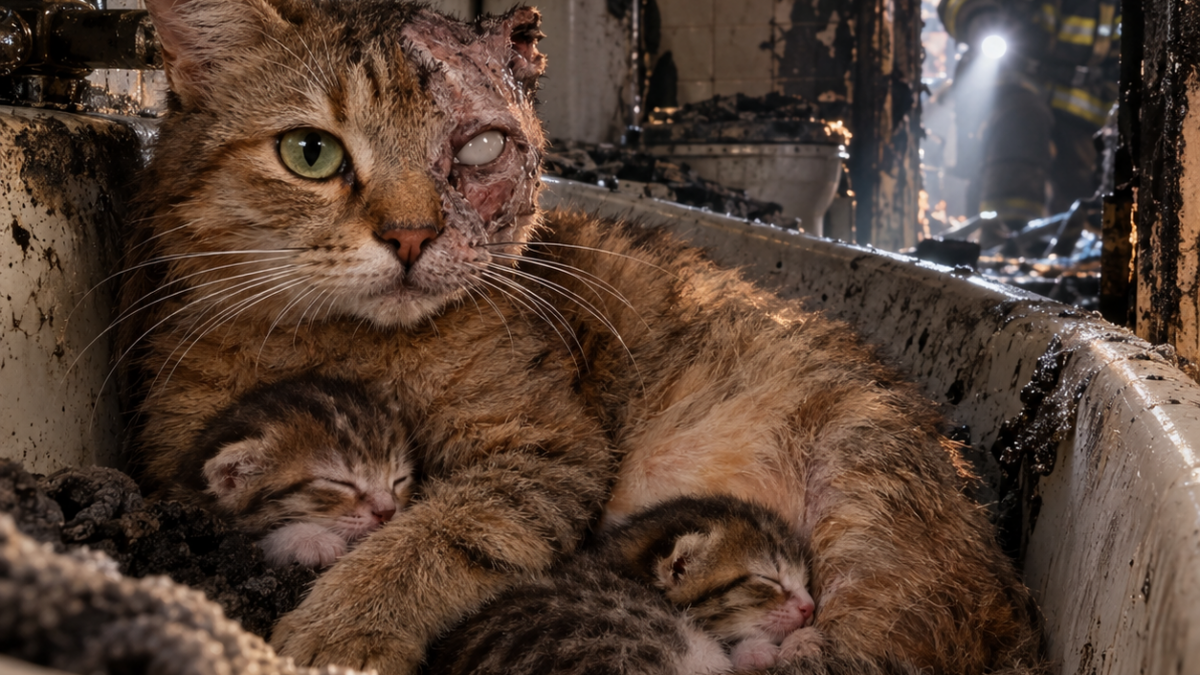
The cat was a copper-colored tabby, perhaps three or four years old, though her condition made age difficult to judge.
The left half of her face was striking.
Amber and copper fur.
Long white whiskers.
One bright green eye.
The right side was devastated.
The fur had burned away from the side of her face and down toward her shoulder.
The right ear was badly damaged, curled inward and darkened.
Her right eye was cloudy and pale.
Most of the whiskers on that side were gone.
The exposed skin looked swollen and blistered.
Daniel had seen burned animals before.
He knew enough to understand immediately that she needed help.
Then he heard a sound beneath her.
A tiny squeak.
Daniel’s eyes dropped.
“Wait.”
He leaned closer.
Another squeak.
The cat shifted slightly.
Two tiny shapes were underneath her body.
Kittens.
Marcus stared.
“No way.”
Daniel reached for his radio.
“We have live animals. Adult cat, injured. Two neonate kittens. We need animal control and veterinary transport now.”
The mother cat did not run.
She could have tried.
The bathroom door was open.
The firefighters had not blocked her path.
But when Daniel stepped closer, she lowered her body over the kittens.
Not aggressively.
Protectively.
Even now.
Even after the fire was gone.
Daniel crouched beside the bathtub.
“Easy, mama.”
The cat watched him with her single clear green eye.
“You’re okay.”
He knew she was not.
But he said it anyway.
“You did good. Nobody’s touching your babies.”
Marcus moved around to the other side.
Daniel slowly extended a gloved hand.
The cat did not hiss.
She did not swipe.
She barely had the strength.
When Daniel touched the unburned side of her neck, her body felt cold.
Far too cold.
Yet when one of the kittens crawled against her abdomen, the tiny body felt surprisingly warm through his glove.
Daniel frowned.
“That doesn’t make sense.”
Marcus looked at him.
“What?”
“She’s freezing.”
Daniel carefully lifted the edge of her body enough to see the kittens.
They were perhaps ten days old.
Eyes barely open.
Small enough to fit in his palm.
Neither appeared burned.
No singed fur.
No obvious injuries.
Nothing.
Marcus stared at the ruined right side of the mother cat.
Then at the kittens.
“How?”
Daniel did not answer.
He did not know.
Animal control arrived with transport carriers and thermal blankets.
Moving the mother cat was difficult.
She refused to leave the kittens.
Every time someone tried to lift her separately, she turned and reached toward them.
Eventually they placed all three together in a padded crate.
The moment the kittens were against her stomach again, she stopped struggling.
Daniel stood beside the truck as the crate was loaded.
Inside, the mother lowered her head over the kittens.
The burned side of her face faced the carrier door.
The intact side touched her babies.
Daniel noticed that.
He would remember it later.
At the time, he simply thought she was trying to shield them from strangers.
Green Valley Veterinary Hospital was twenty-eight minutes away.
Dr. Michael Avery was already waiting when they arrived.
He had received the call from animal control and prepared the emergency treatment area before the transport van pulled in.
The moment the carrier door opened, his expression changed.
“Mother first,” he said.
Two technicians moved carefully.
The kittens cried when they were separated.
The mother tried to lift her head.
“We’ll keep them where she can see them,” Dr. Avery instructed.
The kittens were placed together beneath warm blankets only a few feet away.
Then the team began examining the mother.
Temperature.
Pulse.
Respiration.
Oxygenation.
Burn depth.
Eye damage.
Hydration.
Her body temperature was approximately 93 degrees Fahrenheit—around 34 Celsius.
Dangerously low.
One technician looked confused.
“She was in a house fire.”
Dr. Avery nodded grimly.
“Shock. Fluid loss. Exposure after the fire. Severe burns can destroy temperature regulation.”
They started warmed intravenous fluids.
Pain medication.
Oxygen.
Antibiotics.
The burned skin was gently cleaned.
The right eye was examined.
Dr. Avery stared into it for several seconds before shaking his head.
“Cornea’s gone.”
“Any chance of vision?”
“No.”
The right ear had suffered severe thermal injury.
Part of it had effectively folded in on itself from damaged tissue.
The skin from her cheek down toward the shoulder was badly burned.
But when he examined the kittens, the room became strangely quiet.
One weighed just over nine ounces.
The other slightly less.
Both were hydrated enough to surprise him.
Both had normal coloration.
Both were breathing well.
Their temperatures were close to normal for kittens of that age.
No burns.
No smoke damage obvious enough to cause immediate concern.
No singed whiskers.
No damaged paw pads.
Nothing.
Dr. Avery checked them twice.
Then he looked again at the mother.
The injuries were almost entirely concentrated on her right side.
The left side was remarkably preserved.
Not perfect.
She had inhaled smoke.
Several whiskers were singed.
There was soot through her coat.
But compared with the right side, the contrast was startling.
One of the technicians, Lauren, finally said what everyone was thinking.
“How could they be untouched?”
Dr. Avery did not answer immediately.
He walked around the exam table.
He looked at the mother from the left.
Then the right.
He asked animal control where she had been found.
“In the bathtub,” the officer said.
“What position?”
“Back end of the tub. Kittens underneath.”
“Which side faced the door?”
The officer frowned.
“I don’t know.”
Dr. Avery picked up the phone.
He called the fire department.
Daniel answered.
“This is Dr. Avery at Green Valley Vet. I’ve got the cat from the Benton fire.”
“How is she?”
“Alive. Critical but stable for now.”
Daniel exhaled.
“The babies?”
“Shockingly good.”
“Yeah. We couldn’t understand that.”
“That’s why I’m calling.”
Dr. Avery looked at the cat.
“When you found her, which side of her body was facing the bathroom door?”
Daniel was quiet.
Then he remembered.
“Right side.”
“You’re sure?”
“Yeah.”
“And the kittens?”
“Under her, mostly tucked against the back of the tub.”
Dr. Avery’s eyes moved to the mother’s intact left side.
“Where did the fire enter the bathroom?”
“The doorway.”
“From which direction?”
Daniel thought.
“The hallway was burned worst along the right wall. So the heat would’ve come through that doorway from her right.”
Dr. Avery said nothing.
Daniel waited.
“Doc?”
“I think I know what happened.”
“What?”
Dr. Avery lowered the phone slowly.
Lauren looked at him.
“What is it?”
He walked to the chair beside the treatment table and sat down.
For several seconds, he stared at the floor.
No one interrupted him.
Veterinary medicine teaches people to stay functional around suffering.
There is always something to do.
Another dose.
Another dressing.
Another blood pressure.
Another emergency.
You learn not to stop too often because if you stop, emotion catches you.
Dr. Avery stopped anyway.
Lauren stepped closer.
“Michael?”
He looked at the cat.
“She faced it.”
“What?”
“The fire.”
Lauren followed his gaze.
Dr. Avery pointed toward the burned half of the cat’s body.
“The doorway was on her right. That’s where the flames and radiant heat entered.”
Then he pointed toward the intact side.
“This side was against the kittens.”
Lauren covered her mouth.
Dr. Avery continued, quieter now.
“She put herself between them and the fire.”
No one said anything.
The mother cat lay under a warming blanket, barely conscious.
The kittens slept nearby in a heated incubator.
Dr. Avery looked at their perfect fur.
Their tiny ears.
Their unburned skin.
Then back at the mother.
“She stayed facing it.”
Lauren’s eyes filled.
“For how long?”
“I don’t know.”
Later, after the fire investigator reconstructed the timeline, they estimated the bathroom had been exposed to extreme heat for a prolonged period—possibly hours between the initial spread of the fire, active suppression, cooling, and the discovery the following morning.
The bathtub had probably saved all three of them.
Porcelain and tile offered less combustible material than the rest of the house.
The tub itself provided partial shelter from falling debris.
Water sprayed during firefighting may have cooled the room.
But none of those things fully explained the kittens.
Kittens ten days old cannot regulate their body temperature effectively.
They are fragile.
They should not have survived that level of heat, smoke, and disruption without severe injury.
Yet their body temperatures were nearly normal.
The mother’s was dangerously low.
That detail bothered Dr. Avery more than anything.
He returned to the treatment room several times that afternoon.
Each time, the mother was positioned the same way.
Whenever the kittens were brought near her for supervised nursing, she turned her injured side outward.
Her intact side remained against them.
It seemed instinctive.
The same orientation she had apparently maintained in the bathtub.
Toward danger with the injured side.
Toward her babies with the safe side.
Daniel came to the clinic after his shift.
He had changed out of his turnout gear, but he still smelled faintly of smoke.
Dr. Avery met him in the hallway.
“You were right,” Daniel said before the veterinarian spoke.
Dr. Avery frowned.
“About what?”
“I went back.”
Daniel held out his phone.
He had taken photographs during the daylight inspection.
One showed the bathroom doorway.
The burn pattern was unmistakable.
The door frame on the right was deeply charred.
Tile near that side had heat damage.
The opposite side of the tub was significantly less affected.
“She was in the far corner,” Daniel said.
He pointed.
“Right side toward this.”
Dr. Avery looked at the photograph.
Daniel swiped to another.
Dark soot formed a rough outline along the bathtub wall where the cat had been found.
“I talked to the investigator,” Daniel said. “He thinks the fire reached the hall sometime before midnight. We didn’t knock it down until after three.”
Dr. Avery looked up sharply.
“She could have been there for three hours?”
“Maybe longer.”
The veterinarian stared through the window at the treatment room.
The mother cat was asleep.
“She could have left,” Daniel said.
Dr. Avery nodded.
“The door was open.”
“Partly.”
“Enough for a cat?”
Daniel gave a humorless little laugh.
“Easily.”
Neither man spoke for a while.
Daniel finally said, “I kept thinking maybe she was trapped.”
“No.”
“No.”
The kittens began to cry.
The mother lifted her head despite the pain medication.
That movement cost her.
Everyone could see it.
She turned toward the sound.
Lauren brought the kittens closer.
The moment they touched her uninjured side, the mother stopped trying to move.
Daniel swallowed hard.
“Damn.”
Dr. Avery glanced at him.
Daniel shook his head.
“I’ve seen people freeze in fires. I’ve seen people run the wrong direction. Panic does things to you.”
He looked at the cat.
“She stayed.”
The next seventy-two hours were uncertain.
Burn injuries are deceptive.
The first appearance does not always reveal the full depth of tissue damage.
Skin can worsen as circulation fails.
Smoke inhalation can cause delayed complications.
Infection becomes a constant threat.
Fluid loss is dangerous.
Pain management has to be balanced carefully in an already unstable patient.
For the first night, a technician remained in the room with the mother almost constantly.
The shelter did not yet know what to call her.
Her elderly owner, Harold, was contacted through his daughter.
He had owned the property, but when shown a photograph, he explained the cat was not actually his.
“She showed up under my shed last winter,” he said.
“Wouldn’t let me touch her for months.”
Harold’s daughter held the phone near him in the rehabilitation center.
“Did she have kittens before?” the animal control officer asked.
“No.”
“Was she living inside the house?”
“Started coming inside around spring.”
“What did you call her?”
Harold was quiet.
“Copper.”
The name fit.
Before the fire, her coat had been a deep copper-brown tabby pattern.
Harold’s voice shook when they told him she had survived.
“The babies too?”
“Yes.”
“All of them?”
“Both kittens are alive.”
He began crying.
His daughter took the phone.
“He’s been asking about her since you called.”
The officer hesitated.
“Her injuries are serious.”
“I understand.”
“The right side of her face is badly burned.”
Harold’s daughter lowered her voice.
“My father’s not going back to that house. It’s a total loss.”
“We know.”
“And his health… he can’t care for a recovering cat.”
“We understand.”
“Please don’t let anything happen to her because of that.”
“No one’s planning to.”
“Promise me.”
The officer looked through the glass at the mother.
“I promise.”
The next morning, Harold insisted on seeing a photograph.
His daughter tried to prepare him.
He waved her off.
“Show me.”
She held the phone out.
Harold stared.
His expression collapsed.
“Oh, Copper.”
He touched the screen.
The photograph showed the astonishing divide clearly.
Beautiful copper fur on the left.
Burned skin and missing fur on the right.
One green eye.
One white damaged eye.
His daughter sat beside him.
“She protected the babies.”
Harold looked at her.
“What?”
“The vet thinks that’s why the injuries are only on one side.”
She explained.
Harold stared at the photo for a long time.
Then he covered his face with both hands.
“I should’ve taken her with me.”
“Dad.”
“I should’ve taken her.”
“You didn’t know there would be a fire.”
“She had those babies under my bathroom sink. I knew they were there.”
“You were only supposed to be gone a few days.”
Harold shook his head.
“I left food. Water.”
“You did everything you thought you needed to do.”
“I should’ve taken them.”
His daughter rested a hand on his shoulder.
Harold looked at the photograph again.
“She always slept facing the bedroom door.”
“What?”
“That cat.”
He wiped his eyes.
“Once she finally trusted me enough to sleep inside, she always picked a place where she could see the door.”
That detail eventually reached Dr. Avery.
He never forgot it.
Copper underwent the first of several procedures during the following days.
Dead tissue had to be carefully removed.
The damaged ear could not be saved completely.
Her right eye was permanently blind.
For a time, there was concern the eye itself might need to be removed, but as swelling decreased, the veterinary team decided it could remain if it stayed comfortable and free from chronic infection.
Its appearance changed.
The clear green vanished beneath a white, opaque cornea.
The injured ear contracted as it healed, leaving only a small folded remnant.
Most of the right side of her face never regrew hair.
The skin healed smooth and pale in some areas, darker and textured in others.
She looked, as one technician quietly said, like someone had drawn a line down the center of her face separating before from after.
The kittens remained untouched.
They were temporarily bottle-supplemented because their mother needed procedures and rest, but Copper refused to stop caring for them.
When she was alert enough, she called to them.
When they were returned to her, she washed them obsessively.
If one squeaked, her single functioning eye opened instantly.
Dr. Avery once watched her attempt to stand only eighteen hours after a painful bandage change because one kitten had crawled just beyond the edge of her bedding.
He gently pushed her back down.
“No.”
Copper tried again.
“No, ma’am.”
She stared at him.
“You nearly died for them. You’re allowed to lie down for five minutes.”
Lauren laughed softly.
“She doesn’t agree.”
“No, she doesn’t.”
They began calling the kittens Ember and Ash.
Not because either was burned.
Precisely because they were not.
Ember was female, the slightly larger of the two, with copper markings around her face.
Ash was male, gray-brown with a white chest.
At two weeks old, they opened their eyes fully.
At three weeks, they began attempting to walk.
At four, they discovered that bedding existed primarily to be climbed.
By five weeks, they had turned Copper’s recovery enclosure into a playground.
They attacked her tail.
Climbed over her back.
Bit her paws.
Pounced on bandages they were not supposed to touch.
She tolerated everything.
Once, Ash launched himself from a folded blanket directly onto the uninjured side of her face.
Lauren gasped.
Copper simply closed her eye and waited until he slid off.
“You are the most patient creature I’ve ever met,” Lauren told her.
Copper began purring.
The sound was rough and low.
It was the first time anyone at the clinic had heard it.
News of the cat from the fire began spreading locally.
At first, Dr. Avery resisted publicity.
She was still critical.
He did not want her turned into a feel-good story while there was still a chance she could decline.
But volunteer firefighters had talked about the discovery, and someone posted a photograph of the bathroom.
Soon local residents were asking about “the mama cat.”
Donations arrived.
Burn ointment.
Blankets.
Money toward veterinary bills.
One elementary school sent forty-three handmade cards.
Many showed cats standing in front of cartoon flames with capes on.
Dr. Avery taped several to the wall near Copper’s recovery area.
One card, written in large crooked letters, said:
YOU ARE STILL BEAUTIFUL.
Lauren cried when she read it.
Copper did not care.
She tried to eat the corner.
Weeks passed.
Healing was slow.
The kittens grew quickly.
The contrast became harder for staff to ignore.
Ember and Ash became round, glossy, playful little creatures.
Copper remained bandaged.
Then partially bandaged.
Then scarred.
Every ounce of suffering seemed to have landed on her while the babies carried no visible evidence at all.
At eight weeks old, the kittens were medically cleared for adoption.
That day was more emotional than anyone expected.
A family with two teenage children adopted Ember.
A young couple adopted Ash.
Both families had been told the full story.
Both understood the kittens had survived because of extraordinary circumstances.
They were also asked whether they would be comfortable maintaining occasional contact if Copper’s future adopter wanted updates.
Both said yes.
When Ember left, Copper watched the carrier from her bed.
Lauren sat with her.
“I know.”
Copper’s eye remained fixed on the door.
“You kept her alive so she could leave.”
The door closed.
Copper looked around.
Then settled.
When Ash left two days later, she watched again.
He cried from inside his carrier.
Copper answered once.
One short sound.
Then the carrier disappeared down the hallway.
Lauren expected Copper to search.
She did not.
She ate dinner.
She washed her left front paw.
Then she slept.
It was as if the work had been completed.
The babies were strong enough to go into the world.
That was all.
Copper’s own recovery lasted fourteen weeks.
Fourteen weeks of dressings.
Medication.
Laser therapy.
Debridement.
Eye checks.
Pain management.
Careful grooming around scar tissue.
Nutrition designed to help her body rebuild what it could.
And patience.
So much patience.
During that period, she stopped being Copper.
Not officially at first.
The new name came from a foster volunteer named Megan Torres.
Megan had agreed to take Copper home once she was stable enough to leave the clinic but still required regular veterinary care.
The first time Megan saw her, she stood in the exam room and stared.
Copper turned her head.
From the left, she looked almost untouched by the fire.
Beautiful copper stripes.
Green eye.
Long white whiskers.
Full ear.
Then she turned the other direction.
White eye.
Scarred skin.
Missing fur.
Collapsed ear.
Megan whispered, “It’s like two different cats.”
Lauren smiled sadly.
“We’ve heard that.”
Megan crouched.
Copper approached cautiously.
“Half angel, half warrior.”
Dr. Avery glanced up from the chart.
“That sounds dramatic.”
Megan stroked the left side of Copper’s face.
“What about Half?”
Dr. Avery looked at the cat.
“Half?”
“Not because half of her is missing.”
Megan’s voice softened.
“Because you have to see both halves to understand her.”
The name stayed.
Half.
In Megan’s house, Half had her own quiet room overlooking a backyard.
At first she slept beneath the bed.
Then beside the bed.
Then on it.
She preferred the left side.
Always.
Megan noticed this within the first week.
No matter how she arranged the blankets, Half chose the left side of the mattress.
She would curl with her scarred right side facing upward and her functioning left eye angled toward the bedroom door.
The first few times, Megan thought it was coincidence.
Then she moved the bed.
Half adjusted.
Same position.
Scarred side exposed.
Good eye watching the entrance.
Megan mentioned it during a veterinary follow-up.
Dr. Avery leaned back.
“She was found with her right side toward the fire.”
Megan nodded.
“And her good eye toward the kittens?”
“Essentially.”
Megan looked down at Half inside the carrier.
“She’s still doing it.”
Dr. Avery was quiet.
Half had developed another habit too.
Whenever someone new entered the room, she moved between that person and the nearest smaller animal.
Megan had two older cats of her own.
Half did not immediately bond with them, but if one was sleeping and the doorbell rang, Half would often position herself where she could see both the doorway and the resting cat.
It was subtle.
Megan was careful not to turn every movement into mythology.
Animals develop patterns for countless reasons.
Fear.
Habit.
Comfort.
Conditioning.
Instinct.
Still, once you knew her history, it was hard not to notice.
Half always seemed to know where the exits were.
Always seemed to know where everyone else was.
Always chose the outer edge of a group rather than the protected center.
Months into her recovery, a woman named Evelyn Carter saw Half’s photograph online.
Evelyn was fifty-eight and lived forty minutes from Megan’s foster home.
She had not been looking for a cat.
At least that was what she told herself.
Her last cat, Grace, had died the previous year after sixteen years together, and Evelyn had decided she was not ready for another.
Then Half’s photograph appeared on her screen.
She almost scrolled past.
Not because the injuries disturbed her.
Because the photograph hurt in a different way.
Half was sitting sideways.
Her beautiful left profile faced the camera.
The burn scars were still visible along the opposite edge.
The caption explained the fire.
The bathtub.
The kittens.
The fourteen weeks of treatment.
Evelyn read the post twice.
Then a third time.
At the bottom was one sentence.
Half is not yet available for adoption, but she welcomes quiet visitors during recovery.
Evelyn closed the app.
Ten minutes later, she opened it again.
The following Saturday, she drove forty minutes to meet Half.
Megan expected the visit to last maybe half an hour.
Evelyn stayed two.
She sat on the floor without trying to touch the cat.
Half remained on the windowsill.
Evelyn talked anyway.
Not baby talk.
Not the exaggerated sweetness people sometimes use around injured animals.
She told Half about Grace.
“I had another cat,” she said.
Half’s ear turned slightly.
“She was bossy.”
Megan smiled from the doorway.
“She’d scream at me if dinner was three minutes late.”
Half looked outside.
“She slept on my pillow even though she had six beds.”
Evelyn laughed to herself.
“When she died, everybody told me I should get another one.”
She paused.
“I hated that.”
Half turned her head slightly.
“As if you replace one life with another.”
The room was quiet.
“I don’t need you to replace anybody.”
Half jumped down from the windowsill.
She walked past Evelyn.
Did not stop.
Then walked back.
She sniffed Evelyn’s sleeve.
Evelyn did not move.
Half sat three feet away.
Megan smiled.
“That’s actually pretty good.”
Evelyn looked at her.
“Really?”
“She usually stays across the room for first meetings.”
Evelyn returned the next Tuesday.
Then Saturday.
Then Wednesday.
The drive was forty minutes each way.
Sometimes traffic made it almost an hour.
She kept coming.
Twice a week.
Every week.
At first, Half barely touched her.
Then she allowed one stroke down the back.
Then two.
Eventually she began approaching when Evelyn entered.
One evening, Evelyn sat on the sofa while Half slept on the opposite cushion.
Without warning, the cat stretched one paw across the gap and rested it against Evelyn’s leg.
Evelyn froze.
Megan whispered from the kitchen, “Don’t move.”
“I wasn’t planning to.”
They stayed that way for nearly twenty minutes.
Afterward Evelyn cried in her car.
She did not know exactly why.
Maybe because Half had chosen contact.
Maybe because trust from an animal that had every reason to fear the world felt like something you should never take lightly.
Or maybe because Evelyn understood what scars did to the people carrying them.
She knew something about being looked at differently.
Seven years earlier, her husband had died unexpectedly of an aneurysm.
For months afterward, people spoke to her in the softened voices reserved for the bereaved.
Then eventually they stopped asking.
Life moved on around her.
She returned to work.
Paid bills.
Bought groceries.
Went to birthdays.
Smiled when expected.
On one side, she looked fine.
On the other, there was damage nobody could see.
Half’s face made sense to her.
Not because Evelyn believed pain should be romanticized.
She hated when people called suffering beautiful.
There was nothing beautiful about what the fire had done.
The beauty was in what Half had chosen despite it.
There was a difference.
At every follow-up appointment, Half improved.
Her weight returned.
Her coat grew thick everywhere it could.
The scar tissue softened.
She learned to compensate perfectly for vision loss on the right.
Her balance normalized.
The remaining ear worked well enough.
Dr. Avery eventually declared her fully recovered.
“As recovered as she’s going to be.”
Megan smiled.
“That means adoption?”
“It means adoption.”
Word spread quickly.
Half had become locally known.
Applications arrived.
Some were excellent.
Megan should have been thrilled.
Instead, she felt protective.
There were people who wanted Half because of the story.
People who called her “the fire cat.”
People who asked whether she could appear at events.
One applicant mentioned starting a social media account for her.
Megan understood they might mean well.
But Half was not a symbol first.
She was a cat.
A quiet cat.
A cat who hated sudden movement.
A cat who slept deeply only when the house was calm.
A cat who had already paid enough for a story.
Megan wanted someone who wanted Half when nobody was watching.
Evelyn never submitted an application.
That confused her.
Finally, during one visit, Megan asked.
“You know she’s cleared, right?”
Evelyn was sitting beside Half on the couch.
“I know.”
“You’ve been coming here for months.”
“I know.”
“You drive forty minutes.”
“Forty-three if traffic behaves.”
Megan smiled.
“So why haven’t you applied?”
Evelyn looked down at Half.
The cat’s head rested against her thigh.
“I’m scared.”
“Of what?”
“That I’m choosing her because of what happened.”
Megan sat across from her.
“What’s wrong with that?”
“I don’t want to make her scars the reason she matters.”
Megan’s expression softened.
Evelyn continued.
“I don’t want to be the person who takes home the famous injured cat because her story makes me feel noble.”
Half opened her eye.
Evelyn stroked beneath her chin.
“I’ve been trying to figure out whether I want the story or whether I want her.”
“And?”
Evelyn smiled.
“The story got me through the door.”
She looked at Half.
“But this stubborn little woman is why I keep coming back.”
Megan laughed.
Half began purring.
Evelyn took a breath.
“I want to apply.”
Megan’s eyes immediately filled.
“Good.”
The adoption interview happened three days later.
It was mostly a formality.
Evelyn owned her home.
No other animals.
Quiet neighborhood.
Financially stable.
Veterinary references.
Safe indoor environment.
The adoption coordinator asked the standard question.
“Why Half?”
Evelyn hesitated.
Then said the words that eventually appeared in the shelter newsletter.
“I didn’t want a beautiful cat.”
The coordinator looked up.
Evelyn smiled.
“That came out wrong.”
She thought again.
“I mean, I wasn’t looking for perfection.”
She looked through the glass where Half sat on the windowsill, good eye fixed on the room.
“I wanted the one who understood what mattered when it cost her everything.”
The coordinator said nothing.
Evelyn continued.
“She had an open door.”
A pause.
“She could’ve run.”
Another pause.
“She could’ve come out of that house looking exactly the way she did before.”
Her voice became quieter.
“But she stayed.”
The coordinator wiped beneath one eye.
Evelyn looked embarrassed.
“I know she’s a cat. I know we can’t know exactly what she thought.”
“No.”
“But whatever instinct told her to protect those babies…”
She looked toward Half.
“She paid for it with her face.”
The adoption was approved.
Megan prepared Half’s belongings.
Her favorite fleece blanket.
Food.
Medication records.
A small felt mouse she had ignored for four months but carried around obsessively during the final week.
Evelyn arrived with a new carrier and cried before Half was even inside it.
“I’m ridiculous.”
Megan hugged her.
“You’re not.”
“I’ve been here twice a week for seven months. You’d think I’d be less emotional.”
“That’s why you’re emotional.”
Before the carrier door closed, Megan crouched.
Half looked at her.
“Listen.”
Megan touched the intact side of her face.
“You don’t have to guard anybody anymore.”
Half blinked.
“You hear me?”
Another blink.
“You get to be the one protected now.”
Evelyn looked away because she was crying again.
The drive home took forty-six minutes.
Half complained for the first twelve.
Then she became silent.
At Evelyn’s house, the carrier was placed in the bedroom and opened.
Half did not come out.
Evelyn sat on the floor.
“I know.”
Half watched her.
“This is a lot.”
An hour passed.
Evelyn read a book.
Eventually Half stepped out.
She sniffed the rug.
The dresser.
The wall.
The window.
Then she climbed onto the bed.
Evelyn held her breath.
Half walked across the comforter.
Turned in a circle.
Lay down on the left side.
Burned side facing upward.
Green eye toward the bedroom door.
Evelyn stared.
“You really do that.”
Half closed her eye.
That night, Evelyn expected Half to hide.
Instead, sometime around 2:00 a.m., she woke to weight near her legs.
Half was there.
Left side of the mattress.
Same position.
Guarding.
Evelyn reached down carefully.
“Sweetheart.”
Half lifted her head.
“No fires here.”
She stroked her.
“No babies to protect.”
Half leaned into the hand.
“You can sleep.”
For the first few weeks, Half explored the house systematically.
She inspected every room.
Every closet.
Every doorway.
She disliked the smoke detector test so intensely that Evelyn had to sit on the floor with her afterward.
The first time Evelyn used the fireplace, Half disappeared under the bed.
Evelyn never used it again.
Friends told her that was excessive.
She did not care.
“I can wear a sweater.”
Half discovered a kitchen chair where afternoon sun fell across the seat.
She discovered a basement window that showed rabbits.
She discovered the sound of tuna cans opening.
She discovered Evelyn’s lap.
Slowly, the title “fire cat” disappeared.
She became Half.
Just Half.
Half who demanded breakfast.
Half who slapped pens off the desk.
Half who hated vacuum cleaners.
Half who sat beside Evelyn every morning while she drank coffee.
Half who sometimes woke from sleep abruptly and looked toward a doorway that held nothing.
Half whose white eye frightened strangers until they learned to look at the whole cat.
One afternoon, a repairman came to the house.
He saw Half in the hallway and stopped.
“What happened to her?”
Evelyn had been asked the question many times.
She could have given the short version.
House fire.
Burns.
Survived.
Instead she said, “She had kittens.”
The man looked confused.
“What?”
“She had two babies in a bathtub during a fire.”
He stared at Half.
Evelyn told him.
When she finished, the repairman crouched.
He did not touch Half.
He simply looked at her.
“That’s something.”
Evelyn nodded.
“That’s something.”
Half walked away.
She had no interest in being admired.
Daniel Mercer visited once.
It happened almost a year after the fire.
Green Valley Veterinary Hospital held a fundraiser for its emergency assistance program, and Dr. Avery invited Daniel, Evelyn, and Half.
Daniel had not seen the cat since the morning she was carried out of the bathroom.
When Evelyn arrived with Half in a soft carrier, Daniel stood completely still.
“That’s her?”
Evelyn smiled.
“That’s her.”
Half emerged slowly.
Daniel crouched.
For a moment he was back in the burned bathroom.
The smoke.
The cold porcelain.
The ruined right side of her face.
The impossible warmth of those two kittens beneath her.
He cleared his throat.
“You look better.”
Half sniffed his hand.
Daniel laughed shakily.
“Yeah. You don’t remember me.”
Maybe she did.
Maybe she didn’t.
She touched her nose to his knuckles.
Daniel’s eyes filled immediately.
“Oh, come on.”
Evelyn smiled.
“She has that effect.”
Dr. Avery joined them.
Daniel looked at the veterinarian.
“You remember when I called you?”
“I remember.”
“You asked which side faced the door.”
Dr. Avery nodded.
“I knew what you were thinking before you said it.”
“I didn’t want to be right.”
Daniel stroked the left side of Half’s neck.
“She could’ve left.”
Dr. Avery looked down at her.
“Yes.”
“Do you ever think about that?”
“All the time.”
The room around them was full of people.
Laughter.
Coffee cups.
Dogs wearing bandanas.
Silent auction tables.
But for a moment the three adults seemed to occupy a quieter space.
Daniel finally said, “I wish we knew what made her stay.”
Dr. Avery considered this.
“Instinct.”
“Love?”
The veterinarian smiled slightly.
“I don’t know if animals define it the way we do.”
Evelyn looked at Half.
“Does it matter what we call it?”
Dr. Avery shook his head.
“No.”
Half sat between them.
Scarred side visible.
Beautiful side visible.
Whole.
Evelyn occasionally received photographs from Ember and Ash’s families.
Both kittens grew into healthy adult cats.
Ember became a sleek copper tabby who looked astonishingly like Half’s untouched side.
Ash became a stocky gray-brown male with a habit of sleeping upside down.
No scars.
No eye damage.
No missing fur.
Nothing on their bodies suggested they had spent the first days of their lives inside a burning home.
Evelyn showed every photograph to Half.
“Look.”
Half usually ignored the phone.
“That’s your daughter.”
No reaction.
“Your son is getting fat.”
Half washed a paw.
Evelyn laughed.
“Fine. I’m sentimental enough for both of us.”
A year after the fire, Harold Benton died peacefully at his daughter’s home.
He never returned to the burned house.
Before his death, Evelyn took Half to see him.
The visit almost did not happen because everyone worried it might stress the cat.
But Harold had asked.
Repeatedly.
So Evelyn brought her.
Half entered the quiet bedroom in a carrier.
Harold was thin by then.
His hands shook.
When Evelyn opened the carrier, Half stayed inside.
Harold whispered, “Copper.”
Her head lifted.
Everyone in the room froze.
He said it again.
“Copper girl.”
Half stepped out.
Slowly.
She walked toward the bed.
Harold began crying before she reached him.
“Oh, sweetheart.”
Half jumped onto a chair.
Then onto the edge of the mattress.
Evelyn was ready to intervene if needed.
She didn’t have to.
Half walked across the blanket and stopped beside Harold’s hand.
He touched her intact cheek.
“You saved them.”
Half closed her eye.
Harold’s voice broke.
“I’m sorry I wasn’t there.”
His daughter turned away.
Evelyn wiped her face.
Harold stroked Half again.
“I should’ve taken you with me.”
Half began to purr.
The sound filled the small room.
Harold laughed weakly through tears.
“You forgive an old fool?”
Half pushed her forehead into his palm.
Maybe it meant nothing more than a cat enjoying familiar touch.
But no one in that room needed a scientific explanation.
Harold died nine days later.
His daughter later told Evelyn that the visit had been the last time she saw her father look completely peaceful.
Half continued sleeping on the left side of Evelyn’s bed.
Years passed.
The scars never disappeared.
The right side remained hairless in places.
The ear remained a small folded remnant.
The eye stayed white.
Children sometimes stared.
Adults tried not to.
Evelyn stopped being bothered by either.
When people asked whether Half’s appearance made her sad, Evelyn gave the same answer.
“No.”
Then she usually added:
“What happened to her makes me sad.”
A pause.
“What she did doesn’t.”
Half aged.
The copper on her face lightened slightly.
Her green eye remained bright.
She grew rounder.
Softer.
More comfortable.
She became the kind of cat who expected blankets to be arranged properly.
The kind who complained when breakfast was late.
The kind who occupied freshly folded laundry because ownership, in her view, belonged to whoever sat on something first.
But some habits never changed.
At night, she still chose the left side of the bed.
Her damaged right side faced upward and outward.
Her good eye faced the bedroom door.
If Evelyn turned on her side during the night, Half often repositioned herself between Evelyn and the open doorway.
“Still on duty?” Evelyn would whisper.
Half would close her eye.
One winter night, thunder woke Evelyn around 3:00 a.m.
Half was sitting upright.
Her body was tense.
Evelyn reached toward her.
“It’s okay.”
Another boom.
Half stared at the door.
Evelyn lifted the blanket.
“Come here.”
Half hesitated.
Then crawled beneath the covers.
For once, she did not position herself on the outside.
She curled against Evelyn’s chest.
Protected.
Evelyn put one arm around her carefully.
“There.”
Half purred.
“That’s how it’s supposed to work now.”
Outside, thunder rolled.
Half stayed.
The story people told about her was always about the fire.
That made sense.
It was dramatic.
A burning house.
A bathtub.
Two newborn kittens.
A mother using her own body as a barrier.
A face permanently changed.
But if Evelyn had been asked to choose the most important part, she would not have chosen the flames.
She would have chosen everything after.
Because sacrifice was only one chapter of Half’s life.
It was not her entire identity.
She survived.
She healed.
She trusted again.
She learned safety.
She accepted affection.
She found a home in which nothing was required of her.
And perhaps most importantly, she eventually allowed someone else to stand between her and danger.
The kittens she protected grew up without carrying her scars.
That seemed fitting.
Their bodies did not remember the flames.
Hers always would.
Every photograph showed it.
Every mirror reflected it.
Every stranger noticed it.
A line down the center of her face told a story before anyone knew the words.
On one side, the cat she had been before the fire.
Copper fur.
Green eye.
Long whiskers.
Perfect ear.
On the other, the cost of staying.
Bare skin.
White eye.
Collapsed ear.
Missing whiskers.
People sometimes called the scarred side ugly.
Evelyn never corrected them angrily.
She simply told the story.
Then she watched their faces change.
Because once people knew why the scars were there, they stopped seeing damage.
They saw evidence.
Evidence that the bathroom door had been open.
Evidence that escape had been possible.
Evidence that two tiny kittens had been too young to save themselves.
Evidence that their mother had stayed between them and the heat anyway.
Evidence that the side of her body facing the fire took nearly everything.
Evidence that the side facing her babies remained almost untouched.
Evidence that for hours, while the house burned around her, she held one position that gave them the best chance she could offer.
And evidence that when firefighters finally found her, she was still there.
Still covering them.
Still watching the doorway.
Still guarding.
Dr. Avery kept one photograph in his office.
Not because he wanted to remember suffering.
He had enough memories of that already.
The photograph showed Half late in recovery.
She was lying on a blanket.
The camera had captured her face directly from the front.
Perfect left half.
Scarred right half.
Her green eye stared straight at the lens.
Her white eye reflected the window.
People sometimes asked why he kept it.
He usually answered, “Perspective.”
If they asked what that meant, he would tell them.
“When I first saw her, I saw injuries.”
He would pause.
“Then I realized I was looking at the reason two kittens didn’t have any.”
That was the part that had made him sit down on that first afternoon.
He had spent his career understanding wounds.
Where force came from.
How tissue failed.
How heat moved.
How trauma left patterns.
Half’s injuries formed a pattern so clear that once he saw it, he could never unsee it.
The fire had written its direction across her body.
And so had her decision.
There was nothing mystical about the burn pattern.
It was physics.
Radiant heat struck the exposed side.
The sheltered side received less.
The porcelain tub reduced direct flame exposure.
Her body retained warmth around the kittens.
Every element could be explained clinically.
What could not be reduced so neatly was the choice to remain in place.
Animals protect young instinctively.
That too could be explained.
But explanation did not make the result smaller.
If anything, it made it more remarkable.
She did not need to understand courage.
She did not need to know the meaning of sacrifice.
She did not need a human word for love.
She simply stayed.
The door was open.
She stayed.
The heat intensified.
She stayed.
Her fur burned.
She stayed.
Her skin blistered.
She stayed.
Smoke filled the bathroom.
She stayed.
Her own body temperature eventually crashed from shock and fluid loss.
Still, when the firefighters found her the next morning, the kittens were beneath her.
Warm.
Breathing.
Unburned.
Alive.
Years later, Evelyn still sometimes woke during the night and looked toward the left side of the bed.
Half would be there.
Scarred side facing the room.
Good eye toward the door.
Older now.
Safe.
No smoke.
No flames.
No tiny bodies depending on her.
Nothing to guard.
Yet she kept watch.
Evelyn would reach across the blankets and place her hand gently on the beautiful copper fur just behind Half’s intact ear.
Sometimes the cat would lean back into her fingers.
Sometimes she would not move at all.
And Evelyn would think about that bathtub.
About the open door.
About the line dividing Half’s face.
About everything a person could misunderstand if they saw only the scar.
Because some scars are simply wounds.
Some are reminders of accidents.
Some carry grief.
Some carry cruelty.
And some tell you exactly where someone chose to stand when running away would have been easier.
Half could have left that bathroom.
She could have preserved the copper fur.
The green eye.
The perfect ear.
The long whiskers.
She could have walked out of the house looking exactly the way she looked before the flames arrived.
Her kittens could not.
So she stayed where they needed her.
And the evidence of that decision remained written across half her face for the rest of her life.
Not because the fire defeated her.
But because, when the moment came to choose what mattered most, she turned one side of herself toward the danger…
and kept the ones she loved safely behind the other.








