A Mother Cat Lost Both Eyes Fighting Off a Coyote—Then Staff Watched Her Touch Each Kitten’s Head Every Night to Make Sure All Four Were Still There
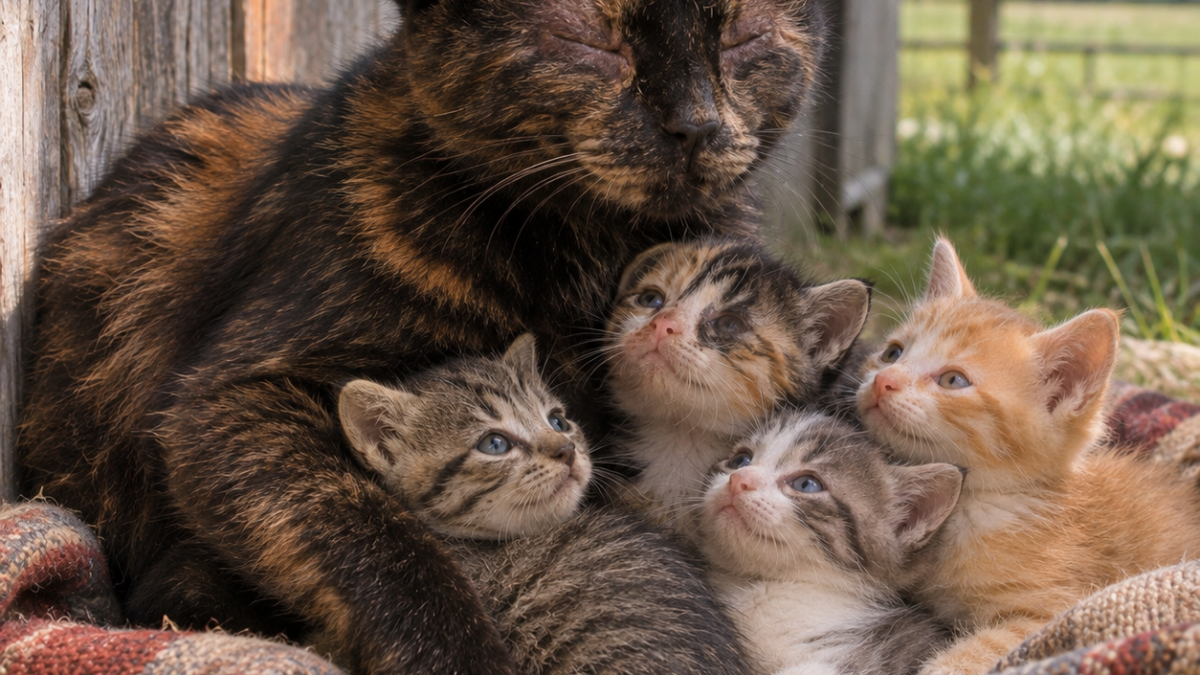
A Mother Cat Lost Both Eyes Fighting Off a Coyote—Then Staff Watched Her Touch Each Kitten’s Head Every Night to Make Sure All Four Were Still There.
The coyote took both of her eyes, tore open her face, and left her bleeding behind a Montana ranch shed—but somehow, every one of her four tiny kittens survived without a single scratch.
For two days, the blind mother refused food, water, and safety, carrying each baby thirty yards through the brush one at a time because she believed the predator might come back.
Eleven weeks later, the veterinary staff discovered that every night she still touched four little heads with her nose—one, two, three, four—as if losing her sight had only made her more determined to make sure she never lost a baby.
The first thing Wade Mercer noticed was the blood.
It wasn’t much at first.
Just three dark drops on the pale dirt behind the equipment shed, almost black beneath the weak morning sun.
Wade stopped.
He had been carrying a five-gallon fuel can toward the old John Deere parked near the western fence line, thinking about a hydraulic hose that needed replacing and whether the weather forecast was finally going to give them three dry days in a row.
Then he saw another spot.
And another.
He lowered the fuel can.
Late March in central Montana was an awkward season, neither winter nor spring, when snow lingered in the shadows of cottonwoods while exposed ground turned to mud by noon and froze again after sunset.
The Mercer ranch sat forty miles from the nearest town large enough to have a grocery store open past seven.
There were no subdivisions nearby.
No traffic lights.
No backyard fences.
Just pasture, rolling sagebrush, old windbreaks, shallow ravines, and distant mountains that sometimes looked close enough to touch.
Wade had spent all fifty-nine years of his life there.
He knew what blood on ranch dirt could mean.
A wounded rabbit.
A fox.
A deer clipped by barbed wire.
Sometimes worse.
He crouched.
The blood wasn’t fresh enough to shine, but it wasn’t old either.
A few feet away lay a tuft of fur.
Dark.
Orange.
Cream.
Wade picked it up carefully.
Cat fur.
He frowned.
The Mercers didn’t own a cat.
They had cattle dogs, barn swallows, mice no one invited, and enough wild creatures passing through that Wade had never understood why anyone would deliberately add a cat to the arrangement.
But stray cats occasionally appeared.
They followed grain trucks.
They wandered from neighboring ranches.
Sometimes they established themselves in barns and became unofficial employees by reducing the mouse population.
Wade had seen a small tortoiseshell cat around the machinery shed twice during winter.
Never close.
The first time, she’d vanished beneath stacked irrigation pipe before he could get within twenty feet.
The second time, he’d seen only her tail disappearing behind a pile of fence posts.
He hadn’t thought much about her.
Now he stood holding a tuft of tortoiseshell fur.
“Well, hell.”
The blood trail continued behind the shed.
He followed it.
Near the northwest corner, he found deep grooves scratched into the weathered wood.
Wade’s expression changed.
PART2:
The marks began perhaps eighteen inches above the ground and rose higher, as though something had clawed desperately while being pushed upward.
More fur clung to a splinter.
There was blood on the siding.
Not drops now.
A smear.
Wade put the fur down.
His cattle dog, Boone, had followed him from the house and now stood several yards away with his head low.
Boone usually investigated everything.
That morning he wouldn’t approach.
“What do you smell?”
The dog whined.
Then Wade saw the tracks.
Coyote.
He knew them instantly.
Narrower than a dog’s.
Compact.
Purposeful.
The tracks came out of the brush, crossed the dirt behind the shed, circled near the blood, then headed west.
Wade had seen the animal itself twice during the previous two weeks.
A large coyote, unusually bold.
The first sighting happened at dusk near the calving pasture.
Wade had shouted from the porch and the animal had trotted away without urgency, turning once to look back.
The second time he’d caught it near the chicken enclosure at his brother’s place three miles north.
Coyotes were part of Montana.
Wade didn’t hate them.
PART3:
He understood predators were doing what predators did.
But he also knew when one became comfortable approaching buildings and livestock, it could become a problem quickly.
A neighboring rancher, Clark Jensen, had called three nights earlier.
“You missing a cat?”
“I don’t own a cat.”
“Something got one of ours behind the barn.”
“Coyote?”
“Looks that way.”
Wade hadn’t connected the conversation to the tortoiseshell stray.
Now he followed the tracks.
Twenty feet beyond the shed he found drag marks.
They were faint.
Something small had moved through the dirt, pulling or stumbling.
Another patch of fur appeared beneath the sage.
Then another.
Wade’s stomach tightened.
“Boone, stay.”
The dog stayed.
Wade moved into the brush alone.
The trail wasn’t easy.
There were places where the ground turned stony and the marks disappeared.
Then he’d find another broken stem.
A spot of dried blood.
A print pressed into damp earth.
Thirty yards from the shed stood a collapsed section of old wire fencing that Wade had been meaning to remove for years.
Several cedar posts had fallen decades earlier, pulling the wire into a twisted arch. Sagebrush and dry grass had grown through it, creating a covered pocket beneath.
Wade heard something.
A tiny sound.
He stopped.
Again.
A faint squeak.
Not a bird.
Not a mouse.
He crouched and pushed aside a branch.
At first he saw only darkness.
Then something moved.
A kitten.
Tiny.
Its face appeared between dried grass stems.
Wade stared.
Another kitten shifted behind it.
Then he saw the mother.
His breath caught.
She was sitting upright.
Or trying to.
Her body was gaunt beneath filthy tortoiseshell fur.
One shoulder was crusted with blood.
Part of her left ear had been torn.
And her face—
“Jesus.”
Wade whispered the word before he could stop himself.
Where her left eye should have been was a dark, injured cavity partially sealed with dried blood.
Her right eye was grotesquely swollen.
The surface had turned cloudy white and blue.
Fluid stained the fur beneath it.
She could not possibly see him.
Yet the instant his boot moved against the ground, she stood.
Every muscle in her thin body tightened.
She placed herself between Wade and the kittens.
Her back arched.
A low sound came from her throat.
Not loud.
Not threatening in any way that could have frightened a man Wade’s size.
But unmistakable.
Stay away.
Wade froze.
“Easy.”
The cat hissed.
Her head turned toward his voice.
Four kittens crowded behind her.
Wade counted.
One.
Two.
Three.
Four.
All alive.
No obvious injuries.
The mother’s back legs trembled.
She didn’t retreat.
“Easy, little mama.”
Wade slowly leaned away.
The cat tracked the sound of him moving.
Blind.
He realized it fully then.
She was blind.
Completely.
And still guarding them.
Wade pulled out his phone.
There was no signal.
Of course there wasn’t.
The ranch had several dead zones, and this patch of brush was one of them.
He backed away slowly.
The cat remained standing until he had retreated nearly ten yards.
Only then did she lower herself.
Wade hurried toward the house.
His adult daughter, Hannah, was in the kitchen when he came through the back door.
She had moved back onto the ranch six months earlier after a divorce she’d stopped trying to explain to people.
At thirty-four, Hannah had the same stubborn jaw as her father and the same habit of going silent when she was worried.
She was pouring coffee when Wade entered.
“Get a box.”
She looked at him.
“What?”
“A carrier. Towels. Whatever we’ve got.”
“Why?”
“Cat.”
Hannah stared.
“You hate cats.”
“I don’t hate cats.”
“You once called them freeloading knives with whiskers.”
“That was one cat.”
“It was every cat.”
“Hannah.”
She saw his expression.
“What happened?”
“Coyote got her.”
Her face changed.
“How bad?”
“Bad.”
“Alive?”
“Yeah.”
“Kittens?”
“Four.”
Hannah set the coffee down.
Five minutes later they were crossing the yard carrying a dog crate, thick gloves, towels, and a plastic laundry basket.
Wade stopped Hannah before they reached the brush.
“She can’t see.”
“What do you mean?”
“Eyes are gone.”
“Both?”
“Looks like it.”
Hannah went pale.
“How is she still—”
“I don’t know.”
They approached slowly.
The mother heard them immediately.
Again she rose.
Again she positioned herself between the footsteps and the kittens.
Hannah knelt fifteen feet away.
“Oh, sweetheart.”
The cat hissed.
Hannah’s eyes filled.
“She’s protecting them.”
“Yeah.”
“She can barely stand.”
“I noticed.”
For the next twenty minutes, they worked slowly.
They didn’t try to grab the mother first.
Wade knew enough about frightened animals to understand that separating her from the kittens might cause panic.
Instead, Hannah spoke continuously.
Softly.
Pointlessly, perhaps.
But it gave the cat one consistent sound to track.
“It’s okay, Mama. Nobody’s taking them. We’re helping.”
The cat did not believe her.
Why would she?
Every instinct in her body had been sharpened by the last forty-eight hours.
Footsteps meant danger.
Movement meant danger.
The world she had once navigated with vision had turned into darkness filled with sounds she couldn’t identify.
When Hannah reached toward the first kitten, the mother lunged.
She moved barely a foot before collapsing.
Hannah jerked back.
The cat struggled upright again.
Wade swallowed.
“She’s going to kill herself trying.”
“Then we keep them together.”
They placed the laundry basket on its side near the nest.
Hannah put a towel inside.
Then they waited.
One kitten wandered toward it.
Another followed.
The mother turned her head toward their tiny cries.
Hannah moved the basket inch by inch.
Eventually, three kittens crawled inside.
The fourth remained pressed against its mother’s belly.
Wade put on the thick gloves.
“She’ll bite.”
“I know.”
“Your hands aren’t what they used to be.”
“Neither is the rest of me.”
Hannah gave him a look.
“Very reassuring.”
He moved slowly.
The mother hissed again.
When his hands finally touched her sides, she twisted violently.
Not because she was strong.
Because she was desperate.
She struck blindly.
One claw tore through Wade’s glove.
“Dammit.”
“Dad.”
“I’m fine.”
He lifted her.
She screamed.
The sound stopped both of them.
It wasn’t anger.
It was pain.
Deep, uncontrolled pain.
Hannah covered her mouth for half a second.
Then she reached for the fourth kitten.
“We’re taking them all.”
They placed the mother in the crate with the kittens tucked against her.
The instant she smelled them, she stopped fighting.
Her nose moved.
One kitten.
Another.
Another.
Another.
Then she collapsed.
Hannah saw it.
“Did you notice that?”
“What?”
“She checked them.”
Wade looked down.
“She’s smelling them.”
“One by one.”
“Probably.”
They covered the crate with a blanket and drove.
The closest veterinary clinic capable of emergency treatment was nearly an hour away in Lewistown.
Hannah sat in the passenger seat with the crate on the floor between her boots.
Wade drove faster than he normally would on wet county roads.
Every few minutes Hannah lifted the blanket.
“Still breathing?”
“Yeah.”
“Kittens?”
“All four.”
The mother made almost no sound.
At mile seventeen, one kitten squeaked.
The mother’s head rose.
Her nose moved across the darkness.
She touched the kitten.
Then the others.
Hannah stared.
“She did it again.”
Wade kept his eyes on the road.
“Did what?”
“One, two, three, four.”
“You’re counting for her now?”
“No.”
Hannah’s voice went quiet.
“I think she’s counting for herself.”
Dr. Lydia Hart was finishing a dental procedure when the front desk called her.
“We’ve got wildlife trauma coming in.”
“What kind?”
“Cat. Possible coyote attack. Severe facial injuries.”
Lydia removed her gloves.
“How far?”
“They’re in the parking lot.”
The exam room changed immediately.
Emergency table cleared.
Oxygen ready.
Warming blankets.
IV supplies.
Pain medication.
Lydia had practiced veterinary medicine for seventeen years.
Rural Montana gave her an unusual range of cases.
Dogs kicked by horses.
Barn cats trapped in machinery.
Hunting dogs cut on wire.
Calves attacked during difficult births.
Porcupine quills.
Snake bites.
Gunshot wounds.
Predator injuries.
She had seen cats survive things that seemed impossible.
Still, when Wade entered carrying the covered crate, Lydia knew from his face that this was different.
“Where’d you find her?”
“Behind my shed.”
“Coyote?”
“Tracks everywhere.”
“How long ago?”
“No idea. Could be two days.”
Lydia uncovered the crate.
Her expression tightened.
“Okay.”
Hannah crouched beside it.
“All four kittens are hers.”
“We’ll keep them close.”
The mother heard unfamiliar voices and forced herself upright.
She stood over the kittens.
Lydia watched.
“She can’t see you.”
“No.”
“Left eye’s gone.”
“I figured.”
“Right one may be ruptured.”
Hannah’s voice cracked.
“Can you save it?”
Lydia didn’t answer immediately.
“First we stabilize her.”
“What are her chances?”
“We need to know how much blood she’s lost, whether there are skull fractures, whether there’s infection, whether she’s dehydrated, whether she’s eaten.”
“She was nursing.”
“That’s actually part of the problem.”
Hannah frowned.
“Why?”
“Four kittens can drain calories and fluids quickly. If she’s been unable to hunt or drink for forty-eight hours, she may be in serious metabolic trouble.”
Wade stood near the wall.
“Do whatever she needs.”
Lydia looked at him.
“Are you the owner?”
“No.”
“Then you understand this could become expensive.”
“Do whatever she needs.”
“Dad—”
Wade didn’t look at Hannah.
“I said do it.”
Lydia nodded.
“All right.”
The examination took nearly an hour.
The mother weighed 6.1 pounds.
Based on her frame, Lydia estimated she should have weighed between eight and nine.
Her gums were pale.
She was severely dehydrated.
There were punctures on both sides of her face.
Several were infected.
The left eye was gone entirely.
The right globe had ruptured.
There were tears around her cheek and neck.
One canine tooth was broken.
Her left shoulder bore three deep wounds.
Miraculously, X-rays showed no major skull fracture.
No broken limbs.
No collapsed lung.
The bites had been concentrated around her head.
Lydia stepped into the hallway where Wade and Hannah waited.
“She’s tough.”
Wade nodded.
“What now?”
“Her right eye can’t be saved.”
Hannah looked down.
“Will she ever see again?”
“No.”
The word landed heavily.
“Both eyes?”
“Yes.”
“Is she in pain?”
“Considerable pain.”
“Can you fix that?”
“Yes.”
Hannah’s eyes lifted.
“Then do it.”
“There’s more.”
Lydia held the chart.
“Her left socket is infected. We need to clean it aggressively. The remaining tissue around the right eye is damaged. Ultimately, both sockets will likely need surgery.”
“When?”
“Not today.”
“Why?”
“She’s too weak. Surgery and anesthesia carry risk. I’d like twenty-four to forty-eight hours of fluids, antibiotics, nutrition, pain control, then reassess.”
Wade asked, “Kittens?”
“Surprisingly good.”
“All four?”
“All four.”
Lydia’s expression softened.
“One’s mildly dehydrated. Otherwise they’re healthy.”
Hannah released a breath.
“Not one bite?”
“No.”
Wade stared through the treatment-room window.
“She took all of it.”
Lydia followed his gaze.
“Looks that way.”
That afternoon a wildlife officer named Grant Keller drove to the ranch.
Wade had called because he wanted confirmation about the tracks.
Grant spent nearly two hours examining the area.
He photographed paw prints.
Measured the width.
Collected fur.
Examined the blood near the shed.
There were two distinct types.
Cat.
And something else.
Coyote, almost certainly.
There were claw marks on the wood.
Blood on both sides of the corner.
The pattern suggested a struggle.
Grant crouched near the shed, studying the ground.
“You see this?”
Wade leaned over.
“What?”
“Tracks circle here.”
“So?”
“Cat was against the building.”
Grant pointed.
“Coyote came from that side. She backed into the wall.”
Wade pictured it.
The tiny tortoiseshell.
The predator.
The kittens somewhere nearby.
“She fought it?”
“Looks like.”
Grant moved several yards.
“Here’s where it gets interesting.”
A line of blood led away from the shed.
Not the cat’s.
Larger drops.
“He was bleeding.”
“The coyote?”
“Yeah.”
“She got him?”
“Seems like she did.”
Wade looked toward the brush.
“Enough to make him leave?”
“Maybe.”
Grant stood.
“Coyotes don’t usually want a serious fight with an adult cat unless food pressure is high or they catch one exposed. If she went at him aggressively, face first, he may have bitten and shaken, then backed off if she clawed his nose or eyes.”
“Why face first?”
“Protecting something behind her.”
The kittens.
Wade swallowed.
Grant walked toward the hidden nest.
He followed the trail.
Then stopped halfway.
“What’s this?”
Wade saw paw prints.
Cat.
Small.
Uneven.
The tracks ran from the shed toward the collapsed fence.
Grant crouched.
“There are repeated routes.”
“What do you mean?”
“She didn’t make this trip once.”
He pointed.
“Look at the impressions. Same cat, same direction, overlapping.”
Wade’s skin prickled.
“The kittens.”
Grant looked at him.
“What?”
“She moved them.”
Grant glanced toward the shelter beneath the wire.
“How many?”
“Four.”
The officer stared at the ground again.
“How far from the shed?”
“Thirty yards, maybe.”
He measured roughly.
Thirty-two.
Hannah heard about it that evening.
She was sitting beside the clinic kennel when Wade called.
“Grant thinks she carried them.”
Hannah looked through the bars.
The mother lay on a thick blanket.
Four kittens pressed against her belly.
“What?”
“One at a time.”
“She was already blind.”
“Probably.”
Hannah’s throat tightened.
“How do you know?”
“Tracks.”
She looked at the cat.
“Thirty yards?”
“Thirty-two.”
“Four trips?”
“At least.”
Hannah ended the call several minutes later.
Then she sat there in silence.
One kitten crawled away from the group.
The mother heard its tiny claws on the blanket.
Her head lifted.
She turned.
The kitten moved farther.
Without being able to see, she followed the sound.
Slowly.
Her nose found its head.
She touched it.
The kitten squeaked.
The mother nudged it back toward her body.
Hannah pressed her lips together.
“How did you do that?”
The cat settled again.
“How did you carry them through brush when you couldn’t even see?”
A technician named Marisol Vega had been standing in the doorway.
“Maybe she knew the path.”
Hannah looked over.
“From before?”
“Could’ve had a nest near the shed.”
“But after losing her eyes?”
Marisol leaned against the frame.
“Cats use more than sight.”
“I know, but still.”
Marisol nodded.
“Yeah.”
They both watched the mother.
“Still.”
The clinic needed a name for the chart.
They couldn’t keep writing TORTOISESHELL STRAY.
Hannah suggested “Mara.”
Wade hated it.
Marisol suggested “Scout.”
Wade said that sounded like a dog.
Lydia eventually asked Hannah, “What did she do when your dad found her?”
“Stood between him and the kittens.”
“Even blind?”
“Yes.”
Lydia thought for a moment.
“Guardian?”
“Too dramatic.”
Wade, who had been silent, looked through the kennel bars.
“Call her Mercy.”
Hannah turned.
“Mercy?”
“Because somebody better show her some.”
No one offered another suggestion.
Mercy stayed.
Her kittens received temporary names based on the colored bands staff used to identify them.
Blue became Jasper.
Green became Fern.
Yellow became June.
Red became Otis.
By the third day, Mercy’s condition stabilized enough for surgery.
The right eye was removed.
The infected left socket was debrided, cleaned, and closed loosely so drainage could continue.
The procedure lasted almost two hours.
Hannah waited in the lobby.
She wasn’t technically responsible for the cat.
She hadn’t planned to adopt her.
She barely knew her.
But leaving felt wrong.
At noon Wade arrived with sandwiches.
“You haven’t eaten.”
“Neither has she.”
“She’s under anesthesia.”
“Exactly.”
He handed her a sandwich.
Hannah took it.
“You paid the deposit.”
“Yep.”
“How much?”
“Enough.”
“Dad.”
“It’s my property.”
“That doesn’t make her your bill.”
“Found hurt animals on my land before.”
“Not like this.”
“No.”
He sat beside her.
After a while Hannah said, “Mom would’ve taken her.”
Wade looked toward the floor.
“Your mother would’ve taken the cat, the kittens, and probably the coyote if it showed up looking sorry.”
Hannah laughed unexpectedly.
Her mother, Claire, had died six years earlier from ovarian cancer.
She had been the soft part of the Mercer ranch.
The one who left warm milk for barn kittens.
The one who made Wade stop tractors for nests of field mice.
The one who once drove two hours to rescue an injured owl despite Wade pointing out that wildlife rehabilitation was “not our business.”
After Claire died, the house had changed.
Not physically.
Emotionally.
Rooms became quieter.
Meals became functional.
Wade talked less.
Hannah visited often, then eventually moved back after her marriage ended.
Neither of them talked much about grief.
The blind cat forced something open.
“She would’ve named her something ridiculous,” Hannah said.
“Buttercup.”
“Princess.”
“Miss Whiskers.”
“Lady Coyote-Kicker.”
Wade smiled.
“That one’s not bad.”
For a few minutes, the waiting room felt lighter.
Then Lydia came out.
“She’s awake.”
Hannah stood immediately.
“How’d she do?”
“Better than I expected.”
“Both sockets?”
“The right is closed. The left still worries me.”
“Infection?”
“Yes.”
“What happens if it spreads?”
“We stay ahead of it.”
“Can we?”
Lydia looked at her.
“We’re going to try.”
Mercy’s recovery was not cinematic.
It was ugly.
Slow.
Messy.
There were no magical leaps.
No sudden transformation.
She vomited after medication.
Stopped eating on day five.
Developed a fever on day seven.
The left socket began draining again.
A culture showed resistant bacteria.
Lydia changed antibiotics.
Three days later the infection improved, then returned.
Mercy lost more weight.
At one point she dropped below six pounds.
The kittens continued nursing.
That worried everyone.
“She’s giving them what she doesn’t have,” Marisol said.
So they began supplementing the kittens aggressively.
Formula.
Soft food.
Scheduled feedings.
At first Mercy panicked whenever staff removed one.
She couldn’t see which kitten was being taken.
She only heard the cry disappear.
The first time Marisol lifted Jasper for feeding, Mercy stood and paced blindly inside the kennel.
She called.
Once.
Twice.
A rough, urgent sound.
Her nose moved along the bedding.
Hannah happened to be visiting.
“Put him back.”
“He needs supplementing.”
“I know. Feed him where she can smell him.”
Marisol understood.
They changed the routine.
No kitten was removed beyond earshot.
Whenever possible, Mercy was allowed to touch each baby before and after handling.
That helped.
But the first time all four were taken for vaccinations, she became frantic.
She struck the kennel door with one shoulder.
Circled.
Called repeatedly.
Lydia heard from the treatment room.
“What’s wrong?”
“Kittens are next door.”
“Bring one back.”
“Which?”
“Any.”
June returned first.
Mercy found her instantly.
Nose to head.
Then her nose moved past the kitten.
Searching.
Again.
Again.
Lydia watched.
“She knows.”
Marisol said, “Of course she knows.”
“No.”
Lydia crouched.
“She knows one isn’t enough.”
Jasper came back.
Mercy touched him.
Then Fern.
Then Otis.
Only after the fourth kitten returned did she lie down.
That evening, the staff saw the ritual for the first time.
The clinic was quiet.
Most appointments were over.
Marisol was cleaning kennels when Mercy began moving.
The kittens had eaten and were gathering together.
Mercy approached.
She touched Jasper’s head.
Pause.
Fern.
Pause.
June.
Pause.
Otis.
Then she circled once and lay beside them.
Marisol watched.
The next night it happened again.
One.
Two.
Three.
Four.
On the third night, Marisol called Lydia.
“Come here.”
“What?”
“Just watch.”
They stood quietly outside the kennel.
Mercy waited until the kittens settled.
Her nose found the first head.
Touch.
Second.
Touch.
Third.
Touch.
Fourth.
Touch.
Then she rested.
Lydia whispered, “She checks them.”
Marisol nodded.
“Every night.”
“Same order?”
“Not always the same kitten first.”
“But four.”
“Always four.”
The behavior continued.
Sometimes she checked them during the day too.
But at night it became ritual.
One.
Two.
Three.
Four.
Nobody taught her.
No reward followed.
She simply needed to know.
All there.
All safe.
Hannah witnessed it during week three.
She sat on the floor beside the kennel while Mercy moved through the kittens.
One.
Two.
Three.
Four.
Then Mercy rested.
Hannah stared at her.
“She counts them.”
Lydia was updating notes nearby.
“Not in the human mathematical sense.”
“You know what I mean.”
“I do.”
“She checks until she gets four.”
“Yes.”
Hannah wiped beneath one eye.
“Because she can’t see them.”
“Probably.”
“Or because she lost the others?”
Lydia looked up.
“What others?”
Hannah hesitated.
“We don’t know if there were others.”
“No.”
“But cats have litters larger than four.”
“They can.”
“Maybe these were all.”
“Probably.”
Hannah nodded.
Still, the thought stayed.
What would it feel like to live in permanent darkness after violence?
To wake and never know who stood near you?
To hear one baby but not know whether three others were safe?
Mercy had solved the problem in the only way available.
Touch.
Smell.
Sound.
One.
Two.
Three.
Four.
The local story began spreading because ranch towns are terrible places for secrets.
Wade told Grant.
Grant told his wife.
His wife volunteered with an animal rescue.
Within a week, half the county seemed to know about the blind mother cat who had fought a coyote.
The first newspaper story exaggerated parts.
“Hero Cat Battles Giant Coyote.”
Wade threw the paper onto his kitchen table.
“Giant? Who measured the damn coyote?”
Hannah smiled.
“People like giant.”
“It’s a coyote. Not a mountain lion.”
“Don’t ruin journalism.”
The story brought donations.
Hundreds of dollars.
Then thousands.
The clinic created a medical fund so Wade wouldn’t carry the entire cost.
He objected.
“I said I’d pay.”
Lydia replied, “And now other people want to help.”
“I don’t need charity.”
“It’s not for you.”
That shut him up.
A third-grade class in Great Falls mailed handmade cards.
Most included drawings of Mercy with enormous green eyes because the children hadn’t fully understood that she no longer had them.
One child drew a cat wearing sunglasses fighting a coyote with boxing gloves.
Wade kept that one.
Another card said:
DEAR MERCY,
YOU ARE BRAVE EVEN IN THE DARK.
Hannah cried when she read it.
She taped it near Mercy’s kennel.
The kittens grew.
By week five they had become tiny disasters.
Otis climbed everything.
Jasper stole food from his siblings.
Fern was cautious.
June seemed determined to bite every shoelace in Montana.
Mercy adapted around them.
At first she moved slowly, keeping her body low.
Within weeks she memorized the kennel dimensions.
Water three steps from the bed.
Food along the right wall.
Litter box in the back corner.
She rarely collided with anything.
When staff changed the arrangement, she became confused.
So Lydia created a rule.
“Nothing moves unless necessary.”
A new technician forgot and shifted the water bowl eighteen inches.
Mercy walked toward the old location.
Her paw touched empty floor.
She stopped.
Her nose moved.
She searched.
Marisol noticed and returned the bowl.
Mercy found it immediately.
The staff learned.
Blind animals don’t need pity as much as consistency.
Mercy didn’t spend her days mourning sight in a way humans could recognize.
She adapted.
What frightened her was unpredictability.
A metal tray dropped unexpectedly.
She flattened.
A stranger entered quickly.
She stood over the kittens.
A barking dog passed too close.
Her body became rigid.
But familiar voices relaxed her.
Marisol.
Lydia.
Hannah.
Eventually Wade.
His relationship with Mercy developed badly.
He was too loud.
His boots were heavy.
He smelled like cattle, diesel, hay, leather, and Boone.
Mercy disliked all of it.
The first three times he visited, she hissed.
“Ungrateful animal.”
Hannah glared at him.
“She lost her eyes to a predator and you’re the giant stomping toward her.”
“I brought beef.”
“She can’t eat beef.”
“Then I’ll eat it.”
The next visit he left his boots near the door and wore clinic shoe covers.
Hannah stared.
“What?”
“Nothing.”
“Stop smiling.”
“I’m not.”
Mercy still hissed.
Wade sat down ten feet away.
“Fine. Take your time.”
He visited again.
And again.
He began talking so she’d identify him before he approached.
“Morning, cat.”
Hiss.
“That’s right. Me again.”
By week seven, Mercy stopped hissing.
By week eight, she allowed him to touch her back.
By week nine, she walked toward his voice.
Wade pretended this meant nothing.
Hannah didn’t embarrass him by saying otherwise.
The coyote disappeared from the property.
Grant found tracks leading north several days after the attack.
He believed the animal survived.
There was blood, but no carcass.
Wade initially wanted to hunt it.
Then he didn’t.
When Hannah asked why, he shrugged.
“It did what coyotes do.”
“It almost killed her.”
“Yeah.”
“You aren’t angry?”
“At nature?”
He looked toward the hills.
“Plenty of things in life deserve anger. A hungry animal being hungry isn’t high on my list.”
Hannah thought about Darren, her ex-husband.
About lies.
About humiliation.
About cruelty delivered deliberately and then defended as reasonable.
Her father’s distinction stayed with her.
Mercy hadn’t lost her eyes because the world was evil.
She’d lost them because she loved something small in a world where danger existed.
That didn’t make the loss easier.
But it made it different.
At week ten, the infection returned again.
Mercy had been scheduled for final closure of the left socket.
Instead, Lydia found swelling along the scar.
She took a sample.
The culture result was discouraging.
Another resistant infection.
Hannah received the call at work.
“How bad?”
“Treatable.”
“You said that last time.”
“It was.”
“And then it came back.”
“Yes.”
“Could it spread to her brain?”
Silence.
“Lydia.”
“That’s one possibility if we can’t control it.”
Hannah sat down.
“What do we do?”
“Another antibiotic. Surgical cleaning. We may need to reopen the entire area.”
“Do it.”
“There’s risk.”
“I said do it.”
After hanging up, Hannah sat in her truck and cried.
She didn’t understand why the possibility of losing Mercy hurt so much.
This wasn’t her cat.
Not technically.
She kept repeating that.
Then she realized she’d been visiting almost daily for ten weeks.
She knew the texture of Mercy’s fur.
Knew which ear turned toward her voice first.
Knew Mercy liked chicken-flavored food but ignored salmon.
Knew she hated being touched near the left cheek.
Knew her kittens’ personalities.
Knew the nightly count.
One.
Two.
Three.
Four.
“This is stupid,” Hannah whispered to herself.
She was crying over a cat she’d known less than three months.
But grief did not care about timelines.
Neither did attachment.
That evening she told Wade, “If she survives, I’m taking her.”
Wade was sitting at the kitchen table repairing a halter.
He didn’t look up.
“Figured.”
“You don’t object?”
“Nope.”
“You hate cats.”
“I don’t hate cats.”
“Freeloading knives with whiskers.”
“I was younger.”
“That was four years ago.”
“People change.”
She smiled.
“You mean Mercy changed you.”
“No.”
“Sure.”
Wade tightened a buckle.
“Who’s taking the kittens?”
“I don’t know yet.”
“You can’t take five cats.”
“I know.”
“Your mother would’ve.”
“I know.”
“Your mother was crazy.”
“I know.”
They both laughed.
Then Wade became serious.
“Keep them close if you can.”
“The kittens?”
“Yeah.”
“Why?”
He looked toward the window.
“Seems wrong to make her fight that hard just to never know where they went.”
Hannah had been thinking the same thing.
But adoption was complicated.
The kittens couldn’t remain with their mother forever.
They would mature.
Develop independent behaviors.
Need socialization.
Need homes.
Mercy herself needed a quiet environment with predictable furniture and no outdoor access.
Lydia introduced Hannah to Prairie Paws Rescue.
The organization agreed to handle adoptions with one unusual condition requested by Hannah.
The kittens should be adopted in pairs.
And if possible, both families should live nearby.
Some volunteers thought this was excessive.
The kittens were young.
They’d adapt.
Hannah knew that.
The request wasn’t entirely for the kittens.
It was for Mercy.
She couldn’t explain why.
Maybe she imagined visits.
Maybe she couldn’t tolerate the thought of all four disappearing from Mercy’s world at once.
The rescue agreed to try.
At week eleven, Mercy underwent her final surgery.
The infected tissue was removed.
The socket was cleaned thoroughly.
The surgeon closed it.
Three days later, the swelling decreased.
Five days later, the incision looked clean.
Seven days later, Lydia entered the kennel area, examined the scar, then smiled.
“I think we’re finally ahead of it.”
Marisol leaned against the wall.
“Say that quieter.”
“I’m serious.”
“Don’t tempt anything.”
Mercy had gained almost a pound.
Her coat looked better.
The kittens were weaned.
She still allowed them to curl against her.
She still groomed them.
And every night—
One.
Two.
Three.
Four.
The adoption applications poured in.
Some were terrible.
One applicant wanted a kitten as an outdoor mouser.
Rejected.
Another wanted only June because she was “the prettiest.”
Rejected.
A family with three small children wanted two kittens but planned to declaw them.
Immediately rejected.
Then came the Bennett family.
Rachel and Mark Bennett lived fifteen miles from the Mercer ranch.
They had two teenage sons, an older indoor cat, and experience with rescues.
They applied for Jasper and Otis.
During the interview Rachel asked, “Can they still see their mother?”
The rescue volunteer paused.
“Why?”
“We read her story.”
Rachel smiled.
“Feels like we should let her know they’re okay.”
The second family, Caleb and Nora Finch, lived nine miles in the opposite direction.
They wanted Fern and June.
Nora worked from home.
Caleb was a middle school science teacher.
They had recently lost a nineteen-year-old cat.
During the home visit, Nora said, “We’re not looking for a replacement. There isn’t one. We just miss having life in the house.”
Both applications were approved.
The kittens’ departure was scheduled for the same afternoon.
Hannah dreaded it.
She had seen Mercy panic when one kitten disappeared for ten minutes.
What would happen when all four left?
Lydia suggested staggering the departures.
Hannah refused.
“That makes it last longer.”
“She may not understand.”
“Exactly.”
They debated.
Eventually they decided both pairs would leave within an hour.
Mercy would remain at the clinic until the following morning, giving staff a chance to observe her.
The first pair to leave were Jasper and Otis.
Rachel Bennett arrived carrying a large carrier.
She sat beside Mercy before taking them.
“Hi, Mama.”
Mercy turned toward her voice.
Rachel’s eyes filled.
“I’m taking care of two.”
Hannah knew the words meant nothing to the cat.
Still, they mattered to Rachel.
Jasper and Otis were placed in the carrier.
They cried briefly.
Mercy stood.
Her head moved.
Her nose searched.
The carrier left.
Mercy walked the perimeter of the kennel.
She called.
Hannah’s chest hurt.
“Maybe this was a mistake.”
Lydia watched carefully.
“Give her time.”
Mercy went to Fern.
Touched her.
June.
Touched her.
Then searched again.
There should have been two more.
There weren’t.
She paced.
Called.
Searched.
Hannah cried silently.
An hour later, Nora and Caleb arrived.
Fern and June left.
Mercy’s kennel became quiet.
Too quiet.
She walked to the bedding.
Searched.
Food bowl.
Litter area.
Door.
Back to bedding.
Her nose moved across the empty blanket.
Again.
Again.
Hannah couldn’t bear it.
“I’m taking her home tonight.”
Lydia shook her head.
“She’s been here eleven weeks. The clinic is familiar.”
“Her babies are gone.”
“Exactly why changing environments tonight may overwhelm her.”
“So what am I supposed to do? Leave her here searching?”
“Stay.”
Hannah stayed.
For three hours.
Mercy eventually stopped walking.
She curled on the blanket.
But she did not sleep.
Every hallway noise lifted her head.
Every kitten cry from another room made her stand.
At 9:00 p.m., Hannah was still there.
Marisol finished closing duties.
“You should go home.”
“No.”
“Hannah.”
“No.”
Marisol sat beside her.
“She’ll adjust.”
“How do you know?”
“I don’t.”
“Great.”
“I know animals survive change.”
“She already survived enough.”
“That’s not the same as being unable to survive anything else.”
Hannah looked through the bars.
“What if she thinks she failed?”
Marisol’s expression softened.
“That’s us talking.”
“What?”
“That’s a human thought.”
“Maybe.”
“She knows they’re gone. She doesn’t know adoption.”
“Exactly.”
“But tomorrow she’ll know your house.”
“She has never been there.”
“Then you’ll teach her.”
The next morning Hannah brought Mercy home.
Not to the big farmhouse.
To the smaller one-story guesthouse seventy yards away that Hannah had renovated after moving back.
She had prepared for weeks.
Furniture pushed against walls.
Sharp corners padded.
Litter box in an easy-to-find location.
Food and water far from the litter.
A small heated bed beside the kitchen stove.
No dangling cords.
No open basement stairs.
Textured rugs placed before doorways to create tactile landmarks.
A shallow ramp beside the two steps leading to the enclosed porch.
Wade inspected everything.
“You’ve turned your house into a cat rehabilitation center.”
“Correct.”
“Boone’s offended.”
“Boone has the main house.”
“He’s still offended.”
Mercy arrived in a hard-sided carrier.
Hannah set it on the kitchen floor and opened the door.
She did not pull Mercy out.
She waited.
Five minutes.
Ten.
Mercy’s nose appeared.
She smelled the air.
One paw emerged.
Then another.
She stepped onto the rug.
Stopped.
Her whiskers moved forward.
Hannah sat several feet away.
“It’s me.”
Mercy turned toward her voice.
“You’re home.”
The word made Hannah cry.
Home.
She had moved back to the ranch after her marriage collapsed but still hadn’t been sure the place was home.
Maybe it was.
Maybe home wasn’t the place where nothing changed.
Maybe it was the place where change no longer meant abandonment.
Mercy took three steps.
Her shoulder touched a cabinet.
She backed up.
Tried again.
She explored for twenty minutes.
Slowly.
Methodically.
When she found the heated bed, she sniffed it.
Stepped in.
Turned twice.
Lay down.
Wade stood in the doorway.
“That’s it?”
“What?”
“Eleven weeks, twelve thousand dollars, two surgeries, and she likes a twenty-dollar bed.”
“That’s cats.”
“Freeloading—”
Hannah looked at him.
He stopped.
“Never mind.”
For the first few nights, Mercy barely slept.
She woke at every unfamiliar sound.
The refrigerator compressor.
The heater.
Wind against the porch.
A branch tapping the siding.
Hannah began sleeping on the couch.
Whenever Mercy stood confused, Hannah spoke.
“Kitchen.”
Or:
“It’s me.”
Or simply:
“You’re okay.”
Within a week Mercy had mapped the house.
Seven steps from bed to water.
Eleven to the hallway rug.
Turn left.
Four steps to Hannah’s bedroom.
Right.
Three to the bathroom threshold.
She learned the slight change in floor texture before each doorway.
She learned that the couch edge sat six inches from the rug.
She learned where sunlight warmed the floor even though she could no longer see it.
Hannah sometimes found her lying in the patch of warmth by afternoon.
“You still know where the sun is.”
Mercy’s ears moved.
The hardest adjustment came at night.
At the clinic, bedtime had meant kittens.
One.
Two.
Three.
Four.
At Hannah’s house, the first evening Mercy began her old ritual.
She walked around the bed.
Nose searching.
Nothing.
She moved toward the kitchen.
Nothing.
Hallway.
Nothing.
Then she called.
Hannah froze.
Mercy continued.
Searching.
Calling.
Hannah sat on the floor.
“Oh, honey.”
Mercy found her knee.
Sniffed.
Then walked past.
She wasn’t looking for Hannah.
She searched until nearly midnight.
The next night she did it again.
The third night was worse.
Hannah called Lydia.
“She looks for them every night.”
“I was afraid she might.”
“What do I do?”
“You can’t replace them.”
“I know.”
“Don’t change her routine too much. Give her something familiar from the clinic if you’ve got it.”
Hannah remembered the blanket.
One small fleece blanket had stayed with Mercy and the kittens for weeks.
Marisol had sent it home unwashed.
Hannah retrieved it from a sealed bag and placed it in Mercy’s bed.
Mercy approached.
Stopped.
Her nose touched the fabric.
Then she began sniffing rapidly.
She stepped onto it.
Turned.
Sniffed again.
The smell of four kittens was still there.
Faded.
But present.
Mercy lay down.
For the first time since arriving, she slept through most of the night.
Two weeks later, the Bennett family called.
“Would you be comfortable if we brought Jasper and Otis over?”
Hannah nearly dropped the phone.
“Yes.”
The visit happened Saturday.
Rachel brought them in one carrier.
They were bigger.
Louder.
Confident.
When Hannah placed the carrier on the floor, Mercy was asleep near the stove.
Jasper meowed.
Mercy’s head snapped up.
She stood.
Another meow.
She walked toward the sound so quickly she bumped the chair.
Hannah moved it aside.
Mercy reached the carrier.
Her nose found the door.
Jasper pressed against it.
Mercy made a sound Hannah had never heard before.
Half chirp.
Half cry.
Rachel covered her mouth.
“Open it.”
Hannah did.
Jasper came out first.
Mercy touched his head.
Once.
Then again.
Otis emerged.
Mercy’s nose moved to him.
One.
Two.
Then she searched behind them.
Hannah’s heart broke a little.
“Only two today.”
Mercy kept searching.
Rachel understood.
“Oh.”
“She expects four.”
A half hour later, another car pulled into the driveway.
Nora and Caleb had coordinated with Rachel without telling Hannah.
Fern and June arrived.
The moment the carrier opened, June ran across the kitchen.
Mercy heard her.
Her head turned.
Fern meowed.
Mercy moved.
Touch.
One.
Touch.
Two.
Jasper.
Three.
Otis.
Four.
She stopped.
All four kittens surrounded her.
Fully weaned now.
Nearly twice the size they’d been.
Different smells from different homes clung to their fur.
But she knew them.
No one in the kitchen spoke.
Mercy moved among them.
One.
Two.
Three.
Four.
Again.
Again.
Then she lay down.
The four kittens crowded against her.
Rachel cried.
Nora cried.
Hannah cried.
Caleb pretended to study the ceiling.
Wade arrived five minutes later.
“What did I miss?”
Everyone pointed silently.
He looked.
Mercy lay on the rug.
Four kittens against her body.
Wade took off his hat.
He stood there for a long time.
“Well.”
His voice was rough.
“Guess she got her count.”
After that, the visits became routine.
Not every night.
Not even every week.
But often enough.
The Bennett family and Finch family stayed in touch.
Sometimes all four kittens came together.
Sometimes only one pair.
Mercy always checked.
When two arrived, she welcomed two but searched for more.
When all four arrived, she settled quickly afterward.
The people around her stopped pretending this was coincidence.
She remembered.
Perhaps not the abstract number four.
Perhaps not as human beings understood counting.
But she knew the complete scent-map of her family.
She knew when something was missing.
And she knew when the group was whole.
Months passed.
Spring became summer.
Grass returned to the ranch.
The old shed was repaired.
Wade left one section of scratched siding untouched.
Hannah noticed.
“You missed a board.”
“No.”
“That corner’s damaged.”
“I know.”
“You replacing it?”
“Nope.”
“Why?”
Wade looked at the claw marks.
“Don’t know.”
Hannah did.
They were evidence.
Not of violence alone.
Of resistance.
A tiny animal had been trapped against that wall by something stronger and faster.
She had nowhere to go.
Behind her were kittens.
So she stood.
Those scratches were the physical record of a decision.
Not conscious heroism in the human sense.
Not nobility.
Instinct.
Attachment.
Protection.
Whatever word people used, the result was carved into cedar.
The predator left.
The kittens lived.
Mercy’s scars changed too.
Fur grew around the closed sockets.
At first people found her face shocking.
Eventually Hannah stopped noticing.
Mercy was simply Mercy.
She navigated the guesthouse confidently.
She jumped onto a low chair by following sound.
She climbed the couch with a small hesitation.
She learned Boone’s footsteps.
When the old cattle dog visited, Mercy initially puffed herself twice her size.
Boone immediately lay flat.
“Smartest thing you’ve ever done,” Wade told him.
Over time they developed a strange friendship.
Boone moved carefully around Mercy.
He never rushed her.
Sometimes he lay near the stove.
Mercy followed the warmth and eventually discovered him.
The first time she stepped onto his tail, Boone looked at Wade with enormous betrayal.
Wade laughed.
“Don’t move.”
Boone remained still.
Mercy sniffed.
Then curled beside his belly.
From then on, Boone became another landmark.
A warm, breathing piece of furniture that occasionally changed locations.
One evening in August, Hannah sat on the porch while Mercy rested near the screen door.
The sunset turned the sky orange.
Hannah found herself describing it.
“Clouds are pink tonight.”
Mercy’s ears moved.
“Mountains look purple.”
No response.
“There’s a hawk over the east field.”
Mercy washed one paw.
“You don’t care, do you?”
Wade was sitting on the porch steps.
“She’s a cat.”
“I know.”
“You think she misses seeing?”
Hannah looked at Mercy.
“I don’t know.”
“Probably doesn’t think about it like we would.”
“Maybe.”
Wade scratched Boone’s head.
“Your mom would’ve.”
“What?”
“Thought about everything she couldn’t see anymore.”
Hannah went quiet.
Near the end of Claire’s illness, her vision had blurred because of medication and neurological complications.
She had hated losing independence.
One evening she’d asked Hannah to describe the sunset.
Hannah had forgotten that.
Until now.
“Dad.”
“Yeah.”
“Were you scared after Mom died?”
He didn’t answer for a long time.
“Still am sometimes.”
Hannah looked at him.
“Of what?”
“That I forgot things.”
“Like what?”
“Voice.”
He swallowed.
“The exact voice.”
Hannah’s chest tightened.
“I remember it.”
“You think you do.”
“I do.”
Wade nodded.
“Good.”
Mercy stood.
Walked toward them.
Her nose touched Wade’s boot.
Then Hannah’s ankle.
Then Boone’s shoulder.
She seemed satisfied.
Hannah smiled.
“She’s checking us.”
“Don’t start.”
“One old man.”
“I’m not old.”
“One daughter.”
“You’re old too.”
“One dog.”
Mercy sat.
“Three.”
Wade laughed.
The attack became a local legend.
That irritated him.
People stopped at the ranch occasionally asking to see “the coyote cat.”
Wade turned most away.
“She’s not a tourist attraction.”
A regional television station requested an interview.
Hannah declined.
Then a children’s animal welfare program asked to film a short educational piece about blind pets.
She considered that.
Lydia supported it.
“Could help people understand blindness isn’t a death sentence.”
That mattered.
Too many owners assumed blind animals had no quality of life.
Mercy was living proof otherwise.
The filming crew agreed to strict conditions.
No bright equipment in her face—not that she could see it.
No crowd.
No forced positioning.
No handling by strangers.
The segment focused on adaptation.
Textured rugs.
Consistent furniture.
Voice cues.
Safe indoor spaces.
Hannah demonstrated how Mercy mapped routes.
The presenter asked, “Do you think she knows she’s blind?”
Hannah looked at Mercy.
“I think she knows the world changed.”
“Does she seem unhappy?”
“No.”
“Does she still search for her kittens?”
Hannah smiled.
“When they visit, she checks every single one.”
“Like counting?”
“I can’t tell you what number means to a cat.”
She paused.
“But I can tell you she knows when somebody’s missing.”
The segment aired months later.
Letters arrived.
One came from an elderly woman in Idaho whose fourteen-year-old cat had recently become blind from hypertension.
She wrote that she had been considering euthanasia because she believed blindness meant suffering.
After seeing Mercy navigate Hannah’s house, she changed her mind.
She installed rugs.
Moved dangerous furniture.
Started speaking before touching him.
Three months later she wrote again.
“He sleeps on my pillow every night. Thank you for showing me that dark does not mean empty.”
Hannah kept that letter.
Another came from a family in Wyoming with a blind puppy.
Another from a veteran who had lost part of his vision in Afghanistan.
He wrote only a few sentences.
“The cat didn’t inspire me because she was blind. She inspired me because everyone around her stopped treating blindness like the end of her story.”
Hannah read that one twice.
Then handed it to Wade.
He read it.
Folded it.
Unfolded it.
Read it again.
“Good letter.”
“Yeah.”
Mercy continued living without knowing that strangers far away had learned her name.
That was probably for the best.
Her priorities remained simple.
Food.
Warmth.
Familiar footsteps.
Boone.
Hannah.
And on certain Sundays—
Kittens.
The kittens became adult cats.
Jasper grew broad and lazy.
Otis remained mischievous.
Fern became the shyest.
June acted as though the world existed entirely for her entertainment.
They no longer needed Mercy.
Biologically, that relationship had changed.
But when they visited, something old remained.
They rubbed against her.
She groomed their heads.
And she checked.
One.
Two.
Three.
Four.
Always four.
When they were eighteen months old, the families accidentally arrived at different times.
The Bennetts came first.
Jasper and Otis entered.
Mercy greeted them.
Then spent the next hour restless.
Hannah knew why.
She called Nora.
“Are you still coming?”
“We’re twenty minutes away.”
When the second car finally arrived, Mercy was near the door before anyone opened it.
She’d heard the engine.
Fern cried from the carrier.
Mercy stood perfectly still.
June cried.
Her tail lifted.
The carrier entered.
Touch.
Touch.
Then back to Jasper and Otis.
Touch.
Touch.
Mercy lay down.
Hannah laughed softly.
“There.”
Nora smiled.
“Full inventory.”
“Exactly.”
At two years after the attack, Mercy developed arthritis in her hips.
Nothing serious.
Lydia prescribed supplements and later mild medication.
Hannah placed another ramp beside the couch.
Mercy hated it for three days.
Then used it constantly.
At three years, Boone died.
He was fourteen.
The old dog declined slowly.
One winter morning Wade brought him into Hannah’s house because Boone had always liked the warm spot near the stove.
Mercy found him.
She curled beside him.
That evening he stopped eating.
The next day Lydia came to the ranch.
Wade sat on the floor with Boone’s head in his lap.
Hannah knelt beside him.
Mercy remained nearby.
When Boone’s breathing stopped, Wade cried quietly.
He pressed his forehead against the dog’s head.
Mercy stood.
She approached.
Her nose touched Boone’s ear.
Then shoulder.
Then paw.
She waited.
No response.
She touched him again.
Wade watched.
“He’s gone, cat.”
Mercy remained.
Hannah wondered what death meant to an animal who could not see stillness.
Maybe scent changed.
Maybe absence had its own shape.
When Boone was carried away, Mercy searched the kitchen for him that night.
One corner.
Another.
The stove.
The porch.
For several days she paused where he’d usually slept.
Hannah did not say, “She’s grieving.”
She didn’t know.
But she recognized searching.
Searching was something they both understood.
Wade didn’t get another dog for almost a year.
Then a skinny cattle dog mix appeared at the county shelter.
Hannah sent him a photograph.
“No.”
She sent another.
“No.”
Three days later Wade drove to the shelter.
The dog came home named Hank.
Mercy hated him.
Hank was young.
Fast.
Clumsy.
He rushed everything.
The first time he entered Hannah’s house, Mercy flattened and hissed.
Hank tried to sniff her.
Wade grabbed his collar.
“No.”
Training began.
Hank learned to stop several feet away.
Wait.
Approach slowly.
Make noise so Mercy knew where he was.
Within months, they tolerated each other.
Within a year, Hank learned something Boone had known instinctively.
Blindness required courtesy.
He started tapping the floor with his paw before moving around her.
Hannah wasn’t sure whether it was intentional.
She chose to believe it was.
Life continued.
Wade aged.
Hannah healed in ways she hadn’t expected.
Her divorce stopped feeling like an open wound.
She started teaching part-time agricultural business classes at the community college.
She planted flowers her mother used to grow.
She laughed more.
Mercy became part of every ordinary day.
Then came the night the coyotes returned.
Not the same animal.
Years had passed.
But their howls rose from the far pasture after midnight.
Hannah woke.
Mercy was already standing.
Every muscle tense.
Her body low.
Her ears forward.
She made a sound.
A growl.
Small.
Deep.
Hannah turned on the light.
“It’s okay.”
The coyotes called again.
Mercy backed toward the hallway.
Not away from the sound.
Toward Hannah’s bedroom.
Hannah realized what she was doing.
Positioning herself.
Between the noise and Hannah.
“Mercy.”
Another howl.
Mercy arched.
Hannah felt tears sting her eyes.
“Oh, you stubborn thing.”
She sat on the floor.
Mercy stayed standing.
“You don’t have babies here.”
Mercy turned toward her voice.
“You don’t have to fight anything.”
She reached out.
Mercy smelled her hand.
Then relaxed.
Hannah lifted her gently.
Mercy allowed it now.
She carried her to bed.
For the rest of the night, Mercy slept against Hannah’s legs.
The coyotes remained outside.
The world remained dangerous.
Mercy did not need to conquer it.
She only needed to know where the people she loved were.
On the fifth anniversary of the attack, the four kittens—no longer kittens at all—came back to the ranch.
The families had turned the date into an informal tradition.
Nothing elaborate.
Dinner.
Coffee.
Cats roaming the guesthouse.
Wade grilled steaks.
Rachel brought pie.
Nora brought photographs.
One showed all four kittens on adoption day.
Another showed Mercy with closed surgical wounds and a body painfully thin.
Then they compared it with the cat sleeping near the stove.
She was older now.
Rounder.
Her tortoiseshell coat contained a few silver hairs.
Her scarred face looked peaceful.
“Hard to believe that’s the same cat,” Rachel said.
Wade shook his head.
“Same cat.”
Hannah watched Mercy.
“No.”
Everyone looked at her.
She smiled.
“Same cat. Different life.”
That evening the four grown kittens settled around the living room.
Mercy woke.
She began her ritual.
Jasper first.
Her nose touched his forehead.
He barely opened his eyes.
Otis next.
He tried to grab her whiskers.
She ignored him.
Fern.
Then June.
One.
Two.
Three.
Four.
Mercy returned to her bed.
Everyone in the room had seen the ritual dozens of times.
Still, no one spoke for several seconds.
Caleb finally said, “Do you think she’ll ever stop doing that?”
Hannah looked at Mercy.
“No.”
“Even now?”
“Especially now.”
“Why?”
Wade answered.
“Because once you’ve lost enough, you check.”
The room became quiet.
Hannah looked at her father.
His eyes remained on Mercy.
She knew he wasn’t talking only about the cat.
Years later, when people asked Hannah what made Mercy extraordinary, she rarely talked first about the coyote.
That surprised them.
Wasn’t that the entire story?
A small mother cat confronting a predator several times her size.
Losing both eyes.
Saving four kittens.
Surely that was the heroic part.
Hannah disagreed.
Fighting happened in minutes.
Maybe seconds.
The harder story came after.
Waking blind.
Learning darkness.
Enduring infection.
Living through surgeries.
Eating again.
Trusting hands she couldn’t see.
Memorizing rooms.
Losing kittens to adoption without understanding why their voices vanished.
Learning a new house.
Learning new animals.
Learning that unfamiliar sounds did not always mean danger.
Learning that survival meant more than staying alive.
Mercy’s true strength wasn’t that she had fought once.
It was that she kept living afterward.
She didn’t become fearless.
People liked telling animal stories that way.
As though trauma disappeared because the ending became hopeful.
It didn’t.
Mercy startled at sudden barking for the rest of her life.
Coyotes made her rigid.
Fast footsteps behind her caused panic.
She disliked being touched unexpectedly near her face.
She never completely stopped checking doors.
She never stopped searching when one of her familiar people was absent longer than usual.
Healing did not erase what happened.
It taught her how to live beside it.
And every night, she still checked.
Sometimes the kittens weren’t there.
Then she checked Hannah.
Her bed.
The kitchen.
The hall.
When the kittens visited, the old count returned.
One.
Two.
Three.
Four.
People called it maternal instinct.
Lydia called it scent confirmation.
Marisol called it her bedtime roll call.
Wade called it “the count.”
Hannah never gave it a name.
She thought naming it made it smaller.
It was simply what Mercy did.
The four grown kittens reached six years old.
Then seven.
All remained healthy.
Jasper became overweight and went on a diet he deeply resented.
Otis once swallowed part of a ribbon and required surgery.
Fern developed a habit of sleeping inside laundry baskets.
June became the queen of Nora’s household and terrorized a new Labrador puppy for nearly a year.
They lived ordinary lives.
That fact mattered.
No one attacked them.
No one chased them through brush.
No predator took their sight.
Their biggest troubles were vaccinations, hairballs, diets, and furniture they weren’t supposed to scratch.
They got to be ordinary because their mother had not.
There was justice in that.
Not courtroom justice.
Not punishment.
Something quieter.
Mercy’s sacrifice had accomplished exactly what instinct had demanded.
Her babies grew up.
They were safe.
Wade sometimes stood behind the old equipment shed, looking at the claw marks.
Weather faded the blood long ago.
Rain softened the wood.
Sun bleached it.
The scratches remained.
One spring, a contractor working on siding asked, “Want me to replace this section?”
Wade said, “No.”
“Pretty torn up.”
“Leave it.”
“Why?”
Wade considered explaining.
Then shook his head.
“Just leave it.”
After the contractor walked away, Wade touched the grooves.
He could almost reconstruct the fight.
The mother pressed against the shed.
The coyote lunging.
Claws scraping.
Teeth closing around her face.
Pain.
Blood.
Darkness.
And somehow—
Retaliation.
Enough to drive the predator back.
What Wade could not reconstruct was what came next.
That part exceeded his understanding.
How did a newly blind cat find each kitten?
How did she know where to carry them?
How did she navigate thirty-two yards through brush, fallen wire, stones, and grass?
Four trips out.
Four trips back.
Potentially more if she became confused.
How did she continue after the first?
Or the second?
How did she ignore thirst?
How did she nurse while infected wounds throbbed across her skull?
There were biological explanations for all of it.
Scent trails.
Spatial memory.
Maternal hormones.
Auditory cues.
Adrenaline.
Instinct.
Wade accepted every scientific explanation.
But explanation did not reduce wonder.
Sometimes knowing how something happens doesn’t make it less extraordinary.
It makes it more so.
Mercy was nearing nine when Hannah noticed she was slowing down.
Nothing dramatic.
Longer naps.
Hesitation before climbing.
Less interest in playing with string.
Lydia examined her.
“Kidneys are a little early-stage.”
Hannah’s stomach dropped.
“How bad?”
“Manageable.”
“How long?”
Lydia smiled gently.
“Don’t do that.”
“Do what?”
“Turn a diagnosis into a countdown.”
Hannah looked away.
“Hard not to.”
“I know.”
They changed Mercy’s diet.
Added medication.
Monitored blood work.
Mercy improved.
For another two years, life remained steady.
At eleven, kidney disease progressed.
She lost weight.
Started drinking more.
Needed fluids under the skin twice weekly.
Hannah learned how to administer them.
Mercy hated the needle but tolerated it because Hannah always warned her first.
“Little poke.”
Mercy’s ear would flatten.
“I know.”
Hannah kissed the top of her head.
“Me too.”
Wade, now seventy, helped.
His hands were slower.
His hair white.
But his voice remained steady.
“Morning, cat.”
Mercy still walked toward it.
One afternoon the four offspring visited.
They were seniors themselves.
Jasper moved stiffly.
Fern had gray around her muzzle.
June had lost several teeth.
Otis still behaved like an idiot.
Mercy woke when she heard them.
She stood slowly.
Hannah watched.
The ritual took longer now.
Jasper.
Touch.
Mercy paused.
Otis.
Touch.
Rest.
Fern.
Touch.
June.
Touch.
One.
Two.
Three.
Four.
Mercy lay down.
The four adult cats gathered around her.
Hannah photographed them.
It became her favorite picture.
Not because it was beautiful.
It wasn’t.
The lighting was poor.
Half the cats faced away.
Otis was licking himself.
Wade’s boot appeared in one corner.
But Mercy was in the middle.
Four lives around her.
Everything she had fought for.
Years earlier, the world had narrowed to one impossible job:
Keep them alive.
She had done it.
Eventually the kidney disease won.
Not suddenly.
There was no final dramatic crisis.
Mercy simply became tired.
She stopped finishing meals.
Then stopped climbing onto the couch.
Then one morning she walked to her bed by the stove and didn’t leave for hours.
Hannah called Lydia.
She came to the house.
Wade arrived.
Rachel and Nora brought the four cats later that afternoon after Hannah asked.
“Are you sure?” Lydia said.
“I want them here.”
“She may not understand.”
“Maybe.”
Hannah looked at Mercy.
“But she always checks.”
The grown kittens entered quietly.
Somehow they seemed calmer than usual.
Jasper approached first.
Mercy’s nose lifted.
He touched her face.
Her breathing changed.
Then Otis.
Fern.
June.
Mercy moved her head.
Slowly.
Jasper.
One.
Otis.
Two.
Fern.
Three.
June.
Four.
Her body relaxed.
Hannah sat beside her.
Wade sat on the other side.
Lydia listened to Mercy’s heart.
“We don’t have to do anything immediately.”
Hannah nodded.
“I know.”
“She isn’t in acute distress.”
“I know.”
“You can take more time.”
Hannah touched Mercy’s shoulder.
“What would more time be for?”
Lydia didn’t answer.
Hannah cried.
“For me.”
Wade reached across and held his daughter’s hand.
Mercy was tired.
That was the truth.
And dignity sometimes meant knowing when love had changed jobs.
For years love had said:
Fight.
Feed.
Protect.
Heal.
Adapt.
Stay.
Now it said something else.
Rest.
Hannah lay down beside Mercy on the rug.
“I’m here.”
Mercy’s ear moved.
“Jasper’s here.”
Touch.
“Otis.”
Touch.
“Fern.”
Touch.
“June.”
Touch.
“Everybody’s here.”
Wade’s face broke.
Hannah buried her nose against Mercy’s fur.
“You can stop checking.”
Mercy breathed.
Slowly.
Her nose rested near June’s head.
Lydia gave the sedative.
Mercy’s muscles softened.
The four cats remained around her.
Hannah stroked her back.
Wade whispered, “Good cat.”
For once, no joke followed.
No complaint.
No pretending he didn’t care.
“Good girl.”
Mercy’s final breath came in the same house where she had learned that darkness did not mean danger.
Beside the stove.
Beside Hannah.
With all four of her babies close enough to smell.
One.
Two.
Three.
Four.
Afterward, Hannah couldn’t move.
The room felt impossibly quiet.
June remained beside Mercy.
Jasper sniffed her face.
Otis walked away and returned.
Fern sat near the bed.
Wade stared at the floor.
Lydia gave them time.
Eventually Hannah said, “She knew.”
Wade looked at her.
“What?”
“They were all here.”
He nodded.
“Yeah.”
“She didn’t have to search.”
“No.”
Hannah cried harder.
Wade moved beside her and put an arm around her shoulders.
Outside, Montana stretched beneath an enormous evening sky.
Wind moved through dry grass.
Somewhere miles away, a coyote called.
Hannah heard it.
For the first time in years, there was no blind cat standing to face the sound.
She thought that would hurt.
It did.
But beneath the grief was something else.
Peace.
The predator had taken Mercy’s eyes.
It had taken blood.
Pain.
Weeks of healing.
Years of scars.
But it had failed at the one thing Mercy had cared about most.
It never reached the kittens.
All four had lived.
All four had grown old enough to return.
The next spring, Wade finally replaced the damaged siding behind the equipment shed.
He removed the clawed board himself.
Hannah came outside and saw it leaning against the barn.
“You finally fixing it?”
“Yep.”
She touched the scratches.
For years she’d assumed he wanted to preserve them forever.
“What are you doing with this?”
Wade picked up the board.
“Thought maybe you wanted it.”
“Why?”
He shrugged.
“Because you keep everything.”
She smiled through tears.
“I don’t keep everything.”
“You kept a blanket that smelled like kittens for six years.”
“Fair.”
They cut a small section from the board.
Hannah cleaned it.
Not too much.
The scratches remained.
She mounted it in the hallway beside the framed photograph of Mercy surrounded by the four grown cats.
No plaque.
No inspirational quote.
No explanation.
People who knew understood.
People who didn’t could ask.
Years passed.
Wade died peacefully in his sleep at seventy-eight.
Hannah inherited the ranch.
The Bennett and Finch families remained friends.
One by one, Mercy’s kittens reached the ends of their own lives.
Jasper first.
Then Fern.
Then Otis.
June lived longest.
Seventeen years.
When June finally died, Nora brought her ashes to the ranch.
She and Hannah sat on the porch.
“That’s all four,” Nora said.
Hannah nodded.
The sentence hit differently.
All four.
Not lost young.
Not taken by a coyote.
Not abandoned behind a shed.
They had been loved into old age.
Hannah looked toward the hills.
“She would’ve checked.”
Nora laughed through tears.
“One, two, three, four.”
“Always.”
Hannah sometimes imagined Mercy waiting somewhere impossible to prove.
Not with restored eyes.
Not as some sentimental fantasy.
Just as the cat she had been.
Head lifted.
Nose searching.
One familiar scent.
Then another.
Then another.
Then another.
Count complete.
Rest.
But Hannah didn’t need that image to give the story meaning.
Mercy had already given it meaning while alive.
A mother cat weighing barely eight pounds had been confronted by a predator built to kill her.
She could have run.
Instinct might have told any animal to preserve itself.
But another instinct proved stronger.
Four kittens were behind her.
So she stood.
The coyote struck her face.
Then again.
It destroyed both eyes.
Mercy fought anyway.
She clawed hard enough to draw blood.
Hard enough to make the predator retreat.
Then, already blind and bleeding, she did something perhaps even harder than fighting.
She began moving her children.
One kitten held gently by the scruff.
Thirty-two yards through brush.
Return.
Another kitten.
Thirty-two yards.
Return.
Again.
Again.
Four separate journeys through darkness.
Then she lay in front of them and waited.
Hungry.
Thirsty.
Infected.
In pain.
She nursed them.
Cleaned them.
Warmed them.
Guarded them.
When footsteps finally approached, she did not know whether rescue was coming.
She couldn’t see the rancher.
Couldn’t see the crate.
Couldn’t see the hands reaching toward her.
All she knew was that something large was approaching her babies.
So once more, she stood between danger and the four small bodies behind her.
That was how Wade found her.
That was how Hannah first knew her.
That was how Mercy lived.
Years later, people would remember the missing eyes because the injury was dramatic.
Hannah remembered the nose touches.
The quieter part.
The part that happened after headlines faded.
Every evening.
Every visit.
One head.
Pause.
Second.
Pause.
Third.
Pause.
Fourth.
Then rest.
Mercy could never again watch her kittens sleeping.
She never saw them grow.
Never saw Jasper become enormous.
Never saw June’s ridiculous tail.
Never saw Fern’s silver muzzle.
Never saw Otis knock a lamp off Hannah’s table during a Christmas visit.
She never saw the kitchen she’d learned by memory.
Never saw Boone sleeping beside her.
Never saw Wade grow old.
Never saw the sunsets Hannah described.
But sight was not the only way she knew a life.
She knew footfalls.
Scents.
Warmth.
Breathing.
Vibrations through floorboards.
The tiny differences between four kittens other people struggled to tell apart.
She knew when one was missing.
She knew when all four had returned.
And perhaps that was the lesson Hannah carried longest.
Love does not always need to see.
It notices.
It remembers.
It reaches out into darkness and checks again.
One.
Two.
Three.
Four.
All there.
All safe.
Only then does it rest.








