A Missing Girl Was Gone All Night—Then a Police K9 Stopped Beneath One Window of an Abandoned School Bus
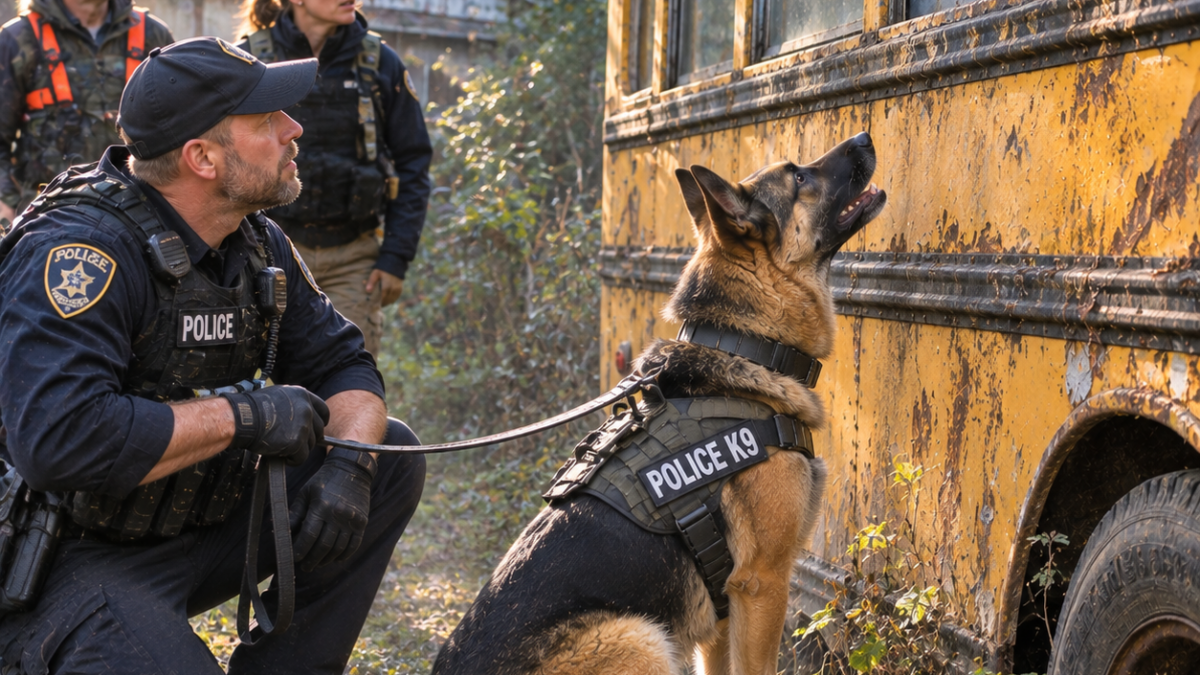
A Missing Girl Was Gone All Night—Then a Police K9 Stopped Beneath One Window of an Abandoned School Bus.
Eleven-year-old Emma Lawson had been missing for fourteen freezing hours when police K9 Biza ignored every building search already marked complete and dragged her handler behind an abandoned maintenance shed toward a school bus that three different search teams swore had already been checked.
Instead of barking at the door, the Belgian Malinois sat beneath the fourth window from the rear, stared upward, and refused to move—even when her handler showed her Emma’s scent article again and ordered her to continue searching.
Then Deputy Mara Collins climbed onto the bus, looked at the glass above Biza’s head, and found five tiny fingerprints in the morning condensation beside a message so small nobody outside could have seen it—and realized Emma had been alive inside that bus while half the town was searching somewhere else.
At 6:13 on Sunday morning, the sun had not yet cleared the pine trees outside Bellweather, North Carolina.
The town looked colorless.
Gray sky.
Gray road.
Gray frost along the grass.
Search lights still burned beside the volunteer fire station even though they were no longer necessary.
Nobody had bothered turning them off.
Deputy Mara Collins had been awake for twenty-one hours.
Her police K9, Biza, looked better than she did.
The five-year-old Belgian Malinois stood beside Mara’s patrol SUV with her chest rising steadily, dark face alert, ears moving toward every sound around the command post.
People assumed working dogs became exhausted the same way humans did.
They did.
But differently.
Biza could sleep for twelve minutes beneath a folding table and wake ready to work.
Mara required coffee, ibuprofen, and increasingly dishonest conversations with herself.
One more sector.
One more trail.
One more hour.
Then another.
Eleven-year-old Emma Lawson had disappeared the previous afternoon.
Not from a shopping mall.
Not from a crowded festival.
Not while walking miles from home.
From a church parking lot in a town where almost everybody knew her father.
At 4:09 Saturday afternoon, Emma walked out of a youth choir rehearsal at First Baptist Church.
Her father, Daniel Lawson, was supposed to pick her up.
He arrived seven minutes late because a tractor-trailer stalled across Route 17.
At 4:16, the parking lot was mostly empty.
Emma was gone.
Her purple backpack remained beside a concrete planter.
Her water bottle was still inside.
So was her phone.
That changed everything.
An eleven-year-old girl might walk home.
She might go to a friend’s house.
PART2:
She might become angry about waiting and make a bad decision.
But Emma never went anywhere without her phone.
According to Daniel, she barely crossed the kitchen without it.
By 4:31, deputies were searching surrounding streets.
By 5:10, volunteers had arrived.
By 6:00, the county sheriff requested tracking dogs, drones, state police assistance, and neighboring departments.
By midnight, almost three hundred people had participated in some part of the search.
They checked drainage ditches.
Empty houses.
Businesses.
Church rooms.
School grounds.
Wood lines.
Creeks.
Storage buildings.
Construction sites.
Every unlocked structure within two miles.
Nothing.
Biza had been deployed at 6:42 Saturday evening.
Mara gave her Emma’s pink hoodie from home.
PART3:
The dog picked up scent near the church parking lot.
Followed it seventy yards toward Oak Street.
Then lost it beside the curb.
That suggested vehicle pickup.
Or contamination.
Or both.
Mara hated scent tracks ending at roads.
Roads meant possibilities multiplied.
Cars.
Trucks.
Direction unknown.
Distance unknown.
By 2:00 a.m., state police had reviewed traffic cameras.
No obvious abduction.
No suspicious vehicle clearly associated with Emma.
A white pickup crossed the area.
Three black SUVs.
Two sedans.
A school district maintenance van.
Nothing stood out.
At 3:17, Daniel Lawson asked Mara a question she had been avoiding.
“What are the chances now?”
They stood beside the command tent.
Daniel was forty-two.
Widower.
High school science teacher.
His wife, Rachel, had died from breast cancer four years earlier.
Emma was his only child.
Daniel had not cried during the first hours.
He organized.
Called friends.
Answered questions.
Provided photographs.
Listed names.
Remembered what Emma wore.
White sneakers.
Blue jeans.
Green sweatshirt.
Silver necklace with a tiny moon.
Then sometime around midnight, organization gave way to fear.
By 3:17, he looked twenty years older.
Mara answered carefully.
“She’s got a lot of people looking.”
“That’s not what I asked.”
“I know.”
He looked toward the dark road.
“Cold tonight.”
“Yes.”
“Thirty-one?”
“About.”
“She hates cold.”
Mara said nothing.
Daniel rubbed both hands over his face.
“I should’ve been there.”
“You were seven minutes late.”
“That’s enough.”
“Daniel.”
“I’m her father.”
“I know.”
“I told her never to leave.”
Mara looked directly at him.
“We don’t know that she left willingly.”
That hurt worse.
She saw it.
Daniel looked down.
“Sorry.”
“No.”
He shook his head.
“No, you’re right.”
He took a breath.
“Find her.”
Mara looked toward Biza sleeping beneath a table.
“That’s the plan.”
At 5:48, a volunteer coordinator approached.
“Maintenance district wants us clear of the old school yard by eight.”
Mara frowned.
“Why?”
“Roofing crew.”
“What school?”
“Lincoln Elementary.”
Mara looked at the search map.
Lincoln Elementary had closed seven years earlier after the county consolidated schools.
The main building was used occasionally for storage.
The rear maintenance shed held landscaping equipment.
Search teams had checked it.
Twice.
“Already cleared.”
The coordinator nodded.
“Building, shed, playground.”
“Vehicles?”
“School buses too.”
Mara looked up.
“What buses?”
“Two old ones behind maintenance.”
She had not known that.
“Who checked them?”
The coordinator looked at the log.
“Volunteer Team Four around eleven.”
“Doors?”
“One unlocked.”
“Other locked.”
Mara stared.
“Locked bus was cleared how?”
The man hesitated.
“Exterior visual.”
“That’s not cleared.”
“He said windows were empty.”
“Who said?”
“Carl Jennings.”
Mara knew the name.
School district transportation supervisor.
Fifty-six.
Volunteer firefighter.
Local.
Everybody knew Carl.
He had helped organize search vehicles the night before.
Mara looked toward Biza.
Then back to the coordinator.
“Where’s Lincoln?”
“Three blocks east.”
She clipped Biza’s working harness.
The dog woke instantly.
“Come on.”
The coordinator frowned.
“You think she’s there?”
“I think I don’t like boxes checked by eyesight through glass.”
Deputy Luke Serrano joined her.
Thirty-nine.
Former Marine.
Patrol supervisor.
He carried coffee in one hand.
“You going somewhere?”
“Lincoln.”
“Already searched.”
“So I keep hearing.”
Luke sighed.
“Coffee?”
“Yes.”
He offered it.
Mara took one drink.
Then handed it back.
“That is horrible.”
“You drank it.”
“I was desperate.”
They drove separately.
Lincoln Elementary sat behind a chain-link fence at the end of Maple Avenue.
The school had once served nearly five hundred children.
Now weeds pushed through cracks in the parking lot.
Murals had faded along the brick walls.
A wooden sign still read:
LINCOLN LIONS — LEARN, LEAD, LOVE.
The maintenance shed stood behind the gymnasium.
Two buses were parked beyond it.
One yellow.
One mostly white where weather had stripped the paint.
Both old.
The yellow bus sat closest to the tree line.
Mara got out.
Biza jumped from the rear compartment.
Luke walked over.
“That one?”
“Both.”
Mara gave Biza Emma’s hoodie again.
“Smell.”
Biza inhaled.
Mara waited.
“Find Emma.”
The dog immediately turned away from the school building.
Straight toward the buses.
Luke’s expression changed.
“That quick?”
Mara did not answer.
Biza crossed cracked asphalt.
Passed the first bus.
Barely slowed.
Then turned sharply behind the maintenance shed.
The second bus sat partially hidden from the school.
Its front door faced the fence.
Windows fogged faintly from overnight temperature changes.
Biza pulled harder.
Mara felt the line tighten.
“Easy.”
The dog reached the front folding door.
Sniffed.
Moved along the side.
Window one.
Two.
Three.
Then stopped beneath the fourth from the rear.
She sat.
Mara waited.
“Search.”
Biza remained sitting.
Head tilted upward.
“Biza.”
Nothing.
Luke approached.
“What’s she doing?”
Mara looked at the dog.
“I don’t know.”
She pointed toward the front.
“Search.”
Biza stood.
Moved two steps.
Then returned to the same place.
Sat again.
Stared at the window.
Luke looked upward.
“Can you see anything?”
Glass cloudy.
Dirty.
Inside dark.
“No.”
Mara moved toward the front door.
Locked.
She checked emergency rear door.
Locked.
“Who has keys?”
Luke radioed.
School district representative was ten minutes away.
Mara did not want ten minutes.
She looked at Biza.
The dog whined.
Scratched once against the metal beneath the window.
Then sat again.
Luke said:
“Break it?”
Mara considered.
Missing child.
Probable cause.
Exigent circumstances.
“Yes.”
Luke retrieved a window punch.
Mara stopped him.
“Not that window.”
“Why?”
“If she’s directly inside.”
He nodded.
They broke a smaller pane near the front.
Reached the emergency door mechanism.
Inside smelled like dust, vinyl, old gasoline, mouse droppings.
And something else.
Fresh.
Mara entered.
“Emma!”
No answer.
Luke followed.
Seats remained in place but several had torn upholstery.
Cardboard boxes filled the front rows.
Maintenance supplies.
Old textbooks.
Traffic cones.
Mara walked toward the rear.
Fourth window.
Biza remained outside beneath it.
From inside, Mara could finally see.
Condensation had formed lightly along the glass.
Near the lower corner were fingerprints.
Small.
Five.
A child’s hand.
Mara’s heart started pounding.
“Luke.”
He saw.
“Jesus.”
Then Mara noticed lines beneath the prints.
Not marker.
Scratched through condensation and dirt.
Two words.
HELP ME.
Luke immediately radioed.
“Command, we have confirmed evidence Emma was inside Lincoln bus. Lock the property down. Crime scene response now.”
Mara stared at the window.
Fresh condensation could preserve prints only temporarily.
But the underlying grime held finger marks too.
Emma had pressed her hand there.
Maybe hours earlier.
Maybe while search teams were nearby.
Mara’s stomach turned.
The volunteers had checked this bus at eleven.
If Emma had been inside—
She stopped herself.
Evidence first.
The interior had to be preserved.
Still, Biza was already moving outside.
Mara heard scratching.
She stepped down.
Biza went around the bus.
Toward the rear.
Sniffed the tire.
Then undercarriage.
Then pulled toward the maintenance shed.
“Find Emma.”
The dog moved fast.
Luke followed.
Behind the shed, fresh tire tracks cut through soft soil.
Not bus tires.
Van.
Pickup maybe.
Biza sniffed.
Moved toward the back fence.
Stopped.
Scent gone.
Road beyond.
Another vehicle transfer.
Mara cursed quietly.
Luke looked at her.
“She was here.”
“Yes.”
“And moved.”
“Yes.”
“When?”
“Need cameras.”
Lincoln had no active security system.
Or so the district believed.
A nearby hardware store did.
So did a gas station two blocks away.
Within an hour, detectives were collecting footage.
Mara returned to the bus.
Forensics arrived.
Biza remained outside.
Daniel Lawson reached the perimeter at 7:21.
Someone had called him.
He rushed toward Mara.
“Is she there?”
“No.”
His face collapsed.
“But she was.”
“What does that mean?”
Mara kept her voice steady.
“We found her fingerprints.”
Daniel stared at the bus.
“She was inside?”
“Yes.”
“When?”
“We don’t know yet.”
“Was she hurt?”
“We don’t know.”
“Did she leave?”
“We believe someone moved her.”
Daniel looked at Mara.
“Someone?”
“Yes.”
He covered his mouth.
Then looked at the bus again.
“They searched this place.”
“I know.”
“They told me they searched it.”
“I know.”
Daniel’s voice rose.
“She could’ve been here while we were—”
Mara stepped closer.
“Don’t.”
He looked at her.
“Don’t build the timeline before we have it.”
“She wrote help me.”
Mara wished nobody had told him that yet.
His knees nearly buckled.
Luke caught his arm.
Daniel pulled away.
“I’m fine.”
He was not.
Biza walked toward him.
Daniel looked down.
The dog sniffed his hand.
Then pressed lightly against his leg.
Mara allowed it.
Daniel touched her head.
“You found where she was.”
Biza looked toward the bus.
Daniel whispered:
“Find where she is.”
At 8:04, technicians found blood.
Very small amount.
One smear beneath seat thirty-two.
Mara’s stomach tightened.
Preliminary test confirmed blood.
DNA later.
Beside it:
A broken silver chain.
Tiny moon pendant missing.
Daniel identified it instantly.
Emma’s necklace.
The blood could be from a scratch.
Not necessarily serious.
Still, every minute mattered.
Then they found something beneath the seat.
A plastic inhaler.
Blue.
Emma did not have asthma.
Name sticker:
TYLER MASON.
Mara frowned.
“Who?”
School records search.
Tyler Mason had attended Lincoln Elementary before closure.
Would be twenty-one now.
His family moved away six years earlier.
Why was his inhaler under a bus seat?
Maybe old.
Could have been there for years.
Forensics bagged it.
Then another object.
A pink hair tie.
Fresh.
Daniel said Emma wore black ties.
Unknown significance.
The bus was becoming a timeline of multiple lives.
Mara forced herself not to turn everything into evidence.
At 8:37, the hardware-store camera produced the first major break.
11:42 p.m.
A white school district maintenance van entered Maple Avenue.
Turned toward Lincoln.
Lights off before reaching the lot.
12:09 a.m.
Same van left.
Mara stared.
“Who drives that?”
District fleet records.
Van 14.
Assigned to transportation supervisor Carl Jennings.
Luke looked at Mara.
The same man who said the locked bus was visually cleared.
“Find Carl.”
He was not at home.
Wife said he had left at 5:30 to help with search operations.
His truck remained in driveway.
Phone went straight to voicemail.
The maintenance van was missing.
Sheriff Grant Ives ordered units to locate him immediately.
Daniel heard the name.
His face changed.
“Carl?”
Mara turned.
“You know him well?”
“Everybody does.”
“Specifically.”
Daniel stared toward the bus.
“He drove Emma’s elementary route for two years before he became supervisor.”
Luke said:
“Would Emma know him?”
“Yes.”
“Trust him?”
Daniel hesitated.
“Yes.”
That answer hit hard.
A trusted adult could get an eleven-year-old into a vehicle without struggle.
But Emma’s backpack was left at church.
Why?
Maybe she went willingly for a moment.
Then realized something wrong.
Mara asked:
“Any reason Carl would target her?”
“No.”
“Problems with you?”
“No.”
“Your wife?”
“Rachel?”
“Yes.”
Daniel shook his head.
“She barely knew him.”
Then stopped.
“Wait.”
Mara saw it.
“What?”
“When Rachel was sick, the school did a fundraiser.”
“Carl organized transportation.”
“For hospital appointments?”
“No. Meals. Pickups. Stuff.”
“Did he ever drive Rachel?”
“Maybe once.”
Daniel rubbed his forehead.
“I don’t know.”
“Think.”
“I was working.”
“Rachel did chemo in Raleigh.”
“People helped.”
“Carl was one of them.”
Not motive.
Connection.
They searched Carl’s personnel file.
Twenty-eight years with school district.
No criminal record.
No complaints involving children.
One disciplinary action for using district fuel for personal errands.
Married.
Two adult sons.
Stable employment.
Not obvious.
Then his phone records arrived.
He had called Daniel Lawson twelve times during Rachel’s final year.
Daniel had no memory of those calls.
Text records old enough that content required warrants and carrier availability.
Why so much contact?
Maybe logistical support.
Maybe not.
At 9:12, a deputy found Maintenance Van 14.
Abandoned at an old boat ramp eight miles west.
No Carl.
No Emma.
Biza was transported there.
Mara gave the command.
“Find Emma.”
The dog sniffed passenger side.
Then rear cargo doors.
Alerted strongly.
Inside:
Blankets.
Cable ties.
Two bottles of water.
A child’s green sweatshirt fiber caught near the floor latch.
And a smear of blood.
Mara looked away.
Luke said:
“Could be same small injury.”
“I know.”
Biza jumped down.
Tracked from van toward river.
Mara’s heart sank.
Water.
Scent loss.
Worst possibility.
The dog followed twenty yards.
Then turned away from the river.
Up the access road.
Luke exhaled.
“Good girl.”
Biza tracked toward the highway shoulder.
Then stopped.
Scent terminated near tire marks.
Third vehicle.
Someone had moved Emma again.
Mara’s frustration became anger.
This was organized.
Not panic.
Not one man improvising.
At least two transfer points.
Church.
Bus.
Boat ramp.
Different vehicles.
Why?
To defeat tracking.
To create distance.
Someone understood search procedure.
Carl, as a volunteer firefighter and transportation supervisor, would know enough.
But why move her repeatedly?
And why keep her alive overnight?
Ransom?
None.
Revenge?
Unknown.
Sexual motive?
No evidence yet.
Mara hated every possible answer.
At 10:03, Carl Jennings called 911.
From a payphone outside a convenience store in Greensboro.
Ninety miles away.
“I need police.”
Dispatcher kept him talking.
“Is this Carl Jennings?”
Long pause.
“Yes.”
“Where is Emma Lawson?”
“I don’t know.”
“Carl.”
“I swear to God.”
“You used your van.”
“Yes.”
“You moved her.”
“Yes.”
Mara listened live through command communications.
Carl sounded terrified.
“Is she alive?”
Dispatcher asked.
“She was when I last saw her.”
Daniel, standing nearby, heard.
He closed his eyes.
Alive.
At least at some point.
Carl continued:
“They made me do it.”
“Who?”
Silence.
“Carl, who made you do it?”
“My son.”
Everyone in the command room looked up.
Carl had two adult sons.
Evan, thirty-two.
Michael, twenty-nine.
Both local.
Mara whispered:
“Which one?”
Dispatcher asked.
“Which son?”
Carl answered:
“Evan.”
Sheriff Ives immediately ordered units to Evan Jennings’s residence.
Empty.
Vehicle missing.
Occupation:
Private security installer.
Former Army military police.
No serious criminal record.
Divorced.
One child.
Why Emma?
Carl said he did not know.
Then contradicted himself.
“He said it was about Rachel.”
Daniel stared.
“My wife?”
Carl began crying.
“I’m sorry.”
“What about Rachel?”
Dispatcher did not know how significant the name was.
Mara did.
She motioned for the dispatcher to ask.
“What about Rachel Lawson?”
Carl said:
“Evan thought Daniel killed her.”
The room became silent.
Daniel looked as if someone had struck him.
“What?”
Rachel Lawson died from cancer.
Documented.
Hospitalized.
Hospice.
Nothing suspicious.
Mara looked at Daniel.
He stared back.
“That’s insane.”
Carl remained on the phone.
“He said she told him things.”
“What things?”
“That Daniel was hurting her.”
Daniel shouted:
“No!”
Sheriff Ives raised a hand.
“Daniel.”
Carl continued.
“I told him Rachel was sick.”
“He said that wasn’t what he meant.”
“What did he mean?”
“I don’t know.”
“Where did you take Emma?”
Carl answered.
“Lincoln bus.”
“Then?”
“Van to boat ramp.”
“Then?”
“I gave her to Evan.”
“Vehicle?”
“Dark SUV.”
“Where was he going?”
“I don’t know.”
“Did Emma know him?”
“No.”
“Was she injured?”
“She cut her hand on a broken seat.”
Small blood smear.
Relief, limited but real.
“Why did you help?”
Carl began crying harder.
“He had my granddaughter.”
The room changed again.
Evan’s daughter:
Sophie Jennings.
Age seven.
Supposedly with her mother in Charlotte that weekend.
Police contacted the mother.
She answered.
Sophie was not there.
Evan had picked her up Friday after school for his weekend custody.
Now two missing girls.
Carl said Evan video-called him Saturday evening.
Showed Sophie asleep in a room.
Threatened to disappear with her forever if Carl did not help move Emma.
Carl obeyed.
He lied about checking the bus.
He waited until search teams left the old school.
Then used his van to move Emma at 11:42.
“Why not call police?”
Dispatcher asked.
Carl’s voice broke.
“Because he said he’d kill Sophie.”
Everyone went quiet.
Mara looked at the search map.
Evan Jennings was not simply hiding Emma.
He had his own daughter too.
Two children.
One plan.
And the motive apparently reached back to Rachel Lawson.
Carl surrendered to Greensboro police.
He provided everything he knew.
Evan believed Daniel had abused Rachel during her illness.
Where did that belief come from?
Rachel herself.
Carl had learned only after her death that Rachel and Evan had been close.
How close?
Carl would not say at first.
Then:
“They had an affair.”
Daniel sat down.
His face emptied.
Mara wished he had not been present.
But there was no taking it back.
“Rachel?”
He whispered.
Carl’s recorded statement continued.
The affair began during Rachel’s chemotherapy.
Evan installed a security system at the Lawson home through a district referral.
He and Rachel became friends.
Then more.
Daniel looked like he might vomit.
Luke sat beside him.
Daniel whispered:
“I was working extra shifts.”
No one answered.
“To pay for treatment.”
Luke said quietly:
“This is not the time to decide what any of that means.”
Daniel stared at the floor.
Mara returned to the case.
Affair explained emotional connection.
Not abduction.
According to Carl, Rachel ended the relationship before she died.
Evan refused to accept it.
He believed Daniel forced her.
Then Rachel died.
Evan blamed Daniel.
For four years, apparently.
But why wait?
The answer emerged from a letter.
Evan’s ex-wife found it inside a storage box.
Rachel had written to Evan months before her death.
Handwritten.
She thanked him for friendship.
Apologized for the affair.
Told him to leave Daniel and Emma alone.
Explicitly.
Daniel loves me. He has never hurt me. What happened between us was my failure too. Do not turn it into something it wasn’t.
Evan had kept the letter.
But beneath it were pages in his handwriting.
Obsessive.
Daniel manipulated her.
Daniel made her write this.
Emma belongs with someone who knows truth.
Mara’s stomach tightened.
He had built an alternate reality.
Over years.
The trigger?
Daniel had recently announced plans to move to Virginia with Emma after receiving a teaching position near his sister.
Evan learned through church gossip.
If Emma left town, he would lose access to the child he had apparently watched from a distance for years.
He decided to “rescue” her from Daniel.
Not kill her.
That mattered.
At least initially.
But his plan was unstable.
He kidnapped Emma intending to show her “evidence” against her father and convince her to stay willingly.
When Emma rejected him and tried escaping from the bus, he panicked.
Carl became involved.
Then the search intensified.
Evan moved both girls.
Now no one knew where.
Mara returned to the bus.
Biza still had something to say.
The dog had first sat beneath one specific window.
Emma’s prints.
Message.
That made sense.
But after evidence collection, Biza repeatedly sniffed the rear seat area.
Mara watched.
“Search.”
Biza moved beneath seat thirty-four.
Pawed.
Forensics had checked there.
Nothing.
Mara crouched.
Metal floor.
Seat bolts.
Old gum.
Dust.
Biza scratched again.
Luke joined.
“What?”
“She likes something.”
They removed the seat after photographing.
Under the mounting bracket, scratched into paint:
S + E.
Tiny.
Beside it:
HOUSE WITH RED DOOR.
Mara’s pulse accelerated.
Emma.
Maybe Sophie.
Two girls leaving a message.
But what red door?
Carl was brought back for questioning.
“Does Evan own a house with a red door?”
“No.”
“Cabin?”
“No.”
“Storage property?”
Carl thought.
Then froze.
“My mother’s place.”
“Where?”
“Dead Creek Road.”
“Who lives there?”
“Nobody.”
Carl’s mother had died three years earlier.
Family farmhouse sat vacant eighteen miles north near the county line.
Front door painted red.
Sheriff Ives mobilized teams.
Mara brought Biza.
They approached cautiously.
No lights.
One dark SUV parked behind the barn.
Registered to Evan.
Positive.
Tactical team surrounded the property.
Mara stayed back with Biza.
Negotiator called.
No answer.
Again.
No answer.
Then upstairs curtain moved.
A child’s face appeared.
Gone instantly.
Mara’s heart pounded.
“Visual child second floor.”
Could be Emma.
Could be Sophie.
Negotiator used loudspeaker.
“Evan Jennings, this is the sheriff’s office. We know you’re inside. We want everyone safe.”
Nothing.
Five minutes.
Ten.
Then front door opened.
A seven-year-old girl ran out.
Sophie.
Bare feet.
Crying.
Deputies grabbed her.
“Where’s Emma?”
Sophie sobbed:
“Upstairs.”
“Where’s your dad?”
“Basement.”
That was strange.
“Why?”
“He locked himself.”
“Is Emma hurt?”
“No.”
“Can she come out?”
“Door locked.”
Tactical entry.
No gunfire.
No dramatic standoff.
Evan Jennings was found in the basement sitting on the floor beside an unloaded handgun.
He surrendered.
Emma was in an upstairs bedroom.
Door locked from outside.
When deputies opened it, she backed into a corner.
“Emma?”
Mara stood outside.
The child stared.
Green sweatshirt.
Bandage improvised around left palm.
Exhausted.
Alive.
Mara knelt.
“My name is Mara.”
Emma looked past her.
Then heard claws.
Biza.
Mara smiled.
“You want to meet somebody?”
Emma nodded.
Biza entered.
The girl dropped to her knees.
Wrapped her arms around the dog.
Biza licked her cheek.
Emma began crying.
“You found my message?”
Mara swallowed.
“Yes.”
“Which one?”
That stopped her.
“How many?”
Emma looked at Sophie.
“We left three.”
Mara stared.
One on bus window.
One under seat.
Third?
“Where?”
Emma said:
“In the van.”
Forensics returned.
The maintenance van had been searched thoroughly.
But not with knowledge of a deliberate child clue.
Inside the rear cargo wall, written in marker beneath a folded blanket:
E TAKING US NORTH.
Emma had written it while Carl stopped for fuel.
Covered it with the blanket so Evan would not see.
They had missed it.
Mara hated that.
Then reminded herself:
They still found her.
Children under stress had done more investigative work than anyone expected.
At the sheriff’s office, Emma finally reunited with Daniel.
No cameras allowed.
No press.
Mara stood outside the room.
She heard Daniel say her name.
Then nothing except crying.
Emma shouted:
“Dad!”
Then:
“I knew you’d come.”
Daniel answered:
“I’m sorry.”
Emma:
“For what?”
“I was late.”
Even through the door, Mara heard Emma respond:
“Seven minutes?”
Daniel began sobbing.
That mattered.
Children sometimes cut directly through the guilt adults spent years building.
Evan Jennings confessed partially.
He insisted he never intended to hurt Emma.
He claimed he wanted to tell her the “truth” about Daniel and Rachel.
Investigators asked why he locked her inside a bus.
“Because she wouldn’t listen.”
“Why take her phone?”
“She’d call Daniel.”
“Why move her repeatedly?”
“Police misunderstood.”
“Why threaten your father with Sophie?”
“He would’ve betrayed me.”
“Why have a gun?”
“For protection.”
The delusion was coherent enough to be dangerous.
He believed himself rescuer.
That frightened Mara more than someone admitting selfish motive.
Rachel’s letter destroyed much of his claimed justification.
So did medical records showing Daniel participated fully in her cancer care.
Nurses remembered him.
Doctors.
Hospice workers.
There was no evidence Daniel abused Rachel.
Quite the opposite.
But the affair was real.
Daniel had to grieve his wife a second time.
Not because the love was false.
Because he learned it had been complicated.
He asked Emma’s therapist how much to tell her.
The therapist said:
“Not everything at once.”
Emma already knew Evan claimed to love her mother.
She did not understand why.
Daniel eventually explained when she was older.
Not immediately.
At eleven, she needed her mother to remain larger than one mistake.
The criminal case against Evan included kidnapping, child endangerment, unlawful restraint, coercion, weapons charges, and offenses involving his own daughter.
Carl Jennings faced charges too.
That caused controversy.
He had helped move Emma.
Lied to search teams.
Delayed rescue.
But he did so under threat involving his granddaughter.
Prosecutors eventually offered a plea agreement.
Probation after limited confinement.
Community service.
Permanent loss of school transportation employment.
Daniel surprised everyone by speaking at Carl’s sentencing.
“I am angry.”
He looked at Carl.
“You watched me search while you knew my daughter had been inside that bus.”
Carl cried.
Daniel continued.
“I don’t know whether I will ever forgive that.”
Then:
“But I also know someone used your granddaughter against you.”
He paused.
“I hope nobody ever learns what they would do in that situation.”
That was all.
Not forgiveness.
Not condemnation.
Truth.
Evan received decades in prison.
The court ordered no unsupervised contact with Sophie.
His parental rights became subject to separate proceedings.
Sophie entered intensive therapy.
She and Emma remained friends for a while.
Not ordinary friends.
Something formed by survival.
They wrote letters.
Then saw each other less as life moved.
That was healthy too.
The abandoned bus became evidence for months.
Eventually the district planned to scrap it.
Emma heard.
She asked Daniel:
“Can I see it first?”
He hated the idea.
Her therapist supported it if controlled.
So one Saturday morning, Mara met them at Lincoln Elementary.
Biza came.
The bus remained where it had been.
Weather had changed.
Spring.
Green grass.
Warm air.
Emma stood outside.
Looked at the fourth window.
“That one.”
Mara nodded.
“You could see us?”
Emma shook her head.
“It was dark.”
“What happened?”
Emma looked toward Daniel.
He stayed back.
Her choice.
“Mr. Evan said Dad sent him.”
“Did you believe him?”
“At first.”
“He knew Mom’s nickname for me.”
Mara frowned.
“What?”
“Birdie.”
Only close family used it.
Evan learned it from Rachel.
“He said, ‘Come on, Birdie. Your dad got stuck.’”
Emma followed him to an SUV.
By the time she realized they were not going home, doors were locked.
He brought her to the old bus after dark.
He played recordings.
Rachel’s voice.
Old voicemail messages.
Tried convincing Emma that Daniel had caused her mother’s death.
Emma refused.
“My dad loved Mom.”
Evan became angry.
Not violent at first.
But unstable.
Emma tried opening the bus door.
Cut her palm on exposed metal.
That explained blood.
When search volunteers arrived around eleven, Emma heard them.
Mara’s chest tightened.
“You heard the searchers?”
Emma nodded.
“I yelled.”
“Did they hear?”
“No.”
“Why?”
“Mr. Evan put tape over my mouth when cars came.”
Daniel looked away.
Emma continued.
“He hid behind the shed.”
“Carl was with them?”
She nodded.
“Grandpa Carl looked through the window.”
Mara froze.
“He saw you?”
Emma’s eyes filled.
“Yes.”
That was worse than they knew.
Carl had visually checked the bus.
He saw Emma.
And because Evan held Sophie elsewhere, Carl lied.
He walked away.
Daniel’s jaw clenched.
Emma whispered:
“He was crying.”
That mattered too.
No simple villains except perhaps the man who built the situation.
After volunteers left, Emma wiped condensation from the window with her fingers.
Wrote HELP ME.
Then Evan returned.
He never saw it because exterior dirt concealed the writing from his angle.
At some point Sophie was brought to the bus briefly.
Emma whispered through the seats:
“Leave clues.”
That was how S + E appeared.
House with red door came from Sophie.
She recognized her grandmother’s old house when Evan talked about taking them there.
Mara looked at Emma.
“You figured all that out?”
Emma shrugged.
“Mom liked mystery books.”
Daniel smiled through tears.
“So do you.”
Emma looked at Biza.
“Did she smell my hand?”
“Maybe.”
“On the window?”
“Could’ve.”
“How did she know which window?”
Mara answered honestly.
“I don’t know exactly.”
Emma touched the bus.
“She knew.”
Mara smiled.
“She knew something.”
Biza sat beneath the window again.
Same place.
Emma laughed.
“She remembers.”
Probably scent association.
Probably Mara’s behavior.
Maybe old residual odor.
Maybe simply training context.
Mara did not ruin it.
Sometimes the precise mechanism mattered less than the moment.
Emma asked:
“Can I go inside?”
Daniel tensed.
She looked at him.
“I want to.”
He nodded.
They entered.
The bus felt smaller in daylight.
Emma walked to seat thirty-two.
Touched the torn vinyl.
Then the window.
Mara watched her.
No panic.
Not yet.
Emma said:
“I thought nobody would see it.”
Mara stood beside her.
“Biza did.”
Emma smiled.
“No.”
“What?”
“She didn’t see it.”
Emma looked out at the dog below.
“She stopped where I was.”
That sentence stayed with Mara.
The bus was scrapped two weeks later.
Daniel kept one small thing.
With district permission, workers removed the metal panel beneath the fourth window.
Not the glass.
Just a piece of yellow-painted steel.
He stored it in his garage.
Emma thought that was weird.
Daniel agreed.
Still kept it.
Biza became famous locally.
News stations wanted dramatic footage.
POLICE K9 FINDS CLUE THAT SAVED MISSING GIRL.
Mara corrected reporters repeatedly.
“Biza found where Emma had been.”
“The girls saved themselves too.”
“Search teams found the farmhouse because Emma and Sophie left information.”
Reporters preferred dog heroics.
Reality was more collaborative.
Biza had pointed at the first thread.
Humans followed.
Emma left the next.
Sophie another.
Carl finally spoke.
Investigators connected pieces.
No single hero.
Emma liked that version.
At school, classmates treated her strangely.
Some stared.
Some asked invasive questions.
One boy asked whether she was tied up.
She punched him.
Daniel got a call.
He tried to look stern while Mara stood nearby.
“You cannot punch people.”
Emma crossed her arms.
“He asked if I cried.”
“You still cannot punch him.”
“He deserved it.”
Mara coughed.
Daniel looked at her.
“Do not encourage this.”
“I didn’t say anything.”
“You made a sound.”
“Seasonal allergy.”
Emma smiled.
Therapy helped.
So did Biza.
Emma began visiting the K9 unit every few weeks.
She learned scent games.
How dogs used air currents.
Why handlers avoided contaminating scent articles.
How tracking differed from trailing.
She asked better questions than adults.
“Does Biza know missing means scared?”
Mara thought.
“No.”
“Then what does find mean?”
“A job.”
“Just that?”
“At first.”
Emma looked at Biza.
“Does she know when people are happy she found someone?”
“Probably.”
“How?”
“Voice.”
“Smell.”
“Body language.”
Emma nodded.
“Then she knows enough.”
Years passed.
Emma and Daniel moved to Virginia eventually.
One year later than planned.
They needed time.
Before leaving, Emma asked to walk Biza one last time through the veterans’ trail near the K9 unit.
Mara agreed.
Emma was thirteen.
Taller.
Quieter.
Still loved mystery novels.
They stopped at a bench.
Emma asked:
“Did you ever blame yourself?”
“For what?”
“For not checking the bus earlier.”
Mara stared ahead.
“Yes.”
Emma looked surprised.
“You didn’t know.”
“I know.”
“Then why?”
Mara smiled faintly.
“Feelings don’t always care.”
Emma considered.
“Dad does that.”
“Your dad does a lot of that.”
She laughed.
Mara continued.
“I looked at the search map afterward.”
“A hundred times.”
“Thought maybe if I had sent Biza there at seven instead of sunrise…”
Emma interrupted.
“I wasn’t there at seven.”
Mara turned.
“What?”
“Mr. Evan didn’t put me in the bus until after nine.”
That was in reports.
Mara knew it.
But hearing Emma say it changed something.
“You couldn’t have found me there earlier.”
“No.”
“So stop.”
Mara laughed.
“Yes, ma’am.”
Emma smiled.
Biza leaned against her leg.
At fifteen, Emma wrote a school essay about the incident.
Not titled “The Night I Was Kidnapped.”
She called it:
THE WINDOW.
Daniel sent Mara a copy.
One paragraph read:
People talk about being found like it is one moment. It isn’t. I was found many times. Biza found where I had been. Sophie found a way to help me leave clues. Carl found the courage to finally tell the truth. The police found the farmhouse. My dad found a way to stop blaming himself. I think I am still finding parts of myself too.
Mara cried in her patrol car.
Then denied it when Luke saw.
Biza retired at eight.
Arthritis in one shoulder.
Nothing severe.
Enough.
Mara adopted her.
Obviously.
The retirement ceremony was small.
Emma and Daniel drove down from Virginia.
Emma was sixteen now.
She carried something wrapped in cloth.
After the official remarks, she handed it to Mara.
“What?”
“Open it.”
Inside was a wooden frame.
Photograph of Biza sitting beneath the school-bus window.
Not dramatic.
No emergency lights.
Just a dog staring upward.
Beneath it:
SHE STOPPED WHERE EVERYONE ELSE KEPT WALKING.
Mara stared.
“Okay.”
Emma smiled.
“You hate sentimental things.”
“I do.”
“You’re crying.”
“I have allergies.”
“Still?”
“Chronic.”
Daniel laughed.
Biza spent retirement sleeping on Mara’s couch despite being given three expensive dog beds.
She developed a passion for stealing socks.
Hated vacuum cleaners.
Loved Emma whenever she visited.
At twelve, kidney disease appeared.
Then arthritis worsened.
Mara adjusted.
Shorter walks.
Ramps.
Medication.
One afternoon Emma, now in college, called.
“I heard Biza’s sick.”
Mara looked at the dog sleeping near the window.
“Yeah.”
“How bad?”
“Not today bad.”
“What does that mean?”
“It means come when you can, but don’t drive like an idiot.”
Emma came that weekend.
Sat on the floor.
Biza recognized her immediately.
Tail against carpet.
Emma whispered:
“Hi, girl.”
Biza lifted her head.
Emma held the dog’s face.
“You look old.”
Mara said:
“So do you.”
Emma laughed.
For several months, things stabilized.
Then one January morning, Biza refused breakfast.
Mara knew.
Veterinarian confirmed.
Kidneys failing.
Pain increasing.
Days.
Maybe a week.
Emma drove down.
Daniel too.
Luke came.
Even Sheriff Ives, retired now, stopped by.
No ceremony.
Mara wanted home.
Biza lay beside the living-room window.
Winter sunlight across her face.
Emma sat nearest.
She had brought the framed photograph.
Mara noticed.
“Why?”
“Felt right.”
Biza looked at it.
Or maybe at Emma’s hands.
The veterinarian prepared medication.
Emma stroked the dark fur behind Biza’s ears.
“Do you remember me?”
Mara answered before thinking.
“Yes.”
Emma smiled.
“How do you know?”
“Because I do.”
Fair.
Emma leaned closer.
“You found my window.”
Biza breathed slowly.
“I was so scared.”
Daniel’s eyes filled.
Emma continued:
“I heard people outside.”
“I thought they left me.”
Mara looked down.
Emma had never told her that part directly.
“Then the next morning you sat right underneath me.”
Biza’s ear moved.
Emma laughed softly.
“You didn’t even know what I wrote.”
Another breath.
“You just knew I’d been there.”
The veterinarian administered the sedative.
Biza relaxed.
Mara put one hand on her chest.
Years of work beneath her palm.
Tracks.
Searches.
Training.
Rain.
Mud.
Missing children.
Lost seniors.
Evidence fields.
Quiet drives home.
Emma whispered:
“You can stop looking now.”
Mara’s throat tightened.
Biza breathed.
Once.
Again.
Then was still.
Nobody moved.
Daniel put a hand over his face.
Emma kept hers on Biza’s head.
Mara stared through the window.
For years, people had told the story as though the dog performed a miracle.
Mara knew better.
Biza had done something more ordinary and more impressive.
She paid attention.
That was what working dogs did when trained well.
They noticed what humans walked past.
A scent lingering near a window.
A difference in air.
A trail where no person saw one.
Then they trusted it enough to stop.
Humans often hated stopping.
Stopping felt like wasting time.
Stopping meant admitting the plan might be wrong.
Search teams loved movement.
More roads.
More buildings.
More acres.
More people.
But sometimes finding someone depended on refusing to move beyond the place that mattered.
Biza had done exactly that.
Years later, Emma became a forensic psychologist.
Not because of Evan.
She always corrected people who assumed that.
She had been interested in human behavior long before.
But the experience shaped what questions she cared about.
How trusted adults manipulate children.
Why family members reinterpret reality.
How coercion changes decision-making.
Why people under threat sometimes make choices outsiders cannot understand.
Carl Jennings attended one of her public lectures years later.
Older.
Walking with a cane.
He waited until everyone left.
Then approached.
Emma recognized him.
He looked terrified.
“Miss Lawson.”
She stared.
“Carl.”
He swallowed.
“I’ve wanted to say this for years.”
Emma waited.
“I saw you in that bus.”
She knew.
“I know.”
“I should’ve opened the door.”
“Yes.”
His eyes filled.
“I thought Sophie would die.”
“I know.”
“I chose her.”
Emma looked at him.
“Yes.”
He started crying.
“I’m sorry.”
Emma did not say it was okay.
It was not.
She also did not tell him she hated him.
She had once.
Not anymore.
Finally she said:
“I was eleven.”
Carl nodded.
“You were the adult.”
He closed his eyes.
“Yes.”
“That’s the part you have to live with.”
“Yes.”
Emma took a breath.
“But Evan is the one who put you in that choice.”
Carl looked up.
She continued:
“Both things can be true.”
He cried harder.
That was the lesson she had learned from the case.
People wanted clean categories.
Victim.
Villain.
Hero.
Coward.
But Carl had betrayed her and loved Sophie.
Rachel had betrayed Daniel and still written a letter trying to protect him and Emma before dying.
Daniel had loved his wife without knowing all of her.
Evan had convinced himself he was rescuing a child while terrorizing two of them.
Complexity did not erase responsibility.
Responsibility did not require pretending people were simple.
Biza had been simpler.
Find the scent.
Follow it.
Stop where it matters.
Years after Biza died, Emma returned to Bellweather.
Lincoln Elementary was gone.
The county demolished it and built a community center.
The maintenance shed disappeared.
So did the buses.
But Daniel still had the yellow metal panel from beneath the fourth window.
He finally gave it to Emma.
“What am I supposed to do with this?”
“Your problem now.”
She laughed.
The paint had faded.
She ran a hand across it.
No fingerprints.
No message.
Nothing anyone else would understand.
She kept it anyway.
Not as evidence of what happened.
As evidence of what did not happen.
She did not die in that bus.
She did not disappear into the farmhouse.
She did not become a photograph on a missing-child poster.
She grew up.
Went to college.
Argued with her father.
Changed majors once.
Fell in love twice.
Got her heart broken.
Built a career.
Lived.
Sometimes survival looked less dramatic after enough years passed.
That was the point.
At one of her lectures, someone asked:
“Do you believe Biza knew you were inside that bus?”
Emma smiled.
“She knew I had been.”
“But how?”
“I’m not a dog handler.”
The audience laughed.
Emma continued:
“Maybe scent transferred to the glass.”
“Maybe air moved through a cracked seal.”
“Maybe there was something else my handler friends could explain better.”
She paused.
“But I don’t think the important question is how she knew.”
“What is?”
Emma looked toward the photograph projected behind her.
Biza sitting below the fourth bus window.
“The important part is that when she knew something, she stopped.”
She let the room remain quiet.
“Everybody else had already checked the bus.”
“Everybody else had a reason to keep moving.”
“She didn’t care that a box on a search sheet said cleared.”
“She didn’t care that three people had looked through the windows.”
“She didn’t know what should have been true.”
“She only knew what her nose told her.”
Then Emma smiled.
“And my life changed because one dog was stubborn enough to sit down.”
That was how she told the story.
Not as a miracle.
Not as fate.
Not even as a story about a kidnapped girl.
It was a story about attention.
A town had searched roads, woods, buildings, yards, creeks, rooftops, sheds, and fields.
Hundreds of people walked miles through darkness trying to find one child.
And at sunrise, when almost everyone was exhausted enough to believe there was nowhere left to look, Biza pulled her handler behind an old maintenance shed.
Past one abandoned bus.
Toward another.
She ignored the locked door.
Ignored the engine.
Ignored the tires.
She stopped beneath one dirty window.
Sat.
Looked up.
And waited for the humans to notice what she already had.
Emma had been there.
The search was not over.








