A Military K9 Scratched at His Dead Handler’s Empty Locker Until His Paws Bled—Then They Removed the Bottom Panel
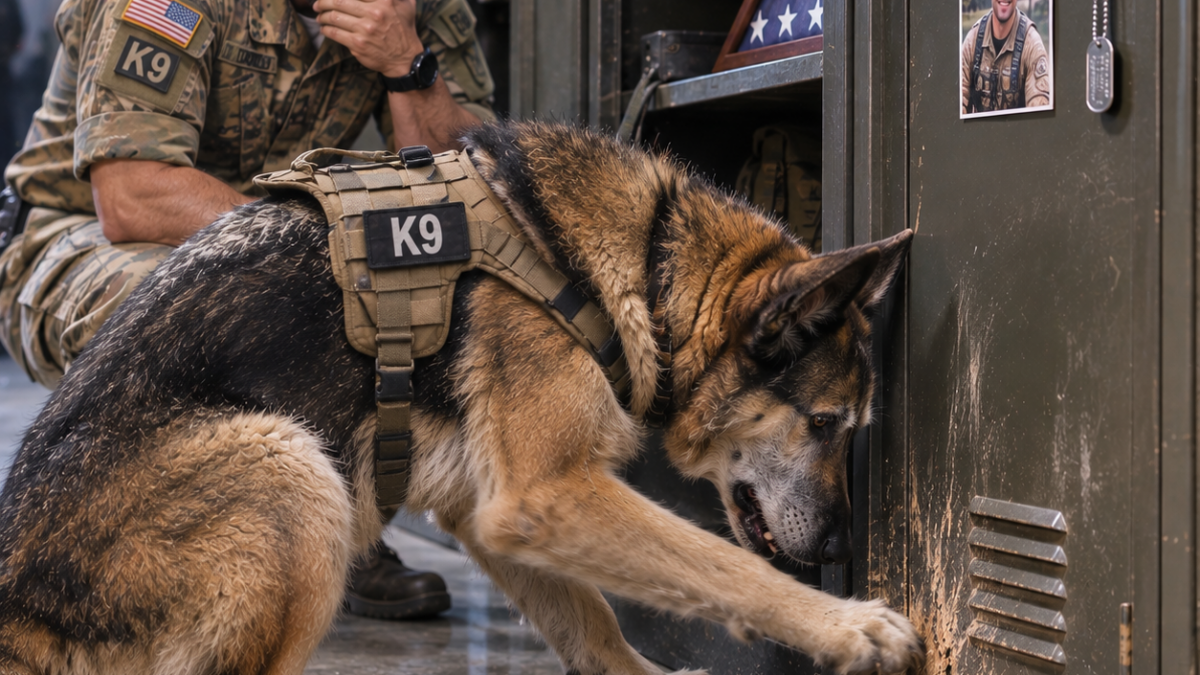
A Military K9 Scratched at His Dead Handler’s Empty Locker Until His Paws Bled—Then They Removed the Bottom Panel
For twenty-three nights after Staff Sergeant Luke Serrano was buried, his military K9 returned to the same supposedly empty locker and clawed at one corner until blood streaked the steel floor beneath his paws.
The kennel staff called it grief until the bottom panel finally came loose and revealed a sealed pouch containing photographs, a handwritten warning, and the identification number of a soldier the Army insisted had never been assigned to Luke’s final deployment.
But the most disturbing thing inside the locker was a message Luke had written to his dog’s next handler—because the first line made it clear he had known before he left that there was a chance he would never come home.
Rook started scratching at 1:17 in the morning.
The sound carried through the empty equipment room at Fort Calder like metal being dragged across concrete.
Scrape.
Pause.
Scrape.
Pause.
Scrape.
Sergeant First Class Mason Hale heard it from the kennel office thirty yards away.
He looked up from the incident report on his computer.
The sound came again.
Scrape.
Then a low whine.
Mason closed his eyes.
“Not again.”
He stood, grabbed the flashlight from beside the door, and walked toward the locker bay.
The installation had gone quiet hours earlier.
No training.
No vehicles moving.
Only the hum of fluorescent lights and the distant ventilation system.
Rook was supposed to be asleep in Kennel Six.
Instead, the seven-year-old Belgian Malinois stood inside the equipment room with his front paws braced against Locker 42.
Luke Serrano’s locker.
Or what had been Luke’s locker.
The door hung open.
Empty shelves.
Empty hooks.
No boots.
No uniform.
No harness.
No photograph taped inside.
Luke’s personal effects had been boxed, inventoried, and delivered to his mother seventeen days earlier.
The locker had been cleaned.
Inspected.
Marked for reassignment.
Yet Rook kept coming back.
Mason shined the flashlight downward.
“Rook.”
The dog ignored him.
Scratch.
His right paw hit the same lower corner.
Scratch.
Mason stepped closer.
“Enough.”
Rook scratched again.
PART2:
There was blood on the metal.
Mason swore.
He grabbed the dog’s harness.
Rook growled.
Not aggressively.
Warning.
Focused.
“Don’t.”
The dog’s ears flattened.
Mason softened his voice.
“Easy.”
Rook looked at him.
His eyes were dark, alert, furious in the strange way grieving working dogs could appear furious at the world.
Mason crouched.
“Luke’s not in there.”
Rook looked back at the locker.
Mason hated himself immediately for saying it.
Dogs did not need sentences like that.
People did.
Rook’s front claws were worn down.
One pad had split.
PART3:
Mason touched the leg.
The dog jerked away.
“Great.”
He reached for the leash clipped to his belt.
“You’re going back to medical.”
Rook refused to move.
Mason pulled gently.
The Malinois planted all four feet.
“Rook.”
Nothing.
“Come.”
Nothing.
Mason stared at the empty locker.
The dog had done this every night for nearly three weeks.
Always the same place.
Lower right corner.
At first, everyone thought it was grief.
Luke had been Rook’s handler for four years.
They had deployed together twice.
Trained together nearly every day.
Shared quarters during exercises.
Shared helicopters.
Armored vehicles.
Dust.
Gunfire.
Silence.
The kind of partnership civilians sometimes described as loyalty because they had no better word for something built from hundreds of tiny repetitions under stress.
Luke had died six weeks earlier during an overseas operation.
The Army told the unit his vehicle had been struck by a roadside explosive while returning from a joint patrol.
Three Americans died.
One interpreter.
Rook had not been with Luke.
That was unusual.
Almost everything about Luke’s final week had been unusual.
Rook had been pulled from the mission forty-eight hours before departure because of a minor paw injury.
Luke had gone without him.
Rook had spent the next four days restless and agitated.
Then a major arrived at the kennels.
Spoke privately to Mason.
Luke was dead.
Rook had stood outside the office throughout the conversation.
Nobody knew whether he understood.
But when Mason emerged, the dog did not bark.
He simply walked to Luke’s locker.
Sat.
And waited.
The scratching began after the funeral.
Night one.
Small.
Night two.
Again.
By night seven, Mason had put a temporary panel in front of the locker.
Rook pulled it away.
By night twelve, they moved him to another kennel wing.
He escaped.
By night sixteen, veterinary staff recommended mild medication at night.
Mason refused.
“He’s trying to tell us something.”
The veterinarian gave him a tired look.
“He’s grieving.”
“So am I. I don’t claw one specific piece of steel every night.”
“You’re not a dog.”
“Helpful.”
Now, twenty-three nights after the first scratching, Mason looked at the blood on Rook’s paw and felt something inside him change.
“Fine.”
He stood.
“You win.”
Rook stopped scratching.
Mason stared at him.
The dog stared back.
“You better not be doing this because Luke dropped a piece of jerky behind there.”
Rook’s ears moved.
Mason grabbed a screwdriver from the maintenance cabinet.
The locker was old military steel.
Bolted to the wall.
The bottom shelf sat three inches above the floor.
Mason knelt.
Looked closely at the corner Rook had been scratching.
At first, nothing.
Then he noticed one screw.
Slightly newer.
The others were dull gray.
This one was black.
Mason touched it.
“Who replaced you?”
He removed the screw.
Then another.
The bottom plate did not move.
Rook began whining.
Mason ran his fingers along the edge.
There.
A narrow seam.
Not factory.
Cut.
Modified.
He slid the screwdriver under it.
Pulled.
The panel flexed.
Rook stepped forward.
“Back.”
The dog backed up instantly.
That made Mason pause.
Rook had ignored every command for three weeks around this locker.
Now he obeyed.
Mason pulled harder.
The panel came free.
Behind it was a cavity perhaps four inches deep.
Someone had cut away the locker base and created a hidden compartment beneath the false floor.
Inside sat a flat black waterproof pouch.
Mason stopped breathing.
Rook sat.
No scratching.
No whining.
Just watching.
Mason reached toward the pouch.
Then stopped.
Evidence discipline.
Years of military police work overrode curiosity.
He stood.
Locked the equipment room.
Called Captain Nora Callahan.
Nora arrived nineteen minutes later wearing sweatpants under a field jacket and her hair tied back badly enough that she had probably done it while driving.
She looked at Mason.
“If this is another dog behavior issue—”
Mason opened the locker.
She stopped talking.
“What is that?”
“Don’t know.”
“You touched it?”
“Panel only.”
“Contents?”
“Didn’t touch.”
Nora crouched.
Rook moved beside her.
She looked at the dog.
“He found it.”
Mason nodded.
Nora put on gloves.
Photographed the cavity.
The pouch.
The screws.
The locker number.
Then she carefully removed the pouch.
It had no exterior marking.
Heavy canvas.
Waterproof zipper.
Inside were three things.
A small encrypted flash drive.
A folded envelope.
And six photographs.
Nora looked at the first photograph.
Then the second.
Her face changed.
Mason noticed.
“What?”
She handed him one.
It showed Luke standing outside a mud-brick structure somewhere overseas.
Not posing.
Unaware of the camera.
Beside him stood another American soldier.
Mason did not recognize the man.
On the back, Luke had written:
M. ROURKE — 18 MAY.
Nora handed him the next.
Same man.
Different location.
A medical tent.
His face bruised.
One wrist bandaged.
Back:
HE WAS NEVER ON THE ROSTER.
Mason looked up.
“What does that mean?”
Nora shook her head.
Third photograph.
A white Toyota pickup near a base entrance.
License plate visible.
Fourth.
Two men loading sealed military cases into it.
Fifth.
A page of a handwritten inventory sheet.
Sixth.
A printed deployment roster with one name circled.
Staff Sergeant Luke Serrano.
Below it, in Luke’s handwriting:
ASK WHY TEAM 3 WAS REPLACED 48 HOURS BEFORE MOVEMENT.
Mason felt cold.
Nora opened the envelope.
Inside was a letter.
Not addressed to command.
Not to Luke’s mother.
Not to his unit.
Written across the front:
TO WHOEVER HANDLES ROOK NEXT.
Mason stared.
Nora looked at him.
“You should read it.”
“Why me?”
“You’re kennel master.”
He opened it.
Luke’s handwriting was unmistakable.
Messy.
Slanted.
Too much pressure on the pen.
Mason began reading aloud.
“If you found this because Rook showed you where it was, trust him before you trust the report.”
He stopped.
Rook sat beside the locker.
Mason continued.
“I trained him to return to this spot and scratch if I failed to come back from the next rotation.”
Nora whispered, “Jesus.”
Mason read on.
“He’ll keep doing it until somebody removes the bottom panel. Do not punish him. Do not medicate him for this. He is following an emergency retrieval command.”
Mason looked at Rook.
The dog’s paw was bleeding because he had been doing exactly what Luke trained him to do.
For twenty-three nights.
Mason’s throat tightened.
He kept reading.
“I don’t know if what I found is corruption, theft, or something being hidden for reasons above my clearance.”
“Two weapons shipments do not match the logs.”
“One soldier appeared at our forward site without appearing on any movement order I could access.”
“That soldier called himself Matthew Rourke.”
Nora looked at the photograph again.
Mason continued.
“Rourke told me he had been held for questioning by our own people after reporting missing detonators from an engineering cache.”
“He said someone warned him not to contact CID because the complaint had already been routed through the same officers involved.”
“I did not believe him at first.”
Mason stopped.
Nora asked, “Keep going.”
“I checked.”
“A series of training explosives, blasting caps, and controlled components have been logged as expended but were never used on the ranges listed.”
“There are vehicle movements after midnight that do not appear in duty logs.”
“I have photographed what I can.”
“The drive contains copies.”
Then:
“If I return, I will recover this myself.”
“If I do not, assume somebody will eventually come looking for it.”
Mason’s hands tightened around the letter.
The last lines were different.
Less formal.
“If Rook makes it home and I don’t, let him work through it.”
“He will wait for me.”
“Don’t lie to him.”
“Just give him a job.”
Then one final sentence:
“He is better at finding the truth than most people I know.”
Mason lowered the page.
Nobody spoke.
Rook lay down beside Luke’s locker.
For the first time since the funeral.
Not scratching.
Not pacing.
Resting.
Nora looked at Mason.
“This stays between us until we call outside investigators.”
Mason nodded.
“CID?”
“Not local.”
“Why?”
She held up the letter.
“Luke explicitly says the complaint chain may be compromised.”
“You believe that?”
“I believe he believed it.”
“That’s not the same.”
“No.”
Nora looked at the dog.
“But that hidden compartment is real.”
They called Army CID regional headquarters before dawn.
Special Agent Dana Brooks arrived just after eight.
She was forty-eight.
Short dark hair.
No patience for dramatics.
She listened.
Photographed everything again.
Logged the pouch.
Took custody of the flash drive.
Then asked one question.
“Who knew Serrano’s locker had been emptied?”
Mason answered.
“Everybody.”
“Who physically cleared it?”
“Supply Sergeant Ben Carter. Two junior soldiers. Me for final sign-off.”
“You checked the bottom?”
“No.”
“Why?”
“It looked empty.”
Brooks nodded.
“Anyone else access the room?”
“Lots of people.”
“Camera?”
“Hallway only.”
“Review it.”
Nora asked, “You think someone knew?”
Brooks looked at the hidden cavity.
“I think Staff Sergeant Serrano believed someone might.”
The hallway footage showed something odd.
Three nights after Luke’s death, a civilian maintenance technician entered the equipment room at 2:11 a.m.
Stayed seven minutes.
Left.
No work order existed.
The technician was identified as Paul Denning.
Contract employee.
Former Army logistics specialist.
He had quit two weeks after Luke died.
Current address unknown.
Mason stared at the screen.
“He was looking for the pouch.”
Brooks said, “Maybe.”
“He enters at two in the morning with no work order.”
“Still maybe.”
“You’re very cautious.”
“It keeps cases alive.”
The flash drive was encrypted.
It took five days to access.
During those five days, Rook changed.
The scratching stopped completely.
He still visited Locker 42.
Every evening around 1:17.
But now he simply sat beside it.
Mason began sitting there too.
At first, five minutes.
Then twenty.
Sometimes he talked.
Not because Rook needed conversation.
Because Mason did.
“You know he trained you to do this?”
Rook stared ahead.
“He always did think ten steps farther than everyone.”
The dog’s ears moved.
Mason smiled.
“Except paperwork.”
Nothing.
“Worst reports in the kennel.”
Rook rested his chin on his paws.
Mason looked at the empty locker.
Luke had been thirty-six.
From El Paso.
Unmarried.
One younger sister.
Mother alive.
Father dead.
He collected terrible gas-station coffee mugs and hid candy bars in his assault pack even though he denied it every time.
He hated ceremonial events.
Loved baseball.
Never missed calls to his mother on Sunday.
And apparently believed enough people around him were lying that he built a secret compartment under a locker and trained his dog to expose it if he died.
Mason hated that last part.
Not because Luke had done it.
Because Luke had not trusted him enough to say it directly.
That thought stayed until Brooks called.
“Drive’s open.”
Nora and Mason met her in a secure office.
Brooks placed printed material on the table.
Inventory spreadsheets.
Photographs.
Short videos.
Emails.
Vehicle logs.
The missing explosive components were real.
Not massive quantities.
That was what made the pattern easy to hide.
A detonator here.
Two blocks of military-grade explosive there.
Cord.
Initiators.
Small items classified as training expenditure.
Over eighteen months, enough material had disappeared to matter.
Nora asked, “Where did it go?”
Brooks turned over a photograph.
The white Toyota pickup.
“Unknown.”
“Who signed the inventory adjustments?”
“Multiple officers.”
“Names?”
Brooks pointed.
Captain Adrian Voss.
Major Douglas Mercer.
Chief Warrant Officer Nolan Price.
Mason knew Voss.
Everyone did.
Voss had been Luke’s operations officer on the final deployment.
Currently promoted to major.
Stationed at Fort Calder.
Mercer had retired.
Price had died in a helicopter crash ten months earlier.
Mason looked at Brooks.
“What about Matthew Rourke?”
Brooks’s face changed.
“We found him.”
“Where?”
“On paper, nowhere.”
Nora leaned forward.
“Meaning?”
“There is no Matthew Rourke matching the photograph in the deployment roster.”
“Luke already knew that.”
“Yes.”
“But facial comparison gave us a match.”
Brooks slid over an old personnel photograph.
Different name.
Staff Sergeant Michael Rourke.
Army combat engineer.
Reported killed eleven years earlier.
Mason stared.
“Reported killed?”
“Afghanistan.”
“Body recovered?”
“According to file.”
Nora looked at the photograph Luke had taken.
“He was alive.”
“At least six weeks before Luke’s death.”
Mason sat back.
“So a soldier officially dead for eleven years appears at Luke’s site under a different first name.”
Brooks nodded.
“And says he’s being held by Americans.”
“Yes.”
“Why?”
“That is what we’re trying to find out.”
Then Brooks showed them the video.
Luke had filmed it secretly.
Camera low.
Likely phone in shirt pocket.
The location appeared to be a storage building.
Michael Rourke sat on a folding chair.
Older than his personnel photo.
Thin.
Scar across his forehead.
Hands cuffed in front.
Luke’s voice:
“Say your name again.”
“Michael Andrew Rourke.”
“Service number?”
Rourke gave it.
Luke:
“You’re officially dead.”
Rourke laughed weakly.
“I know.”
“Who brought you here?”
“Contract security.”
“Names?”
“I don’t know.”
“Why?”
“Because I found missing inventory in 2015.”
Luke:
“Explosives?”
“Yes.”
“Where were they going?”
Rourke looked toward someone off-camera.
Then lowered his voice.
“Not overseas.”
Luke:
“Where?”
Rourke whispered:
“Home.”
The video ended.
Mason stared at the black screen.
Nora asked, “Home where?”
Brooks shook her head.
“Second video.”
Rourke again.
This time outside.
Walking beside Luke.
“I started seeing serials from military detonators in domestic bomb recoveries.”
Luke’s voice:
“Police recoveries?”
“Yes.”
“Where?”
“Three states.”
“What kind of cases?”
“Extortion. Organized crime. One militia investigation.”
Nora went still.
Rourke continued:
“Somebody was selling small quantities through contractors.”
Luke:
“Who?”
“I never got that far.”
“Then why fake your death?”
Rourke laughed bitterly.
“They didn’t fake it for me.”
Luke:
“What?”
Rourke:
“I survived the blast.”
A pause.
“I woke up in Germany under another name.”
Luke:
“Why?”
“I’d filed a complaint forty-eight hours before the mission.”
“What complaint?”
“Missing explosives.”
Mason felt cold.
History repeating.
Rourke continued.
“When I recovered enough to talk, they told me I was part of a counterintelligence operation.”
Luke:
“Were you?”
“No.”
“Who told you that?”
“Colonel Edwin Shaw.”
Brooks paused the video.
Mason looked at her.
“Shaw.”
Nora whispered, “General Edwin Shaw?”
The same man who currently served as deputy director of a national veterans security foundation.
Retired three-star.
Former commander of multiple logistics and engineering formations.
Mason had shaken his hand once.
Brooks nodded.
“Back then, Colonel.”
Nora leaned back.
“This just got ugly.”
Brooks corrected her.
“It was already ugly.”
Michael Rourke had survived an attack eleven years earlier.
His death had been officially recorded.
His family received a coffin.
No visual identification.
DNA confirmation processed through a military lab.
According to his sister, they had been discouraged from seeking independent verification due to the condition of the remains.
The coffin had been buried in Ohio.
Rourke himself had spent months in medical care under an alias.
Then years moving through what he believed was a protected witness arrangement.
But no federal witness program could confirm him.
Brooks described it carefully.
“It appears Rourke was controlled.”
Mason frowned.
“Controlled?”
“Moved. Monitored. Given enough support to survive. Prevented from reaching family.”
“For eleven years?”
“Yes.”
“Why not kill him?”
Brooks looked at him.
“Dead people can become evidence.”
Nora understood.
“Living unstable people can be dismissed.”
Brooks nodded.
Rourke eventually escaped that system.
How remained unclear.
Then he began tracing the missing inventory himself.
That search led him to Luke.
Luke believed him enough to investigate.
Then Luke died.
Mason stood.
“Where is Rourke now?”
“We don’t know.”
“He was at Luke’s forward site.”
“Then disappeared three days before Luke’s fatal mission.”
“Was he taken?”
“We don’t know.”
Mason pointed to the report.
“And Luke’s death?”
“Still officially hostile explosive attack.”
“Do you believe that?”
Brooks looked at him.
“I don’t believe anything before evidence earns it.”
Rook’s veterinary records became the next clue.
Luke had withdrawn the dog from the final mission due to a paw injury.
The paw injury was real.
But minor.
Mason found the original clinical note.
“Superficial pad abrasion. Fit for limited duty.”
Yet the movement order marked Rook:
MEDICALLY NON-DEPLOYABLE.
Entered by Captain Adrian Voss.
Mason called Brooks.
“You need to see this.”
Within hours, investigators compared timestamps.
Luke’s mission roster had included Rook until 48 hours before departure.
Then Voss altered it.
The replacement K9 team was removed entirely.
Luke went on the patrol without any detection dog.
Nora stared at the change log.
“Why send a route patrol without its explosives dog?”
Mason answered quietly.
“You don’t.”
Brooks did not respond.
That silence frightened him more.
Luke’s convoy had been struck by an explosive placed along a route supposedly cleared the previous day.
The official report described a sophisticated pressure-plate device.
Recovered fragments were minimal.
Most evidence had been destroyed.
But one photograph showed a detonator fragment.
Brooks enlarged it.
A partial serial number.
She compared it with Luke’s stolen inventory spreadsheet.
Match.
Mason stopped breathing.
“The bomb that killed Luke used one of the missing military detonators.”
Brooks nodded.
Nora whispered, “Someone killed him with the evidence he was tracing.”
Brooks corrected her.
“Someone used a component linked to the missing inventory.”
“That’s the same thing.”
“No.”
“Come on.”
“It becomes the same thing when we prove who placed it.”
Nora stared.
Brooks’s voice remained level.
“I need you angry enough to keep looking and disciplined enough not to ruin this.”
That became the rule.
The investigation expanded quietly.
Voss was not confronted.
Neither was retired General Shaw.
Instead, agents traced contractors.
Vehicle records.
Procurement anomalies.
Old domestic bomb cases.
A pattern emerged.
Small pieces of military explosive material had appeared in criminal cases across four states for years.
Not enough to suggest a massive trafficking ring.
Enough to suggest selective sales.
Private buyers.
Organized crime.
Extremist groups.
People willing to pay absurd amounts for controlled material because civilian acquisition was difficult.
The quantities stayed small to avoid attention.
Most inventory losses were disguised as training expenditure or destruction.
One name connected multiple transport companies.
Paul Denning.
The maintenance contractor who had entered Luke’s locker room.
He had worked military logistics before becoming a civilian contractor.
Brooks found his bank records through a warrant.
Large unexplained cash deposits.
Then Denning disappeared.
His truck was found outside Atlanta.
Empty.
No blood.
No body.
Mason looked at Nora.
“Same pattern.”
“Rourke.”
“Vale.”
“Luke.”
People turning into absences.
The next breakthrough came from Rook.
Again.
Mason had taken him through Luke’s old storage cage to inventory retired equipment.
The dog stopped beside a black deployment duffel that had supposedly been cleared.
He sniffed.
Sat.
Alert.
Mason froze.
“Rook?”
The dog pawed the side.
Not frantically.
One deliberate touch.
Mason called Brooks before opening it.
Inside the inner seam of the duffel, investigators found a micro SD card sewn beneath the fabric.
Luke had hidden more evidence.
The card contained audio.
One file.
Recorded four days before his death.
Luke speaking with Captain Voss.
Voss:
“You need to drop the inventory questions.”
Luke:
“Why?”
“Because you’re misreading logs from multiple units.”
“Then explain the serials.”
“Not your job.”
“Some of those detonators are showing up stateside.”
Silence.
Then Voss:
“Who told you that?”
Luke:
“So you know.”
Voss’s tone changed.
“Luke.”
“Who told you?”
“Doesn’t matter.”
“It matters.”
Luke:
“I met Rourke.”
Long silence.
Voss:
“You what?”
“I met Michael Rourke.”
Another silence.
Then Voss’s voice became quieter.
“Where?”
Luke:
“You tell me why a dead soldier is sitting in a contractor holding room.”
Voss:
“You need to forget that name.”
Luke:
“That’s not happening.”
Voss:
“You have a mother in Texas.”
Mason felt rage ignite.
Luke’s voice changed too.
Calm.
Dangerous.
“Was that a threat?”
Voss:
“That was me reminding you that people outside this job can get caught in consequences they don’t understand.”
Luke:
“You just threatened my mother.”
Voss:
“I did not.”
“You did.”
The audio ended.
Nora stood.
“That’s enough to arrest him.”
Brooks shook her head.
“For intimidation maybe.”
“For Luke?”
“Not yet.”
Mason wanted to punch the wall.
Instead he looked at Rook.
The dog sat beside Luke’s duffel.
Quiet.
Waiting.
“Luke left everything with him.”
Nora looked at Mason.
“What?”
“He couldn’t trust people.”
Mason swallowed.
“So he built the whole contingency around the dog.”
The locker.
The duffel.
Commands.
Retrieval behaviors.
Rook had become Luke’s dead-man switch.
Three days later, Voss was detained.
Not for murder.
For obstruction, intimidation, and conspiracy related to stolen military property.
He immediately asked for counsel.
Said nothing.
Then requested protective custody.
That surprised everyone.
Brooks met Mason afterward.
“He’s scared.”
“Of prison?”
“No.”
“Shaw?”
Brooks did not answer.
“What did he say?”
“Only that there are people he will not name unless his family is protected.”
Mason laughed bitterly.
“Same threat he used on Luke.”
“Fear often travels downhill.”
Voss eventually cooperated.
Partially.
Enough to reveal the structure.
The theft ring had started years earlier with contractors diverting small amounts of controlled material.
A few officers discovered it.
Some accepted money.
Some looked away.
Shaw did not create the ring.
According to Voss, he discovered it while a colonel.
Then made the catastrophic decision to bury it rather than expose a scandal that would damage commands, careers, and major defense contracts.
At first, he told himself he was containing a limited problem.
Then people involved realized his silence protected them.
The theft grew.
Shaw became trapped by his own cover-up.
Michael Rourke found irregularities.
He filed a complaint.
Days later, he was nearly killed in an overseas blast.
No evidence proved Shaw ordered that attack.
But Shaw used Rourke’s injuries to bury the complaint.
He facilitated an alias medical status.
Allowed Rourke’s family to be told he had died.
Kept him isolated under the argument that the theft investigation involved national-security concerns.
Years passed.
Shaw retired.
The ring continued under people who knew enough to threaten one another.
Rourke escaped.
Then Luke found him.
Luke reopened a wound everyone had agreed to pretend was healed.
Mason asked Brooks one question.
“Did Voss order Luke’s death?”
“We don’t know.”
“Did he alter Rook’s medical status?”
“Yes.”
“Why?”
Brooks looked grim.
“He says Shaw told him Luke should go on the patrol without the dog.”
Mason felt sick.
“Why?”
“Voss claims he wasn’t told.”
“Do you believe him?”
“No idea.”
“Then he knowingly removed Luke’s explosives dog before Luke drove onto a road with a device using stolen military components.”
“Yes.”
Mason stood.
“He knew.”
Brooks replied, “Maybe.”
Mason looked at her.
“You must hate that word.”
“I trust it.”
They found Michael Rourke in a rural hospital in Tennessee.
Not because investigators tracked him.
Because he walked into an emergency department with pneumonia and used his real name.
The system flagged it.
A dead soldier admitted himself to a hospital.
Brooks flew out.
Mason asked to go.
Initially denied.
Then Rourke heard Rook was alive.
He asked for the dog.
The request changed everything.
Mason drove ten hours with Rook in the back.
The Malinois slept most of the way.
They reached the hospital after dark.
Rourke was sixty-one.
Much thinner than in Luke’s photograph.
Oxygen cannula.
Gray beard.
Deep scar across his forehead.
He sat propped in bed when Mason entered.
Rook stopped in the doorway.
Rourke stared.
Neither moved.
Then Rourke lifted one hand.
Palm inward.
Two fingers down.
A strange old working-dog signal Mason did not recognize.
Rook’s body changed instantly.
He crossed the room.
Placed both front paws against the bed.
Rourke started crying.
“Hey.”
Rook whined.
Rourke buried both hands in the dog’s neck.
“You made it.”
Mason looked away.
Rourke whispered, “Luke?”
Mason’s throat tightened.
“He died.”
Rourke closed his eyes.
“How?”
“Roadside device.”
Rourke nodded once.
Like someone hearing confirmation of a fear.
“I told him to stop.”
Mason looked at him.
“You knew?”
“I knew they knew about him.”
“Who?”
“Shaw.”
“Voss?”
“Voss too.”
“What did Luke say?”
Rourke looked at Rook.
“He said if everybody who got scared stopped, nobody would ever reach the end.”
That sounded exactly like Luke.
Mason sat.
“Why did you disappear?”
“Because they came for me.”
“Who?”
“Contractors.”
“Names?”
“Denning was one.”
Mason leaned forward.
“Paul Denning?”
“Yes.”
“He entered Luke’s locker room after Luke died.”
Rourke looked horrified.
“Then they knew.”
“Knew what?”
“That Luke had hidden records.”
“How?”
Rourke shook his head.
“I don’t know.”
“Did you tell him to use the locker?”
“No.”
“That was Luke.”
Rourke smiled faintly.
“Smart.”
“Stubborn.”
“Same thing on good days.”
Mason almost laughed.
Then he asked, “Who killed Luke?”
Rourke’s face changed.
“I don’t know.”
“Who put the device there?”
“I don’t know.”
“Who knew his route?”
Rourke looked toward the window.
“Everybody in operations.”
“Who had access to the stolen detonators?”
“More people than you want.”
Mason’s frustration rose.
“So we’re back where we started.”
“No.”
Rourke looked at him.
“You have Rook.”
Mason frowned.
“What does that mean?”
“Luke trusted him with more than hiding places.”
“What else?”
Rourke thought.
“Patterns.”
“Be specific.”
“Luke trained Rook to identify people.”
“Everyone does.”
“No.”
Rourke shook his head.
“Not bite work. Recognition.”
“Recognition?”
“If Luke said ‘watch him,’ Rook remembered scent.”
“For how long?”
“Months.”
Mason felt something shift.
“Did Luke use that with anyone connected to this?”
Rourke looked at Rook.
“Shaw.”
Mason went still.
“When?”
“Three days before Luke died.”
“Where?”
“Forward site.”
“Why was Shaw there?”
Rourke laughed weakly.
“Officially? Morale visit.”
“Unofficially?”
“He met Voss privately.”
“And Luke?”
“Saw them.”
“What happened?”
“Luke brought Rook near the vehicle.”
Rourke coughed.
Then continued.
“He gave the dog a watch command on Shaw.”
Mason’s pulse quickened.
“If Rook sees Shaw again…”
“He’ll remember.”
It was not legal proof.
But it was another thread.
Shaw’s public life continued as though nothing had happened.
He denied knowledge of the theft ring.
His attorney called Voss “a compromised subordinate seeking leniency.”
He denied ever meeting Michael Rourke after the soldier’s reported death.
That statement mattered.
Because Luke had photographed Shaw’s government vehicle at the same forward site where Rourke was being held.
Investigators recovered gate footage.
There.
Shaw arriving.
Same day.
No meeting captured.
But enough to prove he had been there.
His denial cracked.
Then Michael Rourke identified him.
Then Voss did.
Shaw was subpoenaed.
His legal team fought.
Lost.
He testified behind closed doors.
Two weeks later, federal agents arrested him.
Obstruction.
Conspiracy.
Falsification.
Witness tampering.
Charges connected to stolen military property.
Not Luke’s murder.
Not yet.
Mason felt cheated by that.
Brooks told him, “Cases are not stories.”
“What’s that supposed to mean?”
“They don’t owe you one clean villain who did everything.”
“Luke is dead.”
“I know.”
“And somebody chose a route, removed his dog, and used a stolen detonator.”
“I know.”
“I want the person.”
“So do I.”
Mason looked at her.
Brooks’s voice softened.
“But wanting certainty faster than evidence gives it is how people become the kind of investigators Luke was fighting.”
That shut him up.
The final piece came from Staff Sergeant Ben Carter.
Luke’s old supply sergeant.
The man who had helped empty the locker.
Carter walked into CID voluntarily.
He looked sick.
“I need to tell you something.”
Brooks questioned him.
Mason was not initially in the room.
Later, he learned.
Carter had known about the hidden locker panel.
Not what was inside.
Just that Luke had modified it.
Luke had asked him months earlier to ignore it during inspections.
Carter agreed.
After Luke died, Carter cleared the locker.
Saw the newer screws.
Remembered the request.
And left the panel untouched.
Why?
Because Luke had once told him:
“If I die, let the dog do his job.”
Carter did not understand.
But he obeyed.
Then Paul Denning approached him after Luke’s death.
Asked whether anything unusual had been found.
Carter lied.
Said no.
Two nights later, Denning entered the equipment room.
Carter had intentionally loosened one locker-room camera connection so Denning would believe no useful footage existed.
But the hallway camera remained.
“Why didn’t you report this?” Brooks asked.
Carter answered:
“Because Luke told me not to trust anyone who asked before Rook found it.”
That infuriated Mason.
Also impressed him.
Carter then produced one final item.
A sealed phone.
Luke had given it to him before deployment.
“Only turn this on if Rook opens the locker.”
Carter had waited.
Why so long?
Fear.
The phone contained scheduled cloud backups.
One final video.
Luke.
Filmed the night before he left.
He sat inside the kennel office.
Rook visible behind him.
Luke looked tired.
“Okay.”
He rubbed his face.
“If you’re watching this, I’m dead or in enough trouble that Ben decided I might as well be.”
Mason laughed despite himself.
Luke continued.
“I’m not making this because I think I’m some hero.”
“I’m making it because I’ve made enough noise that people know I’m looking.”
He held up a printed movement schedule.
“Tomorrow’s patrol was changed.”
Mason leaned closer.
Luke:
“My K9 was removed by Captain Voss.”
“I challenged it.”
“He said medical.”
“Medical says otherwise.”
He looked toward Rook.
“I think they need me on that road without him.”
Mason’s stomach dropped.
Luke knew.
He knew.
Luke continued.
“I requested removal from mission.”
“Denied.”
“Major Mercer told me direct order.”
Nora whispered, “Mercer.”
Retired Major Douglas Mercer.
One of the names signing inventory corrections.
Luke continued.
“I could refuse.”
He paused.
“I won’t.”
Mason whispered, “Why?”
Luke answered as though hearing him.
“Because Rourke says they move material on Thursdays after convoy routes open.”
“If I don’t go, they change everything.”
He looked exhausted.
“This may be stupid.”
“It probably is.”
Then:
“If something happens, start with Mercer.”
The room became silent.
Luke continued.
“Voss is scared.”
“Shaw is protecting something.”
“Mercer is making the route changes.”
There.
Not proof.
Direction.
Investigators reopened Douglas Mercer’s finances.
Retired two years.
Living in Arizona.
Large unexplained deposits had been hidden through property companies.
Records connected him to Paul Denning.
Phone metadata from the week Luke died showed Mercer communicating with Denning.
And most important:
Mercer personally changed Luke’s convoy departure time by forty-two minutes.
The device was command-detonated.
Not pressure-plate.
The official report had been falsified.
A signal log showed an unauthorized encrypted transmitter active nearby.
Registered years earlier to a training demolition set.
Serial tied to missing inventory.
Who checked that set out?
Douglas Mercer.
Federal agents arrested him.
He denied murder.
Then Denning resurfaced.
Alive.
He had been hiding in Mexico.
Extradited months later.
Faced with conspiracy charges, he talked.
Mercer ordered the device placement.
Not Shaw.
Not Voss.
Mercer.
Why?
Luke had identified his role in diverting military explosives to private buyers.
Mercer believed Luke was about to turn evidence over to federal investigators.
Voss removed Rook at Mercer’s request after being told the dog was needed elsewhere.
Voss suspected something was wrong.
He did it anyway.
Shaw had spent years covering the broader theft network because exposing it would reveal his earlier misconduct with Rourke.
But according to the evidence, Shaw did not order Luke killed.
He had created the protected ecosystem.
Mercer committed the murder within it.
That distinction mattered in court.
It mattered to Mason too.
At first, he wanted one monster.
Instead, he got a chain.
A man who stole.
A superior who covered it.
Subordinates who obeyed.
Contractors who profited.
Officers who stayed silent.
And one man who finally decided murder was easier than exposure.
Luke’s death had not required every person in the system to be evil.
It required enough people to compromise at different times.
Mercer was charged with murder, conspiracy, theft of government property, trafficking in explosives, and obstruction.
Denning pleaded guilty and testified.
Voss pleaded guilty to obstruction and unlawful diversion of military property, plus intimidation.
Shaw faced federal convictions for conspiracy, obstruction, record falsification, and witness tampering tied primarily to the Rourke cover-up and the long-running theft scheme.
Michael Rourke’s death record was corrected.
His family learned he was alive.
That reunion happened quietly.
No cameras.
His sister flew to Tennessee.
She walked into his hospital room.
Stood there for ten seconds.
Then slapped him.
Then hugged him.
Mason heard about it from Brooks.
“Fair.”
“Apparently Rourke agreed.”
Rook finally stopped visiting Luke’s locker.
Not immediately.
For weeks after the arrests, he still walked there at 1:17.
Sat.
Waited.
Mason joined him.
One night he brought Luke’s old leather lead.
Placed it on the floor.
Rook sniffed it.
Then picked it up.
Mason’s throat tightened.
“Want to go?”
The dog looked at him.
Mason opened the exterior door.
They walked.
No destination.
Just the base at night.
Rook carried the leash for the first hundred yards.
Then dropped it beside Mason’s boots.
Mason picked it up.
That was how it started.
Rook gradually accepted him as handler.
Not replacement.
Mason refused that word.
Luke could not be replaced.
A dog did not need him replaced.
Rook needed someone to stand at the other end of the leash now.
That was different.
The trial began eleven months after the locker opened.
Luke’s mother, Elena Serrano, came from Texas.
Small woman.
Sixty-three.
Silver hair.
Straight-backed.
She had never met Mason before.
The first thing she asked:
“Where’s Rook?”
Not hello.
Not thank you.
Where’s Rook?
Mason brought him to the courthouse courtyard.
The dog saw her.
Stopped.
Elena whispered, “Baby.”
Rook walked toward her.
Slowly.
Sniffed her hands.
Then leaned against her legs.
She began crying.
“Luke said you were impossible.”
Rook looked up.
“He said you stole socks.”
Mason smiled.
“He does.”
“He said you hated country music.”
“That I didn’t know.”
Elena looked at Mason.
“He used to call me from deployment and put the dog on speaker.”
Mason laughed.
“What did Rook say?”
“Mostly breathing.”
She buried both hands in the Malinois’s fur.
“He told me if something ever happened, the dog would know what to do.”
Mason felt cold.
“He said that?”
“Years ago.”
“Did you know about the locker?”
“No.”
She looked at Rook.
“But I knew Luke trusted him.”
The prosecution used Luke’s video.
The locker letter.
The route changes.
Financial records.
Denning’s testimony.
Detonator serials.
Phone metadata.
Mercer’s defense argued Denning had placed the device for his own reasons.
The jury did not believe it.
Guilty.
When the verdict was read, Elena Serrano did not smile.
She closed her eyes.
Mason sat behind her.
Rook was not allowed inside.
Waiting outside with Nora.
Afterward, reporters asked Elena whether justice had been served.
She looked at them.
“My son is still dead.”
Silence.
She continued.
“So don’t ask mothers whether a verdict fixes anything.”
A reporter lowered his microphone.
“What does it mean to you, then?”
Elena thought.
“It means he was not paranoid.”
She swallowed.
“He was not reckless.”
“He was not killed by chance.”
Then:
“And the dog did exactly what Luke trained him to do.”
She walked away.
The Army corrected Luke’s casualty report.
Original:
Killed by enemy improvised explosive device during overseas patrol.
Revised:
Killed in a deliberately placed explosive attack connected to criminal diversion of military explosive material.
Mason hated both versions.
One sentence could not contain Luke.
No report could.
Luke was Sunday calls to his mother.
Bad coffee.
Gas-station mugs.
Baseball arguments.
A hidden candy bar inside a medic pouch.
A dog he trusted more than an entire chain of command.
That was Luke too.
At Fort Calder, Locker 42 was never reassigned.
Initially because of the investigation.
Later because nobody wanted it.
Eventually command decided to remove the entire locker row during renovation.
Mason asked for the bottom panel.
The maintenance chief thought he was joking.
He was not.
Mason took it.
Cleaned it.
Left Rook’s scratch marks visible.
The blood had been washed away long before.
The grooves remained.
Twenty-three nights.
Twenty-three nights of a dog being told to stop.
Twenty-three nights of staff assuming grief.
Twenty-three nights of Rook doing the job Luke gave him.
The panel went to the military working dog school.
Not as a trophy.
As a training artifact.
A small card beside it read:
LOCKER 42 — FORT CALDER
Recovered after MWD Rook repeatedly indicated a hidden compartment following the death of Staff Sergeant Luke Serrano.
And beneath it:
BEHAVIOR IS INFORMATION.
Mason liked that.
No dramatic hero language.
Just a reminder.
Listen to the dog.
Rook retired eighteen months later.
Arthritis in one shoulder.
Old bite-work injuries.
Seven going on fifty, Mason joked.
Elena Serrano had first adoption rights as Luke’s next of kin.
She declined.
“I want him with you.”
Mason looked at her.
“You sure?”
“No.”
That made him smile.
Elena touched Rook’s face.
“But Luke trusted you.”
Mason almost corrected her.
Luke had not told him about any of this.
Then he understood.
Trust was not always confiding every secret.
Luke had trusted Mason to eventually listen.
Maybe that was enough.
Mason adopted Rook.
They moved to a small house outside Fredericksburg.
Backyard.
Fence.
One oak tree.
A porch Rook immediately claimed.
Michael Rourke visited once.
He had recovered enough to travel.
Older.
Still thin.
Officially alive now.
A strange phrase.
He sat on Mason’s porch with Rook’s head on his knee.
“You look better.”
Rook yawned.
Mason brought coffee.
Rourke took one sip.
“This is terrible.”
“Luke liked worse.”
Rourke smiled.
They sat in silence.
After a while, Mason asked, “Why did Luke trust you?”
Rourke looked down at the dog.
“He didn’t.”
“What?”
“Not at first.”
“Then?”
“I told him everybody around me kept saying I was crazy.”
Rourke scratched Rook’s ear.
“He said, ‘Crazy people can still be right.’”
Mason laughed.
“That sounds like him.”
Rourke looked toward the yard.
“He didn’t save me.”
“No?”
“He believed me long enough to check.”
Mason understood.
Sometimes that was the difference.
Not blind trust.
Not heroic faith.
Just checking.
Years passed.
The theft-ring case produced reforms.
Explosive inventory tracking changed.
Dual verification.
Automated serial reconciliation.
Stricter audit requirements.
Whistleblower protections expanded.
Training losses scrutinized.
None of those things brought Luke back.
Mason still appreciated them.
Justice that prevented another family from getting the phone call counted, even if it arrived too late for yours.
Rook slowed.
First on stairs.
Then long walks.
Then cold mornings.
His black muzzle turned gray.
He stopped jumping onto Mason’s bed and began waiting for help.
Mason complained every time he lifted him.
“You’re supposed to be seventy pounds.”
Rook looked offended.
“You’re at least ninety.”
More offense.
“Fine. Eighty-nine.”
Elena visited every Christmas.
She always brought one of Luke’s old belongings.
A baseball cap.
A photograph.
A coffee mug.
One year, she brought a small notebook.
Luke’s childhood handwriting.
Mason flipped through it.
Baseball scores.
Phone numbers.
Army recruiting notes.
Then on the last page:
DOG NAMES IF I EVER GET ONE:
RANGER
ROOK
BANDIT
ACE
Mason stared.
“He chose Rook before the Army?”
Elena smiled.
“He liked chess.”
“Luke hated chess.”
“He liked the name.”
“Of course.”
Rook slept at her feet.
Elena looked at him.
“He finally got one.”
“More like Rook got him.”
“Probably.”
The final winter came quietly.
No dramatic diagnosis.
Kidneys declining.
Arthritis worsening.
A heart murmur becoming more serious.
Rook still ate.
Still wanted the porch.
Still followed Mason from room to room.
Until one February morning when he did not.
Mason found him lying beside an old storage trunk in the hallway.
Inside were Luke’s remaining effects.
Mason had never noticed Rook showing interest before.
The dog rested one paw against it.
Mason’s heart broke immediately.
“No.”
Rook looked up.
Mason sat on the floor.
“Not another hidden compartment.”
The dog’s tail moved once.
Mason opened the trunk.
Luke’s old uniforms.
Photographs.
A baseball glove.
Boots.
And at the bottom, the worn leather leash.
The same one Elena had given Mason after the trial.
Rook lifted his head.
Mason took it out.
The dog sniffed.
Then gently took the handle in his mouth.
Mason could not speak.
Rook tried to stand.
His back legs failed.
Mason supported him.
“Easy.”
The dog took one step.
Then another.
Toward the front door.
Mason knew.
He opened it.
Cold morning air entered.
Rook carried the leash onto the porch.
Mason walked beside him.
The dog stopped beneath the oak tree.
Dropped the leash.
Lay down.
Mason sat next to him.
For almost an hour they watched nothing.
Birds.
Cars.
Clouds.
The ordinary world.
Mason called Elena.
She arrived that afternoon.
She sat beside Rook on the blanket.
“He looks tired.”
“Yeah.”
She touched his gray muzzle.
“Luke used to say you never knew when to quit.”
Rook’s tail moved.
Elena laughed through tears.
“Still listening when it benefits you.”
Michael Rourke called.
Nora came.
Ben Carter came.
Nobody planned a gathering.
People simply heard.
By evening, Rook’s breathing had changed.
Mason placed Luke’s leather leash across the blanket.
Rook rested one paw on it.
Elena whispered, “Do you think he waited for Luke?”
Mason looked at the dog.
“For a while.”
“And then?”
“He found another job.”
Elena nodded.
“That’s what Luke wanted.”
Mason stroked Rook’s shoulder.
He thought about the letter.
If Rook makes it home and I don’t, let him work through it.
He will wait for me.
Don’t lie to him.
Just give him a job.
Mason leaned closer.
“You did it.”
Rook opened his eyes.
“You hear me?”
The dog breathed slowly.
“You found the locker.”
“You found the duffel.”
“You carried all of us farther than Luke ever should’ve had to ask.”
Mason’s voice broke.
“So this job’s done.”
Rook’s ear moved.
Elena placed her hand on his head.
“No more waiting.”
The dog relaxed.
Mason picked up the leash.
Held one end.
Placed the other beside Rook’s paw.
For years, Luke had been missing from the other side.
Then Mason had taken it.
Not as replacement.
As continuation.
Now Rook did not need either of them to hold it.
Mason whispered the last command.
“Free.”
Rook exhaled.
His body softened.
And sometime after sunset, with Luke Serrano’s old leash between them, Rook died.
They buried his ashes in two places.
Half with Luke in Texas.
Elena insisted.
The other half beneath Mason’s oak tree.
The military dog school asked for the leash.
Mason refused.
They already had the locker panel.
The leash belonged with Rook.
So he placed it in a wooden box beneath the oak.
Years later, young handlers at Fort Calder still heard the story.
It changed a little each time.
Some said Rook dug through the steel locker himself.
He did not.
Some said Luke predicted his own murder exactly.
He did not.
Some said one dog exposed an entire national conspiracy.
That was not true either.
Investigators exposed it.
Witnesses testified.
Technicians recovered data.
Families endured courtrooms.
People finally stopped looking away.
Rook did something simpler.
And maybe more important.
He kept scratching.
The first night, people called it grief.
The fifth, obsession.
The tenth, anxiety.
The twentieth, self-harm.
They almost medicated him.
Almost moved him.
Almost trained the behavior away.
Because people have a habit of assuming repetition means confusion when they do not understand the message.
Rook was not confused.
Luke Serrano had given him one final command.
If I do not come back, go to the locker.
Scratch.
Do not stop until somebody looks underneath.
The dog could not read Luke’s evidence.
He did not understand detonator serial numbers.
He knew nothing about stolen explosives, hidden bank accounts, generals protecting careers, or men who thought a soldier’s life could be erased with a false report.
Rook knew one thing.
His handler had told him where to go.
So he went.
Again.
And again.
Until his paws bled.
Until somebody finally removed the bottom panel.
And when the truth came out, people called Rook loyal.
Mason always thought the word was too small.
Loyalty sounded passive.
Rook had worked.
He had carried a dead man’s instruction through grief, confusion, locked doors, empty rooms, and people repeatedly telling him to stop.
Luke Serrano had hidden evidence because he no longer knew which humans he could trust.
But before his last deployment, he trusted one partner completely.
The partner who could not testify.
Could not read.
Could not argue.
Could not be intimidated by rank.
A military K9 named Rook.
And in the end, Luke had been right about him.
Rook found the truth.
He just needed someone willing to look where he kept pointing.








