A Military K9 Refused to Cross the Same Bridge for 10 Years—Then an Old Man With a Cane Gave the Deployment Command Only His Unit Knew
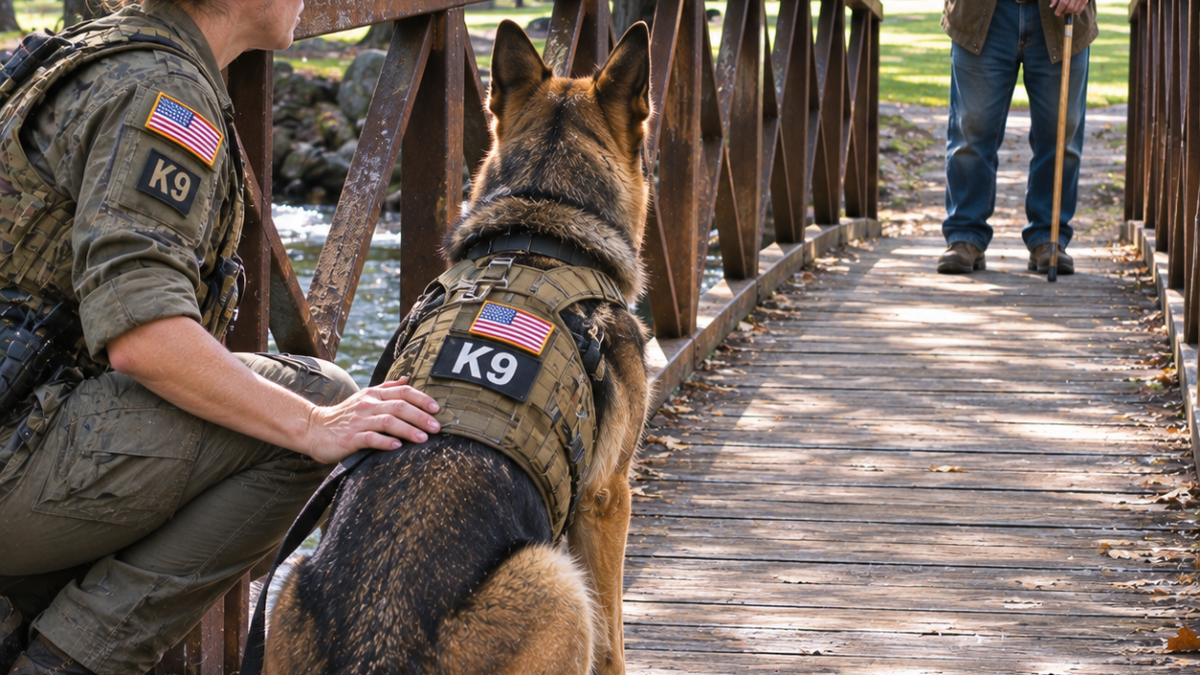
A Military K9 Refused to Cross the Same Bridge for 10 Years—Then an Old Man With a Cane Gave the Deployment Command Only His Unit Knew.
For ten years, Gunner would walk every trail in the veterans’ park except the narrow wooden bridge over Millstone River, where the decorated military K9 always sat at the first plank and stared toward the opposite bank as though somebody had once told him to wait there and never came back.
Handlers blamed age, water, combat trauma, and even the vibration beneath the boards, but none of them could explain why the German Shepherd never backed away from the bridge—he simply watched the far side for as long as anyone allowed him to stay.
Then one cold October morning, an older man with a cane stepped out from behind the trees, raised the cane horizontally across his chest, and spoke a deployment command that had been removed from Gunner’s records years earlier—and the dog’s reaction made everyone in the park realize the bridge had never been what frightened him.
Gunner stopped at exactly the same place.
Front paws two inches before the first weathered plank.
Rear legs slightly apart.
Head up.
Ears forward.
Waiting.
Master Sergeant Luke Serrano had seen it enough times to know the routine.
“Come on, old man.”
Gunner did not move.
Luke loosened the leash.
No tension.
No correction.
No second command.
Ten years earlier, he might have tried.
Not anymore.
The German Shepherd was thirteen now.
Maybe fourteen.
Military records disagreed by several months.
His black-and-tan coat had gone silver around the muzzle and eyebrows.
A scar curved over his left shoulder.
Two toes on his rear paw were missing.
His right hip had arthritis bad enough that cold mornings made the first hundred yards of any walk slow.
But his mind remained sharp.
Food bag opening from three rooms away?
PART2:
He knew.
Luke putting on trail shoes instead of work boots?
He knew.
A rabbit moving through grass sixty yards distant?
Absolutely knew.
And every Tuesday, Thursday, and Saturday morning, Gunner knew when they reached Millstone Bridge.
He stopped.
Sat.
Watched.
The bridge crossed a narrow section of the river inside Freedom Veterans Park, a wooded rehabilitation area outside Fayetteville, North Carolina.
Nothing dramatic.
Thirty-seven feet long.
Six feet wide.
Wooden planks.
Black iron railings.
The river below rarely exceeded six feet deep.
Children crossed it.
Joggers.
Wheelchairs.
Cyclists.
People walking tiny dogs wearing sweaters.
Gunner had faced explosions.
Helicopters.
Gunfire.
Crowds.
Armored vehicles.
PART3:
He had rappelled from training towers.
Walked through smoke.
Crossed unstable flooring in bombed buildings.
Yet he would not place one paw on that bridge.
The first time Luke saw it, Gunner had been three.
Fresh from his first deployment.
Another handler then.
Staff Sergeant Caleb Ross.
Caleb laughed.
“Watch this.”
He gave the command.
“Gunner, forward.”
The dog approached the bridge.
Stopped.
Sat.
Caleb repeated.
Nothing.
Tried food.
Nothing.
Walked ahead.
Gunner stayed.
They eventually went around.
Everyone called it strange.
Then amusing.
Then behaviorally interesting.
Eventually nobody called it anything.
It simply became Gunner.
Ten years later, Caleb was gone from the Army.
Luke had inherited the dog after retirement.
The bridge remained.
So did the ritual.
Gunner sat.
Watched the far bank.
Luke checked his watch.
6:48 a.m.
“You know, I’ve got coffee at home.”
Gunner’s left ear moved.
“Better coffee than the stuff in that veteran center.”
No response.
“Bacon.”
Nothing.
“You don’t even deserve bacon.”
Gunner breathed out through his nose.
Luke smiled.
“There you are.”
Mist hung above the river.
Leaves had turned copper and yellow.
A few runners moved on the opposite trail.
An elderly man pushed a bicycle.
A woman in gray sweats crossed from the far side.
Gunner watched each person.
Not anxiously.
Evaluating.
One came.
Passed.
Another.
Passed.
Luke had once asked a veterinary behaviorist what she thought.
“He’s waiting for a cue.”
“From me?”
“Maybe.”
“Then why doesn’t any cue work?”
She had shrugged.
“Maybe it isn’t yours.”
Luke looked at the dog now.
“Who are you waiting for?”
Gunner continued staring.
Luke sat on the bench beside the bridge.
That was the compromise.
Five minutes.
Sometimes ten.
Then they turned around.
He had learned not to rush grief he did not understand.
At 6:53, footsteps sounded beyond the opposite tree line.
Gunner stood.
Luke noticed immediately.
The dog usually remained seated.
A man emerged from the fog.
Older.
Mid-sixties, perhaps.
Tall but slightly bent.
Gray beard trimmed close.
Dark green jacket.
Brown trousers.
Flat cap.
His right hand rested on a black cane.
He walked slowly.
Unevenly.
One leg stiff.
Nothing about him should have mattered.
Gunner began trembling.
Luke stood.
“Easy.”
The man reached the far entrance to the bridge.
Stopped.
His face changed.
Luke was too distant to read the expression fully.
But the man had seen the dog.
Gunner stepped forward.
One paw touched the first plank.
Luke stopped breathing.
In ten years, Gunner had never done that.
The dog pulled back immediately.
Stared.
The old man dropped his gaze.
Then looked at Luke.
Then Gunner.
His hand tightened around the cane.
Luke shortened the leash.
Not because Gunner seemed aggressive.
Because something was happening.
The man slowly lifted the cane.
Horizontal.
Across his chest.
Gunner’s body went rigid.
Luke frowned.
The gesture meant nothing to him.
Then the man spoke.
Not loudly.
The river carried the words.
“Raven Two.”
Gunner screamed.
Luke had heard military dogs make sounds humans were not prepared for.
The high cry when a handler returned after months away.
The guttural mourning sound beside an empty locker.
The frantic bark of a dog trying to reach an injured teammate.
This was different.
Gunner dropped his chest nearly to the ground.
Tail beating once.
Twice.
Then he lunged forward.
Luke caught the leash.
“Gunner!”
The dog pulled toward the bridge.
Not away.
Toward it.
The old man’s cane fell.
He covered his mouth.
“Gunner.”
The dog barked.
Three times.
Paused.
Then twice.
The man began crying.
Luke stared.
“What the hell?”
The stranger stepped onto the bridge.
One step.
Then another.
Gunner tried again.
Luke let out two feet of leash.
The German Shepherd placed both front paws on the bridge.
Stopped.
Whined.
The man continued toward them.
Halfway across, he raised one hand.
Palm downward.
Two fingers curled.
Gunner lowered immediately.
A military down.
Precise.
Luke felt cold spread through his chest.
He had never taught that signal.
Caleb had never used it in front of him.
The man limped closer.
Gunner remained down.
His entire body trembled.
When the stranger reached the final plank, he stopped.
Luke moved between them.
“Sir.”
The man looked at him.
His eyes were blue.
Tired.
Wet.
“Who are you?”
The stranger’s gaze went to Gunner.
“My name is Mason Hale.”
Luke froze.
The name meant nothing for one second.
Then everything.
No.
Impossible.
Luke stared at the man.
“Mason Hale?”
“Yes.”
Luke’s grip tightened around the leash.
“Captain Mason Hale?”
The man nodded.
Gunner whined.
Luke’s heart started pounding.
Captain Mason Hale had been Gunner’s first operational team leader.
Not primary handler.
But the officer who commanded the route-clearance detachment during Gunner’s first Afghanistan deployment.
Mason Hale had been listed killed in action ten years earlier.
Luke knew the casualty report.
Everyone in the working-dog program did.
The operation became training material after an ambush killed four soldiers and left Gunner separated from his team for sixteen hours.
Mason Hale was one of the dead.
Luke whispered:
“You’re dead.”
The stranger gave him a tired smile.
“I’ve heard.”
Gunner pulled again.
Mason looked at Luke.
“Can I?”
Luke did not answer.
Mason lowered his hand.
Let Gunner smell from several feet away.
The dog inhaled hard.
One step.
Another.
Luke gave slack.
Gunner reached Mason.
Sniffed the cane.
Boots.
Trousers.
Hands.
Then the dog’s nose moved up the man’s left side.
Stopped at his jacket.
Mason’s face collapsed.
“Hey, brother.”
Gunner pressed into him.
Hard.
Mason nearly fell.
Luke caught his shoulder.
The cane dropped.
Gunner pushed his head under Mason’s hand.
Whined.
Licked his wrist.
Then suddenly moved behind him.
Sniffed the stiff right leg.
Mason laughed through tears.
“Yeah.”
He tapped it.
“They kept part of me.”
Gunner returned to his chest.
Mason went to one knee despite obvious pain.
Wrapped both arms around the dog.
Gunner climbed halfway into him.
Luke stood frozen.
Ten years.
The dog who would not cross the bridge.
The dead officer on the other side.
Mason whispered:
“You waited.”
Gunner whined.
“I’m sorry.”
The dog pawed his coat.
“I’m sorry.”
Luke finally found his voice.
“What does Raven Two mean?”
Mason kept one hand on Gunner.
“Deployment recall.”
“Whose?”
“Mine.”
Luke stared.
“That isn’t in his current file.”
“I know.”
“How?”
Mason looked up.
“Because somebody removed everything tied to that mission.”
Luke felt his stomach tighten.
People passed the bridge.
A jogger slowed.
Luke gestured toward a nearby pavilion.
“We need somewhere private.”
Mason nodded.
Then looked at the bridge.
Gunner had never crossed.
Luke realized that.
They stood on the near side.
Mason had crossed toward them.
Gunner never needed to.
Mason smiled faintly.
“Still won’t cross?”
Luke stared.
“You knew?”
Mason looked toward the far bank.
“That’s where I left him.”
The words silenced the morning.
They sat beneath the pavilion.
Gunner refused to leave contact with Mason.
His shoulder pressed against the man’s shin.
Luke called the veterans’ park office and asked for privacy.
He did not explain.
Then he called Colonel Thomas Caldwell.
Caldwell answered sleepily.
“Luke?”
“You awake now?”
“What happened?”
Luke looked at Mason.
“I’m sitting with a dead captain.”
Silence.
“Excuse me?”
“Mason Hale.”
The phone went quiet.
Then Caldwell said:
“Do not move.”
Luke almost laughed.
“Wasn’t planning to.”
“Where?”
“Freedom Veterans Park.”
“I’m coming.”
“Sir—”
The call ended.
Mason watched.
“Caldwell?”
“You know him?”
“His brother.”
Luke frowned.
“Caldwell’s brother?”
“Thomas had an older brother. Patrick.”
Luke knew.
Patrick Caldwell.
Killed Afghanistan.
Same deployment cycle.
Mason looked toward the river.
“He was with me.”
Luke’s chest tightened.
“On the mission?”
“Yes.”
“How much of the official report is wrong?”
Mason’s expression emptied.
“Most of the part after the bridge.”
Luke leaned forward.
“Start there.”
Mason shook his head.
“Start earlier.”
He rubbed Gunner’s ears.
“He was young.”
“Three.”
“First deployment.”
“Caleb Ross handled him.”
Luke nodded.
“Caleb told me almost nothing.”
“He couldn’t.”
“Classified?”
“Partly.”
Mason looked at the bridge.
“Mostly shame.”
Luke’s expression hardened.
“Whose?”
“All of ours.”
The mission began in eastern Afghanistan in November 2016.
Mason commanded a mixed route-clearance and reconnaissance element moving toward a valley where intelligence suggested insurgents were storing explosives.
Gunner worked ahead with Caleb.
Patrick Caldwell handled communications.
Two engineers.
Four infantrymen.
Local interpreter named Farid.
“Standard?”
Luke asked.
“At first.”
They found the first problem three kilometers from the village.
Gunner alerted to a culvert.
Explosive charge.
Military-grade.
Not improvised in the usual sense.
“American component?”
Mason nodded.
Luke felt familiar dread.
“Where from?”
“That was the question.”
They photographed serial numbers.
Called them in.
Operations told them to mark and continue.
Mason refused.
The components belonged to a shipment listed destroyed six months earlier.
“Destroyed where?”
“Convoy attack.”
“Verified?”
“Apparently not.”
Mason continued.
Farther up the valley, Gunner alerted again.
Not explosives.
A storage building.
Inside:
Encrypted radios.
Medical kits.
Optics.
American ammunition.
Foreign weapons.
Some tagged from partner forces.
Some supposed to be destroyed.
Mason’s team began documenting.
Then the radio changed.
Orders came through directing them to move immediately toward extraction point Raven.
“Raven Two?”
Luke asked.
“My call sign.”
“Extraction point?”
“Across a river.”
Mason looked toward Millstone Bridge.
Luke understood before he said it.
“Bridge.”
Mason nodded.
“The bridge in Afghanistan looked almost exactly like this one.”
Luke turned toward the park bridge.
Narrow.
Wooden.
River.
Far bank.
“How?”
“Not identical.”
“Enough.”
Luke felt sick.
Gunner had not feared the structure.
He remembered the layout.
The far side.
The last place Mason stood.
Mason continued.
They reached the bridge under fire.
Not insurgents from the village.
Men from the ridge behind them.
Precise fire.
Suppressive.
English commands heard over radio.
“Americans?”
“We didn’t know.”
The team started crossing.
Patrick first.
Then one engineer.
Farid.
Caleb and Gunner.
Mason stayed rear security.
Halfway through, an explosion hit the near-side approach.
Caleb went down.
Gunner ran back.
Mason dragged Caleb behind a concrete abutment.
The dog stayed with them.
“Was Caleb alive?”
“Yes.”
“Badly wounded?”
“Leg.”
“Concussion.”
“Couldn’t walk.”
Mason looked at Gunner.
“He kept trying to pull Caleb toward the bridge.”
Luke’s chest tightened.
“What happened?”
“Patrick radioed from the far side.”
“Extraction aircraft inbound.”
“Then new orders came.”
“Leave casualties.”
Luke stared.
“What?”
“Bridge likely compromised.”
“Enemy closing.”
“Move remaining team to far LZ.”
“You refused.”
“Yes.”
“Patrick refused too.”
Mason smiled faintly.
“Patrick was good at refusing.”
“What happened?”
“Aircraft came.”
“Not military.”
“Contractor helicopter.”
“Why?”
“Official bird diverted.”
“Contract bird closer.”
Luke waited.
Mason’s eyes darkened.
“The pilot landed on the far bank.”
“Patrick got Farid and the engineer aboard.”
“Then came back toward us.”
“Across the bridge?”
“Yes.”
Luke pictured it.
Gunfire.
Smoke.
Caleb bleeding.
Gunner frantic.
Mason looked at the dog.
“Patrick reached halfway.”
“Then another explosion.”
The bridge partially collapsed.
Not completely.
A section near the middle dropped into the river.
Patrick fell.
“Died?”
“No.”
“Broke his arm.”
“Mason?”
“Yes?”
“How did Gunner get across?”
“He didn’t.”
Luke stopped.
Mason continued.
“Gunner stayed with me and Caleb on the near side.”
“Patrick on far side.”
“Pilot couldn’t land near us.”
“River rising.”
“Fire closing.”
“What did you do?”
“I made a choice.”
Mason’s face tightened.
“Worst choice of my life.”
He ordered Caleb to remove Gunner’s harness.
Tied an emergency line to the dog.
Sent him across a narrow surviving beam section.
Luke stared.
“Across the broken bridge?”
“Yes.”
“Why?”
“Message.”
Mason touched his chest.
“Radio jammed.”
“Patrick couldn’t hear.”
“I needed him to leave.”
“With survivors.”
“So you sent Gunner?”
Mason nodded.
“With a note inside his collar.”
Luke looked at Gunner.
“Did he go?”
“Only after the Raven Two command.”
The same command Mason used this morning.
Not a recall.
A go-to command.
A specific deployment routine.
Raven Two meant:
Cross to me.
Or cross toward the designated team element.
Luke whispered:
“That’s why he waits.”
Mason nodded.
“I sent him across.”
“And?”
“He made it.”
“Patrick got him.”
“Then what?”
Mason looked down.
“I stayed.”
“With Caleb?”
“Yes.”
“Why?”
“He couldn’t move.”
Luke’s jaw tightened.
“What happened to the helicopter?”
“Left.”
“With Patrick.”
“Farid.”
“Engineer.”
“Gunner?”
Mason shook his head.
“Gunner refused.”
“What?”
“He jumped off the aircraft.”
“Before takeoff.”
“Ran back to the bridge.”
Luke looked at the dog.
Mason smiled through tears.
“Patrick had to drag him away.”
“Then why wasn’t he on the final flight?”
“He was.”
“Eventually.”
“Patrick sedated him with veterinary kit.”
Luke exhaled.
“So Gunner left.”
“Yes.”
“And you?”
“Caleb and I were captured.”
Silence.
Luke stared.
Mason’s voice remained level.
Too level.
“How long?”
“Caleb died after nine days.”
Luke closed his eyes.
He had known Caleb as alive.
Wait.
Something did not fit.
“Caleb Ross?”
“Yes.”
“Caleb Ross trained Gunner until 2018.”
Mason stared at him.
“No.”
Luke’s blood ran cold.
“Yes.”
“No.”
“I spoke to him.”
Mason’s face drained.
“Luke.”
“He retired.”
“Colorado.”
“Dog training business.”
Mason stood too fast.
Pain shot through his leg.
He grabbed the table.
“No.”
Gunner rose immediately.
Luke caught Mason.
“What?”
Mason stared.
“Caleb died.”
“Maybe you thought—”
“I held him.”
Luke stopped.
Mason’s voice broke for the first time.
“He died in my arms.”
The man Luke knew as Caleb Ross could not be Caleb Ross.
Colonel Caldwell arrived twenty-eight minutes later.
He saw Mason from the parking lot.
Stopped walking.
Mason stood.
Caldwell looked ten years older in seconds.
“Jesus Christ.”
Mason whispered:
“Tom.”
Caldwell crossed the distance.
Then punched him.
Hard.
Luke almost intervened.
Mason stumbled.
Gunner barked once.
Caldwell grabbed Mason’s coat.
“You were alive?”
Mason did not defend himself.
“Yes.”
“You were alive?”
“Yes.”
“My brother died looking for you.”
Mason’s face collapsed.
“I know.”
Caldwell hit him again.
Not as hard.
Then hugged him.
Both men cried.
Gunner circled them anxiously.
Luke looked away.
When they finally sat, Luke explained the Caleb problem.
Caldwell stared.
“I know Caleb Ross.”
Luke looked at him.
“You met him?”
“Twice.”
“Then who is he?”
Caldwell frowned.
“Former handler.”
Mason shook his head.
“Not the real Caleb.”
Caldwell’s face hardened.
“What are you saying?”
Mason looked at Gunner.
“The original Caleb Ross died in Afghanistan.”
Luke pulled out his phone.
Opened old handler photographs.
Found Caleb.
Showed Mason.
“This man.”
Mason stared.
Then whispered:
“Eli.”
“Who?”
“Eli Mercer.”
Luke’s chest tightened.
“Contractor?”
“Intelligence sergeant attached to us.”
“On the mission?”
“No.”
“Support cell.”
Mason stared at the image.
“Why is he using Caleb’s name?”
Nobody knew.
Caldwell’s voice changed.
“We need to get off the park.”
They moved to a secure conference room at the base.
Mason hesitated entering.
Gunner did not.
The dog stayed with him.
The base legal office verified Mason’s fingerprints.
DNA.
Military records.
No doubt.
Captain Mason Hale was alive.
Officially dead since 2016.
The room filled with people.
Inspector General.
CID.
Medical.
Command.
Mason hated every additional chair.
Luke saw it.
“Too many?”
Mason nodded.
Caldwell cleared half the room.
Then Mason told the rest.
Captured near the river.
Caleb dying.
Mason moved between insurgent groups and criminal intermediaries.
Then sold—not literally in paperwork, but effectively—to a private security network seeking intelligence about what his team had found.
“Who?”
“Raven Meridian Group.”
Caldwell’s eyes narrowed.
He knew the name.
Defense logistics contractor.
Aviation.
Secure transport.
Communications.
They had supported U.S. operations.
Mason was kept in multiple sites.
Afghanistan.
Pakistan.
Then Central Asia.
“They wanted the storage photographs.”
“Where were they?”
“Patrick had copies.”
“Anything else?”
“Gunner.”
Luke frowned.
“The dog?”
“I hid a microcard in his collar before sending him across.”
Luke looked at Gunner.
“Original collar?”
“Deployment collar.”
“Gone.”
Mason nodded.
“They never found it?”
Luke shook his head.
“Not in accessible records.”
Mason’s face hardened.
“Then Patrick might have.”
“What happened to Patrick Caldwell?”
Tom asked quietly.
Mason looked at him.
“He came back for me.”
The room became silent.
Patrick, against orders, organized a search three days after the official mission ended.
He used local contacts.
Found evidence Mason was alive.
Then disappeared during the search.
His remains were recovered months later.
Officially insurgent attack.
Tom’s jaw trembled.
“He knew.”
“Yes.”
“He knew you were alive.”
“Yes.”
“Why didn’t he tell me?”
“He may have tried.”
Tom looked away.
Mason continued.
During captivity, interrogators repeatedly asked where the microcard was.
That meant someone knew Mason copied evidence.
Mason eventually escaped in 2021.
Five years after capture.
“How?” Luke asked.
“Vehicle crash.”
“Guards killed.”
“I walked.”
“For how long?”
“Eleven days.”
He reached an NGO clinic.
Used a false name.
Tried contacting U.S. authorities.
Then saw one of the same men connected to Raven Meridian outside the clinic.
He fled.
For years, Mason lived under aliases.
Georgia.
Turkey.
Germany.
Canada.
Eventually returned to the U.S. using forged documents.
“When?”
“2024.”
“Why didn’t you go to the FBI?”
“I did.”
The room shifted.
“What happened?”
“I requested a meeting.”
“Man came.”
“Showed credentials.”
“Asked about Gunner.”
Luke’s stomach tightened.
“Why Gunner?”
“Because of the card.”
“Did you tell him?”
“No.”
“What happened?”
“I recognized him.”
“From where?”
“Raven Meridian.”
“So you ran.”
“Yes.”
Mason laughed bitterly.
“After a while, every official door looked the same.”
Tom said quietly:
“And me?”
Mason looked at him.
“I found your name.”
“You were commanding here.”
“I drove to Fayetteville twice.”
“Never came in.”
“Why?”
“I didn’t know who had access to you.”
Tom’s eyes filled with anger.
“You could have called.”
“I know.”
“My brother died for you.”
“I know.”
“You let us bury an empty coffin.”
“I know.”
Mason did not defend himself.
That made the anger harder to hold.
Luke asked the question none of them wanted.
“Why today?”
Mason looked toward Gunner.
“I saw the park online.”
“Veterans group posted about retired working dogs.”
“Gunner was in a photograph.”
“You knew him?”
“Immediately.”
“What about the bridge?”
Mason smiled sadly.
“I recognized that too.”
“You’ve been watching him?”
“For three months.”
Luke stood.
“You’ve been watching us?”
“From a distance.”
“Why not approach?”
“I was scared.”
“Of Gunner?”
Mason laughed once.
“Of being wrong about everything else.”
Luke sat.
Fair.
Mason continued.
Every time he came to the park, he watched Gunner stop at the bridge.
That was how Mason knew the dog still remembered.
“I thought maybe today I’d just stand on the far side.”
“And leave?”
“Yes.”
“Without talking?”
“Yes.”
Luke shook his head.
“Bad plan.”
“I’ve had worse.”
Tom asked:
“What made you use the command?”
Mason looked at Gunner.
“He looked old.”
“So?”
“I realized I might run out of time before he did.”
That landed.
The investigation into Eli Mercer began immediately.
Luke called the number he had for “Caleb Ross.”
Disconnected.
Business website gone.
Colorado address sold six months earlier.
Records showed a Caleb Ross with matching military history.
But deeper review exposed inconsistencies.
Fingerprint data sealed.
Service photographs low quality.
Birth certificate duplicated.
Social Security record activated only after 2017.
The real Caleb Ross’s family had been told he died overseas.
His mother passed away in 2020.
His father lived in Montana.
Investigators contacted him carefully.
He confirmed his son was dead.
They showed him the photograph of Eli Mercer.
“That’s not Caleb.”
No ambiguity.
Whoever Eli was, he had spent years using a dead soldier’s identity.
Why?
Gunner.
Access.
Records.
Proximity.
Luke felt sick.
Eli had handled Gunner.
Slept near him.
Trained him.
Maybe searched his equipment.
Mason said:
“He was looking for the card.”
That was the obvious answer.
But why spend years?
Maybe he never knew exactly where.
Maybe Gunner’s collar had been replaced before Eli gained custody.
Maybe the card moved.
They searched archival K9 equipment.
Nothing.
Then Mara Collins, the veterinarian who had known Gunner for years, remembered something.
“His first surgery.”
“What?”
“Shoulder wound.”
“After Afghanistan.”
“His collar was removed.”
“Where did it go?”
She checked paper archives.
Original gear transferred to evidence storage because Gunner was associated with a fatal mission.
Storage location later closed.
Inventory moved twice.
One item listed:
LEATHER COLLAR, MWD GUNNER, DAMAGE/PERSONAL EFFECT.
Disposition:
RETURNED TO UNIT REPRESENTATIVE 2018.
Representative signature:
C. Ross.
Luke stared.
Eli got it.
Mason went pale.
“Then card is gone.”
Maybe.
Investigators searched Eli’s former Colorado property.
The house was empty.
But a detached training shed contained burned documents inside a metal drum.
Most unreadable.
One fragment:
RAVEN TWO.
Another:
BRIDGE RESPONSE PERSISTS.
Luke felt rage.
“He tested him.”
Mason looked sick.
“Eli knew about the bridge.”
“Apparently.”
“Why didn’t he just use the command?”
“Maybe he didn’t know exact wording.”
Mason pointed toward the burned paper.
“Raven Two.”
Luke stared.
“He did.”
Then why did Gunner never cross?
Mason thought.
“Because it wasn’t my voice.”
Luke looked at the dog.
Ten years.
He had not been waiting for a command.
He had been waiting for a person.
The search for Eli expanded nationally.
Financial records connected him to Raven Meridian through shell companies.
Payments began months before he assumed Caleb’s identity.
Continued through 2024.
Then stopped.
Flight records showed travel to Europe.
Central Asia.
Multiple trips.
He had likely been part of the network searching for Mason.
Then one investigator found surveillance footage from the veterans’ park.
Six months earlier.
Eli.
Standing on the far side of Millstone Bridge.
Watching Gunner.
Luke froze the frame.
“He came here.”
Mason leaned closer.
“He was looking for me.”
“Or testing whether you had.”
Mason’s jaw tightened.
“He knew I was back.”
That meant danger had not ended.
Security increased around Mason.
He hated it.
No surprise.
He refused military housing at first.
Then someone broke into the motel room where he had been staying.
Nothing stolen.
That changed his mind.
Gunner moved into the secure quarters with him temporarily.
Luke allowed it.
Technically Gunner belonged to Luke after retirement.
Practically, the dog had already decided.
The first night, Mason woke screaming.
Luke heard from the hallway.
Gunner was already on the bed.
Chest against Mason.
Head beneath his chin.
Mason’s breathing slowed.
Luke stood outside the open door.
Mason noticed.
“Sorry.”
“For what?”
“Noise.”
Luke leaned against the frame.
“Dog snores louder.”
Mason smiled faintly.
Gunner did not.
Over the next weeks, Luke learned the man behind the casualty report.
Mason hated fluorescent lights.
Loved terrible coffee.
Could not sleep with doors closed.
Refused to sit with his back to windows.
Had nerve damage in the right leg and three fused vertebrae.
The cane was not temporary.
Neither were the nightmares.
He kept apologizing for things nobody blamed him for.
Caleb.
Patrick.
Gunner.
Tom.
His wife.
Luke eventually asked:
“Wife?”
Mason looked away.
“Claire.”
“Alive?”
“Yes.”
“Where?”
“Virginia.”
“You contacted her?”
“No.”
Luke stared.
“You’ve been in the U.S. two years.”
“I know.”
“Does she think you’re dead?”
“Yes.”
Luke wanted to throw something.
Instead:
“Why?”
Mason rubbed his face.
“She remarried.”
“You know?”
“I checked.”
“Kids?”
“One daughter.”
“How old?”
“Nineteen.”
Luke understood.
Mason had missed almost everything.
He asked:
“Does Claire know why?”
“No.”
“She deserves to.”
“I know.”
“You keep saying that.”
Mason smiled bitterly.
“Useful phrase.”
Luke sat across from him.
“What are you actually afraid of?”
Mason answered immediately.
“That she’ll look at me and wish I stayed dead.”
Luke had no clever response.
So he gave the truth.
“Maybe.”
Mason looked up.
Luke continued:
“Maybe she’ll hate you.”
“Maybe she’ll love you.”
“Maybe both.”
“Maybe she’ll tell you to leave.”
“But right now you’re making the decision for her.”
Mason looked at Gunner.
The dog rested beside his cane.
Luke added:
“You spent ten years angry people made decisions about your life without you.”
Mason closed his eyes.
“That was low.”
“Effective?”
“Yes.”
Claire Hale was contacted through a trauma liaison.
Not by Mason.
He could not do it.
She arrived two days later.
Her husband came too.
His name was Michael Reeves.
Civil engineer.
Quiet.
Kind.
The kind of man Mason probably wished he could hate.
Claire entered the secure room.
Saw Mason.
Stopped.
Her face went white.
“No.”
Mason stood slowly.
“Claire.”
She slapped him.
Hard.
Then again.
He let her.
“You were alive?”
“Yes.”
“You were alive?”
“Yes.”
She hit his chest.
Michael stayed by the door.
No interference.
Claire sobbed.
“You let me bury you.”
“I’m sorry.”
“You let Ava grow up without you.”
“I know.”
“You had years.”
“I know.”
She stepped backward.
“I hate you.”
Mason nodded.
“I know.”
Then Claire looked down.
Gunner was standing beside him.
Her face broke again.
“Oh my God.”
Gunner walked toward her.
Sniffed.
Then sat.
Claire covered her mouth.
“You too.”
The dog leaned into her.
Mason whispered:
“He remembered.”
Claire dropped to her knees.
Gunner pressed against her.
She cried into his fur.
Michael looked away.
Mason watched his wife—former wife emotionally, though legal status was complicated—hug the dog that had been the last living piece of him she knew.
That reunion was not romantic.
Not yet.
Maybe never.
It was worse and better.
Claire asked questions for three hours.
Mason answered everything.
Where he had been.
Why he did not call.
Why he came back and still stayed away.
She became angrier at that part than captivity.
“You were twenty minutes from my house once?”
“Yes.”
“When?”
“Last Christmas.”
Claire stood.
“You watched us?”
“From across the street.”
Michael’s face tightened for the first time.
Mason looked at him.
“I’m sorry.”
Michael said:
“That was not okay.”
“No.”
Claire cried.
“You saw Ava?”
“Yes.”
“And left?”
“Yes.”
She hit him again.
Then collapsed into a chair.
Gunner rested his head on her knee.
Mason whispered:
“I thought you were happy.”
She looked at him.
“I am.”
That surprised him.
Claire continued:
“That does not mean you had the right to stay dead.”
Mason nodded.
Michael finally spoke.
“We can deal with what happens next later.”
Mason looked at him.
Michael’s eyes were wet too.
“But your daughter needs the truth.”
Ava came the following morning.
Nineteen.
College freshman.
She had Mason’s eyes.
He knew instantly.
She walked in.
Stared.
No slap.
No hug.
Just:
“You look old.”
Mason laughed and cried.
“So do you.”
She almost smiled.
Then her face hardened.
“Don’t.”
“Sorry.”
“You don’t get jokes yet.”
“Fair.”
They talked.
Awkwardly.
Painfully.
Ava asked if he remembered her fifth birthday.
He did.
Sixth?
Yes.
Seventh?
Gone by then.
She asked what she had worn at his funeral.
He did not know.
She told him.
Yellow dress.
Because she thought he liked yellow.
Mason cried.
Ava did not comfort him.
Not immediately.
That was fair too.
Then Gunner walked between them.
Placed one paw on Ava’s shoe.
She stared.
“My dad’s dog?”
Mason nodded.
“Partly.”
Ava touched the gray muzzle.
“You’re ancient.”
Gunner sneezed.
She smiled.
That was the first crack in the wall.
Eli Mercer was arrested three months later.
Not dramatically.
Traffic stop outside Albuquerque.
Fake license.
Hidden handgun.
Multiple passports.
Agents searched his vehicle.
Found photographs of Mason.
Luke.
Gunner.
The bridge.
Claire’s house.
Even Ava’s college campus.
Luke felt sick.
Mason went silent.
The network had still been watching.
Eli negotiated.
He had information prosecutors wanted.
Raven Meridian executives.
Everett Sloan, the former director.
Contractor sites.
Payments.
Deaths disguised as battlefield loss.
Mason’s captivity.
Patrick Caldwell’s search.
And the real Caleb Ross.
Eli admitted helping create the false identity after Caleb died.
“Why him?”
Investigators asked.
“Access.”
“A dead handler’s identity gave you credibility around the dog.”
“Yes.”
“Did you know the microcard was hidden in Gunner’s collar?”
“We suspected.”
“Did you find it?”
Eli smiled.
“Yes.”
Mason’s face fell when investigators told him.
The evidence was gone.
Then Eli added:
“But not all of it.”
“What does that mean?”
The microcard had been copied before destruction.
Raven Meridian used the images internally to identify everyone compromised by the discovery.
Copies existed on an archived server.
Federal agents seized it.
The evidence Mason thought lost returned.
Photographs.
Serial numbers.
Shipment logs.
Payments.
Names.
Raven Meridian executives.
Military logistics officials.
Foreign intermediaries.
And video.
One file showed Patrick Caldwell after the mission.
Alive.
Wounded.
Arguing with Raven personnel.
He demanded a search for Mason.
He accused them of lying.
Then the footage ended.
Another file weeks later showed Patrick at a forward site.
He had discovered part of the network.
He recorded himself.
“If Tom gets this…”
Colonel Caldwell stopped breathing when the video played.
Patrick looked exhausted.
“This is bigger than the weapons.”
“They’re moving people.”
“Detaining anyone who sees too much.”
“Mason may be alive.”
“I’m going back.”
Tom covered his face.
Patrick’s final words on the file:
“Tell Mom I’ll call Sunday.”
He never did.
Tom cried quietly.
No one interrupted.
The investigation confirmed Patrick was killed during a genuine insurgent attack while searching for Mason.
No contractor murder.
No conspiracy in the death itself.
That mattered.
Painfully.
He died trying to find his friend.
Not because Raven directly killed him.
Tom eventually said:
“I think that’s worse.”
Mason looked at him.
“Why?”
“Because he chose it.”
Mason shook his head.
“He chose me.”
Tom’s voice broke.
“Exactly.”
Mason carried that guilt.
Therapy helped.
Gunner helped more than therapists liked admitting.
Every morning Mason walked him.
Short distances.
Cane in one hand.
Leash in the other.
They avoided Millstone Bridge.
At first.
Then one day Luke asked:
“You ever going to try?”
Mason looked at the bridge.
Gunner sat at the first plank.
Same as always.
Mason stood on the near side now.
Not opposite.
He raised the cane horizontally.
“Raven Two.”
Gunner looked at him.
Whined.
Then one paw touched the plank.
Mason’s breath caught.
Second paw.
The dog stopped.
Luke stayed back.
No encouragement.
No pressure.
Mason stepped onto the bridge.
Not ahead.
Beside him.
“Together.”
Gunner moved.
One plank.
Then another.
Halfway across, his body began trembling.
Mason crouched as far as his leg allowed.
“I know.”
The dog looked toward the river.
The place where memory said the bridge should be broken.
Mason touched his neck.
“It held this time.”
Gunner took another step.
Then another.
They reached the center.
Stopped.
Mason cried.
Luke did too.
No shame.
Gunner continued.
Thirty-seven feet.
Ten years.
They reached the far bank.
The dog turned.
Looked back.
Then sat.
Mason whispered:
“Good crossing.”
Gunner leaned against his leg.
Luke reached them.
“You know what this means?”
Mason wiped his face.
“What?”
“We can stop walking the extra mile around the river.”
Mason laughed.
Gunner’s tail moved.
The bridge did not become easy.
Some days Gunner crossed.
Some days he stopped.
Mason never forced him.
“That’s healing,” Luke once said.
“Not forgetting?”
“No.”
“Being able to choose.”
Mason liked that.
The federal case ended over the next two years.
Raven Meridian collapsed.
Several executives went to prison.
Military officials were charged with procurement fraud and obstruction.
Not every person received punishment.
Some statutes had expired.
Some evidence too weak.
Some people dead.
Mason hated that.
Then learned to live with it.
His legal status changed from killed in action to recovered service member.
He stared at the new paperwork.
“Recovered.”
Luke smiled.
“Could be worse.”
“How?”
“Misplaced.”
Mason laughed.
His back pay and benefits were restored.
He used most of the settlement money to create a legal aid fund for veterans with identity and records problems.
He called it Bridge House.
Luke rolled his eyes.
“Subtle.”
“Shut up.”
The program helped people whose service records were wrong.
Discharges misclassified.
Benefits missing.
Deployment injuries undocumented.
People trapped between databases.
Mason understood what a piece of paper could do to a human life.
Claire remained married to Michael.
That hurt.
Mason never asked her to leave.
She never offered.
Over time, they became something else.
Family, but not marriage.
Ava visited Mason often.
Eventually called him Dad without pausing first.
The first time it happened, he pretended not to react.
Then cried in the bathroom.
Gunner aged.
Fourteen.
Then fifteen.
Kidneys.
Hips.
Hearing.
One eye clouded.
Mason’s cane became permanent.
Luke joked the two of them were racing toward assisted living.
Mason replied:
“Dog’s winning.”
They still walked the veterans’ park.
Still visited the bridge.
Gunner crossed more often than not.
On the tenth anniversary of Patrick Caldwell’s death, Tom joined them.
The three men stood in the center of the bridge.
Gunner between them.
Tom carried Patrick’s old radio patch.
Mason carried nothing.
Luke brought coffee.
Tom looked at the river.
“This is where you last saw him?”
“Not this bridge.”
“I know.”
“Feels like it.”
Mason nodded.
Tom said:
“I hated you.”
“I know.”
“Part of me still does.”
Mason looked at him.
“I know.”
Tom smiled sadly.
“Good.”
They stood quietly.
Then Tom touched Gunner’s back.
“My brother died looking for you.”
Mason’s eyes filled.
“Yes.”
“He’d be furious you wasted two years hiding after coming home.”
Mason laughed through tears.
“Sounds like him.”
Tom nodded.
“Does.”
That was forgiveness.
Not clean.
Enough.
Gunner’s last winter was cold.
Hard on his joints.
Mason moved a mattress downstairs because the dog could no longer climb.
Luke installed ramps.
Ava bought an orthopedic bed Gunner ignored.
He preferred Mason’s rug.
The final day came in March.
Warm unexpectedly.
Gunner refused breakfast.
Then water.
The veterinarian came to Mason’s small house.
Luke.
Tom.
Ava.
Claire.
Michael stayed outside at first, giving the family space.
Mason noticed.
“Tell him to come in.”
Claire looked surprised.
“You sure?”
“Yes.”
Michael entered.
Gunner knew him too.
The dog had collected people over the years.
Not replaced anyone.
Added.
They carried Gunner outside.
To the veterans’ park.
The veterinarian thought Mason was crazy.
But Gunner remained comfortable.
They chose a quiet patch near Millstone Bridge.
The dog lay on a blanket.
River moving below.
Birds.
Wind.
No ceremony.
No uniforms.
Mason sat with Gunner’s head in his lap.
Luke held one paw.
Ava touched the old scar.
Tom stood beside the railing.
The veterinarian waited.
Mason looked at the bridge.
“Can we do one thing?”
Luke knew.
“You sure?”
Mason nodded.
They helped Gunner stand.
Barely.
The dog wobbled.
Mason held the harness.
Slowly, they approached the bridge.
Gunner stopped at the first plank.
Of course.
Everyone smiled through tears.
Mason raised his cane.
Horizontal.
Across his chest.
“Raven Two.”
Gunner’s ears lifted.
He looked toward the far bank.
Empty.
Then at Mason.
Mason lowered the cane.
“No.”
His voice broke.
“Not this time.”
He stepped beside the dog.
“Together.”
Gunner moved.
One plank.
Then another.
Mason limped beside him.
Luke followed but did not touch.
At the center, Gunner stopped.
His breathing was heavy.
Mason knelt painfully.
“Enough.”
He looked toward the river.
“You don’t have to finish.”
Gunner looked at the far bank.
Then turned.
Pressed his head into Mason’s chest.
Mason understood.
They did not cross.
They sat in the middle of the bridge.
Luke spread the blanket there.
The veterinarian came.
Traffic on the trail was redirected.
Nobody complained.
Gunner lay with his body touching Mason.
The river moved below them.
Mason stroked the gray muzzle.
“You waited a long time.”
Gunner breathed.
“Too long.”
Another breath.
“I’m sorry.”
Luke said quietly:
“He wasn’t only waiting.”
Mason looked up.
Luke smiled.
“He lived.”
Mason nodded.
That lesson again.
Gunner had worked.
Saved people.
Loved Caleb.
Loved Luke.
Learned new handlers.
Eaten stolen sandwiches.
Slept in sun.
He carried memory without letting it consume every year.
Mason touched the dog’s ear.
“Better at this than me.”
Ava whispered:
“He taught you.”
Mason smiled.
“Yeah.”
The veterinarian administered the sedative.
Gunner relaxed.
His breathing slowed.
Mason raised the cane one final time.
Not command.
Memory.
“Raven Two.”
Gunner’s ear moved.
Mason lowered the cane.
Then whispered:
“Crossing complete.”
Gunner exhaled.
Once.
Then again.
Then no more.
Mason remained seated.
The cane beside him.
The old dog across his legs.
Halfway over a bridge Gunner had refused for most of his life.
No one rushed.
Eventually Tom said:
“Patrick would’ve liked this.”
Mason looked at him.
“He hated bridges.”
Tom laughed.
“He hated heights.”
“That too.”
They laughed through tears.
Gunner’s ashes were divided.
Luke kept a portion.
Mason kept most.
A small amount went to Caleb Ross’s father in Montana.
Mason had struggled with that.
The real Caleb had died almost forgotten because another man stole his identity.
His father deserved something that proved Caleb had not vanished completely from Gunner’s story.
A portion went with Patrick Caldwell’s memorial.
And one small sealed container was placed beneath a stone near Millstone Bridge.
The park approved a plaque.
Mason rejected twelve drafts.
Too dramatic.
Too military.
Too sentimental.
Finally Ava wrote one.
GUNNER
MILITARY WORKING DOG
HE STOPPED HERE FOR TEN YEARS
BECAUSE SOME PROMISES TAKE LONGER TO COME BACK.
Mason stared at it.
“Too sentimental.”
Ava smiled.
“You’re putting it up.”
He did.
The bridge became known locally as Gunner’s Bridge.
Mason hated that too.
Then secretly loved it.
Veterans visited.
Handlers.
Families.
People with service dogs.
Some left coins.
Some dog tags.
One child left a tennis ball.
Mason moved it to the edge so nobody tripped.
Years later, Bridge House opened a small counseling office beside the park.
Not because Mason believed every trauma needed symbolism.
He distrusted symbolism.
But because walking helped.
And the bridge created conversations people did not always know how to begin.
One veteran told him:
“I haven’t crossed a bridge in three years.”
Mason looked at him.
“Literal?”
“No.”
Mason smiled.
“Good.”
“Why?”
“Literal ones are easier.”
The veteran laughed.
They walked.
Sometimes Mason told Gunner’s story.
Not the conspiracy.
Not Raven Meridian.
Not captivity.
The simpler version.
A military dog stopped at the same bridge for ten years.
People thought he was afraid.
He was not.
He remembered being sent across something broken while his people stayed behind.
He sat there because one part of him expected the missing man to appear on the far side.
Then one morning the man did.
Listeners often asked:
“Did the dog know it was him after ten years?”
Mason would raise an eyebrow.
“He knew before I took off my hat.”
“How?”
“Scent.”
“Voice.”
“Body language.”
“Memory.”
Then he would shrug.
“Take your pick.”
What mattered was not how.
What mattered was that Gunner had preserved something the official record erased.
Mason Hale had been dead on paper.
Gunner never read the paper.
He remembered the voice.
The command.
The man who stayed behind.
And perhaps that was why Mason eventually stopped resenting the years the dog spent at the bridge.
Gunner had not wasted them.
He had made a place for the possibility that the story was unfinished.
Humans had closed the file.
Declared casualties.
Held funerals.
Archived reports.
Reassigned the dog.
Changed handlers.
Moved forward.
Gunner moved forward too.
But he left one part of himself beside that river.
Just in case.
That was the difference.
He could live and still wait.
Love new people and still remember the missing one.
Work another mission and still carry the old command.
Cross other bridges and still stop at this one.
Humans often treated healing as proof that something no longer hurt.
Gunner had never believed that.
He healed enough to live.
Not enough to forget.
And when Mason finally appeared on the opposite bank with a cane in his hand and ten stolen years in his body, Gunner did not hesitate because the old soldier looked different.
He did not care about gray hair.
Scars.
A limp.
Age.
Paperwork.
Names used while hiding.
He heard two words.
Raven Two.
The command that once meant:
Go across.
Find me on the other side.
Ten years earlier, Gunner had obeyed and discovered Mason was not there.
So he waited.
And waited.
Until one October morning, the old command finally became true.








