A Military K9 Refused to Board His Flight Home—Then an Old Man Behind the Airport Glass Raised Two Fingers
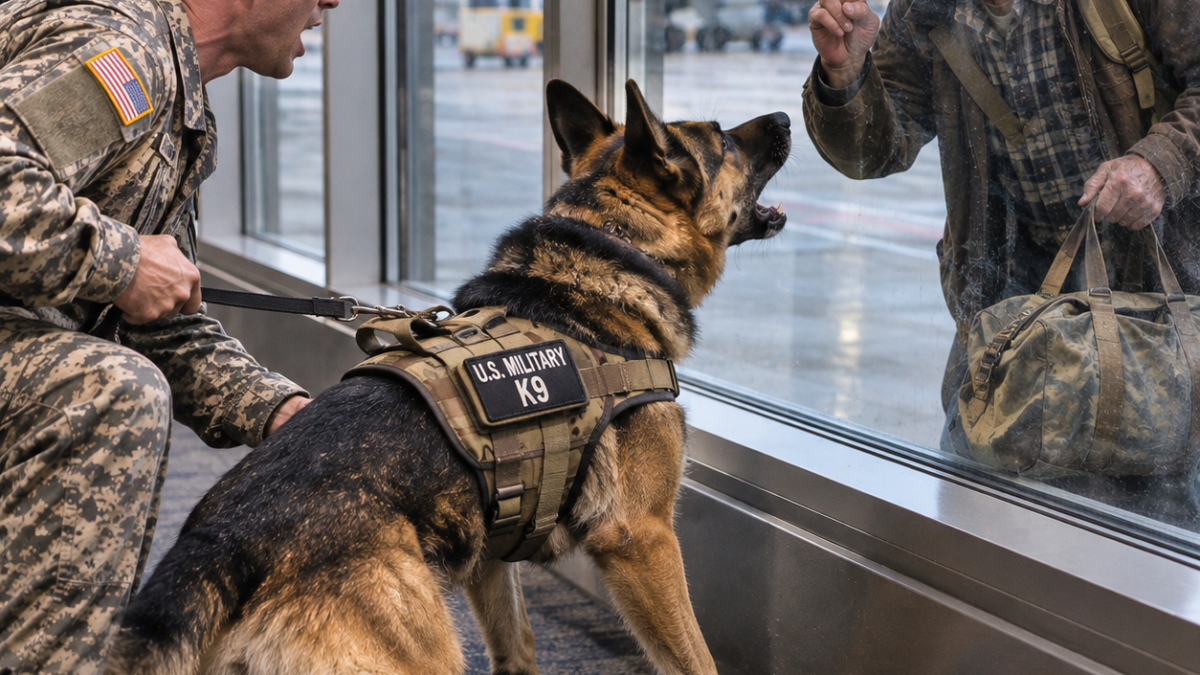
A Military K9 Refused to Board His Flight Home—Then an Old Man Behind the Airport Glass Raised Two Fingers
For eight years, Rex had obeyed every command through gunfire, explosions, crowded airfields, and combat zones—but on the morning he was finally supposed to leave the military forever, the aging German Shepherd locked all four paws beside the boarding gate and refused to take another step.
His handler thought Rex was frightened of the aircraft until the dog ignored every correction, stared through the terminal glass at a gray-haired stranger carrying a battered canvas duffel, and began trembling as if someone had suddenly opened a door into a life everyone believed he had forgotten.
Then the old man slowly raised two fingers against his chest, Rex broke a stay command for the first time in his career, and Captain Luke Serrano realized the stranger knew a signal that had never appeared in any official training manual—and there was only one person who should have known it.
At 6:17 on a cold Tuesday morning, Rex decided he was not going home.
Staff Sergeant Luke Serrano did not understand that yet.
He thought the dog needed to relieve himself.
“Come on, old man.”
Luke gave the leash a gentle tug.
Rex did not move.
Around them, Fayetteville Regional Airport was beginning to wake.
Rolling suitcases clicked over tile.
Coffee machines hissed behind metal counters.
A toddler cried near security.
A recorded female voice announced a delayed flight to Atlanta.
Military personnel moved through the terminal in ones and twos, some in uniform, some already dressed like civilians trying to become ordinary again.
Rex noticed almost none of it.
He stood near Gate 5 with his body angled toward the enormous windows overlooking the passenger drop-off lane.
His ears were forward.
His tail hung still.
Luke checked the time.
Their flight boarded in twenty-three minutes.
“Rex.”
Nothing.
Luke crouched.
“Hey.”
The German Shepherd was eleven years old now.
Black across the saddle.
Tan around the chest and legs.
Gray had spread across his muzzle during the final two years of service.
PART2:
There was a thin scar above his right eye, another beneath the fur near his left shoulder, and stiffness in his hind legs whenever the temperature dropped.
He had completed two deployments to Afghanistan, one to Iraq, and five years of stateside explosives-detection work.
He had cleared routes.
Searched vehicles.
Worked presidential-event support.
Found explosives hidden inside false walls, buried containers, abandoned cars, bags, and once inside a child’s plastic toy truck that insurgents had packed with enough material to kill half a patrol.
Rex had ridden helicopters without complaint.
Boarded armored vehicles in darkness.
Walked through smoke.
Ignored gunfire.
Obeyed commands while bleeding.
Luke had never seen him refuse a simple forward cue.
Not once.
Until today.
“Rex. Heel.”
The dog’s ears moved.
His body did not.
Luke followed his gaze.
Outside, beyond the glass, civilians moved beneath the terminal awning.
A woman hugging a soldier.
A taxi driver lifting luggage.
PART3:
An elderly couple arguing about a parking ticket.
A gray-haired man stood near one of the concrete columns.
Luke barely noticed him at first.
The man looked somewhere in his late sixties.
Maybe seventy.
Lean.
Weathered.
Wearing an old brown field jacket over a plaid shirt and faded jeans.
His boots were scuffed.
A canvas military duffel hung from one shoulder.
Not the modern style.
Older.
Olive green.
The kind soldiers had carried decades ago.
The man was not looking at Rex.
Not yet.
Luke turned back to the dog.
“Come on.”
Rex emitted a sound.
Soft.
Almost below hearing.
Luke froze.
He knew that sound.
It was not fear.
Not exactly.
Rex had made it once when Luke returned from surgery after being away for nine days.
A low whine trapped behind closed teeth.
Recognition mixed with distress.
Luke looked outside again.
The old man had turned.
He was staring directly through the glass.
At Rex.
Something changed in his face.
The canvas duffel slipped off his shoulder.
Luke felt the hairs on his forearms rise.
The stranger took one step toward the window.
Rex leaned forward.
Luke tightened the leash.
“Easy.”
The old man stared at Rex for several seconds.
Then slowly lifted his right hand.
Two fingers extended.
Index and middle finger.
Held vertically against the center of his chest.
Rex exploded.
Not aggressively.
Forward.
The leash snapped taut.
Luke nearly lost it.
“Rex!”
The dog barked once.
A sound so deep and desperate that half the gate area turned.
“Rex, stay!”
The dog pulled again.
“Stay!”
Rex stopped.
For one second.
His entire body trembled.
Outside, the old man lowered his hand.
Rex broke the command.
Luke had never seen that happen.
The dog lunged toward the glass, dragging Luke three steps before the handler locked both hands around the leash.
People moved out of the way.
An airport employee shouted, “Sir, control your dog!”
Luke barely heard him.
“Rex!”
The German Shepherd planted his front paws against the bottom of the window.
His nails scraped tile.
He whined.
Outside, the old man covered his mouth.
Luke stared through the glass.
The stranger was crying.
Not casually emotional.
Not smiling.
Crying like someone had just seen a ghost.
Luke’s instincts shifted.
This was not random.
“Who the hell are you?” he whispered.
The old man could not hear him.
But somehow the stranger seemed to understand the question.
He picked up his duffel.
Then started toward the terminal entrance.
Luke looked at the gate clock.
Boarding in eighteen minutes.
He looked at Rex.
The dog would not take his eyes from the direction the man had disappeared.
“Okay.”
Luke shortened the leash.
“Let’s find out.”
The retirement flight could wait.
At least Luke thought it could.
He walked Rex toward the main terminal.
The dog moved quickly.
Too quickly for his arthritis.
Nose lifted.
Tracking scent.
Rex pulled past a restaurant.
Past baggage claim.
Past a family standing beside a stroller.
Then stopped near the public side of security.
The old man stood twenty yards away.
Passengers flowed between them.
He saw Rex.
Rex saw him.
This time neither moved.
Luke studied the stranger.
There was something military in the way he stood.
Not posture exactly.
His shoulders were slightly rounded.
Age and injury had taken care of parade-ground stiffness.
It was the eyes.
The way they swept exits.
Corners.
Crowds.
The habit of keeping the duffel on the side away from strangers.
Luke had seen it in men who had spent too long in dangerous places.
The stranger raised his empty hands.
“I’m not going to touch him.”
Luke stopped several feet away.
“That’d be smart.”
The man nodded.
His eyes never left Rex.
Luke asked, “You know this dog?”
The old man swallowed.
“I knew a dog.”
“That’s not what I asked.”
The stranger looked at Luke.
Up close, he seemed older.
Deep lines across his face.
Gray stubble.
A pale scar disappearing beneath his left ear.
His eyes were blue.
Tired.
“I knew Rex.”
Luke’s grip tightened.
“How?”
The man looked back at the dog.
“When was he born?”
Luke did not answer.
The stranger continued.
“Belgian line. Army breeder program originally tagged him R-417.”
Luke felt something shift in his chest.
That identification was real.
Almost nobody knew it.
Rex had been renamed before Luke met him.
“Who are you?”
The man whispered, “Does he still hate thunderstorms?”
Luke stared.
Rex did.
The dog would face explosions without hesitation but became restless during thunder.
“He ever figure out how to stop opening kennels with his nose?”
Luke said nothing.
The man smiled through tears.
“Guess not.”
Luke took one slow step closer.
“Name.”
The smile vanished.
“Caleb Ross.”
Luke’s mind searched.
Nothing.
“You military?”
“Used to be.”
“Branch?”
“Army.”
“Unit?”
Caleb hesitated.
That was enough to make Luke suspicious again.
“I’m asking once.”
Caleb looked at Rex.
“Task Force Orion.”
Luke’s body went still.
Rex’s file contained references to Orion.
Very little else.
A special reconnaissance and route-clearance element attached to operations in eastern Afghanistan.
Records from Rex’s first deployment were heavily redacted.
Even Luke had never seen most of them.
“What year?”
“2018.”
Luke frowned.
Rex would have been three.
His first deployment.
“Handler?”
Caleb looked at him.
“Me.”
Luke felt the floor disappear beneath him.
“No.”
Caleb gave a tired half-smile.
“That’s what I expected.”
“Rex’s first handler was Sergeant Aaron Pike.”
“That’s what the paperwork says.”
Luke stepped between Caleb and the dog.
Rex immediately tried to look around him.
Luke lowered his voice.
“Do not play games with me.”
“I’m not.”
“Aaron Pike handled this dog from initial certification through deployment.”
Caleb shook his head.
“He took him after me.”
“That’s not in the file.”
“I know.”
Luke stared.
Caleb’s eyes filled again.
“I’m not asking you to believe me.”
“Good.”
“I’m asking you to look at him.”
Luke did.
Rex had stopped pulling.
He stood with his ears forward.
Watching Caleb.
Caleb slowly lowered himself to one knee.
Luke shortened the leash.
“No contact.”
“I said I wouldn’t.”
Caleb rested one hand on his own thigh.
Then he made the two-finger signal.
Rex sat instantly.
Luke’s blood ran cold.
That was not one of Luke’s commands.
Not verbal.
Not visual.
“What does that mean?”
Caleb whispered, “Anchor.”
Luke frowned.
“What?”
“Stay connected to me.”
“That’s not a military command.”
“No.”
“Then why does he know it?”
Caleb looked at Rex.
“Because I taught him.”
Rex’s breathing changed.
Slow.
Focused.
Caleb lowered the two fingers toward the floor.
Rex lay down.
Luke stared.
Then Caleb rotated his wrist.
Rex rolled onto his side.
Luke’s jaw tightened.
He had spent six years with this dog.
He knew Rex’s formal cues.
His old cues.
His quirks.
His false alerts.
The exact head tilt he made before finding odor.
He had never seen those signals.
“Who else knows them?”
Caleb’s face changed.
“Nobody should.”
Luke looked at him.
“Should?”
Caleb rose slowly.
“We made them during deployment.”
“Why?”
“Because verbal commands weren’t always safe.”
“That’s normal. Hand signals are standard.”
“These weren’t.”
“Why not?”
Caleb glanced around the airport.
Luke noticed.
“Talk.”
Caleb lowered his voice.
“Because sometimes we needed commands nobody else understood.”
Luke’s suspicion sharpened.
“Who’s we?”
Caleb did not answer immediately.
“Sergeant Pike.”
Luke stared.
“You knew Pike.”
Caleb smiled sadly.
“He was my best friend.”
Now Luke knew the name.
Aaron Pike.
Killed in Afghanistan in 2019.
Officially during a vehicle-borne explosive attack.
Rex had survived.
Luke had read the citation.
Pike had been posthumously awarded the Silver Star.
Rex had been reassigned after recovering from injuries.
Luke became his next handler months later.
“You were there when Pike died?”
Caleb’s face emptied.
“Yes.”
Luke waited.
Caleb looked toward the windows.
Then whispered, “But not the way they told you.”
The boarding announcement for Luke’s flight sounded overhead.
Final preboarding for military assistance passengers.
Luke ignored it.
“What does that mean?”
Caleb looked at the departure board.
“You need to get on your flight.”
Luke almost laughed.
“You think we’re walking away now?”
“I think you’re taking Rex home.”
“That’s what I was doing until my dog saw you.”
Caleb’s jaw tightened.
“He’s not your dog anymore?”
“He retires today.”
Something crossed Caleb’s face.
Pain.
Then relief.
“Where?”
“With me.”
Caleb looked at Luke.
“You adopted him?”
“Paperwork finalized yesterday.”
For the first time, Caleb smiled fully.
“Good.”
Rex’s tail moved once.
Luke caught it.
The dog had responded to that smile.
Caleb stepped backward.
“Then take him home.”
Luke blocked him.
“No.”
“Sergeant—”
“You know my rank?”
Caleb looked at his uniform.
Luke glanced down.
Of course.
“Don’t dodge.”
“I’m not trying to cause trouble.”
“You already did.”
“I came here for a connecting flight.”
“With an old duffel and enough knowledge about a military dog to contradict his service record?”
Caleb’s expression hardened.
“My knowledge isn’t your problem.”
“It became my problem when Rex refused a command.”
Caleb looked at the dog.
“That wasn’t refusal.”
“What was it?”
Caleb’s voice softened.
“Recognition.”
Luke felt that more deeply than he wanted to.
Rex suddenly moved forward.
Not lunging.
One slow step.
Luke allowed slack.
Another step.
Caleb stayed still.
Rex reached him.
Sniffed his boot.
Then his jeans.
Then the duffel.
Caleb began trembling.
Rex lifted his nose toward Caleb’s hand.
Luke watched carefully.
The old man did not move.
Rex pressed his muzzle beneath the hand.
Caleb’s eyes closed.
“Oh, buddy.”
Luke said nothing.
Caleb touched him.
Just fingertips.
The top of Rex’s head.
The German Shepherd made that same broken whine.
Caleb crouched.
Rex pushed into his chest.
Hard.
Caleb wrapped one arm around him.
Luke looked away.
He suddenly felt like he was intruding on something private.
Caleb buried his face in Rex’s neck.
“I’m sorry.”
The words were muffled.
“I’m so sorry.”
Rex’s tail struck the floor.
Again.
Again.
Luke had not seen him wag like that in months.
Caleb whispered, “You got old.”
Rex sneezed.
Caleb laughed through tears.
“So did I.”
Luke swallowed.
Then he heard the airport announcement again.
Final boarding.
Their names were called.
Luke took out his phone.
Canceled the check-in.
They missed the flight.
Neither cared.
An hour later, the three of them sat in a nearly empty airport café.
Rex lay beneath the table with his body pressed against Caleb’s boots.
Luke bought coffee.
Caleb barely touched his.
Luke said, “Start at the beginning.”
Caleb stared into the cup.
“You won’t like it.”
“I don’t need to like it.”
“You may not believe it.”
“Try me.”
Caleb looked down at Rex.
“In 2017, I was assigned to a special route-clearance group.”
“Orion.”
“Yes.”
“We worked with K9 teams, engineers, intelligence people.”
“Rex?”
“Arrived early 2018.”
Caleb smiled faintly.
“He bit my glove the first day.”
“That sounds right.”
“He was supposed to go to another handler.”
“What happened?”
“He chose me.”
Luke raised an eyebrow.
“That’s not how assignments work.”
Caleb shrugged.
“It’s what happened.”
He explained.
Rex had been paired with a younger handler.
Training did not go well.
Technically competent.
No bond.
Rex performed but remained detached.
During one evaluation, the dog slipped his handler and crossed the training compound to Caleb.
Sat beside him.
Refused to leave.
The evaluator called it an anomaly.
It happened again.
Then again.
Eventually Caleb received Rex.
“We deployed six weeks later.”
“To Afghanistan.”
Caleb nodded.
Luke asked, “Where does Pike fit?”
“Aaron was our team leader.”
“Not a dog handler?”
“Not initially.”
Caleb looked toward the terminal.
“He understood Rex better than most handlers.”
The first months were ordinary by their standards.
Sweeps.
Convoys.
Village approaches.
Route checks.
Rex found three explosives caches.
Two pressure plates.
One buried command wire.
“He saved us constantly.”
Luke nodded.
“I know the type.”
Caleb looked at him.
“You love him.”
It was not a question.
Luke answered anyway.
“Yeah.”
“Good.”
Caleb continued.
Things changed six months into deployment.
Orion received orders to support a series of operations aimed at intercepting weapons shipments crossing through mountain routes near the Pakistani border.
“We kept finding American equipment.”
Luke frowned.
“What kind?”
“Small arms accessories. Radios. Medical supplies.”
“Captured?”
“That’s what we assumed.”
“But?”
Caleb’s eyes darkened.
“Serial numbers showed some had been shipped to Afghan partner units weeks earlier.”
Luke leaned forward.
“You found diversion.”
“Maybe.”
“Maybe?”
“At first.”
Then Rex found something else.
During a sweep of an abandoned agricultural compound, the dog alerted on a sealed underground storage room.
Not explosives.
Chemical odor associated with ammunition and propellant residue.
Inside were weapons.
American.
Dozens.
Some still in military packaging.
Caleb photographed everything.
Pike transmitted the images.
Their commanding officer ordered them to leave immediately.
Luke asked, “Who?”
Caleb’s jaw tightened.
“Lieutenant Colonel Everett Shaw.”
Luke recognized the name.
A respected officer.
Retired brigadier general.
Occasional television analyst.
“Well decorated,” Luke said.
Caleb smiled bitterly.
“Very.”
“What happened?”
“Pike didn’t trust the order.”
“He thought Shaw was involved?”
“He didn’t know.”
Caleb paused.
“But the compound had been cleared by another American element three days earlier.”
“Meaning someone should have found the weapons.”
“Yes.”
“Unless they knew.”
“Yes.”
Luke leaned back.
Rex shifted beneath the table.
Caleb stroked his ears.
“That night Aaron made us copy the photographs.”
“Us?”
“Me and one intelligence sergeant.”
“Name?”
“Nina Cole.”
Luke waited.
“Where is she?”
Caleb looked at him.
“Dead.”
Luke’s expression changed.
“How?”
“Officially? Suicide.”
“And unofficially?”
“I don’t know.”
Luke sat back.
The airport noises seemed farther away.
Caleb continued.
Two days after discovering the weapons, Orion was ordered on a route-clearance mission that made no tactical sense.
“We were sent down a road local forces had already declared unusable.”
Luke frowned.
“Why?”
“No explanation.”
“And Rex?”
“With me.”
The convoy entered a narrow valley at 0600.
Rex alerted before the first vehicle reached a culvert.
Caleb stopped the formation.
The engineers found explosives.
Not insurgent improvisation.
Sophisticated.
Directional charges.
Remote initiation.
Placed to destroy the lead vehicle and block withdrawal.
“It was an ambush.”
Luke nodded.
“Except something was wrong.”
“What?”
“The triggering system.”
Caleb looked at him.
“It was American.”
Luke said nothing.
“The encryption module had come from one of our own stores.”
“That could be battlefield capture.”
“Maybe.”
Caleb’s voice hardened.
“Then somebody started shooting at us from behind.”
“Insurgents?”
“English.”
Luke froze.
“What?”
“Commands.”
Caleb stared at him.
“American English.”
Luke felt cold.
Caleb continued.
Pike pulled the team into cover.
Rex stayed with Caleb.
During the firefight, a round struck Caleb’s leg.
Another hit his plate carrier.
Pike reached him.
Dragged him behind rock.
Then ordered him to take Rex and move toward a secondary extraction point.
“I refused.”
Luke could imagine.
“Aaron screamed at me.”
Caleb laughed without humor.
“He was good at that.”
“What happened?”
Caleb’s expression emptied.
“He told me someone had betrayed the team.”
Luke remained silent.
“He gave me a memory card.”
Caleb tapped his chest.
“Photos. documents. names.”
“And told you to run.”
“Yes.”
“With Rex.”
“Yes.”
Luke looked down at the dog.
“So Pike stayed.”
“He covered us.”
Caleb swallowed.
“I got maybe four hundred yards.”
Then an explosion.
Caleb was knocked unconscious.
When he woke, Rex was gone.
His left leg was badly injured.
He could hear vehicles.
Voices.
He crawled into a drainage channel and hid.
“How long?”
“Almost two days.”
Luke stared.
“You were reported killed.”
Caleb looked up sharply.
“You checked?”
“Not yet.”
“No.”
Caleb smiled sadly.
“I was reported missing for six hours.”
Then killed.
Luke felt a knot forming in his stomach.
“How do you know?”
“I found out later.”
Caleb eventually reached a village where an Afghan interpreter’s family hid him.
His leg became infected.
He drifted in and out of consciousness.
By the time he reached a coalition checkpoint three weeks later, his own identity had become a problem.
“They said I was dead.”
“Fingerprints?”
“They confirmed me.”
“So what happened?”
Caleb laughed once.
“That should have fixed everything.”
It did not.
Two men arrived.
American.
No names.
No unit patches.
They asked about the memory card.
Caleb denied having one.
They asked about Rex.
He said he did not know.
They asked about Pike’s last words.
Caleb stopped answering.
Luke stared.
“Were you detained?”
“For a while.”
“How long?”
“Seven months.”
Luke’s face hardened.
“Where?”
“Different places.”
“By Americans?”
Caleb looked at him.
“Mostly.”
Luke sat back.
This was becoming impossible.
But Rex remained pressed against Caleb.
The secret hand signals were real.
The identification number was real.
The knowledge was real.
“Why didn’t you come forward?”
“I tried.”
“When?”
“As soon as they released me.”
“Released you?”
“Dumped me is more accurate.”
Luke said nothing.
Caleb returned to the United States under a different identity arranged through people who claimed it was temporary protection.
His family had been told he died overseas.
His marriage ended before he could contact his wife.
His father suffered a stroke.
His mother died two years later.
Caleb spent years fighting to restore his identity.
Every attempt created complications.
Records did not match.
Service files were sealed.
Officials denied parts of his story.
Eventually he stopped.
“You disappeared.”
“Yes.”
“Why?”
Caleb looked at Luke.
“Because people who knew I was alive kept finding me.”
Luke felt the temperature of the café drop.
“Who?”
“I never found out.”
“You think Shaw?”
“I think Shaw was one piece.”
Luke rubbed his jaw.
“And Pike?”
Caleb’s eyes filled.
“I thought Aaron died.”
“He did.”
Caleb nodded.
“Rex?”
Luke understood.
“You thought Rex died too.”
Caleb looked down.
“Yes.”
His hand rested on the dog’s neck.
“For eight years.”
Luke frowned.
“But he became a decorated K9.”
“I never looked.”
“That makes no sense.”
“I couldn’t.”
Caleb’s voice broke.
“Every time I searched military records, people appeared.”
Luke stared.
“So you stopped searching.”
“Yes.”
Caleb wiped his eyes.
“I told myself Rex probably died in that valley.”
Luke looked at the German Shepherd.
“Then how did you end up here?”
Caleb smiled faintly.
“Connecting flight to Denver.”
“Why Denver?”
“My daughter.”
Luke looked up.
“You have a daughter?”
“She was fourteen when I disappeared.”
“How old now?”
“Thirty.”
“Does she know?”
Caleb’s face changed.
“Not yet.”
Luke sat back.
“You’re going to see her.”
“I’m going to try.”
“For the first time in sixteen years?”
“Fourteen.”
Luke looked at the duffel.
Everything Caleb owned for the trip appeared to be inside.
“You planned to walk into your daughter’s life today.”
Caleb nodded.
“And accidentally found Rex.”
Caleb laughed weakly.
“Apparently God has a cruel sense of timing.”
Luke looked down.
Rex was asleep.
His head on Caleb’s boot.
The sight stirred something Luke did not like.
A question.
“Why did Rex end up with Pike?”
Caleb stopped smiling.
“I don’t know.”
“You lost him in the valley.”
“Yes.”
“Official records say Pike continued handling Rex for six months after your death.”
Caleb frowned.
“Six months?”
“Yes.”
“That’s impossible.”
“Why?”
“Aaron was shot in that valley.”
Luke froze.
“What?”
“I saw it.”
“Where?”
“Upper chest.”
“You sure?”
“I watched him go down.”
Luke knew Pike’s official death date.
Six months later.
Vehicle bombing.
Caleb whispered, “Aaron survived.”
Luke stared at him.
Neither spoke for several seconds.
Caleb’s face went pale.
“Oh God.”
Luke took out his phone.
“What are you doing?”
“Calling someone.”
“Who?”
“General Thomas Caldwell.”
Caleb immediately stood.
“No.”
Rex woke.
Luke looked up.
“Why?”
“Because I don’t know him.”
“I do.”
“You knew Shaw?”
“No.”
“Then you don’t know who knows whom.”
Luke stood too.
“You’re not disappearing again.”
Caleb’s expression hardened.
“You don’t get to decide that.”
Rex stepped between them.
Luke lowered his voice.
“I have spent six years with this dog.”
Caleb looked at him.
“He has pulled me out of a burning building.”
Rex’s ears flicked.
“He found an explosive under a school bus.”
Luke touched the dog’s shoulder.
“He slept beside me after my divorce because apparently I was too stupid to eat.”
Caleb’s expression softened.
Luke continued.
“So when Rex breaks the first stay command of his life because he sees a dead man through airport glass, I’m not pretending this is none of my business.”
Caleb looked down.
Luke said, “If you walk, Rex watches you disappear again.”
That landed.
Caleb’s jaw trembled.
He sat back down.
Luke made the call.
General Thomas Caldwell answered on the fourth ring.
“Luke?”
“Sir.”
“Shouldn’t you be on an airplane?”
“We missed it.”
“Why?”
Luke looked at Caleb.
“Rex recognized someone.”
Silence.
Caldwell said, “That usually happens.”
“No, sir.”
Luke lowered his voice.
“Someone from his first deployment.”
Another pause.
“What name?”
Luke watched Caleb.
“Caleb Ross.”
The phone went silent.
Not background silence.
Human silence.
The kind that revealed more than words.
Luke’s pulse accelerated.
“Sir?”
Caldwell finally spoke.
“Where are you?”
Luke looked at Caleb.
“At the airport.”
“Do not leave.”
Caleb stood again.
Luke raised a hand.
Caldwell continued.
“Do not contact base security.”
Luke frowned.
“Why?”
“I’m on my way.”
“Sir, you’re three hours away.”
“Two.”
The line disconnected.
Caleb stared at him.
“He knew.”
Luke nodded.
“Yeah.”
Caleb picked up his duffel.
“We should go.”
“Caldwell said stay.”
“That’s exactly why we should go.”
Rex suddenly growled.
Both men stopped.
Not at each other.
At the terminal entrance.
Two men in dark jackets had entered.
They looked ordinary.
Too ordinary.
No luggage.
No family.
Both scanning.
Caleb’s face drained.
“Luke.”
“What?”
“Bathroom.”
“What?”
“Now.”
Luke did not argue.
They moved.
Rex between them.
The men followed.
Luke saw it in a reflection from a storefront window.
“Friends?”
“No.”
They entered the restroom.
Caleb checked stalls.
Empty.
Luke locked the accessible stall.
“This is insane.”
“Welcome to my life.”
Luke pulled out his phone.
No signal issue.
He texted Caldwell.
TWO MEN FOLLOWING. DARK JACKETS. NO LUGGAGE.
Caldwell replied almost instantly.
GET TO AIRPORT POLICE. PUBLIC AREA. DO NOT CONFRONT.
Luke nodded.
“Good idea.”
Caleb looked skeptical.
“What?”
“Security systems create records.”
“Exactly.”
“Records can be deleted.”
“Not before twenty witnesses see us.”
They walked out.
The two men were gone.
That worried Caleb more.
Airport police placed them in an office after Luke showed military ID and described the situation.
Rex remained calm.
Twenty-seven minutes later, security footage showed the two men leaving the terminal.
Their vehicle had temporary plates.
Luke stared at the screen.
Caleb whispered, “They found me.”
The airport police lieutenant asked, “Who are they?”
Caleb did not answer.
Luke did.
“We don’t know.”
Caldwell arrived ninety-three minutes later.
Retired Major General Thomas Caldwell entered wearing civilian clothes and a look Luke had never seen before.
Fear.
He saw Caleb.
Stopped.
Caleb stood.
For several seconds, the two men stared at each other.
Caldwell whispered, “Jesus Christ.”
Caleb’s expression hardened.
“You know me.”
Caldwell nodded.
“I knew of you.”
“From Shaw?”
Caldwell’s jaw tightened.
“No.”
“Then who?”
“Aaron Pike.”
Caleb staggered slightly.
“What?”
Caldwell looked at Luke.
“Can we speak privately?”
Caleb said, “No.”
“This concerns classified—”
Caleb laughed.
“I’ve given enough years to classified.”
Caldwell stared at him.
Then nodded.
“Fair.”
They remained in the airport police office.
Rex lay beside Caleb.
Caldwell sat across from them.
“Aaron Pike came to me in January 2019.”
Caleb’s face tightened.
“Six months after the valley.”
“Yes.”
“He survived.”
“Barely.”
“Why didn’t he find me?”
“He thought you were dead.”
Caleb closed his eyes.
Caldwell continued.
“He had evidence of weapons diversion involving American contractors and Afghan officials.”
“Shaw?”
“Yes.”
Caleb’s fists tightened.
“He tried to expose it.”
“What happened?”
Caldwell looked toward Rex.
“His first report disappeared.”
Caleb laughed bitterly.
“Of course.”
“His second caused an internal inquiry.”
“And?”
“The investigator died in a car accident.”
Luke stared.
Caldwell continued.
“Aaron became paranoid.”
“Was he wrong?”
“No.”
Silence.
“He transferred Rex temporarily to another program.”
Luke frowned.
“Why?”
“To protect the dog.”
Caleb stared.
“Protect Rex from what?”
Caldwell looked at him.
“Aaron believed Rex knew something.”
Caleb almost laughed.
“He’s a dog.”
“Yes.”
“But?”
“Aaron said Rex could identify people.”
Caleb’s face changed.
Luke understood immediately.
Dogs recognized scent.
Voices.
Movement.
People.
If Rex had encountered individuals connected to the ambush…
Caleb whispered, “He could recognize them.”
Caldwell nodded.
“Aaron thought someone tried to have Rex euthanized after a veterinary incident.”
Luke’s body stiffened.
“What incident?”
“Officially aggression.”
“Rex?”
“I know.”
Luke looked at the dog.
Rex had never shown unprovoked aggression in six years.
Caldwell said, “Aaron intervened.”
“Then what?”
“He kept digging.”
Caleb asked, “How did he die?”
Caldwell hesitated.
Luke already knew the official version.
“Vehicle bombing.”
Caldwell looked at him.
“That was the report.”
Caleb’s face went still.
“No.”
Caldwell continued.
“Aaron’s vehicle exploded on a training road stateside.”
Luke stared.
Stateside.
The official citation had implied overseas service.
“He was in the U.S.?”
“Yes.”
Caleb looked sick.
“Who planted it?”
“We never proved it.”
“Was Rex with him?”
Caldwell shook his head.
“He was supposed to be.”
Caleb frowned.
“What changed?”
“Aaron left him at the kennel that morning.”
“Why?”
Caldwell looked at Rex.
“Nobody knows.”
Caleb’s face collapsed.
“I do.”
Everyone looked at him.
He reached slowly toward Rex’s collar.
“Take this off.”
Luke frowned.
“Why?”
“Please.”
Luke unclipped the leather retirement collar.
Caleb turned it over.
Nothing unusual.
He felt along the stitching.
Then shook his head.
“Not this.”
“What?”
“The old collar.”
Luke stared.
“Which one?”
“Deployment collar.”
“Rex has had several.”
“The first.”
Luke thought.
Military working dog equipment was sometimes retained.
Sometimes destroyed.
Sometimes stored with unit memorabilia.
“I might know where it is.”
Caldwell frowned.
“What are you looking for?”
Caleb looked at him.
“Aaron and I had a rule.”
“What rule?”
“If one of us got evidence we couldn’t carry, we hid it with the one member nobody searched.”
Luke looked down at Rex.
The room became silent.
“The dog.”
Caleb nodded.
The original deployment gear had been transferred with Rex years earlier and eventually placed in storage at Fort Liberty.
Caldwell made calls.
Not official ones.
People he trusted.
They drove back to the base under airport police escort.
Caleb sat in the rear seat with Rex.
The dog never left contact with his leg.
Luke watched through the mirror.
Caleb stroked Rex’s fur.
“You remember Pike?”
Rex’s ears moved at the name.
Caleb stopped.
“Aaron.”
Rex lifted his head.
Luke felt his chest tighten.
Caleb smiled through tears.
“Yeah.”
Rex whined.
Caleb whispered, “He loved you too.”
The storage building smelled like dust, oil, canvas, and old concrete.
A supply sergeant located three sealed bins from Rex’s earlier service history.
Luke opened the first.
Training harnesses.
Muzzles.
Leashes.
Nothing.
Second.
Medical vest.
Boots.
Cooling gear.
Nothing.
Third.
A battered tactical harness.
Caleb touched it like a relic.
Then beneath it:
An old brown leather collar.
He picked it up.
Turned it.
Ran his thumb along the inside.
Then stopped.
“There.”
A tiny section of leather was thicker.
Luke handed him a multitool.
Caleb cut the stitching.
A narrow waterproof tube slid out.
Caldwell whispered, “My God.”
Inside were two microSD cards.
And a folded piece of waterproof paper.
Caleb opened it.
Aaron Pike’s handwriting.
If you found this, I was right.
Caleb stopped breathing.
Luke read over his shoulder.
Rex knows Ross.
If Ross is alive, trust him.
Second card contains names.
Do not send through command.
Caldwell sat down.
Caleb could not move.
His best friend had believed he might be alive.
Not enough to find him.
But enough to leave instructions.
Caleb touched the handwriting.
“He knew.”
Caldwell said quietly, “He hoped.”
Caleb’s eyes filled.
“That’s more than anyone else did.”
They did not insert the cards into a government computer.
Caldwell insisted on an offline laptop.
One card contained photographs.
Weapons manifests.
Bank records.
Contractor communications.
The second contained video.
A helmet camera.
Date corresponding to the valley ambush.
The footage showed Caleb.
Pike.
Rex.
Members of Orion.
Then later, during the firefight, a frame captured two men emerging from a vehicle on the ridge.
American clothing.
American weapons.
One face visible.
Caleb leaned closer.
He knew him.
“David Mercer.”
Caldwell frowned.
“Who?”
“Shaw’s security liaison.”
Caldwell’s face changed.
Mercer had later become a senior executive at Black Ridge Strategic Solutions.
A defense contractor.
Still operating.
The footage continued.
Then an audio file.
Pike speaking.
Recorded months later.
“If this file is being played, I’m either dead or I finally got smart enough to disappear.”
Luke glanced at Caleb.
Aaron’s voice continued.
“Caleb Ross was not killed in the valley.”
Caleb covered his mouth.
“I saw him move after the blast.”
“I tried to reach him.”
“I was ordered out.”
“I was told recovery assets would return.”
“They never did.”
Caleb closed his eyes.
Aaron continued.
“Three days later Shaw told me Ross had been confirmed dead.”
“No body.”
“No photograph.”
“No verification.”
“I never believed it.”
Caleb cried silently.
Then:
“Rex kept searching for him for months.”
Luke looked at the dog.
Rex was lying beside Caleb.
Aaron’s recording continued.
“He stopped at every green canvas bag.”
Caleb glanced at his duffel.
Everyone understood.
The airport.
The bag.
The scent of old canvas.
The association.
Not random.
Memory.
Aaron’s voice:
“I trained him on the old anchor signal because Ross used it.”
Caleb began laughing through tears.
“He remembered.”
Luke looked down.
Eight years.
Rex had remembered.
The evidence triggered a federal investigation that could not be quietly buried because Caldwell made sure too many independent offices received copies simultaneously.
Inspector General.
Justice Department.
Military criminal investigators.
Congressional oversight.
Three journalists who specialized in defense corruption received encrypted packages only after investigators secured the originals.
Caleb hated publicity.
But invisibility had nearly destroyed him.
This time, witnesses knew he existed.
That mattered.
Black Ridge executives denied everything.
Everett Shaw called the accusations “a tragic fantasy created by damaged veterans and misinterpreted archival material.”
Then David Mercer disappeared.
He was arrested at Dulles International Airport two days later while attempting to board a flight to Lisbon.
His attorney advised silence.
A former Black Ridge accountant did not.
She accepted immunity.
Then another witness came forward.
Then another.
The structure began collapsing.
Weapons had been diverted.
Operational intelligence manipulated.
Caleb had been deliberately abandoned.
His detention had been routed through unauthorized contractor facilities under falsified security justifications.
Aaron Pike had spent months trying to expose it.
And his death had not been an accident.
The explosive that destroyed his vehicle used components traced to Black Ridge inventory.
Everett Shaw was arrested six months after the airport encounter.
So were four others.
Justice moved slowly.
There were hearings.
Motions.
Classified evidence disputes.
Witness challenges.
Defense lawyers attacked Caleb’s memory.
His years outside official systems.
His mental health.
His employment history.
His periods of homelessness.
They called him unstable.
Confused.
Opportunistic.
Caleb sat through all of it.
Luke attended whenever he could.
Rex lay beside them.
During one hearing, an attorney asked:
“Mr. Ross, after so many years, why should anyone trust your memory?”
Caleb looked at him.
“They shouldn’t.”
The attorney smiled.
Then Caleb continued.
“They should trust serial numbers.”
The smile vanished.
“They should trust bank transfers.”
He pointed toward the evidence screen.
“They should trust video.”
Another pause.
“And if they still have questions…”
Caleb looked down at Rex.
“…they can ask why a dog remembered me more accurately than your clients remembered where twenty million dollars went.”
Even the judge struggled not to react.
The public loved the line.
Caleb hated that people repeated it.
He did not want to become a symbol.
He wanted his name back.
His record.
His daughter.
That was harder.
Her name was Emily.
Thirty years old.
A high school counselor in Denver.
Married.
One daughter.
Caleb had missed everything.
Graduation.
College.
Wedding.
Birth of his granddaughter.
He had carried a photograph of fourteen-year-old Emily for years.
The day he finally stood outside her house, Rex was with him.
Luke stayed in the rental car.
“You want me to come?”
Caleb shook his head.
Then looked at Rex.
“He comes.”
Luke smiled.
“Of course.”
Caleb walked to the front door.
Rex beside him.
The two-finger anchor signal was unnecessary.
The dog stayed against his leg.
Caleb knocked.
A woman answered.
Emily had his eyes.
That almost destroyed him.
She looked at the old man.
Then at Rex.
Then back.
“Yes?”
Caleb could not speak.
He had rehearsed a hundred openings.
None survived.
Emily frowned.
“Can I help you?”
Caleb’s eyes filled.
“I’m sorry.”
Her expression changed.
Not recognition.
Something deeper.
Fear.
“Who are you?”
Caleb opened his mouth.
Nothing.
Then Rex sat.
Emily looked at the dog.
Caleb raised two fingers against his chest.
Rex lowered into the anchor position.
Emily stared.
Her face went pale.
“My dad had a dog.”
Caleb stopped breathing.
She whispered, “In one of the pictures.”
Caleb reached slowly into his jacket.
He removed an old photograph.
Himself.
Aaron Pike.
Rex.
Afghanistan.
Emily looked at it.
Then at Caleb.
“No.”
He nodded.
“No.”
Her hands began shaking.
“Emily.”
She stepped backward.
“My father is dead.”
Caleb’s voice broke.
“I know what they told you.”
“No.”
“I’m sorry.”
She covered her mouth.
Her husband appeared behind her.
“What’s wrong?”
Emily stared at Caleb.
Then slapped him.
Hard.
Luke saw it from the car.
He did not move.
Caleb did not either.
Emily hit his chest with both hands.
“You were alive?”
“I tried—”
“You were alive?”
“Yes.”
“For fourteen years?”
“Yes.”
“You let me bury you!”
Caleb cried.
“I didn’t choose—”
“You missed everything!”
“I know.”
“You missed Mom dying!”
His face collapsed.
“I know.”
“You missed my wedding!”
“I know.”
“My daughter doesn’t know you!”
“I know.”
She hit his chest again.
Rex moved but did not interfere.
Caleb let her.
Emily finally broke.
She collapsed against him.
Not forgiveness.
Not yet.
Something messier.
Grief meeting reality.
Caleb held his daughter for the first time since she was fourteen.
She sobbed into his jacket.
“I hate you.”
He closed his eyes.
“I know.”
“I missed you.”
“I know.”
“I hate you.”
“I love you.”
She cried harder.
Behind them, Rex sat quietly.
Anchor.
Stay connected.
The first months were difficult.
Emily wanted answers Caleb did not have.
Why had he not tried harder?
Why had he stopped searching?
Why had he believed hiding was safer than reaching her?
Caleb explained.
Then apologized when explanations sounded like excuses.
He met his granddaughter, Sophie.
Six years old.
She liked Rex immediately.
“Is he a police dog?”
“Military.”
“Did he fight bad guys?”
Caleb smiled.
“He mostly found dangerous things.”
“Did he save you?”
Caleb looked at Rex.
“Yes.”
Sophie patted the old dog.
“Good boy.”
Rex leaned into her.
Caleb had to look away.
He moved to Colorado after the first trial.
Not with Emily.
Nearby.
He rented a small house.
Luke helped him furnish it.
Rex moved in too.
That decision created their first real argument.
Luke stood in Caleb’s kitchen with his arms crossed.
“He’s my retirement dog.”
Caleb smiled.
“Correct.”
“So why is his bed here?”
“Ask him.”
Rex was asleep beside Caleb’s chair.
Luke glared.
“Traitor.”
Rex opened one eye.
Caleb laughed.
They eventually settled on something that would have sounded absurd on paper.
Rex belonged to Luke.
He lived mostly with Caleb.
Luke visited often.
Neither man cared what the documents said.
The dog had spent enough of his life being assigned.
He could choose.
Rex chose both.
At twelve, his arthritis worsened.
At thirteen, his hearing started fading.
Caleb joked that the dog was finally ignoring him on purpose.
Luke said he had been doing that for years.
They took him to lakes.
Mountain trails he could manage.
Emily’s backyard.
Sophie read books to him.
Rex fell asleep during every story.
At Christmas, Sophie tied a red bow around his neck.
Caleb hated it.
Rex seemed indifferent.
Luke took fifty pictures.
One January evening, Caleb opened the old canvas duffel.
He had never fully unpacked it.
At the bottom was his original service jacket.
A photograph.
Several letters.
And one object wrapped in a sock.
Aaron Pike’s watch.
Caleb had received it from investigators after the evidence hearings.
He sat at the kitchen table.
Rex lay nearby.
Luke was visiting.
Caleb placed the watch down.
“I should give this to Aaron’s family.”
Luke nodded.
“You haven’t?”
“No.”
“Why?”
“Coward.”
Luke shook his head.
“You’re running out of ways to use that word.”
Caleb smiled.
Aaron’s parents were alive.
His younger sister too.
They knew the truth now.
That Aaron had been trying to expose corruption.
That his death had been deliberate.
But Caleb had never visited.
He was ashamed.
Because Aaron had stayed behind.
Because Aaron had searched.
Because Aaron died while Caleb survived.
Survivor’s guilt did not care about logic.
Luke said, “Go.”
Caleb looked at Rex.
“You coming?”
Luke shrugged.
“I’m not driving fourteen hours.”
“You own an airplane ticket app.”
Luke sighed.
Two weeks later, they stood outside a small farmhouse in Ohio.
Aaron’s mother answered.
She recognized Caleb instantly from old photographs.
She did not slap him.
She hugged him.
That was worse.
“I’m sorry.”
She held him tighter.
“You came home.”
Caleb cried.
“I left him.”
“No.”
“I did.”
She stepped back.
“My son was a grown man who made his own choices.”
“He died because—”
“He died because bad people were afraid of what he knew.”
Caleb could not answer.
Then Aaron’s father saw Rex.
The old man stopped.
“Is that…”
Caleb nodded.
Rex walked toward him.
Aaron’s father lowered himself painfully.
“Hey, boy.”
Rex sniffed him.
Then sat.
Aaron’s mother began crying.
“He looks old.”
Luke smiled.
“He is old.”
Aaron’s father touched Rex’s head.
“You were with our boy?”
Caleb answered softly.
“After me, yes.”
The family spent the afternoon telling stories.
Not about medals.
Not about court cases.
Aaron stealing his sister’s car at sixteen.
Aaron failing algebra.
Aaron pretending not to cry at his grandmother’s funeral.
Aaron calling home from deployment and asking how to cook rice.
Caleb laughed until his stomach hurt.
Then Aaron’s mother gave him an envelope.
“He left this with us.”
Caleb frowned.
“For who?”
“You.”
His hands shook.
The letter was dated three weeks before Aaron died.
Caleb,
If somehow you’re alive, I hope you’re somewhere warm, because you complained about the cold like an eighty-year-old man.
Caleb laughed through tears.
Aaron continued.
I don’t know what happened in that valley. I know what they told me. I also know Rex searched every vehicle for your stupid green bag for four months.
Caleb looked toward the dog.
Rex lay beside Sophie, who had come with Emily for the trip.
Aaron’s letter continued.
Dogs don’t understand casualty reports.
Maybe that’s why I trust him more than command.
If you are alive, I hope you know I went back.
I hope you know I looked.
If you’re dead, then I hope I’m embarrassing myself by writing to a ghost.
Either way, I’m keeping Rex moving.
He deserves a life after us.
So do you.
Caleb stopped.
He read the last sentence again.
So do you.
For years Caleb had survived.
He had not lived.
There was a difference.
Rex had somehow found him at an airport on the very day he was trying to face his daughter.
Maybe coincidence.
Maybe scent.
Maybe memory.
Maybe none of that mattered.
What mattered was that when Caleb wanted to disappear again, Rex pulled him toward the life he had been avoiding.
The trials ended over the following two years.
Everett Shaw was convicted on multiple federal charges connected to conspiracy, fraud, obstruction, and the unlawful targeting of personnel who discovered the diversion network.
David Mercer accepted a plea agreement and provided evidence against other contractors.
Several civil cases followed.
The Army formally amended Caleb’s service record.
His death certificate was voided.
His benefits restored.
Awards corrected.
Pay reconciled.
Paperwork.
So much paperwork.
Caleb kept the corrected service document in a drawer.
Emily asked why he did not frame it.
He said, “I already knew I was alive.”
She smiled.
“That’s not what it means.”
“What does it mean?”
“That somebody finally admitted it.”
He thought about that.
Then framed it.
Rex was fourteen when his health began declining quickly.
Kidneys.
Hips.
A tumor near his spleen.
The veterinarian explained treatment options.
Luke listened like a handler.
Caleb listened like an old man who had already lost too much.
They chose comfort.
No surgery.
No aggressive treatment.
Good food.
Pain control.
Sunlight.
Sophie brought Rex pancakes one Saturday.
The vet said absolutely not.
Caleb gave him half anyway.
Luke pretended not to see.
Rex’s last good day came in September.
Caleb took him to a small regional airport outside Denver.
Not because Rex needed to fly.
Because Caleb had been thinking about that morning for years.
The morning Rex refused to board.
The morning everything changed.
They sat behind the terminal glass.
Planes taxied outside.
People hurried past.
Rex rested on a blanket.
Luke had flown in.
Emily and Sophie sat nearby.
Caleb wore the old field jacket.
The canvas duffel was beside him.
Sophie asked, “Is that the bag Rex remembered?”
Caleb nodded.
“How?”
He thought.
“Smell, probably.”
She frowned.
“After eight years?”
“Dogs remember strange things.”
Luke said, “So do people.”
Caleb smiled.
Rex lifted his head.
Caleb raised two fingers.
Anchor.
Rex tried to sit.
Could not.
Caleb immediately lowered his hand.
“No, no.”
He moved to the floor beside him.
“You don’t have to work.”
Rex looked at him.
His hearing was almost gone.
Caleb touched two fingers gently to the dog’s chest.
“Anchor.”
Rex relaxed.
Luke sat on the other side.
For several minutes they watched aircraft through the glass.
Caleb whispered, “You know, you ruined my flight that day.”
Luke laughed.
“His flight.”
“Mine too.”
“You weren’t even going the same direction.”
“Details.”
Emily smiled through tears.
Caleb rubbed Rex’s muzzle.
“I thought I was going to Denver to meet my daughter.”
Emily sat beside him.
“You did.”
Caleb looked at Rex.
“But I guess you figured I needed backup.”
Rex’s tail moved once.
Sophie whispered, “He heard you.”
Luke looked away.
That evening, Rex could no longer stand.
The veterinarian came to Caleb’s house.
They carried his bed onto the porch.
Colorado mountains were purple beneath the sunset.
Emily held Sophie.
Luke sat cross-legged beside Rex.
Caleb held the old dog’s head in his lap.
No uniform.
No medals.
No ceremony.
They had already had enough of all three.
Caleb whispered, “Remember Afghanistan?”
Luke smiled sadly.
“He probably remembers the pancakes better.”
“Traitor.”
Rex breathed slowly.
Caleb looked at Luke.
“Thank you.”
Luke’s eyes filled.
“For what?”
“For bringing him home.”
Luke shook his head.
“He brought you home.”
Caleb could not answer.
The veterinarian prepared the medication.
Sophie came forward.
“Can I say goodbye?”
Caleb nodded.
She kissed Rex’s forehead.
“You’re the best dog.”
Rex’s ear twitched.
Emily placed a hand on Caleb’s shoulder.
Caleb looked down.
For eight years, he had believed Rex died in a valley.
For years after Rex found him, Caleb feared every goodbye.
Now there was nowhere left to run from this one.
He raised two fingers.
Not as a command.
As a memory.
Rex’s nose moved toward them.
Caleb whispered, “Anchor.”
The dog exhaled.
Caleb’s voice broke.
“You stayed connected.”
Luke began crying.
Caleb pressed his forehead to Rex’s.
“When I disappeared.”
A breath.
“When Pike died.”
Another.
“When Luke needed you.”
Rex’s breathing slowed.
“When I was too scared to go see Emily.”
Caleb smiled through tears.
“You always stayed.”
The veterinarian administered the medication.
Caleb kept talking.
“No more gates.”
Rex’s body relaxed.
“No more flights.”
Another breath.
“No more work.”
Caleb kissed his head.
“You can break the command.”
Rex exhaled one final time.
Then became still.
Nobody moved.
The mountains darkened.
An aircraft passed high overhead.
Caleb kept one hand in Rex’s fur.
Luke whispered, “Good boy.”
Caleb closed his eyes.
“Best I ever knew.”
Rex’s ashes were divided between Luke and Caleb.
Part went beneath a small memorial stone near Luke’s home.
Part stayed with Caleb.
A small amount went to Aaron Pike’s family.
Not because Rex belonged to any one of them.
Because each had belonged to him.
The old canvas duffel eventually went into Caleb’s closet.
But not hidden.
Sophie used it years later for a school presentation about military working dogs.
Caleb nearly objected.
Then changed his mind.
She stood in front of her class with a photograph of Rex projected behind her.
She told them he had detected explosives.
Worked in Afghanistan.
Served for eight years.
Saved lives.
Then she told them her favorite part.
“He broke a command once.”
Her teacher smiled.
“Was that bad?”
Sophie shook her head.
“No.”
“Why?”
“Because it was the right time.”
Caleb watched from the back of the classroom.
His eyes filled.
The teacher asked, “What command?”
“Stay.”
Sophie pointed toward the photograph.
“He was supposed to stay with his handler at an airport.”
“What did he do?”
“He ran to my grandpa.”
Some children turned toward Caleb.
Sophie smiled.
“My grandpa was supposed to be dead.”
The class became silent.
Caleb covered his face.
Emily whispered beside him, “She gets storytelling from you.”
“No chance.”
“Definitely.”
Years later, Caleb still returned to airports with mixed feelings.
Sometimes he traveled to speak quietly with veterans’ organizations about record correction, missing-person cases, contractor accountability, and the dangers of letting classified systems become excuses for abandoning people.
He refused inspirational introductions.
He hated being called a hero.
Whenever someone said Rex had miraculously recognized him, Caleb corrected them.
“There was nothing miraculous about the dog.”
Then he would pause.
“He was just better at loyalty than most of us.”
The audience usually laughed.
Caleb did not.
He meant it.
One morning, nearly a decade after the day Rex found him, Caleb sat beside Emily in an airport terminal.
His granddaughter Sophie was leaving for college.
The old canvas duffel sat beside her.
She had insisted on using it.
Caleb protested that it was older than some buildings.
She refused to change bags.
At the security entrance, Sophie hugged Emily.
Then Caleb.
She whispered, “Two fingers?”
He smiled.
They had adopted the old signal as a family gesture.
Not military.
Not secret anymore.
Two fingers against the chest.
Anchor.
Stay connected.
Sophie raised hers.
Caleb returned it.
She disappeared through security.
Emily sat beside him.
For a few minutes neither spoke.
Then she said, “You know what’s weird?”
“What?”
“If Rex had gotten on that flight…”
Caleb looked toward the windows.
He knew.
No investigation.
No truth.
Maybe no restored identity.
Maybe he would have panicked at Emily’s door and left before knocking.
Maybe Rex would have retired peacefully with Luke.
A good life.
A different life.
Caleb shook his head.
“Don’t do that.”
“What?”
“Build alternate worlds.”
Emily smiled.
“You do it.”
“I’m old. I’m allowed bad habits.”
She laughed.
Then leaned against him.
“Do you think he knew who you were immediately?”
Caleb considered.
“Yes.”
“How?”
“Smell.”
“After eight years?”
Caleb smiled.
“Maybe the duffel.”
“Maybe.”
He looked out through the glass.
“Or maybe I still smelled terrible.”
Emily laughed.
Then grew quiet.
“I’m glad he remembered.”
Caleb’s expression softened.
“So am I.”
Because in the end, that was the part that remained with him.
Not the trials.
Not Everett Shaw.
Not the newspapers.
Not the corrected military file.
Not even the years stolen from him.
It was the image of an old German Shepherd standing beside an airport gate on the morning he was finally supposed to retire.
A dog trained his entire life to obey.
Stay.
Heel.
Wait.
Trust the handler.
Follow the command.
Rex had done all of it.
For eight years.
Then, through a wall of airport glass, he saw a gray-haired man everyone else had forgotten.
The man raised two fingers.
And Rex chose memory over obedience.
He broke his stay.
Not because his training failed.
Not because he was confused.
Not because age had made him unreliable.
He broke it because somewhere beneath the scars, gray fur, deployments, new handlers, new homes, and thousands of commands given since Afghanistan, Rex still remembered the first promise hidden inside that private signal.
Anchor.
Stay connected to me.
And when Caleb Ross had spent fourteen years believing every connection to his old life had been severed, the one soldier who could not read a casualty report, could not understand bureaucracy, and could not be ordered to forget him looked through an airport window and proved otherwise.








