A Military K9 Failed Every Retirement Test—Then a One-Armed Veteran Raised Two Fingers and He Became Perfect Again
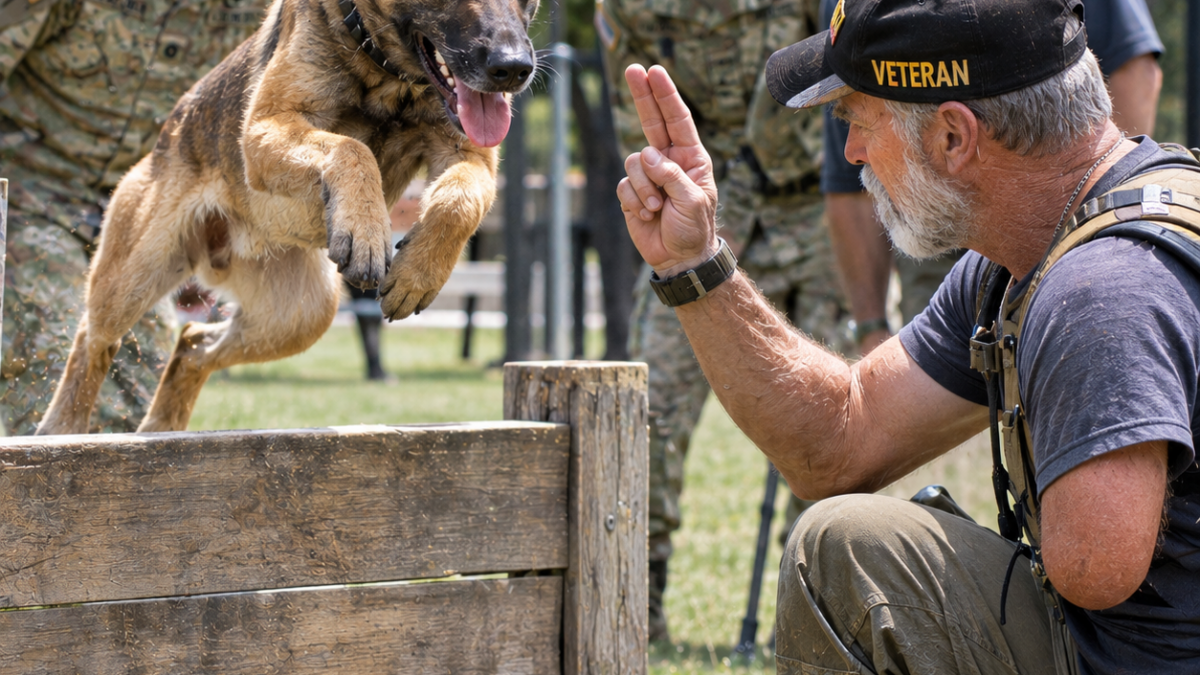
A Military K9 Failed Every Retirement Test—Then a One-Armed Veteran Raised Two Fingers and He Became Perfect Again.
For six straight weeks, Deacon failed every retirement evaluation they gave him—ignoring verbal commands he had obeyed for years, refusing obstacle drills, and staring past his trainers as if the person giving the order was standing somewhere beyond the fence.
Veterinarians feared the seven-year-old Belgian Malinois might be developing a neurological problem, and the base was preparing to remove him permanently from active service when a one-armed veteran happened to cross the parking lot beside the training field.
The man never called Deacon’s name; he simply stopped, lifted two fingers in a silent signal no one on the current team recognized, and the dog immediately rose, crossed the entire obstacle course flawlessly, then sat trembling at the veteran’s boots as though he had finally found the person he had been waiting for.
The first time Deacon refused the wall, Staff Sergeant Caleb Morris assumed the dog was tired.
It was August in North Carolina.
Ninety-three degrees before noon.
Humidity so thick the training field seemed to hold its own weather.
The Malinois had already completed three scent drills, two vehicle searches, and a controlled obedience circuit before Caleb pointed toward the six-foot climbing wall.
“Up.”
Deacon looked at him.
Then looked beyond him.
Toward the far parking lot.
“Deacon. Up.”
Nothing.
Caleb frowned.
The dog knew the command.
Not approximately.
Not usually.
Deacon had cleared that wall hundreds of times.
He had worked military security details, explosives detection, and deployment support since he was barely two years old.
He could search a vehicle line in darkness.
Ignore food tossed at his feet.
Hold position during gunfire simulation.
Move through narrow tunnels, unstable surfaces, stairs, aircraft ramps, and crowds.
He had once located explosive material hidden beneath a false floor panel in a transport truck after two other dogs passed the vehicle without alerting.
Deacon did not forget “up.”
Caleb walked closer.
“Come on, buddy.”
Deacon’s ears moved.
His body did not.
Then, strangely, he stared toward the parking lot again.
Caleb followed his eyes.
Three maintenance trucks.
A woman walking toward headquarters.
Two airmen carrying boxes.
Nothing unusual.
Caleb touched Deacon’s harness.
The dog stood.
He walked beside Caleb to the wall.
Caleb pointed again.
“Up.”
Deacon sat.
That was how it began.
Not dramatically.
Not with collapse.
Not with aggression.
One refusal.
Then another.
The following morning, Deacon refused the tunnel.
PART2:
Two days later, he stopped halfway through a search pattern and simply stood facing west.
During obedience work, he responded to “sit” but ignored “heel.”
During another session, he completed the first half of an obstacle run perfectly, then walked off the course and sat beside the fence.
His current handler, Caleb, took it personally at first.
Handlers do.
They are trained not to.
Still do.
A working dog is a partner, and when years of communication suddenly stop working, the first instinct is to ask what you did wrong.
Caleb checked his timing.
Tone.
Body position.
Reward schedule.
Harness fit.
Everything.
Nothing explained it.
By the second week, Deacon’s behavior had become impossible to dismiss.
Captain Mara Vance, the veterinary officer responsible for working-dog health, watched from the edge of the field.
Deacon stood beside Caleb.
Calm.
Alert.
Physically strong.
“Send him.”
PART3:
Caleb pointed toward the low barrier.
“Over.”
Deacon remained.
“Over.”
Nothing.
Mara watched his eyes.
“He’s hearing you.”
“I know.”
“Any changes in the kennel?”
“No.”
“Eating?”
“Everything.”
“Sleep?”
“Normal.”
“Stool?”
Caleb looked at her.
“Do you want the complete romantic version of our partnership?”
“I want the stool answer.”
“Normal.”
“Any stumbling?”
“No.”
“Head tilt?”
“No.”
“Circling?”
“No.”
“Seizure activity?”
“No.”
“Startle response?”
“Normal.”
Mara looked toward Deacon.
“Pain?”
“He lets us handle everything.”
“That doesn’t mean no pain.”
“I know.”
They started medical workup.
Blood.
Joints.
Spine.
Vision.
Hearing.
Neurological exam.
Deacon tolerated the entire process with the same unsettling neutrality.
Nothing obvious.
No infection.
No acute orthopedic problem.
No significant vision loss.
His hearing remained excellent.
His blood work looked unusually good for a working dog of his age.
There was some expected wear in his hips and lower back.
Nothing severe enough to explain a complete behavioral change.
Mara ordered more testing anyway.
Because working dogs do not suddenly stop doing familiar tasks without a reason.
The reason is not always dramatic.
But there is a reason.
Meanwhile, Deacon continued failing.
The command failures became stranger.
He did not simply disobey everything.
He responded to some commands immediately.
“Down.”
Perfect.
“Stay.”
Perfect.
“Leave it.”
Perfect.
But obstacle sequences fell apart.
Certain directional cues failed entirely.
And every few minutes, Deacon looked toward some distant point beyond whoever was working with him.
Like he was checking for something.
Or someone.
One trainer joked:
“Maybe he’s retiring himself.”
Nobody laughed much.
Retirement was already being discussed.
Deacon was seven.
Not ancient for a Malinois.
But old enough that reassignment, medical retirement, or adoption could be considered if his reliability had changed.
A military working dog cannot be “mostly” reliable.
Especially in explosives work.
Mostly is not enough.
If a dog misses a cue during a demonstration, embarrassing.
If a dog misses a cue during a real search, people can die.
So Deacon was pulled from operational work pending evaluation.
Caleb hated it.
The dog did not appear to care.
That was worse.
On the third week, they tested Deacon with another handler.
Tech Sergeant Naomi Brooks.
Experienced.
Calm.
Different voice.
Different movement.
She had worked with Deacon during earlier training rotations.
“Heel.”
Deacon moved.
“Sit.”
Perfect.
“Forward.”
Nothing.
Naomi repeated.
Deacon looked past her toward a service road.
She lowered her hand.
“Interesting.”
Caleb stood outside the pen.
“What?”
“He’s not refusing us.”
“Looks like refusing.”
“No.”
Naomi walked toward Deacon.
“He’s waiting.”
“For what?”
“I don’t know.”
She tried again.
Same response.
Mara began reviewing older records.
That was where the first problem appeared.
Deacon’s file was complete enough for administration.
Incomplete for history.
Current handler:
Caleb Morris.
Previous handler:
Master Sergeant Eric Dalton.
Before Eric:
Unclear.
There was a transfer code.
A unit abbreviation.
Then almost nothing.
Deacon had apparently begun his working career under another handler before being reassigned after an overseas incident.
Mara requested archived files.
The response came back:
Records retrieval may take time.
Caleb hated that answer.
“What does ‘may take time’ mean?”
“It means exactly what it says.”
“We have a dog failing retirement evaluation now.”
“Caleb.”
“Sorry.”
Mara understood.
They tried familiar scent items from Eric Dalton.
Eric had retired from service two years earlier and lived in Arizona.
He mailed an old training sleeve, a cap, and a leash.
Deacon sniffed everything.
His tail moved once.
Then nothing.
Eric joined by video.
“Deacon.”
The dog oriented toward the speaker.
Ears forward.
Eric smiled.
“Hey, ugly.”
Deacon walked closer.
For a moment, Caleb thought they had it.
Then Eric gave a command.
“Place.”
Deacon looked at the screen.
Did nothing.
Eric’s smile disappeared.
“What the hell?”
“You seeing this?”
“Yeah.”
“Did he ever do anything like it with you?”
“Never.”
“Anything he was strange about?”
Eric thought.
“No.”
Then:
“Wait.”
Everyone looked.
Eric leaned closer to screen.
“He used to react to hand signals before voice.”
“What hand signals?”
“I don’t know. Old handler stuff.”
Mara straightened.
“Old handler?”
“The guy before me.”
“You knew him?”
“No.”
“Name?”
Eric shook his head.
“I think Mason. Maybe Mercer.”
Caleb looked at Mara.
“You never mentioned this?”
“It was years ago.”
“What happened?”
Eric’s expression changed.
“I was told handler was medically separated.”
“Why?”
“Combat injury.”
“What kind?”
“No idea.”
“Did Deacon stay with him afterward?”
“No.”
“Why not?”
“Dog still belonged to program.”
That was all Eric knew.
Another fragment.
Not enough.
Then the retirement testing officially began.
Three evaluations.
Deacon failed all three.
Not because he became unsafe.
Because he became unreliable.
He would begin correctly.
Then stop.
Wait.
Stare.
On the third evaluation, the evaluator wrote:
DOG APPEARS TO ANTICIPATE NONVERBAL CUE NOT PRESENT IN CURRENT HANDLER PROTOCOL.
Mara read that line twice.
“Nonverbal cue.”
Caleb looked over her shoulder.
“What does that mean?”
“It means the evaluator noticed what Eric mentioned.”
“What?”
“He might be waiting for a signal.”
“Whose signal?”
Mara looked toward Deacon’s kennel.
“That is becoming a very important question.”
The medical team began discussing advanced neurological imaging.
Possible focal neurological issue.
Cognitive change.
Stress response.
Behavioral shutdown.
Nobody liked guessing.
At the same time, command reliability was too poor to return Deacon to work.
A recommendation was drafted:
Remove from operational service pending final neurological and behavioral review.
Caleb read it alone.
Then walked to Deacon’s kennel.
The Malinois lay on his cot.
Caleb sat outside.
“You trying to get rid of me?”
Deacon blinked.
“Because if this is personal, you’re doing a great job.”
Nothing.
Caleb leaned against the wall.
“You know what the bad part is?”
Deacon rested his muzzle on his paws.
“I would retire you tomorrow if I thought that was what you wanted.”
Caleb laughed softly.
“Like you get a vote.”
Deacon’s ears shifted toward the parking lot.
Again.
Caleb followed the movement.
Nothing.
He whispered:
“Who are you looking for?”
The answer came the following Thursday.
By accident.
The base was hosting a veterans’ employment event in a building adjacent to the K9 training compound.
Former service members arrived all morning.
Some in suits.
Some in work boots.
Some carrying folders and résumés.
One man arrived late.
His name was Thomas Mercer.
Forty-one.
Former Army Staff Sergeant.
He wore jeans, a gray button-down shirt, and a black prosthetic harness beneath the left sleeve that had been pinned neatly near the shoulder.
His left arm ended above the elbow.
Thomas parked in the overflow lot because the main lot was full.
That required him to walk along the chain-link fence bordering the K9 field.
He had no reason to stop.
Deacon was not even working.
The dog sat beside Caleb near the start of the obstacle course while Naomi adjusted equipment.
Thomas walked past carrying a folder under his right arm.
Deacon’s head snapped around.
Caleb noticed instantly.
The reaction was different.
Not the usual distant stare.
Deacon stood.
His whole body changed.
Weight forward.
Ears rigid.
Mouth closed.
Eyes locked.
Caleb tightened the lead automatically.
“Easy.”
Thomas kept walking.
Then stopped.
Not because anyone called him.
Because he had seen the dog.
He stared through the fence.
For several seconds, neither moved.
Caleb said:
“Sir?”
Thomas did not answer.
His face had gone pale.
He slowly shifted the folder beneath his right arm.
Then raised his right hand.
Two fingers.
Index and middle.
Vertical.
Small motion.
Almost nothing.
Deacon exploded into movement.
Not toward Thomas.
Toward the course.
Caleb nearly lost the lead.
“Whoa.”
Deacon moved to Caleb’s left side.
Perfect heel position.
Then looked up.
Waiting.
Thomas lowered two fingers toward the ground.
Deacon dropped instantly.
Naomi froze.
“What the hell?”
Thomas lifted the two fingers.
Rotated his wrist forward.
Deacon stood.
Thomas pointed once toward the low barrier.
Deacon cleared it.
No verbal command.
Next barrier.
Tunnel.
Wall.
Platform.
Weave poles.
Every obstacle.
Perfect.
Caleb stood motionless with the loose lead in his hand.
Deacon reached the final platform.
Sat.
Thomas’s hand lowered.
The dog remained.
Then Thomas walked through the field gate after Naomi opened it.
Slowly.
No one told him to.
No one stopped him.
Deacon trembled.
That was the part Caleb remembered most.
Not barking.
Not jumping.
Not pulling.
Trembling.
Thomas stopped ten feet away.
His eyes filled.
“Deacon.”
The dog broke position.
Crossed the distance.
Then stopped at Thomas’s boots.
Sat.
Looked up.
Thomas reached down with his right hand.
Touched the dog’s forehead.
Deacon made a sound Caleb had never heard from him.
Half whine.
Half breath.
Thomas knelt awkwardly.
One knee.
One hand.
Deacon pressed his chest against him.
Thomas closed his eyes.
“Hey, Deke.”
Caleb looked at Mara.
Mara was already crying.
Not dramatically.
Quietly.
Like someone watching a locked door open after weeks of trying the wrong key.
Thomas buried his face briefly against Deacon’s neck.
The Malinois remained still.
Then leaned harder.
Caleb finally asked:
“You know him?”
Thomas looked up.
“Yes.”
“How?”
Thomas wiped his face.
“I trained him.”
Silence.
Caleb stepped closer.
“You were his handler?”
Thomas nodded.
“First one.”
Mara stared.
“Thomas Mercer?”
He looked at her.
“Yes.”
The archived name.
Mercer.
Mara exhaled.
“We’ve been trying to find you.”
Thomas almost laughed.
“Apparently he was too.”
That sentence spread around the field quickly.
Later, Mara would correct anyone who took it too literally.
Deacon had not necessarily spent six weeks consciously waiting for Thomas Mercer to cross that specific parking lot.
Dogs do not build human narratives on command.
But something about Thomas—his movement, scent, posture, and especially those hand signals—had unlocked a learned pattern that current handlers did not know existed.
And the history behind those two fingers explained almost everything.
Thomas had been paired with Deacon when the Malinois was fourteen months old.
Young.
Intense.
Fast.
Too fast sometimes.
“Everyone thought he needed harder handling,” Thomas said later in the conference room.
“What did you think?” Caleb asked.
“That he needed clearer handling.”
Thomas had been twenty-nine.
Already an experienced soldier.
Deacon was his first full-time military working dog.
They trained together for nearly a year before deploying.
Explosives detection.
Patrol movement.
Vehicle search.
Building clearance support.
Thomas discovered early that Deacon responded better to hand signals than repeated voice cues.
“Why?” Naomi asked.
Thomas shrugged.
“Less noise.”
“Was that standard?”
“Some signals were.”
“And the two fingers?”
Thomas looked toward the kennel window where Deacon lay watching him.
“That was ours.”
“What did it mean?”
“Look at me.”
Caleb went still.
Thomas demonstrated.
Two fingers raised.
“Focus.”
Then fingers down.
“Down.”
Forward rotation.
“Move.”
Point.
Direction.
The entire obstacle routine Deacon completed that morning had been built around a silent sequence Thomas used during deployment.
Caleb asked:
“Why isn’t any of this in the current command sheet?”
Thomas gave him a tired smile.
“Because people assume dogs transfer like equipment.”
Mara leaned forward.
“What happened to you?”
Thomas looked down at the empty left sleeve.
“Roadside blast.”
No one spoke.
He continued without embellishment.
Their unit had been moving between compounds.
Deacon alerted near a roadside culvert.
The team halted.
The device they found was not the only one.
A secondary explosive detonated farther back.
Thomas survived.
His arm did not.
Another soldier was killed.
Thomas spent months in surgeries.
Then rehabilitation.
Deacon remained in the working-dog program.
At first Thomas assumed they would reunite.
“I kept asking.”
“What did they tell you?” Mara said.
“That Deacon was being evaluated.”
“For adoption?”
“For reassignment.”
Thomas’s jaw tightened.
“I wasn’t ready to handle him.”
Physically or psychologically.
He understood that now.
At the time, it felt like the last thing from his old life being taken away.
Then Deacon was reassigned.
Thomas was medically retired.
Records scattered across different systems.
Years passed.
“Did you try to find him?”
Thomas looked embarrassed.
“For a while.”
“What happened?”
“I stopped.”
“Why?”
He thought.
“Because every answer reminded me I wasn’t who I had been.”
Caleb did not push.
Thomas continued.
“I learned he was still working. That should’ve been enough.”
“Was it?”
“No.”
Thomas had moved twice.
Divorced.
Worked private security briefly.
Quit.
Went back to school.
Lost contact with almost everyone from the unit.
The employment event that morning was supposed to help him find a job in logistics.
He had parked in overflow because he was late.
That was all.
No plan.
No reunion arranged.
Just timing.
Mara asked the question everyone had avoided.
“Why did Deacon suddenly stop responding now?”
Thomas looked toward Caleb.
“I don’t know.”
Caleb said:
“Neither do we.”
But the records helped.
The archived file arrived two days later.
More complete.
Thomas Mercer listed as first operational handler.
Then injury.
Transfer.
Reassignment.
Several transition notes.
One stood out.
DOG SHOWS STRONG RELIANCE ON VISUAL CUE SEQUENCING FROM PRIOR HANDLER. RECOMMEND STANDARDIZATION DURING TRANSITION.
Another:
DOG MAY PAUSE WHEN VERBAL COMMAND GIVEN WITHOUT EXPECTED VISUAL CONFIRMATION.
Eric Dalton had apparently learned enough of the signals informally to keep Deacon working.
Over the years, the behavior faded.
Or seemed to.
Then after Eric’s retirement and later transfer to Caleb, Deacon had continued successfully.
Until the recent evaluation period.
Mara compared dates.
The first refusal occurred during a training week when the team had changed Deacon’s visual cue protocol as part of standard retirement testing.
More voice.
Less hand signaling.
They had unintentionally removed the visual confirmations Deacon had relied on for years.
That alone did not explain everything.
But it explained a lot.
Caleb felt sick.
“So I caused this?”
Mara shook her head.
“No.”
“I changed the cues.”
“Under standard evaluation protocol.”
“I should’ve noticed.”
“You did notice.”
“After three weeks.”
“Caleb.”
She waited.
“This isn’t about blame.”
Then:
“We had incomplete history.”
The neurological concern did not vanish immediately.
Mara still completed medical evaluation.
Because one emotional reunion did not rule out disease.
That mattered.
Deacon’s physical and neurological tests remained reassuring.
No evidence of a major neurological disorder.
His behavior improved dramatically when the old hand-signal sequence was reintroduced.
Not perfectly.
But consistently.
That shifted the interpretation.
Not neurological failure.
Not sudden loss of intelligence.
Not stubbornness.
A communication breakdown complicated by age, transitions, and an old training history nobody currently understood.
Thomas returned the next morning.
Then the next.
Not to reclaim Deacon.
That surprised everyone.
Caleb expected it.
Mara expected Thomas to ask.
He didn’t.
On the third visit, Mara finally said:
“You haven’t asked about adopting him.”
Thomas looked at her.
“I thought about it.”
“And?”
“I’m not ready to answer.”
“Why?”
He looked toward Deacon.
“Because wanting him isn’t the same as being good for him.”
Mara respected that immediately.
Thomas lived alone in a second-floor apartment.
No elevator.
His job situation uncertain.
Deacon was seven, physically strong, with years of structured working behavior.
Thomas’s right shoulder had chronic overuse injury from compensating for his missing left arm.
Handling a powerful Malinois one-handed in daily life required planning.
Thomas knew.
“I don’t want a movie ending,” he said.
Mara smiled.
“Good.”
“I want the right ending.”
So they evaluated.
Could Thomas safely manage leash?
Yes, with an adaptive waist-and-shoulder system.
Could Deacon adjust to civilian home?
Probably, with transition.
Could Thomas provide exercise?
With help.
Backup caregiver?
His sister Rachel lived fifteen minutes away.
She agreed.
Housing?
Thomas’s lease prohibited dogs over sixty pounds.
Problem.
He could move.
But he did not yet have employment.
Another problem.
The simplest emotional answer was not immediately the responsible answer.
Meanwhile, Deacon’s retirement status changed.
He would not return to operational explosives work.
Not because of failure.
Because the entire episode convinced the command that retirement was appropriate.
Seven years old.
Years of service.
Physical wear.
And now clear evidence that his communication history required more individualized handling than a new operational pairing would justify.
Caleb struggled with that.
“He can still work.”
Mara nodded.
“I know.”
“He just proved it.”
“He proved he can perform familiar sequences.”
“He’s healthy.”
“He is.”
“So why retire?”
Mara looked at him.
“Because retirement isn’t punishment.”
That stopped him.
She continued.
“He doesn’t need to fail badly enough to earn rest.”
Caleb stared at Deacon.
He had never thought of it that way.
Military working dogs often work until retirement is medically or operationally appropriate.
Humans have a habit of treating usefulness as the condition for continued value.
Mara did not.
“He has done enough.”
Thomas heard that later.
He sat silently for a long time.
Then said:
“Yeah.”
Two weeks after the reunion, Thomas received a job offer.
Warehouse logistics coordinator.
Veteran-owned medical supply company.
Day shift.
Stable pay.
The company owner had a retired Labrador and did not care that Thomas needed occasional schedule flexibility.
Housing remained.
Thomas found a small one-story rental house with fenced backyard twelve minutes from base.
More expensive.
Manageable.
His sister helped with deposit.
He hated accepting help.
Accepted anyway.
Then came the handling evaluation.
Not a symbolic obstacle run.
Real life.
Leash.
Doorways.
Car.
Veterinary office.
Food.
Visitors.
Startle.
Recall.
Rest.
Thomas had to prove he could manage Deacon safely.
He used the adaptive leash around his waist.
Right hand controlled a secondary loop.
Deacon walked beside him almost too perfectly.
Evaluator intentionally asked Thomas not to use the old two-finger cue every time.
Because the goal was not to freeze Deacon inside past.
Thomas had to build new communication too.
Voice.
New signals.
Consistent reinforcement.
At one point, Deacon paused at a doorway.
Thomas started raising two fingers.
Then stopped.
He said:
“With me.”
Deacon looked up.
Moved.
The evaluator smiled.
That mattered more than the first reunion.
Not because it was dramatic.
Because it showed their relationship could become current instead of merely remembered.
Adoption was approved six weeks later.
Caleb was there.
He pretended not to be emotional.
Failed.
Thomas signed paperwork with his right hand.
Then looked at Caleb.
“You okay?”
“No.”
“Good.”
Caleb laughed.
“You better not feed him garbage.”
Thomas said:
“He used to eat half my MRE crackers.”
“That explains everything wrong with him.”
Deacon stood between them.
Caleb knelt.
Touched the dog’s chest.
“You’re retiring, old man.”
Deacon licked the side of his face.
Caleb closed his eyes.
Thomas looked away to give him privacy.
That was respect.
Before leaving, Caleb handed Thomas a folder.
Current records.
Medical.
Commands.
Retirement instructions.
And something else.
A handwritten sheet.
THINGS DEACON LIKES.
Chicken.
Cool floors.
Car windows cracked.
Sleeping near doors.
Tennis balls only if no one is watching.
Hates baths.
Pretends not to know “come” when distracted by squirrels.
Thomas laughed.
“He likes tennis balls?”
Caleb looked offended.
“Don’t ruin my reputation.”
Thomas folded the paper.
“This is better than the military file.”
“That was the idea.”
Deacon’s first night in Thomas’s house was difficult.
Of course.
He paced.
Door to window.
Window to hallway.
Back.
Thomas sat on floor.
Did not command him down.
Did not repeatedly signal.
Just waited.
At midnight, Deacon finally lay near the front door.
Thomas slept on couch.
Second night, Deacon chose hallway.
Third night, beside Thomas’s bedroom.
Within two weeks, he slept on a dog bed at the foot of Thomas’s bed.
Thomas discovered civilian Deacon was less disciplined than military Deacon.
He stole socks.
Carried them around.
Did not chew.
Just collected.
One morning Thomas found five socks arranged beside dog bed.
He called Caleb.
“Did you know he’s a thief?”
“Government property redistribution.”
“He took all my left socks.”
Silence.
Then Caleb laughed so hard he had to sit down.
Thomas looked at empty sleeve.
“Very funny.”
Caleb managed:
“Efficient dog.”
Deacon barked in background.
Thomas smiled.
There it was.
Normal.
Not military legend.
Not miraculous reunion.
A dog stealing socks.
Retirement.
Thomas kept working with visual cues, but they changed.
Two fingers no longer meant “everything is normal because we are twenty-nine again.”
It became just focus.
A tool.
One signal among many.
Sometimes Thomas deliberately used voice first.
Sometimes hand.
Sometimes both.
He wanted Deacon flexible.
He wanted himself flexible too.
That was harder.
For years, Thomas had organized life around what was missing.
Left arm.
Old unit.
Career.
Marriage.
Deacon did not fix those things.
A dog cannot repair biography.
But Deacon imposed routine.
Morning walk.
Food.
Medication.
Training games.
Veterinary appointments.
A reason to stop working at six.
A reason to go outside on bad days.
A reason to notice when the weather was good.
Thomas began helping at a veteran adaptive-sports program because someone at his new job invited him.
He resisted.
Then went.
Deacon stayed home.
Important distinction.
Retired military dog did not automatically become service dog.
Thomas never claimed public-access rights he did not have.
If he needed a service animal someday, that would require separate evaluation and training.
Deacon was his companion.
Former partner.
Retired working dog.
That was enough.
A year later, Caleb visited.
Deacon recognized truck before Caleb got out.
Barking.
Pacing.
Thomas opened gate.
“Don’t embarrass yourself.”
Deacon launched across yard.
Caleb crouched.
The dog hit him hard enough to knock him backward.
Thomas laughed.
“Great handling.”
Caleb lay in grass with Deacon licking his face.
“Shut up.”
They grilled.
Talked.
For the first time, Caleb heard full story about Thomas’s injury.
Not the public version.
The private one.
Thomas did not glorify.
Explosive.
Smoke.
Confusion.
Blood.
Waking without arm.
Learning Deacon survived.
Then losing him anyway to reassignment.
Caleb asked:
“Did you resent us?”
“Who?”
“The program.”
“Yes.”
“Still?”
Thomas thought.
“No.”
“Why?”
“Because Deacon kept working.”
He looked across yard.
“He had a life after me.”
That realization had taken years.
“You too,” Caleb said.
Thomas smiled.
“Working on it.”
Two years after retirement, Deacon’s hips worsened.
Nothing catastrophic.
Age.
He slowed.
Shorter walks.
No jumping into truck.
Thomas installed ramp.
His neighbor offered help.
Thomas hated help less now.
That was progress.
The two-finger cue stayed.
Sometimes Thomas used it from across yard.
Deacon would look up.
That was all.
Focus.
Here.
Now.
Not past.
At ten, Deacon developed degenerative changes in spine.
Managed with medication.
Physical therapy.
Weight control.
Swimming sessions.
Thomas joked that Deacon had better healthcare than he did.
Mara remained involved through retirement-veteran network.
One afternoon she visited.
Deacon was lying under porch.
Thomas sat nearby.
Mara said:
“He looks good.”
“He’s getting old.”
“So are you.”
“Cruel.”
“You started it.”
They watched Deacon sleep.
Thomas asked:
“Do you really think he was waiting for me that day?”
Mara took time.
“No.”
Thomas nodded.
“I figured you’d say that.”
“I think he was waiting for something he understood.”
Thomas looked at her.
“Difference?”
“Yes.”
She pointed toward him.
“Your scent. Your posture. Your movement. The visual cue. All of it together may have brought back a trained context.”
“So not me.”
“I didn’t say that.”
Thomas raised eyebrow.
Mara smiled.
“We can’t ask him which part mattered most.”
Thomas looked at Deacon.
“I like my version better.”
“You’re allowed.”
“What version?”
“That he remembered.”
Mara nodded.
“That’s reasonable.”
“Not magical?”
“No.”
“Good.”
She stood.
“Memory doesn’t have to be magical to matter.”
Thomas remembered that sentence.
Three years later, Deacon was eleven.
Cancer.
Splenic mass.
Found after sudden weakness.
Surgery was possible.
Risk high.
Imaging suggested spread.
Thomas sat with veterinary oncologist.
Questions.
Options.
Numbers.
No one told him what choice to make.
That was worse.
He called Caleb.
Then Mara.
Then Rachel.
Everyone said same thing in different words.
You know him best.
Thomas hated that too.
He had once been responsible for Deacon in combat.
Then lost him.
Got him back.
Now had to decide when not to ask for more.
They chose comfort care.
Weeks.
Maybe months.
Deacon had good days.
Chicken.
Yard.
Sun.
Short drives.
On bad days, Thomas stayed close.
No bucket list.
No military ceremony.
No final heroic mission.
Just life.
One evening, Deacon could not rise without help.
Thomas used the waist harness.
Got him outside.
Deacon stood in grass.
Looked at sunset.
Then at Thomas.
Thomas lifted two fingers.
Deacon’s eyes focused.
Same as years before.
Thomas lowered his hand.
“Good boy.”
The next morning, Deacon refused breakfast.
Breathing changed.
Thomas called Mara.
Then veterinarian.
Home visit.
Caleb drove three hours and arrived in time.
They sat on living-room floor.
Deacon between them.
Thomas’s right hand on his chest.
Caleb touching shoulder.
No one pretended.
Thomas said:
“You ready?”
Caleb looked at him.
“He is.”
Thomas nodded.
Veterinarian gave sedation.
Deacon relaxed.
Thomas lifted two fingers one last time.
Not as command.
Habit.
Deacon’s eyes moved toward them.
Focused.
Then closed.
Thomas whispered:
“Stand down.”
Caleb looked away.
Deacon died quietly.
Afterward, Thomas kept his collar.
Not harness.
Not military gear.
Just retirement collar.
Blue.
Cheap.
Name tag scratched.
DEACON.
Years later, people still told reunion story.
Military K9 waits for amputee veteran.
One gesture restores him.
Thomas corrected when he could.
“He wasn’t broken.”
People looked confused.
“He had incomplete training continuity.”
That sounded less viral.
More true.
“And he didn’t fail everything.”
“He failed retirement evaluations.”
“He stopped responding the way they expected.”
“Same thing.”
“No.”
Thomas cared about the distinction.
Because for a while, everybody had looked at Deacon and asked:
What is wrong with this dog?
The better question turned out to be:
What are we no longer saying in the language he learned first?
The two-finger signal had not cured neurological disease.
There was no neurological disease to cure.
It did not turn back time.
It did not make Thomas whole.
It did not return the arm.
It did not erase the years apart.
It simply connected two histories that had been separated by incomplete records and ordinary bureaucracy.
A handler.
A dog.
A training language.
A silent cue.
That was enough to change the diagnosis of the situation.
Enough to prevent Deacon from being misunderstood.
Enough to give him a retirement with someone who knew why two raised fingers mattered.
And maybe that was why Thomas never called the day a miracle.
When people asked what happened, he said:
“He finally got a command he recognized.”
Then, after a pause:
“And so did I.”








