A McDonald’s Worker Saw a Trash Bag Moving Inside the Dumpster—Then a Cat’s Head Pushed Through the Plastic From the Inside.
PART3:
I turned toward the dumpster.
Nothing.
I walked closer.
Listened.
Another movement.
Not from the bag I’d just thrown.
Lower.
Something already inside.
My first thought was raccoon.
We got them sometimes.
They were clever enough to open almost anything and angry enough to blame you for discovering them.
I grabbed my flashlight.
Leaned over.
Black restaurant bags.
Cardboard.
Food waste.
Then something white near the bottom.
That caught my attention immediately.
We didn’t use white garbage bags.
It was a regular household kitchen bag.
Maybe thirteen gallons.
Tied tightly at the top.
It moved.
Not shifted.
Moved.
The entire bag flexed outward.
Something struck the inside.
I don’t remember climbing halfway into that dumpster.
I just remember grabbing the bag.
It was warm.
Too warm.
Something inside pushed against my hand.
“Jesus.”
The bag jerked again.
I pulled it upward.
Set it on the metal edge.
There was already a hole in one side.
Small.
Maybe two inches across.
Plastic around it wet and torn.
Something orange moved behind it.
Then a nose appeared.
Whiskers.
One eye.
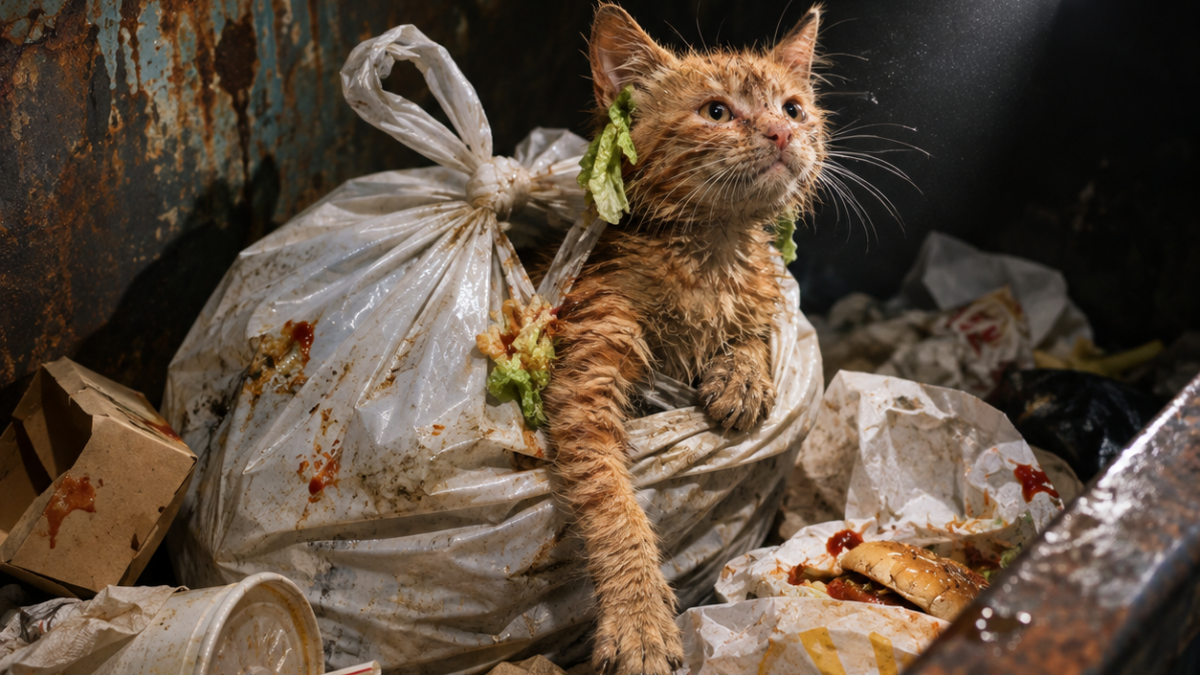
A tiny orange cat’s face pushed against the opening.
For one second, my brain couldn’t understand what I was looking at.
Then I ripped the bag open.
Not carefully.
Both hands.
Straight down the seam.
The plastic split.
A young orange tabby exploded out of it.
She landed on the dumpster’s metal rim.
Balanced.
Then sat down.
Just sat.
I stared at her.
She stared at me.
She was covered in garbage.
Ketchup streaked across one side of her face.
Grease had soaked into her chest fur.
Bits of shredded lettuce clung to her back.
Something that looked like half a hamburger bun was stuck against her side.
Her paws were dirty.
Her whiskers were coated with something sticky.
She smelled exactly like you’d expect a cat pulled from a fast-food dumpster to smell.
Fryer oil.
Old ketchup.
Garbage.
But she was alive.
Very alive.
I expected her to panic.
Jump.
Scratch me.
Run.
Instead, she lifted one front paw.
Licked it.
Slowly.
As if the last two hours had merely inconvenienced her grooming schedule.
I said:
“Are you serious?”
She licked again.
I looked at the destroyed bag.
The hole she’d started was larger from inside than I’d realized.
Her teeth had punctured the plastic repeatedly.
She had worked one section until it weakened.
Another few minutes?
Maybe ten?
She probably would have torn through.
That thought hit me later.
At the time, I was too angry.
Someone had tied her inside.
Not loosely.
The knot at the top was tight.
Double knot.
She hadn’t crawled in.
She hadn’t gotten trapped accidentally.
Somebody had put a living cat inside a kitchen trash bag.
Tied it shut.
Thrown it into a dumpster.
And left.
I picked her up.
She didn’t fight.
She was smaller than she first looked beneath all that dirty fur.
Maybe six pounds.
Young.
Thin.
I carried her inside through the service entrance.
Our closing coworker, Marcus, was cleaning the drive-thru area.
He looked at me.
Then the cat.
Then me again.
“Why do you have a cat?”
“Dumpster.”
He laughed.
“No, seriously.”
“Dumpster.”
He stopped laughing.
“What?”
I put her on a clean towel in the back utility area.
The cat immediately sat.
Marcus walked closer.
Then recoiled.
“Man, she smells like fries.”
“She was inside a garbage bag.”
“What?”
I explained.
Marcus stared toward the back door.
“Somebody dumped her?”
“In a tied bag.”
His expression changed.
“That’s messed up.”
“Yeah.”
The manager, Andrea, came back.
She stared.
“Why is there a cat in my stockroom?”
Marcus answered:
“Because apparently Daniel is adopting garbage now.”
I gave him a look.
Andrea crouched.
“Oh my God.”
The cat sniffed her fingers.
Then started licking ketchup off her shoulder.
Andrea said:
“We need water.”
We gave her a shallow bowl.
She drank.
Not frantically.
Steady.
Long.
Then more.
We found plain cooked chicken from the kitchen.
No seasoning.
Small pieces.
She ate everything.
Then looked for more.
“Slow down.”
She disagreed.
She ate the second portion too.
Andrea looked at me.
“You can’t keep her back here.”
“I know.”
“What are you doing?”
“I don’t know.”
It was nearly one in the morning.
Animal control wouldn’t answer until morning.
The local emergency vet said they’d examine her if we brought her in, but there would be fees.
I didn’t have much money.
Night maintenance at McDonald’s did not exactly come with an emergency-cat fund.
But I also wasn’t putting her outside.
And there was no chance in hell she was going back near that dumpster.
So we made a temporary box with towels.
She ignored it.
Instead, she sat beneath a metal prep table watching me finish cleaning.
Every ten minutes I’d look down.
Still there.
Sometimes grooming.
Sometimes staring.
Around two, I brought her into my car.
I expected her to panic once the engine started.
She climbed onto the passenger seat.
Curled up.
That was it.
My roommate, Tyler, was awake when I got home around three-thirty.
He worked mornings at a warehouse and apparently had fallen asleep playing video games on the couch.
I opened the apartment door.
The cat followed me inside.
Tyler woke.
Squinted.
Then said:
“Why does it smell like McDonald’s?”
I looked at him.
“It’s the cat.”
He sat up.
“The what?”
“The cat.”
He stared at her.
“We don’t have a cat.”
I smiled.
“We do now.”
There was a long silence.
Tyler looked at me.
Then the orange cat.
Then me.
“No.”
She walked toward him.
Sniffed his sock.
Rubbed against his ankle.
Tyler sighed.
“Damn it.”
I laughed.
“She smells terrible.”
“I noticed.”
“What’s her name?”
“I don’t know.”
“You can’t bring home an animal with no name.”
“You didn’t know she existed thirty seconds ago.”
“Still.”
The cat jumped onto the couch.
Tyler moved aside.
She curled into the warm spot he had just vacated.
He stared.
Then whispered:
“Okay.”
“What?”
“She can stay tonight.”
“That’s generous.”
“Tomorrow we’re figuring something out.”
“Sure.”
Neither of us knew how permanent “tonight” was going to become.
The first bath was a disaster.
I filled the bathroom sink with warm water.
The second her paws touched it, she transformed from exhausted dumpster survivor into an animal capable of rotating her entire body in six directions simultaneously.
Water everywhere.
My shirt soaked.
Tyler holding a towel.
Cat yelling.
I said:
“She survived a tied garbage bag and this is what makes her angry?”
Tyler said:
“She has standards.”
Eventually, we got most of the ketchup out.
Not the grease.
That took another bath the following afternoon using shampoo the veterinarian recommended.
Even after two baths, she smelled faintly of fryer oil for two days.
I didn’t hate it.
Which probably says something concerning about me.
The veterinarian saw her first thing that morning.
No microchip.
Not spayed.
Around one year old.
Maybe a little younger.
Slightly underweight.
Dehydrated.
But otherwise?
Healthy.
No broken bones.
No serious injuries.
No obvious respiratory damage from being inside the bag.
The vet listened to her lungs.
Checked her gums.
Looked at her teeth.
Then said:
“She’s incredibly lucky.”
I looked at the cat.
“She was already chewing out.”
The vet looked up.
“What?”
I told her.
She examined the marks on the plastic bag, which I’d brought with me because I didn’t know whether animal control or police would want it.
She shook her head.
“That’s probably what kept air moving.”
I hadn’t considered that.
The hole.
The chewing.
Every bite she had taken through that plastic had not just brought her closer to freedom.
It had probably increased airflow.
She had been saving herself in more ways than one.
I asked:
“How long could she have survived inside?”
The veterinarian didn’t answer immediately.
“Too many variables.”
“Heat.”
“Ventilation.”
“How tightly the bag was closed.”
“How much oxygen was inside.”
“But in a closed dumpster during July?”
She looked at me.
“You’re lucky you heard her.”
That sentence stayed with me.
Because I almost hadn’t.
The dumpster area was noisy.
Air-conditioning units.
Drive-thru speaker.
Highway.
Metal lids.
Garbage bags shifting.
I could have thrown the trash in and gone back inside.
I had done exactly that hundreds of times.
What if I’d been wearing headphones?
What if I’d taken the trash out twenty minutes later after she stopped moving?
What if the bag had been underneath something heavier?
What if another employee had compacted the trash?
What if—
I stopped.
You can drive yourself crazy with alternate endings.
The next morning, Andrea and I checked the security cameras.
The restaurant had exterior coverage because the dumpster area had been used for illegal dumping before.
Old furniture.
Construction waste.
That kind of thing.
We rolled footage backward.
11:00 p.m.
10:50.
Then 10:47.
A car entered from the side access road.
Not toward the drive-thru.
Not toward parking.
Straight behind the building.
It stopped beside the dumpster enclosure.
Driver’s door opened.
A person stepped out.
The camera angle wasn’t good enough for a face.
They opened the rear door.
Reached inside.
Pulled out a white trash bag.
You could see something shifting inside it.
My stomach turned.
The person carried it with both hands.
Walked to the dumpster.
Lifted the lid.
Threw the bag in.
Closed the lid.
Returned to the car.
Drove away.
Time from stopping to leaving?
Fourteen seconds.
Fourteen.
I watched three times.
Andrea wouldn’t watch the third.
“Enough.”
I paused the video.
Timestamp.
10:47 p.m.
I found her around 12:31.
One hour and forty-four minutes.
Nearly two hours inside a tied bag at the bottom of a dumpster.
The footage showed something else.
The person knew exactly where they were going.
No hesitation.
Didn’t accidentally discover the dumpster.
Didn’t park and think about it.
Drive in.
Dump.
Drive out.
That made it feel worse.
Planned.
We gave the footage to local authorities.
The plate wasn’t readable enough from the camera.
The vehicle was common.
Nothing came of it while I was following the case.
Maybe someone eventually identified the person.
Maybe not.
I stopped caring about them as much as I expected.
Because I had the cat.
And she had better things to do than become evidence in somebody else’s worst decision.
At home, she adapted almost immediately.
The first afternoon after the vet, she slept six straight hours.
On my pillow.
Not beside it.
On it.
I found her there when I went into my room.
She opened one eye.
Didn’t move.
I said:
“You know that’s mine.”
She closed the eye.
Apparently, negotiations were over.
Food was another story.
That cat ate everything.
Wet food.
Dry food.
Chicken.
Treats.
She once stole part of a tortilla from Tyler’s plate.
Another time she tried licking butter from a pan.
We had to lock trash cans.
I couldn’t blame her.
After what she’d experienced, she seemed to treat every meal as something that might disappear permanently if she didn’t finish it immediately.
The veterinarian told us to feed smaller portions more often until she learned food was reliable.
So we did.
Morning.
Afternoon.
Evening.
Same bowls.
Same place.
For the first couple weeks, she would finish eating and immediately check the other bowl.
Then the counter.
Then the floor.
Then stare at us.
Eventually she stopped.
One evening, she ate half her food.
Walked away.
Came back an hour later.
That shouldn’t have felt emotional.
It did.
Because leaving food unfinished meant she believed it would still be there.
Safety sometimes looks like leftovers.
Tyler wanted to call her McFlurry.
I wanted Nugget.
He said:
“Nugget is too obvious.”
“You suggested McFlurry.”
“That’s sophisticated branding.”
“No.”
“Fry?”
“No.”
“Big Mac?”
“She’s a girl.”
“So?”
“No.”
“McChicken?”
“Stop naming the cat after menu items.”
“You started it with Nugget.”
Fair.
Eventually we compromised.
Her official veterinarian record says:
NUGGET MCFLURRY CARTER.
The receptionist stared.
I said:
“Long story.”
She looked at Nugget.
“I’m guessing McDonald’s.”
“Unfortunately.”
Nugget grew into an absolutely beautiful cat.
Once the grease was gone, her fur turned bright orange with subtle tabby stripes.
White patch beneath the chin.
Golden eyes.
Tiny nick on one ear.
She filled out.
Six pounds became seven.
Then eight.
She got spayed.
Vaccinated.
Microchipped.
I made sure the chip registration had three phone numbers.
Mine.
Tyler’s.
My mother’s.
Nobody was ever going to be able to say they couldn’t identify where Nugget belonged.
For the first few months, she hated closed plastic bags.
We discovered that accidentally.
Tyler pulled a new trash liner from a box.
The plastic snapped.
Nugget disappeared beneath the bed.
Not normal curiosity.
Panic.
Low body.
Wide eyes.
Wouldn’t come out for almost an hour.
After that, we stopped shaking trash bags open near her.
Sometimes trauma leaves obvious scars.
Sometimes it hides inside ordinary sounds.
She also hated the apartment dumpster.
When I carried her past it in a carrier on the way to the vet, she started crying.
I changed routes after that.
Maybe she remembered.
Maybe she just hated the smell.
I don’t know.
You don’t need certainty to be considerate.
For weeks after she moved in, coworkers asked about her.
Andrea:
“How’s Dumpster Cat?”
“Nugget.”
“Dumpster Nugget.”
“No.”
Marcus:
“Still smells like fries?”
“Not anymore.”
“Shame.”
Customers who had heard the story sometimes asked.
Local rescue groups shared her picture.
One post called me a hero.
I hated that.
Because the truth is less dramatic.
I took out the garbage.
I heard a sound.
I opened a bag.
Nugget had already done the hard part.
That’s the thing I kept explaining.
She wasn’t motionless.
She wasn’t waiting helplessly.
She had bitten through layers of plastic.
Again.
Again.
Again.
There were tiny tooth marks all around the hole.
She had almost created an opening large enough for her head before I touched the bag.
If I hadn’t come outside?
Maybe she would have freed herself.
I choose to believe that.
Because it fits the cat I came to know.
Nugget didn’t ask permission for much.
Closed bedroom door?
She learned to open it.
Cabinet with treats?
She learned which one.
Bathroom occupied?
Unacceptable.
Cat carrier?
Negotiable only under protest.
If a toy rolled beneath furniture, she did not sit there and cry.
She attacked the furniture.
That first night had told me who she was.
Somebody had decided she was disposable.
Nugget disagreed.
Strongly.
About two months after I found her, I was taking trash out at the end of another shift.
Same dumpster.
Same warm air.
I paused beside it.
I hadn’t meant to.
Something about standing there brought everything back.
White bag.
Movement.
Orange face pushing through plastic.
I looked into the dumpster.
Empty except for restaurant bags.
For one second, I imagined what would have happened if she had escaped before I arrived.
She would have climbed out.
Then what?
Parking lot.
Highway nearby.
Cars.
Coyotes.
Heat.
Would somebody else have seen her?
Would she have hidden?
Would she have survived?
Maybe I hadn’t saved her from the bag.
Maybe I had saved her from what came next.
Or maybe she saved herself and simply allowed me to become part of the story.
I liked that explanation better.
A year later, my life changed.
I left McDonald’s.
Got a maintenance job at an apartment complex.
Better pay.
Day shift.
Benefits.
When I packed my uniform shirts into a donation bag, Nugget sat on them.
I laughed.
“You can’t keep everything that smells like fries.”
She ignored me.
Tyler moved out not long after.
He got engaged.
When he packed, Nugget kept climbing into boxes.
On his last night, he sat on the floor beside her.
“You know you were supposed to be temporary.”
Nugget rubbed against him.
He looked at me.
“I still think McFlurry was better.”
“Get out.”
He laughed.
Then cried a little when he left.
He denied this afterward.
I maintain witnesses were present.
Nugget stayed with me.
Obviously.
I eventually moved into a small house.
Real yard.
Sunroom.
No highway behind it.
The first afternoon, Nugget sat in the sunroom window for four hours.
Birds.
Squirrels.
Trees.
Safe behind glass.
I wondered whether whoever threw her away would recognize her now.
Healthy.
Shiny coat.
Collar.
Tag.
A home.
Would they regret it?
Would they feel guilty?
Would they even remember?
I used to want them to.
Then somewhere along the way, I stopped.
Nugget’s life didn’t need their remorse.
That surprised me.
Anger can make you believe justice requires the person who hurt you to understand what they did.
Sometimes they never will.
Sometimes the better ending happens without them.
Years passed.
Nugget remained food obsessed.
Less desperately.
But still enthusiastically.
I could open a bag of chips from three rooms away and hear her running.
She never received actual French fries.
Despite intense lobbying.
On her adoption anniversary—yes, I called it that—I bought her a chicken treat.
Tyler mailed a McDonald’s Happy Meal toy one year.
Nugget loved the box more.
At five years old, she became calmer.
At six, she discovered the heated blanket.
At seven, she decided my pillow belonged to her permanently.
I bought a second pillow.
She took that one too.
That’s cat ownership.
The original trash bag?
I didn’t keep it.
Police took it initially.
Good.
I wouldn’t have wanted it.
But I did keep one thing.
A screenshot from the surveillance camera.
Not the person.
Nugget.
Actually, not Nugget directly.
The white bag.
The moment the stranger lifted it toward the dumpster.
For years, I couldn’t understand why I kept the image.
It made me angry.
Then one day, I deleted it.
Nugget was lying on my desk while I cleaned old files from a computer.
I opened the image.
Looked.
Then looked at her.
She was asleep.
One paw over her face.
I realized I didn’t need proof anymore.
Her life was the proof.
I deleted it.
That felt better than I expected.
What I didn’t delete was the first photograph I took after bringing her home.
Nugget on my couch.
Still slightly damp from her first bath.
Fur sticking out.
Golden eyes narrowed.
She looked furious.
Below the photograph, I’d written:
Found in dumpster. 12:31 a.m.
Years later, I changed the caption.
Nugget’s first night home.
Same photograph.
Different story.
That’s what time did.
At first, everything about Nugget was defined by what someone had done to her.
Dumpster cat.
Bag cat.
Abandoned cat.
McDonald’s rescue.
Eventually, those descriptions became too small.
She was Nugget.
She liked sleeping on my pillow.
She hated thunderstorms.
She loved chicken.
She tolerated exactly seven seconds of being held before complaining.
She purred louder when I was sick.
She sat outside the bathroom like security.
She had opinions about every closed door.
She wasn’t what happened to her.
That was only one night.
A terrible one.
But one.
I think humans forget that about rescued animals.
We tell their worst moments because that’s what makes people care.
But if rescue works, eventually the worst moment stops being the most important thing about them.
Nugget was not a trash-bag cat.
She was a cat who had once been in a trash bag.
Huge difference.
One summer, years after I found her, my niece visited.
She was nine.
She knew Nugget’s story because my mother had apparently told everyone in the family several hundred times.
My niece sat beside Nugget on the couch.
“Was she really in garbage?”
“Yes.”
“Why?”
“I don’t know.”
“Did somebody hate her?”
That question caught me.
“I don’t think we know that.”
“But they threw her away.”
“Yes.”
She thought.
Then:
“Maybe they were bad.”
“Maybe.”
“Are you mad?”
“Sometimes.”
She pet Nugget.
Then said:
“But Nugget won.”
I smiled.
“What does that mean?”
“She got out.”
I looked at the cat.
My niece was right.
Not in some grand moral sense.
There are no winners in cruelty.
But whoever tied that bag had intended one outcome.
Disappear.
Nugget rejected it.
Tooth by tooth.
Hole by hole.
She fought toward air.
Toward light.
Toward whatever came next.
And what came next happened to be me taking out trash at 12:31 in the morning.
That’s why I still correct people when they tell me:
“You saved her.”
No.
Not exactly.
I helped.
I opened the bag.
I drove her home.
I paid the vet.
I gave her food.
A bed.
A name.
A microchip.
Love.
Those things matter.
But the first decision to survive belonged entirely to her.
Before she heard my voice.
Before anyone knew she existed.
Before there was a rescue story.
Nugget had already started chewing.
Maybe that’s why I’ve always loved the little scar near one of her canine teeth.
The vet said it could be from anything.
I decided it was from the bag.
Probably not scientifically defensible.
I don’t care.
It’s my version.
The years changed us both.
I married eventually.
My wife, Rachel, understood from the beginning that Nugget was part of the contract.
On our third date, Nugget climbed onto Rachel’s lap.
I said:
“Apparently you’ve passed inspection.”
Rachel said:
“Good. I was worried.”
When we moved in together, Nugget slept between us.
Rachel complained.
Then bought Nugget a heated bed.
Hypocrite.
When our son was born, Nugget kept her distance for two weeks.
Then one afternoon, I found her sleeping beneath his crib.
Not inside.
Beneath.
Guarding, maybe.
Or enjoying the heating vent.
We’ll never know.
Our son grew up believing Nugget had always existed.
When he was four, he called her “Nug-Nug.”
The name stuck.
Sometimes I think about the person who put her inside that bag.
Their fourteen seconds on surveillance.
Get out.
Throw.
Leave.
Fourteen seconds.
And then I think about everything that happened because Nugget survived those fourteen seconds.
Years on couches.
Tyler crying when he moved out.
My niece petting her.
Rachel buying the ridiculous heated bed.
My son calling her Nug-Nug.
Vet visits.
Christmas mornings.
Sunlight through the window.
Thousands of meals.
Thousands of naps.
All the ordinary things somebody tried to erase with a knot in a garbage bag.
That’s the real weight of abandonment.
You aren’t throwing away one moment.
You’re trying to erase an entire future you cannot see.
Nugget refused.
She’s older now.
Very old by cat standards.
Her orange fur has faded around her face.
She doesn’t jump as high.
Arthritis medication helps.
She sleeps more.
Still on my pillow when possible.
Still appears if chicken is involved.
Still dislikes trash bags.
We use a different kind now.
Thicker.
Quiet.
It helps.
Sometimes, late at night, I wake and find her sleeping beside my head.
I think about that first night.
Fryer grease.
Ketchup.
Lettuce.
Hamburger bun stuck to her fur.
The smell.
Tyler asking:
“Why does the apartment smell like fries?”
And me saying:
“It’s the cat.”
Then:
“We don’t have a cat.”
“Now we do.”
Such a small sentence.
Now we do.
I didn’t understand what I was agreeing to.
Years.
Responsibility.
Veterinary bills.
Furniture damage.
Love.
Eventually grief.
The whole contract.
I just knew I couldn’t put her back outside.
Sometimes that’s all a beginning requires.
One decision.
Stay.
Years after leaving McDonald’s, I stopped at that location.
Different manager.
Different employees.
Same dumpster enclosure.
I bought coffee.
Walked outside.
Didn’t go behind the building.
Didn’t need to.
I sat in my car.
Thought about the young man I’d been.
Twenty-seven.
Tired.
Underpaid.
Taking out trash after midnight.
I had spent a lot of that year feeling like my life wasn’t going anywhere.
I didn’t have a career.
Didn’t own a house.
Didn’t have much money saved.
I compared myself to friends who seemed further ahead.
Then a small cat appeared inside a garbage bag.
I became the most important person in the world to one living thing for about ten minutes.
Not because I was successful.
Because I was there.
That’s another thing Nugget taught me.
We think helping requires preparation.
Money.
Expertise.
A big plan.
Sometimes it does.
Sometimes it only requires noticing the sound everybody else could have missed.
Scratch.
Scratch.
Movement under the garbage.
Stop.
Look.
Open.
I don’t romanticize what happened.
Nugget was lucky.
Another cat might have suffocated.
Another night worker might not have heard.
Another bag might have landed on top.
The dumpster might have been emptied before morning.
There is nothing beautiful about what somebody did to her.
The beautiful part is what happened afterward.
Nugget fought.
I heard.
Tyler complained and then loved her.
The veterinarian cared for her.
People helped.
Life continued.
That’s where beauty entered.
Not in cruelty.
In response.
My son is old enough now to understand the basic story.
Not all the details.
One night he asked:
“Dad, did you save Nugget?”
I looked at her sleeping nearby.
Then said:
“Sort of.”
He frowned.
“What does sort of mean?”
“She was already saving herself.”
“How?”
“She chewed a hole.”
“With her teeth?”
“Yes.”
He looked impressed.
Then walked to Nugget.
Crouched beside her.
“You’re tough.”
Nugget opened one eye.
He continued:
“Dad helped too.”
She closed it again.
Apparently she agreed.
I like that version.
She saved herself.
I helped finish the opening.
That’s enough.
One day Nugget won’t be here.
I know that.
I’ve learned not to pretend otherwise.
She’s already lived far longer than the person who threw her away probably imagined.
When that day comes, people may remember the McDonald’s story.
I’ll remember everything after.
Her stealing chicken.
Her sleeping on my pillow.
Her hating baths.
The faint smell of fryer oil that somehow lingered for two days.
Her first night on the couch.
Her first time leaving food unfinished because she finally understood more would come tomorrow.
Those are the moments that matter now.
The tied bag became the beginning.
Not the definition.
And sometimes, when people tell me how terrible it was that somebody threw her away like garbage, I think of something else.
They were wrong about the most important part.
Garbage disappears.
Nugget didn’t.
She chewed.
She scratched.
She pushed toward the tiny hole.
She made herself impossible to discard quietly.
By the time I reached into that dumpster, her orange nose was already pressing through the opening.
Her whiskers were already touching the night air.
She had only a few inches left.
That’s why I never say I saved Nugget.
I opened the bag faster.
That’s all.
She had already decided the ending for herself.
Someone tied the plastic.
Someone closed the dumpster.
Someone drove away believing what they’d thrown out would simply disappear.
But sometimes what people decide is worthless refuses to stay buried.
Sometimes it bites through the dark.
Sometimes it pushes its face toward the smallest piece of light.
And sometimes, if someone happens to be listening, the whole rest of a life begins with one faint scratching sound from the bottom of a dumpster.








