A Massive Tumor Had Deformed Sam’s Jaw and Made Every Meal Painful—Then a Stranger Reached for Him, and He Did Something No One Expected.
PART3:
“I don’t know what we’re doing yet.”
She crouched again.
“But not this.”
Getting him into a carrier should have been difficult.
It was not.
Sam hesitated only briefly.
Anastasia placed a towel inside.
He smelled it.
Then walked in.
No fight.
No claws.
No frantic attempt to escape.
He turned once and sat.
As if whatever came next could not be much worse than what he already knew.
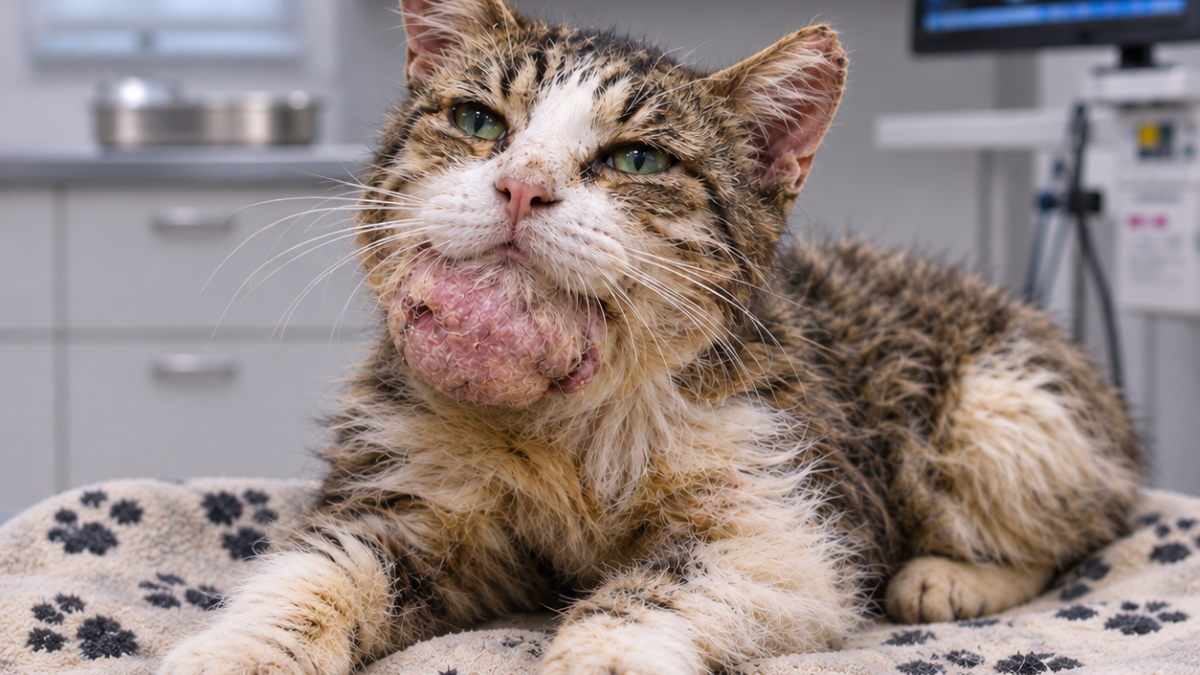
The first veterinary visit confirmed what Anastasia feared.
Sam was severely underweight.
His coat needed careful grooming.
His mouth was painful.
The mass involving his lower jaw was significant enough that no responsible veterinarian could discuss treatment without imaging.
The first priority was helping him stabilize.
Food he could manage.
Pain control.
Hydration.
Basic bloodwork.
Anastasia sat beside the examination table while Sam allowed the veterinarian to touch his face.
He flinched when the jaw was examined.
But he did not strike.
He did not bite.
Afterward, he immediately leaned toward Anastasia.
She placed her hand beside him.
Sam pushed his forehead beneath it.
The veterinarian paused.
“He trusts you.”
Anastasia shook her head.
“He barely knows me.”
“Maybe he’s decided.”
That night, Sam came home with her.
It was supposed to be temporary.
Almost everything in animal rescue begins with that sentence.
Temporary.
Until they knew what the tumor was.
Until they understood what treatment was possible.
Until Sam gained weight.
Until something better could be arranged.
Anastasia prepared a quiet room.
Blanket.
Water.
Litter box with a low edge.
Several different foods because nobody yet knew what texture would be easiest.
Sam explored slowly.
He smelled the walls.
The furniture.
The blanket.
Then found the bed Anastasia had prepared.
Ignored it.
Walked toward her.
Anastasia sat on the floor.
Sam climbed directly onto her lap.
She froze.
The tumor rested heavily against her arm.
She could feel how thin he was beneath the tangled fur.
Sam circled once.
Then stretched himself against her chest.
His face pressed beneath her chin.
A moment later, he began to purr.
Deep.
Steady.
Anastasia stared at the wall.
“You have terrible judgment.”
Sam purred louder.
“You don’t know anything about me.”
Purr.
“I could be awful.”
Sam closed his eyes.
That became their evening ritual.
Whatever happened during the day—appointments, calls, uncertainty—Sam climbed onto Anastasia at night.
Chest.
Shoulder.
Sometimes directly beneath her chin.
And purred.
He seemed most comfortable there.
Anastasia began timing her breathing around his.
Slow.
Warm.
Alive.
During those first nights, she kept looking at the growth.
It was impossible not to.
She imagined what it must feel like.
The weight.
The pressure.
The constant interference with eating.
Perhaps pain every time the jaw moved.
Yet Sam still tried to eat every morning.
That mattered to her.
He showed interest.
He smelled meals.
He approached eagerly.
He experimented with angles and textures.
Soft food worked better.
Small portions.
Sometimes food had to be positioned carefully.
Meals were messy.
Anastasia did not care.
She placed towels beneath the bowl.
Cleaned Sam’s face afterward.
Then offered more.
He slowly began gaining a little weight.
Not enough.
But something.
The diagnostic process moved forward.
X-rays.
Consultations.
Additional imaging.
Anastasia learned quickly that getting an answer and getting a solution were two very different things.
The tumor involved the lower jaw.
Its size made surgery complicated.
Sam was older.
Thin.
His overall condition increased the risk of anesthesia and recovery.
One veterinarian examined the imaging and shook his head.
“I would be very cautious.”
“What does cautious mean?”
“Comfort care.”
“No operation?”
“I’m not saying nobody could operate.”
“But you wouldn’t.”
He paused.
“No.”
Another consultation ended similarly.
The veterinarian explained that removing such a large lesion could require sacrificing part of the jaw.
Recovery might be difficult.
Eating afterward could be challenging.
There was no guarantee of what they would discover during surgery.
Anastasia listened.
She did not argue.
These were not people trying to abandon Sam.
They were doctors weighing suffering against benefit.
That distinction mattered.
Still, every appointment felt like another door closing.
One veterinarian told her gently:
“Sometimes the most loving thing is not to put an older animal through a major operation.”
Anastasia looked at Sam.
He sat on the examination table.
Thin body.
Huge growth.
Tired face.
Then he reached one paw toward the edge of her jacket.
Hooked a claw into the fabric.
Anastasia moved closer.
Sam leaned against her.
“What does comfort care look like?”
“Pain management.”
“Food he can manage.”
“Monitoring.”
“For how long?”
“No one can tell you.”
“Will the tumor keep growing?”
“Very likely.”
“Will eating get worse?”
“It may.”
Anastasia swallowed.
“What about bleeding?”
“That may become more frequent.”
She nodded.
The veterinarian’s voice softened.
“I know that’s hard to hear.”
Anastasia looked at Sam.
It was.
She took him home.
That evening he ate perhaps half of what she hoped he would.
Then he climbed onto her chest.
Purred.
Anastasia lay on the sofa staring at the ceiling.
“Everybody keeps telling me what might happen.”
Sam’s paw rested against her collarbone.
“I wish you could tell me what you want.”
Purr.
“Because I don’t want to make you suffer because I’m afraid to lose you.”
Sam shifted.
His massive jaw rested against her shoulder.
“And I don’t want to give up because a difficult surgery scares me.”
She closed her eyes.
“Those are not the same thing.”
There was no answer.
Only purring.
For several days, Anastasia thought about stopping the search.
She had already heard multiple opinions.
At some point, asking another veterinarian can become less like seeking information and more like shopping for the answer you want.
She knew that.
She was afraid of becoming that person.
So she focused on Sam.
Was he eating?
Yes, with difficulty.
Was he interested in affection?
Constantly.
Was he hiding all day?
No.
Did he explore?
Yes.
Did he respond to voices?
Yes.
Did he appear to have moments of comfort?
Absolutely.
Did he still experience significant difficulty because of the tumor?
Also yes.
The answers did not simplify anything.
Then Sam did something small.
Anastasia was preparing food in the kitchen.
Sam had been lying in the hallway.
He heard the bowl.
Stood.
Walked toward her.
Stopped at her feet.
Then meowed.
A strange, slightly distorted sound because of his jaw.
But unmistakably demanding.
Anastasia looked down.
“You are yelling at me?”
Sam meowed again.
She laughed.
The first real laugh she had managed in days.
“Everybody says you’re old and fragile.”
Meow.
“You appear to disagree.”
He followed her to the feeding area.
That evening Anastasia opened her laptop.
She searched again.
Veterinary surgeons.
Oral surgery.
Maxillofacial procedures.
Sofia.
Other cities.
She sent records.
Scans.
Photos.
Medical summaries.
Some responses were cautious.
Some never answered.
One clinic wanted additional imaging.
Eventually, the name Dr. Voichev entered the conversation.
A surgeon in Sofia.
Anastasia sent everything.
Then waited.
The call came while Sam was asleep beside her.
Dr. Voichev had reviewed the information.
He wanted to see the cat personally.
Anastasia did not let herself become excited.
A consultation was not a promise.
She reminded herself of that repeatedly.
Sam traveled to Sofia.
The carrier sat beside Anastasia.
He complained for part of the journey.
That oddly comforted her.
The cat who had once accepted everything silently had become capable of expressing displeasure.
At the clinic, additional evaluation followed.
More detailed scans.
Bloodwork.
Physical examination.
Waiting.
Always waiting.
Anastasia sat with Sam.
He pushed his head against her fingers.
She scratched the safe area above his cheek.
Finally, Dr. Voichev returned.
Anastasia watched his face before listening to his words.
Doctors often reveal the answer a second early.
He sat.
“The scans are encouraging in one important respect.”
Anastasia’s heart moved.
“What?”
“We do not see evidence that the tumor has spread elsewhere.”
She stared.
“Say that again.”
“At this time, the imaging does not show spread.”
“Does that mean surgery?”
“It means surgery can reasonably be discussed.”
Not promised.
Discussed.
Still, it was the first opening they had been given.
Dr. Voichev explained the challenge.
The tumor involved a substantial portion of Sam’s lower jaw.
Removing the diseased tissue would require removing part of that jaw as well.
The surgery would be complex.
Anesthesia carried risk.
Recovery would require careful pain management and feeding support.
Sam’s appearance would change.
His eating mechanics would change.
There could be complications.
Nobody could guarantee perfect function.
Anastasia listened to everything.
Then asked:
“What is the goal?”
“Comfort.”
That surprised her.
Not cure.
Not transformation.
Comfort.
Dr. Voichev continued.
“Reduce the source of pain.”
“Remove the diseased tissue.”
“Stop recurrent bleeding.”
“Give him a better chance to eat without fighting against that mass.”
Anastasia looked at Sam.
He was trying to rub his face against her arm.
“What happens if we don’t operate?”
The surgeon answered carefully.
The tumor would remain.
Symptoms could worsen.
Eating could become increasingly difficult.
The balance was not:
safe versus dangerous.
It was:
one set of risks versus another.
Anastasia asked the question she feared most.
“If he were your cat?”
Dr. Voichev paused.
Doctors hate that question.
She knew it.
Still, she waited.
“I think there is a reasonable surgical option.”
That was enough.
Not because Anastasia wanted somebody to guarantee success.
Because nobody did.
She wanted to know whether trying was medically defensible.
It was.
Preparation began.
Sam needed to be as stable as possible.
Nutrition mattered.
Blood values mattered.
His body needed strength for a major procedure.
Anastasia became obsessive about meals.
Different textures.
Different temperatures.
Small portions.
Frequent attempts.
Whatever Sam could manage.
He remained thin.
But stronger than when she found him.
The night before surgery, Sam climbed onto her chest.
Of course.
Anastasia had promised herself she would not cry.
She cried immediately.
Sam purred.
“I finally found someone willing to try.”
Purr.
“And now I’m terrified.”
Sam stretched one paw against her neck.
“What if I made the wrong choice?”
No answer.
“What if keeping you comfortable would have been kinder?”
Purr.
“What if surgery gives you something better?”
His eyes closed.
Anastasia touched his head.
“I’m sorry you don’t get to vote.”
That was the hardest responsibility in caring for an animal.
You decide for someone who cannot understand the options.
You decide whether pain today may lead to comfort tomorrow.
Whether treatment is hope or burden.
Whether stopping is mercy or surrender.
And sometimes nobody can tell you with certainty.
The morning of surgery came.
Sam was admitted.
Anastasia handed the carrier to the veterinary nurse.
Then changed her mind.
“Wait.”
She opened it.
Sam looked up.
She put her hand inside.
He leaned toward her.
Of course.
“You have one job.”
Sam blinked.
“Wake up.”
The nurse waited quietly.
Anastasia closed the carrier.
They took him through the doors.
Then there was nothing left to do.
Waiting is its own kind of helplessness.
Anastasia walked.
Sat.
Stood.
Checked her phone.
Put it down.
Picked it up.
Drank half a coffee.
Forgot where she put it.
Bought another.
She imagined every possibility she had been warned about.
Bleeding.
Anesthesia.
Complications.
Recovery problems.
She tried to stop imagining.
Failed.
Hours passed.
The phone finally rang.
Anastasia answered before the first full vibration ended.
“Hello?”
“Sam is out of surgery.”
Her hand tightened around the phone.
“And?”
“He is awake.”
Anastasia closed her eyes.
“Stable?”
“Yes.”
The word broke something open inside her.
She sat down.
“He made it?”
“He made it through the procedure.”
Anastasia covered her face.
For the first time since finding Sam, she allowed herself to believe there might be a life on the other side of the tumor.
Not the old life.
Not a perfect life.
Something different.
The surgeon had removed the diseased section of Sam’s lower jaw along with the mass.
His face looked different afterward.
There was no pretending otherwise.
Part of his jaw was gone.
Swelling remained.
Stitches.
The whole area needed time.
When Anastasia first saw him after surgery, she stopped at the kennel.
Sam looked exhausted.
Very small beneath the recovery blanket.
She whispered:
“Hi.”
His eyes opened.
Slowly.
He recognized the voice.
His head shifted toward her.
Anastasia started crying again.
“You did your job.”
Sam closed his eyes.
The first days after surgery required careful monitoring.
Pain control.
Hydration.
Nutrition.
Wound care.
Sam did not immediately spring back into life.
Recovery does not work that way.
He slept.
A lot.
His body needed it.
The absence of the giant tumor did not instantly erase everything it had done.
He needed to learn the new shape of his own mouth.
Eating required adjustment.
The first attempts were cautious.
Anastasia watched every movement as intensely as she had watched him eat on the street.
Only now the obstacle was different.
The enormous mass was gone.
His jaw anatomy had changed.
Food needed to be easy to manage.
Small portions.
Soft texture.
Patience.
Sam smelled the food.
Approached.
Tried.
Anastasia held her breath.
He managed a little.
Stopped.
Tried again.
A nurse smiled.
“That’s good.”
Anastasia almost laughed.
“It looks impossible.”
“Not to him.”
Sam continued.
Not much.
Enough.
The first meal was not graceful.
No one cared.
The next was better.
Then another.
His appetite increased.
That became one of the clearest differences.
Before surgery, hunger and eating seemed to fight each other.
Sam wanted food.
The tumor made getting it painful.
After surgery, there was recovery discomfort and adaptation, but gradually the enormous physical obstruction was no longer there.
Anastasia watched him eat one afternoon.
He finished.
Then looked at her.
She placed more food in the bowl.
Sam ate again.
Anastasia cried into a paper towel.
The nurse walked in.
“Everything okay?”
“He’s eating.”
The nurse smiled.
“He has been doing that.”
“I know.”
That was the strange thing about recovery.
A normal event could remain miraculous long after it became routine.
Sam rested more comfortably too.
Before surgery, he often shifted his head as though searching for a position where the heavy jaw did not bother him.
After the initial recovery period, Anastasia noticed him sleeping differently.
Deeply.
Head down.
Body loose.
One evening, back home again, Sam climbed onto her chest.
The ritual returned.
Anastasia lay on the sofa.
Sam settled.
His face felt different against her.
Lighter.
Changed.
His purr started.
Anastasia smiled.
“There you are.”
The cat kneaded her shirt.
Then tucked himself beneath her chin.
For months, the tumor had dominated every photograph and every conversation.
Now Anastasia began discovering how quickly something else replaced it.
Sam.
His personality.
He was affectionate to an almost unreasonable degree.
He followed her.
He waited outside rooms.
He wanted contact.
If Anastasia sat, Sam considered the lap available.
If she lay down, her chest belonged to him.
If she tried working on a laptop, Sam positioned himself directly between her face and the screen.
“You survived major surgery for this?”
Purr.
“You are blocking everything.”
Purr.
“You have become inconvenient.”
Sam closed his eyes.
His coat improved too.
With regular nutrition and grooming, the mats disappeared.
Soft fur replaced the neglected coat.
His body slowly gained weight.
The sharp line of his spine became less pronounced.
His sides filled out.
His face would always look different because of the surgery.
That became less important every week.
People meeting him for the first time sometimes stared.
They noticed the missing portion of jaw.
Then Sam approached them.
Rubbed against a hand.
Demanded attention.
Within minutes, the surgery became background information.
Anastasia loved that.
She did not want Sam to spend the rest of his life being introduced as:
“The cat with the tumor.”
He had been that cat.
Now he was also the cat who stole her pillow.
The cat who complained when dinner was late.
The cat who slept through television.
The cat who somehow knew when she opened cheese.
The cat who sat beside the window watching birds he had no realistic chance of catching.
The cat who hated one particular blue blanket for reasons nobody understood.
His age remained uncertain.
Seven?
Nine?
Twelve?
Maybe somewhere in between.
Anastasia eventually stopped caring about the number.
Sam did not know it.
He did not behave as if he were counting whatever time remained.
He had survived the streets.
Then the tumor.
Then surgery.
Now he seemed interested mainly in breakfast.
Follow-up appointments continued.
The surgical site was checked.
Healing monitored.
Any concerning changes evaluated.
Anastasia worried before every appointment.
Sam did not.
He disliked the carrier.
That was progress too.
The cat who once walked into one without protest now complained loudly.
Anastasia said:
“You used to be cooperative.”
Sam meowed.
“You’ve become spoiled.”
Another meow.
“Yes, I hear you.”
At the clinic, he charmed everyone anyway.
The surgeon examined him.
Healing looked encouraging.
Anastasia asked the question she had been afraid to ask earlier.
“Did we do the right thing?”
Dr. Voichev looked at Sam.
The cat was rubbing against the edge of the examination towel.
“We evaluate the cat in front of us.”
“That sounds like a doctor answer.”
“It is.”
Anastasia smiled.
He continued.
“He is eating.”
“Yes.”
“Maintaining himself.”
“Yes.”
“Comfortable at home?”
“Very.”
“Interested in his surroundings?”
“Constantly.”
“Then those things matter.”
Anastasia nodded.
That became enough.
Months after surgery, someone sent her an old photograph from the day Sam was found.
Anastasia had not looked at it in a long time.
The difference shocked her.
Thin.
Matted.
Jaw grotesquely distorted by the tumor.
Eyes tired.
Then she looked at Sam asleep on her sofa.
Fur clean.
Body fuller.
Face changed forever but relaxed.
Paws curled beneath him.
The tumor was gone.
She put the phone down.
Sam opened one eye.
“What?”
She whispered.
“You don’t even look like yourself.”
Then she realized that was wrong.
The cat in front of her looked more like himself than ever.
The tumor had been something happening to Sam.
It was never Sam.
That distinction became important.
People often saw the before photo and responded:
“Poor cat.”
Anastasia understood.
She had thought the same thing.
But Sam did not spend his days being tragic.
He spent them sleeping.
Eating.
Following her.
Purring.
Sometimes trying to investigate things that were none of his business.
A neighbor once came to repair a leaking pipe.
Sam sat directly beside the toolbox for forty minutes.
The plumber laughed.
“Supervisor?”
“Unfortunately.”
Sam eventually climbed into the empty tool bag.
“Very strict supervisor.”
Another day, Anastasia found him asleep across her clean laundry.
He had chosen the exact shirts she needed for work.
“Sam.”
No response.
“Move.”
Sam purred.
“You are lucky you had a tumor.”
She immediately gasped.
“That sounded terrible.”
Sam slept.
“I mean I feel guilty moving you.”
Nothing.
“You’re manipulating me.”
Purr.
Life became wonderfully unremarkable.
That was the part rescue stories often skip.
People tell the dramatic moment.
Street.
Tumor.
Doctor.
Surgery.
Survival.
Then stop.
But what came afterward mattered most.
Morning light through the window.
Clean water.
A bowl that would be refilled.
The sound of Anastasia returning home.
A warm chest to sleep on.
Not wondering where the next meal came from.
Not eating through pain beside a street.
Not carrying the weight of that mass every hour.
Sam did not need his life to remain extraordinary.
He needed it to become ordinary.
One winter afternoon, snow covered parts of Sofia and the surrounding roads.
Anastasia sat at home reading.
Sam was asleep against her.
His purr vibrated through her sweater.
She thought about the first veterinarians.
The ones who advised comfort care.
For a long time, a tiny part of her had felt angry at them.
Why had they not seen what Dr. Voichev saw?
Then, with distance, she understood something.
They had not been villains.
They were looking at a difficult patient.
A thin older cat.
Large jaw tumor.
Major surgery.
Real risks.
Their caution came from concern.
Sam’s story did not prove that every difficult case should be operated on until someone says yes.
It proved something subtler.
Sometimes complicated cases deserve careful questions.
Sometimes another specialist sees an option that others reasonably did not recommend.
Sometimes comfort care is the right answer.
Sometimes surgery is.
The only ethical goal was never to prove someone wrong.
It was to help Sam.
Anastasia became grateful that each veterinarian had been honest.
Even the answers that hurt.
They forced her to understand what she was asking Sam to endure.
That made the eventual choice more serious.
Not less.
Years passed.
Sam aged.
At least everyone assumed he did.
His exact birthday remained a mystery.
Anastasia chose the day she found him as his birthday.
The first year, she bought a small cat-safe treat and took approximately fifty photographs.
Sam cared only about the food.
“Happy birthday.”
Sam ate.
“You could be eight.”
Eat.
“Or thirteen.”
Eat.
“I have no idea.”
Sam finished.
“Very mysterious.”
He climbed onto her.
Purred.
Birthdays became annual jokes.
Each year she added one to an age nobody knew was correct.
“Happy possibly-fourteen.”
“Happy theoretically-fifteen.”
“Happy statistically-questionable-sixteen.”
Sam remained unimpressed.
As he grew older, routine veterinary monitoring became more important.
His jaw surgery remained part of his medical history.
So did the tumor.
But his life continued to expand beyond both.
He became slower.
Slept more.
That was expected.
One morning Anastasia noticed him hesitating before jumping onto the couch.
She placed a small step there.
Sam ignored it.
Attempted the jump.
Missed slightly.
Looked offended.
Anastasia tried not to laugh.
“The step is for you.”
Sam turned away.
The next day he used it when he thought she was not watching.
“Caught you.”
Sam froze.
“You’re old.”
He walked away.
“Still handsome.”
Tail flick.
Over time, his fur developed more gray.
His eyes remained soft.
His appetite fluctuated as older cats’ appetites sometimes do.
Whenever Sam skipped food, Anastasia’s old fear returned immediately.
The image of him struggling with the tumor never fully left her.
She would crouch.
“Jaw?”
Sam stared.
“Teeth?”
Nothing.
“Stomach?”
Meow.
“Or are you simply being difficult?”
Sometimes the answer was apparently the last one.
He would reject one food.
Then eat another enthusiastically.
Anastasia accused him of financial sabotage.
The most meaningful thing never changed.
Every evening, if she lay down, Sam climbed onto her chest.
Even when he needed a step to reach the sofa.
Even when his movements became slower.
Chest.
Purr.
Sleep.
That was where their story had always made sense.
One evening a friend asked:
“Why do you let him sleep there? Isn’t he heavy?”
Anastasia looked down.
Sam was considerably less thin now.
“Yes.”
“So?”
“He used to weigh almost nothing.”
That ended the complaint.
There were difficult days too.
No rescued animal gets a guarantee because they survived one crisis.
Sam developed typical age-related problems.
More veterinary appointments.
Medication.
Blood tests.
Adjustments.
Anastasia’s goal shifted gradually.
Early on:
Save him.
After surgery:
Help him recover.
Years later:
Keep him comfortable.
The phrase that had once sounded like surrender became something else.
Comfort care was not failure.
Timing changed its meaning.
When Sam still had curiosity, appetite, affection, and a treatable cause of severe pain, surgery had offered him a chance.
When age eventually brought problems medicine could manage but not erase, comfort became exactly what love required.
That realization helped Anastasia forgive the fear she had felt during those first consultations.
Nobody can defeat mortality by choosing the right veterinarian.
They can only try to give an animal the best life available in the time that exists.
Sam had already received more time than Anastasia once dared imagine.
One afternoon, years after the operation, she found him sitting in a patch of sunlight.
He was thinner again.
Not like the street.
Just old.
His altered jaw cast an unusual shadow.
Anastasia took a photograph.
Then stopped.
She compared it mentally to the first picture.
The old photo looked more dramatic.
This one looked peaceful.
She preferred this one.
Sam noticed her.
Walked over.
Slowly.
Placed his head beneath her palm.
The same motion.
All those years later.
Anastasia almost cried.
“You did that the first day.”
Sam leaned harder.
“You had that horrible thing on your face.”
Purr.
“You were filthy.”
Purr.
“Very thin.”
Purr.
“And apparently you decided I was yours immediately.”
He closed his eyes.
She sat on the floor beside him.
There was no need to know whether Sam remembered the street.
Cats do not narrate their past for us.
Humans do that.
Maybe Sam remembered hunger.
Maybe pain.
Maybe nothing specific.
What mattered was that he knew this hand.
This room.
This voice.
This home.
The woman who once searched across cities for someone willing to reconsider his case no longer had to search anywhere.
The answer was sleeping beside her.
Sam’s life did not become valuable because surgery succeeded.
That would have been the wrong lesson.
His life was valuable when he was still lying thin and matted on the street.
It was valuable when veterinarians recommended palliative care.
It was valuable on the operating table.
It was valuable after.
Medicine did not give Sam worth.
It gave him a chance to experience more of a life that already had worth.
That distinction mattered to Anastasia more with every year.
Eventually, Sam reached the stage every animal reaches if they are fortunate enough to grow old.
His good days became fewer.
He ate more slowly.
Slept longer.
Needed more help.
Anastasia monitored him with the same attention she had given him after surgery.
But now she knew something she had not understood when they met.
Fighting for an animal does not always mean continuing treatment.
Sometimes fighting means protecting comfort.
Sometimes it means knowing when to stop asking the body for more.
When that day finally came, Anastasia did not feel ready.
Nobody does.
Sam rested on her chest.
Exactly where he had rested through every uncertain evening.
His body was lighter again.
Old.
Tired.
His altered jaw rested against her shoulder.
Anastasia ran her fingers over his head.
“You know how many doctors we bothered because of you?”
A faint purr.
“Several cities.”
Breath.
“Scans.”
Breath.
“Calls.”
Purr.
“You were very expensive.”
His paw moved weakly against her sweater.
Anastasia laughed through tears.
“Worth it.”
She did not tell him to fight.
That word had followed him enough.
She did not call him a warrior.
He did not need to perform bravery.
She simply held him.
“You can rest.”
Sam closed his eyes.
The cat who had once endured every painful bite on the street no longer had to endure anything.
When he died, he did so warm.
Clean.
Loved.
Against the person he had chosen the first time she reached toward him.
For months afterward, Anastasia sometimes woke expecting weight on her chest.
Nothing.
She continued sleeping slightly angled because that was how she had made room for Sam.
Habits survive bodies.
His bowl stayed in the kitchen longer than necessary.
The step beside the sofa remained.
One afternoon Anastasia finally moved it.
Then sat down and cried.
Later, she printed two photographs.
The first:
Sam shortly after rescue.
Thin.
Matted.
Massive jaw tumor impossible to ignore.
The second:
Sam years later.
Asleep.
Face changed by surgery.
Fur clean.
Body relaxed.
She placed them side by side.
For a long time, she thought the transformation was the point.
Then she realized something.
The most important thing was invisible in both photographs.
The first photograph could not show the way Sam leaned into her hand.
The second could not show years of him climbing onto her chest.
Those were the moments that explained him.
Not the tumor.
Not surgery.
Trust.
Sam had every reason to keep his distance from people.
He had survived streets nobody could fully reconstruct.
Hunger.
Weather.
Pain.
A tumor so large that something as simple as eating became work.
Yet when Anastasia reached out, he moved closer.
That choice did not magically save him.
It started a chain.
A hand.
A carrier.
A clinic.
Another clinic.
Another opinion.
Scans.
Sofia.
A surgeon.
An operation.
Recovery.
Food.
Home.
Years.
Sometimes people later asked Anastasia:
“What if you had accepted the first answer?”
She never liked the question.
Because the lesson was not that the first veterinarians were wrong and persistence always wins.
Sometimes the first answer is the correct one.
Sometimes there truly is no safe operation.
Sometimes love means accepting that.
Sam’s case happened to contain another possibility.
The tumor had not spread.
A skilled surgeon believed removal offered a reasonable chance to improve his comfort.
Anastasia found that option.
Sam survived it.
That was their specific story.
Hope does not mean refusing reality.
It means looking at reality carefully enough to see whether something is still possible.
For Sam, something was.
Not immortality.
Not a perfect jaw.
Not a body returned to what it had been before.
Something simpler.
Meals that did not require fighting around a giant mass.
Nights without the same pressure against his face.
A clean coat.
Warm rooms.
Windows.
Soft beds he mostly ignored because Anastasia’s chest was better.
The right to become annoying.
The privilege of getting old.
Those things were enough.
Long after Sam was gone, Anastasia still remembered the first touch.
A thin stray.
A deformed jaw.
Tired eyes.
Her hand extended.
She expected him to recoil.
Instead, Sam leaned forward.
He had no idea that movement would lead across Bulgaria to consultations, imaging, surgery, and a different life.
Anastasia had no idea either.
For Sam, it probably meant only one thing.
The hand was gentle.
So he moved toward it.
Sometimes an entire life begins again with nothing more complicated than that.








