A Marine Veteran Found a Starving German Shepherd Behind a Gas Station—Then Discovered the Dog Was an Elite Military K9 Declared Dead 3 Years Ago. But When an X-Ray Revealed a Secret Device Hidden Inside His Stomach, Armed Men Came Hunting Them… and What Was Stored on That Device Exposed a Deadly Military Betrayal.
PART3:
Oil-stained concrete.
Cardboard boxes collapsed by sun.
Then amber eyes opened in the darkness.
Garrett stopped.
German Shepherd.
Large male.
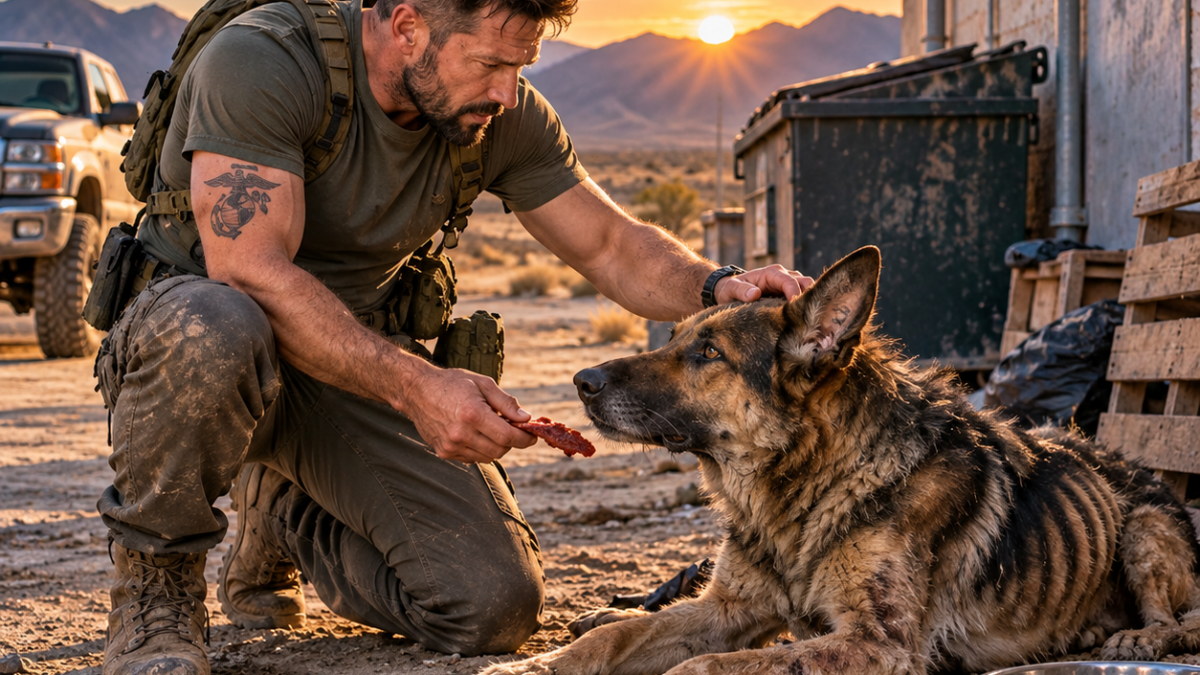
Black-and-tan coat almost gray beneath dirt.
Emaciated badly enough that ribs showed individually.
Hips sharp.
One ear torn near the edge.
Paws red and raw.
Blood had dried between two pads.
The dog did not bark.
Did not crawl away.
Did not lunge.
He watched Garrett.
That was the first thing that felt wrong.
A starving stray should have looked uncertain.
Desperate.
Afraid.
This animal looked exhausted.
But not uncertain.
Its body was down.
Chest lifted slightly off the concrete.
Rear legs tucked.
Front paws placed forward.
Head positioned where both exits of the alley remained within peripheral vision.
Garrett stared.
“Who taught you that?”
One ear moved.
Garrett lowered himself slowly.
Not directly facing.
He turned one shoulder.
Avoided hard eye contact.
“Easy.”
Nothing.
“You’ve had a bad week.”
The dog watched his hands.
Garrett reached into the convenience-store bag.
Beef jerky.
Not ideal.
Better than nothing.
He tore a small piece.
Held it out.
The dog did not move.
Garrett placed it on the concrete.
Backed his hand away.
Only then did the shepherd lean forward.
Sniff once.
Eat.
No frantic snapping.
No gulping followed by lunging for more.
Disciplined.
Garrett’s skin prickled.
He placed another piece.
Same reaction.
Wait.
Sniff.
Eat.
“Okay.”
Garrett whispered.
“You’re not somebody’s backyard dog.”
He moved closer.
The shepherd’s eyes tracked.
No growl.
Garrett noticed the paws again.
This animal had traveled.
Miles.
Maybe dozens.
Raw pads did not come from one afternoon on hot pavement.
He offered water in the lid of his coffee cup.
The dog drank slowly.
Then lifted his head.
His lips parted slightly.
Garrett saw metal.
He leaned closer.
Four canine teeth carried smooth silver caps.
Not decorative.
Not the kind of novelty work somebody bought for a pet.
Titanium crowns.
Garrett’s stomach tightened.
He had seen that before.
Not often.
Military working dogs with damaged canines sometimes received reinforced crowns after injuries.
Biting training sleeves.
Hard surfaces.
Doors.
Protective equipment.
The public myths exaggerated what titanium teeth meant.
Garrett knew that too.
Still, four crowned canines on a half-dead German Shepherd behind a convenience store in southern New Mexico were not normal.
“Jesus.”
The dog’s ears shifted.
Garrett extended his hand again.
This time the shepherd allowed touch.
Forehead first.
Slow.
Coarse fur.
Heat.
Dehydration.
Garrett’s fingers moved behind the left ear.
Scar.
Then something else.
Ink.
He gently folded the ear.
Inside:
XR9B77.
Military-style identification.
Faded.
Real.
Garrett sat back.
For several seconds, neither moved.
Highway noise continued.
Someone pumped gas thirty yards away.
A child laughed near the soda machine.
Ordinary evening.
Garrett looked at the dog.
“Who do you belong to, soldier?”
The shepherd blinked.
That was all.
Garrett had spent five years avoiding responsibility for anything that breathed.
He told himself he did not need a dog.
Especially one carrying military marks.
Especially one that might belong to a unit.
Especially one that looked like it had escaped something.
Garrett stood.
Walked toward the truck.
Opened the passenger door.
Then hated himself because he already knew what he was going to do.
He turned.
Patted the seat.
“Come on.”
The dog stared.
“Offer expires in five seconds.”
The shepherd stood.
Or tried.
Rear legs trembled.
Front paws slipped once.
Garrett instinctively moved forward.
The dog stiffened.
Garrett stopped.
“Your choice.”
The shepherd gathered himself.
Walked from the pallets.
Every step painful.
Reached the truck.
Looked at the seat.
Then Garrett.
One jump.
Almost failed.
Garrett caught the handle of an old nylon harness hidden beneath the matted fur.
The dog landed inside.
Sat.
Facing forward.
Garrett closed the door.
“Great.”
He walked around the hood.
“I went in for coffee.”
The dog watched him through the windshield.
Garrett started the engine.
“Now I’ve kidnapped classified livestock.”
The shepherd’s right ear lifted.
“Don’t get comfortable.”
Thirty miles later, the dog was asleep with his head against the passenger door.
Garrett drove slower than usual.
He noticed that too.
At the cabin, he used the old galvanized wash basin in the utility room.
Warm water.
No harsh soap.
Tweezers.
Saline.
Antiseptic.
The shepherd stood without complaint while Garrett cleaned his paws.
That bothered him more than resistance would have.
Animals learned stillness like that in two ways.
Training.
Or pain.
This one had both.
“Easy.”
Garrett removed burrs.
Mud.
A piece of cactus spine.
The dog’s breathing stayed steady.
Then the water cleared enough for Garrett to see the scars.
Old shrapnel marks along the left flank.
Burned tissue near the shoulder.
Puncture scar at the neck.
And a surgical line down the abdomen.
Garrett stopped.
It was ugly.
Not veterinary-clinic work.
Jagged.
Uneven.
Stitches had once crossed at inconsistent intervals.
Field surgery.
Emergency closure.
Possibly no anesthesia.
Possibly done while someone nearby was dying.
Garrett touched the edge.
The dog’s abdominal muscles tightened.
“Sorry.”
He backed off.
Afterward he fed a small portion of chicken and rice.
Not too much.
A starving dog could become dangerously sick from eating aggressively after prolonged deprivation.
Garrett remembered enough from working-dog handlers to know that.
The shepherd ate.
Then chose Garrett’s right boot as a pillow.
Within ten minutes he was asleep.
Garrett sat at the kitchen table.
Stared down.
Amber eyes closed.
One paw touching his boot.
Something about that trust made him uncomfortable.
He reached for the satellite phone.
There were numbers Garrett had deleted from ordinary phones but never forgotten.
Frank Reynolds answered after four rings.
“What?”
Same voice.
Older.
More tired.
Garrett almost hung up.
“Frank.”
Silence.
Then:
“Garrett?”
“Yeah.”
“Holy hell.”
Another pause.
“You alive?”
“Apparently.”
“You know normal people call once every couple years so friends don’t assume coyotes ate them.”
“I need something.”
Frank laughed bitterly.
“Of course you do.”
Frank Reynolds had been a Marine intelligence specialist attached to Garrett’s task force years earlier.
Lost his left leg below the knee in Kandahar.
Stayed in government service afterward.
Now worked inside Defense logistics and archival registry.
High clearance.
Low tolerance for Garrett’s personality.
“What?”
Garrett looked at the dog.
“I need a military K9 identifier checked.”
Frank became quiet.
“Why?”
“Found a shepherd.”
“Take it to animal control.”
“Titanium crowns.”
Silence.
“Ear tattoo.”
Longer silence.
“Garrett.”
“Just run it.”
“Central database logs everything.”
“Legacy archive.”
“You’re asking me to bypass—”
“I know what I’m asking.”
Frank exhaled.
“Number?”
“X-ray Romeo Nine Bravo Seven Seven.”
Keyboard.
Garrett waited.
The shepherd slept.
Refrigerator hummed.
Outside, desert wind moved over the porch.
Frank stopped typing.
Nothing.
“Frank?”
No answer.
“Frank.”
When he finally spoke, his voice had changed.
“Where are you?”
“Cabin.”
“Alone?”
Garrett looked down.
“Not anymore.”
“Listen to me.”
“What?”
“Do not say that serial number again over an open line.”
Garrett straightened.
“Why?”
Frank breathed.
“That identifier belonged to a military working dog named Odin.”
Garrett looked at the shepherd.
One ear moved at the name.
Odin.
Frank continued.
“Crossbred German Shepherd-Malinois line.”
“Attached to a Ranger special-mission element.”
“Handler Staff Sergeant Wyatt Miller.”
“Deployed Afghanistan.”
“When?”
“Three years ago.”
Garrett’s mouth went dry.
“What happened?”
Frank hesitated.
Then:
“They died.”
Garrett stared at Odin.
“The whole element was reported killed during an interdiction mission.”
“Wyatt too?”
“Yes.”
“Odin?”
“Yes.”
“No.”
“Garrett.”
“The dog is breathing on my floor.”
Frank whispered:
“That dog has a death certificate.”
Garrett said nothing.
Frank continued.
“Official report says the position was destroyed after the team was overrun.”
“Remains incomplete.”
“Equipment compromised.”
“K9 listed among fatalities.”
Garrett looked at the abdominal scar.
“What kind of destruction?”
“Classified.”
“Frank.”
“I’m looking at sealed wording.”
“Then read it.”
Frank swore.
“Remote strike authorized after loss of contact.”
Garrett’s jaw tightened.
“Friendly strike?”
“Sanitization strike.”
“What exactly were they sanitizing?”
“I don’t know.”
“Bullshit.”
“I genuinely don’t know.”
Keyboard again.
Then Frank stopped.
“Oh no.”
“What?”
“Archive has two versions.”
Garrett leaned forward.
“Explain.”
“Public classified record says unit lost during hostile ambush.”
“Internal logistics record shows their extraction beacon stayed active seventeen hours afterward.”
Garrett’s blood chilled.
“Meaning?”
“At least somebody was alive.”
Odin opened one eye.
Frank whispered:
“Garrett, shut your phone down.”
“Why?”
“I just triggered something.”
“What?”
“Legacy lookup bounced into a dormant watchlist.”
Garrett stood.
“Who owns it?”
“I can’t see.”
“Frank.”
“Private security routing.”
“That makes no sense.”
“It means somebody outside normal channels has been waiting for this serial number to reappear.”
Garrett looked toward the dark window.
Frank’s breathing accelerated.
“I’m wiping the query.”
“Don’t call me.”
“What aren’t you telling me?”
“I’m telling you everything I know.”
“Frank—”
“If Odin is alive, somebody lied about Wyatt’s team.”
“And whoever built this watchlist expected the dog might surface.”
Silence.
“That means they never found what they were looking for.”
The call ended.
Garrett lowered the phone.
Odin stood.
Not suddenly.
Quietly.
Head raised.
Ears forward.
Looking toward the front of the cabin.
Low vibration came from his chest.
Not a growl.
Alert.
Garrett shut off the kitchen light.
Then living-room light.
Darkness.
He moved to the side of the window.
Lifted one blind slat.
Black SUV.
No plates.
Parked at the end of the dirt drive.
Lights off.
Engine possibly running.
Garrett watched.
Odin moved beside him.
Shoulder against Garrett’s thigh.
Not scared.
Ready.
Garrett’s pulse slowed.
Combat physiology.
Old machinery starting.
He hated how familiar it felt.
“Okay.”
He whispered.
“They’re not here for cigarettes.”
Garrett did not intend to defend the cabin.
That was the first difference between the man he had been and the man he had become.
Five years earlier he might have turned the house into a fortress.
Now he thought first about the dog.
Odin could barely stand.
Unknown pursuers.
Unknown authority.
Unknown numbers.
Staying was foolish.
The previous owner of Garrett’s cabin had been an apocalyptic survivalist who had built an absurd escape tunnel beneath the pantry.
Garrett had mocked it when purchasing the property.
Now he moved the rug.
Opened the trapdoor.
Grabbed water.
Medical supplies.
Dog food.
Clothing.
Phone batteries.
Then clipped a leash to Odin’s harness.
“We’re leaving.”
Odin stepped into darkness without hesitation.
The tunnel smelled of earth and rust.
Garrett moved first.
Odin behind.
Quarter mile through a narrow drainage corridor.
When they emerged into a dry ravine, lights appeared at the cabin.
Three beams.
Maybe four.
Men entering.
Professional spacing.
No shouting.
No police lights.
Garrett watched from below the ridge.
“Definitely not animal control.”
Odin looked toward the house.
Then Garrett.
“Come on.”
They moved.
Two hours on foot.
The dog struggled.
Garrett finally carried him over the worst terrain.
Seventy pounds of underfed working dog.
Odin resisted initially.
Then surrendered.
His head rested against Garrett’s shoulder.
Garrett remembered carrying wounded Marines.
Memory hit so hard he nearly stumbled.
“Not tonight.”
He whispered.
“Stay here.”
At a forgotten county road he reached an old Jeep stored under canvas.
Emergency vehicle.
Paranoia inherited from deployments.
For once useful.
They drove north before dawn.
Garrett knew one veterinarian he trusted enough to ask the wrong question.
Dr. Harrison Cole.
Former Navy corpsman.
Later veterinarian through a military transition program.
Brilliant.
Difficult.
Had lost his conventional clinic after treating undocumented gunshot injuries without proper reporting during a border incident.
The stories about why varied depending on who told them.
Garrett knew only that Harrison hated bureaucracy more than he feared consequences.
His clinic outside Albuquerque looked abandoned.
Half the sign dead.
Faded paint.
Security camera hidden inside a broken porch light.
Garrett knocked on the rear door.
Harrison opened wearing sweatpants and an undershirt.
“You look terrible.”
“Dog looks worse.”
Harrison saw Odin.
Then stopped joking.
“Inside.”
Under bright examination lights, Harrison worked.
Temperature.
Heart.
Blood.
Hydration.
Paws.
Scars.
Then the abdominal incision.
“Whoever did this was in a hurry.”
“Can you image it?”
“Why?”
“I think something’s inside.”
Harrison looked at Garrett.
“What kind of something?”
“Something people are willing to cross state lines for.”
Harrison sighed.
“I hate knowing you.”
Portable X-ray.
Then ultrasound.
Harrison stared at the monitor.
Expression gone.
“Garrett.”
“What?”
“Come here.”
Near the abdominal wall sat a small rectangular foreign object enclosed in dense material.
Not a microchip.
Far too large.
Surgically placed.
Harrison measured.
“Titanium casing.”
“What’s inside?”
“Can’t tell.”
“Could it be explosive?”
“Unlikely.”
“Tracking device?”
“Wrong shape.”
“Data storage?”
Harrison looked at him.
“That would be my guess.”
Garrett stared at Odin.
The dog lay sedated lightly.
Amber eyes half open.
“Wyatt.”
“What?”
“His handler.”
Garrett explained.
Dead team.
False death certificate.
Watchlist.
SUV.
Harrison swore.
Then looked back at the scan.
“His handler put this inside him.”
“Maybe.”
“Why?”
Garrett answered:
“Because nobody searches the dog who’s supposed to die beside you.”
Harrison did not like that sentence.
Neither did Garrett.
Removing the device would be difficult.
Scar tissue had grown around it.
Odin was malnourished.
Weak.
Surgery risk high.
Garrett sat beside the table.
Odin opened one eye.
Garrett touched his head.
“We can wait.”
Harrison shook his head.
“Not if whoever followed you knows what he’s carrying.”
Garrett looked toward the locked door.
Harrison added:
“But I’m not cutting until he’s stable enough.”
“How long?”
“Several hours at least.”
Garrett nodded.
“No heroics.”
Harrison almost smiled.
“Look at you learning.”
They began fluids.
Antibiotics.
Pain control.
Careful nutrition.
Garrett remained beside Odin.
At noon, Harrison asked:
“You going to tell me why a former Force Recon sniper lives alone like a condemned lighthouse keeper?”
“No.”
“Worth trying.”
Hours passed.
Odin slept.
Garrett watched his breathing.
At some point Harrison noticed how Garrett’s hand rested on the dog’s shoulder.
“You had a K9 before?”
“No.”
“You look like you did.”
“Worked around them.”
“Lost somebody?”
Garrett looked at him.
Harrison raised both hands.
“Never mind.”
But the question stayed.
Garrett had lost several people.
One mattered differently.
Lieutenant Daniel Cross.
Garrett’s spotter and closest friend during his final deployment.
Not killed.
Worse in Garrett’s mind.
Daniel survived.
Garrett had misread a movement during a chaotic extraction and called a threat direction that diverted their team for less than a minute.
In that minute, an explosive struck the vehicle Daniel occupied.
Daniel lived.
Spinal injury.
Career over.
Garrett had visited once.
Daniel said:
“It wasn’t your fault.”
Garrett never went back.
Three years later Daniel sent a Christmas card.
Garrett returned it unopened.
Same pattern.
Disappear before forgiveness could become complicated.
Odin shifted.
Garrett closed his eyes.
“Not again.”
Harrison heard.
“Not what?”
“Nothing.”
Near evening, Odin was stronger.
Harrison prepared surgery.
No battlefield theatrics.
No gunfire.
Just sterile light.
Monitoring.
Precision.
Garrett waited outside the room because Harrison ordered him to.
That was harder than combat.
Forty-seven minutes.
Then sixty-two.
Then Harrison appeared.
Mask lowered.
Holding a sealed titanium capsule in a surgical container.
“Odin?”
“Stable.”
Garrett exhaled.
Harrison continued.
“Still fragile.”
“He’s staying overnight.”
“No argument.”
Garrett stared at the capsule.
“That thing nearly killed him.”
“Scar tissue almost did.”
“Whoever implanted it knew enough to keep him alive.”
“Barely.”
Garrett looked through the window.
Odin unconscious.
Bandaged.
Alive.
For the first time Garrett felt anger toward Wyatt Miller.
Not judgment.
Anger.
“You used him.”
He whispered.
Then another thought:
Or Wyatt had no other option.
Garrett hated problems without clean answers.
At 11:14 that night, headlights appeared outside the clinic.
Not black SUV.
Two county sheriff vehicles.
Garrett tensed.
Harrison checked the camera.
“Relax.”
“Why police?”
“Because I called them.”
Garrett turned.
“You what?”
“I’m not doing your secret-war fantasy.”
Harrison pointed toward Odin.
“That dog needs protection.”
“And if the people after him have government credentials?”
“Then we build witnesses.”
That stopped Garrett.
Harrison continued.
“Your instinct is disappear.”
“Yes.”
“How’s that been working?”
Garrett glared.
Harrison smiled.
“Thought so.”
The deputies entered cautiously.
Harrison gave them only what they needed.
Unknown men had trespassed at Garrett’s cabin.
Possible pursuit.
Threats.
Sensitive property.
One deputy called state investigators.
Then federal contacts.
Garrett hated every second.
But did not run.
That became important later.
Frank called from an unrecognized number shortly after midnight.
“You’re still alive.”
“Yes.”
“I found Wyatt’s handler file.”
“Talk.”
“Before the mission, Wyatt submitted two protected disclosures.”
“About what?”
“Contractor theft.”
Garrett leaned forward.
“Keep going.”
“A logistics consortium was diverting seized assets during Afghan drawdown operations.”
“Fuel contracts.”
“Equipment.”
“Cash transfers.”
“Maybe more.”
“Who?”
Frank named a fictionalized contractor consortium Garrett recognized from deployment support networks.
Huge.
Politically protected.
Layers of subsidiaries.
“They buried the complaint?”
“Investigation assigned internally.”
“To?”
Frank laughed without humor.
“One of the same subcontractor oversight groups he accused.”
Garrett’s jaw hardened.
“What happened next?”
“Wyatt’s unit received the mission.”
“And died.”
“Yes.”
“Coincidence?”
“Not looking like one.”
“What about the drive?”
“Could hold his evidence.”
Garrett looked toward the surgical container.
Frank continued.
“One more thing.”
“What?”
“The death records were altered two days after the team was lost.”
“By who?”
“Authorization signature belongs to a colonel who retired six months later.”
“Alive?”
“Yes.”
“Location?”
“Virginia.”
Garrett thought.
Then stopped himself.
Old Garrett would have planned a private confrontation.
New Garrett asked:
“Inspector General?”
Frank paused.
“What?”
“Can we hand it to them?”
“You trust them?”
“No.”
“Then why?”
“Because if Wyatt died trying to expose something, I’m not turning his evidence into another secret carried by three paranoid veterans.”
Silence.
Frank said:
“That sounded almost healthy.”
“Shut up.”
Garrett and Harrison opened the capsule the next morning inside a secure digital forensics room provided by state investigators.
Not alone.
That mattered.
Present:
A federal inspector general investigator.
An FBI public corruption agent.
A military criminal investigator.
Digital forensic technician.
Garrett.
Frank joined remotely through counsel.
No one person controlled the evidence.
Chain of custody documented.
Harrison looked at Garrett.
“Witnesses.”
Garrett nodded.
The drive was encrypted.
But it contained a small unencrypted text file.
One line.
IF ODIN ARRIVED ALIVE, LISTEN TO MILLER_01 FIRST.
The room went still.
Technician isolated the file.
Audio.
Wyatt Miller’s voice.
Weak.
Wind in background.
Gunfire far away.
Dog panting.
Garrett had never met him.
Within ten seconds he understood the man.
“Name is Staff Sergeant Wyatt Miller.”
Breath.
“Time approximately 0210 local.”
Another breath.
“If you’re hearing this, the team is gone or I am.”
Garrett closed his eyes.
Wyatt continued.
“We found financial records tied to contract convoys moving seized assets through military logistics lanes.”
“We reported it.”
“After that, our route changed.”
“My men think the ambush was arranged.”
Pause.
“I don’t know who can be trusted.”
Odin whined from his recovery kennel in the adjacent room as though hearing something familiar.
Garrett looked.
Wyatt’s voice broke slightly.
“Odin is injured.”
“I put the storage capsule inside him.”
“I know what that means.”
“I know what I’m asking of him.”
Long pause.
“If anybody finds him…”
Wyatt swallowed.
“He did not fail.”
Garrett felt something inside his chest move.
“He got farther than we did.”
Wyatt coughed.
“Tell my mother I tried.”
“Tell the families we didn’t walk into that valley blind.”
“We were sent.”
Then:
“And whoever finds Odin…”
The recording grew quieter.
“Don’t make him carry this after he gets home.”
Audio ended.
Nobody spoke for nearly a minute.
Garrett looked through the glass.
Odin lay on a blanket.
Bandage around his abdomen.
Eyes open.
He had carried it anyway.
Three years.
Somehow survived Afghanistan.
Transport.
Unknown handlers.
Escape.
Desert.
Miles of road.
Until a convenience-store alley.
The encrypted portion took professionals hours to unlock through keys stored elsewhere in the capsule and embedded authentication data tied to military registries.
Not magic.
Not Garrett guessing a password.
Actual forensic work.
When it opened, the evidence was devastating.
Procurement ledgers.
Shipping manifests.
Internal emails.
Drone imagery.
Transfer authorizations.
Bank records.
Recorded meetings.
Names.
Dates.
A trail showing senior executives inside a private defense consortium and several corrupted logistics officials had redirected assets worth hundreds of millions during chaotic withdrawal operations.
Not just money.
Gold reserves temporarily secured during partner-government collapse.
Bearer instruments.
Weapons components.
Medical supplies.
Anything difficult to track in collapsing systems.
Wyatt’s Ranger element had discovered one of the transfer sites.
They reported it.
Then their mission orders changed.
Their extraction support was reduced.
The route given to them passed directly through an area where hostile forces were known to operate.
Somebody had created conditions in which the unit would likely disappear.
The corruption did not need to look like murder.
War would do the work.
Garrett stared at the screen.
“Daniel.”
Harrison looked at him.
“What?”
Garrett had said the wrong name.
His own ghost.
He realized why.
Different men.
Different incident.
Same habit.
One terrible outcome becoming the whole identity of the survivor.
Garrett stood.
Walked to Odin.
The dog raised his head weakly.
Garrett sat on the floor.
“You got home.”
Odin pushed his nose into Garrett’s palm.
“You hear me?”
Tail moved once.
“You got home.”
The investigation expanded quietly.
Garrett expected retaliation.
Instead visibility protected them.
Once the evidence existed simultaneously inside inspector-general offices, federal evidence systems, congressional oversight channels and protected copies held by attorneys, killing one man or one dog would accomplish nothing.
Harrison had been right.
Witnesses.
Garrett had spent years believing survival meant becoming harder to find.
Sometimes survival meant becoming impossible to erase.
Federal warrants followed.
Executives questioned.
Accounts frozen.
Storage sites searched.
Several arrests.
Some suspects fought charges.
Some cooperated.
One logistics official took a plea.
Another denied everything until confronted with his own recorded communications.
The retired colonel who signed Wyatt’s altered death paperwork eventually admitted he had been told the unit’s records were being “administratively sanitized” for operational security.
He claimed he did not know the larger conspiracy.
Prosecutors would decide how much of that they believed.
Garrett did not.
But for once, Garrett understood his belief was not the final verdict.
He let investigators do their work.
That may have been the greatest evidence he had changed.
Odin recovered slowly.
The first week he ate small meals six times a day.
The second, four.
Paw wounds began closing.
Coat regained shine.
Weight returned.
Garrett slept on the clinic floor for three nights.
Harrison eventually said:
“He’s not dying.”
Garrett answered:
“I know.”
“Then go home.”
“No.”
“You smell terrible.”
“So does he.”
Odin’s ear moved.
Harrison sighed.
“Two stubborn animals.”
On day eight, Odin stood without trembling.
Walked five steps.
Stopped.
Looked back at Garrett.
“Show-off.”
Tail moved.
On day twelve, Garrett received a call from a number he did not recognize.
Woman.
Older.
“Mr. Hayes?”
“Yes.”
“My name is Ellen Miller.”
Garrett sat.
Wyatt’s mother.
Federal victim liaison had given her the option to contact him.
She knew Odin was alive.
Her voice shook.
“Can I see him?”
Garrett looked at Odin.
The dog sat beside the porch door.
“Yes.”
Ellen arrived two days later.
Sixty-three.
Silver hair.
Small woman.
She carried nothing.
No treats.
No leash.
Just herself.
Garrett met her outside the clinic.
“This might be hard.”
“I buried my son without a body.”
She said.
“I’ve had hard.”
Garrett opened the door.
Odin was asleep on a blanket.
Ellen whispered:
“Oh.”
The dog’s head lifted.
He stared.
For one second, nothing.
Then Odin stood.
His entire body changed.
Not frantic.
Recognition.
He walked toward her.
Slow.
Bandaged stomach.
Tail moving low.
Ellen dropped to her knees.
“Odin?”
The shepherd pressed his head against her chest.
The sound she made did not resemble crying.
Garrett turned away.
He gave them privacy.
Ten minutes later he returned.
Ellen sat on the floor.
Odin’s head in her lap.
She stroked behind his ears.
“Wyatt brought him home once.”
She said.
“Before the last deployment.”
Garrett sat opposite.
“He slept beside Wyatt’s bed.”
“Shepherds do that.”
“He stole a roast.”
Garrett looked at Odin.
“Finally something normal.”
Ellen smiled through tears.
“My son loved this dog.”
“I know.”
“How?”
Garrett thought about the recording.
“He trusted him with the last thing he had.”
Ellen closed her eyes.
Garrett immediately regretted the phrasing.
But she nodded.
“Yes.”
After a while she asked:
“What happens to Odin?”
Garrett had been avoiding that question.
Technically military property.
Officially dead.
Complicated.
Medical retirement possible.
Transfer.
Adoption.
Ellen said:
“I can’t take him.”
Garrett looked at her.
“My husband’s health.”
“Small apartment.”
“I want to.”
She touched Odin’s face.
“But wanting isn’t enough.”
Garrett understood.
“Then who?”
Ellen looked directly at him.
“He chose you.”
Garrett almost laughed.
“He was starving behind a dumpster.”
“He climbed into your truck.”
“That isn’t a character reference.”
“He sleeps on your boot.”
Garrett looked down.
Odin’s paw rested across his shoe.
Ellen smiled.
“My son used to say Odin never attached casually.”
Garrett said nothing.
The military review took another month.
Odin was officially reclassified from deceased to recovered.
Then medically retired.
The paperwork correcting a dead dog’s status somehow required more signatures than Garrett’s own separation from the Marines.
Frank joked about it.
Garrett almost enjoyed the absurdity.
The adoption form eventually arrived.
HARRISON COLE witnessed.
ELLEN MILLER signed family acknowledgement.
Garrett stared at his own blank signature line.
Odin sat beside him.
“Don’t pressure me.”
Odin leaned against his leg.
“You have no income.”
Tail.
“No useful household skills.”
Tail.
“You’re expensive.”
Tail faster.
“You violated my bathroom twice.”
Odin looked away.
Garrett signed.
“Manipulative bastard.”
Odin became his dog.
Officially.
But the story did not end there.
Because Garrett still had one unfinished name.
Daniel Cross.
For five years Garrett had avoided him.
Daniel’s injury was not identical to Mason Reed’s or Wyatt Miller’s story.
No conspiracy.
No falsified report.
Just war.
Bad information.
Fast decisions.
A blast.
The kind of incident military investigations dissected until every action became a line in a document.
Garrett had spent years reading only the line that belonged to him.
He called Daniel.
No answer.
Called again next day.
Voicemail.
“Dan.”
Garrett stopped.
He had rehearsed apology speeches.
All sounded selfish.
Finally:
“It’s Garrett.”
Long silence.
“I should have called five years ago.”
Another.
“I don’t know if you want to hear from me.”
“But I finally understand that deciding you didn’t was another way of making the decision for you.”
He looked at Odin.
“I’m sorry.”
“That’s it.”
“I’m in New Mexico.”
“You have my number.”
He hung up.
Three days passed.
Nothing.
Garrett accepted it.
That was new too.
Apology did not create entitlement to forgiveness.
On day four, phone rang.
Daniel.
Garrett stared at the screen until almost missing it.
“Hello?”
“You still smoke?”
Garrett closed his eyes.
“Yeah.”
“Idiot.”
“Probably.”
Daniel’s voice sounded older.
But alive.
“You got a dog?”
“How do you know?”
“You’re apparently national news adjacent now.”
Garrett groaned.
“I avoided interviews.”
“Still ugly.”
“Good to hear you too.”
Silence.
Then Daniel said:
“You disappeared.”
Garrett swallowed.
“I know.”
“I was furious.”
“I know.”
“No.”
Daniel’s voice sharpened.
“You don’t know.”
Garrett waited.
“You came to the hospital once.”
“Then nothing.”
“I thought maybe you blamed me.”
Garrett sat down.
“What?”
“I thought you blamed me for being where I was.”
“That’s insane.”
Daniel laughed once.
“Yeah.”
“People in pain tell themselves stupid stories.”
Garrett looked at Odin.
“Yes.”
Daniel continued.
“I don’t need you to confess to me.”
“I need you to stop pretending punishment is the same thing as responsibility.”
Garrett’s eyes filled.
Odin lifted his head.
Daniel said:
“Come visit.”
“When?”
“Whenever you can manage to stop hiding behind a desert.”
Two weeks later Garrett drove to Colorado.
Odin beside him.
Daniel lived outside Colorado Springs.
Wheelchair.
Strong arms.
Same bad sense of humor.
When Garrett stepped onto the porch, neither knew what to do.
Daniel solved it.
“You going to stand there all day?”
Garrett approached.
Daniel punched his thigh.
Hard.
“Ow.”
“That’s for five years.”
“Fair.”
Then Daniel hugged him.
Garrett broke.
Completely.
Odin moved close.
Pressed against both men.
Daniel scratched his ears.
“So this is the dead hero.”
“Apparently.”
“Better looking than you.”
“Low standard.”
They talked until two in the morning.
Not only about the blast.
That surprised Garrett.
Daniel’s marriage.
Divorce.
Rehabilitation.
Adaptive shooting competitions.
His daughter’s college applications.
Movies.
Old teammates.
People who died.
People who lived.
Life after the part Garrett thought was the ending.
When Garrett finally brought up the mission, Daniel stopped him.
“I remember your call.”
Garrett’s chest tightened.
“It was wrong.”
“It was based on what you could see.”
“I should have—”
Daniel raised a hand.
“You can regret it.”
“You should.”
Garrett looked at him.
“That’s not the same as letting it consume every year after.”
Daniel nodded toward Odin sleeping by the couch.
“That dog carried something because he had no choice.”
“What’s your excuse?”
Garrett did not answer.
He did not need to.
Months passed.
The corruption case grew.
Hearings.
Indictments.
Internal reforms.
Families of Wyatt’s fallen teammates received corrected findings acknowledging evidence that their mission had been compromised by criminal interference.
Not every question received an answer.
Some never would.
But their names were cleared of whispers that they had walked recklessly into an avoidable ambush.
Wyatt’s mother received his final recording.
Private version.
Not the one released publicly.
She listened once.
Then again months later.
Odin visited her twice a year.
Each time, the old dog slept beside Wyatt’s photograph.
Garrett never hurried him.
The first anniversary of Odin’s discovery, Garrett returned to the convenience store.
Same highway.
New cashier.
Dumpster replaced.
Alley cleaner.
Odin stood beside him.
Healthy now.
Ninety pounds.
Coat dark and shining.
Scars visible beneath short fur.
Garrett looked at the spot behind the pallets.
“You looked terrible.”
Odin sniffed.
“Still do.”
Odin lifted a leg near the dumpster.
Garrett sighed.
“Respectful.”
Back home, Garrett changed.
Not dramatically.
He still liked quiet.
Still disliked crowds.
Still smoked occasionally despite reducing.
Still woke from nightmares.
Still checked doors.
Still disliked fireworks.
Healing did not turn him into somebody else.
It simply returned options.
He started helping at a veteran-run working-dog rehabilitation program in Las Cruces.
Initially:
“Only equipment.”
Then:
“Only transportation.”
Then he was teaching handlers how to recognize stress behavior in retired working dogs.
Then drinking coffee with veterans after sessions.
One of them asked:
“You going to keep pretending you don’t work here?”
Garrett looked at Odin.
Odin wagged.
“Traitor.”
A year later, Garrett built three kennel runs behind his property.
Not a rescue.
He was very clear.
Then a county coordinator called about a retired Belgian Malinois whose handler had died.
“Temporary.”
Garrett said.
Three months later the Malinois still lived there.
Frank visited.
Walked around.
Counted dogs.
“You know temporary has a definition.”
“Leave.”
Frank laughed.
The old cabin stopped feeling like exile.
Daniel visited.
Wheelchair ramp installed.
Garrett complained.
Daniel said:
“You built it.”
“Because you’re difficult.”
“Love you too.”
Harrison came for dinner sometimes.
Complained about everything.
Ellen Miller visited Odin.
Brought roast.
Garrett warned her.
“He has history.”
She smiled.
“So did Wyatt.”
Odin aged.
Military working dogs always seemed indestructible until suddenly they didn’t.
At eleven, stiffness.
At twelve, hearing faded slightly.
At thirteen, Garrett lifted him into the truck on bad days.
Odin hated assistance.
Garrett understood.
“Same.”
They compromised.
Ramp.
One autumn morning Odin stopped halfway toward the porch.
Looked toward Garrett.
Then lay down.
Garrett knew.
Veterinarian confirmed aggressive cancer.
Treatment options existed.
None offered much time.
Garrett listened.
Asked questions.
Did not demand impossible rescue.
That was growth too.
He called Ellen.
Daniel.
Frank.
Harrison.
People came.
Odin spent his final weeks surrounded.
Not military ceremony every day.
Just life.
Sun on porch.
Chicken.
Slow walks.
Sleeping near Garrett’s chair.
One evening Garrett played Wyatt’s recording.
Only the final portion.
Odin lifted his head at the voice.
Ears turned.
Garrett’s chest broke.
Wyatt:
“And whoever finds Odin… don’t make him carry this after he gets home.”
Garrett stopped the recording.
“I tried.”
Odin looked at him.
Garrett laughed through tears.
“You made it difficult.”
Tail moved once.
On Odin’s final morning, sunrise entered through the cabin window.
Ellen sat on one side.
Garrett on the other.
Veterinarian nearby.
Odin’s breathing was slow.
Garrett held his head.
“You did good, soldier.”
Words he had said years earlier.
This time his voice failed.
“Mission’s over.”
Odin’s amber eyes stayed on him.
“You can go home.”
The dog exhaled.
And did.
Garrett did not disappear afterward.
He wanted to.
For three days he barely spoke.
Then Daniel called.
Garrett answered.
Frank drove out.
Garrett opened the door.
Ellen sent Wyatt’s old dog tag, the duplicate the family had kept.
Garrett hung it beside Odin’s retired collar.
Harrison arrived with food and insulted his cooking.
Life remained around him.
That was the promise Garrett made to himself.
Do not disappear.
Grieve.
But stay.
Years later, Garrett testified at a veterans’ oversight hearing about the case.
He hated every second.
Suit felt wrong.
Cameras worse.
A senator asked:
“Mr. Hayes, why do you believe the evidence survived?”
Garrett thought.
The expected answer involved encryption.
Operational failures.
Chain of custody.
Instead he said:
“Because a dying soldier trusted something that couldn’t be bribed.”
The room quieted.
“He trusted his dog.”
“And then that dog survived long enough to find someone.”
The senator asked:
“You?”
Garrett shook his head.
“No.”
“Odin would’ve taken food from whoever treated him right.”
Soft laughter.
Garrett continued.
“The important part is that when the evidence appeared, enough people finally stopped trying to hide it.”
That distinction mattered.
Heroes made good stories.
Systems needed better habits.
Garrett’s name eventually faded from headlines.
He preferred that.
Odin’s did not.
A training center for retired military working dogs named one rehabilitation wing after him.
Not because he exposed corruption.
Dogs did not understand corruption.
Because he survived.
Because he carried something humans placed inside him.
Because he remained disciplined even while starving.
Because after everything people had demanded of him, he still chose to trust again.
At the dedication, Ellen stood beside Garrett.
A bronze plaque read:
ODIN XR9B77
MILITARY WORKING DOG
RECOVERED
SERVED UNTIL THE MISSION ENDED.
Garrett stared at the word.
Recovered.
Not deceased.
Not lost.
Recovered.
Ellen touched his arm.
“Wyatt would have liked that.”
Garrett nodded.
“So would Odin.”
Years afterward, people still asked Garrett how he knew the shepherd behind the gas station was not an ordinary stray.
Some expected:
Titanium teeth.
Military tattoo.
Tactical posture.
Garrett always answered differently.
“The eyes.”
“What about them?”
“He was exhausted.”
“Starving.”
“Bleeding.”
“But he was still watching the world like somebody had given him a job.”
People loved that answer.
Garrett did not tell them the second part.
He recognized the look because he had worn it himself.
A man could stop being in the military and still keep performing the last mission he understood.
Odin had been carrying Wyatt’s secret.
Garrett had been carrying guilt.
Both burdens had outlived the moment that created them.
Both had become identity.
Both had needed someone else to say:
You can put it down now.
That became Garrett’s work later.
Not formally.
He was never a therapist.
Never pretended.
But veterans came through the K9 program.
Some angry.
Some silent.
Some newly disabled.
Some carrying the names of dead friends.
Garrett rarely gave speeches.
He would point toward a dog.
“Walk him.”
A veteran once said:
“What’s that supposed to fix?”
“Nothing.”
Garrett answered.
“Walk him anyway.”
They did.
Sometimes that was enough for a first day.
One young Marine named Tyler had lost two friends in a rollover.
He blamed himself.
Stopped speaking to his family.
Garrett recognized the pattern immediately.
Did not say so.
Months into the program, Tyler asked:
“You ever think if you punish yourself long enough it balances things?”
Garrett looked toward the kennel where an old Malinois slept.
“Yes.”
“Does it?”
“No.”
“How do you know?”
Garrett touched Odin’s old collar hanging beside the office door.
“Experience.”
Tyler waited.
Garrett finally said:
“Responsibility asks what you do next.”
“Punishment just keeps you facing backward.”
Tyler looked down.
“That sounds like therapy.”
“Don’t insult me.”
The kid laughed.
First time Garrett heard it.
That night Garrett drove home.
Alone now.
But not lonely in the same way.
His cabin still had two chairs.
Both used regularly.
Daniel when visiting.
Frank.
Harrison.
Ellen.
Veterans.
Neighbors.
Sometimes nobody.
Silence could be silence again.
Not sentence.
Above Garrett’s desk hung two photographs.
One:
His old Marine team.
Daniel standing beside him before the explosion.
The photograph Garrett had once hidden.
The second:
Odin healthy.
Standing outside the cabin.
Amber eyes.
Scar visible.
Garrett’s hand resting on his neck.
Between them:
Wyatt Miller’s duplicate dog tag.
Garrett sometimes stared at the three objects.
Three survivors.
Different wars.
Different mistakes.
Different losses.
Connected by one lesson he had learned too late and then spent the rest of his life trying not to forget.
The dead do not require the living to become dead beside them.
Memory is not loyalty if it destroys every future relationship.
Regret can remain.
Love can remain too.
One does not cancel the other.
On the tenth anniversary of the night Garrett found Odin, he drove back down Highway 54.
The convenience store had been renovated.
New sign.
Fresh paint.
Different owners.
The alley still existed.
Garrett parked.
Bought black coffee.
No cigarettes.
He had finally quit.
Took the cup outside.
Walked around the building.
Behind the dumpster stood a young couple trying to coax a skinny mutt toward a bowl of food.
The dog backed away.
The man stepped forward.
Garrett said:
“Don’t chase him.”
The couple turned.
“What?”
“Put the food down.”
“Step away.”
The woman asked:
“You work with dogs?”
Garrett looked at the alley.
For a second, amber eyes returned.
Raw paws.
Metal teeth.
Impossible serial number.
A dog officially dead.
He smiled.
“Sometimes.”
They stepped back.
The stray approached the bowl.
Slowly.
Ate.
The couple smiled.
Garrett walked toward his truck.
The man called:
“Hey.”
Garrett turned.
“What should we do now?”
He thought about everything that came after Odin.
Evidence.
Truth.
Wyatt.
Daniel.
Forgiveness.
Years.
Then answered the simplest part.
“Give him time.”
Garrett drove home beneath a red New Mexico sunset.
He no longer lived off-grid.
Not really.
There was electricity now from a proper connection.
Neighbors knew the road.
Veterans came every week.
Dogs barked behind the rehabilitation runs.
A wooden sign near the gate read:
ODIN HOUSE
WORKING DOG TRANSITION & VETERAN SUPPORT.
Garrett hated the name.
Everyone else voted for it.
He lost.
As he pulled in, a young retired shepherd in one kennel barked.
Garrett raised a hand.
“Yeah.”
“I’m coming.”
He parked.
Walked toward the dogs.
For years, Garrett Hayes believed the most important thing Odin carried was hidden inside his abdomen.
The drive.
The proof.
Wyatt’s final evidence.
He had been wrong.
That secret exposed criminals.
Cleared dead soldiers’ names.
Recovered stolen assets.
Changed investigations.
Important.
But not the most important thing Odin carried out of the desert.
Odin carried proof that something declared finished could still be alive.
A dog certified dead.
A friendship Garrett believed destroyed.
A Marine who thought his useful years had ended.
A promise from a dying Ranger.
A truth buried beneath official paperwork.
None of them were what the record claimed.
The dog had scars.
So did Garrett.
Neither scar meant the story was over.
That was what Garrett finally understood whenever someone asked why he kept Odin’s old collar hanging where every veteran walking into the program could see it.
Because once, behind a dusty store in southern New Mexico, Garrett had looked into the eyes of a starving military dog that officially did not exist.
He thought he was rescuing the animal.
He brought Odin home.
Fed him.
Protected him.
Helped reveal the secret his dead handler had died trying to expose.
But years later, Garrett understood the exchange had never been one-directional.
Odin had found a Marine who was still breathing but had quietly declared himself dead.
And without understanding guilt, classified files, military investigations, grief, forgiveness, or any other complicated human invention, the dog had done the one thing Garrett had been unable to do for himself.
He showed up alive.
Garrett had been trying to do the same ever since.








