A Man Who Kept Everyone Out Found a Freezing Kitten at His Door—Then He Canceled His Move Because He Couldn’t Leave Him Behind
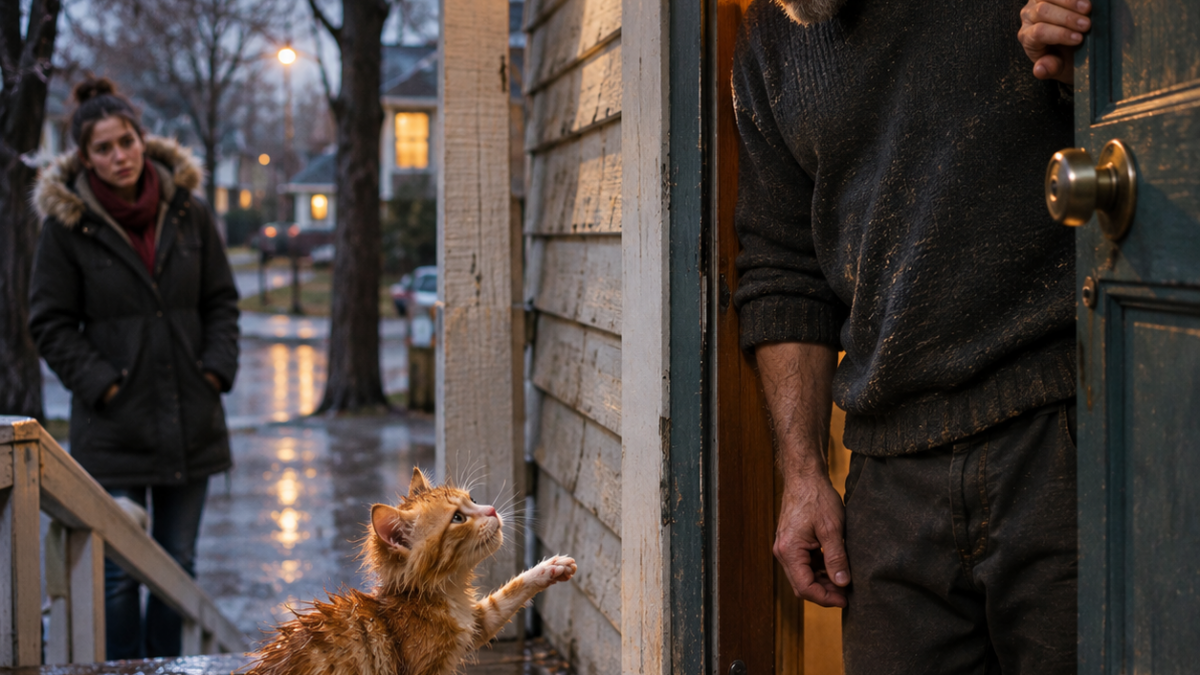
A Man Who Kept Everyone Out Found a Freezing Kitten at His Door—Then He Canceled His Move Because He Couldn’t Leave Him Behind.
For three years, Arthur Hale kept his curtains closed, ignored every neighbor who knocked, and prepared to sell the Denver house where the worst night of his life had left him convinced that loving anything only gave the world something else to take from him.
Then, during the coldest storm of November, a soaked six-week-old kitten dragged itself across his porch—and Arthur broke the one rule he had sworn he would never break again: he opened the door.
But when we discovered where that kitten had come from, why someone desperately wanted the abandoned house behind our block cleared before inspectors arrived, and what Arthur had been blamed for years earlier, saving one tiny animal became the first step toward exposing a lie that had destroyed a family and nearly destroyed him.
I was sure Arthur Hale was going to close the door.
That was what Arthur did.
He closed doors.
My name is Maya Bennett, and at the time I was thirty years old and had lived directly across the street from Arthur for almost three years in a quiet older neighborhood in west Denver where the houses sat close enough that people knew when you changed your curtains but far enough apart that privacy could still become a lifestyle if you worked at it.
Arthur worked at it.
He was sixty-one.
Tall even after age had started bending him slightly at the shoulders.
Gray hair cut short.
Heavy hands.
A face that looked stern from a distance and exhausted up close.
He wasn’t rude.
That would have been easier.
Rude people give you something to react to.
Arthur simply gave you nothing.
If I waved while checking the mail, he nodded once.
If someone said good morning, he answered good morning.
If neighbors held a summer block party, his curtains stayed shut.
Halloween candy?
A bowl appeared on the porch with a handwritten sign:
PLEASE TAKE ONE.
Nobody ever saw him refill it.
Christmas?
One small white light in the front window.
No wreath.
No tree visible.
No visitors.
His garbage went out Tuesday evening.
His porch light went off at 9:00.
His blinds closed before dark.
The same old dark-green pickup moved twice a week, sometimes three times.
Hardware store.
Grocery store.
Pharmacy.
That was about it.
The only person I ever saw enter Arthur’s house was a realtor named Dean Whitmore.
And even Dean rarely stayed longer than twenty minutes.
By that November, everyone on our street knew Arthur planned to sell.
There was a FOR SALE COMING SOON sign leaning sideways inside his garage.
PART2:
A property investor had been buying houses in our area one at a time, renovating some, demolishing others, then replacing them with tall narrow duplexes that looked like they had been designed by someone who hated windows.
Arthur’s property was valuable because his lot was wider than most.
People assumed he was cashing out.
I assumed he was leaving because he didn’t care where he lived.
I was wrong about almost everything.
The night the kitten appeared, Denver had been under a freezing-rain warning since afternoon.
Not a dramatic blizzard.
Something worse in its own quiet way.
Cold rain.
Wet pavement.
Wind finding every gap in your coat.
The temperature dropping fast enough that puddles became glass at the edges.
I was standing at my front window around 8:30, holding a mug of tea and wondering whether I should bring my porch plants inside when something moved beneath Arthur’s porch light.
At first I thought it was a leaf.
Then it moved again.
Tiny.
Orange.
A kitten.
He couldn’t have been more than six weeks old.
Maybe seven at most.
Domestic shorthair.
Ginger striped.
Soaked through.
PART3:
His fur was flattened against his ribs.
His tail looked like a wet piece of string.
He took two steps toward Arthur’s front door.
Stopped.
Trembled.
Took another.
Then collapsed onto his chest.
I set my mug down.
Before I reached my own door, Arthur’s porch light came on.
His front door opened.
He appeared wearing dark work pants and an old gray sweater.
He looked down.
The kitten tried to lift his head.
Failed.
Tried again.
Arthur stood motionless.
I knew exactly what I expected.
Arthur would step around him.
Maybe call animal control.
Maybe place a box outside.
Maybe knock on someone else’s door.
Anything except allow something vulnerable into his house.
Instead, he just stared.
The kitten stretched one front paw toward the thin line of warmth at the threshold.
Arthur’s jaw tightened.
He stepped backward.
I actually whispered, “Don’t.”
I don’t know whether I meant Arthur or the universe.
Then I crossed the street.
The cold hit hard enough to take my breath.
By the time I reached his porch, Arthur had disappeared inside.
The kitten barely reacted when I crouched.
“Oh, sweetheart.”
He was colder than I expected.
Not just wet.
Cold.
His body felt terrifyingly light.
Then Arthur returned carrying an old gray rag.
He laid it near the kitten.
Not touching him.
Just close.
“Arthur.”
“Not my problem.”
He said it automatically.
Flat.
Almost irritated.
But he stayed.
The kitten shifted weakly toward the fabric.
I looked up.
“He needs to be inside.”
Arthur’s expression hardened.
“I don’t bring animals into my house.”
“Then I’ll take him.”
I said it immediately.
I meant it at the time.
Arthur looked at me.
“You have animals?”
“No.”
“Know anything about kittens?”
“Enough to know he can freeze.”
“So do I.”
“Then open the door.”
He looked down.
Rain ticked against the porch railing.
A car passed at the end of the street.
The kitten made a tiny sound.
Not a full cry.
Almost a breath.
Arthur’s hand flexed once at his side.
Then he bent down and picked him up.
Quickly.
Like a man who knew hesitation might save him from making a decision he had already lost.
The kitten folded into his hands.
No struggle.
No cry.
Arthur looked startled by how little he weighed.
“Jesus.”
That was the first emotion I had ever heard clearly in Arthur Hale’s voice.
Fear.
He carried the kitten inside.
I followed.
I had lived across from him for nearly three years.
I had never been inside his house.
The first thing I noticed was that it didn’t look lived in.
Not dirty.
Not neglected.
Paused.
Boxes lined one wall.
Half taped.
Half open.
Books missing from shelves.
No photographs.
No decorations.
Two chairs in a living room built for more.
A dining table without anything on it.
The kind of house you would expect someone to be leaving next week.
Except Arthur had apparently lived like that for months.
He set the kitten on the kitchen counter.
Still wrapped in the rag.
For a few seconds he stared at him.
Then looked at me.
“What do we do?”
That question surprised me more than the kitten.
Arthur Hale asking for help.
I pulled out my phone.
“Warm first. Slowly.”
“I have towels.”
“Good.”
He brought three.
Then another blanket.
Then a cardboard box.
Then a heating pad he apparently owned but had never used.
We put it beneath half the box on low so the kitten could move away if he got too warm.
I searched emergency kitten care.
Everything online seemed to disagree with something else.
Do not feed a cold kitten.
Warm first.
Check gums.
Watch breathing.
Use kitten formula, not cow’s milk.
Emergency vet if lethargic.
Arthur stood beside me reading over my shoulder.
“Temperature?”
“I don’t know.”
“Do you have a thermometer?”
“For people.”
“Fine.”
“Arthur, I don’t think we put—”
“I meant room temperature.”
“Oh.”
He looked irritated.
I almost laughed.
Instead, I adjusted the towel.
The kitten’s eyes opened.
Blue-gray.
Too young.
Arthur leaned closer.
The kitten lifted one paw.
It caught weakly around Arthur’s index finger.
Arthur froze.
Not dramatically.
Completely.
I saw his face change.
He whispered:
“Not now.”
The words were barely audible.
The kitten held his finger.
Arthur’s breathing became shallow.
“Arthur?”
He pulled his hand away.
Too fast.
The kitten’s paw fell back onto the towel.
Arthur turned toward the sink.
“I’m calling a clinic.”
The nearest emergency veterinary hospital was fifteen minutes away.
The receptionist asked about breathing, alertness, gum color.
Arthur answered every question.
Then she said if we could safely warm the kitten and get him there immediately, they would take him.
Arthur reached for the box.
I stopped him.
“Slowly.”
“I know.”
“You’re shaking.”
“I’m cold.”
He wasn’t.
He carried the box to his truck.
I drove because Arthur refused to leave the kitten in the back seat.
He sat beside me holding the box against his chest.
We reached the emergency hospital at 9:17.
A technician came immediately.
She lifted the kitten.
Checked him.
Wrapped him in another warm blanket.
“What’s his name?”
Arthur said, “He doesn’t have one.”
The technician looked at me.
I shook my head.
“Stray.”
“Okay. Who’s responsible for treatment decisions?”
Silence.
Arthur looked at me.
I looked at him.
He said, “I am.”
One sentence.
Quiet.
Final.
The technician carried the kitten through double doors.
We waited.
Arthur did not sit.
He paced.
Ten steps.
Turn.
Ten steps.
Turn.
Every time the treatment-room door opened, he stopped.
After nearly forty minutes, a veterinarian came out.
Dr. Patel.
Young woman.
Dark hair pulled back.
Calm voice.
“He’s hypothermic and dehydrated. Mild hypoglycemia. He also has an upper respiratory infection.”
Arthur asked, “Is he dying?”
Dr. Patel paused carefully.
“He is very sick.”
“That wasn’t my question.”
“He could die.”
Arthur looked away.
“But he responded to warming. His glucose came up slightly. That’s good.”
“What does he need?”
“Hospitalization tonight would be safest.”
“How much?”
She gave him a range.
Arthur didn’t blink.
“Do it.”
I looked at him.
He ignored me.
Dr. Patel asked whether he could authorize diagnostics.
“Yes.”
“Vaccines later once stable?”
“Yes.”
“Fecal screening?”
“Yes.”
“Anything else medically indicated?”
“Yes.”
She almost smiled.
“I’ll have the estimate brought out.”
Arthur said, “Do whatever keeps him alive.”
That was when I first knew this wasn’t going to remain a story about a kitten on a porch.
We got home after midnight.
Arthur stood outside his front door.
Key in hand.
For a strange second, he seemed reluctant to go inside.
I said, “You okay?”
“Yes.”
“You’re not.”
He looked toward my house.
“You should go home.”
“Arthur.”
“Good night, Maya.”
The door closed.
But not quickly.
The next morning, I crossed the street at seven.
Arthur’s front door was unlocked.
Not normal.
I knocked.
No answer.
Pushed it open.
“Arthur?”
“In here.”
He was at the kitchen table.
Still wearing yesterday’s sweater.
Phone beside him.
Coffee untouched.
“They called at five.”
My stomach dropped.
“And?”
“He ate.”
I smiled.
“That’s good.”
Arthur nodded.
“He took formula.”
“Good.”
He looked at the phone.
“Temperature normal.”
“Even better.”
“They think he’ll make it.”
I exhaled.
Arthur didn’t.
He sat there staring at the table.
“Arthur.”
“What?”
“Why do you look like someone gave you bad news?”
He gave me a long look.
Then stood.
“I need to finish packing.”
That was how he avoided the question.
I noticed the boxes again.
“You’re really moving?”
“Yes.”
“When?”
“End of the week.”
“Where?”
“Wyoming.”
I blinked.
“Wyoming?”
“Outside Laramie.”
“Why?”
“Cheaper.”
“You know anyone there?”
“No.”
“Family?”
“No.”
“Friends?”
“No.”
He looked at me.
“That’s the point.”
I stared.
He walked toward the living room.
I followed.
“You were going to move somewhere you know nobody?”
“Yes.”
“Why?”
He lifted a box.
“Because I can.”
“That isn’t an answer.”
“It’s the only one you’re getting.”
Then he carried the box toward the garage.
Arthur picked up the kitten from the hospital that afternoon.
He had improved enough for home care.
Antibiotics.
Formula.
Small meals.
Monitoring.
Warmth.
The technician asked again about a name.
Arthur looked down into the carrier.
The kitten was awake.
Tiny orange face.
Huge ears.
One white patch on his chest I hadn’t noticed before.
Arthur said:
“Finn.”
I smiled.
“Finn?”
“What?”
“Nothing.”
“You don’t like it?”
“I love it.”
He frowned as if I had accused him of sentiment.
Finn came home.
For the next twenty-four hours, Arthur pretended not to become a cat owner.
“I’m fostering him.”
“To whom?”
“Until someone takes him.”
“Who?”
“A rescue.”
“Which rescue?”
“I’ll find one.”
He bought six cans of kitten food.
Formula.
Two beds.
A litter tray.
A scratching pad.
Three blankets.
A toy mouse.
Then said:
“I’m not keeping him.”
By day three, Finn followed Arthur’s hands.
By day four, he could walk without wobbling.
By day five, he purred when Arthur picked him up.
Arthur looked personally betrayed.
“You did that on purpose.”
Finn purred louder.
I was there when it happened.
I laughed.
Arthur glared at me.
“This is temporary.”
“Of course.”
“You’re enjoying this.”
“Immensely.”
Then Dean Whitmore arrived.
The realtor.
He knocked at three in the afternoon.
Arthur opened the door holding Finn against his chest.
Dean froze.
“You have a cat?”
“No.”
Finn was visibly a cat.
Dean looked at me.
I shrugged.
Dean was fifty-something.
Expensive coat.
White teeth.
Fast smile.
He had the polished friendliness of a man who made money convincing people decisions were already made.
“Arthur, I need those final signatures.”
Arthur shifted Finn.
“What signatures?”
“The addendum.”
“I signed the sale agreement.”
“Right, but Ridgeway wants early access.”
Ridgeway Development.
The company buying his property.
Arthur’s face tightened.
“For what?”
“Surveying. Soil testing. Preliminary demolition prep.”
“I’m not closing for twelve days.”
“It helps them move faster.”
“No.”
Dean smiled.
“It’s routine.”
“No.”
“Arthur.”
“No one enters before closing.”
Dean’s smile thinned.
“The contract permits reasonable inspection.”
“Inspection isn’t demolition prep.”
“They’re not demolishing anything.”
“Then they can wait.”
Dean looked toward the boxes.
“You told me you were leaving Friday.”
“Plans changed.”
“What plans?”
Finn chirped.
Dean looked down.
Then laughed.
“You’re changing a quarter-million-dollar transaction over a stray cat?”
Arthur’s entire body went still.
I felt the room change.
Dean must have sensed it too.
He raised both hands.
“I’m joking.”
Arthur said:
“Get out.”
“Come on.”
“Get out.”
Dean left.
Two minutes later, Arthur’s phone rang.
He ignored it.
It rang again.
Then again.
“Ridgeway?” I asked.
“Yes.”
“You going to answer?”
“No.”
Finn climbed awkwardly up Arthur’s sweater.
Arthur supported him automatically.
“Arthur.”
“What?”
“Why do they need access so badly?”
He looked at me.
“I don’t know.”
That became important three days later.
Because Finn disappeared.
Only for eleven minutes.
But those eleven minutes changed everything.
Arthur had been feeding him in the kitchen when a truck pulled into the alley behind the houses.
Loud engine.
Metal ramp dropping.
Finn startled.
Ran.
The back door had been open because Arthur was carrying boxes into the garage.
Finn slipped through.
Arthur called me in a panic.
Not concern.
Panic.
“Maya.”
“What?”
“He’s out.”
I ran across.
We searched the yard.
Porch.
Fence.
Then alley.
Arthur kept calling.
“Finn.”
No kitten.
“Finn!”
We reached the abandoned house at the end of the block.
It had sat vacant more than a year.
Ridgeway had purchased it two months earlier.
Plywood on windows.
Chain-link construction fence partially installed.
Behind it, workers were clearing debris.
I heard a kitten.
Tiny.
Somewhere beneath a pile of old boards near the foundation.
Arthur heard it too.
He moved toward the fence.
A worker stopped him.
“Sir, you can’t come in.”
“My cat is in there.”
“You have to wait.”
Arthur grabbed the fence.
“Finn!”
A small orange head appeared beneath the boards.
Then disappeared.
Arthur moved toward the gate.
The worker blocked him.
“I said wait.”
Arthur looked at him.
“You have thirty seconds to move.”
“Arthur,” I said.
The worker was younger.
Bigger.
He smiled in disbelief.
“Or what?”
Arthur didn’t answer.
A supervisor approached.
“What’s happening?”
“Cat got inside.”
The supervisor frowned.
“We’re clearing this.”
“That’s why we’re getting him.”
“No one goes in without PPE.”
“Then you get him.”
The supervisor looked toward the boards.
“We’re behind schedule.”
Arthur stepped forward.
I grabbed his arm.
“Arthur.”
He shook me off.
Not violently.
“Move.”
The supervisor said, “We can stop equipment for five minutes.”
“You stop it until he’s out.”
“Sir—”
“You touch those boards with a machine while he’s under there, I’ll have police, animal control, OSHA, and every television camera in Denver standing here before lunch.”
The supervisor stared.
I stared too.
This was not the Arthur I knew.
Or maybe it was.
Maybe I had only known the version who had stopped using his voice.
The supervisor ordered the machines off.
Two workers moved boards by hand.
Finn emerged three minutes later.
Arthur crouched.
Finn ran directly to him.
Straight into his hands.
Arthur pulled him against his chest.
Finn buried his face beneath Arthur’s chin.
Arthur closed his eyes.
For several seconds, the entire alley seemed to disappear around him.
Then I noticed something.
Behind the cleared boards.
Small plastic bowls.
Old blankets.
Several empty cans.
A cracked carrier.
And farther beneath the foundation ledge—
movement.
Not one cat.
Several.
A gray adult.
Black-and-white kitten.
Another orange face.
I pointed.
“Arthur.”
He looked.
The supervisor swore.
“What?”
“There are cats under there.”
He said it like they were trash.
Arthur looked at him.
“How long have you known?”
“We didn’t.”
One worker muttered, “We saw them yesterday.”
The supervisor snapped toward him.
“What?”
The worker looked uncomfortable.
“There were cats.”
“Why didn’t you tell me?”
“I did.”
The supervisor’s face changed.
Arthur noticed.
“So you knew.”
“No.”
“You just heard him.”
“I knew there might be strays.”
“And you were going to clear the foundation?”
“We have a schedule.”
Arthur handed Finn to me.
“Call animal control.”
The supervisor stepped forward.
“You don’t need to do that.”
Arthur turned.
“What?”
“We can handle it.”
“How?”
“We’ll scare them out.”
“With what?”
“Noise.”
I looked at the heavy equipment.
Then at the tiny opening.
My stomach turned.
Arthur said:
“No.”
One word.
The supervisor laughed.
“This is private property.”
Arthur took out his phone.
“Then you won’t mind explaining your plan to animal control.”
That was the beginning.
Animal protection officers arrived.
Then a rescue volunteer.
Then another.
The site shut down for the afternoon.
They found eleven cats.
Four kittens.
Two nursing females.
Three adults.
Two juveniles.
One kitten looked almost identical to Finn.
Same approximate age.
Same respiratory infection.
Same thin body.
Dr. Patel later estimated Finn had likely come from that colony.
The question became:
Why were kittens suddenly wandering away from a colony that had apparently survived there for months?
The answer arrived from an elderly woman named Mrs. Alvarez who lived behind the property.
She came outside when rescue volunteers began trapping.
She carried a grocery bag full of cat food.
“I feed them.”
“How long?” I asked.
“Since spring.”
“Did Ridgeway know?”
She looked toward the supervisor.
“Yes.”
Arthur’s jaw tightened.
“How?”
“I told them.”
“When?”
“Three times.”
She pointed toward the abandoned house.
“They told me stop feeding because demolition coming.”
“Did they arrange rescue?”
“No.”
“Did they trap?”
“No.”
Her eyes filled.
“Last week someone took away their shelter boxes.”
I looked toward the site.
That explained Finn.
The cats’ hiding areas had been disturbed before official clearing even started.
Cold arrived.
Finn wandered.
Straight to Arthur’s porch.
Arthur looked at the kitten in my arms.
Something in his face hardened.
Then Dean Whitmore appeared.
Of all people.
He parked at the end of the alley and walked toward us.
“Arthur.”
Arthur didn’t move.
Dean looked around.
“What is all this?”
“Cats.”
“Yes, I can see that.”
“Ridgeway knew.”
Dean lowered his voice.
“Don’t start.”
“Start what?”
“This property has nothing to do with your sale.”
“It has everything to do with it if they’re doing the same thing behind my lot.”
Dean stared.
Arthur took Finn back from me.
“No early access.”
“I told them that.”
“No closing until my attorney reviews everything.”
Dean’s face changed.
“Arthur.”
“What?”
“You signed.”
“I know.”
“You cannot just decide not to close.”
“I can decide not to let anyone onto my property before closing.”
“You’re creating a problem.”
Arthur smiled.
It was the first time I saw him smile at Dean.
There was no warmth in it.
“No.”
He stroked Finn’s back once.
“You people created a problem.”
Two days later, a city inspector visited the abandoned property.
Then another.
Someone had reported possible asbestos disturbance.
Then unauthorized debris removal.
Then erosion-control issues.
Ridgeway’s permits were temporarily paused.
Dean stopped smiling.
But the bigger revelation had nothing to do with cats.
It began when Arthur’s attorney reviewed Ridgeway’s paperwork.
Arthur had not told me he had an attorney.
Apparently he had not used him in two years.
His name was Samuel Grant.
Retired county attorney.
Old friend.
Samuel came to Arthur’s house on a Friday evening.
I was there feeding Finn.
Samuel looked at me.
Arthur said, “She stays.”
I tried not to smile.
Samuel opened a folder.
“Ridgeway’s purchase agreement references an environmental disclosure.”
Arthur nodded.
“So?”
“So the disclosure says you acknowledged historical contamination affecting three properties in this block.”
Arthur stared.
“What contamination?”
Samuel looked at him carefully.
“You don’t know?”
“No.”
“Your signature is here.”
He turned the page.
Arthur looked.
His face emptied.
“That isn’t my signature.”
Silence.
Samuel looked at Dean’s electronic transaction certificate.
“Document says signed digitally four months ago.”
“I never saw this.”
“Arthur.”
“I never saw it.”
I felt cold.
Samuel asked, “Did Dean ever send an addendum?”
“A financing update.”
“Did you sign electronically?”
“Yes.”
“Did you read every page?”
Arthur looked away.
There it was.
“No.”
Samuel exhaled.
“What exactly is Ridgeway buying these lots for?”
“Redevelopment.”
“That isn’t what I asked.”
Arthur looked at him.
Samuel continued:
“The contaminated-property disclosure can substantially reduce future liability for a buyer if redevelopment uncovers buried industrial waste.”
I frowned.
“This was residential land.”
“Now.”
Samuel looked toward Arthur.
“What was here before the neighborhood?”
Arthur said, “Rail maintenance yards. Long time ago.”
Samuel nodded.
“Exactly.”
Arthur went pale.
And that was when his past finally entered the room.
Twenty-one years earlier, Arthur had worked for the Denver Department of Environmental Health.
Not as a field inspector.
As a civil engineer overseeing remediation compliance on municipal redevelopment projects.
One project had involved contaminated soil beneath a former rail yard.
Our neighborhood had been built on part of that land.
Arthur had flagged incomplete remediation records.
Then a contractor provided revised test results.
The project moved forward.
Seven months later, Arthur’s wife, Claire, died.
Not from contamination.
Not directly connected.
A drunk driver crossed the center line on Interstate 70.
Claire died at the scene.
Their seventeen-year-old son, Noah, survived.
Physically.
Emotionally, the family fractured.
Arthur became consumed with work.
Noah blamed him for not being present.
Arthur blamed himself.
Then, one year later, the remediation project resurfaced in an internal audit.
Missing records.
Conflicting soil samples.
Arthur was accused of signing off on a section he had actually questioned.
His supervisor claimed Arthur approved it.
The signature appeared on the final certification.
Arthur insisted it was not his.
Nobody proved forgery.
Nobody proved criminal wrongdoing either.
Arthur resigned.
The city settled quietly with the contractor.
His reputation never fully recovered.
Noah left Denver at nineteen.
Barely spoke to Arthur again.
Claire was gone.
Career gone.
Son gone.
Arthur made a choice.
Stop needing people.
Stop asking.
Stop explaining.
Stop giving anyone access to enough of him that they could leave with something important.
And now, decades later, another document connected to the same redevelopment corridor carried a signature Arthur said was not his.
Samuel looked at him.
“Who was the contractor on the old remediation?”
Arthur didn’t answer.
Samuel already knew.
He slid another page across.
Hale & Whitmore Environmental Services.
I looked at Arthur.
“Whitmore?”
Arthur whispered:
“Dean’s father.”
Everything became very quiet.
Dean Whitmore wasn’t simply Arthur’s realtor.
His father had been a principal in the contracting company involved in the old remediation dispute.
Dean had approached Arthur about selling eighteen months earlier.
Said Ridgeway was consolidating lots.
Said Arthur could finally leave Denver.
Arthur had trusted him partly because their families had known each other decades ago.
Trusted.
That word hurt.
Samuel contacted the city.
The current investigation expanded.
Historic files were retrieved.
Digital signature logs examined.
The city discovered that Arthur’s supposed old approval signature existed only on a scanned version submitted after the original file had already contained his written objection.
His original objection still existed in an archived engineering backup.
Twenty years.
That was how long Arthur had carried blame for something the city could now see he had tried to stop.
Dean denied knowing anything about the old files.
Then investigators found emails between Ridgeway consultants and Dean discussing “legacy Hale exposure” and the importance of obtaining Arthur’s acknowledgement before purchase.
They knew.
They knew Arthur’s name was connected to historic remediation.
They wanted his signature on the new disclosure.
Not because Arthur was responsible.
Because his signature could help shift future liability.
The property sale was suspended.
Ridgeway’s redevelopment permits were frozen pending environmental review.
Dean’s brokerage opened an ethics investigation.
The city attorney referred document irregularities to prosecutors.
Arthur became local news.
He hated every second.
A reporter stood outside his gate one morning.
Arthur shut the curtain.
Finn jumped onto the windowsill.
Arthur opened the curtain again.
Just six inches.
I noticed.
The story spread.
Former city engineer cleared by archived records after decades-old dispute.
Developer documents questioned.
Possible contamination review reopened.
Neighbors panicked.
Property values.
Health concerns.
Lawsuits.
At one public meeting, a man stood up and pointed at Arthur.
“You knew!”
Arthur went still.
The old reflex.
Shut down.
Disappear.
I was sitting two rows behind.
Samuel beside me.
The man shouted:
“You worked on this!”
Arthur looked toward the exit.
I thought he was going to leave.
Then his phone vibrated.
He looked down.
A photo from me.
Finn asleep on Arthur’s sweater at home.
I had taken it that morning.
Arthur stared at the picture.
Then walked to the microphone.
“I did work on it.”
The room quieted.
“I also objected to incomplete testing.”
Someone shouted, “Prove it!”
Arthur looked toward the projector.
Samuel handed documents to city staff.
Arthur’s original memo appeared.
Dated.
Signed.
Warning that soil data was incomplete.
The room changed.
Arthur continued.
“My objection was removed from the final paper file.”
People stopped shouting.
“I spent twenty years believing I had failed to prove that.”
His voice shook.
He swallowed.
“I stopped explaining because eventually silence felt less humiliating than asking people to believe me.”
Nobody moved.
Then he said:
“That was a mistake.”
I felt tears rise.
Arthur continued.
“Because when people who know the truth stop talking, somebody else gets to write it.”
That sentence made the evening news.
Ridgeway eventually withdrew its purchase offer on Arthur’s property.
Arthur could have sued immediately.
Samuel recommended waiting until the investigation finished.
Arthur did.
Not because he was afraid.
Because he had finally learned the difference between waiting and hiding.
Dean lost his real-estate license after investigators found he had improperly presented and certified documents in multiple transactions.
Whether he personally created Arthur’s false signature became the subject of a separate criminal investigation.
Ridgeway paid substantial civil penalties and funded environmental testing across the redevelopment area.
Contaminated soil was found in two undeveloped sections.
Not beneath occupied homes.
That was the best news anybody received.
The historic record was formally amended to state that Arthur had objected to the incomplete remediation documentation and had not authorized the final certification attributed to him.
The city sent him a letter.
Arthur read it once.
Folded it.
Put it in a drawer.
I said:
“That’s it?”
“What?”
“You waited twenty years for that.”
“No.”
He looked toward Finn.
“I waited twenty years to hear somebody else say it.”
He touched the kitten’s head.
“I should’ve known it before.”
Finn had grown.
Healthy.
Bright orange.
Unreasonably confident.
He owned Arthur’s house within months.
The curtains opened first.
Then the boxes disappeared.
The FOR SALE sign left the garage.
Arthur canceled Wyoming.
His answer when I asked why was simple.
“I’m not done here.”
He replaced one dining chair.
Then another.
Put photographs back on the shelves.
The first was Claire.
The second was a younger Arthur, Claire, and a teenage boy I knew immediately must be Noah.
I looked at him.
“You talk to him?”
“No.”
“Do you want to?”
Arthur stared at the photograph.
“Yes.”
“Then call.”
“He doesn’t want to hear from me.”
“You don’t know that.”
“I know my son.”
“You knew him at nineteen.”
Arthur glared.
I shrugged.
“Different person.”
He didn’t call that day.
Or the next.
A week later, Finn knocked Arthur’s phone from the table.
The screen lit.
Contact list.
NOAH.
Arthur stared at it.
I said, “That cat is getting aggressive.”
He almost smiled.
Then picked up the phone.
He called.
Noah answered.
I wasn’t there.
Arthur told me afterward.
The conversation lasted six minutes.
Mostly silence.
Noah had seen the news.
Knew about the cleared record.
Had a wife.
Two daughters.
Lived in Oregon.
Arthur told him about Finn.
That apparently broke something open.
Noah laughed.
First time Arthur had heard his son laugh in twenty years.
They spoke again Sunday.
Then Wednesday.
Then nearly every week.
Four months later, Noah visited Denver.
Arthur asked me to be there when he arrived.
“Why?”
“In case.”
“In case of what?”
“I don’t know.”
I understood.
When Noah stepped out of the rental car, I saw Claire in the old photograph immediately.
Same eyes.
Arthur stood on the porch.
Finn at his feet.
Father and son looked at each other across twenty feet of frozen yard.
Nobody moved.
Then Finn ran toward Noah.
Of course he did.
Noah crouched.
Finn climbed his jeans.
Noah laughed.
Arthur laughed too.
The tension cracked.
Noah picked up the cat.
“This him?”
Arthur nodded.
“Finn.”
“This is the cat?”
“Yes.”
“The famous one?”
Arthur looked offended.
“He’s not famous.”
“He was on television.”
“Against my wishes.”
Noah scratched Finn under the chin.
Then looked at his father.
“I guess he’s why you called.”
Arthur said:
“Partly.”
Noah’s expression softened.
“What’s the other part?”
Arthur looked at him.
“You.”
That was all.
No dramatic embrace immediately.
Real families rarely heal on cue.
But Noah walked onto the porch.
Arthur opened the door.
Six months later, two little girls were chasing Finn through the living room while Arthur complained they were “overstimulating the cat.”
Finn was having the best day of his life.
I stood in the kitchen laughing.
Arthur looked at me.
“What?”
“You.”
“What about me?”
“You used to close the curtains at nine.”
“I still close them.”
“It’s ten-thirty.”
He looked toward the windows.
Forgotten.
Open.
Snow falling outside.
Warm light spilling onto the porch where Finn had nearly died.
Arthur’s granddaughter called from the hallway.
“Grandpa!”
Arthur turned immediately.
No hesitation.
I watched him go.
That was when I realized what had truly changed.
Not the house.
Not the legal record.
Not even the family.
Arthur had become reachable.
Years passed.
Finn grew into a large orange cat with a white chest, one torn ear from some unknown pre-Arthur adventure, and the personality of a creature who believed every closed door was a personal insult.
Arthur never sold the house.
He renovated the back room instead.
Turned it into a temporary foster space for kittens from the same rescue that had helped clear the colony.
That was my favorite part.
The man who once said, “I don’t bring animals into my house,” became impossible to control.
“One litter,” he promised.
Then two.
Then a mother cat and four kittens.
Then an elderly tabby nobody wanted.
I walked in one afternoon and found three carriers in his kitchen.
“Arthur.”
“They’re temporary.”
“You have become a cliché.”
“Get out.”
He smiled while saying it.
Mrs. Alvarez helped too.
The colony near the abandoned property was trapped, vaccinated, sterilized, and either adopted or returned where safe.
Finn’s likely mother was a small orange-and-white cat they named Marigold.
Nobody could prove she was his mother.
Arthur believed it anyway.
Marigold eventually went to a retired teacher.
Arthur checked on her twice.
Pretended it was administrative.
Nobody believed him.
The neighborhood changed.
Some properties were redeveloped after environmental review.
Some weren’t.
But the reckless demolition stopped.
The city created stronger notice requirements when known animal colonies were present on demolition sites.
Not a huge law.
Not headline-making.
A practical rule.
Arthur attended the hearing.
He spoke for ninety seconds.
“Wildlife and stray animals are invisible until somebody decides they’re inconvenient,” he said. “Inconvenient does not mean nonexistent.”
That line went into the minutes.
So did his name.
Correctly this time.
On the fifth anniversary of the night Finn appeared, Denver got another freezing rain.
Same wet cold.
Same shining pavement.
I looked across the street around eight-thirty.
Arthur’s porch light was on.
His curtains were open.
Finn sat in the window.
Arthur stood outside holding something.
A small shelter box.
Blankets.
Food.
Water.
I crossed the street.
“What is this?”
He shrugged.
“Cold night.”
“So?”
“In case something comes.”
I looked at him.
“You built an emergency porch shelter.”
“It’s a box.”
“With insulated lining.”
“Basic.”
“And a heating pad.”
“Low voltage.”
“Arthur.”
“What?”
I smiled.
“You’re ridiculous.”
He looked toward the street.
“Go home, Maya.”
I started down the steps.
Then he said:
“Thank you.”
I turned.
“For what?”
He rubbed one hand over the back of his neck.
Arthur had gotten better at speaking.
Not perfect.
“Coming across that night.”
I smiled.
“You opened the door.”
He looked through the window at Finn.
“Eventually.”
“No.”
I shook my head.
“That night.”
Arthur was quiet.
Then nodded.
Maybe that was the entire story.
People often tell it backward.
They say Finn saved Arthur.
That a freezing kitten arrived at exactly the right time and somehow repaired a lonely man.
That is prettier.
It is not entirely true.
Finn did not erase Claire’s death.
He did not restore twenty years with Noah.
He did not make betrayal harmless.
He did not magically teach Arthur to trust.
Healing is not that generous.
Finn simply created one moment where Arthur had to choose.
Close the door.
Or open it.
Arthur opened it.
Then had to choose again.
Pay the veterinary bill.
Stay awake.
Feed him.
Take him back when he got sick.
Protect him in the alley.
Ask questions.
Read documents.
Call an old attorney.
Face people he had spent years avoiding.
Speak at a meeting.
Call his son.
Open the curtains.
One choice did not change Arthur Hale’s life.
A hundred small choices did.
Finn was simply there for the first one.
Arthur once told me something I wrote down afterward because I knew I would forget the exact words.
We were sitting on his porch.
Finn was asleep between us.
Arthur said:
“I thought closing people out meant nobody could hurt me again.”
I waited.
He scratched Finn’s ear.
“What it really meant was nobody could reach me when I was hurting.”
That was Arthur.
For years he had mistaken isolation for protection.
Silence for strength.
Leaving for control.
Then a tiny orange kitten appeared on the coldest night of the year with no understanding of Arthur’s rules.
Finn didn’t care that Arthur had sworn never to love something vulnerable again.
Didn’t care about old accusations.
Broken families.
Property contracts.
Men who falsified papers.
Years of shame.
He saw light beneath a door.
Warmth.
And he moved toward it.
Sometimes I think that is all any of us are doing.
Moving toward whatever small line of warmth we can still see.
Years later, Finn still sleeps near Arthur’s front door.
Not because he wants out.
He has no interest in Denver weather anymore.
He sleeps there because that is where his life changed.
Maybe Arthur does something similar.
His chair now faces the window.
Curtains open.
Family photographs on the shelves.
Grandchildren’s drawings on the refrigerator.
A cat tree beside the window that Arthur complained was “architecturally offensive” before assembling it himself.
The house is noisier.
Messier.
Alive.
And when someone knocks, Arthur no longer waits for them to leave.
Most of the time, anyway.
He opens the door.
That is the part I remember whenever people say someone is too far gone.
Too bitter.
Too old.
Too hurt.
Too accustomed to being alone.
Maybe.
Or maybe there is still one door they have not opened yet.
One person they have not called.
One truth they have not faced.
One small frightened thing on the other side asking for nothing more than warmth.
Arthur Hale spent years keeping everyone out.
Then a six-week-old kitten came to his porch in a freezing rain and stretched one tiny paw toward the light beneath his door.
Arthur thought he was deciding whether to save a kitten.
He wasn’t.
He was deciding whether there was still a part of himself worth opening the door for.
And for the first time in years, he chose yes.








