A Lost Puppy Followed a Wounded Navy SEAL Home—Then the Puppy Began Copying His Every Move, and an Old K9 File Revealed Why.
PART2:
Then another weak scratch from somewhere behind the warehouse.
I raised one gloved hand.
Noah stopped immediately.
We listened.
The sound came again.
Not metal.
Not wind.
Movement.
Small.
Irregular.
Alive.
I turned toward a narrow passage nearly covered in drifted snow. Broken pallets leaned against one wall. A rusted equipment box sat half-buried near the corner. Behind it, barely visible beneath the white surface, was the edge of an old K-9 transport crate.
Only part of the metal door showed.
I knelt and brushed snow away with my gloves.
“There’s something inside,” I said.
Noah moved beside me. His expression changed, the humor leaving his face in an instant.
Together, we cleared the crate.
The lock was stiff with ice. I worked it slowly, careful not to shake the frame too hard. The metal finally gave with a brittle snap, and the door creaked open.
Inside was a small black-and-tan German Shepherd puppy.
He was curled tight against the frozen floor, coat clumped with frost, body frighteningly still. His eyes were only half-open, but they found me immediately.
A thin metal tag hung from his collar.
SAM.
For a moment, neither of us spoke.
I had seen things in war zones that trained my face into stillness. I had walked past scenes I could not afford to react to until later. Much later. Sometimes never.
But there was something about that puppy lying in a crate made for working dogs, left behind in a forgotten compound, watching me without a sound.
No panic.
No fight.
Only waiting.
I stripped off my outer thermal layer, wrapped him carefully, and lifted him against my chest.
He felt too light.
Like cold wrapped in fur.
Noah looked around the empty yard.
“How long do you think he’s been here?”
I did not answer.
There was no useful answer.
Only the crate.
The untouched snow.
The frozen lock.
And the fact that someone had left him.
“We’re taking him back,” I said.
“The mission schedule—”
“Has changed.”
Noah looked at me for a second, then nodded.
We moved fast.
Not reckless.
Fast.
Sam barely stirred inside my jacket. Once, his nose pressed weakly against my shirt, as if checking whether the warmth was real. I held him closer and kept walking.
The field medical station sat near the entrance road, a low building with a heated treatment room and lights that looked too warm against the winter gray.
Dr. Claire Bennett met us at the door.
Claire was in her mid-thirties, with auburn hair tied back, clear green eyes, and the kind of calm that made both people and animals breathe easier without realizing it. She served as the veterinary officer for the rescue unit and managed Aurora Haven, a small animal center that cared for abandoned pets, retired working dogs, and any wounded creature no one else had room for.
When she saw the bundle in my arms, she did not waste a word.
“Table,” she said. “Now.”
I placed Sam on a heated examination surface.
Claire moved with quiet precision. She checked his breathing, temperature, gums, paws, eyes, and response to touch. She spoke softly, not to reassure me, but to keep the room steady.
“He’s severely hypothermic,” she said. “We warm him gradually. Fluids. Small food once his body can handle it. Close observation. No sudden heat.”
“Will he make it?”
She did not give me the comforting lie.
“The next few hours matter.”
I nodded.
I had been on missions where lives depended on seconds, discipline, and decisions made before fear caught up. This was different. There was no enemy to locate, no door to breach, no command that could force the outcome.
All I could do was stand there and watch a puppy fight to stay alive.
Claire covered Sam with a soft blanket and placed a heating pad nearby.
“Do you know where he came from?” I asked.
“Not yet. The tag gives us a name, but I don’t have a registration record. I’ll scan him once he’s stable. I’ll also check the Northstar files.”
She hesitated.
I noticed.
I always noticed hesitation.
“What?”
Claire glanced toward the office behind her.
“Aurora Haven has been struggling. We lost a major donor last month. If Sam needs extended care, I’ll make it work, but placements are tight. We may not even have the building through the end of winter.”
I looked down at Sam.
His eyes were closed now.
Barely breathing.
“I’ll keep him until you find somewhere.”
Claire studied me.
“You mean that?”
“I mean he won’t be left here again.”
That was the closest thing to a promise I was willing to make.
Noah leaned against the doorway, one hand near his injured shoulder.
“You know,” he said, “you could let someone else carry responsibility for once.”
“It’s temporary.”
Noah gave a faint smile.
“That’s what people say when they’re trying not to care.”
I ignored him.
But the words stayed in the room long after he left.
That night, I stayed beside the examination table.
Claire worked at her desk, calling old contacts about Sam and quietly fighting to keep Aurora Haven alive. Noah finished the assignment report, then pretended not to look at a message on his phone. His shoulder had been worsening for weeks, and everyone knew it except the man attached to it.
Sam slept in short, fragile stretches.
Every time Claire checked his temperature or adjusted the blanket, his eyes opened and searched the room until he found me.
I pretended not to notice.
That was one of my specialties.
Pretending not to notice things that mattered.
I had spent years making sure no one could depend on me too deeply. Dependence created expectations. Expectations created attachment. Attachment created loss.
That was what I learned after Ryan Blake.
Ryan had been my closest teammate. The one man who could read my silence without forcing me to translate it. He had laughed easily, argued honestly, and believed patience was a form of strength.
Then he failed to come back from a mission.
After that, I kept my life clean and narrow.
My cabin had only what it needed.
My schedule was exact.
My conversations were short enough that nobody could mistake them for invitations.
And now I was sitting beside a frozen puppy who kept searching for me whenever he woke.
“You’re not staying with me,” I murmured.
Sam was too tired to understand.
Claire glanced up from her desk.
She said nothing.
Near midnight, she told me he was stable enough for me to leave for a few hours.
“He’ll need rest,” she said. “So will you.”
“I’m fine.”
“You’re standing like a man whose spine was replaced with steel cable.”
“That means I’m awake.”
“It means go home.”
I pulled on my coat and walked toward the door.
I had taken two steps when I heard a faint movement behind me.
I turned.
Sam had lifted his head from the blanket. He looked impossibly small, eyes open, fixed on me with quiet uncertainty.
I stood still.
Then Sam slowly extended one trembling paw across the edge of the blanket until it touched my hand.
I should have left.
Instead, I stayed another hour.
By morning, Sam was strong enough to leave the clinic under strict instructions.
Warmth.
Quiet.
Small meals.
Limited movement.
Observation.
Claire repeated the list twice because she seemed to understand I trusted written procedures more than emotional instincts.
I arrived before sunrise with a clean blanket, a small travel crate, and the expression of a man completing a practical task.
At least that was what I told myself.
My cabin stood near the edge of the Northstar grounds, surrounded by snow-covered pines. A narrow cleared path led from the road to the front steps. Inside, everything had a place.
Boots beneath the bench.
Gloves beside the door.
Keys in a metal dish.
Gear cleaned, folded, stored, and ready.
The cabin was quiet by design.
Sam entered slowly, sniffing the floor, pausing at every unfamiliar sound.
I carried the crate to the warmest corner of the living room, placed the blanket inside, and set two bowls nearby.
“You stay here,” I said. “Food at six. Short walk after breakfast. Rest after. Outside only when I say.”
Sam looked up at me.
I interpreted the silence as agreement.
That was my first mistake.
Before breakfast, I wrote a schedule on a notepad.
6:00 food.
6:30 short walk.
7:00 rest.
Noon meal.
Afternoon basic handling.
Evening quiet.
Simple.
Orderly.
Controlled.
Sam seemed determined to attack the concept of control directly.
When I folded my arms beside the window, the puppy sat upright and drew his front legs close to his chest.
I looked down.
He looked back.
I turned toward the kitchen and decided it was coincidence.
A few minutes later, I paused to listen to a vehicle moving along the distant road. Sam tilted his head in the exact same direction.
I slowly turned.
He remained still, one ear raised and the other leaning slightly to the side.
“What are you doing?”
Sam blinked.
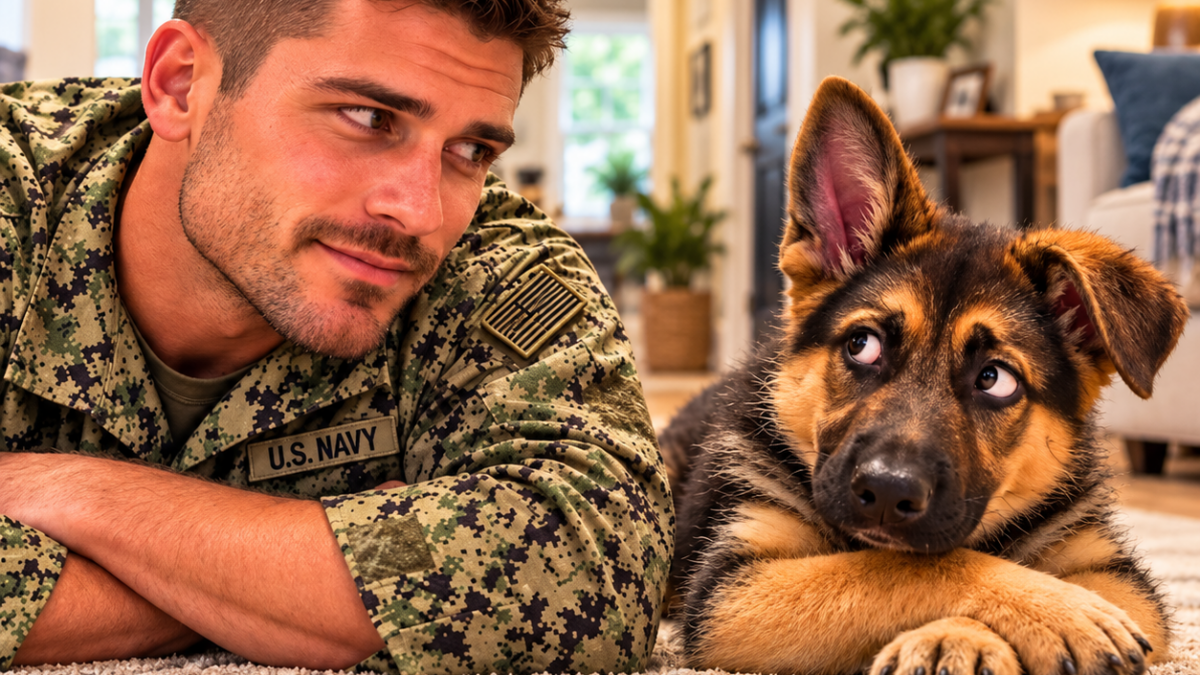
Later, while reviewing a map on the living room floor, I stretched out on my stomach and rested one arm beneath my chest.
Sam watched from the blanket.
Then he crawled across the rug and lowered himself beside me.
Paws forward.
Chest down.
Head lifted at nearly the same angle.
His body was too small and clumsy to copy the pose perfectly, but the intention was unmistakable.
I raised my head.
Sam raised his.
I moved one elbow.
Sam shifted his front paws.
“You’re a copycat,” I muttered.
His tail moved once against the floor.
By noon, there had been too many coincidences.
When I stood, Sam stood.
When I sat, he sat.
When I leaned toward the window, he leaned forward too.
He did not crowd me. He did not bark for attention. He did not demand affection.
He watched.
He waited.
Then he adjusted himself according to me.
I found it unsettling.
I had spent years believing almost no one noticed the small things I did.
Now a puppy had made a mission out of studying them.
At 12:17, I discovered he had stolen one of my socks from the laundry basket and carried it beneath the table.
I removed it gently, placed it back, and returned to the kitchen.
When I came back, the sock was in the hallway.
Sam sat beside it with an expression of complete innocence.
“That does not belong there.”
Sam lowered his head.
I moved the sock again.
By lunch, one of my boots had been dragged six inches from the door, the folded blanket on the sofa had been pulled to the floor, and Sam had settled directly in the center of it.
I stood with both hands on my hips.
Sam opened one eye.
Then closed it again.
It would have been easier if he had been destructive.
Destruction could be corrected.
Chewed cord? Remove the cord.
Broken object? Replace it.
But Sam seemed interested only in disrupting things I had deliberately arranged.
The more I restored order, the more he studied it.
That afternoon, Claire arrived with medicine, puppy food, and her eleven-year-old daughter, Lily.
Lily was quiet, with dark hair tied in a loose braid and a stack of colorful paper cards held carefully against her chest. She had the habit of watching people before speaking, which immediately made her more observant than most adults.
She noticed Sam within thirty seconds.
“He doesn’t do that with me,” she said.
“Do what?” I asked.
“Copy you.”
“He’s not copying me.”
I crossed my arms.
Sam sat straighter near the sofa.
Lily pointed.
I looked from the puppy to the girl.
“He’s imitating movement.”
“Only yours.”
Claire checked Sam, confirmed he was recovering, and reminded me again not to overwhelm him.
While she spoke, her phone vibrated. She read the message, and the calm expression she wore like armor faded slightly.
Lily noticed immediately.
“Are we really going to lose the center?”
Claire turned the phone face down.
“We’re going to do everything we can to keep it.”
Lily nodded, but the cards in her hands bent slightly under her grip.
I looked at them for the first time.
Each one had a hand-drawn paw print and the words:
HELP GIVE THEM A HOME.
She planned to sell them at school and around town to help Aurora Haven.
I had handled weapons, classified operations, logistics, extraction plans, hostile terrain, and crisis briefings.
I had no idea what to say to a child trying to save an animal shelter with construction paper.
So I said nothing.
That evening, Noah stopped by with a supply report.
He laughed when he saw Sam sitting beside my chair in nearly the same posture.
“He really is copying you.”
“He is not.”
“He’s a dog, Ethan. Not a classified surveillance system.”
I closed the notebook on the table before Noah could read it.
He saw enough.
“What’s that?”
“Nothing.”
He leaned closer.
The title at the top read:
THINGS SAM DOES TO TEST MY PATIENCE.
Below it were three entries.
Moves one shoe.
Lies on folded blankets.
Stares without explanation.
Noah grinned.
Before he could make a comment, his phone vibrated. He looked at the screen, and the grin disappeared.
“What is it?” I asked.
“Work.”
It was not work.
Or maybe it was.
Later, I learned it was an instructor position at another base—an option that would keep Noah in service but move him away from active fieldwork. His injured shoulder had been making the decision for him long before he was ready to admit it.
That night, after Noah left, I turned off the lights and checked the locks.
Sam followed from room to room, copying the way I paused at each door.
At the final window, I folded my arms and looked out at the silent snow.
Sam sat beside me and did the same in his awkward little way.
Small chest lifted.
Paws tucked close.
Eyes forward.
“You’re still doing it,” I said.
Sam looked up.
For a moment, I considered moving away.
Instead, I opened the notebook and wrote one more line.
Copies me whenever something feels unfamiliar.
I stared at the sentence.
For the first time, it felt less like a complaint and more like a clue.
The next morning, Claire arrived with a folder.
“I found a reference to Sam in the old Northstar records,” she said. “Not much. The files are in the former administration building. If we’re going to help him, we need to know what happened before you found him.”
“He’s not staying with me.”
“I didn’t say he was.”
“You were thinking it.”
“I think many things.”
“That sounds inconvenient.”
“It often is.”
By midmorning, Claire, Noah, and I crossed the frozen training grounds toward the old administration building.
The records room smelled like dust, cold wood, and forgotten decisions. Metal shelves lined the walls, filled with boxes marked by faded numbers and half-erased names.
Claire worked through medical records.
Noah searched training reports.
I checked every label, date, and file code, returning each box exactly where I found it.
Nearly an hour passed.
Then Noah pulled out a thin gray folder.
“S17-S,” he read.
My hand stopped.
Sam.
Inside was a short profile for a male German Shepherd puppy.
Name: Sam.
Breed: German Shepherd.
Age: young.
Several sections were incomplete.
The first evaluation described him as observant, responsive, and unusually sensitive to posture and tone.
A later note said he often paused before following commands, watching the person in front of him before deciding whether to move.
Another report mentioned that he mirrored certain body positions when introduced to unfamiliar rooms, voices, or handlers.
I read the lines twice.
“They marked him unsuitable.”
Claire looked over my shoulder.
“That’s not exactly what it says.”
“It says inconsistent. Hesitant. Distracted by handler movement. Unsuitable for conventional deployment.”
“It says he wasn’t right for one type of work. That isn’t the same as failure.”
I did not answer.
The language felt too familiar.
I had seen men judged by one bad day, one injury, one hesitation, one moment when they could not perform exactly as expected.
Then Claire turned the page.
I saw the evaluator’s name before she said it.
Ryan Blake.
The room seemed to lose sound.
Ryan’s name sat beneath a faded Northstar stamp, written in the precise handwriting I remembered from mission reports and gear notes.
My chest tightened.
I had not seen his name on paper in years.
Ryan’s notes were different from the others.
He wrote that Sam looked for emotional stability before responding. That the puppy calmed when a handler slowed his breathing and settled his posture. That Sam was not resisting instruction.
He was checking whether the person giving it was safe to follow.
One sentence had been underlined twice.
Observation is not defiance. Sam reads the room before entering it.
I stared at the line until the letters blurred.
Claire stood quietly beside me.
“Ryan saw something the others missed,” she said.
My voice came out controlled, but not steady.
“Ryan saw potential in everyone.”
A knock came from the doorway.
Walter Avery stepped inside, carrying a ring of old keys and wearing a faded work jacket. He was a retired K-9 instructor in his late sixties, silver-haired, careful in his movements, patient in the way only people who have spent years earning frightened animals’ trust can be patient.
Claire introduced him as one of the last instructors who had worked with Northstar.
Walter saw the folder in my hands.
“S17,” he said quietly. “I remember him.”
I looked up.
Walter explained that Sam had been part of a social response project. The program tested whether certain dogs could help handlers recognize stress, fear, and emotional withdrawal before those feelings became overwhelming.
Sam had not excelled at traditional drills.
But he had been remarkably attentive to human behavior.
When a handler became tense, Sam became watchful.
When the handler relaxed, Sam settled too.
“Ryan wanted him placed in a support program,” Walter said. “Veterans. Children. People who needed a dog that noticed what they weren’t saying.”
“What happened?”
Walter glanced toward the shelves.
“Funding disappeared. The program closed before final placements were completed. Some dogs went to military facilities. Others were transferred out. Sam’s paperwork was incomplete. The transport process broke down.”
He did not need to say more.
The quiet failure of a system was enough.
Somewhere between budget cuts, closed doors, misplaced files, and people assuming someone else had handled it, Sam had been left in the cold.
Walter lowered his voice.
“Ryan argued that Sam needed patience, not pressure. He said the dog was learning how to feel safe.”
I looked away from the folder.
For years, I believed Ryan’s death was the last thing we would ever share.
Now a puppy had carried an unfinished part of him back into my life.
In the days after we found the Northstar file, I slept badly.
Whenever I closed my eyes, I saw Ryan’s name.
The frozen crate.
Sam watching me from the doorway.
Noah staring at his phone, trying to decide whether changing roles meant disappearing.
Claire pretending not to be terrified that Aurora Haven might close.
Lily making cards with small hands and too much hope.
Everything felt unfinished.
One afternoon, I returned to the cabin with another sealed folder from Northstar Records. I placed it on the table, removed my coat, and opened the drawer where I kept the few things connected to Ryan.
An old photograph.
A worn compass.
A dark cloth handkerchief embroidered with his name.
I rarely touched them.
The handkerchief was not valuable. It was simply the last personal object I had kept from the man who once understood me better than anyone else.
I closed the drawer and went to the kitchen.
A few minutes later, I heard something slide across the floor.
When I returned, the drawer was open.
Sam stood beside the table with the handkerchief in his mouth.
He had not damaged it.
He had simply carried it a short distance and placed it near his blanket.
I froze.
For one brief moment, all I saw was the cloth, the embroidered name, and Sam’s uncertain eyes.
Then exhaustion, memory, and the fear I had controlled for years rose too quickly.
“Drop it,” I said.
Sam froze.
I took one step forward.
“Sam, drop it now.”
My voice came out sharper than I intended.
The puppy released the handkerchief at once and backed away.
I heard my own voice echo in the cabin.
Too hard.
Too cold.
Too much like command when what he needed was safety.
I lowered my voice.
But the damage was already done.
Sam turned away, walked to the far side of the room, and settled near the wall where he could watch me without facing me directly.
I stood beside the table with the handkerchief in my hand.
I had not touched him.
I had not threatened him.
Nothing dramatic had happened.
And yet the room had changed.
His body was stiff.
Cautious.
The playful little disruptions were gone.
That evening, he ate only after I left the room.
He no longer stole socks.
He no longer dragged blankets.
He no longer copied the way I sat or tilted my head.
The absence unsettled me more than the mischief ever had.
I had thought his habits were inconvenient.
Now I understood they had been signs of trust.
Sam had felt safe enough to interfere with my routines.
He had believed I would remain steady even when he made mistakes.
I wanted to fix it immediately.
Call him.
Offer food.
Reach out.
Make him understand.
But Claire’s advice came back to me.
Trust cannot be demanded.
It cannot be hurried.
So I filled a clean bowl with water, placed it halfway between us, and sat on the floor several feet away.
Hands open.
Eyes toward the window.
Not directly at him.
Ten minutes passed.
Sam lifted his head.
I did not move.
Another few minutes.
One paw shifted forward.
Then stopped.
I stayed still.
I had spent my life believing action was always better than waiting.
But now every attempt to repair things felt like another way of asking Sam to comfort me.
The only thing I could offer was time.
Later that night, Noah came by.
He found me sitting on the floor near the kitchen while Sam rested across the room.
Noah stepped inside, removed his gloves, and took the chair near the door.
For a while, neither of us spoke.
Then he said, “I got an offer to move into training.”
I waited.
“It may be the right thing,” he continued. “But I keep thinking if I leave the field, everyone will remember me as the guy who couldn’t keep up.”
“Your shoulder is injured,” I said. “That doesn’t make you useless.”
He gave a quiet laugh.
“That sounds simple when you say it.”
“It is simple.”
“No, it isn’t.”
He looked down at his hands.
“I don’t know who I am without the next mission. I don’t know what I’m supposed to do when there’s no clear objective.”
I could have given him a plan.
Medical review.
Training pipeline.
Transition schedule.
Skills transfer.
All the practical steps.
Instead, I looked at Sam.
Then back at Noah.
“You already know what I would say.”
Noah studied me.
The silence that followed was not empty.
It gave him room.
So he talked.
About pain.
Fear.
Shame.
The terror of becoming someone the team remembered in past tense.
I listened.
For once, I did not correct, solve, or instruct.
When Noah finally looked up, his eyes were tired but calmer.
“Thanks,” he said.
I nodded.
Across the room, Sam lowered his head onto his paws.
After Noah left, I remained on the floor with the lights low.
I did not know whether Sam would trust me again.
I did not know whether Aurora Haven would survive three more weeks.
I did not know whether Noah would accept the instructor position.
I did not know whether I could become a man who stayed when a room became difficult.
For once, I did not force an answer.
I stayed where I was.
The next morning, I returned to Northstar before sunrise.
The sky over the compound had shifted from dark gray to thin silver-blue. Snow covered the roofs and empty walkways. The place felt different now, less like an abandoned facility and more like a question I had not finished answering.
Walter had mentioned that pieces of the old program had been stored near the abandoned kennels before closure.
I went back to the crate where I had found Sam.
It remained behind the warehouse, half-buried and still.
I cleared away the snow and inspected the inside carefully. The floor was scratched from age. The lining had shifted near one corner.
I pressed my fingers along the edge and found a narrow gap.
Beneath the liner was a small wooden compartment.
Inside lay a worn training notebook wrapped in faded canvas and a sealed envelope in Ryan Blake’s handwriting.
For several seconds, I could not move.
The envelope had no official stamp.
No date.
No recipient name.
Only two words.
For later.
I carried both items into the old office building and sat near the window.
The notebook contained observations written over several months.
Ryan had recorded Sam’s responses to unfamiliar sounds, new handlers, tense voices, quiet rooms, sudden movement, and changes in routine.
These notes were not formal evaluations.
They were patient.
Almost tender.
He wrote how Sam watched a person’s shoulders before approaching. How he settled when someone slowed their breathing. How he often copied a trusted handler’s posture after entering a new space.
One page described a nervous trainee whose breathing became shallow during an exercise.
Sam had moved near him and stayed there until the man’s breathing steadied.
Ryan had underlined the final sentence.
He notices fear before people admit it.
I turned each page slowly.
The official file had called Sam inconsistent.
Ryan’s notebook described a dog learning the language of human emotion.
One report treated Sam as a problem to be corrected.
The other treated him as a gift waiting for the right person to understand it.
Finally, I opened the envelope.
The letter was written in Ryan’s less formal hand, the way he wrote when he was tired or when he cared more about truth than presentation.
Ethan,
If you are reading this, it means somebody finally found the part of Northstar they were too busy to understand.
Sam is not broken.
He copies people because matching them helps him feel less alone in unfamiliar places. He follows posture before commands. He trusts calm before authority. Most people will think that makes him hesitant.
It doesn’t.
It means he is asking the oldest question any frightened living thing asks.
Are you safe?
A dog like Sam could help veterans, children, anyone carrying invisible wounds. He will notice fear before pride admits it. He will follow the person who makes him feel safe.
If one day he chooses you, do not mistake that choice for a burden.
You may be the place he has been waiting for.
I read the last sentence once.
Then again.
The old office blurred around me.
For years, I had turned Ryan’s death into a locked room inside myself. I had kept grief organized, sealed, stored, contained. I thought control was strength.
But Ryan’s handwriting broke through every locked door I had built.
I saw him laughing beside a training field.
I heard his voice telling me patience was not weakness.
I remembered all the times he had tried to get me to stop treating every feeling like a threat.
I lowered the letter to the desk.
For the first time since Ryan died, I let myself grieve without turning it into anger.
It was not dramatic.
No collapse.
No sound except one rough breath I could not hold back.
Just sorrow finally given permission to exist.
When I returned to the cabin, Sam was still near the wall.
He lifted his head and watched me enter.
Uncertain.
Attentive.
I placed Ryan’s notebook and letter on the floor several feet away.
I did not call Sam’s name.
I did not reach.
I lowered myself onto the rug, facing slightly away, and let my hands rest open in front of me.
Minutes passed.
Sam stayed still.
The heater clicked softly.
Wind moved over the roof.
I did not look at the clock.
I had spent too long expecting trust to return on my schedule.
Eventually, Sam shifted one paw forward.
I remained still.
Then another few inches.
Then a pause.
Finally, he crossed the space between us.
He lowered his head onto my hand.
His small muzzle was warm against my skin.
I did not move too quickly.
After a moment, Sam turned onto his side in nearly the same position I had chosen.
I looked down at him.
For the first time, I understood.
He was not copying a command.
He was copying comfort.
Across town, Claire began organizing a community effort called Warm Paws to save Aurora Haven.
Lily made more cards.
Other children joined her.
Walter contacted former adopters and asked them to share their stories.
Noah read the instructor offer again.
Then he accepted it.
Not because he had failed.
Because service could change shape and still remain service.
That evening, he sent me a message.
Took the position.
I looked down at Sam, sleeping against my leg.
Then I typed three words.
You’ll be good.
Noah replied:
Thanks.
Two days later, Northstar command sent a transfer notice.
Sam was to be moved to another K-9 facility where trained staff could supervise his development and decide whether he belonged in a support program.
It was practical.
Responsible.
Reasonable.
Sam needed consistency, veterinary care, structured training, and someone who understood the commitment of raising a German Shepherd puppy into adulthood.
I repeated those facts while making coffee.
Sam lay near the doorway, watching me.
When I crossed the room, he rose and followed.
When I stopped, he stopped.
“You’ll have a proper place,” I said. “That’s what you need.”
He tilted his head.
I refused to interpret it.
Instead, I opened a notebook and began writing the costs of keeping a dog.
Food.
Vaccines.
Veterinary care.
Training.
Equipment.
Emergency care.
Exercise.
Boarding during assignments.
Future medical needs.
I filled one page.
Then another.
Numbers were safer than feelings.
Numbers did not change because a puppy looked at you with uncertain eyes.
Claire arrived later and found me surrounded by papers.
She read the list without smiling.
“You’re considering keeping him.”
“I’m considering whether I can provide what he needs. That is usually how responsible decisions begin.”
“It isn’t enough to want him,” she said.
“No. It has to be more than that.”
I looked toward Sam.
“If I keep him, he needs routine. Training. Care even when I’m tired. Exercise even when it’s inconvenient. Medical expenses. Time. Patience. He will grow bigger, stronger, and more demanding. There will be days when he’s restless, sick, frightened, difficult.”
Claire nodded.
“And?”
“And I’m still thinking.”
She did not push.
That afternoon, I drove to Aurora Haven to help with Warm Paws.
The center looked different than before. Paper signs covered the walls. Tables were arranged near the entrance. Lily’s handmade cards sat beside boxes of cookies. Families from the neighborhood had come to help. Walter was near the front desk collecting stories from people whose animals had once come through Aurora Haven.
Claire moved between tables with a clipboard, keeping everything calm.
I stood near the side entrance with Sam.
He had become more comfortable in unfamiliar places, but he still looked at me before approaching new sounds or people.
This time, I noticed the habit without trying to stop it.
The event stayed quiet until a metal display frame slipped from a table and hit the floor with a sharp clatter.
A man near the wall froze.
His name was Daniel Harris, a former service member in his early forties who carried himself carefully and stayed near exits. The sudden sound locked his body in place. His breathing shifted fast and shallow.
Claire started toward him.
I raised one hand, asking her to slow down.
I lowered my shoulders, planted both feet, and took one deliberate breath.
Sam looked at me first.
Then he turned toward Daniel.
The puppy walked several steps closer and stopped at a respectful distance. He did not bark, jump, or demand attention.
He lowered his body and rested his chest near the floor.
I stayed still.
After a moment, Sam adjusted his breathing to match mine.
Daniel watched him.
Then glanced at me.
“Is he trained?” he asked quietly.
“Not yet,” I said. “He’s learning.”
Daniel looked down at Sam.
Several minutes passed.
Then Daniel sat in a nearby chair.
Sam moved closer only when Daniel extended one hand.
The contact lasted only a few seconds.
But something in the room changed.
Daniel’s shoulders loosened.
His breathing steadied.
He was able to speak with Claire about the service dog he had lost the year before.
I watched in silence.
Sam had not followed a command.
He had observed.
Waited.
Offered quiet company.
The behavior once labeled hesitation had become something else.
Awareness.
Patience.
Care.
Claire stood beside me.
“That is what Ryan saw,” she said softly.
I nodded.
“He was right.”
By sunset, the fundraiser had raised enough to cover Aurora Haven’s outstanding debt and keep the center open.
Claire read the message twice before showing Lily.
Lily covered her mouth with both hands, then hugged her mother so tightly that Claire had to close her eyes.
I watched from across the room while Sam leaned against my leg.
Aurora Haven had not been saved by one dramatic gift.
It survived because many people decided the animals inside were worth making room for.
Later, after the visitors left, Claire and I stood outside beneath a clear evening sky.
The building glowed warm against the snow.
I told her about the transfer order.
The list.
The costs.
The fear.
I told her I was afraid keeping Sam would give me something else to lose.
I told her about Ryan’s letter and how long I had carried grief without naming it.
Claire listened without interrupting.
When I finished, she did not tell me everything would be fine.
She did not promise Sam would protect me from future pain.
Instead, she said, “A home is not a place where nothing is ever lost. It is a place where you don’t have to face loss alone.”
I looked through the window.
Lily was arranging the last cards.
Noah was speaking with Walter.
Sam sat near the door, waiting.
For years, I had believed attachment created weakness.
Now I understood refusing attachment had only made my world smaller.
That night, I returned to the cabin, placed the transfer notice beside the notebook, and completed the adoption paperwork.
Under the line marked Name, I wrote one word.
Sam.
I also began the registration process for the veteran support K-9 program.
When I set down the pen, Sam walked over and rested his head against my knee.
I placed one hand gently along his neck.
“You’re staying,” I said.
Sam looked up at me.
This time, I did not need to wonder what the gesture meant.
Several months later, winter still covered Fairbanks in pale mornings and quiet evenings, while ribbons of green and violet light moved across the sky above the snow.
Sam had grown from a fragile puppy into a strong young German Shepherd with steady eyes, long legs, and an unusual gift for noticing when someone needed space or reassurance.
His training continued slowly.
No harsh demands.
No rushed expectations.
He learned to walk beside me through crowded rooms, wait calmly near unfamiliar people, and approach only when invited.
Whenever he became uncertain, he still looked at me first.
At the beginning, that had felt like a responsibility I might fail.
Now, I understood it as trust.
The veteran support K-9 program accepted Sam after observing his response to anxious people, and I began bringing him to Aurora Haven several days a week.
Former service members visited the center to spend time with the older dogs, sit quietly, talk when they were ready, or simply exist in a room where nobody expected them to recover on schedule.
Claire managed the program with careful patience.
Lily continued volunteering. She read aloud to older K-9s even when they seemed asleep. Sam lay near her feet, lifting his head whenever she paused too long, as if reminding her to continue.
Lily said he was protecting the story.
I suspected he was protecting her.
Noah settled into his instructor position.
His shoulder still bothered him on bad days, but he no longer treated every limitation as proof that he had become useless. He learned that teaching required discipline, awareness, patience, and the ability to stay calm when someone else was afraid.
The cabin changed too.
It was still small.
Still orderly.
Still surrounded by snow-covered trees.
But it no longer looked like a temporary shelter.
Photographs of Ryan were displayed in the hallway instead of hidden in a drawer.
A wooden bowl held Sam’s collar near the door.
Lily’s cards decorated one wall.
A knitted blanket from Claire rested over the sofa.
Sam’s toys appeared beneath the table, beside the stairs, and occasionally in places that made no tactical sense.
There was fur on the cushions.
A water bowl near the kitchen.
A large dog bed that Sam used only when I was sitting somewhere else.
I still folded my clothes carefully.
I still placed my keys in the same metal dish.
But I no longer became irritated when a tennis ball interrupted the arrangement.
A home, I had learned, could remain safe even when it was not perfectly controlled.
One quiet evening, I returned from Aurora Haven and found Sam lying in the middle of the living room.
The lights were low.
Snow reflected softly against the windows.
I placed my coat over a chair and lowered myself onto the rug.
Sam lifted his head.
Watched.
Waited.
I stretched out on my stomach, resting one arm beneath my chest.
Sam rose, crossed the room, and lowered himself beside me.
The movement was no longer a perfect copy. He had grown too large and awkward to fit neatly beside me, and his front paws landed too far apart.
But the intention was still there.
I turned my head.
Sam turned his.
I narrowed my eyes.
Sam gave me the same serious sideways look he had offered during those first strange days.
For a moment, I remembered the man I had been when Sam arrived.
Guarded.
Impatient.
Convinced anything I loved would eventually be taken from me.
I remembered the frozen warehouse, the old crate, Ryan’s handwriting, and the first night when Sam reached across the blanket to touch my hand.
I understood then that Sam had never been mocking me.
Never judging me.
Never testing my patience for sport.
He had simply been asking a question in the only language he knew.
Are we safe here?
I smiled.
“You’re still copying me.”
Sam remained completely serious.
I folded my arms.
He pulled his front paws closer together.
I tilted my head.
He tilted his head in return.
This time, I laughed.
Not the restrained sound I once allowed when something mildly amused me.
Real laughter.
Warm.
Open.
Enough to fill the room.
Sam lifted his head in surprise.
Then I reached forward and drew him against my chest.
He settled into me without hesitation, placing his head beneath my chin.
I rested one hand along his neck and closed my eyes.
“You’re not being abandoned again,” I whispered. “You’re home.”
A few days later, Claire, Noah, Lily, Sam, and I stood outside Aurora Haven while the center prepared for another group of visitors.
Inside, older dogs rested on clean blankets.
Volunteers moved quietly through the rooms.
Lily’s books were stacked near the reading corner.
Claire stood by the entrance with a folder of appointments.
Noah spoke with a young handler about training schedules.
Sam leaned gently against Lily’s shoulder on the steps.
I looked at all of them and realized none of us had arrived there untouched.
Claire had carried the fear of losing the center.
Lily had carried the fear that every home was temporary.
Noah had carried the fear that his worth depended on staying in the field.
I had carried grief for Ryan and the belief that love was only another name for future pain.
Sam had carried the uncertainty of a puppy left behind in the cold, learning to search for safety in another person’s movements.
Yet somehow, we had all found a way to stay.
Not because the past disappeared.
Because we stopped letting it decide what came next.
Sam looked up at me and touched my hand with one paw.
I bent down and placed my palm over it.
Above us, the northern lights moved silently across the sky, and the snow around Aurora Haven reflected their soft colors.
For the first time in years, I did not think about leaving, losing, or preparing for the next goodbye.
I looked at Sam.
At Claire.
At Noah.
At Lily.
At the animals waiting inside.
The little dog I had rescued from the cold had not simply found a home.
He had helped build one around us all.
I used to believe strength meant needing no one, feeling nothing, and keeping every part of life under control.
Sam taught me something gentler.
Love could be inconvenient.
Untidy.
Frightening.
It could move your boots, steal your socks, interrupt your routines, and ask you to stay when every old instinct told you to leave.
But love could also give a lonely man the courage to remain.
And in the quiet place where a small German Shepherd once waited for someone to return, I finally understood something Ryan had known long before I did.
Being saved does not always happen in one dramatic moment.
Sometimes it happens slowly.
Through a warm room.
A patient hand.
A loyal companion.
And the simple choice to stay beside one another.








