A Loose Pit Bull Charged a Stray Cat on My Mail Route—Two Hours Later, She Was Still Clinging to My Mailbag
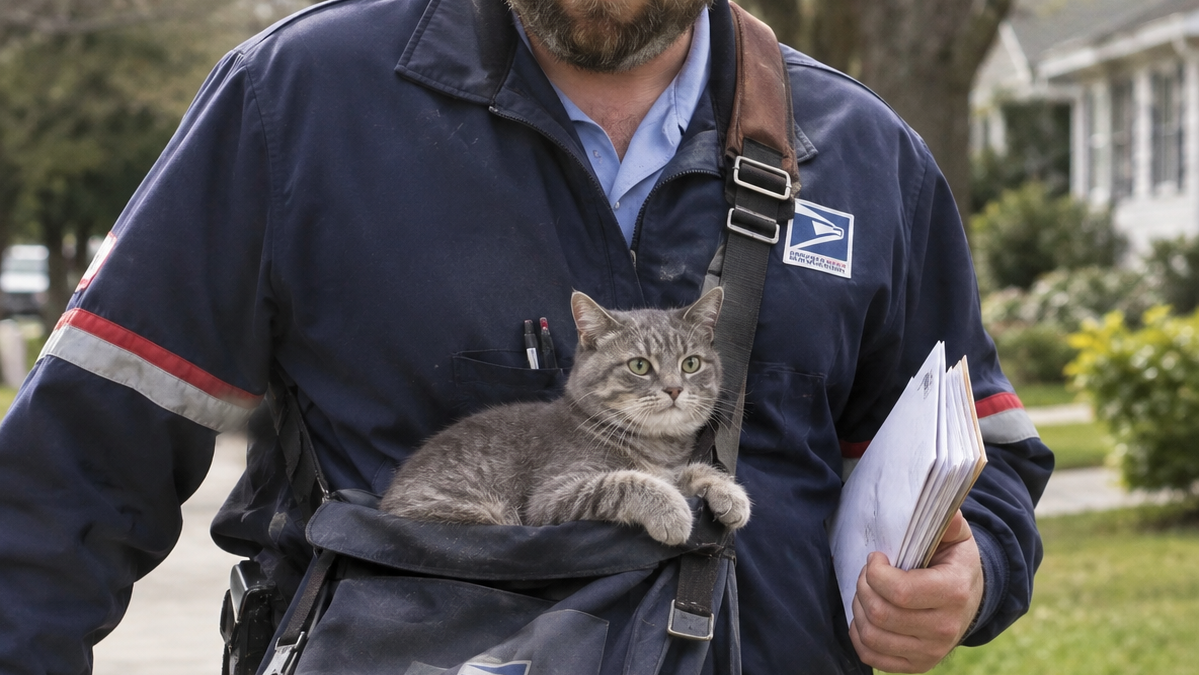
A Loose Pit Bull Charged a Stray Cat on My Mail Route—Two Hours Later, She Was Still Clinging to My Mailbag.
I had carried dog spray on my mail route for nine years and prayed I would never need it, but when a loose pit bull came charging toward a skinny gray cat trapped against a customer’s front door, there wasn’t time to think about anything except getting between them.
The dog turned and ran after I sprayed him, but the terrified cat stayed frozen on the porch until I crouched beside her—and then she climbed onto my leather mail satchel, dug all four paws into it, and refused to let go.
I still had forty-six houses and nearly two hours left on my route, and I had absolutely no idea that the strange little passenger pressed against my uniform was about to turn an ordinary workday into a story my wife would never let me live down.
I’ve delivered mail for nine years.
Nine years is long enough to learn things nobody tells you during training.
You learn which porch steps turn slippery before the rain actually starts.
You learn which doors have broken bells even though the owners insist they work.
You learn which retirees are waiting behind the curtains because the mail carrier may be the only person they speak to before dinner.
You learn which dogs bark because they are excited and which bark because they are giving you exactly one warning.
You learn where children leave bicycles across sidewalks.
You learn which customers order enough online shopping to fund an entire delivery company by themselves.
You learn who moves away.
Who gets married.
Who gets divorced.
Who starts receiving college letters.
Who suddenly starts receiving medical bills.
A mail route becomes a kind of biography written in envelopes.
I had been on my current residential route for most of those nine years.
Not every day.
We covered for one another when people were sick or on vacation.
Routes shifted occasionally.
But most weeks, I walked the same streets, climbed the same porches, and waved to the same people.
I knew every dangerous dog on the route.
That sounds like exaggeration.
It isn’t.
Mail carriers notice dogs.
We have to.
There was Bruno, a German shepherd on Linden Avenue who sounded like he wanted to remove my kidneys but would sit politely if his owner told him to.
There was Daisy, a beagle who escaped through a gap under the fence at least once every month and followed me for half a block until somebody retrieved her.
There was a little white terrier named Napoleon who weighed perhaps eleven pounds and considered himself responsible for national border security.
And there was Tank.
Tank was a large pit bull who lived three houses down from number 214.
I knew his house.
I knew the fence.
I knew his bark.
I knew the owner usually kept him in the backyard or inside.
I had never had a problem with him.
That matters.
Tank was not some dog who had spent years lunging at me through a broken fence.
He had never attacked me.
He had never even approached me loose.
Most of the time I saw him through a window or behind the gate, head high, watching me walk past.
I had probably delivered thousands of pieces of mail within fifty yards of that dog without incident.
But mail carriers do not get to assume yesterday’s situation will be today’s situation.
That is why I carried dog repellent.
Small canister.
Bright label.
Clipped where I could reach it quickly.
I hated it.
I never liked the idea of spraying a dog.
But I also did not like the idea of being bitten by one.
PART2:
There is a difference between loving animals and pretending animals cannot hurt you.
Dogs are dogs.
They have instincts.
Fear.
Territory.
Excitement.
Bad days.
Bad training.
Bad owners sometimes.
We carried spray because sometimes two seconds is all you get.
Until that Tuesday, I had never used mine.
Not once.
I had reached for it a few times.
I had put my thumb on the trigger once when a shepherd mix came through a broken screen door.
The owner grabbed him in time.
Another time, two loose dogs followed me down a block barking, and I kept the canister in my hand until they lost interest.
But I had never actually fired it.
Then came the gray cat.
I had seen her around for several weeks.
Not every day.
Just enough to recognize her.
PART3:
Small female.
Short gray coat.
Maybe a little white under the chin.
Thin.
Not skeletal, but definitely a cat who did not receive a bowl at the same time every morning.
No collar.
She moved between the houses along the middle section of my route.
Sometimes under parked cars.
Sometimes beneath shrubs.
Sometimes stretched in the sun on porches as if she had personally selected each property for its architecture.
She never approached me.
But she did not run far either.
I would see her watching from ten feet away while I put mail in a box.
“Morning,” I’d say.
She would blink.
Then I would continue.
That was our relationship.
There are more stray and community cats in residential neighborhoods than most people realize.
Some belong to someone but roam.
Some are fed by three different households that each believe they are the only one feeding them.
Some truly have nobody.
You learn not to assume.
I had asked one customer about the gray cat once.
“Is she yours?”
Mrs. Carter looked across her lawn.
“That little thing?”
“Yeah.”
“No.”
“She belong to anybody?”
“Not that I know of.”
Mrs. Carter lowered her voice as though the cat might overhear.
“Janice across the street puts food out.”
Of course Janice did.
There is always a Janice.
Every neighborhood has at least one person who claims not to own the local stray animals while simultaneously knowing their breakfast schedule, favorite canned-food flavor, and current relationship status.
A week later, I saw a dish of food beside Janice’s garage.
The gray cat was eating.
I figured she had the neighborhood arrangement handled.
Then Tuesday happened.
It was almost eleven in the morning.
Clear day.
Cool but comfortable.
I was a little behind schedule because one of the apartment clusters earlier on the route had received a stack of certified mail.
I had thirty or forty letters in the satchel across my chest, a bundle in my left hand, and my scanner clipped at my waist.
Number 214 had a mailbox beside the front door.
The house had a small covered porch.
Three concrete steps.
Blue front door.
Two chairs.
Usually nothing unusual.
That morning, the gray cat sat directly in front of the door.
She looked at me as I came up the driveway.
“Morning, supervisor.”
I talked to animals on my route.
Occupational side effect.
The cat stayed where she was.
I reached the bottom step.
Then I heard running.
Fast.
Heavy enough that I knew immediately it was not a little dog.
The sound came from behind me and to the left.
Nails against pavement.
Then grass.
I turned.
Tank.
No leash.
No owner.
Running full speed.
For half a second, I assumed he was coming toward me.
Training kicked in.
Turn sideways.
Do not run.
Get spray.
Use satchel as barrier if necessary.
Then I saw his eyes.
He was not looking at me.
He was looking past me.
At the cat.
The gray cat saw him at almost the same moment.
She shot toward the door.
But there was nowhere to go.
The door was closed.
The porch railing blocked one side.
A large planter blocked part of the other.
The dog was coming up the walkway.
The cat flattened herself against the blue door.
Tank was maybe twenty feet away.
Then fifteen.
I remember seeing the cat’s ears disappear backward against her skull.
I remember her body making itself tiny.
I remember thinking:
She’s trapped.
I wish I could tell you I made some heroic calculation.
I did not.
There was no calculation.
I stepped up onto the porch.
I put myself between them.
My mail went everywhere.
One bundle hit the porch floor.
A catalog slid under a chair.
I pulled the spray.
Tank kept coming.
“NO!”
I used the same voice I had used hundreds of times with loose dogs.
Deep.
Hard.
Command voice.
Tank did not stop.
Ten feet.
Maybe less.
I fired.
The spray caught him across the face.
He yelped.
Stopped so suddenly his front paws skidded.
He shook his head violently.
Then turned.
He ran back down the walkway.
Across the lawn.
Into the street.
I watched until he reached the direction of his house.
My heart was hammering.
Dog spray is designed as a deterrent, not a punishment.
I knew that.
Still, hearing a dog cry after you spray him is not a pleasant sound.
I did not feel triumphant.
I felt sick.
But I also looked behind me.
The cat was alive.
Still pressed against the door.
Completely motionless.
“You okay?”
No movement.
I picked up my dropped scanner.
My hand was shaking.
The spray canister went back into its holder.
Then I crouched.
“Hey.”
The cat stared.
Her pupils were huge.
Her entire body trembled.
Not metaphorically.
I could see it.
Her sides.
Her front legs.
Tiny vibrations through the fur.
The danger had gone.
Her body had not received that information yet.
I stayed several feet away.
“You’re all right.”
Nothing.
I collected the scattered mail because apparently even during animal emergencies the United States Postal Service still expected people to receive their grocery coupons.
I slid the envelopes into the mailbox.
Then I looked back.
The cat had not moved.
I took one step closer.
She did not hiss.
Did not run.
Did not swat.
She just stared.
I crouched again.
“Can I check you?”
I held out my fingers.
The gray cat watched them for maybe two seconds.
Then something changed.
She stood.
I thought she was finally going to run.
Instead she walked directly toward me.
One step.
Two.
Then she climbed onto my mailbag.
I do not mean she put her paws on it.
She climbed it.
My satchel was the traditional leather carrier bag worn cross-body, strap over my right shoulder, bag resting near my left hip.
The cat put both front paws on the leather flap.
Then climbed.
Claws caught the bag.
Back paws followed.
Before I understood what she intended, she had worked herself up against my chest.
Half sitting on the top of the satchel.
Half leaning against my uniform.
All four sets of claws hooked into leather.
I froze.
“Oh.”
She pressed closer.
Her head tucked under my chin.
I could feel her shaking.
“Well.”
I tried touching her back.
She allowed it.
“Okay.”
She stayed.
I waited a minute.
Then two.
Her breathing slowed slightly.
Eventually I said:
“I have to work.”
The cat did not appear concerned about my employment.
I put one hand beneath her.
“Come on.”
I tried lifting.
She tightened every claw.
The leather creaked.
“No.”
She held on harder.
I laughed despite the adrenaline.
“You cannot stay there.”
Apparently she could.
I tried again.
Very gently.
One paw released.
Then immediately reattached.
“Seriously?”
The cat buried her face against the front of my shirt.
I looked down the street.
No sign of Tank.
No owner running after him.
No obvious person to hand the cat to.
The house where she had been trapped appeared empty.
I rang the bell.
Nothing.
Knocked.
Nothing.
I considered putting her down in the yard.
Every time my hand moved beneath her, her claws tightened.
I did not want to force a terrified animal onto the ground after she had just decided I was the safest object available.
So I did something no training manual had ever addressed.
I adjusted the mailbag.
Made sure her weight was supported.
Picked up the next bundle.
And continued my route.
With the cat.
The first house was easy.
She stayed still.
The second house had three porch steps.
The cat tightened her grip every time I moved.
By the third, she had found a more comfortable position.
Her back paws sat on the satchel flap.
Front paws against the strap.
Her body rested directly against my chest.
She looked forward.
Like she had been assigned to the route.
I could feel her heartbeat through my uniform.
Fast at first.
Then slower.
House number four after the incident belonged to Mr. Perkins.
He was seventy-two and spent approximately nine hours a day on his porch whenever weather allowed.
He watched me come up the walk.
Then leaned forward.
He squinted.
I knew what was coming.
“Mike?”
That’s my name.
“Yeah?”
“There’s an animal on you.”
“I know.”
“Is that a cat?”
“Yes.”
He stared.
“Why?”
“Long story.”
The cat looked at him.
Mr. Perkins removed his glasses.
Cleaned them.
Put them back on.
The cat remained.
“Well, I’ll be damned.”
“Probably.”
“Does she work for the government now?”
“Temporary contract.”
He laughed so loudly the cat’s ears twitched.
“Careful.”
“Sorry.”
I handed him two envelopes.
He looked at the cat again.
“You stealing people’s pets now?”
“Occupational expansion.”
I kept walking.
At the next house, a woman came outside because her Ring camera had apparently alerted her to the unusual delivery method.
“Excuse me.”
“Yes, ma’am?”
“Is that a cat on your bag?”
I looked down as if noticing for the first time.
“Yes, ma’am.”
She stared.
“Is that normal?”
“No, ma’am.”
The cat blinked.
The woman laughed.
“Okay.”
I handed over her mail.
She asked, “Is it yours?”
“No.”
“Then whose is it?”
I considered the question.
“At the moment?”
“Yes.”
I looked down.
“Apparently mine.”
That answer would come back later.
At the time, I meant possession in the immediate logistical sense.
The cat was physically attached to me.
Therefore, operationally, mine.
I did not understand what I was saying.
My route covered several blocks on foot before I returned to the truck and moved to the next section.
Normally I walked at a pretty steady pace.
With the cat, I slowed.
Partly because I did not want to jar her.
Partly because every three houses somebody stopped me.
A man trimming hedges stared.
“Man, you know there’s a cat on you?”
“I’ve been informed.”
At another house, two little girls were drawing with sidewalk chalk.
One pointed.
“Kitty!”
Their mother looked up.
“Oh my God.”
The girls ran toward me.
The cat stiffened.
“Slow,” I said.
They stopped.
“Can we pet her?”
“Not today.”
“Is she your cat?”
“Not exactly.”
“Why is she on you?”
“She had a bad morning.”
The older girl looked serious.
“Did she miss the bus?”
I almost lost it.
“No.”
The mother apologized.
I told her there was nothing to apologize for.
The girls waved goodbye to the cat.
The cat watched them go.
A few houses later, I reached Janice’s place.
Remember Janice?
Neighborhood cat-feeding intelligence agency.
She was outside watering flower pots.
She saw the cat before she saw me.
“Oh!”
She dropped the hose.
“Gray Girl!”
I stopped.
“You know her?”
“Of course I know her.”
Naturally.
“What’s her name?”
“I call her Gray Girl.”
“That’s not much of a name.”
“She never told me another one.”
Fair.
Janice hurried over.
“What happened?”
I explained.
Loose dog.
Porch.
Spray.
Cat climbed onto bag.
Janice’s face changed.
“Tank?”
“You know him?”
“Everybody knows him.”
“He normally contained?”
“Yes.”
She looked toward his house.
“He got out last month too.”
That was new information.
“Did he hurt anything?”
“No. He chased a squirrel.”
I looked at the cat.
“Has she been around long?”
“Six weeks maybe.”
“Owner?”
“None I can find.”
“You’ve checked?”
“I posted her photo in the neighborhood group twice.”
Of course she had.
“No response.”
“Chip?”
“Couldn’t get her into a carrier.”
The cat was currently riding a federal employee like luggage.
“Apparently I should’ve brought the mailbag,” Janice said.
I smiled.
“Can you take her?”
I expected yes.
Janice hesitated.
“My husband’s cat hates other cats.”
“Could you hold her until I finish?”
“I could try.”
That was the problem.
Try.
I put one hand beneath the gray cat.
She immediately locked down.
Janice reached.
The cat flattened against me.
Not aggressive.
Panicked.
Her claws went through one edge of the leather and caught my shirt.
“Ow.”
“Never mind,” Janice said.
“Great.”
“I’m sorry.”
“It’s okay.”
“What are you going to do?”
I looked at the remaining bundles in my bag.
“Apparently deliver mail.”
Janice laughed.
Then realized I was serious.
“You’re going to keep carrying her?”
“She seems to have filed paperwork.”
Janice brought out a small dish of water.
The cat would not climb down.
So we held the bowl near her.
She drank.
That was the first time I realized how thirsty she might be.
Then Janice brought a little canned food.
“Do not feed her on my mail.”
“She’s skinny.”
“She can eat after work.”
The cat smelled it.
Her head came up.
For one beautiful moment, I thought food would persuade her to leave the bag.
Janice set the dish on the porch.
The cat leaned.
Stretched.
Then looked at the ground.
Looked at me.
Climbed higher.
“Nope,” Janice said.
“Excellent.”
She put a spoonful of food on a paper plate and held it near my chest.
The cat ate while attached to me.
There are dignity levels in every profession.
That day, I discovered one of mine.
A mail carrier can maintain authority while a stray cat eats pâté six inches beneath his chin.
Barely.
I left Janice’s house with the promise that she would continue trying to locate an owner.
The cat remained.
I had been worried she might panic when I returned to the postal vehicle.
Instead, she treated the truck like another part of the route.
I opened the passenger door.
Tried setting her on the seat.
She refused.
So I climbed into the driver’s side with the cat still on the satchel.
That was not going to work.
I could not safely drive like that.
“All right.”
I sat still.
“Negotiation time.”
The cat watched me.
“I need you to sit there.”
I pointed to the passenger seat.
She blinked.
“I cannot operate a government vehicle with you physically attached to my ribs.”
Nothing.
I slowly unhooked the satchel strap from my shoulder.
The cat remained on the bag.
That worked.
I placed the entire satchel—with cat attached—on the passenger seat.
Success.
She immediately sat upright on the bag.
I drove three blocks.
At the next walking loop, I put the satchel back on.
She remained attached to it as I lifted.
“Okay.”
Apparently the bag itself had become safety.
That made sense.
When the dog charged, she had climbed onto that bag while pressed against me.
Whatever association had formed, it was strong.
For the next two hours, the satchel belonged to both of us.
At some point, someone took the photograph.
I did not know until later.
The picture showed me walking up a driveway.
Blue-gray uniform.
Hat.
Mail bundle in one hand.
Leather satchel across my chest.
Gray cat sitting upright on top of it.
She looked directly ahead.
Ears up.
Completely serious.
I looked tired.
The photograph made it appear like we had been working together for years.
People later said the cat looked like my supervisor.
That was accurate.
The teenage boy with the phone appeared around the second hour.
I saw him filming.
“Please don’t.”
He laughed.
“This is going online.”
“I know.”
“Can I ask what happened?”
“No.”
“Is it your cat?”
“No.”
The cat looked up at me.
I sighed.
“Maybe.”
The boy laughed harder.
At another house, Mrs. Wallace stood beside her mailbox.
She was in her eighties and never missed an opportunity to ask questions.
“Michael.”
“Yes, ma’am.”
“There is a cat.”
“Yes, ma’am.”
“On your purse.”
“It is a mail satchel.”
“It’s a purse with government funding.”
I had no response.
She leaned closer.
The cat sniffed toward her.
Mrs. Wallace smiled.
“Pretty thing.”
“Don’t touch.”
“I wasn’t going to.”
She absolutely was.
“What happened?”
I gave her the short version.
Her face hardened.
“That loose dog again?”
“Again?”
“He chased my neighbor’s cat last week.”
That was the second mention.
I filed that information mentally.
“Anybody contact the owner?”
“Robert did.”
“Result?”
Mrs. Wallace gave me a look that answered perfectly.
The owner apparently had a habit of saying Tank had “just slipped out.”
I liked Tank.
I did not know the owner well.
But by that point, I was getting angry.
Not at the dog.
At the situation.
A strong, fast dog repeatedly getting loose in a neighborhood full of other animals was not a harmless accident.
It was a preventable problem.
I told myself I would report the incident properly after the route.
For now, I had forty-six houses turning into thirty.
Then twenty.
The cat stopped shaking completely.
She began looking around.
Birds.
Cars.
People.
Once, a dog barked behind a fence.
Her entire body tightened.
Her claws dug into the leather.
I put one hand over her back.
“You’re okay.”
She stayed.
Another dog barked farther away.
Same reaction.
I slowed.
“Still okay.”
By the final block, she had started purring.
I almost thought I imagined it.
Postal trucks make noise.
Street traffic.
Wind.
But when I stopped walking, I felt it.
Vibration against my chest.
She was purring.
“You’re unbelievable.”
Purr.
“You know you’ve destroyed this bag.”
Purr.
“You are not getting reimbursed.”
Purr.
At the last house, a little boy waited beside his grandmother.
He had obviously been watching from the window.
“Are you the cat mailman?”
I closed my eyes.
The grandmother laughed.
“I’m sorry.”
“No, you’re not.”
She laughed harder.
The boy approached carefully.
“What’s her name?”
“I don’t know.”
“You need to name her.”
“I don’t own her.”
He stared at the cat.
Then at me.
“She owns you.”
The grandmother made a noise that sounded suspiciously like agreement.
I handed them the mail.
“That is not how ownership works.”
The boy shrugged.
“You’re carrying her.”
Again, difficult to argue.
I finished the route at 1:07 p.m.
Two hours and change after the dog incident.
I sat inside the truck.
The cat stayed on the satchel.
“That’s it.”
She looked at me.
“Workday over.”
Nothing.
“You have to get off.”
Purr.
I removed the satchel again and placed it on the passenger seat.
Cat and bag together.
Then I slowly opened the flap beneath her.
She adjusted.
Still stayed.
I slid the remaining trays and paperwork away.
Then I waited.
Five minutes.
Finally, the cat stepped off the bag.
Onto the passenger seat.
I froze.
“Good.”
She sat.
Looked at me.
I had expected her to jump down and leave.
The truck door was closed, obviously.
But she did not search for an exit.
She just sat there.
I looked at the clock.
I was supposed to return to the station.
I also had a stray cat.
Postal regulations contain many rules.
I am reasonably confident there is no section titled WHAT TO DO WHEN A CAT ADOPTS YOUR SATCHEL AFTER A DOG INCIDENT.
I called my supervisor.
“Hey, Tom.”
“You done?”
“Route done.”
“Good.”
“I have a situation.”
“What?”
“There’s a cat in the truck.”
Silence.
Then:
“A dead cat?”
“What? No.”
“Why is there a cat in the truck?”
“She climbed onto my satchel.”
Another silence.
“And?”
“And she stayed there for two hours.”
Tom laughed.
He laughed hard.
“This isn’t funny.”
“It’s extremely funny.”
“She was almost attacked by a loose dog.”
The laughter stopped.
“What happened?”
I explained.
“You use spray?”
“Yes.”
“Dog retreat?”
“Yes.”
“You bit?”
“No.”
“Cat injured?”
“Doesn’t look like it.”
“Dog owner?”
“No contact yet.”
“You need incident paperwork.”
“I know.”
“What are you doing with the cat?”
“I’m taking her to get scanned.”
Tom sighed.
“Fine.”
“Fine?”
“You want me to tell you to throw her out?”
“No.”
“Then go scan the cat and come back.”
This is why Tom was a good supervisor.
He loved rules.
But he knew when reality did not fit neatly inside them.
There was a veterinary clinic five minutes from the end of my route.
I drove there.
The gray cat sat upright the entire way.
Every time I stopped, she looked through the windshield.
At the clinic, I carried her inside.
No carrier.
Just both arms.
She allowed it.
The receptionist looked at my uniform.
Then cat.
“Delivery?”
“Apparently.”
That joke happened a lot for the next several days.
They scanned her.
No microchip.
Checked for collar marks.
None.
Female.
About two years old.
Already spayed, according to the vet’s exam.
That was interesting.
Someone had cared enough at some point to have her fixed.
Could have been a community-cat program.
Could have been a previous owner.
Could have been a rescue.
The vet estimated she was underweight by maybe a pound or two.
Otherwise healthy.
No bite wounds.
No scratches from the dog.
No obvious injuries at all.
“She got lucky,” the vet said.
I looked at her.
“Yeah.”
Then the veterinarian corrected herself.
“Actually, you got there before luck became relevant.”
I did not know what to say to that.
They checked lost-pet databases.
Nothing.
The receptionist took a photo.
Posted it to a local lost-and-found page.
I called Janice.
“No owner yet,” she said.
“What should I do?”
“You’re asking me?”
“You’re the cat department.”
“I feed cats. That doesn’t make me municipal government.”
“Close enough.”
She offered to take the cat overnight if necessary.
But she reminded me about her territorial indoor cat.
The clinic could not hold her without intake paperwork through a shelter.
Animal control could take her.
That was the logical option.
I knew it.
The veterinarian knew it.
The cat sat on the exam table.
Then jumped onto my satchel, which I had placed on a chair.
Everybody looked at me.
“No.”
The receptionist smiled.
“I didn’t say anything.”
“She is not mine.”
The cat curled on the bag.
The vet said:
“She seems to have an opinion.”
“Everyone today has an opinion.”
I called my wife.
Her name is Sarah.
We had been married twelve years.
Sarah likes animals.
That is important.
Sarah also believes every animal I encounter will somehow become our financial responsibility if she does not supervise me.
That belief is not entirely unfounded.
Three years earlier, I brought home an injured pigeon in a shoebox.
Two years before that, I spent six hundred dollars on surgery for a rabbit I hit with my truck.
We currently had no pets.
Our old Labrador, Rosie, had died the previous year at thirteen.
We had agreed to wait.
Not because we did not want another animal.
Because losing Rosie had hurt in a way neither of us expected.
The house had become easier eventually.
Quieter.
Cleaner.
Also emptier.
I called Sarah.
“Busy?”
“Sort of. Why?”
“I need to ask you something.”
“No.”
“You don’t know what I’m asking.”
“You only use that voice when you’re about to create a problem.”
“Fair.”
“What happened?”
“I have a cat.”
Silence.
“What do you mean you have a cat?”
“I don’t own a cat.”
“That is not the same sentence.”
“A dog went after her.”
“What dog?”
“Tank.”
“The pit bull?”
“You remember Tank?”
“You complain about his owner.”
“I have never complained.”
“You have discussed him extensively in a negative tone.”
“Anyway.”
I explained.
Dog.
Spray.
Porch.
Satchel.
Two-hour route.
Vet.
No chip.
When I finished, Sarah said nothing for several seconds.
Then:
“You carried a cat for two hours?”
“She carried herself.”
“On your body.”
“On government equipment.”
“That is somehow worse.”
“I need somewhere for her to stay tonight.”
“You mean our house.”
“I didn’t say that.”
“You absolutely mean our house.”
“I could call animal control.”
Silence.
Sarah knew what a shelter meant.
Not death.
Not automatically.
Our local shelter did good work.
But it meant another transition for an already frightened stray.
“Bring her home,” Sarah said.
“Just tonight.”
“Of course.”
“Michael.”
“Yes?”
“You said ‘of course’ too fast.”
I arrived home around three.
Later than normal.
Uniform covered in gray fur.
Satchel visibly clawed.
Cat in my arms.
Sarah opened the door.
She looked at me.
Then the cat.
Then me.
“What happened?”
“I pepper-sprayed a dog and a cat adopted me.”
Sarah stared.
“That explains absolutely nothing.”
“I think it explains everything.”
The cat stretched toward Sarah.
Sarah’s face softened instantly.
“Oh, you’re tiny.”
Betrayal.
Immediate.
I had just carried this animal across forty-six houses and suddenly Sarah got the sweet voice.
“She’s underweight.”
“You took her to a vet?”
“Yes.”
“Chip?”
“No.”
“Healthy?”
“Yes.”
“Name?”
“None.”
Sarah took her.
The cat allowed it.
Then looked back at me.
I do not care what anyone says.
I saw the look.
Where are you going?
“I’m right here.”
Sarah noticed.
“Oh.”
“What?”
“She’s looking for you.”
“No.”
“She absolutely is.”
The cat climbed from Sarah’s arms back toward me.
I caught her.
Sarah folded her arms.
“You’re doomed.”
“We are fostering.”
“Sure.”
“Until we find the owner.”
“Sure.”
“Or a home.”
“Sure.”
“Stop saying it like that.”
Sarah laughed.
We put food and water in the laundry room.
Improvised litter box.
Old blanket.
The cat ate like she had missed several meals.
Not frantic.
Focused.
Then drank.
Then walked around the house.
She did not hide.
That surprised us.
She investigated the kitchen.
Living room.
Hallway.
Sniffed Rosie’s old basket, which we still had in the closet because apparently grief makes people store ridiculous things.
Then she found my satchel hanging near the front door.
She stopped.
Sniffed it.
Looked at me.
Jumped onto a small bench.
Then climbed onto the bag.
“Absolutely not.”
She curled up.
Sarah laughed.
“That’s her bed.”
“No.”
“She picked it.”
“It’s work equipment.”
“You have an entire closet of work equipment.”
“That is my main satchel.”
Sarah took a picture.
“What are you doing?”
“Documenting evidence.”
“For what?”
“The divorce when you choose the cat over me.”
The cat closed her eyes.
I moved the bag.
She woke.
Looked offended.
I set it on the floor.
She followed.
Curled on it again.
I gave up.
That night, she slept on the satchel.
Not the couch.
Not the blanket we put beside it.
On the leather bag.
Four paws tucked beneath her.
Head on the strap.
I woke around midnight and checked.
Still there.
Two in the morning.
Still there.
Six.
Still there.
When I picked up the satchel for work, the cat woke instantly.
She stood.
I lifted the bag.
She tried climbing aboard.
“No.”
Sarah came into the hallway laughing.
“You created a commuter.”
“I cannot take a cat to work.”
The cat put one paw on the satchel.
“No.”
Another.
“Absolutely not.”
Sarah picked her up.
The cat watched me put the bag over my shoulder.
Her ears angled forward.
I left.
When I returned that afternoon, she was sitting inside the front window.
The second my truck door closed, she stood.
By the time I opened the house, she was at the door.
Not meowing.
Just there.
I sat on the floor.
She climbed onto my lap.
Sarah leaned around the kitchen doorway.
“She didn’t do that with me all day.”
I tried not to smile.
“Really?”
“Don’t be smug.”
“I’m not.”
“You are deeply smug.”
The cat pushed her forehead under my chin.
I was deeply smug.
The photograph appeared online that evening.
The customer who had taken it posted it in the neighborhood group.
Caption:
Our mailman had an assistant today.
Within hours, somebody tagged somebody who tagged someone else.
Then the teenager posted his video.
There I was.
Walking down the sidewalk.
Cat attached.
A woman off camera asking:
“Is that your cat?”
My voice:
“Now, yes.”
That clip became the line everyone repeated.
Janice sent it to Sarah.
Sarah sent it to me.
I stared.
“I did not mean legally.”
Sarah replied:
Too late.
The post spread outside the neighborhood group.
Local animal pages.
Mail-carrier groups.
Someone posted:
USPS introducing same-day cat delivery.
Another:
Priority Meow.
Another:
Neither snow nor rain nor random attached felines.
Mail carriers are not known for allowing a joke to die gracefully.
By Wednesday morning, half the station had seen it.
I walked in.
Someone meowed.
Another carrier had taped a cat picture to my sorting case.
Tom handed me the incident report.
“Your partner coming?”
“No.”
“Shame. Productivity was high.”
I filled out paperwork about Tank.
Location.
Time.
Dog description.
Repellent discharge.
No bite.
No human injury.
No animal injury observed.
Animal control followed up with Tank’s owner.
That was the part the internet did not care about but mattered.
The owner had left a side gate unlatched.
Tank was fine after being rinsed.
No lasting injury.
Animal control warned the owner and documented the incident.
There had been at least one previous complaint about Tank getting loose.
The city required additional containment measures.
I was glad.
Not because I wanted Tank punished.
I did not.
Tank had done what a loose, prey-driven dog might do when he saw a small animal run.
The responsibility was with the person who allowed him access to the street.
People online argued anyway.
Some called Tank vicious.
Others blamed me for spraying him.
Some said I should have let “nature happen.”
I made the mistake of reading comments once.
Never again.
Nature was not relevant.
This was a residential neighborhood.
The dog belonged behind a secure barrier.
The cat was cornered against somebody’s house.
I had a legal and practical obligation to protect myself and prevent an immediate attack when I could.
The dog went home alive.
The cat went home alive.
That was enough for me.
The gray cat stayed.
Temporarily.
At first.
We posted notices.
Neighborhood group.
Lost-pet pages.
Shelters.
Veterinary clinics.
I printed a FOUND CAT notice and delivered copies personally along part of the route.
It felt ridiculous delivering a flyer about the cat who had ridden along while I delivered the previous day.
No one claimed her.
A woman contacted us saying the cat might belong to an elderly neighbor who had moved.
Wrong cat.
Another said she had seen the gray female living behind a gas station months earlier.
Possibly.
Nothing provable.
No microchip.
No collar.
No missing report.
After the required stray-hold process through the local system, there still was no owner.
By then, she had a name.
Registered.
That was Sarah’s fault.
Or mine.
Depends who tells the story.
We were sitting at the kitchen table trying names.
Sarah suggested:
Gracie.
“No.”
“Why?”
“Too normal.”
“You’ve been calling her Gray Cat.”
“That is functional.”
“Terrible.”
“Mail-related name?”
Sarah thought.
“Stamp.”
“No.”
“Postage.”
“Absolutely not.”
“Parcel.”
“That sounds like a goat.”
“Priority?”
“That sounds like a horse.”
The cat sat on my satchel by the door.
Sarah looked at her.
“She signed for you.”
I laughed.
“What?”
“She climbed onto your bag. Wouldn’t release.”
Sarah made a writing motion.
“Signature required.”
“Registered mail.”
We both stopped.
The cat looked at us.
Sarah smiled.
“Registered.”
“That’s terrible.”
“It’s perfect.”
“I hate it.”
“You’re smiling.”
Registered stuck.
We called her Reggie most of the time.
The first week, she slept on my satchel every night.
I bought her a cat bed.
Forty dollars.
Soft.
Round.
Machine washable.
She sniffed it.
Then slept on the bag.
Sarah bought another bed.
Window hammock.
Ignored.
Blanket.
Ignored.
Cardboard box from a grocery delivery.
Loved for twenty minutes.
Satchel remained number one.
I started bringing a second mailbag home from work so I could leave the damaged one for her.
She knew.
Would not sleep on the replacement.
“It smells different,” Sarah said.
“It’s the same model.”
“It doesn’t smell like you.”
That made me uncomfortable.
Sarah noticed.
“What?”
“Nothing.”
“You’re having emotions.”
“No.”
“You are.”
“I just don’t want a cat smelling my work bag.”
“Right.”
The truth was simpler.
Registered had attached meaning to the satchel.
Maybe because it was where she felt safe during those first minutes after Tank.
Maybe because she smelled me on it.
Maybe because cats are weird and there was no deeper explanation.
But every night, she returned.
Sometimes I would sit beside the bag and pet her.
She would roll slightly.
Expose her stomach.
Then immediately attack my hand if I interpreted that invitation incorrectly.
Normal cat.
I liked that.
I had worried the dog encounter might leave her fearful of everything.
It did not.
Dogs were different.
The first time she heard a dog bark through our front window, she disappeared under the dining table.
When a neighbor walked past with a Labrador, Registered flattened herself behind the couch.
We never forced her.
Eventually, she watched dogs from windows.
Then stopped hiding at distant barking.
Still, if a dog came close to the glass, she left.
That seemed fair.
I am not afraid of every dog because of one charge.
I still become more alert when I hear fast paws behind me.
Bodies keep records the mind thinks it has filed away.
Registered’s relationship with my work routine became increasingly ridiculous.
Every morning at 7:10, I put on my uniform.
She knew.
If the satchel came off the hook, she appeared.
Sometimes she sat on it before I could pick it up.
“Move.”
Nothing.
“I have federal obligations.”
Nothing.
“You cannot interfere with the mail.”
Purr.
I would lift her.
Set her down.
She climbed back.
Sarah once filmed five minutes of this.
“Do not post that.”
“I’m sending it to your mother.”
“That is worse.”
My mother loved Registered.
She told everyone I had rescued her.
I corrected her.
“I interrupted a dog chase.”
“You rescued her.”
“The spray did most of the work.”
“You carried her.”
“She climbed.”
“You adopted her.”
“She adopted the bag.”
My mother waved me off.
“You always have to ruin a nice story with details.”
Maybe.
But details mattered.
I did not want to make myself larger than what happened.
The important part was not that I was brave.
I was trained.
I had equipment.
I was standing where I needed to be.
The important part, if there was one, was what happened after.
Registered trusted.
We responded.
That was all.
Two months later, I saw Tank again.
Behind his new reinforced gate.
The owner had installed a second latch and an interior barrier.
Good.
Tank stood watching me.
I slowed.
I had wondered how I would feel.
Anger?
Fear?
He wagged once.
I stopped several feet away.
“Hey.”
Tank’s ears lifted.
No bark.
I tossed no treat.
Did not approach.
Just stood.
“You caused me a lot of paperwork.”
Tank wagged again.
I moved on.
The owner came outside.
“Mailman.”
I stopped.
His name was Darren.
Maybe thirty.
He looked embarrassed.
“I wanted to apologize.”
I waited.
“I should’ve fixed that gate sooner.”
“Yes.”
He nodded.
No excuses.
That helped.
“He okay?” I asked.
“Tank?”
“Yeah.”
“He was miserable for an hour. Vet said no damage.”
“Good.”
“I was mad at first.”
“I understand.”
“No.”
Darren shook his head.
“I was mad at you. Then animal control showed me the report.”
He looked toward the gate.
“He could’ve killed that cat.”
“Yes.”
“I didn’t think he would.”
“That doesn’t secure a gate.”
“I know.”
Silence.
Then:
“You kept the cat?”
I smiled.
“How do you know?”
“Everyone knows.”
Right.
“Yeah.”
“What’d you call her?”
“Registered.”
Darren stared.
“That’s bad.”
“Thank you.”
He laughed.
Then became serious.
“I’m sorry.”
This time I nodded.
“Keep the gate closed.”
“I will.”
We moved on.
No dramatic confrontation.
No enemies.
No lawsuit.
A man made a mistake.
The mistake could have killed an animal.
He took responsibility.
Fixed the problem.
That was a better outcome than rage.
Registered did not know any of that.
She was busy destroying one corner of our couch.
The irony did not escape me.
Sarah found her scratching the upholstery one evening.
“Reggie!”
The cat stopped.
Looked at us.
I laughed.
“What?”
Sarah pointed.
“She’s ruining the couch.”
“Maybe she had a difficult childhood.”
“That excuse is going to get expensive.”
We bought scratching posts.
Three.
Registered ignored two.
Used the cheapest one.
Naturally.
She also learned to chase paper.
That was unfortunate considering my occupation.
If I brought home any loose mail-related paperwork, she attacked it.
Once she shredded a union newsletter.
I considered that political expression.
At Christmas, my coworkers gave me a custom patch.
REGISTERED CAT DELIVERY UNIT.
I refused to wear it.
Tom hung it above my case.
Somebody else gave me a stuffed gray cat wearing a miniature postal bag.
Ridiculous.
Registered loved the stuffed cat.
Dragged it around the house.
Then disemboweled it.
Professional jealousy.
Spring came.
By then, she had gained weight.
Her coat became glossy.
The sharpness around her hips disappeared.
The veterinarian said she was exactly where she should be.
Two years old.
Healthy.
Indoor cat.
Vaccinated.
Microchipped.
Under owner name:
Michael and Sarah Bennett.
Seeing that on the registration form did something to me.
Owner.
I thought about all those weeks seeing her under cars.
On porches.
A cat who technically belonged nowhere.
Now some database somewhere connected her to our address.
Our phone numbers.
If she ever got lost, somebody could scan her.
Call us.
She had a place to be returned to.
I did not tell Sarah why I was staring at the form.
She knew anyway.
“You’re emotional.”
“I’m reading.”
“You have the face.”
“What face?”
“The Registered face.”
“There is no Registered face.”
“Sure.”
Our old Labrador Rosie had died eleven months before the day Registered climbed onto the satchel.
We had spent months telling each other we were not ready.
That statement had been true.
Then it stopped being true before either of us noticed.
Registered did not replace Rosie.
Nothing could.
Rosie had been with us through moving houses.
My first postal route.
Sarah changing jobs.
My father’s heart surgery.
A thousand ordinary evenings.
When she died, her absence lived everywhere.
No toenails on the floor.
No water bowl.
No leash.
No body at the foot of the bed.
Registered entered that emptiness sideways.
Not as replacement.
As interruption.
One night, Sarah said:
“Do you think Rosie sent her?”
I laughed.
“No.”
Sarah smiled.
“I knew you’d say that.”
“I don’t think dead dogs coordinate neighborhood emergencies.”
“You have no imagination.”
“I have a mail route.”
“Same thing.”
Registered slept between us that night.
Not on the satchel.
That was new.
Around six months after adoption, she began dividing her loyalty.
Satchel during the day.
Bed some nights.
Couch.
Window.
My lap when she decided I had sat still long enough.
One evening, I realized the satchel had been hanging untouched for three days.
I should have been relieved.
Instead, I felt almost sad.
“She’s abandoning it.”
Sarah stared.
“You complained about that bag for six months.”
“I’m observing.”
“You are emotionally attached to her emotional attachment.”
“That sentence is illegal.”
Registered walked past us.
Jumped onto the satchel.
Curled up.
I smiled.
Sarah pointed.
“There.”
“I said nothing.”
“You didn’t need to.”
The photo continued circulating online occasionally.
Every few months, someone would send it to me as if I had never seen it.
“That you?”
“Yes.”
Someone made a meme.
MAIL ESCORT SERVICE.
Another:
When your package requires purr-sonal delivery.
Terrible.
Then a larger animal page reposted the photo with a completely inaccurate caption claiming I had carried the cat “twelve miles through a snowstorm after saving her from an attacking pack of dogs.”
I reported it.
Sarah laughed.
“You hate improvements.”
“It was seventy degrees and one dog.”
“Less cinematic.”
“Truth matters.”
“On Facebook?”
“Especially on Facebook.”
The original story was strange enough.
It did not need snow.
A year passed.
On the anniversary, not that we officially called it one, I was delivering the same section.
Registered’s old porch.
Blue door.
Number 214.
I looked at the spot.
Nothing special.
The customer had changed the planter.
The porch chairs were gone.
Life moves furniture around even when something important once happened there.
I put mail in the box.
Then heard:
“Mike!”
Mrs. Carter from next door.
She waved.
“How’s your assistant?”
“Sleeping at home.”
“Still got her?”
“Of course.”
She smiled.
“Good.”
Then:
“You know she still comes up in neighborhood memories on Facebook.”
“I know.”
“You’re famous.”
“No.”
“The cat is famous.”
“That I accept.”
I kept walking.
At Janice’s house, she had left a small bag hanging from the mailbox.
My name on it.
Inside was a cat toy shaped like an envelope.
I shook my head.
Registered loved it.
Two years passed.
Then three.
Registered became less skinny stray, more confident house cat.
She developed strong opinions.
Wet food at six.
Not six-fifteen.
Window shade open by eight.
Bedroom door never closed.
If I worked overtime, Sarah said Registered waited near the front window around the time I normally returned.
I did not believe her until she sent video.
The cat sat facing the street.
Truck passed.
Head up.
Another.
Head down.
Postal vehicle turned onto our block.
Registered stood.
Walked to door.
I watched the video five times.
Maybe smell.
Maybe engine sound.
Maybe routine.
Did not matter.
She knew I came back.
That mattered to me more than I admitted.
At work, dog-safety training continued every year.
We watched videos.
Practiced positioning.
Discussed spray.
Satchels as barriers.
Do not run.
Do not assume.
One year, a new carrier asked:
“Have you ever had to spray one?”
Everybody looked at me.
I sighed.
“Yes.”
“Did it work?”
“Yes.”
“What happened?”
Tom said:
“Tell him the cat story.”
“No.”
The room erupted.
I told the short version.
Afterward, the instructor said:
“That’s actually a good example.”
“Of what?”
“Situational awareness.”
I thought.
Maybe.
But awareness alone was not the whole thing.
The cat had been lucky that I was there.
I had been lucky Tank responded to spray.
Tank had been lucky he was not hit by a car when he ran away.
A strange chain of seconds.
People like turning those moments into fate.
I do not.
I think ordinary days occasionally collide in ways no one planned.
Then people decide what to do.
That decision is the part we own.
When Registered was five, Sarah and I finally adopted another dog.
That took courage.
Not because of Tank.
Because of Rosie.
We chose an older golden retriever mix named Hank.
Eight years old.
Calm.
Good with cats.
The shelter introduction took forty-five minutes.
Registered sat behind a baby gate.
Hank sniffed.
Registered hissed.
Hank walked away.
Excellent.
At home, we introduced slowly.
Separate rooms.
Scent swapping.
Controlled distance.
Weeks.
I was terrified Registered would associate him with the dog charge.
She did not.
Not exactly.
She watched carefully.
Stayed high.
Never panicked.
Hank respected her.
Within two months, they shared the couch.
Not touching.
Within four, Registered slept against his side.
I took a photograph.
Sent it to Darren, Tank’s owner.
We had exchanged numbers after another neighborhood issue.
He replied:
That’s the same cat???
Yep.
He sent back a photo of Tank.
Gray around the muzzle now.
Behind his secure gate.
Funny how lives continue beyond the moment you know them for.
Tank became older.
Registered became comfortable around dogs.
I remained a mail carrier.
Years accumulated.
Rain.
Snow.
Heat.
Dogs.
Christmas packages.
Election mail.
Birthday cards.
Certified letters.
Catalogs nobody remembered requesting.
My knees began complaining more.
Registered stopped sleeping on the satchel every single night.
Maybe twice a week.
Then once.
She preferred our bed.
I never admitted I missed seeing her on it.
When she was eight, my original leather satchel finally became unusable.
Not because of her claws alone.
Years.
Rain.
Sun.
Wear.
One strap attachment cracked.
The supervisor issued another bag.
I brought the old one home.
Sarah asked:
“What are you doing with that?”
“Keeping it.”
“Why?”
I looked at her.
She smiled.
“Of course.”
I placed it beside Registered’s favorite window.
She sniffed.
Climbed on.
Turned three times.
Lay down.
Eight years after the porch, she still knew.
That bag stayed there permanently.
The leather softened further.
Scratches across the flap.
One deep mark from the first day.
I could not know which claw made which scratch.
Still, I sometimes traced them.
Evidence of fear becoming attachment.
Registered aged.
Not dramatically.
White hairs around her chin.
Longer naps.
Less interest in destroying paper.
When she turned ten, her veterinarian called her a senior.
I objected.
“She’s ten.”
“That’s senior.”
“She was two yesterday.”
The vet laughed.
“That is generally how pet ownership feels.”
Hank died that year.
Registered searched for him for days.
She slept on his bed.
That taught me something.
The little cat who had once climbed onto me because a dog terrified her had learned to love one.
Life did not erase the first fear.
It expanded around it.
A few months after Hank died, Registered returned to sleeping on the satchel every night.
I noticed.
Sarah noticed.
Neither of us said much.
Maybe smell.
Maybe comfort.
Maybe grief has patterns across species.
I do not know.
By then, the internet photo was old.
People still occasionally recognized me.
One new customer moved onto the route and looked at my name badge.
“Wait.”
I knew immediately.
“No.”
“You’re the cat mailman.”
I closed my eyes.
“Yes.”
“Where’s the cat?”
“At home.”
“You kept her?”
“Ten years so far.”
The customer smiled.
“That makes my day.”
“Glad somebody’s having one.”
He laughed.
I handed him his mail.
Then he asked:
“Best thing that ever happened on your route?”
I started to give the obvious answer.
Yes.
Registered.
Then I thought about it.
Nine years before her, and many years after, I had delivered pieces of people’s lives.
Acceptance letters.
Birthday cards.
Checks.
Condolence letters.
Passports.
Divorce documents.
Christmas packages.
Medical supplies.
I had called ambulances for customers.
Helped an elderly man after he fell.
Returned a toddler who slipped out an open gate before his mother realized.
Found lost dogs.
Noticed mail piling up and requested wellness checks.
A route is full of moments.
Still.
“Yes,” I said.
“Probably.”
Registered was thirteen when I retired.
Thirty-two years old when I started carrying mail?
No.
That would make no sense.
I had twenty-some years total by then.
Enough.
My knees were tired.
Shoulder too.
Thousands of miles walking with weight on one side had written itself into me.
On my last official day, my coworkers decorated my case.
There were photographs from years on the route.
One was that original picture.
Me.
Satchel.
Cat.
Underneath someone had written:
BEST DELIVERY: NOT USPS PROPERTY.
Tom had retired before me.
He came back for the party.
“You finally taking your partner home full-time?”
“She’s been home full-time for years.”
“I meant you.”
Right.
That first Monday after retirement felt wrong.
No uniform.
No alarm.
No satchel.
I sat at the kitchen table at eight in the morning.
Registered walked in.
Looked at me.
She seemed confused too.
“You’re stuck with me.”
She jumped onto the chair beside mine.
Then my lap.
“Good talk.”
The old leather satchel remained near the window.
One afternoon, I moved it to vacuum.
Registered appeared immediately.
Stood where it had been.
Stared.
“All right.”
I put it back.
She climbed on.
Sarah said:
“You moved her house.”
“She has twelve beds.”
“She has one bag.”
Fair.
Registered reached sixteen.
Then seventeen.
Older than Rosie had been.
Older than Hank.
She developed kidney disease.
Early at first.
Diet.
Monitoring.
More water bowls.
Then arthritis.
Little steps appeared beside the couch.
The cat who once climbed a leather bag without hesitation now calculated every jump.
I carried her more.
She liked that.
Especially from bedroom to kitchen.
I sometimes joked:
“Full circle.”
She would purr against my chest.
At seventeen, she spent most afternoons on the old satchel.
The leather was cracked.
Strap removed.
I placed a soft blanket under it because the bag itself had become hard.
She still chose the leather surface.
One evening, Sarah sat beside me.
Registered sleeping nearby.
“Do you remember what you said on the video?”
“What?”
“Someone asked if she was yours.”
I knew.
“Now, yes.”
Sarah smiled.
“You were right.”
“By accident.”
“Most important predictions are.”
Registered lived to eighteen.
Her final decline came gradually.
Kidneys.
Weight loss.
Less appetite.
More sleep.
The veterinarian gave us the language every old pet eventually brings into a home.
Quality of life.
Good days.
Bad days.
Comfort.
Pain.
We adjusted.
Fluids.
Medication.
Warm places.
Food whenever she wanted it.
Registered stopped climbing the couch.
Stopped waiting at the window.
But she still walked to the satchel.
Every night.
One morning, she did not eat.
Not breakfast.
Not tuna.
Not chicken.
Nothing.
She drank a little.
Then returned to the bag.
Sarah called the veterinarian.
I already knew.
Knowing and accepting are unrelated skills.
The vet came to the house that afternoon.
Registered lay on the satchel.
We could have moved her to a blanket.
We did not.
That was where she wanted to be.
I sat on the floor.
Same position, almost, as that porch eighteen years earlier.
Older knees.
Older hands.
Same cat.
She weighed less than half what she had in middle age.
I put one hand beside her.
Registered placed a paw on my wrist.
Not claws.
Just paw.
Sarah cried.
I did too.
The veterinarian gave the sedative.
Registered relaxed.
Her head settled against the worn leather.
I rubbed between her ears.
“You remember this thing?”
Purr.
Faint.
Maybe imagined.
Maybe not.
I thought about the first day.
Tank running.
Blue door.
Spray.
Scattered mail.
Gray cat frozen.
Then climbing.
Claws.
Weight against my chest.
Forty-six houses.
Two hours.
A thousand strangers online laughing about the mailman carrying a cat.
No one could see everything that followed inside that one photograph.
The mornings.
Vet appointments.
Furniture scratches.
Hank.
The window.
Sarah laughing.
The old satchel.
Eighteen years of a life.
The vet said:
“Whenever you’re ready.”
Nobody is ready.
I nodded anyway.
Registered’s breathing slowed.
I kept my hand on her.
“You did good.”
Her eyes closed.
“You’re off duty.”
Sarah laughed through tears.
Then Registered was gone.
For a long time, we did not move.
The veterinarian waited.
No hurry.
Eventually, Sarah touched the leather bag.
“What do we do with this?”
I looked down.
The question felt impossible.
Throw it away?
No.
Store it?
Maybe.
I could not decide.
So I left it where it was.
For months.
Empty.
The first time I walked past and saw no cat there, the house felt wrong.
That feeling softened.
Not disappeared.
Softened.
A year later, Sarah suggested donating some old pet things.
Beds.
Bowls.
Unused carriers.
I agreed.
Then she picked up the satchel.
“No.”
She stopped.
“Okay.”
I laughed.
“I know it’s stupid.”
“No.”
“It’s an old damaged mailbag.”
“It’s Registered’s bed.”
That was the truth.
We kept it.
It sits in my office now.
Not displayed dramatically.
No plaque.
No framed viral photo beside it.
Just the bag.
Sometimes visitors ask why an ancient leather postal satchel is sitting beneath the window.
If I like them, I tell the story.
I tell them about the loose dog.
The porch.
The spray.
The cat who climbed up and refused to get down.
I tell them about forty-six houses.
The woman who asked:
“Is that normal?”
And my answer:
“No, ma’am.”
I tell them about Sarah opening the door.
“What happened?”
“I pepper-sprayed a dog and a cat adopted me.”
“That explains absolutely nothing.”
“It explains everything.”
People laugh.
That is the right reaction.
The story is funny.
It is strange.
It has a happy middle.
People sometimes focus on the dramatic beginning.
Dog charging.
Spray.
Rescue.
But when you have lived an entire lifetime with an animal, the dramatic beginning becomes surprisingly small.
The important part is everything after.
Breakfast.
Litter boxes.
Vet visits.
A scratched couch.
The cat waiting in the window.
The dog she eventually trusted.
The old bag she refused to stop loving.
Ordinary days.
Hundreds.
Thousands.
That was what Registered gave us.
Not a heroic rescue story.
A life.
A very normal, slightly ridiculous life.
Looking back, I do not think she climbed onto me because she instantly understood I was a good person.
Cats are not judges in robes.
She was terrified.
A dog had nearly reached her.
I happened to be the large object between her and danger.
My bag smelled like leather and paper and probably nine years of sweat.
She grabbed it.
Then she did not let go.
Maybe the whole story began with nothing more complicated than that.
Fear.
Safety.
Leather.
Claws.
But relationships do not need mystical beginnings to become meaningful.
What happens next matters more.
She trusted the bag first.
Then me.
Then Sarah.
Then the house.
Eventually even another dog.
Every expansion was small.
But by the end, the world that had once narrowed to one blue door and an approaching pit bull had grown into eighteen years of places where she was safe.
That is enough magic for me.
I still walk sometimes.
Not mail routes.
Just the neighborhood.
Old habit.
I pass houses where I used to deliver.
Some customers are gone.
Some homes have new owners.
Fences changed.
Trees taller.
Tank died years ago.
Darren told me.
Old age.
He had been a good dog after that incident.
Secure gate.
Training.
No more escapes.
I was glad.
Tank was never the villain of Registered’s life.
He was a dog in the wrong place because a human failed to secure him.
That distinction always mattered to me.
The blue-door house changed owners twice.
The porch was remodeled.
If I stood there now, nobody would know a frightened stray cat once pressed herself against that door while a mail carrier threw letters across the porch and reached for dog spray.
Places forget.
People remember.
Photographs remember a little.
Objects sometimes remember more.
The old satchel still carries claw marks.
Four deep ones across the upper flap.
I cannot prove those were from the first day.
They probably were.
Sometimes I run my thumb across them.
Leather raised around the scratches.
Permanent.
I think about how terrified she must have been to hold that tightly.
Then I think about all the nights she slept on the same surface voluntarily.
Fear transformed the object into safety.
That may be the strangest part.
People sometimes ask why she never switched to a comfortable bed.
Maybe the bag reminded her of me.
Maybe it reminded her of the day she survived.
Maybe she simply liked leather.
Who knows?
Cats are allowed mysteries.
One thing I know:
I spent nine years delivering mail before Registered.
Years of dogs.
Rain.
Heat.
Snow.
Christmas packages.
Long streets.
Heavy bags.
Routine.
Then one Tuesday, for two hours, I carried something alive instead of envelopes.
A gray cat pressed against my chest.
Forty-six houses.
One driveway after another.
People laughing.
People pointing.
The cat looking forward like she knew exactly where we were going.
I thought I was finishing my route.
She apparently thought we were heading home.
Turns out she was right.








