A Lonely Rancher Opened His Door to Four Silent Children—Then He Saw the Letter in Their Hands
PART3:
I had spent three decades avoiding responsibility for anything that could look back at me with human eyes.
Now four children waited for me to decide whether their mother’s trust had been misplaced.
I cleared my throat.
“Well,” I said, because a man facing ruin will often begin with foolishness, “I don’t rightly know how to feed four children.”
Delia stepped past me into the house.
“Mama said you’d figure it out.”
I stared after her.
“Horses are simpler than children.”
She set her bag down by the table.
“That’s what Mama said you’d say too.”
The boys followed her inside.
Nell remained on the porch.
She looked up at me for a long moment.
Then she crossed the threshold without a word.
And just like that, my quiet life ended.
I made flapjacks that first morning.
Badly.
There are foods a man can cook for himself for twenty years and still discover he has no business serving them to children. The first batch burned on one side and sagged wet in the middle. The second was better only because Delia took the spoon from my hand and said, “You’re stirring like you’re angry at breakfast.”
“I was not aware breakfast had feelings.”
“Everything has feelings if you ruin it enough.”
Sam laughed.
Eli said, “Mama makes them thinner.”
Nell said nothing.
She sat on the bench with her doll in her lap, moving one torn cloth hand back and forth with her thumb.
I gave her the least-burned flapjack.
She stared at it like it might betray her.
“Does she talk?” I asked Delia quietly later, after the boys had gone to inspect my barn without permission.
“When she’s ready,” Delia said.
Her voice carried warning beyond her years.
“Mama says forcing it only makes it worse.”
“I wasn’t forcing.”
“You were wondering too loud.”
That child had Vera’s blood sure enough.
The first days were chaos wearing small boots.
I had imagined, foolishly, that sheltering children meant giving them beds and keeping them fed until their mother returned.
That was like saying ranching meant owning cows.
True in the least helpful way.
Children required constant translation.
Sam and Eli were twins only to the untrained eye. Within two days, I learned Sam was the one who spoke softly to horses and loudly to people, while Eli spoke loudly to everyone and trusted fence work more than conversation. Sam could calm my nervous bay mare by standing near her stall and murmuring nonsense. Eli could spot a loose rail from thirty yards away and complain about fixing it the entire time he did.
Delia carried too much.
That was clear by supper the first night.
She cut Nell’s food, corrected the boys, folded blankets, checked the water bucket, and watched me as if expecting me to fail some test Vera had not told me existed.
I wanted to say, You are eleven. Sit down.
But I recognized something in her face.
If I took responsibility from her too quickly, it would not feel like relief.
It would feel like danger.
So I let her help.
At first.
Nell followed everyone and trusted no one.
She moved like a shadow through my house, appearing in doorways, near chairs, by the stove, always clutching that rag doll. Her hair came loose constantly. The first morning I tried to braid it, I made such a poor job that one side stuck out like a frightened rope.
Delia took over before Nell cried.
“You’re pulling too tight,” she said.
“I am doing my best.”
“Your best hurts.”
She showed me properly.
I practiced on a piece of twine that evening after they slept.
I told myself it was practical.
It was not.
It was the beginning of loving them.
I simply did not know it yet.
By the end of the first week, my house had changed beyond recognition.
There were tin cups drying on the porch rail.
A small coat hung too low by the door.
The wash line carried stockings.
The kitchen smelled of bread more often than coffee.
My evenings were no longer silent. They were full of quarrels over chores, boots dropped in the wrong place, Delia humming while she peeled potatoes, Sam reporting horse opinions no one had requested, Eli objecting to Sam’s reports on principle, and Nell sitting near the fire with her doll, watching me as if I were a weather pattern she had not decided to trust.
I slept badly.
Not because of the noise.
Because of the letter.
Each night after the children went to bed, I took Vera’s letter from beneath the Bible on the shelf and read it again.
Do not come looking for me.
That line angered me more every time.
Vera knew me too well.
She knew my first instinct would be to saddle a horse and follow every track until I found her. She knew I would tell myself the children were safe enough with a neighbor woman or a hired hand. She knew I would try to fix the danger directly because men alone often mistake action for usefulness.
So she forbade it.
And because it was Vera, because the old trust had never broken even when life put distance between us, I obeyed.
For two weeks, no one came.
Then one afternoon, three riders appeared on the south road.
I saw them from the corral.
Not neighbors.
Not lost.
Men who rode too casually toward another man’s house are rarely casual by accident.
I sent the children inside before they reached the yard.
Delia understood immediately.
The boys resisted.
Nell’s eyes went wide.
“Inside,” I said.
They went.
The lead rider was a thick-necked man with a dark mustache and a gray hat pulled low. The two behind him kept their hands loose near their thighs. Not threatening enough to call a threat. Not innocent enough to ignore.
“Afternoon,” the lead rider said.
“Afternoon.”
“Looking for Vera Langley.”
“Haven’t seen Vera in some time.”
That was true in the narrowest possible sense.
His eyes drifted past me.
To the porch.
Four cups drying on the rail.
A rag doll on the top step.
A child’s coat hanging near the door.
“Considerable amount of washing for one bachelor,” he said.
I looked toward the porch as if surprised by my own domestic evidence.
“My sister’s children visit some summers.”
“Is that right?”
“Gone back to town this week.”
His smile did not move.
Neither did mine.
He studied me for a long moment.
“Mrs. Langley could be in trouble.”
“Then I expect the sheriff would like to know that.”
His eyes sharpened.
“Sheriff can’t help with everything.”
“No,” I said. “But I find men who say that are usually the reason.”
The two riders behind him shifted.
My rifle leaned against the fence post three steps away.
Not in my hands.
Visible.
That mattered.
The lead rider touched his hat.
“You hear from her, tell her Mr. Voss would like a word.”
“I will tell her nothing of the kind.”
His smile disappeared.
Then he turned his horse.
They rode away without looking back.
Only when they vanished over the rise did I feel my hands shaking.
Inside, Nell stood at the window.
Her small face pale.
I went in, knelt before her, and lied as gently as I knew how.
“Just men asking about cattle prices.”
She studied me.
Children know more truth than adults want them to.
“Will Mama know where to find us?” she whispered.
It was the first full sentence I had heard from her.
It nearly broke me.
I wanted to say yes with certainty.
I wanted to say your mother is safe, your father’s death will be answered, no one will hurt you, and every promise made to children can be kept if spoken by a man who means it.
But I had lived long enough to know better.
So I gave her the strongest truth I had.
“Your mama knows this ranch better than the road to town,” I said. “She’ll find you.”
Nell looked at me.
“You promise?”
That was the first time one of Vera’s children asked me for something larger than food or a braid or a fixed toy.
“Yes,” I said.
I had no right to promise it.
I did anyway.
By the end of the first month, the children had become part of the ranch in ways I could no longer separate.
Sam had a gift with horses.
Not the noisy, proud kind men like to claim after surviving one gentle mare. A real gift. He noticed ears, breath, stance, fear. He waited. Animals rewarded that.
Eli became my shadow during repairs. He complained about nails, mud, splinters, wind, bad tools, and Sam’s “horse whisper nonsense,” but he worked until the work was done.
Delia started asking my opinion.
Not often.
Small things.
“Do you think supper can wait until the boys finish bringing water?”
“It can.”
“Should I use the last onions tonight or save them?”
“Save them.”
“Do you think Mama will be angry I let Nell wear her blue dress twice without washing it?”
“I expect your mama has larger matters in mind.”
Delia looked down at the dress in her hands.
“Still.”
“We’ll wash it tomorrow.”
Her shoulders loosened.
That was when I realized she was not asking about onions or dresses.
She was asking whether she could stop being the only adult in her own childhood.
Nell took longest.
She watched me from doorways.
Followed me at a distance.
Sat near my chair but never too near.
Then one evening, after a long day moving cattle, I came inside exhausted and dropped into the rocker by the fire.
Nell climbed into my lap without a word.
I froze.
She tucked herself against my chest, doll pressed between us, and fell asleep within minutes.
I sat there long after my legs went numb.
Delia saw.
She said nothing.
But her face changed.
From then on, Nell came to my lap most evenings.
Not always.
Only when she chose.
I learned children, like skittish horses, trust better when no one grabs for it.
While we were building a life Vera had not planned, she was fighting for the old one.
Her letters came rarely and by careful routes.
Never long.
Never with enough detail to endanger anyone.
I learned later what she had been doing: traveling under her maiden name, moving between county offices, land records rooms, old claims offices, and dusty hotels where clerks became nervous the moment Edmund Voss’s name entered the air.
Voss owned land across three counties.
He had friends in banks.
Friends near judges.
Friends who owed him money.
Men like that do not need to threaten loudly. Their power arrives before they do.
Thomas Langley had found something in old land records—something about water access, mineral rights, and falsified boundary claims that would have made Vera’s land worth far more than anyone in town knew. Voss wanted it. Thomas refused him. Then Thomas died in a wagon accident on a road he knew too well to make the mistake they claimed he made.
Vera had gone to the sheriff once.
He believed her.
But belief is not proof.
So she went to find proof.
She left her children with me because she knew Voss could force land from a mother more easily than from a widow alone.
I understood that.
I hated it.
But I understood.
The first real scare came in the second month.
Eli vanished.
Only for twenty minutes.
Twenty minutes is nothing unless a child is missing, and then it becomes a country too large to cross.
He had been sent to gather eggs with Sam. Sam returned alone, angry.
“He said he could find a better nest in the lower shed and wouldn’t listen.”
“Where is he?”
Sam’s anger disappeared.
“I thought he came back.”
He had not.
Delia went white.
Nell began crying without sound.
I grabbed my hat and called Eli’s name until my throat hurt. Sam ran toward the lower shed. Delia searched the wash area. Nell stood on the porch clutching her doll with both fists.
I found Eli near the dry creek bed, sitting behind a fallen cottonwood, knees pulled to his chest.
He was not hurt.
He was shaking.
I dropped to one knee a few feet away.
“Eli.”
He wiped his nose with his sleeve.
“I wasn’t hiding.”
“I see.”
“I was checking tracks.”
“Behind a tree?”
He glared.
“I thought those men came back.”
My anger drained away.
He had seen something near the wash trail.
Fresh hoof marks.
Maybe from a neighbor.
Maybe from no one important.
Maybe from Voss’s men.
To a nine-year-old boy whose mother was gone and whose father was dead, every track looked like danger.
I sat beside him.
“Next time you think someone came, you tell me.”
“I was going to protect Nell.”
The words were so fierce and so small that I had to look away.
“That is my job,” I said.
He shook his head.
“Mama said we all watch each other.”
“She was right.”
“Then it’s my job too.”
I thought about arguing.
Instead, I said, “Then we do it together. Watching does not mean wandering off alone.”
He sniffed.
“You mad?”
“Yes.”
His chin trembled.
“I’m also glad I found you.”
That confused him.
Adults often confuse children by having more than one feeling at once.
I put a hand on his shoulder.
“You scared me half to death.”
“I did?”
“Yes.”
He looked down.
“I didn’t know I could.”
That hurt.
So I said what I should have said much earlier.
“You can.”
His face changed.
Something inside that boy, always loud to cover fear, heard the truth.
He mattered enough to frighten me.
We walked back together.
Nell ran to him first.
Then Delia.
Then Sam punched his arm and hugged him so fast he pretended not to.
That night, Eli fell asleep on the rug with his head against my boot.
I did not move for an hour.
By the time Vera returned, nearly two months had passed.
She came at dusk.
I was by the barn when I heard the wagon.
The children heard it too.
Nell was the first out the door.
Then Sam and Eli.
Then Delia, who made it halfway down the steps before all her careful strength shattered and she ran like the child she had been refusing to be.
Vera climbed down from the wagon just in time to be nearly knocked over by four children at once.
I stood back.
That reunion did not belong to me.
Vera looked thinner.
Harder.
Her dress was dusty. Her face pale from travel. But her eyes were alive in a way that told me she had not returned defeated.
She held her children and cried into their hair.
Nell sobbed loudly, great broken sounds that seemed to surprise everyone, including herself.
“Mama,” she kept saying. “Mama. Mama.”
Vera sank to her knees in the yard and held them all.
I turned away because some moments should be protected even from witnesses who helped make them possible.
Later, when the children had eaten and talked themselves into exhaustion, Vera sat at my kitchen table with a cup of coffee between both hands.
“He’s been arrested,” she said.
“Voss?”
She nodded.
“And two of his men. Maybe more by morning.”
I sat across from her.
“What did you find?”
“Enough.”
Her voice was steady, but her fingers trembled around the cup.
“Thomas kept copies hidden in the old smokehouse. Land records. Receipts. Names. I found a former ranch hand of Voss’s two counties over. He had seen a ledger entry from the week Thomas died.”
“What entry?”
Her eyes hardened.
“Langley matter settled.”
The words sat between us like a grave marker.
“The sheriff has it?”
“All of it.”
“Good.”
Vera looked toward the bedroom where the children slept.
“I thought I would come back and find them exactly as I left them.”
I followed her gaze.
“They’re still yours.”
“I know.”
Her voice softened.
“But they’re not only mine now, are they?”
I did not know how to answer.
She looked at me.
“You learned them.”
It was not a question.
I tried to shrug.
“They were here.”
“Ezekiel.”
I looked down.
“Yes,” I said. “I learned them.”
A faint smile touched her tired mouth.
“Delia says you burn flapjacks less now.”
“Delia exaggerates my progress.”
“Nell says you braid badly but kindly.”
“That is accurate.”
“Sam says the horses like you but prefer him.”
“He is correct and arrogant about it.”
“Eli says you let him fix real fence, not pretend fence.”
“He complains too much for pretend work.”
Vera laughed.
It was small and tired.
But it was laughter.
I had not heard her laugh since we were children by the creek, arguing over fish neither of us ever caught.
The next week, Vera stayed at my ranch while the legal matter unfolded.
Voss’s reach had been long, but not long enough to strangle every honest man in the territory. Once Vera’s evidence gave the sheriff cause to act, other families came forward. Families pressured, threatened, cheated, frightened into silence until one widow’s stubborn proof made speaking safer.
Thomas’s death was reopened.
Witnesses changed their stories.
A damaged wheel pin, once dismissed as accident, became evidence.
The men who had ridden to my property were found tied to Voss’s foreman.
The law moved slowly, but it moved.
Meanwhile, Vera watched her children inside my house.
That was its own trial.
Not painful exactly.
But complicated.
She saw Sam lead my bay mare from the barn, talking softly as if he had been born there.
She saw Eli scold me for using the wrong nails on a gate repair.
She saw Delia hand me a grocery list because “you’ll forget salt again.”
She saw Nell climb into my lap after supper and fall asleep with absolute certainty.
The first time it happened after Vera returned, I went still.
Nell tucked her face under my chin.
Vera watched from across the room.
I could not read her expression.
“I can move her,” I said quietly.
Vera shook her head.
“No.”
So I sat there.
Nell slept.
Vera looked at us for a long time.
Then looked toward the fire.
The next afternoon, Vera and I walked the fence line between our properties.
It was the same land we had known as children, though age had stretched the distances and filled them with ghosts. Her father’s old pasture lay beyond the ridge. My north field rolled toward it. Two pieces of land. Two lives that had grown separately despite beginning side by side.
“You still hammer nails crooked,” Vera said, watching me repair a post.
“You still notice things nobody asked you to notice.”
“Somebody has to.”
“You marched into my father’s barn at eight years old accusing me of stealing your fishing spot.”
“It was the best spot.”
“It was.”
She turned sharply.
“You never admitted that.”
“I didn’t want to lose the argument.”
For a moment, we were children again.
Then grief returned, but softer.
Vera leaned against the fence.
“Thomas loved that creek.”
“I know.”
“He wanted to build another shed near it.”
“You still can.”
Her eyes moved to me.
“I don’t know what I’m building now.”
That was the honest center of it.
Neither did I.
That evening, after the children slept, Vera came to the porch and sat beside me without asking.
For a while, we listened to crickets.
Then she said, “Nell called you Papa before I could get her bonnet off.”
I closed my eyes.
“She was frightened.”
“She meant it.”
“She is five.”
“Five-year-olds can mean things.”
“That does not mean the rest of us should build a life on it.”
Vera looked at me.
I kept my eyes on the dark yard.
“She can call me whatever makes her feel safe,” I said. “I’ll answer gladly. But I won’t have you thinking your children decided something you and I did not choose honestly.”
The porch was quiet.
“That is a great deal of restraint from a man who spent two months practically raising them.”
“Restraint is about the only thing I’ve practiced well in thirty years alone.”
“Is that what you call it?”
“What would you call it?”
“Fear, maybe.”
The word landed too close.
I said nothing.
Vera’s voice softened.
“I have fear too.”
“I expect you do.”
“I still think of Thomas every day.”
“You should.”
“Sometimes I feel guilty sitting here with you.”
“You needn’t.”
“That does not stop it.”
“No.”
She looked toward the children’s window.
“Thomas would have wanted them safe.”
“Yes.”
“And loved.”
“Yes.”
“And raised by someone who treats that responsibility like it matters.”
I swallowed.
The night air felt colder suddenly.
“Vera.”
“I’m not saying more tonight.”
That was very like her.
Say enough to crack a man open.
Then leave him to examine the damage.
The next evening, Nell solved what the rest of us had been circling.
She climbed into my lap after supper, doll in hand, hair braided crookedly by me and corrected mercifully by Delia.
Vera sat nearby mending a shirt.
The boys argued in whispers over whether a frog found near the pump could be kept in a jar until morning.
Delia told them both they were fools.
Nell patted my chest.
“You’re staying too, Papa.”
The room stopped.
Sam and Eli looked up.
Delia’s needle paused.
I looked at Vera.
She held my gaze for a long moment.
Then she said softly, “Let her have it.”
My throat tightened.
“Vera—”
“She worked out the ending before either of us managed to.”
“That doesn’t mean—”
“I’ve had my days to think, Ezekiel. Same as you asked of me without asking.”
The boys had gone completely silent.
Delia watched with those careful eyes, but there was something hopeful beneath the guard.
Vera crossed the room and sat beside us.
“I choose this,” she said. “Not because Nell said the word. Not because I am afraid. Not because I need a man to do what I already proved I can do myself.”
Her voice shook once.
Then steadied.
“I choose this because I watched you love my children without trying to own them. I watched you protect Thomas’s name instead of stepping over it. I watched you make room.”
I could not speak.
Vera placed one hand over Nell’s back, where the child rested against me.
“And because I am tired of believing grief is the only faithful thing left to me.”
The fire popped.
Eli whispered, “Does this mean supper is late?”
Delia smacked his shoulder.
I laughed.
It broke out of me before I could stop it.
Then Vera laughed too.
Then Sam.
Then even Delia, though she tried to hide it.
Nell only sighed against my shirt, pleased with herself.
“I choose it too,” I said.
Vera looked at me.
“For the same reasons.”
We did not marry immediately.
That mattered.
The children had already lived through enough sudden changes. Vera had just survived months of danger, grief, pursuit, and justice. I had discovered, at an age when many men settle into their hard shapes permanently, that my life was not finished after all.
We moved carefully.
Vera returned to her property with the children at first, and I rode over most mornings. Then the children came back and forth so often that no one knew which boots belonged near which door. We repaired the Langley house where neglect and fear had left marks. We restored the fences Thomas had built. We worked both ranches as one operation long before anyone said the words.
“Seems wrong letting it sit idle,” Vera said one day, looking over her pasture.
“Then we won’t let it.”
“Thomas loved this land.”
“I know.”
“It should not be abandoned just because the family is changing.”
“No,” I said. “Land deserves tending. Whoever’s name sits on the deed.”
She looked at me then with something like peace.
Voss was convicted the following winter.
Not only for Thomas, though that was the wound closest to us, but for the pattern Vera had helped uncover: intimidation, forged claims, bribery, violence dressed as accidents, land taken from families who had been too isolated to fight.
Vera did not celebrate when the news came.
She stood on the porch, read the letter from the sheriff twice, then folded it carefully.
“Good,” she said.
That was all.
At night, I found her by Thomas’s photograph.
She touched the frame once.
“They heard me,” she whispered.
I stayed in the doorway.
After a while, she reached back without turning.
I took her hand.
The following spring, we married on the fence line between our properties.
It was Vera’s idea.
“Seems fitting,” she said. “A boundary is as good a place as any to stop being one.”
The day was bright, wind moving through new grass, cattle lowing in the distance as if offering commentary. Delia stood beside Vera, no longer guarded. Sam and Eli wore shirts clean enough to count as a miracle. Nell insisted on holding both our hands through as much of the ceremony as the preacher would allow.
When I spoke my vows, I did not promise to replace Thomas.
No honest vow could.
I promised to honor what had been built before me, to protect what had been trusted to me, to stand beside Vera in truth, and to love the children not as borrowed burdens but as my own chosen family.
Vera promised much the same, though better worded, because she always could out-speak me when it mattered.
Afterward, Nell announced, “Now it’s official.”
Eli said, “It was official before.”
Sam said, “Horses knew.”
Delia rolled her eyes and cried at the same time.
Years changed the porch.
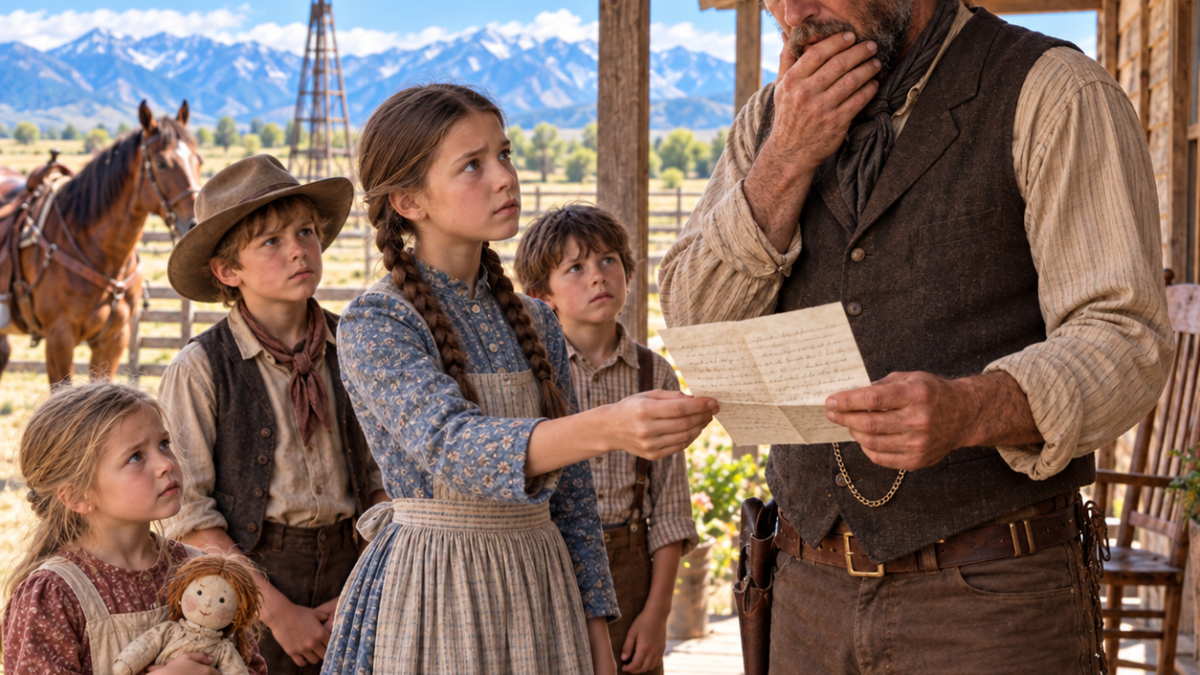
That place where four children once stood silently with small bags and a letter became the loudest part of the ranch.
Boots piled near the door.
Tin cups on the rail.
Mending baskets.
Half-carved toys.
Dogs sleeping under chairs.
Children growing taller by the season.
Arguments.
Laughter.
Storm warnings.
Wedding flowers.
Grandchildren.
More laundry than any bachelor could have imagined without fear.
Delia grew into a woman with Vera’s stubborn certainty and a gift for accounts that saved us from more than one bad season.
Sam became a horseman so skilled that even Eli stopped mocking him eventually, though he maintained the horses had simply given up arguing.
Eli built fences straighter than mine and reminded me of it for the rest of my life.
Nell learned to braid hair better than any of us and still climbed into my lap long after she was too grown for it, just to make me complain.
“You’re too big for this,” I would say.
“You’re too old to argue,” she would answer.
Vera never let me forget the first braid.
Or the crooked nails.
Or the flapjacks.
Love, I learned, keeps record of failures kindly when they belong to home.
Sometimes, in the evening, Vera and I sat on the porch after the children went quiet.
She would look toward the road where she had once left them.
“I thought I was leaving everything behind that morning,” she said once.
“You left them where they were loved.”
“I hoped.”
“You knew.”
She smiled faintly.
“Maybe.”
“You told Delia I’d figure it out.”
“I knew you would.”
“I barely did.”
“But you did.”
We sat in the fading light, two old neighbors who had taken thirty years and one terrible letter to understand what had been growing quietly along the fence line all along.
I kept Vera’s letter.
She knew.
I never hid it.
It stayed folded inside a box with other things that mattered: Thomas’s old pocketknife, Nell’s rag doll after she outgrew it, one of Sam’s first horse brushes, a crooked nail Eli saved to mock me, Delia’s first household ledger, and a fishing hook Vera claimed I had stolen when we were nine.
The paper yellowed.
The words remained.
Don’t come looking for me.
For years, that line haunted me.
Then it changed.
It became not a command born of fear, but proof of trust.
Vera knew I would want to come.
She trusted me not to.
She trusted me with the hardest part.
Waiting.
Protecting.
Loving what was placed before me instead of chasing what had been taken beyond my reach.
I had thought courage meant riding out.
Sometimes courage means staying on the porch.
Holding the line.
Burning breakfast.
Learning braids.
Telling frightened children their mother knows the road home.
Answering to Papa when a five-year-old decides your heart before you do.
Vera made the hardest choice of her life when she left those children at my door.
I made mine when I opened it.
At the time, I thought I was taking them in for a while.
Just until danger passed.
Just until Vera came back.
Just until life returned to its proper shape.
But life never returned to the shape it had before.
Thank God for that.
Because before, my house was quiet.
After, it was home.
Before, I had cattle and silence.
After, I had four children racing to the gate when they heard my horse.
Before, I believed my solitary life was complete because nothing in it hurt too badly.
After, I learned that love makes a man vulnerable in exact proportion to how much it saves him.
One ordinary morning in Wyoming Territory, I opened my door and found four children waiting with their mother’s letter.
Their clothes were clean.
Their bags were small.
Their eyes were brave in a way children’s eyes should never have to be.
I did not know how to feed them.
I did not know how to comfort them.
I did not know how to become the man they needed.
But Vera had written that I would figure it out.
So I did.
One burnt flapjack, one crooked braid, one mended fence, one promise, one long day at a time.
And by the time their mother came home, those children had already done what no one else had managed in thirty years.
They had found every empty room inside me.
And filled it.








