A Little Girl Whispered, “Nobody Wants Me,” as Strangers Turned Away—Then a Dusty Cowboy Stepped Forward, and What He Did Next Changed More Than Her Fate Forever
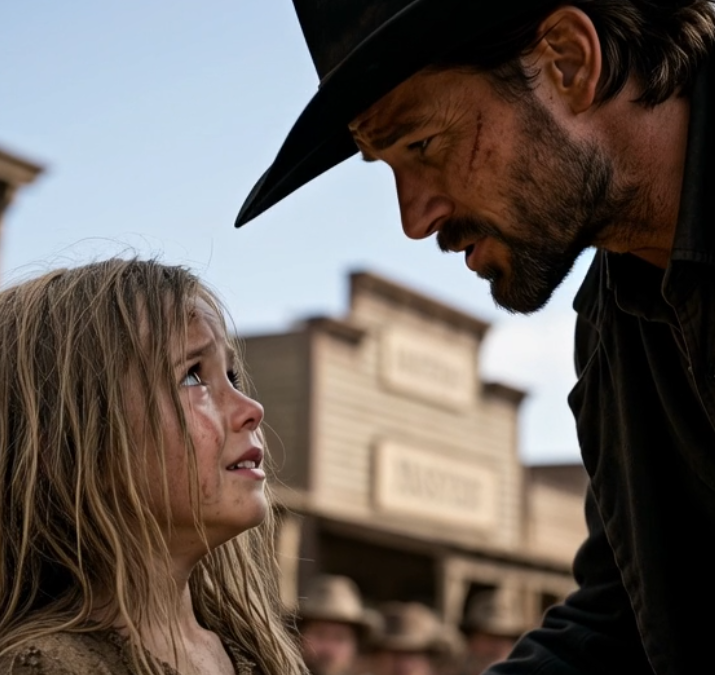
A Little Girl Whispered, “Nobody Wants Me,” as Strangers Turned Away—Then a Dusty Cowboy Stepped Forward, and What He Did Next Changed More Than Her Fate Forever.
They called the three-year-old girl defective, worthless, and too broken to feed, while she stood barefoot on a wooden auction block in the summer heat.
I paid five dollars to end the laughter, not knowing I had just rescued my dead brother’s hidden daughter and the heir to a fortune powerful men had killed to steal.
By the time she whispered “Don’t leave,” I understood the truth too late: I had not bought that child—I had found the one person fate had been trying to bring back to me.
My name is Elias Boone, and before I saw Laya Grace Morrison standing on that auction platform, I believed a man could outwork grief.
I was wrong.
I owned more land than any man in three counties had any honest right to own. That is what people said, anyway. They called me rich in the tone folks use when they want the word to sound like an accusation. Maybe it was. By the summer of 1887, I owned twelve thousand acres of cattle land west of Clemens Ridge, two hundred head of prime stock, four barns, a white farmhouse on a rise above the creek, and enough money tucked into bank ledgers that men smiled differently when I entered a room.
But none of that meant much inside my own chest.
Land does not answer you at supper.
Cattle do not remember your brother’s laugh.
Money cannot walk into a quiet house and make it feel less like something abandoned.
I was forty-two years old that summer, though the mirror had been calling me older for some time. Dust had settled into the lines around my eyes. My shoulders were broad still, but carried the hard downward pull of a man who had spent too many years telling himself work was the same thing as living. I rose before sunrise, rode fence lines until my shirt stuck to my back, drove hard bargains at market, paid my men fairly, spoke little, and let people decide I was stern because stern was easier to explain than lonely.
My younger brother, Thomas Grace, had been dead for four years.
At least, that was what I had believed.
Even now, after all these years, I can still see Thomas as he was before trouble took him: laughing too loudly, trusting too quickly, spending money like tomorrow was a rumor, and charming every woman in a room before he knew whether she deserved charm. He had our mother’s smile and our father’s worst impatience. He could break a horse gently and a promise carelessly. He could walk into my house with mud on his boots and make my housekeeper Ruth forgive him before I finished scolding him.
He was impossible.
I loved him anyway.
That is the curse of family.
You can know every flaw in a person and still feel the world tilt when they are gone.
Thomas had married Rose Bennett against nearly everyone’s advice, including mine. Not because Rose was bad. She was not. She was gentle, sharp-minded, and steadier than Thomas deserved. But the Bennett name came with tangled money, old disputes, and men who smiled with closed mouths. There was a cattle trust tied to her family, legal papers my brother waved away whenever I asked. He said love mattered more than ledgers.
Only a young man, a fool, or someone already running from the truth says such things.
Four years before that auction, Thomas and Rose came to my ranch in the middle of a winter storm. Rose was heavily pregnant, pale with pain, and Thomas looked like a man who had ridden through hell with hell still following behind him. I put them in the east room. Ruth heated water. I sent a hand for the doctor, but the roads had washed into mud and the doctor did not come until morning.
I remember hearing the baby cry.
I remember that more clearly than anything else.
It was a thin, fierce sound, too stubborn to be called weak.
Sometime before dawn, Thomas came downstairs with his coat thrown over his nightshirt and asked me to keep watch while he rode out to fetch medicine himself. He was shaking. I thought it was fear for Rose.
“Just hold the house,” he told me.
“What are you not saying?” I asked.
He looked at me the way he had when we were boys and he had broken something he could not repair.
“Nothing you can fix tonight.”
I should have stopped him.
Instead, I did what older brothers often do when exhaustion has worn down suspicion. I let him go.
By morning, Thomas was back. The baby was gone from the room. Rose lay asleep, waxy and still, too drained to speak. Thomas told me the child had died. A girl, he said. Born too early. Not strong enough.
I never saw her body.
That fact would haunt me later.
At the time, I believed him because grief asks fewer questions than suspicion. Three days later, Thomas and Rose left before sunrise. A note on the kitchen table said they had business west. Six months after that, word came that they had died near a burned-out mill sixty miles away.
Bandits, some said.
Fire, others said.
Debts catching up, whispered men who enjoyed adding shame to a grave.
I buried my brother without a body and told myself that was the worst of it.
PART2:
Then, four years later, on a scorching summer day in 1887, I rode into Clemens Ridge to buy grain nails and came upon a child being sold.
The town square sat beneath a heat so fierce it made the world waver. Packed dirt shimmered in waves. Horses stamped under hitching rails. Flies circled sweaty collars. Somewhere behind the general store, a mule brayed like it had an opinion about mankind.
A striped canvas awning had been set up in the square, and beneath it stood a wooden platform.
People had gathered there.
Laughing.
That was what first made me slow my horse.
There are different kinds of laughter. I have heard men laugh at weddings, funerals, card tables, branding pens, and gallows jokes told to hide fear. This was uglier. It had the loose, careless sound of people enjoying cruelty because someone else had given them permission.
I tied my horse to the rail and stepped closer.
Then I saw her.
A little girl stood barefoot on the platform.
Three years old, maybe. No older. Small enough that the dusty dress hanging from her shoulders looked stolen from another child. Her knees were stained. One sleeve was torn. Her hair had been cut brutally short, uneven tufts around her ears, as if someone had taken shears to her not out of necessity but irritation.
But her eyes.
God help me, her eyes.
Gray-green. Enormous. Still in a way no child’s eyes should ever be still.
She was looking at a crack in the boards near her toes as if the crack were the only merciful thing in town.
“Lot number seventeen,” called the auctioneer.
His name was Harlan Voss. I knew him by reputation, not respect. A red-faced man with a polished smile and whiskey breath, the sort who could sell a cracked plow to a starving farmer and make the farmer apologize for needing time to pay.
“Female child,” Voss announced. “Approximately three years of age. Physically sound. Quiet disposition.”
A woman snorted near the front.
“Quiet? She hasn’t moved since she got up there.”
“She does not talk,” said a woman beside the platform.
Agnes Peton.
Director of the county orphan asylum.
PART3:
I had seen her once before, collecting donations after a church supper. She wore the same high-necked gray dress despite the heat, the same rigid posture of a person who thought kindness was weakness dressed up for company.
“She refuses to speak,” Mrs. Peton continued. “Refuses to engage. Hoards food. Wakes at night. Has fits of stubbornness.”
“What kind of fits?” someone asked.
“No screaming,” she said coldly. “No crying. Just staring.”
A rancher folded his arms.
“What good is she?”
“With firm discipline,” Mrs. Peton said, “she may become useful for household work when she is older.”
“When?” the rancher asked.
“Several years.”
“I need workers now.”
The crowd laughed.
The little girl did not move.
Only her fingers curled slightly against her dress.
I took one step forward without deciding to.
Voss lifted his gavel.
“Perhaps we begin at fifty cents?”
Silence.
“Twenty-five?”
Nothing.
The heat seemed to press down harder.
“Surely, ladies and gentlemen, someone is willing to offer Christian charity for an orphaned child.”
A farmer at the back called, “Charity costs more than twenty-five cents.”
More laughter.
My hand tightened into a fist.
The child closed her eyes.
I did not yet know her name.
I did not know why her silence struck me like recognition.
I only knew that everything in me rejected the sight of her standing there while grown men decided whether she was worth feeding.
“Ten cents!”
The bid came from an old man with a tobacco-stained beard and a wagon waiting at the edge of town.
Voss brightened as if salvation had arrived.
“Excellent. Ten cents!”
The little girl lowered her head.
Ten cents.
Less than a loaf of bread.
Less than a good horseshoe.
Less than the bottle of cheap whiskey Harlan Voss would probably buy that evening.
“Ten cents going once,” Voss called.
The gavel lifted.
My horse whinnied behind me.
Just once.
The crowd shifted.
The little girl opened her eyes.
She looked at me.
And the world stopped.
I have thought about that moment until memory has worn grooves in me.
I cannot say what I recognized because my mind did not know yet. But my body did. My heart did. Some buried part of me, older than reason, rose up and answered those gray-green eyes.
I saw the winter storm.
I heard a newborn cry.
I saw Thomas’s face in candlelight.
I saw Rose’s hand clenching a bedsheet.
Then it was gone.
Only the child remained.
“What is the child’s name?” I asked.
Mrs. Peton turned toward me with annoyance.
“Sir, this is a private placement proceeding.”
“Her name.”
The square quieted.
Mrs. Peton glanced at her ledger.
“Laya Grace Morrison.”
My jaw tightened.
“Again.”
She frowned.
“Laya Grace Morrison.”
Grace.
My brother’s name.
I looked back at the little girl.
She stared at me as though she had been waiting without knowing what waiting meant.
Voss cleared his throat.
“Sir, if you’re interested, we are currently at ten cents.”
“How much?” I asked.
“Ten cents.”
“How much?”
“For the placement?”
“How much to end this?”
He hesitated.
The crowd shifted. Men knew me by then. Most did not like me, but enough owed me money or hoped to sell me cattle that my displeasure had weight.
“Five dollars,” Voss said, as if testing madness.
The square erupted.
“Five dollars?”
“For her?”
“That’s a month’s feed.”
“That man’s lost his mind.”
I reached inside my coat, pulled out my wallet, and counted five silver dollars into Voss’s palm.
The coins clicked together.
The whole town seemed to hear it.
Voss stared down.
“You understand this is nonrefundable?”
“I did not come here for a refund.”
I turned to the child.
The first time she moved all morning, she stepped backward.
Just one step.
It stopped me more completely than a gun.
Fear had taught her motion was dangerous. That much was plain. I removed my hat slowly and held it at my side.
“My name is Elias Boone,” I said.
She stared.
“You do not have to come with me if you are afraid.”
Mrs. Peton stiffened.
“Mr. Boone, the placement papers—”
“Bring them.”
“Sir—”
“I said bring them.”
She obeyed because there are voices men and women obey before deciding whether they want to.
The papers were signed.
The money changed hands.
The crowd watched.
No one laughed now.
I stepped onto the platform slowly. One boot. Then the other. Laya’s breathing grew shallow. I stopped several feet away.
“I am going to pick you up,” I said quietly. “But only if you let me.”
She stared at me.
Nobody, I learned later, had ever asked her.
Her lips trembled.
I waited.
Finally, almost imperceptibly, she nodded.
I moved slowly enough that she could have run.
When my arms came around her, she went rigid.
I expected her to fight.
Instead, after one terrible moment, her small body collapsed against my chest.
She weighed nothing.
That was my first thought.
Nothing.
A child should have weight. Warmth. Resistance. Life pushing outward.
Laya felt like hunger wrapped in cotton.
Her cheek pressed against my coat before she could stop herself.
The smell of her hair—dust, sweat, old soap, and fear—nearly broke me in half.
My eyes closed.
“Good Lord,” I whispered.
No one in Clemens Ridge knew then what those two words cost me.
I carried her down the steps and placed her carefully into my saddle. When I climbed behind her, she stiffened again.
“Easy,” I murmured.
My arm came around her waist. Not tight. Just enough to keep her from falling.
We rode out of Clemens Ridge with every eye in town on our backs.
Laya watched the town until it became a blur behind us.
For several miles, neither of us spoke.
I did not know how to speak to a child who had learned words were dangerous.
At last, I reached into my saddlebag and took out a biscuit wrapped in cloth. Ruth had packed it that morning because she insisted I forgot meals whenever I rode into town.
I held it out.
“It is yours.”
Laya stared at








