A Little Girl Whispered “I Know Where They Hid Her” to a Biker—Then 714 Riders Took Over the Night
PART3:
Cole looked at him.
“What?”
“That girl. Been missing since Monday.”
“I know.”
“My mom says it’s probably some custody thing.”
Cole’s jaw tightened.
“Your mom a detective?”
The kid blinked.
“No.”
“Then maybe don’t repeat it.”
The cashier looked back down at his phone, embarrassed or annoyed. Cole didn’t care which.
He paid and stepped outside.
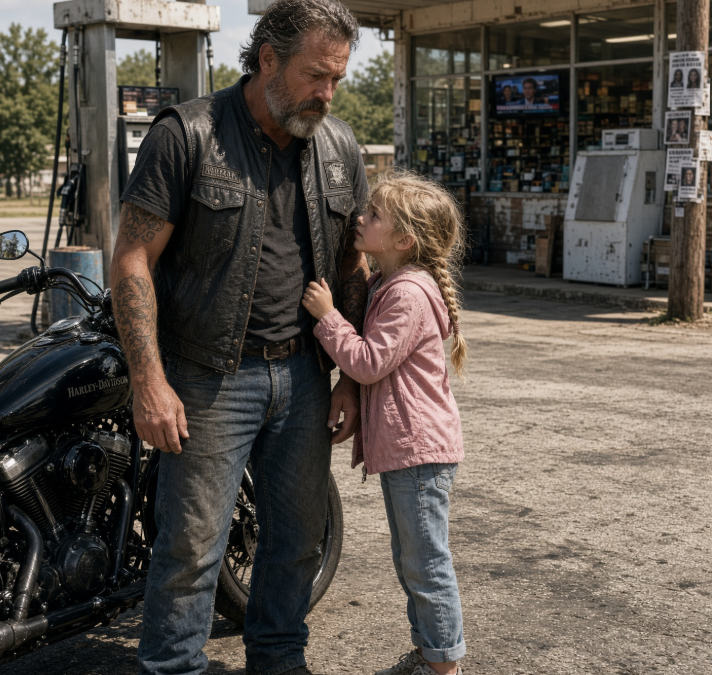
That was when he saw Harper.
She sat on the curb beside the ice machine with her knees drawn up under her chin.
A little girl, six or seven years old, blond hair in two messy braids, one of them half undone.
She wore a faded pink jacket despite the heat.
Not a rain jacket.
Not a school jacket.
A comfort jacket.
Cole understood that immediately.
Kids carried certain objects like armor because the world had not yet taught them better armor existed.
Her sneakers had holes near the toes.
Her socks did not match.
She was alone.
Cole scanned the parking lot.
No mother.
No father.
No older sibling.
No car waiting with a door open.
Just a little girl sitting in heat strong enough to warp road signs.
A pickup roared past on Route 42.
Its horn blasted.
Harper did not flinch.
That unsettled Cole more than if she had.
Fear was normal.
Stillness in a child that small usually meant she had already learned fear did not help.
Cole walked closer but stopped several feet away.
He crouched slowly, ignoring the pain in his knees.
“Hey there.”
The girl looked up.
Green eyes.
Wide.
Still.
“You waiting on somebody?”
She did not answer.
Her gaze moved over his vest, his patches, his tattoos, his beard. Not with fear exactly. With assessment.
Like she was reading a label.
Cole kept his hands visible.
“My name’s Cole.”
Her eyes narrowed slightly.
That was all.
“You thirsty?”
She looked at the water bottle in his hand.
Then at his face.
He set it on the curb halfway between them and slid it gently toward her.
“You can have it.”
She stared at the bottle.
Did not reach.
Cole nodded as if that made sense.
“All right.”
He sat down on the curb a safe distance away.
The concrete was hot through his jeans.
For a while they simply sat there.
Cars came and went.
The cashier came outside to smoke and immediately went back in when he saw Cole sitting with the child, probably deciding he wanted no part of whatever this was.
Cole drank from his own bottle.
Harper finally picked up the other one.
She opened it carefully.
Took one sip.
Then twisted the cap back on tight as if she had been taught not to waste anything.
Cole said, “You live around here?”
Harper’s eyes remained on the parking lot.
“Birch Lane.”
“Your mom know you’re here?”
“She’s working.”
“Where?”
“The diner.”
“Is someone supposed to be watching you?”
“No.”
That answer came too quickly.
Cole let it sit.
Then Harper stood.
She took two small steps toward him, close enough that he caught the smell of sun-warmed cotton and diner grease clinging to her jacket.
She grabbed the edge of his vest.
Cole went completely still.
Not because he was afraid of her.
Because he understood that a child who touches a stranger’s vest in a parking lot is either very brave, very desperate, or both.
Harper rose onto her tiptoes.
Her mouth came near his ear.
“I know where they hid her.”
Cole’s entire body locked.
He pulled back slowly.
Not too quickly.
He looked into the child’s face.
She was not playing.
She was not confused.
Her eyes were steady with the unbearable certainty of someone who had seen what adults missed.
“Who?” he asked.
“Lily.”
The air seemed to leave the parking lot.
Harper’s fingers tightened in his vest.
“They took Lily, and I know where she is.”
Cole felt something open inside him.
Not hope.
Hope was too dangerous.
Something sharper.
Purpose.
He took one slow breath.
“Okay.”
The little girl watched him carefully.
“Do you believe me?”
The question was not innocent.
It was a test.
Cole heard all the adults who had failed before him inside those four words.
Do you believe me?
Not will you call someone?
Not will you be nice?
Believe.
He looked straight at her.
“Yes.”
For the first time, her lower lip trembled.
Just once.
Then she swallowed it back.
Cole pulled out his phone and called Frank Brennan.
Frank answered on the second ring.
“Talk.”
Frank did not say hello.
He never did when Cole called during daylight.
Frank Brennan was the Iron Ridge road captain, a former Marine with shoulders like a refrigerator and a voice that could make drunk men sit up straight. He had led convoys through deserts, buried friends in uniform, and once organized a three-state charity ride with twenty minutes’ notice because a veteran’s house had burned down.
Cole kept his eyes on Harper.
“I’m at Crossroads Fuel on 42.”
“What’s wrong?”
“There’s a little girl here alone. Says her name is Harper. She says she knows where Lily Ashford is.”
Silence.
Three seconds.
Four.
“You believe her?”
Cole looked at Harper.
She had sat back down, holding the water bottle with both hands, staring at the ground like she had already said the hardest part and was waiting to see whether the world would change.
“I do.”
Frank’s voice shifted.
“Do not move.”
“I wasn’t planning to.”
“I’m calling Detective Welden.”
Cole frowned.
“You know her?”
“I know everyone with a badge within sixty miles who might pick up when I call.”
“Of course you do.”
“Stay put. Keep the kid calm. Don’t interrogate her.”
“I know.”
“Cole.”
“What?”
“If she gives you anything specific before they get there, write it down exactly.”
Cole glanced toward Harper.
“She already chose who to talk to.”
“Then listen.”
Frank hung up.
Cole sat beside Harper again.
“Someone is coming.”
She stiffened.
“Police?”
“A detective.”
Harper shook her head.
“No.”
Cole kept his voice low.
“You don’t have to talk to her if you’re not ready.”
“They don’t listen.”
Cole felt those words in his chest.
“Some don’t.”
Harper looked at him.
“Do you?”
He thought about Emma.
Her small hand pressing against her temple.
Daddy, my head hurts.
Cole forced himself to breathe.
“I’m trying.”
Twenty-two minutes later, Detective Patricia Welden pulled into the gas station in an unmarked sedan.
She got out with controlled urgency.
No siren.
No dramatic lights.
Badge clipped to her belt.
Dark hair pulled back tight.
Gray shirt.
Black pants.
The face of a woman who had slept maybe six hours total since Lily Ashford disappeared.
Her eyes went first to Harper.
Then to Cole.
Then his vest.
Cole watched the judgment flicker.
Not full prejudice.
Not hate.
Calculation.
A child.
A biker.
A missing girl.
A gas station.
Welden approached.
“Mr. Harrington?”
“Cole.”
“Detective Welden.”
“I know.”
“Frank Brennan called.”
“I figured.”
Her eyes moved toward Harper, who had shifted behind Cole’s leg.
“I understand there may be information about Lily Ashford.”
Cole nodded toward Harper.
“From her.”
Detective Welden crouched.
Not too close.
Good, Cole thought.
“Hi, sweetheart. I’m Detective Welden. Can you tell me what you told him?”
Harper’s fingers curled into the back of Cole’s vest.
“No.”
Welden’s mouth tightened.
“Do you know Lily?”
Harper pressed closer to Cole.
“No.”
Cole looked down at her.
That was a lie.
A fear lie.
Welden saw it too.
She stood and motioned Cole away.
He moved three steps, not far enough that Harper couldn’t see him.
Welden lowered her voice.
“What exactly did she say?”
“That she knows where they hid Lily.”
“Location?”
“Not yet.”
“Vehicle?”
“Not yet.”
“Names?”
“No.”
The detective exhaled through her nose.
“We’ve had sixteen false tips today.”
Cole’s temper sparked.
“This is not a false tip.”
“You don’t know that.”
“I know what a child looks like when she’s carrying something too big for her.”
Welden studied him.
“Do you?”
Cole met her eyes.
“Yes.”
Something in his tone shifted the detective’s face.
Not trust.
Not yet.
But attention.
“She won’t talk to me,” Welden said.
“She might talk to me.”
“I can’t have a civilian handling a potential witness in an active child abduction case.”
“And I can’t have the one kid who says she knows where Lily is shut down because the first adult with a badge couldn’t wait long enough.”
Welden’s eyes hardened.
Cole held his ground.
“I know what you see when you look at me,” he said. “Leather. Patch. Tattoos. Trouble you don’t have time for.”
“That is not—”
“It is. And maybe most days I wouldn’t blame you. But right now, that child chose me. I don’t know why. Maybe because I was sitting there. Maybe because I didn’t tell her to go away. Maybe because kids can see things adults pretend they can’t. But she chose me.”
Welden glanced toward Harper.
The girl was watching them without blinking.
Cole continued.
“So we can waste time arguing about what I look like, or we can use what we have.”
Detective Welden was quiet a moment.
Then she said, “Fine.”
Cole nodded once.
“You stay where I can hear everything. You do not lead her. You do not suggest answers. You repeat what she says to me exactly.”
“Agreed.”
“No side missions. No club hero nonsense.”
“Agreed.”
“I mean it.”
“So do I.”
Cole returned to the curb.
Harper’s hand found his vest again immediately.
He sat.
Did not ask anything.
His father had once worked with horses.
A farrier outside Knoxville.
A patient man with huge hands and a superstition about coffee after sunset.
He used to tell Cole that trust was not a door you forced open.
It was a door that opened toward you.
You just had to stand still long enough.
Cole sat still.
Two full minutes passed.
Three.
Welden stood nearby, arms crossed, barely containing herself.
Cole ignored her.
At last Harper said, “Lily lives across from me.”
Cole nodded.
“On Birch Lane?”
“Yes.”
“Is she your friend?”
Harper looked at the bottle in her hands.
“She sits with me at lunch.”
“That sounds like a friend.”
“The other kids say I smell like fries.”
Cole’s throat tightened.
Harper continued, “Lily says fries are better than perfume.”
A faint smile touched her face, then vanished.
“Monday, I was in my room.”
Cole nodded.
“My window looks at Lily’s yard.”
“All right.”
“I saw a white van.”
Detective Welden went completely still.
Cole did not look at her.
“Where was it parked?”
“By the mailbox.”
“Did you see who was inside?”
“Two men got out.”
“Did you know them?”
“No.”
“Did Lily know them?”
Harper shook her head.
“I don’t think so.”
“What happened?”
“They talked to her.”
Harper’s voice became smaller.
“She looked at the house.”
“Her house?”
“Yes.”
“Like she wanted to go back?”
Harper nodded.
“She kept looking at the door. But they told her something and she went with them.”
Cole felt his pulse in his neck.
“What did they look like?”
“One had a red hat.”
“Okay.”
“The other had a tattoo.”
“Where?”
Harper touched the side of her own neck.
“What kind?”
“A snake, maybe.”
Welden had her notebook out now, writing fast.
Cole asked, “Did you tell anyone?”
“I tried.”
“Who?”
“My mom.”
“What did she say?”
Harper’s fingers picked at the water bottle label.
“She was tired.”
Cole waited.
“She said I saw a delivery van and I needed to stop making stories.”
Cole swallowed.
“Did you tell anyone else?”
Harper nodded.
“A police man.”
Welden’s face changed.
“When?”
“Tuesday.”
“Where?”
“My street.”
“What happened?”
“He said go inside and let the adults handle it.”
The detective closed her eyes for one second.
Just one.
Then opened them.
Cole asked, “Harper, you said you know where they hid Lily. How do you know?”
Harper took a breath.
“I saw the van again.”
“When?”
“Yesterday.”
“Where?”
“Old Garrett farm.”
Welden’s pen stopped.
Cole repeated carefully, “Old Garrett farm?”
Harper nodded.
“On Millstone Road?”
“Yes.”
“My bike trail goes behind it. I ride there when Mama sleeps.”
Cole did not comment on that.
“What did you see?”
“The white van.”
“Are you sure it was the same van?”
“Yes.”
“How?”
“Dent.”
“Where?”
“Back bumper. Left side. Looks like a bite.”
Cole glanced at Welden.
Her face had gone pale.
“Anything else?”
Harper whispered, “Red door.”
“What red door?”
“The barn.”
“What about it?”
“I heard crying.”
The world narrowed.
Cole could hear the fuel pump clicking outside.
The cicadas.
His own breathing.
Harper looked up at him.
“I think Lily is behind the red door.”
Detective Welden was already moving.
She stepped away, radio in hand.
“This is Welden. I need units staged near Millstone Road, old Garrett property. Possible location for Lily Ashford. White van with rear bumper damage, red barn door. Do not approach without my order. We need a warrant and we need it fast.”
Harper leaned closer to Cole.
“Are they mad?”
“No.”
“Because I waited?”
Cole turned toward her.
“No, Harper.”
Her eyes filled.
“No.”
“Everybody keeps saying hurry and I didn’t hurry.”
“You tried.”
She shook her head.
“I should’ve made them listen.”
Cole felt something inside him crack.
A seven-year-old child had just described the failure of every adult around her and turned it into guilt.
He crouched in front of her.
“You listen to me.”
She blinked.
“This is not your fault.”
Her mouth trembled.
“I saw.”
“Yes.”
“I didn’t help.”
“You tried to tell.”
“They didn’t believe me.”
“That is not the same as you not helping.”
Tears slid down Harper’s cheeks now.
Silent.
Controlled.
Far too practiced.
Cole lowered his voice.
“You did the right thing.”
She looked at him like the words were in a language she wanted badly to understand.
“You did exactly the right thing.”
Welden returned.
Her expression had changed.
She was no longer looking at Cole like a complication.
She was looking at him like an asset she had not expected to need.
“We’re confirming property records. The Garrett farm has been vacant six years. No utility accounts. No legal occupants.”
“Good.”
“Not good. It means if somebody’s there, they don’t want to be.”
Cole looked toward the road.
“You need more people.”
Welden’s eyes sharpened.
“No.”
“You have fourteen officers in town. County’s exhausted. You’ve been searching four days.”
“This is police work.”
“And back roads don’t care who works them.”
She stepped closer.
“I am not unleashing a motorcycle club on a possible kidnapping scene.”
“Not on the scene.”
“No.”
“Perimeter.”
“No.”
“Eyes and ears.”
“Cole.”
“If they move her, how many roads off that property?”
Welden did not answer.
Cole continued.
“How many logging paths? Creek crossings? Farm roads? Deer trails with tire tracks?”
She hated that he was right.
He could see it.
“We know this county,” Cole said. “Not from maps. From riding it. From breaking down on it. From knowing where pavement ends and where people dump stolen cars.”
Welden looked toward Harper.
Then back at him.
“No vigilante nonsense.”
“No contact.”
“No confrontation.”
“No chasing.”
“Report and hold.”
She studied him.
“You can guarantee that?”
Cole took out his phone.
“No.”
That surprised her.
“I can’t guarantee every rider inside two hundred miles unless we organize properly.”
He dialed Frank.
“But I know the man who can.”
Frank arrived fifteen minutes later.
By then Harper’s mother, Donna Caldwell, had been found at the Ridgewood Diner.
Donna came running across the parking lot still wearing her apron.
She was thin, thirty-two, with exhausted eyes and a face that looked older than it should have.
“Harper!”
Harper stood.
For a second, anger crossed her face.
Small but real.
Then she ran to her mother.
Donna dropped to her knees and wrapped both arms around her.
“I’m sorry,” Donna said before anything else. “Baby, I’m so sorry.”
Harper pressed her face into her mother’s shoulder.
“I told you.”
Donna closed her eyes.
“I know.”
“I told you.”
“I know. I should have listened.”
Cole looked away.
Some apologies were not for witnesses.
Frank Brennan walked up beside him.
“Welden briefed me.”
Cole nodded.
“What do you need?”
Cole looked across Route 42 toward the hills turning hazy blue in late afternoon.
“If Lily is at that farm, we need to keep anyone from leaving unnoticed.”
“And if she’s not?”
“Then we need to find where she was moved.”
Frank nodded slowly.
“How many?”
“All of them.”
Frank lifted an eyebrow.
Cole looked at him.
“A little girl whispered because nobody else listened.”
Frank’s jaw tightened.
“I’ll make calls.”
What happened over the next three hours would become something Ridgewood talked about for decades.
Frank did not just call Iron Ridge.
He called Stone Valley Brotherhood.
Mountain State Riders.
Cumberland Sons.
Smoky Road Saints.
Old veteran riding groups.
Independent riders.
Men he liked.
Men he hated.
Men he had not spoken to since a fight over a charity run eight years earlier.
The message was simple.
A missing child may still be alive.
A seven-year-old found her.
We need disciplined riders for perimeter watch.
No hero work.
No guns out.
No contact.
No ego.
If you can follow orders, ride.
If you cannot, stay home.
By 5:00, the first riders came.
Forty-seven motorcycles from Stone Valley rolled into town in a tight staggered formation.
Then twenty-three from Knoxville.
Then Nashville.
Chattanooga.
Bristol.
Men and women in denim and leather, with tattoos, gray beards, shaved heads, ponytails, patched vests, plain vests, old military jackets, steel-toed boots.
Some looked exactly like the kind of people suburban mothers warned children about.
Some were suburban mothers.
A school principal rode in from Murfreesboro.
A nurse from Nashville arrived still wearing scrubs under her riding jacket.
A retired state trooper came on a dusty Indian Chief.
Ridgewood stared.
People came out of shops.
Phones lifted.
Children pressed against windows.
At the community center, Detective Welden stood beside Cole watching motorcycles fill the parking lot, then the Baptist church lot, then the shoulder of Route 42.
“This is either the best thing that has ever happened to this case,” she said, “or the biggest headache of my career.”
Cole said, “Could be both.”
She almost smiled.
Almost.
Inside the community center, Frank spread a county map across a folding table.
He moved like he had gone back twenty years into uniform.
“Listen up.”
The room quieted.
Seven hundred bikers are not easy to quiet.
Frank did it with two words.
“You are here to help find a child. That is all.”
He pointed at the map.
“You will be divided into teams of ten. Each team gets one road section, trailhead, or intersection. You will have one lead, one radio contact, and one person writing down plates, vehicle descriptions, times, and direction of travel.”
He looked up.
“If you see something, you call it in.”
“No chasing.”
“No approaching.”
“No blocking vehicles unless law enforcement orders it.”
“No weapons displayed.”
“No threats.”
“No speeches.”
A few men shifted.
Frank’s voice lowered.
“If one of you decides tonight is about proving how tough you are, you will answer to me before you answer to police, and I promise you will prefer jail.”
A ripple of grim laughter moved through the room.
But everyone understood.
Welden stepped forward.
She did not look entirely comfortable addressing them.
She did it anyway.
“Lily Ashford is ten years old.”
Silence deepened.
“She has been missing since Monday evening.”
Her voice remained steady.
“We have reason to believe she may have been held at or near the old Garrett property on Millstone Road.”
A murmur moved through the riders.
Welden raised a hand.
“You are not entering that property.”
Nobody argued.
Good.
“My officers and county deputies will execute the warrant. You will cover the outer roads and report any suspicious movement. I need discipline. I need accuracy. I do not need bravery. Bravery gets people killed if it is not attached to restraint.”
Cole looked at her.
She glanced at him briefly.
Then away.
By 9:00 p.m., the count had reached 714.
Final confirmed.
714 riders.
Eleven clubs.
Four states.
Every back road, dead-end road, farm road, creek bridge, and logging path within five miles of the Garrett property had eyes on it.
Not roaring.
Not showing off.
Waiting.
Engines off unless moving.
Radios checked.
Phones charged.
Coffee passed around in paper cups.
A town that had been losing hope all week felt the ground under it change.
At 10:15, the warrant came through.
Detective Welden gathered her team in the back room of the community center.
Cole stood near the door, arms crossed.
Frank was beside the map.
Sheriff Douglas Barrett had arrived from the county seat, jaw tight, hat in hand.
Welden briefed them.
“Property is eighty-seven acres, mostly wooded. Farmhouse vacant six years. Barn two hundred yards east of main structure. Red door. White van reportedly observed behind or beside barn.”
“Any known suspects?” Sheriff Barrett asked.
“We have two men potentially linked through a white cargo van seen near Birch Lane Monday, but no confirmation yet.”
“Armed?”
“Unknown.”
“Lily’s condition?”
“Unknown.”
The word hung there.
Unknown was the worst word.
Welden turned to Cole.
“You ride with me.”
Sheriff Barrett frowned.
“He’s a civilian.”
“He’s the reason we have this lead.”
“He stays back.”
“He will.”
Cole looked at her.
Welden said, “If we find Lily, I may need someone nearby who does not look like authority. Some children shut down around uniforms after trauma. Harper chose him. Lily may respond better to him than a badge.”
Sheriff Barrett studied Cole.
Cole expected resistance.
Instead the sheriff said, “You do exactly what Detective Welden says.”
“Yes, sir.”
“No improvising.”
“No, sir.”
“No biker hero routine.”
Cole almost smiled.
“Detective already covered that.”
Welden said, “Multiple times.”
The convoy moved at 10:40.
Welden’s sedan first.
Two patrol cars.
Sheriff’s truck.
An ambulance staged farther back.
Cole sat in the passenger seat of Welden’s car, hands pressed flat against his thighs to stop them shaking.
He could feel the road vibration through the floor.
Behind them, at a distance, sixty riders followed until they reached the outer staging point.
The rest spread across the county like a living net.
One rider at the covered bridge.
Ten along the old logging road.
Three near Millstone Creek.
Two at the abandoned feed store.
Five near Highway 9.
No one moved without reporting.
The night smelled like damp soil and honeysuckle.
Cicadas had given way to crickets.
The Garrett property appeared through the trees like something the county had decided to forget.
The farmhouse sagged inward, windows black.
Tall weeds choked the yard.
Beyond it, in the clearing, the barn stood.
Gray boards.
Metal roof.
And the door.
Red.
Faded.
Peeling.
Exactly as Harper had said.
Beside it, half hidden beneath a canvas tarp, sat a white van.
Rear bumper dented on the left side.
Like a bite.
Cole’s throat closed.
Welden killed the headlights.
The car rolled to a stop.
Deputies fanned out.
No flashlights.
No shouting.
No sirens.
Cole stayed by the car.
Every part of him screamed to run.
To break the red door down.
To do something.
But he had given his word.
His job was not to be dramatic.
His job was to be useful.
He heard Frank’s voice in his head.
No hero work.
Minutes stretched.
Five.
Seven.
Eleven.
Then the radio crackled.
Static.
A deputy whispered, “Van clear.”
More silence.
Cole gripped the car door.
Then came Welden’s voice.
Sharp.
Controlled.
But underneath it, something broke.
“We have her.”
Cole stopped breathing.
“She’s alive. Request medical now.”
His knees buckled.
He caught himself against the car.
For one terrible second, he was back in the hospital room five years ago, watching a monitor, waiting for words that never became miracle.
But this time the words were alive.
Lily was alive.
He bent forward, both hands on the hood, and exhaled a sound that was half sob, half prayer.
Inside the barn, they found Lily in a plywood-partitioned room.
Thin.
Pale.
Scared.
But alive.
She had water bottles.
Canned food.
A battery-powered lantern.
A wool blanket.
A cereal box she had been drawing on with a broken crayon.
When Welden entered, Lily pressed herself into the corner.
Welden crouched.
“Lily? My name is Detective Welden. Your dad is looking for you.”
Lily’s lips trembled.
“Dad?”
“He’s coming.”
“Harper told?”
Welden froze.
Then nodded.
“Yes.”
Lily began crying.
Not loud.
Just tears.
“She saw?”
“She saw enough.”
“I told them she would tell.”
Welden’s chest tightened.
“You knew Harper saw?”
Lily nodded.
“I hoped.”
That was all she said before exhaustion overtook her.
Welden did not press.
She wrapped Lily in a silver thermal blanket and carried her toward the ambulance herself until Lily insisted she could walk.
Outside, 714 riders heard the news by radio.
No cheers at first.
Only silence.
A stunned, grateful silence.
Then, across back roads and bridges and dark intersections, men and women who looked like trouble to most of the world lowered their heads.
Some cried.
Some prayed.
Some simply stared at the road ahead, realizing they had just been part of a night that would matter for the rest of their lives.
The two men responsible were not at the barn.
They had left earlier in another vehicle.
But the net held.
At 2:13 a.m., a team of riders posted near Route 9 spotted an old sedan matching a partial description from a gas station receipt found in the van.
They did exactly what Frank ordered.
No chase.
No confrontation.
Plate number.
Direction.
Call.
State patrol stopped the vehicle thirty-eight minutes later outside Dunlap County.
The men were arrested before sunrise.
At the ambulance staging point, Glenn Ashford arrived twelve minutes after the call.
He had been waiting at the community center, pacing the same twelve feet of linoleum until the soles of his shoes squeaked.
When he saw Lily step out of the ambulance wrapped in silver, he made a sound Cole would never forget.
Not a scream.
Not a sob.
Something deeper.
A father’s soul returning to his body.
Glenn dropped to his knees in the gravel.
“Lily.”
She ran to him.
The blanket fell from one shoulder.
He caught her and folded around her like he could build a wall with his own bones.
“I’m sorry,” he kept saying.
Over and over.
“I’m sorry. I’m sorry. I’m sorry.”
Lily cried into his shirt.
“I tried to wait.”
“You did good, baby. You did good.”
“I was scared.”
“I know.”
“Harper saw.”
“I know.”
“She told?”
“She told.”
Lily looked around.
The dark road beyond the ambulance was lined with motorcycles.
Silent riders.
No engines.
No voices.
Just witnesses.
“Who are they?”
Glenn looked over his shoulder.
He had no answer.
Cole stood apart near his bike.
His eyes burned.
Welden walked up beside him.
“She asked about Harper.”
Cole nodded.
“She knew.”
“Yes.”
He looked toward Lily and her father.
“You ever think about how close the world comes to losing somebody because no one takes a child seriously?”
Welden looked exhausted.
“Yes.”
“Will that officer be held accountable?”
Her face tightened.
“Yes.”
Cole believed her.
Not because she said it confidently.
Because she sounded ashamed.
By sunrise, Lily was in the hospital for evaluation.
Harper and Donna Caldwell were brought to the station for a proper child interview with a psychologist present.
Harper gave details like a trained investigator.
Vehicle direction.
The dent.
The red door.
The time of day.
The neck tattoo.
The partial plate.
The path behind the creek.
The place she had hidden her bicycle when she crept close enough to hear crying.
Cole sat outside the interview room with Donna.
She looked shattered.
“She tried to tell me,” Donna whispered.
Cole said nothing at first.
“She tried three times.”
Donna’s hands twisted in her lap.
“I worked sixteen hours Monday. Fourteen Tuesday. My feet were swollen. My head hurt. She was saying things about vans and barns and I just…”
She covered her face.
“I told her to stop making up scary stories.”
Cole waited.
“What kind of mother does that?”
“The exhausted kind,” he said softly.
Donna looked at him.
“That doesn’t fix it.”
“No.”
“I failed her.”
Cole looked at the closed interview-room door.
“You missed her.”
Donna flinched.
“Missing a child is still serious.”
“I know.”
“But she came back to you with the truth. You can meet her better now.”
Donna cried silently.
Cole sat beside her.
He could have filled the moment with advice.
He didn’t.
Some people do not need a speech.
They need someone willing to sit beside the worst thing they know about themselves and not look away.
Three days later, Ridgewood held a gathering at the park behind the library.
It began as a thank-you event and became something larger.
Three hundred people came.
Then four.
Families brought lawn chairs.
The hardware store owner brought lemonade.
The church ladies brought casseroles.
Teenagers came in clusters, embarrassed to be emotional but unwilling to miss it.
Riders remained scattered around the edges of the park, leather and denim among picnic blankets and strollers.
Cole almost did not go.
After the rescue, the adrenaline disappeared, and the silence returned.
For two days, he sat in the apartment above his repair shop, staring at Emma’s old bookcase.
He had never moved it.
A shelf of children’s books remained where she left them.
A plastic horse.
A photograph of her at seven, missing two teeth and holding a cupcake.
He had spent five years trying to outrun the question he hated most.
Why didn’t I listen sooner?
Harper had walked up to him at the gas station and, for one terrible second, he felt Emma’s hand in his.
Not literally.
Not in some magical way.
Memory is crueler than magic.
It gives you exactly enough to hurt.
Ray Prescott, Iron Ridge sergeant-at-arms and Cole’s oldest friend, showed up at 1:30 carrying two coffees.
“You’re coming.”
Cole opened the door.
“No.”
Ray stepped inside.
“Yes.”
“I’m not in the mood for speeches.”
“Good. I’m not giving one.”
“Then leave.”
“No.”
Cole glared.
Ray sipped coffee.
“You don’t get to disappear after a miracle just because it reminds you of the miracle you didn’t get.”
Cole looked away.
Ray softened.
“Emma’s still gone.”
Cole shut his eyes.
“Yeah.”
“And Lily’s alive.”
Cole said nothing.
“Both are true.”
That was the sentence.
Both are true.
Cole went to the park.
He sat on a bench near the edge of the pavilion.
Detective Welden found him there.
Without the hard lines of the investigation, she looked younger and older at the same time.
“Mind if I sit?”
“Free country.”
She sat.
For a while they watched children run across the grass.
Among them, Harper and Lily moved hand in hand.
Lily was thinner than before.
Quieter.
But alive.
Harper wore the pink jacket.
Still.
Despite the heat.
“Charges are filed,” Welden said.
Cole nodded.
“State and federal. The evidence is strong. They are not getting out.”
“Good.”
Welden took a breath.
“I owe you an apology.”
Cole looked at her.
“When I arrived at that gas station, I saw your vest and I decided what kind of problem you were before you said ten words.”
“You were working a child abduction.”
“That explains stress. Not prejudice.”
Cole did not answer.
Welden continued.
“If I had pushed harder, Harper might have shut down.”
“Maybe.”
“That maybe is enough.”
She looked toward Harper.
“The officer who dismissed her has been placed on administrative leave pending review.”
Cole looked at her.
“Was he tired?”
“Yes.”
“Was he overwhelmed?”
“Yes.”
“Did he fail her?”
Welden’s mouth tightened.
“Yes.”
Cole nodded.
“Good.”
“Good?”
“That you can say it.”
She looked at him.
He said, “A lot of people would protect their own first.”
She looked toward the riders near the tree line.
“Isn’t that what clubs do?”
“Bad ones.”
“And good ones?”
Cole thought about Frank ordering 714 riders not to act like heroes.
“Good ones protect the mission first.”
Welden almost smiled.
“You people have rules.”
“Too many.”
“I didn’t expect that.”
Cole gave her a tired look.
“Yeah. I noticed.”
The smile disappeared.
“Fair.”
A few minutes later, Donna Caldwell approached.
Harper was near the swings with Lily.
Donna stood in front of Cole, hands twisting together.
“She calls you the man who listened.”
Cole froze.
“What?”
“Harper. She says, ‘I told the man who listened.’”
The words went straight through him.
For five years, Cole had named himself many things.
Coward.
Widower, though the marriage had ended before Allison remarried.
Biker.
Failure.
Grieving father.
Man who missed the signs.
Man who didn’t listen.
Harper had given him another name.
The man who listened.
He did not know what to do with that.
Donna’s eyes filled.
“Thank you.”
Cole shook his head.
“She saved Lily.”
“You believed her.”
“That should be ordinary.”
Donna gave a broken smile.
“Maybe ordinary things become heroic when enough people stop doing them.”
Cole looked across the park.
Lily and Harper had reached the big oak tree.
They touched it at the same time, then doubled over laughing.
Lily was alive.
Harper was heard.
Emma was still gone.
Both were true.
As the sun lowered behind the Blue Ridge foothills, Glenn Ashford stood beneath the pavilion with Lily beside him.
The crowd quieted.
Glenn had aged ten years in four days.
His hand rested lightly on Lily’s shoulder as if he were afraid she might vanish if he let go.
“I don’t know how to thank people for bringing my child home,” he said.
His voice broke immediately.
A woman in the crowd sobbed.
Glenn swallowed and tried again.
“I keep thinking about Monday.”
Lily looked down.
“I was making dinner.”
His face twisted.
“Hamburgers.”
He laughed once without humor.
“I burned them. I was mad at myself for burning dinner.”
He looked at his daughter.
“And outside, my whole life was being taken from the front yard.”
No one moved.
Glenn looked toward Harper.
“Harper Caldwell tried to tell the truth when the rest of us were too loud, too busy, too tired, or too grown-up to listen.”
Donna covered her mouth.
Glenn continued.
“That little girl did more for my daughter than any of us.”
Harper pressed into Donna’s side.
“And Cole Harrington listened when she whispered.”
All eyes turned toward Cole.
He hated it.
Ray gripped his shoulder, keeping him seated.
Glenn’s voice steadied.
“And 714 riders—people some of us would’ve crossed the street to avoid—stood on every back road in this county and helped bring Lily home.”
He wiped his face.
“So I’m not going to say thank you like those words are enough.”
“They aren’t.”
He turned to Harper.
Then he lowered himself to one knee in front of her.
A whole park watched.
“Harper,” he said, “you saved my little girl.”
Harper began crying.
Glenn held out his hand.
She looked at Donna.
Donna nodded.
Harper stepped forward.
Glenn hugged her carefully.
Lily joined them.
Then Donna.
Then the whole park seemed to exhale.
Cole stood abruptly and walked away.
Ray followed him to the edge of the library parking lot.
“Cole.”
“I’m fine.”
“No.”
Cole stopped beside his Harley.
The mountains beyond town had turned purple.
He pressed both hands to the seat.
“I didn’t save Emma.”
Ray said nothing.
“I didn’t listen.”
“She had headaches, Ray.”
“I know.”
“She told me.”
“I know.”
“I told her to drink water.”
Ray’s voice was low.
“You were her father. Not her doctor.”
“I was supposed to protect her.”
“You loved her.”
“I missed it.”
“Yes.”
The honesty hurt.
But it was also the only thing Cole trusted.
Ray stepped closer.
“You missed something.”
Cole’s face tightened.
“And you have punished yourself for five years like that brings her back.”
Cole looked away.
Ray said, “It doesn’t.”
“I know that.”
“No. You know it like a fact. You don’t live like it.”
Cole swallowed.
Ray pointed toward the park.
“That little girl grabbed your vest because some part of her knew you would stop.”
“I got lucky.”
“Maybe.”
“Maybe Emma sent—”
“No.”
Ray’s voice sharpened.
Cole looked at him.
Ray softened.
“Don’t do that to yourself.”
“What?”
“Don’t make Lily’s rescue explain Emma’s death.”
Cole’s eyes filled.
Ray continued.
“One child living does not make another child dying meaningful.”
Cole’s breath shook.
Ray put a hand on his shoulder.
“But it can still matter that you were there.”
Cole lowered his head.
That was the closest he came to breaking in public.
And Ray, who had spent childhood in seven foster homes learning that adults often disappeared right after you needed them, did not tell him to stop crying.
He stood there.
Presence.
That was all.
Sometimes that was everything.
Weeks passed.
Then months.
The case against the men who took Lily grew stronger.
A third person was charged later for providing the barn and helping move supplies.
The officer who dismissed Harper resigned after an internal investigation found multiple failures in the canvassing process.
Ridgewood Police changed protocol.
Children were to be interviewed by trained personnel when they attempted to provide information in major cases.
Not waved away.
Not told to go inside.
Not treated as background noise because they were small.
Detective Welden made sure the training included one sentence written across the first slide:
A CHILD MAY BE THE ONLY WITNESS WHO LOOKED LONG ENOUGH.
Cole saw a photograph of that slide months later.
He saved it.
Harper became a local hero, which she hated.
People wanted to hug her.
Thank her.
Ask questions.
Tell her she was brave.
Adults have a strange habit of trying to feed children praise until the child disappears beneath it.
Donna learned to stand between Harper and attention.
So did Cole.
The first time a local reporter approached Harper outside the diner, Cole stepped in front of the camera.
“She’s seven.”
The reporter said, “We just want—”
“I know what you want.”
His voice stayed calm.
“She doesn’t owe you the story.”
Donna watched from the diner window and cried again.
Cole began stopping by the diner on Thursdays.
Not because Donna needed saving.
She didn’t.
Because Harper had started asking whether “the man who listened” might come for pancakes.
So he did.
At first, Harper barely spoke.
Then she talked about school.
Then bugs.
Then how Lily liked drawing horses but was bad at drawing legs.
Then one day, without warning, she asked, “Did you have a little girl?”
Cole froze.
Donna, wiping a nearby table, stopped moving.
Cole looked at Harper.
“Yes.”
“What was her name?”
“Emma.”
“Where is she?”
Cole’s throat tightened.
“She died.”
Harper processed that.
“Were you sad?”
“Yes.”
“Are you still?”
“Yes.”
She nodded as if that made sense.
“I’m sad sometimes after Lily came back.”
Cole leaned forward.
“That happens.”
“Why?”
“Because being scared doesn’t leave your body just because the bad part ended.”
Harper looked down.
“I still see the van.”
“I know.”
“Lily does too.”
“I know.”
“Do you see Emma?”
Cole closed his eyes briefly.
“Yes.”
Harper’s voice became very soft.
“Does it hurt?”
He opened his eyes.
“Yes.”
She reached across the booth and placed her small hand on his wrist.
Not dramatic.
Not a rescue.
Just contact.
Cole stared at her hand.
Five years of grief shifted slightly.
Not gone.
Not healed.
But less alone.
714 riders became a number people used in Ridgewood for a while.
The bakery sold “714 cupcakes” for a fundraiser.
The hardware store owner put up a sign that read THANK YOU, RIDERS.
Some people acted as though bikers had suddenly become acceptable because they had done something dramatic enough to override the leather.
Cole hated that too.
They had always been human.
The town simply required proof under pressure.
Frank turned the temporary mobilization into something permanent.
A volunteer rapid-response network.
Not for vigilante work.
Never that.
For searches.
Floods.
Missing elderly people.
Storm checks.
Amber alert support when requested by law enforcement.
Mapped riders.
Radios.
Training.
Rules.
Detective Welden helped build the legal framework.
Sheriff Barrett signed off reluctantly, then proudly.
The network became known as The Listening Line.
Harper named it.
At a meeting, Frank asked, “Why that?”
Harper, sitting beside Donna with a purple notebook, said, “Because before you move fast, you have to listen.”
Nobody argued.
Two years later, when an elderly man with dementia wandered from a care home during a cold rain, The Listening Line found him in forty-six minutes.
Three years later, after tornadoes tore through the county, riders delivered medication and generators.
Five years later, Harper, now twelve, spoke at a school safety assembly.
She stood on stage wearing no pink jacket.
That was how Cole knew she was getting stronger.
The jacket had stayed on through heat, through winter, through therapy, through interviews, through the first year after Lily came home.
Then one spring, she forgot it at the diner.
Donna cried when she found it hanging on the back of a chair.
Harper stood at the microphone, small but steady.
“Adults always tell kids to speak up,” she said.
“But sometimes kids do speak up and adults don’t stop moving long enough to hear them.”
Teachers sat very still.
Students listened.
Harper looked toward the back of the auditorium, where Cole leaned against the wall beside Frank.
“If a kid tells you something strange, don’t decide it’s nonsense because it’s inconvenient.”
She looked down at her paper.
Then back up.
“If they are wrong, you lost two minutes.”
Her voice trembled once.
“If they are right, you might save a life.”
Lily sat in the front row.
She was thirteen then.
Her hair had grown longer.
She still had hard days.
Certain smells.
Certain van doors.
Certain red paint.
Trauma leaves tripwires.
But she smiled more.
She and Harper remained inseparable in the way children become when they have shared something adults cannot fully understand.
They did not talk about the barn often.
But every August, on the anniversary of Lily coming home, they went to the library park and sat beneath the big oak tree.
Cole never interrupted.
He waited near the parking lot with two lemonades and gave them space.
One year, Lily walked over to him.
She was fifteen.
Tall.
Serious.
“You were there.”
Cole nodded.
“At the farm.”
“Yes.”
“Did you see the barn?”
“Yes.”
“Was the door really red?”
He hesitated.
“Yes.”
She looked toward the trees.
“In my dreams it’s bigger.”
“That happens.”
“I used to think if I saw it again, I’d fall apart.”
“You don’t have to see it.”
“They tore it down.”
“I know.”
She nodded.
“Good.”
Then she looked at him.
“Did Harper seem scared when she told you?”
Cole thought about the little girl sitting on the curb.
“No.”
Lily frowned.
“No?”
“She seemed certain.”
Lily’s eyes filled.
“She promised she’d find someone.”
Cole felt something move in his chest.
“She did.”
Lily looked toward Harper under the tree.
“People call me strong.”
“You are.”
“I don’t feel strong.”
“Most strong people don’t while they’re doing it.”
Lily looked at him.
“Do you?”
“No.”
That made her smile faintly.
“You look like you would.”
“That’s leather doing public relations.”
She laughed.
A real laugh.
Cole carried that sound home with him.
Years passed.
Cole stopped riding to run away.
That was the change he did not expect.
The engine no longer drowned out Emma’s hospital room.
It carried him toward things.
Searches.
Fundraisers.
Thursday pancakes.
Listening Line trainings.
Therapy appointments Harper asked him to wait outside because the waiting room made her nervous.
Coffee with Donna after long diner shifts.
Awkward but healing conversations with Allison, his ex-wife, who called after seeing him on the news.
“I saw what happened in Ridgewood.”
“Yeah.”
“You looked older.”
“So did you.”
She laughed softly.
Then cried.
They spoke about Emma for the first time in years without turning the conversation into blame.
Not forgiveness exactly.
Something gentler.
A ceasefire around a grave.
Allison eventually visited Ridgewood.
She met Harper.
Then Lily.
Afterward she walked with Cole beside Route 42.
“I hated you for not listening,” she said.
Cole kept his eyes on the road.
“I know.”
“I hated myself too.”
“I know.”
“Do you still blame yourself?”
“Yes.”
She nodded.
“Me too.”
They walked in silence.
Then Allison said, “Emma loved motorcycles.”
Cole looked at her.
“She was scared of them.”
“She pretended to be.”
“She told me they were too loud.”
“She told me she liked how proud you looked when you started one.”
Cole stopped walking.
Allison’s eyes filled.
“I never told you because after she died, every memory felt like ammunition.”
He looked toward the hills.
“I wish you had.”
“I know.”
She reached into her purse and gave him a photograph.
Emma at eight, wearing one of Cole’s old bandanas around her neck, standing beside his Harley with both thumbs up.
Cole held the picture for a long time.
That photograph went into his vest pocket.
Not as a wound.
As proof.
A person can carry grief differently when it no longer has to be a weapon.
Ten years after the night 714 riders moved across Ridgewood, the town held a dedication at the new community center.
The old one had flooded the year before, and the rebuilt building included a volunteer coordination room with radios, maps, charging stations, and emergency supplies.
A plaque on the wall read:
THE LISTENING ROOM
In honor of Harper Caldwell, whose courage reminded Ridgewood that children are worth hearing.
Harper was seventeen.
She hated the plaque.
Naturally.
“Too dramatic,” she told Cole.
“You saved your best friend.”
“I whispered to a biker at a gas station.”
“That’s a dramatic sentence.”
“Don’t start.”
Lily stood beside her.
“She’s mad because the mayor used the word heroic.”
Harper groaned.
“He said it four times.”
Lily smiled.
“You are heroic.”
“I will end this friendship.”
“You’ve been saying that since second grade.”
Cole watched them with a kind of gratitude that still hurt.
During the ceremony, Detective Welden—now Captain Welden—spoke.
She did not make the police department look flawless.
Cole respected that.
“Ten years ago,” she said, “a child tried to report what she had seen, and an adult dismissed her. That failure is part of this story. We do not honor Harper by hiding it.”
The room quieted.
“We honor her by changing because of it.”
She looked toward the back, where riders stood along the wall.
“We also learned that night that help does not always arrive in the uniform you expect.”
Frank smiled faintly.
Cole shook his head.
Welden continued.
“Sometimes it arrives wearing leather, covered in dust, with engine grease under its fingernails.”
After the speeches, Harper walked outside.
Cole followed at a distance.
She stood near the bike racks, arms crossed.
“You okay?”
“No.”
He stood beside her.
“What part?”
“All of it.”
“That narrows it down.”
She smiled reluctantly.
Then sighed.
“I don’t like being the reason people improved.”
Cole understood.
“You didn’t make them fail.”
“I know.”
“But if I hadn’t—”
“Harper.”
She looked at him.
“You are not responsible for adults becoming decent after they were careless.”
She swallowed.
“You were a child.”
“I know.”
“Do you?”
Her eyes filled.
“I’m trying.”
Cole nodded.
“That counts.”
She looked toward the road.
“I want to become a detective.”
He smiled.
“Welden knows?”
“She wrote my recommendation letter.”
“Of course she did.”
Harper’s face softened.
“I don’t want kids to need bikers in gas station parking lots.”
Cole nodded.
“That’s a good reason.”
“But if they do…”
He looked at her.
She lifted one shoulder.
“I want to be the adult who crouches down.”
Cole’s throat tightened.
“That’s an even better one.”
The last time Cole rode with the full Listening Line before his knees got too bad for long hauls, the route took them past Crossroads Fuel Stop.
It had changed ownership.
New pumps.
Fresh paint.
The ice machine moved to the other side.
No curb where Harper had sat.
Time has a way of renovating sacred places without asking permission.
Cole parked anyway.
Harper, now twenty-one and in criminal justice classes, was riding passenger in Frank’s truck because she still hated motorcycles.
Lily came too.
So did Donna.
Detective Welden.
Frank.
Ray.
More than two hundred riders stopped along Route 42.
No speeches were planned.
Cole stood where the old curb had been.
“This was it?” Harper asked.
He nodded.
“It looked different.”
“Everything does.”
She smiled.
“I remember the ice machine being huge.”
“You were tiny.”
“I was average.”
“You were a very judgmental seven-year-old.”
“You needed judging.”
Lily laughed.
Donna wiped at her eyes.
Cole looked around.
“I thought I was stopping for gas.”
Frank said, “You were.”
Cole nodded.
“Funny how that works.”
Harper turned to him.
“Do you ever wish it had been someone else?”
“What?”
“That I picked someone else.”
Cole knew the honest answer immediately.
“No.”
“Even with everything it brought back?”
“Especially with everything it brought back.”
Harper’s eyes filled.
“Why?”
Cole took the photo of Emma from his vest pocket.
The edges were worn now.
He handed it to Harper.
She had seen it many times.
Still, she held it carefully.
“I spent five years thinking the worst thing about me was that I hadn’t listened.”
Harper looked at Emma’s smiling face.
“I still wish I had listened sooner.”
His voice roughened.
“I’ll wish that until I die.”
Nobody interrupted.
“But you gave me something else to do with that wish.”
Harper looked up.
Cole continued.
“You gave me a place to put the love I still had for her.”
Harper’s tears spilled.
Lily took her hand.
Cole smiled sadly.
“That doesn’t make Emma’s death okay.”
“It doesn’t make losing her part of some grand plan.”
“I don’t believe in that.”
He looked toward the road.
“But it means grief didn’t get the last word.”
Harper pressed the photograph back into his hand.
“What did?”
Cole looked at the people around him.
Listening.
Waiting.
“Maybe listening.”
Years later, when Cole’s beard had gone white and he no longer rode except short Sunday mornings, Harper became Detective Harper Caldwell with Ridgewood Police.
On her first week, she was called to a domestic disturbance where a little boy kept trying to speak while adults yelled over him.
The responding officer moved him aside.
“Let the adults talk.”
Harper turned so sharply the officer stopped mid-step.
“No.”
She crouched in front of the boy.
“What do you need to tell me?”
The boy gave her the missing piece.
A weapon hidden in a laundry basket.
No one was hurt that night.
Harper later called Cole.
“You would’ve been proud.”
Cole smiled into the phone.
“I already am.”
She was quiet.
Then said, “I listened.”
“I know.”
“Before moving fast.”
He laughed softly.
“Good.”
Cole died at seventy-eight.
Peacefully.
In his sleep.
The funeral was held in Ridgewood because that was where he had finally stopped running.
Hundreds came.
Riders.
Police.
Diner workers.
Teachers.
Children who had been found by The Listening Line over the years.
Adults who had once been those children.
Lily spoke.
Harper could not.
Not at first.
She stood at the podium in a dark dress, detective badge clipped at her waist, and stared at the crowd.
Then she looked at Cole’s vest folded beside his photograph.
Iron Ridge patch.
Worn leather.
A small photo of Emma tucked in the inside pocket.
Harper took a breath.
“When I was seven,” she began, “I learned that telling the truth does not matter unless someone receives it.”
The room became still.
“I tried to tell my mother.”
Donna sat in the front row, crying quietly.
“I tried to tell a police officer.”
Captain Welden lowered her head.
“They were not evil people.”
Harper’s voice trembled.
“They were tired. Busy. Trained badly. Distracted. Human.”
She looked at Cole’s photograph.
“Then I told a biker at a gas station because he sat still long enough for me to trust him.”
A soft sound moved through the church.
“I thought he saved Lily because he believed me.”
She shook her head.
“That was only the beginning.”
“He kept listening after the emergency ended.”
“He listened when I was angry.”
“When I didn’t want attention.”
“When I hated being called brave.”
“When I decided to become a detective.”
“When I made mistakes.”
“When I said I was fine and obviously wasn’t.”
A small laugh broke through tears.
“Cole taught me that listening is not waiting for your turn to talk.”
“It is making room for the truth to arrive in its own condition.”
She touched the podium.
“Sometimes the truth is whispered by a child.”
“Sometimes it is hidden under anger.”
“Sometimes it looks like silence.”
“Sometimes it comes from someone you judged before they opened their mouth.”
She looked around the room.
“Cole was not perfect.”
“He would hate it if we pretended he was.”
A few riders smiled through tears.
“He was stubborn, emotionally difficult, terrible at returning calls, and once told me my college essay was ‘too many feelings in a trench coat.’”
Laughter filled the church.
Harper smiled.
“But he listened when it mattered.”
Her voice broke.
“And because he did, Lily came home.”
Lily wiped her face in the front row.
“Because he did, I became someone who listens too.”
Harper looked at his photograph one last time.
“So thank you, Cole.”
She swallowed.
“The man who listened.”
After the funeral, Harper rode with the procession.
Not on a motorcycle.
In a police cruiser.
Cole would have made a joke about the irony.
At Crossroads Fuel Stop, the procession paused.
The place looked nothing like it had.
Still, everyone knew.
Harper got out.
Lily joined her.
They stood where the curb used to be.
Harper whispered, “I know where they hid her.”
Lily took her hand.
This time, the words did not feel like fear.
They felt like history.
A history that had been heard.
A history that had changed things.
A history that had moved 714 riders into the night and turned a whisper into a rescue.
The world often remembers loud things.
Engines.
Sirens.
Helicopters.
Crowds.
News cameras.
Courtroom doors.
But the thing that saved Lily Ashford began quieter than all of that.
A child’s hand gripping leather.
A mouth near a stranger’s ear.
Six words barely louder than breath.
I know where they hid her.
That was all.
The difference was not that Harper spoke loudly.
She didn’t.
The difference was that someone finally understood a whisper can carry more truth than a room full of adults.
Cole Harrington did not save everyone.
He did not save Emma.
He did not erase his past.
He did not become a saint because a frightened girl trusted him.
What he did was smaller.
And maybe greater.
He stopped.
He listened.
He believed before it was convenient.
He moved fast only after he had heard clearly.
And because of that, a red barn door opened.
A missing girl came home.
A lonely child learned her voice mattered.
A town changed how it listened.
A detective changed how she trained others.
A mother learned exhaustion is real but so is repair.
A biker found that grief could become a road forward instead of only a road away.
And years later, whenever Harper Caldwell crouched in front of a child and asked, “What do you need to tell me?” she carried Cole with her.
Not his leather.
Not his motorcycle.
Not the roar of 714 engines.
Just the silence he made on a hot curb beside an ice machine.
The kind of silence that says:
I’m here.
I believe something inside you is worth hearing.
Take your time.
I’m not leaving.
That was the legacy.
Not the motorcycles.
Not the headlines.
Not even the rescue.
The listening.
Because sometimes the whole world does not need to speak louder.
Sometimes it needs one person strong enough, humble enough, and patient enough to hear a whisper before it becomes a scream.
And on that August afternoon in Ridgewood, Tennessee, a seven-year-old girl found that person in the last man most people would have trusted.
A biker with scars on his hands.
Grief in his chest.
Leather on his back.
And enough pain in his past to recognize the sound of truth when it came trembling toward him in a child’s voice.
Harper whispered.
Cole listened.
And 714 riders moved.
But the real miracle was not how fast they rode into the night.
It was that for once, when a little girl told the truth, the world finally stopped long enough to hear her.








