A Little Girl Waiting Alone at a Diner Innocently Mentioned Her Mother’s Tattoo to a Group of Bikers—Then One Tiny Detail Made Them Go Silent and Remember a Promise Buried for Years
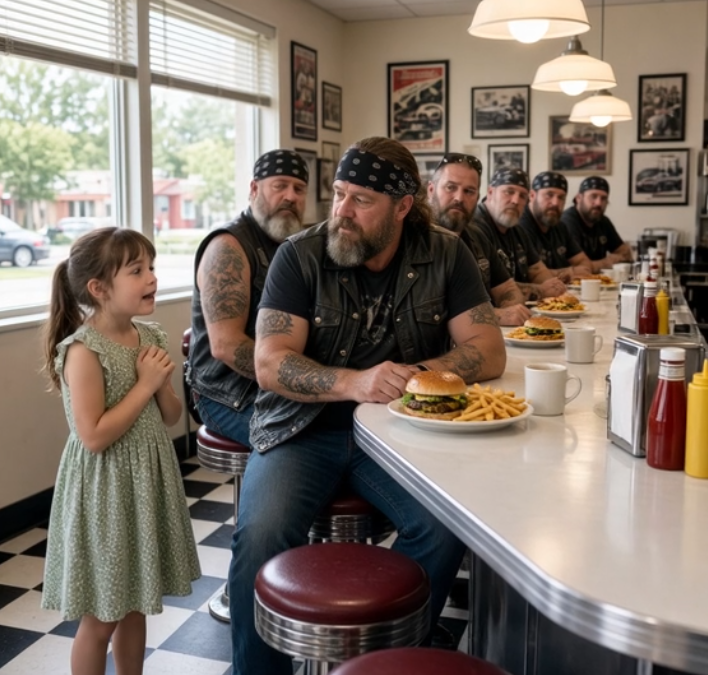
A Little Girl Waiting Alone at a Diner Innocently Mentioned Her Mother’s Tattoo to a Group of Bikers—Then One Tiny Detail Made Them Go Silent and Remember a Promise Buried for Years.
A little girl waiting alone in a roadside diner looked at a biker’s wrist and said her mother had the exact same tattoo.
The room went silent when she described the tiny mistake in one wing, because that mark belonged to a promise made twelve years earlier to a woman everyone thought they would never find again.
Then her mother called from a dark Arizona back road, whispering that a strange man was outside her stalled car — and six bikers stood up before the little girl had even finished crying.
The night air in northern Arizona carried that dry, dusty chill that always seemed to arrive faster after sunset.
By day, the desert looked endless and hard, all pale rock, scrub brush, sun-bleached signs, and highways that shimmered in the heat until distance itself seemed to bend. But after dark, the warmth vanished as if someone had opened a door beneath the earth and let winter breathe upward. The sky became enormous. The stars looked close enough to fall. The roads emptied. And every lighted building along the highway seemed less like a business and more like a small promise that someone, somewhere, was still awake.
Juniper Stop Diner was one of those promises.
It sat off a two-lane road outside the small town of Calico Ridge, not far from the long desert route that ran toward Kingman. The sign above the roof was old enough that two letters flickered whenever the wind came up. Inside, the vinyl booths were cracked at the edges, the pie case hummed behind the counter, coffee burned too long on the warmer, and every wall carried some piece of Arizona memory: rodeo posters, old license plates, faded photographs of Route 66, a framed newspaper clipping about a flash flood from twenty years ago, and a dusty horseshoe nailed above the kitchen door.
The food was simple.
Hot coffee.
Salty fries.
Burgers that came wrapped in paper-lined baskets.
Chicken-fried steak heavy enough to make a grown man rethink his afternoon.
On most nights, Juniper Stop was a place where truckers, ranch hands, nurses coming off late shifts, mechanics, deputies, travelers, and local families could all sit beneath the same tired lights and feel safe in the way small-town diners sometimes make people feel safe.
That night, at a corner table near the window, sat six bikers in worn leather vests.
They were broad-shouldered and quiet.
The kind of men people noticed even when they were trying very hard not to stare.
They had parked their motorcycles in a neat row outside under the diner sign, six dark machines still ticking softly from the ride. Their jackets held dust from the highway. Their boots were scarred. Their hands looked like they had known tools, fights, weather, and loss. They spoke low when they spoke at all, and they had the strange stillness of men who did not need to prove they could become dangerous.
At the counter, swinging her legs from a red vinyl stool, sat a little girl named Nora Wren.
She was eight years old, though she often insisted she was almost nine because almost felt more impressive.
She wore a pale blue hoodie with a fox patch sewn crookedly onto the front pocket, faded jeans, and pink sneakers that had been scrubbed clean too many times to look new but not enough times to hide desert dust in the seams. Her brown hair was tied in two uneven braids. One had already come partly loose because Nora had never learned how to sit still for more than seven minutes unless pancakes were involved.
She was waiting for her mother.
That was normal.
At least, normal for them.
Her mother, Elise Wren, worked at Mercy Mesa Community Hospital three nights a week and picked up evening shifts at Darden’s Grocery whenever bills ran ahead of paychecks, which they usually did. On nights when schedules overlapped, Nora waited at Juniper Stop because the owner, Marla Jensen, had known Elise since high school and let Nora sit at the counter with homework, cocoa, and a plate of fries she pretended not to give away for free.
Nora liked the diner.
She liked the bell above the door.
She liked the old jukebox that sometimes played even when nobody touched it.
She liked the way Marla called everyone honey but somehow made it sound different for each person.
She liked watching people come and go.
Truckers with tired faces.
Tourists asking how far to the Grand Canyon even though the answer changed depending on who was telling it.
Deputies ordering coffee black.
Old couples splitting pie.
Workers with sunburned necks and dirt under their nails.
And sometimes, bikers.
Nora had never been afraid of bikers.
Her mother had once told her that being careful was smart, but being scared of people just because they looked different was lazy. Nora did not fully understand what lazy fear meant, but she liked the sound of it. Her mother said things like that sometimes — small sentences that felt bigger than they were.
At the corner table, the bikers were not causing trouble.
They were eating.
One had chili.
One had a burger.
One had nothing but black coffee.
The man in the middle had a weathered face, graying hair at his temples, and a calm expression that made people wonder whether he was patient or dangerous.
His name was Dean Calloway.
PART2:
To the men at that table, he was president.
To others on the road, he was the man you did not lie to twice.
To himself, Dean was simply getting old.
His knees hurt in cold weather now. His hands stiffened if he rode too many hours without stopping. His beard held more silver than black, and lately, when younger men called him sir, he heard respect and warning at the same time.
He had lived a life that gave people reasons to step aside.
Some good.
Some bad.
Some he would carry to the grave without explaining.
That night, Dean was not thinking about the past.
He was thinking about coffee, the long ride ahead, and the fact that Mason had eaten half his fries after claiming he did not want any.
Then Nora Wren noticed the tattoo on Dean’s wrist.
It was visible because he had pushed one sleeve back to lift his coffee.
Small.
Faded.
A skull with wings.
Not a flashy design. Not one of the larger club tattoos that covered shoulders and backs. Just a simple old mark inked near the inside of his wrist, darkened by years, with one wing slightly crooked where the original artist had made a mistake and nobody had ever corrected it.
Nora leaned forward from her stool.
“Hello, sir,” she said brightly. “My mom has a tattoo just like yours.”
The room did not erupt.
It did something stranger.
It went still.
The waitress behind the counter stopped wiping a glass.
Marla looked up from the register.
One of the truckers glanced from Nora to the bikers, then back down at his coffee as if deciding not to exist for a while.
At Dean’s table, six men stopped moving at once.
Not because a child had spoken to them.
Because of what she had said.
PART3:
Dean lowered his cup slowly.
He turned toward Nora.
Not harshly.
Not kindly either.
Carefully.
“What’s your mom’s name, sweetheart?”
“Elise Wren,” Nora said without hesitation. “She told me she got that tattoo a long time ago.”
The other men exchanged quick glances.
Cole Mercer, the oldest among them, silver-bearded and lean, narrowed his eyes as if reaching into a locked room in his memory.
Mason, younger and tense, sat up straighter, one hand hovering near the table edge.
Jace, the youngest, looked between Dean and Nora with confusion sharpening into alertness.
Dean kept his voice low.
“Where on her wrist?”
Nora immediately pointed to her own left wrist.
“Right here. It’s a little skull with wings. One wing has a tiny mark on it. My mom said the man making it sneezed and messed up the line, but she kept it anyway.”
That was it.
That tiny detail landed at the table like a dropped key in a silent church.
Cole breathed out slowly.
“Dean…”
Dean did not look away from the child.
“That can’t be random,” Cole finished.
No one in the diner spoke.
Forks paused.
Cups remained halfway lifted.
Even the cook in the kitchen stopped moving near the pass window.
Dean’s eyes stayed on Nora.
“Are you sure your mother’s name is Elise Wren?”
Nora nodded with the cheerful confidence only a child could have in a room full of tension.
“Yes, sir. Elise Wren. She works at the hospital and the grocery store. She says she’s always late because bills don’t wait.”
That line, spoken so simply, softened something in the diner before anyone admitted it.
Dean rested both hands on the table.
He was no longer studying Nora as if she might be trouble.
Now he was studying her as if she had stepped out of a memory.
“Elise Wren,” he repeated. “If that’s who I think she is, then she’s the reason one of our brothers made it home.”
Nora blinked.
“My mom knows you?”
No one answered right away.
The men at the table all looked toward Dean, and it was clear that whatever happened next would begin with him.
Finally, Dean nodded once.
“A long time ago, your mother helped someone when she had every reason to walk away. We never forgot it.”
Nora tilted her head.
“Did my mom do something brave?”
Dean’s expression softened in a way that surprised even his own men.
“Yeah,” he said quietly. “She did.”
Nora turned fully on her stool now, both hands gripping the counter edge.
“What did she do?”
Dean leaned back in his chair and looked out the diner window for a moment, as if the dark glass could carry him backward through the years.
“Twelve years ago,” he said, “outside Kingman, one of our men got stranded in bad shape after a roadside attack.”
The diner stayed silent.
Even Marla had come closer, towel forgotten in one hand.
“His name was Wyatt Mercer,” Dean continued. “He was riding alone because he’d stayed behind to help a brother whose bike had blown a belt near Needles. Bad decision, maybe. Loyal one, definitely. He got jumped outside a service road by men who thought an Iron Saint alone was an Iron Saint they could erase.”
Nora’s eyes widened.
Iron Saint.
She did not know the name, but she understood from the way the men reacted that it mattered.
Cole looked down at his coffee.
Wyatt Mercer had been his nephew.
Not by blood, exactly.
By road.
Sometimes that counts more.
Dean continued.
“Wyatt got away, barely. He made it to a motel on the edge of town. He was hurt, exhausted, bleeding through his shirt, and out of time.”
Nora whispered, “Was he scared?”
Dean’s mouth tightened.
“He was smart enough to be.”
That was the most honest answer he could give a child.
“Your mother was there,” Dean said. “She was young. Maybe twenty, twenty-one. Working nights at the motel, cleaning rooms, taking front desk shifts when the owner drank too much to count cash right.”
Marla’s face changed.
She remembered that part of Elise’s life.
Elise had not talked about it often.
“She had almost nothing,” Dean continued. “A tiny room in the back building. An old lamp. A half-empty first aid kit. And just enough courage to do what most people wouldn’t.”
Cole’s voice came quietly.
“Wyatt knocked on her door because it was the only light he could see.”
Dean looked back at Nora.
“Your mom opened that door and saw a stranger in rough shape. Leather vest. Blood on him. Trouble written all over his face.”
Nora’s lips parted.
“And she let him in?”
“She let him in.”
“She wasn’t scared?”
Dean gave a sad smile.
“She was terrified.”
“Then why did she help?”
“Because he asked.”
Nora went very still.
Something about that answer touched her in a place children understand before adults do.
Dean rolled his wrist, showing the faded tattoo.
“She cleaned him up. Hid his vest. Stitched what she could with a sewing kit and hands that shook so bad Wyatt later said he worried she’d sew him to the mattress.”
Cole huffed once.
A laugh without much humor.
Dean went on.
“She stayed with him while men came looking room to room. Men who had already hurt him once.”
The air in the diner tightened again.
Nora leaned forward.
“What did Mom do?”
A long-haired biker named Jace answered softly.
“She stood at that door and lied better than most grown men.”
Dean nodded.
“They asked if she had seen a biker. She said the only man she’d seen all night was the motel owner, and if they wanted him, they could check behind the office where he was probably sleeping off cheap whiskey.”
Nora stared.
“My mom said that?”
“She said more than that,” Cole murmured. “Wyatt said she had a mouth on her.”
Nora smiled proudly.
“She still does.”
That broke the tension just enough for a few people to breathe.
Dean continued.
“Those men left. Wyatt lived. A few days later, when he could stand, he wanted to pay her. She refused.”
“Why?”
“Because some people don’t help for money.”
“What happened after that?”
Dean’s thumb moved over the tattoo.
“Before Wyatt left, he gave your mother a version of our old mark. Not because she belonged to us. Not because she asked for protection. He gave it to her as a promise. A sign that if any of us ever saw that mark, we would know she had once protected one of ours.”
Nora looked down at her own wrist, as if she could see her mother’s faded tattoo there.
“So my mom was helping people before I was even born.”
Dean smiled.
“That sounds like her.”
Nora sat a little straighter.
“My mom helps people all the time. She says some people get tired and mean because nobody ever helped them when they were tired.”
Cole looked away first.
Mason cleared his throat.
Dean studied Nora for a long second.
Kids repeat what adults say.
But they also reveal what adults live.
“Elise raised you right,” he said.
Nora shrugged.
“She tries.”
Before Dean could answer, Nora’s backpack began to ring.
The sound startled everyone because the room had been holding its breath for too long.
Nora jumped, unzipped the front pocket, and pulled out a cheap phone with a cracked screen and a purple case covered in peeling stickers.
The screen said MOM.
She answered immediately.
“Mom?”
Static crackled through the speaker.
“Nora… can you hear me?”
Nora’s smile disappeared.
“Mom?”
Elise’s voice came through broken and thin.
“My car—”
The line crackled.
“Mom, where are you?”
“Back road past the turnout. Car stopped.”
There was a pause.
A sound like wind.
Then Elise’s voice came again, lower now.
“There’s a man here and I don’t— Nora, stay inside. Don’t come out. Stay where people can see you.”
“Mom?”
The call dropped.
Nora stared at the screen.
“Mom?”
Nothing.
The change at Dean’s table was instant.
Chairs moved back.
Boots hit the floor.
Every biker in that booth stood up within seconds.
Not in chaos.
In purpose.
Nora’s face had gone pale.
“She sounded scared.”
Dean held out his hand.
“Give me the phone.”
She did.
He checked the screen, saw the last call, glanced at the signal, then looked at his men.
“She’s alone on a dark road.”
Mason was already reaching for his helmet.
“Then we go.”
Marla came from behind the counter.
“Dean.”
He looked at her.
“She can stay here. I’ll lock the door. I’ll call the sheriff.”
Dean nodded.
Then he looked down at Nora.
The child was shaking now.
Not dramatically.
Just enough that the sleeves of her blue hoodie trembled.
Dean crouched until they were eye level.
“Listen to me. You are not walking out there alone tonight. Marla can keep you here, safe, with people around.”
Nora shook her head immediately.
“No.”
“Nora—”
“She’s my mom.”
Dean stopped.
That sentence had weight.
It had the same shape as loyalty, only smaller.
“She told me to stay inside,” Nora whispered. “But she was scared. She never sounds scared. Not even when Mr. Hanson yelled at her at the grocery store because his coupon expired. Not even when I had a fever and she drove fast. Not even when the power got shut off.”
Her voice broke.
“She sounded scared.”
Dean’s jaw tightened.
Marla stepped closer.
“Nora, honey, we can wait here.”
But Nora looked at Dean, not Marla.
“You said you don’t forget a debt.”
Dean went very still.
There are moments when adults realize a child has understood exactly enough to make things impossible.
Dean glanced at Cole.
Cole gave one slow nod.
Not approval exactly.
Acceptance.
Dean looked back at Nora.
“If you come, you do exactly what we say. You stay between us. You keep the helmet on. You do not run toward anything until I say it’s safe.”
Nora nodded quickly.
“I promise.”
Dean’s voice hardened.
“This is not an adventure.”
“I know.”
“We’re bringing your mother home.”
Her lower lip trembled.
“You promise?”
His answer came without hesitation.
“I do.”
The diner’s front door opened, and cold night air rushed in as the group moved outside.
The motorcycles waited under the flickering sign.
Engines turned over one by one until the parking lot filled with the deep thunder of six Harleys waking together. To the people watching from inside, it must have looked like something out of an old story — six towering men in leather gathering around one frightened little girl as if she were the most important person in the world.
Dean gave instructions fast.
Calm.
Sharp.
“Mason, lead. Cole with me. Jace takes the kid. Keep her center. No racing blind. We find the car first, people second. Nobody plays hero unless I say so.”
Jace grabbed a spare helmet from his saddlebag.
It was too large for Nora, but he adjusted the strap carefully.
“You ever been on a bike?” he asked.
“No.”
“Okay. Rule one. Hold on.”
“What’s rule two?”
“Hold on harder.”
Nora climbed behind him, small hands gripping his jacket.
Dean looked toward the diner window.
Marla stood inside with one hand over her mouth.
He pointed to her, then to the phone.
She nodded.
Sheriff first.
Then Elise’s number again.
Then everyone else.
The bikes rolled out onto the highway.
The cold wind pressed against Nora’s sleeves, and the lights from the motorcycles carved long white paths through the desert dark. Under different circumstances, riding through northern Arizona at night might have felt thrilling. The stars were bright. The highway stretched ahead like a ribbon. The desert smelled of dust, sage, and cooling stone.
But Nora felt only urgency.
Jace raised his voice just enough for her to hear.
“Hold on, kid. We’ve got you.”
She pressed her helmet against his back.
Behind them, Dean scanned everything.
Every shadow.
Every parked vehicle.
Every bend in the highway.
He was not riding like a man looking for trouble.
He was riding like a man refusing to be late.
The back road past the turnout was narrow and poorly lit.
It cut away from the main highway and ran between low desert ridges where scrub brush leaned toward the road and old fence posts stood crooked in the dirt. It was not a road people took unless they knew it, or unless they were avoiding something.
Dean knew it.
Years ago, before the county widened the highway, that road had been used by truckers, ranchers, and men who preferred fewer witnesses.
He did not like that Elise was there.
He liked even less that her phone had dropped.
Mason’s brake light flashed ahead.
The formation slowed.
Then Nora saw the hazard lights.
Weak.
Blinking red in the darkness.
An old sedan sat angled toward the ditch, one door open. Its hood was up. Beside it stood a woman in a torn cardigan, dark hair pulled loose from a clip, one hand raised as she backed away from a man standing too close.
Nora saw her first.
“Mom!”
Elise turned toward the sound.
The look on her face shifted from fear to disbelief so quickly it seemed to break something in her.
The bikes reached them in seconds.
Dean pulled his Harley directly between Elise and the stranger, blocking the man’s path. Mason and Cole angled their bikes on either side. Jace stopped far enough back to keep Nora clear. The others formed a wide half-circle of headlights and rumbling engines.
The stranger froze.
He was maybe thirty-five, thin, twitchy, wearing a dark jacket and work boots, his face sharpened by anger or something worse. One hand hung near his pocket.
Dean noticed.
So did Cole.
Dean removed his helmet.
His voice carried no panic.
No heat.
Only steel.
“Step back.”
The man blinked at him.
“I was just talking to her.”
Cole answered before Dean could.
“Then you can talk to the police when they get here.”
The man’s eyes jumped from one biker to another.
“Police?”
Dean looked toward Elise.
“You hurt?”
Elise shook her head quickly.
“No.”
“Car trouble?”
“It died. I think the battery. Maybe more. I called Nora, then he came out of nowhere and kept trying to get me into his truck.”
The man snapped, “I offered help.”
Elise’s voice shook.
“I said no.”
“I was being nice.”
Dean turned back toward him.
“Nice hears no.”
The man’s jaw tightened.
“I don’t want trouble.”
“Then stand still.”
Jace helped Nora off the bike.
The second her feet touched the ground, she ran.
“Mom!”
Elise dropped to her knees and wrapped both arms around her daughter so tightly it looked like she might never let go.
“You stayed inside?” Elise whispered.
“I did. Then I didn’t. But Dean said it was okay.”
Elise pulled back just enough to see her face.
“Dean?”
Dean turned.
For the first time, Elise truly looked at him.
Not at the motorcycles.
Not at the situation.
At his face.
Then his wrist.
The tattoo.
The skull with wings.
The crooked mark.
Recognition moved across her expression like a match struck in a dark room.
“You…”
Dean nodded once.
“Wyatt Mercer’s people.”
Elise’s breath caught.
For a second, the cold desert, the dead car, the stranger, the flashing lights — all of it seemed to fall away.
“You’re Iron Saints.”
“Some of us,” Dean said. “Some were. Some still are in every way that matters.”
Elise covered her mouth.
Tears filled her eyes before she could stop them.
“I never thought anyone would remember that night.”
Cole stepped closer.
“My nephew remembered until the day he died.”
Elise’s face changed.
“Wyatt?”
Cole nodded.
“He made it home because of you.”
Elise closed her eyes.
“Oh God.”
The stranger shifted behind Dean.
Mason’s voice cut through.
“Don’t.”
The man stopped.
A sheriff’s cruiser appeared in the distance, lights flashing red and blue across the dark road.
Marla had made the call.
Good woman.
Dean kept his attention on the stranger until the deputy arrived. The man tried to explain himself. He said he was helping. He said the woman misunderstood. He said the bikers threatened him. Elise gave her statement with Nora pressed against her side.
Then the deputy ran the man’s identification.
His expression changed.
There was an outstanding warrant from another county.
Harassment.
Failure to appear.
A prior complaint involving a woman stranded near a gas station outside Flagstaff.
The deputy cuffed him.
The man shouted then.
People always showed their true size when control left their hands.
Dean did not move.
Nora hid her face in Elise’s sweater.
When the cruiser finally pulled away with the stranger inside, the desert grew quiet again.
Only the weak blink of Elise’s hazard lights remained.
Elise looked at the bikers.
Then at Dean.
Then at Cole.
“You came because of Nora?”
Dean shook his head.
“We came because she called.”
“That isn’t an answer.”
“It’s the only one that matters tonight.”
Elise wiped her face with the back of one hand.
“She shouldn’t have been dragged into this.”
“No,” Dean said. “She shouldn’t have had to be brave. Kids usually become brave because adults run out of room.”
Elise flinched.
Not because he was judging her.
Because he was right in a way that hurt.
“My shift ran late,” she whispered. “The hospital asked me to stay because two nurses called out. Then Darden’s called and said if I missed another grocery shift, they’d give my hours away. I thought I could make both. I thought…”
Her voice broke.
“I keep thinking if I just work harder, I’ll get ahead.”
Nora hugged her tighter.
Dean looked at Elise’s car.
“What’s wrong with it?”
Elise gave a shaky laugh.
“What isn’t?”
Mason already had a flashlight out.
He and Jace lifted the hood properly and began looking.
Cole called for a tow.
Dean stayed near Elise and Nora, not too close, not too far.
Elise glanced at his wrist again.
“Wyatt really made it home?”
Cole answered this time.
“He did.”
“For how long?”
Cole’s face tightened.
“Seven years.”
Elise lowered her eyes.
“I’m sorry.”
“He got seven years he wouldn’t have had.”
That sentence settled into the cold road between them.
Elise looked toward the desert.
“I thought about him sometimes.”
Dean said nothing.
“I was so scared that night,” she admitted.
Nora looked up.
“You never told me the whole story.”
“No,” Elise whispered. “I didn’t.”
Dean glanced at the child.
“Maybe she should hear it from you.”
Elise hesitated.
Then nodded.
But not there.
Not on that road.
Not beside the ditch where her hands were still shaking.
The tow truck came twenty minutes later. Mason confirmed the battery was dead, but that was not the only problem. The alternator was failing too. The car would not make it home on its own.
Dean did not ask permission before paying the tow driver to take it to a trusted garage.
Elise protested immediately.
“No. I can’t let you do that.”
“You can.”
“I can’t pay you back.”
“I didn’t ask.”
“That makes it worse.”
Dean turned toward her.
“Twelve years ago, a man knocked on your door bleeding. You let him in. Did you ask whether he could pay you back?”
Elise looked away.
“That was different.”
“No,” Cole said. “It wasn’t.”
The tow truck took the sedan.
Elise and Nora rode back to Juniper Stop in Marla’s old pickup because Elise refused to put Nora back on a motorcycle after midnight, no matter how many helmets Dean had. The bikers followed in formation, engines low.
When they returned, the diner lights were still on.
Marla had locked the front door but opened it the second she saw them.
She pulled Elise into a hug before asking questions.
Then she fed everyone.
That was Marla’s way.
Coffee for the men.
Hot chocolate for Nora.
Soup for Elise.
Fries because nobody at Juniper Stop believed a crisis ended properly without fried potatoes.
The diner had emptied except for staff, the bikers, Elise, Nora, and one trucker who claimed he had nowhere else to be but mostly wanted to know how the story ended.
Elise sat in a booth with Nora pressed against her.
Dean sat across from them.
Cole beside him.
For a long moment, nobody spoke.
Then Nora looked at her mother’s wrist.
“Can I see?”
Elise hesitated.
Slowly, she pushed up her sleeve.
There it was.
Faded now.
Small.
A skull with wings.
One wing held a tiny crooked line.
The same mark Dean carried.
Nora touched it with one finger.
“You really helped him?”
Elise nodded.
“I did.”
“Were you scared?”
“Very.”
“Then why did you open the door?”
Elise looked at Dean.
Then at Cole.
Then back to her daughter.
“Because he knocked.”
Dean closed his eyes briefly.
The past had long arms.
Sometimes it reached gently.
Elise began to tell the story.
Twelve years earlier, she had been twenty-two and living in a motel room behind the Desert Star Motor Lodge outside Kingman. She worked front desk from five in the afternoon until midnight, then cleaned rooms in the morning if the owner needed help, which he always did because he was cheap and unreliable.
She was alone most nights.
Alone in a place where people paid cash and used false names.
Alone with a baseball bat beneath the counter and a phone that only worked if the weather felt generous.
That night, a storm had rolled in from the west, dry lightning over the hills and wind dragging dust through the parking lot. Elise had just locked the lobby when someone pounded on her back door.
Not knocked.
Pounded.
Three desperate strikes.
She grabbed the bat.
“Who is it?”
A man’s voice answered.
“Please.”
That was all.
Please.
She opened the door two inches with the chain still on.
Wyatt Mercer stood outside, one hand braced against the frame, blood dark across his shirt, face gray beneath road dirt. His leather vest was torn. His breathing sounded wrong.
Elise should have closed the door.
Any sensible woman alone at midnight should have closed the door.
Instead, she saw his eyes.
Not wild.
Not drunk.
Not hunting.
Afraid.
And exhausted beyond pretending otherwise.
“What happened to you?” she whispered.
“Bad people,” Wyatt said.
Then he almost fell.
Elise shut the door, unlatched the chain, and pulled him inside.
He was too heavy. She nearly went down under his weight. He apologized while bleeding on her floor.
That detail stayed with her.
“He kept saying sorry,” Elise said softly in the diner. “Like blood on linoleum was the biggest problem.”
Cole smiled sadly.
“That was Wyatt.”
She cleaned his wounds with motel towels and peroxide from the first aid kit. She used butterfly bandages where she could. One cut needed stitches, but there was no way to take him to the hospital without alerting whoever had hurt him.
Wyatt gave her a phone number.
Dean’s.
But the landline was dead because the storm had knocked something out.
Then headlights swept across the motel.
Wyatt tried to stand.
He could not.
Elise looked through the blinds and saw two men moving door to door.
“They came looking for him,” Nora whispered.
“Yes.”
“What did you do?”
Elise took a slow breath.
“I hid him under the bed.”
Nora frowned.
“That worked?”
“It was a bad motel.”
Dean almost smiled.
Elise stood at the door when the men came.
They asked if she had seen a biker.
She lied.
They pushed.
She lied better.
One tried to look past her.
She stepped into the doorway and said the only men she had seen all night were drunk truckers, the owner, and a traveling preacher who had tried to pay for his room with expired coupons.
The men believed enough of it to leave.
Or maybe they did not want to waste time on a young woman with a tired face and a motel uniform.
After they drove away, Elise found Wyatt awake beneath the bed, one hand wrapped around a knife he had hidden from her.
He looked ashamed.
She looked furious.
“Were you going to stab someone under my bed?” she snapped.
Wyatt blinked.
“If necessary.”
“You are not bleeding to death on my floor and stabbing people under my bed. Pick one disaster.”
Wyatt stared.
Then laughed so hard he nearly tore open one of the cuts.
Nora giggled.
Elise smiled faintly at the memory.
“He stayed two nights,” she said. “The phone came back. Dean sent men. Before Wyatt left, he asked if he could give me something.”
“The tattoo,” Nora said.
Elise nodded.
“I said no at first. I thought tattoos were for people who belonged somewhere. He said that was exactly the point.”
Dean looked at her.
“He said that?”
Elise nodded.
“He said, ‘You don’t know us, and maybe that’s good. But if one of ours ever sees this, they’ll know you stood between a brother and the dark.’”
Cole’s eyes shone.
Elise touched the mark.
“He had someone do it in a back room behind a shop near the motel before they left. The artist sneezed and messed up one wing. I thought Wyatt would be mad, but he laughed and said, ‘Good. Now nobody can fake it right.’”
Dean chuckled once, low and rough.
“That son of a…”
His voice failed before the insult finished.
Nora looked between the adults.
“What happened to Wyatt later?”
Cole answered.
“He lived a good while after that.”
“That’s not what I asked.”
Elise closed her eyes.
Children are cruel only when adults mistake honesty for cruelty.
Cole leaned forward.
“He died seven years later. Motorcycle accident outside Payson.”
Nora lowered her eyes.
“I’m sorry.”
“Me too.”
“Did he have kids?”
Cole shook his head.
“No.”
“Oh.”
Nora thought about that.
Then said quietly, “Then my mom helped him have seven more years.”
The table went silent.
Cole looked away.
Dean stared at his coffee.
Elise pulled Nora closer.
“Yes,” she whispered. “Maybe she did.”
After that night, things changed.
Not all at once.
Life does not transform neatly because bikers arrive under headlights and settle old debts over diner fries.
Elise still had bills.
Her car still needed repair.
She still worked too much.
Nora still needed school lunches, shoes, dental appointments, winter clothes, and permission slips Elise sometimes signed in the grocery break room because she had forgotten at midnight.
But now, Elise was no longer alone in quite the same way.
The next morning, Dean took the sedan to a mechanic he trusted.
By noon, he had a list.
Battery.
Alternator.
Belts.
Two tires worn nearly smooth.
Brake pads thin enough to make Mason swear.
Elise nearly cried when she saw the estimate.
Dean folded the paper.
“You’re not paying that.”
“Yes, I am.”
“No.”
“I don’t take charity.”
Dean looked at her wrist.
“Neither do we. We settle road debts.”
“That was twelve years ago.”
“And late fees are brutal.”
She almost smiled.
Almost.
He paid the mechanic.
Elise argued for twenty minutes.
Dean let her.
Then he paid anyway.
The Iron Saints did not stop there.
Cole found out Nora had been waiting at the diner three nights a week because Elise could not afford childcare for every shift. Within two days, Marla had a schedule of volunteers — not club babysitters, exactly, but trusted people who could keep Nora safe at the diner, help with homework, or drive her home when Elise got stuck at work.
Nora loved it.
She made Jace learn multiplication tables with her.
Jace, who could rebuild a carburetor blindfolded, struggled with long division so badly that Nora patted his shoulder and said, “It’s okay. Everyone has different talents.”
Mason taught her how to check tire pressure.
Cole taught her how to play gin rummy.
Dean taught her nothing on purpose, but she learned from him anyway.
She learned that quiet people often notice the most.
She learned that scary-looking men can be gentle with ketchup packets when a child cannot open one.
She learned that when Dean said, “Call when you get there,” people called.
Elise resisted the help.
Every bit of it.
She resisted the repaired car.
The grocery cards.
The winter coat Marla claimed had been “extra” even though it had Nora’s exact size.
The hospital shift change Dean somehow arranged through a board member he knew from an old charity ride.
That one made Elise furious.
“You interfered with my job?”
“I asked if they had safer scheduling options.”
“You don’t get to manage my life.”
“No.”
“Then stop acting like you do.”
Dean accepted the anger calmly.
That only made her angrier.
“You think because I helped Wyatt, I’m some helpless woman you need to rescue?”
“No.”
“Then what is this?”
Dean looked at her for a long moment.
“This is six men who should have found you twelve years ago and didn’t.”
Elise stopped.
Dean’s voice stayed low.
“Wyatt told us your first name. The motel shut down before we came through again. Nobody had your last name. Nobody looked hard enough. That was our failure.”
“It wasn’t your responsibility.”
“Maybe not.”
He looked toward Nora, who was inside the diner showing Jace how to carry the seven in a math problem.
“But it matters now.”
Elise looked away first.
Because the worst thing about help, when life has trained you not to trust it, is that good help hurts.
It asks you to set down burdens you have spent years believing proved your worth.
One week after the roadside incident, Dean came to Juniper Stop with a small envelope.
Elise was finishing coffee before her hospital shift.
Nora was coloring at the counter.
Dean placed the envelope beside Elise’s mug.
She eyed it suspiciously.
“What is that?”
“Wyatt.”
Her face changed.
Inside was a photograph.
A younger Wyatt Mercer stood beside a motorcycle outside a canyon overlook. He had one arm in a sling, a grin on his face, and a cigarette behind his ear. On the back, written in sharp black ink, were the words:
For the woman with the motel bat.
Made it home.
— Wyatt
Elise covered her mouth.
Dean sat across from her.
“He carried that story with him.”
She touched the photograph.
“I thought maybe he forgot.”
“Wyatt forgot birthdays, court dates, oil changes, and once, the fact that he was married for about six months.”
Elise laughed through tears.
“He did not.”
“He did. Different story.”
Dean leaned back.
“But he didn’t forget you.”
Elise stared at the photograph.
In it, Wyatt looked alive in the careless way people look alive when they do not know how limited time is.
“He was kind,” she said.
“When he wanted.”
“He was scared that night.”
“Yes.”
“He didn’t pretend not to be.”
Dean nodded.
“That may have saved him.”
Elise looked up.
“What do you mean?”
“Proud men die in ditches because they won’t knock.”
The sentence stayed with her.
Later, she would think of it often.
Especially when life cornered her.
Especially when she wanted to pretend she could manage everything alone.
Proud men die in ditches because they won’t knock.
Proud women too, she thought.
Two months passed.
Then three.
The man arrested on the back road pleaded guilty to an outstanding charge and received additional penalties for violating prior conditions. Elise gave a statement. Dean sat in the back of the courtroom, not as intimidation — though it worked — but as witness.
Afterward, Elise stood outside the courthouse beneath a pale Arizona sky.
“I hated seeing him again,” she said.
Dean nodded.
“But I’m glad I did.”
“That happens.”
“You sound like you know.”
“I’ve seen a few courtrooms.”
She gave him a look.
He shrugged.
“Different story.”
That became his answer for many things.
Why did you stop wearing club colors for three years?
Different story.
How did you get that scar?
Different story.
Why does Cole call you Preacher when you clearly are not one?
Different story.
Nora collected those unanswered questions like treasures.
She told Dean one day, “You have too many different stories.”
He replied, “That’s what happens when you keep surviving things.”
She thought about that.
Then nodded solemnly.
“I have some different stories too.”
Dean looked at her.
“Yes, you do.”
The first time Nora called him Uncle Dean, Elise nearly dropped a plate.
They were at Juniper Stop. Nora had spilled chocolate milk on her homework, Jace was panicking as if paper were alive, and Dean was calmly separating the soaked pages with napkins.
“Uncle Dean, the six is drowning,” Nora said.
Everyone froze.
Nora looked up.
“What?”
Dean blinked once.
Then said, “Then save the six.”
That was it.
No big emotional scene.
No correction.
No claim.
But outside afterward, Cole clapped Dean on the shoulder and said, “You all right?”
Dean shoved him off.
“Go bother someone else.”
Cole grinned.
“Sure.”
Dean sat on his bike for a long moment before starting it.
Some debts become family if you carry them long enough.
Not because anyone plans it.
Because people keep showing up.
Winter came.
Arizona winter is strange to people who imagine the whole state as heat and sand. In northern towns, nights bite. Wind cuts through jackets. Desert roads frost. Old trailers lose warmth quickly. Gas bills rise. Cars complain.
Elise’s life did not become easy, but it became less impossible.
She dropped one grocery shift.
Then another.
She slept more.
Nora’s teacher wrote that Nora seemed less tired in class.
Elise cried over that note in the diner bathroom for ten minutes.
Marla found her there.
“You okay?”
Elise held up the paper.
“My kid looks rested and it feels like a miracle.”
Marla hugged her.
“It is.”
In January, Nora got sick.
Not badly at first.
A cough.
Then fever.
Then breathing fast enough that Elise drove her to the ER with both hands white on the wheel.
Pneumonia.
Not severe, thank God.
But enough for overnight observation.
Elise sat beside the hospital bed, watching Nora sleep under a thin blanket.
Her phone buzzed.
Dean.
You need anything?
She typed no.
Then deleted it.
She typed nothing.
Deleted that too.
Finally, she wrote:
Coffee.
Dean arrived forty minutes later with coffee, soup, two blankets from the club’s emergency supplies, and a stuffed fox wearing a tiny leather vest.
Elise looked at it.
“What is that?”
Dean looked offended.
“Emotional support fox.”
“It has a vest.”
“Safety gear.”
Nora woke enough to smile.
That was when Elise stopped pretending she did not need these people.
Not completely.
Pride dies hard.
But it cracked.
By spring, the Iron Saints organized a ride in Wyatt Mercer’s name.
Not public at first.
Just a small memorial ride from the old Desert Star Motel site to Calico Ridge. The motel had been demolished years earlier. Only a signpost remained near cracked pavement and weeds.
Elise and Nora rode in a support truck with Marla.
At the old motel site, Cole stood with Wyatt’s photo.
Dean spoke briefly.
“Wyatt made it home because somebody opened a door. That’s the whole sermon.”
Cole muttered, “That was not a sermon.”
Dean ignored him.
Elise stood near the broken pavement, remembering the young man at her door, pale and bleeding, saying please like it cost him everything.
Nora slipped her hand into hers.
“You were brave.”
Elise looked down.
“I was scared.”
“Can’t you be both?”
Elise smiled.
“Yes.”
Dean heard.
He did not turn around.
But later, when everyone returned to the diner, he told Nora, “That’s the smartest thing anybody said today.”
Nora beamed.
The ride became annual.
The first year raised money for a roadside assistance fund for women and families stranded on remote roads.
The second year funded emergency hotel vouchers for domestic violence shelters.
The third year, they added a scholarship in Wyatt’s name for trade school students who aged out of foster care or grew up without family support.
Elise tried to stay behind the scenes.
Nora did not allow it.
“My mom is the reason,” she told everyone.
Elise kept saying, “No, Wyatt is the reason.”
Dean finally corrected her.
“Wyatt is why we remembered. You’re why he lived long enough to be remembered.”
That shut her up.
For once.
Years moved.
Nora grew taller.
The fox hoodie disappeared into a memory box after she outgrew it, though the patch was later sewn onto her backpack. She became a teenager with quick wit, fierce loyalty, and a habit of asking direct questions that made adults uncomfortable.
At fifteen, she asked Dean why he never married.
He choked on coffee.
Cole laughed so hard Marla threatened to charge him extra for disturbing customers.
Dean said, “Different story.”
Nora said, “Coward.”
Dean said, “Accurate.”
Elise laughed from behind the counter.
By then, she was no longer working two jobs.
With Marla’s help and a hospital training program Dean absolutely insisted he had not influenced, Elise became a certified medical assistant. Later, she moved into patient coordination, helping families navigate appointments, billing, transportation, and paperwork.
She was good at it because she understood exhausted people.
She understood fear disguised as anger.
She understood the humiliation of needing help.
She kept Wyatt’s photograph in her desk drawer.
Not because patients needed to know the story.
Because she did.
On hard days, she looked at the young man in the sling and remembered that a knock on the door can change more than one life.
The tattoo on her wrist faded.
The crooked wing blurred.
One day, Nora asked if Elise would ever cover it.
Elise shook her head.
“No.”
“Even if it gets ugly?”
“It earned the right.”
At eighteen, Nora got her own tattoo.
Not the skull with wings.
Elise would not allow that, and Dean agreed.
“That mark belongs to a particular promise,” he said.
So Nora chose a tiny fox on the inside of her wrist, with one ear deliberately crooked.
Dean paid for it over Elise’s objections.
Nora held out her wrist afterward.
“See? The artist didn’t sneeze. I requested the mistake.”
Dean studied it.
“Good. Perfect things are harder to trust.”
Nora smiled.
“Did you just say something poetic?”
“No.”
“You did.”
“Different story.”
When Dean got sick, nobody knew what to do with it.
He had always seemed permanent.
Like highways.
Like desert rock.
Like the diner sign flickering outside Juniper Stop.
But bodies do not care how long people have leaned on them.
It started with fatigue.
Then weight loss.
Then pain he ignored.
Then one day at the diner, his hand shook so badly holding a coffee cup that Nora took it from him without asking and said, “We’re going to the hospital.”
Dean said no.
Elise said yes.
Dean looked at her.
She looked at him.
He went.
Lung cancer.
Treatable, but serious.
For a man who had ridden through storms, fights, funerals, and broken roads, the hardest part was sitting in a chair while medicine entered his body.
The first chemo day, Dean arrived alone.
Or tried to.
When he walked into the infusion center, Elise was waiting.
So was Nora.
So were Cole, Mason, Jace, Marla, and half the Iron Saints.
Dean stopped.
“What is this?”
Nora held up a thermos.
“Coffee.”
“Elise.”
Elise folded her arms.
“You knocked twelve years late. We opened.”
Dean stared at them.
Then looked away.
For the first time Nora could remember, he had no answer.
During treatment, Dean became irritable.
More than usual.
He hated weakness.
He hated nausea.
He hated needing rides.
He hated people seeing him without the armor of motion.
One afternoon, Nora found him sitting outside the infusion center, pale and angry.
“You’re allowed to be scared,” she said.
He glared.
“I’m not scared.”
“You told me scared and brave can happen at the same time.”
“I said you said that.”
“And you said it was smart.”
“I regret encouraging you.”
She sat beside him.
“Mom said Wyatt knocked because he wanted to live.”
Dean looked toward the parking lot.
“I’m not Wyatt.”
“No. You’re Dean. So knock different.”
He closed his eyes.
The next day, he asked Cole to drive him.
Not because he could not physically drive.
Because he was tired.
For Dean, that was a confession.
For Cole, it was an honor.
Dean survived.
Not easily.
Not neatly.
But he did.
At the next Wyatt Mercer ride, he stood thinner than before, hair silver, face drawn, but upright.
He gave the same speech.
“Wyatt made it home because somebody opened a door.”
Then he paused.
Looked at Elise.
Looked at Nora.
Looked at his men.
“Some of us have been making it home ever since.”
Nobody laughed at him for saying something sentimental.
Not even Cole.
Especially not Cole.
Years later, Juniper Stop Diner changed ownership, but Marla made the new owners promise to keep the old sign. The pie improved. The coffee did not. Everyone agreed this was tradition.
A framed photograph went up near the counter.
In it, an eight-year-old Nora stood in a pale blue hoodie between Dean and Elise. Elise’s left wrist was visible. Dean’s too. Same mark. Same crooked wing. Nora grinned like she had personally solved a mystery that night.
Below the photo, a small plaque read:
BECAUSE SHE KNOCKED.
BECAUSE THEY REMEMBERED.
People asked about it all the time.
Marla, who had retired but still came in twice a week to judge the pie, gave different versions depending on who asked.
Sometimes she said, “That little girl saved her mama with one sentence.”
Sometimes she said, “A woman helped a stranger twelve years before she needed strangers herself.”
Sometimes she simply said, “Road debts travel.”
All were true.
Nora eventually became a social worker.
Nobody was surprised.
She worked with children whose parents had too many jobs, too few safe rides, too many bills, and too much pride to ask for help before things became dangerous. She kept a photo of the fox patch on her desk and a small toy motorcycle on one shelf.
When frightened kids asked whether they were in trouble, she told them, “No. We’re just going to figure out who can help.”
When overworked mothers apologized for needing assistance, she said, “People shouldn’t have to earn help by almost breaking.”
That sentence was Elise’s.
Or Dean’s.
Or Wyatt’s.
Or maybe all of theirs by then.
Dean died when Nora was twenty-six.
Peacefully, which surprised everyone.
Men like Dean seem like they should leave during thunder, on a highway, engines roaring, making some dramatic last argument with God.
Instead, he died in a hospice bed with Elise on one side, Cole on the other, and Nora holding his hand.
His wrist tattoo had faded almost to blue-gray.
Nora touched it gently.
“The wing still looks messed up.”
Dean’s eyes opened halfway.
“Good.”
“Do you want anything?”
He took a shallow breath.
“Tell your mom…”
Elise leaned closer.
“I’m here.”
Dean turned his head slightly.
His voice was barely more than air.
“You opened the door.”
Elise cried silently.
He looked at Nora.
“You kept it open.”
Those were his last words.
At the funeral, the Iron Saints rode in formation from Juniper Stop to the cemetery outside Calico Ridge. Nora rode in the lead support vehicle with Elise and Cole.
On Dean’s casket lay his vest, his gloves, and a small printed photo of a young Wyatt Mercer standing beside a motorcycle with one arm in a sling.
Elise placed a motel key beside it.
Not a real one.
The Desert Star had been gone for years.
She had found an old blank key tag at an antique store and written Room 12 on it in black marker.
“For the door,” she whispered.
Cole cried openly.
Nobody mentioned it.
After the burial, everyone returned to Juniper Stop.
Nora stood beneath the photograph by the counter.
She looked at her mother’s wrist.
Then at her own fox tattoo.
Elise placed an arm around her.
“Do you ever wish I hadn’t said anything that night?” Nora asked.
Elise frowned.
“At the diner?”
“Yes.”
“Why would I wish that?”
“Because everything changed.”
Elise looked through the window at the motorcycles outside, lined up beneath the flickering sign.
“Yes,” she said. “It did.”
Nora waited.
Elise smiled through tears.
“Thank God.”
Late that evening, after most people had gone, Nora sat in the same counter seat where she had sat as a child.
Her feet reached the floor now.
That bothered her for reasons she could not explain.
The diner was quiet.
Cole sat at the corner table with Mason and Jace.
Older now.
Softer in some ways.
Harder in others.
The door opened, and a woman came in holding the hand of a little boy. She looked exhausted in a way Nora recognized immediately. Work clothes. Tired eyes. A careful smile for the child. Panic hidden beneath politeness.
Her car had broken down two miles away.
Her phone was nearly dead.
She had seen the diner lights.
Nora stood before anyone asked.
“Come sit down,” she said.
The woman hesitated.
“I don’t want to bother anybody.”
Nora smiled gently.
“You knocked.”
The woman did not understand why Cole looked away, why Mason stared at his coffee, or why Elise suddenly covered her mouth.
But she accepted the booth.
She accepted coffee.
She accepted a phone charger.
She accepted help because sometimes survival leaves no room for pride.
Outside, Jace went to look at her car.
Mason called a tow.
Cole distracted the little boy with a deck of cards.
Nora stood near the counter and looked at the old photograph again.
Her eight-year-old self stared back in a blue hoodie, standing between a mother who had once opened a motel door and a biker who had never forgotten.
She finally understood the whole story.
It had never been about a tattoo.
Not really.
The tattoo was only a key.
The real mark was made by what people did after recognizing one another.
A stranger knocks.
You open.
A debt returns.
You honor it.
A child speaks.
You listen.
A woman calls from the dark.
You ride.
And years later, when someone else stands cold and frightened beneath a flickering sign, you do not ask whether helping is convenient.
You do not ask whether they can pay.
You do not ask whether they belong to you.
You open the door because someone once opened one before you.
The night air outside Juniper Stop carried that dry, dusty chill again.
Motorcycles cooled in the parking lot.
Coffee burned on the warmer.
Rain threatened somewhere beyond the dark ridges, though the desert would decide for itself whether to let it fall.
Nora touched the crooked fox tattoo on her wrist.
Then she looked toward the woman and child in the booth.
“Hungry?” she asked.
The little boy nodded.
Nora smiled.
“Fries here are pretty good.”
Behind her, Cole chuckled.
Elise leaned against the counter, watching her daughter become exactly the kind of person she had raised her to be.
And above them, in the old framed photograph, Dean Calloway still stood beside the little girl who had once changed the whole room with one ordinary sentence.
Hello, sir… my mom has a tattoo just like yours.
That was all it took.
One sentence.
One memory.
One promise.
One ride into the dark.
And a debt that found its way home.








