A Little Girl Vanished From a County Fair—Then the K9 Ignored Her Jacket and Sniffed Her Teddy Bear Instead
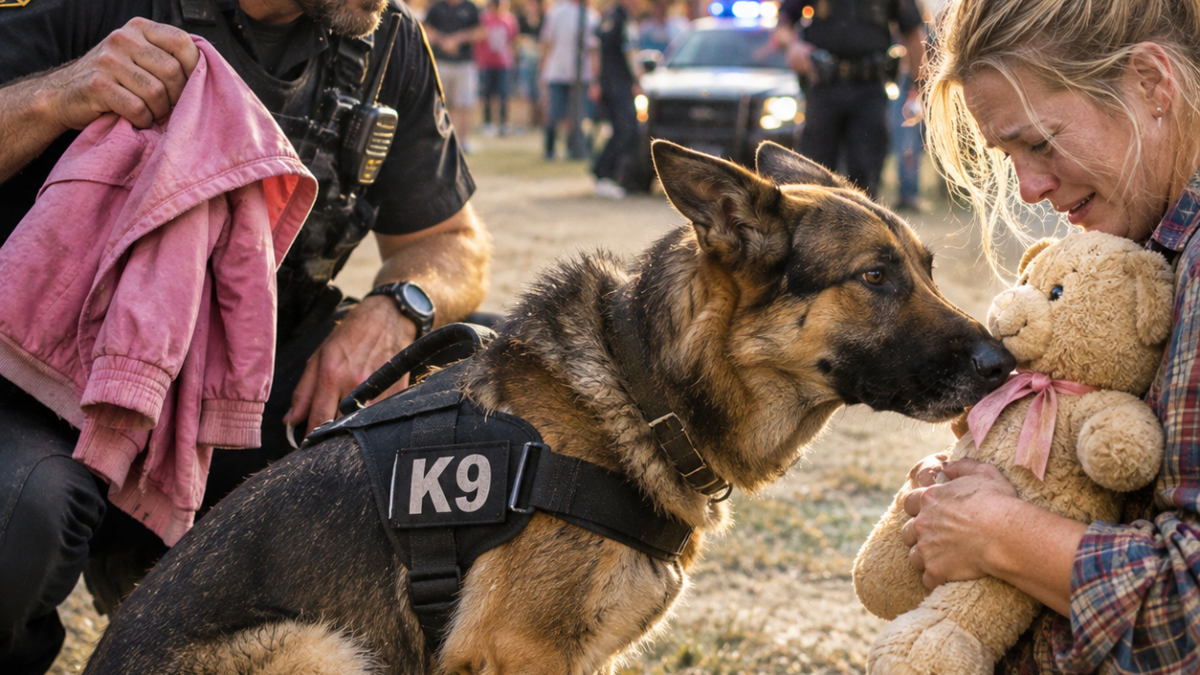
A Little Girl Vanished From a County Fair—Then the K9 Ignored Her Jacket and Sniffed Her Teddy Bear Instead
Hundreds of footprints covered the county fairground by the time seven-year-old Emma Lawson vanished, and every minute that passed made the trail colder beneath the carnival lights.
Deputy Caleb Ross offered K9 Duke the little girl’s jacket, but the German shepherd ignored it three times and kept turning toward the battered teddy bear her mother was clutching against her chest.
Then Duke buried his nose in the bear, snapped his head toward a row of livestock trailers behind the barns, and began pulling so hard on the leash that Caleb knew the dog had found something no human search team had noticed.
The first scream came from somewhere near the Ferris wheel.
Not the kind people make on rides.
This one cut through the music.
Through the generators.
Through the announcer calling numbers over the livestock pavilion speakers.
Through the shrieks from the spinning carnival rides and the constant hum of thousands of people moving through the Mercer County Fair.
I heard it from nearly a hundred yards away.
A mother screaming a child’s name.
“Emma!”
People turned.
Most only for a second.
County fairs are loud places.
Children cry.
Parents shout.
Someone is always calling for somebody.
But there was something different in that voice.
I had been a sheriff’s deputy long enough to know the sound of fear before I knew the reason for it.
I looked down at Duke.
His ears had already lifted.
Duke was a six-year-old sable German shepherd, seventy-eight pounds, trained for tracking, area search, article search, and patrol work.
People who saw him at demonstrations usually noticed his size first.
Children noticed his ears.
Other cops noticed his focus.
I noticed everything.
The scar across his left shoulder from a barbed-wire fence two years earlier.
The way his right ear tilted slightly when he was thinking.
PART2:
The little patch of white hair beneath his chin that made him look older than he was.
And the fact that he had already heard the fear in that woman’s voice before I had finished turning around.
We were at the fair for what should have been an easy shift.
Crowd patrol.
Lost property.
Parking arguments.
Drunk adults who temporarily forgot they were standing beside children.
Maybe a demonstration for the 4-H kids if there was time.
Duke had spent most of the afternoon lying beneath a folding table near the sheriff’s mobile command unit, watching people carry fried dough past him with quiet personal resentment.
It was 7:18 p.m.
The sun had started dropping behind the grandstand.
The fairground lights were coming on.
Families were moving from the agricultural side toward the midway.
The crowd was getting denser.
I saw the woman before I reached her.
Brown hair pulled back.
Blue jeans.
White T-shirt.
One sneaker untied.
She was standing near a lemonade stand, spinning in circles as if looking fast enough might make her daughter appear.
A stuffed teddy bear was crushed against her chest.
A man beside her kept saying:
“She was right here.”
Over and over.
“She was right here.”
I pushed through the crowd.
“Sheriff’s office.”
The woman grabbed my sleeve.
“My daughter.”
“What’s her name?”
PART3:
“Emma.”
“How old?”
“Seven.”
“When did you last see her?”
“Five minutes ago. Maybe six. I don’t know.”
“Where?”
She pointed toward a children’s game booth where stuffed animals hung from hooks above a row of plastic ducks.
“She was playing there.”
“What was she wearing?”
“Yellow shirt. Denim shorts. Pink sneakers.”
“Hair?”
“Brown. Braids.”
“Any medical conditions?”
“No.”
“Phone?”
“She’s seven.”
“Anyone she might leave with?”
“No.”
“Family here?”
“My husband. My sister. My parents.”
The man beside her stepped forward.
“I’m her dad. Mark Lawson.”
I looked between them.
“Did either of you see her walk away?”
“No,” Mark said.
His face was pale.
“I turned around to pay.”
“For how long?”
“Maybe thirty seconds.”
The mother interrupted.
“Less than that.”
“Who noticed first?”
“I did.”
She squeezed the bear harder.
“I turned around and she was gone.”
“What’s your name?”
“Mara.”
“All right, Mara, I need you both to listen to me.”
They did.
Parents in those moments will do anything if you give them one clear instruction.
“Do not start running randomly through the fair. We’re going to lock this down by zones. Stay with Deputy Foster when he gets here. He’s going to get a photo of Emma and every detail you can remember.”
Mara looked at Duke.
“Can the dog find her?”
“We’re going to try.”
Try.
I hated that word.
Parents hear can.
Police officers answer try.
That gap contains a lot of pain.
I keyed my radio.
“Command, Ross. Missing juvenile, female, seven years, last seen midway near north Ferris wheel entrance. Start perimeter containment. Need units at all public exits and service gates. Possible active search.”
The radio exploded with responses.
A missing child at a county fair is every deputy’s nightmare because a fairground is one giant contamination scene.
Thousands of people.
Thousands of shoes.
Food smells.
Livestock.
Generators.
Vehicle exhaust.
Hay.
Sweat.
Perfume.
Grease.
Smoke.
Every direction touched by hundreds of people.
Tracking dogs work best with clear information.
Fresh scent.
Known direction.
Limited contamination.
We had almost none of that.
The fair had roughly twelve thousand visitors on the grounds that evening.
By the time anyone realized Emma was missing, maybe five hundred people had already crossed the immediate area.
I asked Mara:
“Do you have something Emma wore today?”
She nodded quickly.
“My sister has her jacket.”
“Get it.”
Mark shouted toward another woman.
“Amy!”
A blonde woman hurried over holding a child’s light blue zip-up jacket.
Mara reached for it.
I stopped her.
“Don’t touch it anymore.”
She froze.
I took the jacket by one edge.
Duke stood.
His entire posture changed.
Work.
I walked him several yards away from the family first.
Tracking dogs are not magic.
They do not sniff an object and instantly create a glowing path through the world.
They work from odor.
Human skin cells.
Sweat.
Hair.
Environmental scent.
And context matters.
So does contamination.
I crouched.
“Duke.”
He looked at me.
I offered the jacket.
“Smell.”
Duke sniffed.
Once.
Then looked away.
I repositioned it.
“Smell.”
He sniffed again.
Turned his head toward the crowd.
Not focused.
I frowned.
That was not normal.
I tried a third time.
“Duke. Smell.”
He touched the jacket with his nose.
Then immediately turned toward Mara.
More specifically, toward the teddy bear in her arms.
I followed his gaze.
“No.”
Mara looked confused.
“What?”
I stepped closer.
“Where did that bear come from?”
“What?”
“The stuffed animal.”
“Emma’s.”
“Was she carrying it?”
Mara shook her head.
“She brought it in the car. I made her leave it because I thought she’d lose it.”
“Who has touched it?”
“Me. Mark. Maybe my mom.”
“Today?”
“Yes.”
Not ideal.
But Duke was interested.
That mattered.
I held the jacket out again.
He barely acknowledged it.
Then his nose lifted.
Toward the bear.
Duke pulled one step.
“Show me that.”
Mara hesitated.
It was instinctive.
That bear was probably the only thing in the world she wanted to hold at that second.
Then she gave it to me.
Brown teddy bear.
One eye slightly crooked.
Left ear repaired with pink thread.
The fur around its stomach flattened from years of being hugged.
I held it toward Duke.
His response was immediate.
Nose deep into the fabric.
Long inhale.
Another.
He moved around it.
Sniffed the head.
The arms.
The worn belly.
Then he looked up at me.
Focused.
There.
That was the dog I knew.
“Good.”
I let him scent again.
“Find Emma.”
Duke pulled.
Hard.
Not toward the game booth.
Not toward the Ferris wheel.
He turned away from the midway.
Toward the barns.
I almost stopped him.
Almost.
Because every human assumption said Emma should be somewhere near the rides.
Maybe confused.
Maybe following another family.
Maybe at a restroom.
Maybe she had walked toward food vendors.
The livestock side was darker.
Quieter.
Farther from where she disappeared.
But Duke did not care about human assumptions.
He pulled through the crowd.
I followed.
“Move!”
People stepped aside.
Some recognized the vest.
SHERIFF K9.
A few started filming.
I hated that.
Every major event now has ten people recording before one person moves.
But I had no attention for them.
Duke dragged me past the funnel-cake stand.
Across a gravel service lane.
Toward the sheep barn.
His nose stayed low.
Then high.
Low again.
Working.
We passed hundreds of footprints.
Children.
Workers.
Farm families.
Duke did not follow a neat path.
He zigzagged.
Corrected.
Paused.
Then accelerated.
Deputy Grant caught up behind me.
“Anything?”
“He’s got something.”
“You sure?”
“No.”
That was the honest answer.
The jacket had bothered me.
Why ignore it?
Possible contamination.
Maybe Emma had barely worn it.
Maybe it belonged to someone else originally.
Maybe detergent overwhelmed the individual scent.
The teddy bear had years of Emma on it.
Skin.
Sleep.
Tears.
Hands.
Hair.
That made sense.
Still, a dog turning toward a livestock area could be reacting to any number of competing smells.
I trusted Duke.
But trust does not mean pretending he cannot be wrong.
We entered the cattle barn.
The sound changed immediately.
Hooves shifting.
Fans humming.
Cattle lowing.
Hay.
Manure.
Teenagers cleaning pens.
Duke barely slowed.
He moved down the central aisle.
Then abruptly veered left.
Toward an exit at the far end.
“Caleb!”
A voice behind me.
Mara.
She had followed.
Deputy Foster was with her.
I stopped.
“No.”
“I’m coming.”
“Mara, I need you back at command.”
“That’s my daughter.”
“I know.”
“Then don’t tell me to wait while you look for her.”
I understood.
But emotion does not change search procedure.
“If Duke finds something dangerous, I cannot protect you and work him.”
“I don’t care.”
“I do.”
She looked ready to fight me.
I pointed at Foster.
“Stay with him. If we get a direction change, you need to be available for questions.”
It was partly true.
Mostly I did not want her following us into dark service areas.
Mark arrived behind her.
He put both hands on her shoulders.
“Let him go.”
Mara looked at me.
“Bring her back.”
No officer should promise that.
I knew better.
Instead I said:
“I’m going where Duke takes me.”
Then we moved.
Outside the cattle barn was a service road running behind the livestock buildings.
Trailers were parked in rows.
Horse trailers.
Stock trailers.
Equipment haulers.
Some attached to trucks.
Some sitting alone.
Farther back were fair maintenance sheds, dumpsters, portable generators, and fencing.
Not many visitors came there.
That was good for scent.
Bad for every other reason.
The sky was darker now.
I turned on my flashlight.
Duke pulled toward a row of livestock trailers.
A deputy was already there.
“Search team cleared this row,” he called.
“When?”
“Ten minutes ago.”
“How?”
“Visual.”
“Opened?”
“Most.”
Most.
That word made me angry.
“Which not?”
He pointed.
“Some locked.”
Duke pulled harder.
Toward the locked ones.
My heartbeat changed.
“Find Emma.”
Duke moved past the first trailer.
Sniffed the hitch.
Ignored it.
Second.
Nose along the ground.
Third.
He stopped.
Large white livestock trailer.
No truck attached.
Mud on the tires.
Vent windows high along the side.
Rear doors shut.
Duke circled.
Sniffed the lower seam.
Then pulled to the side door.
He scratched once.
Stopped.
Looked at me.
Then scratched harder.
“Sheriff’s office!”
Nothing.
I knocked.
“Anyone inside?”
Nothing.
Duke barked.
One sharp bark.
Then another.
Grant came beside me.
“Locked.”
There was a padlock through the exterior latch.
My stomach dropped.
“Owner?”
Radio chatter.
Fair staff checking registration.
Duke scratched again.
Then pressed his nose to the bottom seam.
Whined.
I had heard Duke whine on searches before.
Usually when scent was strong but access blocked.
“Get bolt cutters.”
Grant radioed.
I crouched near the door.
“Emma?”
Nothing.
I pressed my ear against metal.
At first:
Nothing.
Then—
A sound.
Maybe.
I held my breath.
“Emma?”
A tiny knock.
Three taps.
I looked at Grant.
He heard it too.
“Jesus.”
“Emma!”
This time:
“Mom?”
Barely audible.
Everything inside me released and tightened at once.
“We’ve got her!”
The radio call went out.
I shouted through the door.
“Emma, my name is Deputy Caleb. We’re getting you out. Stay where you are.”
“I want my mom.”
“She’s here. She’s close.”
“Is Duke there?”
I looked at the dog.
“Yes.”
That surprised me.
“How do you know Duke?”
“I heard him.”
“Okay. Duke’s here.”
The bolt cutters arrived.
The padlock broke.
We pulled the latch.
The side door did not open.
Something blocked it from inside.
I pushed.
An inch.
Two.
“Emma, move away from the door.”
“I can’t.”
My blood went cold.
“Why?”
“My foot hurts.”
Grant and I exchanged looks.
We went to the rear doors.
No lock.
But the latch was wired shut from the outside with a twisted piece of baling wire.
Not uncommon during transport.
Very concerning on a stationary trailer with a child inside.
Grant cut it.
We opened the door.
Flashlights swept in.
Empty livestock compartments.
Metal gates.
Straw.
No child visible.
“Emma!”
“Here!”
Her voice came from the forward storage section.
We climbed inside.
Duke stayed at the rear with another deputy.
A divider gate had been partially closed.
Behind it, in a narrow front compartment, a small girl sat on the floor.
Yellow shirt.
Denim shorts.
Pink sneakers.
Brown braids.
One shoe missing.
Her left ankle wedged beneath a low metal rail.
She was crying silently.
Not screaming.
The kind of crying children do when they have been scared too long and used up the louder part.
I crouched.
“Emma?”
She nodded.
“You’re okay.”
That was another phrase officers use when things are not yet okay.
“You’re going to be okay.”
Better.
“Where’s my mom?”
“Right outside.”
“I want her.”
“I know.”
Grant radioed.
“Child located, conscious. Need EMS at livestock trailer row three. Possible ankle injury.”
I examined the rail.
Her foot was trapped by position, not crushed.
We could free it.
“Emma, did someone put you in here?”
Her expression changed.
That was enough to make every hair on my arms rise.
She looked away.
“Emma?”
She whispered:
“A man said Mom was looking for me.”
Grant stopped moving.
I kept my voice calm.
“What man?”
“I don’t know.”
“Did he bring you here?”
She nodded.
The missing-child search just became something else.
“Where is he?”
“I don’t know.”
“Did he leave?”
She nodded again.
“How long ago?”
“I don’t know.”
“Did he hurt you?”
She shook her head.
“My foot.”
“Anything else?”
“No.”
I did not push further.
Not there.
Not then.
We lifted the metal rail just enough.
Emma pulled her ankle free.
She immediately tried to stand.
Collapsed.
I caught her.
“Easy.”
“I want Mom.”
I picked her up.
Seven years old.
Maybe fifty pounds.
She wrapped both arms around my neck.
As we moved through the trailer, she saw Duke waiting outside.
“That dog found me?”
“Yes.”
She looked at him.
Then buried her face into my shoulder.
Outside, Mara broke through the deputies before anyone could stop her.
“Emma!”
The sound she made did not resemble the scream from the Ferris wheel.
This one broke.
Emma reached.
“Mom!”
I handed her over.
Mara collapsed to her knees with her daughter in her arms.
Mark fell beside them.
For several seconds, nobody moved.
Deputies looked away.
Fair workers stood silent.
Even the radio traffic seemed far away.
Duke sat beside my left leg.
Watching.
I put my hand on his head.
“Good boy.”
His tail hit the gravel once.
That should have been the end of the story.
Little girl found.
Dog gets praise.
Family goes home.
But it was only the beginning.
Because Emma had not wandered into that trailer.
Someone had taken her there.
And while EMS examined her ankle, detectives started asking questions.
Very careful questions.
Who spoke to you?
What did he look like?
What did he say?
Did you know him?
Where did he touch you?
Did he have a car?
Did anyone else see him?
Emma was overwhelmed.
Mara refused to leave her side.
Mark paced ten feet away like he wanted somebody to give him a wall to punch.
I stayed out of the interview.
Not my role.
My role had been the search.
But then Emma said something that brought me back into it.
“The bear.”
Detective Nora Callahan looked at her.
“What bear?”
“My Teddy.”
Mara held it up.
Emma reached.
“That’s why the dog found me?”
Nora looked toward me.
I explained.
“Duke rejected the jacket. He alerted on the bear.”
Emma hugged Teddy.
“I sleep with him.”
That explained everything.
Her jacket had been hanging on the back of a chair for days, Mara later told us.
Emma had worn it only briefly that afternoon because the evening turned cool.
Other family members had handled it.
Teddy, though, had slept in Emma’s bed since she was three.
She carried him around the house.
Held him during movies.
Took him to the doctor.
Cried into him.
Human odor accumulates deeply in fabric.
Duke had made the better choice.
That bothered me in a different way.
Because I had nearly corrected him away from it.
Handlers are trained to read dogs.
But handlers are also human.
Humans like instructions.
This is the scent article.
Search from this article.
Duke had basically said:
Wrong one.
Use that.
And for one second, I had thought he was distracted.
That humbles you.
K9 work is partnership.
The moment you believe the leash only sends information one direction, you become dangerous.
Detectives found tire impressions near the trailer.
One set fresh.
A truck had been attached recently.
Fair registration records showed the trailer belonged to a livestock contractor named Walter Brenner.
Sixty-two.
Longtime exhibitor.
But Brenner had gone home that afternoon after dropping equipment.
His trailer was supposed to be empty.
He had left it unlocked.
He confirmed he had not placed the padlock.
The lock was not his.
That meant whoever used the trailer brought one.
Calculated.
Chose a place behind the barns.
Knew or guessed which trailer would be unattended.
The search became immediate.
Fairground exits had already been locked down for the missing child.
Now deputies began reviewing everyone detained near service gates.
Security cameras were pulled.
Vendors questioned.
Employees checked.
Emma described the man as:
“Brown hat.”
“Gray shirt.”
“Smelled like cigarettes.”
“Had a picture badge.”
That last detail mattered.
Fair workers wore laminated credentials.
So did vendors.
Contractors.
Livestock personnel.
Hundreds of people.
The man had approached while Emma stood near the game booth.
He told her:
“Your mom sent me. She’s by the animal barns.”
Emma had hesitated.
He said her mother knew she had won a blue plastic ring at the duck game.
That detail made him believable.
He had been watching.
Or close enough to hear.
Emma followed.
Halfway across the grounds, she became scared and asked to go back.
He grabbed her hand.
Not violently enough to draw attention.
Firmly enough that she could not leave.
Behind the barns, he put her into the trailer.
Emma kicked.
Her sneaker caught.
The man shut the divider.
She tried to follow.
Her ankle became trapped.
Then he left.
Why?
Maybe because search announcements began sooner than he expected.
Maybe because deputies flooded the exits.
Maybe because he intended to return.
The possibilities made everyone sick.
A fair security camera eventually showed a man in a brown cap leading Emma toward the livestock barns.
The image was distant.
Face partly obscured.
Gray shirt.
Credential badge.
He walked normally.
That was almost worse.
Anyone watching casually would see an adult and child walking together.
Nothing dramatic.
No struggle.
Emma’s hand in his.
That was how fast danger could disguise itself as normal.
The fair shut down early.
Rides stopped.
Music cut.
Thousands of people were asked to leave through controlled exits after being screened.
Parents held children closer.
Rumors spread faster than facts.
By midnight, social media had turned one missing-child incident into twenty imaginary stories.
Some said Emma had been found miles away.
Others claimed she was in a horse trailer with three other children.
False.
One post said Duke had attacked the suspect.
False.
Another said the suspect had been arrested.
False.
At that point, we did not know who he was.
I got home at 3:10 a.m.
My wife, Claire, was awake.
She was a nurse and knew better than to ask immediately.
She looked at Duke first.
He drank half a bowl of water.
Then ate.
Then collapsed onto the kitchen floor.
I sat beside him.
Claire sat across from me.
“You found her.”
“Yes.”
“Alive?”
“Yes.”
“Injured?”
“Ankle.”
“Anything else?”
“Not physically that we know.”
She understood the qualifier.
“Someone took her?”
“Yes.”
Claire closed her eyes.
I rubbed Duke’s neck.
“He ignored the jacket.”
“What?”
“The scent article.”
I told her.
The bear.
Three refusals.
The pull toward livestock trailers.
Claire smiled faintly.
“He knew better than you.”
“Apparently.”
“Does that bother you?”
“Yes.”
“Good.”
I looked at her.
She shrugged.
“You always say the dangerous handlers are the ones who think the dog can’t teach them anything.”
I hated when my own words returned.
Duke slept.
I did not.
Every time I closed my eyes, I saw Emma inside the trailer.
Small.
Yellow shirt.
One shoe.
And I kept thinking about the first search team.
They had checked the row.
Visual.
Most trailers.
Not all.
Nobody had heard Emma.
Duke had.
Or smelled her.
And the bear had made the difference.
At 6:40 a.m., my phone rang.
Detective Nora.
“We have a possible.”
I sat up.
“Who?”
“Temporary livestock worker. Name’s Grant Ives. Forty-three. Contract labor for setup.”
“Badge?”
“Yes.”
“Brown cap?”
“Seen in one on video two days ago.”
“Where is he?”
“Not home.”
“Vehicle?”
“Silver Ford F-150.”
Camera review showed a silver pickup leaving a rear service lot at 7:26 p.m.
Eight minutes after Emma was reported missing.
The plate was partially visible.
Matched a vehicle registered to Ives.
His credential had scanned into the livestock service gate at 4:52.
No exit scan because staff had opened a vehicle gate during congestion.
Ives had worked fairs across three counties.
No violent criminal record.
A misdemeanor trespass years earlier.
Nothing that would have automatically flagged him.
Deputies went to his apartment.
Empty.
His truck was found at a motel forty miles away.
He was arrested without incident in the lobby.
A brown cap was in the room.
Gray work shirts.
Fair credentials.
A roll of baling wire.
And a new two-pack of small brass padlocks.
One missing.
The key in his pocket fit the lock removed from the trailer.
That was enough for probable cause.
Later evidence made the case much stronger.
But that came after.
The arrest did not make me feel better.
People assume it does.
It gave the fear a face.
That was useful.
It did not erase the trailer.
Emma spent one night in the hospital for observation and imaging.
No fracture.
Severe ankle sprain.
Bruising.
She went home the next afternoon.
Mara called the sheriff’s office.
She asked whether Duke could visit.
Normally, I would hesitate.
Victims’ families need space.
Dogs are working equipment in one sense and living beings in another.
But Duke had become part of Emma’s understanding of what happened.
So two days later, we went.
The Lawson house was modest.
White siding.
Basketball hoop.
Sidewalk chalk still visible near the driveway.
Mara opened the door.
Her eyes looked like she had not slept.
Then she saw Duke.
She covered her mouth.
“He’s bigger than I remember.”
“He was probably moving faster then.”
Emma sat on the couch.
Ankle wrapped.
Teddy beside her.
When Duke entered, he stopped.
Looked at her.
Then at me.
I released him from heel.
“Go say hi.”
Duke approached.
Slow.
Emma froze.
Not fear exactly.
Emotion.
She held out one hand.
Duke sniffed.
Then rested his chin on her knee.
Emma cried.
Mara cried.
Mark turned toward the window.
I became fascinated by a family photograph on the wall because sometimes professionals need somewhere else to look.
Emma hugged Duke’s neck.
He allowed it for three seconds.
Then looked at me like:
This is excessive.
I smiled.
“Good boy.”
Emma asked:
“Did he really smell Teddy?”
“Yes.”
“Why not my jacket?”
“Because Duke makes his own decisions sometimes.”
“Is he smarter than you?”
Mark laughed for the first time.
I said:
“Frequently.”
Emma picked up the bear.
Duke sniffed it.
Tail moved.
She smiled.
“I thought Teddy was a baby toy.”
Mara looked at her.
“You did?”
“I was going to stop sleeping with him.”
Duke sat.
Emma hugged Teddy tighter.
“Now I’m keeping him forever.”
Fair enough.
Before we left, Emma disappeared into her bedroom.
She returned with a blue ribbon.
Not a real award.
Craft ribbon with FIRST PLACE printed on it from some school activity.
She tied it loosely around Duke’s vest handle.
“For him.”
I looked at Duke.
He looked deeply unconcerned.
“Thank you.”
“He won.”
“Yes.”
“He found me.”
“Yes.”
Then Emma said:
“But you listened to him.”
That hit harder than she knew.
I crouched.
“Eventually.”
She smiled.
That ribbon stayed in my patrol bag for years.
Not on Duke.
Working dogs do not need sentimental accessories on duty.
But I kept it.
The case moved through the courts slowly.
Far too slowly for the family.
Ives was charged with kidnapping, unlawful restraint, child endangerment, and related offenses.
Evidence connected him to Emma.
The video.
Padlock.
Wire.
Witnesses.
Digital records.
His phone location.
He eventually accepted a plea rather than take the case to trial.
I will not pretend that gave anyone a satisfying ending.
No sentence returns a child to the version of herself who had never followed a stranger toward the barns.
But Emma survived.
That was not small.
Mara later told me Emma struggled with crowds.
County fairs.
Stores.
School assemblies.
She became frightened when she lost sight of her mother for even seconds.
Therapy helped.
Time helped.
Family helped.
And strangely, Duke helped.
Every few months, Emma sent him something.
A drawing.
A photograph.
A Christmas card addressed:
DEPUTY DUKE.
One said:
THANK YOU FOR SMELLING THE RIGHT THING.
I framed that one in the K9 office.
Duke continued working.
Searches do not usually end like Emma’s.
That is the truth people do not want in heroic K9 stories.
Sometimes there is no dramatic rescue.
A lost elderly man with dementia is found sitting beneath a tree.
A teenager runs away and returns before the dog arrives.
A suspect trail ends at a vehicle.
A missing hiker is found by volunteers while the K9 team works another sector.
Sometimes the person is already dead.
Dogs do not know which outcome waits at the end of the trail.
They only work.
That may be one of their greatest gifts.
Humans carry expectation.
Fear.
Memory.
Dogs carry task.
Scent.
Direction.
Next step.
Duke had difficult searches after Emma.
One winter, we searched seven hours for an autistic nine-year-old who had left his grandmother’s house.
Duke tracked through snow to an abandoned shed.
The boy was inside wearing socks.
Alive.
Another time, an elderly man disappeared from a memory-care facility.
Duke found his scent along a creek.
We located him downstream.
Too late.
I cried in the truck afterward.
Duke ate dinner.
Not because he did not care.
Because he did not carry moral narratives.
He had done his job.
Sometimes I envied that.
Emma visited the sheriff’s K9 demonstration the following summer.
She was eight.
Ankle healed.
Teddy came too.
She sat in the front row.
When I brought Duke out, she waved.
He saw her.
I know people exaggerate animal recognition.
I try not to.
But Duke changed.
Head higher.
Tail moving.
He looked directly at her.
I let him greet her afterward.
She knelt.
Duke pressed his shoulder against her.
Mara said:
“He remembers.”
Maybe.
Maybe scent.
Maybe body language.
Maybe familiarity.
I did not need to decide.
Emma did.
She whispered something into his ear.
I did not hear it.
Later Mara told me.
“She said, ‘I wasn’t scared when I heard you barking.’”
That became one of the hardest sentences I carried.
Because Emma had been scared.
Terrified.
But in the trailer, after hearing Duke outside, something changed.
She knew someone was looking.
There is a difference between being trapped and being trapped while rescue is close enough to hear.
Sometimes hope is just a bark on the other side of a metal wall.
Years passed.
Duke turned seven.
Then eight.
His muzzle grayed.
His shoulder stiffness worsened after long searches.
The veterinarian started joint supplements.
Then anti-inflammatory medication as needed.
I pretended not to notice how long he took standing after naps.
K9 handlers are excellent at recognizing decline in other people’s dogs.
Terrible with our own.
At nine, Duke still worked.
Slower.
More selective deployments.
No long patrol tracks in extreme heat.
More article searches.
Demonstrations.
Short searches.
My captain started talking about retirement.
I resisted.
“He’s fine.”
“He’s nine.”
“Dogs don’t know numbers.”
“Caleb.”
“He passed certification.”
“He did.”
“Then what’s the problem?”
The captain looked at Duke lying beside my desk.
“The problem is he’d work until his body failed because you asked him to.”
That shut me up.
Working dogs do not retire themselves.
That is the handler’s responsibility.
And love sometimes means deciding the animal has given enough before the animal decides it.
We scheduled Duke’s retirement for spring.
I did not tell Emma.
I did not know whether she still cared.
She was twelve then.
Middle school.
Friends.
Sports.
Life.
Then a letter arrived.
Hand-addressed.
DEPUTY ROSS & DUKE.
Inside:
Dear Duke,
Mom said you are getting older.
I am too.
I don’t sleep with Teddy every night anymore but I still have him.
I remember the trailer sometimes.
Mostly I remember hearing you outside.
I hope when you retire you get a couch and steak.
Love,
Emma
P.S. You are still smarter than Deputy Ross.
I called Mara.
“How did she know?”
“Small town.”
Fair.
“Does she want to come?”
“To retirement?”
“If she wants.”
Emma came.
So did her parents.
The K9 unit held a small ceremony.
Nothing elaborate.
Duke did not understand.
He thought we were standing around waiting for somebody to throw his ball.
The sheriff talked.
My captain talked.
I spoke for thirty seconds because anything longer would have become embarrassing.
Then Emma walked forward carrying Teddy.
Same bear.
Much more worn.
Duke sniffed it.
Tail wag.
Emma laughed.
“You remember.”
She gave him a steak-shaped dog toy.
Not an actual steak.
“He’ll get the real one later,” I promised.
She hugged him.
This time Duke tolerated five seconds.
Retirement was strange.
For both of us.
Duke had lived with my family his entire working life.
So home did not change.
Routine did.
First Monday after retirement, I put on my uniform.
Duke stood.
Walked toward the door.
I said:
“No.”
He stared.
“You’re retired.”
Tail wag.
“No work.”
He looked at the leash.
Then me.
I left without him.
He barked once.
I nearly called in sick.
Claire texted me an hour later.
He’s sleeping on your side of the bed.
Traitor.
Eventually Duke adapted.
Couch.
Backyard.
Walks without objectives.
Food that fell accidentally from the table suspiciously often.
He had spent his life following scent to other people.
Now he followed Claire to the refrigerator.
Retirement suited him.
Mostly.
I stayed in the K9 unit as a handler instructor.
New dog eventually.
A Belgian Malinois named Rook.
Completely different.
Faster.
More intense.
Less forgiving.
Duke tolerated him with the exhausted contempt of an old man watching a teenager discover energy drinks.
Emma met Rook once.
“He’s crazy.”
“Yes.”
“Duke was calmer.”
“Yes.”
“Duke was better.”
I looked at Rook.
“Don’t tell him.”
Emma became a teenager.
Then high school student.
We heard less.
That was normal.
The Lawson family moved across town.
Mara still sent a Christmas card.
Duke’s photo occasionally appeared in Emma’s social-media posts on anniversaries of the fair incident, though we tried not to turn the event into a spectacle.
I learned Emma had joined a youth volunteer program.
Later she worked with missing-children organizations.
Not because anyone told her to.
She said she wanted other children to know adults would keep looking.
That sentence made sense.
At sixteen, Emma spoke at a county safety event.
I sat in the back.
She told her story publicly for the first time.
Not the details of the man.
Not trauma.
She talked about trust.
She said:
“I followed an adult because he knew one true thing about me.”
The blue ring.
He knew she had won it.
That tiny detail convinced her.
She told parents:
“Teach kids that adults who need help should ask other adults, not children.”
She told kids:
“If someone says your parent sent them, you can still say no until you see your parent.”
Then she talked about Duke.
“I was inside a metal trailer and I heard a dog bark.”
She paused.
“I did not know where my mom was. I did not know where the man went. But when I heard that bark, I knew somebody had come.”
I cried.
Quietly.
Retired deputies are allowed.
Duke was fourteen by then.
Very old for a German shepherd.
Hips weak.
Hearing fading.
Still eating.
Still stubborn.
He slept most days.
When I got home from the event, he lifted his head.
I sat beside him.
“You’re famous again.”
One eye opened.
“Emma talked about you.”
Nothing.
“She says you saved her.”
Duke sighed.
“You could at least pretend.”
Tail moved once.
Good enough.
A month later, Duke stopped eating breakfast.
Handlers notice immediately.
He had never refused breakfast in fourteen years.
Claire looked at me.
I knew.
“Maybe stomach.”
“Maybe.”
We went to the vet.
Bloodwork.
Ultrasound.
Mass on spleen.
Likely cancer.
The veterinarian explained options.
Surgery at his age.
Risks.
Potential bleeding.
Maybe weeks.
Maybe months.
We could do more diagnostics.
I listened.
Then looked at Duke.
Old dog.
White muzzle.
The scar on his shoulder.
His paws.
Those paws had covered hundreds of miles searching for people.
I asked the question I had trained families to ask.
“What would you do if he were yours?”
The vet looked at Duke.
“Comfort.”
That was the answer.
We took him home.
Pain medication.
Good food.
Short walks.
No stairs.
The K9 unit came to visit.
Rook sniffed him.
Duke growled once.
Professional standards maintained.
The captain brought steak.
Actual steak.
Claire rolled her eyes.
Duke ate that.
Of course.
I did not tell Emma immediately.
Mara found out through the sheriff’s office.
She called.
“Can we come?”
“Yes.”
Emma was seventeen.
Almost grown.
She walked into our living room carrying Teddy.
I had not expected that.
The bear’s fur was nearly flat.
Pink stitching still on the ear.
Duke was lying on his bed.
Emma knelt.
“Hey.”
Duke opened his eyes.
She placed Teddy near his nose.
For several seconds, nothing.
Then his nose moved.
One breath.
Two.
His tail thumped the bed.
Emma covered her face.
“Oh my God.”
Maybe he remembered.
Maybe the bear simply smelled interesting.
I will let Emma keep her version.
She lay beside Duke.
Not hugging.
Just one hand on his shoulder.
“You found me.”
Duke breathed.
“You were right about Teddy.”
She looked at me.
“Did you ever figure out why?”
“Best guess? Stronger scent.”
“Because I slept with him.”
“Yes.”
She smiled.
“I still do sometimes.”
“No judgment.”
“Good.”
Then she looked at Duke.
“What if he had taken the jacket trail?”
I hated the question because I had asked it myself for years.
“Maybe he still finds you.”
“Maybe not.”
“Emma.”
She looked at me.
“Search dogs make decisions based on scent. Duke picked the best article available.”
“But you could’ve made him use the jacket.”
“Yes.”
She waited.
“Why didn’t you?”
I thought.
“Because I knew when he was telling me I was wrong.”
Emma nodded.
“That’s important.”
“Yes.”
Not just in K9 work.
The ability to recognize when something trusted tells you your assumption is wrong.
Dog.
Child.
Evidence.
Victim.
Partner.
Reality.
People get hurt when authority becomes more important than listening.
Duke died four days later.
At home.
His bed.
Claire beside me.
I kept one hand on his chest.
The veterinarian gave sedation.
Duke relaxed.
For the first time in fourteen years, there was nothing left for him to find.
No command.
No scent.
No next task.
I whispered:
“Good boy.”
The phrase felt inadequate.
Thousands of repetitions.
Training.
Searches.
Arrests.
School demonstrations.
Emma.
An entire life reduced to two words handlers say every day.
Good boy.
Maybe simple words become enough when they have been true often enough.
His breathing stopped.
I stayed.
The house became impossibly quiet.
Rook was still working, but Rook was not Duke.
That distinction mattered.
Dogs are not roles.
You do not replace them by filling the kennel.
A few weeks later, a package arrived from Emma.
Inside was Teddy.
I called immediately.
“No.”
She laughed.
“What?”
“I cannot keep this.”
“Yes, you can.”
“This is yours.”
“It was.”
“Emma.”
“I want Duke to have it.”
“Duke is—”
I stopped.
She continued softly:
“I know.”
There was also a note.
Deputy Ross,
Teddy made me feel safe before I knew what safe meant.
Duke used him to find me when I needed somebody.
I think he belongs with the person who listened to the dog.
Emma
I sat at the kitchen table for a long time.
Teddy stayed.
He sits on the shelf above Duke’s ashes now.
Not because I like memorial displays.
I usually do not.
But some objects accumulate too much meaning to become ordinary again.
Years passed.
Emma went to college.
Studied social work.
Then child advocacy.
No surprise.
She returned to Mercer County after graduation.
Worked with families.
Eventually joined a regional missing-children response organization.
The first time she came to a K9 training after becoming a professional, I almost did not recognize her.
Twenty-three.
Hair shorter.
Confident.
Clipboard.
She watched handlers run scent drills.
Rook had retired by then.
I was no longer an active handler.
Mostly training and consulting.
A young deputy brought out a two-year-old German shepherd.
The dog ignored the scent article he was offered.
Handler corrected him.
Dog turned away again.
The handler tried a third time.
I watched.
Emma stood beside me.
She whispered:
“Bear.”
I smiled.
The handler eventually realized the bag had been contaminated by another person.
They switched articles.
The dog worked perfectly.
Emma asked:
“Does that happen often?”
“More than people think.”
“So Duke wasn’t being weird.”
“No.”
“He was working.”
“Yes.”
She looked toward the field.
“When I was little, I thought he chose Teddy because Teddy was special.”
“Teddy was special.”
“You know what I mean.”
“Yes.”
The bear was not magical.
Its value was practical.
It carried her.
More truly than the jacket did.
But that fact did not make the story less beautiful.
Reality rarely needs supernatural help.
Sometimes a dog’s nose is enough.
The Mercer County Fair continued every year.
For a while, Emma refused to return.
Nobody blamed her.
At eighteen, she went for thirty minutes.
Left.
At twenty-one, she stayed an hour.
At twenty-five, she volunteered at the child-safety booth.
The livestock trailers still lined the same service road.
Different trailers.
Same gravel.
She walked there once with Mara.
Not for therapy.
Not officially.
Just to see it.
The original trailer had been sold years earlier.
The space was ordinary.
That upset her at first.
Then helped.
Places do not hold power forever unless we keep giving it to them.
Emma told me that later.
We were drinking coffee at the fair command post.
“You know what I remembered most?”
“What?”
“Not the man.”
I waited.
“Not the trailer.”
“What then?”
“Duke barking.”
I looked away.
Of course.
She smiled.
“That’s the part my brain kept.”
I understood.
Trauma memory is strange.
Sometimes terror.
Sometimes smell.
Sometimes one sound that meant danger was ending.
The county eventually created a formal missing-child protocol for large public events based partly on lessons from Emma’s case.
Immediate exit containment.
Centralized child-description broadcasts to staff.
Rapid camera preservation.
Credential checks.
Designated K9 scent-article procedure.
And one rule I insisted on:
Do not assume the first scent article is the best scent article.
Ask questions.
What did the child wear most recently?
Who touched it?
Was it washed?
Do they have a comfort item?
Pillowcase?
Blanket?
Hat?
Toy?
Several years later, that policy mattered again.
A four-year-old wandered from a campground festival.
Family gave the K9 team his sweatshirt.
Dog struggled.
Handler asked for something else.
Mother produced a blanket from the car.
Strong scent.
Dog tracked the boy into woods.
Found him asleep under a picnic table nearly a mile away.
Alive.
The handler called me afterward.
“Bear rule.”
I laughed.
“Bear rule.”
Emma heard.
She cried.
Duke had been gone six years.
Still teaching.
That is the strange thing about working dogs.
Their influence outlives their bodies if people remember correctly.
Not as mythology.
As lessons.
Trust the dog.
Control the scene.
Check the article.
Listen.
Do not let ego hold the leash tighter than information.
I retired fully at sixty-one.
No badge.
No patrol car.
No dog kennel in the backyard anymore.
Claire celebrated by throwing away twelve old uniforms I had kept for no reason.
She tried throwing away Duke’s first training lead.
I caught her.
“No.”
She stared.
“You have not touched this in twenty years.”
“No.”
“You’re becoming a hoarder.”
“Specific hoarder.”
She let me keep it.
Teddy remained too.
One afternoon, Emma visited with her daughter.
Yes.
Emma had a daughter.
Her name was Lucy.
Six years old.
Brown hair.
Same eyes.
That did something to Mara the first time she held her.
Probably to everyone.
Lucy wandered through our living room.
Found the shelf.
Pointed at Teddy.
“Whose is that?”
Emma stopped.
Mine, I expected.
Instead she said:
“A dog’s.”
Lucy looked confused.
“Dogs have teddy bears?”
“This one did.”
She took Teddy down.
Held him.
The repaired ear.
The flattened fur.
Then Emma told the story.
Age-appropriate.
She got lost at a fair.
A police dog named Duke used Teddy’s smell to find her.
Lucy’s eyes widened.
“Did you cry?”
“Yes.”
“Was Grandma scared?”
“Very.”
“Did the dog bite the bad guy?”
“No.”
“Did he bark?”
“Yes.”
“Was he a superhero dog?”
Emma smiled.
“No.”
I looked at her.
“He was just very good at his job.”
That answer made me proud.
Stories grow in retelling.
People add capes.
Villains become bigger.
Heroes become perfect.
Details sharpen until reality disappears.
Emma kept Duke a dog.
A remarkable dog.
But a dog.
He had ignored commands sometimes.
Stolen food once.
Hated baths.
Snored.
Got distracted by deer early in training.
Failed his first article-search test because he tried to urinate on the evidence cone.
Heroism is more meaningful when the hero is allowed to remain real.
Lucy asked:
“Can I hold Teddy?”
Emma hesitated.
Then nodded.
“Careful.”
Lucy hugged him.
The same bear that had absorbed Emma’s scent decades earlier now disappeared beneath another child’s chin.
For a second, I remembered Mara at the fair.
Teddy crushed against her chest.
Duke turning away from the jacket.
That one movement.
What if I had corrected him?
What if I had insisted?
You can live inside questions like that forever.
I learned not to.
You respect the lesson.
Then release the alternate ending.
The real ending is enough.
Emma survived.
Duke came home.
A suspect was caught.
A child grew up.
A dog grew old.
A bear stayed.
That is enough.
Years after my retirement, Mercer County invited me to speak at a K9 memorial dedication.
Duke’s name was one of many.
Working dogs from decades of service.
Tracking.
Narcotics.
Patrol.
Explosives.
Search and rescue.
Names engraved in stone.
People asked me to tell one story.
I knew which.
I stood in front of deputies, families, children, retired handlers.
Emma sat in the front row with Lucy.
Mara and Mark beside them.
I told them about the fair.
Not the whole case.
The jacket.
The bear.
The trailers.
Duke pulling.
The sound inside the metal door.
Then I said:
“The most important thing Duke did that night was not obey me.”
People looked up.
“He told me my information was wrong.”
I held up an imaginary jacket.
“I gave him what I thought was the right scent article. He disagreed.”
I looked toward Emma.
“He chose the bear.”
Then:
“A good working dog is not a machine that follows commands. A good working dog is a partner trained to solve a problem you cannot solve with your own senses.”
The younger handlers listened.
“So your job is not only to tell the dog what to do.”
I paused.
“Your job is to recognize when the dog is telling you something.”
That was Duke’s legacy to me.
Not just finding Emma.
Teaching me to listen when the answer did not look the way I expected.
After the ceremony, Emma came over.
“You tell it differently now.”
“How?”
“When I was little, you said Duke found me.”
“He did.”
“Today you said he corrected you.”
“He did that too.”
She laughed.
“Still smarter than you?”
“Consistently.”
Lucy interrupted.
“Mom says Teddy found her.”
Emma and I looked at each other.
“No,” Emma said.
“Duke found me.”
“But Teddy helped.”
“Yes.”
Lucy thought.
“Teamwork.”
Exactly.
Somewhere along the way, a frightened seven-year-old’s worst night became a story her daughter could understand without inheriting the fear.
That mattered more than any arrest.
I still go to the fair occasionally.
Not every year.
When I do, I walk the livestock row.
I cannot help it.
The trailers change.
Families load cattle.
Teenagers sweep straw.
Generators hum.
Nothing looks sinister.
Good.
Ordinary places should be allowed to become ordinary again.
Near the old search area, the county installed a small water station for working dogs.
A plaque beside it says:
IN HONOR OF K9 DUKE
MERCER COUNTY SHERIFF’S OFFICE
GOOD DOG. TRUSTED PARTNER.
Emma wanted one more line.
The county approved it.
Beneath:
HE FOLLOWED THE RIGHT SCENT.
People who do not know the story probably think it is just a K9 phrase.
Those who know understand.
Sometimes I stand there longer than necessary.
I think about that evening.
Crowd.
Lights.
Mara screaming.
Blue jacket.
Duke turning away.
Teddy.
Then the pull.
Handlers describe moments when a dog commits to scent.
There is a physical feeling through the leash.
Not mystical.
Mechanical almost.
Shoulders engage.
Stride changes.
Leash tension becomes purposeful.
The dog stops asking.
He knows.
I felt that from Duke when he turned toward the barns.
At the time, I thought we were following a possibility.
He was following Emma.
There is a photograph from that night I have never shared publicly.
Deputy Foster took it after Emma was found.
Mara kneeling on gravel holding her daughter.
Mark crouched beside them.
EMS behind.
Duke in the foreground.
He is not looking at Emma.
He is looking at me.
Waiting for the next command.
That is working dogs.
They do something that changes a family forever.
Then they ask:
What now?
Maybe that is why we love them.
Not because they know they are heroes.
Because they do not.
Duke never knew what 437 news articles—no, that was another story; rather, he never knew what headlines said about him.
He never knew Emma became an advocate.
Never knew protocols changed.
Never knew another child was found years later partly because handlers remembered to ask for a better scent article.
He knew:
Search.
Find.
Reward.
Home.
Dinner.
Ball.
My voice.
Claire’s couch.
That was enough for him.
It should probably be enough for us more often.
Emma once asked me what I would change if I could relive that night.
I thought she expected:
Get there faster.
Lock exits sooner.
Catch Ives before he left.
Prevent the abduction entirely.
Of course I would change all of that if magic allowed.
But within the moment I actually controlled?
“I’d trust Duke the first time.”
She smiled.
“Not the third?”
“No.”
“The bear?”
“Yes.”
She nodded.
“Me too.”
The jacket had looked more official.
More sensible.
A clothing item.
A textbook scent article.
Teddy looked like a child’s toy.
Worn.
Dirty.
Handled by family.
Imperfect.
But Emma had slept with that bear for four years.
Her scent lived deep inside it.
Duke knew.
Sometimes the most reliable clue is not the one adults think belongs in evidence.
Sometimes it is the thing a child loves enough to hold every night.
That is the story I remember.
Not the man.
Not the lock.
Not even the trailer.
A dog turning his head away from what I offered him.
Looking toward a frightened mother.
Toward a battered stuffed bear.
And saying, in the only language he had:
Not that.
This.
Then pulling me toward a little girl who was waiting in the dark.
And because I finally listened, we followed.








