A Little Girl Stopped a Hells Angel From Taking One Sip of Coffee—Minutes Later, 350 Bikers Fell Silent as the Truth Behind Her Warning Began to Unfold
PART3:
That phrase has mocked more men than any curse ever invented.
I was near the front that morning but not leading. Frank Hadley rode two bikes back and to my left, white beard moving against his chest in the wind, eyes hidden behind amber lenses. Frank was sixty-five and had been in the chapter since 1984. He had the kind of hands that looked like they had repaired half the machines in California and buried the other half. He was my oldest brother in the club, not by age alone but by history. He had seen me young, stupid, drunk, sober, angry, grieving, useful, useless, right, wrong, and everything between.
There are men who know too much about you for friendship to remain casual.
Frank was one of those.
He said later that he noticed I was quiet on the ride.
I told him I was always quiet.
He said, “Not like that.”
Frank was usually right about things I preferred he be wrong about.
The Redwood Diner came into view at 7:52 a.m.
Low and wide along the shoulder of Dutch Creek Road, windows glowing amber from inside, sign faded but still standing, parking lot cracked in the same three places it had been cracked since at least 1997. A blue pickup was already parked near the entrance. A couple of sedans. A white work truck. Ordinary morning vehicles belonging to ordinary morning people.
Ordinary people always look slightly disappointed when we arrive.
Not angry.
Not even always afraid.
Just disappointed that the morning they had ordered for themselves now had us in it.
We pulled in clean.
Forty-seven bikes moving into spaces and along the edge of the lot with practiced order. No revving. No show. No circus. The engines cut in staggered sequence until the last one went quiet, and the stillness afterward made the diners inside more aware of us than the noise had.
I removed my gloves slowly.
Stretched my right hand.
The knuckles did not like cold mornings anymore.
Frank walked up beside me and looked through the window.
“Same booth’s open.”
“Then God still favors sinners,” I said.
“God has low standards before breakfast.”
I grunted.
He smiled.
We walked in.
The bell over the door gave its thin little ring, absurd under the weight of forty-seven men in leather entering behind me over the next several minutes. Conversations inside the diner lowered by half. Not stopped. People think silence is the sign of fear, but that is not always true. Sometimes fear tries to behave normally and simply fails at volume control.
There were eleven customers inside before we arrived.
Two older women at a table near the pie case.
A road crew guy drinking coffee alone.
A couple in the back pretending not to stare.
A father and daughter at the counter.
I noticed them because the girl noticed me.
Most children stare at the vest, the beard, the tattoos. Then their parents correct them, and the staring becomes sideways, interrupted by shame.
This girl looked directly.
Not rude.
Not nervous.
Just direct.
She sat at the counter with both palms flat on the laminate, wearing a navy shirt with a yellow star on the front and sneakers that did not touch the floor. Nine maybe, though I was not good with ages. Brown hair pulled back badly, as if she or her father had done it in the truck. Eyes sharp, curious, measuring without malice.
Her father noticed where she was looking and placed one hand lightly on her shoulder.
Not a grab.
A message.
Not now.
Don’t stare.
I love you.
Please.
I recognized that touch.
A parent trying to steer a child away from danger without making danger feel too interesting.
He was a careful man. I could tell before anyone told me his name. Work shirt. Hands with small cuts near the nails. Posture of someone who did not assume rooms would make space for him. A man who measured words before he spent them.
Later, I learned his name was Tom Carver.
Later, I learned he managed an automotive shop two miles north on 101.
Later, I learned he brought his daughter Lily to the Redwood every Saturday because after her mother left, pancakes had become the bridge between grief and routine.
But that morning, he was just a father at a counter trying to keep his daughter from staring at the man everyone else in the diner had already decided not to see too clearly.
The waitress, Donna Slater, moved behind the counter with a coffee pot in one hand and her notepad in the other. Donna had worked the Saturday morning shift for eleven years and had earned the right not to pretend cheer came naturally. She was not unkind. She was not warm either. She was Donna at 8 a.m., and everyone who knew the Redwood understood that was its own category.
“Morning, Buck,” she said.
“Donna.”
“Usual?”
“Coffee first.”
“Always is.”
I took the corner booth facing the door.
Not because I expected trouble.
Because old habits stop asking permission after a while.
Frank slid into the seat across from me. Two others took the booth beside us. The rest of the chapter filled tables, stools, and standing space until the Redwood looked like it had been temporarily occupied by a leather convention no one had invited but everyone had known was coming.
The conversations were ordinary.
Road conditions.
A soft rear brake on Tommy’s bike.
A chain adjustment.
Whether the eggs were better before the cook changed last year.
Someone complaining that the coffee at the gas station north of Healdsburg tasted like burnt cardboard and regret.
Nothing remarkable.
That is the part people miss about groups they fear.
Most of the time, we are not talking about anything more threatening than breakfast.
Donna poured coffee for the six-top by the window.
Behind her, through the pass-through, the kitchen moved in its usual rhythm: spatulas, steam, plates sliding onto the shelf, the muted bark of a cook asking for more toast.
I did not notice Dale Kesler at first.
That bothers me.
I have spent my life noticing things.
In EMS, missing one detail can kill someone. A pill bottle on the counter. A smell in the air. Skin color under bad light. A person not answering the question you asked. A crowd member who knows too much about the injury. You train yourself to see what does not belong.
But that morning, I did not notice the young line cook at the coffee station with the small clear bottle.
Lily did.
She saw him because children look where adults have stopped looking.
The coffee station sat behind the main counter, partly hidden by the pass-through shelf. Two burners. Four glass pots. A rack of white mugs. Donna moved back and forth there so automatically the motion had become wallpaper to everyone else.
But Lily saw the man who was not Donna.
Mid-twenties. Narrow face. Short-order apron tied at the waist. Quick, agitated movements. A man always half a step behind, always looking like the next sound in the room might be his fault.
He had started three weeks earlier.
Dale Kesler.
Quiet. Efficient enough. Resume checked out. Reference from Ukiah said he was fine.
Fine is one of those words that means almost nothing and gets accepted anyway because life is busy and breakfast does not cook itself.
Lily watched him stand at the far-left coffee pot.
The fresh batch.
The one Donna had started before we arrived.
The one she would bring to our tables first because biker tables drink coffee like engines drink fuel.
Dale Kesler held a small clear bottle low, below counter level. He angled it over the pot and squeezed.
A thin stream went in.
Then he capped the bottle and looked up.
His eyes met Lily’s across fifteen feet of diner space.
That mattered.
She looked away.
Not from fear, she later said.
From the automatic training adults give children without meaning to: if you see something private, something you are not supposed to see, look away. Do not embarrass anyone. Do not make trouble. Do not insert yourself into adult business.
I have wondered many times how close I came to dying because of that training.
Not because Lily obeyed it.
Because for one second, she almost did.
She looked down at her hands. Thought about orange juice. Thought about pancakes. Thought about whether the thing she had seen had a category.
Then, as she described it later, she turned the image over in her mind the way she turned over smooth rocks at the creek to see what lived underneath.
Why would a man pour something into coffee and then look around to see if anyone saw?
That was the question that saved me.
Donna came through with the far-left pot.
I accepted the mug she set in front of me with a nod.
She poured.
The coffee rose dark and steaming.
I wrapped both hands around the mug.
I remember the warmth.
My hands always liked the first mug of the morning.
I lifted it toward my face.
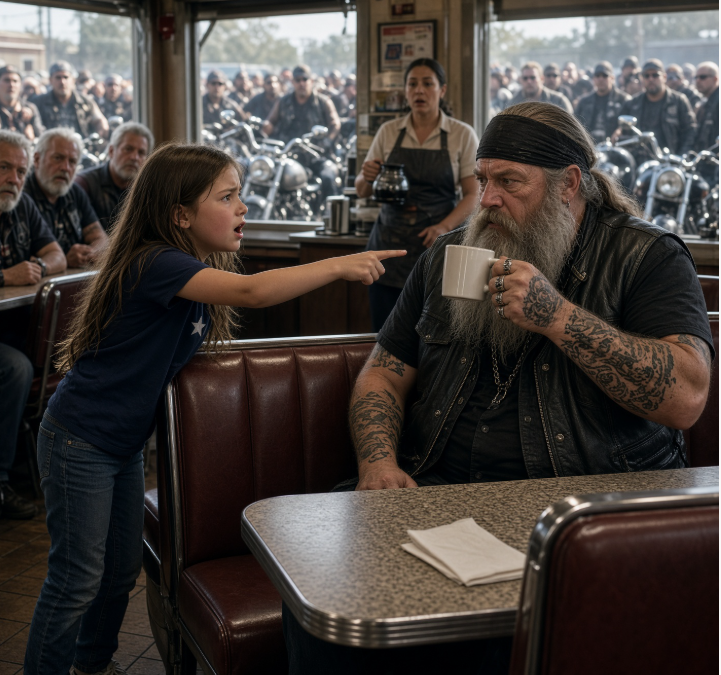
“Don’t drink that.”
The voice came from beside the booth.
High.
Clear.
Not loud, exactly, but it traveled because the room had already been holding its breath around us.
I stopped with the mug halfway to my mouth.
Frank’s eyes moved first.
Then every man at every biker table.
The little girl in the star shirt stood at the edge of my booth pointing at my cup.
Tom Carver was already crossing the room behind her, his face wearing the horror of a father who has realized his child moved faster than his ability to protect her.
For half a second, all the old reflexes in the diner collided.
Customers expected anger.
Donna expected something sharp.
Tom expected to apologize.
The chapter expected me to decide the temperature of the room.
And Lily expected, I think, to be dismissed.
I lowered the mug.
Looked at her finger.
Then at her face.
She was breathing fast.
Not crying.
Not backing up.
Good eyes.
That was my first real thought about her.
Not brave.
Not sweet.
Not foolish.
Good eyes.
“Something wrong with it?” I asked.
My voice came out low. It usually does.
Tom reached us.
“I am so sorry,” he started, hand reaching for Lily’s arm. “She doesn’t mean any—”
“She can speak for herself,” I said.
I did not look at him.
I looked at Lily.
“Go ahead.”
Her father froze.
He did not like it.
But he did not pull her away.
That was the first thing Tom did right that morning.
The first of many.
Lily took one breath.
“There was a man at the coffee station,” she said. “The young one with the apron. He poured something from a bottle into that pot.”
She nodded toward the pot in Donna’s hand.
“The one on the far left. He looked around after to see if anyone saw him.”
Silence.
Not the silence from when we entered.
A deeper thing.
A total pause in the room’s machinery.
I set the mug down carefully.
Very carefully.
If you want to see what a man is, watch his hands when fear enters the room.
Mine did not shake.
Not because I was not afraid.
Because fear had been an old coworker for too long to impress me with its entrance.
I looked at Donna.
“Which pot is that from?”
Donna stared at the glass pot in her hand.
Her face changed color in stages.
“The one I—”
She stopped.
Swallowed.
“The fresh batch. Far left.”
I turned slightly in the booth.
Did not raise my voice.
Did not need to.
“Don’t drink it.”
Every mug at every biker table went down.
Immediately.
Ceramic against laminate. Ceramic against wood. Small sounds, one after another, like a line of doors closing.
The customers noticed that too.
Men they had assumed would argue had obeyed one quiet warning faster than most classrooms obey teachers.
I looked back at Lily.
“What did the bottle look like?”
“Clear,” she said. “Small. Like a travel bottle. He had it low, so I almost didn’t see.”
“Cap?”
“Clear too. Maybe white. I’m not sure.”
“Did he leave the station?”
“He went back into the kitchen.”
Donna had already turned toward the pass-through. She took two steps, looked through the window, then came back even paler.
“Dale’s not at the griddle.”
“Dale,” I repeated.
“He started three weeks ago.”
Her voice had gone careful.
“I’ll check the back.”
“Don’t go alone,” I said.
She stopped.
I was already out of the booth.
Two brothers rose when I glanced at them. Not dramatically. Not with fists. Men like us are always accused of moving aggressively because large men moving with purpose frighten people who prefer danger to look smaller.
I said something low to them, and we went toward the kitchen entrance.
Tom stood with Lily at the edge of the booth, his hand on her shoulder, not knowing what to do.
Doing nothing was the right call.
Most people ruin emergencies by needing to feel useful.
The kitchen smelled of bacon grease, dish soap, coffee, and old fryer oil.
Dale Kesler was not at the griddle.
Not by the prep table.
Not near dry storage.
The service exit at the back was half open.
I moved faster.
Outside, the small back lot opened toward a fence line and a strip of gravel before the trees began. Dale Kesler was there, apron half untied, right hand in his jacket pocket, moving toward the side gate with the quick, ugly walk of a man trying not to look like he was fleeing.
“Dale,” Donna called from behind me.
He looked back.
That was all I needed.
Guilt is not always visible.
Panic usually is.
He ran.
Badly.
Running is a skill, and fear does not teach it in the moment. He hit the gravel wrong, slipped, caught himself on the fence, and tried to climb.
I caught him by the back of his apron and pulled him down.
Not slammed.
Not struck.
Pulled.
One of my brothers, Mack, took his left arm. The other, Lewis, stepped between him and the gate.
Dale twisted once and stopped when he realized he was held by three men who had no need to prove anything.
“I didn’t do anything,” he said.
A terrible first sentence.
“Then don’t make yourself look guilty,” I told him.
His eyes went to his jacket pocket.
So did mine.
I did not reach into it.
That matters.
I took a folded dish towel from the prep counter just inside the door, wrapped my hand in it, and carefully removed the small clear bottle from his right pocket.
Same size Lily described.
Cap on.
Residue near the top.
No label.
Dale’s face collapsed inward.
Not confession.
Not yet.
Recognition that the world had caught up.
By the time we brought him inside, Deputy Ray Pickett had walked through the front door expecting his regular Saturday coffee and found forty bikers, twelve civilians, a pale waitress, a father holding his daughter close, and a room vibrating with the aftermath of a child’s warning.
Pickett was forty-six, built like a man who had once been athletic and had allowed life to soften the architecture. He wore his uniform with the slightly apologetic air of someone who knew diners changed when a deputy walked in and assumed it was because of the badge.
When he saw the room, his hand moved toward his belt.
“Nobody’s fighting,” Donna said before the assumption could grow roots. “Buck went to the kitchen. Something may have been put in the coffee. One of the customers saw it happen.”
Pickett looked at Tom.
Then Lily.
The nine-year-old girl in the star shirt.
I saw the internal negotiation on his face.
Adults do that around children all the time. They decide how much reality a small person can be allowed to carry before the small person has finished speaking.
“One of the customers saw it happen?” he repeated.
“She did,” Tom said.
Pickett turned to Lily.
“How old are you, sweetheart?”
“Nine.”
“And you saw someone put something in the coffee pot?”
“Yes.”
“Can you tell me exactly what you saw?”
She did.
Clear bottle.
Far-left pot.
Below counter level.
Squeezed it in.
Looked around afterward.
Saw her watching.
Went back to the kitchen.
Pickett’s expression shifted slowly as she spoke.
Not all at once.
Slowly.
The way a door opens when the hinges are rusted but still work.
Then we came back in with Dale Kesler.
Pickett took him by the arm.
Dale looked smaller in the dining room than he had in the kitchen. Some men are only dangerous before consequences arrive.
“You want to tell me what’s in the coffee?” Pickett asked.
Dale said nothing.
I held up the bottle, still wrapped in the dish towel.
“Found this in his right jacket pocket. Same hand he would have used to pour.”
Pickett looked at me.
Then at the bottle.
Then back at me.
“Mr. Tanner,” he said.
The mister was deliberate.
Maybe respect.
Maybe performance.
Maybe a deputy buying himself time.
“How did you know to look there?”
“When someone tries to leave out the back at 8:30 in the morning,” I said, “they’re usually carrying the thing they don’t want found.”
I set the bottle on the counter, still wrapped.
“You’ll want that tested. Don’t touch it directly.”
Pickett stared.
“You’re telling me how to handle evidence?”
“I’m telling you what I’d tell anyone about to touch a potential poison container without gloves.”
His eyes narrowed.
“And how would you know?”
“Twenty-two years as an EMT. Sonoma County Emergency Medical Services. Retired 2011.”
I said it without pride.
Without challenge.
Just fact.
The room absorbed it.
Donna leaned both hands on the counter behind her and looked at me differently.
Not warmly.
This was not a warm moment.
But specifically.
Like a person revising one sentence in a book she had believed she already knew.
Lily watched everything.
I noticed her watching.
The deputy’s face changing.
Donna’s hands on the counter.
Dale Kesler’s collapse into silence.
My hand wrapped in a towel around the bottle.
She saw the way adults recalibrated when information no longer matched the categories they had walked in with.
And I think she understood, maybe for the first time consciously, that people had done that to her too.
Decided she did not count.
Decided she was too little, too young, too quiet, too much someone’s daughter and not enough someone with eyes.
Dale Kesler had looked right at her after pouring that bottle.
He had seen a child and decided she was not a threat.
That was his first mistake.
His second was thinking no one in a room full of bikers knew how to stay calm.
At 8:47 a.m., after Pickett called it in, I walked outside onto the porch.
The September light had turned gold but not warm yet. The redwoods behind the diner held the cool like a secret. The parking lot was full beyond the front line of bikes now, with the visiting chapters staged along the side road and into the gravel lot near the hardware store. Three hundred and fifty riders, give or take. Some smoking. Some talking. Some checking straps. Most unaware that the morning had shifted from breakfast into something else.
I pulled the Motorola radio from my vest.
Three clicks.
Our signal.
Then I pressed the button.
“Come inside, all of you.”
I paused.
“No one leaves the property.”
That was all.
The parking lot moved.
Not like a mob.
Not like a panic.
Like a unit.
Men who had spent decades reading each other’s shoulders understood before the explanation reached them. Some moved to the street. Some to the side lot. Some to the rear fence line. Some near the service exit. Some by the front door.
Not blocking civilians.
Not threatening.
Making a perimeter.
An informal cordon.
The kind you build when you do not know whether one man acted alone and you refuse to let the second one slip away because people are still deciding whether the first one fits their idea of danger.
From inside the diner, it must have looked like the parking lot emptied itself.
Lily turned on her stool to watch through the front window.
Tom did not turn her back.
Good father.
He watched too.
“Are they surrounding the diner?” he asked.
“They’re making sure nobody leaves,” I said when I came back in. “Dale Kesler wasn’t the only one who had to make a decision today.”
Pickett had Dale in a corner booth by then, two brothers sitting across from him.
Not threatening.
Present.
Large men with time and patience, using both.
Deputy Clara Dawson arrived at 8:58.
She came through the door fast, assessed the room in one sweep, and crossed to Pickett. Younger than him. Sharper in the face. Not as burdened by assumptions, or maybe better at setting them down when they got in the way.
The bottle went into evidence at 9:04.
The pot was secured.
So was the mug I had nearly drunk from.
Dawson sat across from Dale Kesler and began asking questions in the slow, methodical way good deputies use when they already have the object and are waiting for the person to decide whether silence will help.
Dale began talking at 9:11.
Not fully at first.
Not confession.
Collapse.
He had been paid.
He needed the money.
He did not know what it was supposed to do.
That lie lasted less than thirty seconds.
Then he said he knew it would make people sick.
Then he said he thought it would only be one pot.
Then he said it was not supposed to kill anyone.
Every version was smaller than the last, as if he believed shrinking the intention could shrink the act.
But poison does not care what story you tell after pouring it.
When the lab report came back later, it confirmed ethylene glycol.
Industrial antifreeze.
Present in the pot.
Present in my mug.
Concentrations sufficient to cause acute renal failure in adults.
Sweet under coffee.
Easy to miss.
Quiet in the body at first.
That was what angered me most.
Not that someone wanted us dead.
Men had wanted us dead before.
It was the quietness of it.
The cowardice of a warm mug.
No confrontation.
No warning.
No chance to face the man who decided a diner full of people could become collateral damage because the intended targets wore patches.
Dale Kesler did not know our names.
He knew where we sat.
He knew the pot Donna poured for us first.
That had been enough for whoever paid him.
The second unit secured the scene. Statements began. Customers were asked to stay. Some complained until they understood what had almost happened. Some looked at us and then away. Some looked at Lily with an awe that made her uncomfortable.
Pickett pulled me aside near the doorway after Dale began talking.
“I want you to know something,” he said.
Then he stopped.
When a man stops before finishing, it usually means the next part costs him something.
“If it had been anyone else in there handling that,” he said, “I would have been faster.”
I waited.
He looked out at the parking lot.
“I made assumptions.”
“About what?”
“What a room full of bikers was likely to do in a situation like this.”
At least he had the decency not to dress it up.
“That’s on me,” he said.
I was quiet for a moment.
The way quiet men are quiet.
Not withholding.
Choosing.
“You’re not the first.”
“No,” Pickett said. “I imagine not.”
We stood at the edge of the doorway with the September morning coming in around us. The lot was full of parked motorcycles and men who had formed a perimeter around a diner so a nine-year-old’s instinct could be taken seriously long enough for the truth to catch up.
Pickett looked toward the counter.
“She’s something.”
Lily sat there now, talking to Frank Hadley, who had moved from his booth to the stool beside her with his coffee relocated like this was the most natural thing in the world.
“She’s nine,” I said.
Pickett looked at me.
“And she wasn’t afraid of me.”
“That what did it?”
“Most adults see the vest before they see the man.” I looked at Lily. “She saw me reach for the cup.”
I paused.
“Saved my life. That’s all.”
But of course, it was not all.
It never is.
Donna kept the diner open.
I still do not know how.
A weaker person would have locked the door, sent everyone away, sat in the kitchen, and shaken until noon. Donna did not. She disappeared into the walk-in cooler around 9:30, and later I learned she sat on a box of potatoes for fifteen minutes and let herself feel the weight of the morning where no customers could see her.
Then she came back out with her face steady.
She made fresh coffee herself.
New pot.
Clean station.
Her eyes never left the burner.
She brought two mugs to my booth, where I had returned with Frank across from me.
“Coffee’s fresh,” she said. “I made it myself, and I stood there the whole time.”
She set the mugs down.
“On the house.”
“You don’t have to do that,” I said.
“I know I don’t have to.”
She poured.
“That’s why I’m doing it.”
She moved on.
No speech.
No apology.
No grand declaration that she had misjudged us or that we were welcome now or any of the things people say when they want forgiveness quickly.
Just coffee.
Safe coffee.
Poured by her own hand.
That was better.
Tom Carver paid his check around 10.
I watched him from the booth. He had the look of a man whose ordinary Saturday had been split open, and who did not yet know how to carry the two halves. He gathered Lily’s jacket slowly. Spoke to Donna. Folded the receipt. Checked the counter for anything left behind even though there was nothing.
People do that after fear.
They become precise with small tasks because large facts are too much.
Lily was still at the counter with Frank.
I could hear some of what he was telling her.
“Thing about people deciding what you are before you open your mouth,” Frank said, “you spend your whole life either fighting it or you don’t.”
Lily listened with the seriousness of a child who has been given adult truth and knows it.
“Buck fought it,” Frank continued. “Forty years of doing the right thing so many times it becomes the only reflex you’ve got. People look at the leather and the beard and the patches, and they’ve already written the whole story before you say a word. They’ve decided you’re dangerous. They’ve decided you’re not worth much.”
He leaned forward slightly.
“But here’s the thing. It was never about us. It was always about who they needed us to be so they didn’t have to look harder.”
Lily was quiet.
Then she said, “People do that to me too.”
Frank stopped.
“Because I’m little,” she said. “They think I didn’t see what I saw.”
Frank nodded slowly.
Not the way adults nod at children to be kind.
The way a man nods when something he has known all his life has been handed back to him in a voice he did not expect.
“That’s exactly it,” he said. “That’s exactly what it is.”
Tom reached them then.
He placed his hand on Lily’s shoulder.
Frank looked up at him.
“Your daughter’s got good eyes.”
“I know,” Tom said.
But he meant it more than he had before.
I could hear the difference.
Lily came to my booth before leaving.
She did not seem to plan it. She simply stopped at the edge of the table the same way she had crossed the dining room two hours earlier.
I looked up.
“You’re leaving?”
“Yes.”
A pause.
“Are you okay?”
The question landed harder than it should have.
Not because no one had asked.
Men had asked in their way.
Frank had asked by sitting across from me.
Donna had asked with coffee.
Pickett had asked by apologizing.
But Lily asked plainly.
Are you okay?
Children can still do that before adults teach them to hide concern behind jokes or logistics.
“I am,” I said. “Thanks to you.”
I held out my right hand.
Ringed.
Tattooed.
The hand that had nearly lifted poison to my mouth.
“Wallace Tanner. People call me Buck.”
She shook it.
Her hand disappeared inside mine.
“Lily Carver.”
“I know. Your dad told me.”
I let her hand go.
“You heading back next Saturday?”
She looked at Tom.
Tom raised an eyebrow.
A question and surrender at once.
“Probably,” she said.
“Then maybe we’ll see you around.”
She nodded once, the way she had seen adults nod when they meant something.
Then she followed her father out.
At 10:24, Deputy Clara Dawson drove Dale Kesler toward the county detention facility in Santa Rosa. He would cooperate eventually, though cooperation after being caught has never impressed me much.
He named the man who had paid him.
A business dispute.
A decade-old debt.
Someone who owed the chapter money, though not me personally. Someone who convinced himself that our yearly pattern at the Redwood made us predictable enough to poison. Someone who saw vests and not men, targets and not a room full of people, affiliation and not human bodies with kidneys and daughters and old friends and Saturday traditions.
The district attorney would later describe it as an attempted poisoning targeting a group based on affiliation and perceived status.
That phrase was accurate.
Cold.
But accurate.
The press ran the story badly, of course.
They always do.
Some headlines said Hells Angels Poison Plot Foiled by Little Girl.
Some said Child Saves Biker Gang From Toxic Coffee.
One station called me “an alleged motorcycle club leader,” which amused Frank enough that he printed the article and taped it to the clubhouse fridge.
But the story that mattered did not belong to them.
It belonged to the Redwood Diner.
To Lily.
To Donna.
To Tom.
To Ray Pickett and Clara Dawson.
To three hundred and fifty riders who emptied a parking lot without laying hands on anyone.
To the ordinary morning that almost became a mass casualty event because one man decided a child did not count.
The next Saturday, I went back.
Not with the whole chapter.
Just me and Frank.
Maybe that was selfish.
Maybe I needed to prove the booth still existed after fear.
Maybe I needed coffee in that diner to become coffee again.
The Redwood looked the same.
That was strange.
Trauma expects places to show evidence.
The sign was still burgundy and faded.
The parking lot was still cracked.
The redwoods still held the morning light.
Donna was behind the counter.
She saw us come in and did not smile.
Donna rarely wasted those.
But she pointed with the coffee pot toward my booth.
“It’s open.”
“Morning, Donna,” I said.
“Coffee?”
I looked at the pot.
She understood immediately.
“Made it myself.”
“Then yes.”
Frank slid into the booth across from me.
Lily and Tom arrived at 8:06.
I know because I checked the clock.
She wore a different shirt, this one with planets on it. Her hair was pulled back better than last time. Tom looked like a man who had asked himself all week whether bringing his daughter back was wise and had decided that fear should not own pancakes.
Good father.
Lily looked at me when she entered.
I lifted two fingers off the table.
A small rider’s wave.
She lifted two fingers back.
Tom saw.
He shook his head faintly, but he was smiling.
Donna served Lily orange juice without asking.
Then pancakes.
Silver dollar, extra butter, syrup on the side.
Traditions matter after near disasters.
They tell the body the world did not end.
Over the next few months, the Redwood changed.
Not dramatically.
No banners.
No biker shrine.
No plaque at first.
Just small things.
Donna stopped letting anyone but herself or the senior cook handle coffee during chapter mornings.
Deputy Pickett came in every Saturday at nine, still early, still slightly apologetic, but now he nodded at me like a man determined to practice seeing correctly.
Tom and Lily kept coming.
Lily did not become loud because of what happened.
Some children would have.
She did not ask to be treated like a hero.
She asked questions.
Many questions.
About motorcycles.
About poison.
About why antifreeze was sweet.
About why people did bad things for money.
About whether EMS was scary.
About why adults sometimes ignored kids.
That last one she asked me on a rainy November morning when the diner was half empty and Tom was at the register paying.
“Why do adults ignore kids?” she asked.
I looked at her over my coffee.
“Because listening to kids would force adults to admit they miss things.”
She considered that.
“That seems like a bad reason.”
“It is.”
“Do you ignore kids?”
“I used to.”
“Do you now?”
“Not as much.”
She seemed satisfied.
“Good.”
Then she stole a piece of Frank’s toast because he had told her she could have some “if she could reach it,” which was an operational error on his part.
By December, Lily knew half the chapter by name.
Not all at once.
Not like a mascot.
I would not have allowed that.
She learned them the way she learned everything: by watching first.
Frank Hadley, who pretended to hate children and brought her old motorcycle magazines “for mechanical education.”
Mack, who looked terrifying and had three cats named after country singers.
Lewis, who never spoke before his second cup of coffee and made wooden toy cars for his grandsons.
Tommy, who had a soft rear brake problem for six months because he preferred complaining about it to fixing it.
Lily categorized men the way other children categorized rocks or birds.
Carefully.
Without fear.
Tom watched all of it with caution at first.
I respected that.
If a father had not been cautious with his nine-year-old daughter around men like us, I would have thought less of him.
One morning after Christmas, he sat across from me while Lily helped Donna refill napkin holders at the counter.
“I owe you something,” he said.
“No, you don’t.”
“I do.”
He looked toward Lily.
“When she walked away from the counter that day, I thought the only danger in the room was you.”
I said nothing.
“I saw the vest. The beard. The others. I saw the whole room watching her, and I thought, God, please don’t let this man be angry.”
He swallowed.
“I didn’t think maybe she was saving you. I didn’t think maybe you’d listen better than I did.”
“You’re her father. Fear gets first chair.”
“That’s generous.”
“That’s accurate.”
Tom looked at me.
“I’m trying not to teach her to doubt herself.”
“That’s harder than it sounds.”
“Yeah.”
He gave a small laugh.
“Her mother used to say Lily noticed too much.”
He stopped.
That was the first time he had mentioned Lily’s mother to me.
“She left when Lily was four,” he said. “I started bringing her here because I didn’t know what else to do with Saturday mornings. Pancakes were cheaper than therapy and less likely to make either of us cry.”
“That work?”
“Sometimes.”
“Sometimes is what most people get.”
He nodded.
“She remembers things I think she should have been too little to remember. The exact sound of her mother’s suitcase wheels. The sweater she wore. The fact that I burned eggs that first Sunday because I was trying to make breakfast and pretend everything was fine.”
I looked at Lily.
She was arranging napkins in the holder so the edges lined up exactly.
“She sees what adults hope she won’t.”
Tom followed my gaze.
“That scares me.”
“It should.”
He looked back.
“That’s not comforting.”
“Wasn’t trying to be.”
After that, Tom and I became something like friends.
Not close.
Not beer-in-the-garage friends.
Not call-at-midnight friends.
But diner friends.
A particular category that matters more than people think.
We sat near each other on Saturdays. Talked about engines sometimes. Raising daughters sometimes. Silence often. He helped me once when my bike would not start clean in the parking lot, and I let him because refusing would have been an insult to his profession.
He was good with machines.
Careful.
Patient.
He listened to engines the way Lily listened to rooms.
Like father, like daughter, though I do not know if either would have believed me then.
The court case dragged through winter and spring.
Dale Kesler pleaded guilty to avoid a trial that would have required Lily to testify at length. I appreciated that, though not enough to forgive him. He had been paid five thousand dollars. Half upfront. Half afterward. He had debts. He had bad friends. He had the moral spine of wet cardboard and a bank account that made him cheap to purchase.
The man behind it, Victor Rawlin, had once done business with men connected to the chapter. The details were boring in the way criminal motives often are: money owed, resentment nurtured, humiliation remembered, opportunity noticed.
He believed our September run made us predictable.
He believed bikers would be blamed for any chaos.
He believed if several of us got sick or died after breakfast, the story would first become drugs, alcohol, internal dispute, maybe something we brought on ourselves.
He was not entirely wrong about what people might assume.
That was the ugliest part.
The room had been ready to misread us.
So had the deputy.
So had the town.
So had Tom.
So had Donna.
So had almost everyone.
Lily had not.
Because she was not looking for the story adults had already written.
She was looking at the coffee station.
The sentencing happened in Santa Rosa on a hot June afternoon. The courtroom was crowded but quiet. Lily did not attend. Tom decided against it, and I agreed. She had already done enough.
Donna attended.
So did Pickett.
Dawson.
Frank.
Several brothers.
I gave a statement.
I kept it short.
“I am not here because a man tried to kill me,” I said. “I have lived long enough to know some people can hate what they have never bothered to understand.”
I looked at the judge, not at Rawlin.
“I am here because he chose a diner full of civilians. He chose a waitress pouring coffee. He chose fathers and daughters at breakfast. He chose a nine-year-old girl as someone too small to matter. She mattered. That is why we are alive.”
That was all.
Donna cried after.
Not dramatically.
She stood by the vending machines in the courthouse hallway, wiped under one eye with the heel of her hand, and said, “Damn allergies.”
Frank said, “Courthouse mold.”
I said nothing because I enjoy living.
By the next September, the annual run changed shape.
We still ended at the Redwood.
But there was a stop first.
At the edge of town, near a small turnout facing the redwood line, the chapters gathered before breakfast. Three hundred and fifty riders again, maybe more. Not all the same men. Some had ridden hundreds of miles. Word had moved across states by then, refined and corrected through better tellings.
The girl.
The coffee.
The cordon.
Buck’s cup.
Donna’s new pot.
Tom and Lily were invited but not pressured.
They came.
Lily was ten now, taller by an inch and proud of it, wearing the same star shirt from that morning though it was getting short at the wrists because she had insisted.
A small patch had been made.
Not a club patch.
Not colors.
Nothing like that.
A small embroidered star, yellow on navy, with three words underneath:
GOOD EYES LISTEN.
Frank said the grammar was debatable.
Lily said it was not a sentence; it was a command.
Frank accepted defeat with dignity.
We did not put the patch on her.
That would have been wrong.
We gave it to Tom in a small envelope.
He looked at it for a long time.
Then handed it to Lily.
She touched the stitching with one finger.
“Can I put it on my backpack?”
“If you want,” Tom said.
She looked at me.
“Is that okay?”
“It’s yours.”
“Does it mean I’m in the club?”
“No.”
“Good,” Tom said too fast.
Lily smiled.
“What does it mean?”
I looked at three hundred and fifty riders waiting in the morning light.
“It means we remember who saw clearly.”
She pinned it to her backpack herself.
The ride rolled into Cloverdale slow.
Not loud for the sake of loud.
Measured.
Respectful.
Engines like distant thunder held in human hands.
The Redwood parking lot filled the way it always had, but something in the air was different. Locals still looked. Of course they did. But curiosity had replaced some of the old fear. Donna had extra coffee ready and another waitress helping because, as she said, “I am not dying under a mountain of mugs because you people discovered feelings.”
Inside, Lily took her counter stool.
Tom sat beside her.
I took my booth.
Donna poured my first cup.
Set it down.
“Safe,” she said.
“I trust you.”
She looked at me.
That meant more than either of us wanted to discuss.
So we did not.
Over the years, Lily grew up in the margins of our Saturdays.
Not every week.
Life changes. School, soccer for a while, then quitting soccer because she said people yelled too much about a ball no one planned to keep. Science fairs. Braces. More homework. A phase where she wore headphones and pretended not to care about anything while still noticing everything.
But she came often enough that the Redwood staff stopped calling her “that girl” and started calling her “our Lily,” which she pretended to dislike.
At thirteen, she wrote an essay about bystander effect and social perception using the diner incident as an example without naming us. She got an A-minus because the teacher said the conclusion was “too blunt.”
The conclusion was: Adults are not smarter than children; they are just more experienced at ignoring evidence that makes them uncomfortable.
I thought that deserved an A.
At fourteen, she asked me why I had become an EMT.
I told her the truth.
“My father died in front of me, and nobody knew what to do.”
She went still.
“I was seventeen,” I said. “Logging accident. Bad one. Men stood around shouting. I remember thinking somebody should know how to help before people start praying.”
“So you learned?”
“Yeah.”
“Did it help?”
“Not him.”
She nodded.
“But other people?”
“Yes.”
“Then it helped.”
I looked at her.
That child had a way of closing doors grief had left swinging for decades.
At fifteen, she volunteered at a community first-aid training because she wanted to know what I had known when I smelled the cup. I was one of the instructors. Tom came too and sat in the back, proud and terrified in equal measure.
Lily learned CPR compressions on a rubber mannequin with a seriousness that made the other teenagers stop joking.
When we covered poisoning symptoms, she asked better questions than some adults.
“How do you know when something is wrong before it looks wrong?” she asked.
“That’s the whole game,” I said.
“How?”
“You listen to small inconsistencies.”
“Like what?”
“Smell. Behavior. Timing. Who is looking around. Who is trying not to look like they’re looking around. Who leaves when they should stay. Who stays when they should leave.”
She wrote that down.
Then looked at me.
“That’s not just medical.”
“No,” I said. “It isn’t.”
At sixteen, she got a job at the Redwood.
Donna hired her officially as a weekend hostess and unofficially as the person most likely to notice if something went sideways before anyone else did.
“You’re not a deputy,” Donna told her on the first day. “You’re not security. You seat people, wipe menus, and tell me if something feels off.”
“That seems like security.”
“It is not.”
“It sounds like junior security.”
“Lily.”
“Fine.”
She became good at it.
Not because she was dramatic.
Because she was exact.
She noticed the man who always asked for water but never drank it because he was waiting for someone and too nervous to admit it.
The woman crying in the bathroom who needed Donna, not a menu.
The elderly customer whose speech slurred slightly and whose coffee cup slipped twice before anyone else noticed. That one turned out to be a stroke. Early. Treatable. The ambulance arrived in time.
After that, Donna stopped pretending Lily was only a hostess.
When Lily graduated high school, three hundred bikers did not show up.
That would have horrified her and gotten us banned from the school district.
But Frank, Donna, Pickett, Dawson, and I sat in the back row of the auditorium beside Tom, quiet and civilized, looking exactly like the kind of group that makes other parents whisper and then feel guilty about whispering.
Lily crossed the stage with honors.
She had chosen emergency medicine as a path, though whether nurse, paramedic, physician, or something else, she had not decided.
“Something where noticing matters,” she told me.
“It all matters.”
“Then something where noticing matters fast.”
After the ceremony, she found us outside.
Frank gave her a card with cash.
Donna gave her a pen “for signing forms that scare men.”
Pickett gave her a small challenge coin from the sheriff’s department and looked embarrassed about it.
I gave her my old EMS field notebook.
Empty pages, weathered cover, elastic strap stretched from use. I had carried it in my pocket for years after retirement without knowing why.
She held it carefully.
“This yours?”
“Was.”
“Did you write important things in it?”
“Sometimes. Mostly blood pressures and addresses.”
“That’s important.”
“Sometimes.”
She hugged me then.
Lily was not a casual hugger.
That made it count more.
“You listened,” she said into my vest.
I looked over her head at Tom.
His eyes were wet.
“So did you,” I said.
Years have a way of making legends out of things that were mostly breakfast, fear, and quick thinking.
People still tell the poisoned coffee story.
Some tell it wrong.
They say Lily slapped the mug from my hand.
She did not.
They say three hundred and fifty bikers stormed the kitchen.
They did not.
They say Dale Kesler confessed because he was afraid of us.
He confessed because a nine-year-old saw him, a waitress preserved the pot, a deputy secured evidence, and the truth had too many witnesses.
They say I smelled the poison myself.
I did not.
I smelled it after Lily stopped me.
That distinction matters.
Without her, I would have taken the first sip.
Maybe a second.
Maybe Frank would have too.
Maybe Donna would have poured refills down the line.
Maybe the Redwood Diner would be remembered for kidney failure, ambulances, yellow tape, and the morning everyone wished they had listened to the child.
But that is not what happened.
What happened is this:
A girl turned on a counter stool at the right moment.
A man pouring poison looked at her and decided she did not count.
She counted.
A room full of adults saw leather and missed danger.
She saw danger and ignored the leather.
A biker listened.
A father let his daughter speak.
A waitress admitted what pot she had poured.
A deputy overcame his first assumption quickly enough for it to matter.
A parking lot full of riders emptied into a perimeter without anyone needing to shout.
And a poisoned cup sat untouched on a counter while morning light came gold through the windows and the redwoods held still behind the diner as if they had seen human beings nearly fail each other and, for once, correct course in time.
I still go to the Redwood.
Not every Saturday.
My body does not enjoy long rides the way it once did, though I still make it out when I can. Donna owns part of the place now. She says this is proof she suffered brain damage from customer service, because no sane woman buys into a diner after working in one for decades.
Tom still comes sometimes.
Older now.
Less careful in some ways, more in others.
He remarried eventually, a school librarian named Claire who was smart enough not to try to become Lily’s mother and kind enough to become someone Lily called when she needed books or advice.
Lily is twenty-one now.
She is in a paramedic program.
Of course she is.
She sends me texts from training sometimes.
Got my first clean IV today.
Or:
Instructor says scene safety first. I said coffee safety too. He didn’t understand.
Or:
Do people ever stop underestimating young women in emergency settings?
I wrote back:
No. Make it expensive for them.
She replied:
That sounds legally questionable.
I answered:
Emotionally expensive.
She sent a thumbs-up.
The mug from that morning sits behind the counter at the Redwood now.
Not the poisoned one. That went into evidence and never came back.
This is a matching white mug Donna ordered from the same supplier. On the bottom, where only someone lifting it would see, she wrote in black marker:
ASK WHAT SHE SAW.
That is the Redwood’s rule now.
Not just for girls.
Not just for children.
For anyone.
If someone says something is wrong, you ask what they saw.
You do not first ask how old they are.
You do not ask whether they are sure in a tone that means they should become less sure.
You do not look at the person they are accusing and decide from clothing, age, job, patch, gender, size, or silence who is more believable.
You ask what they saw.
Then you look.
It is a small rule.
Small rules save lives all the time.
The last time Lily came back from school, she stopped at my booth the way she had when she was nine.
I was older.
She was taller.
The diner smelled like coffee and bacon and warm syrup.
The redwoods outside were exactly where they had been, patient and enormous, indifferent to the fact that human beings keep needing reminders.
“You’re leaving?” I asked.
“Tomorrow.”
“Back to training?”
“Yeah.”
“You scared?”
She considered lying.
Did not.
“A little.”
“Good.”
“That’s what you always say.”
“Because fear keeps you respectful.”
“And panic gets people killed.”
“You do listen.”
She smiled.
Then she looked at the mug in my hands.
“You trust the coffee now?”
I looked at Donna behind the counter.
At Tom near the register.
At Frank’s old empty seat across from me, because he had passed the winter before and some absences remain seated even after chairs are cleared.
At Lily, whose eyes were still good.
“Yes,” I said. “But I still look.”
She nodded.
“Me too.”
Before she left, she hugged me.
Not long.
Not dramatic.
Just enough.
Then she headed toward the door.
The bell rang above her as she stepped into the September light.
For a moment, I saw her as she had been at nine years old, barely reaching the edge of the table, pointing at a cup every adult had failed to fear.
Then I saw her as she was now.
A woman walking toward a life where noticing would matter fast.
I lifted my coffee.
Safe.
Hot.
Bitter.
Ordinary.
And I thought about all the things that had to happen for me to be sitting there.
A child had to ignore the lesson that small people should stay quiet.
A father had to let his daughter speak in front of men he feared.
A waitress had to admit the fresh pot was the one in question.
A deputy had to revise his assumptions while the clock was running.
A chapter had to choose discipline over anger.
And I had to lower the cup.
That last part seems simple.
It was.
The choice that saved me was made before I knew there was danger.
I listened to a girl no one else had decided was important yet.
That is why I am alive.
Not because I was tough.
Not because of the vest.
Not because of the years in EMS or the brothers in the parking lot or the reputation people imagined around me.
I am alive because Lily Carver saw a man pour poison into coffee and understood that being nine did not make the truth smaller.
So if you ever sit in a diner and someone small tells you not to drink from a cup, lower it.
If a child says something smells wrong, look.
If a person everyone ignores points toward danger, do not waste the moment deciding whether they look qualified to save your life.
Ask what they saw.
Then listen.
I did.
And three hundred and fifty riders who emptied a parking lot that morning are still here to tell you that listening was enough.








