A Little Girl in a Purple Wheelchair Asked to Sit With the Most Feared Biker in Town—Then the State Tried to Take Her Away From the Only Man Who Would Walk Through Fire for Her
PART2:
That was what people didn’t understand. Fear doesn’t always come from what a man does in front of you. Sometimes it comes from what everyone says he could do if he wanted.
He paid cash. Tipped too much. Sat alone. Left before noon. Never smiled. Never chatted. Never let anyone sit near him if there were other tables open.
Cops watched him.
Bikers respected him.
Ordinary people avoided looking too long.
And that little girl pointed right at his booth.
“May I sit there?”
The diner changed.
I know that sounds dramatic, but I swear it’s true.
A spoon stopped clinking in a coffee cup. The construction workers quieted. Old Bill Harper at the counter turned halfway around on his stool. Even the grill cook, Luis, leaned enough to look through the pass window.
The elderly woman’s face went white.
“Emma,” she whispered. “No, honey. We’ll sit over here.”
The girl—Emma—kept looking at Reaper.
“May I sit there?” she asked again.
I stepped closer to block her line of sight, though I’m not sure whether I meant to protect her from him or him from her.
“Sweetheart,” I said gently, “that gentleman is having his lunch alone.”
Emma looked up at me with eyes so direct they made adults feel like they were the ones being evasive.
“He looks lonely.”
Across the diner, Reaper’s hand stopped around his mug.
I saw it.
His fingers froze.
His coffee cup hung an inch above the table.
The old man behind Emma cleared his throat. “We’re sorry. She doesn’t mean to disturb anyone.”
But Emma had already started rolling forward.
The old woman reached for the handles. “Emma, please.”
“I have something to show him,” Emma said.
I should have stopped her.
Maybe that’s what a responsible waitress would have done. Maybe I should have guided her gently to the window table, handed her crayons, and protected the order of things. Because every town has its rules, even the ones nobody writes down.
Don’t ask about the boarded-up house on Alder Street.
Don’t bring up the mill closing at church fundraisers.
Don’t mention whose son got arrested unless the mother mentions it first.
And don’t approach Jackson “Reaper” Cole.
But there was something in Emma’s voice that made stopping her feel wrong.
Not rude.
Wrong.
She rolled across the cracked black-and-white tile with steady little pushes. Her grandparents followed two steps behind, horrified and helpless. I followed them because if this went bad, I wanted my body between that child and whatever the town believed Reaper was capable of.
Reaper looked up slowly.
His face was hard enough to make the bravest man reconsider his errands.
Emma stopped at the edge of his booth.
“May I sit here?”
Reaper said nothing.
His eyes moved from her face to the wheelchair, to the sketchbook on her lap, to her grandparents, to me, then back to Emma.
Several seconds passed.
The whole diner held its breath.
The old man reached for Emma’s handles. “We’re sorry. She can sit—”
The sound that came from Reaper’s throat was so rough I almost didn’t recognize it as speech.
“Leave her.”
Two words.
The first two words I’d heard him speak to anyone except “coffee” and “keep it.”
Emma’s grandmother put a hand to her mouth.
Reaper folded his newspaper with slow precision, moved his coffee to one side, and shifted just enough to make space opposite him.
Emma’s face lit up like someone had opened a curtain inside her.
“Thank you.”
She maneuvered herself carefully to the end of the booth. Her grandfather helped lock the wheels, though his hands shook so badly he fumbled twice.
Reaper watched the old man struggle, then reached out one massive hand and clicked the brake into place.
The old man froze.
Reaper withdrew his hand without a word.
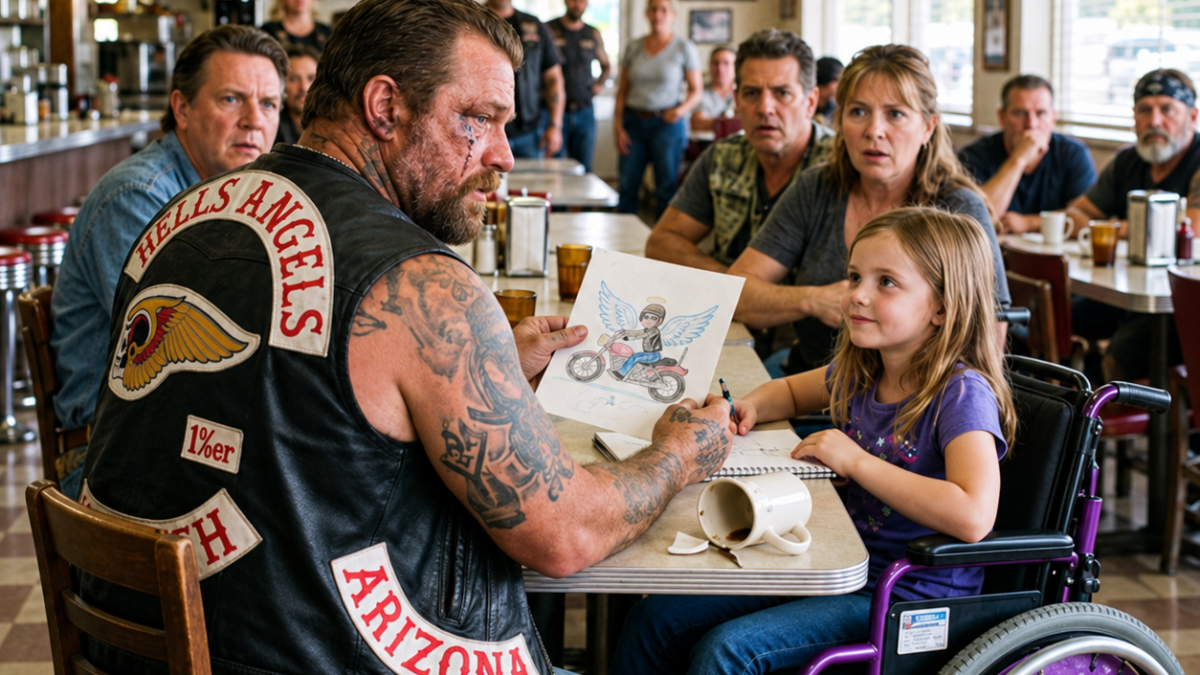
Emma opened her sketchbook like she had been invited to a tea party.
“What’s your name?” she asked.
He stared at her.
“Reaper.”
“That’s not a real name.”
The construction workers leaned forward.
Reaper’s jaw twitched. “Real enough.”
“It’s scary.”
“Wasn’t trying.”
Emma tilted her head. “I think you were.”
A sound went through the diner.
Not laughter.
Fear of laughter.
Reaper’s eyes narrowed.
I prepared to intervene.
But Emma was not finished.
“I think you look scary because you’re sad. Sad people sometimes look mean because they’re protecting themselves. That’s what my therapist says.”
There are moments when a child says something so true that every adult in the room feels accused.
Reaper’s hand tightened around his coffee mug.
The elderly woman whispered, “Emma, honey…”
Emma ignored her and turned a page in her sketchbook.
Then she slid it across the table.
I saw the drawing from where I stood.
It was Reaper.
Not a childish scribble. A real drawing. Charcoal, careful shading, shadows under the eyes, the scar across his forehead, the heavy shape of him leaning on a motorcycle. His Harley was drawn perfectly too—chrome, handlebars, black tank, even the little skull detail near the front fender.
But he was not alone in the picture.
Behind him, faint as smoke, stood a woman with long dark hair and kind eyes. Her hands hovered near his shoulders but did not touch. Beside her stood another woman I didn’t know, younger, softer, smiling sadly down at Emma’s empty wheelchair drawn near the bike.
Reaper stared at the paper.
The color left his face.
Emma’s voice softened. “I’ve drawn you fourteen times.”
Nobody moved.
“You come here every Thursday. You sit in the corner. You look out the window when motorcycles pass, but you never go outside until they’re gone.” She tapped the page gently. “You look like you’re thinking about someone.”
Reaper’s mouth opened, but no sound came out.
Emma looked down at the drawing.
“I think about someone too,” she said. “My mama died nineteen months ago.”
Her grandmother made a small broken sound behind me.
Emma touched the unknown woman in the sketch.
“That’s her. I draw her behind me sometimes because I don’t like pictures where she’s gone.”
Reaper’s eyes lifted to the first woman in the drawing.
The one behind him.
His hand began to shake.
“That’s Maria, isn’t it?” Emma asked.
The coffee cup shattered.
It didn’t fall.
He crushed it.
One second it was whole in his hand, and the next it cracked under his grip like an egg. Hot coffee spilled over his fingers and across the table. Ceramic pieces skidded onto the floor.
Emma did not scream.
I did.
“Jackson!”
I don’t know why I used his real name.
Maybe because the man in that booth was not Reaper anymore.
He was a widower bleeding coffee over his hand and staring at a child’s drawing like it had opened a grave.
Reaper did not move.
Coffee dripped from his knuckles.
Blood welled where ceramic had sliced his palm.
Tears cut clean tracks down his dirty, weathered face.
The diner sat in stunned silence.
Emma reached into the pocket of her wheelchair and pulled out a napkin. She pushed it across the table.
“My hand bleeds sometimes too,” she said softly. “When I fall wrong.”
Reaper looked at the napkin.
Then at her.
His lips trembled once.
He took it.
That was the first miracle.
Not the rescue.
Not the fire.
Not the courtroom.
That napkin.
That giant, feared man taking a paper napkin from a nine-year-old girl because she was the first person in four years brave enough to see grief under the leather.
I cleaned the coffee while her grandparents apologized too much and Reaper said nothing. He wrapped his hand in the napkin. Emma explained her drawings with the confidence of a museum guide. She told him her mother’s name was Lily. She told him Lily used to sing off-key in the car and burn pancakes and say wheelchairs were not sad unless people made them sad. She told him her grandparents were nice but tired. She told him she hated people whispering over her head like disability had stolen her hearing.
Reaper listened.
That was the second miracle.
He listened like every word mattered.
When Emma finally closed her sketchbook, she said, “You can keep that one.”
Reaper looked at the drawing.
“I can’t.”
“Yes, you can.”
His voice scraped out. “Why?”
Emma shrugged. “Because she’s still with you. You just forgot how to look.”
No one knew what to do with that.
Not me.
Not her grandparents.
Not Reaper.
He took the drawing with both hands, as carefully as if it were alive.
Then he stood.
Every conversation in the diner stopped again.
He pulled a twenty from his vest, dropped it on the table, and walked out into the rain without touching his coffee or his food.
Emma watched through the window as he climbed onto his Harley.
The engine roared to life.
The sound shook the glass.
Most people flinched.
Emma smiled.
“He’ll be back,” she said.
Her grandmother wiped her eyes. “How do you know?”
Emma looked down at her sketchbook.
“Because sad people come back when somebody notices.”
She was right.
The following Thursday, Reaper came in at 11:30.
Same booth.
Same coffee.
Same leather vest.
But this time, when Emma rolled in with her grandparents at 11:42, he had already moved his newspaper to the side of the table.
Emma didn’t ask permission that day.
She rolled straight over.
“Hi, Reaper.”
He grunted.
She smiled like a grunt counted.
“What are you drawing?” he asked.
The question was so unexpected that I nearly poured coffee onto Old Bill’s lap.
Emma beamed. “You remembered I draw.”
“Hard to miss.”
She opened her sketchbook.
That became the routine.
Thursday lunches.
Corner booth.
Black coffee for him.
Grilled cheese cut into triangles for her.
Decaf for her grandmother, Earl Grey tea for her grandfather, though both of them spent more time watching Reaper than eating.
At first, the whole diner watched too.
People whispered. People judged. People invented stories.
But habit is stronger than fear in small towns.
By the fourth Thursday, the sight of Emma and Reaper together no longer stopped conversation. By the sixth, he had started pushing her wheelchair out when her grandfather’s arthritis acted up. By the eighth, Emma had convinced him to try a bite of her apple pie and declared his expression “emotionally constipated.”
Reaper almost smiled.
Almost.
That tiny almost spread through the diner faster than gossip about a divorce.
I began to learn pieces of him in the way diner people do—not from confessions, but from patterns.
He never sat with his back to the door.
He always checked exits.
He flinched at sudden crashes from the kitchen, though he hid it well.
He wore a wedding ring on a chain under his shirt. I saw it once when he bent to pick up Emma’s pencil.
He paid for her grilled cheese every Thursday without telling her.
She knew anyway.
“Thank you,” she told him one day.
“For what?”
“The sandwich.”
“Didn’t pay for it.”
“Yes, you did.”
He glanced at me.
I raised both hands. “Don’t involve me.”
Emma leaned across the table. “You’re a terrible liar.”
“So I’ve heard.”
“My grandma says lying makes your soul wrinkly.”
Reaper looked at her grandmother.
The poor woman nearly dropped her tea.
Emma continued, “Your soul looks very wrinkly, but not because of lying. Because of being sad too long.”
Reaper stared at her.
Then a sound came from him.
Low.
Brief.
Rusty.
A laugh.
The whole diner heard it.
Nobody acknowledged it, because some things are too sacred to clap for.
His real name was Jackson Cole, and he had not always been feared.
That much I pieced together from people who remembered before Maria died. Before the wreck. Before the scar. Before his voice went quiet and his fists became the thing people spoke of first.
Jackson had been a mechanic. A veteran. A husband. A man who rode with the Iron Seraphs Motorcycle Club, which the papers called an outlaw club and the club called a brotherhood. He had been wild, yes. Dangerous when crossed, probably. But not cruel.
Maria had worked at the elementary school library.
That still struck me as impossible and perfect.
A librarian married to a biker named Reaper.
People said she softened him.
I don’t think that was true.
I think she simply saw the softness already there and refused to let him bury it.
They were driving home from the coast on a wet October night when a drunk driver crossed the center line. Maria died before the ambulance arrived. Jackson survived with broken ribs, a fractured skull, a torn face, and a voice that came back rougher than before.
Something else did not come back at all.
For four years, he existed around Riverside like a storm cloud that never broke.
Then Emma asked to sit with him.
By winter, he was not just sitting with her.
He was showing up.
Her grandparents, Harold and June Whitaker, lived in a small blue house on Cedar Lane. The porch steps were steep. The ramp they had was cheap aluminum, narrow and slick in rain. Every time Harold pushed Emma up it, his jaw clenched with pain. Every time June watched, fear tightened her mouth.
One Saturday morning, Reaper arrived on his Harley with three other bikers and a truck full of lumber.
Harold opened the door with a face full of panic.
“Mr. Cole, we didn’t ask—”
“Good,” Reaper said. “Would’ve said no.”
He spent the whole day building.
Not a makeshift plank.
A real ramp.
Wide, sturdy, measured correctly, with railings strong enough for Harold to lean on and a landing at the top so Emma could turn herself without help. He worked with the concentration of a man rebuilding part of the world by hand. His brothers worked beside him—big men in leather with names like Tank, Preacher, and Dice, all strangely gentle around the little girl supervising from the driveway.
“That board is crooked,” Emma informed them.
Tank, who looked like he could lift a refrigerator, looked wounded. “It is not.”
Emma squinted. “It is emotionally crooked.”
Preacher laughed so hard he dropped a box of screws.
By sunset, Emma rolled up the ramp by herself.
No one pushed.
No one held the chair.
No one said “careful” six times.
She reached the porch, turned around, and lifted both fists in the air.
“I did it!”
June cried into a dish towel.
Harold turned away and pretended to inspect the railing.
Reaper stood in the yard, arms crossed, face unreadable.
Emma looked down at him.
“You built me a road.”
He shrugged. “Built a ramp.”
“No,” she said. “A road.”
That was how she saw things.
Bigger than they looked.
After that came the roof leak.
Then the bathroom grab bar.
Then the loose porch light.
Then the back gate Harold had been meaning to fix for six years.
Every time, Reaper showed up as if fixing things were not kindness but weather.
Expected.
Unremarkable.
He never asked for money. When Harold tried to pay him, Reaper looked offended.
“Buy the kid more pencils,” he said.
Emma drew him constantly.
Reaper on his bike.
Reaper holding a hammer.
Reaper sitting at the diner.
Reaper with Maria behind him.
Reaper with angel wings, though he told her twice to stop that.
She did not.
“Angels can be grumpy,” she said.
“Not that grumpy.”
“You don’t know every angel.”
He had no answer for that.
Riverside did what small towns always do when tenderness appears where they expected violence.
It watched.
Then it judged.
Some people softened. They saw the biker carry grocery bags for June and began nodding at him differently. Some still crossed the street. Some said he was grooming the family for something. Some said the Whitakers were too old to know better. Some said no man with patches like that should be near a child.
The whispers reached the school.
Then the church.
Then, eventually, the county office.
The first time Ms. Brennan appeared, she wore navy heels on the Whitakers’ porch and looked at Reaper’s ramp like it had personally offended her.
I was there because June had asked me to drop off a pie from the diner. Apple, Emma’s favorite. I was in the kitchen when the knock came.
June wiped her hands and opened the door.
A woman stood outside with a clipboard hugged to her chest like a shield.
“Mrs. Whitaker? I’m Carla Brennan with the Department of Child and Family Services.”
June went still.
Harold rose slowly from the recliner.
Emma, seated at the kitchen table drawing, looked up.
Reaper was outside tightening a bolt on the ramp railing.
Ms. Brennan stepped in without really waiting to be invited. She was in her late forties, with a crisp bob, thin mouth, and the kind of perfume that announces authority before compassion has entered the room. Her eyes swept over the house.
Clean living room.
Old carpet.
Medical equipment near the wall.
A stack of Emma’s drawings on the table.
Then her gaze landed on Reaper through the front window.
Her expression sharpened.
“I understand there has been frequent contact between Emma and Mr. Jackson Cole.”
June’s hand tightened on the door.
“He’s a family friend.”
Brennan wrote something down.
The sound of pen on paper made Emma’s face change.
Children who have been in systems know the sound of being reduced to notes.
“He helps us,” Emma said.
Brennan looked at her with professional brightness. “And you must be Emma.”
Emma did not answer.
Brennan smiled tighter.
“We just want to make sure everyone is safe.”
Reaper came up the ramp then, wiping his hands on a rag. He stepped into the doorway but not the house, as if he knew his size could be used against him.
“You got a reason to be here?” he asked.
Brennan turned.
I saw the decision form on her face before she spoke.
Not curiosity.
Recognition of a type.
Leather vest. Scar. Patches. Reputation.
Guilty before file review.
“Mr. Cole,” she said, voice cool. “Your presence is part of the reason I’m here.”
June stepped forward. “He has been nothing but kind.”
“Kindness does not erase criminal history.”
The room went silent.
Reaper did not flinch.
Emma did.
“My friend isn’t a criminal,” she said.
Brennan glanced down at her. “Adults have complicated histories, sweetheart.”
“Don’t sweetheart me.”
June whispered, “Emma.”
Emma’s eyes flashed. “She’s being fake nice.”
Brennan’s cheeks colored.
Reaper’s mouth twitched once.
Not a smile.
Close.
Brennan turned back to June. “We’ve received reports that Mr. Cole has unsupervised access to the child.”
“He fixes things here,” Harold said. “We’re always home.”
“And your ability to supervise consistently is one of the concerns.”
Harold’s face went gray.
June’s lips parted.
There it was.
The second judgment.
Not only was Reaper dangerous.
The grandparents were weak.
Old.
Unfit.
Brennan had come with a story already written.
She only needed details to staple to it.
“Emma is safe here,” June said, voice shaking.
Brennan looked around the modest living room.
“That remains to be determined.”
Reaper stepped fully onto the porch, staying outside the threshold.
“Lady,” he said, rough voice low, “you scare that child more than I do.”
Brennan looked at him like she had been waiting for that.
“Threatening language will be noted.”
“I didn’t threaten you.”
“You raised your voice.”
“No, ma’am,” I said before I could stop myself. “He didn’t.”
Brennan’s eyes moved to me.
“And you are?”
“Maggie. I work at the diner. I brought pie.”
Her look suggested pie was not an approved credential.
She wrote something else down.
That was the first day I understood how dangerous a clipboard could be in the wrong hands.
Nothing happened immediately.
That was worse.
For two weeks, Brennan visited. Called. Asked for records. Inspected medication schedules. Questioned the ramp’s construction. Questioned Harold’s driving. Questioned June’s ability to lift Emma if necessary. Questioned whether Emma’s friendship with Reaper was “age appropriate.” Questioned whether the motorcycle club’s presence created “community concern.”
Community concern.
That phrase became the polite name for cowardice.
A few neighbors had called.
Not many.
Enough.
And every call gave Brennan more paper.
Emma changed.
The light in her dimmed first. Then the drawings became darker. She drew doors. Long hallways. Cars with no windows. A girl in a purple chair reaching toward a man with no mouth.
At the diner, she still sat with Reaper, but now she watched the door.
So did he.
One Thursday, she asked him, “If they take me away, will you come?”
Reaper’s face went still.
June inhaled sharply.
Harold looked down.
“Emma,” I said gently, setting down her grilled cheese.
But she kept looking at Reaper.
He leaned forward.
“I don’t break promises,” he said.
“You never made one.”
He tapped the table once with two fingers.
“Then I’m making it.”
Emma swallowed.
“What is it?”
Reaper’s voice was quiet enough that only our booth could hear.
“Nobody rides alone.”
Emma studied him.
Then nodded as if accepting a legal contract.
Nobody rides alone.
Three days later, the state came for her.
It was a Monday morning, cold and bright, with frost still clinging to the edges of the Whitakers’ lawn. I know because June called me crying, and I drove over without even telling Luis I was leaving the diner. By the time I arrived, two police cars were parked outside the blue house. A white county sedan blocked part of the driveway.
Neighbors stood across the street.
Of course they did.
People who would not carry a grocery bag for June had found time to watch her family collapse.
Ms. Brennan stood on the porch with two officers and a folder pressed to her chest. Her navy coat looked expensive. Her expression looked carved from policy.
Reaper stood at the bottom of the ramp.
Not on the porch.
Not blocking.
But there.
His Harley was parked at the curb. His fists hung at his sides. His face was stone.
Emma was at the top of the ramp in her purple wheelchair, hands locked around the railing Reaper had built. June knelt beside her, crying. Harold stood behind them with one hand on the doorframe, breathing hard, the color wrong in his face.
“No!” Emma screamed. “No, I’m not going!”
Brennan’s voice stayed flat. “Emma, this is temporary.”
“You’re lying!”
“We are placing you in emergency care pending further review of your guardians’ ability to protect you from inappropriate outside influence.”
“His name is Reaper!” Emma shouted. “He’s my friend!”
Brennan glanced at him.
Disdain dripped from her like rainwater.
“Mr. Cole’s involvement is exactly why we are here.”
Reaper took one step forward.
The officers tensed.
He stopped.
I saw what that cost him.
Every muscle in his body wanted to move. To climb the ramp. To put himself between that child and the people dragging her into a system that had already decided what she was.
But he was not stupid.
If he touched one officer, if he shoved one person, if he gave them one second of violence, Emma would be gone forever and he would be behind bars before sunset.
Brennan knew it.
That was the cruelty of it.
She had brought rules to a fight where he could not use strength.
“Mr. Cole,” she said, “stand back.”
Emma reached for him.
“Reaper!”
His jaw clenched so hard I thought his teeth might crack.
“I’m here,” he said.
“You promised!”
His eyes shone.
“I know.”
The officers moved up the ramp.
June sobbed. Harold said, “Please. Please, she can’t be away from us. She has night spasms. She needs—”
Brennan held up one hand. “Mr. Whitaker, failure to cooperate will be documented.”
Emma screamed when they unlocked her hands from the railing.
It is a sound I still hear sometimes.
Not loudest sound.
Worst sound.
The sound of a child discovering that adults can call something protection while making her less safe.
They carried her down the ramp because she refused to wheel herself. One officer looked sick. The other stared straight ahead. Brennan directed them toward the county vehicle like she was managing furniture delivery.
Emma twisted in the officer’s arms, reaching for Reaper.
Her fingers spread wide.
“Reaper! You promised nobody rides alone!”
He stood in the yard.
Silent.
Fists clenched white.
Eyes burning.
But he did not move.
I hated him for it for half a second.
Then I understood.
He was doing the hardest thing a violent man can ever do.
Nothing.
He bowed his head.
The car door shut.
Emma’s cries dulled behind glass.
As the county sedan pulled away, Brennan looked back once.
At Reaper.
At June collapsed on the porch.
At Harold gripping the railing with one shaking hand.
At the neighbors pretending they had not helped summon this.
Then she got into her car and left.
For a moment, there was only silence.
The kind after explosions.
Reaper lifted his head.
The neighbors across the street looked away.
Maybe they thought shame was coming.
Maybe they thought he had been cowed.
Maybe they thought the monster had finally been shown his place.
They were wrong.
He reached into his vest and pulled out his phone.
His thumb moved once.
He waited.
When someone answered, his voice came out low and cold.
“We go to war.”
Then he hung up.
That was the line people repeated later, because people love lines that sound like movie trailers.
But they misunderstood it.
They thought war meant fists.
Guns.
Harleys roaring through town.
Men in leather surrounding the county office and terrifying receptionists.
Maybe the old Reaper would have done that.
Maybe before Maria, before Emma, before grief taught him that rage without purpose only burns the person holding it.
This war was different.
It began with presence.
Within two hours, the Iron Seraphs clubhouse became a command center.
I had never been inside before.
Most of Riverside had not, though plenty had opinions about it. The clubhouse sat outside town near the old lumber yard, a low building with black-painted doors, security cameras, and a gravel lot usually packed with motorcycles. People said drugs moved through there. Weapons. Stolen parts. Secrets.
What I saw that day was coffee, folding tables, old laptops, extension cords, and a group of terrifying-looking men trying to connect a printer.
Tank was on the phone with a lawyer in Portland.
Preacher was calling reporters he claimed owed him favors from “a misunderstanding in 2009.”
Dice was pulling public records.
A woman named Sherry, who apparently handled the club’s books and could frighten grown men with one eyebrow, set up a spreadsheet so aggressively I stepped aside on instinct.
Reaper stood at the center of it all, silent, holding one of Emma’s drawings.
The one with angel wings.
His hands did not shake now.
Harold and June sat near the wall. June looked hollow. Harold had an oxygen tube under his nose because the stress had triggered chest pain, but he refused to go to the hospital until they knew where Emma was.
I made coffee because it was the only thing I knew how to do.
“Where did they take her?” I asked.
“Emergency placement,” Sherry said without looking up. “Oak Street Children’s Home.”
Harold’s head lifted. “No.”
Everyone turned.
His face had gone pale.
“What?” Reaper asked.
Harold swallowed.
“June’s niece was there years ago. Before we took Emma. It was bad then.”
“How bad?” Tank asked.
Harold looked at June.
June whispered, “She ran away twice.”
Sherry’s typing stopped.
Reaper’s eyes darkened.
Dice leaned over his laptop. “Oak Street has state contracts. Private nonprofit. Takes emergency placements. Mostly kids with disabilities or behavioral classifications.”
“Classifications,” Preacher muttered. “Fancy word for children they plan to ignore.”
The lawyer called back.
Then a private investigator.
Then someone from a disability rights organization.
By midnight, the table had files stacked across it.
Complaints.
Violations.
Overcrowding reports.
Staff turnover.
A lawsuit settled quietly three years ago.
A fire inspection warning about faulty wiring in the east wing.
A complaint about wheelchair access ignored for nine months.
And then the money.
It was Sherry who found it.
She printed the first document, stared at it, then said, “Oh, Brennan, you greedy little bureaucratic snake.”
Reaper turned.
Sherry held up the paper.
Oak Street received county placement referrals. The more emergency placements, the more funding. That alone was ugly but legal. Then Sherry connected payments from a consulting company tied to Oak Street’s administrator to a community advocacy fund Brennan helped oversee.
Not a suitcase of cash.
Not a movie bribe.
Real corruption is often more boring.
Consulting fees.
Speaking honorariums.
Donation reimbursements.
A network of polite theft wearing business casual.
“She’s been feeding them kids,” Sherry said. “And getting paid around the edges.”
June covered her mouth.
Harold whispered, “Emma.”
Reaper picked up his helmet.
Tank stepped in front of him.
“Brother.”
Reaper’s eyes could have cut steel.
Tank did not move.
“You ride over there now,” Tank said, “they call the police. They say you threatened staff. They lock her deeper.”
Reaper’s chest rose and fell.
Tank lowered his voice.
“We’re going to get her. But we do it clean.”
Reaper looked down at the helmet.
Then at Emma’s drawing.
He set the helmet back on the table.
That was the second time he saved her by not using his fists.
The next day moved like a nightmare trapped in molasses.
The lawyer filed an emergency motion.
The disability rights group called the county.
The private investigator drove to Oak Street and took photos from public sidewalks. He came back with pictures that made June cry: peeling paint, a side ramp blocked by trash bins, children visible in upstairs windows, one looking out through dirty glass with no expression at all.
We tried to see Emma.
Denied.
We tried to call.
No direct calls permitted during intake stabilization.
Stabilization.
That word made Reaper leave the room.
I found him outside behind the clubhouse, standing beside his bike in the rain.
He had one hand on the seat.
The other pressed against his chest, fingers curled in his vest near Maria’s memorial patch.
“She thinks I left her,” he said.
I had never heard him sound like that.
Not rough.
Broken.
“No,” I said, though I did not know. “She knows you’re coming.”
His jaw worked.
“I promised.”
“You’re keeping it.”
He looked toward the road.
“I watched them take her.”
“You stayed free so you could fight.”
He closed his eyes.
“I let them take Maria too.”
The sentence hit so hard I almost stepped back.
“What?”
Rain ran down his face, or maybe not only rain.
“The wreck,” he said. “She was trapped. Car smoking. I was pinned. Couldn’t move. She was awake at first. Talking. Telling me not to sleep.”
His voice scraped thinner.
“Then she wasn’t.”
I had no words.
He opened his eyes.
“I spent four years thinking the world only gives you one chance to fail someone like that.” He looked at me. “Then Emma rolled up to my table and gave me another.”
The rain fell harder.
“You didn’t fail Maria,” I said.
His face hardened. “You weren’t there.”
“No,” I said. “But Emma is. And she doesn’t need a perfect man. She needs one who comes back.”
He stared at me.
Then, slowly, he nodded.
Two nights later, fire answered before the court did.
I was at the diner closing up when the scanner behind the counter crackled.
Luis liked to keep it on for weather and road closures. Mostly it hissed through minor accidents and medical calls. But that night, the dispatcher’s voice sliced through the room.
Structural fire.
Oak Street Children’s Home.
Possible trapped occupants.
For one second, my body refused to understand.
Then Luis looked at me.
“Maggie.”
I was already running.
By the time I reached the clubhouse, bikes were roaring to life. Reaper tore out of the lot before anyone could stop him. No helmet. No hesitation. Just the black shape of him and the scream of his Harley ripping down the highway.
I drove behind the bikers in my little Honda, hands shaking so badly I nearly missed the turn.
Smoke was visible before we reached Oak Street.
Thick black smoke rising above the old Victorian house like a curse.
The building was three stories, white paint turned orange under flames chewing through the east side. Children huddled on the lawn in blankets. Staff shouted. A neighbor sprayed a garden hose uselessly toward the porch. Sirens wailed in the distance but were still too far away.
Reaper skidded to a stop so hard the back tire fishtailed.
He was off the bike before it settled.
His eyes swept the lawn.
Children.
Staff.
Brennan.
She stood near the sidewalk, face pale, hair loose, soot on her coat. Her clipboard was gone.
Reaper grabbed her by the arm.
“Where is she?”
Brennan stared at him, mouth opening and closing.
“Where is Emma?”
“I—” She looked toward the house. “I couldn’t get to the second floor. The stairs—there was smoke—”
“She’s in a wheelchair!”
“I know! I tried!”
Her voice broke.
Maybe she had tried.
Maybe not.
In that moment, it did not matter.
Reaper shoved past her.
Tank shouted, “Reaper!”
Too late.
He ran toward the burning house.
Not away.
Toward.
The front door was half-open, smoke pouring out. Heat shimmered against the porch. A window exploded upstairs, glass raining onto the lawn. People screamed.
Reaper wrapped his leather vest over his mouth and disappeared inside.
The whole world became waiting.
I remember the sound of the fire more than the sight.
Fire in movies roars cleanly.
Real fire eats.
It pops, cracks, groans, hisses. It breathes like something alive and hungry. The old house moaned as beams surrendered. Smoke rolled through windows in thick pulses. Somewhere inside, something heavy collapsed.
The first fire engine turned onto the street.
Too far.
Too slow.
Not their fault.
Still too slow.
Tank and Preacher had to physically hold Harold back when he arrived with June. June screamed Emma’s name until her voice broke. I held her hand and felt her bones through skin.
The firefighters began dragging hoses.
“Occupant inside!” someone shouted.
“Second floor!”
“Wheelchair user!”
Minutes stretched.
One.
Two.
Three.
I could not breathe.
Then, above us, a crash.
A second-floor window blew outward.
For a heartbeat, there was only smoke.
Then Reaper appeared in the broken frame with Emma in his arms.
She was small against his chest, soot-streaked, coughing, alive.
The staircase behind him was gone.
Flames crawled along the ceiling above.
A firefighter shouted something about a ladder, but Reaper looked down and knew what everyone knew.
There was no time.
He wrapped Emma tighter, turning his body around her.
“Hold on,” he rasped.
Emma’s arms clung around his neck.
Then he jumped.
Fifteen feet.
Maybe more.
He twisted in the air, putting his back beneath her, making himself the thing the ground would break first.
They hit with a sound I felt in my teeth.
Reaper’s body slammed into the wet grass and rolled once, still holding Emma against him. Debris rained from the window above. Flames licked through the frame where they had been seconds before.
For one awful moment, neither moved.
Then Emma coughed.
June screamed in relief so raw it sounded like pain.
The firefighters reached them. Paramedics rushed in.
But before anyone could crowd too close, the Iron Seraphs formed a wall.
Not threatening.
Protective.
A ring of black leather, broad backs, and silence around the fallen man and the child he had pulled from fire.
“Move!” a paramedic shouted.
The wall opened instantly.
Reaper was conscious.
Barely.
His face was black with soot, hair singed, one sleeve burned through. His breath came in sharp, painful pulls. Emma lay on a stretcher beside him, oxygen mask over her face, eyes wide and terrified.
She reached for him.
“Reaper?”
His hand found hers.
“I’m here, kid.”
His voice was almost gone.
Her fingers squeezed weakly.
“Nobody rides alone,” she whispered through the mask.
His eyes closed for half a second.
Then opened.
“Nobody,” he rasped.
The aftermath should have belonged to the rescue.
To Emma alive.
To Reaper’s broken ribs, smoke inhalation, fractured wrist, burns along one arm, and a back bruised so badly the doctors said another few inches in the landing could have paralyzed him.
But scandal is greedy.
By morning, Oak Street was national news.
By afternoon, Brennan was suspended.
By evening, she was under investigation.
The fire marshal found the old electrical fault in the east wing. The same one flagged in the ignored inspection warning. Staff records showed they were short-handed that night. The wheelchair-accessible evacuation chair for the second floor had been locked in a storage closet because “kids played with it.”
Kids played with it.
That was the official excuse for why Emma had nearly died in a burning room.
Sherry leaked nothing illegally.
She didn’t have to.
The filings became public fast enough.
The lawyer moved like a shark.
The private investigator handed over photos.
The disability rights organization held a press conference that made three county officials look like they wanted to dissolve into the carpet.
And Brennan?
Brennan tried to blame everyone else.
She said the emergency placement had been necessary.
She said Reaper’s history had presented a risk.
She said the grandparents’ supervision had been inadequate.
She said Oak Street had been “previously deemed acceptable.”
She said many things.
Then the kickback documents surfaced.
After that, she said much less.
The custody hearing happened nine days after the fire.
Reaper attended against medical advice.
He walked into that courtroom with a brace on his wrist, bandages under one sleeve, bruises dark along his jaw, and Tank hovering beside him like a human guardrail. His leather vest was gone, cut off by paramedics. Someone had given him a plain black button-up shirt that made him look somehow more dangerous, as if the patches had only ever softened the warning.
Emma sat in the front row between her grandparents.
Purple wheelchair.
Oxygen still nearby just in case.
A bandage on one small hand.
Her sketchbook in her lap.
When Reaper entered, she reached for him.
He went straight to her.
Slowly, because every step hurt.
He crouched with a grimace.
She touched the burn dressing on his arm.
“Does it hurt?”
“Had worse.”
“That’s a lie.”
“Probably.”
She studied his face.
“I knew you’d come.”
His eyes went wet.
“I promised.”
The courtroom saw.
All of it.
Even people who had come expecting a monster saw a child touch his wounded arm like he was the safest person in the room.
Judge Marlene Whitaker—not related to Harold and June, though the coincidence had made everyone nervous—entered with a thick stack of filings and the expression of a woman who had spent the morning reading things that made her angry.
The hearing was supposed to determine whether Emma would return to her grandparents, remain in state placement, or be moved to another foster option while the investigation continued.
But nothing about that day stayed simple.
Brennan appeared with an attorney and a face stripped of its former arrogance. She still tried.
“Your Honor,” she said, “while the Oak Street incident is regrettable, it does not erase the original concerns. Mr. Cole has a documented criminal history and association with a known outlaw motorcycle club. His involvement with a disabled minor remains deeply inappropriate.”
Emma stiffened.
June gripped her hand.
Reaper did not move.
The judge looked over her glasses.
“Ms. Brennan, are you currently under internal investigation for financial conflict related to placements at Oak Street?”
Brennan’s attorney rose. “Your Honor—”
“Yes or no.”
Brennan’s mouth tightened.
“Yes.”
“Were prior safety complaints regarding Oak Street available to your office before Emma Whitaker was placed there?”
“I would have to review—”
“Already in evidence.” The judge tapped the file. “Were they available?”
Brennan swallowed.
“Yes.”
The courtroom shifted.
The judge turned a page.
“Was Emma placed on the second floor despite mobility limitations?”
Brennan’s voice thinned. “Placement decisions are made based on availability and—”
“Was she placed on the second floor?”
“Yes.”
“Was her wheelchair found near the doorway while she was found in the corner attempting to drag herself toward a window?”
Brennan looked down.
“Yes.”
The judge sat back.
Then she turned to Reaper.
“Mr. Cole.”
He stood slowly.
Tank moved as if to help.
Reaper shook him off.
Pride survives burns.
“Your Honor,” he rasped.
“You have a criminal record.”
“Yes, ma’am.”
Gasps from people who expected denial.
The judge looked at him carefully.
“Assault. Disorderly conduct. Weapons possession.”
“Yes, ma’am.”
“How long ago?”
“Most recent was nine years.”
“Any convictions involving children?”
“No.”
“Any allegations involving children before this matter?”
“No.”
“Why did you become involved with Emma Whitaker?”
Reaper looked at Emma.
Then at the judge.
“She asked to sit down.”
A few people in the courtroom exhaled, almost laughing and crying at once.
The judge’s face did not change, but her eyes softened.
“And after that?”
“She needed a ramp.”
“So you built one.”
“Yes.”
“And a roof repaired?”
“Yes.”
“And bathroom modifications?”
“Yes.”
“Did you request payment?”
“No.”
“Did you ever spend unsupervised time with Emma?”
“No.”
“Did you enter the Whitaker home without permission?”
“No.”
“Did you run into Oak Street while it was actively burning?”
“Yes.”
The judge’s voice changed.
“Why?”
Reaper looked confused by the question.
“She was inside.”
Silence.
The kind that tells the truth better than speeches.
Brennan stood suddenly.
“Your Honor, emotional theatrics should not override risk assessment. This man is not a savior. He is a violent criminal with a hero complex who inserted himself into a vulnerable child’s life.”
Emma’s voice cut through the room.
“He didn’t insert himself. I invited him.”
The judge looked at her.
Emma held up a drawing.
It was new.
A courtroom, rendered in charcoal. Her grandparents beside her. Reaper standing behind her chair, not touching it, just there. Around him, not angel wings this time, but flames turning into feathers.
Emma’s voice shook, but she did not stop.
“When my mom died, everyone talked about me like I was breakable. Like I was a sad little chair with a girl attached. Reaper didn’t. He was sad too, so he knew not to lie about it.” She looked at Brennan. “You said you were protecting me, but you didn’t ask what safe felt like to me.”
The judge leaned forward.
“What does safe feel like to you, Emma?”
Emma looked back at Reaper.
Then at her grandparents.
Then down at her drawing.
“Like people who come back.”
June sobbed.
Reaper stared at the floor.
The judge removed her glasses.
For a long moment, she said nothing.
Then she looked at the filings again.
“The court is not blind to Mr. Cole’s history,” she said. “But neither is this court blind to the difference between reputation and evidence.”
Brennan’s face tightened.
The judge continued, “The evidence before me shows that Emma Whitaker was removed from a stable kinship placement based on speculative community concern, then placed in a facility with documented safety problems that directly endangered her life.”
Her voice hardened.
“The evidence also shows that Mr. Cole, whatever his past, built accessibility modifications, provided practical support, did not violate supervision boundaries, and ultimately saved this child from a burning building.”
She turned to Brennan.
“You called him a monster.”
Brennan looked down.
The judge’s voice dropped.
“I have seen many monsters in this courtroom. They rarely jump into fire to rescue children other people left behind.”
The gavel came down.
Emma returned home to her grandparents immediately.
An independent review would oversee support services.
Brennan was barred from involvement pending investigation.
Oak Street’s license was suspended.
And Reaper, though granted no formal custody role, was recognized in the order as an approved support person under the supervision and consent of the Whitakers.
Approved support person.
The phrase was too small for what he was.
But it was paper.
And paper, in that system, mattered.
Outside the courthouse, reporters waited.
Reaper hated it.
Emma loved it for exactly ninety seconds, then announced cameras were boring and asked for pancakes.
That was how the new tradition began.
Every Saturday morning after that, table nine at Riverside Diner was reserved.
At first, it was just Emma, June, Harold, and Reaper.
Then Tank came once.
Then Preacher.
Then Dice.
Then two more riders whose names I never learned because Emma renamed them Mr. Beard One and Mr. Beard Two and everyone accepted it.
By spring, every Saturday morning brought a line of motorcycles outside the diner, chrome shining in the sun, black leather hanging from chairs, and a little girl in a purple wheelchair holding court over pancakes.
Tourists stared.
Locals got used to it.
Kids asked to see the bikes.
Old ladies flirted with Tank.
Reaper complained about the noise but never missed a Saturday.
Emma changed too.
The fire left nightmares. Of course it did. Healing is not a courtroom order. She woke screaming some nights. She hated the smell of smoke. She panicked the first time a toaster burned bread in the diner and Reaper carried the toaster outside like it had insulted his bloodline.
But she also grew stronger.
She went to therapy.
She drew more.
She rolled herself up the ramp every day because it was her road and she had earned it.
Harold’s health improved once fear stopped eating him alive. June laughed more. Not loudly. Not easily. But more.
Reaper became less invisible.
Not friendly exactly.
Let’s not lie.
He still scared delivery drivers. Still glared at men who parked in accessible spots. Still had a voice like gravel and a resting expression that could wilt flowers.
But he began speaking.
Small things.
“Morning, Maggie.”
“Need help with that box?”
“Coffee’s burnt.”
That last one I did not appreciate, especially because he was right.
One summer afternoon, Emma asked him about Maria in the diner.
The room had quieted after lunch. Rain pressed softly against the windows, the same kind of rain as the day Emma first came in.
She was drawing him again.
Older now by a year that had cost too much.
“Was she funny?” Emma asked.
Reaper looked up.
I froze behind the counter.
He did not talk about Maria.
Not even after everything.
But Emma waited with her pencil poised.
Reaper stared into his coffee.
“Yeah.”
“What kind of funny?”
He took a long breath.
“She used to hide my keys when I was mad.”
Emma grinned. “Why?”
“So I couldn’t ride angry.”
“Smart.”
“Annoying.”
“Smart and annoying can both be true.”
His mouth twitched.
“She’d put them in stupid places. Cereal box. Freezer. Once inside my boot.”
Emma laughed. “Did you find them?”
“Eventually.”
“Did you stop being mad?”
He looked out the window.
“Sometimes.”
Emma’s pencil moved.
“What did she sound like?”
Reaper’s face changed.
Not closing.
Opening, painfully.
“She sang badly,” he said.
Emma looked up. “That’s a good thing?”
“The best.”
He swallowed.
“She knew all the wrong words to songs and sang them like she was right.”
Emma smiled softly.
“My mom did that too.”
“I know.”
“How?”
“Your grandma told me.”
Emma nodded.
Then she went back to drawing.
“You should talk about Maria more.”
Reaper shook his head.
“Hurts.”
Emma didn’t look up.
“So does physical therapy. Doesn’t mean I get to skip it.”
I turned away so he would not see me crying.
Six months after the fire, the town held a hearing about Oak Street and child welfare oversight.
This time, the room was full before the meeting began.
Parents. Foster families. Former residents. Advocates. Bikers. Teachers. Nurses. People who had never cared about zoning or budgets suddenly cared very much about placement protocols and inspection enforcement.
That was Emma’s doing.
She had drawn a picture that spread through town—not online at first, just printed and taped to bulletin boards.
A wheelchair at the bottom of a staircase.
Above it, smoke.
Below it, one sentence in her careful handwriting:
Protection should not leave children upstairs in a fire.
No one could argue with that.
Brennan was arrested weeks later on corruption-related charges. The administrator of Oak Street resigned, then faced charges of neglect and fraud. The facility closed permanently. Some children were moved to better placements. Some cases were reopened. Some families were reunited. Not enough. Never enough. But more than before.
Emma testified by video for part of the investigation.
Reaper sat outside the room the whole time, because she asked him to stay close but not inside.
When she came out, pale and shaking, he was leaning against the wall.
She rolled straight to him.
He crouched.
She put her forehead against his shoulder.
Neither spoke.
Nobody needed them to.
Years later, people would tell the story wrong.
They always do.
They would say Reaper adopted Emma, which wasn’t true. Her grandparents remained her guardians, fiercely and beautifully. They would say the Iron Seraphs became her bodyguards, which was dramatic but not exactly right. They were family, not security. They would say Emma saved Reaper, which was partly true, but too simple.
People want one rescuer and one rescued.
Real love is messier.
Emma rescued Reaper from becoming only grief.
Reaper rescued Emma from a fire.
June and Harold rescued Emma every day before and after that by staying, even when staying exhausted them.
The bikers rescued their brother by giving him a war he could fight without destroying himself.
And Riverside, in its slow, ashamed, stubborn way, rescued part of itself by finally admitting it had mistaken fear for wisdom.
As for me, I kept pouring coffee.
That sounds small.
But the diner became the place where the story continued, and I had a front-row seat to the healing nobody claps for.
I saw Emma grow taller.
I saw her wheelchair change from purple to black with purple rims because she said she needed “a more serious artistic brand.”
I saw Reaper learn to laugh without looking surprised afterward.
I saw him teach Emma to sketch motorcycles properly because apparently her early handlebars were “mechanically offensive.”
I saw Emma teach him to text with punctuation that did not make every message look like a threat.
I saw June bring cookies to the clubhouse.
I saw Harold fall asleep in booth three while Tank and Preacher argued quietly about whether to build Emma a better art desk.
I saw the first time Reaper came in without his vest.
Just a gray T-shirt, jeans, and the chain with Maria’s ring visible against his chest.
Nobody commented.
Emma did.
“Your arms are too tattooed.”
He looked down. “Too tattooed?”
“Like you ran out of paper and used yourself.”
He stared at her.
Then laughed so hard Luis came out of the kitchen to see if someone was choking.
On the anniversary of the fire, Emma asked to go to the old Oak Street lot.
The building had been demolished by then. Grass had begun growing over the cleared ground. A chain-link fence stood around the property, though someone had tied purple ribbons to it. Nobody admitted who started that.
Reaper took her.
June and Harold came.
So did half the club.
So did I, because Emma said every good witness deserved closure and apparently I qualified.
She rolled to the fence and sat quietly for a long time.
Reaper stood beside her.
The wind moved through the ribbons.
Finally, Emma opened her sketchbook.
She tore out a page and threaded it carefully through the fence.
It was a drawing of a house on fire.
But from the smoke rose dozens of birds.
Not angels.
Birds.
Each carrying a small key.
Reaper looked at it.
“What’s that mean?” he asked.
Emma shrugged.
“That places can burn and still open doors.”
He looked away.
His eyes were wet.
“You’re a weird kid.”
“You’re a weird adult.”
“Fair.”
She reached for his hand.
He gave it to her.
His hand was scarred from the fire now. Burn marks along the knuckles, tight skin near the wrist. Emma traced one scar gently.
“Does it still hurt?”
“Sometimes.”
“Good.”
He looked at her. “Good?”
“If it never hurt, you might forget.”
Reaper stared at the lot.
“I won’t forget.”
“I know,” she said. “But scars are like notes your body keeps.”
He looked down at her.
“Who taught you that?”
She smiled.
“You did.”
By the time Emma turned eleven, she had become famous in Riverside for two things: drawing portraits that made adults cry and telling the truth so directly that people needed a chair afterward.
At her birthday party, held in the diner after closing, the Iron Seraphs hung purple streamers so badly that I had to redo half of them. Tank baked a cake that leaned dangerously to one side. Preacher gave her a set of professional charcoal pencils. Dice gave her a helmet painted with stars and moons, even though June immediately said she was not riding anywhere until she was thirty.
Reaper gave her a leather sketchbook cover he had made himself.
Burned into the front were three words.
Nobody Rides Alone.
Emma ran her fingers over the letters.
Then she looked up at him.
“I have something for you too.”
Reaper frowned. “Not your birthday.”
“I know how calendars work.”
She handed him a framed drawing.
In it, Reaper sat at the diner booth. Across from him was Emma. Behind him stood Maria, one hand on his shoulder. Behind Emma stood Lily, smiling. Around them sat the entire strange family they had built—grandparents, bikers, waitress, cook, even old Bill at the counter.
But this time, Reaper was smiling.
Not much.
Enough.
He stared at it for so long the room quieted.
Emma shifted nervously. “If you hate it, you can—”
“I don’t.”
His voice broke on the second word.
He cleared his throat.
“I don’t hate it.”
“Is that biker language for thank you?”
“Yeah.”
“Then you’re welcome.”
He hung it in the clubhouse first.
Then, after three months, he brought it back and asked if I would hang it in the diner.
“Why here?” I asked.
He looked at the corner booth.
“This is where she found me.”
So I hung it on the wall above table nine.
People still ask about it sometimes.
Tourists mostly.
They see the drawing and the reserved sign and the row of motorcycles outside and think there must be a simple story.
There isn’t.
There never is.
There is a little girl who saw a grieving man and refused to be afraid just because everyone else was.
There is a man who let a child hand him a napkin when his heart cracked open in public.
There are grandparents who were tired but never stopped loving.
There is a system that called cruelty protocol and almost killed the child it claimed to protect.
There is a fire.
A jump.
A courtroom.
A gavel.
A town learning that monsters are not always the people wearing leather, and saviors are not always the ones carrying clipboards.
One night, long after the birthday party, I found Reaper alone in the diner parking lot.
It was closing time. The sky was dark, and the neon sign buzzed red against the wet pavement. His Harley stood beside him, polished but scratched in places he never bothered to hide.
He was looking through the window at table nine.
Emma had gone home an hour earlier. She had fallen asleep in her chair after too much cake, and Harold had wheeled her out while June carried her sketchbook. Tank had followed with leftover presents. The rest of the bikers rode away in a rumble that made car alarms complain two blocks over.
Reaper stayed.
I stepped outside with a trash bag.
“You okay?”
He didn’t answer right away.
Then he said, “I thought if I let myself care again, it would finish me.”
I stood beside him.
The night smelled like rain and motor oil.
“Did it?”
He looked at the drawing through the window.
“No.”
A long silence.
Then he added, “It hurt worse than I thought.”
“That sounds more honest.”
His mouth twitched.
“Maria would’ve liked her.”
“Emma?”
“Yeah.”
“Emma would’ve corrected Maria’s song lyrics.”
“She would’ve failed. Maria was committed to being wrong.”
We both smiled.
Then he looked down at his scarred hands.
“I still hear Emma screaming sometimes. When they took her. In the fire. I hear it and I think…” He stopped.
“You think what?”
“That I almost lost her because I was trying so hard not to be what people said I was.”
I let that sit.
Then I said, “You didn’t lose her.”
“No.”
“And you didn’t become what they said.”
His eyes lifted.
I continued, “You became what she needed.”
He looked away.
“That’s harder.”
“Yes,” I said. “It usually is.”
He climbed onto his bike slowly. His ribs had healed, but not perfectly. Some hurts stayed in the way people moved forever.
Before he started the engine, he looked back at the diner.
“At first,” he said, “I thought she was wrong.”
“About what?”
He touched the scar near his eyebrow.
“That I was sad, not scary.”
I waited.
The corner of his mouth lifted, barely.
“Turns out I was both.”
Then he rode off into the dark.
Years have passed now.
Not many.
Enough.
Emma is thirteen and more formidable than ever. She sells prints of her drawings at the summer market and donates half the money to disability advocacy groups, not because anyone told her to, but because she says anger should have a job. She still uses a wheelchair. She still wears purple when she wants to feel lucky. She still sits at table nine on Saturdays, though now she orders coffee with too much cream and argues with Reaper about whether she is old enough for a motorcycle ride longer than around the parking lot.
June’s hair is whiter.
Harold moves slower.
But they are still there.
Reaper built a second railing on the ramp when Harold started needing one too.
The Iron Seraphs still come for pancakes.
They are still loud, still rough-looking, still capable of making strangers nervous by existing in groups. But every Christmas, they deliver toys to children in foster care. Every spring, they show up at accessibility fundraisers. Every October, on the anniversary of the fire, they stand quietly at the Oak Street lot while Emma ties one new purple ribbon to the fence.
Brennan went to prison.
Not for long enough, some said.
Long enough to learn, I hope, that cruelty behind policy is still cruelty.
The county changed procedures after the investigation. Not perfectly. Systems do not become gentle overnight. But emergency placements now require accessibility checks. Prior violations cannot be buried as easily. Disabled children are no longer supposed to be placed upstairs without evacuation plans.
“Supposed to” is not the same as safe.
But it is something people can fight with.
Emma taught us that.
Reaper taught us something else.
He taught Riverside that a reputation can become a cage, and sometimes people keep you there because it makes them feel safer than admitting you are human.
The first day Emma rolled up to his booth, most of us saw leather, scars, patches, and danger.
She saw sadness.
That does not mean she was naïve.
People always call compassion naïve when it notices something fear missed.
Emma was not blind to danger. She knew danger better than most adults in that diner. She had lost her mother. She had lived in a body strangers discussed like paperwork. She knew what helplessness felt like.
Maybe that was why she recognized it in him.
Not helplessness of body.
Helplessness of grief.
A man trapped in the moment he could not save his wife.
A girl trapped in the world adults kept making too small for her.
Two people everyone stared at but few truly saw.
I still work at Riverside Diner.
The coffee is better now because Reaper insulted it so consistently that I bought a new machine out of spite. Table nine still has the best view of the street. Above it hangs Emma’s drawing in the leather frame Reaper made. Beneath it, someone from the club screwed in a small brass plaque without asking me.
It says:
NOBODY RIDES ALONE.
Sometimes a stranger asks what it means.
If the diner is busy, I just say, “Long story.”
If it’s quiet, and the rain is on the windows, and the motorcycles are lined up outside like sleeping thunder, I tell them.
I tell them about a little girl in a purple wheelchair who asked four words no one else was brave enough to ask.
May I sit here?
I tell them about the most feared man in town moving his coffee cup aside.
I tell them about the drawing.
The shattered mug.
The ramp.
The state car.
The fire.
The jump.
The courtroom.
The gavel.
The pancakes after.
I tell them how everyone thought Reaper was dangerous because of what he had done in his past, while the truly dangerous people were the ones so certain of their own goodness that they stopped listening.
I tell them that family is not always blood.
Sometimes it is a grieving biker who builds you a road to your own front porch.
Sometimes it is a waitress who witnesses the truth and refuses to let the town forget.
Sometimes it is grandparents who keep holding on when they are tired.
Sometimes it is a motorcycle club standing shoulder to shoulder around a child on a stretcher.
Sometimes it is a little girl who sees through every scar and says, without flinching, “I think you’re sad, not scary.”
And if the stranger asks whether Reaper ever became happy again, I tell them the truth.
Not all at once.
Not cleanly.
Not the way movies pretend broken hearts mend.
But yes.
Piece by piece.
Thursday by Thursday.
Pancake by pancake.
Drawing by drawing.
He learned how to stay.
And Emma, who had once believed adults always left or decided for her, learned something too.
Some promises survive fire.
Some monsters are only men waiting for someone brave enough to see them clearly.
And some angels wear black leather, carry scars, drink terrible coffee, and show up at the exact moment the world expects them to run away.
Last Saturday, Emma rolled in late.
She is too old now to be called little, though Reaper still calls her kid and she pretends to hate it. Her purple rims flashed as she pushed herself across the diner. The lunch crowd barely looked up. They were used to her. Used to him. Used to the impossible thing that had become ordinary through repetition.
Reaper sat in the corner booth, newspaper folded, coffee untouched, the seat across from him empty.
Emma stopped beside the table.
“May I sit here?” she asked.
Same words.
Older voice.
Reaper looked up slowly.
For one second, I saw the man from that first day—the scar, the silence, the grief like armor.
Then he moved his coffee aside.
“Been saving it,” he said.
Emma smiled and rolled into place.
Outside, twenty Harleys gleamed in the sun.
Inside, pancakes hit the griddle, coffee poured hot, and the diner hummed with ordinary life around a miracle everyone had finally stopped treating as strange.
Reaper leaned back.
Emma opened her sketchbook.
And the town that once feared him kept eating breakfast beneath the drawing of the biker with fire turning into wings.








