A Little Girl Held Up Three Fingers to Me and Said Nothing—48 Hours Later, 600 Hells Angels Knew Why
PART3:
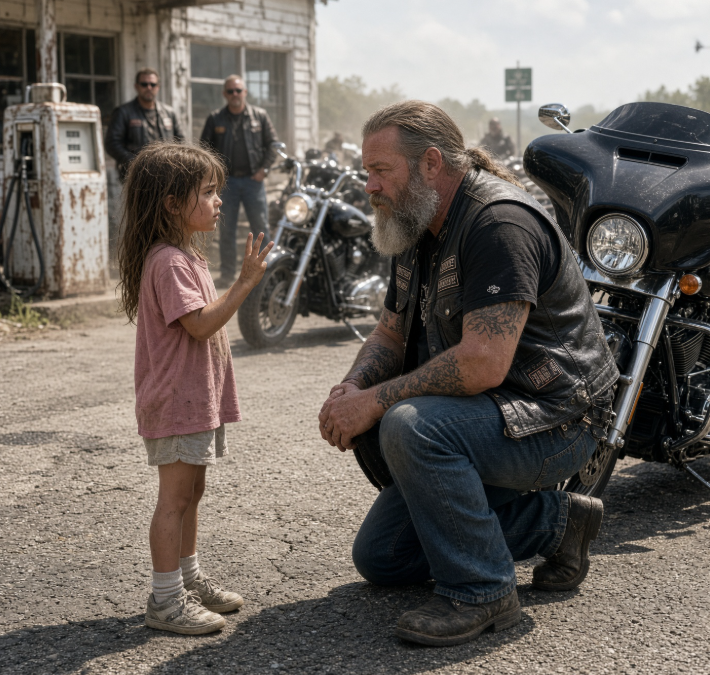
Brown hair pulled into a ponytail that had mostly fallen apart.
A faded pink T-shirt hanging too large over shorts.
Sneakers with both laces untied.
One sock pulled high.
The other bunched at her ankle.
Her face was dirty.
Her lips looked dry.
And she was staring directly at me.
Not frightened exactly.
That would have made more sense.
She looked… finished.
That was the word that came to me.
Finished with waiting.
Finished with being afraid.
Finished with whatever had happened before I arrived.
I put the gas nozzle back.
The girl did not move.
I took one slow step toward her.
Then another.
“Hey there.”
Nothing.
I kept my voice low.
The way I once spoke to my daughter when thunderstorms woke her.
“You okay?”
Her eyes stayed on mine.
“Waiting for somebody?”
Nothing.
I looked toward the road.
No one.
I crouched.
My knees complained loudly enough to embarrass me.
I rested my forearms on my thighs so I would not look like a giant leaning over her.
“My name’s Nathan.”
Nothing.
“What’s yours?”
Her lips parted.
No sound came.
That was when I noticed her fingernails.
Bitten almost to nothing.
And the way she held both arms close to her sides as if trying not to disturb the space around her.
I had seen frightened children before.
Not many.
Enough.
They did not always cry.
Sometimes fear was loud.
Sometimes it got so deep inside that silence became the only safe thing left.
Then she lifted her right hand.
Slowly.
Deliberately.
Three fingers.
Index.
Middle.
Ring.
Held straight up between us.
I looked at them.
Then at her.
“Three?”
Her lower lip trembled.
Once.
She pressed it tight again.
Raised the fingers higher.
Not a wave.
Not counting for fun.
A message.
She was telling me something.
And for reasons I could not yet explain, I understood that whatever those three fingers meant mattered more than anything I had planned for the rest of the day.
“I see you,” I said softly.
Her eyes changed.
Barely.
“I see your three.”
She lowered her hand.
I waited.
The silence stretched.
I did not push.
Eight years earlier, my daughter Lily had been four years old.
She had brown hair too.
Not as dark.
She had loved purple socks and strawberry yogurt and any cartoon involving talking animals.
And one rainy Tuesday, a pickup truck ran a red light on Elm Street.
Three seconds.
That was all it took.
Three seconds of tires screaming.
Metal folding.
Glass exploding.
Three seconds to split my life into before and after.
Lily died at the hospital.
My marriage followed slowly afterward.
Not because my wife and I stopped loving each other.
Because we looked at each other and saw the same empty bedroom.
Some couples survive that.
We did not.
After the divorce, I bought a smaller house on Ridgeline Road.
I joined longer rides.
Worked later.
Learned how to answer “How are you?” without lying exactly.
Fine.
Fine does not mean happy.
Fine means the machine is still running.
Standing there with that silent girl, I felt something I had not felt in years.
Needed.
Not wanted.
Not appreciated.
Needed.
“Can you tell me what three means?” I asked.
She stared down at her shoes.
Her mouth opened.
Closed.
Then finally, a sound came out.
Rough.
Small.
Like her voice had been unused.
“Three days.”
My stomach tightened.
“Three days since what?”
She looked at me.
“Grandma fell down.”
Everything in me went alert.
“Your grandma fell?”
A nod.
“Where?”
“Kitchen.”
“When?”
She raised three fingers again.
I felt heat press through the soles of my boots.
“What happened after she fell?”
“I called the numbers.”
“What numbers?”
“The paper.”
“What paper?”
“The one Grandma said to call if something bad happened.”
“911?”
She nodded.
“They came in the truck with lights.”
“Ambulance.”
Another nod.
“They took her.”
“And who stayed with you?”
Emma looked at me.
Nobody.
She did not need to say it.
I asked anyway because sometimes adults force terrible things into words before we allow ourselves to believe them.
“Someone came after?”
She shook her head.
“A neighbor?”
No.
“Family?”
No.
“Anybody?”
No.
Three days.
This little girl had been alone in a house for three days.
“What’s your name?”
“Emma.”
“Emma what?”
“Ashford.”
“All right, Emma.”
My throat tightened.
“Have you eaten?”
She nodded.
“Tell me.”
“Crackers.”
“And?”
“Peanut butter.”
“That all?”
“The peanut butter’s gone.”
“What about water?”
“The sink.”
I closed my eyes.
Only for a second.
Behind them, Lily’s pink bedroom appeared so clearly it stole my breath.
Then I opened them.
Emma was still there.
Alive.
Waiting.
This child did not need my memories.
She needed me standing in front of her now.
“Okay.”
I made my voice steady.
“Emma, you did good.”
She stared.
“You did real good.”
Her shoulders shifted slightly.
“I’m going to help you now.”
I stood and pulled out my phone.
My first call was technically not a call.
I called inside Thornton’s.
Rick answered.
“You’re standing thirty feet away.”
“Water. Food. Kid stuff. Bring it out.”
His tone changed.
“Problem?”
“Now, Rick.”
He did not ask again.
My next call went to Wyatt Brennan.
Wyatt had been president of our Cedar Falls chapter for eleven years and had mastered the skill of staying calm when everyone else became stupid.
He answered on the second ring.
“Nathan.”
“I’m at Thornton’s.”
“You break down?”
“No.”
He heard something in my voice.
“What happened?”
“Little girl here. Six years old. Emma Ashford.”
I looked toward her.
Rick was coming from the store carrying water, crackers, and a banana.
“Her grandmother collapsed three days ago.”
Silence.
“Ambulance took the grandmother.”
I swallowed.
“Nobody came for the kid.”
Another silence.
“How long?”
“Three days.”
Wyatt cursed quietly.
“She hurt?”
“Not visibly. Hungry. Dehydrated. Shut down.”
“You called police?”
“Not yet.”
“Why?”
“You know what happens.”
Wyatt sighed.
Yes.
We both knew.
Police call county services.
County services does what the law requires.
Sometimes that law saves children.
Sometimes it moves them like packages because there are too many emergencies and not enough good homes.
I was not saying the system was evil.
Only tired.
And Emma looked like she had already spent enough time paying for other people’s exhaustion.
“I want to know where the grandmother is,” I said. “I want the whole situation before someone puts Emma in a car and sends her an hour away.”
Wyatt was quiet.
“What are you thinking?”
“I don’t know.”
“Dangerous.”
“She held up three fingers.”
“What?”
“Wouldn’t speak. Just three fingers.”
I looked at Emma accepting water with both hands.
“Three days.”
Wyatt exhaled.
“I’ll call Derek.”
Derek Holloway was one of our members and a former paramedic. His wife worked at Mercy General.
“If an ambulance picked the grandmother up around Cedar Falls,” Wyatt said, “Mercy is most likely.”
“Good.”
“Keep the kid safe.”
“Planning on it.”
“And Nathan?”
“Yeah?”
“Call county before this gets interpreted the wrong way.”
“I know.”
I hung up.
Rick handed Emma the food.
She took the bottle first.
Small sips.
Slow.
Careful.
The way someone drinks when they have learned supplies can disappear.
Derek arrived twenty minutes later on a black Sportster.
He crouched beside Emma and checked her gently.
Pulse.
Eyes.
Skin.
Reflexes.
No dramatic medical equipment.
Just calm.
She answered mostly in nods.
When he finished, he pulled me aside.
“Mild dehydration. Hungry. Probably exhausted. Physically she’s holding up.”
“Emotionally?”
Derek looked back at her.
“That’s above my pay grade.”
“What about Grandma?”
His expression changed.
“My wife found her.”
“Alive?”
“Yes.”
I let out air.
“Margaret Ashford. Seventy-one. Admitted three days ago after a stroke.”
“ICU?”
“Yeah.”
“Family?”
“Hospital has a disconnected number listed.”
“That’s it?”
“That’s it.”
I looked at Emma.
She was eating one cracker at a time.
Holding each with both hands.
Six years old.
Three days.
And nobody had noticed.
We called the county.
Two hours later, a caseworker named Carol Whitfield arrived at the Cedar Falls diner where I had taken Emma for an actual meal.
Grilled cheese.
Tomato soup.
Milk.
She ate without talking.
Not quickly.
Steadily.
She cleaned the bowl with the last corner of bread.
That nearly broke me more than the three fingers.
Hungry kids should eat like kids.
Messy.
Distracted.
Complaining about crust.
Emma ate like every calorie was inventory.
Carol entered wearing a gray blazer despite the heat, carrying a clipboard and the exhausted expression of someone who had spent years walking into other people’s disasters.
“Mr. Mercer?”
“That’s me.”
“I understand you found the child.”
“She found me.”
Carol looked past me toward Emma.
Derek sat in the booth across from her.
Emma was drawing on a napkin with a pen Rick had given her.
A house.
One window.
One door.
One small person standing beside it.
Carol opened the file.
“Margaret Ashford is in ICU following a severe stroke.”
“I know.”
“No reliable emergency contacts. Emma’s father is not listed.”
“And mother?”
Carol paused.
“Relinquished parental rights four years ago.”
My jaw tightened.
“Emma has been in her grandmother’s kinship care since she was two.”
“What happens tonight?”
Carol looked at me.
“You already know.”
“Tell me.”
“Emergency foster placement.”
“Where?”
“Cookeville.”
“That’s an hour away.”
“It’s the available certified placement.”
I looked through the diner window.
Emma had stopped drawing.
She could not hear us from outside.
But she knew.
Children always know when adults are deciding their future.
“She been in foster care before?”
Carol hesitated.
That told me enough.
“Before Margaret received kinship placement, Emma spent time in two foster homes.”
“Good homes?”
“The first placement was disrupted.”
“What does disrupted mean?”
“It wasn’t a good fit.”
I looked through the glass again.
Emma was holding the pen so tightly her knuckles were white.
“Buttons?” I asked.
Carol frowned.
“What?”
“She flinches when strangers come close. Barely talks. Eats like someone might take the food. You’re telling me she’s already been through placements.”
Carol’s professional expression hardened.
“Mr. Mercer, I am not going to discuss confidential history with someone who has no legal relationship to the child.”
“Fair.”
I rubbed my beard.
“But I’m also not watching her get put in a stranger’s car tonight without asking if there’s another option.”
“The law requires a safe placement.”
“She was alone for three days.”
Carol’s eyes tightened.
“I am aware.”
“No one from your office knew.”
“We were not notified.”
“The hospital had a six-year-old’s grandmother unconscious for seventy-two hours and nobody thought there might be a kid at home?”
“That is not my department.”
“That’s the problem.”
Carol stared at me.
I knew I was being unfair.
Not completely.
But enough.
She was not the woman who left Emma alone.
She had probably seen fifty children that week.
Maybe more.
Still, I was angry.
Anger likes a face.
Carol lowered her clipboard.
“I don’t make the rules.”
“Then who does?”
Silence.
I continued more quietly.
“She needs her grandmother.”
“Yes.”
“Grandmother may recover.”
“Yes.”
“So Emma needs somewhere here. Cedar Falls. People she knows. Not a house an hour away.”
“And who are you proposing, Mr. Mercer?”
The question stopped me.
Me?
No.
I had not considered it.
Maybe Carol saw that.
Her expression softened a fraction.
“I have met men like you.”
“Lucky you.”
“I mean people who see a child in crisis and become emotionally invested.”
“Is that bad?”
“No.”
Her voice became tired.
“But I have also seen them disappear when the emergency becomes routine.”
I said nothing.
“When the child has nightmares. When school calls. When they hide food. When they scream because a door closes too hard. When there are court dates and home visits and paperwork.”
She looked straight at me.
“Concern is easy for three days.”
Three days.
The words hit me.
Emma’s three.
Carol’s three.
I looked at the child through the window.
“What would it take?”
Carol blinked.
“For what?”
“Emergency placement. With me.”
“Mr. Mercer—”
“What would it take?”
“Background check. Home assessment. Approval.”
“Do it.”
“You ride with—”
“I know what vest I’m wearing.”
She exhaled.
“Your criminal record?”
“Run it.”
“Anyone else in the home?”
“No.”
“Weapons?”
“Locked. Legal.”
“Alcohol?”
“Beer in the refrigerator.”
“Drugs?”
“No.”
“History of violence?”
“Not unless you count football in high school.”
She almost smiled.
Almost.
“I can request a seventy-two-hour emergency placement pending review.”
“Do that.”
“It is not custody.”
“I know.”
“It can be terminated.”
“I know.”
“You may not interfere if the court orders placement elsewhere.”
I looked at Emma.
“I know.”
The background check took forty minutes.
No felonies.
No warrants.
No restraining orders.
No pending charges.
I had spent half my adult life being judged by a vest, yet somehow my official paperwork looked painfully boring.
While we waited, I sat across from Emma.
She had filled three napkins.
All houses.
Different roofs.
Same single person outside.
“You draw a lot of houses.”
She shrugged.
“Grandma says I draw too many.”
“Why?”
The pen stopped.
She stared at the little square she had made.
“Because if I draw enough…”
She paused.
I waited.
“Maybe one will be real.”
I had to look away.
The window suddenly became very interesting.
Forty-six-year-old men with gray beards do not like crying in diners.
Especially not in leather vests.
That evening, Emma slept on my couch.
Carol had approved the temporary emergency arrangement.
Seventy-two hours.
That was all I had.
My house felt different with a child inside it.
Smaller.
More fragile.
Alive.
I found an old blanket in the hallway closet and gave it to her.
She curled under it fully dressed.
Shoes off.
Socks still on.
She refused the spare bedroom.
Too far from the front door, maybe.
Too unfamiliar.
I did not ask.
After she fell asleep, I sat on the porch and called Wyatt.
“She’s here.”
“How’s that feel?”
“Terrifying.”
Wyatt laughed once.
“County?”
“Wants foster placement after the emergency period.”
“You don’t.”
“No.”
“What do you want?”
I looked through the screen door.
Emma lay motionless under the blanket.
“I don’t know.”
That was the truth.
“I just know she raised three fingers because three days was all she had left to say.”
Wyatt stayed quiet.
“I’m not letting her become paperwork if there’s another way.”
“What way?”
I watched fireflies blink between the trees.
“We have six hundred brothers in Tennessee.”
There was a pause.
“Nathan.”
“If six hundred men can shut down a highway for a funeral procession, they can show up for one living child.”
“What exactly are you asking?”
“Not threats.”
“I know.”
“Not intimidation.”
“I know.”
“Just… show up.”
Wyatt understood.
“They need to see she has a community.”
“Yes.”
“I’ll put the word out.”
After midnight, Emma whimpered.
One small sound.
I went inside.
She was still asleep.
Face tight.
Hands clutching the blanket.
I sat in the armchair across from her.
Did not touch her.
Did not wake her.
Just stayed.
I remembered doing that beside Lily’s bed during storms.
That memory hurt.
But it did not kill me.
That surprised me.
Morning came with seventeen messages and eight missed calls.
Riders from Knoxville.
Nashville.
Memphis.
Chattanooga.
Jackson.
Clarksville.
Small towns I had barely heard of.
Same question.
Where?
When?
Emma woke quietly.
No crying.
No calling.
Just sitting on the couch with the blanket pulled to her chin, watching me enter.
“Morning.”
She nodded.
“Hungry?”
Another nod.
I made eggs.
They were too dry.
Toast was nearly raw because apparently grief had not improved my cooking.
Emma ate everything.
Then carried her plate to the sink without being asked.
She stood on her toes to reach the counter.
Something inside my chest cracked.
Not painfully.
Like ice on a river beginning to thaw.
Derek arrived at nine.
“Margaret’s stable.”
Emma’s head turned sharply.
“Grandma?”
Derek smiled.
“Your grandma’s still sleeping, but the doctors are taking care of her.”
Emma stared at him.
“Can I see?”
“Not yet.”
Her face closed.
I said, “But soon.”
She looked at me.
I hoped I had not lied.
Derek pulled me aside.
“Stroke was severe. Could be weeks before she’s functional.”
“And Emma?”
“Court hearing Monday.”
Four days.
Four days to convince a judge that temporary placement in Cedar Falls was better than moving her away.
Four days to show up.
Monday morning, I woke before dawn.
I did not need an alarm.
I heard them.
At first, just a low sound far away.
A distant rumble.
Then deeper.
Closer.
The windows vibrated.
Emma sat up on the couch.
“What is that?”
I walked to the front window.
Headlights appeared through early morning mist.
One row.
Then another.
Then another.
Motorcycles.
Hundreds.
Coming from every direction.
By seven, Route 41 sounded like thunder.
Six hundred riders came to Cedar Falls.
Six hundred.
Men in leather.
Gray beards.
Young faces.
Old scars.
Mechanics.
Veterans.
Truck drivers.
Roofers.
Electricians.
Business owners.
Fathers.
Grandfathers.
Men who had lost children.
Men who had been lost children.
Men who knew exactly what it meant when a child counted the days nobody came.
They parked from Thornton’s Gas and Go all the way toward the county courthouse.
No signs.
No chants.
No threats.
No engines revved outside the courthouse.
Wyatt had made the rule clear.
We were not there to frighten anyone.
We were there to be visible.
To make one statement.
Emma was not alone.
I drove her to court in my truck because putting her on a motorcycle would have caused Carol to die on the spot.
When we turned onto Main Street, Emma pressed both hands to the passenger window.
“What are they doing?”
“Waiting.”
“For what?”
“You.”
She looked at me.
“Why?”
I thought about how to explain brotherhood to a six-year-old.
“You held up three fingers.”
She looked down at her hand.
“They understood.”
Inside the courthouse, only forty riders fit.
The rest stayed outside.
Judge Raymond Parks looked exactly like a judge in an old movie.
White hair.
Half-moon glasses.
Face that suggested he had heard every excuse human beings could invent and believed approximately none of them.
Carol presented the state recommendation.
Temporary foster care in Cookeville while Margaret remained hospitalized.
Continuity of school could be arranged later.
Family review pending.
Then my name was called.
I stood.
My mouth went dry.
I would rather speak to six hundred bikers than one judge.
“Mr. Mercer,” Judge Parks said, “you are requesting continued temporary placement?”
“Yes, Your Honor.”
“You have no biological relationship to this child.”
“No.”
“Had you met her before last Thursday?”
“No.”
“You understand why that creates concern?”
“Yes.”
“What qualifies you?”
There are questions men spend their lives avoiding because the answer may be nothing.
I looked at Emma.
She sat beside Carol.
Feet not touching the floor.
Watching me.
“I’m a mechanic.”
The judge waited.
“I ride motorcycles.”
A few people almost smiled.
“I belong to a club people have opinions about.”
Judge Parks glanced toward my vest.
“I am aware.”
“I’m not a social worker.”
“No.”
“I’m not a teacher.”
“No.”
“I was a father.”
The room became still.
I corrected myself.
“I am a father.”
The words surprised me.
Lily was dead.
That did not change the tense.
“I lost my daughter eight years ago.”
Judge Parks’s expression shifted.
“Four days ago, Emma walked up to me at a gas station and held up three fingers.”
I raised my own hand.
“Like this.”
Emma stared.
“She couldn’t speak at first.”
I lowered my hand.
“Three days. That’s what they meant.”
The courtroom was silent.
“She had been alone for three days after her grandmother’s stroke.”
I looked at Carol.
Not accusing this time.
“She did what a six-year-old could do. Ate crackers. Finished the peanut butter. Drank sink water. Waited.”
My voice roughened.
“And then she walked until she found someone.”
I swallowed.
“I know temporary placement with me is unusual.”
Judge Parks said nothing.
“I know a vest full of patches isn’t a parenting credential.”
A faint sound of agreement came from behind me.
Probably Wyatt.
“But Emma’s grandmother is alive.”
I faced the judge.
“She is fighting to come back.”
My hands tightened.
“This child does not need a new life an hour away if we can safely hold her old one together long enough for her grandmother to return.”
Judge Parks leaned back.
“And you believe you can provide that?”
“Yes.”
“Alone?”
That was the question I had been waiting for.
“No, sir.”
I turned toward the window.
The judge followed my gaze.
Main Street was filled with motorcycles.
Blocks of them.
Men standing beside them silently.
No shouting.
Just there.
“Six hundred riders came here this morning.”
Judge Parks removed his glasses.
“Six hundred?”
“Yes.”
“To influence this court?”
“No.”
I looked directly at him.
“To prove I’m not alone.”
The judge stayed quiet.
“And neither is Emma.”
Outside, sunlight reflected off chrome.
“Those men have families. Businesses. Skills. Homes. Some have daughters. Some buried daughters. Some grew up in foster care. Some got their lives saved because somebody decided they were worth showing up for.”
I turned back.
“Four days ago, Emma had nobody at that gas station.”
I looked at her.
“Today she has six hundred people standing outside who know what three fingers mean.”
Judge Parks cleaned his glasses slowly.
Carol shifted beside Emma.
Then something unexpected happened.
Carol stood.
“Your Honor.”
“Yes, Ms. Whitfield?”
“I would like to amend the department’s recommendation.”
I stared.
Carol looked at Emma.
Then me.
“The emergency home inspection found no safety issues.”
She opened her folder.
“Mr. Mercer has complied with all requirements. Emma has remained stable. She is enrolled at the same school district and has an established community connection in Cedar Falls.”
The judge waited.
Carol inhaled.
“The department recommends continued temporary placement with Mr. Mercer for thirty days, subject to weekly visits, while Margaret Ashford’s medical status is reviewed.”
I almost forgot how to breathe.
Judge Parks looked over his glasses.
“Mr. Mercer?”
“Yes, sir.”
“If I grant this, you will cooperate with social services?”
“Yes.”
“School?”
“Yes.”
“Medical appointments?”
“Yes.”
“Counseling?”
“Yes.”
“No interference with eventual reunification if the grandmother becomes medically capable?”
I looked at Emma.
“That’s what I want.”
Judge Parks studied me.
Then looked at the window one more time.
“The court grants temporary emergency custody to Nathan Mercer pending full review in thirty days.”
My knees almost gave out.
“Emma will remain in Cedar Falls.”
Outside, word spread.
There was no explosion of cheering.
Wyatt had told everyone to keep it respectful.
Just a murmur.
Then nods.
Handshakes.
One by one, engines started.
One by one, riders left.
Thunder rolling away into Tennessee hills.
Like a storm that had come not to destroy anything—
but to make sure somebody heard it.
The next thirty days were harder than court.
People like stories with neat endings.
They want the judge to bang the gavel and music to begin.
Real life does not work that way.
Emma had nightmares.
Some nights she woke screaming.
Other nights she woke silently and stood in the hallway outside my bedroom until I opened my eyes.
She never asked to come in.
The first time, I nearly jumped out of bed.
Then I saw her.
“Bad dream?”
Nod.
“Want to talk?”
No.
“You can sit.”
She sat on the floor.
So did I.
We leaned against opposite walls until she fell asleep sitting up.
The next morning, I found a pillow and blanket outside my bedroom door.
Just in case.
Breakfast was its own education.
Toast had to be triangles.
Not rectangles.
I did not ask why after making the mistake once.
She hated buttons.
Would not wear shirts with them.
Hated closed bathroom doors.
Hated anyone raising their voice, even at television football.
She hid crackers under the couch cushion.
The first time I found them, my instinct was to say something.
Then I remembered Carol.
Children who experienced food insecurity sometimes hide food.
So I bought a basket.
Put it in the pantry.
Filled it with snacks.
I showed Emma.
“This stays full.”
She stared at it.
“You don’t have to ask.”
No response.
“If it gets low, tell me.”
She touched one package of crackers.
“Always?”
I swallowed.
“As long as you’re here.”
She took one.
That night, I found three crackers under her pillow anyway.
Healing does not care about promises yet.
It wants evidence.
So I kept filling the basket.
She kept checking.
Eventually, the hidden crackers disappeared.
Carol visited every week.
At first, she inspected everything.
Medicine cabinet.
Gun safe.
Smoke alarms.
Food.
Sleeping arrangements.
By week three, she sat at my kitchen table drinking coffee while Emma drew.
The houses had changed.
Still houses.
But now sometimes there were two people outside.
Then three.
“Your reports okay?” I asked Carol after one visit.
She smiled.
“Best ones I’ve written in years.”
Margaret woke on the seventeenth day.
Derek called me first.
“She’s awake.”
I sat down hard.
“Talking?”
“Not yet. Right side movement is good. Left is weak.”
“Emma know?”
“Hospital wants family there carefully.”
I looked toward the living room.
Emma was drawing.
“Okay.”
The next day, I took her.
Hospitals terrified her.
The elevator.
Monitors.
Overhead announcements.
Shoes squeaking on polished floors.
She froze halfway down the ICU corridor.
“I can’t.”
I crouched.
“That’s okay.”
“Grandma.”
“We can wait.”
She shook her head.
“No.”
Then lifted both arms toward me.
I had not carried a child in eight years.
My body remembered before my mind did.
I picked her up.
She weighed almost nothing.
She weighed everything.
Her arms wrapped around my neck.
Face tucked against my shoulder.
We entered Margaret’s room.
Tubes.
Monitors.
Walker waiting near the wall for a future nobody could guarantee yet.
Margaret looked small in the hospital bed.
Older than seventy-one.
Emma stiffened in my arms.
I lowered her carefully.
She stood at the foot of the bed.
“Grandma?”
Margaret’s eyes opened.
Slowly.
She could not speak.
She looked at Emma.
Tears filled her eyes.
Then she raised her right hand.
Three fingers.
Emma stopped breathing.
So did I.
Margaret held them there.
Three fingers.
The same signal.
But not the same meaning.
Emma looked at me.
I nodded.
She walked forward.
Climbed onto the edge of the bed with my help.
Pressed her forehead against her grandmother’s shoulder.
The sound she made was not exactly crying.
Not laughter either.
It was what happens when a body finally releases fear it has been carrying too long.
I stepped into the hallway.
Derek was waiting.
“She’s gonna be okay,” he said.
I rubbed my face.
“Which one?”
He smiled.
“Both.”
Then after a pause:
“Maybe you too.”
I looked at him.
Said nothing.
Because sometimes a man knows the truth before he can afford to speak it.
The thirty-day hearing came in September.
Margaret had moved to a rehabilitation center.
Speech returned slowly.
Walking was harder.
But she was stubborn.
Emma got that from somewhere.
The court had Carol’s reports.
Medical records.
School records.
A letter from Emma’s teacher.
And a petition signed by more than a hundred Cedar Falls residents asking for a guardianship arrangement that would let Emma stay connected to me while Margaret recovered.
Forty-seven bikers had signed.
Not all six hundred.
Most did not live nearby.
But the ones who did created a rotation.
One repaired Margaret’s roof.
Another rebuilt her porch steps.
Two handled yard work.
Someone stocked the pantry every other week.
Derek coordinated medical rides.
Wyatt quietly paid for a ramp and then threatened anyone who tried to thank him.
When Judge Parks called Margaret to speak, she stood with a walker.
Emma watched from the front row.
Margaret’s words were slow.
Careful.
“My granddaughter… comes home… with me.”
She breathed.
“But Nathan…”
She looked at me.
“Stays family.”
I lowered my head.
The judge reviewed everything.
Then looked at me.
“Mr. Mercer, in thirty years on this bench, I have seen many people claim to care about children.”
I waited.
“Very few prove it after the emergency ends.”
He looked at Carol’s reports.
“You proved it.”
My throat tightened.
“The court returns primary custody to Margaret Ashford, contingent on continued support services and medical review.”
Emma reached for her grandmother’s hand.
“And designates Nathan Mercer as supplementary legal guardian.”
I stared.
Judge Parks almost smiled.
“This should reduce the likelihood of six hundred motorcycles appearing outside my courthouse again.”
Wyatt whispered behind me, “No promises.”
I elbowed him.
Two months later, I rode to Margaret’s house on Pine Street.
November had stripped most leaves from the trees.
The repaired roof looked good.
New porch steps.
Orange and yellow mums lined the railing.
I shut off the Harley.
Before I could remove my gloves, the front door opened.
Emma came running out.
Not the silent girl from Thornton’s.
Not the child measuring every movement.
Running.
Coat too big.
Hair flying.
She stopped in front of me.
I smiled.
“Hey, kid.”
She raised her right hand.
Three fingers.
My chest tightened.
“Three?”
She nodded.
“What does it mean this time?”
For the first time, her smile came quickly.
Not completely fearless.
Maybe it never would.
But chosen.
“Three words.”
I waited.
She looked straight at me.
“I love you.”
The world stopped.
Same as the gas station.
Same child.
Same hand.
Same three fingers.
Different universe.
I knelt on the driveway.
Pulled her into my arms.
My hands shook against her little coat.
I had cried enough in eight years to know tears were not weakness.
Still, none came.
My eyes burned.
My throat closed.
But mostly I felt something else.
Gratitude.
Behind us, Margaret stood in the kitchen window leaning on her walker.
She put one hand against the glass.
I looked over Emma’s shoulder.
Margaret raised three fingers too.
I laughed.
Emma laughed into my vest.
Somewhere on Route 41, a motorcycle passed in the distance.
Low thunder moving through the Tennessee hills.
For years, I thought silence meant nothing was there.
After Lily died, my house became silent.
My marriage became silent.
I became silent.
I treated silence like absence.
Emma taught me differently.
Silence can be a language.
A child standing beside a broken air pump without saying a word can still be screaming for the entire world to notice.
Three fingers can mean:
Three days.
Three nights.
Three times I woke up and nobody came.
Three days I counted because counting was the only thing I could control.
I am still here.
Do you see me?
And if somebody answers—
if one person kneels down instead of walking past—
the meaning can change.
Three fingers can become:
You stayed.
I trust you.
I love you.
People later told the story like the six hundred motorcycles were the miracle.
They were not.
They were loud.
Impressive.
Good for photographs.
But they were not the miracle.
The miracle happened before any engine started.
A six-year-old girl who had every reason to believe adults disappeared decided to trust one more.
She walked toward a stranger.
Raised her hand.
And tried again.
Everything after that began because somebody noticed.
That is what I tell people now when they ask why six hundred Hells Angels rode through Tennessee for a girl none of them knew.
They did know her.
Not her favorite cereal.
Not how she wanted toast cut.
Not why buttons scared her.
Not what she dreamed about at night.
But they knew the message.
Some had spent days alone.
Some years.
Some their entire childhoods.
They knew what it was to count.
To wait.
To wonder whether anyone was coming.
So when Emma raised three fingers, six hundred men understood.
She was not asking for a parade.
She was not asking for heroes.
She was asking the oldest question any frightened child can ask.
Am I alone?
And six hundred of us answered the only way we knew how.
We showed up.
Three fingers started the story.
Three words finished it.
And everything between them was simply a promise repeated often enough for a little girl to finally believe it:
We hear you.
We see you.
You are not alone.








