A Librarian Found 60 Love Notes Hidden Inside the Same Old Book—Then the Final Note Sent Her Looking for a Hells Angel Who Had Waited 55 Years
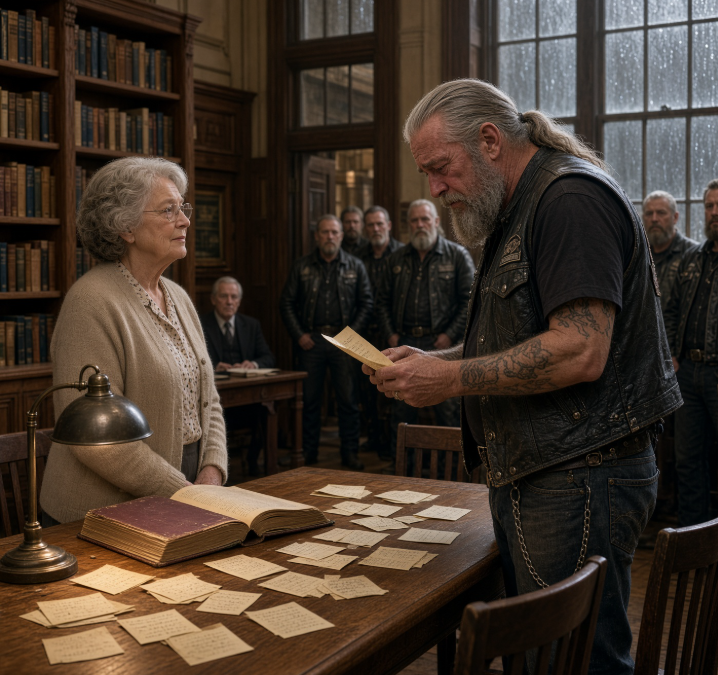
PART3:
The pages smelled like dust and old paper.
There was nothing unusual there.
Until she turned to the back.
Atoria had moved to computerized circulation years ago, but older books sometimes still carried their original paper checkout cards in pockets glued inside the cover.
Frances liked those cards.
They were ghosts of readers.
Dates.
Names.
Handwriting.
Proof that books had histories beyond their stories.
The card in this book was unusually full.
Frances pulled it halfway out.
It resisted.
She frowned.
The pocket was swollen.
She ran one finger along the inner seam.
Something was behind it.
“Please don’t be food,” she whispered.
She had once opened a 1960s cookbook and found a piece of bacon pressed between two pages.
That experience had changed her as a person.
She took the book to the repair room.
Under the yellow work lamp, she used a thin bone folder to lift the edge of the paper pocket.
Something pale appeared beneath it.
Folded paper.
She stopped.
For some reason, her heart beat faster.
She worked slowly.
The first note came free.
Small.
Folded into quarters.
Paper yellowed almost brown along the edges.
Frances stared at it.
Reading private correspondence felt wrong.
She knew that.
She spent her career protecting people’s privacy.
But there was no name on the outside.
No envelope.
The note had been hidden in a public book for decades.
“Professional curiosity,” she told the empty room.
Edward would have called it nosiness.
She unfolded it.
Six words.
Still Wednesday.
Still waiting.
Still yours.
Then one letter beneath them.
V.
Underlined twice.
Frances read it again.
Still Wednesday.
Still waiting.
Still yours.
The words were intimate enough that she felt like someone had spoken behind her.
She looked toward the doorway.
Empty.
Then she looked back at the book.
The paper pocket was still not flat.
There was more behind it.
That discovery took nearly an hour.
Someone had carefully loosened part of the back endpaper and created a narrow hidden compartment along the board.
Whoever had done it understood books.
Not professionally perhaps.
But enough to avoid damaging the binding.
Frances opened the pocket.
A bundle of folded notes slid forward.
The rubber band around them had gone brittle.
It broke the moment she touched it.
Papers scattered across the table.
“Oh my.”
She began counting.
Ten.
Twenty.
Thirty.
Forty.
Fifty.
Fifty-nine.
Then one more.
Sixty.
The first notes were browned with age.
The last was white enough to be recent.
Two different styles of handwriting appeared.
One looping and controlled.
One slanted, heavy, and impatient.
Both were signed V.
That confused her.
Two V’s?
She arranged them by apparent age.
Then she retrieved the checkout card.
Two names appeared again and again.
VERA SUTCLIFFE.
V. THORNE.
The first date was September 1969.
The second borrower checked out the book six weeks later.
Then Vera again.
Then Thorne.
Always the same title.
Always separated by days or weeks.
And after the early 1970s, almost every checkout occurred on a Wednesday.
Frances lowered herself into the work chair.
The rain tapped against the small window.
The library would open in twenty-eight minutes.
She picked up the oldest note.
The handwriting was young.
Virgil,
You were rude yesterday.
I am still angry.
Meet me by the cannery after six if you want to apologize properly.
Do not bring those ridiculous cigarettes.
Vera
Frances smiled.
The next was from the other hand.
Vera,
I was not rude.
Your father was rude.
I reacted with accuracy.
I will be at the cannery.
I quit the cigarettes Tuesday.
That means technically I can bring them because I am no longer smoking.
Virgil
Frances laughed aloud.
“Edward, you would have liked these two.”
The notes continued.
Small.
Funny.
Ordinary.
Want to see the ocean Sunday?
Your father thinks my motorcycle caused the decline of Western civilization.
I saved you a seat at the back of church.
I will attend church when lightning insurance becomes affordable.
Stop teasing me.
Never.
Then something changed.
A note dated January 1970 read:
Virgil,
Daddy knows.
Do not come to the house.
Please.
Not because I do not want you there.
Because I am afraid of what he will do.
Wednesday.
Same place.
V.
The next note had only one sentence.
Nothing he says changes what I know about you.
V.
Frances stopped smiling.
She looked at the checkout card.
There was a gap.
Almost two years.
No Vera.
No Virgil.
When the notes resumed, the handwriting looked older.
Not physically much older.
Emotionally.
Vera wrote:
I heard you came home.
I looked for your motorcycle on Marine Drive for three days before I admitted what I was doing.
Wednesday if you still want to know me.
V.
Virgil answered:
I wanted to know you every day I was gone.
V.
Frances sat back.
“Vietnam,” she whispered.
She checked the date.
The next notes confirmed it without describing much.
Virgil did not write about combat.
He wrote around it.
Could not sleep.
Could not stand fireworks.
Could not eat rice for years.
One note read:
I thought coming home would mean it was over.
Nobody tells you home can feel foreign too.
Vera answered:
Then be foreign here.
I know you.
V.
Frances closed her eyes.
There are sentences that become heavier because nobody intended strangers to read them.
She should have stopped.
Instead she read for another hour before opening the doors.
That day, she moved through her routine distractedly.
She checked out mysteries.
Helped a child print a science report.
Showed a man how to use the copier even though he insisted the machine disliked him personally.
But every few minutes, she thought about the sixty notes.
At lunch she read more.
Virgil asked Vera to marry him in 1974.
Not with poetry.
His note said:
I have $1,820 saved.
A motorcycle.
A toolbox.
A bad apartment.
And absolutely no business asking you this.
But marry me anyway.
Vera’s answer came three weeks later.
I said yes before I finished the note.
Then I sat here for an hour trying to figure out how to tell my father.
I still do not know.
Yes.
Yes.
Yes.
V.
There should have been a wedding.
There wasn’t.
The next note came months later.
Virgil,
My father says he will have you arrested.
He says he knows the sheriff.
He says he will tell the school board things about you.
He says if I leave, Mother will never speak to me again.
I am ashamed of how afraid I am.
Please do not think fear means I stopped loving you.
V.
Virgil replied:
Fear means you are afraid.
Nothing else.
I will not punish you for it.
Wednesday.
Always.
V.
Frances had to remove her glasses.
She rubbed her eyes.
A person can spend decades around books and still be surprised by the quiet cruelty hidden inside ordinary families.
The notes continued year after year.
Vera never married.
That Frances knew.
Virgil apparently did not either.
They met sometimes.
Secret dinners.
Walks.
A motel in Portland mentioned only once.
A Christmas spent parked above the river because Vera’s father had guests at the house.
Then years became decades.
Her father died.
But by then something else had happened.
The notes grew more hesitant.
They had lost the habit of imagining a future.
They had become experts at surviving a love no one had properly allowed to live.
One from Vera in 1987 read:
We wasted so much time obeying ghosts.
Virgil answered:
Then let us waste no more.
But they did.
Not because either wanted to.
Life had hardened around them.
Vera cared for her mother after a stroke.
Virgil worked.
Then lost a close friend.
Then spent years helping veterans.
They remained connected by Wednesdays.
The book traveled back and forth like a mailbox no one knew existed.
Some years contained only one note.
Some contained several.
One in 1999 simply said:
Still here?
The reply:
Where else would I be?
Frances thought of Edward.
She had loved him thirty-six years.
They had fought about money.
Laundry.
His habit of leaving cabinet doors open.
Her habit of pretending she was not angry until she was furious.
Ordinary marriage.
Ordinary closeness.
Ordinary access to the person you loved.
She had never once considered what it might do to a human being to love somebody for fifty years and live as if that love required permission.
By the third day, Frances knew enough to understand that the final note mattered more than all the others.
She had not opened it yet.
Something in her resisted.
The paper was new.
The ink dark.
Unlike the earlier notes, the handwriting trembled.
Vera’s loops had collapsed.
Letters leaned.
Some words were rewritten.
Frances placed it aside.
She needed context first.
Then Wendell Griggs arrived.
Wendell chaired the library board.
He was sixty-nine, retired from the county assessor’s office, and believed every problem could be reduced to a number provided nobody emotional was allowed near the calculator.
He entered the repair room holding a clipboard.
He stopped.
Sixty notes covered the table.
“What is all this?”
“History.”
“That usually means expense.”
“Good morning to you too.”
His eyes found the old Brontë.
“Frances, tell me that isn’t one of the books from the withdrawal list.”
“It was.”
“Was?”
“It is no longer.”
“You cannot personally rewrite board policy.”
“I have been doing it quietly for years.”
“I know.”
She looked at him.
He looked back.
That was the closest their friendship ever came to affection.
Frances held up one note.
“These were hidden in the binding.”
Wendell frowned.
“Why?”
“Two people communicated through this book for more than fifty years.”
“That is unfortunate for the book.”
She stared.
He cleared his throat.
“Interesting. I meant interesting.”
“One of them is Vera Sutcliffe.”
That got him.
Even Wendell knew Miss Sutcliffe.
His son had been in her class.
“Vera?”
“Yes.”
“Who is the other?”
“Virgil Thorne.”
Wendell’s expression changed instantly.
Frances saw it.
Not confusion.
Judgment.
“You mean the biker.”
“I mean Virgil Thorne.”
“Hells Angel.”
“I am aware.”
Wendell picked up his clipboard again.
“Whatever those notes say, the book is structurally compromised.”
“Wendell.”
“And old private notes do not make something archival.”
“Fifty-five years of local correspondence absolutely qualifies as archival.”
“Not automatically.”
“Do you want me to show you our collection of Mayor Hammond’s grocery receipts?”
“That was donated.”
“So were these, accidentally, fifty-five years ago.”
Wendell sighed.
“Fine. We discuss it Wednesday.”
Then, as he turned, he said, “And be careful this week.”
“About what?”
“Motorcycle rally.”
Frances looked at him.
“They are across town.”
“They wander.”
“So do Rotarians.”
“That is not the same thing.”
“Why?”
Wendell gave her a tired look.
“You know why.”
“No. I know what you are implying.”
“Frances.”
“They have never caused trouble here.”
“People like that eventually do.”
People like that.
The phrase lingered after Wendell left.
Frances looked at the table.
At fifty-five years of careful paper.
At the name THORNE.
She felt annoyed.
Not only with Wendell.
With herself.
Because when she first recognized the club patch in an old newspaper photograph of Virgil, she had felt a small instinctive caution too.
She disliked that.
Frances had spent her life insisting books should not be judged by covers.
Apparently humans still required practice.
That evening she went downstairs to the local history archive.
Atoria kept everything.
Newspapers.
Property maps.
School yearbooks.
Old photographs.
Meeting minutes.
Frances found Vera first.
1968 high school yearbook.
Dark hair.
White blouse.
Serious expression.
“Most likely to become a teacher.”
She did.
Then Virgil.
Not in the yearbook.
She searched newspaper indexes.
In 1974, a photograph appeared.
Five motorcycle riders outside the old cannery.
Young Virgil stood third from left.
Lean.
Long dark hair.
Leather vest.
Arms crossed.
He looked tough.
That was what the picture wanted you to see.
Then Frances noticed something.
A little boy stood beside the group holding a toy motorcycle.
Virgil’s hand rested lightly on the boy’s shoulder.
The caption said:
LOCAL RIDERS RAISE $3,200 FOR CHILDREN’S BURN UNIT.
Frances found more.
Motorcycle charity run for veterans.
Food drive.
Funeral escort for a local Marine.
Toy drive.
Flood relief.
The club had arrests in its history too.
Fights.
Public intoxication.
Weapons violations.
Messy human beings.
Not saints.
Not demons.
People.
Virgil’s own name appeared surprisingly little.
One article mentioned him repairing donated wheelchairs for veterans.
Another named him as a volunteer conservator at the county historical archive.
Frances blinked.
Conservator?
She checked again.
It was him.
Virgil Thorne.
Book and paper repair.
For thirty-eight years.
She looked upstairs toward the room containing the hidden notes.
The secret compartment.
The careful folds.
The preserved paper.
She suddenly understood who had built the hiding place.
The next evening, Frances drove to the old cannery lot.
She almost turned around twice.
Motorcycles lined the fence.
Big machines.
Chrome.
Black paint.
Leather.
Music came from portable speakers.
Men and women stood around picnic tables with paper plates.
It looked less like an outlaw encampment than a family reunion with unusually loud transportation.
Frances parked.
Sat.
“Do not be ridiculous,” she told herself.
Then got out.
A man near the gate saw her.
Around fifty.
Gray-streaked beard.
Leather vest.
He approached slowly.
“Can I help you, ma’am?”
“I am looking for Virgil Thorne.”
The man’s expression sharpened.
“Who’s asking?”
“Frances Redmond. Atoria Public Library.”
His eyebrows rose.
“Virgil owe late fees?”
“Possibly fifty-five years’ worth.”
The man almost smiled.
Then Frances said, “It concerns Vera Sutcliffe.”
His expression disappeared.
Behind him, movement stopped.
A few riders had heard.
The man looked across the lot.
Frances followed his eyes.
Virgil Thorne was crouched beside a motorcycle.
He was enormous.
Six-two or six-three.
Broad shoulders.
Gray beard halfway down his chest.
Arms covered in old tattoos.
His leather vest had faded nearly white along the folds.
He held a cloth in one hand.
At Vera’s name, the cloth stopped moving.
“Virgil,” the first man called.
Virgil rose.
Slowly.
A large man carrying his age carefully.
He approached.
People often look smaller up close.
Virgil looked larger.
But his eyes were not hard.
Pale gray.
Watchful.
Tired.
“Who are you?”
“Frances Redmond.”
“The librarian.”
“Yes.”
He looked at the book under her arm.
Everything in him changed.
Not dramatically.
His shoulders tightened.
His jaw stopped moving.
His hands went still.
Frances held up Wuthering Heights.
“I think you know this.”
Virgil did not touch it.
“Where did you get that?”
“My shelf.”
“No.”
The word came sharp.
“That copy was withdrawn years ago.”
“It was nearly withdrawn this week.”
His eyes snapped to hers.
“You opened it?”
“I found the notes.”
His face hardened.
“That wasn’t yours to read.”
“I know.”
“You read them anyway.”
“Yes.”
“Then knowing did not help much.”
Frances accepted that.
“You are right.”
Several riders watched quietly.
Frances lowered her voice.
“There are sixty.”
Virgil blinked.
For the first time, uncertainty broke through.
“Sixty?”
“Yes.”
His lips moved.
He counted something internally.
“That can’t be right.”
“There is a recent one.”
His face lost color.
“How recent?”
“Six weeks.”
Virgil looked away.
Toward the river.
“Vera hasn’t written me in eleven years.”
“She wrote this one.”
“You don’t know that.”
“I know her handwriting.”
“So do I.”
“Then come verify it.”
He stepped backward.
“No.”
Frances had expected many answers.
Not that.
“Mr. Thorne—”
“No.”
“She is at Cedar Bluff.”
“I know where she is.”
“You have seen her?”
“Not in eleven years.”
“Why?”
His eyes became cold.
“Because her family asked me not to.”
“Which family?”
“Does it matter?”
“Yes.”
“Her brother before he died. Her niece. People who believed my being around complicated her life.”
“Did Vera believe that?”
He did not answer.
Frances held the book tighter.
“She asked for you.”
“You don’t know that either.”
“I read the note.”
His jaw tightened.
“Then you read enough.”
He turned.
Frances called after him.
“Virgil.”
He stopped.
“What if she cannot ask twice?”
The lot went quiet.
Virgil’s back remained toward her.
Frances continued.
“She has Alzheimer’s.”
“I know.”
“She may forget she wrote it.”
“I know.”
“She may forget you.”
His shoulders moved once.
Barely.
“I know.”
“Then why are you walking away?”
He turned.
There was anger in his face now.
But not at her.
“Because I have spent fifty-five years learning the difference between what I want and what I have a right to take.”
Frances said nothing.
Virgil pointed toward the book.
“That woman spent half her life paying for loving me. I will not make the last part harder because one piece of paper woke up hope I had finally put down.”
Then he walked away.
Frances drove home feeling ashamed.
Necessary and ashamed.
Both can be true.
Three days later, Catherine Ferrell entered the library.
She was forty-seven.
Tired eyes.
Wet coat.
“Mrs. Redmond?”
“Frances.”
“I’m Catherine. Vera Sutcliffe is my great-aunt.”
Frances’ stomach tightened.
“Who told you?”
“Cedar Bluff. Someone said you had asked about old records.”
Frances brought her into the workroom.
Catherine saw the notes.
Stopped breathing for a second.
“Oh.”
“You knew?”
“No.”
She sat.
“My God.”
Frances explained.
Not every detail.
Enough.
When she reached Virgil’s name, Catherine covered her mouth.
“I knew there was somebody.”
“Your family never told you?”
“No. Aunt Vera never married. We always thought she just…”
Catherine stopped.
“Just what?”
“Never found anyone.”
Frances looked at sixty notes.
“She found someone.”
Catherine’s eyes filled.
Then she told Frances about the morning six weeks earlier.
Vera had been declining quickly.
Language disappearing.
Names slipping.
But that morning she woke lucid.
Clear.
Insistent.
“I need the library.”
Catherine thought she wanted books.
Vera refused every book she offered.
“No,” she had said. “The old one.”
She knew exactly which shelf.
Exactly which copy.
At the library, Vera sat for twenty minutes writing.
Her hand shook.
She crossed out words.
Started again.
Then folded the paper.
“Put it where it belongs.”
Catherine did.
She returned the book through the after-hours slot.
By the time they reached Cedar Bluff, Vera no longer remembered going.
Frances looked toward the unopened final note.
“Did she say anything else?”
Catherine nodded slowly.
“She said, ‘I waited too long because I thought obedience was goodness.’”
Frances felt cold.
“Anything about Virgil?”
“One word.”
“What?”
“Wednesday.”
That night Frances finally opened the sixtieth note.
Virgil,
If this reaches you, then I remembered long enough.
I am losing things now.
Names first.
Then rooms.
Sometimes I wake up and I am twenty and sometimes eighty-four.
Sometimes I know Catherine.
Sometimes I think she is my sister.
I am not frightened of forgetting the town.
I am frightened I will forget that I was ever brave enough to love you.
You asked me once to leave with you.
I said not yet.
Then not yet became a year.
Then years.
Then a whole life.
I was afraid of my father.
Then afraid of my mother’s sadness.
Then afraid of gossip.
Then afraid we were too old to start again.
I kept finding new fears because fear was easier than admitting I had already wasted time.
I do not want my last clear thought of you to be another delay.
Come see me.
Even if I do not know you.
Tell me it is Wednesday.
You will understand.
Still Wednesday.
Still waiting.
Still yours.
Vera
Frances cried.
Not delicately.
At seventy-four, she had long since stopped pretending tears were embarrassing.
The next morning she called the man from the motorcycle lot.
His name was Sherman Ridgeway.
“Tell Virgil.”
“I tried.”
“Tell him the whole note.”
Silence.
“Lady, that may break him.”
“He is already broken.”
Sherman sighed.
“So is she.”
“That is exactly why I am calling.”
Wednesday afternoon, the library board met at five.
Wendell arrived early.
Frances had placed the sixty notes across the long oak reading table.
Chronological.
Protected in archival sleeves now.
The old book sat at the center.
Wendell stopped.
“You are not seriously turning the board meeting into—”
The front door opened.
Motorcycle engines rumbled outside.
Wendell looked toward the windows.
One motorcycle.
Then another.
Then another.
Six.
He stood.
“Frances.”
“Sit down.”
“What have you done?”
“I invited history.”
“I am not sitting here while—”
The front door opened again.
Virgil entered.
Leather vest.
Gray beard.
Rain on his shoulders.
Six riders followed him.
Nobody spoke.
Two college students at nearby tables stared.
A mother gathered her toddler slightly closer.
Virgil noticed.
Frances saw him notice.
That hurt more than she expected.
He had probably seen that movement thousands of times.
People instinctively protecting themselves from him before he had done anything.
Sherman walked behind him.
Another rider removed his hat.
Virgil approached the table.
Then he saw the notes.
He stopped.
For nearly a minute, he did not move.
Finally he whispered, “You kept them.”
Frances said, “She kept them.”
His eyes moved across fifty-five years.
His hands shook once.
He put them behind his back.
Wendell cleared his throat.
“We do have a scheduled board meeting.”
Virgil looked at him.
“Then have it.”
His voice was calm.
Wendell visibly regretted speaking.
Frances pulled out a chair.
“Sit.”
Virgil sat.
He reached for the oldest note.
Then stopped.
“Gloves?”
Frances blinked.
“For paper this age?”
“Clean dry hands are safer than cotton. Gloves reduce tactile sensitivity.”
Wendell looked at him.
Virgil looked back.
“What?”
“How do you know that?”
Virgil unfolded the first note by its edges.
“Forty years repairing books.”
Silence.
Sherman frowned.
“What?”
Virgil kept reading.
“County archive. Historical society. Private collections.”
Sherman stared.
“I have known you thirty-two years.”
“You never asked.”
Frances almost smiled.
Wendell sat down.
Virgil continued.
Each note changed him.
The first made him smile.
The second made his eyes close.
By the fifth, he had removed his glasses twice to wipe them.
Nobody mocked him.
Not one rider.
When he reached the 1974 marriage proposal, Sherman stepped away and pretended to inspect a window.
Virgil read Vera’s yes.
His mouth trembled.
“God,” he whispered.
Frances heard.
Wendell did too.
Then they reached the notes after her father’s threats.
Virgil sat very still.
One of the younger riders muttered, “That son of a bitch.”
Virgil looked up.
“No.”
The rider blinked.
“No?”
“He was afraid too.”
“Afraid of what?”
Virgil smiled without humor.
“People like me.”
Wendell looked down.
Virgil continued.
He reached 1987.
We wasted so much time obeying ghosts.
He pressed his thumb to the edge of the page.
Frances asked, “Why didn’t you leave together after her father died?”
Virgil did not answer immediately.
Then he placed the note down.
“Pride.”
Nobody expected that.
He looked around the table.
“Everybody wants a villain.”
His eyes settled briefly on Wendell.
“Her father was one. Easy answer.”
Then back to Frances.
“But after he died, Vera asked me to come back.”
“What happened?”
“I said she had chosen her family.”
His voice grew rough.
“I wanted her to prove she would choose me.”
Frances understood.
“You punished her.”
“Yes.”
The word came without defense.
“I was angry.”
Sherman looked shocked.
“I thought you said her family kept you apart.”
“They did.”
Virgil looked at him.
“And then I helped them.”
Silence.
“For years I told myself I was respecting her life. Truth was, part of me wanted her to suffer enough to make up for what I suffered.”
He looked at the papers.
“That is an ugly thing to admit.”
Frances said quietly, “Ugly truth is still better than pretty lies.”
Virgil almost smiled.
“Librarian?”
“Widow.”
He nodded.
“I understand.”
Wendell shifted.
“So the two of you…”
Virgil looked at him.
“What?”
“You remained in contact all these years.”
“Mostly through the book.”
“Why not simply write letters?”
Virgil looked almost offended.
“Her mother opened her mail.”
“Telephone?”
“Her father listened.”
“After they died?”
Virgil looked at the notes.
“By then Wednesdays belonged to us.”
That sentence silenced the room.
Then Virgil reached the last note.
Number sixty.
He knew immediately.
The paper.
The shaky handwriting.
His fingers froze.
Frances said, “That one is hers.”
“I know.”
“Six weeks ago.”
“I know.”
He opened it.
Read.
Stopped.
Started again.
Halfway through, his face collapsed.
Not dramatically.
No sound.
His eyes simply filled.
He continued.
By the end, tears had reached his beard.
Sherman looked away.
Wendell removed his glasses.
Virgil folded the note along its original crease.
Carefully.
Very carefully.
Then he slid it into the inside pocket of his vest.
“What did she say?” Sherman asked.
Virgil stared at the table.
“She asked me to come.”
His voice broke.
“Before she forgets she asked.”
He stood.
Frances looked at the clock.
4:51.
Cedar Bluff visiting hours ended at six.
Wendell stood suddenly.
Everyone looked at him.
“I can call.”
Frances blinked.
“What?”
“Cedar Bluff.”
He was already reaching for his phone.
“My sister-in-law knows the director.”
He looked at Virgil.
“I can make sure they keep someone at the desk.”
Virgil stared at him.
Wendell’s face reddened.
“Go.”
He dialed.
Virgil hesitated.
Then nodded once.
Outside, six motorcycles started.
Frances followed in her car.
Cedar Bluff sat above the river behind cedar trees dark with rain.
The riders stopped in the parking lot.
Virgil got off his motorcycle.
Then did something Frances had never expected.
He froze.
A man who had crossed a war zone.
A man people crossed streets to avoid.
A man built like he could break a door with his shoulder.
He stared at the entrance to memory care and could not walk through it.
Sherman approached.
“Want us with you?”
Virgil shook his head.
“No.”
“You sure?”
“No.”
Sherman smiled faintly.
“Good answer.”
Frances stood beside Virgil.
He whispered, “What if she doesn’t know me?”
“Then you introduce yourself.”
“What if that scares her?”
“Then you leave.”
“What if she knows me and then forgets?”
Frances swallowed.
“Then you will have been known once more.”
His eyes closed.
“I wasted fifty-five years.”
“No.”
He looked at her sharply.
“Do not make this prettier than it is.”
“I am not.”
Frances pointed toward the building.
“You lost years.”
“Yes.”
“You made mistakes.”
“Yes.”
“She made mistakes.”
“Yes.”
“Other people hurt both of you.”
“Yes.”
“But those notes exist.”
He looked down.
“She wrote sixty.”
Frances corrected him.
“You wrote some.”
He nodded.
“Then fifty-five years were not nothing.”
Virgil wiped his face.
“No.”
“Go.”
He entered.
A nurse named Colleen met them.
She spoke gently.
“Vera’s had a quiet day.”
“What does that mean?”
“It means she is not distressed.”
“Will she know me?”
“I cannot promise that.”
Virgil nodded.
“I need you to understand something.”
Colleen stopped.
“If she gets frightened, I leave.”
“Yes.”
“If she does not want me near her, I leave.”
“Yes.”
“I do not care what the note says.”
Colleen smiled softly.
“I understand.”
Virgil looked surprised.
Maybe because people rarely told him that.
They walked down the hallway.
Past framed paintings.
Past an activity room where four residents watched a game show.
Past a man sleeping in a wheelchair.
Vera’s name was beside room 214.
Virgil stopped.
His hand touched the note inside his vest.
Colleen opened the door.
Vera sat by the window.
White hair pinned neatly back.
Blue blanket over her knees.
Smaller than Virgil remembered.
Much smaller.
She turned.
Looked at Frances.
Then at Virgil.
Nothing.
No recognition.
No shock.
No smile.
Polite emptiness.
Virgil’s face fell.
Only slightly.
He moved toward the chair across from her.
“May I sit?”
Vera looked at Colleen.
Colleen nodded.
Vera said, “If you like.”
Virgil sat.
His knees nearly touched hers.
For a long time, nobody spoke.
Rain touched the glass.
Finally Virgil pulled the folded note from his vest.
He did not hand it to her.
He held it.
“Still Wednesday,” he said.
Vera’s face changed.
Not recognition exactly.
Something smaller.
A tremor beneath the surface.
She looked at the paper.
Then his face.
“Wednesday?”
Virgil nodded.
“Every Wednesday.”
Her hand turned palm-up on the chair arm.
An unconscious gesture.
Virgil stared at it.
Then slowly placed his hand beneath hers.
Not around it.
Under it.
Giving her the choice.
Vera’s fingers closed.
Barely.
Virgil stopped breathing.
“Vera.”
She looked at his beard.
At his eyes.
At the vest.
Her forehead wrinkled.
“You got old.”
Virgil laughed and cried at the same time.
“So did you.”
She frowned.
“No.”
“No?”
“I am nineteen.”
He smiled.
“All right.”
“You look terrible.”
Frances covered her mouth.
Virgil laughed harder.
“That sounds like you.”
Vera looked toward Frances.
“Who is she?”
“The librarian.”
Vera nodded seriously.
“Good. We need one.”
Then her eyes returned to Virgil.
Confusion came again.
Clouding.
She looked at their joined hands.
“Are you my brother?”
Virgil’s smile broke.
“No.”
She became embarrassed.
“I am sorry.”
“Do not be.”
“Do I know you?”
Virgil swallowed.
“Yes.”
Then he corrected himself.
“You did.”
Vera looked worried.
“Was I kind to you?”
That question destroyed him.
He leaned forward.
“Yes.”
Tears fell.
“Yes, Vera.”
She watched him.
“Did I hurt you?”
He hesitated.
Then told the truth.
“Yes.”
She looked down.
“I am sorry.”
He squeezed her hand.
“I hurt you too.”
Vera nodded as if this made sense.
“People do that.”
Virgil laughed weakly.
“They do.”
“Were we married?”
“No.”
“Why not?”
Virgil closed his eyes.
Frances looked away.
When he opened them, he said, “We were scared.”
Vera studied him.
“That was stupid.”
Virgil laughed.
“Yes.”
Then she smiled.
Small.
Mischievous.
The ghost of a nineteen-year-old girl.
“You always did keep your notes too short.”
Virgil froze.
Frances stopped breathing.
Colleen’s eyes filled.
Virgil whispered, “You remember?”
Vera did not answer.
Maybe she could not.
But her thumb moved across his knuckle.
Once.
Twice.
A familiar gesture.
Virgil lowered his face into his free hand.
He wept.
Not the controlled tears from the library.
Not quiet.
His shoulders shook.
For decades, this man had been reduced by strangers to leather, tattoos, engines, arrests other men had committed, assumptions no one bothered to question.
Now he cried like a boy.
Vera reached toward him.
Her hand touched his beard.
“Why are you crying?”
Virgil raised his head.
“Because I found you.”
She seemed to think about that.
Then said, “Was I lost?”
“No.”
A pause.
“I was.”
That made Frances cry.
Virgil stayed twenty-seven minutes.
For six of them, Vera seemed to know him.
For nine, she knew him as someone important but could not place him.
For the rest, he was simply a gentle stranger holding her hand.
He accepted every version.
When she called him Samuel, he answered.
When she asked whether her father knew she was there, he said she was safe.
When she asked if it was Wednesday, he said yes.
It was Wednesday.
Before leaving, Virgil stood.
Vera looked frightened.
“You are going?”
“I have to.”
“Will you come back?”
He nearly collapsed.
“Yes.”
“You promise?”
“I promise.”
She frowned.
“Men always say that.”
Virgil knelt despite his knees.
“Then I will prove it.”
He kissed the back of her hand.
Not her cheek.
Not her forehead.
Her hand.
The hand that had written to him for fifty-five years.
“I will see you next Wednesday.”
Vera smiled.
“Do not be late.”
He wasn’t.
The next Wednesday, Virgil returned.
And the next.
And every Wednesday after.
Sometimes Vera knew him.
Often she did not.
But she became calmer on Wednesdays.
The nurses noticed.
Around four in the afternoon, she began glancing toward the door.
Once she asked Colleen, “Is the loud man coming?”
Virgil’s motorcycle was loud.
Colleen laughed.
“Yes.”
Vera nodded.
“Good.”
Virgil brought no flowers.
Vera had never cared for cut flowers.
He brought books.
Old ones.
Poetry.
Bronte.
Dickens.
Sometimes he read aloud.
His voice was deeper than Frances expected.
Slow.
Careful.
He read the way people do when words matter.
Catherine began visiting at the same time.
At first she felt awkward around Virgil.
She had grown up hearing fragments.
Her grandmother had called him trouble.
Her father called him a disgrace.
Family stories hardened into truth through repetition.
Then Catherine watched Virgil wipe soup from Vera’s sleeve.
Watched him sit silently through forty minutes when Vera slept.
Watched him repair the torn spine of her childhood Bible.
One Wednesday, Catherine said, “I owe you an apology.”
Virgil looked up.
“For what?”
“For believing people I never questioned.”
He nodded.
“That is most of history.”
“I am serious.”
“So am I.”
“Do you hate us?”
Virgil thought.
“No.”
“How?”
“I used to.”
“And now?”
“I got tired.”
Catherine smiled sadly.
“That simple?”
“No.”
He looked toward Vera.
“But simple sounds better.”
The library changed too.
At the next board meeting, Wendell stood.
Frances expected an argument over preservation expenses.
Instead he cleared his throat.
“The withdrawal list requires revision.”
One board member looked confused.
“Why?”
Wendell glanced at the old Wuthering Heights on the table.
“Because I made a mistake.”
Nobody moved.
Wendell Griggs had apparently never said those words in public.
Frances actually checked whether she was awake.
Wendell continued.
“We evaluate historical value too narrowly.”
His ears turned red.
“Sometimes history is not a mayor’s speech or a war record. Sometimes it is… private.”
Frances almost smiled.
“Are you proposing an archive?”
“Yes.”
“For local correspondence?”
“Yes.”
“Wendell?”
“What?”
“Are you ill?”
“Frances.”
The board approved a preservation shelf.
Unanimously.
The first artifact would be the old Brontë.
Virgil agreed to restore it.
At no charge.
Wendell refused.
“The library will pay professional rates.”
Virgil looked at him.
“You sure?”
“Yes.”
“You know I am a Hells Angel.”
Wendell reddened.
“I am familiar with your wardrobe.”
Virgil smiled.
“So you trust me with a nineteenth-century binding?”
Wendell met his eyes.
“No.”
The room tightened.
Then Wendell continued.
“I trust your documented forty years of conservation experience.”
Virgil stared.
Frances looked between them.
Wendell added, “Which apparently I should have learned about before forming an opinion.”
Virgil nodded.
“That will do.”
The restoration took five weeks.
Frances watched sometimes.
Virgil’s hands fascinated her.
Huge hands.
Scarred knuckles.
Tattooed fingers.
Hands people expected to break things.
He used them to lift fibers with tweezers.
Flatten paper.
Repair folds.
Reattach cloth.
Stitch signatures.
Make paste.
One afternoon, a teenage volunteer named Priscilla stood watching.
“How do you know how tight to pull the thread?”
Virgil looked up.
“You do not pull.”
“What?”
“You guide.”
He demonstrated.
“Paper tells you when you are hurting it.”
Priscilla laughed.
“It talks?”
“Everything talks if you stop assuming you already know what it is going to say.”
Frances looked at him.
Virgil saw.
“What?”
“Nothing.”
“That look means something.”
“I was thinking that sounds like the lesson of your entire life.”
Virgil returned to the book.
“Then I learned it late.”
“Late still counts.”
His hands stopped.
Frances immediately realized she had said something important.
Virgil nodded slowly.
“Yeah.”
Seven weeks after that first visit, Vera began sleeping more.
She ate less.
Cedar Bluff called Catherine on a Monday.
Then Virgil.
Frances heard Wednesday morning.
She drove over.
Vera’s room was dim.
Catherine sat on one side of the bed.
Virgil sat on the other.
No vest.
For the first time Frances had ever seen, he wore a plain blue shirt.
Vera’s breathing was shallow.
She had not spoken since Tuesday afternoon.
Virgil held her hand.
Catherine looked exhausted.
Frances whispered, “Has she woken?”
“No.”
Virgil did not look up.
He had been there all night.
Around noon, Vera moved.
Barely.
Her eyes opened.
Catherine leaned forward.
“Aunt Vera?”
No response.
Virgil said nothing.
Vera’s eyes wandered.
Ceiling.
Window.
Catherine.
Then Virgil.
Her fingers tightened.
Virgil bent close.
“Hey.”
Her lips moved.
No sound.
He leaned closer.
“What?”
Vera whispered one word.
“Wednesday?”
Virgil broke.
“Yes.”
He brought her hand to his face.
“Yes, sweetheart.”
It was Wednesday.
Vera smiled.
Small.
Barely there.
Then her eyes closed again.
She died the next morning.
Thursday.
At 6:17.
Virgil was beside her.
Catherine too.
No dramatic final speech.
No miraculous return of memory.
Just breathing.
Then no breathing.
Virgil sat for almost an hour afterward.
He did not release Vera’s hand until a nurse gently asked.
At the funeral, nearly two hundred people came.
Former students.
Teachers.
Neighbors.
Family.
The church filled.
Virgil sat in the back.
Leather vest on.
Alone.
Frances saw him.
So did Catherine.
Just before the service began, Catherine left the front family pew.
Walked down the aisle.
Every person watched.
She stopped beside Virgil.
“You are sitting with us.”
He shook his head.
“No.”
“Yes.”
“This is your family.”
Catherine’s eyes filled.
“So are you.”
Virgil looked toward the casket.
His jaw shook.
Then he stood.
A few people stared as the Hells Angel walked to the front.
Let them.
Catherine seated him beside her.
When the minister asked whether anyone wished to speak, nobody moved at first.
Then Virgil stood.
Frances’ heart stopped.
He walked to the lectern.
Looked out at the town that had talked about him for fifty-five years.
“I was not going to speak.”
His voice filled the church.
“Vera would tell you that when I say that, I am about to speak too long.”
A few people laughed.
Virgil looked at the casket.
“I loved Vera Sutcliffe from 1969 until Thursday morning.”
Silence.
“I expect I will continue.”
A woman in the second row began crying.
Virgil rested both hands on the lectern.
“We were not brave enough when bravery would have been useful.”
He did not blame Vera’s father.
Not directly.
He did not attack the town.
He did not turn grief into revenge.
“We let other people’s fear become ours.”
He swallowed.
“Then we let pride finish what fear started.”
His eyes moved across the room.
“If you came here expecting me to say love conquers everything, I cannot.”
He shook his head.
“Sometimes love loses years.”
The church was absolutely still.
“Sometimes people love each other and still fail each other.”
He looked at Vera.
“But failure is not the same as absence.”
His voice broke.
“She gave me sixty notes.”
Frances corrected him from the pew before she could stop herself.
“You wrote some.”
The church laughed softly.
Virgil smiled.
“Frances has been correcting me for two months.”
“She needs the exercise,” Wendell said from three rows back.
More laughter.
Even Virgil laughed.
Then he grew serious again.
“Those notes were enough to remind me that our life did happen.”
His eyes shone.
“Not the life I wanted.”
“Not the one she deserved.”
“But ours.”
He reached into his vest.
Pulled out the sixtieth note.
“I carried this every day after she wrote it.”
He did not read it aloud.
He folded it.
Held it against his chest.
“The last clear thing she asked me to do was come see her.”
His voice dropped.
“I almost did not.”
Frances closed her eyes.
“Because I thought I was protecting her.”
Virgil shook his head.
“Sometimes the difference between protecting somebody and abandoning them is whether you ever asked what they wanted.”
Emily—no, Catherine—lowered her head.
Several people cried.
Virgil continued.
“So if you love somebody, ask.”
“Do not decide for them.”
“Do not let somebody else’s shame choose your life.”
“And if you have waited too long…”
He looked at the casket.
“…go anyway.”
That was all.
He stepped down.
The next month, the restored book went onto the local history shelf.
It could no longer circulate.
The sixty notes were preserved separately in archival sleeves after Catherine and Virgil agreed.
The book contained a small card.
No sensational title.
No romantic legend.
No mention of “forbidden lovers.”
Virgil hated that phrase.
The card said:
This book was borrowed repeatedly by Vera Sutcliffe and Virgil Thorne between 1969 and 2024.
For fifty-five years, it carried a private correspondence between two people whose lives were shaped by love, fear, prejudice, pride, and time.
Please ask a librarian if you would like to know their story.
Underneath, in smaller writing, Frances added:
Do not withdraw.
Wendell pretended to disapprove of that line.
He left it.
The story spread anyway.
Small towns cannot keep anything quiet once librarians, bikers, schoolteachers, and board members all know different pieces of it.
But something unusual happened.
People began telling other stories.
A retired nurse came in with letters her husband had sent from Korea.
A fisherman brought photographs of Filipino cannery workers nobody had cataloged.
A woman donated a diary written by her grandmother during the 1962 storm.
Two motorcycle club members brought boxes of charity-run flyers dating back thirty years.
History grew.
Not cleaner.
Bigger.
That was better.
Wendell changed too.
Slowly.
One afternoon Frances saw him talking to Sherman Ridgeway beside the circulation desk.
Sherman was laughing.
Wendell almost was.
Afterward Frances asked, “Making friends?”
“No.”
“Of course not.”
“He knows quite a lot about municipal drainage.”
Frances stared.
“What?”
“His company installs culverts.”
She smiled.
“People surprise you.”
Wendell frowned.
“I have always known that.”
“No, you have always disliked it.”
He walked away.
But she saw him smiling.
Virgil kept coming every Wednesday.
At first he sat by the history shelf.
Sometimes touched the book.
Never opened it.
Then he began volunteering in the repair room.
Priscilla learned binding from him.
So did two high school students.
Once a month he taught free preservation workshops.
The first class filled immediately.
Half came because they wanted to learn.
Half came because they wanted to see the Hells Angel librarian.
Virgil hated that nickname.
Frances encouraged it.
One rainy Wednesday, almost a year after Vera died, a girl of fourteen entered the library carrying a novel.
She wandered toward the local history shelf while waiting for her mother.
Frances watched from the desk.
The girl pulled down Wuthering Heights.
Read the card.
Then approached.
“Is this true?”
Frances looked up.
“Which part?”
“These two people wrote notes for fifty-five years?”
“Yes.”
“Were they together?”
Frances considered.
“That depends what you mean.”
“Like married.”
“No.”
“Dating?”
“Sometimes.”
The girl frowned.
“That is sad.”
“Yes.”
“Why did they not just ignore everybody?”
Frances smiled.
“That is easy to ask from the outside.”
The girl looked at the book again.
“Did they get a happy ending?”
Frances glanced toward the repair room.
Virgil was teaching Priscilla how to repair a torn hinge.
His beard had grown whiter.
His hands remained steady.
“What do you think?”
The girl considered.
“She remembered him at the end?”
“For a little while.”
“And he came?”
“Yes.”
“Then maybe.”
Frances nodded.
“Maybe.”
The girl carried the book back.
Virgil emerged later.
“Kid asking about Vera?”
“Yes.”
“What did you tell her?”
“The truth.”
“That could mean anything coming from you.”
“She asked whether you got a happy ending.”
Virgil stopped.
“What did you say?”
“I made her answer.”
“Coward.”
“Librarian.”
He looked toward the shelf.
For a while, neither spoke.
Then Virgil said, “I used to hate that question.”
“Happy ending?”
“Yeah.”
“Why?”
“Because it made everything sound like it only mattered where it stopped.”
Frances looked at him.
He continued.
“Fifty-five years.”
He shook his head.
“People hear that and say tragedy.”
“Wasn’t it?”
“Parts.”
He smiled.
“Some Wednesdays were pretty damn good.”
Frances laughed.
Virgil looked at the rain.
“I would take every bad year again for the six minutes she knew me.”
Frances’ throat tightened.
“That sounds painful.”
“It is.”
“Worth it?”
Virgil looked at her.
“Those are not opposites.”
That stayed with Frances.
Painful.
Worth it.
Not opposites.
Years later, Frances would remember that sentence more than almost anything else.
Because she lived long enough to understand it too.
The library eventually renovated.
New carpets.
New computers.
New lights.
The history shelf moved once.
Then again.
But the old Brontë remained.
Spine facing out.
Morning light touching it through the window.
Virgil kept teaching repair workshops until arthritis made fine work difficult.
When his hands finally became too stiff, Priscilla—now assistant librarian—taught them instead.
She repeated his rule.
“You do not pull the thread.”
A student asked, “Why?”
“You guide it.”
“Who taught you that?”
She pointed toward an old photograph on the wall.
Virgil and Vera.
The photograph had been taken at Cedar Bluff during one of Vera’s clearer Wednesdays.
Nobody knew Catherine had taken it until after Vera’s funeral.
Vera sat by the window.
Virgil beside her.
No dramatic embrace.
No kiss.
Their hands simply rested together between the chairs.
Vera was looking at him.
Virgil was looking at her.
That was enough.
Underneath the photograph was a line chosen by Virgil.
Nothing lasts because it is hidden.
Some things survive because someone eventually opens the book.
Frances retired at eighty.
She hated retirement.
Came back three days later as a volunteer.
Nobody was surprised.
On Wednesdays she still had coffee with Virgil.
Sometimes they talked about books.
Sometimes Edward.
Sometimes Vera.
Sometimes nothing important.
One afternoon Virgil arrived carrying a small wooden box.
“What is that?”
“My notes.”
Frances stared.
“What?”
“Copies.”
He sat.
“The originals belong here now.”
“What do you want me to do with copies?”
“When I die, you will want them.”
Frances glared.
“Do not schedule my emotions.”
He laughed.
“Then throw them away.”
“I will not.”
“I know.”
She opened the box.
Inside were sixty handwritten transcriptions.
His.
Vera’s.
All copied carefully.
The last one was still Wednesday.
Frances touched the page.
“You rewrote this?”
“Couldn’t trust myself to carry the original anymore.”
“Where is it?”
“Archive box.”
“Good.”
He looked out the window.
“You know what bothers me?”
“So many possibilities.”
“I spent most of my life thinking those notes proved what we lost.”
Frances waited.
“And now?”
“Now I think maybe they prove what survived.”
He looked at her.
“That make sense?”
“Yes.”
“You are not going to argue?”
“I am eighty years old. I am tired.”
“You argued with Wendell yesterday.”
“He deserved it.”
Virgil smiled.
Then Frances asked, “If you could go back to 1969, what would you tell yourself?”
Virgil thought for a long time.
“Get off the motorcycle.”
“That is surprising.”
“Walk to her front door.”
Frances smiled.
“And then?”
“Let her father hate me to my face.”
His smile faded.
“I spent decades angry that he judged me.”
He rubbed one tattooed hand.
“But I also let his judgment tell me where I was allowed to stand.”
Frances nodded.
“What would you tell Vera?”
“Nothing.”
“Nothing?”
“She knew.”
His voice softened.
“She just needed time to believe she was allowed to choose herself.”
Rain began against the windows.
Virgil listened.
“Maybe I would tell both of us the same thing.”
“What?”
“That waiting feels harmless while you are doing it.”
He looked at the old book.
“It is not.”
Frances never forgot that.
A few years later, Virgil died.
Not on a motorcycle.
Not dramatically.
Not violently.
His heart gave out one winter morning while he was making coffee.
Sherman found him because Virgil failed to meet the club for breakfast.
Frances was eighty-three.
Priscilla called her.
She sat at her kitchen table after hanging up.
For a long time, she did nothing.
Then she drove to the library.
The building opened at nine.
She still had an old staff key.
She went straight to the history shelf.
Pulled down the Brontë.
Sat at the long oak table.
The same table where Virgil had first read all sixty notes.
Frances opened the cover.
She read the card.
Then sat quietly.
Priscilla arrived twenty minutes later.
Found her there.
“I thought you might come.”
Frances nodded.
They did not speak for a while.
Then Priscilla placed something on the table.
A folded note.
Frances stared.
“What is that?”
“He left it with Sherman.”
“For me?”
“No.”
Priscilla’s eyes filled.
“For the book.”
Frances laughed through tears.
“Of course he did.”
Her hands shook opening it.
The writing was older.
Less steady.
But unmistakably Virgil.
It said:
Vera,
I kept coming Wednesdays.
You were right.
I was late.
But I came.
If there is a shelf wherever you are, save me the old seat.
Still Wednesday.
Still yours.
Virgil
Frances pressed the note to her mouth.
Priscilla cried beside her.
“Sixty-one,” Frances whispered.
“What?”
“Notes.”
“There were sixty.”
Frances smiled.
“Not anymore.”
They preserved it.
Of course they did.
And every Wednesday after that, sunlight still moved across the shelf.
Children grew up.
Mayors changed.
Businesses closed.
Motorcycles became quieter.
Then louder again.
People entered the library carrying assumptions.
They always would.
That may be the one thing no town ever fully outgrows.
But sometimes someone asked about the old book.
And a librarian told the story.
Not about a dangerous biker.
Not about a tragic spinster.
Not about star-crossed lovers.
Those labels were too easy.
She told them about Vera Sutcliffe, who spent her life teaching children to read while learning too late how difficult it could be to read the truth inside herself.
She told them about Virgil Thorne, whose leather vest frightened people who never knew his tattooed hands had spent forty years repairing fragile paper.
She told them about a father whose prejudice hurt his daughter.
A young man whose pride prolonged that hurt.
A family that inherited fear without checking whether it was true.
A librarian who opened something private because she believed the person who wrote it deserved an answer before memory closed the door.
She told them that Vera forgot almost everything near the end.
Her telephone number.
The year.
The nurse’s name.
Sometimes her own room.
But when an old man with a gray beard sat across from her and said, “Still Wednesday,” some hidden part of her remembered enough to turn her hand over and reach for him.
And maybe that was the part of the story people remembered most.
Not because love defeated Alzheimer’s.
It didn’t.
Love does not always defeat illness.
It does not always defeat time.
It does not erase regret.
It does not return lost years.
Sometimes love arrives too late to repair the life you wanted.
But late is not the same as meaningless.
Virgil did not get fifty-five years beside Vera.
He got Wednesdays.
He got sixty notes.
He got twenty-seven minutes in a room above the river.
He got one last morning when she opened her eyes and asked whether it was Wednesday.
He got to say yes.
And she got to hear it.
Maybe that was not enough.
Maybe no amount would have been enough.
But it was real.
Years after both of them were gone, Frances once watched a young man stand in front of their book.
He wore a leather jacket.
Not a motorcycle vest.
Just a jacket.
Beside him stood an older woman.
His mother, perhaps.
She pointed at the card.
They read in silence.
Then the young man asked Priscilla, “What does ‘Still Wednesday’ mean?”
Priscilla looked toward Frances.
Frances smiled.
Priscilla answered.
“It means someone is still waiting.”
The young man frowned.
“For what?”
Frances spoke from her chair by the window.
“To be answered.”
He thought about that.
Then nodded.
Frances watched them leave.
Outside, rain had started.
Soft.
Directionless.
The same rain that had covered Atoria the morning she found the first note.
She turned toward the shelf.
The old book stood exactly where it belonged.
Sixty-one notes now.
Fifty-five years of fear.
Pride.
Prejudice.
Patience.
Regret.
And love stubborn enough to survive being reduced to folded paper.
Frances had spent most of her life believing libraries preserved stories.
She eventually learned that was only half true.
Sometimes stories preserved people.
They kept a young woman alive inside the teacher who grew old.
They kept a frightened veteran alive inside the gray-bearded biker.
They kept a Wednesday alive inside a mind that had forgotten nearly every other day.
They kept two people from being completely erased by all the things they had failed to do.
And in the end, that battered old book carried something no catalog number could properly describe.
Proof.
Proof that Vera had loved.
Proof that Virgil had waited.
Proof that people had been wrong about him.
Proof that he had sometimes been wrong too.
Proof that fear could waste years.
Proof that pride could waste more.
Proof that a person could still choose differently at the very end.
And proof that sometimes the greatest kindness is not saving someone from pain.
It is making sure their last brave act reaches the person it was meant for.
On the final Wednesday Frances ever worked at the library, she was ninety-one.
Her hands shook.
Her steps were slow.
Priscilla was now library director.
She had tried three times to convince Frances to stop volunteering.
Frances accused her of becoming Wendell.
That ended the discussion.
At closing time, Frances walked to the history shelf.
She ran one finger over the old book.
Priscilla stood nearby.
“Ready?”
“In a minute.”
Frances opened the cover.
Looked at the card.
Then at Virgil’s final note displayed beneath glass.
Still Wednesday.
Still yours.
She smiled.
“What?”
Priscilla asked.
Frances shook her head.
“I was thinking how strange it is.”
“What?”
“We spend our whole lives worried about being forgotten.”
Priscilla waited.
Frances looked around the library.
At young people studying.
An old man reading.
A child asleep against her mother.
Stories everywhere.
“Maybe being remembered is not the important part.”
“What is?”
Frances closed the book gently.
“Being known while you are here.”
Priscilla’s eyes filled.
Frances handed her the book.
“Put it back.”
Priscilla did.
Spine out.
Facing the window.
Where the last light of Wednesday touched it.
And there it remained.
Not as a monument to a perfect love.
There had been nothing perfect about Vera and Virgil.
They had been frightened.
Proud.
Late.
Human.
That was precisely why the story mattered.
Because somewhere in almost every life there is a Wednesday.
A call we have delayed.
A door we are afraid to knock on.
A person we have allowed pride to keep at a distance.
An apology waiting too long.
A truth hidden because somebody else taught us to be ashamed of it.
Most people believe they have time.
One more week.
One more year.
After the holidays.
When things calm down.
When the family understands.
When the anger fades.
When courage arrives.
But sometimes courage does not arrive first.
Sometimes you have to move while still afraid.
Vera learned that at eighty-four.
Virgil learned it standing outside a memory-care door with a folded note in his pocket.
Frances learned it when she walked into a motorcycle rally carrying a book.
Wendell learned it when he picked up a telephone to help a man he had spent years judging.
None of them learned early.
But late still counted.
And that became the lesson hidden deeper than all sixty-one notes.
Love is not measured only by how long you get to keep someone.
Sometimes it is measured by whether you finally stop letting fear speak for you.
Whether you cross the room.
Whether you make the call.
Whether you sit beside the bed.
Whether you say the name.
Whether you answer the note.
Whether, after fifty-five years of Wednesdays, you finally show up before the person waiting for you forgets she ever asked.
Virgil did.
And for six minutes, Vera remembered enough.
Enough to turn her palm upward.
Enough to recognize his voice.
Enough to tease him about his short notes.
Enough to let a man the whole town had misunderstood put his face in his hands and cry beneath hers.
Six minutes.
After fifty-five years.
It should have felt cruel.
Instead, to everyone who witnessed it, it felt almost sacred.
Because the miracle was never that Vera remembered everything.
She didn’t.
The miracle was that Virgil came anyway.
And when she forgot who he was, he stayed.
When she called him the wrong name, he stayed.
When she became nineteen, he met her there.
When she became eighty-four again, he stayed there too.
When she asked whether she had been kind to him, he told her yes.
When she asked whether she had hurt him, he told her the truth.
And when she asked whether he would come back, he stopped being the young man who waited for somebody else to make the first brave choice.
He said yes.
Then he proved it.
Every Wednesday.
Until there were no Wednesdays left.
That was the part Frances eventually told people last.
Because that was the part that mattered most.
Not the leather vest.
Not the motorcycle.
Not the father who disapproved.
Not the hidden notes.
Not even the forgotten years.
The staying.
A whole town had spent decades asking whether Virgil Thorne was the kind of man Vera Sutcliffe should have loved.
Almost nobody asked whether he was the kind of man who would stay after being forgotten.
He was.
And in the end, that answer was worth more than every judgment people had ever made about the patch on his back.
The old library still has the book.
If you open it today, you will find no secret compartment.
Virgil repaired that.
The notes are protected now.
Nothing hidden.
Nothing ashamed.
And beneath the card explaining whose hands once carried it back and forth across fifty-five years, there is one final sentence.
Frances wrote it herself.
It says:
Some people spend their whole lives waiting for permission to love—if you are lucky enough to still have time, do not wait for Wednesday.








